







1. Introduction and main results
The non-k-equal manifold ${M_d^{(k)}(n)}$
is defined as the complement in
${M_d^{(k)}(n)}$
is defined as the complement in $(\mathbb{R}^d)^n$
of the arrangement
$(\mathbb{R}^d)^n$
of the arrangement ${A_d^{(k)}(n)}$
consisting of the diagonal subspaces
${A_d^{(k)}(n)}$
consisting of the diagonal subspaces
 \[A_I = \big\lbrace(x_1,\ldots,x_n)\in \big(\mathbb{R}^d\big)^n \,\big\lvert\, x_{i_1} = \cdots = x_{i_k}\big\rbrace,\]
where $I=\{i_1,\ldots, i_k\}$
runs through the cardinality-k subsets of the segment
$I=\{i_1,\ldots, i_k\}$
runs through the cardinality-k subsets of the segment ${\mathbf{n}}=\{1,2, \ldots, n\}$
. Note that
${\mathbf{n}}=\{1,2, \ldots, n\}$
. Note that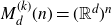 ${M_d^{(k)}(n)}=(\mathbb{R}^d)^n$
for
${M_d^{(k)}(n)}=(\mathbb{R}^d)^n$
for $k \gt n$
, while
$k \gt n$
, while $M^{(n)}_d(n)$
has the homotopy type of the
$M^{(n)}_d(n)$
has the homotopy type of the $(dn-d-1)$
-dimensional sphere. Hence, in this paper, we focus on the more interesting cases with
$(dn-d-1)$
-dimensional sphere. Hence, in this paper, we focus on the more interesting cases with $k \lt n$
. We will also assume implicitly that
$k \lt n$
. We will also assume implicitly that $d\geq2$
, so to stay away from the non-simply connected —but aspherical— spaces
$d\geq2$
, so to stay away from the non-simply connected —but aspherical— spaces $M^{(3)}_1(n)$
, and that
$M^{(3)}_1(n)$
, and that $k\geq3$
, so to stay away from the classical configuration spaces Conf
$k\geq3$
, so to stay away from the classical configuration spaces Conf $(\mathbb{R}^d,n)$
.
$(\mathbb{R}^d,n)$
.
In [
Reference Miller18
], Miller obtained partial results on the structure of Massey products in the “complex” case, i.e., for non-k-equal manifolds ${M_d^{(k)}(n)}$
with
${M_d^{(k)}(n)}$
with $d=2$
. Miller showed that all p-order Massey products on
$d=2$
. Miller showed that all p-order Massey products on $M^{(k)}_2(n)$
vanish provided either one of the following conditions holds:
$M^{(k)}_2(n)$
vanish provided either one of the following conditions holds:
 \begin{align}3&\leq p \lt k\qquad \mbox{ (in view of [18, theorem 1${\cdot}$2]).} \end{align}
 \begin{align} n&\leq k(k-1)\quad \mbox{(in view of [18, corollary 1${\cdot}$3]).} \end{align}
Both of these restrictions are sharp as neither the upper bound for p in (1·1) nor the upper bound for n in (1·2) can be improved for general k. Indeed, Miller proved in addition that
 \begin{equation}M^{(3)}_2(n)\ \mbox{admits non-trivial triple Massey products when}\ n \gt 6.\end{equation}
This paper is motivated by the fact that the statement in (1·3) turns out to be sharp also in rational-formality terms. In short: $M^{(3)}_2(n)$
cannot admit non-trivial triple Massey products for
$M^{(3)}_2(n)$
cannot admit non-trivial triple Massey products for $n\leq6$
as, in fact, such a space is rationally formal, as recorded in (1·6) below. Indeed, start by recalling that any c-connected CW complex X with
$n\leq6$
as, in fact, such a space is rationally formal, as recorded in (1·6) below. Indeed, start by recalling that any c-connected CW complex X with $c\geq1$
and
$c\geq1$
and
 \begin{equation}\dim\!(X)\leq 3c+1\end{equation}
is rationally formal (see [
Reference Halperin and Stasheff10
, corollary 5·16]). Then, as observed in the proof of [
Reference González and León–Medina8
, theorem 3·3], for $d\geq2$
and
$d\geq2$
and $k\geq3$
, the connectivity condition above holds for
$k\geq3$
, the connectivity condition above holds for ${M_d^{(k)}(n)}$
with
${M_d^{(k)}(n)}$
with $c=d(k-1)-2$
, while (1·4) can be spelled out as
$c=d(k-1)-2$
, while (1·4) can be spelled out as
 \begin{equation}{n(d-1)+m(k-2)\leq 3dk-2(d+3).}\end{equation}
Here and below m stands for the integral part of $n/k$
. Note that when
$n/k$
. Note that when $k=3$
, condition (5) holds if and only if
$k=3$
, condition (5) holds if and only if $n\leq6$
(recall
$n\leq6$
(recall $d\geq2$
). The point then is that
$d\geq2$
). The point then is that
 \begin{equation}M^{(3)}_d(n)\ \mbox{is rationally formal for}\ n\leq6.\end{equation}
However, $M^{(3)}_d(n)$
is not rationally formal for
$M^{(3)}_d(n)$
is not rationally formal for $n \gt 6$
, at least when
$n \gt 6$
, at least when $d=2$
, in view (1·3). The goal of this paper is to show that the restriction
$d=2$
, in view (1·3). The goal of this paper is to show that the restriction $d=2$
in the latter assertion is, in fact, unnecessary:
$d=2$
in the latter assertion is, in fact, unnecessary:
Theorem 1·1. For $d\geq2$
, the non-3-equal manifold
$d\geq2$
, the non-3-equal manifold $M^{(3)}_d(n)$
is rationally formal if and only if
$M^{(3)}_d(n)$
is rationally formal if and only if $n\leq6$
.
$n\leq6$
.
Theorem 1·1 stands in contrast with the known factFootnote
1
that all classical configuration spaces $M^{(2)}_d(n)=\text{Conf}(\mathbb{R}^d,n)$
are rationally formal, just as are all complements of arrangements of arbitrary complex linear subspaces with geometric lattice of intersections.
$M^{(2)}_d(n)=\text{Conf}(\mathbb{R}^d,n)$
are rationally formal, just as are all complements of arrangements of arbitrary complex linear subspaces with geometric lattice of intersections.
In view of (6), Theorem 1·1 will be proved once we show the rational non-formality of $M^{(3)}_d(n)$
for
$M^{(3)}_d(n)$
for $n \gt 6$
. Such a task will be achieved through the identification of non-trivial triple Massey products in
$n \gt 6$
. Such a task will be achieved through the identification of non-trivial triple Massey products in $M^{(3)}_d(n)$
(Theorem 4·6 and Corollary 4·7 at the end of the paper).
$M^{(3)}_d(n)$
(Theorem 4·6 and Corollary 4·7 at the end of the paper).
Miller’s paper ends by conjecturing that
 \begin{equation}M^{(k)}_{{d}(n)} \textit{ has non-trivial Massey products for } n \gt k(k-1) \textit{ and } d=2.\end{equation}
Presumably, the non-trivial Massey products conjectured by Miller would be of order precisely k. In view of the results in this paper, it is tempting to think that our techniques could actually lead to a proof of (1·7), even without the restriction on d.
Miller’s computations of cup products and Massey products on the complex manifolds $M^{(k)}_2(n)$
are based on Yuzvinsky’s DGA structure on the relative atomic complex for
$M^{(k)}_2(n)$
are based on Yuzvinsky’s DGA structure on the relative atomic complex for $M^{(k)}_d(n)$
introduced by Vassiliev [
Reference Vassiliev23
,
Reference Yuzvinsky24
]. With such an approach, much effort is required to show cohomological non-triviality of a given cocycle. As a consequence, the extent of results in [
Reference Miller18
] get somehow limited. We have circumvented the problem by following a more direct route. Namely, as originally noted in [
Reference Massey16
], in many cases Poincaré duality and intersection theory (using Borel-Moore homology in our non-compact case) can be used to evaluate Massey products. Actually, Dobrinskaya and Turchin use Poincaré duality in [
Reference Dobrinskaya and Turchin5
] to give a fully workable description of the cohomology ring of
$M^{(k)}_d(n)$
introduced by Vassiliev [
Reference Vassiliev23
,
Reference Yuzvinsky24
]. With such an approach, much effort is required to show cohomological non-triviality of a given cocycle. As a consequence, the extent of results in [
Reference Miller18
] get somehow limited. We have circumvented the problem by following a more direct route. Namely, as originally noted in [
Reference Massey16
], in many cases Poincaré duality and intersection theory (using Borel-Moore homology in our non-compact case) can be used to evaluate Massey products. Actually, Dobrinskaya and Turchin use Poincaré duality in [
Reference Dobrinskaya and Turchin5
] to give a fully workable description of the cohomology ring of ${M_d^{(k)}(n)}$
. Here, we build on their approach in order to get an effective assessment of Massey products. We have not touched the classification by rational formality of manifolds
${M_d^{(k)}(n)}$
. Here, we build on their approach in order to get an effective assessment of Massey products. We have not touched the classification by rational formality of manifolds ${M_d^{(k)}(n)}$
with
${M_d^{(k)}(n)}$
with $k \gt 3$
, as such a problem is far more involved, possibly not within reach with current technology. Indeed, assuming
$k \gt 3$
, as such a problem is far more involved, possibly not within reach with current technology. Indeed, assuming $k \gt 3$
, we see that condition (1·2) is strictly less restrictive than the case
$k \gt 3$
, we see that condition (1·2) is strictly less restrictive than the case $d=2$
of (1·5). So, even for
$d=2$
of (1·5). So, even for $d=2$
, there are manifolds
$d=2$
, there are manifolds $M^{(k)}_{{d}}(n)$
which, despite not supporting non-trivial Massey products of any order, are not known to be rationally formal through a simple application of (1·5) (or through any other method known to the authors). Even worse, the gap would not improve much even if (1·4) —and therefore (1·5)— could be improved by a condition of the sort
$M^{(k)}_{{d}}(n)$
which, despite not supporting non-trivial Massey products of any order, are not known to be rationally formal through a simple application of (1·5) (or through any other method known to the authors). Even worse, the gap would not improve much even if (1·4) —and therefore (1·5)— could be improved by a condition of the sort $\dim(X)\leq 4c+\varepsilon$
, i.e., a potential analogue (for non-compact manifolds!) of the results in [
Reference Cavalcanti4
,
Reference Miller19
].
$\dim(X)\leq 4c+\varepsilon$
, i.e., a potential analogue (for non-compact manifolds!) of the results in [
Reference Cavalcanti4
,
Reference Miller19
].
As noted above, the hypotheses $d\geq2$
and
$d\geq2$
and $n \gt k\geq3$
will be in force throughout the paper.
$n \gt k\geq3$
will be in force throughout the paper.
2. The cohomology of ${M_d^{(k)}(n)}$
: additive structure
${M_d^{(k)}(n)}$
: additive structure

In this section we recall the geometric-combinatorial description of the additive structure of the cohomology of ${M_d^{(k)}(n)}$
, as given in [
Reference Dobrinskaya and Turchin5
]. We also shed additional light on some points in Dobrinskaya-Turchin’s constructions. All homology and cohomology groups will be taken with either integer (
${M_d^{(k)}(n)}$
, as given in [
Reference Dobrinskaya and Turchin5
]. We also shed additional light on some points in Dobrinskaya-Turchin’s constructions. All homology and cohomology groups will be taken with either integer ( $\mathbb{Z}$
) or mod-2 (
$\mathbb{Z}$
) or mod-2 ( $\mathbb{Z}_2$
) coefficients. Assertions made without specifying coefficients are meant to hold for both options. While
$\mathbb{Z}_2$
) coefficients. Assertions made without specifying coefficients are meant to hold for both options. While $\mathbb{Z}$
coefficients are needed to set descriptions correctly, Massey product computations in Section 4 will use exclusively mod 2 coefficients for the sake of simplicity, so orientations and sign specifications below can and will safely be ignored.
$\mathbb{Z}$
coefficients are needed to set descriptions correctly, Massey product computations in Section 4 will use exclusively mod 2 coefficients for the sake of simplicity, so orientations and sign specifications below can and will safely be ignored.
Definition 2·1.
-
(a) A k-forest on
${\mathbf{n}}$
(or simply a k-forest) is an acyclic simple graph which is
${\mathbf{n}}$
-bipartitioned in the sense that it has two types of vertices, square ones and round ones, each containing a certain subset of
${\mathbf{n}}$
, and in such a way that the subsets of integers inside the various vertices partition
${\mathbf{n}}$
. A square vertex must contain
$k-1$
elements of
${\mathbf{n}}$
, and cannot be an isolated vertex. In fact, the set of immediate neighbours of a square vertex must contain a round vertex. A round vertex must contain a single element of
${\mathbf{n}}$
, and must be either an isolated vertex or have valency 1, in which case it must be connected to a square vertex. Square vertices are declared to have degree
$d(k-2)$
, while edges are declared to have degree
$d-1$
. The degree
$\deg(T)$
of a k-forest T is then defined as the sum of the degrees of the square vertices and edges of T. -
(b) An orientation for a k-forest consists of three ingredients:
-
(b·1) An orientation for each edge;
-
(b·2) A total ordering for the elements inside each square vertex;
-
(b·3) A total ordering for the orientation set, i.e., the set consisting of all edges and all square vertices.
-


Theorem 2·2 ([
Reference Dobrinskaya and Turchin5
, theorem 6·1]). Let $R\in\{\mathbb{Z},\mathbb{Z}_2\}$
. As a graded R-module,
$R\in\{\mathbb{Z},\mathbb{Z}_2\}$
. As a graded R-module, $H^*({M_d^{(k)}(n)})$
is free and generated by oriented k-forests on
$H^*({M_d^{(k)}(n)})$
is free and generated by oriented k-forests on ${\mathbf{n}}$
subject to the relations listed below.
${\mathbf{n}}$
subject to the relations listed below.
-
(1) Orientation relations:
-
(i) Permuting the order of the orientation set introduces a Koszul sign induced by the permutation (with respect to the degrees of the elements of the orientation set).
-
(ii) A permutation
$\sigma \in \Sigma_{k-1}$
of the elements inside a square vertex introduces the sign
$\epsilon(\sigma)^{d}$
, where
$\epsilon(\sigma)$
stands for the sign of
$\sigma$
. -
(iii) reversing the orientation of an edge introduces the sign
$(-1)^d$
.
-
-
(2) Three-term relations:
The three pictures are local in the sense that we have three oriented k-forests that are identical except for the disposition and ordering of the two oriented edges connecting vertices A, B and C. The relative orderings of each such pair of oriented edges in the corresponding orientation sets are indicated by the attached numbers.
-
(3) Generalised Jacobi relations:
The
$\omega$
pictures are again local. Moreover, in each of the global pictures, the square vertex cannot be connected to other (non-shown) round vertices.



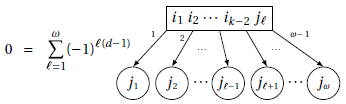

In pictures like the one above, we agree that elements inside a square vertex are written increasingly, from left to right, following ingredient (b·2) of the intended orientation. Note that, in the orientation set, the transposition of a square vertex and an oriented edge produces a positive Koszul sign since $d(k-2)(d-1)$
is even. Thus, the ordering in the orientation set is really a pair of orderings, one for square vertices and another for oriented edges.
$d(k-2)(d-1)$
is even. Thus, the ordering in the orientation set is really a pair of orderings, one for square vertices and another for oriented edges.
Orientation and three-term relations can be used to express any oriented k-forest as a linear combination of oriented linear k-forests, that is, of oriented k-forests whose non-trivial components, i.e. those different from an isolated round vertex, are trees with square vertices lying along an embedded arc, as in Figure 2. Similarly, orientation and generalised Jacobi relations can be used to express any oriented k-forest as a linear combination of oriented ordered k-forests, i.e., those satisfying that the largest of the integers inside round vertices attached to a given square vertex A is larger than any of the integers inside A. The two rewriting processes can then be coordinated so to yield basis elements:
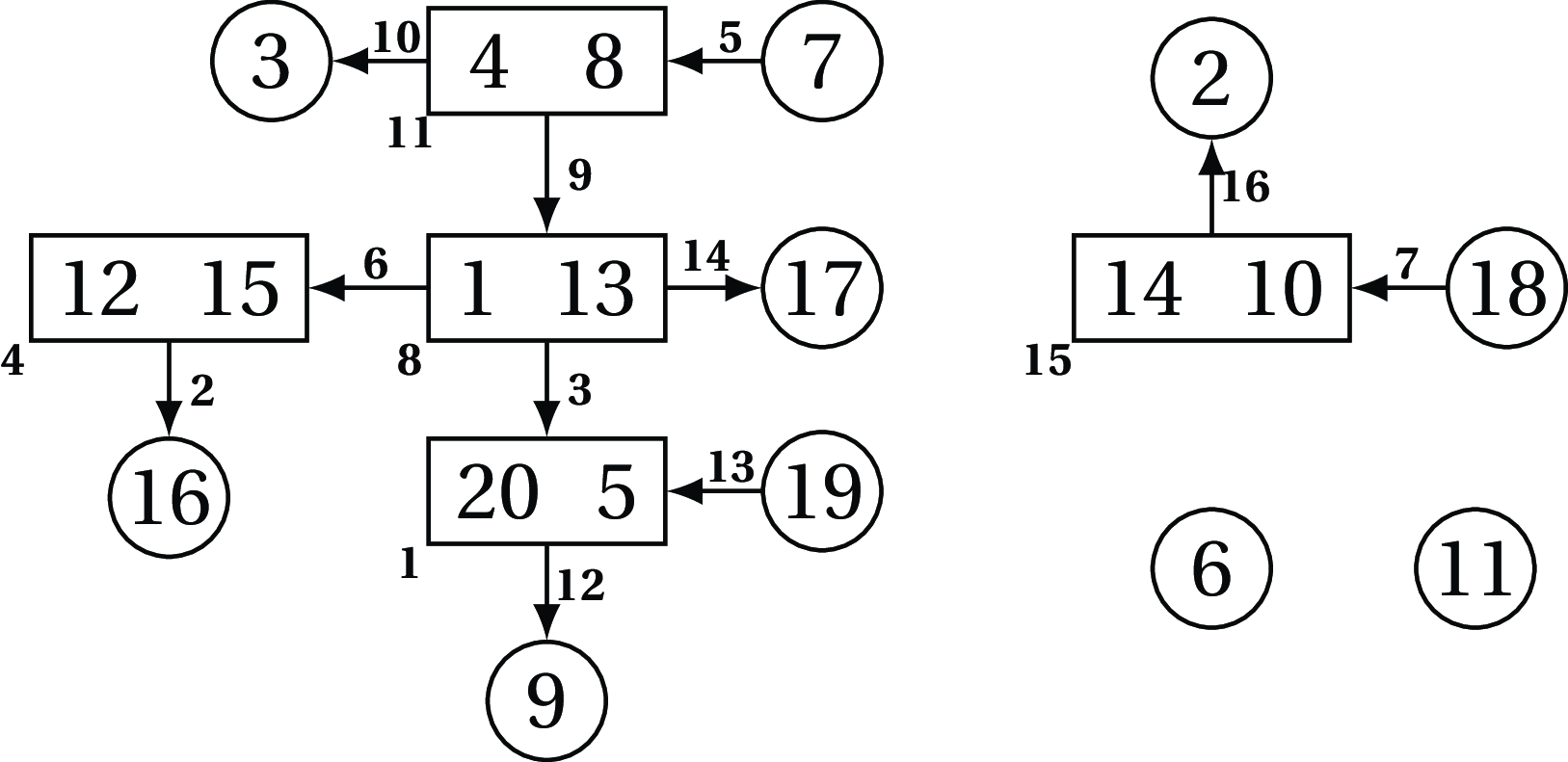
A 3-forest on $\text{ 20}=\{1,2,\ldots,20\}$
with four connected components and its orientation ingredients. The small bold numbers determine the orientation set.
$\text{ 20}=\{1,2,\ldots,20\}$
with four connected components and its orientation ingredients. The small bold numbers determine the orientation set.

A non-trivial component of a linear k-forest.

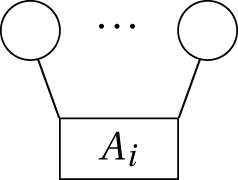
Definition 2·3. An oriented ordered linear k-forest is called basic provided its non-trivial components satisfy the following conditions, where notation is as in Figure 2:
-
(i) edge orientations are as indicated in Figure 2;
-
(ii) according to their orientation order:
$A_1 \lt A_2 \lt \cdots \lt A_s$
; -
(iii) for a portion of the form
the elements inside the square vertex appear in their natural order. Likewise, the ordering (in the orientation set) of the edges attaching round vertices to the square vertex agrees with the natural order of the integers inside the round vertices. Furthermore, if
$i \gt 1$
, then the edge from
$A_{i-1}$
to
$A_i$
is smaller than all edges connecting
$A_i$
to round vertices. Likewise, if
$i \lt s$
, then the edge from
$A_i$
to
$A_{i+1}$
is larger than all edges connecting
$A_i$
to round vertices; -
(iv) the minimal
$m\in{\mathbf{n}}$
inside the vertices of the linear tree component C in Figure 2 appears either inside
$A_1$
or inside a round vertex attached to
$A_1$
. Furthermore, if
$m^\prime$
is the corresponding minimal element in another linear tree component
$C^\prime$
of the k-forest, and
$m \lt m'$
, then orientation elements associated to C are smaller than orientation elements associated to
$C^\prime$
.



Theorem 2·2 (Continued). Basic k-forests yield a graded basis for the cohomology of ${M_d^{(k)}(n)}$
.
${M_d^{(k)}(n)}$
.
Theorem 2·2 is proved in [
Reference Dobrinskaya and Turchin5
] in two stages. First, a set of cohomology classes parametrised by oriented k-forests is constructed as Borel-Moore Poincaré duals of fundamental classes of suitably chosen oriented submanifolds of ${M_d^{(k)}(n)}$
. See the revision below. It is then checked that the cohomology classes resulting from basic k-forests give the identity matrix when paired with an explicit basis for the homology of
${M_d^{(k)}(n)}$
. See the revision below. It is then checked that the cohomology classes resulting from basic k-forests give the identity matrix when paired with an explicit basis for the homology of ${M_d^{(k)}(n)}$
. For the purposes of this work, the rest of the section is devoted to recalling and illustrating the connection between oriented k-forests and their corresponding Poincaré-dual fundamental classes in the Borel-Moore homology of
${M_d^{(k)}(n)}$
. For the purposes of this work, the rest of the section is devoted to recalling and illustrating the connection between oriented k-forests and their corresponding Poincaré-dual fundamental classes in the Borel-Moore homology of ${M_d^{(k)}(n)}$
.
${M_d^{(k)}(n)}$
.
Consider the projection $p_1:\mathbb{R}^d \to \mathbb{R}^{d-1}$
onto the last
$p_1:\mathbb{R}^d \to \mathbb{R}^{d-1}$
onto the last $d-1$
coordinates, i.e.,
$d-1$
coordinates, i.e., $p_1(x)=(x^{(2)},\ldots,x^{(d)})$
, for
$p_1(x)=(x^{(2)},\ldots,x^{(d)})$
, for $x=(x^{(1)},x^{(2)},\ldots,x^{(d)})$
. An oriented k-forest T determines a convex domain
$x=(x^{(1)},x^{(2)},\ldots,x^{(d)})$
. An oriented k-forest T determines a convex domain $c_T$
of a vector subspace
$c_T$
of a vector subspace $C_T$
of
$C_T$
of $(\mathbb{R}^d)^n$
. Explicitly,
$(\mathbb{R}^d)^n$
. Explicitly, $C_T$
consists of all tuples
$C_T$
consists of all tuples $(x_1,\ldots,x_n)\in(\mathbb{R}^d)^n$
satisfying:
$(x_1,\ldots,x_n)\in(\mathbb{R}^d)^n$
satisfying:
-
(i) if i and j in
$\mathbf{n}$
lie in the same square vertex, then
$x_i=x_j$
; -
(ii) if two vertices A and B of T are connected by an edge oriented from A to B, then for all
$i\in A$
,
$j\in B$
, one has
$p_1(x_i) = p_1(x_j)$
.



Note that, if i and j lie in the same connected component of T, then the condition $p_1(x_i)=p_1(x_j)$
holds true for the points
$p_1(x_i)=p_1(x_j)$
holds true for the points $(x_1,\ldots,x_n)$
in
$(x_1,\ldots,x_n)$
in $C_T$
. The domain
$C_T$
. The domain $c_T$
, also referred to as a linear cell, is defined by the equalities above together with the inequalities
$c_T$
, also referred to as a linear cell, is defined by the equalities above together with the inequalities
 \begin{equation}x_i^{(1)} \leq x_j^{(1)}\end{equation}
in the case of (ii). Note that the degree of T, $\deg(T)$
, in Definition 2·1 is the codimension of both
$\deg(T)$
, in Definition 2·1 is the codimension of both $C_T$
and
$C_T$
and $c_T$
in
$c_T$
in $(\mathbb{R}^d)^n$
.
$(\mathbb{R}^d)^n$
.
Recall from the introduction that ${A_d^{(k)}(n)}$
is the subset of
${A_d^{(k)}(n)}$
is the subset of $(\mathbb{R}^d)^n$
given by union of diagonals
$(\mathbb{R}^d)^n$
given by union of diagonals $x_{i_1} = \cdots = x_{i_k}$
over all k-element subsets of
$x_{i_1} = \cdots = x_{i_k}$
over all k-element subsets of $\{1,\ldots,n\}$
. The locally compact linear cell
$\{1,\ldots,n\}$
. The locally compact linear cell $c_T$
has boundary contained in
$c_T$
has boundary contained in ${A_d^{(k)}(n)}$
and, thus, represents the Borel-Moore fundamental class in
${A_d^{(k)}(n)}$
and, thus, represents the Borel-Moore fundamental class in
 $${H}_{dn-\deg(T)}^{\text{BM}}\big({M_d^{(k)}(n)}\big)$$
of the submanifold $\text{Int}(c_T)$
of
$\text{Int}(c_T)$
of ${M_d^{(k)}(n)}$
given by the interior of
${M_d^{(k)}(n)}$
given by the interior of $c_T$
. We say that the submanifold
$c_T$
. We say that the submanifold $\text{Int}(c_T)$
is encoded by T.
$\text{Int}(c_T)$
is encoded by T.
The orientation ingredients of T determine (as illustrated below) a co-orientation of $C_T$
in
$C_T$
in $(\mathbb{R}^d)^n$
and, thus, of
$(\mathbb{R}^d)^n$
and, thus, of $\text{Int}(c_T)$
in
$\text{Int}(c_T)$
in ${M_d^{(k)}(n)}$
. We thus get a
${M_d^{(k)}(n)}$
. We thus get a $\deg(T)$
-dimensional cohomology class in
$\deg(T)$
-dimensional cohomology class in ${M_d^{(k)}(n)}$
which is Poincaré dual to the Borel-Moore fundamental class of
${M_d^{(k)}(n)}$
which is Poincaré dual to the Borel-Moore fundamental class of $\text{Int}(c_T)$
in
$\text{Int}(c_T)$
in ${M_d^{(k)}(n)}$
. As suggested by Theorem 2·2, the resulting cohomology class is denoted by T. Note that, while oriented k-forests can be considered as elements in the cohomology of
${M_d^{(k)}(n)}$
. As suggested by Theorem 2·2, the resulting cohomology class is denoted by T. Note that, while oriented k-forests can be considered as elements in the cohomology of ${M_d^{(k)}(n)}$
, two distinct forests might represent the same class, see for instance Remark 4·2. Of course, such a faithfulness problem does not hold in the case of basic k-forests.
${M_d^{(k)}(n)}$
, two distinct forests might represent the same class, see for instance Remark 4·2. Of course, such a faithfulness problem does not hold in the case of basic k-forests.
For example, the basic 4-forest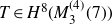 $T\in H^8(M_{3}^{(4)}(7))$
given by
$T\in H^8(M_{3}^{(4)}(7))$
given by
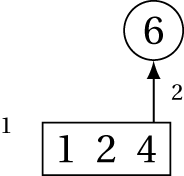
corresponds to the linear cell $c_T$
consisting of all tuples
$c_T$
consisting of all tuples $(x_1,\ldots,x_7)\in(\mathbb{R}^3)^7$
such that
$(x_1,\ldots,x_7)\in(\mathbb{R}^3)^7$
such that $x_1 = x_2 = x_4$
,
$x_1 = x_2 = x_4$
, $p_1(x_1)=p_1(x_6)$
and
$p_1(x_1)=p_1(x_6)$
and $x_1^{(1)} \leq x_6^{(1)}$
. The co-orientation of
$x_1^{(1)} \leq x_6^{(1)}$
. The co-orientation of $C_T$
, i.e., the orientation of the normal bundle of
$C_T$
, i.e., the orientation of the normal bundle of ${C_T}\hookrightarrow(\mathbb{R}^3)^7$
, is induced through the surjection
${C_T}\hookrightarrow(\mathbb{R}^3)^7$
, is induced through the surjection $\pi_T\colon(\mathbb{R}^3)^7\to\mathbb{R}^{\deg(T)}=(\mathbb{R}^3)^2\times\mathbb{R}^2$
with components
$\pi_T\colon(\mathbb{R}^3)^7\to\mathbb{R}^{\deg(T)}=(\mathbb{R}^3)^2\times\mathbb{R}^2$
with components $\pi_{\mbox{}}\colon(\mathbb{R}^3)^7\to(\mathbb{R}^3)^2$
and
$\pi_{\mbox{}}\colon(\mathbb{R}^3)^7\to(\mathbb{R}^3)^2$
and $\pi_{\mbox{}}\colon(\mathbb{R}^3)^7\to\mathbb{R}^2$
given by
$\pi_{\mbox{}}\colon(\mathbb{R}^3)^7\to\mathbb{R}^2$
given by

Note that $C_T$
is the kernel of
$C_T$
is the kernel of $\pi_T$
and, hence, the tangent space of
$\pi_T$
and, hence, the tangent space of $c_T$
. Moreover, following the orientation of T, the first and second components of
$c_T$
. Moreover, following the orientation of T, the first and second components of $\pi_T$
account, respectively, for the square vertex and the edge in T.
$\pi_T$
account, respectively, for the square vertex and the edge in T.
In such a setting, sums of (co)homology classes correspond to unions of representing linear cells, while signs arise from a consistent management of orientations. For example, consider the three-term relation

which, under the sign conventions can be written as

The point is that the term on the left-hand side encodes the linear cell given as the union of the two linear cells encoded by the summands on the right-hand side. To illustrate the phenomenon, consider the sum
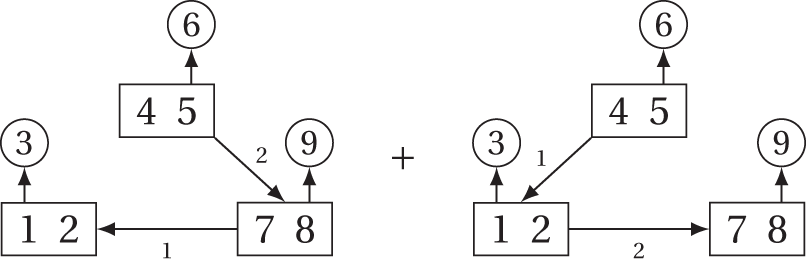
which encodes the linear submanifold of $M_d^{(3)}(9)$
corresponding to the interior of the union of the co-oriented linear cells
$M_d^{(3)}(9)$
corresponding to the interior of the union of the co-oriented linear cells $c_1$
and
$c_1$
and $c_2$
with common defining inequalities
$c_2$
with common defining inequalities
 \begin{equation}x_1^{(1)}=x_2^{(1)} \leq x_3^{(1)}, \;\;\;x_4^{(1)}=x_5^{(1)} \leq x_6^{(1)}\;\;\;\mbox{and}\;\;\; x_7^{(1)}=x_8^{(1)} \leq x_9^{(1)},\end{equation}
together with the requirement that all $x_i$
-coordinates have the same projection under
$x_i$
-coordinates have the same projection under $p_1$
. The additional defining inequalities in
$p_1$
. The additional defining inequalities in $c_1$
are
$c_1$
are
 \begin{equation}\underbrace{x_4^{(1)} \leq x_7^{(1)}}_2 \mbox{ and } \underbrace{x_7^{(1)}\leq x_1^{(1)}}_{1},\end{equation}
while the additional defining inequalities in $c_2$
are
$c_2$
are
 \begin{equation}\underbrace{x_4^{(1)} \leq x_1^{(1)}}_{1} \mbox{ and } \underbrace{x_1^{(1)}\leq x_7^{(1)}}_{2}.\end{equation}
The union of conditions (2·3) and (2·4) can then be stated as
 $$\underbrace{x_4^{(1)}\leq x_1^{(1)}}_{1} \mbox{ and } \underbrace{x_4^{(1)}\leq x_7^{(1)}}_2$$
which, together with (2·2), is encoded by
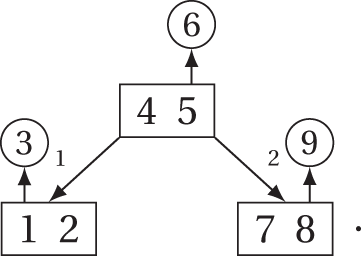
Remark 2·4. As detailed in [
Reference Dobrinskaya and Turchin5
, remark 6·2 and proof of theorem 6·1], the generalised Jacobi relation in Theorem 2·2 arises as the Borel-Moore boundary of a linear cell described by a forest-like graph one of whose square vertices has $k-2$
(rather than
$k-2$
(rather than $k-1$
) elements. Now, by definition, the generalised Jacobi relation makes sense only for
$k-1$
) elements. Now, by definition, the generalised Jacobi relation makes sense only for ${\omega} \gt 1$
. Yet, as observed by Dobrinskaya and Turchin, it is possible to consider oriented k-forests T with square vertices admitting no neighbouring round vertices. For them, the corresponding linear cells
${\omega} \gt 1$
. Yet, as observed by Dobrinskaya and Turchin, it is possible to consider oriented k-forests T with square vertices admitting no neighbouring round vertices. For them, the corresponding linear cells $c_T$
are then Borel-Moore boundaries, thus validating the generalised Jacobi relation for
$c_T$
are then Borel-Moore boundaries, thus validating the generalised Jacobi relation for $\omega=1$
.
$\omega=1$
.
3. The cohomology of
${M_d^{(k)}(n)}$
: products

The cup product $T{{}\smile{}}T'$
of oriented k-forests T and T’ is assessed geometrically in [
Reference Dobrinskaya and Turchin5
] as the Poincaré dual of the fundamental class of the intersection
$T{{}\smile{}}T'$
of oriented k-forests T and T’ is assessed geometrically in [
Reference Dobrinskaya and Turchin5
] as the Poincaré dual of the fundamental class of the intersection $c_T\cap c_{T'}$
. We start by setting notation and basic ingredients, which can be found in standard references such as [
Reference Bredon3
, Section V.11], [
Reference Iversen12
, sections II.9, IX.3, IX.4 and IX.5], [
Reference Fulton7
, section 19.1] and [
Reference Spanier21
, theorem 10·4].
$c_T\cap c_{T'}$
. We start by setting notation and basic ingredients, which can be found in standard references such as [
Reference Bredon3
, Section V.11], [
Reference Iversen12
, sections II.9, IX.3, IX.4 and IX.5], [
Reference Fulton7
, section 19.1] and [
Reference Spanier21
, theorem 10·4].
For a locally compact space Z, there is a (sheaf theoretic supported) cap product $\frown\colon H^{\text{BM}}_a(Z)\otimes H^b(Z)\to H^{\text{BM}}_{a-b}(Z)$
. This has several properties, including:
$\frown\colon H^{\text{BM}}_a(Z)\otimes H^b(Z)\to H^{\text{BM}}_{a-b}(Z)$
. This has several properties, including:
-
(1)
$f_*(a'\frown f^*\xi)=f_*a'\frown\xi$
, for any proper map
$f\colon Z'\to Z$
and arbitrary classes
$a'\in H^{\text{BM}}_*(Z')$
and
$\xi\in H^*(Z)$
; -
(2)
$(a\frown\xi)\frown\eta=a\frown(\xi\smile\eta)$
, for arbitrary classes
$\xi,\eta\in H^*(Z)$
and
$a\in H^{\text{BM}}_*(Z)$
; -
(3) for an oriented n-dimensional (Hausdorff paracompact) manifold N, cap product with the fundamental class
$[N]\in H^{\text{BM}}_n(N)$
yields a duality isomorphism
$$D\colon H^*(N)\to H_{n-*}^{\text{BM}}(N);$$
-
(4) for an oriented properly embedded submanifold
$V\subset N$
of codimension c, the orientation class
$\mathfrak{o}^N_V\in H^{{c}}(N)$
of V in N, i.e., the restriction of the (normal) Thom class
$\mathfrak{u}^N_V\in H^{{c}}(N,N-V)$
of V in N, yields
$D(\mathfrak{o}^N_V)=[V]_N{{}\in H^{\text{BM}}_{n-c}(N),}$
the image of [V] under the inclusion
$V\hookrightarrow N$
.









This information suffices to prove, just as in [ Reference Bredon2 , theorem∼VI·11·9], that cup products on a given oriented n-manifold N can be assessed, in geometrical terms, through the intersection pairing at the bottom of the commutative square

Theorem 3·1. Let the manifold N be as in item (3) above. If the oriented submanifolds X and Y are properly embedded in N and have transverse intersection, then
 \[[X]_N \bullet [Y]_N = [X\cap Y]_N.\]
The use of Theorem 3·1 in the case of non-k-equal manifolds leads to:
Definition 3·2. Two oriented k-forests $T_1$
,
$T_1$
,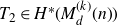 $T_2 \in H^\ast({M_d^{(k)}(n)})$
are said to be superposable when no square vertex of
$T_2 \in H^\ast({M_d^{(k)}(n)})$
are said to be superposable when no square vertex of $T_1$
intersects a square vertex of
$T_1$
intersects a square vertex of $T_2$
. In such a case we define the bent superposition
$T_2$
. In such a case we define the bent superposition $T_1\cup T_2$
as the oriented
$T_1\cup T_2$
as the oriented ${\mathbf{n}}$
-bipartitioned graph obtained by superposition of the oriented
${\mathbf{n}}$
-bipartitioned graph obtained by superposition of the oriented ${\mathbf{n}}$
-bipartitioned graphs underlying
${\mathbf{n}}$
-bipartitioned graphs underlying $T_1$
and
$T_1$
and $T_2$
. This means that square vertices, their contents, and oriented edges between such vertices in
$T_2$
. This means that square vertices, their contents, and oriented edges between such vertices in $T_1\cup T_2$
are those holding either on
$T_1\cup T_2$
are those holding either on $T_1$
or on
$T_1$
or on $T_2$
. Likewise, round vertices with content i, as well as oriented edges involving such vertices in
$T_2$
. Likewise, round vertices with content i, as well as oriented edges involving such vertices in $T_1\cup T_2$
are those holding either on
$T_1\cup T_2$
are those holding either on $T_1$
or on
$T_1$
or on $T_2$
, as long as i has not been accounted for by some square vertex. Instead, if some integer
$T_2$
, as long as i has not been accounted for by some square vertex. Instead, if some integer $i \in {\mathbf{n}}$
lies in a square vertex A in, say,
$i \in {\mathbf{n}}$
lies in a square vertex A in, say, $T_{1}$
as well as in a round vertex attached to some square vertex B through an oriented edge in, respectively,
$T_{1}$
as well as in a round vertex attached to some square vertex B through an oriented edge in, respectively, $T_{2}$
, then not only i appears in
$T_{2}$
, then not only i appears in $T_1\cup T_2$
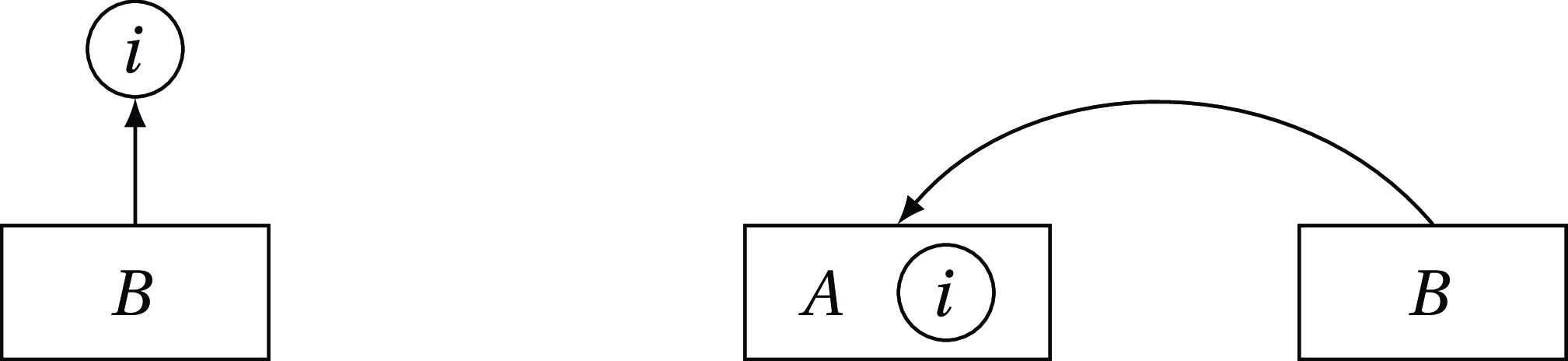
inside the corresponding square vertex A, but a corresponding oriented “bent” edge in
$T_1\cup T_2$
inside the corresponding square vertex A, but a corresponding oriented “bent” edge in $T_1\cup T_2$
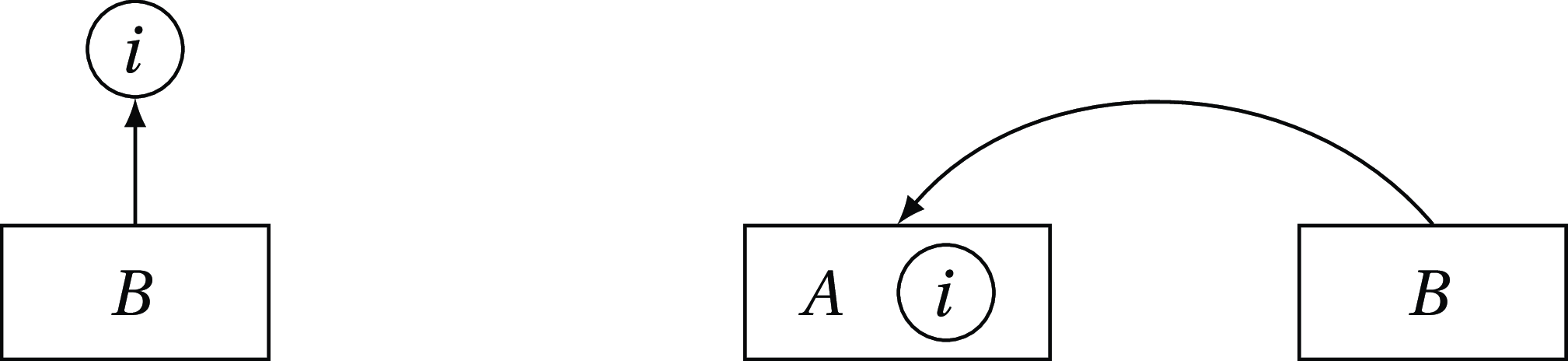
between A and B must be added. The left- and right-hand sides in Figure 3.1 sketch the relevant situations for
$T_1\cup T_2$
between A and B must be added. The left- and right-hand sides in Figure 3.1 sketch the relevant situations for $T_2$
and
$T_2$
and $T_1\cup T_2$
, respectively.
$T_1\cup T_2$
, respectively.
Bending an edge.
Note that $T_1\cup T_2$
might end up having multiple oriented edges between square vertices, as well as round vertices having two square vertices as immediate neighbouring vertices.
$T_1\cup T_2$
might end up having multiple oriented edges between square vertices, as well as round vertices having two square vertices as immediate neighbouring vertices.
Theorem 3·3 ([
Reference Dobrinskaya and Turchin5
, theorem 7·1]). The cup product $T_1\smile T_2$
of two oriented k-forests
$T_1\smile T_2$
of two oriented k-forests $T_1$
,
$T_1$
,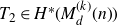 $T_2 \in H^\ast({M_d^{(k)}(n)})$
vanishes in either of the following three conditions:
$T_2 \in H^\ast({M_d^{(k)}(n)})$
vanishes in either of the following three conditions:
-
(A)
$T_1$
and
$T_2$
are not superposable; -
(B)
$T_1$
and
$T_2$
are superposable and
$T_1 \cup T_2$
has unoriented cycles (for instance if two square vertices of
$T_1 \cup T_2$
are joined by multiple edges); -
(C)
$T_1$
and
$T_2$
are superposable and
$T_1 \cup T_2$
has a square vertex with no round vertex attached.


In any other case the intersection $c_{T_1}\cap c_{T_2}$
is transverse and
$c_{T_1}\cap c_{T_2}$
is transverse and
 $$T_1 {{}\smile{}} T_2{{}={}}T_1\cup T_2$$
with orientation set given by the concatenation of the orientation sets of the factors, and with the convention that, if $T_1\cup T_2$
happens not to be a k-forest (in the sense of Definition 2·1), so that
$T_1\cup T_2$
happens not to be a k-forest (in the sense of Definition 2·1), so that $T_1 \cup T_2$
has one or several round vertices of valency 2, then we transform
$T_1 \cup T_2$
has one or several round vertices of valency 2, then we transform $T_1 \cup T_2$
into a sum of oriented k-forests through repeated use of orientation relations and the following form of the three-term relation:
$T_1 \cup T_2$
into a sum of oriented k-forests through repeated use of orientation relations and the following form of the three-term relation:

As above, pictures are local.
Items (B) and (C) in Theorem 3·3 might have to be used in the iterative process of applying relation (3·2) in order to write a non-k-forest $T_1\cup T_2$
as a sum of oriented k-forests. For instance, if the pictures in (3·2) are in fact global (omitting possible isolated round vertices), then each of the two summands on the right of (3·2) would vanish in view of item (C) in Theorem 3·3.
$T_1\cup T_2$
as a sum of oriented k-forests. For instance, if the pictures in (3·2) are in fact global (omitting possible isolated round vertices), then each of the two summands on the right of (3·2) would vanish in view of item (C) in Theorem 3·3.
Relevant for us is the fact that $H^\ast({M_d^{(k)}(n)})$
is multiplicatively generated by elementary k-forests, i.e., basic k-forests having a single square vertex. Explicitly, a basic k-forest is, up to sign, the product of its connected components. In turn, each such connected component is, up to sign, a product of elementary k-forests. For example, the basic 3-forest
$H^\ast({M_d^{(k)}(n)})$
is multiplicatively generated by elementary k-forests, i.e., basic k-forests having a single square vertex. Explicitly, a basic k-forest is, up to sign, the product of its connected components. In turn, each such connected component is, up to sign, a product of elementary k-forests. For example, the basic 3-forest
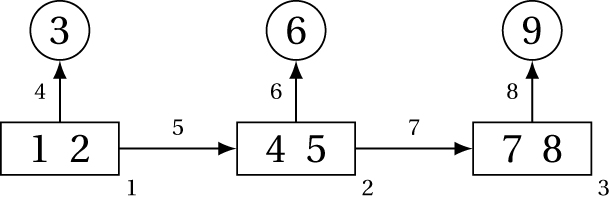
can be factorised as
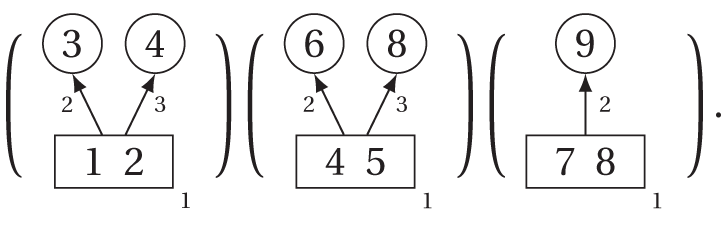
Note that factorizations are not unique.
The following additional piece of information regarding items (A)–(C) in Theorem 3·3 will be useful in the next section.
Lemma 3·4. Consider cohomology classes $u,v\in H^*({M_d^{(k)}(n)})$
represented, respectively, by elementary k-forests:
$u,v\in H^*({M_d^{(k)}(n)})$
represented, respectively, by elementary k-forests:
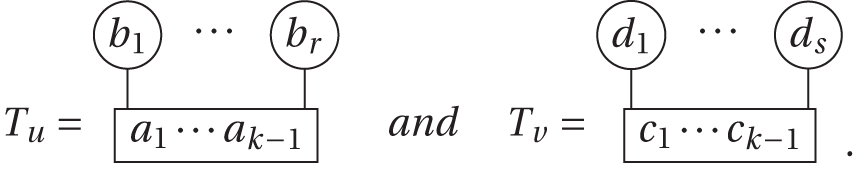
-
(a) If
$T_u$
and
$T_v$
are not superposable (so that
$u\smile v=0$
), then representing k-forests and linear cells can be chosen so that
$c_{T_u} \cap c_{T_v}$
is empty in
$M^{(k)}_d(n)$
. -
(b) Assume
$T_u$
and
$T_v$
are superposable, still with
$u\smile v=0$
, and set
$\omega\,:\!=\text{card}\,(\{a_1, \ldots,a_{k-1},b_1,\ldots, b_r \} \cap \{c_1,\ldots,c_{k-1},d_1,\ldots,d_s\})$
—so that
$\omega \gt 0$
. Then one of the following options must hold:-
(b.1)
$\,\,\,{\omega} \gt 1$
; -
(b.2)
$\,\,\,{\omega}={r}=1$
and
${b}_1\in {\{c_1,\ldots,c_{k-1}\}}$
; -
(b.3)
$\,\,\,{\omega}={s}=1$
and
${d}_1\in {\{a_1,\ldots,a_{k-1}\}}$
; -
(b.4)
$\,\,\,{\omega}=r=s=1$
and
$b_1=d_1$
.
-










Furthermore, the conclusion in (a) also holds true in case (b.1), whereas the intersection $c_U\cap c_V$
is a Borel-Moore boundary in cases (b.2)–(b.4).
$c_U\cap c_V$
is a Borel-Moore boundary in cases (b.2)–(b.4).
Proof. The fact that, under the hypotheses in (b), one of (b.1)–(b.4) must hold follows from Theorems 2·2 and 3·3, in view of the trivial-cup-product hypothesis. The assertion about $c_{T_u}\cap c_{T_v}$
in (b.2)–(b.4) comes from Remark 2·4. Lastly, the empty-intersection condition in the case of non-superposable factors, as well as for
$c_{T_u}\cap c_{T_v}$
in (b.2)–(b.4) comes from Remark 2·4. Lastly, the empty-intersection condition in the case of non-superposable factors, as well as for $\omega \gt 1$
with superposable factors, is contained in the proof of [
Reference Dobrinskaya and Turchin5
, theorem 7·1]. As indicated by Dobrinskaya and Truchin, this might require a small adjustment of representing elementary k-forests, at the cohomology level, or corresponding linear cells, at the homology level. Explicitly, in both cases, the codimension of
$\omega \gt 1$
with superposable factors, is contained in the proof of [
Reference Dobrinskaya and Turchin5
, theorem 7·1]. As indicated by Dobrinskaya and Truchin, this might require a small adjustment of representing elementary k-forests, at the cohomology level, or corresponding linear cells, at the homology level. Explicitly, in both cases, the codimension of $c_{T_u}\cap c_{T_v}$
is not the sum of the factor’s codimensions, showing that the intersection is not transverse. Hence, to assess the intersection product of
$c_{T_u}\cap c_{T_v}$
is not the sum of the factor’s codimensions, showing that the intersection is not transverse. Hence, to assess the intersection product of $c_{T_u}$
and
$c_{T_u}$
and $c_{T_v}$
we are free to slightly perturb one of the linear cells by a translation to obtain a new linear cell, let’s say
$c_{T_v}$
we are free to slightly perturb one of the linear cells by a translation to obtain a new linear cell, let’s say $c_{T_v}'$
, such that the intersection
$c_{T_v}'$
, such that the intersection $c_{T_u}\cap c_{T_v}'$
now is vacuously transverse —because the slight perturbation of the w equal variables will make the linear cells
$c_{T_u}\cap c_{T_v}'$
now is vacuously transverse —because the slight perturbation of the w equal variables will make the linear cells $c_{T_u}$
and
$c_{T_u}$
and $c_{T_v}'$
disjoint. This slight perturbation has no effect on the (co)homology classes involved.
$c_{T_v}'$
disjoint. This slight perturbation has no effect on the (co)homology classes involved.
4. Massey products and duality
For the rest of the paper we deal exclusively with non-3-equal manifolds $M^{(3)}_d(n)$
. Orientation issues will be neglected by working with mod-2 coefficients to simplify arguments. In particular, edges of a 3-forests T will no longer be oriented. Yet, we will keep the convention that linear cells
$M^{(3)}_d(n)$
. Orientation issues will be neglected by working with mod-2 coefficients to simplify arguments. In particular, edges of a 3-forests T will no longer be oriented. Yet, we will keep the convention that linear cells $c_T$
, and the corresponding submanifolds
$c_T$
, and the corresponding submanifolds $\text{Int}(c_T)$
of
$\text{Int}(c_T)$
of $M^{(3)}_d(n)$
encoded by T, are taken (in terms of (2·1)) as if edge orientations were the canonical ones in Figure 2, i.e., assuming that edges point right or upwards. See for instance (4·3) and (4·4) below.
$M^{(3)}_d(n)$
encoded by T, are taken (in terms of (2·1)) as if edge orientations were the canonical ones in Figure 2, i.e., assuming that edges point right or upwards. See for instance (4·3) and (4·4) below.
We assume familiarity with Massey’s triple products as originally defined in [
Reference Massey15
,
Reference Uehara and Massey22
]. We briefly review essential parts, mainly to set notation. Let X be a topological space, and let $u\in H^p(X)$
,
$u\in H^p(X)$
, $v\in H^q(X)$
and
$v\in H^q(X)$
and $w\in H^r(X)$
be cohomology classes (recall that we only care for mod 2 coefficients) with trivial cup products
$w\in H^r(X)$
be cohomology classes (recall that we only care for mod 2 coefficients) with trivial cup products
 \begin{equation}u\cdot v=0 \quad\text{and}\quad v\cdot w=0.\end{equation}
Then Massey’s triple product $\langle u, v, w\rangle$
is defined and is an element of the factor group
$\langle u, v, w\rangle$
is defined and is an element of the factor group
 $$H^{p+q+r-1}(X)/ \big( u\cdot H^{q+r-1}(X)+H^{p+q-1}(X)\cdot w \big).$$
When we say that a Massey triple product $\langle u,v,w\rangle$
is well defined, we simply mean that (4·1) holds. Additionally, we say that a well defined triple product is trivial when it vanishes, i.e., when it is represented by some (any) element of the indeterminacy
$\langle u,v,w\rangle$
is well defined, we simply mean that (4·1) holds. Additionally, we say that a well defined triple product is trivial when it vanishes, i.e., when it is represented by some (any) element of the indeterminacy
 $$u\cdot H^{q+r-1}(X)+H^{p+q-1}(X)\cdot w.$$
In his seminal work [
Reference Massey16
], Massey introduced a geometric method to assess these products when X is a manifold. The idea is to use Poincaré duality in order to replace cup products at the cochain level by intersections of dual submanifolds at the (locally compact) chain level. Variants of the technique have been used in knot theory to compute higher order linking numbers [
Reference Hain9
,
Reference Hsieh, Kauffman and Tsau11
,
Reference Porter20
]. Intersection theory has also been used to evaluate Massey products on classical configuration spaces [
Reference Longoni and Salvatore14
,
Reference Miller17
]. With mod-2 coefficients, the basic (folklore) observation is summarized in Remark 4·1 below, where we use the symbol $\pitchfork$
to indicate that an intersection of submanifolds is transverse.
$\pitchfork$
to indicate that an intersection of submanifolds is transverse.
Remark 4·1. Consider properly embedded submanifolds K, L and M of some manifold N, and let $\kappa$
,
$\kappa$
, $\lambda$
and
$\lambda$
and $\mu$
denote the Poincaré duals of the fundamental classes
$\mu$
denote the Poincaré duals of the fundamental classes $[K]_N,[L]_N,[M]_N\in H_*^{\text{BM}}(N)$
. Assume
$[K]_N,[L]_N,[M]_N\in H_*^{\text{BM}}(N)$
. Assume $K\pitchfork L=\partial X$
and
$K\pitchfork L=\partial X$
and $L\pitchfork M=\partial Y$
for submanifolds X and Y with
$L\pitchfork M=\partial Y$
for submanifolds X and Y with $X\pitchfork M$
and
$X\pitchfork M$
and $K\pitchfork Y$
. Then the triple Massey product
$K\pitchfork Y$
. Then the triple Massey product $\left\langle \kappa,\lambda,\mu\right\rangle$
is well defined and represented by the Poincaré dual of the fundamental class
$\left\langle \kappa,\lambda,\mu\right\rangle$
is well defined and represented by the Poincaré dual of the fundamental class $\big[{(}X\cap M{)} {{}\cup{}} {(}K\cap Y{)}\big]_N\,.$
In the computations below, $M^{(3)}_d(n)$
will play the role of N, while the submanifolds L, K and M will be encoded by suitably chosen 3-forests. On the other hand, the submanifolds X and Y will fail to correspond to honest 3-forests, but will be encoded through a similar terminology (cf. Remark 2·4). For example, the first forest-like graph in
$M^{(3)}_d(n)$
will play the role of N, while the submanifolds L, K and M will be encoded by suitably chosen 3-forests. On the other hand, the submanifolds X and Y will fail to correspond to honest 3-forests, but will be encoded through a similar terminology (cf. Remark 2·4). For example, the first forest-like graph in

encodes the $(4d-3)$
-codimensional linear submanifold of
$(4d-3)$
-codimensional linear submanifold of $M^{(3)}_d(n)$
determined by the conditions
$M^{(3)}_d(n)$
determined by the conditions
 \begin{align}&p_1(x_i)=p_1(x_j), \text{ for } i,j\in\{1,2,3,4,5\}, \nonumber\\&x_3=x_4, \\&x^{(1)}_1\leq x^{(1)}_2,\,\,x^{(1)}_1\leq x^{(1)}_3,\,\,x^{(1)} _3\leq x^{(1)}_5.\nonumber\end{align}
Likewise, the forest-like graph on the right hand-side of (4·2) encodes the $(4d-3)$
-codimensional linear submanifold of
$(4d-3)$
-codimensional linear submanifold of $M^{(3)}_d(n)$
determined by the conditions
$M^{(3)}_d(n)$
determined by the conditions
 \begin{align}&{p_1(x_i)=p_1(x_j), \text{ for } i,j\in\{3,4,5,6,7\},} \nonumber\\&{x_5=x_6,} \\&{x^{(1)}_3\leq x^{(1)}_4,\,\,x^{(1)}_3\leq x^{(1)}_5,\,\,x^{(1)} _5\leq x^{(1)}_7.}\nonumber\end{align}
Remark 4·2. As cohomology classes, the 3-forests
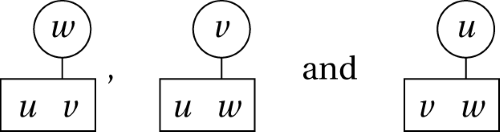
agree, in view of Theorem 2·2(3). The common cohomology class will simply be denoted by
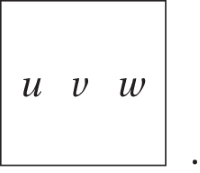
Part of the subtleties in the search of non-trivial Massey products in the first meaningful case outside the range in (1·1) comes from:
Proposition 4·3. Every well-defined triple Massey product of elementary basis elements in $H^*(M^{(3)}_d(n))$
is trivial.
$H^*(M^{(3)}_d(n))$
is trivial.
Proof. Consider a well defined triple Massey product $\langle \kappa, \lambda, \mu\rangle$
of classes represented by elementary 3-forests
$\langle \kappa, \lambda, \mu\rangle$
of classes represented by elementary 3-forests $\kappa$
,
$\kappa$
, $\lambda$
, and
$\lambda$
, and $\mu$
(so that
$\mu$
(so that $\kappa\smile\lambda=0=\lambda\smile\mu$
). It suffices to argue that, after perhaps a slight adjustment of representing elementary 3-forests or linear cells,
$\kappa\smile\lambda=0=\lambda\smile\mu$
). It suffices to argue that, after perhaps a slight adjustment of representing elementary 3-forests or linear cells,
 \begin{equation}c_\kappa\cap c_\lambda\text{ and }c_\lambda\cap c_\mu\text{ are empty in} M^{(3)}_d(n),\end{equation}
for then $0\in \langle \kappa, \lambda, \mu\rangle$
, by Remark 4·1. In view of Lemma 3·4, the only way in which (4·5) could fail is if some of the representing elementary 3-forests have a single round vertex attached to its single square vertex. But in those cases, Remark 4·2 can be used to assure the required conditions forcing (4·5).
$0\in \langle \kappa, \lambda, \mu\rangle$
, by Remark 4·1. In view of Lemma 3·4, the only way in which (4·5) could fail is if some of the representing elementary 3-forests have a single round vertex attached to its single square vertex. But in those cases, Remark 4·2 can be used to assure the required conditions forcing (4·5).
As a warmup for the proof that $M^{(3)}_d(n)$
supports non-trivial triple Massey products for
$M^{(3)}_d(n)$
supports non-trivial triple Massey products for $n \gt 6$
, we illustrate the arguments in a simpler situation.
$n \gt 6$
, we illustrate the arguments in a simpler situation.
Example 4·4. Since the product

lies in the indeterminacy of

Proposition 4·3 implies that (4·6) lies in (4·7). Our aim is to recover the latter assertion through a direct geometric argument. Consider the submanifolds K, L and M of $N:\!=\, M^{(3)}_d(n)$
encoded, respectively, by
$N:\!=\, M^{(3)}_d(n)$
encoded, respectively, by
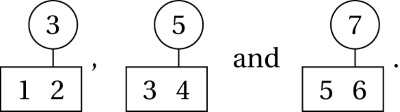
The submanifolds X and Y encoded, respectively, by the forest-like diagrams in (4·2) satisfy $K\pitchfork L=\partial X$
and
$K\pitchfork L=\partial X$
and $L\pitchfork M=\partial Y$
in N. Indeed, no boundary condition (i.e., an equality that replaces an inequality) can be taken with respect to the
$L\pitchfork M=\partial Y$
in N. Indeed, no boundary condition (i.e., an equality that replaces an inequality) can be taken with respect to the $\leq$
inequalities coming from the edges of the square vertices in (4·2) containing
$\leq$
inequalities coming from the edges of the square vertices in (4·2) containing $\{3,4\}$
or
$\{3,4\}$
or $\{5,6\}$
, for otherwise we fall outside N. Furthermore
$\{5,6\}$
, for otherwise we fall outside N. Furthermore $X\pitchfork M$
and
$X\pitchfork M$
and $K\pitchfork Y$
are respectively encoded by
$K\pitchfork Y$
are respectively encoded by

The aim is then achieved in view of Remark 4·1, as the fundamental class $\varphi\,:\!=[(X\cap M) \cup (K\cap Y)]_N\in H^{\text{BM}}_*(M^{(3)}_d(n))$
is Poincaré dual of (4·6). Indeed, the union
$\varphi\,:\!=[(X\cap M) \cup (K\cap Y)]_N\in H^{\text{BM}}_*(M^{(3)}_d(n))$
is Poincaré dual of (4·6). Indeed, the union $(X\cap M) \cup (K\cap Y)$
sits inside the boundary of the submanifold Z of N encoded by
$(X\cap M) \cup (K\cap Y)$
sits inside the boundary of the submanifold Z of N encoded by
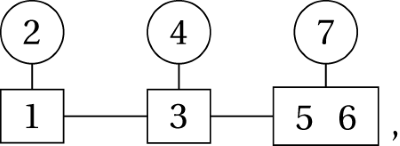
while the rest of the boundary of Z is a manifold representing $\varphi$
and clearly encoded by (4·6).
$\varphi$
and clearly encoded by (4·6).
The verification of the following auxiliary fact is an elementary exercise using the cup-product descriptions in Section 3.
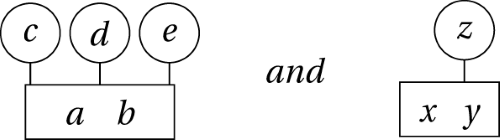
Lemma 4·5 The product of two elementary terms
in $H^*(M^{(3)}_d(n))$
is either zero or a sum of basic elements of one of the two forms
$H^*(M^{(3)}_d(n))$
is either zero or a sum of basic elements of one of the two forms

and, in either case, the set of numbers inside the vertices of each of these summands is precisely $\{a,b,c,d,e,x,y,z\}$
.
$\{a,b,c,d,e,x,y,z\}$
.
Theorem 4·6. For $n \gt 6$
, the triple Massey product in
$n \gt 6$
, the triple Massey product in $M_d^{(3)}(n)$

is well defined and non-trivial.
Proof. Well-definedness is obvious. Consider the submanifolds K, L, M, X and Y in Example 4·4, together with the submanifolds $M_5$
,
$M_5$
, $M_6$
and
$M_6$
and $M_7$
encoded, respectively, by the second, third and fourth summands of
$M_7$
encoded, respectively, by the second, third and fourth summands of
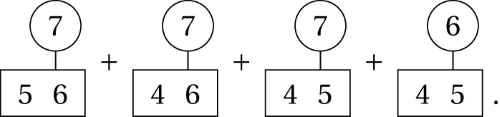
Note that $L\cap M_i=\varnothing$
for
$L\cap M_i=\varnothing$
for $5\leq i\leq7$
, so that
$5\leq i\leq7$
, so that $L\pitchfork\widetilde{M}=L\pitchfork M=\partial Y$
, where
$L\pitchfork\widetilde{M}=L\pitchfork M=\partial Y$
, where $\widetilde{M}=M\cup M_5\cup M_6\cup M_7$
. Since
$\widetilde{M}=M\cup M_5\cup M_6\cup M_7$
. Since $X\cap M_i=\varnothing$
for
$X\cap M_i=\varnothing$
for $5\leq i\leq7$
, the conclusion in Example 4·4 extends to yield that
$5\leq i\leq7$
, the conclusion in Example 4·4 extends to yield that
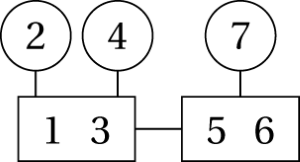
also lies in (4·8). The proof will then be complete once we rule out any possible solution $\alpha,\beta\in H^*(M^{(3)}_d(n))$
to the equation
$\alpha,\beta\in H^*(M^{(3)}_d(n))$
to the equation

Here, for $\ell \in \{4,5,6,7\}$
,
$\ell \in \{4,5,6,7\}$
, $T_\ell$
stands for the ordered triple of elements in the set
$T_\ell$
stands for the ordered triple of elements in the set ${\{T_\ell\}}\,:\!=\{4,5,6,7\}\setminus \{\ell\}$
.
${\{T_\ell\}}\,:\!=\{4,5,6,7\}\setminus \{\ell\}$
.
In what follows, the expression of a cohomology class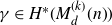 $\gamma\in H^*({M_d^{(k)}(n)})$
as a
$\gamma\in H^*({M_d^{(k)}(n)})$
as a $\mathbb{Z}_2$
-linear combination of basic elements (Definition 2·3) will be referred to as the expansion of
$\mathbb{Z}_2$
-linear combination of basic elements (Definition 2·3) will be referred to as the expansion of $\gamma$
. For instance, by dimensional reasons, the expansions of both classes
$\gamma$
. For instance, by dimensional reasons, the expansions of both classes $\alpha$
and
$\alpha$
and $\beta$
in a potential equation (4·9) would have to involve exclusively elementary basis elements of the form
$\beta$
in a potential equation (4·9) would have to involve exclusively elementary basis elements of the form

with $\{a,b,c,d,e\}\subset {\mathbf{n}}$
. Then, looking at the expansions of the two products on the right-hand side of any such expression (4·9), and using Lemma 4·5, we see that no basis element
$\{a,b,c,d,e\}\subset {\mathbf{n}}$
. Then, looking at the expansions of the two products on the right-hand side of any such expression (4·9), and using Lemma 4·5, we see that no basis element $\varepsilon$
in the expansion of the first product of (4·9) can also appear in the expansion of the second product, nor
$\varepsilon$
in the expansion of the first product of (4·9) can also appear in the expansion of the second product, nor $\varepsilon$
can be the basic element on the left-hand side of (4·9). Consequently, the first product on the right-hand side of any potential expression (4·9) would have to vanish, and we are left to rule out solutions to the simpler equation
$\varepsilon$
can be the basic element on the left-hand side of (4·9). Consequently, the first product on the right-hand side of any potential expression (4·9) would have to vanish, and we are left to rule out solutions to the simpler equation

Let $\mathfrak{S}$
denote the sum inside the parenthesis of (4·11), and suppose for a contradiction that (4·11) holds for some
$\mathfrak{S}$
denote the sum inside the parenthesis of (4·11), and suppose for a contradiction that (4·11) holds for some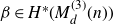 $\beta\in H^*(M^{(3)}_d(n))$
. We can assume without loss of generality that no basis element (4·10) in the expansion of
$\beta\in H^*(M^{(3)}_d(n))$
. We can assume without loss of generality that no basis element (4·10) in the expansion of $\beta$
has zero product with
$\beta$
has zero product with $\mathfrak{S}$
. In particular, a new application of Lemma 4·5 shows that all basis elements (4·10) in the expansion of
$\mathfrak{S}$
. In particular, a new application of Lemma 4·5 shows that all basis elements (4·10) in the expansion of $\beta$
must satisfy
$\beta$
must satisfy
 \begin{equation}\{1,2,3\}\subset\{a,b,c,d,e\}\subset\{1,2,3,4,5,6,7\}.\end{equation}
Let us analyse the product with $\mathfrak{S}$
of any such basis element
$\mathfrak{S}$
of any such basis element $\tau$
in the expansion of
$\tau$
in the expansion of $\beta$
. To begin with, there must be a (not necessarily unique)
$\beta$
. To begin with, there must be a (not necessarily unique) $\ell\in\{4,5,6,7\}$
with
$\ell\in\{4,5,6,7\}$
with

In particular, $\{a,b\}\cap {\{T_\ell\}}=\varnothing$
and
$\{a,b\}\cap {\{T_\ell\}}=\varnothing$
and $|\{c,d,e\}\cap {\{T_\ell\}}|=1$
, in view of (4·12). Say
$|\{c,d,e\}\cap {\{T_\ell\}}|=1$
, in view of (4·12). Say $e\in {\{T_\ell\}}$
, so that
$e\in {\{T_\ell\}}$
, so that $\{c,d\}\cap {\{T_\ell\}}=\varnothing$
. Then (4·13) takes the (perhaps non-basic) form
$\{c,d\}\cap {\{T_\ell\}}=\varnothing$
. Then (4·13) takes the (perhaps non-basic) form
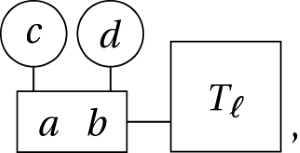
where $\{1,2,3\}\subset\{a,b,c,d\}\subset\{1,2,3,4,5,6,7\}\setminus {\{T_\ell\}}$
. Altogether, we have
$\{1,2,3\}\subset\{a,b,c,d\}\subset\{1,2,3,4,5,6,7\}\setminus {\{T_\ell\}}$
. Altogether, we have
 \begin{equation}\{a,b,c,d\}=\{1,2,3,\ell\} \quad \text{and} \quad {e\in\{T_\ell\},}\end{equation}
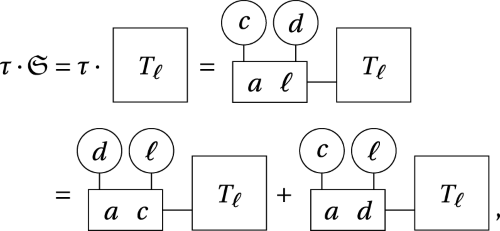
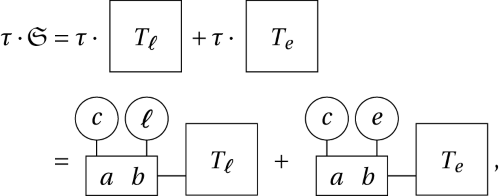
which allows us to evaluate in full the product $\tau\cdot{\mathfrak{S}}$
:
$\tau\cdot{\mathfrak{S}}$
:
-
(i) if
$\ell\in \{a,b\}$
, say
$b=\ell$
, thenwhich is a sum of two basis elements, in view of (4·14);
-
(ii) if
$\ell\in\{c,d\}$
, say
$d=\ell$
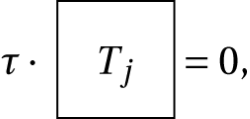
, then for
$j\in\{4,5,6,7\}\setminus\{d,e\}$
so that
which is again a sum of two basis elements, in view of (4·14).





This shows that the product $\beta\cdot {\mathfrak{S}}$
is a sum of an even number of basis elements, which is incompatible with (4·11), since the left-hand side term is its own expansion.
$\beta\cdot {\mathfrak{S}}$
is a sum of an even number of basis elements, which is incompatible with (4·11), since the left-hand side term is its own expansion.
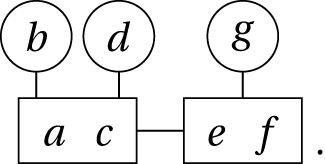
Corollary 4·7. For seven pairwise distinct numbers a, b, c, d, e, f, g in ${\mathbf{n}}$
, the triple Massey product in
${\mathbf{n}}$
, the triple Massey product in $M_d^{(3)}(n)$

is well defined, non-trivial, and represented by
Proof. Choose a permutation $\sigma\in\Sigma_n$
with
$\sigma\in\Sigma_n$
with $\sigma(1)=a$
,
$\sigma(1)=a$
, $\sigma(2)=b$
,
$\sigma(2)=b$
, $\sigma(3)=c$
,
$\sigma(3)=c$
, $\sigma(4)=d$
,
$\sigma(4)=d$
, $\sigma(5)=e$
,
$\sigma(5)=e$
, $\sigma(6)=f$
and
$\sigma(6)=f$
and $\sigma(7)=g$
. Then, the induced diffeomorphism
$\sigma(7)=g$
. Then, the induced diffeomorphism $\widetilde{\sigma}\colon M^{(3)}_d(n)\to M^{(3)}_d(n)$
identifies the triple Massey product in Theorem 4·6 with the one in Corollary 4·7.
$\widetilde{\sigma}\colon M^{(3)}_d(n)\to M^{(3)}_d(n)$
identifies the triple Massey product in Theorem 4·6 with the one in Corollary 4·7.
Acknowledgements
The first author is grateful to José Cantarero and CIMAT Mérida for the warm hospitality while pieces of this work went underway. The second author thanks the CIMAT-Mérida Algebraic Topology Group for providing an enriching research environment. This work was partially supported by a SECIHTI postdoctoral fellowship and grant CBF2023-2024-4059, “Interacciones topológico-computacionales”. The authors would like to thank the anonymous referee for helpful comments and suggestions.





 Open access

