


1. Introduction
The design of interior environments can influence how people feel, think, and behave. The properties of the environment, such as color, light, sound, and smell, have been shown to influence people's emotional states (Bower et al., Reference Bower, Tucker and Enticott2019; Schreuder et al., Reference Schreuder, van Erp, Toet and Kallen2016; Zamani et al., Reference Zamani, Mehran, Abad, Rezaee and Vafaee2023). Emotional responses are important because they are processed at multiple levels, starting as physiological responses, evolving to conscious experience, and then mediating higher-order processes like perception and decision-making (Reference Schreuder, van Erp, Toet and KallenSchreuder et al., 2016). 'Arousal', for example, refers to one's level of physiological and emotional activation. Arousal level has been associated with 'work vigor' (Reference Sosnowska, Hofmans and FruytSosnowska et al., 2019), reward-based decision-making (Reference Liu, Hsieh, Hsu and LaiLiu et al., 2015), creativity (Reference de Korte, Kuijt, van der Kleij and Robertsonde Korte et al., 2011), and stress recovery (Reference Ignacio and ShealyIgnacio & Shealy, 2023). So, if designers can influence emotional arousal, they have the potential to create spaces that support the kinds of higher-order thought processes involved in modern knowledge work.
There is currently a gap in knowledge about whether designers can, in practice, implement the kinds of emotion-changing interventions that have been identified in controlled experiments. A limitation of lab and field experiments is that they are concerned only with the manipulation of one or a small number of variables at a time. In practice, a designer who wishes to elicit specific emotional responses in the workspace needs to balance many (potentially conflicting) goals and requirements whilst dealing with pragmatic constraints such as time and cost, all to deliver spaces that are, e.g., functional, beautiful, safe, and practical. This is challenging because research on multisensory stimuli has shown that the individual properties of environments can combine and interact in complex ways (Reference Schreuder, van Erp, Toet and KallenSchreuder et al., 2016; Reference Spence, Puccinelli, Grewal and RoggeveenSpence et al., 2014). As such, it is not clear whether designers can influence emotional states in a naturalistic design process or whether such intentions get lost in the complexities of multisensory stimuli interactions.
In this work, we address the research question: “Can workspace designers intentionally elicit specific emotional responses in the occupants of spaces?”. Specifically, we sought to determine whether designers could intentionally influence the levels of arousal experienced by those participants through the design of physical products and spaces. To do this, we employed a novel study format, which we call an 'exhibition-experiment'. We conducted a controlled experiment in a live exhibition environment hosted during the Munich Creative Business Week (MCBW), a large, industry-focused design event. Working professionals came to use the designed spaces as private working environments, and we measured their emotional, physiological, and behavioral reactions to being in a space. This design allowed us to evaluate whether the designers had successfully addressed their design briefs. The exhibition setting allowed us to rapidly recruit a sample from the designers' target population to participate in a study that provided experimental control in a naturalistic, live environment.
In this article, we report on the study methods in their entirety but present only a partial analysis of the data, focusing on the 'traditional' self-report measures of emotion but excluding physiological and behavioral measures. In section 2, we provide an overview of the design process and show how the designers' goals were translated into relevant theoretical constructs and an experimental design. In the remainder of the article, we present the study method (Section 3), results (Section 4), and a discussion of the results (Section 5).
2. Overview of the design process and evaluation approach
We employed a multi-part approach to determine whether designers can elicit specific emotional responses through workspace design. The designers first designed spaces in response to briefs with emotional goals, i.e., to 'activate' or 'relax' their participants. These design briefs were used to identify theoretical constructs and appropriate measures, and these constructs and measures were used to generate hypotheses and establish a research design.
The design process. In the design phase, Master's students in Architecture at the Technical University of Munich designed products and workspaces without knowledge that they would later function as stimuli for the exhibition-experiment. The students were given one semester (16 academic weeks) to design a biophilic-inspired product, directing themselves to products such as lamps, stools, and stationary organizers. After 9 weeks, they were placed into groups and tasked with designing full-scale workspaces in which to situate and exhibit their products. Two of the briefs were to create a room for 'activation' and a room for 'relaxation'.
Translating the design goals to theoretical constructs. To evaluate whether the designers achieved their design goals, the concepts of 'activation' and 'relaxation' were operationalized as emotional responses. The circumplex model of core affect (Figure 1a) conceptualizes emotional responses in two dimensions. Arousal refers to the level of intensity of emotion, and Valence refers to whether the emotions are positive or negative. Here, 'activation' is a high-arousal emotional response with neutral valence. 'Relaxation' is a low arousal response with positive valence.
(a) The circumplex model of emotion showing the main dimensions of arousal and valence, and (b) the dimensions of the Activation Deactivation checklist (Thayer, 1986) overlaid on the same axes. Modified from (Reference Russell and BarrettRussell & Barrett, 1999). The solid axes show the main, explicit axes of each model. The dashed lines show examples of emotional responses to provide consistency between the models

Establishing measures. Defining the designers' goals as emotional responses further led to the identification of relevant measures. As emotional responses are processed at multiple levels (Section 1), there was a need to use multiple measures that correspond to these various levels. Unconscious and automatic processing in the nervous system can be measured using physiological biomarkers such as electrodermal activity (Reference BauerBauer, 1998; Reference Egger, Ley and HankeEgger et al., 2019). Subjective perceptions of emotions can be measured using a variety of self-report scales, including the Activation-Deactivation Adjective Checklist (Thayer, 1986) and the Positive and Negative Affect Scale (Watson et al., 1988). At the behavioral level, emotions can influence fast, unconscious changes in behavior such as approach or avoidance behaviors (Reference Schreuder, van Erp, Toet and KallenSchreuder et al., 2016).
Study overview: an exhibition-experiment to evaluate emotional responses to spaces. To evaluate whether the designers in the aforementioned project successfully achieved their briefs, we conducted an experiment to measure and compare the levels of activation and relaxation experienced by occupants of the workspaces. We implemented a novel form of controlled experiment, which was conducted during the Munich Creative Business Week (MCBW) in 2024. This format, which we term an 'exhibition-experiment', involved creating a third 'neutral' room to act as an experimental control. Visitors to MCBW were recruited to use the spaces as private working environments (the 'exhibition'), whilst their emotional responses were measured across two of the spaces (the 'experiment'). During the experiment, participants visited the neutral room and one of the intervention rooms (activating room or relaxing room).
Our general, substantive hypothesis was that, consistent with the design briefs, the activating room would be associated with increased arousal than the neutral room and that the relaxing room would be associated with decreased arousal. Further, we expected that both rooms would elicit emotional responses with positive valences (i.e., pleasant rather than unpleasant responses). This was not an explicit requirement, but the designers were guided to create desirable experiences for the occupants of the space, i.e., emotional responses with positive valence. Three sets of measures were used to assess emotional responses to the spaces. Electrodermal activity was used as a measure of emotional arousal at the physiological level. An emotional self-report scale, the Activation Deactivation Adjective Checklist (AD-ACL), (Thayer, 1986) was used to measure subjective emotional responses. Video recordings were used to capture physical behavior.
In this article, we report on the results from the AD-ACL and the corresponding hypotheses:
-
H1 The 'relaxing' room would be associated with statistically significantly greater degrees of emotional activation than the neutral room.
-
H1a Self-reported emotional responses for the 'relaxing' room will be statistically significantly higher along the dimension of 'calmness' than in the neutral room.
-
-
H2 The 'activating' room would be associated with statistically significantly greater degrees of emotional activation than the neutral room.
-
H2a Self-reported emotional responses for the 'activating' room will be statistically significantly higher along the dimension of 'energy' than in the neutral room.
-
For both H1a and H2a, the null hypothesis was that there would be no statistically significant differences between the rooms. The study involved a mixture of confirmatory and exploratory elements. The hypotheses and analyses for the AD-ACL tests reported here were fully confirmatory, being defined prior to data collection.
3. Method
3.1. Study design
A within-group experiment design was used to test the study hypotheses (Figure 2). This is a randomized control trial that has been modified with certain concessions to maximize the user experience of the participants whilst preserving sufficient experimental control to test the hypotheses. Each participant was randomly assigned to spend time in either (i) the neutral and activating room or (ii) the neutral and relaxing room. Participants always entered the neutral room first and one of the intervention rooms second.
An overview of the research design, showing participant group allocation and the rooms that participants in each group visited. N = neutral room, A = activating room, R = relaxing room

Two key design decisions were taken to balance the needs of the experiments versus the needs of the exhibition. The rooms were not counterbalanced, as this would reduce the total number of participants that could be processed on any given day (see the implications of order effects in Section 6). Participants visited only two of the three rooms so that they could maximize the time spent in each room whilst minimizing the number of interruptions by the experimenter. This was done to maximize the value of the event as a space to conduct work, thereby making it easier to recruit participants and improve their user experience.
The independent variable was ‘room’, i.e., which of the three rooms that the participant was in. There were three categories of dependent variables intended to capture emotional responses at the physiological, subject, and behavioral levels. Electrodermal activity was measured using the Empatica Embrace Plus wristwatch. The Activation-Deactivation Adjective Checklist (AD-ACL) was used to measure subjective emotional responses. Physical behavior was captured on 2D and 3D (depth and infrared) cameras and from the accelerometer data on the Empatica.
As noted in Sections 1 and 2, we report here only on the self-report measures from the AD-ACL.
3.2. Participants
30 participants were originally recruited for the study. 2 participants were excluded for missing data Section 4), leaving 28 participants (12M 16F) for the analyses. Participants ranged from the 18-24 age bracket to the 65+ age bracket. 50% of the participants belonged to the median and modal age bracket of 25-34. Participants varied in professional experience, including architecture professionals (7), management professionals (5), design professionals (4), students (5), research professionals (4), IT professionals (2) and one administration professional. The population of interest was adult, working professionals, i.e., anyone who would be likely to work in an office-like environment. A voluntary response sampling procedure was used, where participants responded to public calls for participation. No a priori sample size was calculated. Participant numbers were constrained by resource constraints as the entire recruitment event was limited to 7 days. A sensitivity power analysis using G*Power 3.1 showed that with 14 participants in each sub-group, paired-sample T-tests had a 55% chance to detect medium effect sizes of Cohen's d = 0.5, a 79% chance of detecting large effects of d = 0.8.
3.3. Stimuli and setting
The independent variables for the study were the three rooms. The two intervention rooms were designed by Master’s students in response to the briefs of making an ‘activating’ and a ‘relaxing’ room. The control room was designed by the experimenters to act as a comparison for the intervention rooms.
All three of the rooms were built with a modular wall system designed for museums and trade fairs, equipped with overhead aluminium u-shaped beams, 1-phase lighting rails, and four lamps with Philips Hue bulbs.
The two intervention rooms comprised products bought from existing retailers (such as desks, chairs, artificial plants, and picture frames) and products designed by the students (including stools, lamps, and wall-mounted storage). Vinyl foils were provided for wall coverings and were either applied directly (as in the yellow stripe of the activating room) or painted (as in the relaxing room). The neutral room comprised no student products and was furnished solely with products already on the market.
-
The neutral room (Figure 3a) had various tones of white and grey. Materials were smooth (mostly plastics and metal surfaces) with some felt accents (e.g., in the chair upholstery and lampshade). Shapes were more rectangular than in the other rooms, and there was no further wall decoration. The window was covered with frosted glass to prevent views. Unlike in the other two rooms, there were no plants, biophilic elements, or added scents.
-
The relaxing room (Figure 3b) had a light blue and teal color scheme with Cream-colored walls and floor. There was a lounge sofa with a small side table that allowed for a reclined working posture. Natural materials like fluffy carpet, wool, and transparent curtains were complemented by organic (rounded) shapes and natural visuals like a printed abstract forest to simulate a window view. A lavender scent was spread through scented cushions, and several (artificial) plants supported the general biophilic theme.
-
The activating room (Figure 3c) had a color scheme of beige, light yellow, orange, and brown tones. Materials were smooth (e.g., leather) and shapes more angular than in the relaxing room. A height-adjustable desk with both a highchair and a swivel chair allowed for flexible work postures and switching between standing and sitting. Two whiteboards were provided within the yellow zone. An abstract graphic poster and a printed sunset gradient in the window added vibrancy. A stimulating scent of dried lemon was spread through a scented cushion, and several (artificial) plants acted as biophilic elements.
The rooms that acted as the stimuli in the experiment, showing a) the neutral, b) the relaxing and c) the activating room. The front walls and some products have been removed

The event took place in a large room on the third floor of a University building. A plan view and photograph of the space are shown in Figure 4, showing the arrangement of all three plan rooms. The space also contained a reception desk (used to welcome and check-in guests) and a lounge area (used to administer pre-study questionnaires and to equip the measurement device).
The setting of the exhibition-experiment, showing a) the layout of the space including the three rooms and b) a photograph pointed towards the activating and relaxing rooms, taken during a public exhibition after the study recruitment

3.4. Measures and technical setup
Self-report measures of affect. The participants’ emotional responses to each room were collected through the short form Activation-Deactivation Adjective Checklist (AD-ACL) (Thayer, 1986). The AD-ACL measures emotions in terms of four factors, listed in Table 1. As shown in Figure 1, these four factors can be aligned to the arousal-valence dimensions of the circumplex model of emotion at a 45-degree rotation (Reference Russell and BarrettRussell & Barrett, 1999). Participants were presented with the 20 adjectives in a fixed order. They were instructed to rate, on a Likert-type scale, the extent to which they felt each emotion. The options are 'definitely feel', 'feel slightly', 'cannot decide', 'definitely do not feel'. Adjectives were presented alongside a German translation. Translations were created by making minor modifications to the German version of the AD-ACL (Reference ImhofImhof, 1998) with feedback from three native German speakers. Participants completed the survey using Google Forms on a Samsung Galaxy 8.7-inch tablet. A short, multi-item, verbal checklist was chosen to be fast to administer whilst hiding the underlying theoretical dimensions of energy and calmness that underly the hypotheses.
Factors and terms for the Activation-Deactivation Checklist

Note: * means that the scores for these items are reversed relative to the others in the same factor
Physiological measures. Electrodermal activity (EDA) was measured using the Empatica Embrace Plus wristwatch. The Embrace Plus captures six kinds of raw data: heart interbeat interval (IBI) and blood volume pulse (BVP) (using an optical photoplethysmogram sensor), electrodermal activity, temperature, accelerometer values, and step count. The wristbands were paired via Bluetooth to the same tablet computers used to administer the AD-ACL.
Measures of physical activity. The participants were recorded using one GoPro camera placed directly overhead and one 3D Orbbec Femto Mega camera placed on top of one of the walls of the 3x3m room.
Post-study questionnaire and follow-up interviews. A brief survey was administered after the study to determine what tasks the participants were working on and how appropriate the room was for that task. Follow-up interviews were conducted between 4 to 6 months later to evaluate the participants' user recollections of their experience of the event as both a design exhibition and a scientific experiment.
3.5. Procedure
The study was administered in four phases. Figure 5 shows each phase, the location of the participant, and the administration of the study measures.
Overview of the procedure, showing the four phases and the activities that the participants carried out. The rest period was 5 minutes; the work period was 25 minutes

-
Phase 1: Arrival and Briefing (approx. 15 minutes). The participants check in at the event, sign GDPR consent forms, and are assigned a unique participant ID. The participants are guided to the lounge, equipped with the Empatica wristband, and asked to complete the pre-room survey (the first instance of the AD-ACL).
-
Phases 2 & 3: Working in rooms (30 minutes per room). Participants are guided into the neutral room for 30 minutes and then their assigned intervention room for 30 minutes. They are asked to spend the first five minutes in each room sitting down, doing as little as possible other than looking around and taking in the environment. The experimenter turns over a 5-minute egg timer to record this period before leaving the room. For the remaining 25 minutes, they can do whatever kind of work they choose to do. At the end of the 30 minutes, an experimenter comes to take them to the next phase.
-
Phase 4: Debriefing (approx. 5 minutes). The participant is accompanied back to the reception desk, where they are debriefed, given an information pack, and return the Empatica watch.
The AD-ACL was administered prior to entering the first room to establish a baseline and then at the end of the time spent in each room to assess emotional responses. The wristband and video cameras were recording constantly. EDA was measured during the 5-minute rest period to minimize any extraneous variables that could have been introduced during the working period.
3.6. Analysis
The AD-ACL is scored by assigning 4, 3, 2, and 1, respectively, to the four points on the rating scale: definitely feel (4), feel slightly (3), cannot decide (2), definitely do not feel (1). Scores for each factor were calculated by taking the sum of the ratings for each item within that factor. Two of the items for the 'tiredness' factor are reversed relative to the others, as indicated by asterixis in Table 1.
Paired sample t-tests were used to compare the scores in different rooms for each factor of the AD-ACL. A significance threshold of p ≤ 0.05 was used for all tests. H1a was tested by comparing the activating and neutral rooms, and H2a was tested by comparing the neutral and relaxing rooms. Whilst a directional hypothesis was stated for the 'energy' and 'calmness' factors, two-tailed (rather than one-tailed) tests were used to provide a more conservative estimate of statistical significance with respect to H1a and H2a and because we were also interested in effects in the opposite direction.
4. Results
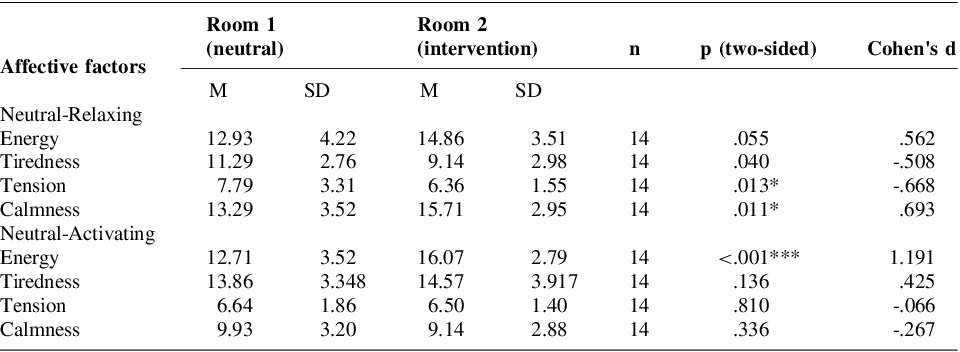
Table 2 shows the summary statistics from the AD-ACL scores across the neutral and intervention rooms for each group of participants. 30 participants took part in the study, but the responses from two participants (one in each sub-group) were removed owing to partial missing data. Thus, 28 participants were included in the analysis (14 in each sub-group).
Means, Standard Deviations, count values, and results from a paired-sample t-test of the difference between AD-ACL factor scores across the neutral and intervention rooms

Note: Significant values are indicated at <.05 (*), <.01 (**), and < .001 (***).
A paired samples t-test was used to determine whether there was a statistically significant mean difference between self-reported emotional states in the neutral room and intervention rooms. In all cases, the assumption of normality for all tests was satisfied as assessed by a Shapiro-Wilks test with p > .05. Results are shown in Figure 6.
Boxplots of the paired t-test results for the neutral—relaxing comparisons (a-d) and the neutral—activating comparisons (e-h). Charts are arranged in groups of four to correspond to the four axes of the AD-ACL (Figure 1b) (e.g., energy on the top right, calmness on the bottom right). Significant values are indicated at <.05 (*), <.01 (**), and < .001 (***)

To test H1a and H2a, we first examined the scores for self-reported energy in the activating room and self-reported calmness in the relaxing room. Participants who spent time in the neutral and relaxing rooms reported greater feelings of calmness in the relaxing room (M = 15.71, SD = 2.95) than in the neutral room (M = 13.29, SD = 3.52), a statistically significant difference of 2.42, 95% CI [0.18, 4.45], t(13) = 2.595, p < .022, d = 0.639 (Figure 6a). Thus, the null hypothesis for H1a was rejected. Participants who spent time in the neutral and activating rooms reported greater feelings of energy in the activating room (M = 16.07, SD = 2.79) than in the neutral room (M = 12.71, SD = 3.52), a statistically significant difference of 3.36, 95% CI [1.73, 4.98], t(13) = 4.458, p < .001, d = 1.191 (Figure 6f). Thus, the null hypothesis for H2a is rejected.
No a priori predictions were made about the influence of the activating and relaxing rooms on other emotional factors. Nonetheless, the spaces may have had (unintended) effects on their participants beyond what the designers attempted to achieve in their briefs. Thus, we conducted a full set of t-tests to examine the mean differences between all four emotion factors for each sub-group. There was only one other statistically significant difference between any of the spaces. Specifically, self-reported 'tension' was lower in the relaxing room (M = 6.36, SD = 1.55) than in the neutral room (M = 7.79, SD = 3.31), a statistically significant difference of -1.43, 95% CI [2.663, 0.194], t(13) = -2.500, p < .027, d = -0.668 (Figure 6d).
5. Discussion
The results show how both the relaxing and activating rooms differed from the neutral room in terms of subjective self-reports of emotion. This provides an initial answer to the research question: “Can workspace designers intentionally elicit specific emotional responses in the occupants of spaces?”. The answer, according to the subjective self-report measures, is yes. Consistent with H1a, the activating room was associated with statistically significantly higher scores for 'energy' on the AD-ACL, i.e., a pleasant, energized affective state. Consistent with H2a, the relaxing room was associated with statistically significantly higher scores for 'calmness', which is a pleasant, low-arousal affective state. Exploratory analyses also showed that the relaxing room was associated with reduced tension', compared to the neutral room. This is consistent with the increase in calmness and provides further support for the view that the designers of the relaxing room achieved their brief.
Contribution and relation to prior work. The study presented in this paper is the first to show that designers (students) can elicit targeted emotional responses in a naturalistic, multi-week design process. Our work complements (but is unique from) lab studies that investigate the relationship between properties of environments and emotional outcomes (Bower et al., 2019; Schreuder et al., Reference Schreuder, van Erp, Toet and Kallen2016; Zamani et al., Reference Zamani, Mehran, Abad, Rezaee and Vafaee2023). Such studies typically involve researchers manipulating precisely controlled experimental stimuli. For example, de Korte et al. (Reference de Korte, Kuijt, van der Kleij and Robertson2011) created three different space variations that were intended to vary in arousal and psychological safety. They did this by manipulating properties of the spaces, such as color, materials, and sitting arrangement, based on ratings from independent judges. This allowed them to evaluate whether the combination of these properties successfully elicited the desired outcomes. Yet, such studies do tell us whether design interventions survive out of the lab and when out of the hands of experimenters. The designers who were evaluated in our study not only had to elicit specific emotional responses but also create workspaces that were visually appealing and functionally useful for work and ergonomically comfortable whilst considering a multitude of multisensory such as color, light, sound, scent, and texture. They also had to navigate constraints, such as limited time and budget and a highly constrained spatial extent (i.e., the 3x3m rooms), whilst constantly making concessions to address their briefs with the materials available. Yet, despite these real-world requirements and constraints, they still managed to elicit the desired emotional responses in the self-report measures.
Implications. Our work provides the first preliminary indication that designers (students) can elicit targeted, measurable emotional responses in a naturalistic, multi-week design process. Consistent results from the physiological and behavioral measures would further strengthen this claim. This would, in turn, demonstrate the emotion-influencing impact of workspace design in practice. Inconsistent or contradictory results would justify further research to understand how and why designers fail to elicit desired emotional responses. Methodologically, running controlled experiments in large-scale design events could enable the rapid recruitment of participants, providing valuable data for designers and design researchers whilst also engaging the public in the design and science process.
Limitations. Two important methodological limitations of the study design are that the self-report measures are sensitive to participant biases and that there are order effects because all participants first entered the neutral room and then the intervention (activating or relaxing) room. A potential bias is the 'good participant' or 'social desirability' bias (Reference NederhofNederhof, 1985), when participants attempt to behave or respond in a way that they believe will help support the researchers' aims. Steps were taken to avoid this, such as by removing all advertising material from the setting and by advertising the spaces in related media under different names. However, given that participants were asked to visit two rooms, one of which may have obviously been interpreted as a 'neutral' room, the participants may have been motivated to provide more extreme ratings once they entered the intervention rooms. This potential issue was a key motivation behind conducting a multi-modal study. Future analyses of the physiological and video data can be compared with the self-report data to infer whether the participants were responding in a biased manner. A risk with order effects could have been that, for example, the participants may have all found their intervention room more exciting than the neutral room. Although the current results do not support such an interpretation, it may become problematic for the physiological data. Our study design means that we can conduct additional between-group comparisons of the activating and relaxing rooms to work around the order effects. A final limitation is that the current results cannot be used to infer which elements of the spaces may have caused the specific emotional responses. Future work could employ process measures such as protocol analysis and eye-tracking to understand how the participants processed their environment.
Future work. The immediate next steps for this work are to triangulate the results of the physiological measures (particularly the electrodermal activity) and the measures of physical activity in the space. If the rooms successfully activated and relaxed their participants, then we would expect to see physiological and behavioral responses associated with increased and decreased arousal, respectively. Beyond this, we have also conducted follow-up interviews with some of the participants to evaluate their experience, which provides not only a means of improving the research approach but also of gaining richer, qualitative insights into their perceptions about the spaces. Future iterations of this study will be required to assess the external validity of the findings, i.e., whether they generalize to other design goals, stimuli (spaces), contexts, and participants. In these studies, researchers may wish to collect more background information about the participants. For example, it could have been interesting to measure and control for details of the participant's typical working environment.
6. Conclusions
This paper presents a hybrid exhibition-experiment, carried out to evaluate whether workspace designers could create spaces that elicited specific emotional responses. Design students created workspaces to 'activate' and 'relax' their occupants. To evaluate whether the designers were successful, a controlled experiment was conducted, in which participants were randomly assigned to visit a newly created 'neutral' room (activating as an experimental control) and then either the activating or relaxing room. Emotional responses were measured using physiological, subjective, and video-based measures. In this conference paper, we report on the results of the subjective self-report scales using the Activating-Deactivating Adjective checklist (AD-ACL). The results show that, as hypothesized, the activating room was associated with statistically significantly higher scores for the 'energy' factors of the AD-ACL when compared to the neutral room. This is a pleasant, high-arousal factor that is consistent with the concept of 'activation'. Likewise, the relaxing space was associated with statistically significantly higher scores for the 'calmness' factor. This is a pleasant, low-arousal factor that is consistent with the concept of ''relaxation''. Additional exploratory analyses showed only one other statistically significant difference: reduced scores for 'tension' in the relaxing room. Importantly, self-report measures can be sensitive to biases that limit their utility. Thus, the results only show that the participants reported feelings that were consistent with the designers' intended outcomes. In future publications, we will report on the results of the physiological and behavioral analyses to determine whether the spaces also elicited changes in the participants' bodies and actions.






 Open access

