




‘There is no such manuscript.’
(K. W. Humphreys and A. S. C. Ross, ‘Further Manuscripts of Bede’s “Historia Ecclesiastica”, of the “Epistola Cuthberti de Obitu Bedae”, and Further Anglo-Saxon Texts of “Cædmon’s Hymn” and “Bede’s Death Song”’, N&Q 22.2 (1975), 50–5, at 53.)
1. Introduction
Rome, Biblioteca Nazionale Centrale ‘Vittorio Emanuele II’, Vitt. Em. 1452 + Durham (North Carolina), Duke University, David M. Rubenstein Rare Book & Manuscript Library, Lat. 140 is a copy of Bede’s Historia ecclesiastica gentis Anglorum, the Pseudo-Augustinian Sermo 160, and Jerome’s Epistula ad Evangelum Presbyterum de Melchisedech (Ep. 73), produced at Nonantola, in north-central Italy, in the first third of the ninth century. While the manuscript was mentioned (twice, as both doubtful and untraced) in Laistner and King’s Hand-List of Bede Manuscripts (1943),Footnote 1 and its whereabouts were known to Colgrave and Mynors in 1969Footnote 2 (only for the Director of the Library which subsequently acquired it in 1972 to categorically deny its existence to Humphreys and Ross in 1975), its complex provenance history, elucidated below, means it has never been recognised that it contains a copy of the Old English version of Cædmon’s Hymn (fig. 1).Footnote 3
Rome, Biblioteca Nazionale Centrale ‘Vittorio Emanuele II’, Vitt. Em. 1452, 122v. Courtesy of Rome, Biblioteca Nazionale Centrale ‘Vittorio Emanuele II’.

The manuscript is important as one of the earliest surviving texts of Bede’s Historia ecclesiastica, written within a century of his completion of it in 731, and offering further evidence of its early Continental transmission. Its principal interest here is as: (i) the third earliest vernacular text of Cædmon’s Hymn, after those in the Moore and Leningrad Bedes; (ii) the earliest witness to the Northumbrian eordu recension, of which it offers a much higher quality text than any of the three other known witnesses; and (iii) the earliest copy of the Hymn to be embedded directly in Bede’s Latin. Additionally, it contains the second earliest copy of the so-called ‘Moore Annals’, a set of four annals covering the years 731–734 named after the Moore Bede,Footnote 4 in which they were entered by the main scribe after the explicit of the Historia ecclesiastica (Cambridge, University Library, Kk. 5. 16, 128r).Footnote 5
In what follows, we discuss first the history of the manuscript and its rediscovery (§2), as well as details of its production at Nonantola (§3). We then provide a diplomatic version of its text of Cædmon’s Hymn (§4.1), a new edition of the Northumbrian eordu recension that takes the evidence of this new manuscript into account (§4.2), and a philological commentary (§4.3), along with an account of the unique punctuation of this witness and, putatively, of the eordu recension (§4.4).
2. The History of the Manuscript
As we discuss in §3, the manuscript with which this article is concerned was copied in the first third of the ninth century at the Benedictine Abbey of St Silvester in Nonantola, in north-central Italy. It is evident it remained there until the late fifteenth century, as the abbey’s medieval catalogues show, listing it as no. 60 in the 1166 catalogue;Footnote 6 no. 96 in the 1331 catalogue;Footnote 7 no. 83 in the 1464 catalogue;Footnote 8 and no. 136 in that of 1464–90.Footnote 9 By 1650, the codex had passed to the Cistercian monastery of Santa Croce in Gerusalemme, Rome, located on the site of the Basilica Sessoriana in the Palatium Sessorianum, the former imperial complex that had housed the residence of Empress Helena, mother to Constantine. At Santa Croce, Abbot Ilarione Rancati (1594–1663) established the original nucleus of the Biblioteca Sessoriana, assembling a total of 171 codices from various monastic sites, principally Nonantola.Footnote 10 The manuscript was recorded as item number 5 in the catalogue of Santa Croce compiled in 1664 by Abbot Franco Ferrari (c. 1635–1711):Footnote 11 this was the first systematic inventory of the monastery’s holdings, commissioned by Pope Alexander VII following the death of Rancati, with the explicit intention – in Ferrari’s words – ‘to distinctly determine whether any were singular, rare, or had never been printed … amidst the obscurity of so many ancient manuscripts’.Footnote 12 The manuscript remained in the monastery until the late eighteenth century, figuring as item number 107 in the inventory compiled around 1742 by Cardinal Gioacchino Besozzi (1679–1755)Footnote 13 and as number 103 in an anonymous index prepared in the late eighteenth century, under the heading codices antiquiores et pretiosiores. Footnote 14
In 1810, amid the upheavals of the Napoleonic Wars, a collection of 440 manuscripts was transferred from Santa Croce in Gerusalemme to the Vatican Library for safekeeping. The codices remained there for seven years, until 8 March 1817, when they were returned to the Cistercians and temporarily relocated to the monastery of San Bernardo alle Terme, which had been repurposed as a hospice under the French occupation.Footnote 15 It was presumably from San Bernardo alle Terme that the manuscript vanished sometime before 1821, along with many other Sessoriani codices, abstracted and sold into private hands.Footnote 16 Of the ‘countless and outstanding books’ that were stolen,Footnote 17 Alberico Amatori (1811–75), custodian of the library at Santa Croce between 1834 and 1849, was able to identify thirty-five deperditi manuscripts, among which ours is listed as number 24.Footnote 18
The manuscript resurfaced a few years later, in 1827, as number 2701 in the collection of Sir Thomas Phillipps,Footnote 19 who likely acquired it from the London antiquarians Payne and Foss, known to have purchased several Nonantolan codices from the Roman bookseller Giovan Battista Petrucci,Footnote 20 some others of which eventually also passed into Phillipps’s ownership.Footnote 21 Already in possession of another copy of Bede’s Historia ecclesiastica, dating to the final third of the ninth century (Berlin, Staatsbibliothek zu Berlin-Preußischer Kulturbesitz, Phill. 1873),Footnote 22 Phillipps undertook a collation of the two manuscripts, noting in pencil in the margins of the Berlin copy beside the Latin of Cædmon’s Hymn: ‘In codice Langobardico, … linguae Saxonicae’ (81r). Further evidence that this note was referring to our copy is provided by Phillipps’s transcription of the Rome text of the Moore Annals in the margins of the relevant folios of the Berlin codex (113v–114r). The manuscript, along with almost all of Phillipps’s collection, was acquired after his death by William H. Robinson Ltd. in 1872, and in due course sold in London in 1948 as ‘A Supremely Important Manuscript of Bede’s History. … One of the very few almost contemporary manuscripts now remaining to us’, thus entering the collection of Martin Bodmer in Cologny, Switzerland.Footnote 23
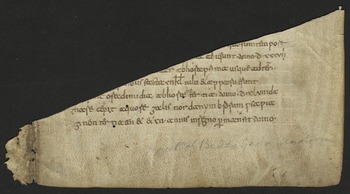
It was likely during its passage through successive hands that a fragment of a detached leaf containing a portion of the Recapitulatio (V.xxiv), already loose during its time in Phillipps’s possession – as evidenced by his pencil inscriptions, ‘Part of Bede’s Gesta Anglorum’ on the leaf itself (fig. 2) and ‘caret uno folio’ on the Rome volume (164r) – became separated from the manuscript. The fragment was auctioned at Sotheby’s, London, in 1976,Footnote 24 where it was acquired by the London dealer Winifred Myers on behalf of Duke University.Footnote 25
Durham (North Carolina), Duke University, David M. Rubenstein Rare Book & Manuscript Library, Lat. 140, recto. Courtesy of David M. Rubenstein Rare Book & Manuscript Library, Duke University.

Hardy was not aware of these ownership transfers when, in 1862, compiling a list of manuscripts of the Historia ecclesiastica for his Descriptive Catalogue of Materials Relating to the History of Great Britain and Ireland, he classified the codex as “MS. Bibl. S. Crucis in Jerusalem, Romæ, 5”, relying on Ferrari’s 1664 catalogue, despite it having been in Phillipps’s possession for about thirty-five years by that time.Footnote 26 Nor were Laistner and King when, in 1949, they identified it as ‘a doubtful copy’ of Bede’s Historia ecclesiastica, supposedly housed in the Sessoriana collection at the National Central Library in Rome, when it had entered Bodmer’s collection the year before; also separately listing the codex Phillipps 2701 as ‘untraced’.Footnote 27 Our manuscript (but not its copies of Cædmon’s Hymn or the Moore Annals) was known to Colgrave and Mynors to be part of Bodmer’s collection,Footnote 28 where it remained until 1970, when it was purchased by the Austrian-born book dealer H. P. Kraus, by then based in New York.Footnote 29 From Kraus, the manuscript was acquired two years later by the Italian Ministry of Public Education and was subsequently gifted by the Italian Government to the National Central Library of Rome in 1972,Footnote 30 where it is currently housed under the shelfmark Vittorio Emanuele 1452.Footnote 31 Nevertheless, when in 1975, as part of their research into further copies of Cædmon’s Hymn – which ultimately led to the discovery of four additional copiesFootnote 32 – Humphreys and Ross contacted the National Central Library to verify Laistner’s report of a doubtful copy of Bede’s Historia ecclesiastica in its holdings, the library’s head at the time categorically denied that any such manuscript existed.Footnote 33 Following our enquiry in February 2025, the National Central Library of Rome digitized the manuscript in full and made its catalogue description available online in May of the same year.Footnote 34
3. The Manuscript
The Rome manuscript consists of Bede’s Historia ecclesiastica (1r–28r10, 29v23–165v12), with Pseudo-Augustine’s Sermo 160 (28r11–29v20) intercalated between the end of Book I and the Capitula of Book II,Footnote 35 followed by Jerome’s Epistula ad Evangelum Presbyterum de Melchisedech (Ep. 73) (165v13–168v).Footnote 36 According to the library’s catalogue, the leaves measure approximately 285 × 195 mm, with a written space of about 230 × 150–60 mm. The text, written in long lines and ruled with a hard point, is arranged in twenty-eight lines per page, occasionally fewer. The current binding dates to 1828, shortly after Phillipps acquired it, and is the work of Charles Lewis (1786–1836), a bookbinder active in London in the early nineteenth century, as recorded by a pencil inscription on the front pastedown. The codex consists of twenty-three quires: eight quaternions, six ternions, six quinternions, and two quires of four, arranged as follows: i 6 (fols. 1–6), ii–vii 8 (fols. 7–54), viii–ix 10 (fols. 55–74), x 6 (fols. 75–80), xi 8 (fols. 81–8), xii 6 (fols. 89–94), xiii 10 (fols. 95–104), xiv 4 (fols. 105–8), xv 10 (fols. 109–18), xvi 8 (fols. 119–26), xvii 10 (fols. 127–36), xviii 6 (fols. 137–42), xix 10 (fols. 143–52), xx–xxi 6 (fols. 153–64), xxii 4 (fols. 165–8).Footnote 37
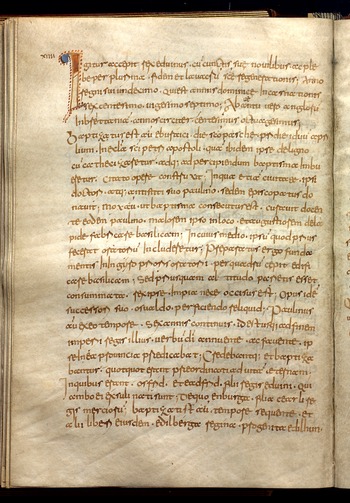
The manuscript constitutes ‘a remarkable example of the pre-Caroline Nonantolan style of the first third of the ninth century’.Footnote 38 Copied by numerous scribes, with occasional additions and corrections by contemporary hands, it is characterised by a very strong ductus, pronounced long r-ligatures with upturned shoulder-stroke, ct and st ligatures, consistent use of oc-shaped a with uncial a used as a capital to mark the beginning of paragraphs; alternate use of uncial d and straight-backed d; and capital q with the right-hand curve extended below the baseline and terminating in a horizonal flourish.Footnote 39 The number four is indicated by Roman numerals arranged in the form of a cross, following Nonantolan use (95v, 102v, 109v, 132r, 151v and 164v).Footnote 40 Initials are occasionally outlined by red dots (16r, 18r, 23v, 27r, 28r, 30v, 40r, 42r, 51v, 53r, 54r, 56r, 59r, 61r: see fig. 3), ‘a decorative motif borrowed from the insular tradition’,Footnote 41 and are touched with yellow, blue, green and orange; more rarely, the manuscript has initials characterised by interlacing foliage (2r and 132r). The currency of possible Insular affiliations at Nonantola has been tentatively attributed by Bischoff to the presence of scribes or exemplars that the centre received from Bobbio in the decades immediately following the monastery’s foundation, in the second half of the eighth century,Footnote 42 which may have led to the adoption, among other features, of ‘the Anglo-Saxon style of initials in the pre-Caroline period’ and its combination ‘with native traditions’.Footnote 43
Rome, Biblioteca Nazionale Centrale ‘Vittorio Emanuele II’, Vitt. Em. 1452, 51v. Courtesy of Rome, Biblioteca Nazionale Centrale ‘Vittorio Emanuele II’.

The version of the Historia ecclesiastica surviving in the Rome manuscript is almost complete: the text is acephalous (with the Preface starting at ‘diligenter a fratribus monasterii, quod ab ipsis conditum’) and lacunose at two points due to the loss of leaves. The first lacuna occurs in Book I, likely resulting from the loss of a single folio between fols. 6 and 7, and encompasses the text following Book I.vii (‘quem lateribus longe lateque deductum’ …) as far as Book I.ix (… ‘atque in Italiam transire meditantem’). Of the leaf that contained the text between Book V.xxii (‘octogesimo quinto, dominicae autem incarnationis anno dccxxxi’ …) and the Recapitulatio in Book V.xxiv (… ‘Theodoro, utillima x capitulorum’) only the triangular Duke fragment survives (115 × 200 mm), with annals from the Recapitulatio covering the period 449 to 565 on the recto and 633 to 673 on the verso. The remaining part of this leaf must have been missing since at least the first decade of the nineteenth century, as indicated by the supplementation of the text in the hand of Leandro De Corrieri (163v–164r), librarian of Santa Croce from 1801 to 1834.
In consideration of the five criteria which Plummer identified to distinguish m- and c-type manuscripts of the Historia ecclesiastica, the Rome Bede can be asserted to belong to the former, as corroborated by its agreement with all five readings distinctive of the m-recension.Footnote 44 Strikingly, however, with regard to the additional discrepancy mentioned by Plummer, where the c-class refers at the end of Book IV.xxviii to a single miracle of St Cuthbert rather than more than one (unum quod in the c-redaction in lieu of quaedam quae in the m-redaction), our manuscript follows the c-type reading (130r7).Footnote 45 Of the three additional criteria identified by Lapidge as distinctive of the two redactions, our manuscript once again conforms in its entirety to the readings of the m-type.Footnote 46 Its status within the m-class appears therefore consistent, notwithstanding this isolated agreement with the c-class.Footnote 47
4. The Text of Cædmon’s Hymn
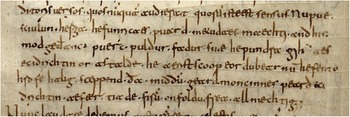
Cædmon’s Hymn is found on 122v22–27 of the Rome manuscript (fig. 4), as part of Book IV.xxii of the Historia ecclesiastica, inserted between Bede’s introduction to his Latin paraphrase of the Hymn ‘quorum iste est sensus’ and that paraphrase, beginning ‘nunc laudare debemus’. There is no indication that the scribe perceived it to be a linguistically or textually alien insertion in the text.
Rome, Biblioteca Nazionale Centrale ‘Vittorio Emanuele II’, Vitt. Em. 1452, 122v22–27 (detail). Courtesy of Rome, Biblioteca Nazionale Centrale ‘Vittorio Emanuele II’.

4.1. The Text of Rm
We begin by offering a diplomatic transcription of Rome’s text of Cædmon’s Hymn. Word division, capitalization, and punctuation have been preserved, and a forward slash is used to indicate manuscript line breaks:
Some unusual word division and the erroneous use of <p> for <ƿ> apart, this is clearly a very good text of Cædmon’s Hymn, even though the Nonantolan scribe does not seem to have been familiar with English orthography. The reading ‘eor du’ in 5b means Rm’s text is part of the eordu recension, hitherto believed to be attested in just three manuscripts: Dijon, Bibliothèque Municipale, 574, 59v col. 2 [Di] (s. xii3/4, Cîteaux);Footnote 50 Paris, Bibliothèque nationale de France, Lat. 5237, 72v [Pa] (c. 1430, Cologne);Footnote 51 and Brussels, Bibliothèque Royale, 8245-57, 62rv [Br] (dated 1489, Priory of Corsendonk).Footnote 52 The stemmata of Cavill and O’Donnell for the eordu group are accordingly based on just these three manuscripts.Footnote 53 Wuest and Dobbie did not take account of Br, which was only discovered by Humphreys and Ross in 1975.Footnote 54
4.2. A New Edition and Stemma of the Eordu Recension
Accordingly, we now present a new edition of the eordu recension, based on Rm, with variants from Di, Pa and Br, using the punctuation from the most recent critical edition, by O’Donnell:

[1] pue] puc Pa Br
[2] sciulun] sciulin Pa, scinlun Br
[3] herga] horga Br
[4] hefunricaes] hesimruicaes Pa, hesunruicaes Br
[5] puard] pueard Di Pa Br
[6] metudaes] metundaes Pa Br
[7] maechti] mechti Di Pa Br
[8] modgeðanc] modgedeanc Di Pa, modgedanc Br
[9] puerc] puere Pa Br
[10] puldurfadur] puldurfudur Di, puldur Pa Br
[11] suæ] suae Di Pa Br
[12] he] hae Di
[13] gihuaes] gihnaes Br
[14] aerist] aerst Di, raeirst Pa
[15] bearnum] pearnum Pa Br
[16] hefen] efen Di Pa
[17] ða] da Di, dā Pa
[18] geard] gaerd Br
[19] moncinnes] moneinnes Br
[20] eci] eei Pa Br
[21] drichtin] drintinc Di, drichtim Pa
[22] aefter] efter Di
[23] tiade] ciade Br
[24] on] ol Pa Br
[25] frea] fre Br
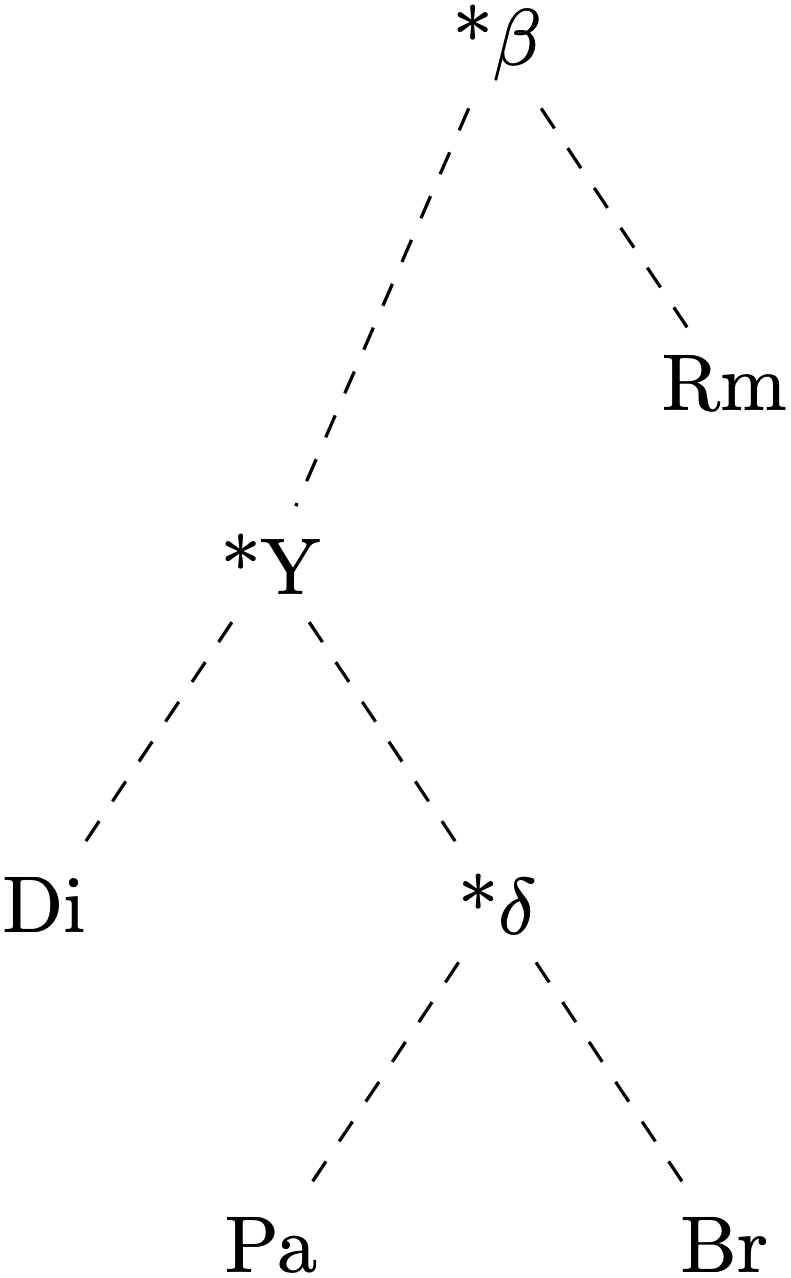
These variant readings suggest the stemma in fig. 5.
New stemma of the eordu recension.

Starting at the base of the stemma, Pa and Br share numerous (mis)readings (e.g. ‘puc’ for ‘pue’ (1a), ‘s’ for ‘f’ in ‘hefunricaes’ (1b), the intrusive ‘n’ in ‘metundaes’ (2b)), and are clearly closely related. Both, however, also contain independent errors, Pa reading ‘raerist’ for ‘aerist’ (5a) and ‘drichtim’ for ‘drichtin’ (8a), and Br inter alia ‘horga’ for ‘herga’ (1a), ‘gihnaes’ for ‘gihuaes’ (3b), and ‘fre’ for ‘frea’ (9b). This suggests both derive directly or indirectly from the same exemplar (here labelled *δ, following Cavill). Di, nonetheless, contains several independent readings, including ‘hae’ for ‘he’ (3b), ‘aerst’ for ‘aerist’ (5a), and ‘drintinc’ for ‘drichtin’ (8a), suggesting it did not derive from *δ.
Di, Pa, and Br do, however, share readings not in Rm, including ‘pueard’ for ‘puard’ (1b), ‘mechti’ for ‘maechti’ (2a), and ‘modgedanc’ for ‘modgeðanc’ (2b). This suggests that Di, Pa and Br shared a common ancestor distinct from Rm (here labelled *Y, following Wuest). The <ea> they share in ‘pueard’ is unlikely to have been a chance mistake and seems to indicate breaking: as such, it is a variant much more likely to have arisen in an English-speaking area than on the Continent. This seems to suggest that *Y was produced in England after the creation of Rm’s exemplar.Footnote 55 Accordingly, *Y is represented lower on the stemma than Rm. Placing *Y and Rm in separate branches of the stemma requires that Rm and *Y’s descendants independently substituted <p> for <ƿ>, since *Y itself (being putatively written in England) is unlikely to have contained such an error. However, it is not so improbable that two Continental scribes, unfamiliar with the conventions for writing English, confronted with <ƿ>, both transcribed it as <p>.
Rm is presumably not the archetype of the eordu recension, since the variant ‘eordu’ (for ‘ælda’, the reading of the Moore and Leningrad copies of the Hymn) is semantically meaningful and the scribe of the version of Cædmon’s Hymn in Rm seems not to have understood English. Accordingly, we place *β (chosen to denote the archetype of the eordu recension to respect the conventional use of *α to represent the overall archetype of the Hymn) at the top of the stemma, with both Rm and *Y descending (directly or indirectly) from it. However, there seems nothing to disqualify Rm from having been copied directly from *β.
While this stemma accounts for the variants in the text of the Hymn, it is somewhat complicated by broader considerations. Rm, Pa, and Br all contain the Moore Annals,Footnote 56 suggesting it is likely *Y (and *β) also included them. Yet Di does not.Footnote 57 Two possible explanations suggest themselves for this: first, Di (or its immediate exemplar) chose to omit the Moore Annals; second, Di (directly or indirectly) took the text of the Hymn from a different exemplar, having copied the bulk of the Historia ecclesiastica from a manuscript that did not have the Annals. The first option seems unlikely, since in each of Rm, Pa and Br, the Moore Annals are embedded directly in the Recapitulatio in Book V.xxiiii, and the scribe of Di (or its exemplar) presumably had no indication they were otherwise different from the other annals. It therefore seems likely that Di (or its exemplar) might be underpinned by exemplars from different textual traditions, a hypothesis which may be supported by the crosses that demark the beginning and end of text of the Hymn in Di.Footnote 58
To allow for the copying of Rm, *β, or a copy of it, must have reached Northern Italy by the early ninth century. As argued above, the reading ‘pueard’ suggest *Y originated in England a little later than this. *Y, or a copy of it, had reached Cîteaux by the mid-twelfth century to serve as the exemplar of Di. When precisely it migrated to France is unknown, but it is conceivable its acquisition was arranged by Stephen Harding, English by birth and initially a monk of Sherborne, who became abbot of Cîteaux in 1109.Footnote 59 We discuss the linguistic evidence for the possible date and origin of *β (or Rm’s direct exemplar) in the section that follows.
4.3. The Language of Rm and the Origin of the Eordu Recension
Even though it was copied on the Continent, the Rome Bede faithfully preserves many features of early Northumbrian. Many of these features are also found in Pa, Br and Di, suggesting *β, and thus the eordu recension, may itself also have been of such an origin. There are also some hints that the origins of Rm (and *β) were somewhat more southerly than Northumbria, perhaps North Mercian. Citations in this section refer to the new edition of the eordu recension offered in §4.2 and based on Rm, with – where relevant – variant readings from Di, Pa and Br noted in parenthesis.
Orthographical indicators of the earliness of this text of Cædmon’s Hymn include the frequency with which /æ(:)/ is spelled <ae>, for instance in ‘maechti’ (2a: ‘mechti’ Di Pa Br), ‘aerist’ (5a), ‘aefter’ (8b: ‘efter’ Di), with <æ>, the graphy that according to Hogg had prevailed by c. 800, only found in ‘suæ’ (3b: ‘suae’ Di Pa Br, perhaps the reading of *β).Footnote 60 The spelling <ch> for [x], found in ‘maechti’ (2a) and ‘drichtin’ (8a: ‘drintinc’ Di) is another early feature, not preserved in either the Moore or Leningrad versions of the Hymn, which have ‘maecti’ and ‘mehti’ respectively for the former.Footnote 61 The representation of [ð] as <d>, seen in ‘eordu’ (5b), is also common in early texts,Footnote 62 as are geminate spellings for long vowels, like the <oo> in ‘scoop’ (5a).Footnote 63 The spelling of /w/ as <pu> (presumably in error for <ƿu>), for instance in ‘pue’ (1a), is generally seen as ‘late Northumbrian’, but this version of the Hymn with its terminus ante quem of c. 830 may suggest its earlier currency.Footnote 64
Phonological features also point to an early date. ‘Hefunricaes’ (1b) is lacking in back umlaut, a sound change already found in the earliest Northumbrian texts.Footnote 65 In unstressed positions, /æ/, /u/ and /i/ are on occasion preserved, hence ‘eci’ (4a), ‘hefun’ (1b: ‘hesim’ Pa, beside ‘hefen’ (6a)) and ‘suæ’ (3). For Hogg, the merger of /æ/ with /a/, the earliest of these changes, was completed before the end of the eighth century.Footnote 66
Somewhat later features are, however, on occasion apparent: ‘sciulun’ (1a) shows back umlaut, absent from both the Moore and Leningrad copies, and from the very earliest Mercian and Northumbrian texts.Footnote 67 Our copy also lacks archaic forms like the Moore Bede’s ‘heben’, with <b> for /v/. All these features seem consistent with the Rome manuscript preserving a very early text of Cædmon’s Hymn (in its <ch> spellings, preserving at least one feature more archaic than the Moore and Leningrad versions), but also in some ways updated to reflect developments from the second half of the eighth century.
A more southerly, potentially North Mercian, phase in the transmission history of this version of the Hymn is suggested by several spellings. [ã] is spelled <a> not <o> in ‘and’ and ‘modgeðanc’ (both 2b: ‘modgedeanc’ Di Pa, beside ‘moncinnes’ (8b)). While <a> and <o> are both found in early texts, Anglian texts (including those in late Northumbrian) primarily used <o>, but the dialect of the portions of the gloss to the Rushworth Gospels written by Farman (Ru1), which may represent North Mercian, had <a>.Footnote 68 The <i> in the second element of ‘moncinnes’ (8b), though only bearing secondary stress, may also suggest a more southerly phase in the copying, since while <i> for /y/ is not found in early Northumbrian, it is evident in Mercian.Footnote 69 ‘Sceppend’ (6b) may show Mercian second fronting of an /æ/ unaffected by palatal diphthongisation.Footnote 70 Collectively, these hints suggest the version of Cædmon’s Hymn in the Rome manuscript may have come from further south than Wearmouth-Jarrow, conceivably southern Northumbria or northern Mercia.
Since the majority of the forms cited in the preceding paragraphs are preserved in all four eordu recension manuscripts – Rm, Di, Pa, and Br – the likelihood is that they indicate the origin of not just the exemplar of Rm, but also *β. Instances where Di, Pa and Br have different readings are few, and mostly explicable through other considerations: ‘mechti’ (Di Pa Br) and ‘efter’ (Di) may reflect the general replacement of <æ, ae, ę> with <e> in the writing of Latin in the twelfth century, while it is difficult to be sure how Di’s confused ‘drintinc’ originated. Beyond ‘pueard’ (1b), already offered as evidence for the development of *Y in England after Rm’s exemplar went to Nonantola, none of the readings Di, Pa and Br share against Rm suggest *Y had a linguistic stratum distinct to *β. It thus seems likely that *β, and putatively the eordu recension, originated in South Northumbria or North Mercia before c. 830 at the absolute latest (the terminus ante quem provided by Rm’s copying), if not earlier. The rediscovery of Rm is thus key to rebutting recent doubts about the earliness of the eordu recension.Footnote 71
4.4 The Punctuation of Rm
One other feature of Rm’s text of Cædmon’s Hymn that requires comment is the use of pointing and spacing to separate words. This is most evident at the beginning and end of the Hymn, where in the first three lines of the poem (as now lineated) we have punctūs after ‘pue’, ‘sciulun’, ‘herga’, ‘hefunricaes’, ‘puard’, ‘metudaes’, ‘maechti’, ‘his’, ‘modgeðanc’, ‘puerc’, ‘puldur’ and ‘fadur’, and in the last one and a half after ‘aefter’, ‘tiade’, ‘firum’, ‘foldum’, ‘frea’ and ‘allmechtig’. There is thus a punctus after almost all letter sequences we would now consider words (the unpunctuated exceptions are ‘Nu pue’, ‘and his’ and ‘on foldum’, suggesting that the separation of adverbs and conjunctions from personal pronouns and prepositions from the nouns they govern was not necessarily yet fully felt). On one occasion, what we would now regard as a compound, ‘middum. geard’ (7a), is interpuncted.
No other surviving text of Cædmon’s Hymn is punctuated in this way. Of the eordu group manuscripts, Pa has no punctūs, Br just one (at the end of the Hymn), and Di five: one at the end of the Hymn, and the remaining four after ‘pueard’ (1b), ‘maechti’ (2a), ‘da’ (7a) and ‘firum’ (9a), all words followed by punctūs in Rm. While the first two of the points in Di occur at the end of a half-line, the last two are half-line internal. This suggests Di’s punctuation is not metrical and may be a residue of an exemplar with the kind of interpuncting found in Rm. This means that, if our stemma is correct, *β (putatively the origin of the eordu recension) was punctuated with interpuncts.
This punctuation sharply distinguishes *β from the two earlier copies of Cædmon’s Hymn. The Leningrad Bede contains only a single punctus at the end of the Hymn, while the Moore Bede also has only a single punctus, but this is located after ‘scepen’ (5b), and thus at the end of a verse line (and, perhaps more importantly, at the end of the first of the two sense units that comprise the Hymn). If the Moore and Leningrad Bedes represent the original punctuation of the Hymn, then *β’s punctuation looks to be an innovation of the second half of the eighth or early ninth century.
Word division by interpuncting, such as we can posit for *β, is unknown in manuscripts containing Old English.Footnote 72 It is, moreover, very rare in Latin manuscripts. Parkes suggested its use by Roman scribes ceased in the first century of the Christian Era, giving way to the use of scriptio continua undivided into words.Footnote 73 He does, however, note later uses of interpuncting in teaching books produced in Egypt in the fourth century.Footnote 74 Exactly what model *β had for the use of interpuncts and spaces to divide Old English words is unclear, but worthy of further investigation. One possibility might be inscriptions incised on stone, which continued to use interpuncts much longer than manuscripts.
5. Conclusion
The discovery of this manuscript of Bede’s Historia ecclesiastica pushes back the terminus ante quem for the emergence of the eordu recension of Cædmon’s Hymn over three centuries, since to this point the earliest known manuscript was Di, from the third quarter of the twelfth century. The discovery of such an early copy of the eordu recension suggests it is possible the original reading of line 5b of the Hymn was not ‘aelda barnum’ but ‘eordu bearnum’, as O’Donnell suggested.Footnote 75 It also pushes back the terminus ante quem for the incorporation of the text of the Hymn in the text of manuscripts of the Historia ecclesiastica by two centuries, from the eleventh century, when Cambridge, Trinity College, R. 5. 22 was copied, to the first third of the ninth, thus providing a possible model for its inclusion in the main text of the Old English Bede. The unparalleled punctuation of the text in the Rome manuscript, which appears to be the residue of an exemplar that included interword interpuncts, a practice otherwise unattested in Old English, is a powerful reminder that surviving Old English manuscripts are not necessarily representative of the entire population of such books produced in the Middle Ages: new discoveries are thus well worth pursuing because they have the potential to enrich the picture of the earliest phases of writing English in surprising ways.
Acknowledgements
We are grateful to Andrea Cappa and Valentina Longo from the National Central Library of Rome for the digitisation of the manuscript and related materials, as well as for their helpful advice; to J. Andrew Armacost and Neal Z. Shipe from Duke University for supplying images of the Duke fragment and answering our queries; and to Canon Riccardo Fangarezzi from the Abbey Archive of Nonantola for confirming the shelfmarks of the ancient Nonantola catalogues.



 Open access

