

INTRODUCTION
The proportion of Canadians 65 years of age or older is expected to increase from 14.4%, in 2011, to one in every four persons by 2051. 1 , 2 A substantial number of elderly patients sustain injuries and seek treatment in the emergency department (ED).Reference Wilber, Blanda and Gerson 3 In 2011, almost half a million injured elderly patients were treated in Canadian EDs.Reference Sirois, Emond and Ouellet 4
The fast-paced and frequently overcrowded nature of the ED environment can prevent physicians from assessing elderly trauma patients for current and future functional decline. Some 75% of elderly patients with injuries are discharged home after their ED visit, often without an assessment for functional independence.Reference Wilber, Blanda and Gerson 3 , Reference Salvi, Morichi and Grilli 5 Approximately 10%-45% of the patients will develop a decline in function that persists up to seven months post injury.Reference Wilber, Blanda and Gerson 3 - Reference Carpenter 13 Functional decline, or the reduction in ability to perform self-care activities of daily living (ADL) because of a decrement in physical functioning,Reference Sutton, Grimmer-Somers and Jeffries 14 - Reference Hoogerduijn, Schuurmans and Duijnstee 17 is a common and serious problem in elderly patients.Reference Hebert 16 , Reference Hoogerduijn, Schuurmans and Duijnstee 17 Functional decline is associated with social isolation, reduced quality of life, and death.Reference Wilber, Blanda and Gerson 3 , Reference Salvi, Morichi and Grilli 5 , Reference Rowland, Maitra and Richardson 7 , Reference Currie, Lawson and Robertson 8 , Reference Sutton, Grimmer-Somers and Jeffries 14 , Reference Moritz, Kasl and Berkman 18 - Reference Denman, Ettinger and Zarkin 22 It is also an important predictor of hospitalization,Reference Boult, Dowd and McCaffrey 23 , Reference Caplan, Brown and Croker 24 prolonged hospital stay,Reference Hastings and Heflin 25 repeat ED visits,Reference Rowland, Maitra and Richardson 7 , Reference Aminzadeh and Dalziel 26 and the need for home careReference Hastings and Heflin 25 . Moreover, functional decline is the most important predictor of admission to institutions and of disproportionate use of health services by the elderly population.Reference Hebert 16 , Reference Hoogerduijn, Schuurmans and Duijnstee 17 , Reference Hastings and Heflin 25 - Reference Rockwood, Stolee and McDowell 27 It has been suggested that identification of functional decline in elderly patients is more predictive of mortality than organ damage or severity of illness.Reference Fried, Tangen and Walston 28 , Reference Satish, Winograd and Chavez 29
A number of assessment scales to measure functional independence in the elderly exist, the most noteworthy of which is the Older Americans Resources and Services (OARS) ADL Scale, but such scales should not be confused with screening tools purposefully designed to identify patients at risk of functional decline. The OARS Scale is a 14-item questionnaire involving seven basic and seven instrumental activities of daily living (ADL/IADL) items.Reference Fillenbaum 30 - Reference McDowell 33 Each of the 14 items rates the patients on their ability to perform the activities independently. The items in the OARS ADL Scale are graded on a three-point scale as follows: 0 (completely unable to perform the activity), 1 (can perform the activity but with some help), and 2 (can perform the activity without any help). Scores range from 0 to 28, with the highest score indicating complete independence in performing the activities of daily living and the lowest score indicating that the patient is unable to perform the activities at all.Reference Fillenbaum 30 , Reference Breithaupt and McDowell 34 The OARS ADL scale has been validated for ED patients and has been successfully used in ED studies for both in-person and over the telephone interviews.Reference McCusker, Bellavance and Cardin 32 , Reference McCusker, Bellavance and Cardin 35
There are a number of screening tools for return to the ED, but none exist to specifically screen for functional decline after a minor injury. Our goals were to determine what emergency physicians deem to be a minimal clinically important difference on the 28-point OARS ADL Scale, and what the required sensitivity would be for a clinical decision tool to identify elderly patients at high risk of functional decline six months after sustaining a minor trauma. Although we do not plan to use the OARS after this study, we chose to use it to plan the development of a screening tool or clinical decision rule to identify previously independent elderly patients at high risk of functional decline.
METHODS
Study design and participants
This study involved a postal survey of emergency physicians across Canada. To be eligible for study participation, physicians had to have been currently practicing emergency medicine that included care delivery to patients 65 years and older. A random sample of 178 emergency physicians was selected from the Canadian Medical Directory (total population selected from: 2,450 registered as of August 23, 2011). A $10 coffee card was given with the first survey to a random selection of 50% of those invited to participate.
Dillman’s Tailored Design Method was followed.Reference Sutton, Grimmer-Somers and Jeffries 14 Key informant interviews (pre-surveying) were conducted to establish survey feasibility, obtain current knowledge on functional decline, and determine ideal methods of gathering information on sensitivity and minimal point drop on the OARS ADL Scale. Cognitive interviews were conducted to evaluate the clarity, comprehensibility, and face validity of the draft survey instrument. Finally, a pilot survey was conducted to pinpoint and fix any problems with the final draft of the survey instrument and its implementation procedures.
Outcome measures
The primary objectives of this study were to determine: 1) the minimal clinically important difference (MCID) or point drop in basic ADL and IADL scores as defined by emergency physicians; and 2) the sensitivity required by emergency physicians for a clinical tool to screen for functional decline at six months post injury. For the primary objectives, we were interested in determining those values that the vast majority (defined as 90% or more) of physicians would be satisfied with (i.e., the 10th percentile for the point drop and the 90th percentile for the sensitivity). This study also investigated emergency physicians' current knowledge and practice patterns on assessment of functional decline.
Functional decline is often defined and measured by a reduction in ability to perform activities of daily living (ADL).Reference Hastings and Heflin 25 , Reference Lee, Ross and Tracy 36 ADL have been classified into: 1) basic activities of daily living (basic ADL), including transferring, toileting, grooming, dressing, bathing and feeding oneself; and 2) instrumental activities of daily living (IADL) that allow an individual to live independently in a community (e.g., operate a telephone).Reference Dillman 37
Questionnaire development
To aid in the development of the survey instrument, we conducted key informant and cognitive interviews on convenience samples of emergency physicians. From the interviews, we collected a range of responses on current knowledge of functional decline in elderly patients and how it is assessed and measured. The cognitive interviews enabled us to evaluate and address any shortcomings with the questionnaire. The key informant and cognitive interviews helped guide the development of a tailored survey instrument. We pre-tested the questionnaire using a convenience sample of six local emergency physicians to identify and address any shortcomings with the instrument or the survey process.
The final questionnaire consisted of five sections with a total of 13 questions: one eligibility question, seven demographic and practice setting questions, three assessment and measurement of functional decline questions, one relevance of ADL items to functional decline question, and a question on the required sensitivity for the clinical decision rule. The survey material (final questionnaire, pre-notification letters, and cover letters) were translated by an official medical translator into French for physicians identified as French-speaking by the language of correspondence indicator in the Canadian Medical Directory. 38
Survey administration
After finalizing the questionnaire, we mailed the surveys to 178 English- and French-speaking emergency physicians. The survey packages consisted of a cover letter, a questionnaire, and a prepaid business reply mail envelope. A week after the pre-notification letter, the first survey questionnaire, along with the coffee card, if applicable, was mailed. A reminder with a questionnaire was mailed to the non-respondents every three weeks. The final reminder was mailed using Canada Post’s Xpresspost™ courier service.
The researchers coordinating this study were located at the Ottawa Hospital Research Institute in Ottawa, Ontario, Canada. This study was approved by the Ottawa Health Science Network Research Ethics Board.
Data analysis
Descriptive statistics were calculated. The four possible physician responses on the assessment of functional decline (“always,” “often,” “rarely,” and “never”) were dichotomized as assess (“always” or “often”) or do not assess (“rarely” or “never”). The four possible responses on the importance of the basic ADL and IADL items related to functional decline (“very important,” “somewhat important,” “less important,” and “not important”) were dichotomized as important (“very important” or “somewhat important”) or not (“less important” or “not important”). Gaps between physician knowledge and actual practice were illustrated with bar graphs. The minimal clinically important difference in the OARS ADL score and required sensitivities were presented using frequency distributions and boxplots. To evaluate the potential for non-response bias, characteristics of respondents and non-respondents were compared using chi-squared tests. Two-sided significance tests were conducted at an alpha level of 0.05. The sample size was calculated to yield a two-sided 95% confidence interval around the mean estimated sensitivity with a maximum width of 4%, accounting for the finite population correction factor and an anticipated response rate of 55%. We estimated the standard deviation as the range divided by four, based on the well-known property of the normal distribution that approximately 95% of responses are within plus or minus two standard deviations of the mean. We anticipated the range of responses as being between 60% and 100%, and so we obtained a standard deviation of 10%. Data were analyzed using SAS version 9.2 (SAS Institute, Cary, NC).
RESULTS
Respondents
Of 178 emergency physicians invited to participate, seven were unreachable because they had moved, and 15 were ineligible, as they were no longer practicing or were not seeing elderly patients. We received 81 completed surveys (including five from the local pilot survey) from a total of 156 eligible physicians, resulting in a response rate of 51.9%. The response rate of the physicians who received an incentive (56.8%) was higher than the response rate of physicians who did not receive an incentive (46.7%; p=0.2061). The five pilot surveys were included in the analyses, as the pilot and final questionnaire were not substantially different.
Demographic characteristics of the participants is provided in Table 1. A higher proportion of participants were male (75.3%), the most common practice location was a teaching hospital (44.4%), and over 69.0% had been in practice for 10 or more years.
Participant demographics

* CDGH=Community/District General Hospital
Note: Teaching Hospital, Community/District General Hospital (teaching and non-teaching) are applicable to emergency physicians only.
To test for non-response bias, we studied two demographic variables that were available on the sampling frame: language of correspondence and geographic region of residence (Table 2). There was no indication of non-response bias in terms of the language of the questionnaire, as indicated by the non-significant differences (p=0.846) in response rates among the English- and French-speaking emergency physicians. Similarly, there was no indication of a significant difference in response rates (p=0.236) when we compared the regions.
Characteristics of respondents and non-respondents

* British Columbia, Alberta, Saskatchewan, Manitoba, Yukon Territory
** New Brunswick, Nova Scotia, Newfoundland
MCID and required sensitivity
In all, 90% of participants deemed a three or more point drop on the 28-point OARS ADL Scale, when the patient does not have support at home, and a five or more point drop when the patient has support at home, to be a clinically significant change in functional decline when considering all the 14 basic ADL and IADL items (Table 3). When only the seven basic ADL items were considered, 90% of participants considered a one or more point drop when the patient does not have support at home, and a two or more point drop when the patient has support at home, to be clinically significant. Finally, 90% of emergency physicians would be satisfied with a sensitivity of 93% for a clinical decision rule to identify elderly patients at high risk of functional decline.
Required point drop to imply functional decline and required sensitivity for a clinical decision rule that would meet or exceed expectations for 90% of participants
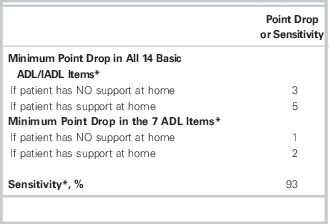
* Meet or exceed expectations for 90% of participants
The distribution of physician responses, to determine a clinically significant point drop, as well as the required sensitivity, is graphically presented in Figures 1 and 2. In general we found a small variability among the emergency physicians on the required sensitivity and the clinically significant point drop to define functional decline. There was, however, a notable variability among the physicians regarding the point drop deemed to be clinically significant when considering all 14 ADL items in a patient with support at home.
Boxplots Showing Distribution of Emergency Physician Responses Regarding a Clinically Significant Point Drop Deemed to Imply Functional Decline

Boxplot Showing Distribution of Emergency Physician Responses for the Required Sensitivity of a Clinical Tool

Assessment for and relevance of ADL to functional decline
Figure 3 provides physician attitudes on the assessment and importance of activities of daily living on functional decline. This illustrates that most emergency physicians do not assess elderly injured patients for the majority of the tasks, even when the tasks are felt to be important.
Percent of Emergency Physicians who Perceive Activity of Daily Living to be Very or Somewhat Important in Terms of Performance by Patients (dashed lines) and Percent of Emergency Physicians Always or Often Asking if Patients Have Difficulty Performing Activity of Daily Living (solid bars).

DISCUSSION
With an increasing geriatric population and concomitant burden on EDs, it is essential to develop clinically useful tools to improve ED efficiency. One example would be a tool to identify elderly patients at high risk of functional decline following a minor injury. Screening tools, such as the Hospital Admission Risk Profile (HARP), Identification of Seniors at Risk (ISAR), Triage Risk Screening Tool (TRST), and Score Hospitalier d’Evaluation du Risque de Perte d’Autonomie (SHERPA) exist to screen for functional decline, but are not specific for functional decline in elderly patients after minor injuries.Reference Hebert 16 , Reference Hoogerduijn, Schuurmans and Duijnstee 17 , Reference Hastings and Heflin 25 , Reference Aminzadeh and Dalziel 26 We conducted this study of emergency physicians to define what constitutes a clinically significant functional decline six months after sustaining a minor trauma.
MCID and required sensitivity
We found that 90% of emergency physicians deemed a drop in function of at least three points (i.e., the MCID) on the 28-point OARS ADL Scale as clinically significant when considering all 14 basic ADL and IADL items. When only the seven basic ADL items are considered, 90% of emergency physicians deemed a drop in function of one or more points to be clinically significant. Physicians were asked for their opinions on the point drop based on whether the patient had support at home or not, since a number of physicians in our key informant interviews had raised the issue and suggested we ask the questions separately. We found that a tool to detect previously independent patients at risk of a functional decline at six months post injury would require a sensitivity of 93% to meet or exceed requirements for 90% of emergency physicians. We opted to consider the 90th percentile more important than the mean or the median, because we would desire that a vast majority of physicians be satisfied with the outcome measures; medians would satisfy only half of the physicians.
In our study, only 25% of the physicians had indicated they would accept a sensitivity of up to 80%. Despite the fact that the most commonly used tool (ISAR) has a sensitivity of 81%,Reference Fillenbaum 30 , Reference Breithaupt and McDowell 34 90% of our study participants indicated that they would require a more sensitive tool. Our results suggest that this tool is not sensitive enough to be acceptable for 75% of our respondents (i.e., the percent of our respondents requiring a sensitivity of greater than 81%, which is the sensitivity of the ISAR).
Our results suggest that the basic ADL items are weighted more by emergency physicians than the IADL items. The importance of the basic ADL items to functional decline is shown by the participants’ responses of a smaller clinically significant point drop in the basic ADL compared to the combined basic ADL and IADL items. As the OARS ADL Scale uses a combined score (basic ADL+IADL) with no weights given to the items, caution should be exercised when using the overall OARS ADL Scale. These findings on the importance of the basic ADL items over the IADL items should be considered when determining the outcome measure of a clinical tool for identifying elderly patients at high risk of functional decline after a minor injury.
Assessment and relevance of ADL to functional decline
A high proportion of emergency physicians do not assess the patients on all the basic ADL and IADL items, despite their opinions on the high importance of the tasks to functional decline.Reference Wilber, Blanda and Gerson 3 , Reference Nankhonya 39 , Reference Sanders and Morley 40 A number of reasons may exist for this gap between knowledge and actual practice. As reported by previous studies, emergency physicians almost always face time pressures to treat patients, due to a high patient volume, and typically do not have the luxury of time to assess for functional decline.Reference Wilber, Blanda and Gerson 3 , Reference Nankhonya 39 , Reference Sanders and Morley 40 Under-assessment of this nature can become especially problematic when the injuries of the elderly patients are not apparent at the time of ED visit, potentially leading to functional decline weeks and months later. For example, soft tissue injuries, such as sprains and contusions, are often less apparent on an initial assessment, and may be overlooked by emergency physicians with regards to functional decline. Our findings suggest that emergency physicians are aware of the importance of the basic ADL and IADL items in terms of functional performance by elderly patients, but do not routinely assess them. A clinical decision rule that identified patients at high risk of functional decline following a minor injury could help close the gap between physician knowledge and actual clinical practice pattern.
Respondents
Our response rate of 51.9% is consistent with research suggesting that response rates of between 34% and 70% are typical for physician surveys.Reference Grava-Gubins and Scott 41 - Reference Thorpe, Ryan and McLean 43 It is also close to the mean response rate of 54% reported by a systematic review of physician postal surveys.Reference McCusker, Bellavance and Cardin 32 , Reference McCusker, Bellavance and Cardin 35 Our rigorous methodological approach, including key informant interviews, cognitive interviews, pilot-testing, short and concise questionnaires with incentives to half of the physicians, and a special contact, optimized our response rate and yielded very few missing data.
The distribution of the respondent characteristics was not surprising. The higher proportion of male participants is consistent with the gender distribution of the population of practicing Canadian physicians in Canada. 44 Further, our data did not suggest any evidence of non-response bias, although this still cannot be entirely ruled out.
LIMITATIONS
This study has a number of limitations that should be considered. We found a small number of physicians who had retired or moved who were still in the Canadian Medical Directory. It is possible that the directory was missing some physicians, potentially leading to enrollment bias. We feel that any such limitations are minimal, as the Canadian Medical Directory claims to be at least 97% accurate, and was the best physician directory we could identify and utilize. 38 Measurement error regarding the point drop value is possible, as it is likely participants envisioned different injuries and scenarios when providing their opinions on the point drops.
Another potential limitation of this study is that the OARS ADL Scale we used does not weight the ADL items, in contrast to other assessment instruments where weights apply to different ADL items. However, the OARS ADL Scale has been validated in the ED, and is anticipated to be used in the ED, and so we elected to use this tool in our study.
Finally, as this study was a self-administered postal survey, it was potentially susceptible to “social desirability bias,” in that physicians might have responded based on an ideal practice scenario rather than their actual practice or attitudes.
CONCLUSION
Our results indicate that a minimal clinically important difference in function—one that would satisfy 90% of emergency physicians—is three points on the 28-point OARS ADL Scale. When considering only the seven basic ADL items, the minimal clinically important difference is one point. Moreover, a sensitivity of 93% would meet or exceed 90% of emergency physicians' requirements for any clinical tool to identify injured seniors at high risk of functional decline six months post injury. We anticipate that these findings will help our study group identify clinically relevant outcomes for a future clinical decision rule, in contrast (for example) to what the general population might perceive as an appropriate outcome.
Currently, a high proportion of emergency physicians indicate that they do not assess patients for functional decline. Such an under-assessment may lead to severe health outcomes, including functional decline at six months post minor injury. We feel that increasing physician awareness of the potential seriousness of apparently “minor injuries” in otherwise independent seniors is important. Development of a clinical decision tool may help emergency physicians identify elderly patients at high risk of functional decline, and our plan is for the results of this survey to inform the development of such a rule. A validated clinical decision rule could help emergency physicians take appropriate steps, such as referring the patient to a geriatric assessment clinic, to prevent functional decline from even occurring in high-risk elderly trauma patients.
Competing Interests: Funding by Canadian Institutes of Health Research (CIHR) for the Canadian Emergency Department Team Initiative (CETI) in Mobility in Aging (Grant # AAM-108750) and the University of Ottawa Department of Emergency Medicine.



