

Aerial view of the Cross Roads site. (Photo courtesy and © I.A.P).

On 10 November 2003, a unique event in world archaeology took place in the Belgian town of Ypres. Minister Paul van Grembergen announced the official opening of the Department of First World War Archaeology, part of the Institute for the Archaeological Heritage of the Flemish Community (IAP). The new department is supported by the province of Western Flanders, the combined Flemish universities, the Belgian Army's Service for the Disposal and Demolition of Explosives (DOVO), associations of amateur archaeologists, and a wide range of international collaborators.
The aims and objectives of the department are clearly defined, and can be expanded as required. The first goal is undertaking archaeological research, making inventories, and site management - all integrated aspects of the region's First World War heritage. It is hoped that one result of this initiative will be to produce databases that will unlock Western Flanders' war-related archaeological heritage, and support many kinds of associated cultural and tourism initiatives.
Equally important will be the new department's responsibility for directing, monitoring, and co-ordinating the abundant and diverse private activities and initiatives undertaken by museums, amateur excavators, historians, and other interested parties. A unique feature of the First World War is that, in addition to military historians, it attracts a large and wide-ranging number of specialist groups. Together, they form a rich repository of specialised knowledge on such varied topics as trench and dugout construction, military maps, uniforms and equipment, armaments, munitions, and memorabilia. The department's formation provides a legally constituted scientific forum for this vast amount of currently fragmented expert knowledge. This forum will be a critical resource for the IAP's professionals, who in turn will provide a modern archaeological context and guidance for amateur groups that will result in greater understanding and co-operation.
Removal of top soil at Cross Roads site. (Photo courtesy and © I.A.P).

The remains of a British soldier found at the Cross Roads site. (Photo courtesy and © I.A.P).

First World War archaeology is a distinctively new kind of archaeology (Reference SaundersSaunders 2002:107), and part of a larger enterprise, the archaeology of twentieth-century conflict. First World War battlefields are multi-layered and deeply ambiguous landscapes. They can be considered, variously, as:
... industrialized slaughterhouses, vast tombs for 'the missing', places for returning refugees and contested reconstruction, popular tourist destinations, locations of memorials and pilgrimage, sites for archaeological research and cultural heritage development, and as still deadly places full of unexploded bombs and shells.
Reference SaundersSaunders 2001:37This complexity demands a multidisciplinary archaeological response, informed by anthropology, and drawing on the expertise of military history, cultural geography, museology, and those who specialize in forensics, cultural heritage, and tourism to mention only the most obvious.
The initial stimulus for the department's creation was the IAP's excavation at Pilckem Ridge in the middle of the infamous Ypres Salient battlefield. Pilckem Ridge saw fierce fighting and terrible losses on both sides during the Third Battle of Ypres (Passchendaele) in July and August 1917, and lay on the route of an extension to the A19 motorway. The IAP has been conducting archaeological reconnaissance in the area since 2002.
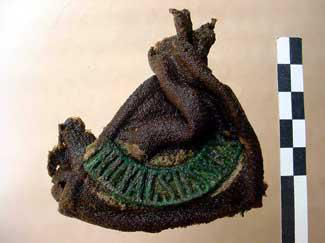
Part of the equipment of a British soldier of the Royal Sussex regiment. (Photo courtesy and © I.A.P).

The investigations quickly demonstrated the need for professional archaeological engagement with the First World War. Site damage by construction activities, illicit digging by collectors of military equipment, and natural erosion represented serious losses of archaeological information. The IAP decided to act, and gave the highest priority to creating the first ever department dedicated to First World War Archaeology. This was a bold step for a new and as yet un-theorised kind of archaeology confronted with formidable methodological challenges.
In landscapes containing innumerable human remains mixed with volatile ordnance in front-line trenches, bomb craters, emergency hospitals, and dugouts, new investigative techniques had to be developed. Building on the IAP's longstanding expertise, these techniques embraced and adapted GIS modelling, systematic metal detecting, geophysical research, trial trenches, and open-area excavation. The A19 excavations have played, and continue to play, a critical role in shaping a highly-focused methodology for First World Archaeology in this small part of Western Flanders.
Shoulder badge of a British soldier of the Royal Sussex regiment. (Photo courtesy and © I.A.P)

The IAP's preliminary research at the Pilckem Ridge site consisted of an extensive survey of the literature, trench maps, and contemporary 1914-18 aerial photographs. Trench systems (marking successive front lines), barbed wire entanglements, bunkers, and dugouts were plotted on modern maps. Subsequent field-walking helped fill in the picture by finding the remains of bunkers and concentrations of other wartime material. An important anthropological dimension of this work was the creation of a battlefield ethnography - contacts and interviews with local residents that proved very informative. In light of this preliminary research, nine zones were selected along the route of the planned A19 extension.
To date, two of these zones have been investigated by trial trenches, and two other areas are being fully excavated. The results so far are promising: trenches and shelters are very well preserved. The remains so far show a clear distinction between German and British structures. Besides a clear chronological development, a military evolution can also be discerned. There is also a diversity of smaller, portable, archaeological remains such as ammunition, entrenching tools, soldiers' equipment, and utilities.
Military actions are most comprehensible when human remains are found. So far, seven different individuals have been recovered. Two were preserved with their full equipment (i.e. webbing, entrenching tool, pistol, bayonet, and ammunition pouches). These remains are now awaiting reburial by the Commonwealth War Graves Commission.
The IAP will be actively seeking co-operation with international specialists and institutions, amongst others, who can help in the multidisciplinary approach that a scientific archaeology of the First World War requires. The input of international researchers is seen as vital to the success of the new department. Information and expertise provided by universities, museums, and other organizations will enable the IAP's local archaeologists to identify and interpret recovered structures, artefacts, and human remains. It is acknowledged that it will take many years to build an appropriate methodology for this new kind of archaeology within the Flemish archaeological community.