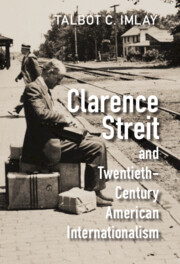


On a warm Washington, DC evening in mid-May 1979, a reception got underway in the speakers’ dining room in the Capitol building. Cohosted by Paul Findley, a Republican representative from Illinois, and Jim Wright, a Texas Democrat and the House Majority leader, and chaired by Tip O’Neill, the House speaker from Massachusetts, the reception celebrated Clarence Streit, described as the “founder of the Atlantic Union movement and author of ‘Union Now.’” Successive speakers affectionately recalled Streit’s four decades of dedication, in Findley’s words, to the cause of “greater unity among the nations which prize individual liberty.” Wright bestowed on the guest of honor an award named after Estes Kefauver, the deceased senator from Tennessee, former vice-presidential candidate, and Streit’s political ally during the 1950s. Other tokens of admiration included a card signed by almost 200 well-wishers, as well as a book of “congratulatory messages” with entries from former presidents Nixon and Ford, among other political luminaries. Accompanied by Jeanne, his wife and collaborator of over five decades, Streit characteristically urged the attendees to continue the couple’s work. His appeal, though, did little to dent the pervasive sense of nostalgia, of bygone times, and vanishing possibilities. Afterward, Streit quickly faded from view, his death in 1986 at the age of ninety marked by perfunctory obituaries.Footnote 1 Today, he is all but forgotten.
Yet not so long ago, as the reception in the speakers’ dining room indicates, Streit was a well-known political figure in the United States. The New York Times’ correspondent in Geneva covering the League of Nations during the 1930s, Streit shot to prominence in 1939 with the publication of Union Now: A Proposal for a Federal Union of the Democracies of the North Atlantic. The book contained a remarkable proposition: that the United States seize the initiative in creating a federation of the Atlantic democracies modeled on the US Constitution. The American federal system, devised in the 1780s for a union of the former thirteen colonies, would now be super-imposed on the transatlantic world, encompassing the United States, Canada, the countries of Western and Northern Europe, and Great Britain (and possibly the British Commonwealth). Against all expectations, except Streit’s, Union Now attracted considerable attention, going through multiple editions and inspiring reams of commentary. Henry Luce’s now-iconic 1941 editorial in Life magazine, “The American Century,” provides one sign of its visibility. “[N]o thoughtful American has done his duty to the United States of America,” the media mogul asserted, “until he has read and pondered Clarence Streit’s book …”Footnote 2
The publication of Union Now was just the beginning. Convinced that Atlantic federal union held the key to US foreign relations, Streit quit the New York Times to devote himself to promoting the project, a crusade he would doggedly pursue over the next four decades. In the process, Streit became a recognizable presence not only in Washington political circles but also among a larger public. In March 1950, he featured on the cover of Time magazine, another piece of Luce’s media empire, and the accompanying article likened him to the abolitionist William Lloyd Garrison, the suffragette Susan B. Anthony, and the socialist Eugene Debs, among others – “the reformers, the crusaders, sometimes the bores or the screwballs, sometimes ineffectual, sometimes movers of the world.”Footnote 3 The same year Streit was one of six Americans nominated for the Nobel peace prize; the others included Harry Truman; George Marshall, the former secretary of state; James Shotwell, the longtime internationalist; Raphael Lemkin, the principal drafter of the United Nations’ genocide convention, and Robert Hutchins, the educational philosopher and Chancellor of the University of Chicago.Footnote 4
This visibility notwithstanding, Streit is almost entirely absent from twentieth-century US history. Occasionally, he receives passing mention in a book or article, most often in reference to Union Now’s publication, leaving an impression of fleetingness. Similarly, his project has been cited as evidence of an upsurge in “globalist ideologies” in the United States (and Britain) during the 1940s, a phenomenon with limited staying power.Footnote 5 To be sure, the scholarship on world government constitutes an exception to the neglect of Streit. Often melding analysis with advocacy, students of the world government movement present Streit as a pioneer and Union Now as a founding text. This twinning of Streit with world government lends his project a decidedly quixotic flavor, helping no doubt to explain the larger scholarly disinterest.Footnote 6 There is an irony here, for Streit persistently labored to distance himself from world government. Throughout his lengthy career, he promoted Atlantic federal union – a significantly different though still hugely ambitious project.
Drawing on an array of published and unpublished sources, Clarence Streit and Twentieth-Century American Internationalism provides the first study of Streit’s promotional activities during the wartime years and postwar decades. In so doing, it writes Streit and his Atlantic federal union project back into US history. The purpose is not to identify a missed historical opportunity – a task familiar to historians in general and often accompanied by bows to the importance of contingency. Truth be told, Streit’s project had little chance of being realized, requiring, as it did, the United States (as well as several other countries) to agree to transform their political-constitutional structures. Instead of excavating a now-imperceptible but once-plausible “might-have-been,” the book uses Streit’s activities to address a question of enduring pertinence: How or why do some policy ideas gain public and political traction? In Streit’s case, the search for answers leads to an exploration of the “public politics” of foreign relations during a critical time when the United States metamorphosed from a major but still mostly regional power into a superpower with global pretensions and reach. Streit’s experience as a foreign policy entrepreneur shadowed this metamorphosis, and a study of his career highlights the vital yet hitherto neglected influence of federalist and Atlanticist ideas in the efforts of mid-century Americans to rethink international politics and their country’s role in them.
In promoting Atlantic federal union during and after World War II, Streit mixed and matched several strategies. One involved the courting of a fairly select group of people, those whom Elmo Roper, the prominent pollster and Streit collaborator, termed the “Great Disseminators”: National figures, such as Luce, whose status, position, or wealth gave them a say in ongoing debates on the United States’ place in the world.Footnote 7 A second strategy aimed at mobilizing grass-roots support, principally in the form of a national movement organized into local chapters. A standard practice among political movements at the time, the creation of chapters proved fraught with difficulties for Streit. As a case study, it suggests the need to nuance claims of a collective boom of “civic voluntarism” in the United States across the wartime and postwar years.Footnote 8 At the grass-roots level, Streit hoped to recruit the “Lesser Disseminators,” local versions of Roper’s “Great Disseminators”; in practice, he relied on coteries of devotees, often women (such as his wife Jeanne) performing the gendered part of under-paid or unpaid seconds.Footnote 9 A third strategy consisted of political lobbying, primarily of Congress, an institution that not only clamored for a more active role in foreign relations but also functioned as a valuable platform for policy entrepreneurs such as Streit.Footnote 10
Taken together, Streit’s promotional strategies illuminate the public dimension of politics in the foreign relations realm. A good deal of scholarship on wartime and postwar US foreign relations examines the politics of policymaking, much of it occurring in the corridors of the country’s burgeoning national security state, largely beyond public view.Footnote 11 Yet there was another, parallel and more accessible, dimension to politics. In some ways, this dimension resembles what Daniel Drezner, borrowing from political economy, refers to as the “modern marketplace of ideas” in the United States.Footnote 12 Although Drezner studies the contemporary period, Streit during the mid-twentieth century operated in a vibrant marketplace of foreign policy ideas in which a variety of participants – foundations, think tanks, interest groups and movements, newspaper and magazine editors and journalists, as well as clusters of politicians, experts (academic and nonacademic), public commentators, and activists – all vied for public attention. As with all markets, the participants in this marketplace were not equally competitive. Better positioned and endowed with more resources, some possessed greater market power and thus greater visibility.
But if the marketplace of ideas usefully highlights the competitive environment in which Streit operated, the concept risks downplaying another and crucial element of his activities – their political nature. In the early modern Republic of Letters, probably the best-known example of a marketplace of ideas, success was defined in terms of money (finding a wealthy patron) and reputation.Footnote 13 Streit’s priority, however, was to shape US foreign relations. And this is why the marketplace of ideas needs to be enfolded into another concept, that of the public dimension of politics. Its contours were (and are) fluid and its component parts shifting, frustrating attempts to define this dimension in abstract terms. One scholar, for example, talks vaguely of an “intricate midcentury matrix.”Footnote 14 Accordingly, it is more useful to conceive of this dimension as a function of the porous nature of policymaking in the United States. A number of factors (multiple branches of government, a popular suspicion of centralized authority, a dynamic mediascape, overlapping public, semi-public and private spheres) combined to open the making of foreign (and domestic) policy to public participation, to entangle policymaking in public politics.Footnote 15 More precisely, this porousness offered diverse entry points for outsiders – those who, such as Streit, lacked the institutional base or proximity to power of the influential insiders whose impact on US foreign and defense policies has become the subject of a thriving scholarship.Footnote 16
Determined and resourceful, Streit embraced the public dimension of politics, capitalizing on its possibilities and openings to gain visibility and even legitimacy for a project involving a far-reaching reconceptualization of US foreign relations. A study of his extensive promotional activities thus provides a practical and intimate perspective on this public dimension, highlighting its functioning as well as the opportunities and frustrations it engendered. Such a study, moreover, presents something of a mid-range option in relation to two other approaches to public politics. One approach centers on Congress and on the political calculations and maneuverings of its members, while the other explores the production and reproduction of an ambient Cold War culture and consensus. If the political realm in the first approach is arguably construed too narrowly, excluding actors such as Streit, in the second it risks becoming all-embracing, leaving little room for alternative policy visions and projects.Footnote 17
Streit operated in this public dimension of politics for well over four decades, gaining public visibility and political legitimacy in the process. This achievement, in turn, allowed Streit to insert his Atlantic federal union project into two major debates on US foreign policy at the time: the nature of the postwar international order and the nature of transatlantic relations.
World War II witnessed a pivotal domestic debate on the postwar international order and the United States’ role in it. More recent studies of this debate have undermined the older binary view of a straightforward struggle between isolationists and internationalists, convincingly demonstrating that so-called isolationists were an eclectic bunch, interested not so much in preventing US interactions with the wider world as in placing limits on them.Footnote 18 Similarly, internationalists now appear as a diverse group, resulting in divergent assessments of wartime internationalism. While many scholars continue to see the wartime years as foundational in the US-led construction of a liberal international order based on multilateral cooperation rooted in democracy, liberalized exchanges, international organizations, and human rights, this generally positive viewpoint has been challenged. For Stephen Wertheim, the origins of Washington’s outsized, ongoing, and disastrous quest for global supremacy are to be found in the early wartime years when US planners responded to the prospects of a Nazi victory in Europe. An emerging third current, meanwhile, identifies the war as a time of rising global awareness among the informed public, though the policy implications of this globalism appear more elusive.Footnote 19
Absent from this buoyant scholarship are other possibilities for international order circulating during the war, conspicuous among them federalist frameworks. Thanks in good measure to Streit’s tireless promotional efforts, federalism imposed itself in wartime debates as a way of understanding international order and, more particularly, the issue of national sovereignty – an issue that had so vexed interwar thinking on international politics in the United States. Presented by Streit as a quintessentially American method, one sanctified by the country’s own history, federalism shifted the locus from an either-or proposition (retention or loss of sovereignty) to the practical issue of apportioning jurisdiction. In a version of what political scientists call the domestic political analogy, in which the internal becomes the archetype for the external, federalist frameworks worked to domesticate international relations for a US audience. In the wartime debate on postwar international order, they assumed a structuring function, quickly emerging as an alternative to the interwar order centered on the League of Nations, widely judged to be a failure. At the same time, federalism proved to be a plastic concept, facilitating not only its detachment from Streit’s project of Atlantic federal union but also its appropriation by advocates of a revamped League of Nations. These advocates would deftly employ federalist language to promote what became the United Nations Organization (UNO) and, more generally, to rehabilitate international organizations as a pillar of postwar international order. In a bitter irony for Streit, the wartime visibility of federalist frameworks facilitated the very outcome his project was designed to avoid.
The second major foreign policy debate influenced by Streit’s Atlantic federal union project involved transatlantic relations. Two distinct approaches dominate the scholarship on the subject. An older and still venerable one focuses on interstate relations, and is well represented, for example, in recent studies of NATO. The principal actors are presidential administrations and their high-ranking members. The second approach explores the cross-ocean activities of a variety of non-state actors: the bankers, philanthropists, academics, businesses, foundations, and think tanks among others who collectively constituted what one scholar calls the “transnational transatlantic.”Footnote 20 Together, these two approaches go far in explaining how the Atlantic and especially the North Atlantic came to be widely perceived as a distinct region whose member countries were tied together by multiple and crisscrossing ties, forming what the journalist Walter Lippmann imagined as early as 1917 as a “community.”Footnote 21
A study of Streit’s activities encompasses both state and non-state actors. And it does so by drawing attention to an issue that was much discussed at the time – that of the appropriate political configuration for transatlantic relations. During the 1950s and into the 1960s, an emerging consensus developed in Washington political circles that transatlantic relations required a political structure, something more elaborated than NATO as a military alliance could furnish. A prolific advocate of this position was Henry Kissinger, at the time an ambitious Harvard lecturer. Positioning himself as a critic of current policy, Kissinger contended in a series of highly visible publications that the moment had arrived “to examine carefully the possibility of creating federal institutions comprising the entire North Atlantic community …”Footnote 22 The Streitian language was not fortuitous, for Streit, principally through the Atlantic Union Committee (AUC), a political lobby group created in 1949, had contributed as much – and probably more – than anyone to foster the idea of NATO’s political inadequacy. Indeed, from the outset, Streit threw himself into the AUC’s lobbying campaign, seeking to direct it toward his ends.
With a hyper-active Streit as member, the AUC pressed Congress to call for a convention of NATO countries to explore proposals for greater political unity. A focus on Congress offered a means to bypass the hesitations of the Eisenhower Administration and the State Department, while also ensnaring both in a bargaining process between the executive and legislative branches. An extensive lobbying campaign resulted in the passage of a congressional resolution in 1960, followed by a convention in January 1962. Yet in another bitter irony for Streit, the upshot proved disappointing. His forceful advocacy of Atlantic federal union motivated a prominent group of Atlanticists, many of them AUC members or supporters, to articulate an alternative “community” vision of transatlantic relations (or Atlanticism). Explicitly rejecting formal structures such as federal union, these Atlanticists countered that the Atlantic community’s political framework should be left to develop organically (or functionally). More concretely, they envisaged a political community guided by networks of like-minded transatlantic elites centered in and on Washington. The Atlantic Council, the AUC’s institutional successor, quickly became the leading voice of this Atlanticism. Today, it is a high-powered and well-funded Washington organization.
Several points are worth emphasizing in regard to Streit’s influence on US foreign relations. First, this influence stemmed from his ability to operate within the public dimension of politics and to exploit the opportunities and openings it provided. Second, influence did not necessarily translate into success: After all, Streit’s Atlantic federal union remained unrealized. But if this failure was arguably predictable, it makes the public visibility and political legitimacy Streit attained for his project all the more remarkable – and deserving of study. It is worth adding that, along the way, Streit did succeed in influencing two major foreign policy debates, just not in the way he envisioned. In the end, his project functioned as a foil, facilitating the articulation of alternatives which would mark US foreign relations after 1945, whether in terms of an international order centered on international organizations such as the UNO or of a community-oriented Atlanticism. Streit’s ultimate disappointment, in short, should not obscure his influence.
Still another point involves the role of federalist frameworks. While scholars have highlighted the importance of federalism to the lively constitutional debates taking place on several continents during the eighteenth and nineteenth centuries, its salience for twentieth-century history is largely confined to studies of the European Union or, most recently, of decolonization in which federalist frameworks appear as a promising if unrealized third way between empire and nation-state.Footnote 23 A study of Streit’s promotional activities suggests the need to incorporate the United States into the scholarship on twentieth-century federalism. It was not simply that the US federal system continued to offer a potential model for nation-makers in various parts of the world. Federalist frameworks also intrigued many Americans. Indeed, a veritable political cult of the federal system flourished in the United States during the interwar years, furnishing a receptive audience for Streit’s argument that federalism offered a home-grown and time-tested conceptual tool and even blueprint for international politics.
Two additional points are worth making, one regarding the book’s American-centrism and the other the Western-centrism of Streit’s Atlantic federal union. Although Streit’s project encompassed several countries, Clarence Streit and Twentieth Century American Internationalism concentrates almost entirely on Streit’s promotional activities at home. The focus is explained by Streit’s belief in the indispensability of the United States to Atlantic federal union: He presumed other countries would follow Washington’s lead, a presumption that reflected considerable complacency toward the outside world in general. This complacency, which was hardly unique to Streit, is pertinent to ongoing debates among historians of US foreign relations on the question of perspective. While some favor an international perspective, encouraging efforts to integrate their field into a more expansive international history, others argue for a national perspective that would root or re-root the field more firmly in US history.Footnote 24 There is much to be said for both perspectives, and there is certainly considerable middle ground between them.
That said, a study of Streit’s promotional activities does highlight the insular and parochial aspects of the public dimension of politics in the United States. Non-American voices were rare and knowledge of Europe and its politics often superficial. What mattered most was what the various (US) participants told one another and what they could convince one another was going on. The impression sometimes is that of a game of mirrors in which cascading perceptions of an object define reality. In a happy irony for Streit, the insularity and parochialism of the public dimension of politics likely helped more than harmed his efforts, allowing him to claim that Atlantic federal union enjoyed significant support both abroad and at home.
As for Streit’s Atlantic federal union, it was indisputably Western and even white-centric. The historian Gary Gerstle has diagnosed a pervasive “racialized nationalism” during the Roosevelt years manifest in the belief in the superiority of white and especially “Nordic” peoples.Footnote 25 Although Streit was no doctrinaire racist, and genuinely disapproved of the treatment of African Americans under Jim Crow, he shared popular assumptions about the geographic, racial, and ethnic hierarchies embedded in international politics. For Streit, the Atlantic countries formed a distinct region construed along broadly civilizational lines – with a common history and culture, as well as a shared political development culminating in democracy, a regime type he came to fetishize. Like so many others, Streit readily accepted that the Atlantic or Western world constituted a higher and more advanced civilizational form than other regions, a proposition that conveniently justified their exclusion from his project.Footnote 26 Similarly, he treated empire largely as an afterthought despite the reality that several member countries of his projected Atlantic federal union possessed overseas empires, not least the United States.Footnote 27
The omission of vast swathes of the globe’s regions and peoples constituted a major weakness, especially in the context after 1945 of a Cold War rivalry assuming global proportions. Eminent anti-imperialists, such as George Orwell, Jawaharlal Nehru, and W. E. B. Du Bois, certainly criticized Streit’s project on these grounds. Yet however merited their criticism, the public visibility and political legitimacy Streit’s project garnered underscores another consideration: Even at a time when international relations were becoming more global in scope, when other regions were vying for attention, the West, and the Atlantic world in particular, continued to occupy a prominent and even preeminent place in US foreign relations. One reason they did so certainly had to do with widespread ethnic/racial assumptions, but another and related reason is that Streit and other Atlanticists worked long and hard to promote the Atlantic world. The regional hierarchies underpinning US foreign relations (just as the definitions of regions themselves) are never permanently fixed but rather are the sometimes fragile and always contingent result of political contest.Footnote 28 And as Clarence Sreit and Twentieth-Century American Internationalism shows, the public dimension of politics was a vital element of this contest.
Book Outline
The book comprises five chapters together with an Introduction and Conclusion. Chapter 1 considers Streit’s career as a foreign correspondent, particularly his lengthy posting in Geneva with the New York Times. It frames his growing interest in Atlantic federal union as a response, not simply to first-hand experience of the League’s (mal)functioning during the 1930s but also to tensions within the profession of foreign correspondent arising from the imperative of objectivity. Chapter 2 focuses on Union Now, Streit’s first and best-known book, published in 1939, spotlighting the interaction of two factors to explain its visibility: Streit’s energetic promotional campaign and federalism’s prominent place in interwar US political culture. Chapter 3 examines Streit’s wartime activities on behalf of federal union, which included the creation of a national movement with local chapters as well as direct political action. Significant in this second category of activities was his involvement in the Commission to Study the Organization of the Peace (CSOP), a semi-official grouping that played a key role in designing and championing the UNO as a pillar of postwar US internationalism. Streit’s unwillingness to collaborate meaningfully with the CSOP left him with inadequate means either to promote his own project or to counter the appropriation of federalism for other ends.
The final two chapters investigate Streit’s postwar activities. Chapter 4 centers on his educational activism, whose principal vehicle was Federal Union, an organization founded during the war, and which in 1946 launched a monthly magazine, Freedom & Union, to stimulate discussion of Atlantic federal union and of federalist frameworks more generally. Political and financial considerations prodded Streit to champion abstract principles of democracy, freedom, and liberty, which further Americanized his project by rooting it in dominant Cold War ideological paradigms while also eliding differences between the United States and Western European countries. Chapter 5 concentrates on Streit’s efforts as a political lobbyist, primarily with the AUC, a vocal proponent of Atlanticism during the 1950s and into the 1960s. If Streit’s federal union project represented one version of Atlanticism, the AUC’s extended give-and-take with Congress acted as a midwife to the emergence in the early 1960s of an opposing version. Imagined as a community of transatlantic elites, this Atlanticism continues to dominate Washington politics today. The Conclusion briefly recapitulates the book’s principal arguments.
