


1. Introduction
Processing textual data that contains sensitive or proprietary information poses a central challenge for organizations seeking to utilize machine learning (ML). Legally, the General Data Protection Regulation (GDPR) provides only two categories for privacy-preserving data transformations: anonymization and pseudonymization (Art. 4). Both categories, however, are poorly suited for scenarios where semantic fidelity is essential. Anonymization typically removes information to the point where domain semantics are lost, while pseudonymization preserves structure but retains re-identifiable elements.
To address this gap, we propose using neutralization as a technical intermediary approach tailored to ML training on sensitive or proprietary data. Neutralization replaces identifiable entities with context-rich, domain-preserving labels that prevent re-identification during model training while maintaining the semantic structures necessary for downstream reasoning tasks. When required, a securely stored label dictionary can be used for controlled re-identification exclusively for validation purposes, without exposing confidential data.
This challenge is particularly pronounced in requirements engineering (RE). RE traditionally depends on human expertise, domain knowledge, and pattern recognition, activities that align closely with the capabilities of large language models (LLMs). At the same time, RE artifacts are among the most sensitive assets organizations possess as they capture customer relationships, intellectual property, product strategies, and contractual obligations. Consequently, the data most needed for developing ML-based RE support systems is also the data organizations are least willing to share, constrained by strict NDAs and concerns over leakage.
In practice, RE datasets draw from heterogeneous sources such as customer interviews, technical specifications, ERP/SAP records, knowledge-management repositories, and regulatory documents. These sources differ widely in format, vocabulary, and abstraction level. Traditional human-to-human processes of assembling and interpreting such data are costly to scale and difficult to standardize across domains. Evolving human-AI-collaboration methods offer relief by delegating routine reformulation tasks to AI systems while human experts retain contextual decision-making (Reference Moruzzi and MargaridoMoruzzi & Margarido, 2024). Yet cross-domain variability and confidentiality constraints limit the ability to train models that generalize beyond organization-specific artifacts.
A further obstacle arises from the need to align automated processing with internationally recognized requirement-writing guidelines such as those encapsulated in ISO/IEC/IEEE 29148 (2018). Traditional anonymization techniques such as replacing entities with generic placeholders undermine this goal as they strip away semantic cues required for learning domain relations, leading to syntactically correct but semantically impoverished outputs that fail to reflect authentic engineering reasoning.
Our work addresses these challenges by demonstrating how security concerns can be reconciled with specific data preprocessing in RE for ML.
2. Background
2.1. Data neutralization techniques
Neutralization applies multiple anonymization techniques to protect sensitive industrial data while maintaining analytical value. Command-injection filtering and canonicalization (Reference JourdanJourdan, 2008) help prevent structural data leakage by normalizing file paths within resource description frameworks. Attribute removal, suppression, and generalization (Reference IyengarIyengar, 2002) eliminate direct identifiers, whereas distortion slightly alters factual values to mask specificity without destroying contextual meaning (Reference Kaptein and Van HelvoortKaptein & Van Helvoort, 2019). Pseudonymization (Reference Sidorenko and KhisamovaSidorenko & Khisamova, 2022) replaces identifiable entities with consistent synthetic references, while k-anonymity (Reference El Emam and DankarEl Emam & Dankar, 2008) and l-diversity (Reference Machanavajjhala, Kifer, Gehrke and VenkitasubramaniamMachanavajjhala et al., 2007) ensure statistical indistinguishability.
Temporal data normalization techniques, including z-score, min–max, and tanh transformations (Reference Singh and SinghSingh & Singh, 2022), stabilize distributions for model input, and graph-based approaches (Reference Ji, Mittal and BeyahMittal & Beyah, 2017) use edge editing and differential privacy to preserve relational integrity. Placeholders can be recognized in zero-shot (Reference Yang, Liu, Xu, Huang, Zhou and TongYang et al., 2022) or few-shot learning settings (Reference Song, Wang, Cai, Mondal and SahooSong et al., 2023) through semantic embeddings or text-based representations (Reference Hassan, Sanchez, Soria-Comas and FerrerHassan et al., 2019). Feature selection identifies variables essential for classification while omitting non-informative attributes, improving model performance, enhancing interpretability, reducing storage demands, and enabling leaner and faster models (Reference Marques and BernardinoMarques & Bernardino, 2020).
While ML models typically perform well within their training distribution, estimating the appropriate level of neutralization for out-of-distribution samples remains challenging. Therefore, ensuring broadly representative datasets is needed for model robustness and practical industry integration.
2.2. ISO 29148 criteria for ML
Product development is increasingly integrating AI into various activities of VDI 2221-1 (2019) (Reference Ataei, Cheong, Grandi, Wang, Morris and TessierAtaei et al., 2025; Reference XuXu, 2025). Recent literature reports attempt to apply RE principles using agents (Reference Jin, Jin, Chen and WangJin et al., 2024), graph-based representations (Reference Cui, Ning, Li, Chen, Yan, Li and YuanCui et al., 2023), or agile software frameworks (Reference Aldave, Vara, Granada and MarcosAldave et al., 2019). However, these approaches do not detail methodologies for transforming textual requirements into ML-ready formats (Reference Xi, Chen and GuoXi et al., 2025). Techniques needed to convert vague customer statements into measurable, implementable data remains largely undocumented; hence, the absence of explicit guidance hinders the development of AI-driven automation tools.
Although existing criteria are valuable for human practitioners, they must be adapted to support AI-centric processing in RE. Our framework adapts ISO 29148 criteria to focus on requirements suitable for automated transformation, retaining criteria essential for ML-ready representations while omitting those dependent on human expert judgment. The retained criteria include singularity (one capability per requirement), verifiability (confirmable by inspection, analysis, demonstration, or testing), unambiguity (only one interpretation), completeness (fully expresses stakeholder intent), and correctness (accurately reflects the original need without hallucination).
Some criteria are renamed to highlight their relevance for AI automation. ISO 29148’s “appropriate” becomes solution independence, underscoring that requirements should describe what must be achieved rather than how. “Conforming” emphasises consistent terminology, discouraging ambiguous synonyms, e.g., consistently using “ship” rather than alternating among “vessel,” “boat,” or “vehicle.”
Feasibility and necessity are omitted as they represent human-to-human assessment that cannot be reliably automated. Expert evaluation remains essential for tasks such as detecting conflicting requirements, risk assessment, and weighting (Reference Guo, Zhang and LianGuo et al., 2021). Because these activities cannot be performed without human-in-the-loop processes, they fall outside the scope of AI automation.
2.3. Requirements engineering aspects
All eight core aspects of RE must remain intact in the conceptual framework. Elicitation (Reference Feng, Marsso, Yaman, Townsend, Cavalcanti, Calinescu and ChechikFeng et al., 2023) involves uncovering stakeholder goals, constraints, and domain vocabulary from heterogeneous and unstructured sources such as interviews, reviews, regulatory documents, and scenarios (Reference Bahn, Corbett and NamBahn et al., 2014). In anonymized data, this requires context-preserving placeholders and ontology-based entity tagging to retain relational meaning.
Analysis ensures both internal quality and external correctness (Reference Cheligeer, Huang, Wu, Bhuiyan, Xu and ZengCheligeer et al., 2022). LLM-assisted feedback loops help detect ambiguity, inconsistency, and incompleteness in anonymized requirements (Reference Ezzini, Abualhaija, Arora and SabetzadehEzzini et al., 2022), supported by iterative expert validation. Formalization for specification sheets (Reference Göhlich, Bender, Fay and GerickeGöhlich et al., 2021; Reference Kogler, Falkner and SperlKogler et al., 2024) transforms informal statements into ISO 29148-compliant formulations, extending quantitative data by explicit verification methods. Continuity, structure, and traceability are maintained throughout the pipeline. Clustering and classification support scalable data use (Reference Dalpiaz, Dell’Anna, Aydemir and ÇevikolDalpiaz et al., 2019; Reference Hey, Keim, Koziolek and TichyHey et al., 2020). Prioritization (Reference Kifetew, Perini, Susi, Siena, Muñante and Morales-RamirezKifetew et al., 2021) ranks requirements according to impact, risk, and feasibility based on available metadata, while conflict resolution (Reference Guo, Zhang and LianGuo et al., 2021) benefits from recorded negotiation rationales and dependency graphs that remain interpretable through consistent placeholder use. Traceability (Reference Das, Deb, Cortesi and ChakiDas et al., 2021) is preserved through stable surrogate identifiers linking requirements to design artifacts, code, and tests, enabling bidirectional tracking. Preserving longitudinal integrity across linked artifacts is essential for complex systems (Reference Gräeßler, Oleff and PreußGräßler et al., 2022), as requirements evolve over RE processes.
3. Method
3.1. Three-phase preprocessing framework
This section introduces a framework for transforming neutralized industrial customer requirements into ISO 29148-compliant product requirements. The methodology addresses the fundamental challenge of preserving semantic relationships in anonymized data, as depicted in Figure 1.
Three-phase framework for privacy-preserving requirements transformation

Figure 1 Long description
Panel A: The diagram begins with neutralized requirements containing placeholders, which are then analyzed. Panel B: The analysis phase involves identifying customer requirements, ambiguities, terms removed, improvements, tolerance, detailed requirements, sub-requirements, and verification. Panel C: The transformation phase applies 42 COSE rules and self-consistency checks to the analyzed requirements. Panel D: The consolidation phase results in a machine learning-ready dataset with multiple abstraction levels. The diagram shows the flow from neutralized requirements through analysis, transformation, and consolidation to create a dataset ready for machine learning.
The framework operationalizes requirement preprocessing through a structured pipeline in which each phase fulfils a distinct quality objective. As shown in Figure 1, neutralized requirements enter the system and pass sequentially through three processing stages, executed via Claude-Opus-4.6 API with 20,000-token limit, for consistent metadata handling and feedback propagation.
In the analysis phase, atomicity is assessed using a decision tree that determines whether a requirement should be preserved as a single unit or split. The transformation phase then branches accordingly: atomic requirements are reformulated into ISO 29148-compliant structures, while compound requirements are decomposed into coherent sub-statements. Finally, in the consolidation phase, all derived outputs are aggregated into a harmonized, ML-ready dataset spanning multiple abstraction levels.
3.1.1. Atomic analysis
The first phase determines the appropriate granularity for each input requirement, balancing between over-splitting (semantic fragmentation) and under-splitting (compound preservation). The task is to evaluate whether a customer requirement is already atomic or must be split. As shown in Figure 1 and detailed in Figure 2, this phase applies a decision tree that integrates structural and semantic analysis.
Detailed view of the decision tree atomic analysis (left); the broken flow illustrates what happens when semantic validation is omitted and splitting is performed purely on structural grounds resulting in data loss (centre); the corrected flow demonstrates how semantic binding between the placeholders time and capacity is preserved in requirements as atomic units (right)

Structural indicators include enumeration detection, where numbered or bulleted lists suggest multiple independent functions. In conjunction analysis, clauses connected by “AND,” “OR,” “FOR,” “WITH,” and “TO” are tested for dependency. Semantically independent terms such as “encrypt data AND notify users” are decomposed, whereas bound expressions such as “operate X days with Y persons” remain unified. Requirement-type mixing (e.g., combining functional, performance, or environmental aspects) is flagged for potential decomposition, guided by the associated verification method.
Requirements containing placeholders undergo minimal linguistic modification to preserve semantic integrity. Initial labels are automatically replaced with context-aware tags to add meaning, for example:
[Cardinal11] (in %) → [MCR_PCT_11], [Cardinal9] (days) → [Days_9].
The framework analyses structural roles such as subjects and conditions to determine whether they collectively describe a single capability or multiple independent variables. By focusing on logical dependencies between placeholders, it can make decomposition decisions without restoring the original terminology. For example, in a statement such as “The [System_X] shall operate for [Duration_Y] with [Capacity_Z],” the new labels reveal relational links between entity, temporal, and capacity attributes, enabling the extraction of multiple independent requirements.
To avoid semantic distortion during decomposition, a parameter-binding taxonomy is applied. Structural pattern recognition identifies the interdependencies that determine atomic integrity. Temporal–capacity binding, for example, in “operate [X] days with [Y] persons,” and performance–range binding capture endurance scenarios and prevent incorrect splitting, while conditional–capability binding distinguishes intrinsic constraints, preserving bound pairs while separating independent environmental descriptors.
For maintaining cross-reference, all decomposed requirements remain contextually linked to the original customer statements. As illustrated in Figure 1, each sub-requirement inherits the source identifier and placeholder set, supporting bidirectional traceability across all transformation stages. The framework thus produces a traceable hierarchy in which anonymized placeholders, semantic dependencies, and verification metadata remain consistently aligned across all requirements of the dataset.
3.1.2. Incorporation of the 42 INCOSE rules based on ISO 29148 requirements criteria
The second phase focuses on quality implementation by aligning all transformed requirements with the ISO 29148 characteristics described in Section 2.2. Each characteristic is operationalized through automated enforcement mechanisms integrated into the pipeline, as outlined in Figure 3.
The 42 INCOSE rules describing ISO 29148 criteria in detail for application

The framework applies the 42 INCOSE rules that translate ISO 29148-criteria into detailed linguistic transformations. Whereas ISO 29148 defines what constitutes a high-quality requirement, the INCOSE rules specify how to achieve it in practice by addressing recurring anti-patterns such as passive voice, vague expressions, or over-complex sentence structures, implemented through few-shot templates. The rules convert ambiguous descriptions into explicit, testable statements, define tolerances, and eliminate subjective or open-ended terms, applicable to both anonymized and vague data.
3.1.3. Consolidation with self-consistency
During the third phase, the consolidation, each requirement, whether preserved in its original form or decomposed into atomic sub-requirements, maintains internal coherence and semantic integrity through a structured object representation. Each transformed statement includes the requirement text, traceability identifiers linking sub-requirements to their original sources, and metadata attributes that support hierarchical alignment. This object-oriented structure preserves the original content, captures contextual information added during preprocessing, and enables detailed backtracking of all transformations. The system enforces self-consistency across requirement levels, ensuring that decomposition preserves intent while reformulated statements align with ISO 29148 (Reference Jin, Jin, Chen and WangJin et al., 2024; Reference Song, Wang, Cai, Mondal and SahooSong et al., 2023).
Self-consistency is maintained through recursive comparison that verifies logical coherence between the original and the transformed requirements. It is checked whether the set of atomic sub-requirements collectively represents the functional scope of the original, and whether any missing dependencies, duplicated intent, or other contradictory specifications are present. Detected inconsistencies, such as mismatched units, lost temporal bindings, and incorrectly assigned verification methods, trigger automatic improvement prompts or insert “[TBD_FIX]” placeholders for expert review, guided by a predefined label dictionary, see Figure 2. The resulting dataset contains uniformly structured, ISO 29148-conform, machine-readable requirements linked by consistent identifiers, preserving engineering integrity throughout anonymized processing.
4. Evaluation
The framework is evaluated using human-centric extrinsic validation criteria (Reference Banerjee and LavieBanerjee & Lavie, 2005) and automatic, training-free metrics (Reference Celikyilmaz, Clark and GaoCelikyilmaz et al., 2020; Reference Sellam, Das and ParikhSellam et al., 2020), as this combination provides robust insights into the quality of the generated requirements.
4.1. Extrinsic evaluation by multiple experts
The extrinsic evaluation was conducted in two phases, each involving distinct industrial experts. In the first phase, the guideline was assessed through sample-based evaluation of anonymized industrial requirements by two systems engineers from an independent company. These experts conducted a comparative assessment of the generated requirements against the original customer requirements, focusing on conformity with the ISO 29148 criteria. Their feedback informed targeted refinements of the framework. A key insight was that requirements containing only one or two variables should not necessarily be decomposed into sub-requirements. Although singularity is one of the seven ISO-derived criteria, decomposition does not automatically improve every requirement; in some cases, it reduces clarity or distorts meaning. In response, we integrated a systematic reasoning loop into the pipeline to evaluate whether decomposition is appropriate based on structural and semantic criteria, see Figure 1. This modification increased the robustness and contextual sensitivity of the framework.
Following these refinements, the pipeline generated a new set of outputs. A domain expert from the contributing organization then conducted a second evaluation, assessing both the neutralized and the vague requirements from the perspective of a requirements engineer.
This dual evaluation, which comprised expert assessment in the originating company and independent cross-validation by two external systems engineers, demonstrates that both the anonymized and the vague datasets can be effectively processed by the framework. The results show that the pipeline enables automated generation of robust, ISO 29148-compliant, and semantically coherent requirements while preserving industrial data integrity across varying levels of input abstraction.
4.2. Automatic evaluation metrics
To assess the generated requirements, we also use automatic evaluation metrics, which can be broadly divided into untrained metrics, not requiring additional model training, and learned metrics based on ML models. We focus on untrained metrics for their efficiency in computing without annotated data.
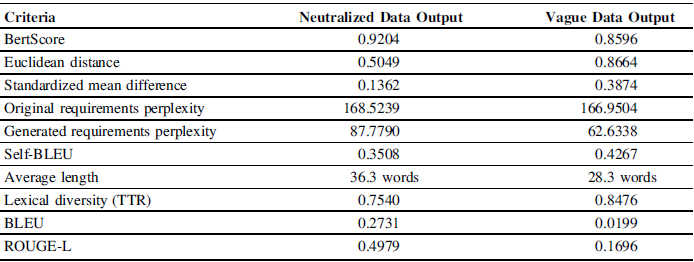
The selected metrics are designed to answer four central evaluation questions: (1) Is the meaning of the original requirements preserved? (2) Is the language of the generated requirements more fluent and well-formed? (3) Is the output less redundant and more diverse across requirements? (4) To what extent did the transformation process rewrite the original requirements beyond superficial edits? These questions guide both the selection and the interpretation of the metrics presented in Table 1.
Mean scoring of the evaluation metrics in the two datasets

Semantic similarity metrics assess whether the generated requirements preserve the intent of the original customer statements. BERTScore (0–1) measures semantic overlap using contextualized embeddings, with values close to 1 indicating strong preservation. Euclidean distance quantifies geometric distance between sentence embeddings, where lower values indicate higher similarity. The standardized mean difference (SMD) transformer computes cosine distance (0–2); values between 0.1 and 0.3 indicate semantically similar but differently phrased text. Fluency and language quality are measured using perplexity, where lower values indicate more natural phrasing (10–50: very fluent; 50–100: acceptable). Higher values (>100) indicate incoherent text. Diversity and redundancy are assessed through self-BLEU (0–1), which measures the average similarity among generated requirements. Low scores (<0.3–0.4) indicate healthy diversity. Additional surface-level metrics, such as average requirement length and lexical diversity (type–token ratio), capture structural consistency across outputs. N-gram overlap is evaluated with BLEU (0–1), where lower scores (0.1–0.3) signal substantial rewriting and higher scores (>0.7) suggest minimal transformation. ROUGE-L measures longest common subsequences with moderate values (0.4–0.6), indicating a balance between technical terminology and informal language.
5. Discussion
The higher scores in the neutralized dataset reflect the quality differential between the two input corpora. The industry dataset contained well-structured initial requirements that were already close to ISO 29148 compliance, resulting in minimal transformation effort and consequently higher BERTScores (0.9204 vs. 0.8596). In contrast, the vague dataset required substantial restructuring of informal customer language, which led to greater semantic distance. The lower Euclidean distance in the neutralized data (0.5049 vs. 0.8664) indicates smaller semantic shifts during transformation, as well-formed inputs needed refinement rather than complete reformulation. A similar pattern is reflected in the SMD scores (0.1362 vs. 0.3874) as neutralized requirements underwent moderate rephrasing while maintaining close semantic proximity, whereas vague requirements required extensive linguistic reconstruction, moving further in semantic space despite preserving core intent.
Perplexity metrics demonstrate significant fluency improvements in both datasets. The original requirements show high perplexity values (168.52 for neutralized data and 166.95 for vague data), both exceeding the threshold of 100, which is unconventional or difficult language. This confirms that customer requirements are typically poorly formulated regardless of technical quality. The generated requirements show substantially lower perplexity (87.78 and 62.63) showing successful transformation into fluent, grammatically coherent specifications. The vague dataset shows a greater improvement (reduction of −104.32 compared to −80.74 for the neutralized data), reflecting heavier restructuring required for informal inputs. Generated vague requirements fall within the acceptable fluency range (50–100), demonstrating that even imprecise language can be systematically refined into professional technical specifications. Combined with high semantic preservation scores, these results show an improvement in linguistic quality without compromising content integrity through the transformation.
The diversity metrics provide critical evidence against template collapse. The self-BLEU scores (0.3508 and 0.4267) fall within a healthy mid-range below 0.5. Because self-BLEU measures average similarity among all generated requirements, these values confirm that the transformation process produces lexically distinct outputs for different functional specifications rather than forcing diverse inputs into a formulaic pattern. The slightly higher self-BLEU in the vague dataset reflects greater structural uniformity in the synthetic input corpus, where similar phrasing naturally propagates through generation. The high lexical diversity (TTR: 0.7540 and 0.8476) indicates rich vocabulary usage and low redundancy, suggesting precise word choice rather than repetitive phrasing. The shorter average length of the vague outputs (28.3 vs. 36.3 words) suggests more concise formulations while preserving functional completeness. Collectively, these metrics show that standardization improves structural consistency without sacrificing the lexical variety needed to distinguish requirements.
The n-gram overlap metrics quantify the extent of linguistic restructuring between original and generated requirements. The lower BLEU score in the vague dataset (0.0199 vs. 0.2731) reflects the extensive reformulation needed to convert underspecified customer language into ISO 29148-compliant specifications. This demonstrates that the pipeline appropriately scales the transformation intensity based on input quality. ROUGE-L scores follow the same pattern (0.4979 vs. 0.1696) with structural reorganization for poorly formed inputs while retaining more sequential structure when neutralized requirements already exhibit reasonable formulation. These low n-gram overlap values, combined with high BERTScores (0.92 and 0.86), provide strong evidence that the transformation process achieves the intended balance: substantial surface-level rewriting to improve compliance while maintaining core semantic content. This pattern confirms that the pipeline behaves appropriately, applying aggressive restructuring where necessary and controlled refinement where the input is already detailed.
6. Limitations
In the following, we discuss potential threats to validity and reflect on the limitations that may affect the interpretation and generalizability of our results.
Construct validity. To assess the extent to which the approach depends on a specific LLM, we evaluated Sonnet 4.5, GPT 5.2, and Gemini 3 Deep Think in addition to Opus. Performance differences across these reasoning-capable models were only marginal, suggesting that the pipeline is not tightly coupled to a specific LLM. However, in-depth reasoning and a strong grammatical understanding of requirement structures proved essential for high transformation quality, indicating that smaller or general-purpose models may not yield comparable results.
External validity. A threat to generalizability arises from the scope of our evaluation data. To mitigate this limitation, we suggest replication using the extended PROMISE datasetFootnote 1 , which is reasonably comparable to our synthetic dataset. Our method currently operates exclusively on textual requirements. Requirements captured as diagrams, drawings, or CAD-based specifications are not yet addressed. Processing such non-textual artifacts would require sufficient contextual information for an LLM for meaningful interpretation.
Internal validity. The expert validation was conducted in a two-step process involving industry practitioners with extensive experience in systems and requirements engineering. While their domain expertise lends credibility to the evaluation, the sample size remains small. We acknowledge this as a limitation and note that a larger expert study would strengthen the empirical foundation of the results.
Conclusion validity. As is common in the RE community, the scarcity of large-scale, balanced datasets poses a threat to statistical conclusion validity. We address this by reporting multiple evaluation metrics and by making our code and synthetic data publicly available for further replication.
7. Conclusion
This work introduced a comprehensive framework for transforming sensitive industrial requirements into ISO 29148-compliant, machine-interpretable artifacts while preserving confidentiality. At the core of the approach is semantic-preserving neutralization, a technique that replaces identifiable entities with context-rich placeholders to retain domain semantics without exposing proprietary information. By positioning neutralization as a technical middle ground between anonymization and pseudonymization, the framework resolves a longstanding tension in RE: the need for realistic, semantically intact datasets for ML development and the obligation to protect confidential industrial data.
A central contribution of this work is the operationalization of ISO 29148 and INCOSE guidelines for automated processing, enabling consistent, high-quality transformations without human intervention during the core pipeline steps. Traditional, human-centric criteria were extended into seven machine-interpretable criteria, enabling decomposition, reformulation, verification assignment, and specification restructuring in a reproducible manner. The integration of the 42 INCOSE rules provides fine-grained linguistic control, systematically addressing ambiguity, vagueness, inconsistent terminology, passive voice, and structural complexity. The combination of semantic placeholders, structural reasoning, and linguistic standardization enables AI-driven transformations that remain fully traceable, auditable, and behaviourally consistent with established RE best practices.
Neutralization is embedded into a three-phase transformation pipeline—analysis, transformation, and consolidation—that operates over both anonymized and vague inputs. The analysis phase determines granularity using structural and semantic signals, supported by a parameter-binding taxonomy that prevents semantic distortion during decomposition. The transformation phase rephrases requirements into ISO 29148-compliant representations while preserving core intent. Consolidation ensures cross-requirement coherence through object-based structures, stable identifiers, and recursive self-consistency checks. This end-to-end pipeline yields high-quality and ML-ready datasets with traceability preserved across every transformation step.
The dual evaluation combining expert assessment and quantitative metrics demonstrates the robustness of the approach. Industrial experts confirmed that the framework produces requirements aligned with ISO 29148 and practical engineering relevance. Their feedback directly informed key refinements, including the introduction of a reasoning loop for context-sensitive decomposition. The automatic evaluation further validated transformation quality, showing high semantic retention (BERTScore >0.85), significant fluency gains (perplexity reductions of 28–47%), strong lexical diversity (self-BLEU <0.45), and appropriate degrees of linguistic restructuring.
Beyond methodological innovation, this work establishes a scalable, reproducible pathway for industry–academia collaboration in requirements engineering. By enabling secure sharing of neutralized yet semantically precise datasets, the framework removes one of the major obstacles to ML research in RE: the scarcity of real-world training data. The result is a privacy-compliant workflow that supports dataset creation for fine-tuning.
Data availability
The synthetic requirements and the pipeline code are publicly available at https://github.com/IPTS-PRODUCT-DESIGN/ISOprep.
Generative AI statement
Generative AI (ChatGPT by OpenAI & Claude by Anthropic) was used only for linguistic refinement. All scientific content, methods, analyses, and conclusions were conceived and validated by the authors.



 Open access

