

Introduction
The disclosure of “invisible” attributes—the attributes not immediately recognizable based on appearances, such as religion, socio-economic class, sexual orientation, and certain types of disabilities and health conditions—has garnered increasing attention across many spheres of society (e.g., Clair et al. Reference Clair2005; Ragins, Singh, and Cornwell Reference Ragins2007; Santuzzi et al. Reference Santuzzi2014).Footnote 1 In various selection processes, including voters choosing candidates, universities evaluating applicants, and companies hiring job seekers, revealing such attributes can expose individuals to discrimination. As a result, many individuals conceal their identities to protect themselves from bias and prejudice.Footnote 2 These societal pressures and latent forms of discrimination, which compel individuals to remain silent or prevent them from openly claiming essential aspects of their identities, raise normative concerns about equity and personal autonomy.
Understanding how these less visible aspects of identity shape decisions and outcomes is essential for fostering equity and inclusion in diverse societal contexts. Nevertheless, research on discrimination rooted in invisible attributes remains relatively limited compared to the extensive literature on discrimination based on visible attributes, such as race, gender, age, and other types of disabilities. This gap in the literature is primarily due to several methodological challenges.
First, by definition, invisible identities leave no observable traces in conventional datasets. As a result, researchers cannot directly examine how the disclosure or concealment of such identities affects evaluations or outcomes. Moreover, standard field experiments, such as audit studies (e.g., Bertrand and Mullainathan Reference Bertrand and Mullainathan2004; Farber, Silverman, and von Wachter Reference Farber2016; Gaddis Reference Gaddis and Michael Gaddis2018), offer limited ecological validity in this context, since invisible attributes are rarely, if ever, recorded in real-world settings. Other field experiments rely on salient visual or symbolic cues (e.g., religious attire or phenotypical differences) to signal identity (Choi, Poertner and Sambanis Reference Choi2019; Reference Choi2023), but such designs make it difficult to isolate the effects of concealment. While suppressing a visible cue, such as refraining from wearing religious clothing, can represent a form of passing, research on invisible identities requires cases where individuals cannot be externally distinguished from those without the identity in question.
Second, conducting interviews presents additional difficulties because researchers cannot readily find interviewees who conceal their invisible attributes. Inevitably, interviews are limited to those who choose to reveal these attributes, creating a classic selection bias problem. While researchers may find individuals with stigmatized identities in some cases, eliciting honest opinions remains an immense challenge.
Finally, several existing studies use surveys to gather evidence of discrimination against candidates with invisible identities in political contexts (e.g., Loewen and Rheault Reference Loewen and Rheault2021; Magni and Reynolds Reference Magni and Reynolds2022; Reher Reference Reher2025). However, these studies often rely on making invisible identities visible, limiting their ability to identify the effects of attempting to conceal an identity on discrimination. For instance, Reher (Reference Reher2025) presents respondents with hypothetical political candidates who are paralyzed, deaf, or blind. These disabilities are outwardly visible and unlikely to be effectively concealed. Other studies focus on attributes that can more easily be concealed (Loewen and Rheault Reference Loewen and Rheault2021; Magni and Reynolds Reference Magni and Reynolds2022). However, in these studies, respondents are often explicitly provided with information on candidates’ identities, such as sexual orientation, disability, religion, and health conditions (e.g., HIV). While these identities may be likely to be disclosed in political candidate selection processes, they are not available in many real-life contexts, suggesting the need for research that more closely examines the effects of concealing and disclosing invisible identities.
We address these challenges by focusing on a unique case that enables causal inference about the effects of disclosing invisible attributes in selection processes: the case of Zainichi Koreans in Japan. These are ethnic Koreans whose ancestors migrated to Japan during colonial rule over Korea and were granted “special permanent resident” status after the Second World War (Lie Reference Lie2008). Due to their long-standing history in Japan, Zainichi Koreans are typically indistinguishable from the ethnic Japanese population, rendering their ethnic identities invisible. However, when applying for employment, housing, or other opportunities, they often face the dilemma of whether to disclose their ethnic identity by using a Korean name (honmy $\bar o$
) or to conceal it as Japanese by adopting a Japanese alias (ts
$\bar o$
) or to conceal it as Japanese by adopting a Japanese alias (ts $\bar u$
mei). For the most part, these names are the only way to identify an individual’s Zainichi Korean identity, making the decision about which name to use important in the everyday experiences of Zainichi Koreans.
$\bar u$
mei). For the most part, these names are the only way to identify an individual’s Zainichi Korean identity, making the decision about which name to use important in the everyday experiences of Zainichi Koreans.
The need for Zainichi Koreans to actively choose whether to conceal or reveal their ethnicity distinguishes their experience from that of other outgroups studied in the context of discrimination. While individuals in some groups may voluntarily disclose an otherwise invisible identity, Zainichi Koreans must use one of the aforementioned names in their everyday lives, making concealment a conscious and unavoidable decision.
Using two conjoint survey experiments (Study 1 and Study 2) on hypothetical hiring processes, we examine the case of Zainichi Koreans to determine whether they face discrimination solely based on the names they choose to use. Conjoint analysis offers several advantages for our inquiry. First, it helps mitigate social desirability bias (SDB), which respondents may exhibit when answering questions on discrimination (Horiuchi, Markovich, and Yamamoto Reference Horiuchi2022). Second, it allows researchers to present hypothetical scenarios that remain “true-to-life,” thereby enhancing the external validity of the results.
Study 1, based on a national sample of Japanese respondents, finds that Zainichi Koreans, on average, face discrimination solely due to their names. However, subgroup analysis reveals that respondents in regions with higher Zainichi Korean populations exhibit weaker discriminatory preferences. Building on these findings, Study 2 focuses on Japanese citizens in the Kansai region, where Zainichi Koreans are most concentrated, and includes various measures of intergroup social contact. The results show that discriminatory attitudes against Zainichi Korean applicants are attenuated by the amount of contact respondents have with Zainichi Koreans.
Our contributions are twofold. First, we provide clear, externally valid evidence of discriminatory attitudes based on the invisible attributes of Zainichi Koreans, who have long been subject to discrimination in Japan (e.g., Chatani Reference Chatani2023; Grimaldi Reference Grimaldi2022; Kim Reference Kim2011a; Lie Reference Lie2008; Nammo Reference Nammo2022). Second, this research provides empirical evidence supporting Allport’s (Reference Allport1954) contact hypothesis, which posits that intergroup contact under certain conditions can reduce prejudice. This finding offers a silver lining, suggesting that fostering meaningful group interactions can help mitigate discriminatory attitudes. These findings highlight the importance of social science research extending beyond visible traits to examine the intricate dynamics of hidden identities. Discrimination based on invisible attributes is a widespread global issue that cuts across borders and social groups, requiring a persistent and multidimensional approach. Therefore, we underscore the importance of extending this research beyond the case of Zainichi Koreans in Japan. We also discuss the broader implications of these findings, emphasizing their relevance to policy and practice in areas such as hiring, education, and community building.
Historical Background
In 1910, Japan annexed Korea, initiating a period of colonial rule during which Koreans became imperial subjects. This period also marked the first wave of mass migration from Korea to the Japanese archipelago, driven primarily by economic push-and-pull factors (Lie Reference Lie2009; Weiner Reference Weiner2013). Japan’s rapid industrialization during World War I heightened the demand for cheap labor, often under harsh working conditions, leading to increased Korean migration to Japan. This included cases of forced migration through labor conscription (Kashani Reference Kashani, Im Lee, Murphy-Shigematsu and Befu2006). Migration flows intensified throughout the early twentieth century as wartime demands led Japan to coerce Koreans into relocating for labor (Tsutsui Reference Tsutsui2018).
After its defeat in World War II, Japan relinquished its claims to imperial territories, including the Korean Peninsula. While many Koreans were repatriated, economic and logistical challenges compelled some to remain in Japan and establish roots (Ryang and Lie Reference Ryang and Lie2009). Their descendants are known as Zainichi Koreans.
Between 1945 and 1952, colonial subjects in Japan who did not repatriate, such as Koreans and Taiwanese, were systematically stripped of their rights through a series of policies. They lost rights such as voting and access to social welfare, and ultimately their Japanese citizenship (Dunlop Reference Dunlop2011). In a sweeping reclassification, all former colonial subjects residing in Japan were officially deemed “foreigners.”
To this day, most Zainichi Koreans—the descendants of Koreans who remained in Japan after the war—do not hold Japanese citizenship. Instead, they are designated individuals with “special permanent residency status,” established by the Japanese government in 1991. This status is granted to individuals who lost their Japanese nationality under the Treaty of Peace with Japan and to their descendants (Japan 1991). Although they are protected from deportation except in extreme cases, they remain barred from certain rights, such as the right to vote and eligibility for public service positions (Lie Reference Lie2008). Additionally, the lingering effects of discriminatory policies often hinder Zainichi Koreans’ access to welfare programs, including the national pension, national healthcare, and public housing (Tsutsui Reference Tsutsui2018).
Despite the presence of Zainichi Koreans and other minority groups, such as the Ainu and Burakumin, these groups are largely overlooked in discussions of Japan’s national identity (Howell Reference Howell1994; Shimahara Reference Shimahara1984; Siddle Reference Siddle2012). Modern conceptions of the Japanese nation-state emphasize a singular culture, people, and identity. This ideology has been reinforced by controversial statements from Japanese government officials, who described Japan as “homogeneous” or having “one race” in several incidents (Burgess Reference Burgess1986; Yamaguchi Reference Yamaguchi2020). Scholars such as Tai (Reference Tai2004) argue that this “ideology of monoethnicity” discourages Zainichi Koreans from openly expressing their ethnic identity. Instead, they are implicitly pressured to assimilate and blend in with the majority ethnic Japanese population.
Indeed, the modern generation of Zainichi Koreans is largely assimilated into Japanese society. Comprising primarily second- and third-generation individuals, they speak Japanese fluently and are well-versed in Japanese culture and social norms. According to Shin (Reference Shin2010), over 90% of Zainichi Koreans neither speak Korean nor have visited Korea. They are also distinct from a group of Koreans who immigrated to Japan in the late 20th century, often referred to as “newcomers” (Nozaki, Inokuchi and Kim Reference Nozaki2006).
While some Korean students receive ethnic education at Ch $\bar o$
sen Gakk
$\bar o$
sen Gakk $\bar o$
, schools for Korean communities, most Zainichi Korean children attend Japanese schools. This choice is often driven by fears of hate and violence, as well as the prohibitive costs of attending ethnic schools (Okamura and Saito Reference Okamura and Saito2022). Additionally, many Zainichi adults marry ethnically Japanese individuals as part of efforts to assimilate (Ryang and Lie Reference Ryang and Lie2009, 10). As a result, most people are unable to distinguish Zainichi Koreans from ethnic Japanese citizens, rendering their Korean ethnicity invisible.
$\bar o$
, schools for Korean communities, most Zainichi Korean children attend Japanese schools. This choice is often driven by fears of hate and violence, as well as the prohibitive costs of attending ethnic schools (Okamura and Saito Reference Okamura and Saito2022). Additionally, many Zainichi adults marry ethnically Japanese individuals as part of efforts to assimilate (Ryang and Lie Reference Ryang and Lie2009, 10). As a result, most people are unable to distinguish Zainichi Koreans from ethnic Japanese citizens, rendering their Korean ethnicity invisible.
Hypotheses
Although this invisibility offers Zainichi Koreans some degree of protection, anecdotal evidence indicates that their identity remains stigmatized, leaving them vulnerable to various forms of discrimination. Throughout their history in Japan, Zainichi Koreans have endured prejudice that manifests in both overt incidents and subtle microaggressions.
In this section, we provide the background information that informs our hypotheses. Specifically, we explore the nature of discrimination against Zainichi Koreans, the dynamics of discrimination tied to invisible identities, and the potentially mitigating effects of intergroup social contact.
Discrimination against Zainichi Koreans
Hate speech and hate crimes against Zainichi Koreans provide stark examples of anti-Zainichi bias in Japan. The country has a long history of violence and expressions of hate directed at Koreans. Notably, in 1923, Koreans in Japan were scapegoated for fires resulting from the Great Kanto Earthquake and falsely accused of various crimes, leading to the massacre of thousands of Koreans across Japan (Ryang Reference Ryang2003). Incidents have continued in the 20th century, including physical assault of Zainichi Korean students, arson in Korean ethnic enclaves, graffiti inciting violence, and online hate speech (Asahi Shinbun 2022; Chatani Reference Chatani2023; Nammo Reference Nammo2022; Ryang and Lie Reference Ryang and Lie2009; Sato Reference Sato2022).
Furthermore, far-right nationalist groups, such as the Zaitokukai (Citizen’s Association Against Zainichi Privilege) and Shuken Kaifuku o Mezasu Kai (Group That Seeks Recovery of Sovereignty), have gained prominence in recent years, spreading hateful messages and intimidating Zainichi Korean residents through street demonstrations, online platforms, and social media (Robillard-Martel and Laurent Reference Robillard-Martel and Laurent2019; Sakamoto Reference Sakamoto2011). In one notable incident, Zaitokukai supporters staged a protest outside a Korean elementary school in Kyoto, which the district court later ruled constituted “racial discrimination” (Fackler Reference Fackler2013).
While some scholars suggest that overt and visible instances of anti-Zainichi hate and discrimination have gradually decreased (Kim Reference Kim2011a), others argue that many Zainichi Koreans continue to report experiencing subtle forms of economic and social discrimination, including biases in hiring, promotions, marriage, and interpersonal relationships (Ryang and Lie Reference Ryang and Lie2009). In particular, Zainichi Koreans continue to face disparities in the labor market, including higher unemployment rates, lower representation in professional occupations, and a greater concentration in blue-collar jobs, reflecting persistent socio-economic inequalities between Japanese citizens and Zainichi Koreans (Kim Reference Kim2011b).
The Japanese government has also been criticized for policy practices deemed discriminatory toward Zainichi Koreans. Zainichi Koreans’ official status as “special permanent residents” has excluded them from voting in Japanese elections, running for public office, and holding public service positions in many prefectures (Dunlop Reference Dunlop2011). Until 1972, ethnic Koreans were entirely barred from public sector employment (Lie Reference Lie2009, 17).
Another prominent example of the government’s discriminatory practices against Zainichi Koreans is their treatment of Korean schools supported by the Chongry $\bar o$
n, an organization affiliated with North Korea. In 2003, families and teachers from Ch
$\bar o$
n, an organization affiliated with North Korea. In 2003, families and teachers from Ch $\bar o$
sen Gakko (Korean ethnic schools) protested a policy requiring their students to take an additional preliminary test, beyond the regular entrance examination, to qualify for admission to national universities (Arita Reference Arita2003). In 2013, the Japanese Ministry of Education, Culture, Sports, Science and Technology excluded these schools from a tuition waiver program to extend free compulsory education through high school (Okamura and Saito Reference Okamura and Saito2022).
$\bar o$
sen Gakko (Korean ethnic schools) protested a policy requiring their students to take an additional preliminary test, beyond the regular entrance examination, to qualify for admission to national universities (Arita Reference Arita2003). In 2013, the Japanese Ministry of Education, Culture, Sports, Science and Technology excluded these schools from a tuition waiver program to extend free compulsory education through high school (Okamura and Saito Reference Okamura and Saito2022).
Despite these cases, proving the existence of discrimination against Zainichi Koreans remains challenging, particularly when relying on observational data. In Kim’s (Reference Kim2011a) qualitative study on Zainichi Korean experiences of discrimination, one interviewee highlighted the difficulty of attributing employment inequalities to discriminatory practices:
“I think Japanese companies may hire a Japanese candidate if they need to hire only one out of two candidates who have similar qualifications, except that one is Japanese and the other is Korean. But in this case[,] it’s impossible to tell the existence of discrimination because no obvious evidence is available… Nobody knows the real reason why the Korean candidate was not hired. It’s very difficult to tell whether the decision was made on the basis of qualification or of discrimination” (296).
The sentiment expressed in this quote underscores the inherent challenge of using observational data to identify discrimination based on invisible attributes, such as Korean ethnic identity. This limitation highlights how our experimental research helps bridge this gap by employing a conjoint design to isolate discrimination rooted in ethnic identity while holding other relevant attributes constant between two hypothetical candidates.
Specifically, we test the following hypothesis:
Hypothesis 1a: When respondents are asked to compare a Japanese applicant and a Zainichi Korean applicant (with a Korean name), they will choose the Japanese applicant for the job, controlling for other relevant attributes.
Zainichi Koreans’ Attempts to Conceal Their Ethnicity
Due to shared phenotypic characteristics and a multi-generational presence in Japan, Zainichi Koreans are virtually indistinguishable from Japanese people regarding appearance, language, and culture. This makes their minority status effectively “invisible.” As a result, many Zainichi Koreans can engage in ethnic “passing,” a practice in which they conceal their Korean heritage and blend in with the Japanese majority (Lie Reference Lie2008, 18–19).
The phenomenon of passing is not specific to Zainichi Koreans. It has been observed across various marginalized communities, including those discriminated against based on race, ethnicity, and sexual orientation. Members of these groups often engage in a “performance” by concealing aspects of their identity to be perceived as part of a majority or minority group (DeJordy Reference DeJordy2008; Leary Reference Leary1999). For instance, since the era of Jim Crow and continuing into the present day, Black and white biracial Americans have been noted to accentuate or downplay certain features of their appearance or cultural expressions to pass as either Black—to avoid stigmatization within their communities—or white, to evade discrimination. Similarly, gay and transgender individuals may choose to pass as straight or cisgender for comparable reasons (Kennedy Reference Kennedy2001; Khanna and Johnson Reference Khanna and Johnson2010).
It is critical to emphasize that passing or revealing is each person’s deliberative choice after carefully weighing social contexts and potential consequences. As Clair et al. (Reference Clair2005) note, invisible identities are “out of sight but not out of mind” because individuals with such identities must continuously navigate how to present, or not present, stigmatized aspects of themselves.
The situation is similar for Zainichi Koreans. For most Japanese, it is almost impossible to tell whether an individual is a Zainichi Korean unless they know the individual uses a Korean name. However, because they can blend into Japanese society through visual, cultural, and social characteristics, many Zainichi Koreans adopt unofficial Japanese names called ts $\bar u$
mei, derived from the Chinese characters in their Korean names.Footnote
3
For Zainichi Koreans, choosing between ts
$\bar u$
mei, derived from the Chinese characters in their Korean names.Footnote
3
For Zainichi Koreans, choosing between ts $\bar u$
mei or an ethnically Korean name, known as honmy
$\bar u$
mei or an ethnically Korean name, known as honmy $\bar o$
, is profoundly personal and fraught with implications for their ethnic, national, and self-identity.Footnote
4
$\bar o$
, is profoundly personal and fraught with implications for their ethnic, national, and self-identity.Footnote
4
Notably, while these Japanese pseudonyms can help Zainichi Koreans conceal their ethnic identity, some Japanese people may still infer—albeit imperfectly—one’s Korean ethnicity even if that person uses a ts $\bar u$
mei, as these names often contain hints toward Korean origin. For example, the ts
$\bar u$
mei, as these names often contain hints toward Korean origin. For example, the ts $\bar u$
mei “Kaneda” includes the character “Kane,” which is read as the common surname “Kim” in Korean.
$\bar u$
mei “Kaneda” includes the character “Kane,” which is read as the common surname “Kim” in Korean.
While it is not clear how often this is the case, several cases exemplify the imperfect nature of Japanese people’s ability to identify Zainichi Koreans, as well as Japanese people’s discrimination against Zainichi Koreans solely based on their names. In 1970, a Japanese district court ruled that Hitachi, a multinational conglomerate, had discriminated against a Zainichi Korean applicant by rescinding his job offer upon discovering he had applied using a Japanese name rather than his Korean name (Kim Reference Kim2011a; Tsutsui Reference Tsutsui2018). Similarly, in 2005, the Japanese Supreme Court ruled that a Zainichi Korean woman was ineligible to take the exam required to become a public health center supervisor due to her nationality (Onishi Reference Onishi2005). She had chosen not to adopt a Japanese ts $\bar u$
mei (alias) and identified herself by her Korean name. These cases underscore how ethnicity-based discrimination—entirely tied to names—continues to shape hiring practices in Japan.
$\bar u$
mei (alias) and identified herself by her Korean name. These cases underscore how ethnicity-based discrimination—entirely tied to names—continues to shape hiring practices in Japan.
Nevertheless, with the growing recognition of diversity, equity, and inclusion (DEI) in Japanese society (Newsweek’s Common Ground Brand Studio 2024; Okubo Reference Okubo2023), Zainichi Koreans have been increasingly encouraged by instructors, acquaintances, and employers to use their ethnic names rather than conceal their identity (Aoki Reference Aoki2012; Fukuoka and Tsujiyama Reference Fukuoka, Tsujiyama, Broadbent and Brockman2011, 95). For instance, in 1998, the Osaka Board of Education introduced a policy encouraging Korean students to adopt Korean names to strengthen their ethnic identity (Minorities at Risk Project, 2004). Some ethnic organizations have also launched “real-name” movements urging Zainichi Koreans to abandon ts $\bar u$
mei in favor of their honmy
$\bar u$
mei in favor of their honmy $\bar o$
(Lie Reference Lie2008, 111). Furthermore, national initiatives such as the 2016 Japan Revitalization Program explicitly promoted the participation of diverse groups, including women, persons with disabilities, and, notably for the present research, foreign workers (Ministry of Foreign Affairs of Japan 2017). As Japanese companies increasingly emphasize workplace diversity (Takenaka Reference Takenaka2025), minority groups such as Zainichi Koreans may now face new incentives to disclose their ethnicity. These developments underscore the need to examine whether disclosing an ethnic name still exposes individuals to discrimination. Specifically, we test the following hypothesis:
$\bar o$
(Lie Reference Lie2008, 111). Furthermore, national initiatives such as the 2016 Japan Revitalization Program explicitly promoted the participation of diverse groups, including women, persons with disabilities, and, notably for the present research, foreign workers (Ministry of Foreign Affairs of Japan 2017). As Japanese companies increasingly emphasize workplace diversity (Takenaka Reference Takenaka2025), minority groups such as Zainichi Koreans may now face new incentives to disclose their ethnicity. These developments underscore the need to examine whether disclosing an ethnic name still exposes individuals to discrimination. Specifically, we test the following hypothesis:
Hypothesis 1b: When respondents compare a Japanese applicant with a Zainichi Korean applicant using a Japanese name (tsūmei), they will prefer the Japanese applicant for the job, controlling for other relevant attributes.
However, the penalty for using an ethnic Korean name is expected to be greater than that for using a Japanese name because Japanese respondents are less likely to identify Zainichi Korean applicants as “Zainichi” when they use a tsūmei compared to a Japanese name. Thus, we also test the following hypothesis:
Hypothesis 2: Respondents are more likely to choose a Japanese applicant for a job when comparing a Japanese applicant to a Zainichi Korean applicant with a Korean name than when comparing a Japanese applicant to a Zainichi Korean applicant with a Japanese name (tsūmei).
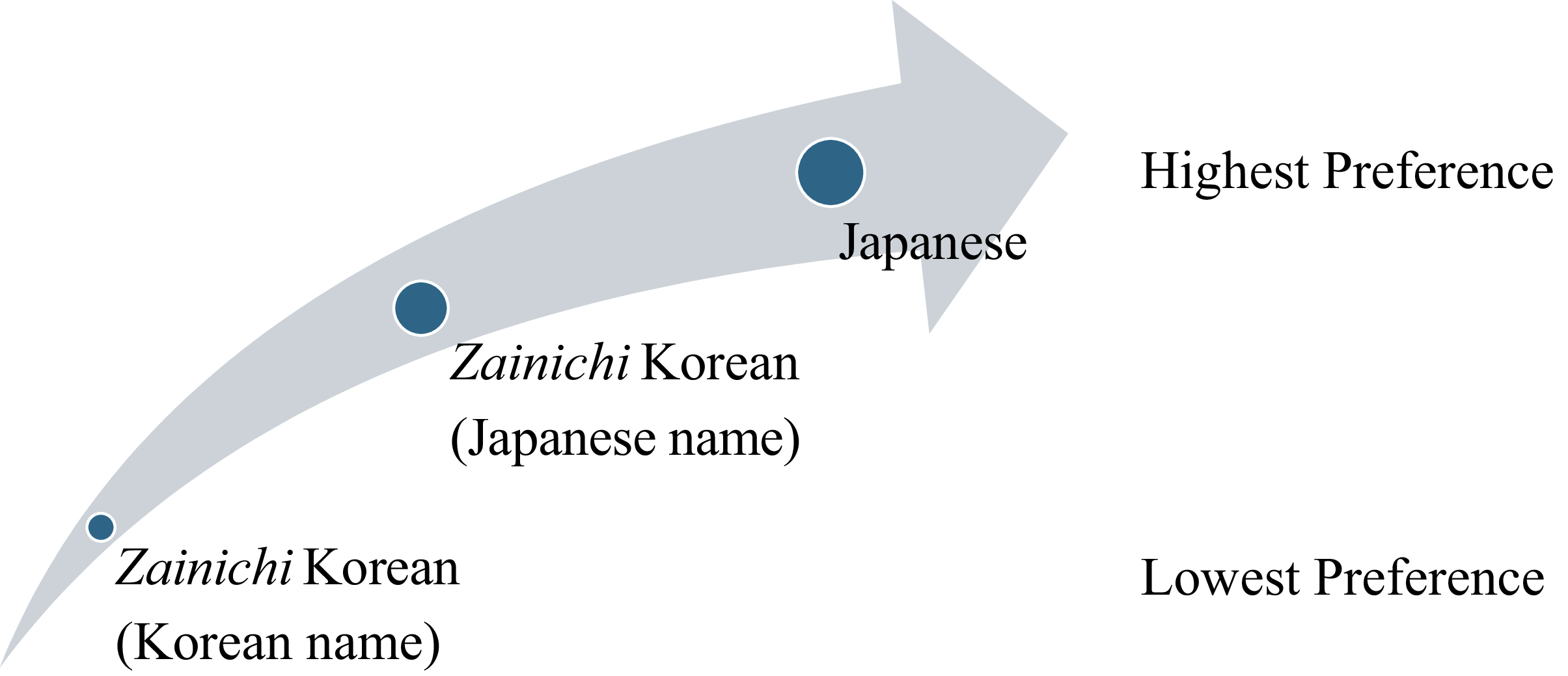
To summarize Hypotheses 1a, 1b, and 2: we anticipate that Japanese candidates will be preferred over Zainichi Korean candidates, regardless of what name the Zainichi candidate uses. Furthermore, we hypothesize that this preference for the Japanese applicant will be greater if the Zainichi applicant uses a Korean name rather than a Japanese pseudonym (honmyō). In other words, as shown in Figure 1, ordered from highest to lowest, respondents’ preferences will be: Japanese candidates, Zainichi candidates using a Japanese name (tsūmei), and Zainichi candidates using a Korean name (honmyō).
Expected preference order for hypothetical Japanese and Zainichi Korean applicants.

Effects Conditional on Intergroup Contact
The intergroup contact hypothesis posits that intergroup social contact can reduce prejudice between groups. Extensive scholarship has sought to clarify the mechanisms through which intergroup contact reduces prejudice.Footnote 5 In a meta-analysis of the literature on intergroup contact theory, Pettigrew and Tropp (Reference Pettigrew and Tropp2008) provide evidence that several factors mediate the relationship between intergroup contact and prejudice, including the cultivation of empathy and the facilitation of intergroup learning. Dovidio, Gaertner, and Kawakami (Reference Dovidio2003) argue that empathy not only fosters more positive perceptions of others but also promotes altruistic support for them. Similarly, Pettigrew (Reference Pettigrew1998) suggests that intergroup learning enhances cultural understanding, encourages the recognition of outgroup members as individuals, and mitigates negative stereotypes.
Another key mechanism by which intergroup contact reduces prejudice is alleviating intergroup anxiety or perceptions of outgroups as threats. Intergroup anxiety has been strongly associated with negative attitudes toward outgroups, including discriminatory behavior (Stephan Reference Stephan2014). However, Stephan and Stephan (Reference Stephan and Stephan1985) observe that such anxiety is often prevalent among individuals who have not yet interacted with outgroup members. Research indicates that those who do engage in intergroup interactions exhibit reduced anxiety. For instance, Horiuchi and Ono (Reference Horiuchi and Ono2023) demonstrate that in Japan, individuals with greater social contact with foreigners are less likely to be influenced by media frames portraying foreign refugees as threats.
Building on these existing studies, which broadly support the validity of intergroup contact theory, we propose the following hypotheses about conditional effects.Footnote 6
Hypothesis 3a: Respondents with low social contact are more likely to prefer a Japanese applicant over a Zainichi Korean applicant with a Korean name.
Hypothesis 3b: Respondents with low social contact are more likely to prefer a Japanese applicant over a Zainichi Korean applicant with a Japanese name.
In other words, we assume that the effects outlined in Hypotheses 1a and 1b vary across respondents’ levels of social contact.
Moreover, we expect the attenuating effect of using tsūmei instead of honmyō to be weaker among respondents with frequent social contact with Zainichi Koreans. We anticipate that this may arise from several factors. Individuals with greater exposure to Zainichi Koreans may be more adept at recognizing tsūmei, leading them to evaluate Zainichi applicants similarly regardless of whether they use a Korean name or a pseudonym. Alternatively, those with more frequent contact may hold fewer discriminatory attitudes toward Zainichi Koreans in general, resulting in uniformly positive evaluations of all applicants in our experiment. The combination of these two factors leads us to posit the following:
Hypothesis 3c: The difference in the likelihood of preferring a Japanese applicant over a Zainichi Korean applicant with a Korean name, compared to a Zainichi Korean applicant with a Japanese name, is greater among respondents with low social contact.
Research Design
We conducted two survey experiments on the PureSpectrum platform to test our hypotheses. Before data collection, we obtained IRB exemption approval from our institutions and preregistered our hypotheses and research designs on the Open Science Framework (OSF).Footnote 7 We adhered to the American Political Science Association’s Principles and Guidance for Human Subjects Research. We compensated respondents USD 2.00 for both Studies 1 and 2. The median completion time was 9 minutes for Study 1 and 7 minutes for Study 2. A complete replication package, including all computer scripts and anonymized data, will be posted to Dataverse upon acceptance for publication.
To assess potentially hidden discriminatory attitudes among respondents, we employed two conjoint experiments in which respondents compared hypothetical job applicants varying across several attributes. As both studies focused on examining discriminatory attitudes of Japanese citizens toward Zainichi Koreans, non-citizens were excluded via a screener question at the beginning of the surveys.
Data for Study 1 were collected from May 16 to May 17, 2023, while data for Study 2 were gathered from February 14 to February 23, 2024. Each survey yielded approximately 1,000 valid responses. Study 2 required oversampling respondents with greater social contact with Zainichi Koreans. To achieve this, the survey distribution for Study 2 targeted the Kansai (or Kinki) region of Japan, which includes prefectures with the highest concentrations of Koreans in the country. An additional screener question excluded respondents outside the Kansai region from participating in the survey.
Conjoint Design
SDB is particularly pronounced in survey research on discrimination, where respondents may be reluctant to disclose behaviors or attitudes deemed socially unacceptable—such as racism, xenophobia, antisemitism, or other forms of discrimination – when they are aware of the topic’s socially sensitive nature (Krumpal Reference Krumpal2013; Tourangeau and Yan Reference Tourangeau and Yan2007). Given the sensitive nature of discrimination against Zainichi Koreans, the risk that SDB will affect survey responses is substantial.
To address this challenge, we utilize a conjoint design, which minimizes the influence of SDB (Horiuchi, Markovich, and Yamamoto Reference Horiuchi2022). Specifically, respondents completed two sets of fully randomized conjoint tasks evaluating hypothetical job applicants with multiple attributes. In this question format, respondents cannot straightforwardly identify the socially sensitive attribute being tested, enabling them to rationalize their responses based on other varying attributes.
Numerous cases have highlighted discrimination against Zainichi Korean applicants in both the private and public sectors. Therefore, we asked each respondent to complete two sets of eight tasks, with the order of these sets randomized. The first set described an open position on a private company’s research and development team, while the second focused on a public elementary school teaching position. These roles were selected to represent private and public-sector jobs, as the average Japanese citizen is likely familiar with their content and responsibilities. Examining respondents’ preferences across these two settings also allows us to deepen our investigation into the nature of discrimination.Footnote 8
Respondents evaluated eight pairs of hypothetical applicants described by names (signaling ethnicity) and several other job-relevant attributes in each set. Names were selected to suggest Japanese or Zainichi Korean ethnicity. Prior research has demonstrated the effectiveness of using names to signal race or ethnicity in studies of discrimination, as they allow researchers to examine bias without explicitly highlighting race (e.g., Gaddis Reference Gaddis2015; Kugelmass Reference Kugelmass2016; Neumark Reference Neumark2012).Footnote 9
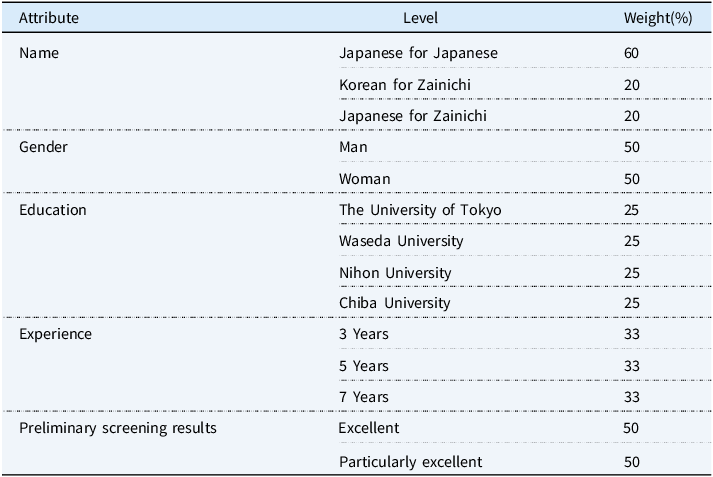
In this study, ten names were used. Six were common Japanese names, signaling Japanese ethnicity. Two were common Korean names, signaling Korean ethnicity. The remaining two were Japanese names adapted from Korean names, signaling Korean ethnicity with a Japanese pseudonym. Names were evenly distributed across male and female categories within each ethnic group, allowing respondents to infer gender. All names were assigned equal weight, as detailed in Table 1.
Attributes, levels, and weights
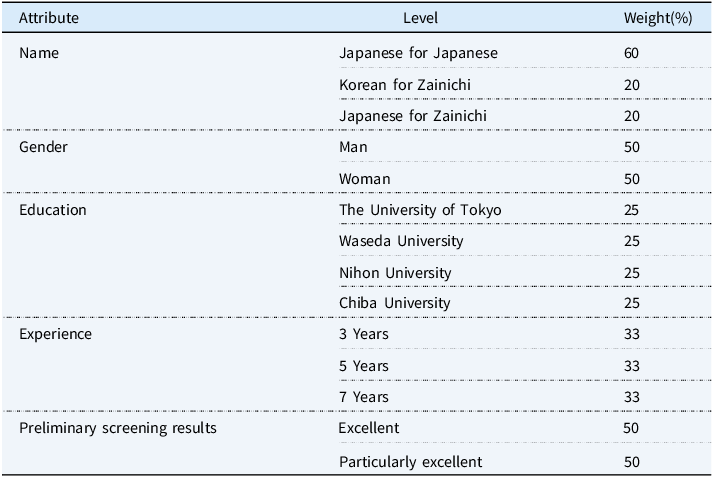
Note: Names also telegraph the gender of the hypothetical applicants. Respondents were not explicitly told the gender of the applicant.
To ensure a realistic context, respondents were informed that all applicants had passed the initial screening and interviews and had entered the final hiring phase. This positioning emphasized that all candidates were strong contenders, thereby isolating the effect of ethnically coded names. In addition to an applicant’s name and preliminary screening results, we included attributes most commonly described as “qualifications” in actual job descriptions: education and experience.
Three pre-tests were conducted to refine the attributes and levels. All attribute levels (except names) were assigned equal weight with no cross-attribute constraints. To address potential measurement error biases, we follow the methods detailed in Clayton et al. (Reference Clayton2026), which include repeating the first pair of each conjoint task to assess intra-respondent reliability.
Measuring intergroup social contact
One key variable in the present study is respondents’ intergroup social contact with Zainichi Koreans. Many prior experiments on intergroup contact theory measure social contact with outgroups through survey questions that ask respondents to quantify their interactions. Respondents are typically asked to estimate the proportion of their friends, neighbors, relatives, or coworkers who belong to the outgroup (e.g., Brown et al. Reference Brown2007; Hewstone et al. Reference Hewstone2006, Jackman and Crane Reference Jackman and Crane1986, Savelkoul et al. Reference Savelkoul, Scheepers, Tolsma and Hagendoorn2010, Schlueter and Scheepers Reference Schlueter and Scheepers2010).
In our study, we measure respondents’ contact with Zainichi Koreans using methods adapted from Clayton, Ferwerda, and Horiuchi (Reference Clayton2021), Hewstone et al. (Reference Hewstone2006), and Yuker and Hurley (Reference Yuker and Hurley1987). These studies employ five-point Likert-scale items to assess intergroup social contact. We adopt four items to measure respondents’ self-reported contact with Zainichi Koreans. Each item is a statement, rated on a five-point Likert scale: “strongly agree,” “agree,” “neither agree nor disagree,” “disagree,” and “strongly disagree.” Half of the items were forward-coded, with agreement corresponding to higher values (5), and the other half were reverse-coded, with agreement corresponding to lower values (1).Footnote 10
Respondents answered these questions only after completing the conjoint tasks to avoid priming them to think about ethnicity while evaluating candidates. Because this study examines how subtle cues—specifically different types of names—influence preferences, priming respondents to consider ethnicity, especially Zainichi Korean ethnicity, could artificially amplify observed discrimination. Furthermore, a key component of this study is whether respondents can recognize Korean ethnicity from tsūmei. If they were primed to think about ethnicity, they might scrutinize names more carefully and identify tsūmei they would otherwise overlook. Although responses to these questions after the conjoint tasks could, in principle, be influenced by the tasks themselves, we do not anticipate that such effects are substantial. Ethnicity was never explicitly mentioned in the conjoint tasks, making it unlikely that the tasks meaningfully affected responses to the intergroup contact questions.
For analysis, we calculated an aggregate contact score for each respondent by averaging their scores across all items. Respondents were then grouped into terciles: “high,” “medium,” and “low” contact―based on their aggregate scores, enabling comparison of results across these groups.
Further Exploratory Analysis
Our survey includes additional questions designed to examine whether respondents hold discriminatory attitudes toward Zainichi Koreans and to identify variables influencing their choice between a Japanese and a Zainichi Korean candidate. First, after implementing a simple attention check to screen out inattentive respondents, we measured respondents’ nationalism using questions adapted from the GESIS Leibniz Institute for the Social Sciences (2013) surveys on national identity. Nationalist groups, such as the Zaitokukai, often disseminate discriminatory rhetoric targeting Zainichi Koreans, thereby contributing significantly to anti-foreigner, anti-immigrant, and other exclusionary attitudes. This context has amplified concerns about the recent rise of Japanese nationalist ideologies. These nationalism-related questions were placed at the beginning of the survey, before a series of demographic and key attitudinal questions, to minimize their potential impact on respondents’ engagement with the conjoint tasks.
Questions directly related to discrimination or Zainichi Koreans were asked after respondents concluded the conjoint tasks to limit their awareness of the measured variable and the possible influence of SDB on their responses. We also asked an open-ended question and encouraged respondents to freely express their thoughts on Zainichi Koreans.
Finally, we adapted a five-point Zainichi Korean Resentment Scale based on the racial resentment scale originally proposed by Kinder and Sanders (Reference Kinder and Sanders1997). This scale has been widely used in studies of racial resentment in the United States (e.g., Abramowitz and McCoy Reference Abramowitz and McCoy2019; Agadjanian et al. Reference Agadjanian2023; Feldman and Huddy Reference Feldman and Huddy2005). While overt discrimination against Zainichi Koreans, such as violence or hate speech, is not common among the broader Japanese population, covert forms of discrimination persist. These subtle expressions of bias align with the concept of modern discrimination, often referred to as racial resentment, as documented in studies by Kim (Reference Kim2011a) and Aoki (Reference Aoki2012).
Quantities of Interest
In each conjoint task, respondents made a forced binary choice. Specifically, they were asked: “Suppose that the following two applicants have made it to the final selection round. Which applicant do you think should be hired? Even if you are not entirely sure, please choose the one you believe should be hired if you had to decide.”
Unlike most applications of conjoint analysis, we treat each choice as the unit of analysis. To test Hypotheses 1a and 1b, we compute the “choice-level” marginal means of selecting a Japanese applicant over a Korean applicant, regardless of whether the Korean applicant uses a Japanese or Korean name.Footnote 11 To test Hypothesis 2, we calculate the choice-level Average Marginal Component Effect (AMCE) by taking the difference between these two choice-level marginal means. In both estimations, we address measurement error using the method proposed by Clayton et al. (Reference Clayton2026).
We apply the same procedure to test Hypotheses 3a, 3b, and 3c, as well as to conduct exploratory analyses across different respondent subgroups. For these subgroup analyses, we categorize respondents into two or three groups based on various questions in our study.
It is important to note that heterogeneity in respondents’ ability to recognize applicants’ ethnic background from their names does not bias our estimates. Because name type is randomized within respondents, differences in sensitivity to Korean versus Japanese names affect only the variance of the estimator, not its expectation. In other words, such heterogeneity introduces random noise rather than systematic bias. Our quantities of interest average across all combinations of other attributes (except applicant names) and across all respondents, ensuring that the estimated effects represent the average impact of name type on candidate evaluation.
Results
This section presents the results of testing our pre-registered hypotheses. Additionally, we discuss insights gained from further exploratory analyses.
Zainichi Korean vs. Japanese
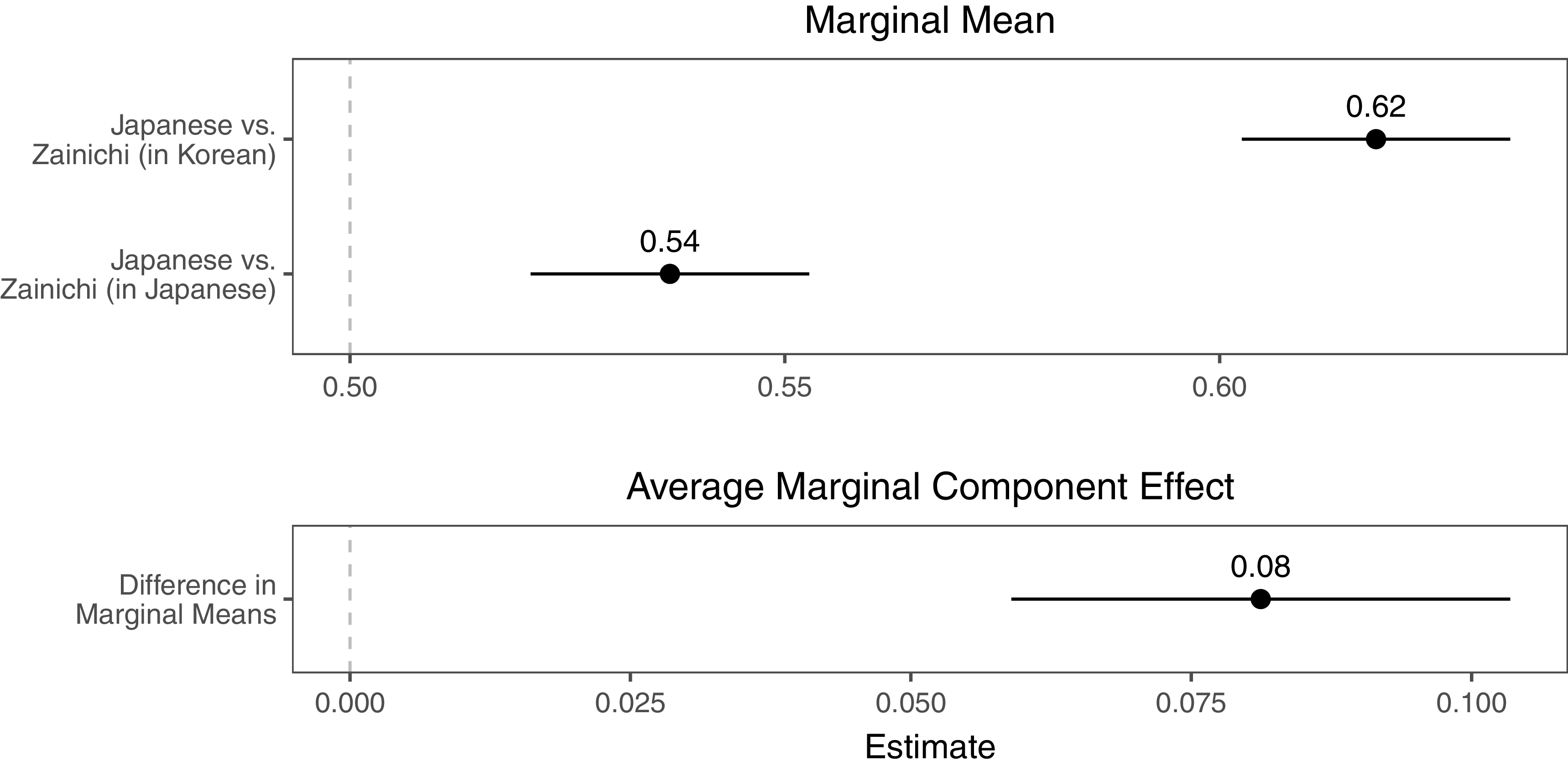
The top portion of Figure 2 illustrates the marginal means of selecting an applicant with a Japanese name across two different match-up types in Study 1. The horizontal bars indicate the 95% confidence intervals. Results from Study 2 align with those of Study 1. The estimates from Study 2, as well as combined data from Studies 1 and 2, are presented in Figures C.3 and C.4, respectively, in Section C of the Supplementary Materials.
Marginal means of Japanese applicant names compared to Zainichi names and average marginal component effect of Korean names.
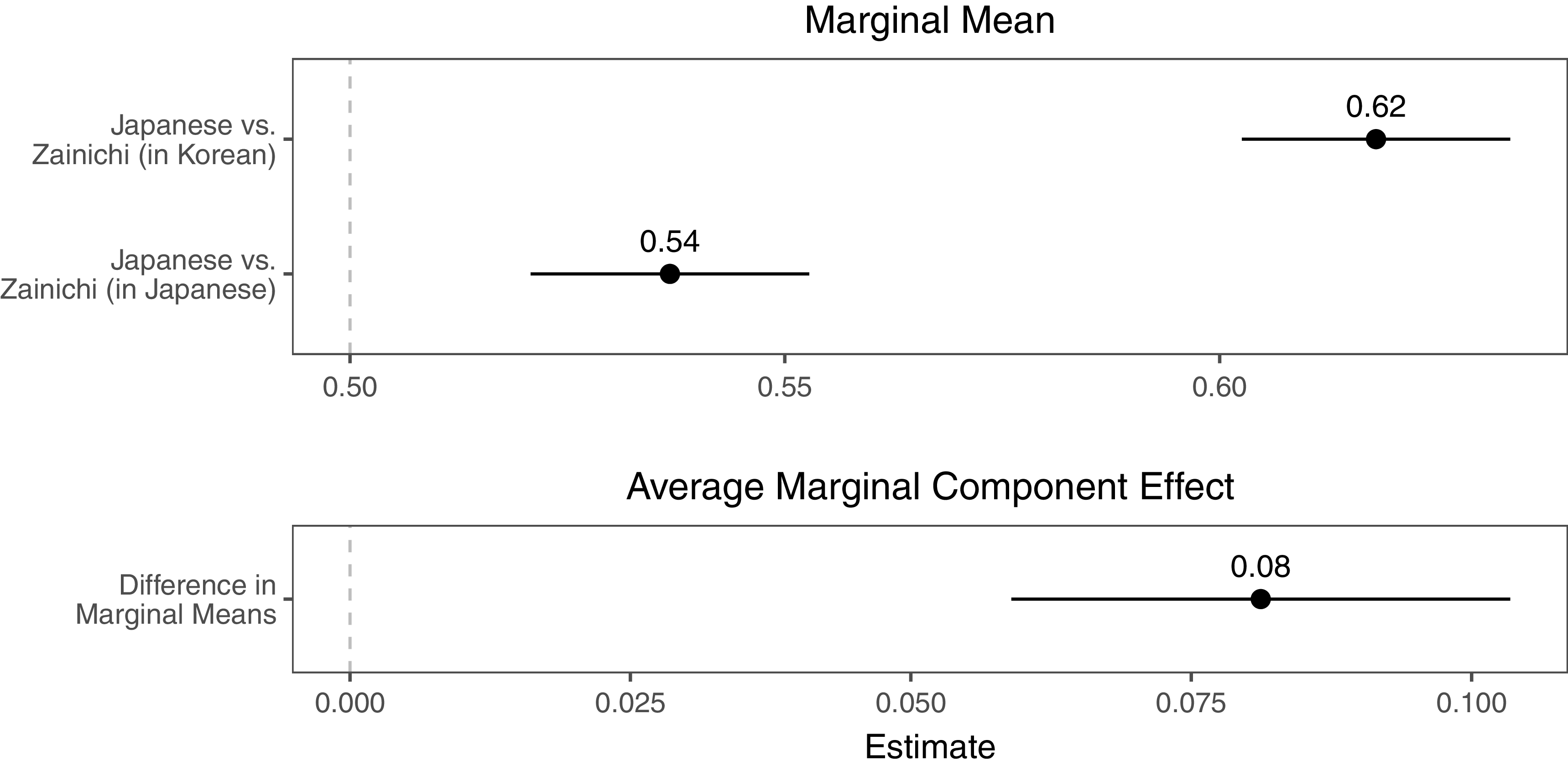
In the first scenario, respondents were presented with a hypothetical choice between one applicant with a typical Japanese name (used among Japanese citizens) and another with an ethnic Korean name, honmyō (their real names). The figure shows that the marginal mean of selecting the Japanese applicant in this match-up was 62. This indicates that respondents preferred the Japanese applicant in approximately 62% of cases, supporting Hypothesis 1a.
The second scenario involved respondents choosing between a Japanese applicant with a typical Japanese name and a Korean applicant using a Japanese pseudonym, or tsūmei. Here, the marginal mean for selecting the Japanese applicant was approximately 54, showing that respondents preferred the Japanese applicant in 54% of cases. These findings support Hypothesis 1b.
Overall, the results from this study provide consistent support for both Hypotheses 1a and 1b. Respondents consistently preferred Japanese applicants over Zainichi applicants, regardless of whether the latter used tsūmei or honmyō
Korean Name vs. Japanese Name
The bottom portion of Figure 2 displays the difference in marginal means between the two types of match-ups discussed above. This difference corresponds to the choice-level AMCE for applicants using an ethnic Korean name, compared to using a Japanese pseudonym as the baseline.
The AMCE for using a Korean name is 08, indicating that Zainichi Korean applicants using an ethnic Korean name rather than a Japanese pseudonym are associated with an 8-percentage-point decrease in the likelihood of being selected, relative to an applicant with an ethnically Japanese name. While respondents are more likely to select the Japanese-named applicant in both scenarios, the preference for the Japanese applicant is stronger when the Zainichi Korean applicant uses a Korean name than when they use a Japanese tsūmei.
These findings suggest that discrimination against Zainichi Koreans is less pronounced when they adopt a Japanese pseudonym compared to when they use their ethnic Korean name. Results from Study 2 corroborate these findings and provide consistent support for Hypothesis 2.
Private Sector Job vs. Public Sector Job
As shown in Figure C.5 in Section C of the Supplementary Materials, we find no significant differences in results across experiment types. Respondents consistently favor Japanese applicants over Zainichi applicants, regardless of whether the position is at a private company or a public school. One might expect, given the differing nature and responsibilities of these hypothetical positions, that the preference against Zainichi applicants would be stronger for the public school position than for the private-sector position. For example, specific stereotypes or discriminatory perceptions of Zainichi Koreans may lead individuals to oppose the idea of Zainichi Koreans interacting with and influencing schoolchildren, as compared to the less personal, research-oriented responsibilities associated with the private company position.
Contrary to this expectation, the effect sizes remain consistent across both job contexts. This pattern suggests that inferred Korean ethnicity does not trigger job-specific fears or discriminatory beliefs. Rather, it appears to evoke a generalized negative sentiment, leading Japanese respondents to disfavor applicants with Korean names or tsūmei, regardless of the position.
Effects conditional on intergroup contact
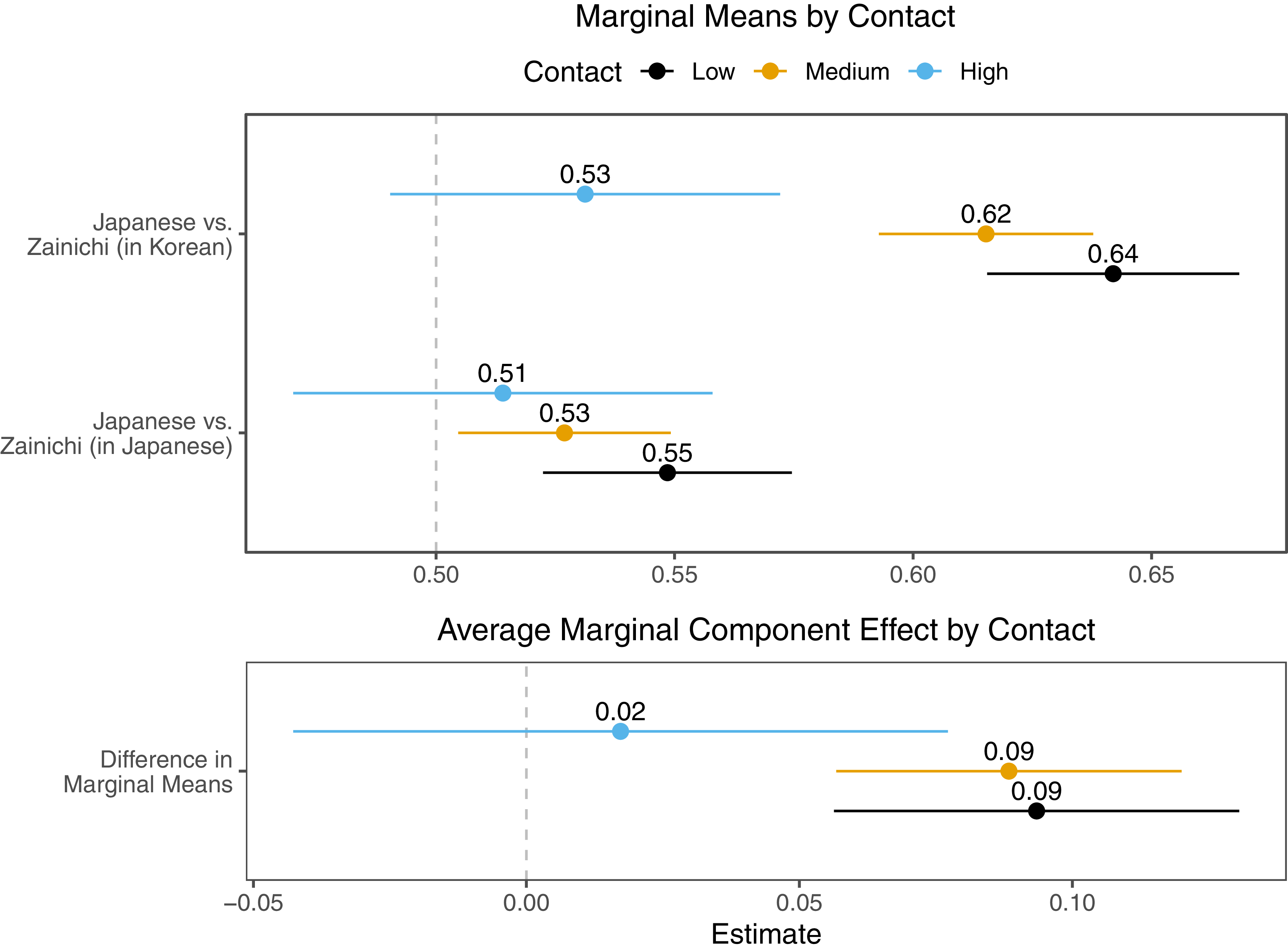
Figure 3 presents the marginal means and AMCEs (in Study 2) broken down by respondents’ aggregate intergroup contact scores. Respondents are categorized into low, medium, and high contact groups. Across all groups and match-up types, marginal means for Japanese applicant names exceeded 5, reinforcing evidence of discriminatory preferences against Zainichi Koreans.
Marginal means of Japanese applicant names compared to Zainichi names and AMCE of Korean names disaggregated by respondents’ social contact with Zainichi Koreans.
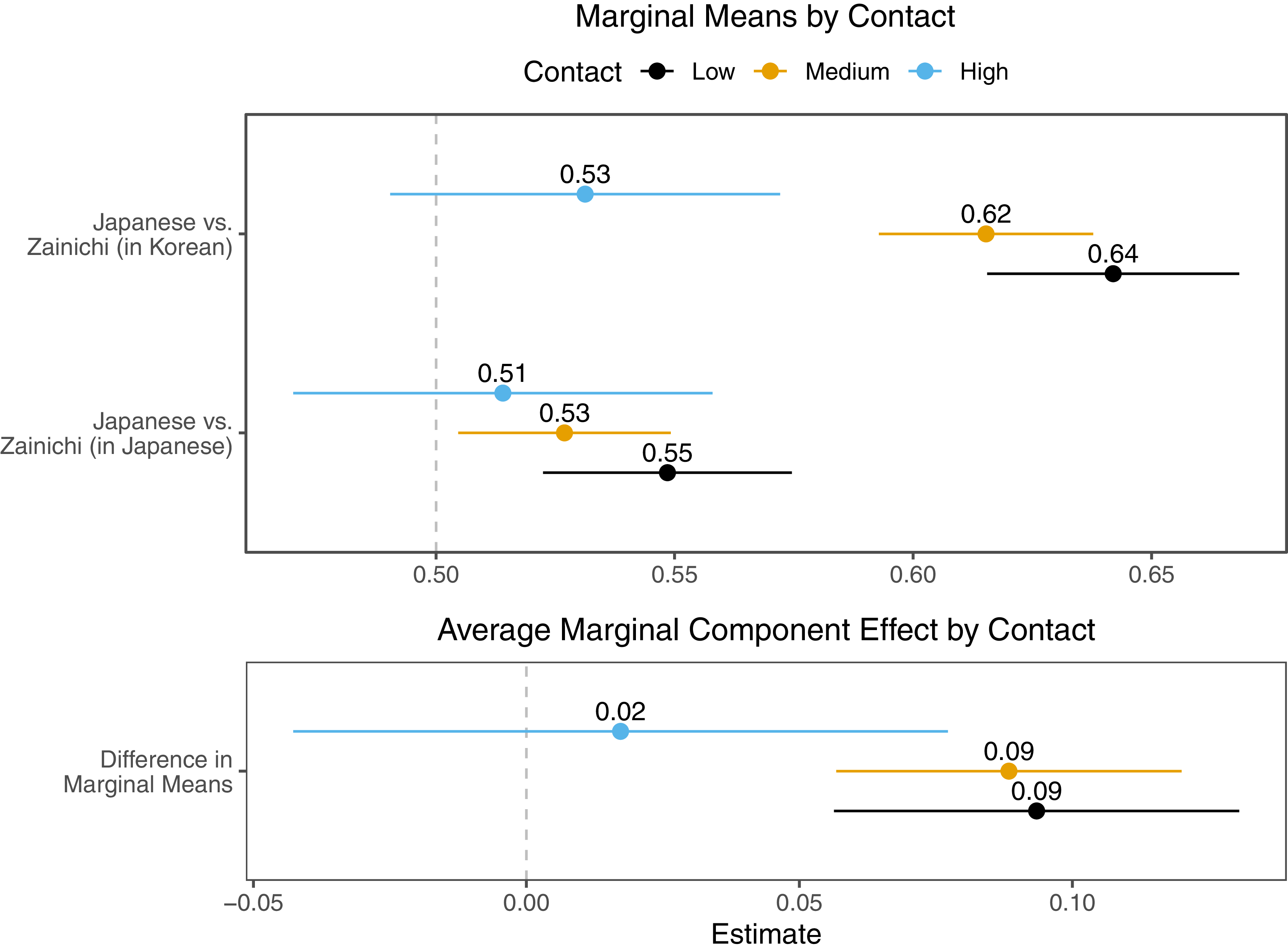
Significant differences emerge when comparing respondents based on their levels of contact with Zainichi Koreans. Among high-contact respondents, the marginal mean for selecting a Japanese applicant over a Zainichi applicant with a Korean name was approximately 0.53, indicating only a slight preference for Japanese candidates. Notably, this deviation from the neutral benchmark of 0.50 is statistically insignificant, as the 95% confidence interval includes 0.50. In contrast, the preference among high-contact respondents is substantially smaller than that of medium-contact respondents (0.62) and low-contact respondents (0.64), providing support for Hypothesis 3a.
Similarly, we find support for Hypothesis 3b. Respondents with low social contact are more likely to prefer a Japanese applicant over a Zainichi Korean applicant using tsūmei. While differences in marginal means between high-, medium-, and low-contact groups are smaller, high-contact respondents still exhibited slightly lower preferences for Japanese candidates than medium- and low-contact individuals.
The results also support hypothesis 3c. The lower portion of Figure 3 shows AMCEs disaggregated by aggregate contact scores. Medium- and low-contact respondents have similar AMCEs of approximately 0.09, significantly different from zero. By contrast, high-contact respondents exhibit a lower AMCE of about 0.02, which is statistically indistinguishable from 0.
We acknowledge that our measure of social contact―based on the aggregate intergroup contact score―is correlated with other respondent attributes. Because the observed heterogeneity in marginal means and AMCEs by social contact may reflect differences associated with these other attributes rather than social contact itself, we conduct an additional robustness test. Following the approach of Clayton, Ferwerda, and Horiuchi’s (Reference Clayton2021), we first estimate a regression model with the IRT score as the dependent variable and respondents’ gender (male [baseline] or female), education (with [baseline] or without a university degree), age, age squared, and political orientation (left [baseline], middle of the road, right) as predictors. We then use the residuals from this model as an alternative measure of social contact that is not explained by demographic factors or political orientation. Next, we divide respondents into terciles based on these residuals to form alternative social contact groups. The results of re-estimating the marginal means and AMCEs using this adjusted measure are presented in Figure C.6 in the Supplementary Materials. The findings remain substantively unchanged.
Overall, these results suggest that social contact significantly mitigates discrimination against Zainichi applicants, regardless of whether they use honmyō or tsūmei. The mitigating effect is particularly pronounced when Korean applicants use their ethnic names.
Further Exploratory Analysis
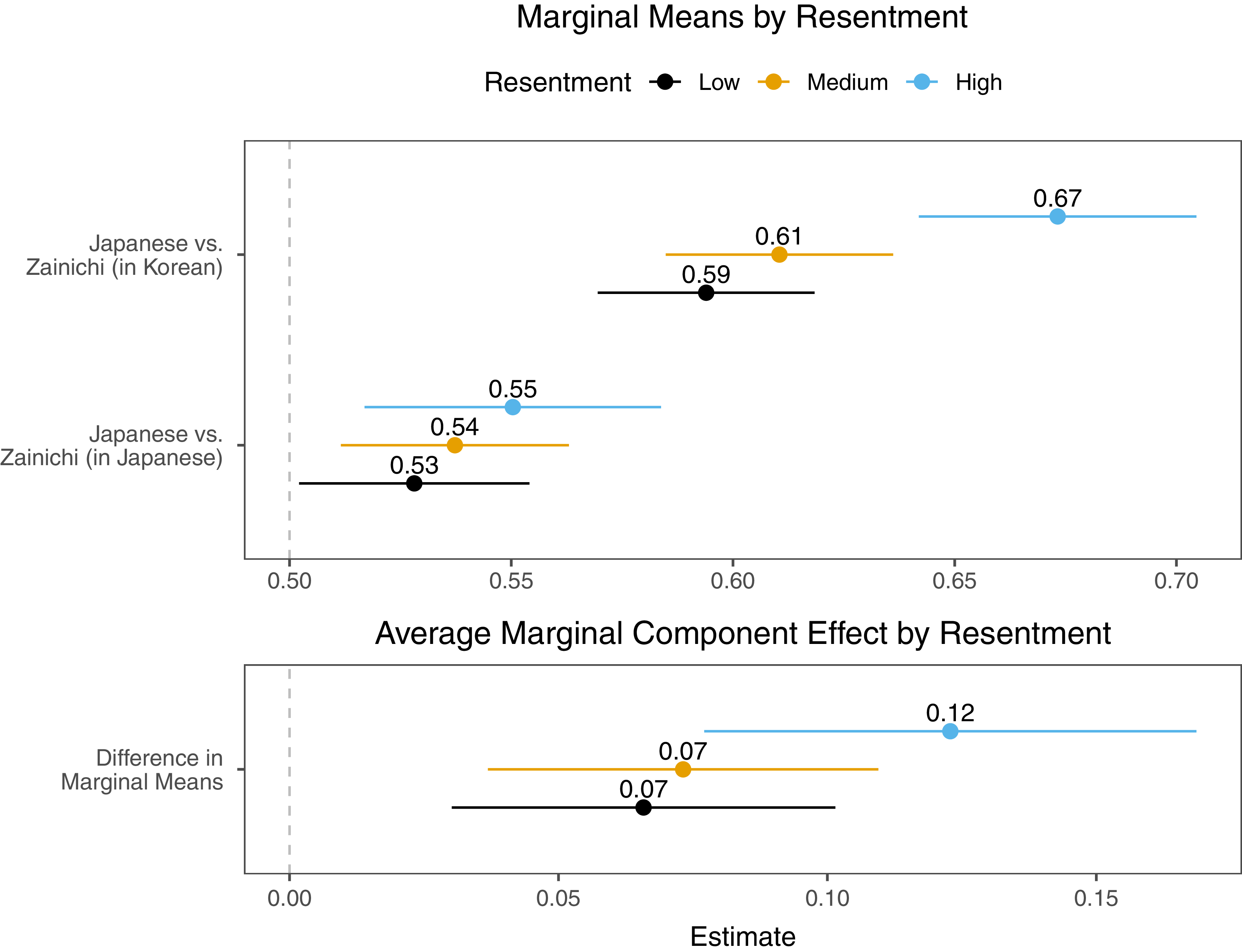
A key exploratory finding from this study is the conditional effect of respondents’ resentment levels on their likelihood of selecting candidates with Japanese names over Zainichi Korean names, whether in Korean or Japanese. Figure 4 presents the results from Study 1 in Figure 2, disaggregated by low-, medium-, and high-resentment terciles based on a 5-point resentment scale derived from responses to the Zainichi resentment scale questions.
Marginal means of Japanese applicant names compared to Zainichi names and AMCE of Korean names disaggregated by resentment.
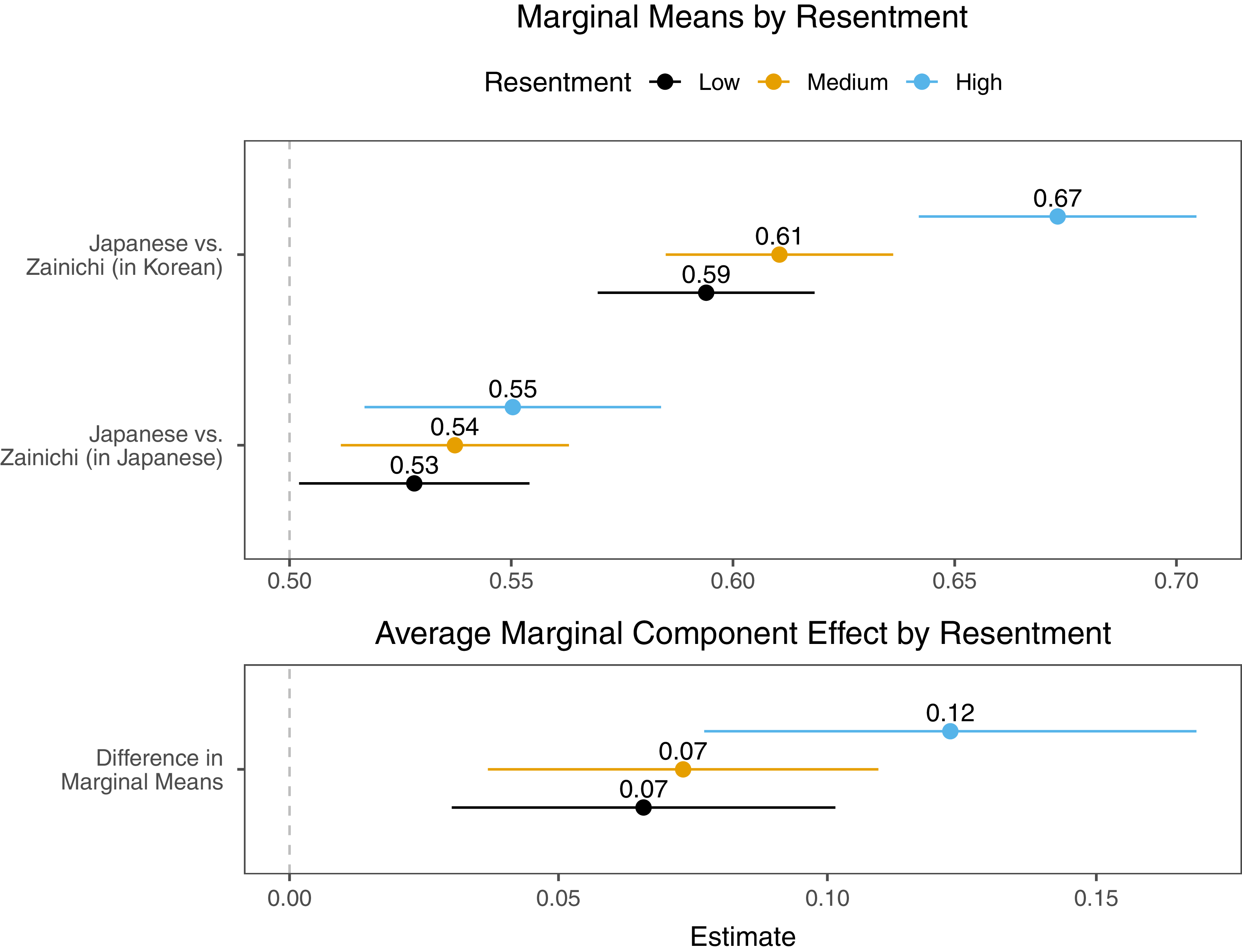
We find that individuals with high levels of resentment are more likely to disfavor Zainichi Korean names, regardless of whether the names are presented in Korean or Japanese. Although low-resentment respondents still favor Japanese names in all matchups, they exhibit the lowest marginal means for selecting Japanese names. These findings suggest a positive correlation between anti-Zainichi resentment and the preference for Japanese-named candidates over Zainichi-named candidates, indicating that high resentment amplifies the outward expression of discriminatory attitudes.
This finding is perhaps unsurprising given the nature of resentment against Zainichi Koreans. Responses from individuals with high resentment scale scores to the free-response question reveal several prevalent discriminatory beliefs about Zainichi Koreans:
-
1. Zainichi Koreans demand and receive undeserved resources and privileges: For example, respondents noted beliefs such as, “…they are taking advantage of the fact that they are in Japan and using it for their own convenience,” and, “They are the privileged class who are sucking up taxpayers’ money without going back to their country of origin.”
-
2. Zainichi Koreans are predisposed to crime and dishonesty: Examples include statements like “I don’t trust them,” and “I don’t trust Zainichi Koreans at all from a human point of view because I have met with terrible deception in business.”
-
3. Zainichi Koreans have loyalties outside of Japan and are anti-Japanese: Respondents expressed beliefs such as, “They have a strong sense of victimization and a strong complex toward Japan. As a result, they tend to be extremely aggressive toward Japan and Japanese people,” and, “Most, if not all, are anti-Japanese.”
These statements reflect deeply discriminatory views, which may stem from underlying anxiety and fear about the perceived threat that Zainichi Koreans pose to ethnic Japanese.
We conduct similar analyses, disaggregating results by respondents, including gender (Figure C.7), age (Figure C.8), education (Figure C.9), political leaning (Figure C.10), and region of residence (Figure C.11). They are all presented in Section C of the Supplementary Materials. When conditioning on age, we find that the youngest group of respondents (18 to 43) is significantly less likely than the two older groups (44 to 56 and 66+) to prefer a Japanese candidate over a Zainichi Korean candidate using a Korean name. However, we do not find any other significant differences across respondent demographic groups.
Disaggregation by respondents’ mean nationalism score yields mixed results, with the respondents with the highest nationalism scores generally showing a substantively stronger preference against Zainichi Korean applicants. Meanwhile, low and medium scorers show mixed preferences (Figure C.12 in Section C of the Supplementary Materials). Additionally, we analyzed results based on the genders of hypothetical applicants (Figure C.13 in Section C of the Supplementary Materials).
Conclusion
The findings of this study confirm that Japanese citizens discriminate against Zainichi Koreans based solely on their names. However, this discriminatory tendency weakens when they adopt Japanese pseudonyms, which more effectively (although imperfectly) conceal their ethnic identity. While our data do not allow us to identify the precise mechanism driving this pattern, we suspect that the weaker preference against applicants using tsūmei (as compared to Korean applicants using ethnic names) arises because respondents often fail to recognize such names as pseudonyms, interpreting them instead as Japanese. Other explanations may involve additional signals beyond ethnicity. For example, even when respondents recognize tsūmei as a Zainichi Korean name, the use of a Korean name may signal weaker assimilation, lower willingness to assimilate, or a “newcomer” status. Regardless of the mechanism, our results demonstrate a clear negative effect of revealing an ethnic identity (by using a Korean name) relative to concealing it (by using a pseudonym).Footnote 12
While this finding suggests that passing as Japanese through a tsūmei may mitigate some effects of discrimination, it also highlights a disproportionate burden placed on those vulnerable to discrimination, forcing them to navigate prejudice strategically. Although concealing an invisible identity may serve as a tool to circumvent discrimination, the results from our study indicate that even those who choose to do so remain subject to discrimination. These findings underscore the persistent nature of discrimination and the need for stronger institutional and societal reforms.
The results also indicate that discriminatory attitudes are conditional on intergroup contact. Individuals with higher levels of contact exhibit weaker preferences for Japanese applicants and show reduced sensitivity to whether Zainichi applicants disclose or conceal their identities. Overall, this finding supports Allport’s (Reference Allport1954) contact hypothesis and adds further evidence to the extensive body of research demonstrating that intergroup contact can mitigate outgroup prejudice. While we do not claim to extend or revise the theory, our results highlight its applicability to contexts involving invisible identities, where the salience of group membership depends on voluntary disclosure.
While characteristics often considered to be invisible—such as religion, sexual orientation, mixed-race heritage, and non-apparent disabilities—have received scholarly attention (Di Stasio et al. Reference Di Stasion.d.; Lippens, Vermeiren and Baert Reference Lippensn.d.), our research contributes to this literature by examining a distinctive case with unique implications. First, Zainichi Koreans are phenotypically, linguistically, and culturally indistinguishable from the ethnic Japanese population, making Korean ethnicity a genuinely invisible attribute. Different invisible attributes, however, may entail distinct social meanings. For instance, whereas religion or sexual orientation have no apparent connection to job performance, disability status may require additional resources or accommodations. Therefore, it is especially valuable to extend existing frameworks to diverse manifestations of invisibility. Second, the decision that many Zainichi Koreans must make between using a honmyō or a tsūmei exemplifies a broader dilemma faced by individuals with invisible attributes—whether to disclose or conceal them. Finally, because names play a crucial role in social interactions where discrimination may occur, the use of ethnic Korean names and Japanese pseudonyms provides an externally valid means for assessing the consequences of revealing or concealing an invisible identity.
Discrimination based on invisible characteristics is pervasive across societies and institutional settings. Our findings underscore the fundamental paradox faced by individuals with such identities: while concealing their identity may reduce exposure to discrimination, it often comes at a significant personal cost, including psychological distress, diminished authenticity, and the reinforcement of systemic inequities (Newheiser and Barreto Reference Newheiser and Barreto2014; Quinn, Weisz, and Lawner Reference Quinn2017).
This dynamic has profound implications for policy and practice. We find that Japanese citizens hold discriminatory attitudes toward individuals with inferred Korean ancestry and that these attitudes are attenuated among those with frequent social contact with Zainichi Koreans. Government policies and programs addressing discrimination should, therefore, seek to foster opportunities for meaningful intergroup interaction, which may play a crucial role in reducing bias and promoting inclusion.
There are several limitations to the present research, which suggest avenues for future research. First, this study does not establish whether intergroup contact causally reduces prejudice or whether less prejudiced individuals are more likely to engage in contact. Future research should consider real-world settings where social contact is randomly or quasirandomly assigned (e.g., Enos Reference Enos2014).
Second, our conjoint experiment asked regular Japanese citizens to make hypothetical hiring decisions. Because most respondents are unlikely to have direct hiring experience, this limits the extent to which our findings can speak to actual hiring discrimination in Japan.Footnote 13 However, the scenarios we employ are still useful precisely because they present regular citizens with a familiar and easily interpretable context in which to express preferences. Our aim is not to infer institutional or administrative forms of discrimination but rather to measure social bias among Japanese citizens toward Zainichi Koreans. Respondents’ limited familiarity with hiring procedures likely prevented them from considering nationality-based administrative constraints, allowing us to isolate attitudinal discrimination based on name cues. Thus, while our results may not directly capture real-world hiring discrimination, the consistent preference against Zainichi Korean candidates in these hypothetical scenarios provides clear evidence of pervasive negative attitudes toward individuals with Korean ancestry in Japan.
A potential alternative for advancing research on discrimination against invisible attributes with high external validity is to use geographical data on the concentration of marginalized populations. A recent study on discrimination against Burakumin—a historically marginalized social group in Japan, formerly associated with stigmatized occupations and subject to persistent discrimination despite being ethnically indistinguishable from other Japanese citizens—offers a helpful framework (Yamagishi and Sato Reference Yamagishi and Sato2025).
Finally, our study primarily focuses on individual-level discriminatory attitudes toward Zainichi Koreans. We do not, however, explore structural dynamics contributing to their socioeconomic inequalities, such as labor market segmentation rooted in post-WWII policies that barred them from jobs (Moon Reference Moon2010). Research on discrimination based on individual attributes requires a broader, multi-perspective approach to fully capture its complexities.
Nevertheless, the findings of this study underscore the need for social science research to further move beyond visible attributes and explore the complex dynamics of invisible identities. Discrimination is a pervasive, global phenomenon that transcends borders and social categories, demanding a sustained and multifaceted response. By shedding light on how bias operates against invisible identities and the conditions that may mitigate it, this study contributes to a deeper understanding of prejudice and its persistence in contemporary societies. Moving forward, continued research in this area will be essential for developing more effective policies and interventions to promote equity and inclusion.
Supplementary material
The supplementary material for this article can be found at https://doi.org/10.1017/rep.2026.10062
Funding statement
We thank financial support from the Kaminsky Family Fund, the Nelson A. Rockefeller Center for Public Policy and the Social Sciences, and the Ethics Institute at Dartmouth College. The financial sponsors played no role in the design, execution, analysis, and interpretation of data or writing of this paper.
Competing interests
The authors declare that they have no known competing financial interests or personal relationships that could have appeared to influence the work reported in this manuscript.
Declaration of AI Usage
We used ChatGPT (OpenAI) solely to improve the flow of arguments and to correct grammatical and spelling errors. The tool was neither used to generate, analyze, or interpret data, nor to develop substantive content, ideas, or conclusions. The authors take full responsibility for the accuracy, integrity, and originality of all content presented in this manuscript.




 Open access

