

It is both evident and uncontested that Gregorian chant exerted a central influence on Olivier Messiaen’s characteristic universe. A substantial body of research has discussed what kind of influence it exerted, and yet this question remains anything but settled. Theologically inclined commentators have been keen to gloss on the composer’s conviction that plainsong is the only truly liturgical music.Footnote 1 Messiaen’s personal fondness for undertaking organ improvisations on chants further situates the significance of chant in such a setting.Footnote 2 It is Messiaen’s liturgical predilection for Gregorian chant that inspires, for example, Wolfgang Bretschneider’s claim that, ‘The image of his life and creativity, his convictions and his spirituality would remain a fragment without this “extraordinary treasure”.’Footnote 3
Such theological or liturgical aspects contrast with more technical approaches. Jason Hardink has suggested that, ‘Messiaen was the first composer to assimilate the language of Gregorian chant and feature it in composition in much the same way as we speak of other composers absorbing folk idioms into their compositional style.’Footnote 4 Messiaen’s method was, however, certainly not unprecedented in this regard. On the contrary, organist composers and mentors such as Charles-Marie Widor, Marcel Dupré and Charles Tournemire had done the same in some of their works. Nevertheless, Hardink’s verdict raises the question of whether Messiaen’s language is permeated with chant to a degree beyond that of his predecessors.
A comment from Harry Halbreich appears to resolve tensions between such different viewpoints: ‘Plainchant occupies a unique place among Messiaen’s sources of inspiration. It is the only source whose impact is as much spiritual as material.’Footnote 5 The composer’s multivalent use of Gregorian melodies largely proves him right. David Lowell Nelson has categorized Messiaen’s different compositional procedures and shows how he sometimes cites plainchant melodies for semantic theological purposes, sometimes only paraphrases them within a musical language that resembles chant.Footnote 6 As a consequence, explanations of chant’s influence must note its impact on several distinct levels.
Messiaen himself provides no unequivocal support for plainchant’s ostensibly unique role. A preliminary version of his treatise Technique de mon langage musical names plainsong and Debussy as the two most influential sources behind his music.Footnote 7 The printed version juxtaposes influences, without explanation of their interrelationship, from ‘birds, Russian music, Debussy’s Pelléas et Mélisande, plainchant, Hindu rhythms’.Footnote 8 It would thus seem that Messiaen certainly drew heavily on plainchant, but as one of several distinct sources.
A literal reading of such statements can reinforce tendencies to assume a fragmentary disorderliness in Messiaen’s creative reception of musical, literary and theological sources. Not least the composer’s colossal and collage-like Traité de rythme, de couleur, et d’ornithologie is frequently found wanting in clarity and coherence. The absence of discursive explanations certainly makes it difficult to find underlying connections between its encyclopedic catalogues of seemingly disparate topics.Footnote 9 Bretschneider noted that plainchant for Messiaen is ‘the source of all our Western music’, but unfortunately he eschews further investigation of this claim. Bretschneider’s understanding that chant’s liturgical and symbolic significance would stand opposed to ‘purely technical and aesthetic perspectives’ seems to reinforce a further conviction that Messiaen’s outlook forms a mosaic of associations rather than a comprehensive theory.Footnote 10 In a similar fashion, Hardink discusses notable elements in Messiaen’s approach, but provides no framework for studying their interconnections, even though he calls the composer an ‘intensively systematic artist’.Footnote 11
This article ventures beyond the view that plainchant serves as one of several unrelated influences (whether primarily spiritual or material) on Messiaen. The point is not to discard other aspects, but to reveal how technical and semantic employments of chant melodies relate to a more fundamental and analytical approach to plainchant in the composer’s writings. It retraces the roots of a decisively theoretical conception of plainchant that has remained unrecognized, or at least has not been thematized as a comprehensive vision. In order to remedy the fragmentary nature of Messiaen’s own writings, the first aim is to undertake a kind of ‘intellectual archaeology’ of the composer’s readings on chant, in order to see how he draws upon ideas in previous literature.Footnote 12 Beyond the range of sources studied in Yves Balmer, Thomas Lacôte and Christopher Brent Murray’s work on Messiaen as borrower,Footnote 13 this study works primarily with the texts he read, analysed and used in his writings.
The task of identifying relevant sources would have been cumbersome without recent findings by Daniel K. S. Walden and Dom Patrick Hala. They have revealed how the musical aesthetics of Dom André Mocquereau – Messiaen’s most cherished authority on chant – was developed in conversation with Vincent d’Indy and Hugo Riemann.Footnote 14 The indisputable influence of Mocquereau on Messiaen’s understanding of Gregorian chant here establishes a broader framework that sheds light on Messiaen’s dependence on a late Romantic trajectory rarely considered in studies of his sources.Footnote 15
In addition to historical studies of such connections, analytical work has lately instilled a heightened awareness of plainchant’s far-reaching impact on Messiaen’s musical syntax. In one of the most significant recent contributions to Messiaen scholarship, Balmer, Lacôte and Murray provide vital clues. Their reading primarily of Technique de mon langage musical unveils a distinct technique of melodic lending hidden behind its statements that, ‘Plainchant is a mine of rare and expressive melodic contours’ and that, ‘We shall make use of them [the contours], forgetting their modes and rhythms for the use of ours.’Footnote 16 Their further analysis reveals how Messiaen typically retains melodic shapes and rhythmic characters from chant melodies, but disintegrates their actual melody and harmony. In other words, contours from chant melodies pass through the ‘deforming prism’ of his own harmonic modes and are reproduced with new pitches.Footnote 17
Recognition of this technique allows Balmer, Lacôte and Murray to identify many previously unrecognized chant models in Messiaen’s music. They can therefore argue that chant functions as a melodic and formal matrix for the composer’s own style.Footnote 18 The melodic motifs in Gregorian neumes are pivotal to the melodic contours that lie at the heart of such processes.Footnote 19 Messiaen regards chant neumes as an archetypal set of melodic contours with universal significance, applicable to all kinds of music: to apply a certain ‘neumatic lens’ is Messiaen’s primary method for analysing melodies within virtually every conceivable musical language.Footnote 20
The composer’s own 1977 Lecture at Notre-Dame offers a promising, albeit enigmatic, vantage point for witnessing applications of this approach. Messiaen claims that, ‘The marvellous thing about plainsong is its neumes,’ and goes on to argue that, ‘The neumes are melodic formulae […] also found in the songs of birds: the Garden Warbler, the Black-Cap, the Song-Thrush, the Field Lark, the Robin, all sing neumes. And the admirable quality of the neume is the rhythmic suppleness which it engenders.’ This suppleness supposedly emerged in Greek and Hindu rhythms, but Messiaen also claims that it was this quality that ‘Chopin tried to rediscover in his rubato’.Footnote 21
The suggestion that neumes can be found even in birdsong is baffling at first. However, Wai-Ling Cheong has shown that the breakthrough of Messiaen’s distinct style oiseaux around 1952–3 followed in the wake of deeper studies in chant and Greek metrics. She points out how these interconnections continued to shape the Traité, where analyses of melodic motifs in birdsong are replete with detailed references to different neumes (see Figure 1).Footnote 22 Cheong gives tentative explanations of Messiaen’s rationale behind this idiosyncratic nexus, among them a suggested religious motive to employ the widest possible range of techniques in his offerings to the Catholic faith.Footnote 23
Messiaen’s neumatic analysis of his La fauvette des jardins, p. 37, last 7 bars, based on Messiaen, Traité, v/1, 395–6. Image reproduced from Wai-Ling Cheong, ‘Neumes and Greek Rhythms: The Breakthrough in Messiaen’s Birdsong’, Acta musicologica, 80 (2008), 1–32 (p. 10).

The second aim of this article is to complement the findings of Balmer, Lacôte and Murray on the one hand, and those of Cheong on the other. They have already helped to establish a ‘neumatic lens’ at the heart of Messiaen’s method of analysis and shown how it functions as a creative matrix in his own language. The following discussion adds the further claim that these aspects are rooted in a speculative theory of neumes. An archaeological examination of antecedents in Riemann, d’Indy and Mocquereau explains Messiaen’s universalism concerning neumes, including both expressive ideals and the method of using chant as a prism for analysing music of all kinds. Speculative dimensions in this particular line of thought lead Messiaen to fundamental musical principles and (inspired by them) the creative employment of chant that eventually distinguishes his approach from lessons first learnt from teachers and mentors such as Dupré, Maurice Emmanuel and Tournemire.Footnote 24 This study sets out to reconstruct Messiaen’s theoretical stance and the now largely forlorn trajectory of historical musical aesthetics upon which it builds. The primary ambition is understanding rather than critique, which is not to be confused with some assumed premiss that the theory would have lasting validity. On the contrary, many assumptions and implications cannot be sustained in a contemporary light, a circumstance that, however, has little bearing on Messiaen’s idiosyncratic use of it in response to topical developments in music.
The article first surveys Messiaen’s chapters on plainchant in the fourth volume of his Traité, with an emphasis on his reception of Dom Mocquereau and neumes. This task permits a further reconstruction of links between Mocquereau, d’Indy, Riemann and Messiaen. Having established biographical and intellectual connections between these authors, the article proceeds to situate Mocquereau’s and Messiaen’s stance towards earlier conceptions of ‘free rhythm’ in the French Romantic revival of Gregorian chant. A discussion of historiography then forms a central part of the overall claim for a distinct theory of chant in Messiaen’s writings, including the further argument that chant is a categorically different source from other influences, such as Greek or Hindu metrics. Indeed, a schema of music’s evolution throughout history, imbibed from Mocquereau and d’Indy, here emerges as a central but often overlooked category in Messiaen’s aesthetics.Footnote 25 Within this outlook, the melodic element in plainchant grows out of ancient rhythm, before harmony eventually emerges from this dual rhythmic-melodic nexus.
Having touched upon how d’Indy’s vision of history influenced Messiaen’s early career and humanism, the article reconstructs the implications of arguments for the historical and systematic primacy of rhythm. Such a tenet combines ontological and mathematical speculation, an ecological basis for music and a correspondence between music and dance that is of immediate relevance for Mocquereau’s performance editions of chant. This ideal rests on a fluctuation between arsis and thésis, notions that connect Messiaen with a sensitivity for expression that is rooted in Riemann’s romanticism. After a discussion of these links, the final section of the article retraces the basis in Mocquereau’s writings for the novel theory of sound represented by Messiaen’s Neumes rythmiques and a similar integration of rhythm, harmony and sound colour in some late works.
The multilayered theory of chant reconstructed here is conspicuously kaleidoscopic. Indeed, its fundamental logic suggests that neumes not only lie at the heart of human and avian music, but also constitute a universal element in music. The complexity of this vision opens vistas that allow numerous hidden links to be traced between chant theory and many different aspects of Messiaen’s own music. The ambition here must be restricted to a reconstruction of the theory itself, together with references to compositions on which it exerts a palpable influence.
Neumes in Traité and the nexus of influences behind Messiaen’s theory
The first challenge is to survey Messiaen’s principal text on chant and to set its content in context. During his lifetime, remarks on Gregorian chant appeared in fragmentary form throughout Technique de mon langage musical, as well as in various interviews and lectures, but these sources fail to formulate a clear-cut conception. Two chapters in the fourth volume of the posthumous Traité contain Messiaen’s most detailed and significant exposition of plainchant.Footnote 26 These chapters have been helpfully annotated and incisively – but only selectively – studied and compared with other sources, but their broader aesthetic significance remains largely undiscussed.Footnote 27 This dearth of scholarly interest echoes Messiaen’s limited success during his teaching at the Paris Conservatoire in conveying his vision of Gregorian chant. Students have described how he stressed knowledge of plainchant as a significant step in a composer’s education, as well as its relevance to modern music. The teaching sought to reveal in this repertoire ‘a survival of fundamental principles from Greek metrics and a distillation of all possible melodic movements’.Footnote 28 As this comment indicates, Messiaen treated chant as a kind of universal melodic matrix that simultaneously provided links back to forlorn teachings on rhythm.Footnote 29
Demonstrating how a ‘distillation’ of plainchant has provided a basis for Western music is a central preoccupation in the first chapter of the Traité to discuss chant. Messiaen’s main thesis is stated already on the first page: ‘The orthography of plainchant is neumatic, that is to say, it employs the grouping of sounds called neumes. These melismas […] we find in birdsong and in all music.’Footnote 30 He then enumerates common neumes, demonstrating how their melodic patterns are contained in modern music. For example, having presented the torculus with its three distinct sounds (down, up, down, with the first and third pitches never identical), Messiaen finds this pattern in the opening right-hand figure of Debussy’s ‘Reflets dans l’eau’ from Images (see Figure 2).Footnote 31 In a similar fashion, the ornamented version of the second theme in the Andante from Mozart’s ‘Jupiter’ Symphony is seen to duplicate the movement of a climacus resupinus: three descending sounds and a final note one step higher than the first (see Figure 3).Footnote 32 In its final edited form, Messiaen’s chapter concludes with an appendix that gives further ‘examples of Neumes that inspired the great Musicians’.Footnote 33 Without explaining the analytical method on which these excerpts rest, examples of each neume are found in melodic themes drawn from modern music. Messiaen finds, for example, the scandicus flexus – three ascending notes, and a final descending interval – in eight works (see Figure 4).Footnote 34
Messiaen, Traité, iv, 9. © Copyright Editions Musicales Alphonse Leduc. Used by kind permission of Hal Leonard Europe Limited.

Messiaen, Traité, iv, 10. © Copyright Editions Musicales Alphonse Leduc. Used by kind permission of Hal Leonard Europe Limited.

Messiaen, Traité, iv, 36. © Copyright Editions Musicales Alphonse Leduc. Used by kind permission of Hal Leonard Europe Limited.

The text points out that neumes can move in both conjunct and disjunct intervals. The singular focus on identifying ascending and descending figures in melodies results in an unusual and abstract analysis which completely ignores pitches and harmonic functions. An editorial comment from Yvonne Loriod confirms the centrality of neumes for her late husband but provides no keys to grasp their significance: ‘It is a pity that Olivier Messiaen did not mention the innumerable Neumes from Plain-chant which inspired his works. The reader will find hundreds.’Footnote 35 Scholars have noted that ‘Messiaen views these neumes and the musical shapes they represent as an intrinsic, inevitable aspect of Western music’, but the rationale he used in collecting these excerpts has remained perplexing.Footnote 36 Only through Balmer, Lacôte and Murray’s analysis of melodic borrowing has it become clear how neumes are treated as melodic motifs, separated from the harmonic framework central to melodies in modern tonality.
The Traité’s second chapter regarding chant is more theoretically discerning and sheds further light on Messiaen’s sources and approaches. The impetus, pedagogical background and method of the chapter is clearly stated at the beginning:
Just as there are several concepts of time, so there are several concepts of rhythm. The theory of arsis and thesis is one of these concepts. It is, without a doubt, the simplest, the most obvious, perhaps the most specifically human […] Having often tried to explain to my students the admirable work, in two volumes, that Dom Mocquereau devoted to plainchant and Gregorian rhythm – the work entitled Le nombre musical grégorien – I have always found that the first section of the first volume, ‘The Origin of Rhythm’, however luminously thought out, written as it is in an easy and agreeable style, and furnished with abundant examples, was extremely difficult to penetrate, even after renewed reading and meditation. So for my own reading (as for my students), I will attempt to make a summary of the 11 chapters by Dom Mocquereau dedicated to rhythm. All of that which follows is thus a condensation of Dom Mocquereau’s thought, with ample citations of the original – and, where necessary, my [own] grain of salt.Footnote 37
Messiaen also discusses the work of Dom Joseph Gajard (1885–1972) and Auguste Le Guennant (1881–1972), but, as proclaimed in the quotation above, their mentor Dom André Mocquereau (1849–1930) is the main source of influence on his own understanding of Gregorian chant.Footnote 38 Even the initial chapter on chant relies heavily on both annotated and hidden quotations from this ‘greatest theoretician of plainchant’.Footnote 39 From this endorsement of Mocquereau, Gareth Healey has inferred that, ‘Messiaen saw his teaching as an extension of the Solesmes tradition to which he so firmly aligned himself.’Footnote 40 Such a stance is, however, now too indistinct, in the light of increasing scholarly attention to disagreements between leading agents within the Solesmes community.
At Solesmes, Mocquereau had initially collected and edited sources to establish a firm historical basis for broader aesthetic ideas proposed by his mentor Dom Joseph Pothier (1835–1923). As the result of internal conflicts, Mocquereau would eventually be given full responsibility and freedom to shape the course of chant scholarship and performance practice. To strengthen the scholarly standard, he sought to keep up with the latest developments in musicology at the turn of the century. At a time when French Catholicism was entangled in a ‘cultural war’ with secular republicanism, he ‘made every effort to cast himself as a sort of bridge between the monastic community and the aesthetic debates that were electrifying the compositional community of turn-of-the-century France’.Footnote 41
As part of these aspirations, Mocquereau began a significant correspondence in 1896 with Vincent d’Indy (1851–1931), co-founder of the private conservatoire Schola Cantorum in Paris.Footnote 42 D’Indy was a strident proponent of a distinct Catholic culture and the foremost public spokesman for a new philosophy of musical education in which renewed attention to Gregorian chant played a significant role. Although commonly dismissed in post-war modernism, towards the end of his life d’Indy was hailed as a ‘bold innovator’ and the ‘uncontested leader of the new school’. Beyond a common confessional identity, Mocquereau could here learn from a figure hailed for ‘the comprehensive sweep of his ideas’.Footnote 43
More specifically, Mocquereau read a draft of the rhythm chapter in d’Indy’s treatise Cours de composition musicale, which was based on the syllabus at the Schola Cantorum.Footnote 44 Mocquereau soon applied its ideas to Gregorian studies, not least in his magnum opus Le nombre musical grégorien. Footnote 45 Messiaen appears to have read this treatise already during his studies at the Conservatoire.Footnote 46 As seen above, his own Traité expresses a desire to illuminate and convey Mocquereau’s treatment of ‘the origin of rhythm’: the fruit of Mocquereau’s reading of the Cours. At this point, it is noteworthy that Messiaen highlights Mocquereau as a theorist of rhythm, a stance that introduces a turn away from melody as the central element in plainchant.
There is, however, also a vital direct influence from d’Indy’s Cours to consider.Footnote 47 When asked about his inspiration to teach musical analysis, Messiaen pointed out that, ‘Since my childhood, I had pored over the composition treatise of Vincent d’Indy […] That’s how musical analysis came into my life.’Footnote 48 The method of analysing music from all ages through Gregorian neumes is in fact taken directly from the Cours, together with the implication that it makes chant relevant to the creation of new music.Footnote 49 D’Indy’s analysis of cyclical form in Franck’s Violin Sonata notes how three motifs serve as a melodic skeleton or framework – charpente mélodique – for the whole piece. He finds the torculus neume in all three motifs and holds it to function as a basic thematic cell for the whole sonata (see Figure 5).Footnote 50 D’Indy’s charpente mélodique and the concomitant method of analysis is clearly the model for Messiaen’s concept of contour mélodique.
D’Indy’s motivic analysis of Franck’s Violin Sonata, taken from his Cours de composition musicale, ii/1, 423–4.

A further theoretical connection lies behind this method. As noted in a snub by Camille Saint-Saëns, Hugo Riemann was a vital source for d’Indy’s theories.Footnote 51 The conception that motifs constitute the most basic building blocks in music is a quintessentially Riemannian idea. His ‘primacy of thematic over tonal structure’ inspired d’Indy’s, and therefore also Messiaen’s, treatment of melodic contours.Footnote 52 As discussed in the fourth volume of Messiaen’s Traité (near to its chapters on chant), d’Indy created a theory of accentuation that bridges melodic motion and rhythm. Messiaen notes that d’Indy follows Riemann’s terminology, although he could just as well have employed Mocquereau’s terms arsis and thésis. A central point is that melodic shapes are regarded as carriers of active or passive rhythmic motion, a tension that Messiaen analyses in Mozart with recourse to Riemann’s notions of masculine and feminine rhythmic groups.Footnote 53 The Traité clearly perceives thematic connections between Riemann and Mocquereau, even though Messiaen cannot have known that the German theorist and the Solesmes scholar corresponded directly on these matters.Footnote 54
At this point, it seems clear that there is a web of influences running between Riemann, d’Indy, Mocquereau and Messiaen. Before seeking to untangle their implications, Messiaen’s motives for engaging with chant theory need to be surveyed against the backdrop of recent scholarship on Gregorian revivalism in France.
Contrasting outlooks on ‘free rhythm’
At the outset of his Technique de mon langage musical, Messiaen includes Gregorian chant among the sources that can set music free to fulfil a new calling, at a moment when forms within the era of tonality have grown ‘old’. As he puts it,
We shall not reject the old rules of harmony and of form; let us remember them constantly, whether to observe them, or to augment them, or to add to them some others still older (those of plainchant and Hindu rhythms) or more recent (those suggested by Debussy and all contemporary music).Footnote 55
Prior to this, Messiaen claims to have ‘special ideas on […] prosody, and the union of the musical line with the living inflections of speech’.Footnote 56 He aspires ‘to make melody “speak”’ and to establish its unequivocal primacy. This stance entails that harmony must confine itself to what lies ‘in a latent state in the melody’.Footnote 57 That six chapters on rhythm precede Messiaen’s treatment of melody and melodic contours suggests that ‘living’ qualities of melody themselves rest upon a prior rhythmic basis. In articles from the late 1930s, he had already established the centrality of chant in liberating the originality, vitality and variety of a ‘living’ (vivant) music. Plainchant had been proclaimed ‘the most living, the most original and the most joyously free’ of Catholic treasures.Footnote 58
For Messiaen, these qualities stand opposed to a prevalent antithesis of freedom: the ‘laziness’ of habitually relying on conventional equal or ternary metre.Footnote 59 The first chapter on rhythm in his Technique de mon langage musical mentions Mocquereau’s teaching on neumes in the context of a desire to ‘replace the notions of “measure” and “beat”’. The first significant example given from Messiaen’s own music illustrates his aspiration to create an ‘ametrical music’ in which ‘the rhythm is absolutely free’.Footnote 60 Such a quest for freedom beyond the ‘enemy’ of fixed measure was a long-standing aesthetic idea in French musical thought, although its implications varied throughout time and between different agents. Messiaen follows statements by d’Indy and Mocquereau, both deeply rooted in a Romantic endeavour to employ chant as a means of venturing beyond strict metre.Footnote 61 His dependency on these authors entails a particular approach to rhythmic freedom that becomes apparent when set against the wider history of French chant theory.
The view that plainchant melodies had been degraded by incorporating fixed metre was integral to Romantic chant theories and underpinned ambitions to restore melodies to a more original state. Such aspirations emerged in tandem with theories of what such pristine qualities implied. Towards the middle of the nineteenth century, restoration efforts in the Benedictine abbey at Solesmes had firmly rejected ‘mensuralism’ and the idea that the durations of notes were established by mathematical relationships to a basic note value. Their contrasting ‘equalism’ exerts a lasting impact on Messiaen’s Traité: ‘Except in some particular cases […] all the sounds are of equal value.’Footnote 62 This terminology is potentially misleading, however. It captures an ambition to break free of fixed proportions, but equalism simultaneously induced a new rhythmic inequality, based on accentuation patterns in the Latin texts of chant melodies.
Mocquereau’s mentor Dom Pothier advocated such a verbal turn as the basis for a more flexible rhythm. For him, attention to textual accents inspired more subtle changes between longer and shorter syllables, thus allowing ‘free’ expressivity in performance.Footnote 63 The turn towards linguistic models nevertheless had its limits. As put in Pothier’s Les mélodies grégoriennes d’après la tradition, a certain liberation from language is necessary when a fixed metre obstructs ‘natural’ rhythmic instincts:
There are two kinds of proportion and consequently two kinds of rhythm. If proportion is established on a rigorous and invariable basis, as in verses, it is measured; if proportion is only determined by the natural instinct of the ear, like in speech, it is free.Footnote 64
In line with this antithesis, Pothier contrasts a linguistic rhythme poétique with the freedom in a rhythme oratoire. Footnote 65 The latter hinges upon a natural instinct, ‘interior sensibility’ and ‘unseen impulse’. This subjective response and religious spontaneity is at once an ideal in performance and serves to situate chant in human nature and a ‘living tradition’ of liturgy.Footnote 66
Mocquereau’s preface to Le nombre musical grégorien praises Pothier’s work for its incontestable religious and aesthetic merits. It affirms Pothier’s ‘accentualism’ but subtly transforms its meaning. While sensitive in tone, this preface heralds a decisive aesthetic turning point within the Solesmes tradition. Pothier’s intuitive streaks are slyly set aside as antiquated when Mocquereau speaks of a general ‘desire for more profound knowledge’ and ‘true principles’ in rhythm – not only for scholarly reasons, but also to overcome uncertainties and imperfection in performance.Footnote 67
Mocquereau’s aim is to venture beyond Benedictine manuals on Gregorian rhythm from the preceding decades by adopting a more universal approach than considering merely language, notation or particular musical parameters.Footnote 68 This stance is symbolic of a wider shift in Romantic music theory and aesthetics, in which Riemann had rejected previous accent theories for lacking systematicity.Footnote 69 In a similar vein, Le nombre musical grégorien suggests that questions of language and notation belong within the (mere) ‘matter of rhythm’; as such, they demand a preceding grasp of the very ‘nature of rhythm’. Mocquerau posits certain ‘natural laws of rhythm’ from which human language, chant and Pothier’s devotional spontaneity could not possibly be exempt.Footnote 70
Thus, before even mentioning the rhetorical and musical elements on which Gregorian rhythm is based, we begin by studying the rhythm in itself, so to speak, that is rhythm stripped, as far as possible, of anything which might obscure it, complicate it, or distort its fundamental principles […] by so doing, [this] will enable us to penetrate to its core, and to see it in its naked truth.Footnote 71
As approvingly noted by Riemann himself, this ambition first requires Mocquereau to establish an abstract aesthetic foundation, which later can be applied to the specific realm of plainchant.Footnote 72 Such a move echoes how Riemann incorporated aspects of natural sciences into music theory to provide a universal foundation for its claims.Footnote 73 Messiaen’s later reception of chant theory follows such a turn towards a natural basis and adheres to its supposed universality and well-grounded epistemology. Mocquereau’s move beyond Pothier’s accents and intuitive subjectivity explains why Messiaen approached melody from the vantage point of rhythm. As a faithful student of Le nombre musical grégorien, he was convinced that a proper understanding of music and rhythm in music requires a prior grasp of an abstract essence of rhythm. In contrast to Pothier’s references to a ‘living tradition’, Messiaen does not approach the potential in chant for a living expressivity in music from liturgical or specifically religious viewpoints. His theory of chant rather rests upon an amalgamation of systematic and historical arguments – as the following discussion will demonstrate.
Progress and universality in the spiral of history
A characteristic feature of a broad ‘quest for the origins of music’ at the turn of the twentieth century is the way in which theories from the natural sciences were merged with theories of a gradual and law-bound unfolding of artistic creation throughout history.Footnote 74 The historical origins of music received a distinct value in such a paradigm, together with the goal, influenced by German idealism, ‘to discover one single source, one natural principle, with which to explain harmony and metre in its entirety’.Footnote 75 The rhythm chapter from d’Indy’s Cours which Mocquereau asked to study is steeped in both these aspirations. Both aspects need be surveyed here. Initially, it is noteworthy how d’Indy’s conception of art rests upon an evolutionary framework:
Art, in its course throughout the ages, can be reduced to the idea of the microcosm. Like the world, like peoples, like civilizations, like man himself, it goes through successive periods of youth, maturity and old age, but it never dies, and renews itself perpetually. It is not a closed circle, but a spiral which constantly rises and progresses.Footnote 76
D’Indy’s quasi-Hegelian spiral movement is directed towards constant progression, but its continually expanding movement remains governed by an original central or systematic axis. To attain further expansion within the spiral, it is necessary to pay close attention both to an original point of departure and the (normative) evolution of history from that point up to the present.Footnote 77 D’Indy’s teaching syllabus also rested on the need for composers to study the history of musical forms before they made their own creative contributions beyond the imprints of a preceding tradition.Footnote 78 The ‘basic foundation’ for his Cours is a division of music history into three ‘grand eras’. They are, in turn:
-
(1) the rhythmo-monodic era, from the third to the thirteenth century,
-
(2) the polyphonic era, from the thirteenth to the seventeenth century,
-
(3) the metered era, from the seventeenth century to our time.Footnote 79
These periods and terms are pregnant with implications. D’Indy dates the birth of a specifically musical art, in which rhythm and (melodic) monody coincide, to the third century. The inner logic of his spiral therefore entails that studies of the origins of rhythm must hark back to a pre-musical age and revisit its historical foundations in antiquity.
D’Indy’s ‘spiral’ left a distinct imprint on Messiaen’s early career. As a newly appointed member of the teaching staff at the Schola Cantorum, he was involved in the formation of the concert society La Spirale in 1935. The honorary president of the group was Nestor Lejeune, who as director of the Schola Cantorum was responsible for appointments of a new generation of progressive teachers.Footnote 80 Messiaen’s adaptation of chant theory and of the universality implied in d’Indy’s ‘neume filter’ clearly embraced an ideological legacy at this institution, but he nevertheless belonged within a new wave of Catholic art.Footnote 81 Notions of free rhythm attained particular political connotations within an emerging nonconformist spirituality, as is evident in Messiaen’s connections between a rhetoric of liberation from the monotony of metre and a humanism centred on ideals such as love, spirituality and sincerity of emotion.Footnote 82
Such a new ‘“integral” humanism’ – to use Jacques Maritain’s topical expression – underpins Messiaen’s aspiration to create a ‘“true”, that is to say spiritual, music. Music that is an act of faith. A music that touches all subjects without ever ceasing to touch God.’Footnote 83 This quest for unlimited connections between human culture and the divine serves as a theological warrant behind Messiaen’s musical eclecticism. It also helps to explain why Mocquereau was such an attractive theoretical inspiration for him. In Le nombre musical grégorien, Messiaen was convinced he had found universal principles applicable to any kind of musical sources. While Greek and Hindu metrics provide beneficial examples of rhythm, to plainchant is ascribed ‘perfect freedom’.Footnote 84 In other words, this consummate Christian music is categorically different from other sources. It functions both as the official musical language of the Church and as a theory for all music, in an asymmetric model of Christian inclusivity.
At the same time, Messiaen’s extensive explorations in ancient rhythms echo d’Indy’s stress on the necessity of remaining in living contact with the origins of an ordered and gradual evolution of civilization and music. D’Indy’s designations for the three ages of music shed light on how historical evolution, rather than theological arguments per se, plays a key role in the elevation of chant above these vital sources. It has already been noted that Messiaen regarded plainchant as a living link to ancient Greek metrics. On a level of principle, d’Indy’s designation of a rhythmo-monodic period implies a similar dual interconnection between Greek metrics and melodic plainchant. Rhythmo-monodic singing forms a historical repertoire that keeps the legacy of a pre-musical era alive.Footnote 85 As melodic music, chant both incorporates pure rhythm and adds a further layer of expression. Within such an outlook, Mocquereau’s Le nombre musical grégorien is significant because it thematizes this reciprocity of rhythm and monody: it seeks out natural and historical (Greek) origins for rhythm that remain normative in what d’Indy deemed the ‘eminently expressive character of Gregorian chant’.Footnote 86
Like d’Indy, Messiaen associates historical periods with characteristic musical elements or techniques, albeit in a way that dissociates his stance from conventional musical historicism.Footnote 87 The overall organization of the material in Messiaen’s two major treatises is arguably the most illuminating testimony to his reception of d’Indy’s schema of evolution. Within them, chant provides a beneficial vantage point for interpreting what has been called a ‘fundamental ambiguity’ in Messiaen’s approach to melody and rhythm.Footnote 88 Technique de mon langage musical claims an unequivocal primacy for melody and yet it is launched with detailed explorations of rhythm.Footnote 89 Comparing the Cours and the Traité, Tobias Janz has rightly called the former the ‘hypotext of a palimpsest’, a verdict that holds both on individual parts and concerning the whole structure.Footnote 90 Volumes 1–3 of the Traité are devoted to fundamental rhythmic principles, before the exposition of plainchant in the fourth volume represents the introduction of melody and thus of music proper in history. The lengthy treatment of birdsong in the fifth volume bridges melody and the introduction of harmony, a topic treated in two final volumes. In its overarching design, the Traité thus mirrors the division of history in d’Indy’s three main epochs.
In spite of these concurrences, Messiaen takes a highly personal approach to historiography, as is evident from his treatment of rhythm. He employs d’Indy’s language of an ordered progress in steps but also adheres to a vigorous orientalism in French music and in comparative philology. A few decades before him, d’Indy’s spiral and the teaching at the Schola Cantorum opposed theorems of a purely linear progression in music, often associated with the Paris Conservatoire and political republicanism.Footnote 91 As a contrast to both outlooks, Messiaen heralds the newfound interest in rhythm, not least from oriental sources, as the recovery of an expressive sensibility that has been lost in Western musical history.Footnote 92
His conviction that rhythm has been given proper attention only recently mirrors, whether knowingly or not, a schema articulated in sketches for François-Joseph Fétis’s never completed treatise on rhythm. Fétis had posited a development in four stages from a prevailing ‘unirhythmical’ stage, in which music is constrained by a single static metre and operates in basic binary or ternary units. For him, progress towards greater expressive capacities called for techniques that permitted more sophisticated and flexible types of metrical organization.Footnote 93 Messiaen echoed a similar Enlightenment conviction of inevitable progress towards increasing complexity in music, at least in the earlier part of his career. While Riemann and d’Indy in a pessimistic teleology feared a final eclipse of music in modernity, the radical young Messiaen saw in the ‘old rules’ of homophonic plainchant a source of progression towards greater rhythmical and expressive complexity.Footnote 94 Although plainchant is described as a consummate art in itself, Messiaen believes there is still room for composers to strive further towards an ‘inexhaustible’ music, ‘powerfully original’ and with ‘varied means of expression’, even a ‘divine melody that will draw us into the sanctuary of the melodies of the Beyond’.Footnote 95
As a student, Messiaen first encountered similar expressive rhythmic ideals in the work of Maurice Emmanuel. There are many overlapping tendencies between what he learnt at the time and in his later thorough reading of Mocquereau.Footnote 96 Nevertheless, Messiaen’s affirmation of a progressive potential in chant implies that he sides with Mocquereau and d’Indy against Emmanuel, who sought continuity with, rather than evolution from, Greek metrics and for whom medieval music – not to speak of modern metre – already constituted a regression.Footnote 97 For Messiaen it was never a matter of composing new music according to results in recent scholarship, as if a leap straight back to rhythms from ancient sources would be possible. Rather, the melodic layer in plainchant has instilled an irreducible contribution in the unfolding of music and thereby gives the Gregorian melodies the status of a focal point in history. Messiaen’s speculative approach to the origin of rhythm clarifies this prominence further, in that his reception of Mocquereau inspires musical principles that ostensibly stem from plainchant and its living contact with the very essence of rhythm.
The primacy of rhythm: mathematics, ecology and beauty of gesture
Having looked at historiographical motives behind quests for a lost essence of rhythm in chant, it is now time to engage with vital motives and implications in Messiaen’s reception of chant theory. A natural point of departure is d’Indy’s and Mocquereau’s shared view that rhythm is ‘the original and primordial element of all art’, a thesis from which a number of central aesthetic convictions follow.Footnote 98 Such a statement indicates that a broad and unitary concept of art is assumed to precede its manifestations in particular art forms, such as music, dance and visual arts. Le nombre musical grégorien cites an informative passage from d’Indy’s Cours:
Rhythm is the primordial element. One must consider it as anterior to all other elements of music; primitive peoples know, as it were, no other musical manifestation. Many peoples know nothing of the existence of harmony; some may know nothing of melody; but none ignore rhythm.Footnote 99
Within d’Indy’s framework, rhythm is fundamental in both temporal and aesthetic regards: it precedes the historical evolution of music proper and is universally recognized by all human beings. The Cours meets idealist methodological expectations that it should be possible to deduce rhythm, in its entirety, from a single proposition and states: ‘Order and Proportion in Space and Time: this is the definition of Rhythm.’ The Traité cites d’Indy’s principle, and Messiaen elsewhere commented on Mocquereau’s slight reformulation of it.Footnote 100 The latter’s version is commended, but without the assumption that it could serve as a single and conclusive statement:
Rhythm is the one musical notion that cannot be defined simply. Innumerable definitions have been proposed, both good and bad according to the perspective from which they’re viewed. One of them – by Dom Mocquereau – is very famous and sums up the ideas of Plato and the ancient Greeks on the subject: ‘Rhythm is the ordering of movement.’ This definition has the advantage of being applicable to dance, to words, and to music, but it’s incomplete.Footnote 101
As Messiaen notes, the possibility of applying this principle to different art forms is a central feature. Although d’Indy and Mocquereau differ on matters of classification, both authors subscribe to a ‘Greek’ subdivision of art into two main branches that operate primarily either with space or with time.Footnote 102 Music belongs within the latter category, but the primacy of an abstract ‘nature’ of rhythm implies that the difference between the ‘matter’ of space and time is only one of degree. The idea of a primordial order that conjoins space and time serves as a focal point also in Messiaen’s theory of rhythm, connecting his preoccupation with (1) mathematics, (2) nature and birdsong and (3) a gestural approach to chant.
The foundation of Messiaen’s rhythmic order on mathematics is central to claims for the universality of neumes, because it induces a ground for rhythm deemed even more fundamental than nature itself. For d’Indy, melody is a compound that unites the realms of nature and culture – including Pothier’s emphasis on accents in language.Footnote 103 He also conjoins natural and psychological dimensions when speaking of an inherent ‘need in our mind’ for creative apperceptions of rhythm.Footnote 104 The vital point here is, however, that all other dimensions in rhythm are tied back to a truly universal mathematic structure.Footnote 105
Modern misconceptions of Mocquereau often stem from failures to grasp how his turn towards a ‘Greek’ order similarly induces a law-bound basis for language and chant rhythm, which in fact inspires rather than restricts a markedly anthropocentric and creative stance.Footnote 106 The mathematical implications in Mocquereau’s title Le nombre musical grégorien stand on the border between, or possibly bridge, textual and arithmetic approaches to chant. Pothier had spoken of ‘numbers’ in connection with an experiential ground for ‘oratorical’ freedom. It remains enigmatic whether Mocquereau’s ‘Gregorian number’ refers primarily to such freedom or else to d’Indy’s very different claim that rhythm ‘is expressed in numbers and depends on arithmetic laws’.Footnote 107
Messiaen is less ambiguous on the aesthetic division between language and mathematics, unmistakably following in the wake of d’Indy. As d’Indy does in the Cours, Messiaen highlights music as the final art within the quadrivium of medieval learning and emphasizes how it bridges the gulf between arithmetic knowledge and human art.Footnote 108 Mathematics and music become closely related intellectual enterprises, which also relate to other sciences. This backdrop indicates the relevance of Messiaen’s fascination with ancient and medieval learning, as well as his inclination for arithmetic, especially the notion of numbers.Footnote 109 Such an ontological basis for rhythm goes hand in hand with his proud self-image of being a ‘rhythmician’, including a claim that explorations in rhythm and music provide valuable insights into the order of the world.Footnote 110
This outlook has direct bearings on the method of finding neumes at work in all kinds of music. It logically entails that analysis can reveal the same universal rhythmic patterns in music by all composers who, while also responding to historical and cultural contexts, have been perceptive enough to build their own musical syntax on universal laws.Footnote 111 As a further example of such reciprocity between music and mathematics, Technique de mon langage musical reveals how Messiaen drew a direct link between Mocquereau’s theory of rhythmic variety in neumes and his own ‘predilection for the rhythms of prime numbers (five, seven, eleven, thirteen, etc.)’.Footnote 112
The sketched ontological basis for rhythm also explains the presence of neumes in birdsong. D’Indy had already used the abstract primacy of rhythm to advocate a universal naturalism. He situates the preoccupation of ancient Greek scholars with human speech and metre within a comprehensive ecology, ranging over areas such as astronomy, biology and zoology:
Rhythm is universal; it appears in the movement of the stars, in the periodicity of the seasons, in the regular alternation of the days and nights. It is found in the life of plants, in the cry of animals, and even in man’s posture and speech.Footnote 113
The integral first volume of Messiaen’s Traité reads like a formidable explication of a universal rhythmic order, both realized in and holding together a complex of ‘superimposed times’ in nature. Within an underlying evolutionary schema similar to d’Indy’s, different time structures are arranged starting from an origin in astronomy and geology before turning to birds, minerals, plants and animals. Only thereafter does the human time of dance and language appear on the scene, as preparation for sustained explications of Greek and Hindu rhythms. These patterns are then posited to have survived in music by Beethoven, Ravel, Claude Le Jeune and Messiaen himself.Footnote 114
The method of treating rhythm as a universal phenomenon implies that Messiaen’s theological basis for Gregorian chant and its rhythms rests on a more abstract basis than the religious and liturgical sensibilities of Pothier’s generation. D’Indy cites the conductor Hans von Bülow’s quip ‘In the beginning there was Rhythm!’ and in a similar paraphrase states that rhythm is, ‘in the genesis of Art, the vitalizing and generative element, akin to the fiat lux, the Word of God, in the genesis of universe’.Footnote 115 Although Messiaen finds Bülow ‘disrespectful’ towards the Bible, his own invocation of Thomas Aquinas at the outset of the first volume of the Traité reads like a less markedly vitalistic version of d’Indy’s basic point. God’s eternity is here the focal point that interconnects and sustains all created time structures.Footnote 116 Messiaen’s theory does not therefore hinge upon individual religious experience or liturgical tradition. Rather, the mathematical order behind all music is held to rest upon a created cosmological foundation, gradually realized in the evolution of nature.Footnote 117 Within this common order, it is less surprising to find similarities between the expressiveness of birds, Chopin and liturgical singing.
Finally, the integration of time and space in rhythm implies a particular reciprocity between music and gestures. The Cours, Le nombre musical grégorien and the Traité all describe an original unity of the spoken word, music and dance as ‘arts of motion’.Footnote 118 As put by Mocquereau, in Greek dramatic performances, ‘There was but one rhythm that could simultaneously give form to three things: musical sounds, words, and orchestration.’Footnote 119 D’Indy describes how a felicitous combination of rhythmical and plastic arts carried an intrinsic sacrality, which was lost when the corporeal element of dance was excluded from Christian liturgy in the Middle Ages. While the rhythm and artistic expressivity of the sung word was developed further in Gregorian chant, it remained separate from the art of dance – which, instead, continued to inspire Western instrumental and symphonic music.Footnote 120
In close proximity to d’Indy, Mocquereau uses Greek concepts to revive a conception of music as a form of constant motion and change. Its imagined reciprocity with physical motions is intended to highlight a dimension of rhythm lost in a metrical era.Footnote 121 As put in a statement that Messiaen cites verbatim: ‘All the rhythmic theories of antiquity were summed up in a single idea repeated under endless forms: the beautiful ordonnance of movement’ (emphasis original).Footnote 122 The notion of beauty points to an intrinsically spatial aspect, and Mocquereau seeks to instil awareness of a real movement in the melodic curves of plainchant. It is hardly surprising that Messiaen found this approach difficult to transmit to students, because Mocquereau argues that melodies quite literally bring forth a palpable movement from one location to another. For him, this reality of rhythmic motion must not be disregarded as a mere analogy to visible movements in space. Vocal motion is portrayed to walk on ‘feet’ of an infinitely light and flexible character, far from the incessant ‘brutality’ of metrical regularity:
The voice indeed moves neither accidentally nor mechanically; its risings and fallings are of a more spiritual than material nature, moved, as it is, by a vital and spontaneous power, a power both free and intelligent.Footnote 123
Mocquereau’s chant editions were largely aimed at inspiring performances of chant informed by the kind of movement suggested here. Central to this endeavour is a certain energy that carries melodic phrases from their inception through various intermediary points to a final cessation. As Messiaen puts it in a paraphrase of Mocquereau’s argument,
The voice that articulates a phrase, recites a verse, sings a melody, moves in its own manner. It goes from the first articulation up to the final syllable, successively passing all the intermediary syllables. On this passage, it mimics the motion of a dancing body, or better, that of a bouncing ball; it rises, falls, from bearing point to bearing point, until the definitive rest that brings to a close phrase, melody, and rhythm.Footnote 124
Mocquereau’s most conspicious attempt to convey his vision to a broad audience is his plastic system of chironomy for Gregorian chant. This particular system is succinctly explained by Messiaen: ‘What is chironomy? It is – etymologically – the rule of the hand: that is to say, the indication of rhythmic motion by means of waves of the hand.’Footnote 125 As Mocquereau saw it, there was a constant tradition in chant performance – ostensibly going back to Greek drama – of a conductor indicating a composite musical and plastic rhythm through hand gestures. He distanced himself from fixed patterns of movement in contemporary solfeggio and a mere striking of beats. Nevertheless, a parallel law-bound system of conducting emerges in Mocquereau’s system, designed to embody his vision of rhythmic subtlety and flexibility. This chironomy involves gestures that visibly capture falling and rising motions, as shown in Figure 6.Footnote 126
Mocquereau, Le nombre musical grégorien, 117.

Beyond such simple rhythmic elements, Mocquereau wants to capture a reinvigoration of melodic energy within the wider compass of a phrase. He expounds on the movement of a ball that bounces several times on the ground on its passage from the beginning to the end of its motion. In this roundabout manner he indicates where melodies in a similar fashion ‘hit the ground’ (see Figure 7).Footnote 127
Mocquereau, Le nombre musical grégorien, 117.

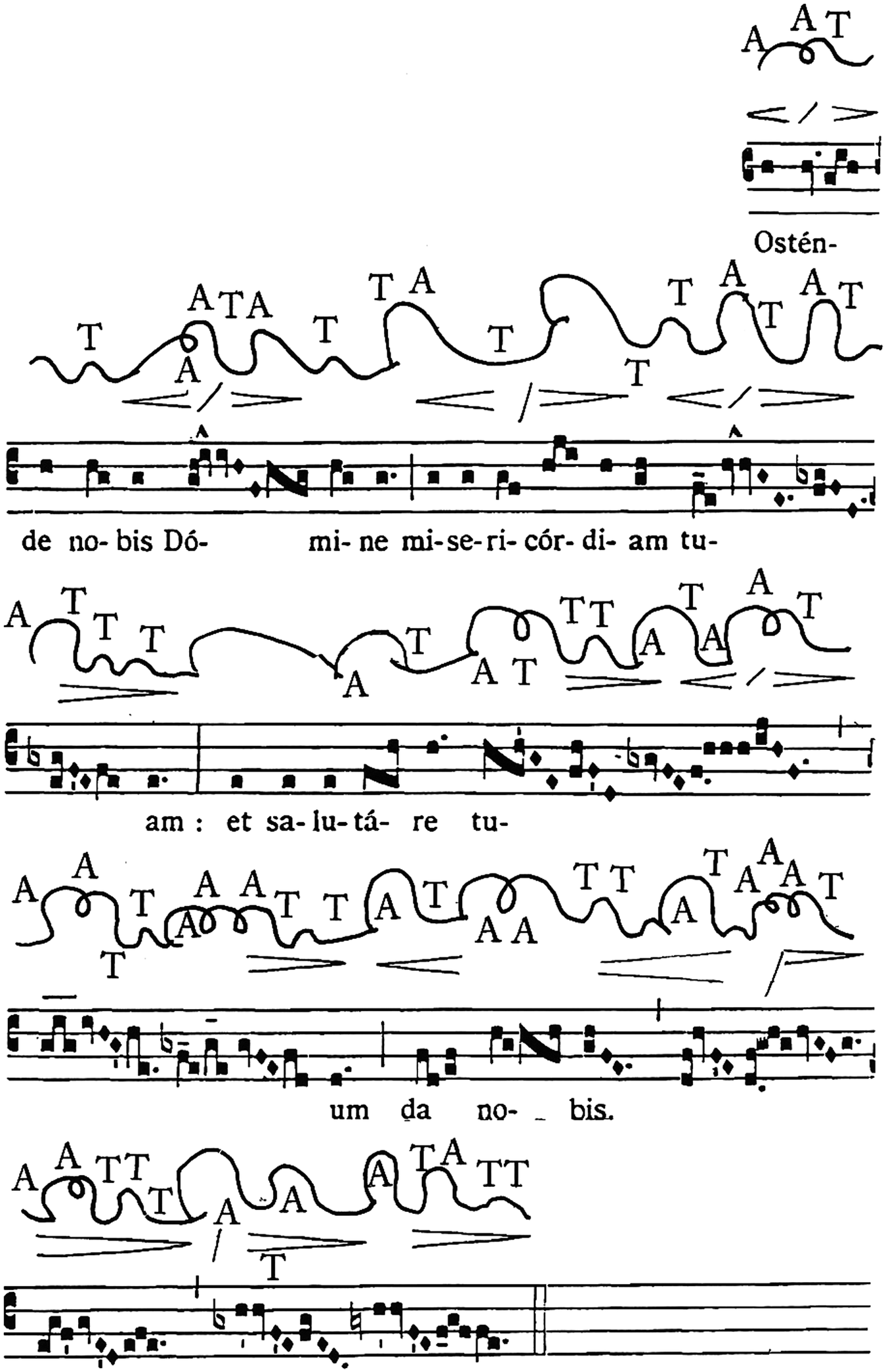
There is no reason to follow Mocquereau’s chironomy in further detail, but it is noteworthy how much space Messiaen devotes to it. He cites extensively from Le nombre musical grégorien, as well as from Gajard’s transmission of his teacher’s system. Having first presented images of various rhythmic elements similar to the ones reproduced here from Mocquereau, Messiaen then gives his own renderings of longer melodic lines according to this method. One of the most elaborate examples shows a formulaic pattern of movements to be used by imaginary conductors. It reveals how such chironomy is derived from close analyses of rhythmical structures in chant melodies. In Messiaen’s view, a major benefit in Le nombre musical grégorien is that rhythm is shown to have a ‘cinematic order’. This order brings the arguably most well-known aspect of Mocquereau’s theory into play: the conviction that rhythm is in its very nature an ‘alternation of momentum and rest, of arsis and thésis’.Footnote 128 Messiaen’s own chironomy for Ostende nobis Domine shows how meticulously he applies these twin concepts in analysis and performance suggestions. The letter A (for arsis) provokes ascending or ‘bouncing’ motions in the chironomy, whereas T (for thésis) brings about descending motions (see Figure 8).Footnote 129
Messiaen, Traité, iv, 61. © Copyright Editions Musicales Alphonse Leduc. Used by kind permission of Hal Leonard Europe Limited.
Similar graphic representations of rhythmic movements beyond strict measures appear in Messiaen’s work around 1930, suggesting an initial influence from Mocquereau at this time. La mort du nombre for soprano, tenor, violin and piano depicts an apocalyptic disintegration of time and space. The composer’s own poetry articulates a contrasting vision of a new liberated existence strikingly similar to the light movement envisioned by Mocquereau.Footnote 130 The orchestral piece Les offrandes oubliées presents conductors with a system for representing the music’s alternation between binary and ternary groups (see Figure 9).
Messiaen, Les offrandes oubliées, bars 1–3. © 1931 Durand Ed. With the kind permission of Editions Durand.

While the actual signs depart from Mocquereau’s, a syntax based on groups of two and three reiterates the most notorious aspect of Gregorian rhythm theories from Solesmes. Furthermore, as in his chironomy for the Ostende nobis Domine, Messiaen uses a diagonal mark to denote what he (perplexingly enough) calls ‘½ temps’.Footnote 131 In the light of his reception of Mocquereau, it seems clear that this indicates a middle ground or high point of tension, within shorter or longer periods. Such traces of influences suggest how a primitivist turn to the ‘old rules’ of plainchant was an important aspect of Messiaen’s youthful aspirations for a more complex rhythmical language.Footnote 132 At the same time, Mocquereau’s chironomy broadly prefigures later graphic notation, which – somewhat like Messiaen’s neumes – typically prescribes gestures and motions without fixed pitches.Footnote 133
A suggestion that post-war graphic notation would stand connected to plainchant or recourses to Greek antiquity seems far-fetched in historiographies shaped by high modernism and the avant-garde. Nevertheless, there is a certain logical progression from ideas about a historical and systematic primacy of rhythm to particular expressive ideals in Messiaen’s music, as well as to allusions to chironomy in his own compositions. Explorations up to this point have outlined how Messiaen’s readings in chant theory instilled a conviction that music is firmly situated in a mathematical and ecological order. This stance provides a truly universal basis for his analyses of music through neumes and reveals an assumed inner connection between such disparate repertoires as birdsong and plainchant. Having first reconstructed these fundamental ideas in dialogue with their roots in d’Indy and Mocquereau, it is now possible to take a closer look at the musical potential in a Greek-inspired theory of rhythm as ‘the beautiful ordonnance of movement’.Footnote 134
Neumes as motifs within Riemannian dynamic shadings
The examples of chironomy given above have already indicated how Messiaen postulates a schema of different levels in rhythm, from basic elements to larger and multiplex structures. As outlined in the Traité, this outlook follows Mocquereau, who enumerates four rhythmic layers, with the ‘phrase’ as the highest unit (see Figure 10). This schema can also be found in d’Indy and harks back to a systematic theory in Riemann.Footnote 135
Messiaen, Traité, iv, 45. © Copyright Editions Musicales Alphonse Leduc. Used by kind permission of Hal Leonard Europe Limited.

In addition, Le nombre musical grégorien establishes the primordial unit of a ‘short or indivisible elementary pulse’. This ‘atomic’ level is equivalent to syllables in language and remains a substrate below the simplest of the four rhythmic layers.Footnote 136 Such a minimal pulse that itself remains inappreciable is crucial to Messiaen’s understanding of ‘an uninterrupted succession of equal durations’ at the bottom of rhythm. He regards awareness of these ‘atoms’ crucial for performers of his music. Listeners, however, perceive only the ‘rhythmizing’ of the flow that takes place in his practice of adding ‘to any rhythm whatsoever a small, brief value which transforms its metric balance’.Footnote 137 Stephen Broad has traced Messiaen’s distinct technique of added values to Mocquereau’s performance ideals in chant; a musical backdrop would then be Riemann’s method of clarifying rhythmic structures through prolongations of their first note.Footnote 138 Messiaen, however, ardently denied that his ‘added values’ constitute a kind of notated rubato.Footnote 139 Recent research appears to prove him right, in reconstructions of his notion from Hindu sources without the Riemannian performance aspects.Footnote 140 Nevertheless, the following discussion aims to show how Riemann’s Greek-inspired term ‘rhythmizing’ explains why he regarded neumes as carriers of rhythmic motion, as well as highlighting expressive ideals intrinsic to this understanding.
For Riemann, the capacity of ‘rhythmizing’ first arises from a motion and expressive potential in tensions between several notes. In contrast to the atomic level of individual notes, he calls the first rhythmic layer that instils such movement ‘motifs’.Footnote 141 Mocquereau echoes this stance and adds a notable emphasis on a certain qualitative criterion: ‘Rhythm is ordered movement […] A series of sounds – syllables or musical tones – does not suffice to constitute a rhythm’ (emphasis original).Footnote 142
Mocquereau thus accepts the idea that a rhythmic order originates in dynamic relations between several events, a Riemannian vision that leads him beyond the primacy of syllabic chant advocated by Pothier. In the wake of Riemann’s motifs, he speaks of neumes as the first layer of rhythm proper. The neume is defined as ‘a melodic group’ which ‘expresses a musical idea’. It thus ‘retains its form, its individuality and autonomy’ (emphases original) even when detached from its original melodic context.Footnote 143 As put in Le nombre musical grégorien,
The word in language and the neum in music are individuals of a highly sociable nature. They exist only to meet, associate and combine in phrases – musical or literary. The neums, in so doing, become flexible and lend themselves to certain transformations and modifications which bring the individual neum into a closer relation with its surroundings in the phrase, fitting it more intimately into the general melodic and rhythmic scheme.Footnote 144
As a basic building block, the neume is ascribed both a constant form and a capacity for adaptation and transformation into different musical structures. Messiaen’s neumatic analyses and technique of melodic borrowing capture the former tendency, towards distinctiveness and permanence, with the implication that the musical idea within a neume remains identifiable in changing musical settings.Footnote 145 Furthermore, Mocquereau discusses cases where pitches are changed to facilitate the melodic flow within a neume or the proper interplay with other neumes.Footnote 146 This trait is a second vital element for turning neumes into a general method of analysis and into creative tools in modern composition.
As these considerations reveal, Messiaen’s conception of neumes is derived from theories that inscribe movement and tensions between distinct events (‘beats’) into the fabric of any truly rhythmic syntax. This basic principle makes it highly problematical to argue, as Hardink does, that: ‘The concept of stasis in Messiaen’s output […] owes its aesthetic to Gregorian chant.’Footnote 147 Messiaen himself had no concept of stasis, although he could describe himself as a ‘static composer’ because of his musical preoccupation with eternity. However, this aspect is in fact at odds with the late Romantic tradition which informed his reception of plainchant.Footnote 148 Rather, influences from chant theory inspired visions of a musical language brimming with dynamic tensions, as shown when he suggests an analogy between simple neumes and appoggiaturas or passing notes in modern harmony.Footnote 149
Within this framework, it is natural to see how Mocquereau’s theory suggested a possible route for liberating rhythm in the writing of new music. Le nombre musical grégorien could teach Messiaen how rhythm, as a form of ordered movements,
seizes the imperceptible undulations of sonorous bodies, unites them, organizes them in more varied and more ample undulations; arranges them with intelligence and taste in a perfect order; this it is that gives to them a form, that spiritualizes them in a certain sense, and gives them movement, beauty and life.Footnote 150
The ideal advocated here is a certain Apollonian refinement that spiritualizes motion. In other words, rhythm should venture beyond a ‘pathological’ tendency in early Romantic affect theories, where metre and human experience of it passively ‘succumbs’ to momenatary affects.Footnote 151 Mocquereau follows Riemann’s move away from simple alternations between distinct and ostensibly unrelated accents and unaccents. The German theorist had articulated a conception of ‘gradually changing intensity of two or three tones grouped into a metrical motif’. The most important feature of a metrical motif is its ‘dynamic shading’ (dynamische Schattierung): a steady growth, a becoming, or a ‘positive development’ leads to a ‘dynamic climax’ followed by a passing away, a dying off, or a ‘negative development’.Footnote 152 Mocquereau’s notions of arsis and thésis, or élan and repos, translates Riemann’s ‘becoming’ and ‘passing away’ and intends to capture similar flexible and subtle gradations.Footnote 153 The inserted crescendo and diminuendo signs in Messiaen’s chironomy reveal how his rhythmic analyses also rest on such a shifting intensity within phrases. The assumed ground of both music and plastic arts within a common nature of rhythm helps to explain why neumes in chironomy are regarded as conjoined melodic and metrical motifs, in line with a late Romantic, ‘ultra-expressive’ ideal in performance.Footnote 154
There is also a lasting influence on Messiaen’s chironomy, through Mocquereau, from the most notorious aspects of Riemann’s break with nineteenth-century accent theories: namely, his often dogmatic conviction that every single metrical unit contains an upbeat and a downbeat, as well as his refusal to place the beginning of motifs on metrically strong positions. Sometimes referred to as having propounded an ‘axiomatic anacrucis (Auftaktigkeit)’, Riemann argued that earlier accent theories had failed to account for an ascending motion at the origin of musical movements. He regarded such energy necessary for phrase structures to take off, but claimed that the real aesthetic worth of metrically accentuated motifs lies in a contrary repose.Footnote 155
Le nombre musical grégorien scrupulously transmits Riemann’s conviction that the energy and equilibrium between these different shadings are reiterated at all four layers of rhythm. Messiaen endorses Mocquereau’s ‘final synthesis’ of all rhythms to a dynamic and ‘indissoluble union of momentum and rest’. In plainchant, at least, he also accepts a deconstruction of all rhythms into underlying alternations between groups of two and three, arguing that they symbolize basic binary or ternary motions in the human body.Footnote 156 A primacy of irregularity and tension becomes manifest in the further suggestion that even spondaic metre emerges from an archetypal forward-directed or ‘iambic’ motion.Footnote 157 In this way, Messiaen’s reception of Mocquereau’s arsis and thésis retains Riemann’s general phrase schema of a necessary ‘upbeat motion’, a middle point – called ictus – and an ensuing cessation of intensity.
The Traité nevertheless deems the chant scholar ‘insatiable’ in his Riemann-like synthesis. This is a point where Messiaen – like d’Indy – breaks with Mocquereau’s ‘Teutonic systematicity’, articulating an enhanced awareness of historical heterogeneity in music, and thus beginning to recede from the strict universality posited by Riemann. The fourth volume of the Traité discusses at length d’Indy’s theory of articulation, which in its analyses of masculine and feminine melodic groups employs Riemann’s basic schema of becoming and passing away within phrases. While its articulation in the Cours is deemed appropriate in music from Gluck to Wagner, Messiaen declares it ‘absurd’ to search for its constitutive elements in plainchant or Stravinsky.Footnote 158 His own chironomy for chant models certainly employs the notions and concomitant vision of Mocquereau’s similar theory of arsis and thésis. In contrast, however, to the more dogmatic use of these basic patterns in his own chapter on Mozart, Messiaen’s analyses of plainchant incorporate these shadings of intensity in a much less heterogeneous fashion.Footnote 159 In this flexibility, supposedly, lies the primary aesthetic value of plainchant for Messiaen.
As this stance makes clear, the argument that plainchant provides a link back to original and universal rhythmic theories does not imply that particular rhythmic patterns in historical chant provide timeless norms for the further evolution of music. It is necessary to distinguish between a fundamental theoretical level and its adaptation in compositional practice. Messiaen’s emphasis on chant as a model for ‘ametrical’ music employs ideas from Mocquereau against the chant scholar’s own strict system. The rhythmic symmetry on four levels articulated in Le nombre musical grégorien, from motifs to full-scale phrases, stands heir to a manifest norm of regular eight-bar periods in Riemann. To accept the underlying logic of such symmetry would, however, oppose the core values Messiaen seeks to salvage from plainchant. In the end, he is a more emphatic champion of ‘freedom’ in chant than Mocquereau, and must find his role model’s rhythmic theories ‘incomplete’.Footnote 160
From Mocquereau to new orders of sound
Beside Messiaen’s theoretical affirmation of a modified form of the expressive ideal of dynamic shading, there is a more manifest – albeit perhaps surprising – creative reception of Le nombre musical grégorien to consider here. Once more, the inspiration comes from Mocquereau’s quest for a ‘pre-musical’ universality, which entails a primacy of sound over particular elements in music (or language).Footnote 161 Messiaen could here find incentives for an emancipation of sounds from traditional musical structures, a central preoccupation in his musical context of the late 1940s and early 1950s. His celebrated serial pieces from the middle of the century have typically been compared to dodecaphony, Boulez, or Pierre Schaeffer’s musique concrète. Influences from Mocquereau’s theory of sound on Messiaen’s distinct brand of serialism have been less widely appreciated. The thesis that ‘Rhythm is ordered movement’ beyond a ‘series of sounds’ led the Gregorian scholar to argue that:
These movements must be put in order and harmoniously arranged. This ordinance, this putting in order, is the form itself of rhythm. This it is that disposes harmoniously the succession of short and long sounds, high and low sounds, and every kind of timbre.Footnote 162
In the Traité, Messiaen takes Le nombre musical grégorien and meticulously reproduces its positing of four, and later five, dimensions inherent in the phenomenon of sound. The original quadruple concerns the interplay between (1) the quantitative order (durations); (2) the dynamic order (intensity); (3) the melodic order (pitches); and (4) the phonetic order (timbres).Footnote 163 These distinct and ‘interpenetrating’ orders in sound provide an obvious link to Messiaen’s Mode de valeurs et d’intensités, together with a decisive stress on human agency in the ordering of sound. This piece creates a composite ‘mode’ of 24 durations, 7 dynamic levels, 36 notes and 12 touches (modes of attack). An order of 12 modes of attack on the piano is clearly not quite the same as different timbres in a more literal sense. Nevertheless, the basic parameters behind this groundbreaking work are a sounding corollary of Mocquereau’s four orders, albeit further advanced.Footnote 164
The most distinctive aspect of Messiaen’s serialism is arguably its focus on the element of rhythm. This trait echoes how Mocquereau’s chant theory outlined a fifth, ‘cinematic’ order, or simply ‘The Rhythmic Order, properly speaking’.Footnote 165 As Vincent Benitez notes, ‘For Messiaen, manipulating the order of durations was a key element […] in discovering different kinds of movement beyond the simple forward.’Footnote 166 A topic worth investigating further is to what extent the subtle flexibility and dynamic shading inherent in Mocquereau’s theory of arsis and thésis influenced Messiaen’s serial explorations of movement, in Quatre études de rythme and beyond.
The individual piece that first springs to mind in this context is Neumes rythmiques. This explicit attempt to turn the movement in different neumes into an element for new compositions was highlighted already in 1958, in a tribute written by his student Karlheinz Stockhausen.Footnote 167 Messiaen’s exposition of the work in the third volume of the Traité in fact contains his single most lucid explication of neumes. He explains that neumes in chant are ‘melodic groups rather than rhythmic groups’;Footnote 168 nevertheless, he argues that their primary musical interest originates in shadings between arsis and thésis. In preparation for the composition, Messiaen first transposed the kind of movement supposedly inherent in the originally melodic gestures of neumes into a new ‘language’ of individual rhythms. Each rhythmic neume then received a fixed intensity – certainly artificial, but often inspired by the intensity of its original melodic gesture.Footnote 169 Equipped with such a fixed repertoire of sonorous rhythms, Messiaen was able to build entire phrases that recreate irregular, ‘fluid, deceptive and imaginative’ shadings of intensity, much in the spirit of Mocquereau.Footnote 170
This procedure allows Messiaen to disentangle the cinematic movement theorized by Mocquereau from the distinct repertoire of plainchant. Neumes become a creative tool in the development of a new musical language that almost literally reproduces fundamental ideals in Mocquereau’s theory of sound, while forming completely new structures. The theory of interconnecting orders of sounds is, however, no less significant than the Riemannian shading of intensity articulated in the interplay between arsis and thésis. Messiaen’s rhythmic neumes are not primarily to do with durations; rather, from the outset they are compound and sounding phenomena that embody a kind of melodic movement, a certain fixed intensity and, in fact, a specific timbre.
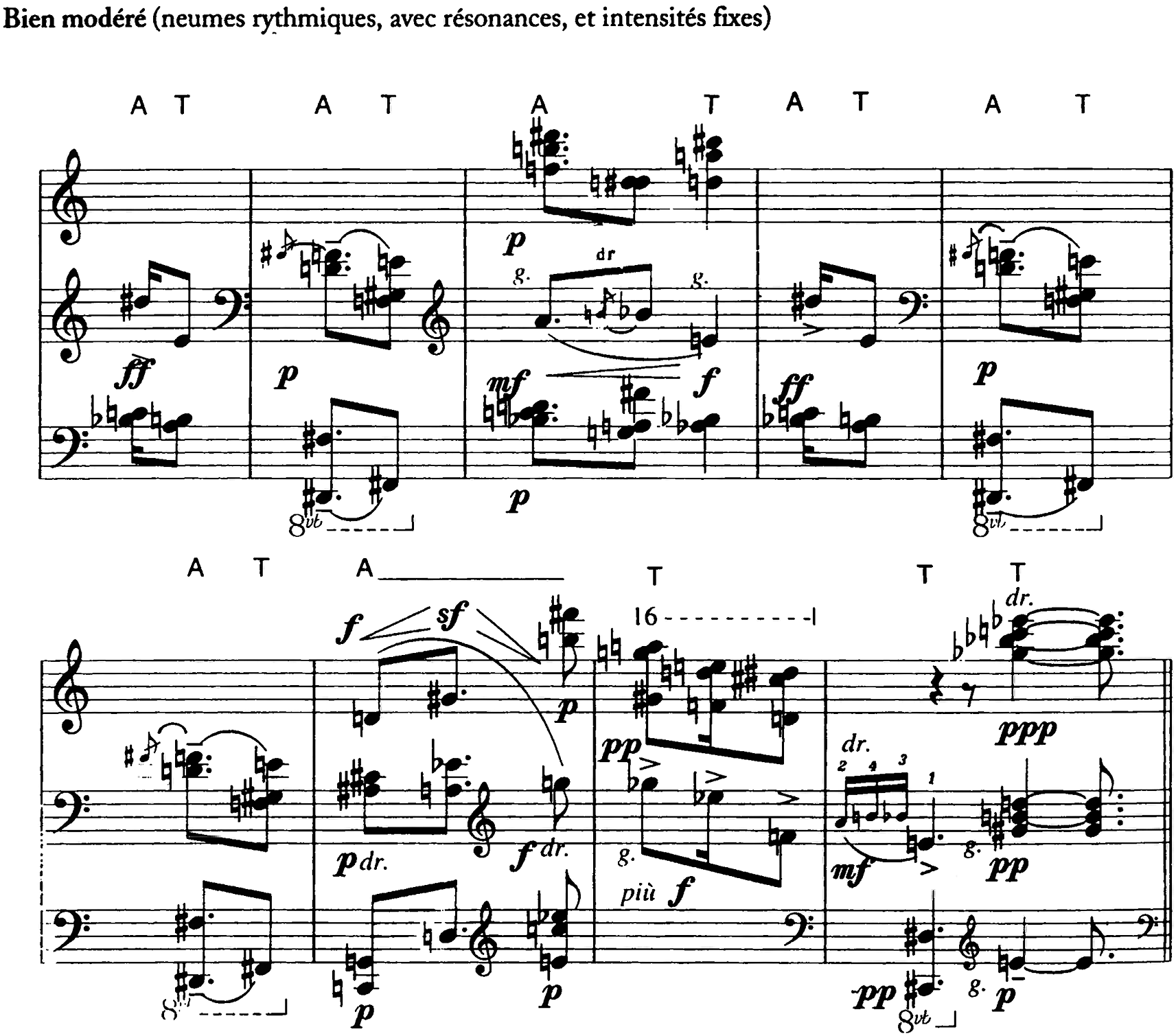
As the composer’s own exposition of Neumes rythmiques reveals, neumes are rhythmic elements that in every appearance retain the same basic rendering in every parameter. While durations can vary slightly, the inherent shading of intensity in Messiaen’s version of a podatus, a clivis or a torculus remains constant. They are reproduced with a fixed melodic movement, but the conviction that timbre is an intrinsic element also inspires Messiaen to add colour by means of harmonic ‘resonances’. In the first section of neumes, each bar represents a distinct neume. While the constant central pitch throughout the nine bars is an e′, it is both set within different structures of melodic intensity, and receives different colourings through the resonance of added chords (see Figure 11).Footnote 171
Messiaen, Neumes rythmiques, bars 3–11 (analysed as a succession of arsis and thésis in Messiaen, Traité, iii, 156). © Copyright Editions Musicales Alphonse Leduc. Used by kind permission of Hal Leonard Europe Limited.
This technique is of pivotal importance in understanding connections between the reception of Mocquereau’s theory of sound in rhythm and Messiaen’s refined rendering of birdsong as developed in the 1950s. The crucial point is that harmonic resonances – or chords – are conceived as an integral aspect in neumatic analyses of a single melodic line. This conviction mirrors the statement in Technique de mon langage musical that harmony lies ‘latent’ in melody. It requires Messiaen to develop complex homophonic harmonic textures in order to reproduce resonances within the melodies of birdsong in an ostensibly ‘authentic’ manner. The link between plainchant and birdsong highlighted by Cheong can at this point be explained as (at least) a threefold interconnection:
-
(1) The natural basis behind Messiaen’s chant theory presupposes an ecological and evolutionary unity between birdsong and the music of humanity.
-
(2) Birdsong shines forth as representative of the flexibility and rhythmic subtleness dormant in a proper understanding of rhythmic-melodic neumes, through which birdsong also can be analysed.
-
(3) An accurate musical rendering of melodic lines in birdsong requires harmonic colouring, in line with the theory of sound orders that Messiaen found articulated in Mocquereau’s Le nombre musical grégorien. It is thus also natural to see a manifest continuity between the experimentation with such orders in a piece like Neumes rythmiques and the development of bird style in ensuing works from the 1950s.
An obvious objection against a one-sided stress on influences from Mocquereau on Messiaen’s integration of rhythm, melody and even harmony is that his previous experiments with resonance appear to be unconnected to writings on chant. However, as shown by James Mittelstadt, vital ideas behind the development of Messiaen’s harmonic language – most notably regarding the concept of resonance – are inspired by readings of d’Indy, and possibly of Riemann.Footnote 172 The obvious affinity between them and Mocquereau indicates that further attention to Messiaen’s creative reception of the Gregorian scholar’s cinematic order may prove a fertile route to the analysis of the integration of durations, melody and sound-colour into the composer’s late works. Its vision of sound as a perfect integration of duration, intensity, pitch and timbre would possibly explain the gradual turn towards the harmonic and instrumental colourings of plainchant essential to works such as Couleurs de la cité céleste and Et expecto resurrectionem mortuorum. Another significant passage where Messiaen makes use of Mocquereau’s orders of sound, including timbre, is the opening of ‘Les stigmates’ from the opera Saint François d’Assise. Footnote 173
Conclusion: chant theory as an integrative but camouflaged influence
This article can be seen as a lengthy gloss on Messiaen’s characteristic statement that, ‘The marvellous thing about plainsong is its neumes.’Footnote 174 When this and other sayings are contextualized, Messiaen’s theoretical approach to neumes arguably becomes ‘the marvellous thing’ in his reception of contemporary literature on chant. ‘Archaeological’ investigation of a backdrop in writings by Riemann, d’Indy and Mocquereau allows a reconstruction of Messiaen’s claim for the universality of neumes as a peculiar but largely coherent and comprehensive theory. This vision brings together some of the composer’s most characteristic and speculative ideas on music with a number of distinct techniques both explicit and implicit at the surface level of his writings.
The potential benefits of this reconstruction for future scholarship bridge the same macro and micro levels as the theory itself. Recent studies have already demonstrated that a certain ‘neumatic lens’ – inherited from d’Indy – plays a central role in Messiaen’s assimilation of Gregorian chant into his own music, not least in the style oiseaux developed in the 1950s. This article draws attention to theoretical foundations behind these procedures.Footnote 175 It shows how Messiaen presupposed a unitary dimension common to all music, on intertwined mathematical, natural, historical and theological grounds. On these particular premisses, his references to ‘neumatic’ formulas in modern composers make logical sense, as does his connection of expressiveness in birdsong with Chopin’s rubato.
Such a comprehensive vision of plainchant points beyond itself to wider vistas within Messiaen’s musical thought. An open question is, to what degree does scholarly analysis require a conscious distance from the often opaque terminology in his two main treatises?Footnote 176 However, the primary challenge is arguably not to pass verdict on Messiaen’s collage-like catalogues of sources and techniques, but to comprehend underlying threads that explain the rationale behind them. His style of writing provides a good case for the lasting relevance of the hermeneutic dictum to ‘understand a writer better than he understood himself’.Footnote 177 The reader often needs to reconstruct underlying concepts and frameworks that make intelligible the fragments on the surface level of the texts. It may well be that Messiaen himself was only dimly aware of fundamental premisses at work in his own musical universe, a circumstance that calls for conscientious attempts to piece them together.
A study of plainchant not only raises the need for further investigations of Messiaen’s reception of German music theory, partly through French authors such as d’Indy and Mocquereau,Footnote 178 but also indicates the centrality of an evolutionary outlook, in which medieval chant preserves an ancient metric legacy, forms a distinct repertoire on its own and carries seeds for modern harmony within its own sounding structures. This framework sheds light on the enigmatic interplay between the main elements of music in Messiaen’s thought. It explains why his main exposition of plainchant occurs in the fourth volume of the Traité – devoted to melody – where it arches over from the initial volumes on rhythm to the subsequent tomes on harmony.
A second area of study is a look at how the reconstructed theory of chant shaped Messiaen’s own musical language. He claimed that all well-written music contains a ‘constant alternation’ between arsis and thésis, as ‘perfectly delineated by the greatest theoretician of plainchant, Dom Mocquereau’.Footnote 179 Thus, it would seem that the main lesson Messiaen drew from Mocquereau was a particular expressive ideal of ‘rhythmic suppleness’, a flexible schema of rises and falls within phrases. This article highlights traces of Mocquereau in works by Messiaen from 1930–1 and points out resemblances between the chant scholar’s writings and motifs behind Messiaen’s own progressive language, as articulated in the composer’s early journalistic writings and the Technique de mon langage musical.
In spite of the claim that such a schema should permeate all music, Messiaen’s neumatic analyses of melodic contours or a certain historiography of music need not imply that chant provided a matrix behind his own compositional processes in every case. Indeed, significant caution is called for regarding the epistemological status of his theoretical claims. As put by Jennifer Donelson, Messiaen’s writings ‘oscillate between a sort of absolute notion of fundamental aesthetic principle (which was really more of a conviction of the things discovered through his own musical language)’ and expressions of a deeply felt personal vocation.Footnote 180 In general, it might be more apt and fruitful to study how absolutist theoretical convictions and Messiaen’s own artistic sensibility stand reciprocally linked than to examine their literal purported implications. It would therefore be natural to investigate further how Mocquereau’s theory of arsis and thésis inspired the composer’s own ‘musical poetics’.Footnote 181 The most obvious way would be to reconsider works from the 1930s or early 1940s, and in them search for connections between the schema of ‘becoming’ and ‘passing away’ and Messiaen’s still enigmatic ‘special ideas […] on prosody, and the union of the musical line with the living inflections of speech’.Footnote 182 Further investigations of how Messiaen read d’Indy’s Cours and Mocquereau’s Le nombre musical grégorien promise to illuminate one of his most cherished aesthetic principles: the possibility of regarding musical sentences as constituting a succession of melodic periods, in which harmony and different rhythmic techniques serve the expressive intensity latent in melody itself.Footnote 183
Mocquereau’s integration of duration, intensity, pitch and timbre as constituent layers in a truly rhythmic or ‘cinematic’ order exerted a more distinct influence on Messiaen, one that surfaces in serial techniques developed in Neumes rythmiques and used in the composer’s late works. The compound theory of sound articulated in Le nombre musical grégorien can also potentially explain why Messiaen again came to cite Gregorian melodies in works from the 1960s, having previously sought rather to amalgamate their musical qualities into his own syntax. Moving away from earlier convictions that plainchant should not be harmonized, Messiaen now developed an interest in harmonic and timbral colourings of chant melodies. To posit Mocquereau’s theory of sound as the sole source behind the idea that melodies contain an inherent harmonic resonance would be reductionistic. Nevertheless, experiments with harmonic colourings in birdsong throughout the 1950s follow naturally from the multidimensional understanding of neumes and sound articulated by the Gregorian scholar. Further work on neumes in the style oiseaux might here benefit from readings of Le nombre musical grégorien.
The claim that plainchant exerts a unique influence on Messiaen’s music is not new. This article endorses this view but seeks to modify the grounds on which it is articulated. Messiaen used plainchant in many different ways and this repertoire certainly held a prominent liturgical and theological significance for him. However, more crucial in this context is how its syntax was amalgamated into the fabric of his own language. Messiaen’s reception of Mocquereau’s theory of neumes is a central backdrop that sheds light on this transformation of historical plainchant into building blocks in the composer’s deeply personal brand of musical modernism. Most crucially, chant theory also functioned as an intellectual filter that allowed Messiaen to situate his own creativity within the broader evolution of music. Finally, and perhaps above all, it provided him with what he held to be a truly universal theory of music, regardless of whether it was created by human or by avian voices.
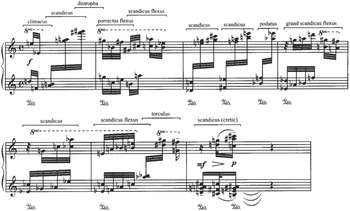


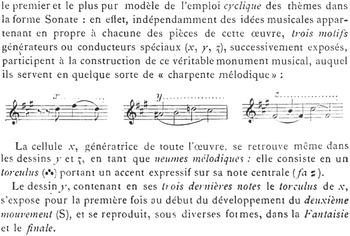


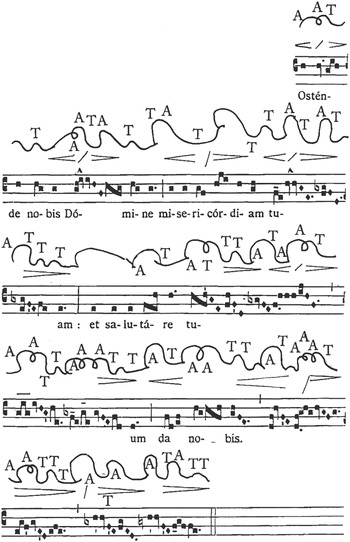
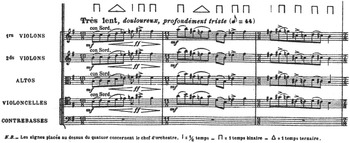

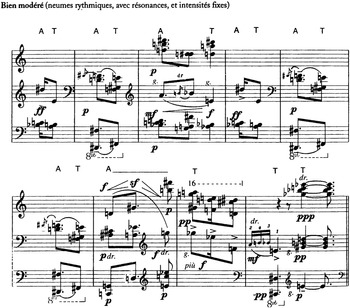

 Open access

