


Introduction
Shigella sonnei is a gram-negative bacterium typically known to cause bacterial gastroenteritis and is one of the causative agents of Shigellosis. Reference Choi, Navarathna and Harston1 S. sonnei is of increasing public health concern due to the extremely drug-resistant (XDR) profile emerging in many strains and is now bypassing S. flexneri in lower- or middle-income countries. Reference Scott, Baker and Trotter2 In the United States, cases of XDR S. sonnei are typically community acquired from men who have sex with men (MSM) populations in metropolitan areas. Reference Caldera, Shaw, Uslan and Yang3,Reference Bowen, Eikmeier and Talley4 Nonetheless, there has been an increased frequency in reports of its acquisition in high-risk populations such as unhoused or immunocompromised individuals, including individuals living with HIV, children, and international travelers. Reference Charles, Prochazka and Thorley5 The rise and dissemination of XDR S. sonnei has also been observed globally, typically with those carrying extended-spectrum beta-lactamases (ESBL) genes such as bla CTX-M . Reference Charles, Prochazka and Thorley5 These antimicrobial resistance (AMR) genes are often carried on mobile genetic elements, particularly the IncF-like plasmids. Reference Caldera, Shaw, Uslan and Yang3,Reference Charles, Prochazka and Thorley5–Reference Campos-Madueno, Bernasconi and Moser7 In our previous studies, we revealed a unique strain of XDR Shigella sonnei carrying ESBL-type bla CTX-M-15 spreading among the MSM populations in Los Angeles. As our genomic surveillance continued, we discovered another novel XDR Shigella sonnei strain carrying an unusual AmpC-type gene bla DHA-1 in two unrelated cases, one of which had no MSM history.
Cases
Patient 1 is a 33-year-old immunocompromised female presented to our institution in 2024 with fever (37.2–38.3°C), intermittent chills, rigors, tachycardia, abdominal pain, and diarrhea in the setting of neutropenia. She was diagnosed with high-grade B-cell lymphoma in 2021 and received a bone marrow transplant in 2024. She also had a history of invasive fungal pneumonia. She was thus admitted for neutropenic fever and given meropenem as empiric therapy. She was discharged 7 days later with no recurring diarrhea.
Patient 2 is a 34-year-old male with a history of advanced HIV (CD4 cell count 23 c/mL, viral load 377,000 copies/mL), polysubstance use, and severe mental health disorder presented to our ED with abdominal pain and chronic diarrhea for approximately 6 months. His prior stool studies variably demonstrated Shigella spp., for which he was given at various intervals, ceftriaxone monotherapy and levofloxacin monotherapy prior to identifying an XDR Shigella. He had a prolonged history of unstable housing and active methamphetamine use and was previously noted as being sexually active with male partners, without more recent exposure history being available. The patient left per patient-directed discharge after four days of intravenous ertapenem.
Genomic characterization
S. sonnei cases were passively identified in our institution first by positive Shigella PCR results from the BD Max Enteric Bacterial Panel on stools from patients with gastrointestinal symptoms, followed by stool culture and serotyping. Criteria for XDR Shigella were based on the CDC’s guidelines as being resistant to azithromycin, ciprofloxacin, ceftriaxone, trimethoprim-sulfamethoxazole, and ampicillin. Whole-genome sequencing (WGS) of the isolates was performed using the Illumina MiSeq platform. Reference genomes that are most closely related to the isolates were determined by KmerFinder (Center for Genomic Epidemiology, https://cge.cbs.dtu.dk/services). Isolates were further genotyped by using Pathogenwatch web application (https://pathogen.watch/, accessed 3/30/25). Qiagen CLC Genomics Workbench (v23.0.4) was used for single nucleotide polymorphism (SNP) analysis. More than 0.5 million reads were acquired for each isolate, ensuring the mean whole genome coverage to be at least 25X, as previously reported. Reference Price, Realegeno and Mirasol8 Center for Genomic Epidemiology tools were used, including CSI Phylogeny 1.4 for SNP calling inferring Phylogeny, ResFinder for AMR gene identification, and PlasmidFinder for plasmid replicon identification. The isolates from Cases 1 and 2 were identified as S. sonnei ST152, and were most closely related to the reference strain 506 isolated from a stool specimen, from a women’s hospital in Boston, United States (NZ_CP053751.1) with a ∼99% genome coverage and pairwise identity.
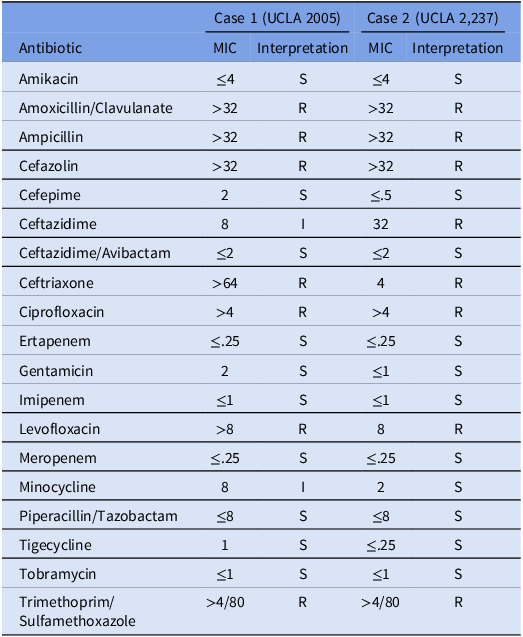
Both isolates exhibited very similar resistance profiles (Table 1). Both isolates were resistant to oral drugs commonly used to treat shigellosis, including azithromycin, ciprofloxacin, and trimethoprim/sulfamethoxazole, attributing to AMR genes conferring resistance to macrolides (erm(B), mphA), quinolones (qnrB4, qnrS1), sulfonamides (sul1, sul2), and trimethoprim (dfrA1, dfrA17). Both were resistant to ampicillin, amoxicillin/clavulanate, and third-generation cephalosporins but susceptible to piperacillin/tazobactam and carbapenems. Most notably, Case 1 (UCLA 2005) carried both an ESBL-type bla CTX-M-15 and an AmpC-type bla DHA-1 , while Case 2 (UCLA 2,237) only carried bla DHA-1 (Figure 1). Despite both having tet(B) gene, predicting resistance to minocycline, UCLA 2005 was intermediate (MIC = 8) while UCLA 2,237 was susceptible (MIC = 2). Additionally, 3 AMR genes conferring resistance to aminoglycosides were detected in both isolates including aadA5, aph(3″)-Ib, and aph(6)-Id, however, this class was phenotypically susceptible. These discrepancies between the genotype and phenotype require further investigation. Possible reasons include insufficient AMR gene expression and low-level resistance that’s below the limit of detection of the phenotypic antibiotic susceptibility test.
Antimicrobial susceptibility profile for XDR Shigella sonnei isolates

MIC = minimal inhibitory concentration, S = susceptible, I = Intermediate, R = Resistant.
Genotypic characterization of Shigella sonnei isolates. A) Phylogenetic tree showing clustering of the two blaDHA-1-carrying XDR Shigella sonnei isolates and AMR genes across Shigella sonnei isolates. UCLA isolates 1,498*, 1551*, and 1565* have been previously published. B) SNP matrix showing number of SNP differences between UCLA isolates.

To investigate the genetic relatedness of the isolates from Cases 1 and 2 (UCLA 2005 and UCLA 2,237), we compared them with five sexually transmitted XDR S. sonnei isolates with clear epidemiologic link to MSM, including three from prior reports (UCLA 1,498*, 1551*, 1565*) Reference Caldera, Shaw, Uslan and Yang3 and two additional unpublished isolates (UCLA 2,148, 2,172). While all isolates analyzed in this study were identified as lineage 3.6.1.1 using mykrobe v0.13.09, phylogenetic analysis showed 2 distinctive clusters of XDR S. sonnei (differed by 100 SNPs), with the sexually transmitted isolates all carrying bla CTX-M-15 and tet(A), while the isolates with unclear transmission route all carrying bla DHA-1 and tet(B) (Figure 1). Further, despite no known epidemiologic link between Cases 1 and 2, the two isolates (UCLA 2005 and UCLA 2,237) only had 26 SNP differences, suggesting a relatively close relatedness and a recent common ancestor strain. In addition, both isolates harbored a IncFII-like plasmid that was closely related to bla DHA-1 carrying plasmids found in a S. flexnerii isolated from a non-MSM patient in Australia (CP061363.1), Reference Guglielmino, Kakkanat and Forde10 and a S. sonnei isolated from a patient in Taiwan (CP151315.1).
Discussion
This is the first report describing a bla DHA-1-carrying XDR Shigella in the U.S. The most concerning finding was that this novel strain was found in patients with unclear transmission route, highlighting the wider spread and continued evolution of XDR Shigella in the community. Strikingly, both bla CTX-M-15 and bla DHA-1 genes were found in the XDR Shigella in a non-MSM patient without a significant travel history or other risk factors. This genotype has never been reported before.
These two isolates, discovered one year apart, differed by only 26 SNPs, suggesting a close genetic relationship and supporting the hypothesis of community transmission of another unique strain of XDR Shigella. There are no identifiable epidemiological links between the two patients, who resided 80 miles from each other and did not overlap at our institution in either location or time. Additionally, there were no known unusual food exposures in either patient or an awareness for an outbreak of foodborne Shigella during the time of these cases.
While previous reports have described Shigella sonnei carrying either AmpC or ESBL genes individually, Reference Muthuirulandi Sethuvel, Anandan and Devanga Ragupathi6,Reference Sturod, Dahle, Berg, Steinbakk and Wester11–Reference Anandan, Muthuirulandi Sethuvel, Gajendiren, Verghese, Walia and Veeraraghavan14 none have demonstrated co-carriage of both bla CTX-M-15 and bla DHA-1 . Other countries have reported co-carriage of blaCTX-M-15 and AmpC (blaCMY-2 or blaCIT ) genes in S. sonnei isolates co-resistant to 3rd gen cephalosporins and fluoroquinolones. Reference Sriyapai, Pulsrikarn, Chansiri and Sriyapai15–Reference Tajbakhsh, Garcia Migura and Rahbar19 Other Enterobacterales such as E. coli and K. pnuemoniae carrying plasmid-borne AmpC and ESBLs have been documented. Reference Kurittu, Khakipoor and Aarnio20 K. pneuomoniae have been reported to co-carry bla DHA-1 and bla CTX-M-3 . Reference Kim, Lim, Jeong and Seol21 What is particularly concerning here is the emergence of bla DHA-1 on a plasmid in a community-acquired Shigella isolate, suggesting possible horizontal gene transfer between species within Enterobacterales. The clinical implications of this are significant given that dual cephalosporinase producers may exhibit higher resistance than the more typical CTX-M–associated XDR Shigella. While global spread of XDR Shigella phenotypes have been more attributed to CTX-M carriage, Reference Ranjbar and Farahani22 the emergence of DHA-1-carrying XDR Shigella in more diverse patient populations signaled a different epidemiologic dynamic and warrant close monitoring and continuous genomic surveillance.
Data availability statement
The WGS sequences can be found via NCBI Genbank (PRJNA1335817 and PRJNA1085759).
Acknowledgements
We thank the UCLA Molecular Microbiology and Pathogen Genomics (MMPG) Laboratory for their technical support. All authors declare no conflict of interest.


 Open access

