


Introduction
There is considerable need for accessible psychological therapies within adult community mental healthcare services (CMHS). Up to half of those attending outpatient services will meet criteria for one or more personality disorder diagnoses (Dale et al., Reference Dale, Sethi, Stanton, Evans, Barnicot, Sedgwick, Goldsack, Doran, Shoolbred, Samele, Urquia, Haigh and Moran2017). This is common both as a primary diagnosis, and as a comorbidity, with a 40% comorbidity rate in an Irish CMHS sample (Carr et al., Reference Carr, Keenleyside, Fitzhenry, Harte, Daly White, O’Hanrahan, Hayes, Cahill, Noonan, O’Shea, McCullagh, McGuinness, Rodgers, Whelan, Sheppard and Browne2015). Crisis presentations are also common amongst this group and are associated with extensive use of healthcare resources and complex patterns of engagement (Lohman et al., Reference Lohman, Whiteman, Yeomans, Cherico and Christ2017). This can result in such individuals being offered minimal active interventions, or a wide range of interventions without a clear rationale (McMurran and Ward Reference McMurran and Ward2010).
Despite the clear need, the implementation of evidence-based psychological therapies can be challenging in CMHS for reasons including availability of resources, staff expertise and training, service-user turnover, and challenges matching specialist interventions to service-user needs. In addition, while treatments such as dialectic behavioural therapy are efficacious in addressing self-harm and suicidality (Chapman Reference Chapman2006), emotional and interpersonal issues can interfere with the capacity to engage in therapeutic work. There have been some attempts to introduce specialist psychological therapies such as mentalization-based therapy (MBT) in non-specialist settings that, while promising, have met with challenges (Beattie et al., Reference Beattie, Murphy, Jamieson and Lee2022; Tong et al., Reference Tong, Costello, McCabe and Doherty2022).
In recent years, there has been considerable work to develop psychotherapeutic interventions which are flexible and can be delivered by practitioners at various levels of specialisation, including MBT. Mentalizing is the process by which we make sense of each other and ourselves, implicitly and explicitly, in terms of subjective states and mental processes. It has been surmised as “holding mind in mind” (Allen et al., Reference Allen, Fonagy and Bateman2008). MBT aims to improve capacity for mentalizing. MBT was developed for Borderline Personality Disorder (BPD) for which there is now a well-established evidence base (Bateman and Fonagy Reference Bateman and Fonagy2016, Reference Bateman and Fonagy2004). More recently MBT has demonstrated effectiveness across a range of disorders and service delivery contexts (Luyten et al., Reference Luyten, Campbell, Moser and Fonagy2024).
Of particular relevance for non-specialist services, including CMHS with undifferentiated caseloads, mentalization is viewed transdiagnostically and is implicated in psychological problems other than personality disorders (Malda-Castillo et al., Reference Malda-Castillo, Browne and Perez-Algorta2019). The evidence base for MBT in other psychological disorders is rapidly growing, although more research and broader samples are needed. Recent RCTs have provided preliminary support for the efficacy of MBT in antisocial personality disorder (Bateman et al., Reference Bateman, Fonagy, Bateman and Fonagy2016), eating disorders comorbid with BPD (Robinson et al., Reference Robinson, Hellier, Barrett, Barzdaitiene, Bateman, Bogaardt, Clare, Somers, O’Callaghan, Goldsmith, Kern, Schmidt, Morando, Ouellet-Courtois, Roberts, Skårderud and Fonagy2016), substance abuse disorder (Suchman et al., Reference Suchman, DeCoste, Borelli and McMahon2018) and depression (Fonagy et al., Reference Fonagy, Lemma, Target, O’Keeffe, Constantinou, Ventura Wurman, Luyten, Allison, Roth, Cape and Pilling2020).
While MBT was originally conceptualised as a long-term psychotherapy programme, short-term adaptations have been proposed. The short-term format is a 20-week adaptation, condensing the original 12 week MBTi format to 5 weeks, and the original 18 month MBT group therapy format to 15 weeks MBT (Juul et al., Reference Juul, Frandsen, Bo Hansen, Sørensen, Bateman and Simonsen2022). Comparison between short-term and long-term MBT have demonstrated the non-inferiority of short-term therapy (Juul et al., Reference Juul, Jakobsen, Hestbaek, Jørgensen, Olsen, Rishede, Frandsen, Bo, Lunn, Poulsen, Sørensen, Bateman and Simonsen2023). A briefer 10-week MBT standalone group carried out as part of a stepped-care, out-patient personality disorder service has demonstrated positive post-treatment changes (McGowan et al., Reference McGowan, Syam, McKenna, Pearce and Saunders2021).
MBT introductory groups (MBTi) cover the psychoeducation component of MBT, including underlying principles and concepts of mentalizing (Bateman et al., Reference Bateman, Fonagy, Bateman and Fonagy2016). It was designed as a preparation for the MBT group therapy programme (MBTg) to introduce individuals to concepts of mentalizing and to promote early awareness of mentalizing, while adhering to MBT principles. Individuals may then progress onto MBTg. There is very limited literature on the efficacy of individual components of MBT such as MBTi . One qualitative evaluation of an MBTi group delivered as stand-alone intervention in a prison setting was experienced by participants as useful and relevant (O’Leary et al., Reference O’Leary, Ryan, O.’Sullivan and Moore2024).
MBTi may have potential as an intervention to bridge individuals to further therapeutic work. It may also be useful for individuals in settings where treatment durations are brief, such as community crisis teams. However this requires further evaluation. This study is an exploration of an MBTi group run in a non-specialist CMHS setting.
Methods
Study design
This exploratory study was conducted to assess the feasibility, acceptability and limited efficacy of the MBTi intervention in a naturalistic setting. Limited efficacy testing was employed due to the limited sample size with a less controlled research design, as an aspect of feasibility testing (Bowen et al., Reference Bowen, Kreuter, Spring, Cofta-Woerpel, Linnan, Weiner, Bakken, Kaplan, Squiers, Fabrizio and Fernandez2009). Both a qualitative and quantitative component were used.
Intervention description
Two MBTi groups were delivered in an Irish publicly funded CMHS based in South Dublin in 2020 and 2021 by non-specialist staff with a transdiagnostic caseload. A senior clinical psychologist and senior psychiatrist trained and supervised in MBT facilitated both groups. A consultant psychiatrist and two assistant psychologists assisted in the preparation and co-facilitation of components of both groups. The first group ran for seven sessions. The second group ran for ten sessions. Both groups were run online. The MBTi format usually covers 12 sessions including one session on diagnosis and another outlining the longer group (MBTg) programme, which were not covered in the group sessions. Materials from the Anna Freud Centre, McLean Hospital and the Irish Prison Service were used to develop group session content.
Participants, sampling and recruitment
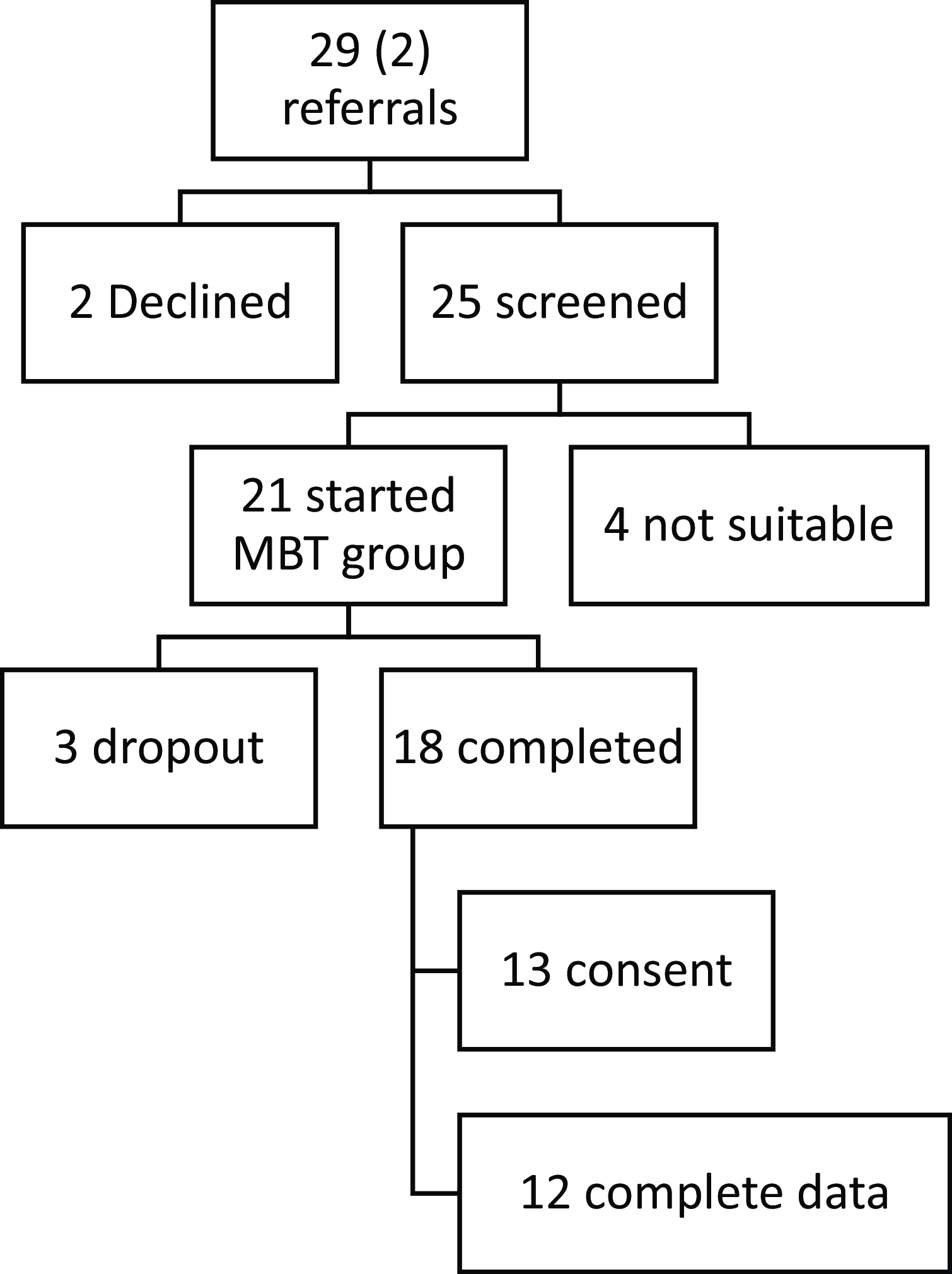
Twenty-nine individuals were referred. Of these, two were re-referrals who started in the second group. Twenty-five were screened. Only four were not considered suitable as they were seeking a different intervention or individual therapy. Twenty-one were offered a place after screening and started the group. There was one drop-out from the first group and two from the second group. Eighteen completed the intervention. They continued to receive outpatient reviews with a psychiatrist, as usual. They did not avail of any other psychotherapy during this interval. Thirteen consented to study inclusion of which pre- and post-intervention data is available for 12 participants. Seven participants took part in in depth post-intervention interviews. The participant flowchart is presented in Fig. 1.
Participant flowchart.

Covid-19 related adaptions
These groups took place during the Covid-19 pandemic, where public health restrictions necessitated the delivery of the intervention in an online format. Group content matched that delivered in the in-person format. Facilitators acknowledged the innovation of online format and use of breakout rooms to encourage engagement. They tried to adopt a mentalizing stance of “not knowing” and being open about the novel application of this intervention in the service. Reflections on the online delivery format are a component of the qualitative feedback.
Quantitative measures and analysis
The Clinical Outcomes in Routine Evaluation – Outcome Measures scale (CORE-OM) (Barkham et al., Reference Barkham, Evans, Margison and McGrath1998) is a 34 item global measure of distress. The CORE-OM comprises 34 items addressing domains of subjective well-being, symptoms, functioning and risk. Lower scores indicate improvement.
The World Health Organization Quality of Life (WHOQoL-BREF) scale is a short version of the WHOQoL-100; the WHOQoL-BREF consists of 26 questions, categorised in four different domains: physical health; psychological; social relations; and environmental (Vahedi Reference Vahedi2010). Scores range from 0 to 100, with higher scores indicating a higher quality-of-life.
The Reflective Functioning Questionnaire (RFQ) is a self-report measure of mentalizing (Fonagy et al., Reference Fonagy, Luyten, Moulton-Perkins, Lee, Warren, Howard, Ghinai, Fearon, Lowyck and Laws2016). Two subscales, RFQu measures Uncertainty associated with hypomentalizing and RFQc measures Certainty which reflects hypermentalizing. High scores on the RFQu indicate high uncertainty about mental states, hence difficulties with mentalizing. High scores on the RFQc can indicate an unrealistic degree of certainty about mental states. Paired samples t tests were used to compare differences on all three scales. Results are reported as mean differences, associated significance levels are reported as p-values and t-statistics. Effect sizes were calculated as Cohen’s d statistic. All analysis took place using the Statistical Package for the Social Sciences version 29.
Qualitative measures and analysis
All participants from the first group were invited to participate in a semi-structured interview. A topic guide was developed by the investigators to elicit participant experiences of the group (see supplemental table 1), which guided semi-structured interviews. Interviews were conducted and transcribed verbatim by an assistant psychologist who was not trained in MBT or involved in the intervention. After transcription, each transcript was reviewed to verify its quality and identifying personal information was removed. Thematic analysis was conducted manually by two independent researchers using an inductive approach (Braun and Clarke Reference Braun and Clarke2006). Emergent themes were then discussed with the rest of the team to reflect on how assumptions might influence finding. We conducted our thematic analysis on the basis of a hermeneutic–phenomenological epistemology (Binder et al., Reference Binder, Holgersen and Moltu2012). We chose to use reflexivity as a tool. We worked to have our own pre-understanding as professional therapists challenged and transformed through a dialogue with perspectives in the material and through reflexive dialogues with each other. This process of reflexivity is the basis of the hermeneutical aspect of this study. The exploration of the participants’ experiences on a concrete and detailed level is the basis of the phenomenological element in this study.
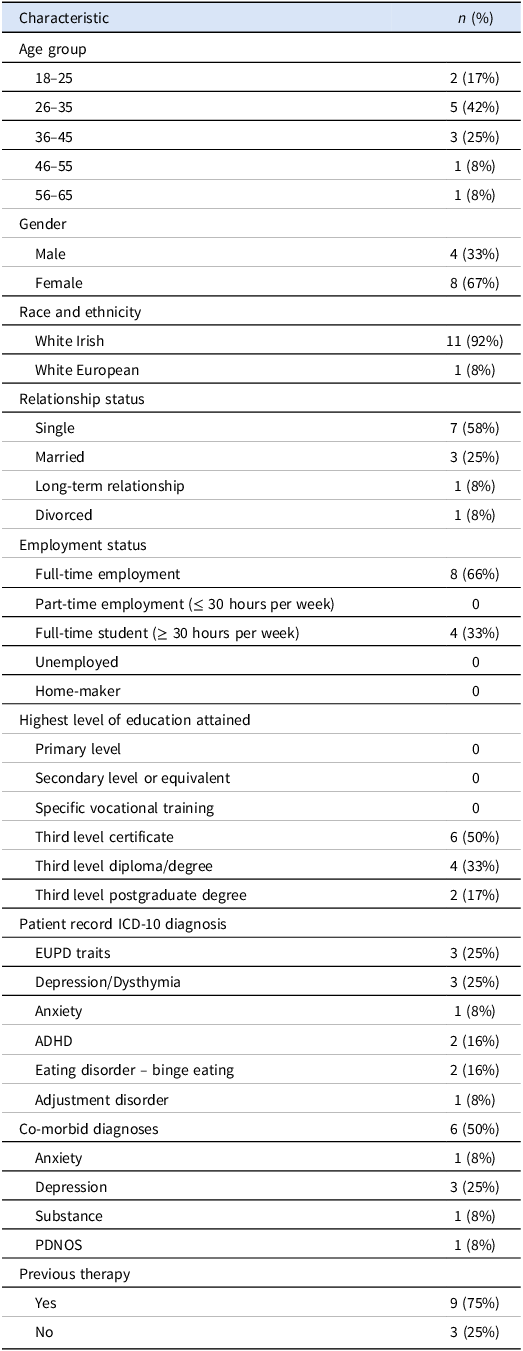
Participant characteristics

Ethical considerations
The local research ethics committee of St John of God Community Services approved this research. This study was conducted in line with the Declaration of Helsinki – Ethical Principles for Medical Research Involving Human Subjects.
Results
Study participants and engagement
The mean age of participants was 33 years. The majority were female (67%, n = 8) and in full-time employment (67%, n = 8). There were a variety of ICD-10 diagnoses including axis-I and axis-II disorders. The majority had accessed therapy previously (75%, n = 9). Most participants missed at least one group but attended at least 60% of the sessions, only 4 (33%) attended all of the sessions. Participant characteristics are reported in Table 1.
Quantitative findings
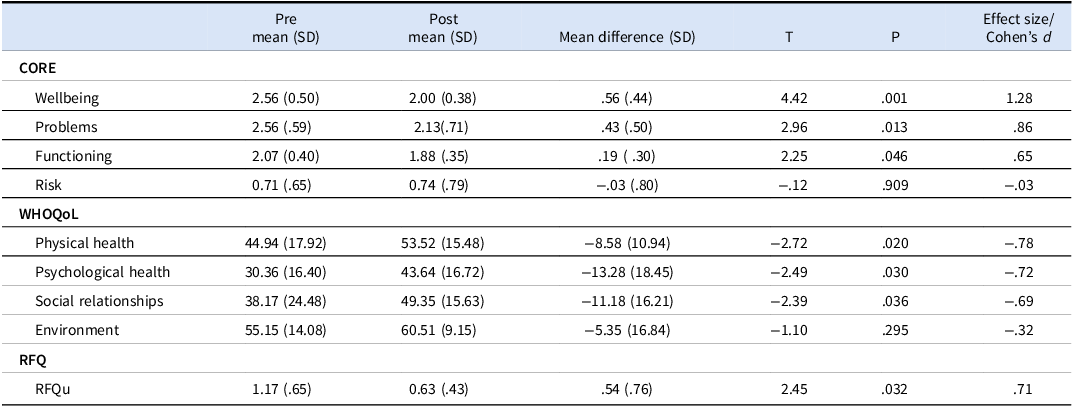
Pre-group RFQu mean was 1.2 (SD = 0.65) compared to pre-group RFQc score mean of 0.6 (SD = 0.61) which suggests this cohort exhibited more problems with hypomentalizing than hypermentalizing. Post-group mean changes were clinically significant for Uncertainty scores, post-RFQu mean = 0.63 (SD = 0.43) but not Certainty scores, post-RFQc mean = 0.9 (SD = 0.71). There was a significant decrease in Uncertainty scale which suggests less hypomentalizing post-group (MD = 0.54, SD difference = 0.76, t = 2.45(11), p = 0.032, Cohen’s d = 0.71).
Participants showed significant improvements across all subscales of the CORE-OM, apart from risk, which remained in the low range. Wellbeing (MD = 0.56, SD difference = 0.44, t = 4.42(11), p = 0.001, Cohen’s d = 1.28); Problems (MD = 0.43, SD difference = 0.50, t = 2.96(11), p = 0.013, Cohen’s d = 0.86); Functioning (MD = 0.19, SD difference = 0.29, t = 2.25(11), p = 0.046, Cohen’s d = 0.65); Risk (MD = 0.03, SD difference = 0.81, t = −0.12(11), p = 0.909, Cohen’s d = −0.03).
On the WHOQoL-BREF, there were improvements across the following domains: Physical Health (MD = −8.58, SD difference = 10.94, t = −2.72(11), p = 0.02, Cohen’s d = −0.78); Psychological Health (MD = −13.28, SD difference = 18.45, t = −2.49(11), p = 0.03, Cohen’s d = −0.72); Social Relationships (MD = −11.18, SD difference = 16.21, t = −2.39(11), p = 0.04, Cohen’s d = −0.69). There was no change for Environment (MD = −5.35, SD difference = 16.84, t = 1.10(11), p = 0.295). Pre- and post-intervention results are presented in Table 2.
Pre- and post-intervention results
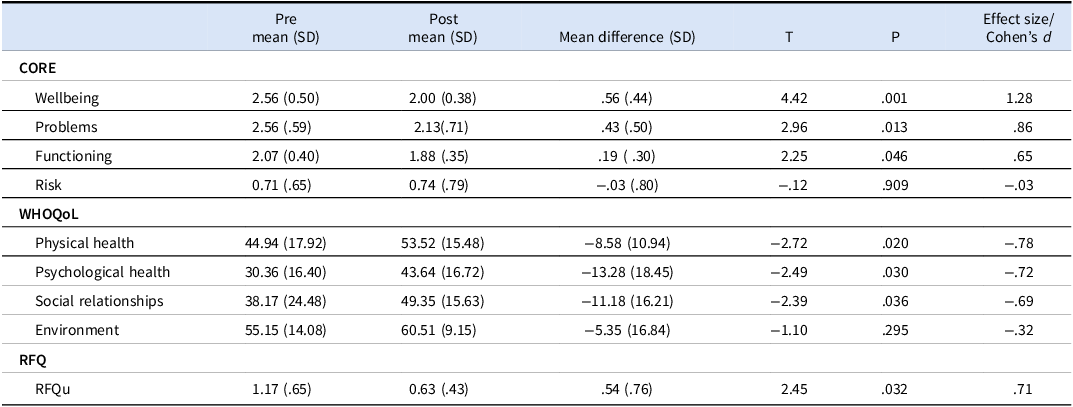
Table 2 Long description
The table presents pre- and post-intervention results across different domains. It has 12 rows and 7 columns. The columns are labeled Pre mean (SD), Post mean (SD), Mean difference (SD), T, P, and Effect size/Cohen's d. The rows are grouped under three main categories: CORE, WHOQoL, and RFQ. Under CORE, the domains are Wellbeing, Problems, Functioning, and Risk. Under WHOQoL, the domains are Physical health, Psychological health, Social relationships, and Environment. Under RFQ, the domain is RFQu. Each row lists the pre-mean (SD), post-mean (SD), mean difference (SD), T value, P value, and Effect size/Cohen's d for the respective domain. Notable trends include improvements in Wellbeing, Problems, Functioning, Physical health, Psychological health, and Social relationships, with significant P values indicating statistical significance. Environment and Risk show no significant changes.
CORE: Clinical Outcomes in Routine Evaluation; WHOQoL: World Health Organization Quality of Life; RFQu: Reflective Functioning Questionnaire (uncertainty subscale)
Qualitative findings
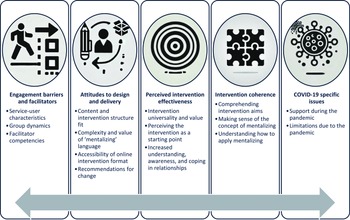
Seven participants completed interviews. Five main themes were identified with fifteen subthemes (Fig. 2).
Overview of thematic structure.

Theme 1: Engagement barriers and facilitators
Service-user characteristics
Most participants described the intervention as requiring minimal effort once they attended. However, for some, they struggled to attend a session when they were having difficulties with their mental health. Personal circumstances, such as bereavement and difficult family dynamics could act as a barrier to engagement. A facilitator of engagement included participants having an open-minded and social predisposition.
Margaret: “You have to be in the right mindset and you have to want to bring about change for the group to be beneficial”.
Group dynamics
The transdiagnostic nature of the intervention impacted engagement as participants described how there was a strong sense of connectedness due to their shared desire to learn about mentalization, although they all had different experiences and types of mental health difficulties, Some participants stated that others had a tendency to overshare in the breakout rooms, leaving little opportunity for them to share their thoughts and experiences.
Mark: “There were situations that the one person dominated the time”.
Facilitator competencies
Participants described facilitator warmth and openness and how this supported intervention engagement. Many participants also expressed desire for facilitators to intervene more in break out rooms. Some participants described how they felt respected and listened to by the facilitators which enabled them to be more open and engaged in the sessions. They described feeling part of the intervention, as opposed to feeling lectured and patronised.
Catherine: “There was no sort of bleakness or coldness of the delivery. It was all sort of delivered very warmly which also helps people come out of their shell more”.
Theme 2: Attitudes to intervention design and delivery
Content and intervention structure fit
While some participants found the session time of 1.5 hrs adequate, the majority desired more time to understand and fully process the information. Many participants found that, due to time constraints, the content material was rushed on several occasions, and this influenced their capacity to learn. They suggested that the length of each session be extended to 2 hrs, and the duration be further extended from 7 to 10 weeks to maximise learning.
Margaret: “If they made it longer, it would be more beneficial for actually being able to absorb the content a little bit more and understand it a little bit more”.
Complexity and value of ‘mentalizing’ language
Many participants found the language used to describe mentalization confusing and ambiguous. The complexity of the language used hindered some participants’ learning and several suggested the use of layman terms when presenting mentalization concepts. Other participants stated that the language used improved their ability to mentalize (e.g. the labelling of specific emotions enhancing coping skills).
Margaret: “Yeah, between naming, yeah exactly. And… I don’t know if that is naming they came up with, I think they’re probably psychological terms, to be honest. But maybe they could make it a bit more user-friendly”.
Accessibility of online intervention format
Most participants found the online format easy to access. Many reported that the online format alleviated their anxiety, alleviating the risk of contagion by attending in-person. For some with hearing impairments, the online nature of enhanced accessibility as they could ensure they heard the group and facilitators at all times. Less time spent on travel was also a benefit. However other participants found the online format difficult to use as they had limited technology skills, issues with their internet connection, and less privacy at home than others.
Margaret: “I prefer just being able to log on at the time, and not having to get ready to go out somewhere. Em… it’s just so much easier and it takes less time out of your day. Em… so you can kind of commit to it a little bit more”.
Recommendations for change
Some participants asked for more time for reflection and less information. However, a large proportion felt as though the intervention could have taken a more solution-based approach. For example, providing information on how to get out of a particular pattern of thinking. Regarding extra resources, participants stated that increased links to reading materials would give more option to those who wished to further explore the topics (e.g., the modes and dimensions of mentalization covered within each session).
Philip: “For future sessions it might be, it might be worth taking a look at, em… you know, solutions. Em… you know, for each of those modes, if there was something for each mode in terms of solutions, that might be helpful”.
Theme 3: Perceived intervention effectiveness
Intervention universality and value
A large proportion of participants stated that the intervention helped to ease symptoms of depression and indicated that others suffering with depression would benefit from it. Several found that, due to the skills-based nature of the intervention, they gained coping skills that would indirectly help with their depression. However, it was highlighted that intervention effectiveness would depend on what stage an individual was at in their mental health journey. The majority recommended the intervention to others experiencing similar mental health issues.
Pamela: “I kinda did my own research on the background of it and like, that it’s for people with… eh… personality disorder, or something like that? But I actually think this could be for anybody, if you know, in that sense”.
Perceiving the intervention as a starting point
A large proportion of participants stated that the intervention was an adequate starting point in the understanding and implementing the basic concepts of mentalization. While some found the number of sessions sufficient, others found the format limited the effectiveness of the intervention. It was highlighted that some participants are at a different stage to others in the group and therefore, find it harder to implement the learnings to their personal life.
Margaret: “I don’t think that somebody is going to be completely enlightened after an hour and a half course for seven weeks. Em… but there is definitely, it definitely brought awareness [awareness of how they interact with others], to most in the group, I think”.
Increased understanding, awareness, and coping in relationships
Many participants said that the intervention helped them to better understand their thoughts, feelings, and behaviours in times of difficulty. It also helped them to understand their own patterns of thoughts, which helped them to ‘make sense’ of certain situations. Overall, the majority of participants reported a higher level of awareness into their own perception of others, how they react to others and how they interact with others.
Pamela: “I think I have better relationships because of it. I think I’m a bit more aware of how I speak to people, if you know what I mean. I’m a bit more… not that I was nasty, but I kinda consider their feelings a bit more in that sense, in the sense that it’s not just me speaking”.
Theme 4: Intervention Coherence
Comprehending intervention aims
Most participants believed that the aim of the intervention was to increase self-awareness regarding thoughts, feelings and behaviours: to observe thoughts and behaviours that were unhelpful and to change these. Several participants found that the intervention aimed to give them a language to better understand the core concepts of mentalization.
Pamela: “To be able to look at everything from every aspect, and be able to put actions in place… prevent yourself from going down a rabbit hole”.
Making sense of the concept of mentalizing
Some participants believed that identifying thought patterns was the main concept of mentalization. However, many felt that they needed more exposure to the intervention to increase their confidence in how to mentalize. Participants stated that it gave them language to cope in difficult situations. This helped several participants see situations from multiple perspectives and become more open towards others. Participants noted that they were unable to mentalize when in a rush, preoccupied or emotionally overwhelmed.
Trish: “Helps you to look at things slightly differently. Cos if you’re in a mindset of looking at, whatever way, ones looking a certain way and it’s not working out for them… leading them to trouble or whatever… then it gives you another way of looking at things”.
Understanding how to apply mentalizing
Participants stated they could identify times in the past when they have not been engaging in mentalization. Many acknowledged that they have applied mentalization by being more mindful of themselves and others. Some participants were able to stabilise the balance between several mentalizing dimensions. For example, a participant who was previously “other-focused” was able to recognise her own needs and become more “self-focused”.
Catherine: “I see it as thinking about things from different aspects, or different perspectives as opposed to assuming or judging straight away based off of… what… you initially think of someone, or why they’re saying something, or where they’re coming from. So… just openness, I guess, in a mental capacity… to be more open, eh… less assuming”.
Theme 5: COVID-19 specific issues
Support during the COVID-19 pandemic
Some participants described how the intervention improved their coping skills, as well as giving them structure and routine during the lockdown periods. Others shared that they think other members of the general public may benefit from learning about mentalization to cope with COVID-19 and life challenges more broadly.
Sean: “I found it pretty helpful to have something in these weird times”
Limitations due to the COVID-19 pandemic
Some participants shared the limiting impact of completing weekly homework for the intervention within their immediate contact bubble only. Some participants were either living alone with few social contacts beyond this, or living with others they know well. In both cases, participants described their limited opportunities to implement their new knowledge and learning into practice. Although the participants were conscious that this was not a limitation of the MBTi intervention itself but rather the context of the intervention, it evidently impacted the group members’ experience of the intervention.
Sarah: “It just didn’t feel the same as doing kinda a group face-to-face with people. Em… I think, em, I’ve done some groups before and being paired up with people… kinda in a big group setting I just thought it was easier to discuss things than… on Zoom”.
Discussion
This study reports on the impact and experiences of participants undertaking a MBTi group in a general adult CMHS. It is, to our knowledge, the first such report of this nature.
Most relevant to the intervention aim, the RFQu demonstrated an improvement in tendency to hypomentalizing in our cohort. Hypomentalizing is reported in many clinical samples, including being associated with self-harm (Badoud et al., Reference Badoud, Luyten, Fonseca-Pedrero, Eliez, Fonagy, Debbané and Tran2016; Cucchi Reference Cucchi2016). Hypomentalizing is a barrier to developing complex models of the minds of others, leading to concrete, or psychic equivalence modes of functioning (Fonagy et al., Reference Fonagy, Luyten, Moulton-Perkins, Lee, Warren, Howard, Ghinai, Fearon, Lowyck and Laws2016). It has a positive correlation with alexithymia, and a negative correlation with empathy and mindfulness (Cucchi et al., Reference Cucchi, Hampton and Moulton-Perkins2018). It is therefore a clinically relevant therapeutic target. Other scales measuring symptomatology and functioning (CORE) and wellbeing and quality of life (WHOQoL) also demonstrated post-intervention improvements. While certain changes were statistically significant, the magnitude of the change may not be a clinically meaningful difference (Connell et al., Reference Connell, Barkham, Stiles, Twigg, Singleton, Evans and Miles2007). This should be considered in the context of the intention of this intervention, which was psychoeducation rather than the group therapy component of MBT.
This was reflected in the qualitative findings, with participants experiencing the intervention as a starting point, with the aim of increasing their understanding and awareness of their difficulties. Hestbæk et al. (Reference Hestbæk, Hasselby-Andersen, Juul, Beier and Simonsen2022) found similar themes on the benefit of short-term MBT to improve perspective taking. Other themes reflected the limitations of the brief and online delivery aspects of the intervention. The difficulty in assimilating the vocabulary of mentalization suggests the invitation to use more relatable terms may not have been experienced as credible in the context of too much emphasis on PowerPoint material used. The use of breakout rooms while intended as an opportunity for smaller group reflection may have undermined rather than encouraged a sense of agency. Our participants expressed concerns about how to apply mentalizing principles to their difficulties which was similar to findings from (O’Leary et al., Reference O’Leary, Ryan, O.’Sullivan and Moore2024), which identified the challenge of mentalizing in practice after MBTi. This would usually be explored in the group therapy component of the MBT rather than offered in the psychoeducation MBTi format. Overall, the themes suggest a potential benefit of MBTi in a non-specialist setting but also the limitations for those requiring longer-term interventions.
Implications for clinical practice
Due to the need for accessible, evidence-based psychological treatments in general mental healthcare settings, continuing to explore the applications of a variety of MBT approaches in this context is relevant. The short-term model of MBT proposed by Juul et al. (Reference Juul, Jakobsen, Hestbaek, Jørgensen, Olsen, Rishede, Frandsen, Bo, Lunn, Poulsen, Sørensen, Bateman and Simonsen2023) which offers more condensed psychoeducation component and briefer group therapy intervention designed for specialist BPD treatment-settings, has potential application for overcoming some of the difficulties applying mentalizing concepts in a general psychiatry setting.
However as part of a stepped-care service model, the MBTi component may also have promising applications. Our findings demonstrate that it is associated with improvement in mentalizing capacity which is an opportunity to consider its role as a pre-treatment component for MBTg and other interventions. Recent research suggests that short-term MBT may have a role for patients who do not need or want longer-term interventions (Hestbæk et al., Reference Hestbæk, Hasselby-Andersen, Juul, Beier and Simonsen2022). More research is needed to examine how to modify MBT for a transdiagnostic group in a non-specialist setting.
Improving mentalization may help restore epistemic trust which may facilitate engagement with treatment providers and other social supports (Bateman et al., Reference Bateman, Fonagy, Campbell, Luyten and Debbané2023). Epistemic trust has been found to have a role in treatment outcomes in psychological interventions beyond mentalizing, however more research is needed to understand what facilitates epistemic trust and how this impacts treatment engagement and outcomes for patients with psychiatric difficulties (Byrne and Egan Reference Byrne and Egan2018). Further areas of research include exploring how targeting mentalizing as well as epistemic trust issues could help overcome some of the obstacles to engaging with accessible and specialist therapies. In a review of the role of mentalizing in psychological interventions with adults, Luyten et al. (Reference Luyten, Campbell, Moser and Fonagy2024) suggest that mentalizing might be a mediator of change in psychotherapy and may moderate treatment outcome. Further research on how enhancing mentalizing increases capacity to engage with a range of therapeutic modalities would be helpful in terms of care pathways.
Study limitations
This study should be considered in light of some limitations. The groups were delivered online due to the COVID-19 pandemic. The online delivery meant therapists had less access to more implicit forms of communication due to muting of ostensive cues (Fisher et al., Reference Fisher, Guralnik, Fonagy and Zilcha-Mano2021). While this was not an intentional feature of their design, public health measures arising in the period of implementation necessitated this change. Further evaluation of this intervention should take place in an in-person format to elucidate the role of delivery on acceptability and outcome.
The limited number of participants in both arms of the study may impact generalisability and transferability. For example, recruiting a larger sample for the qualitative component may provide new insights. Finally, while MBTi is usually delivered over twelve sessions, a condensed programme was delivered over seven and ten sessions in this study. It is possible that this reduction and variation in groups may have impacted the outcomes or experiences of participants. The MBTi component of the more recently developed MBT short-term format covers the essentials of mentalizing concepts that might be more relevant and accessible in a general adult setting (Juul et al., Reference Juul, Frandsen, Bo Hansen, Sørensen, Bateman and Simonsen2022).
Study strengths
This study has a number of strengths. A direct measure of reflective functioning was utilised alongside other measures. As MBT aims to cultivate effective mentalization, it is important to directly assess this dimension, particularly in short-term studies where global impacts may be limited. This has been called for in other studies which have evaluated MBT in similar settings (Beattie et al., Reference Beattie, Murphy, Jamieson and Lee2022).
Our sample was drawn from a general CMHS setting, and the diagnoses of participants reflected a breadth of difficulties. This enhances the external validity of the findings. Both limited efficacy testing and qualitative findings suggest that mentalization is a transdiagnostically salient treatment target.
Conclusion
This study suggests that MBTi in a non-specialist adult mental health service setting is experienced as useful and relevant by participants and that it is associated with changes in mentalization capacity. Further research should explore the role of MBT interventions that have the potential to enhance engagement with more widely available psychological interventions in general adult services as well as preparing for more specialist therapy. A patient with improved mentalizing is likely to engage better with whatever interventions are offered in increasingly under-resourced general adult services.
Supplementary material
The supplementary material for this article can be found at https://doi.org/10.1017/ipm.2025.10085
Financial support
This work received no financial support.
Competing interests
The authors declare that they have no competing interests.
Ethical approval
Institutional ethical approval was granted for this work by the Research Ethics Committee of St John of God Community Services. The authors assert that all procedures contributing to this work comply with the ethical standards of the relevant national and institutional committee on human experimentation with the Helsinki Declaration of 1975, as revised in 2008.


 Open access

