

1. Introduction
Calcite U–Pb geochronology has attracted increasing interest in recent years within the Earth Sciences community. The method provides constraints on the ages of sediment deposition and diagenesis (e.g. Israelson et al. Reference Israelson, Halliday and Buchardt1996; Rasbury & Cole, Reference Rasbury and Cole2009; Hill et al. Reference Hill, Polyak, Asmerom and Provencio2016; Godeau et al. Reference Godeau, Deschamps, Guihou, Leonide, Tendil, Gerdes, Hamelin and Girard2018; Pisapia et al. Reference Pisapia, Deschamps, Battani, Buschaert, Guihou, Hamelin and Brulhet2018; Drost et al. Reference Drost, Chew, Petrus, Scholze, Woodhead, Schneider and Harper2019), fossils (e.g. Rasbury & Cole, Reference Rasbury and Cole2009; Yokoyama et al. Reference Yokoyama, Kimura, Mitsuguchi, Danhara, Hirata, Sakata, Iwano, Maruyama, Chang, Miyazaki, Murakami and Saito-Kokubu2018; Drost et al. Reference Drost, Chew, Petrus, Scholze, Woodhead, Schneider and Harper2019) and mineralization along fracture and fault planes (e.g. Roberts & Walker, Reference Roberts and Walker2016; Goodfellow et al. Reference Goodfellow, Viola, Bingen, Nuriel and Kylander-Clark2017; Nuriel et al. Reference Nuriel, Weinberger, Kylander-Clark, Hacker and Craddock2017; Parrish et al. Reference Parrish, Parrish and Lasalle2018; Holdsworth et al. Reference Holdsworth, McCaffrey, Dempsey, Roberts, Hardman, Morton, Feely, Hunt, Conway and Robertson2019), among others. Regardless of the successful application of calcite U–Pb geochronology in recent years, the method has its challenges. Calcite is typically low in U and rich in initial Pb; it is also susceptible to alteration or recrystallization at low temperature in the presence of fluids, and allows Pb diffusion above moderate temperatures (Cherniak, Reference Cherniak1997). Carbonate formation can be complex and long-lived (Rasbury & Cole, Reference Rasbury and Cole2009); the question therefore arises as to which geological ‘event’ is actually being dated (Rasbury & Cole, Reference Rasbury and Cole2009; Drost et al. Reference Drost, Chew, Petrus, Scholze, Woodhead, Schneider and Harper2019; Roberts et al. Reference Roberts, Drost, Horstwood, Condon, Chew, Drake, Milodowski, McLean, Smye, Walker, Haslam, Hodson, Imber, Beaudoin and Lee2020). The in situ technique, laser ablation inductively coupled plasma mass spectrometry (LA-ICP-MS), helps overcome some of these challenges, namely by allowing for the measurement of discrete zones of uranium enrichment that are typical of diagenetic and hydrothermal calcite (Roberts et al. Reference Roberts, Drost, Horstwood, Condon, Chew, Drake, Milodowski, McLean, Smye, Walker, Haslam, Hodson, Imber, Beaudoin and Lee2020), and by allowing a combination of U–Pb analysis with other in situ petrographic and analytical techniques.
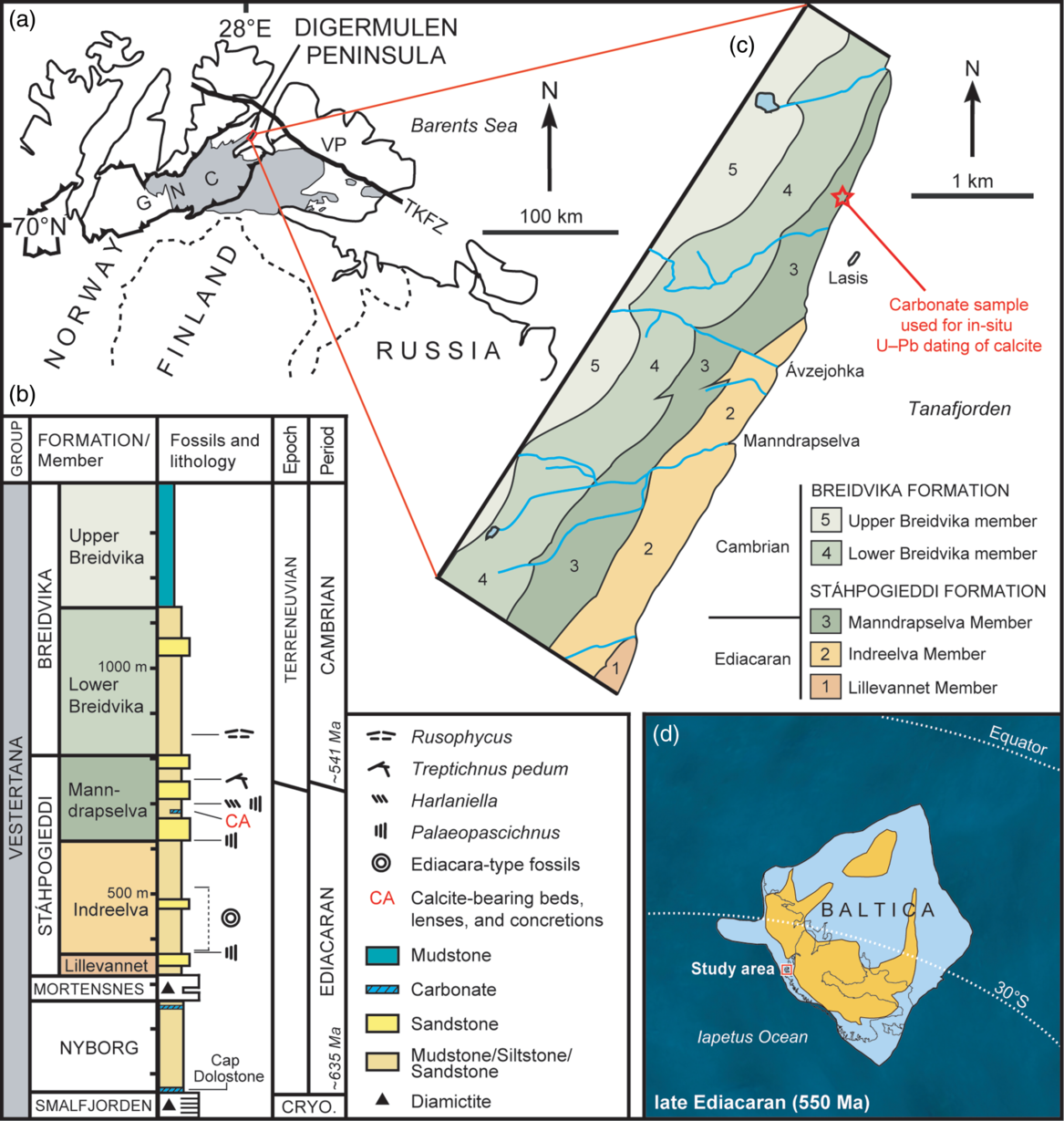
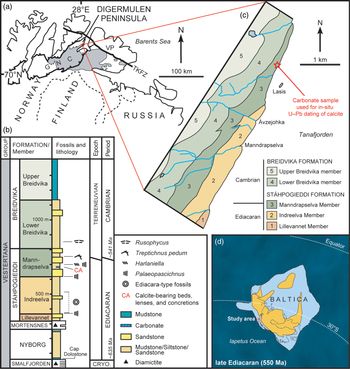
In the present case study, we focus on calcite from carbonates of the upper Ediacaran – lower Cambrian Manndrapselva Member of the Stáhpogieddi Formation (Vestertana Group, Gaissa Nappe Complex) of the Digermulen Peninsula in eastern Finnmark, Arctic Norway (Fig. 1). The study area has attracted renewed research interest because of new findings of Ediacaran-aged fossils (e.g. Högström et al. Reference Högström, Jensen, Palacios and Ebbestad2013; Jensen et al. Reference Jensen, Högström, Almond, Taylor, Meinhold, Høyberget, Ebbestad, Agić and Palacios2018a, b). The upper Ediacaran succession comprises siliciclastic sedimentary rocks with recently described carbonates, some with calcite spherulites and cone-in-cone (CIC) calcite (Meinhold et al. Reference Meinhold, Jensen, Høyberget, Arslan, Ebbestad, Högström, Palacios, Agić and Taylor2019a). Although the age of the carbonate-bearing part of the succession is well established as late Ediacaran based on fossils, the timing of the formation of the various types of calcite is poorly constrained. We therefore applied in situ U–Pb dating of calcite using LA-ICP-MS to address this question. Having different types of calcite in close proximity to each other, and having approximate age constraints of sedimentation based on biostratigraphy (Högström et al. Reference Högström, Jensen, Palacios and Ebbestad2013; McIlroy & Brasier, Reference McIlroy, Brasier, Brasier, McIlroy and McLoughlin2017; Jensen et al. Reference Jensen, Högström, Almond, Taylor, Meinhold, Høyberget, Ebbestad, Agić and Palacios2018a, b) and of the low-grade metamorphic overprint (see discussion in Meinhold et al. Reference Meinhold, Wemmer, Högström, Ebbestad, Jensen, Palacios, Høyberget, Agić and Taylor2019b), allows for the testing of the applicability of U–Pb calcite geochronology on a thin-section scale, and whether ages this far back into deep time can be related to a geological ‘event’ in a meaningful manner.
(a) Outline of northernmost Scandinavia showing the Vestertana Group rocks, in grey shade, preserved within the Gaissa Nappe Complex (GNC), and para-autochthonous in eastern Finnmark on the Varanger Peninsula (VP). Red box highlights the study area. TKFZ – Trollfjorden–Komagelva Fault Zone. (b) Simplified stratigraphy of the Vestertana Group (after Jensen et al. Reference Jensen, Högström, Høyberget, Meinhold, McIlroy, Ebbestad, Taylor, Agić and Palacios2018b), showing occurrences of carbonates in the Ediacaran strata in eastern Finnmark. The stratigraphic position of carbonates, some with calcite spherulites and CIC calcite, analysed in the study are indicated ‘CA’. (c) Geology of the SE portion of the Digermulen Peninsula, based on Siedlecka et al. (Reference Siedlecka, Reading, Williams and Roberts2006), showing locality where carbonates were found within the Manndrapselva Member. We refer to Meinhold et al. (Reference Meinhold, Jensen, Høyberget, Arslan, Ebbestad, Högström, Palacios, Agić and Taylor2019a) for details. (d) Late Ediacaran (550 Ma) palaeogeographic reconstruction of Baltica (after Meert, Reference Meert2014). Land (ochre) and shallow sea (light blue) distributions were adopted from the palaeogeographic map series of Ron Blakey (Global Paleogeography and Tectonics in Deep Time ©2016 Colorado Plateau Geosystems Inc., used under an Academic Content License Agreement). Red box highlights the study area.
2. Geological setting
The study area is located in eastern Finnmark, Arctic Norway, and is part of the Gaissa Nappe Complex (Fig. 1a). The Stáhpogieddi Formation of the Vestertana Group has received much attention in recent years as it contains the only Ediacara-type fossils in Scandinavia as well as its most complete Ediacaran–Cambrian transition (Farmer et al. Reference Farmer, Vidal, Moczydłowska, Strauss, Ahlberg and Siedlecka1992; Högström et al. Reference Högström, Jensen, Palacios and Ebbestad2013; Jensen et al. Reference Jensen, Högström, Almond, Taylor, Meinhold, Høyberget, Ebbestad, Agić and Palacios2018a, b) (Fig. 1b). The Manndrapselva Member of the Stáhpogieddi Formation consists of a basal sandstone-dominated part and two upwards-coarsening cycles. The trace fossil assemblage attests to its marine nature, and the sedimentology is consistent with deposition in a wave-dominated delta or shoreface (McIlroy & Brasier, Reference McIlroy, Brasier, Brasier, McIlroy and McLoughlin2017). The Ediacaran–Cambrian boundary is close to the base of the third cycle of the Manndrapselva Member based on trace fossils, palaeopascichnids and organic-walled microfossils (Högström et al. Reference Högström, Jensen, Palacios and Ebbestad2013; McIlroy & Brasier, Reference McIlroy, Brasier, Brasier, McIlroy and McLoughlin2017; Jensen et al. Reference Jensen, Högström, Almond, Taylor, Meinhold, Høyberget, Ebbestad, Agić and Palacios2018a, b) (Fig. 1b).
Meinhold et al. (Reference Meinhold, Jensen, Høyberget, Arslan, Ebbestad, Högström, Palacios, Agić and Taylor2019a) described carbonates within the second cycle of the Manndrapselva Member, which otherwise largely comprises alternating thin layers of silt- and mudstone and minor sandstone. Some of the sandstone beds show wave-formed ripple marks. Flute casts in the lower part of the succession indicate palaeocurrent flow from the NNE. The rocks show cleavage, particularly pervasive in the muddy sediments.
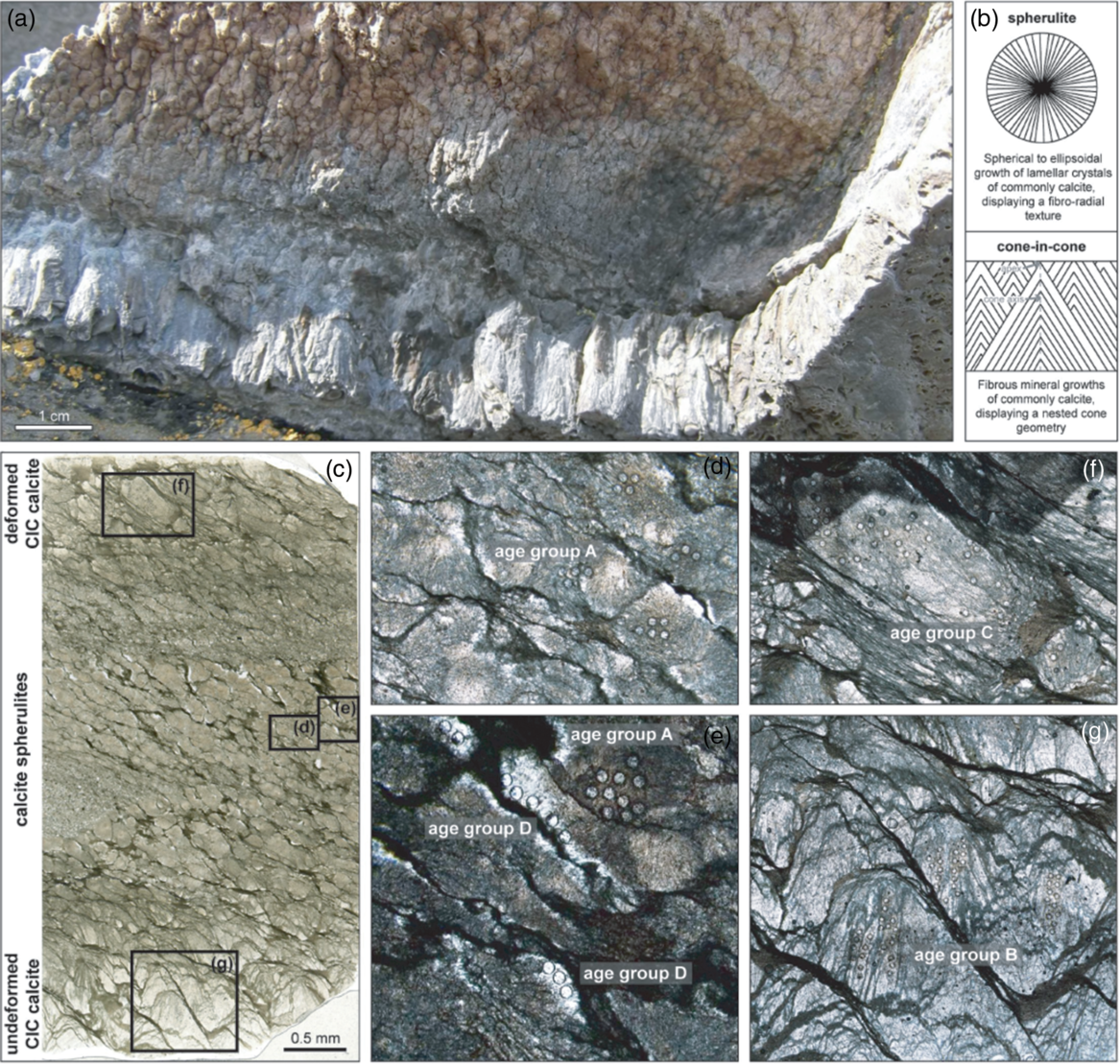
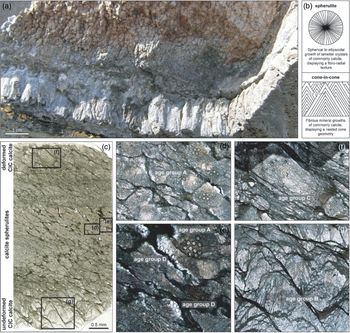
The carbonates crop out along a coastal section at the eastern part of the Digermulen Peninsula (geographic coordinates: 70° 35’ 31.0″ N, 28° 11′ 30.3″ E) (Fig. 1c). They occur as beds, lenses and concretions. Some consist of calcite spherulites and CIC structures made of calcite (see Meinhold et al. Reference Meinhold, Jensen, Høyberget, Arslan, Ebbestad, Högström, Palacios, Agić and Taylor2019a for details) (Fig. 2a, b). The upper Ediacaran sedimentary succession was deposited along the western margin of Baltica (in present-day coordinates) in a marine basinal environment (Fig. 1d). The rocks were metamorphosed during the Scandinavian Caledonian orogeny (Meinhold et al. Reference Meinhold, Wemmer, Högström, Ebbestad, Jensen, Palacios, Høyberget, Agić and Taylor2019b).
(a) Field photograph showing calcite spherulites and undeformed CIC calcite from the second cycle of the Manndrapselva Member of the Stáhpogieddi Formation from the eastern part of the Digermulen Peninsula, Finnmark, Arctic Norway. (b) Schematic illustrations of calcite spherulite and CIC structures (after Meinhold et al. Reference Meinhold, Jensen, Høyberget, Arslan, Ebbestad, Högström, Palacios, Agić and Taylor2019a). (c–g) Images of the thick section from sample D17-GM4 used for in situ U–Pb dating of calcite. All images oriented with top up. (c) Entire thick section. Total length of the glass slide is 4.8 cm. The outer layer (top and bottom) consists of nested cones of fibrous calcite (CIC structures). The inner layers show thinly laminated calcareous siliciclastics and calcite spherulites. CIC structures of the bottom layer are undeformed, whereas CIC structures of the top layer are deformed. Detailed descriptions are given in Meinhold et al. (Reference Meinhold, Jensen, Høyberget, Arslan, Ebbestad, Högström, Palacios, Agić and Taylor2019a). Representative parts of the thick section studied by U–Pb geochronology are outlined with black frames. (d) Photomicrograph showing calcite spherulites with analysed spots (age group A). (e) Calcite spherulites with analysed spots (age group A) and calcite fibres grown in small fissures alongside the spherulite rims with analysed spots (age group D). (f) CIC structures of calcite from the outer layer (top) with analysed spots (age group C). (g) CIC structures of calcite from the outer layer (bottom) with analysed spots (age group B).
3. Methodology
Bedrock sample material was cut with a rock saw perpendicular to the bedding to obtain a rock slice for thick-section preparation and in situ U–Pb dating of calcite (Fig. 2c–g). U–Pb geochronology of calcite was conducted at the Geochronology & Tracers Facility, British Geological Survey (Nottingham, UK), following the procedures described in Roberts & Walker (Reference Roberts and Walker2016) and Roberts et al. (Reference Roberts, Rasbury, Parrish, Smith, Horstwood and Condon2017). The analyses were performed using a New Wave Research 193UC excimer laser ablation system, coupled to a Nu Instruments Attom single-collector sector-field ICP-MS. The method involves standard-sample bracketing with normalization to NIST 614 silicate glass (Woodhead & Hergt Reference Woodhead and Hergt2001) for Pb–Pb ratios and WC1 carbonate reference material (Roberts et al. Reference Roberts, Rasbury, Parrish, Smith, Horstwood and Condon2017) for U–Pb ratios. The laser parameters comprised a 80 μm static spot, fired at 10 Hz, with a c. 3 J cm–2 fluence, for 20 s of ablation. The material was pre-ablated to clean the sample site with 150 μm spots for 2 s. Data are plotted on a Tera–Wasserburg concordia diagram (207Pb/206Pb versus 238U/206Pb). The ages are determined by linear regression between common and radiogenic lead compositions and as lower intercepts on a Tera–Wasserburg concordia using the Microsoft Excel add-in Isoplot 4.15 (Ludwig, Reference Ludwig2012). To keep track of precision and reproducibility of U–Pb ages, the Duff Brown Tank carbonate (206Pb/238U age = 64.04 ± 0.67 Ma; Hill et al. Reference Hill, Polyak, Asmerom and Provencio2016) was analysed in the course of this study. Measured isotopic ratios matched the published values of Hill et al. (Reference Hill, Polyak, Asmerom and Provencio2016) within uncertainty and yielded a lower intercept 206Pb/238U age of 66.3 ± 2.4 Ma (mean square weighted deviation (MSWD), 7.8; n = 46). All ages are quoted at 2σ and include propagation of all systematic uncertainties (Horstwood et al. Reference Horstwood, Košler, Gehrels, Jackson, McLean, Paton, Pearson, Sircombe, Sylvester, Vermeesch and Bowring2016). Full analytical data are provided in online Supplementary Table S1 and Figure S1 (available at http://journals.cambridge.org/geo).
4. Geochronological results
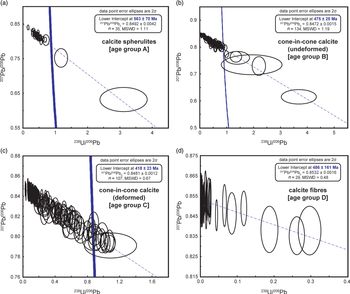
Four types of calcite from a carbonate concretion of the second cycle of the Manndrapselva Member of the Stáhpogieddi Formation were studied (Fig. 3). The domains include calcite spherulites, both undeformed and deformed CIC calcite, and calcite fibres grown in fissures along the spherulite rims (Fig. 2c–g). The majority of the ablated spots yielded low U and Pb contents ranging from less than 0.1 to 2.1 ppm (average, 0.17 ppm; median, 0.06 ppm; n = 305) and over the range 0.47–20.6 ppm (average, 2.5 ppm; median, 1.5 ppm; n = 305), respectively. The analyses of all samples were dominated by common lead, with only a small abundance of radiogenic lead, leading to large uncertainties on the regressed ages. The proportion of radiogenic lead varied in each sample, with the undeformed CIC calcite yielding the greatest abundance of radiogenic lead and, subsequently, the most precise age (Fig. 3b).
In situ U–Pb dating of calcite. (a–d) Tera–Wasserburg concordia plots of 207Pb/206Pb and 238U/206Pb ratios (uncorrected for common lead) for different types of calcite from sample D17-GM4 (second cycle of the Manndrapselva Member) measured in situ on a thick section by LA-ICP-MS. Sample details are given in Meinhold et al. (Reference Meinhold, Jensen, Høyberget, Arslan, Ebbestad, Högström, Palacios, Agić and Taylor2019a). Each data-point ellipse denotes Pb/U ratios with error in 2σ uncertainty including propagation of systematic uncertainties for each laser-ablation spot. The lower intercept of the regression line through the majority of data indicates the age of calcite crystallization.
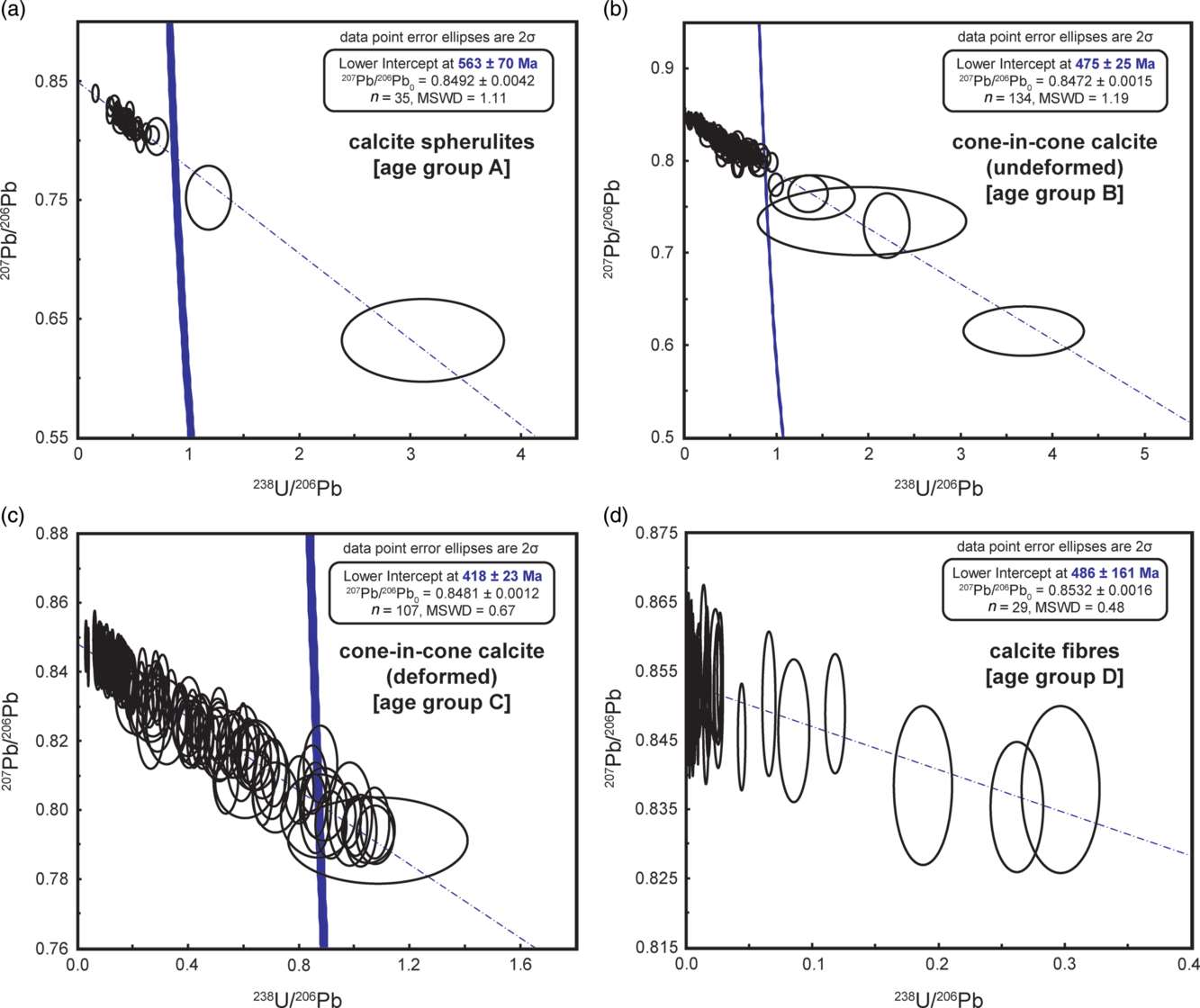
The following U–Pb lower intercept ages were obtained (Fig. 3). Calcite from calcite spherulites gave an age of 563 ± 70 Ma (MSWD, 1.11) (Fig. 3a). Calcite from the undeformed CIC calcite (bottom of concretion) gave an age of 475 ± 25 Ma (MSWD, 1.19) (Fig. 3b), whereas calcite from the deformed CIC calcite (top of concretion) yielded an age of 418 ± 23 Ma (MSWD, 0.67) (Fig. 3c). Calcite fibres grown in fissures along the spherulite rims gave an age of 486 ± 161 Ma (MSWD, 0.48) (Fig. 3d).
5. Discussion
The calcite spherulites are interpreted as a primary feature, forming in the sedimentary environment (Meinhold et al. Reference Meinhold, Jensen, Høyberget, Arslan, Ebbestad, Högström, Palacios, Agić and Taylor2019a). Within the large uncertainty (563 ± 70 Ma), the obtained age overlaps with the estimated timing of sedimentation (late Ediacaran; c. 545 Ma) based on body and trace fossil assemblages (Högström et al. Reference Högström, Jensen, Palacios and Ebbestad2013; McIlroy & Brasier, Reference McIlroy, Brasier, Brasier, McIlroy and McLoughlin2017; Jensen et al. Reference Jensen, Högström, Høyberget, Meinhold, McIlroy, Ebbestad, Taylor, Agić and Palacios2018b) (Fig. 1b).
U–Pb ages from the CIC calcite from the bottom and the top of the concretion are surprisingly different. Undeformed CIC calcite (bottom of concretion) gave an age of 475 ± 25 Ma, whereas deformed CIC calcite (top of concretion) is younger, that is, 418 ± 23 Ma. The age of the undeformed CIC calcite is interpreted as the age of CIC calcite formation during a period of fluid overpressure as the sediments were buried. The age fits well with age estimates based on the required overburden to obtain the fluid overpressure needed to form CIC structures (see discussion in Meinhold et al. Reference Meinhold, Jensen, Høyberget, Arslan, Ebbestad, Högström, Palacios, Agić and Taylor2019a). In the case of the undeformed CIC calcite, the robust isochron (in terms of MSWD) implies that the isotopic system has remained a closed system (no loss or gain of U or Pb). The Early–Middle Ordovician age is interpreted as being meaningful and representing an approximate age estimate of the CIC formation. On the contrary, the apparent Silurian–Devonian age of the deformed CIC calcite is within the age range of the post-depositional overprint related to a late Caledonian tectono-metamorphic event in the Gaissa Nappe Complex of the Caledonides of Finnmark (see discussion in Meinhold et al. Reference Meinhold, Wemmer, Högström, Ebbestad, Jensen, Palacios, Høyberget, Agić and Taylor2019b). This age is also robust in terms of MSWD (0.67), but lacks any measurement with abundant radiogenic lead. At face value, the regressed ages of the deformed and undeformed CIC are different, implying that the deformation of the CIC structures in the top part of the concretion may have occurred during the formation of the cleavage, and providing implications for the resetting of the U–Pb system in calcite.
Based on the colour of organic-walled microfossils from the Manndrapselva Member of the Stáhpogieddi Formation, the sedimentary rocks show a post-mature level indicating a thermal overprint of 200–250°C (T. Palacios, unpublished data, 2019). The maximum metamorphic overprint is given as low epizonal and reached around 300°C (see Meinhold et al. Reference Meinhold, Wemmer, Högström, Ebbestad, Jensen, Palacios, Høyberget, Agić and Taylor2019b). If we assume that the CIC calcite from the top part of the concretion was originally undeformed and formed contemporaneously with the CIC calcite from the bottom part of the concretion (see Meinhold et al. Reference Meinhold, Jensen, Høyberget, Arslan, Ebbestad, Högström, Palacios, Agić and Taylor2019a), the data suggest that the original age of CIC calcite from the top part of the concretion has been reset during the Caledonian metamorphic overprint. Volume diffusion of Pb at temperatures of 250–300°C is a possibility, based on the experimental study of Pb diffusion in calcite (Cherniak, Reference Cherniak1997), but mobility may also have been enhanced by grain deformation. Fluid infiltration is another possibility for resetting of the U–Pb system, although it is more likely to mobilize uranium since U(VI), in the form of uranyl ion (UO22+), is highly soluble in oxidized waters (Langmuir, Reference Langmuir1978); however, it may be expected that fluid-assisted alteration would have obliterated or at least affected the calcite growth structures, and this is not the case. We emphasize that although the data imply a resetting of the U–Pb system in the deformed CIC calcite, the lack of measured radiogenic lead, and hence precise age constraints, leads us to apply caution to this interpretation. Nevertheless, the data provide compelling results that suggest the U–Pb calcite dating method has the potential for examining the timing of depositional, diagenetic and low-grade metamorphic events in sedimentary carbonates.
The calcite fibres grown in small fissures along the spherulite rims (Fig. 2c) gave an age of 486 ± 161 Ma, which is within uncertainty of both the sedimentation age and the age of the metamorphic overprint and deformation. Formation of the calcite fibres is interpreted as being caused by dissolution and precipitation, during fracture and vein formation upon burial and compaction of the sediments. However, the uranium concentrations are extremely low, with the majority of analyses yielding < 0.0012 ppm, leading to a lack of measurable radiogenic lead and a large age uncertainty. We are therefore unable to refine the interpretation of the calcite fibres any further than that defined by the petrographic analysis (Meinhold et al. Reference Meinhold, Jensen, Høyberget, Arslan, Ebbestad, Högström, Palacios, Agić and Taylor2019a).
6. Conclusions
U–Pb calcite dates from an upper Ediacaran carbonate concretion provide timing constraints for depositional, diagenetic and potentially metamorphic processes, overlapping and confirming previous estimates based on relative bracketing of events. Our data show that LA-ICP-MS U–Pb dating of calcite can be a suitable complementary method to approximate the age of syn- to post-depositional processes that operate during burial and metamorphic overprinting, and can be applied to ‘ancient’ carbonates. Of note, Precambrian sedimentary sequences often lack tight age constraints, particularly in settings where more robust geochronometers such as zircon (requiring cross-cutting intrusive or interbedded extrusive rocks) may be absent.
Acknowledgements
In the framework of the Digermulen Early Life Research Group, financial support for fieldwork in Arctic Norway was provided by the Research Council of Norway (grant no. 231103). We thank David Wilde for thick-section preparation. Sören Jensen and Teodoro Palacios acknowledge funding from the Spanish Ministerio de Economía, Industria y Competitividad (grant no. CGL 2017–87631P). We are very grateful to Bernard Bingen and Fernando Corfu for their supportive reviews.
Declaration of interest
None.
Supplementary material
To view supplementary material for this article, please visit https://doi.org/10.1017/S0016756820000564


 Open access

