





Introduction
Volunteers generate many social, cultural, health, and economic benefits (Nichol et al., Reference Nichol, Wilson, Rodrigues and Haighton2023; Volunteering Australia, 2022) and are essential to sustaining many nonprofit organizations by boosting workforce capacity (Jenkinson et al., Reference Jenkinson, Dickens, Jones, Thompson-Coon, Taylor, Rogers, Bambra, Lang and Richards2013; Nichol et al., Reference Nichol, Wilson, Rodrigues and Haighton2023). They can also personally benefit from increased self-efficacy, empowerment, social connection, improved health, and reduced mortality (Jenkinson et al., Reference Jenkinson, Dickens, Jones, Thompson-Coon, Taylor, Rogers, Bambra, Lang and Richards2013; Nichol et al., Reference Nichol, Wilson, Rodrigues and Haighton2023). In Australia, about one in four adults volunteer through an organization, most commonly (31%) in sport and recreation (AIHW, 2023; Volunteering Australia, 2022). Reflecting global trends, volunteering in Australia has declined markedly over recent decades, exacerbated by the COVID-19 pandemic (AIHW, 2023), threatening the sustainability of many nonprofit social and sporting organizations and their societal contributions (Forner et al., Reference Forner, Holtrop, Boezeman, Slemp, Kotek, Kragt, Askovic and Johnson2024). Understanding how to cultivate and sustain volunteer labor is critical. Practice-based insights into drivers of volunteerism can inform recruitment and retention strategies (Forner et al., Reference Forner, Holtrop, Kragt and Johnson2022) and support advocacy for volunteering as a public health intervention (Jenkinson et al., Reference Jenkinson, Dickens, Jones, Thompson-Coon, Taylor, Rogers, Bambra, Lang and Richards2013; Nichol et al., Reference Nichol, Wilson, Rodrigues and Haighton2023; Volunteering Australia, 2022).
parkrun, a UK-based charity, has successfully disseminated an impactful social and physical activity initiative across 23 countries, including Australia (Grunseit et al., Reference Grunseit, Huang, Merom, Bauman, Cranney and Rogers2024; parkrun Global Limited, 2023b). Over 2,200 free weekly community events globally are delivered by local volunteer teams, supported by a relatively small number (n = 51) of paid employees located mostly in the UK and Australia (parkrun Global Limited, 2023a). In 2023, 13 parkrun Australia employees coordinated almost 500 parkrun locations nationally. Local teams are entirely voluntary and comprise an Event Director (ED) or co-Event Directors (who oversee and coordinate the operation of a parkrun event) and Run Directors (RDs) (responsible for the event on the day). The remaining event-day roles (e.g., barcode scanner, timekeeper) are filled by participants who self-nominate weekly (parkrun Global Limited, 2024). Ambassador roles also support event teams and the central administration, for example Regional, Outreach, and Photography/video Ambassadors (Cranney et al., Reference Cranney, Grunseit, van Nassau, Milat and Cleland2025; parkrun Global Limited, 2024). As a widely disseminated and sustained initiative reliant on a sustained volunteer workforce (parkrun Global Limited, 2023a), parkrun offers a valuable case study for examining individual-, community-, and organizational-level drivers of volunteering.
Research on parkrun volunteering largely examines individual motivations and benefits (Hallett et al., Reference Hallett, Gombert and Hurley2021; Renfree & West, Reference Renfree and West2021), reflecting broader research on volunteering in sport and recreation (Angosto et al., Reference Angosto, Bang, Bravo, Díaz-Suárez and López-Gullón2021; Wicker, Reference Wicker2021). Drivers include community belonging (Haake et al., Reference Haake, Quirk and Bullas2022; Hallett et al., Reference Hallett, Mullan, Tideswell, Haake, Graney and Hurley2020; Hindley, Reference Hindley2018), benevolence (Haake et al., Reference Haake, Quirk and Bullas2022; Stevinson et al., Reference Stevinson, Wiltshire and Hickson2015), obligation (Haake et al., Reference Haake, Quirk and Bullas2022; Hallett et al., Reference Hallett, Mullan, Tideswell, Haake, Graney and Hurley2020), and inability to run (Haake et al., Reference Haake, Quirk and Bullas2022). parkrun volunteers can derive enhanced social connections, improved mental and physical health (Haake et al., Reference Haake, Quirk and Bullas2022), and increased social capital (Wiltshire & Stevinson, Reference Wiltshire and Stevinson2017). Studies have noted parkrun’s unique integrated volunteer/participant model, enabling reciprocity by allowing easy movement between participant and volunteer roles (Cranney et al., Reference Cranney, Grunseit, van Nassau, Milat and Cleland2025; Stevinson et al., Reference Stevinson, Wiltshire and Hickson2015), a feature likely central to volunteers’ motivations (Mitchell, Reference Mitchell2023; Stevinson et al., Reference Stevinson, Wiltshire and Hickson2015). The “casual sociability” (an inviting atmosphere created by incidental and casual social interaction) within parkrun events also supports volunteer retention (Hindley, Reference Hindley2018). However, these findings focus on volunteering in event-day roles, leaving questions about why individuals assume volunteer roles with greater organizing or coordinating responsibilities such as Ambassadors and EDs.
parkrun research has also explored the role of social identity theory (SIT) in parkrun engagement, showing that parkrunners were able to derive new positive identity features (Bowness, McKendrick, & Tulle, Reference Bowness, McKendrick and Tulle2020; Warhurst & Black, Reference Warhurst and Black2021) and that higher participation (number of completed events) correlates with stronger parkrunner identification (Stevens et al., Reference Stevens, Rees and Polman2019). These findings may have relevance to parkrun volunteering, but are yet to be explored specifically.
The wider volunteering literature suggests organizations can positively influence volunteer outcomes through organizational climate (Toscano & Zappalà, Reference Toscano and Zappalà2023), leadership styles/practices (Almas et al., Reference Almas, Chacón-Fuertes and Pérez-Muñoz2020), governance and procedures, and volunteer management practices such as reward/recognition systems, empowerment and autonomy, schedule flexibility, orientation and training, and social opportunities (Chiu et al., Reference Chiu, Kang and Cho2023; Cho et al., Reference Cho, Wong and Chiu2020). Healthy organizational climates may facilitate organizational identification (OI) and contribute to volunteer satisfaction and enhanced organizational effectiveness (Toscano & Zappalà, Reference Toscano and Zappalà2023). Organizational and community-level factors likely influence uptake of roles with greater responsibility in parkrun, yet these drivers remain unexplored.
Organizational identification theory
OI is a well-established construct largely based on SIT, theorized to explain individuals’ connection to an organization (Ashforth & Mael, Reference Ashforth and Mael1989; Ashforth & Mael, Reference Ashforth and Mael2024). SIT proposes that individuals hold a collection of social identities that arise from multiple roles they occupy in society (Ashforth & Mael, Reference Ashforth and Mael1989). OI is represented as a distinct form of social identification where individuals define themselves as members of the organization (Ashforth & Mael, Reference Ashforth and Mael1989; Mael & Ashforth, Reference Mael and Ashforth1992) or have a sense of solidarity with an organization (Albert et al., Reference Albert, Ashforth and Dutton2000; Wegner et al., Reference Wegner, Baker and Jones2021).
The original proponents argue that OI is not merely characterized by a cognitive sense of oneself as a member, but also an affective or emotional state (Ashforth, Reference Ashforth2016; Ashforth & Mael, Reference Ashforth and Mael2024). As Ashforth (Reference Ashforth2016, p. 362) states, the organization and what it stands for “takes root in the hearts and minds of those who identify with it, enabling them to enact its purpose, values, beliefs….” OI represents a process where an individual binds their sense of self to the collective identity, deeply accepting the organization’s identity as a partial definition of who they are (Ashforth, Reference Ashforth2016). An individual therefore “becomes a microcosm of the collective,” even conceiving of organizational successes and failures as their own (Ashforth, Reference Ashforth2016, p. 364). The binding of self to an organization distinguishes OI from attitudinal or non-group constructs such as organizational commitment, loyalty, and job satisfaction (Albert et al., Reference Albert, Ashforth and Dutton2000; Ashforth, Reference Ashforth2016; Ashforth & Mael, Reference Ashforth and Mael1989; Mael & Ashforth, Reference Mael and Ashforth1992; Wegner et al., Reference Wegner, Baker and Jones2021).
A prerequisite for OI is a clear organizational identity or definition that comprises relatively enduring features that favorably distinguish it from other organizations (Ashforth & Mael, Reference Ashforth and Mael2024; Whetten, Reference Whetten2006). These features reflect what the organization is committed to, often represented within the organization’s mission, organizational structure, and culture (Ashforth & Mael, Reference Ashforth and Mael1989; Whetten, Reference Whetten2006) and rooted in stories of the organization’s history and defining moments (Whetten, Reference Whetten2006). Other OI antecedents include positive leadership styles, peer interaction, and socialization. Identification with proximal organizational targets such as teams, subunits, networks, or roles can develop or strengthen OI (Ashforth & Mael, Reference Ashforth and Mael2024; Weisman et al., Reference Weisman, Wu, Yoshikawa and Lee2022).
Positive organizational outcomes associated with OI include better job performance and organizational engagement (Miscenko & Day, Reference Miscenko and Day2016), extra-role or organizational citizenship behaviors (working beyond employers’ expectations, e.g., helping a coworker) (Blader et al., Reference Blader, Patil and Packer2017), and group cohesion (Ashforth & Mael, Reference Ashforth and Mael2024). Identity work is a dynamic and complex process, and the link between identification and behavior is not straightforward or deterministic (Ashforth & Mael, Reference Ashforth and Mael2024; Blader et al., Reference Blader, Patil and Packer2017). For example, employees’ work behaviors may depend on their primary motivations at the time; affiliative motivations may drive conformity to organizational norms and practices, whereas organizational-welfare motivations may drive pursuit of organizational success by whatever means necessary (Blader et al., Reference Blader, Patil and Packer2017).
The current study
Our qualitative study has emerged from a broader investigation of stakeholders’ accounts of parkrun dissemination and sustainability in Australia (Cranney et al., Reference Cranney, Grunseit, van Nassau, Milat and Cleland2025). We conducted an inductive analysis of interviews with parkrun Australia employees, volunteer Ambassadors and EDs, and local external stakeholders (e.g., councils, running groups) and generated four themes: “Belief in an essential parkrun” conveys the conviction that the parkrun concept has a fixed (essential) form and feel that is both shared and recognizable; “Fluidity of movement” reflects the way individuals move freely in and out of the attending parkrun, between roles and events (sites); “Organizational and individual evolution” describes individuals’ engagement journey and how the organization adapted with growth; and “Shared custodianship” reflects the dispersed leadership and shared responsibility of local parkrun operations across time, place, and people (Cranney et al., Reference Cranney, Grunseit, van Nassau, Milat and Cleland2025). While that analysis addressed our original question regarding parkrun dissemination and sustainability, it secondarily pointed to the importance of OI in parkrun volunteering among those with greater responsibility for coordinating local events, calling for a more detailed analysis interpreted through an OI lens. The current study, therefore, is a theory-driven examination of the role of OI in experiences of parkrun volunteering. Specifically, we examine the extent to which parkrun volunteers occupying roles with greater coordinating responsibilities identify with the organization itself and why and how parkrun cultivates and benefits from such identification. Given the dynamic and complex process of identity work, these are best explored through rich, narrative accounts that capture the meanings parkrun volunteers attach to their roles and experiences.
Methods
Data collection
Our sample includes all participants interviewed in our broader investigation of stakeholders’ accounts of parkrun dissemination and sustainability in Australia (Cranney et al., Reference Cranney, Grunseit, van Nassau, Milat and Cleland2025). Detailed description of the methods used for sampling, recruitment, and data collection has been published previously (Cranney et al., Reference Cranney, Grunseit, van Nassau, Milat and Cleland2025). Briefly, the study comprised semi-structured interviews with (1) all parkrun central administration employees; (2) a purposive sample of volunteer Ambassadors and EDs; and (3) local external stakeholders (e.g., councils, running groups) (total n = 67). Sampling yielded Ambassadors from each Australian state and territory and EDs from a range of parkrun event sites (across location, size, growth pattern, and area socioeconomic status). Local external stakeholders were identified by consenting EDs. Employees and external stakeholder interviews were relevant because they also offered insights into the organizational identity and contextual factors related to volunteers’ OI, most had at some point assumed parkrun RD or ED volunteer roles, and all but one had volunteered in an event-day role.
The study was approved by the University of Technology Sydney Human Research Ethics Committee (approval number ETH22-7558).
Analysis
Our initial inductive analysis explored how the parkrun organization achieved continued growth in participation and long-term viability in Australia, from the perspectives of those responsible for sustaining parkrun operations. Insights from the initial analysis highlighted the central role of an integrated volunteer component in maintaining organizational viability, and a devolved responsibility model that informally reinforces adherence to its fixed format and ethos through strong OI. These insights prompted a deeper exploration of how OI supports the volunteer workforce. The current secondary analysis was deductive using an established theory. We used existing semantic-level codes derived from the initial analysis (e.g., volunteering, motivations, and individual attributes) and new codes to capture data relevant to OI. We then organized our codes against key theoretical concepts of OI, to assess whether and how our data supported or diverged from them, including: antecedents and consequences of OI; features of organizational identity; and individuals’ OI and identification with other groups within the organization. Interview data were analyzed deductively using NVivo qualitative analysis data software, version 12 (Lumivero, 2017).
Both authors were deeply engaged with the interview data through interviewing, data immersion, and analysis, published previously (Cranney et al., Reference Cranney, Grunseit, van Nassau, Milat and Cleland2025). Coding of interview transcripts and analysis were conducted by the first author and were iteratively reviewed and modified with the second author to refine and sense-check interpretations.
Results
We included 67 participants comprising 13 parkrun employees, eight of nine Ambassadors, 38 EDs (including three co-EDs, and one prior-serving ED who still participates in parkrun) who represented 34 parkrun sites, and eight local external stakeholders.
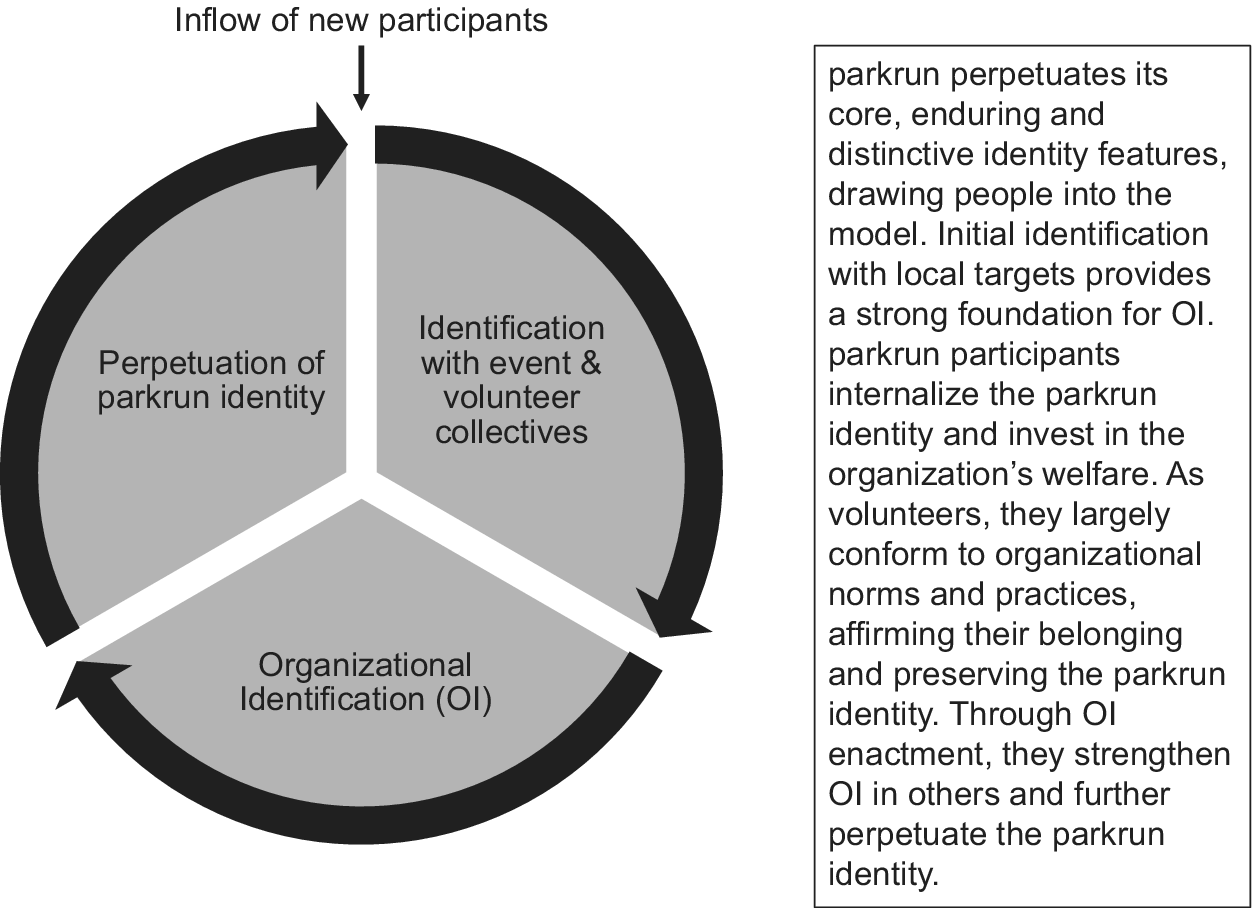
In line with a deductive approach and the principles or concepts drawn from OI theory, we first investigate whether a clear parkrun organizational identity exists that comprises distinct and enduring features and is intentionally perpetuated. Next, we examine whether our interviewees demonstrate a psychological and visceral connection to the parkrun organization and what it stands for, as well as other identification targets in the organization. Last, we explore whether interviewees’ accounts describe the benefits of identification for the organization. Figure 1 is a conceptual map depicting a reinforcing loop of parkrun identity perpetuation and identification with the organization and nested collectives.
Reinforcing loop of parkrun identity perpetuation and identification with local event collectives and the organization.

Fig. 1. Long description
The diagram consists of a central circle divided into three equal segments, surrounded by a thick black clockwise-pointing arrow that forms a perimeter.
* At the top center, an external arrow labeled Inflow of new participants points downward into the cycle.
* The first segment in the top right is labeled Identification with event and volunteer collectives.
* The second segment at the bottom is labeled Organizational Identification O I.
* The third segment in the top left is labeled Perpetuation of parkrun identity.
To the right of the diagram, a text box explains the process. It states that parkrun perpetuates its core identity features to draw people in. Initial identification with local targets provides a foundation for O I. Participants internalize the identity and invest in the organization. As volunteers, they conform to norms, affirming belonging and preserving the identity. Through O I enactment, they strengthen O I in others and further perpetuate the parkrun identity.
Organizational identity
Clear, enduring, and distinct identity features
A clear, enduring, and distinctive organizational identity is a precondition for OI (Ashforth, Reference Ashforth2016; Ashforth & Mael, Reference Ashforth and Mael2024). Our previous analysis described a recognizable core parkrun identity as a social and physical activity movement for good, comprising a fixed format (e.g., 5 km, weekly, free) and an ethos combining simplicity, inclusivity, and being “about community” (Cranney et al., Reference Cranney, Grunseit, van Nassau, Milat and Cleland2025).
There’s the mindset of parkrun is a running event, and then there’s the mindset of parkrun is a community event. Of course, it’s not just those two sides, there’s a whole spectrum in between. [employee 1]
The “enduring” aspect of an organizational identity can foster identification by offering a sense of continuity (Ashforth, Reference Ashforth2016). According to our interviewees, parkrun’s fixed format seems to perform this function, providing consistency and stability over time and location.
It’s 5km no matter where you are, and it all operates exactly the same way, which I think is one of the strengths of it. [ED 1]
It’s almost a little bit like a church. You can go away for 10 years but come back and it’s still there. It does exactly the same role. (ED 2)
Enduring organizational identity features may be embedded in tales of the organization’s history and defining moments or else reflected through an organization’s deep commitment to a principle (Whetten, Reference Whetten2006). As a space for local communities to connect and belong through physical activity outdoors, parkrun’s enduring identity was also reflected in interviewees’ stories of parkrun’s founder and his original vision for social connection.
The founder of parkrun in the UK, Paul Sinton-Hewitt… came out and told us a bit more about why he started parkrun… motivation wasn’t anything to do with training in the off season or keeping his fitness up… He needed to talk to his friends. [ED 3]
There were numerous features our interviewees felt evidenced the uniqueness of parkrun, including the fixed format and recognizable ethos, its social nature, the presence of a tail walker (so no one comes last), and the easy exchange in participation between runner/walker and volunteer. For example, providing free, low-barrier entry and regular ongoing opportunities for physical activity was noted as rare in the sport and recreation context.
When I came back after those couple of events in the UK then I was like, wow, this is really unique in terms of, again, simplicity, accessibility… (employee 2)
So parkrun fits the model that ticks a lot of boxes for sort of physical activity, community sport, recreation, because it’s changing of the guard of the way traditional sport is delivered. [External stakeholder 1 (council)]
The simplicity of parkrun volunteering was also considered unique in the nonprofit context.
One of the amazingly beautiful things that parkrun does compared to other kind of committees and organizations – it doesn’t have the volunteers tied up with the convoluted processes of managing committees and having annual meetings and submitting financial returns…we can just get on with doing what we’re passionate about. [ED 4]
Moreover, parkrun’s social nature was not only valued as a point of difference generally but a feature unique to a particular point in time (namely, post-COVID-19).
It’s just come along at the right time. At a time when there’s – the opportunities for connecting in-person as a community have been dwindling. [Ambassador 1]
parkrun’s identity attributes are recognizable to its participants and are considered distinct from other physical activities and volunteering opportunities. There is an understanding that the central concept has endured, with an enhanced emphasis on inclusivity. As such, the parkrun model gives proponents something definable to identify with that cannot be easily replaced with something else.
Intentional identity perpetuation
Organizations intentionally perpetuate their identity features to their members and beyond as a way of maintaining a distinct and recognizable definition of who they are and what they stand for (Ashforth, Reference Ashforth2016; Whetten, Reference Whetten2006). From our interviews, there seemed to be a persistent effort to perpetuate the core parkrun identity through the organization’s mission statement, policies, and communications. For instance, the organization’s core principle of equally valuing three pillars of parkrun engagement (volunteering, walking, and running) drew significant organizational effort.
The vision of creating a healthier and happier planet…it reaches a wider community…and because parkrun’s so big on inclusivity, anyone can come…I think the park walk campaign was a big launching pad for people to understand that. [employee 3]
I keep going back to this, why do we have parkrun? And I think, if you understand that, then you understand why we have the requirements for volunteers and why we say, don’t close your [volunteer] roster off – encourage as many people to get involved…We’ve got to continue to reinforce and support teams with that messaging. [employee 2]
Additional milestone shirts representing higher individual volunteering contributions (than the original 25) also symbolize the organization’s increasing focus on volunteering as a key pillar of engagement.
The Volunteer Hub (online repository of volunteer resources), Ambassador programme (including the annual conference) and employee roadshows are also key strategies which directly communicate and perpetuate parkrun’s organizational identity. For example, Ambassador outreach strategies perpetuate parkrun’s inclusivity feature through targeting priority populations.
[describing Outreach Ambassadors] Wherever their interest lies, I try and match them up with a [community] group and then work with their local event to get them along and welcome them and tell them what parkrun is all about. [employee 4]
The simplicity aspect of the parkrun identity also permeated operational decision-making. Changes to procedures were often bounded by a need for, at the very least, outward appearance of simplicity to the participant but also commitment to simplify volunteer tasks.
Keeping it simple and enjoyable… We could be adding onerous processes and things to our team…our attitude is always to keep it as simple as possible. [ED 5]
parkrun’s identity as a social and physical activity movement for good was also perpetuated in the recent purposeful selection of sponsors and grant funding, which reflected those features. Perpetuation also meant identifying where alignment with the current ethos was not served, for example, where the vestiges of an organizational identity as a running event worked against other attempts to promote inclusivity.
So if you go on a parkrun website, you think we’re a 5K race. Everything on there is geared towards competition and records and a 5K run each week. So we need to get far better at explaining what it is that we actually stand for as an organization. [employee 5]
The parkrun organization intentionally perpetuates its identity through its mission statement, policies, strategies, communications, and decision-making around funding and operations, maintaining a distinct and recognizable definition of who they are and what they stand for.
Employees’ and volunteers’ identification with the organization
Once an organizational identity exists, individuals are then able to identify with it. OI represents a sense of oneness with an organization, characterized by cognitive and affective states and internalization of the organizational identity as a partial definition of self (Ashforth, Reference Ashforth2016; Ashforth & Mael, Reference Ashforth and Mael2024).
Internalization of the parkrun identity
Our interviewees’ assessment of parkrun reflected a psychological and visceral connection to the organization and its global social and health agenda. They convey their connection to a parkrun identity with affection for the parkrun concept.
I’m a bit of a parkrun nerd… [ED 6]
I choose to do this role because I love parkrun. [Ambassador 2]
Our interviewees’ perceptions of parkrun globally, in Australia and their local event, reveal a personal and affective connection with the parkrun concept and to organizational welfare. Passion and personal pride are evident in their accounts of, and local contribution to, the successful growth and dissemination of the wider movement, revealing a oneness with the organization and its goals.
From the bottom of my heart, every week I just stand up there and, without being conceited, I think, I did this and I look out and I think “these people [sic] here”, and I’m ever so happy. It’s wonderful. [ED 7]
I feel really proud to be part of something like this…it’s a great vision. [ED 8]
They [EDs] do it because they love it, they have got a genuine passion for it. And the ambassadors hang around because they love it, you have to. So even though it is work…it is work they genuinely enjoy…it is a labour of love. [employee 4]
Our interviewees often reflected on parkrun’s identity features when describing what parkrun meant to them, and its alignment with their pre-existing altruistic or prosocial identity features.
We’d had some volunteering history in the community already, but the exercise stuff combined with community connections was something that really spoke to both of us. [ED 3]
For others, these identity attributes appear to be something they aspire to, previously dormant or not yet recognized or expressed.
It was against the grain, I’d say, for me to do that [RD role] but I’m also wanting to help. So I’m like, “Yeah, I’ll be keen to join.” [ED 10]
Among these employees and higher-level volunteers, there was a clear volunteer identification with the parkrun concept and internalization of the parkrun identity, which underpinned an emotional investment in the organization to the extent that its fortunes became their own.
Nested layers of identification with collectives
According to OI theorists, individuals tend to identify more with proximal targets, such as teams, networks, and roles, than with the organization itself because they are locally experienced, more relevant, and concrete (Ashforth, Reference Ashforth2016; Ashforth & Mael, Reference Ashforth and Mael2024). Our interviewees described their identification with nested collectives (local, regional, global), which also overlapped with role-based collectives.
Group-level identification appears to be a central part of the positive volunteer experience that initiates and sustains volunteers’ engagement in parkrun’s collective efforts. Our interviewees seem to identify strongly with local event collectives (particularly the core volunteer team) where social ties are formed and strengthened based on common values or interests and affiliative motivations (i.e., a sense of or desire for group belonging).
The core group are more serious – we’re all serious runners. So that bonds us. [ED 5]
When I found parkrun, I felt there was sort of like-minded people. [ED 12]
Some of our interviewees expressed these feelings of belonging to the local collective in the sense of comfort, support, and familiarity akin to home and family, similar to findings in the UK (Fullagar et al., Reference Fullagar, Petris, Sargent, Allen, Akhtar and Ozakinci2020; Hindley, Reference Hindley2018).
I’ve been there since day one. It’s like home. It’s like a comfy pair of slippers. Just like, put them on every Saturday morning and smile. [ED 13]
It’s a little family…I wouldn’t want to move now. I wouldn’t want to go to another one… [ED 14]
Extending from the local to less proximal targets of identification, EDs and Ambassadors expressed a sense of kinship among informal parkrun networks they created outside of the formal organizational subgroups. These networks comprised volunteers sharing similar roles or contexts (i.e., regional location) and performed informal operational and social support functions, either in person or online.
We had a local Facebook and Messenger group for just the events in this region…I can see that it doesn’t fit in with the regional model that parkrun has, but all of the people in there are proximate to each other geographically. So there’s a bit more sense of connection. [Ambassador 3]
If there’s a particular situation at parkrun where it’s like a forehead slapping kind of whopper moment, like you go and then say, “Would you believe this happened?” And then have a bit of a laugh about it. So it’s a good way of venting in a non-official capacity. [ED 9]
In comparison, there appears to be a disidentification with centrally imposed role-based groups, designed as formal channels for more functional and directive communications. Our interviewees seem to derive less value and belonging from the one-way communication flow devoid of social banter.
Slack [communication technology] is certainly part of the global rules…I think it does lack – it misses the things that bring people to that communication. [Ambassador 3]
Dynamic process of identification
Individuals continuously reevaluate and revise their relationship with an organization they belong to, meaning that OI is a dynamic process of identity work (Albert et al., Reference Albert, Ashforth and Dutton2000; Brown, Reference Brown2017). Our interviewees’ accounts of their parkrun experiences illustrate an evolving process of first a shared identity with fellow parkrunners, which in turn shapes identification with the broader parkrun entity.
Identification with the volunteer collective appears initially prompted through a growing consciousness and gratitude toward the efforts of a few in enabling benefits for many. Consistent with earlier organizational messaging and qualitative parkrun research conducted in the UK (Stevinson et al., Reference Stevinson, Wiltshire and Hickson2015), this spawns a desire to “return the favor” and serve a greater purpose by enabling benefits for others.
For me, getting in and volunteering, it enables a lot of other people to do something they might not have done otherwise that helps their health. [ED 15]
For our interviewees, the social and community aspect becomes their core purpose for attending and offering their services.
Largely what I’ve gained from parkrun in meeting such wonderful people, making some genuine friends…seeing the improvements it has made in their life and the difference parkrun has made to them. [ED 9]
Identification with local targets seems to provide a strong foundation on which identification with the broader parkrun collective and the organization itself is developed over time and place. Subsequent uptake of higher-level volunteer roles generally signals an extension of identification with the local to the regional collective and broader enterprise.
Ambivalent identification
The dynamic nature of identification means that while identification can be gained and strengthened, it can also be lost or diminished (Brown, Reference Brown2017). Ambivalent or conflicted identification manifests where individuals identify with some organizational identity aspects and not others (Kreiner & Ashforth, Reference Kreiner and Ashforth2004). Ambivalence was apparent in some of our longer-term volunteers’ reflections on the parkrun organization, highlighting a differentiation between the parkrun concept itself and the entity encompassing a structure and integral collectives (paid employees, events, volunteers) that work together for a shared purpose.
It seems parkrun’s quest for simplicity is partially disrupted by the organization’s response to its growth and the geographic dispersion of events. Longer-term volunteers noted the organization’s concomitant increased governance and corporatization, which misaligned with parkrun features of being simple, grassroots, and community-led.
They’re getting too big, where – is it still that simplistic? …for most people who turn up to an event it is, but possibly for those of us who are actually behind the scenes, as such, it’s maybe not quite so simple. [ED 16]
I understand that parkrun needs money to survive, they need sponsors. I just think you need to be careful with what you sell to those sponsors…I don’t think you want it to become like a [sponsor name] event. You still want it to be parkrun, you want parkrun to keep its identity. [ED 17]
Growth also appears to partially disrupt the sense of belonging and connection, at the local and regional (Australia) level as personal connections diminish. For some, identification with a smaller local event, or the grassroots organization, which had cultivated a sense of belonging through interpersonal connection, had diminished.
There was always a connection and an understanding, and so you could have these kinds of conversations instead of, now, people in head office probably wouldn’t know everybody because you just can’t because of the size. [ED 18]
These findings suggest that OI is largely based on the identity features that parkrun volunteers align with on initiation as a new member, and any fundamental changes to these features may represent an organizational identity threat that diminishes their volunteer experience and identification with the organization. Thus, longer-term parkrunners may be more likely to hold an ambivalent identification with parkrun.
There’s a few particular events where, if they started sometime before 2016 or something like that, you started a parkrun and then you kind of hold onto that ideology you have initially experienced at parkrun. [employee 1]
It appears the change in the “traditional” way of doing things disrupts the identification process sufficiently for some to step away from their volunteering role. Yet envisioning a loss of organizational membership implies a deficit in one’s self-identity, the threat of which generally keeps them bound to the organization in one form or another.
It was just more and more of the admin stuff that I just went, “I don’t see why we are doing it.”…and I just went, “I think I’ve had enough.” And I didn’t want to get jaded because I loved it and I still love parkrun. [ED 18]
Conversely, one of our interviewees described volunteer team members’ loss of identification with an event collective, resulting in team disbandment. However, strong identification with the organization transcended disidentification with a local collective; these individuals sought out other event collectives they felt more aligned with, retaining them in the organization.
While an organization needs to embed its identity in its processes, if that identity changes, there is a risk that it deviates too much from what members aligned with, and they can stop identifying and investing. Interestingly for parkrun, volunteers sometimes make a distinction between the fundamental concept and its implementation, and while the organization may lose that volunteer, the concept retains their engagement.
Organizational benefits of volunteers’ OI
The parkrun organization seems to benefit from volunteers’ and employees’ OI through their cooperative and conforming behavior and enactment of their OI, which also supports development or strengthening of OI in other members.
Cohesion and conformity
Individuals who identify with an organization are likely to engage in the normative behaviors of the group, which express and maintain their inclusion and belonging to the organization (Ashforth, Reference Ashforth2016; Blader et al., Reference Blader, Patil and Packer2017). OI appears to be a key mechanism that allows parkrun to cultivate an embedded volunteer labor force that works together cohesively and fosters conformity to maintain the larger parkrun phenomenon and preserve its identity features. Behaviors consistent with parkrun identity (e.g., welcoming first timers reflects inclusivity) are encouraged and validated, whereas actions that diverge (e.g., complicating volunteer tasks undermines simplicity) draw reproach and reminders of what parkrun “is all about.”
We very carefully and deliberately handpicked who we have in the team, and been very deliberate about making sure they understand the culture and the purpose and the way that we operate and what it’s all about as being paramount.” [Ambassador 1]
Yet some EDs “bent the rules” to suit their local context (e.g., too few volunteers to fill mandatory event-day roles), illustrating how strongly identifying volunteers can also deviate from normative organizational practices. Nonconformity seems underpinned by welfare-oriented motivations, where they regard organizational practices are not necessarily in the best interests of their local event collective (e.g., cancelling events), and, by extension, in achieving organizational goals.
When you’ve got 12 people [participating as runners/walkers], I don’t want to have five volunteers, it just doesn’t work. And we bend the rules sometimes in that way. [ED 8]
Principally, there seems an implicit, depersonalized trust in the broader parkrun collective for maintaining local events and the broader enterprise. Depersonalized trust is a consequence of OI in which trust arises not through interpersonal bonds, but purely because they are a member of the organization (Ashforth & Mael, Reference Ashforth and Mael2024). In the parkrun organization, responsibility is devolved to regional and local volunteers, who are entrusted with delivering events and preserving the parkrun identity in good faith.
We have the mentality that event teams, whatever they’re doing, whether it’s what applies with our policies or not, that they’re doing it with good intentions…that they’re doing that because they think that’s the right thing for their community. [employee 7]
Enactment of OI
OI can be enacted by individuals, through various means, including discourse (in writing or dialogue), dramaturgy (performed through behaviors, demonstrations of enthusiasm), and symbolism (displays of meaningful object symbols, e.g., attire with logos) (Brown, Reference Brown2017). Enactment benefits the organization by strengthening identification with the organization among others (Brown, Reference Brown2017). Our interviewees appear to enact OI through conversations within their social networks (i.e., family, friends, workmates), drawing in newcomers. They also enact OI among existing organizational members, for example, in weekly social media posts, pre-run briefings, and welcoming first timers.
When I look at the events that do a brilliant job, they recognise what people are interested in, what they’re going to respond to, and that’s what they’re projecting through their first timers welcome, their event welcome, their social media posts, the way they write in their event on the website. All of these things just look really, really welcoming, non-judgmental. [employee 5]
Dramaturgically, Ambassadors’ and EDs’ descriptions of their parkrun volunteering experiences suggest they act with a genuine passion and enthusiasm for their role and the organization in their duties (e.g., celebrating milestones).
We make the volunteering fun. So we’ve got the lanyards, we’ve got the vests and I say fun things about volunteering, and every week I take a photo and I make the volunteers do something crazy. And every week when I do the run report, I put a photo of the volunteers. [ED 7]
Symbolically, volunteer milestone T-shirts were valued by our interviewees as representations of their efforts and affirmation of their volunteer identity in the parkrun community.
It encourages them to keep coming because you can get a shirt and you can wear your shirt with pride that you’ve done so many parkruns or volunteered at so many. [ED 19]
In sum, the parkrun organization benefits from OI through volunteers’ preservation of parkrun identity features and enactment of OI, creating a reinforcing loop that develops and strengthens other parkrunners’ OI and solidifies their own commitment.
Discussion
Our study demonstrates the relevance of OI in understanding the mechanisms driving parkrun volunteering. Ours is the first parkrun study to explore identity beyond an individual’s self-definition as a parkrunner, to those occupying volunteer roles with greater responsibility (paid and unpaid) in the organization. We found evidence that social identification and OI are mutually strengthening mechanisms for driving parkrun volunteer initiation and retention, and system-level features such as the fixed format, communication, and policies work together to perpetuate the central identity. Our research reveals reinforcing loops of identification with parkrun and its nested collectives; individuals internalize a parkrun identity and enact their identification with local collectives and the broader enterprise, which, in turn, fosters OI among others.
Organizations intentionally perpetuate their identity to maintain a distinct and recognizable definition of who they are and what they stand for (Ashforth, Reference Ashforth2016; Whetten, Reference Whetten2006). parkrun intentionally perpetuates its identity by maintaining its standardized format and promoting its distinctive ethos via organizational policy and strategy. Our analysis shows how critical this process has been for mobilizing a committed and sustainable volunteer workforce underpinning the parkrun organization. But the organization also benefits from preservation of identity through its embedded volunteer model, which cultivates strong identification with local collectives and the parkrun concept, fostering custodianship of the global movement at the local level.
Our findings demonstrate the process of volunteers’ identification with the parkrun organization, extending previous literature describing internalization of a parkrunner identity (Bowness, McKendrick, & Tulle, Reference Bowness, McKendrick and Tulle2020; Hindley, Reference Hindley2018; Warhurst & Black, Reference Warhurst and Black2021). parkrun draws in those who already internalize an altruistic or volunteer identity in their self-concept and fosters new positive prosocial identity narratives among others. Its multifaceted nature and fluidity between roles and events (Cranney et al., Reference Cranney, Grunseit, van Nassau, Milat and Cleland2025) offer its participants the opportunity to explore and incorporate multiple aspects of parkrun identity, easily transitioning from participant to volunteer identity through “gateway” volunteer roles (e.g., tailwalker, marshal, and parkwalker) and progressing on to more challenging volunteer roles (RDs, EDs, and Ambassadors). Being able to easily hold multiple identities within parkrun not only enhances reciprocity (Bowness, Tulle, & McKendrick, Reference Bowness, Tulle and McKendrick2020; Mitchell, Reference Mitchell2023), but affords identity synergy (see Fombelle et al., Reference Fombelle, Jarvis, Ward and Ostrom2011), where volunteers’ OI is reinforced through parkrun’s norm of reciprocity over time, helping to retain them in the organization. Organizations aiming to improve volunteer recruitment and retention could design entry-level roles that are simple, enjoyable, and socially rewarding, providing clear pathways to more challenging roles as volunteers’ identification strengthens. Embedding opportunities for volunteers to hold multiple identities within the organization—similar to parkrun’s fluid transition between participant and volunteer roles—can cultivate norms of reciprocity and identity synergy that may foster long-term commitment. Our analysis illustrates the interplay and overlap between identification with the broad organization and its nested collectives (events and roles), answering the call for greater attention to the multiple nested identification targets within organizations (Ashforth, Reference Ashforth2016; Ashforth & Mael, Reference Ashforth and Mael2024; Weisman et al., Reference Weisman, Wu, Yoshikawa and Lee2022). As OI theory predicts, we found individuals identify strongly with proximal targets within the organization due to their social salience (such as teams and networks). Others have similarly reported an emotional attachment or sense of belonging to the broader parkrun movement that is largely connected to their local event (Bowness, Tulle, & McKendrick, Reference Bowness, Tulle and McKendrick2020; Hindley, Reference Hindley2018). Identification with local targets highlights the value of parkrun being characterized as community-led, which prompts affiliative motivations. Social identification with local event collectives and volunteer teams is likely fostered through parkrun’s “casual sociability,” characterized by a welcoming social atmosphere in which incidental and casual social interactions occur (Hindley, Reference Hindley2018). For our volunteers, the social and community aspect becomes a core purpose for attending and offering their services.
In turn, identification with the local collective may embed a deeper sense of belonging to the broader organization, as our findings suggest a dynamic layering process of identification with organizational targets. Social interactions among peers (e.g., co-workers and managers) can shape newcomers’ OI by fostering belonging that generalizes to the organization (Weisman et al., Reference Weisman, Wu, Yoshikawa and Lee2022). parkrun’s “casual sociability” (Hindley, Reference Hindley2018) may thus be appreciated as an important socialization practice central to developing participants’ OI. Given parkrun disseminates through existing social networks (Wiltshire & Stevinson, Reference Wiltshire and Stevinson2017), and the theoretical interest in how networks enable the diffusion of organizational identity and OI (Ashforth, Reference Ashforth2016), further exploration of the extent and means of OI diffusion through parkrun’s social networks is warranted. Organizations could adopt socialization practices that create welcoming environments and encourage informal interactions, as social connections strongly influence volunteer recruitment and retention (Forner et al., Reference Forner, Holtrop, Kragt and Johnson2022; Forner et al., Reference Forner, Holtrop, Boezeman, Slemp, Kotek, Kragt, Askovic and Johnson2024). Recruitment strategies might also leverage peer influence by encouraging volunteers to share experiences and invite friends, amplifying identity-based recruitment.
There also seemed to be a differentiation between identification with the parkrun concept and its operational arm, evident in some interviewees’ ambivalent OI. Our distinction between the parkrun concept from the organization that operates it may resemble the “focal brand” of parkrun noted by Mitchell (Reference Mitchell2023). Our research demonstrated how this separation can be both friend and foe—strong identification with the concept retains volunteers even when they hold ambivalence about organizational operational processes or practices. However, if the organization strays too far from parkrun’s identity features, then it may stop generating the benefits (i.e., voluntary labor) that support it. To mitigate the risk that ambivalent identification evolves into disengagement, organizations should actively reinforce alignment between their operational practices and the core identity features that volunteers value, while maintaining open communication and feedback channels to address emerging concerns.
In terms of organizational benefits, sharing a sense of identity can encourage helping between members (Gray & Stevenson, Reference Gray and Stevenson2019), and this is illustrated through the willingness of parkrun’s higher-level volunteers to take collective ownership and a strong interest in parkrun’s continuation. The net effect is that individuals then invest in the organization’s welfare by devoting time and effort to help it succeed, perpetuating the parkrun identity and recruiting like-minded others through OI enactment. Our study suggests identification with the organization and its nested collectives is central to volunteer initiation, satisfaction, and retention, drawing in a voluntary labor force that sustains the organization.
Strengths and limitations
Our findings are strengthened by the inclusion of a wide and varied sample of parkrun stakeholders working across different levels of the organization and in diverse localities. Our results may be biased toward more positive parkrun views and experiences, as those who identified less strongly with parkrun may have declined an interview. However, some interviewees expressed negative perceptions of aspects of their parkrun experience, and we were also able to capture views and experiences of volunteers who were no longer serving (both first- and secondhand), which provided a deeper understanding of the dynamic nature of identification. We also acknowledge that the perceptions and experiences we have captured reflect the Australian parkrun context. But we believe the fundamental nature of identification may be transferable to other contexts, particularly given our findings resonated with parkrun research conducted in the UK. Further parkrun research in other countries, such as Africa and Japan, would be worthwhile to explore whether and how social identification and OI underpin parkrun volunteering in other cultures. We also did not observe differences in OI between paid and unpaid roles; however, as our study focused explicitly on volunteering, we did not examine how OI is enacted or experienced by employees versus volunteers.
Although our analysis is a theory-driven examination, it arose from an initial inductive exploration of factors underpinning successful parkrun dissemination, in which we held no expectations of social identification and OI. This approach allowed identification of the most relevant theoretical constructs before this deeper exploration of whether and how they drive parkrun volunteerism. As a real-world initiative that relies heavily on volunteering with broad dissemination in a variety of contexts, parkrun makes an ideal case study for this analysis, offering practical implications for volunteer management.
Conclusion
parkrun is an exemplar public health initiative, having proven health and well-being impacts on its participants (Grunseit et al., Reference Grunseit, Richards, Reece, Bauman and Merom2020; WHO, 2018). Preservation of parkrun’s identity features and emphasis on the benefits of volunteering as a key pillar of parkrun engagement will likely enhance its sustainability and, as a consequence, public health benefit. Given public health initiatives that engage individuals in the incorporation of positive aspects of identity into their sense of self may prove more effective than those that do not (Mols et al., Reference Mols, Haslam, Jetten and Steffens2015), further exploration of OI and volunteering outcomes is warranted. parkrun is a useful model in which broader social, physical, and mental well-being benefits can be realized for local communities in a format that almost exclusively relies on volunteers, yet is implemented at scale. Other volunteer organizations could consider socialization practices that enhance identification with nested organizational targets, to enhance volunteer initiation and retention (Gray & Stevenson, Reference Gray and Stevenson2019).
Acknowledgments
We gratefully acknowledge the contributions of parkrun Australia staff to sample selection and recruitment and the parkrun Global Research Board for approving this research. We thank all participants who generously shared their time and parkrun experiences and Dr Jenny Plumb for conducting interviews.
Funding statement
This research was supported by the National Health and Medical Research Council Ideas Grant [2021/GNT2012418].
Competing interests
The authors declare that there is no conflict of interest.
Ethical standard
Our study was approved by the University of Technology Human Research Ethics Committee (approval number ETH22-7558). All participants provided informed consent via the Qualtrics survey platform prior to enrolment in the study, and verbal consent prior to the interview.

 Open access

