

The past is a key resource for political actors and its contestation has been the subject of scholarly inquiry across distinct fields such as sociology (Halbwachs Reference Halbwachs1950; Jansen Reference Jansen2007), anthropology (Ballinger Reference Ballinger2003; Connerton Reference Connerton1989; Macdonald Reference Macdonald2013), archaeology (Hamilakis Reference Hamilakis2007), politics (Müller Reference Müller2002) and geography (Johnson Reference Johnson1995; Lowenthal Reference Lowenthal1998). Mnemonic contestation is a constant feature of contemporary politics, driven by a dialectic between actors with divergent accounts of the past and contrasting views on how it should be remembered (David Reference David2020; Sierp Reference Sierp and Mälksoo2023). In national and international contexts (Sierp Reference Sierp2025), memory contestation takes place over monuments and museums (Art Reference Art2005; Forest and Johnson Reference Forest and Johnson2011); history textbooks and school teaching (Bekerman and Zembylas Reference Bekerman and Zembylas2011; Jaskulowski and Majewski Reference Jaskulowski and Majewski2023); street naming and cartography (Demetriou Reference Demetriou2006); and commemorations and parades (Kubik and Bernhard Reference Kubik, Bernhard, Bernhard and Kubik2014). It involves a wide array of actors, ranging from governments and legislatures seeking to legislate in favour of particular memories of the past (Kallius Reference Kallius2025) to political parties and social movements contesting memorial tropes (Daphi and Zamponi Reference Daphi and Zamponi2019) to epistemic communities created or targeted by memory warriors (Pető Reference Pető, Kończal and Moses2023). Increasingly more salient, memory politics juxtaposes appeals to make nations ‘great again’ with calls to ‘never again’ return to authoritarian yesteryears.
Far-right actors have been at the forefront of memory politics, often as challengers of collective memory and, especially, as contesters of liberal accounts of remembrance (David Reference David2020). The annual commemoration by German right-wing extremist groups of the death of Rudolf Hess (Zeller Reference Zeller2022), the paramilitary marches of the Hungarian Guard, which, according to the European Court of Human Rights, were reminiscent of the Arrow Cross, the Hungarian Nazi Movement (ECHR 2013), the use of public sites by Romanian groups to reinstate the memory of fascist leaders like Corneliu Codreanu (Zavatti Reference Zavatti2021), and the commemoration of divisive and controversial civil war events by the Greek Golden Dawn (Ellinas Reference Ellinas2020), serve as examples of how far-right actors contest the past and challenge the collective memory. In various settings, the contestation of officially sponsored narratives and the memorialized association with an authoritarian past has been central to the ostracization of far-right actors and to the initiation of restrictive measures against them (Capoccia Reference Capoccia2013; Manucci Reference Manucci2024).
Although the instrumentalization of the past has been a long-time feature of the way far-right actors participate in politics, it is only recently that scholarship on memory politics has started catching up with this empirical reality (Couperus et al. Reference Couperus, Tortola and Rensmann2023). Efforts to bridge the gap between social movement and memory studies have helped draw attention to mnemonic agency and practices (Berger et al. Reference Berger, Scalmer, Wicke, Berger, Scalmer and Wicke2021; Daphi and Zamponi Reference Daphi and Zamponi2019; Gutman Reference Gutman2017; Gutman and Wüstenberg Reference Gutman and Wüstenberg2022) and, hence, to the actors strategically involved in the contestation of the past (Sierp Reference Sierp2025). These actors vary significantly in form, ranging from groups, networks and movements (Korhonen Reference Korhonen, Čeginskas, Kaasik-Krogerus and Sääskilahti2021; Schmalenberger et al. Reference Schmalenberger, Kølvraa, Forchtner, Gutman and Wüstenberg2023; Volk Reference Volk2023; Zavatti Reference Zavatti2021) to sizeable parliamentary parties (Rueda Reference Rueda2023). Nonetheless, they share a similar programmatic platform (Pirro Reference Pirro2023) and, more importantly for our purposes, a strategic orientation towards the instrumentalization of the past. The strategic nature of this engagement with the past is evident in their discourses (Cabrero and Sierp Reference Sierp2025; Couperus et al. Reference Couperus, Tortola and Rensmann2023) as well as in their actions. The growing scholarly attention to the political praxes of far-right actors (Ellinas Reference Ellinas2020; Gattinara et al. Reference Gattinara, Froio and Pirro2022), through the analysis of movements and parties active in both the electoral and in the protest arena (Della Porta et al. Reference Della Porta, Fernández, Kouki and Mosca2017; Gattinara and Pirro Reference Gattinara and Pirro2024; Kitschelt Reference Kitschelt, Katz and Crotty2006) turns the spotlight on the range of activities these actors undertake to engage with the past.
The main purpose of this article is to cast new light on the memory practices and activism of far-right actors by systematically tracing the ‘memory work’ (Jansen Reference Jansen2007; Schwartz Reference Schwartz1996) of a far-right political party. I use Cyprus as a case study because of its significance as a place where the far right has a clear legacy of extremism due to its association with the Greek Golden Dawn. This allows me to generate hypotheses about the relationship between the memory work of far-right actors and their electoral aspirations (Lijphart Reference Lijphart1971). The main expectation is that far-right actors do not only challenge the past, but also try to associate themselves with officially sponsored memory as a means of legitimating their presence and claims. I leverage original evidence from a dataset of party events and party archives as well as from in-depth interviews and event observations to illustrate how the memory work of the Cypriot ELAM (National Popular Front) aims to simultaneously contest and appropriate the past. This hybridity enables the party to dispute the memory ownership of other actors (contention) while seeking a legitimate place in memorial politics (convention). I also show that this hybridity is more than a transitory phase towards normalization – it is a strategic choice of far-right actors with growing electoral aspirations.
Memory politics and the far right
Although memory has long been central to the study of nationalism (Anderson Reference Anderson1983; Hobsbawm Reference Hobsbawm1992; Smith Reference Smith1995), the study of nativist parties and movements – which I broadly term far-right actors (Pirro Reference Pirro2023) – has dealt only sporadically with memory politics. Scholarship on far-right political parties has emphasized their programmatic manoeuvring in the competitive space (de Lange Reference de Lange S and Mudde2016; Kitschelt and McGann Reference Kitschelt and McGann1995; Mudde Reference Mudde2007; Zaslove Reference Zaslove2009) and their organizational attributes (Art Reference Art2011; Carter Reference Carter2005; Ellinas Reference Ellinas2020) but has largely overlooked their propensity for street-level political action (Kitschelt Reference Kitschelt, Katz and Crotty2006) and, hence, their mnemonic activity. When focusing on this activity, it has mostly emphasized its contentious nature and the propensity of these actors to contest (rather than appropriate) institutional memories (Art Reference Art2005). Scholarship on far-right social movements has been more attentive to this activity than literature on political parties, although it is equally focused on the more controversial aspects of memory activism. This literature has looked in some detail at contentious mnemonic agency and practices (Gutman and Wüstenberg Reference Gutman and Wüstenberg2022), which range from torch processions during commemorations of Finnish Independence (Korhonen Reference Korhonen, Čeginskas, Kaasik-Krogerus and Sääskilahti2021) to the ‘spectacular’ memory activism of Generation Identity (Schmalenberger et al. Reference Schmalenberger, Kølvraa, Forchtner, Gutman and Wüstenberg2023: 86).
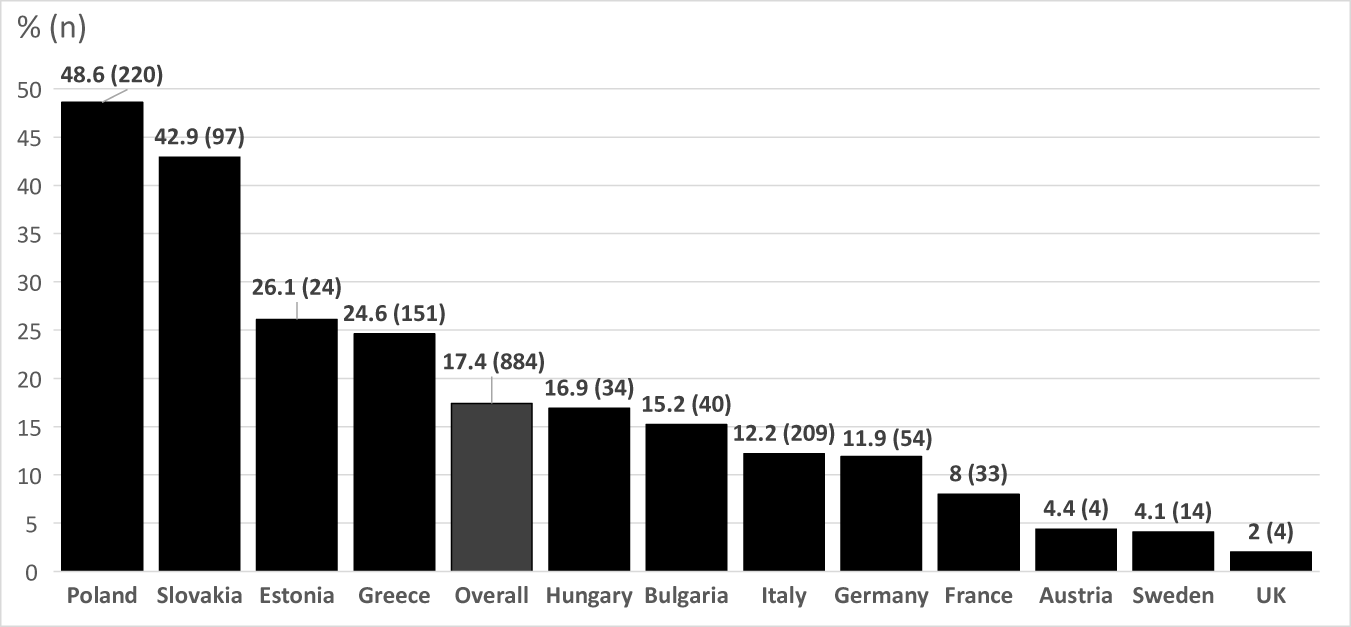
The growing scholarly focus on ‘movement parties’ (Della Porta et al. Reference Della Porta, Fernández, Kouki and Mosca2017; Gattinara and Pirro Reference Gattinara and Pirro2024; Kitschelt Reference Kitschelt, Katz and Crotty2006) has helped cast new light on the memorial practices of far-right actors and brought electoral politics closer to the social movement literature (Tarrow Reference Tarrow2021). The focus on the hybrid nature of movement parties – operating in both the electoral and protest arena – has turned attention not only to their programmatic and discursive manoeuvring, but also their street-level mobilization and action repertoires (Gattinara and Pirro Reference Gattinara and Pirro2019). To analyse the latter, social movement scholars have moved beyond the analysis and interpretation of particular memorial campaigns or events to the compilation of catalogues of protest events (Biggs Reference Biggs2018). Using protest event datasets it is possible to analyse, among other things, the issue emphasis of protest activity as well as the actors involved (Hutter Reference Hutter and Della Porta2014), thus offering potential clues about the strategic emphasis these actors place on memory politics. One such dataset, Far-Right Protests in Europe (FARPE), which tracks far-right protests in 12 countries across a period of 11 years, shows that commemorative events make up nearly a sixth of all protest activity in these countries (Figure 1). The numbers are particularly high in Eastern and Southern European countries, reinforcing the emphasis placed on mnemonic agency in the region (Kubik and Bernhard Reference Kubik, Bernhard, Bernhard and Kubik2014; Meijen and Vermeersch Reference Meijen and Vermeersch2024).
Protest Events in the FARPE Dataset

Despite the growing emphasis on the nature of far-right activism, memory work remains a black box. Qualitative studies have primarily focused on memory activism in relation to specific, usually remarkable, events (e.g. the Rudolf Hess memory march; Zeller Reference Zeller2022) or themes (Volk Reference Volk2023) but have not systematically tracked the memory work of far-right actors across time. While protest event datasets offer possibilities to trace these temporal patterns, they mostly focus on major or contentious events, which naturally attract more media attention (Gattinara et al. Reference Gattinara, Froio and Pirro2022; Wouters Reference Wouters2013) but lack the granularity necessary to grasp the more routinized aspects of memorial activism. This ‘everyday’ far-right memory work, missing from both qualitative and quantitative analyses, helps provide a more comprehensive picture of memorial activity by going beyond the spectacle that far-right actors themselves seek to generate (Froio et al. Reference Froio, Gattinara, Bulli and Albanese2020).
Memory work: contention and convention
The ‘memory work’ (Jansen Reference Jansen2007; Schwartz Reference Schwartz1996) of far-right actors involves the range of activities they undertake to position themselves in relation to the past. By memory work, I specifically mean the strategic emphasis of these actors on commemorative practices, the tactical choices they make in associating with the past, and the repertoire of action they pursue. Situated in the resource mobilization approach in social movements (Gamson Reference Gamson1975; Jenkins Reference Jenkins1983; McCarthy and Zald Reference McCarthy and Zald1977; Tilly Reference Tilly2004), the analysis of memory work turns the spotlight on the far-right actors themselves, rather than on the various opportunities (Arzheimer and Carter Reference Arzheimer and Carter2006; Caramani and Manucci Reference Caramani and Manucci2019; Giugni et al. Reference Giugni, Koopmans, Passy and Statham2005) available in their environments or the grievances that help mobilize people towards various causes (Gurr Reference Gurr1970; Klandermans et al. Reference Klandermans, Van der Toorn and Van Stekelenburg2008).
With a scholarly lineage in the broader literature on political parties (Berman Reference Berman1997) and in the extant literature on the far right (Art Reference Art2011; Carter Reference Carter2005; Ellinas Reference Ellinas2020; Mudde Reference Mudde2007; Gattinara and Pirro Reference Gattinara and Pirro2024), this ‘internalist’ perspective does not mean to downplay the importance of environmental factors in shaping the memorial strategies, tactics and repertoires of far-right actors. A well-established tradition in the political parties and social movements literature has shown how political (Kitschelt Reference Kitschelt1986; Kriesi et al. Reference Kriesi, Koopmans, Duyvendak and Giugni1992) and discursive (Koopmans and Olzak Reference Koopmans and Olzak2004) opportunities shape their trajectories. In this sense, the ‘internal supply’ (Mudde Reference Mudde2007) of memory work can only complement the external supply as well as the demand for memory politics. The revival of memory politics cannot be isolated from the broader memory contestation between major actors (Kubik and Bernhard Reference Kubik, Bernhard, Bernhard and Kubik2014), nor from a broader dialectic at play – both at the national and international level – between cosmopolitan and nativist visions of the past (David Reference David2020). But it helps ascribe agency to actors that are more than hapless victims of their environments (Gattinara et al. Reference Gattinara, Froio and Pirro2022) and, hence, helps sketch a more comprehensive picture of the factors affecting their ascendance.
In terms of how far-right actors associate with the past, their memory work is usually viewed as being in contention with official memory. Far-right actors are thought to be stuck in a memorial ghetto, seeking to distance themselves from mainstream views of the past as a way of signalling their antithesis to the political system generating this collective memory. Indeed, there is considerable evidence pointing to the propensity of these actors to adopt controversial memorial tropes or associate with the authoritarian past (e.g. Froio et al. Reference Froio, Gattinara, Bulli and Albanese2020; Gattinara and Pirro Reference Gattinara and Pirro2024; Zeller Reference Zeller2022). At the same time, there is growing evidence that far-right actors do not only contest collective memory but also seek to appropriate it to legitimate their claims and, ultimately, to change it. The attempted revival of Joan of Arc in France as a religious conservative heroine by the French National Rally (Rueda Reference Rueda2023), the political instrumentalization of the ancient battle of the Spartans against the Persians at Thermopylae by Greek neo-Nazis (Bar Reference Bar2025a; Ellinas Reference Ellinas2020) and of the medieval Christian conquests of the Iberian peninsula against the Muslims by Spain’s Vox (Esteve-Del-Valle and Costa Lopez Reference Esteve-Del-Valle and Costa López2023), as well as the manipulation of the widely delegitimized communist past to mobilize support for nationalist platforms (Jaskulowski and Majewski Reference Jaskulowski and Majewski2023; Volk Reference Volk2023) all serve as examples of memory work that aims to appropriate tenets of a collective memory that enjoys wider legitimacy. This should not be surprising: to the extent that memory work is an exercise in building legitimacy and in shielding these actors from the reputational stigma of an authoritarian past (Daphi and Zamponi Reference Daphi and Zamponi2019), far-right actors have an incentive to adopt not only contentious but also more conventional tropes of the past that align with official or hegemonic historical narratives.
The main expectation here is that this incentive to appropriate rather than solely contest collective memory varies in accordance with how far-right actors engage in the protest and electoral arenas. All far-right actors can be expected to be at the forefront of efforts to mobilize nativist sentiments and hence to be among the main memory entrepreneurs, devoting significant organizational resources to commemorative practices. However, far-right actors vary in their electoral standing and aspirations; those that challenge mainstream memory narratives directly risk being ostracized, their protests generating counter-mobilizations by societal actors (Art Reference Arzheimer and Carter2005) and leaving them to spend decades on the streets, failing to gain much electoral traction (Art Reference Art2007; Reference Art2011; Zeller Reference Zeller2022). A movement, network or group that is solely present in the protest arena might therefore be more prone to contest official memory and associate itself with the authoritarian past than a party that is solely active in the electoral arena.
Aspirations to electoral standing create incentives for actors to adopt a hybrid strategic orientation: there is higher strategic utility in seeking to appropriate rather than solely contest mainstream memories of the past. Nonetheless, the utility of appropriating the past is limited by the multiplicity of actors identifying themselves with the officially sponsored memory of this past. Since mainstream actors competing in the electoral arena might have a similar stance towards the past, far-right competitors with (hopes of) electoral standing need to differentiate their position as they try to appropriate the past. This generates a strategic mix of contestation and appropriation as actors need to simultaneously associate with mainstream memory but also distance themselves from other competitors. This mix can be expected to vary not only across actor types and attributes (e.g. associations versus parties), but also across time: the higher the electoral standing or aspirations of the far-right actor, the more likely it is that it will seek to engage in both contentious and conventional memorial practices.
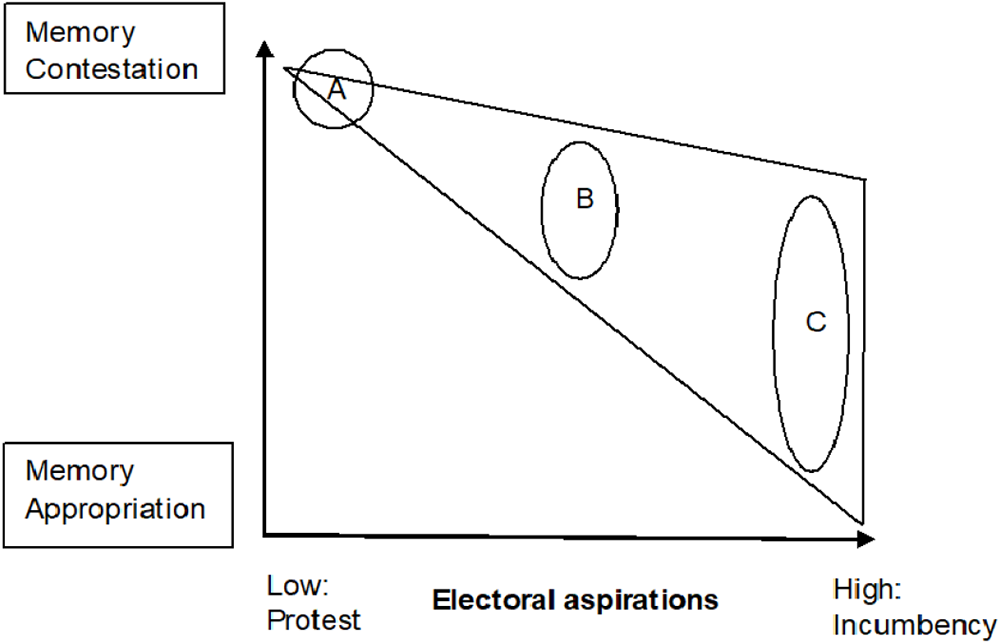
Figure 2 shows the main expectations regarding the memory work of far-right actors. The vertical axis stands for the memory work of far-right actors and the horizontal axis captures their electoral aspirations. Far-right actors solely present in the protest arena but not in the electoral arena – e.g. movements, associations, networks (Actor A) – can be expected to strategically contest the past primarily using contentious tactics and repertoires. Actors active in both the protest and the electoral arena – e.g. movement parties (Actor B) – can be expected to tame their memory work and strategically combine memory contestation and appropriation.
The Memory Work of Far-right Actors

As the aspirations of far-right actors grow, I expect them to focus more on memory appropriation and less on contestation. They are hence expected to adopt more conventional memorial tactics and repertoire. Nevertheless, even as their electoral standing generates aspirations of incumbency, I expect far-right actors to retain contentious tactics and repertoires, to distinguish themselves from memorial competitors. In other words, I expect contention to be a permanent rather than a transitory (Della Porta et al. Reference Della Porta, Fernández, Kouki and Mosca2017; Gattinara and Pirro Reference Gattinara and Pirro2024; Kitschelt Reference Kitschelt, Katz and Crotty2006) feature of the memory work. Even actors with the highest level of electoral ambitions (incumbency) have an incentive to retain some of their contentious memorial tactics and repertoire in order to distance themselves from memorial competitors. This is illustrated in Figure 2, where Actor C retains part of their contentious work while focusing on memory work to appropriate the past.
This strategic combination of contention and convention generates expectations for the tactical choices of memory entrepreneurs. Actor tactics can be expected to signal some degree of identification with the dominant memory regime but also to leave their own mark, distinguishing them from competitors. Far-right actors seeking to both appropriate and contest mainstream narratives therefore need to undertake memory work that simultaneously signals identification and differentiation. The tactical choice of far-right actors is to navigate along the dual track of what I term ‘blending in’ and ‘doubling up’. Blending in constitutes an attempt to present a systemic image that seeks to normalize the party and present it as an actor sharing similarities with others. It involves following existing commemorative conventions and utilizing existing memorial practices, symbols and institutions. On the practical level, blending in requires having a handful of people dispersed in as many locations as possible. To do so requires a degree of actor differentiation that is probably difficult in the early stages of organizational development but becomes progressively more likely as actors grow their local organizational networks and recruit more activists. It also requires recruiting activists who look as ordinary as possible, to enable them to establish links with the local community.
Doubling up is a tactical choice by the far-right party of contending existing actors’ ownership of the memory regime through activity that aims to distinguish itself from others and visibilize its own claims to memory ownership. While doubling up can be observed across the range of events undertaken by the party, it can also be observed within particular events. In addition to organizing its own contentious events, it also involves ensuring it has a sizeable, visible and loud presence in official commemorative events alongside other actors. Claiming ownership of an event requires mobilizing as many activists as possible, training them for how they should conduct themselves during the event, and organizing communicative resources such as loudspeakers, torches and flags. This might be easier to arrange at earlier stages of development with smaller groups of volunteers but could become more difficult as actors professionalize and grow; not least, because it is necessary to balance the requirements of having large numbers with ensuring they are properly trained, so as to avoid excesses that would harm the actor politically (Art Reference Art2011; Ellinas Reference Ellinas2020). The latter aspect also requires organizational capacity to mediatize the memory work of the party and boost its efforts at memory ownership. Moreover, to double up effectively a party needs to recruit at least a core of activists with ‘biographical availability’ (McAdam Reference McAdam1986) to engage in more contentious types of activity.
This balancing act between blending in and doubling up can be expected to generate a repertoire of actions that includes a notable mix of organizational practices. On the one hand, it would include commemorative practices that primarily emulate those of other political actors, both in terms of the presence of the party in these events and in terms of their signalling. The conventional nature of this range of activities would signal the proximity of the party to the official memory narrative and its similarity with other political contestants. It is an attempt to signal that this is an actor just like any other. On the other hand, the need to leave a distinctive mark on these events can be expected to generate novel political practices, ranging from the organization of ‘own’ events around the memorial schedule, to the participation in official events in ways that leave a distinctive mark. The invention of new events or the attempted capture of existing ones constitute tactics that aim to claim ownership of the past or to purify it, without explicitly disputing it, but certainly questioning the ownership of competitors to this past or their efforts to dilute it (Lucardie Reference Lucardie2000). Here, memory work would signal the dissimilarity of the actor to its competitors through, for example, street militancy, symbolic exaggeration and discursive amplification.
Methodology
The article leverages evidence from an original events dataset, party archives, interviews with party functionaries and event observations to examine the memory work of ELAM in Cyprus. This peripheral case of a far-right actor is important not only because of the centrality of memory politics for Cyprus (Demetriou Reference Demetriou2018; Papadakis Reference Papadakis2003), but also, more importantly, because of ELAM’s association with Greece’s Golden Dawn, a party that won representation in the Greek parliament between 2012 and 2019. After being criminally prosecuted in 2013, the leadership of Golden Dawn was convicted and imprisoned in 2020 for running a criminal organization. Despite this setback, ELAM managed to weather the storm after Golden Dawn’s demise, in part by investing in memorial politics and striking a balance between memorial contention and appropriation.
First, the article utilizes an original dataset of 1,329 events publicized on the party website covering the period between 2014 and 2024, and human-coded using standard parameters of protest event analysis (Hutter Reference Hutter and Della Porta2014). Contrary to large, cross-national datasets, this dataset offers the opportunity to capture all events organized by the party, both at the national and local level. Since hardly any of these events are covered by daily newspapers – the most important source for events catalogues – the dataset opens a rare window into the full range of party activities, including its ‘everyday’ and highly localized commemorative practices. Nearly all the events are accompanied with photos and some with video material, thereby also providing an opportunity to analyse event attributes such as size, slogans and symbols (see Section 1 in the Supplementary Material) and to verify the textual information the party provides. The unexpected patterns observed during the analysis of this dataset, which are not easily observed through external sources, provided the basis for probing the memory work of the party further.
Second, to examine the period prior to the dataset and before the party acquired electoral relevance, I examined 937 issues of the newspaper Golden Dawn (published by ELAM’s Greek mother-party, Golden Dawn) as well as 30 issues of ELAM’s newspaper Greece of the South to gather qualitative evidence on the party’s memory activism, especially for the period between 2001 and 2013, which is not covered by the website.
Looking beyond this party material, I utilize two additional data collection methods. The first is a set of nine in-depth interviews with party functionaries, including some of the first members of the party still holding key organizational positions. The interviews, ranging from 30 to 150 minutes, are used to probe the party material on memorial activities. On a number of occasions I conducted follow-up interviews to dive deeper into the subject or triangulate the evidence provided (see Section 2 in the Supplementary Material). The second form of data collection comprises observations of nine of the most important and sizeable events of the party. These were undertaken to verify the information provided by my interviewees and to gain a better understanding of the party’s organizational and commemorative practices (see Section 3 in the Supplementary Material) by attending to the micro-dynamics and processes that the secondary material does not capture.
ELAM: the Golden Dawn of Cyprus
The Cypriot National Popular Front (Ethniko Laiko Metopo, ELAM) started as a local cell of Golden Dawn in 2001 and evolved into a party in 2008. It entered parliament in 2016 with 3.7% of the vote and 2 legislators (out of 56), and improved its standing in 2021 with 6.8% and 4 legislators. It gained 11.2% in the 2024 European election and is currently polling between 12% and 15%, ahead of the May 2026 parliamentary election. In the presidential, multi-party system of the Republic of Cyprus, ELAM has never held executive office.
Since its appearance in Cyprus in 2001 as a Golden Dawn cell and until its evolution into a party in 2008, ELAM operated as a network of a few dozen activists who had been members of Golden Dawn in Greece and visibly participated in various commemorative events. The founding of ELAM in 2008 by Golden Dawn functionaries reinforced the strategic emphasis the new organization placed on memory activism. The leader of ELAM, Christos Christou, was a member of the Political Council of Golden Dawn and a close confidant of its leader, and at least two other ELAM functionaries were in Golden Dawn’s central committee. Throughout these early years as a party, ELAM would emulate the memory activism of Golden Dawn, adjusting it to the Cypriot context.
This activism was primarily contentious and on a number of occasions it led to police arrests, but this all happened before the party became electorally relevant. The electoral momentum and breakthrough of Golden Dawn in the Greek national legislative elections in May and June 2012 was utilized by ELAM in Cyprus to increase its own visibility and electoral prospects (Katsourides Reference Katsourides2013). Throughout this period, ELAM would proudly declare that it was the Golden Dawn of Cyprus (Charalambous Reference Charalambous, Kondor and Little2023; Katsourides Reference Katsourides2013). Even after the criminal prosecution of Golden Dawn’s leaders and cadres in 2013 and up until their conviction in October 2020 (Malkopoulou Reference Malkopoulou2021), ELAM sustained a close association with the Greek party.
Memory politics provided this crucial link: Golden Dawn functionaries would attend some of the most important commemorative demonstrations organized by ELAM, and ELAM leaders would visit the mother-party in Greece and give talks during major events.Footnote 1 After the electoral failure of Golden Dawn in 2019 and especially after the 2020 convictions, ELAM sought to eliminate any links to the Greek party, enhancing its efforts to associate itself with the political mainstream (Charalambous Reference Charalambous, Kondor and Little2023). By late 2019, ELAM had removed any links to Golden Dawn from its websiteFootnote 2 and sought to downplay its association with the Greek party. Facing the stigma of a clear association with one of the most extreme parties in Europe, ELAM sought to present a more systemic profile (Ellinas and Katsourides Reference Ellinas and Katsourides2021). The memory work of the party constituted a significant – albeit unexplored – part of its efforts to gain legitimacy as it sought to extend its electoral base and project the image of a party preparing to govern.
The memory work of ELAM
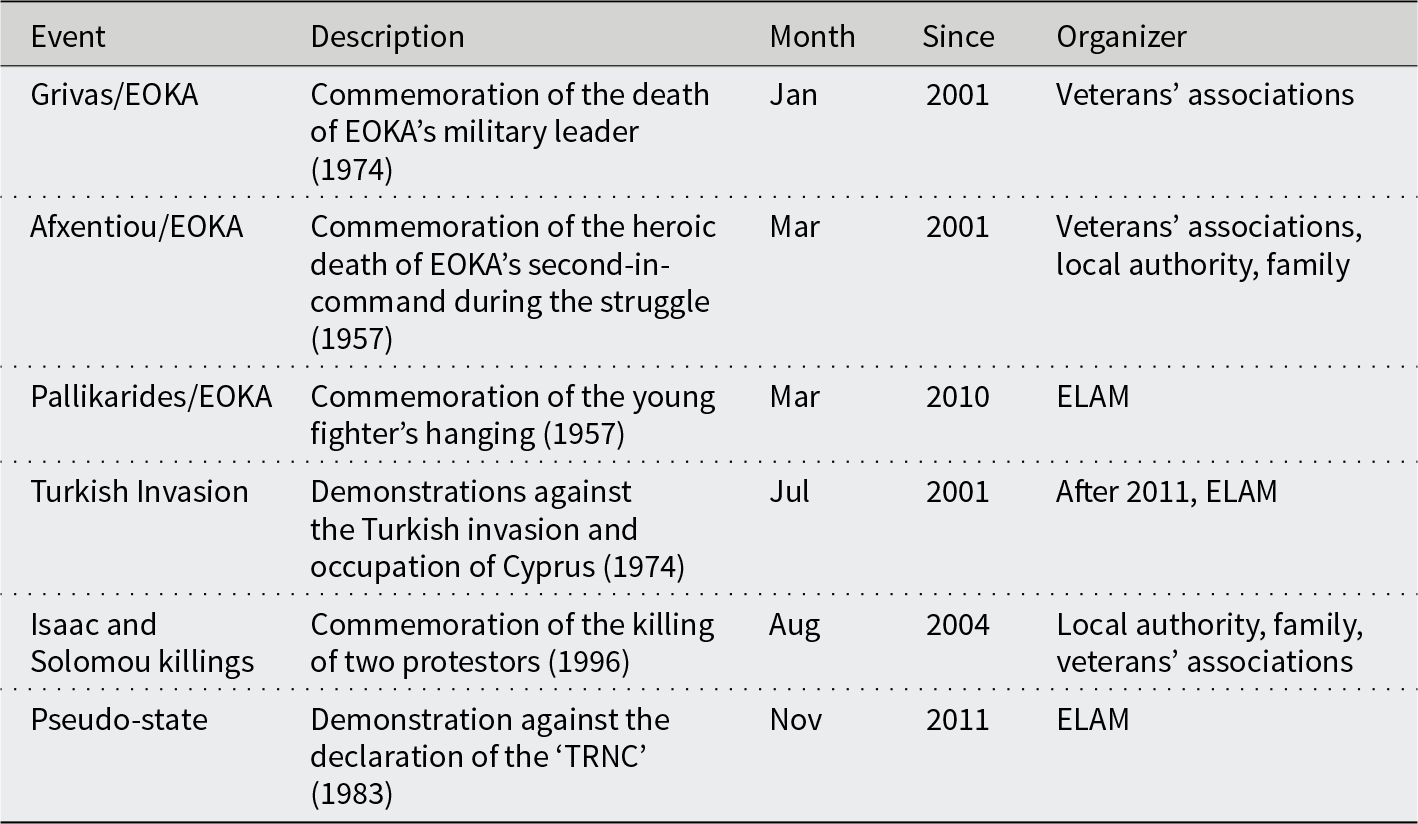
Since its founding as a Golden Dawn cell in 2001 and as a party in 2008, ELAM has strategically focused on using memory to mobilize support for its main programmatic goals – particularly its anti-federalist stance to negotiations for the resolution of the Cyprus conflict. Over the years, ELAM has been mobilizing activists for at least six major annual commemorations, some since the early 2000s and others since the beginning of the 2010s (Table 1). These are major public events which are commemorated at the national level, although the emphasis and level of government representation varies depending on the government of the day.
ELAM’s Participation in Major Commemorative Events

Note: ‘TRNC’ – ‘Turkish Republic of Northern Cyprus’.
ELAM also organizes much smaller commemorative events, primarily for national heroes of the anti-colonial struggle and fallen and missing soldiers of the Turkish invasion in 1974. There has been more sporadic memorial activity for other historical events related to Greece, such as the 1821 Greek War of Independence, the 1940 Greco-Italian War and the Macedonia issue. ELAM is notably absent from commemorations related to the first President of the Republic, Archbishop Makarios III, whom the Greek junta and EOKA B briefly deposed in 1974, triggering the Turkish invasion. ‘It is our choice where we go. Would we do an event for Makarios? [he laughs ironically] No, we won’t. We disagree on many issues. That being said, we would not go to the other extreme, and do an event against Makarios’.Footnote 3 ELAM is also absent from commemorations of the resistance to the junta-led coup, a memorial domain primarily pursued by the left (Papadakis Reference Papadakis2003), and is now silent during celebrations of the independence of the Republic of Cyprus held on 1 October.Footnote 4
We now go to the military parade held on 1 October and present ourselves there. In the past, I believe it was in 2009, we would go there and hand out leaflets against the federation. They arrested us for this, after the communist government prepared the ground about an alleged threat to the security of the President of the Republic. We only went there to give out leaflets and they arrested 20–25 of us. I was one of them.Footnote 5
Interestingly, although some of the main functionaries of ELAM are closely associated with EOKA B functionaries, the party does not publicize its presence at memorial events related to EOKA B, with the exception of the more ambiguous Grivas commemoration.
The biggest events in the dataset are the annual commemorations of the Turkish invasion, held on 20 July, at the Ledra-Palace checkpoint, a site of significant symbolism for the division of the island (Demetriou Reference Demetriou, Stig Sørensen and Viejo-Rose2015). Since 2011, ELAM has also mobilized its youth group Metopo Neolaias for protest marches in mid-November against the unilateral declaration of independence of the ‘Turkish Republic of Northern Cyprus’ (TRNC).Footnote 6 The commemorations used to be organized by the party in different districts, but in recent years they only take place in Nicosia, with a march from ELAM’s head offices to the Ledra-Palace checkpoint. ELAM also has a sizeable presence at the commemorations of the brutal, televised killings of two protesters – Tassos Isaac and Solomos Solomou – in the buffer zone in 1996: the first clubbed to death after a motorcade organized against the occupation and the second shot after the funeral of Isaac as he climbed a mast to take down a Turkish flag.
Over the years, ELAM has also managed to have a sizeable presence in some of the major commemorative events for the anti-colonial struggle fought by EOKA in the name of union with Greece (Stamatakis Reference Stamatakis1994). The biggest of these is the January commemoration of the death of the military leader of the anti-colonial struggle, Grivas.Footnote 7 In 2001, the commemoration of Grivas served as the inaugural event of the Cyprus branch of Golden Dawn, and since the founding of ELAM in 2008, the party has systematically tried to appropriate ‘ownership’ of his legacy from the centre-right Democratic Rally (Papadakis Reference Papadakis2003). Organized by a foundation in memory of Grivas and EOKA veteran associations, the annual event is controversial because of Grivas’ role in EOKA B. This was the paramilitary organization that briefly deposed the first President of the Republic in 1974, triggering the Turkish invasion and subsequent occupation of the northern part (37%) of Cyprus.
Similarly, ELAM mobilizes its activists for the commemoration of Grigoris Afxentiou on top of the 1,400-metre-high mountain range of Machairas, which is organized by veteran associations and foundations. Afxentiou was EOKA’s second-in-command who refused to surrender when the British discovered his hideout and was burnt to death when it was set ablaze in March 1957. This major event is attended by the representatives of the government and all political parties. In addition, since 2010, ELAM has been organizing a march in memory of Evagoras Pallikarides. An EOKA fighter and one of the best-known heroes of the anti-colonial struggle (as well as a poet), Pallikarides was hanged by the British at the age of 19. One of Pallikarides’ poems, describing to his classmates his heavenly ascent to freedom, is taught in schools today and his picture is the emblem of the Pafos football club.
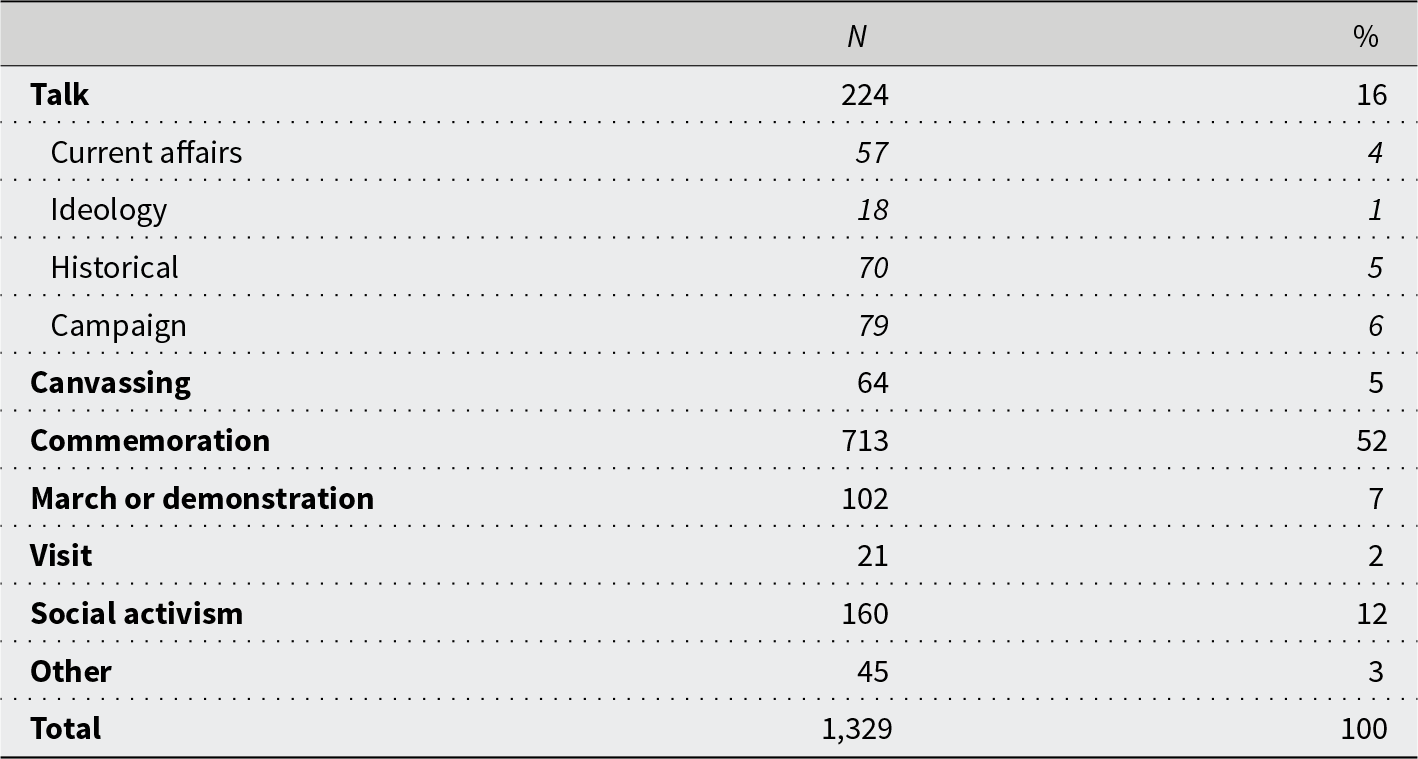
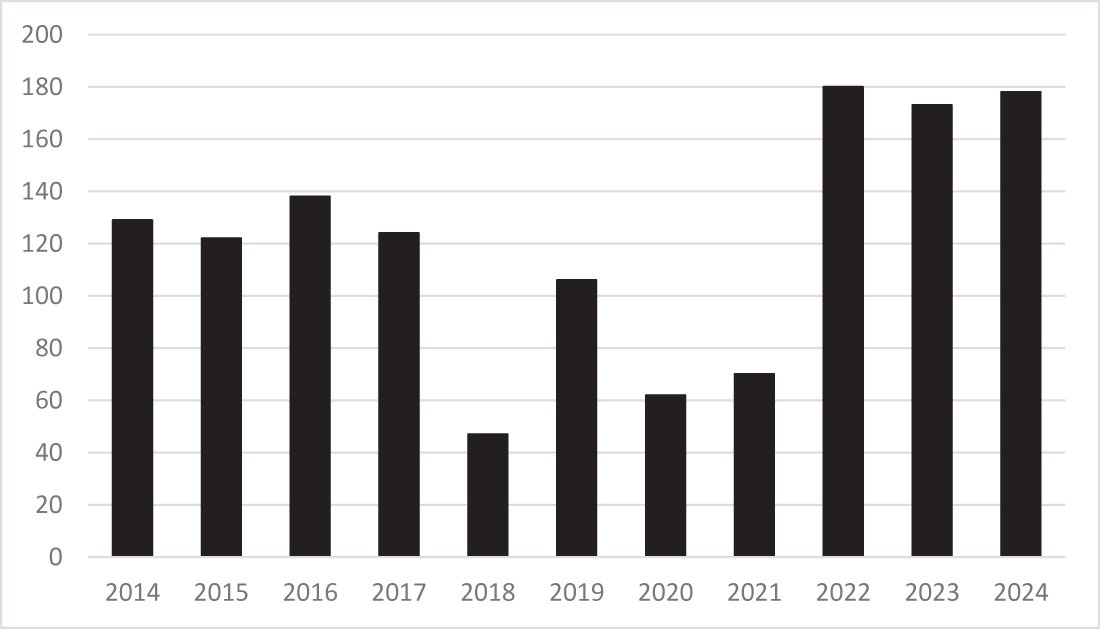
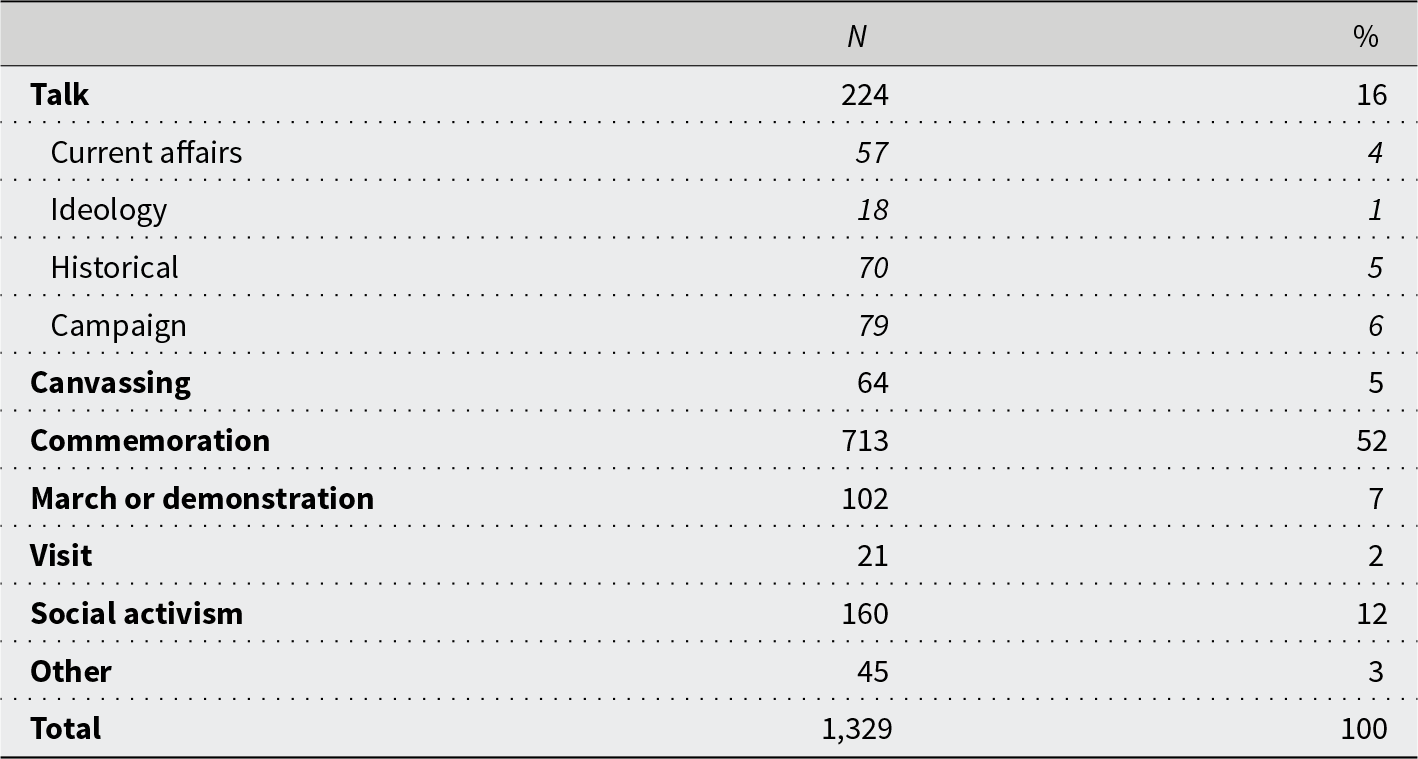
The strategic emphasis the party places on memorial activism becomes evident from the analysis of all activities the party published on its website between 2014 and 2024. With the exception of the pandemic years of 2020 and 2021, as well as 2018, for which ELAM publishes information for only 6 months, in all other years the party organized more than 100 events annually, and in the past few years this number has substantially increased (Figure 3). The analysis of the type of events organized by the party is quite revealing of the emphasis it places on memory activism: more than half (52%) of all publicized events are commemorations (Table 2).
Number of ELAM Events, 2014–2024

Type of ELAM Events, 2014–2024
The analysis of all commemorative events posted on the party website shows that ELAM participates in similar commemorations for dozens of heroes of the EOKA struggle and of fallen soldiers and missing persons during the 1974 Turkish invasion. These events are not organized by ELAM, but by veterans' associations, local authorities, churches and families of the missing or deceased. Many of these events are attended by a dozen or so activists who enthusiastically document their presence through wreath-laying photos at the monument, subsequently uploaded to the website. Most are attended by even fewer activists, especially those in villages away from cities.
More importantly for our purposes, the memorial activism of ELAM is strategically oriented towards a notable mix of contention and convention. In the bigger events, ELAM engages in contentious activity, primarily targeted against Turkey but mostly seeking to distinguish it from its main memorial competitors, especially the centre right, which in the past had also been involved in such commemorations (Papadakis Reference Papadakis2003; Stamatakis Reference Stamatakis1994). The main claims around which these events revolve are rejection of a federal solution to the Cyprus problem and advocacy of a unitary state instead. Through its memorial activism, ELAM seeks to drive home its refutation of federalism, claiming ownership of an issue on which all the other major political parties varyingly disagree with ELAM but for which there is broader public support (Ellinas and Katsourides Reference Ellinas and Katsourides2021: 431). At the same time, however, ELAM also seeks to present itself as a conventional political actor. Its smaller-sized memorial events and its presence at dozens of commemorations across the island seek to portray the image of an actor who, like all other actors, follows the memorial convention of paying respect to the fallen: attending the religious ceremony on Sunday morning, joining the memorial procession outside the church or monument, laying a wreath, and attending the post-commemorative gathering.
Tactics
This strategic mix of contention and convention is most evident in the tactics the party employs in its memory activism. The tactical manoeuvring between contention and convention can be observed across but also within events. On the one hand, ELAM works to ‘double up’ on the contestation of official memory, seeking to distance itself from its competitors and claim ownership of the past, appropriating various memorial tropes for its own use. On the other hand, the party attempts to ‘blend in’ the more conventional memorial processes, projecting its similarity with other political actors.
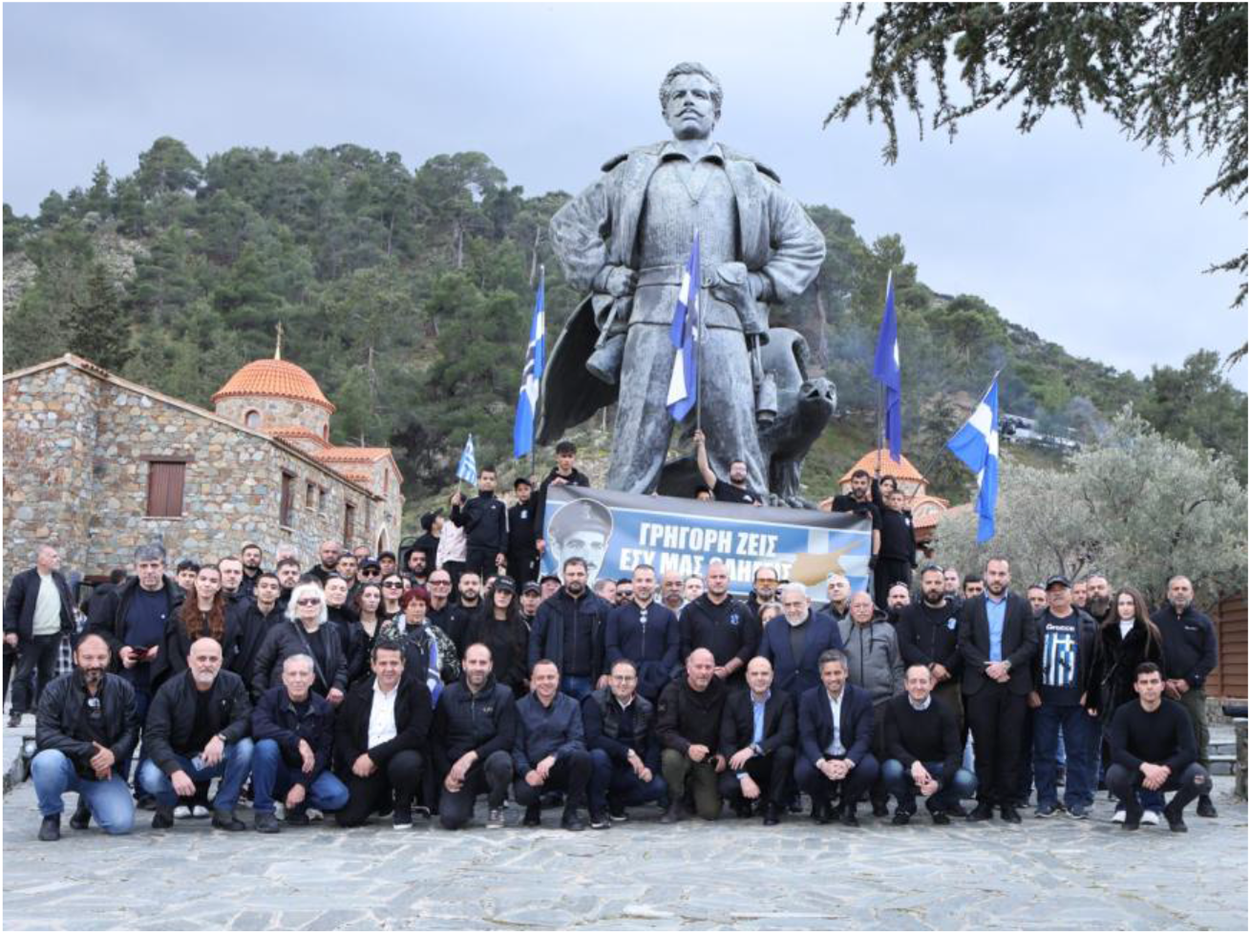
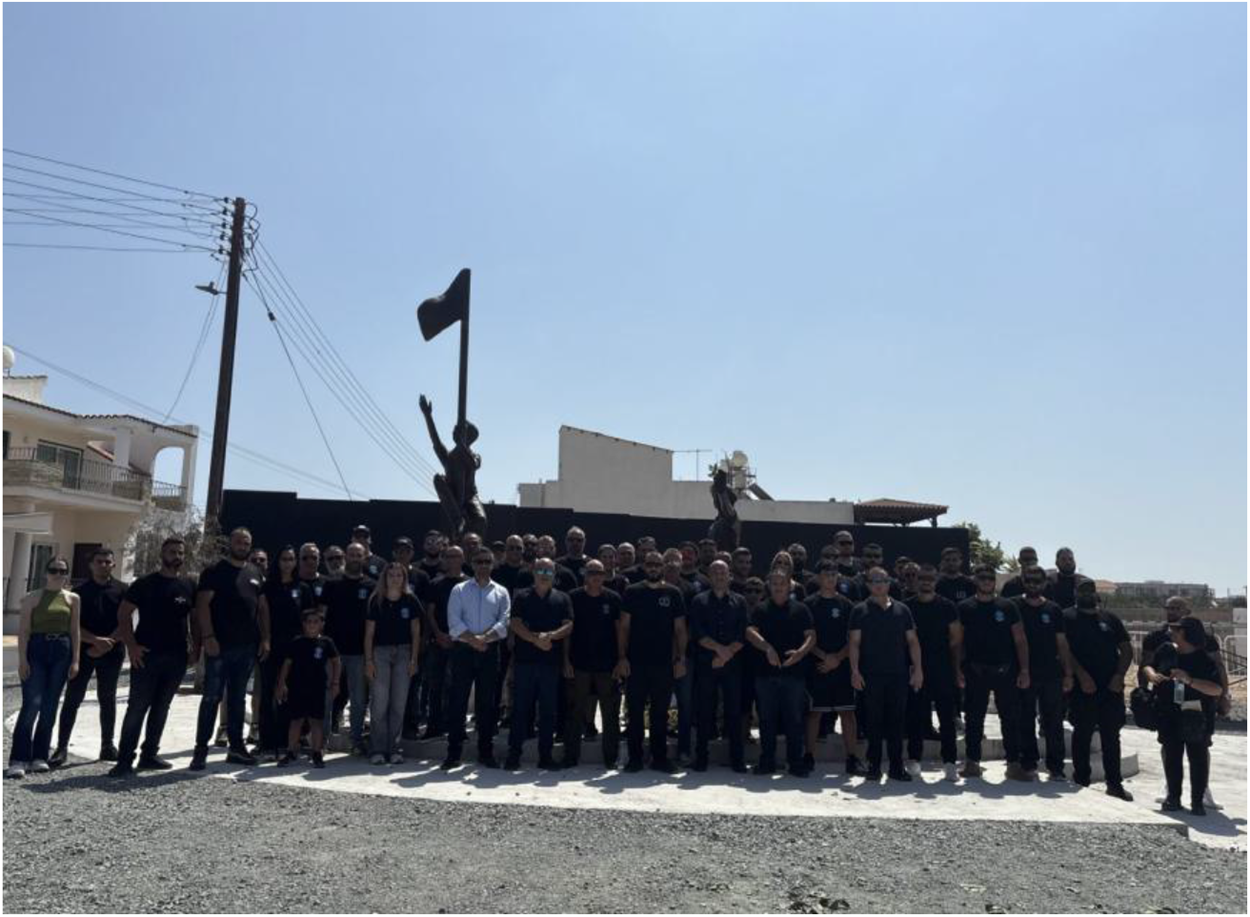
‘Doubling up’ takes place in major memorial events through the mobilization of as many activists as possible in the area where the commemorative event takes place. Through the presence of these activists – in some cases, more than a hundred – the party seeks to visibilize its presence and present itself as a purifier of memories diluted by the centre right (Lucardie Reference Lucardie2000). The activists are engaged in contentious activity that helps distinguish ELAM from the other parties, which usually only send a few representatives to the memorial procession. In the commemoration for Afxentiou, for example, ELAM gathers dozens of its activists to march from the church, where the religious commemoration takes place, to the monument built close to the hide-out of the fallen hero. Dozens of activists stand along the route to the hide-out, and as public officials pass by, they shout slogans like ‘Federalists, hands off Cyprus/it is not for sale/it is Greek!’Footnote 8 After laying a wreath along with all the officials and other parties, the entire ELAM leadership and activists pose for a picture beside the large monument of Afxentiou at the Machairas Monastery, near the hide-out (Figure 4). Photographs like this seek to associate the party with the legacy of Afxentiou and publicize its ability to gather a sizeable group of activists at this event.
Afxentiou Commemorative Event, 2 March 2025

When ELAM organizes its own events, it tries to double up on its memory activism through the spectacle of torch-lit marches, drum-beating and loud chants. In the mid-2010s, its annual anti-occupation event in July opened with football hooligans marching and shouting slogans like ‘A good Turk is a dead Turk’. This would be followed by a military march by a group of former or expelled commandos, a torch vigil by the party’s youth group, the usual religious prayers delivered by a priest (Trisagio), and speeches by party functionaries.Footnote 9 Although the most controversial aspects of the event have given way to more conventional ones, it continues to involve marching groups shouting slogans against the Turks. As a key functionary in charge of event organization put it, ‘we do not have to be so militant any more, people know what we stand for’.Footnote 10 Following the speeches by the party leadership, the event ends with a torch-lit procession through the streets of central Nicosia.
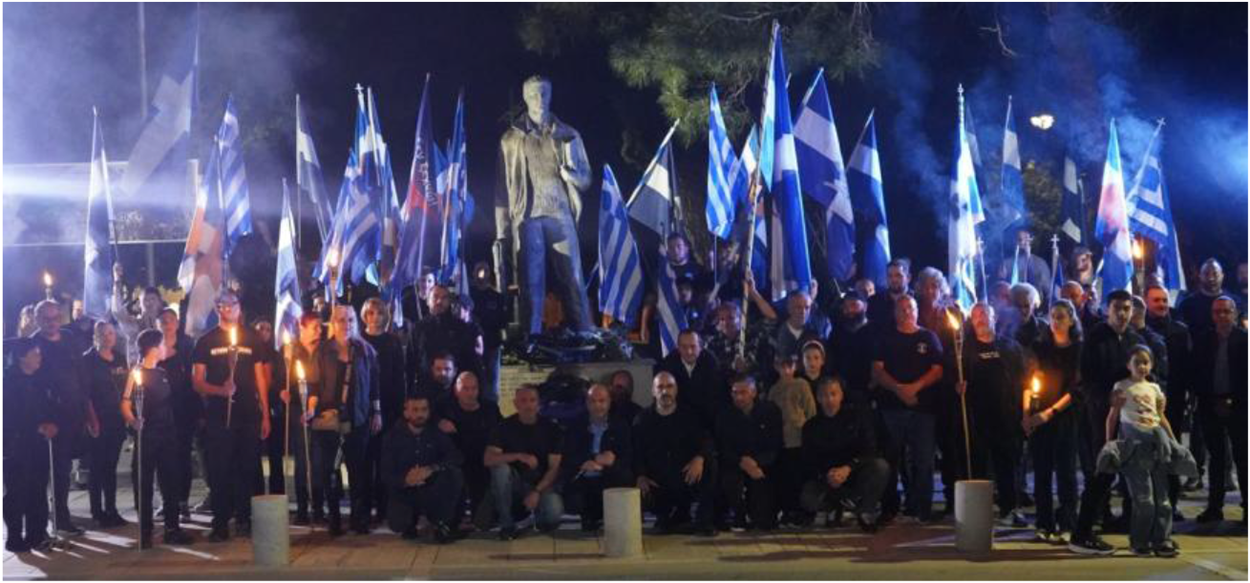
For the Pallikarides memorial, ELAM gathers dozens of activists in its Pafos district office who then march towards the hero’s monument (Figure 5). Throughout the torch-lit march, accompanied by a loud drum and prompted through a loudspeaker by the long-time head of the Pafos district organization, Petros Kountoureshis, activists shout that Pallikarides ‘did not die for a federal solution’ – highlighting the fact that the anti-colonial struggle aimed to unite Cyprus with Greece. Unlike other events organized by ELAM, including the anti-occupation example above, this event is not attended by football hooligans but mostly by local activists and their families.Footnote 11
Pallikarides Commemorative Event in Pafos, 15 March 2025

Apart from doubling up through contentious commemorative activity, ELAM also tries to blend in by diligently following commemorative conventions. The emphasis on convention is indicated through the party’s attempt to participate in as many commemorative micro-events as possible across the country. These events take place on Sundays in churches in many different localities. Even before becoming a parliamentary party, ELAM sought to take part in these events through a handful of activists. However, while in larger and more visible events ELAM is seen shouting slogans and lighting torches, in these smaller events the party sends a few activists to attend the religious ceremony at the church and then be seen laying a wreath alongside other political and social actors.
In the early days, this activity was undertaken by leading functionaries or the leader of the party, but in more recent years, this participation in conventional commemorative events is mostly undertaken by local or regional functionaries. The party website displays hundreds of such events where one, two or a handful of ELAM members with an elected or mandated party official (whether legislator, municipal councillor, school administrator, district or local branch secretary) are shown laying a wreath at the monuments. The web posts usually show the party representatives standing to attention after laying a wreath, alongside military, religious and political officials – signalling both the ordinariness and the legitimacy of the act.
Although this blending in with the local commemorative process currently represents a major component of the party’s memory work, in its early days ELAM had to edge its way carefully into these events, before being accepted as a memory actor meriting a role:
Before we became a parliamentary party, we discovered that there is a protocol for non-parliamentary party participation in these events, and persistently asked the authorities organizing the commemorations to let us lay a wreath. Sometimes this worked and sometimes municipal authorities or organizers did not go with the protocol. Yes, it is a way to gain legitimacy, though not so much by laying a wreath, but more importantly by being seen there and publicizing this through social media and the internet.Footnote 12
The presence of such a small number of activists in a locality is apparently a small act of memorial solidarity with the community. But for the party it is a point of entry and access to previously out-of-reach communities.
These memorials are the ideal way and place to get in touch with people. A memorial ceremony takes place, and afterwards, there is a small gathering for the attendees, usually at the Associations for the Nationally-minded [ethnikofrona somateia, εθνικόφρονα σωματεία]. Therefore, this is an opportunity to go there after the memorial and after you have laid a wreath, for people to come up and talk to you. The people at these gatherings are your constituency. In marches or other events you might get in touch with leftists or centrists, but especially in these memorials, you have your constituency. It is the people who believe in these things that will go to the memorial, and they are the most likely to be the people who will approach you afterwards. They might have seen you on social media or elsewhere, might have heard a speech, and they will come up to you and establish contact. The centre right is also there, but they have always been there, there is nothing new there. We try to attract part of that constituency.Footnote 13
The memorials offer the party an opportunity to put down roots in the local communities through possible recruits, primarily disgruntled centre-right voters or functionaries.
Repertoire
The memorial work of ELAM relies on a relatively broad repertoire of action which incorporates a combination of protests, marches and demonstrations. The commemoration of the Isaac and Solomou killings, which takes place in August and has been attended by ELAM activists since 2004, is a case in point. During this event, ELAM seeks to emulate the stage role of all the other political actors, with its functionaries standing next to the state, political, religious and military officials and, when called, laying a wreath at the monument. Dozens of pictures from these events seek to portray the normality of the party, eager to be seen as a legitimate memorial actor like all the others.
Nonetheless, while following the ceremonial convention, the party clearly seeks to differentiate itself from the rest of the actors. ELAM brings to these events as many activists as possible, grossly outnumbering the presence of other political actors, who are usually only there through their representatives. The sheer size of the ELAM activists, clothed with party attire and carrying party and Greek flags, aims to signal event ownership. Moreover, the regular marches by activists during the event and their loud chants – amplified by portable loudspeakers – lays bare their claim to ownership of the memorial to Isaac and Solomou. After the event, the disciplined ELAM activists gather around the monument, virtually enveloping it with their presence, and take pictures to be circulated on social media (Figure 6).Footnote 14 Then, a few party functionaries walk towards the UN-controlled Buffer Zone and take a video of a wreath being laid on the barbed wire.
Isaac and Solomou Commemoration, 10 August 2025

The other major events ELAM participates in or organizes are similarly choreographed to demonstrate the memorial authority of the party. Nearly all of them are demonstrative in nature (Gattinara et al. Reference Gattinara, Froio and Pirro2022); ELAM's commemorative activities no longer aim to physically confront any authority or political opponents and (with very few exceptions, mostly in earlier years) they are not violent.Footnote 15 In part, this is because ELAM has faced little resistance from other actors in its efforts to be present at official commemorations. But it is also because of the strategic focus of ELAM on appropriating rather than contesting official memory. The strategic orientation towards appropriation necessitates a non-violent repertoire that solely aims to portray the party as the natural heir of the official narrative of the past. At the same time, ELAM activists make sure to shout slogans against their political opponents (‘the federalists’), disputing their association with official memorial narratives and accusing them of betraying national ideals.
Over the years, however, top ELAM functionaries have become increasingly wary of the electoral limits of these more contentious tactics: ‘At the end of the day, this appearance [of the party] in these commemorative events, being intense, is not, in the end, politically beneficial. In the future, it is important on the one hand, to continue this, because it relates to memory, but, on the other hand, ELAM evolves and has to adjust’.Footnote 16 In 2025, the party did not organize its mid-November youth march against the unilateral declaration of independence of the ‘Turkish Republic of Northern Cyprus’. Fearing that youth militancy could be disruptive or violent and tarnish the more moderate image the party seeks to project ahead of the national legislative election, the party organized an event in Brussels and quietly called on its youth to support the marches of other nationalist groups.Footnote 17
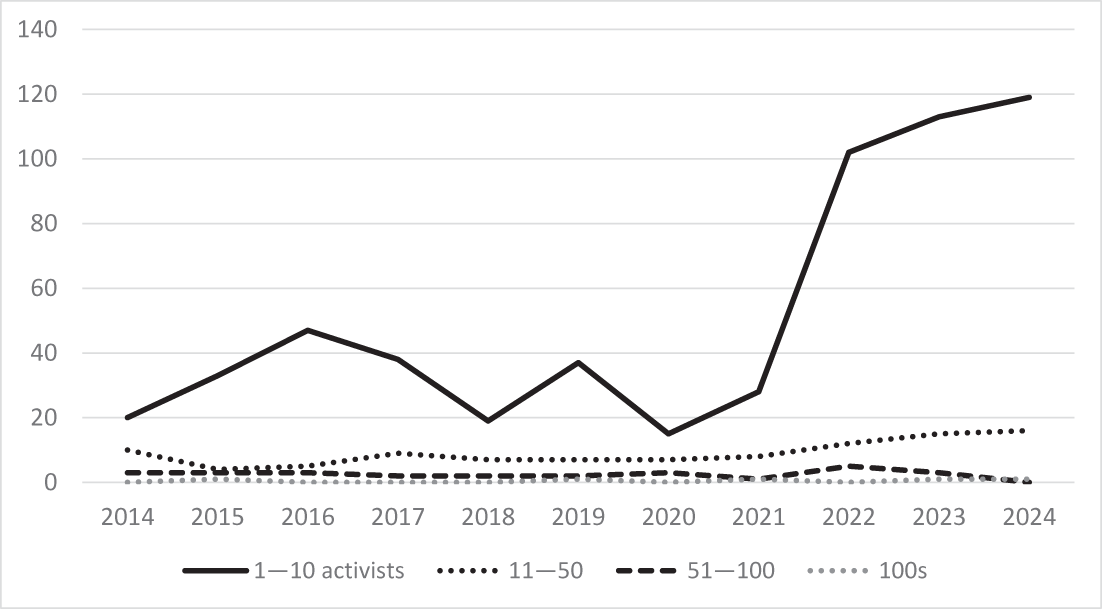
In addition to these events, ELAM increasingly relies on local commemorations. The main activity here is simply attending the religious and then the commemorative ceremony of the local community, followed by laying a wreath and then mingling with the locals in the after-event. Analysis of all the commemorative events publicized by ELAM shows a marked increase in the number of micro-events attended, from a few dozen to more than a hundred per year (Figure 7). These events help recruit new ELAM members who then participate in similar events across more localities and provide existing functionaries with opportunities for public recognition.
Size of Commemorative Events by Number of Activists, per Year (N = 703)

Discussion
From Paris to Rome and from Warsaw to Tel Aviv, far-right actors are increasingly seeking to appropriate hegemonic narratives of the ancient (Bar Reference Bar2025b), medieval (Esteve-Del-Valle and Costa López Reference Esteve-Del-Valle and Costa López2023), colonial (Griffini Reference Griffini2023) or postwar (Jaskulowski and Majewski Reference Jaskulowski and Majewski2023) past, but their memory work is rarely the focus of systematic scholarly attention. Sporadic attention to this memory work often focuses on spectacular or sizeable (Biggs Reference Biggs2018) events celebrating ostracized pasts, rather than on the everyday commemorations seeking to appropriate and change key tropes of the official memory. This article has offered new insights by conceptualizing memory work as a mix of both contestation and appropriation. Leveraging evidence from a dataset of party events and party archives as well as from in-depth interviews and event observations, the article has systematically documented the memory work of a far-right actor, the Cypriot party ELAM.
The evidence presented here offers rare insights into the strategic manoeuvring of the party between memorial contestation and appropriation as well as its tactical and repertorial oscillation between contention and convention. Contentious action allows the party to distinguish itself from competitors, while more conventional memorial action enables it to present itself as a legitimate actor in the political system, just like its competitors. The mix between contention and convention seems to be dynamic, changing as the party’s presence and appeal becomes more mainstream. Nonetheless, contention remains a persistent feature of its commemorative activities.
In tracing the memorial practices of a far-right party, the article has relied on recent efforts to bridge the gap between memory studies and social movements (Berger et al. Reference Berger, Scalmer, Wicke, Berger, Scalmer and Wicke2021; Daphi and Zamponi Reference Daphi and Zamponi2019; Gutman Reference Gutman2017; Gutman and Wüstenberg Reference Gutman and Wüstenberg2022) so as to cast new light on the study of the far right. The contentious nature of highly visible memorial activities has been documented for far-right actors in other settings such as Germany (Art Reference Art2005; Zeller Reference Zeller2022) and Italy (Froio et al. Reference Froio, Gattinara, Bulli and Albanese2020). Yet despite the growing emphasis in the extant literature on the participation of far-right actors in both the electoral and protest arena (Gattinara and Pirro Reference Gattinara and Pirro2019, Reference Gattinara and Pirro2024; Kitschelt Reference Kitschelt, Katz and Crotty2006), the involvement of these actors in more conventional, routine memorial activities has defied systematic scholarly analysis.
This article has demonstrated that these latter activities also seem to be important, especially for actors seeking to access and legitimize themselves in local communities. The analysis of publicized party events in other settings, like Greece and Slovakia (Ellinas Reference Ellinas2020), is suggestive of the strategic focus of far-right actors on these everyday memorial activities. The rare evidence presented here shows the strategic effort of a far-right party to appropriate the past by tactically manoeuvring between contentious and conventional memorial practices.
The article has used the single case to generate hypotheses (Lijphart Reference Lijphart1971) on how memorial strategy, tactics and repertoires vary in accordance with the electoral standing of far-right actors. Although the hybridity of far-right mobilization observed here has already been documented (Pirro and Gattinara 2024; Kitschelt Reference Kitschelt, Katz and Crotty2006), this article charts new terrain by focusing on memory work: systematically tracing and documenting it across time and, more importantly, generating expectations about how this hybridity varies depending on actors’ aspirations and standing in the electoral arena.
Although some of the examples used in the article from other national settings point to the plausibility of these expectations, there is also evidence suggesting that hybridity might be a more permanent feature of protest mobilization, even when electoral stakes are null (Froio et al. Reference Froio, Gattinara, Bulli and Albanese2020). More research would be needed to probe the generalizability and to nuance the expectations generated in the article beyond this single context. The main suggestion here is that doing so would require going beyond sizeable, spectacular and contentious memorial practices that capture media attention (Gattinara et al. Reference Gattinara, Froio and Pirro2022; Wouters Reference Wouters2013) to look at routine commemorations that aim to enfold far-right actors within the mainstream. It would also require an appreciation of this hybridity both across as well as within events.
The proposed theoretical framework has prioritized an internalist perspective, offering a rare view ‘inside’ (Berman Reference Berman1997) the memorial life of a far-right actor and highlighting the strategic nature of memorial contestation. In doing so, it has attributed agency to far-right actors to contest the past, without a consideration of the political or discursive opportunities in this environment. The broader supply of memorial practices at a given time (Kubik and Bernhard Reference Kubik, Bernhard, Bernhard and Kubik2014) and societal counter-mobilization (Rocchetti and Pilati Reference Rocchetti and Pilati2025; Shahin et al. Reference Shahin, Daphi, Haunss and Meier2025) to far-right memorial claims (Art Reference Art2011; Ellinas Reference Ellinas2020) would tend to limit the strategic, tactical and repertorial expectations outlined here. Although the internalist perspective alone cannot account for the memory work of far-right actors, it is becoming increasingly relevant. Far-right actors are better positioned than before to shape, rather than solely be shaped by their environments, and to change the official narrative of the past (Cabrero and Sierp Reference Cabrero and Sierp2025). Examining their memory work seems key to understanding the normalization of far-right actors and the attractiveness of appeals for nations to become ‘great again’.
Supplementary material
The supplementary material for this article can be found at 10.1017/gov.2026.10038.
Acknowledgements
I thank the three anonymous reviewers and the journal editors for constructive feedback. I am grateful for the research assistance of Demetris Comodromos, Lazaros Moutafides, Paris Trokkos and Wangyin Zhao. I am thankful for the precious feedback from Olga Demetriou and Demetris Comodromos and for the constant insights and inspiration of my undergraduate students.
Financial support
The research was supported through a UKRI Research Grant number ES/W012324/1.
Disclosure statement
The author reports that there are no competing interests to declare.


 Open access

