

Introduction
The Arctic is among the top foreign policy priorities in Copenhagen, Nuuk and Tórshavn, where politicians and diplomats are formulating strategies for how they – separately and together – can shape the regional agenda in a direction they find desirable (cf. Jacobsen, Reference Jacobsen2019). A central element in this work is the representation in the Arctic Council, which – despite current challenges caused by Russia’s attack on Ukraine – remains the most important forum for regional governance (e.g. Høegh, Reference Høegh2025; Høglund, Reference Høglund2025). What is special about the representation of Denmark, Greenland and the Faroe Islands in the council is that they form one single joint delegation under the label “the Kingdom of Denmark,” which, from time-to-time results in internal power struggles (Jacobsen & Lindbjerg, Reference Jacobsen and Lindbjerg2025). Some of these struggles attract media attention, while others occur outside the public spotlight. The root cause of the struggles is the current governmental arrangement, where the Faroese Home Rule and the Greenlandic Self-Government have a certain degree of foreign policy authority in areas that only concern them and fully relate to fields of responsibilities taken over, but where the Danish government otherwise has the final say when it comes to foreign, security and defense policy.
In the context of growing aspirations for enhanced self-determination and, with that, more autonomous roles in international politics, Greenlandic and Faroese foreign policy representatives occasionally express dissatisfaction with the collective representation in the Arctic Council. Because Denmark here depends on Greenland’s geographic location and continuous cohesion of the Realm in order to preserve legitimacy as an Arctic state, we have previously witnessed how the council has constituted a well-chosen stage for Greenlandic and the Faroese attempts to expand their foreign policy room for manoeuvre (Jacobsen, Reference Jacobsen2020). As the Kingdom of Denmark chairs the Arctic Council in 2025–2027, it is now particularly relevant to dissect how the representation of Denmark, Greenland and the Faroe Islands has developed as titles and definitions of yours, mine and ours carry great weight for the internal balance of power, the external signalling to the outside world and to the future development of Arctic governance. In this article, we, therefore, pose the following research question: How have participation and designations of Denmark, Greenland and the Faroe Islands developed in their shared delegation to the Arctic Council since its establishment in 1996?
By using quantitative data of participations and designations in three types of council meetings, we will dissect the development of internal differences in the joint delegation. As such, the article’s main contribution is to show how the delegation’s hierarchy has changed throughout three decades, and how much each member of the Kingdom of Denmark has prioritised ministerial meetings, Senior Arctic Official (SAO) meetings and meetings in the council’s six working groups where most concrete initiatives are born. When doing so, we demonstrate how representation in the Arctic Council constitutes a key arena for renegotiating intra-state power relations within the Kingdom of Denmark, where hierarchy, foreign policy authority and sovereignty are continuously negotiated and recalibrated between Copenhagen, Nuuk and Tórshavn.
The article proceeds as follows: we begin by providing some background on Greenland’s and the Faroe Islands’ foreign policy competence. We then present our dataset, outlining the process of data collection and processing. This is followed by an analysis of the historical development of the delegation’s representation in the Arctic Council, focusing on the participation and designations of the three countries in the three different meeting types. Finally, we discuss our findings and reflect on what it might mean for the future development of Arctic governance.
Background: Greenland’s and the Faroe Islands’ foreign policy competence
Greenland’s and the Faroe Islands’ foreign policy competency has been a central element in the processes of decolonisation and gradually enhanced self-determination. One of the defining moments where they first positioned themselves on the international scene happened in the early 70ies when Denmark joined the EC (later the EU). In accordance with their Home Rule Act of 1948, the Faroe Islands refrained from following suit, but as Greenland did not enjoy the same privilege, they were forced to join the EC despite great resistance. This accelerated the Greenlandic independence movement, resulting in the establishment of Home Rule in 1979, which created a foreign policy competence and paved the way for Nordic Council membership in 1984 and withdrawal from the EC in 1985 (cf. Gad, Reference Gad2017). During the subsequent years, both Greenland and the Faroe Islands further enhanced their international presence through entering bilateral agreements with the EU, among others, and by establishing their own diplomatic representations at Danish embassies abroad (Ackrén, Reference Ackrén and Heininen2014; Kleist, Reference Kleist2019; West & Jørs, Reference West and Jørs2025). Today, the Faroe Islands have representations in Brussels, Beijing, Reykjavík, London, Moscow, Tel Aviv and Washington D.C. (Government of the Faroe Islands, n.d.), while Greenland’s current representations are located in Brussels, Beijing, Reykjavík and Washington D.C. (Government of Greenland, n.d.).
As we have previously analysed (Jacobsen, Reference Jacobsen2020; Jacobsen & Lindbjerg, Reference Jacobsen and Lindbjerg2025) – and will further elaborate in the present article – the Arctic Council is and has been an important international platform for further cultivating their respective foreign policy competences. However, it has also confronted them with the practical constraints of being “forced” into a joint delegation with Denmark and, consequently, required their foreign policy representatives to develop the diplomatic skills needed to renegotiate status, visibility and voice within that format. Contestation over these issues has pushed Greenlandic and Faroese actors to articulate distinct interests, build arguments about competence and mandate and insist on arrangements that signal greater parity, both internally within the delegation and externally towards other Arctic actors. In this sense, Arctic Council participation has functioned as a site where foreign policy competence has been accumulated through concrete representational struggles (cf. Jacobsen & Medby, Reference Jacobsen, Medby, Jacobsen and Wilson Rowe2026): not merely learning “how diplomacy works,” but learning how to bargain over the terms of representation itself, and how to convert Arctic relevance into greater autonomy within the Realm.
The legal foundation and Denmark’s Arctic approach
The Constitutional Act of Denmark stipulates that “The King shall act on behalf of the realm in international affairs […]” (Folketinget, 2019 [1953], §19.1), while the Prime Minister’s Office writes that Greenland and the Faroe Islands cannot assume the following areas of responsibility within the current juridical frameworks: the state constitution, citizenship, the Supreme Court, foreign-, defense- and security policy as well as currency and monetary policy (Prime Minister’s Office, n.d.). Despite these restrains, Greenland and the Faroe Islands have juridically obtained some degree of foreign policy competence as agreed in 2005 when two parallel acts specified that they may “[…] negotiate and conclude agreements under international law on behalf of the Kingdom of Denmark where such agreements relate solely to matters for which internal powers have been transferred […]” (Ministry of Foreign Affairs of Denmark, n.d.). However, what solely relates to assumed areas of responsibility is open to definition, and it is, therefore, an ongoing negotiation whether activities such as mining, research and infrastructure are deemed security issues – and thereby within Copenhagen’s area of responsibility – or, if not, Nuuk and Tórshavn can deal with it unilaterally (Jacobsen, Wæver & Gad, Reference Jacobsen, Wæver and Gad2024).
Whereas no one questions that Copenhagen has the final say in the kingdom’s security and defense matters, the two smaller constituent parts have recently been welcomed at the table of ongoing defense budget negotiations when the Arctic and the North Atlantic are on the agenda (Jacobsen & Rahbek-Clemmensen, Reference Jacobsen, Rahbek-Clemmensen, Hønneland, Østhagen and Rottem2026; Olsvig, Reference Olsvig2022). This is the provisional culmination of a development combining three related elements: increased international interest in the Faroe Islands and especially Greenland, growing regional militarisation, and amplified Danish attention to Arctic affairs both in terms of defense and diplomacy. Naturally, the latter has often been associated with the responsibilities and opportunities of being one of the eight member states of the Arctic Council, where the privilege of, e.g. participating in high-level ministerial meetings in remote Arctic areas has meant that Denmark could “punch above its weight” in international politics (Jacobsen, Reference Jacobsen2016). As such, the Danish Minister of Foreign Affairs has gotten more speaking time with his counterparts from i.a. Russia, Canada and the U.S., hence enhancing Denmark’s potential influence in other urgent matters such as the wars in Ukraine and Syria (Olesen, Hansen, Patey, Kjærgaard, Sørensen, Nielsen, Jacobsen, & Banke, Reference Olesen, Hansen, Patey, Kjærgaard, Sørensen, Nielsen, Jacobsen and Banke2020, p. 29). In recent years, Denmark’s foreign policy representatives have been outspoken about this advantage, while politicians across the political spectrum are still more explicitly stating that Greenland’s geographic location and the cohesion of the Realm are what constitute the Arctic state status (Jacobsen, Reference Jacobsen2021; Jacobsen and Lindbjerg, Reference Jacobsen, Lindbjerg, Jacobsen, Wæver and Gad2024). As such, internal and external dynamics have become increasingly intertwined (Kristensen and Mortensgaard, Reference Kristensen and Mortensgaard2022), while Greenland in particular has started to more actively use its “Arctic advantage” to widen the foreign policy competence and achieve more autonomy.
On this basis, we will now explain our data and the methodology behind before we turn to the analysis of the historic development in participation and designations in the Kingdom of Denmark’s delegation to the Arctic Council.
Dataset
The dataset helps us gain a deeper understanding of participation patterns and the use of different designations in the shared delegation consisting of Denmark, Greenland and the Faroe Islands. The primary inspiration for this analysis is Sebastian Knecht’s (Reference Knecht2017) article, The politics of Arctic international cooperation: Introducing a dataset on stakeholder participation in Arctic Council meetings, 1998–2015, which provides the so far most comprehensive and cohesive overview of member states’, observers’ and permanent participants’ participation in Arctic Council ministerial meetings, SAO meetings and working group (WG) meetings. We are standing on the shoulders of Knecht’s work, when zooming in on Greenland, the Faroe Islands and Denmark and the shared delegation’s participation and designations in the various meeting types under the Arctic Council.
Parts of the dataset were previously analysed in Jacobsen and Lindbjerg (Reference Jacobsen and Lindbjerg2025), which also focused on the shared delegation of Denmark, Greenland and the Faroe Islands. The former article examined representational dynamics and symbolic practices of the shared delegation at ministerial meetings and WG meetings, and, in addition to the dataset, also used data from qualitative interviews, observations and documents. The present article focuses on participation patterns and delegation designations as observable indicators of shifting priorities and internal relations among the three countries, placing the dataset at the centre of the analysis. For this article, we thereby shift both the empirical basis and the analytical focus by including data from SAO meetings and placing the dataset at the centre of the analysis.
The dataset covers meetings in the Arctic Council, including ministerial meetings, SAO meetings and WG meetings. The dataset is based on participant lists from meeting records.
The participant lists from the ministerial meetings, 1998–2021, and the SAO meetings, 1999–2021, have been obtained through the Arctic Council online document archives. Data from the WG meetings in CAFF, AMAP and PAME have also been obtained through the online archives, whereas the data from the three other WGs have been made available upon request. All the documents are official meeting records, and we, therefore, code attendance according to the official documentation. Since these documents have been compiled by humans, this means that they may contain occasional inaccuracies, omissions or inconsistencies. Ministerial meetings include both informal and formal meetings as part of their programmes, and the Arctic Council archive only provides attendance lists from the formal meetings. The data were compiled between March 2024 and November 2025, and all documents obtained through the Arctic Council online archive have been accessed between March 2024 and August 2025. The documents cover ACAP meetings from 2004–2021, AMAP 1998–2020, CAFF 1994–2022, EPPR 2000–2021, PAME 1999–2024 and SDWG 2008–2015. In total, the dataset consists of data from 223 meetings, including 11 ministerial meetings, 38 SAO meetings, 25 ACAP, 23 AMAP, 38 CAFF, 32 EPPR, 42 PAME and 14 SDWG. CAFF was established in 1991, along with AMAP, EPPR and PAME (Arctic Council, 2025), before the Arctic Council was formed in 1996, which is why data from a CAFF meeting in 1994 have also been included.
After the full-scale invasion of Ukraine in 2022, all high-level meetings of the Arctic Council have been cancelled, except for the atypical meeting on 11 May 2023, where Norway took over the chairship from Russia at an online meeting. Working group activities were also paused in March 2022 but restarted again in June 2022 for all projects without Russian participation, and later during the Norwegian chairship, where interactions and cooperation have been gradually increasing, though still quite limited (Jacobsen & Rotem, Reference Jacobsen and Rottem2025a, p. 36). After the start of the war, meeting activity and document availability have been limited, and only one meeting document has been published since – a 2024 online meeting in the PAME WG.
After the documents were obtained, all event details, including location, month and year for each meeting, have been noted. This was followed by a manual count of all Faroese, Greenlandic and Danish delegates, as well as a noting of the term used for the delegation, such as “Kingdom of Denmark” or “Greenlandic/Danish delegation.” We have defined nationality in this case based on the organisation the delegate in question has represented at the time of the meeting, such as the Danish Environmental Protection Agency or the Greenlandic Ministry for Foreign Affairs. We have not paid attention to the delegates’ place of birth, home addresses or formal nationality. In a few cases, organisational affiliations or nationalities have not been noted. In all of these cases, we have been able to find the persons’ LinkedIn profiles to note where they have worked at the relevant time. Finally, the data has been entered, systematised and processed in Excel and RStudio. The figures have been created in RStudio.
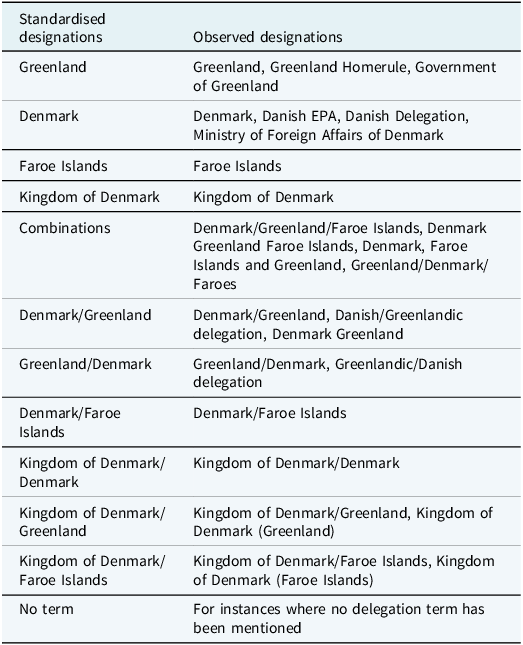
For the part of the analysis concerned with delegation designations, we have found it necessary to standardise the designations, due to many of them having only small variations, as well as the large number of terms. This gives a clearer visualisation and a better overview of the data. The groupings are outlined in Table 1.
Observed delegation designations and corresponding standardised designations

After processing the data in RStudio, two visual representations of, respectively, designations and participation have been made. The figures each include 8 smaller graphs, one for each meeting type. The first (Fig. 1) presents the development in delegation terminology use across all meeting types. We show the data in percentages, illustrating the relative distribution of standardised designations per year. This choice evens out the differences in how many meetings or delegates there were each year, making it easier to make comparisons of how the designations vary over time.
Distribution of standardised delegation designations across Arctic Council meeting types, 1994–2024.

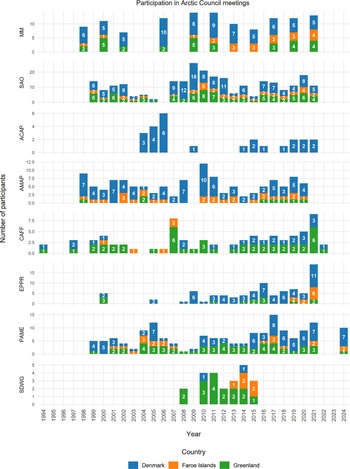
The second (Fig. 2) shows the total number of delegates from Denmark, Greenland and the Faroe Islands participating in the various WG meetings over time. In contrast to Figure 1, it is displayed in absolute numbers, which allows for a direct comparison of the scale and variation of participation over time.
Participation of Denmark, Greenland and the Faroe Islands in Arctic Council meetings by meeting type, 1994–2024.

In the analysis, we focus on identifying patterns in both participation and designation use, highlighting key trends and stand-out observations. We look for periods where participation increases or decreases noticeably and examine how the use of designations evolves over time. In the discussion, we consider how these observations may relate to political or institutional developments in the council and how they connect to broader discussions about the changing dynamics between Denmark, Greenland and the Faroe Islands in Arctic cooperation.
Analysis: participation patterns and delegation designations, 1996–2025
Before analysing the participation patterns and delegation designations of Denmark, Greenland and the Faroe Islands in the Arctic Council throughout the past 30 years, we will now first briefly lay out the council’s history and its current meeting structure.
Arctic Council’s history
The origins of the Arctic Council can be traced to the final years of the Cold War, when ambitions grew to strengthen intergovernmental cooperation on environmental and climate-related concerns in the region (Young, Reference Young1992, Reference Young1998). This initially took shape in the Arctic Environmental Protection Strategy (AEPS), launched in 1991, which was subsequently subsumed into the Arctic Council upon its formal establishment five years later through the signing of the Ottawa Declaration. Since then, the Arctic Council has come to be recognised as the principal intergovernmental forum for dialogue on pathways towards a more sustainable future for the region (Burke, Reference Burke2020; Rottem, Reference Rottem2020). Central to this status are the council’s three legally binding agreements, addressing search and rescue operations (2011), marine oil pollution preparedness and response (2013), and the enhancement of international scientific cooperation in the Arctic (2017).
Agenda-setting authority rests primarily with the eight Arctic states – Canada, Finland, Iceland, Norway, the Kingdom of Denmark, Sweden, Russia and the United States – while Indigenous peoples occupy a distinctive and influential position as permanent participants who speak on behalf of approximately 500,000 Indigenous inhabitants of the Arctic – within a regional population of around four million – and participate directly in agenda-setting processes (Knecht, Reference Knecht2013; Tennberg, Reference Tennberg1996; Wehrmann, Reference Wehrmann, Keil and Knecht2017; Wilson Rowe, Reference Wilson Rowe2018). At the same time, non-Arctic states and other actors may be admitted as observers, provided they can demonstrate a commitment to respecting and contributing to the Council’s objectives of sustainable development and institutional consolidation (Burke & Bondaroff, Reference Burke and Phelps Bondaroff2018; Graczyk, Smieszek, Koivurova, & Stepien, Reference Graczyk, Smieszek, Koivurova, Stepien, Keil and Knecht2017). At present, there are 38 observers, comprising 12 non-governmental organisations, 13 intergovernmental and interparliamentary bodies and 13 non-Arctic states (Arctic Council, n.d.a). These actors commonly justify their involvement by pointing to the global ramifications of climate change and the transboundary nature of many Arctic environmental challenges (Burke, Reference Burke2020).
Arctic Council’s meeting structure
The Council’s activities are organised across three principal institutional levels: ministerial meetings, meetings of SAOs and the working groups. These levels are supported by a permanent secretariat, established in Tromsø in 2013, which currently employs 13 staff members responsible for administrative and communication functions.
In addition to these standing institutional levels, the Arctic Council also operates through ad-hoc subsidiary bodies in the form of task forces and expert groups. These are temporary entities established by ministers or SAOs to address specific, time-bound policy issues or to prepare concrete outputs, such as assessments, guidelines or legally binding agreements. Unlike the permanent working groups, task forces and expert groups are dissolved once their mandates have been fulfilled and typically report to the SAO level and, in some cases, directly to ministerial meetings (Arctic Council, n.d.b). While such bodies have played a significant role in advancing targeted initiatives, including the negotiation of Arctic Council agreements, they remain embedded within the Council’s broader institutional hierarchy and do not constitute a separate standing level of governance. Although these ad-hoc bodies form part of the institutional setting of the Arctic Council, the analysis here focuses on the three principal and enduring institutional levels.
The ministerial meetings constitute the highest decision-making body of the Arctic Council and are typically attended by the member states’ foreign ministers (Knecht, Reference Knecht2017). Convened biennially, these meetings also serve as the forum in which the incoming chairship presents its official programme. Ministerial declarations articulate member states’ collective ambitions for the Council and provide an indication of its future direction (Steinveg, Rottem & Andreeva, Reference Steinveg, Rottem and Andreeva2024). Given their formal authority, influence exercised at the ministerial level can have substantial implications for the Council’s overall policy development. Shaping ministerial outcomes thus allows actors to affect not only the Arctic Council’s agenda but also Arctic cooperation more broadly, given the Council’s status as the region’s foremost international forum (Dodds, Reference Dodds2013; Knecht, Reference Knecht2017).
Much of the Council’s routine governance, however, occurs at lower levels of its institutional structure. Each member state appoints an SAO to represent its interests within the Council, usually drawn from the Ministry of Foreign Affairs. SAOs are tasked with guiding and overseeing the Council’s activities in accordance with ministerial decisions and instructions, and they meet twice a year. In this intermediary role, SAOs function as a crucial link between the political and technical strata of the organisation. They not only facilitate communication between ministerial and WG levels, but may also promote WG priorities upward within the institutional hierarchy (Jacobsen & Rottem, Reference Jacobsen and Rottem2025a). As such, the SAO level constitutes a key site of potential influence, particularly for actors seeking to translate scientific knowledge into political attention and action.
The substantive core of the Arctic Council’s work is located within its six working groups: the Arctic Monitoring and Assessment Programme (AMAP), Conservation of Arctic Flora and Fauna (CAFF), Protection of the Arctic Marine Environment (PAME), Emergency Prevention, Preparedness and Response (EPPR), Arctic Contaminants Action Programme (ACAP) and the Sustainable Development Working Group (SDWG). These bodies produce and synthesise scientific knowledge with the aim of mapping, analysing and responding to key Arctic challenges (Steinveg et al., Reference Steinveg, Rottem and Andreeva2024). Their activities range from monitoring mercury contamination and developing best-practice guidelines for Arctic shipping to generating comprehensive assessments of climate change impacts. On this basis, they formulate policy-relevant recommendations spanning issues from pollutant regulation to broader infrastructural and navigational considerations.
Whereas the working groups differ in size, scope and institutional history – often characterised as three “larger” groups (AMAP, CAFF, PAME) and three “smaller” ones (EPPR, ACAP, SDWG) – they share a number of organisational features: Each operates under a defined mandate, determined by ministerial and SAO-level decisions, and all decisions are taken by consensus, consistent with the broader governance practices of the Council (Rottem, Reference Rottem2020). Nevertheless, agreement is typically easier to achieve at the WG level than at the higher political tiers. The knowledge they generate and the recommendations they formulate contribute to agenda-setting processes and may subsequently be taken up by SAOs or ministers, thereby exerting indirect pressure for political action (Steinveg et al., Reference Steinveg, Rottem and Andreeva2024).
Importantly, WG outputs such as reports and assessments represent the perspectives of the groups themselves rather than those of the Arctic Council as a whole. This distinction underscores the differentiation between scientific knowledge production and political decision-making within the organisation (Steinveg et al., Reference Steinveg, Rottem and Andreeva2024). At the same time, the working groups are not insulated from political dynamics. Their mandates are defined at higher levels, and the projects that receive priority and funding often reflect political considerations (Rottem & Reiersen, Reference Rottem and Reiersen2025). This institutional configuration implies that, while constrained by externally defined frameworks, the working groups retain a degree of autonomy to shape their own agendas. Through their research activities, they may influence deliberations at higher levels and contribute to the gradual reconfiguration of their mandates. In this respect, the SAO level represents a particularly important channel of influence, functioning as a bridge between scientific and political spheres.
The development of participation and delegation designations in the Arctic Council
Ministerial meetings
When comparing the participant lists from the Arctic Council’s ministerial meetings across the years, it is clear that the Kingdom of Denmark’s delegation is unique, as no other delegation changes its designation in a similar manner. Furthermore, it appears from official documents where nationality is included that only Denmark, Greenland and the Faroe Islands register variations in the participants’ nationalities. In 2017, a change to the collective designation “Kingdom of Denmark” can be seen, which has also been a trend in several other meeting types, starting from around 2013. Then, in the latest ministerial meeting in 2021, “Kingdom of Denmark” is still used, but with a dash followed by each country’s name. This could be seen as an indication of Greenland’s and the Faroe Islands’ increased foreign policy agency, which we will elaborate on in the discussion.
The standardisation of terminology happened during the Swedish chairship in 2011–2013 when other symbolic shifts took place, emphasising state perspectives and welcoming new observers such as Japan, India and China into the council (Steinberg, Bruun & Medby, Reference Steinberg, Bruun and Medby2014; Steinberg & Dodds, Reference Steinberg and Dodds2015). Consequently, the roles and representations of the Faroe Islands and Greenland were downgraded, as they were further enveloped in the joint declaration through significant symbolic changes. As such, the Faroese and Greenlandic flags were removed from the table, their chairs moved behind the Danish representative, and their country names were replaced with the collective signifier “Kingdom of Denmark” while they were excluded from SAO meetings (Olsen and Shadian, Reference Olsen, Shadian, Kristensen and Rahbek-Clemmensen2018; Jacobsen, Reference Jacobsen2020). Altogether, the changes highlighted hierarchy within the Realm and caused internal tensions in the joint delegation. These tensions surfaced in the public spotlight when Greenland’s then newly appointed Premier, Aleqa Hammond, decided to boycott all council activities, including the ministerial meeting in 2013. The political gamble paid off to some degree, as an agreement was reached with the new Canadian chairmanship that all three countries were allowed to participate in all meetings on an equal footing. If, in some cases, fewer than three seats are available to the delegation, it is an internal decision who – depending on the agenda – should occupy them. Whereas these agreements lifted the boycott, they did not change the fact that it is the Danish flag and the designation “Kingdom of Denmark” that represent the delegation externally (see Fig. 1), but what has gained less attention is the fact that Greenland gained the right to participate in Denmark’s informal meetings where, for example, granting of observer status and other more sensitive questions are debated outside public attention (Jacobsen, Reference Jacobsen2020).
Taking a closer look at the three countries’ participation in the ministerial meetings (see Fig. 2), it is evident that Denmark most often sends the largest delegation, which reflects the population sizes of the three countries. Moreover, Denmark has participated in all ministerial meetings, while the Faroe Islands were not present in 2002 and 2006, and Greenland did not participate in 2013. Greenland was present in 2015, according to several news sources (Løvschall-Wedel, Reference Løvschall-Wedel2015; Altinget, 2015), though this has not been registered in the council’s official records, which only lists the Faroese and Danish delegates (Arctic Council, 2015). It is unclear whether a mistake has been made in the participation list, or whether there has been a confusion of formal and informal events. In the last three ministerial meetings, Greenland has both been present and sent a larger number of representatives than before.
Concurrent with Greenland’s boycott in 2013, we see increased engagement from the Faroe Islands, which is reflected in the number of Faroese participants, which goes from 0, 1 and 2 participants in 2006, 2009 and 2011 to 3 in 2013, 2015, 2017 and 2019, and 4 in 2021. At the same time, the Faroe Islands also started having a more active participation in the council’s working groups, which we will elaborate on in the section on the working groups. This corresponds with the fact that the Faroe Islands, in the same year, formulated clearer foreign policy ambitions for the Arctic, which was expressed in the country’s own Arctic strategy, The Faroe Islands – A Nation in the Arctic, published April 2013 (Prime Minister’s Office, 2013). This Faroese approach has continued in the subsequent years, resulting in two more Faroese Arctic strategies published in 2022 and 2024, respectively (Uttanríkis- og mentamálaráðið, 2022; Uttanríkis- og vinnumálaráðið, 2024).
Senior Arctic official meetings
When comparing the data in Figure 1, it is evident that most changes in designations in SAO meetings occur between 1999 until 2007, where a lot of shifts between designations take place, as seen in 1999 where “Denmark” is used, 2004 where a combination term (see Table 1) is used, or in 2007 where both “Denmark” and “Denmark/Greenland” are used. However, from 2008 onwards, the designations began to standardise at the SAO meetings. For example, from 2008 to 2011, the delegation is referred to as “Denmark, Faroe Islands and Greenland,” and from 2012 to 2021, the title is “Kingdom of Denmark.”
Furthermore, if we take another look at Figure 1, the Faroe Islands were not mentioned in the delegation term at the SAO meetings in 2001, 2005 and 2007. Compared with the data from Figure 2, it is evident that in those years the Faroe Islands had either no attendance or low attendance at the SAO meetings. This might indicate that the lack of participation corresponds with the lack of mention. However, in 2008, the Faroe Islands did not participate in the SAO meeting but were still included in the designation, which was listed as “Denmark, Faroe Islands, Greenland.” Additionally, in 1999, there was no mention of either the Faroe Islands or Greenland in the SAO designation, yet all three countries sent representatives to the meeting.
Furthermore, if we examine the participation of the three countries at the SAO meetings, as shown in Figure 2, Denmark, similar to the ministerial meetings, has the highest turnout, having participated in all meetings. Greenland has also participated in all the SAO meetings, which contrasts with the ministerial meetings, where Greenland did not participate in 2013. The reason for Greenland’s absence, as mentioned, was its boycott in 2013. Moreover, the Faroe Islands, on the other hand, did not participate in 2001, 2005 or 2008, but aside from these instances, has consistently sent at least one participant to the SAO meetings.
When comparing the size of each delegation, Denmark has generally sent the most – or an equal number of – representatives each year, except in 2001, 2004 and 2019 when Greenland had more. The years 2008 and 2009 stand out, as Denmark sent significantly more representatives compared to Greenland and the Faroe Islands, as shown in Figure 2. Denmark sent 18 representatives in 2009 and 8 in 2010, compared to Greenland’s 6 and 8 and the Faroe Islands’ 2 and 5. These were the years in which the Kingdom of Denmark held the chairship, which explains the high number of delegates. Aside from these exceptions, the number of representatives has been more or less equal since 2016, with the Faroe Islands consistently having the fewest.
Working group meetings
When taking a quick look at Figure 1, you immediately see the massive variation in designations, and these are particularly evident in the WGs, compared to the slightly more standardised Ministerial and SAO meetings.
A closer look into the designations used in the AMAP WG shows that the WG maintained a consistent 50/50 split between the use of “Faroe Islands” and “Denmark” from 1998 to 2013, with exceptions in 2001, 2007 and 2008, where “Denmark” was used, and in 2004, where “Denmark,” “Greenland” and “The Faroe Islands” were used. However, from 2016 to 2020, three different delegation terms were used each year. For example, in 2018, the terms include “Denmark/Faroe Islands,” “Denmark/Greenland” and “Kingdom of Denmark/Denmark.” This marks a shift from a previously consistent pattern to a more fragmented and variable approach. Hence, AMAP’s designations have shifted over the years from a relatively consistent pattern to a less consistent one.
On the other hand, CAFF and EPPR have moved from a rather unorganised use of designations towards a more consistent approach. CAFF’s delegation terms, for example, vary significantly over the years, but from 2017 and onwards, a standardisation is established, using either “Denmark,” “Greenland” or “Kingdom of Denmark.” For EPPR, a standardisation with “Kingdom of Denmark” has been in place since 2014. Hence, both CAFF and EPPR have shifted from an inconsistent pattern of designations to a more consistent usage.
Moreover, PAME, like CAFF and EPPR, moves from a variation of delegation terms to a more consistent use of “Kingdom of Denmark” from 2014 to 2017. This could suggest that they followed the standardisation which took place at the higher levels, as with the SAO and Ministerial Meetings, which also started using “Kingdom of Denmark” consistently. However, beginning in 2018, the WG once again started using several different variations of delegation terms, continuing in the following years. Hence, PAME’s designations shifted from standardisation towards irregularity.
When comparing the development of delegation terms in the working groups with those used in the Ministerial meetings and SAO meetings, it becomes apparent that the working groups change delegation terms more frequently than the two higher hierarchical levels. A possible explanation for this might be that the working groups have their own organisational cultures, which are independent of the structures governing the Ministerial meetings and SAO meetings, where control and standardisation are more prominent (Barry, Daviðsdóttir, Einarsson, & Young, Reference Barry, Daviðsdóttir, Einarsson and Young2020; Rottem, Reference Rottem2021).
When looking at both designations and participation patterns, we also see a natural link. For instance, in the case of AMAP, where the designations “Denmark” and “Faroe Islands” have been the most common designations, which also corresponds with the delegates being from those two countries. Another example of this can be found in CAFF, which has had a mix of participants from all three countries, with Greenland being the most consistent, and accordingly, the designations at CAFF meetings have reflected this also. Hence, delegates may, in some instances, be able to choose their own designations when they sign up, which can lead to the use of various designations.
ACAP is the only WG with lone Danish participants, and also has the lowest level of participation of the groups analysed. AMAP has a rather consistent participation pattern from Denmark and the Faroe Islands, where Denmark has sent most participants throughout the years, yet with very varying numbers, ranging from 2 to 10. Greenland has a stable and consistent participation pattern from 2016 to 2020, sending 1 delegate each year. In CAFF, however, Greenland is a more active contributor, sending representatives most years. Denmark has sent representatives more or less consistently, while the Faroe Islands has only sent representatives on a few instances. Hence, in this working group, Greenland is by far the most active country, having sent the largest group of participants on several occasions.
When comparing the participation among the three countries, it is clear that Denmark is the most active. The logical explanation for this is that Denmark is the biggest of the three and therefore has a larger central administration and the possibility of sending more delegates. Greenland and the Faroe Islands, by contrast, must prioritise their resources more carefully. Yet, Greenland has been an active contributor to both PAME and CAFF throughout the years. This aligns with its foreign policy strategies from 2011 and 2024, as well as its leading roles in CAFF (Jacobsen & Lindbjerg, Reference Jacobsen and Lindbjerg2025, pp. 94–95). Furthermore, Greenland has also steadily increased its participation in the working groups over time, an ambition outlined in its foreign policy strategies, which emphasises leading more projects and engaging actively in the groups (Jacobsen & Lindbjerg, Reference Jacobsen and Lindbjerg2025, pp. 94–95; Naalakkersuisut, 2011, pp. 11–13; Naalakkersuisut, 2024, p. 11).
The Faroe Islands have primarily focused on PAME and AMAP, while their participation in other working groups has been more sporadic. Since 2019, the Faroe Islands have participated in EPPR. One explanation may be their increased prioritisation of maritime security and emergency preparedness, as outlined in their three foreign policy strategies (Prime Minister’s Office, 2013, p. 34; Uttanríkis- og mentamálaráðið, p. 18; Uttanríkis- og vinnumálaráðið, 2024, p. 22).
AMAP is the only WG in which the Faroe Islands has consistently participated. This aligns with the Faroese Arctic Strategy from 2022, which highlights the importance of prioritising climate change within the Arctic Council (Uttanríkis- og mentamálaráðið, 2022, p. 22), and AMAP is one of the most relevant groups in this regard. Here, their participation has been consistent between 1998 and 2020. Additionally, the Faroe Islands’ engagement in AMAP also shows, since they have hosted two AMAP meetings in Tórshavn, something which they have not done for meetings in other WGs so far (Jacobsen & Lindbjerg, Reference Jacobsen and Lindbjerg2025, p. 96). At both meetings, the Faroese hosts held speeches highlighting the Faroese engagement and priority in combating mercury accumulation and ocean pollution, since the traditional diet as well as the maritime industry in the country are threatened by these factors (AMAP, 2002, p. 3; AMAP, 2013, p. 5)
Discussion: rebalancing Arctic multilateralism under pressure
In the early years after the establishment in 1996, the Arctic Council drew little interest from media and ministers, but in step with the amplified Arctic attention – which especially accelerated at the beginning of the new millennium – council meetings were given higher priority (English, Reference English2013; Nord, Reference Nord2016). This change reflected a power shift from north to south, where representatives of state capitals often accompanied or replaced representatives of Arctic origin. As our analysis has shown, this change also influenced the designation for the joint delegation, which became “the Kingdom of Denmark” around 2013 instead of “Denmark, Greenland and the Faroe Islands,” hence highlighting hierarchy and downplaying the agency of Nuuk and Tórshavn. This started an internal debate between the three about how to best represent their respective – and sometimes different – perspectives when “forced” into one single delegation (Fakhoury, Reference Fakhoury2023; West, Reference West2024; Jacobsen, Reference Jacobsen2020; Jacobsen & Lindbjerg, Reference Jacobsen and Lindbjerg2025).
As we have dissected the quantitative data illustrating the historic development of participation patterns and delegation designations, we will now discuss the context of the most recent regional changes affecting the council’s work and what this might mean to the Arctic Council and the current chairship.
Amplified Arctic attention and worsened interstate relations
Whereas climate change effects remain a core catalyser behind the continuous regional changes, two other recent developments have had immense influence; namely, the spill-over of global great power-competition and Russia’s full-scale war against Ukraine which stands as a watershed moment in Arctic governance and security (Exner-Pirot & Bloom, Reference Exner-Pirot and Bloom2022; Jacobsen & Wilson Rowe, Reference Jacobsen and Wilson Rowe2026; Koivurova & Shibata, Reference Koivurova and Shibata2023; Young, Reference Young2022). The result has been a still sharper dichotomy between the seven Western Arctic states on the one hand and China and Russia on the other, hence hardening the interstate rhetoric, accelerating military build-up (Lackenbauer & Sergunin, Reference Lackenbauer and Sergunin2022), and influencing the Scandinavian Arctic states’ regional approach (Auerswald, Reference Auerswald2022), underlined by Finland’s and Sweden’s decisions to join NATO.
For Arctic governance, the pausing of the Arctic Council in the spring of 2022 and Russia’s withdrawal from the Barents Euro-Arctic Council in the autumn of 2023 stand as the worst regional consequences, while cross-border civic cooperation in the High North has also been severely challenged. The precautionary resumption of Arctic Council activities during Norway’s chairship in 2023–2025 concerned limited interaction on the political level and reactivation of more concrete scientific cooperation in the council’s working groups (Andreeva & Rottem, Reference Andreeva and Rottem2025; Paukkunen & Black, Reference Paukkunen and Black2024). The first step happened in June 2022, when half of the WG projects – approximately 70 – without Russian participation were resumed, while the second remarkable step happened in February 2024, when the council allowed Russia to participate virtually (Arctic Council, 2024). This kind of activity pattern has continued after the chairship handover to Denmark, Greenland and the Faroe Islands in May 2025, although little has been shared publicly at the time of writing.
At present, the prospects for high-level political interaction and new concrete agreements – as latest witnessed at the ministerial meeting in Reykjavik in 2021 – remain dim. Furthermore, U.S. President Trump’s refusal of climate change as being human-caused as well as his continuous threats to acquire Greenland cast long shadows over the resumption of effective Arctic multilateralism (Jacobsen & Rottem, Reference Jacobsen and Rottem2025b).
Greenland’s enhanced agency and the future of the Arctic Council
In May 2025, when the chairship handover took place in Tromsø, it was Greenland’s Minister of Foreign Affairs, Vivian Motzfeldt, who received the council gavel from her Norwegian counterpart, Espen Barth Eide. Neither a Danish nor a Faroese minister was present when Motzfeldt and the kingdom’s newly appointed Arctic ambassador – the Greenlandic career diplomat Kenneth Høegh – represented the new chairship. This marked a new historic milestone in the development of Greenland’s foreign policy competence and constitutes the provisional culmination of several years’ tug of war between Nuuk, Tórshavn and Copenhagen regarding the responsibilities in the shared delegation.
Greenland’s increased foreign policy competence has also manifested itself in its Arctic Council participation patterns, where our analysis shows an overall increased participation with a particular focus on the working groups CAFF and PAME. Whereas the development illustrates how Greenland has successfully used its geographic location and membership of the Realm to gain more international impact, it also bears witness to how the existential threat to the council has somewhat caused a power return from the south back to the north, as also highlighted by the increased influence of Permanent Participants such as the Saami Council and the Inuit Circumpolar Council (Nutti, Reference Nutti2025; Olsvig, Reference Olsvig2025). For Denmark, it has probably been easier to accept this development as no ministerial meetings are carried out in the council, while the Danish diplomatic corps is extraordinarily busy with the 2025 Presidency of the EU Council, and the membership of the UN Security Council in 2025–2026. At the same time, Donald Trump’s staunch interest in acquiring Greenland, has further strengthened Greenland’s – and, in the wake, also the Faroe Islands’ – say in politics of the Realm, where relations between the three are today more equal than ever before. The fact that representatives from the Faroese and Greenlandic governments are at the table in the Danish defence budget negotiations when the Arctic and the North Atlantic are on the agenda illustrates well this recent development.
As geopolitical shadows from both East and West continue to pose existential threats to the Arctic Council while Greenland gets a still larger say in the current chairship, the question remains how this will affect the council’s future work. The pulse of the council is the WG projects, so in order to keep it alive, there have to be still more activities that remind us of its role and relevance to regional governance. However, it is easier said than done, and it might take a presidential term and an end to the war in Ukraine before the time is ripe for the council to return to its former strength. In the meantime, it will be interesting to follow whether Greenland’s and the Faroe Islands’ more prominent roles herald a new era where non-state Arctic actors have more influence on the council’s work and future direction.
Conclusion
In this article, we set out to examine how the participation and designations of the shared delegation of Denmark, Greenland and the Faroe Islands to the Arctic Council have developed since the Council’s establishment in 1996. The Arctic is a central foreign policy priority for the three countries, and the Arctic Council serves as a key stage where international aspirations are negotiated and performed. At the same time, the shared delegation has at times generated internal struggles over authority, status and representation, making the Council an arena not only for regional governance but also for negotiating the internal ordering within the Realm.
Drawing on a dataset of 223 meetings across the three most prominent Arctic Council meeting types, we have shown that the Kingdom of Denmark’s delegation is unique in two related respects: its changes in designation and the shifts in the national composition of its participants. Since 2013, there has been a gradual standardisation towards the common designation “Kingdom of Denmark” across meeting types. This trend first became visible at the ministerial level and consolidated from 2017 onwards, but shifted again in 2021, when each country was added after the collective designation. This change may be read as a symbolic acknowledgement of the increased foreign policy agency of Greenland and the Faroe Islands, while still preserving the collective frame that underpins the Kingdom’s external legitimacy as an Arctic actor.
Participation patterns reinforce this interpretation. At both the ministerial meetings and SAO meetings, Denmark has consistently maintained the largest and most stable presence, while Greenland and the Faroe Islands have increased their participation in recent years, broadly in line with their respective foreign policy strategies and their prioritisation of Arctic Council engagement. Participation has sometimes been found to coincide with designations, which is particularly evident at the WG level. Here, standardisation is less common, and designation practices are far more fragmented, indicating a looser organisational structure than at the more formal levels. At the same time, Denmark continues to lead in overall participation, while Greenland and the Faroe Islands have concentrated their engagement in those working groups that align most closely with their respective foreign policy priorities.
Taken together, these developments reflect a broader rebalancing within the Realm, where Greenland – and to a lesser extent the Faroe Islands – has gradually expanded its Arctic engagement alongside its foreign policy agency. This agency has been further amplified in the wake of American purchase proposals and control attempts, as well as wider geopolitical tensions that cast long shadows over the region and the Council’s work. Under these conditions, questions of representation and authority within the Kingdom of Denmark are increasingly intertwined with the future trajectory of Arctic multilateralism. Our study shows how delegation design can play a central role in the organisation and contestation of power within a composite state, and in ongoing changes in Arctic governance.
Acknowledgements
The authors wish to thank representatives of the Arctic Council working groups, especially ACAP and EPPR who kindly agreed to share both data and knowledge with us, which has, all in all, contributed to strengthening the empirical contribution of this article. We would also like to thank Anders Winter Lindbjerg for his technical assistance with figure preparation in RStudio.
Financial support
This work was supported by Carlsberg Foundation [grant number CF21-0118], which financed Signe Winter Lindbjerg’s and Hanna Lüthe’s respective employments as research assistants at the Royal Danish Defence College’s Centre for Arctic Security Studies.


 Open access

