




Introduction
The electroacoustic music scholarship in Venezuela began with Segnini (Reference Segnini1994) almost 10 years before the foundation of Laboratorio Digital de Música (LADIM). The same scholarly impulse was felt by Noya (Reference Noya2007), three years after its foundation, addressing the Laboratorio, our main subject, as one of the ‘new alternatives’ (230) to electronic music training and experimentation in the country. Arocha (2009) focussed her research on the mixed repertoire of electroacoustic music by Venezuelan composers, where the LADIM’s repertoire so far represented a relevant sample of creationFootnote 1 or a ‘new stimulus from the academia and high education sector’ (Rojas Reference Rojas2015: 174). Up to this date, no comprehensive account has been published about the history, development and actual state of LADIM at Universidad Simón Bolívar and how it has served a fundamental role in the electroacoustic music scene in the country. There exists a need to reconstruct the narrative of the facts. Taking as reference Wilson’s comprenhensive study (Reference Wilson2017) on the Iowa Electronic Music Studios, we find ourselves in a privileged position: documenting a twenty-year history that still vibrates, ensuring that the ‘experimental core’ of Venezuelan electroacoustic music is recorded while its pulse is still alive.
Following Chasalow (Reference Chasalow2006), when introducing his understanding of archive-derived composition: ‘One central principle is that the responsibility for documenting the history of electroacoustic music is our own – that this historical moment both enables this work and demands it of us’ (63). Nonetheless, when dealing with such obligations in these kinds of countries, one faces the same certitude as explained by Paraskevaídis (Reference Paraskevaídis2004):
One of the endemic ills and endogenous characteristics that frequently slips in the understanding and transmission of the history of cultures and the arts of the ‘multi-mestiza’ America is that of starting – almost always – from scratch, particularly when it is about rescuing, revaluing, explaining and resignifying that same history as it were, for one side, product of foreign north models and, for the other, something forgettable every time that projects are drafted, particularly at continental levels.Footnote 2 (Paraskevaídis Reference Paraskevaídis2004).
As for the materials to gather the information, we could count on digital traces of an intermittent webpageFootnote 3 in differents periods, videos that documented some of the activities of the Laboratorio uploaded into the last YouTube channelFootnote 4 of the Master’s degree programme, the scant scholarly references traced in the literature and the actual works. Although the Laboratorio is a high-tech space within a high-tech institution, the webpage that registered every activity was not maintained after the departure of the last director, Dr. Adina Izarra. Something relatable to having lost the music recorded on tape: a nightmare for any electronic music centre, but a sustained episode in the country.
The earliest electronic music studios in Venezuela established a significant institutional identity. Soon after, other initiatives emerged. This article will first examine the history of these first electronic music ventures preceding LADIM, laying out the context in which the Laboratorio was established. It will then detail LADIM’s three periods, highlighting its key achievements and pointing towards possible future outcomes yet to be realised. Furthermore, particular emphasis will be placed on LADIM’s creative output over the years.
The first Laboratorios in Venezuela
‘Centre’, ‘institute’, ‘studio’, ‘cabinet’ or even ‘room’ have been some of the most used labelsFootnote 5 to designate the meeting point of the lectures, reflection and experimentation with sound.
Everything began with the planning of the III Latin American Music Festival (1966) and the need for a laboratory that could record the event and could serve as an instrument for the invited composers to show their progress with experimental music (Astor Reference Astor2008). This is the Estudio de Fonología (1965),Footnote 6 later changed to Instituto de Fonología (1972) as the formative activities became fundamental. The Instituto had three directors who represented three different electronic music schools: José Vicente Asuar (Chile) and the Elektronische Musik, Footnote 7 Antonio Estévez and Raúl Delgado Estévez (Venezuela) and the Musique concrète Footnote 8 and finally, Eduardo Kusnir (Argentina) and the Di Tella/Columbia Princeton Electronic Music CenterFootnote 9 alongside the American Tape music tradition.
Some of the works produced during the first period are Guararia Repano (1968) by José Vicente Asuar for tape, Cromofonías I (1967) and Electronic Etude N° 1 (1968) by Alfredo Del Mónaco for tape and Birimbao (1968) by Isabel Aretz for timpani and tape;Footnote 10 during the second period, Segnini (Reference Segnini1994) found works like Derrota (1976) by Raúl Delgado Estévez for narrator and tape with a text by Rafael Cadenas, or the electronic music composed by Servio Tulio Marín for the movie ‘Shhh’ (1978). The final hours of Fonología witnessed the appearance of a group of diligent performers, Grupo Nova Música, that tributed in a very active presence in concerts with pieces like Dualismos (1971) by Alfredo Del Mónaco for flute, clarinet, trombone, piano and tape, Thingsphonia (1978) by Alfredo Rugeles for tape, or Pobre música electrónica pobre (1983) by Ricardo Teruel and Jacques Broquet for tape and performance.
The Instituto, whose equipment deteriorated rapidly,Footnote 11 was bureaucratised and then closed (Segnini Reference Segnini1994: 114). It was amalgamated with FESNOJIV, but the poorly maintained instruments were not preserved, and the objectives of the two organisations did not align. In a new location, and for a small period, it served as the laboratory for IUDEMFootnote 12 composition students. When IUDEM became UNEARTE (2008), one might have expected that this equipment would also be developed, but it did not, and UNEARTE does not have a proper laboratory of electronic music at present times, when composing an electronic piece is demanded for granting the title of Bachelor in Music Composition.
Much of the electronic music developments in our Latin American countries are due to the efforts of the Institute ‘Torcuato Di Tella’ (1958–1969). And, although there were not any VenezuelansFootnote 13 among the scholarship holders at Di Tella, one of these composers, after his doctoral studies in France, came to Venezuela and taught electronic music to many nationals: Eduardo Kusnir (1978). In 1980, Kusnir initiated an electronic music course at Conservatorio de Música ‘Juan José Landaeta’ that was geared up with Kusnir’s personal equipment, and then founded the Centro de Documentación e Investigaciones Acústico – Musicales (CEDIAM) (1992) at Universidad Central de Venezuela. The overlapped course at Conservatorio and the electronic music activities at CEDIAM-UCV continued until Kusnir retired (1995).
By the close of the 20th century, we found no other laboratory, comparable to those described earlier, that exhibited a similar level of production and dimensions. This marked the end of institutional and academic ties with the electronic music scene in Venezuela and continued seven years after the inauguration of the country’s firstFootnote 14 Graduate Music programme focused on contemporary music for composers, conductors and instrumentalists at Universidad Simón Bolívar (1996) that laid the groundwork for a laboratory such as those outlined above (2003).
Master’s degree in Music at USB (1996)
It has been 30 years since its beginning in 1996 and has offered, since the early days, graduate courses in composition, choral and orchestral conducting and instrumental performance with an implicit orientation towards contemporary music. The graduate programme currently has 120 graduates, 32 of whom have majored in composition (26%). It is not a graduate programme entirely centred on electroacoustic music, but there are a few optional courses that any composer and performer/conductor can take according to their interests, such as ‘Sound and Synthesis’, ‘Digital Resources’, ‘Interactivity for Instrumentalists’ and ‘Electronic Music Lab’.
The LADIM was founded in 2003, and it became the first Laboratorio related to a graduate programme in Music in the country (Noya Reference Noya2007; Arocha Reference Arocha Bernal2009; Rojas Reference Rojas2015). As Noya (Reference Noya2007) stated in his dissertation, the LADIM’s project was devised and achieved by the combined efforts of professors from the Master’s degree in music at USB: ‘Emilio Mendoza, Diana Arismendi, Raúl Jiménez, Francisco Díaz, Adina Izarra’ (231). Raul Jiménez was the director of LADIM from 2003 to 2004, Izarra from 2004 to 2017 and Luis Ernesto Gómez from 2018.
To graduate, composers must submit a Composition Portfolio (a Carpeta de Obras de Grado) containing their two most representative works composed during their studies. One piece must be for a large ensemble or orchestra and the other for a small ensemble or a chamber work. Crucially, one of these pieces must be professionally recorded in a studio. However, since LADIM’s foundation, it has been possible to submit an electronic piece, whether acousmatic or mixed. To date, eight courageous composers have submitted electronic pieces as part of their composition portfolio, representing just 25% of the total number of graduating composers.
Need for space
Finding a room to work with sound in academia has been a preoccupation in the region from the beginning. The natural relationship between composer – university – studio (Babbitt Reference Babbitt, Peles, Dembski, Mead and Straus1960) constituted itself in a model in Latin America as it has been the case for many important laboratories: the Laboratorio de Fonología Musical Footnote 15 (1958) inside the Architecture Faculty at Universidad de Buenos Aires, Argentina (Minsburg Reference Minsburg and Espinosa2010), the Studio of Electronic Music (1971) at the Conservatorio de la Ciudad de México, México (Uribe Reference Uribe2003), the Estudio de Fonología y Música Electroacústica (1986) at Universidad Nacional del Litoral, Argentina (Orobitg et al. Reference Orobitg, Subieta, Uslenghi and Wiman2003), the Studio PANorama (1994) at Universidade Estadual Paulista, Brazil (Menezes Reference Menezes2014) or the Laboratorio de Música Electroacústica y Arte Sonoro (2019) at the Universidad Nacional de Música, Perú (López Reference López2020). It is the case with the LADIM at Universidad Simón Bolívar, Venezuela (2003).
The life of LADIM can be divided into three periods: from 2003 to 2008, from 2008 to 2017 and from 2017 to the present.
LADIM’s first general strike and the first two periods (2003–2008, 2008–2017)
The first four months of 2002 were tense enough to precipitate a general strike and a coup d’état in Venezuela (Brewer-Carías Reference Brewer-Carías and Brewer-Carías2008). The subsequent months and years were packed with uncertainty. The inactivity that also characterised the tense and frightening aftermath, prolonging the social and economic crisis, led to retirements, isolation and a lowered profile. These were the – paradoxical?Footnote 16 – months that framed the study group formed by Venezuelan composers Adina Izarra and Julio D’Escriván to study Max/MSP (Noya Reference Noya2007). Two previous dissertations on algorithmic and electronic music (Jiménez Reference Jiménez2002; Díaz Reference Díaz Espósito2004) and the recently established study group initiated the process of creating a space within the Universidad Simón Bolívar campus for musical experimentation: the LADIM. The first studio was at ArtevisionFootnote 17 (2003) and then moved to the ‘Matemáticas y Sistemas’ building (2008).
This Max/MSP study group was cardinal in the research infrastructure of LADIM’s activities in the first 14 years of operations under Adina Izarra’s direction. Then, SupperCollider appeared as part of another sustained study group.
During the first period, a number of relevant composers of electronic music were invited to lecture within the frame of LADIM’s activities, such as Rodrigo Segnini and Chris Chafe (Stanford University, 2004), Ivo Bol (STEIM Institute, 2005), Julio D’Escriván (2006) or Jens Hedman and Lennart Wetsman (Links Concert, EMS, 2008). In 2006, Venezuelan recorder player Jorge Isaac presented a live electronic concert ‘Concierto Omonia’ in a digital environment created with sensors, computers, lights, videos and theatrical performance (Izarra Reference Izarra2009). We highlight the Viva Venezuela recital in Stockholm (2007), organised by the Swedish Electroacoustic Music Society, with the participation of Mirtru Escalona Mijares, Ricardo Teruel, Jacky Schreiber, Miguel Noya, Yoly Rojas, Felipe Barnola, Adina Izarra and Julio D’Escriván. We can also mention two additional recitals in 2008 and 2009 with the use of Max/MSP, MIDI and interactivity with saxophone, theorbo, guitar, keyboards and computers, with the participation of Rubén Riera, Carlos Gómez, Mariana Bustamante, Adina Izarra, Joaquín Mendoza and Lorenzo Leal (MaestriaMusica USB, 2008).Footnote 18
2011, during the second period, was a prolific year. First, an opening recital was offered at the new location, which included works such as Canto Llano (1976) by Eduardo Marturet, for any instrument and delay, performed by Colombian composer and guitarist Daniel Álvarez Acero, and Twilight (2001) by Rodrigo Sigal (Mexico) for bassoon and tape, interpreted by Venezuelan bassoonist Leonardo Dean; then, a recital for Flutes and Electroacoustic Instruments was also presented at the Flute and Piccolo International Festival, coordinated by Mariaceli Navarro, which took place at the Centro Nacional de Acción Social por la Música, headquarter of El Sistema movement. This recital included works by Mirtru Escalona,Footnote 19 Yoly Rojas, Ricardo Teruel, Alonso Toro, Víctor Bolívar, Adina Izarra and Eduardo Marturet. Another notable recital was El laberinto de la interactividad, an electroacoustic concert at the Art Gallery of Universidad Simón Bolívar in 2016 that served as a showcase of creations with improvisations by cellist Clara Rodríguez and trumpeter Wilfrido Galarraga, as well as the works Vendetta (2016) and Apoptosis (2016), both for celtic harp and launchpad by José Antonio Betances, and Kothbiro-Wouthi (2016) for violin, cello, harp, percussion and electronics by María Andreína Montañez.
Curatorship
During these years, the Laboratorio was a very active participant in the only two contemporary music festivals of the country: Festival Latinoamericano de Música Footnote 20 and Festival Atempo. The repertoire consisted of a mixture of music produced in LADIM and that of the invited composers to the actual events of each festival.
LADIM’s only participation in the Festival Atempo ‘Redes de la creación’ (2006) included just Venezuelan composers linked with the Laboratorio: Julio D’Escrivan, Marcos Salazar Delfino, Miguel Noya, Marianela Arocha, Eduardo Lecuna, Alex Romero, Adina Izarra, Paúl Suescún and Julián Higuerey Núñez.
The Latin American Music Festival programmes curated by LADIM began in 2004 – marking LADIM’s first international presentation, co-curated by Rodrigo SegniniFootnote 21 – and continued biennially until 2018. This diligent curatorship enabled the inclusion of electronic works by Argentine composers Ricardo Dal Farra (2004, 2018), Alcides Lanza (whose sole participation was in 2006)Footnote 22 and Dante Grela (2012), the Costa Rican Alejandro Cardona (2006), the Spanish Adolfo Núñez (2010), the Chilean Gabriel Brncic (2012), the Brazilian Sergio Kafejian (2014), the Mexican Rodrigo Sigal (2016) and the Guatemalan Igor de Gandarias (2018), among many others. The relationship between LADIM and the Latin American Music Festival from 2004 to 2018 can be considered a highly productive interconnection for both parties.
Equipment
The equipment of a laboratory must fulfil a central mission, as Sigal (Reference Sigal, Izarra and Rodríguez2012) stated: ‘generate the processes for the artists and students to create whatever they want to create, and not what they could create’ (30), structure what they require and envision what they imagine.
Although the type of equipment expected by a laboratory such as LADIM has changed greatly since the 1960s, with the massification of all the tools needed – made portable, and in no few cases more powerful – the architecture of a laboratory keeps being relevant. Sigal (ibid.) asserted that the ‘electroacoustic composers are still dependent today on the infrastructure of the laboratories for two fundamental aspects. The reproduction and working with high-quality speakers specialised in suitable acoustic environments’ (28).
Among a very detailed list of equipment, LADIM has 2 iMacs, 5 Genelec speakers, 3 speakers, 3 high-quality microphones, a 7-octave keyboard synthesizer, 2 joysticks and a video camera. Noya (Reference Noya2007) argues that:
(…), compared with the big research centres [of electronic music] abroad, the LADIM has some limitations; nonetheless, from a practical point of view it is operational enough to initiate and produce real research projects of music composition of the highest level (…) (Noya Reference Noya2007: 232)Footnote 23
This goes hand in hand with the idea of constantly being aware of a factor to consider in management theory: ‘The obsolescence of equipment and the administrative inefficiency of political systems in the [Latin American] continent’ (Sigal Reference Sigal, Izarra and Rodríguez2012:27).Footnote 24 This represents a race against time to ensure adequate currency as technology develops new advances.
Having basic equipment beyond what is homemade implies broadening possibilities, though certainly also limitations. These so-called limitations must be viewed as the implementation of an initial field of movement, a first push towards discovering and creating the first works. Certainly, the available technology will have its limits, but this is also the case with acoustic music-making: a violin or a flute implies limitations, but it also implies a constellation of possibilities where an artistic interpretation can unfold. The laboratory and its equipment are the targeted musical instruments.
When describing the ‘Laboratorio de Música Electrónica’ (1970) founded at ‘Conservatorio Nacional de Música’ (Mexico), Pérez-Lima (Reference Pérez-Lima2022) points to understanding the laboratory as an excuse to work with other creative people, to collaborate and network: the laboratory as a place for reunion:
Although it was a ‘small and primitive studio built around modular synthesizers and basic recording equipment’ (Álvarez 1996:41), it became the meeting point for those who were already involved with the new approach, but also for those who were just beginning to familiarise with synthesizers and electronic forms as means for composing music.Footnote 25 (Pérez-Lima Reference Pérez-Lima2022:188)
LADIM already allows spatialisation projects on a diverse programming environment (Supercollider, Max/MSP, Jitter, Pure Data, Spear, VCV Rack, among other programmes) that invites not only composers but also musicologists and performers of any kind: instrumentalists, singers and conductors and any other artists and scientists to investigate sound and experiment with synthesis.
Laboratorio inspiration
From its early days, the Universidad Simón Bolívar launched a highly interesting biennial composition competition: ‘Concurso de Composición Aniversario de la Universidad Simón Bolívar’Footnote 26 to honour the university’s foundation.
Each edition called for compositions with different instrumentations. When it was relaunched (2005), the first winning piece was Un sombrero lleno de sonidos Footnote 27 (2006) for symphonic orchestra and recorded sounds by Ricardo Teruel. The jury consisted of Tania León (Cuba), Eduardo Marturet and Raúl Jiménez (Venezuela). We could only think that this openness towards electronic music happened due to the existence of LADIM. This did not stop there.
The regulations for the 2009 edition deliberately asked for an electroacoustic composition. The jury members for the 2009 edition were Eduardo Lecuna, Miguel Noya (Venezuela) and Rodrigo Sigal (México). That year, the winners of the competition were Mirtru Escalona-Mijares with Alap (2008), for bass flute and fixed electronics, and Marianela Arocha with Viaje para piano imaginado (2009), for piano and fixed electronics. Since 2009, it has not featured more electronic works: the last edition was in 2017.
Power cuts, strikes, inflation, migration, pandemic and the third and current period (2017–2024)
The third period of LADIM’s life is shaped by a restructuring phase following the departure of its former director (2016), its legacy, its interaction with the repertoire and the milestones achieved.
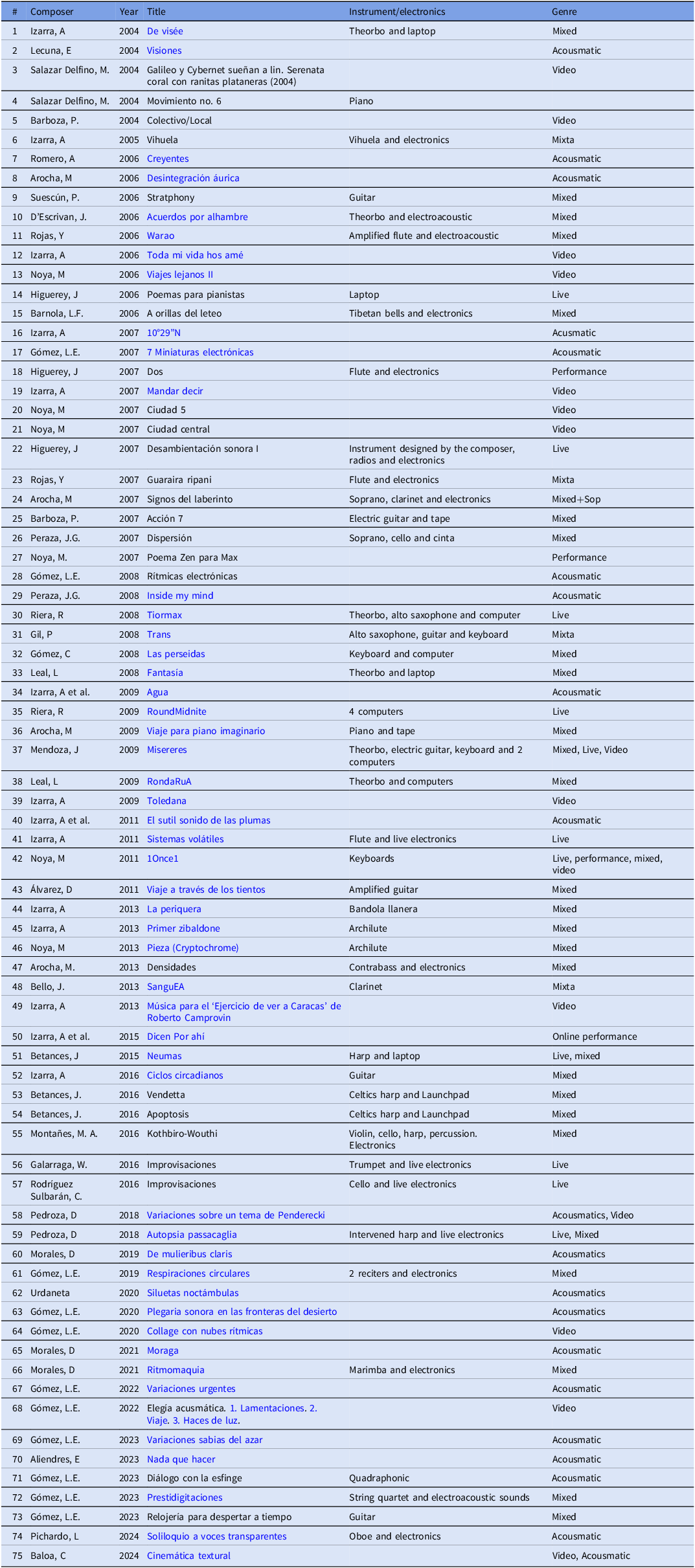
Pérez Valero (Reference Pérez-Valero2024) feels that after the retirement of Adina Izarra (2016) the Laboratorio went to an ‘artistic inertia’ (137) and ‘the (…) activities have been almost nonexistent since the onset of the Covid-19 pandemic in 2020’ (ibid.). Certainly, LADIM entered a discreet stage of reorganisation and has experienced a very different and hostile environment. However, considering its overall performance with such descriptions seems like an exaggeration – a misguided overstatement, as we have shown, and as can be clearly seen by focusing on the production of works in Table 1.
Identified repertoire linked to LADIM-USB 2004–2024
At this point in LADIM’s third period of life we do not see much programming in Max/MSP, but we do see programming in PureData and SuperCollider, promoted by Luis Ernesto Gómez since 2020 – and VCV Rack in 2019, since the guest composer at the time, Miguel Noya (2019), gave classes on this topic – with an emphasis on the connection with literature and sound synthesis. And, at the request of the coordination, research has been systematically requested, both for mixed music and for acousmatic solo electronic pieces, with a willingness to assist in the analysis and presentation of the pieces as part of the composition portfolio. This line was materialised in a research seminar on the study of electroacoustic music, notation and mixed performance held in 2022 with the course students, coordinated by Gómez, with the participation of Diego Morales, Luis Pichardo, Alexander Medina and Adrián Arias. They studied the works of Fieldsteel (Reference Fieldsteel2010), Pestova (Reference Pestova2009), De Andrade (Reference De Andrade2013), García Karman (Reference García Karman, Coessens, De Assis and Brooks2013) and Gonzales Aktories (Reference Gonzales Aktories2008).
Since 2013, the severe economic crisis experienced by Venezuela (Vera Reference Vera2018) has shaken all possible foundations, including those of higher education (Pérez Valero Reference Pérez-Valero2024), particularly studies focused on the Arts. On the one hand, this situation has highlighted the preoccupations and difficult choices regularly faced by the artists in Latin American countries (Machillot Reference Machillot2021; Morales and Amado Reference Morales and Amado2021)Footnote 28 such as ‘dropping out of school’, ‘taking on second or third job’Footnote 29 and ‘migrating’ (Gandini et al. Reference Gandini, Rosas and Lozano-Ascencio2020). Under this frame, the composer presents a particularly interesting character, as stated by Carpentier (1946, ed. Reference Carpentier1987):
The Latin-American composer is an individual who lives surrounded by problems. Like their European counterparts, they are familiar with those issues stemming from the practice of their art. But they must also contend with problems that confront them with the formidable question of knowing who they are, why they write, and to what their creative attitude responds.Footnote 30 (Carpentier 1946, ed. Reference Carpentier1987:143)
On the other hand, this state of affairs has eroded both the usual attendance of students and professors at the university. Nevertheless, the graduate programme in music at USB has maintained a solid commitment to supporting each graduate student. LADIM has also backed such endeavours.
To date, the influence of the initial two periods is evident in the scheduling and production of two major events: a three-day online series of roundtables culminating in a recital (2020) and the joint collaboration with chamber music programmes and the Laboratory’s associated composers (2024).
So far, we have framed the infrastructure of the Laboratorio as a space to share, network and get acquainted with peers and works; as an inspiration to channel the need for this kind of repertoire; as an instrument and, finally, we can argue that LADIMFootnote 31 is a sort of piece of electroacoustic music in itself: under this conceptualisation, this ongoing endeavour is much like a patch Footnote 32 under construction.
Two major events
In its third year, to honour the 50th anniversary of the Deanery of Graduate Studies (USB), and during the COVID-19 pandemic, the Laboratory organised a small electronic music event in November 2020: Encuentros de Música Electroacústica, ‘Si hay una nostalgia es por el futuro’ Footnote 33 (MaestriaMusica USB, 2020) consisting of four online round-tables and a final recital of electronic music and videoart. The invited speakers were Venezuelan composers Mirtru Escalona-Mijares, Miguel Noya, Adina Izarra,Footnote 34 Eduardo Lecuna, Alfredo Rugeles, Luis Ernesto Gómez, David Pedroza, the Mexican artist Daniela Prost and the Ecuadorians Daniel Campoverde and Guillermo Doylet.
One of the most important achievements of these Encuentros (2020) was the re-premiere of Alfredo Rugeles’s Thingsphonia (1978), with a video realisation by José Briceño Reyes specifically commissioned for the event. This particular piece was composed during Rugeles’s formative years in Düsseldorf with Günther Becker, now forming part of LADIM’s archives and legacy. This work is one of the first ten worksFootnote 35 of electronic music composed by Venezuelans catalogued by Segnini (Reference Segnini1994).
The last achievement has been the collaboration between the Laboratorio’s activities with the chamber music programme, resulting in a joint recital in June, 2024 (MaestriaMusica USB, 2024). This event featured mixed works by Luis Ernesto Gómez and Luis Pichardo and electronic music by Emiliano Aliendres and César Baloa.
The Laboratory as an instrument: repertoire reconstruction or the creativity in LADIM
When examining the ‘Electro-acoustic music’ entry in the New Grove Dictionary (Emmerson & Smalley Reference Emmerson and Smalley2001), one finds a vast number of experimental centres and laboratories across Europe and North America. A common pattern in these diverse electronic music initiatives, and one not exclusive to tropical regions, is that some have not lasted more than 15 years. This is particularly evident in Venezuela, where LADIM’s enduring presence singularly stands out.
Making electronic music in Venezuela, in the last years and in these times, makes more sense than ever or depicts the same significance as always. The isolated possibility that a local ensemble, or even the remote chance of an orchestra to programme a new piece, or even an old piece not ever performed, confronts the composer with the need to find a new and autonomous medium. Coding at home, domestic production of the works and releasing them on different platforms seem like a good enough replacement for the old status quo. Nonetheless, the economic and social conditions subvert the prolonged practice in time, hence the ‘heroic act’ (Pérez Valero Reference Pérez-Valero2024) at play, or the enactment of resilience.
In some way, LADIM has channelled this formative need in coding, production and interactivity, drawing the attention of a diverse group of artists and composers from every background.
The quest to build an archive: a digital web collection of the repertoire linked to LADIM
After 21 years, the repertoire produced at LADIM sums up to 75 different works – maybe more. We have assumed the mission stated by Chasalow (Reference Chasalow2006): ‘as no one else is doing it [organising an archive of electroacoustic music], composers must become engaged in building archives of primary source materials’ (63).
The full repertoire of the Laboratorio is largely packed with the music of both its directors, Adina Izarra (2004–2017) and Luis Ernesto Gómez (since 2018).
After considering the catalogue of Adina Izarra,Footnote 36 it can be observed the presence of the mixed piece ‘Vojm’ (1988) for voice and reverb and ‘Luvina’ (1992) for flute and delay. Nonetheless, since the foundation of LADIM, her catalogue has been crowded with electronic music, starting with ‘De Visée’ (2004), for theorbo and laptop. From that moment, electroacoustic music has been a frequent feature in her catalogue.
This same situation applies to the list of works by Luis Ernesto Gómez, a composer with an informatics profile. His initial approach to electronic music was collateral – as one electronic piece was required for the Bachelor’s degree, ‘Vastedad’ (2005), then attending supplementary courses in the Master’s programme, ‘Siete miniaturas’ (2007), ‘Rítmicas Electrónicas’ (2008); however, electronic music began to consolidate its presence in his catalogue after he took over as director of the Laboratorio, starting with ‘Respiraciones circulares’ (2019), for 2 narrators and electronics.
The genre most frequently explored by LADIM’s associated composers and artists is the mixed repertoire, closely followed by acousmatic, video and live performance. A partial list of this repertoire can be found in Table 1.
This table organises the works by composers associated with LADIM as professors, students or researchers during a research stay at the laboratory. In order to be listed, the works would have to describe a direct or indirect relation to the laboratory. Table 1 does not aim to be a comprehensive list of all the works ever produced, as it is still under construction. However, it demonstrates the volume of work accomplished over the years and represents a good sample to understand the scope.
LADIM repertoire profile
Adina Izarra’s versatile electronic catalogue during her years at LADIM can be categorised into three main inclinations: pieces integrating ancient music, video and live electronic improvisation and zoomusic, particularly bird songs. The former type is executed with actual borrowings or with timbral references with the addition of plucked instruments, such as guitar, lute, archilute, theorbo or ‘bandola llanera’. This was the result of an enriching collaboration with guitarist and lute player Rubén Riera, as it can be seen in De Visée (2004), where electronics were added as an accompaniment to the ‘Suite in A minor’ of the Pièces de théorbe et de luth (1716) by French composer Robert De Visée. Similarly, in Toda mi vida hos amé (2006), electronics were added featuring high-pass filtered sounds and video to the piece of the same title inside the treatise Libro de música de vihuela de mano intitulado El Maestro (1536) by Spanish composer Luis de Milán. And finally, Primer Zibaldone (2013) for archilute and electronics, where the electronic part is more present and autonomous. This kind of disposition of instrumentation can be seen in works by Izarra’s students and colleagues of the time, considering that Riera was an associate professor at LADIM:Footnote 37 Leonardo Leal Fantasía (2008), for theorbo and electronics or Miguel Noya Cryptochrome (2013), for archilute and electronics.
The video and live-electronics have also been fundamental in the development of Izarra’s catalogue, and it was assumed as a model followed by colleagues and students, as it can be observed in pieces like the video Viajes lejanos II (2006) by Miguel Noya or RoundMidnite (2009) by Rubén Riera for 4 laptops live, or Neumas (2015), for harp and live-electronics by José Betances. The latter type, zoo-music, has transversalised Izarra’s production so far,Footnote 38 both electronically and acoustically (Barreto Rangel, Reference Barreto Rangel2014), with the inspiration in bird callings like in Sistemas volátiles (2011), for piccolo and electronics with samples of different birds and the flute imitating it with fast high-pitched gestures, and El sutil sonido de las plumas (2011), an acousmatic collaborative music.
On the other hand, the electronic works by Luis Ernesto Gómez are very much linked with literary and poetry interactions and the possibilities of the voice to dialogue with electronics, as in ‘Plegaria sonora en las fronteras del desierto’ (2020), based on homemade recordings of news about the COVID-19 pandemic or ‘Variaciones urgentes’ (2022), based on recitations of poems by Venezuelan poet Beira Lisboa. The poetry as a source of inspiration trend can be seen in some of his students, like Abraham Urdaneta’s ‘Siluetas noctámbulas’ (2020), based on a poem by Arturo Gutiérrez Plaza, or Diego Morales ‘De mulieribus claris’ (2019), based on poems by Lydda Franco Farías, Sylvia Plath and Olga Broumas. Another disposition in electronic writing in the catalogue of Gomez has been sound synthesis and experimenting with video editing, as his ‘Collage de nubes rítmicas’ (2020) or ‘Elegía acusmática’ (2022) can demonstrate.
LADIM and the research gravitation
A reflection space, such as a laboratory of electronic music, is implicitly obliged to describe an inclination towards research production. This includes not only the controversial lack of differentiation stating that composition = research Footnote 39 but also ‘actual’ scholarly research.
As it was asserted earlier, LADIM’s idea was built upon the need for a space to investigate sound, and the first resolution to reach such a space is the dissertation ‘Iterative maps and its use in music composition’Footnote 40 by Raúl Jiménez (Reference Jiménez2002). After this initial research effort, the work continued around the sphere of electronic music: studies exploring the description of patch programming in specific language (Díaz Reference Díaz Espósito2004) and the history of electronic music (Noya Reference Noya2007); other research focussed on the mixed repertoire in Venezuela (Arocha Reference Arocha Bernal2009; Arocha & Izarra Reference Izarra2009; Navarro Salerno Reference Navarro Salerno2010), or the spectro-morphological analysis of electronic music in order to replicate the findings in a composition (Álvarez Reference Álvarez2012). Furthermore, researchers have described the live-performance practice of the researcher (Peraza Reference Peraza2013), and have even traced the electronic music repertoire in the trajectories of two major contemporary music festivals: the Latin American Music Festival (1990–2024) and Festival Atempo (1994–2015) (Gómez & Morales Reference Gómez and Morales2025).
Post-LADIM trails panning
Working at LADIM has left a mark on some of the associated composers. After completing their graduate coursework, some have maintained a consistent electroacoustic inclination, as is the case with Daniel Álvarez, Miguel Noya, Yoly Rojas and Adina Izarra.
Like many other Latin American countries – such as Colombia, Argentina, Uruguay or Cuba – Venezuela has experienced periods where the migration of its composers impacted the national repertoire. This circumstance has greatly affected LADIM’s configuration.
Daniel Álvarez is currently a lecturer at Universidad del Bosque, Bogotá (Colombia), and he followed the direction taken in his master’s dissertation and obtained his Ph.D. (Álvarez, Reference Álvarez2022) exploring the sound constitution of the guitar based on typomorphological approaches. Miguel Noya was involved with electronic music long before LADIM. However, we can trace his electroacoustic trajectory after he left the Laboratory: he is currently engaged as a staff member at two private institutions, Audioplace and Universidad Metropolitana, where he lectures on sound engineering and music production. In her Ph.D. Dissertation (Rojas, Reference Rojas2015) Yoly Rojas embarked on an ontological path towards the categorisation of the electronic Venezuelan repertoire. Currently, Dr. IzarraFootnote 41 runs the composition courses at the Universidad de las Artes, Guayaquil (Ecuador) and participates in several audio-visual projects with Dr. Rubén Riera. The LADIM path proved decisive for Adina Izarra’s electroacoustic emphasis in her catalogue and practice, as is the case with Álvarez Acero, Rojas and Noya too.
Preliminary conclusions and future perspectives
We know that electroacoustic music presents itself as a difficult-to-learn discipline. But we also believe that the appropriate awareness with the support of the State and its institutions, the unbiased and avid for new experiences public will find in it, proposals of great value.
Orobitg et al. Reference Orobitg, Subieta, Uslenghi and Wiman2003 Footnote 42
We can summarise the criteria for evaluating the suitability of the label ‘Laboratory of Electronic Music’ based on three main conditions: composers and musicians training, internal and external events organisation and research production. After 21 years, LADIM has trained composers, has participated in national and international events as protagonist and curator, has also initiated its own events, and has produced a discrete but referenced body of literature. LADIM’s national and international standing has been possible thanks to strong institutional support from the university.
LADIM has also played an experimental music popularisation role,Footnote 43 as part of the holistic teaching approach in curriculum organisation at Universidad Simón Bolívar, in the launching of undergraduate music courses for non-musicians. LADIM thrives on this kind of interaction and involvement with other actors in the community. This is an area that requires more attention: stimulating the use of the Laboratory by other arts and science communities for collaboration, experimentation, testing and networking.
At the time, there is not any programme oriented towards electronic music composition at Universidad Simón Bolívar, or even in the country, as it has been the case in some universities of the region, nor the Laboratorio had received any major additional fundingFootnote 44 after its foundation or any other donation like that of Asociación de Amigos de la USB, but this is a project that is currently on its way.
One of the most prominent aspects of this paper was the gathering of information on most of the works composed during the Laboratory’s early periods and all the pieces created during the current stage. LADIM did not have a proper archive, a collection of works, to reflect upon, to respond to and to confront with, and this represents the first attempt in this direction. The next step is to present the information on an institutional web page to properly evaluate and measure the amount and quality of work being done under the framework of the LADIM.
The task of publishing electroacoustic music in Venezuela is essentially not supported by mass or social media, and its history is easily forgotten in its evolution. To appropriately acknowledge the efforts of LADIM’s first two periods, several initiatives still need to be scheduled. These include inviting relevant regional composers as guest professors, actively participating as curators and performers in various national and international venues, to continue organising discussion forums, encouraging the production of literature about these new endeavours and the current repertoire being composed, and finally, programming and disseminating both the research and the musical works.
LADIM has played a fundamental role in the electronic music scene in the country since its foundation, and it is implicitly called to be a pivotal game changer in the current ‘academic’ electronic music state of affairs.
The stories within One Thousand and One Nights exemplify an endurance narrative. Scheherazade’s remarkable storytelling ability – her capacity to artfully suspend narratives, resuming them nightly to defer the judgement – can be likened to an ingenious application of electroacoustic delay. This narrative structure, characterised by a series of interconnected tales, bears a striking resemblance to patterns observed within the identified repertoire. The numerical dimension of ‘one thousand and one’ functions as a metaphorical representation signifying ‘many nights’. In our case, the twenty-one years of LADIM encompass Seven Thousand Six Hundred and Sixty-Five Nights of dedicated electroacoustic music production. This extensive period, therefore, constitutes a substantial and noteworthy canon, a significant musical legacy that merits scholarly study and further critical exploration.

 Open access

