



INTRODUCTION
Chlamydia comprises a group of important obligate intracellular bacteria that are responsible for a variety of diseases in humans and a wide range of animals, including pet birds [Reference Beeckman and Vanrompay1, Reference Rohde2]. Among these pathogens, Chlamydia psittaci, which can be transmitted from infected birds' secretions and droppings to humans via direct or indirect transmission routes, is recognized as the most important zoonotic pathogen [Reference Van Droogenbroeck3, Reference Vanrompay4]. Infection with Chlamydia spp. may result in difficulty in breathing, high fever and respiratory tract infection, occasionally with severe systemic disease in humans, causing chlamydiosis, ornithosis, psittacosis or parrot fever [Reference Deschuyffeleer5, Reference Petrovay and Balla6].
Parrots often live in close relationship with humans and are frequently reared in family homes, parks and zoos. Budgerigars (Melopsittacus undulatus), lovebirds (Agapornis sp.), cockatiels (Nymphicus hollandicus) and Alexandrine parakeets (Psittacula eupatria) are the four most popular species of parrots in China. They, in addition to other pet birds, are also the best known representative natural hosts of Chlamydia and may shed zoonotic pathogens into the environment [Reference Vanrompay4, Reference Boseret7].
Chlamydia seroprevalence in pigs, cattle, dogs, cats and humans has been widely reported throughout the world [Reference Zhang8–Reference Price15], but there is limited information about Chlamydia infection in parrots available, and no such information is available for parrots in China. In this survey, we investigated the seroprevalence of Chlamydia infection in budgerigars, lovebirds, cockatiels and Alexandrine parakeets in Beijing and Weifang cities, north China, and determined the genotype of Chlamydia shed in faeces from these popular pet birds.
MATERIALS AND METHODS
The investigated sites
The survey was conducted in Beijing and Weifang cities (two main locations of parrot production), north China. Beijing city (39°26′–41° 03′ N, 115° 25′–117° 30′ E) lies to the south of the Yanshan Mountains with an average altitude of 43·5 m, annual precipitation of 626 mm, and average annual temperature of 12·6°C. Weifang city is situated in the middle of Shandong Peninsula (118° 10′–120° 01′ E, 35° 41′–37° 26′ N) and has a northern temperate and monsoonal climate. The average altitude of Weifang city is 19·3 m, and the average annual temperature is 14·0°C.
Study population
The study population comprised of 311 parrots collected from bird sellers. The total number of parrots sold by the sellers in a 6-month period was nearly 50 000. Based on the fact that the seroprevalence of Chlamydia for the pigeon population was 31% in 2013 [Reference Cong16], the expected seroprevalence is 30% (P) with an accepted deviation of the true prevalence of 5% (d) and a confidence level of 95% (z = 1·96). The sample size was therefore calculated as 323 [according to n = P (1 − P)z 2/d 2].
Collection and preparation of serum samples
The 311 birds (202 budgerigars, 26 lovebirds, 22 cockatiels, 61 Alexandrine parakeets) were randomly selected from live bird markets in spring and summer, 2013. Blood samples were collected from the wing vein of parrots by a veterinary practitioner, and then separated by centrifugation at 1000 g for 10 min, and stored at −20°C until analysis. Data regarding species, gender, age and geographical origin were obtained from the bird sellers and the first three were then confirmed by the veterinary practitioners. All operations were performed in strict accordance with the Good Animal Practice requirements of the Animal Ethics Procedures and Guidelines of the People's Republic of China. This study was approved by the Animal Ethics Committee of Lanzhou Veterinary Research Institute, Chinese Academy of Agricultural Sciences (Approval no. LVRIAEC2012-010).
Serological tests
The commercially available indirect haemagglutination assay (IHA) kit (Lanzhou Veterinary Research Institute, Chinese Academy of Agriculture Sciences) was used to examine antibodies to Chlamydia, and the detection procedures were performed as previously reported [Reference Cong16] with a cut-off of 1:16. Dilutions between 1:4 and 1:16 were considered inconclusive and the samples were retested. Positive and negative controls were included in each test and assayed at the same dilutions of the sera samples.
Statistical analysis
The variation in Chlamydia seroprevalence (y) of parrots of different gender (x1), collecting season (x2), age group (x3), species (x4) and geographical location (x5) was analysed by χ 2 test using SAS version 9.1 (SAS Institute Inc., USA). In the multivariable regression analysis, each of these variables was included in the binary Logit model as an independent variable. The best model was judged by Fisher's scoring algorithm. All tests were two-sided, and values of P<0·05 were considered statistically significant. Odds ratios (ORs) and their 95% confidence intervals (95% CIs) were estimated to explore the strength of the association between Chlamydia seropositivity and the conditions investigated.
DNA testing and sequencing
For DNA extraction from droppings of parrots, each of 21 samples was homogenized in sterile PBS, and then filtered through a 0·3-mm wire mesh. The filtrate was collected in a 1·5-ml tube and centrifuged at 1000 g for 10 min. After discarding the supernatant, genomic DNA was extracted using the Stool DNA kit (Omega, USA) according to the manufacturer's recommendations. DNA samples were detected using semi-nested PCR according to previous studies [Reference de Lima17, Reference Buxton18]. The PCR products were subjected to electrophoresis on 1% agarose gel containing 0·5 μg/ml GoldView (Solarbio, China) and were observed under UV light.
To determine the genotype of Chlamydia in positive cases, a ~1000 bp fragment of the ompA gene was sequenced using a pair of primers, FOMPF1/FOMPF2, according to a previous study [Reference Herrmann19]. The positive PCR products were then sequenced by the Sangon Biotech Company (China). The sequence data from the present study were deposited in the GenBank database with accession no. KF611904.
Reconstruction of phylogenetic relationships
Based on the sequencing results of the ompA gene, the relevant sequences of Chlamydia caviae were downloaded from GenBank [Reference Everett, Bush and Andersen20]. All the sequences were then aligned using the multiple sequence alignment program, Clustal X 1·83 [Reference Thompson21], dendrograms were constructed using maximum likelihood (ML) according to previous studies [Reference Strimmer and Haeseler22–Reference Zhao24], and the GTR model with its parameter for configuring concatenated dataset was determined for the ML analysis. Bootstrap support for ML trees was calculated using 100 bootstrap replicates. Phylograms were drawn using Tree View program version 1.65 (University of Glasgow. UK).
RESULTS
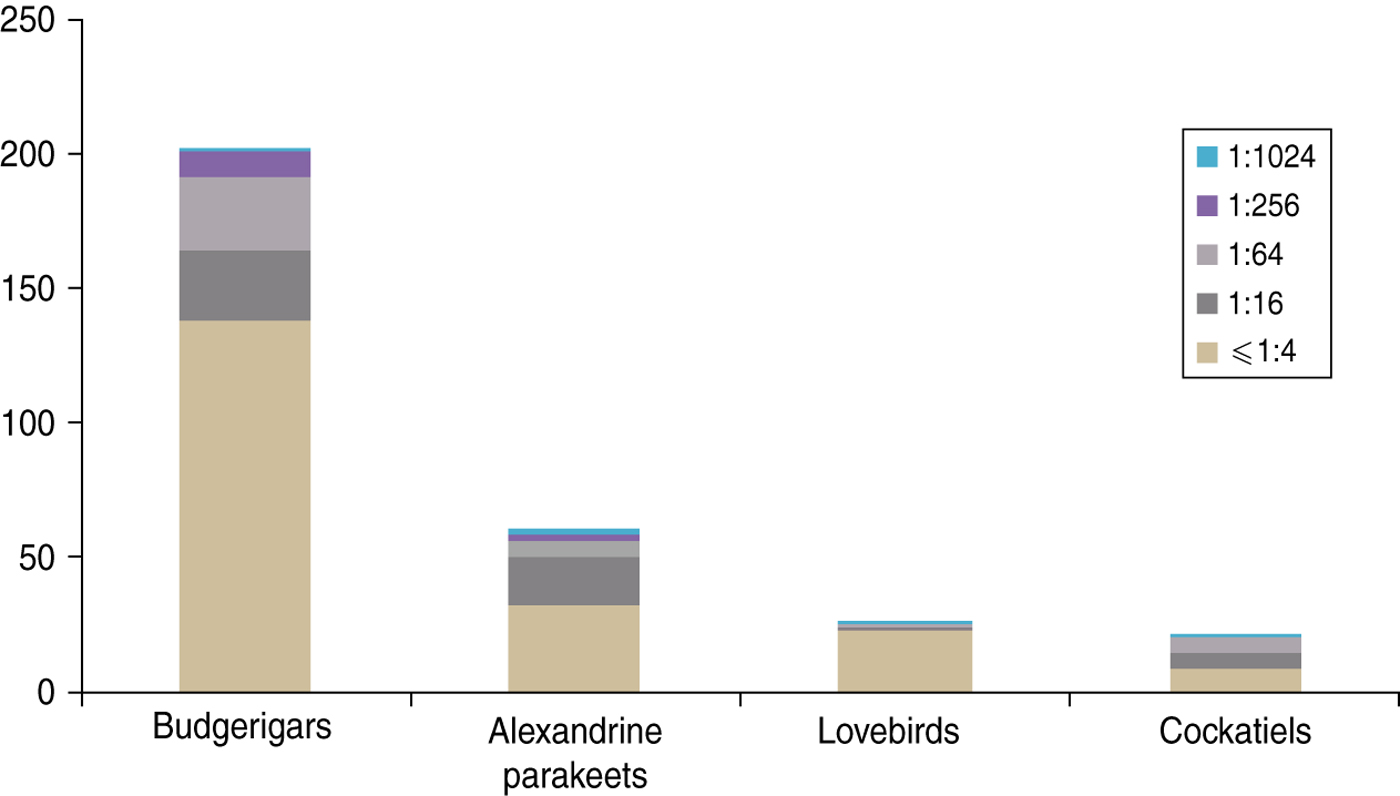
Of the 311 serum samples, 110 (35·37%) were positive for Chlamydia antibodies by IHA (Fig. 1). Table 1 presents the exposure regarding gender, species, age, collecting region and season associated with Chlamydia seropositivity in parrots based on the univariate analysis. Optimized by Fisher's scoring technique, forward stepwise logistic regression analysis was conducted to evaluate the impacts of multiple variables on Chlamydia. In the final model, three variables had effects on the infectious disease, described by the equation
 $$y = 0{\cdot}49x 1 + 0{\cdot}53x3 - 0{\cdot}37x4 - 0{\cdot} 12.$$
Gender and age had positive effects on the risk of Chlamydia, for which the ORs were 1·63 (95% CI 1·01–2·63) and 1·70 (95% CI 1·20–2·43), respectively. Females were seen to be more susceptible than males, and the sub-adult and adult birds were more resistant to Chlamydia than juveniles (Table 1). Bird species had a negative effect on the disease (OR 0·695, 95% CI 0·511–0·946), and cockatiels (OR 13·42), Alexandrine parakeets (OR 6·95) and lovebirds (OR 3·56) were considered to have higher seropositivity compared to budgerigars (Table 1).
[colour online]. The Chlamydia antibody titres in four species of parrots.
Analysis of the variables associated with Chlamydia seroprevalence in pet parrots in China
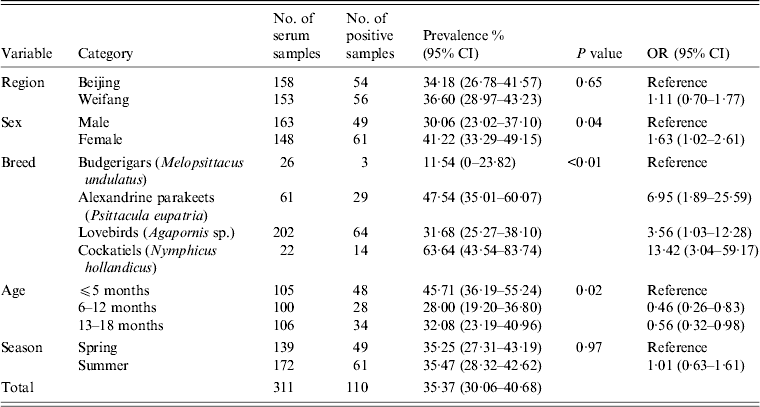
OR, Odds ratio; CI, confidence interval.
Nested PCR diagnosis and phylogenetic analysis based on ompA gene sequence
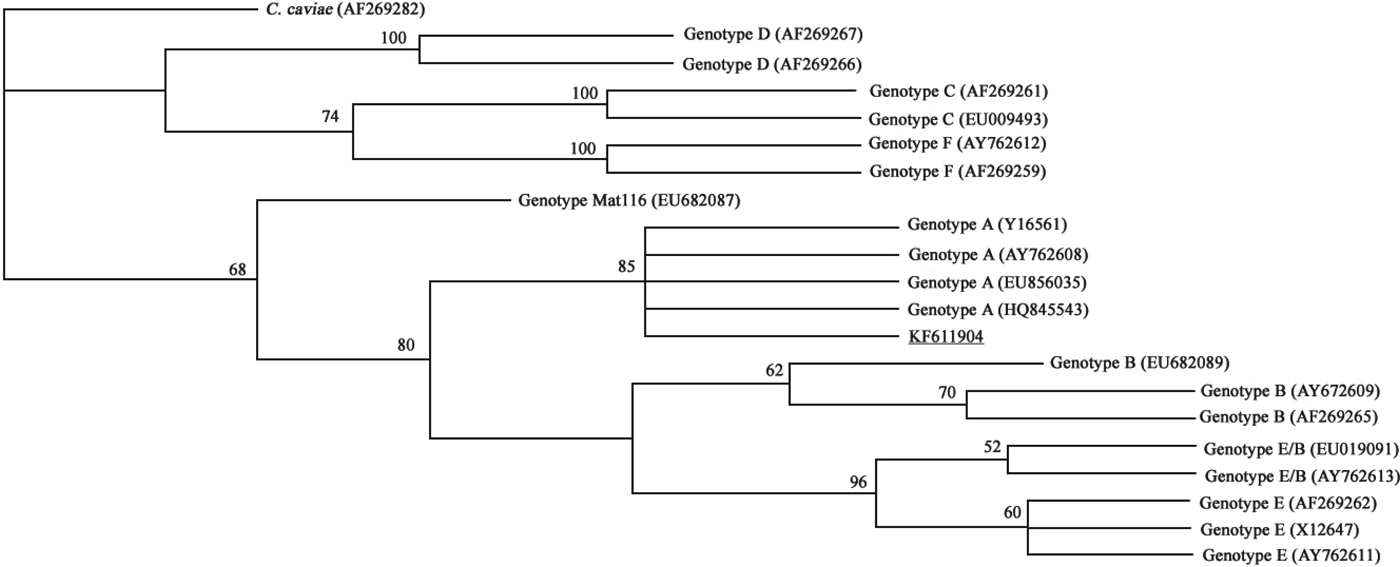
In the present study, 5/21 faecal samples were positive for chlamydial DNA in the diagnostic nested PCR, but only two samples were used for phylogenetic analyses because of the low DNA concentrations of the other three samples. The two samples had identical partial ompA gene sequences, and were 100% identical to the corresponding sequence of C. psittaci strain SP15 deposited in GenBank (accession no. EU856035.1). Comparison with relevant sequences available in GenBank indicated that the two samples represented C. psittaci genotype A (Fig. 2).
Maximum-likelihood phylogenetic analyses of Chlamydia psittaci based on the 1019 bp sequence of the ompA gene. The numbers at nodes indicate bootstrap values. The isolated C. psittaci is underlined and appears in the clade of genotype A.
DISCUSSION
Every year, about 70% of the parrots kept in China originate from Beijing and Weifang cities. These birds are traded throughout China as pets, but can transmit zoonotic pathogens to humans. However, this situation has been neglected by central and local governments in China, a situation which may heavily impact on public health, especially for veterinarians, bird breeders and fanciers. A previous study indicated that C. psittaci was transmitted from infected turkeys to veterinary scientists handling the animals [Reference Van Droogenbroeck3]. Another study of C. psittaci prevalence in 39 breeding facilities indicated high prevalence of human infection in parrot owners and veterinarians working in breeding facilities [Reference Vanrompay4]. Close and continued contact with infected birds may lead to outbreaks [Reference Smith25] and, in some cases, fatalities [Reference Petrovay and Balla6]. Therefore, in view of the potentially important role of parrots in transmission of Chlamydia, we investigated Chlamydia seroprevalence in budgerigars, lovebirds, cockatiels and Alexandrine parakeets in Beijing and Weifang cities, north China.
The overall chlamydial seroprevalence in parrots was 35·37%, which was higher than that observed previously, using the same serological test, in chickens (13·32%), pigeons (31·09%), and sparrows (10·54%) in China, but lower than in ducks (38·92%) [Reference Cong16, Reference Cong26]. A semi-nested PCR, based on the ompA gene, has previously been used to investigate C. psittaci infection in pigeons in Brazil [Reference de Lima17] and, in the present study, 5/21 faecal samples from parrots were PCR positive using this technique. This level is higher than that found in pigeons in The Netherlands [Reference Heddema27], Switzerland (8·4%, 3·6%) [Reference Geigenfeind, Vanrompay and Haag-Wackernagel28, Reference Zweofel29], Belgium (6·3%), and birds in Iran (12·6%) [Reference Madani and Peighambari30], but lower than in chickens in France (⩾90%) [Reference Yin31] and in feral Canada Geese in Belgium (58%) [Reference Dickx32]. Comparisons between different studies can be difficult due to differences in environment, diagnostic methods used, feeding conditions, as well as animal husbandry practices and animal welfare.
The high Chlamydia seroprevalence in the four species of parrots, especially the presence of Chlamydiaceae in faeces, indicates that the birds may be a risk source of infection for humans. In China, unlike in Europe for example, people often take pet birds to the park and onto the street to show them to passers-by and other amateur keepers. In zoos, many bird species are kept together in the same cage in order to enhance the ornamental effects of the displays, often with a relatively high numbers of budgerigars. Parrots are aggressive birds and feathers and dry droppings could become airborne during bird fights and flight. Both of these situations could lead to Chlamydia transmission to humans through aerosol or direct contact.
The results of the present study clearly indicate that bird species is a crucial risk factor for Chlamydia infection in the examined parrots. In our model, cockatiels were the most susceptible to Chlamydia, followed by Alexandrine parakeets and lovebirds, with budgerigars being relatively resistant to the pathogen in each age group. The parrot populations we sampled remain largely discrete in markets and every species is present in each shop. We speculate that seroprevalence differences in the four species may be caused by the difference in their immune response. Further study should focus on examination of chlamydial species and their dynamics, and potential movement of the bacteria in bird species.
In agreement with the conclusion of Madani & Peighambari [Reference Madani and Peighambari30] who found no stastistically significant seasonal differences in the occurrence of avian chlamydiosis, our results show that the seropositivity of Chlamydia in parrots sampled in spring was not statistically different to that sampled in summer (P > 0·05). Chlamydia can be resistant to temperature variations from ~8°C in spring to ~25°C in summer in north China, and the statistically similar seropositivity in parrots in different cities suggests that the pathogen could be mainly transmitted by the direct contact route in birds, which is little influenced by environmental change.
We found support for differences in Chlamydia seroprevalence between sex of parrots, with females having a higher seroprevalence than males. This tendency is consistent with our previous study of Tibetan pigs [Reference Zhang8], and also concurs with that observed in wild boars in Italy (females, 45·95%; males, 38·8%) [Reference Antonietta33] and Germany (females, 83·3%; males, 42·9%) [Reference Helmut34]. Males and females have the same opportunity for exposure to Chlamydia in the environment, and in our model females are more sensitive to the pathogen than males for each species in each age group. Gender-related differences in Chlamydia seroprevalence were suspected to result from variation in immune response or antibody persistence rates between males and females.
In our study, age was the strongest risk factor to Chlamydia. For male parrots, Chlamydia seroprevalence in each species increased with age. However, for females, only budgerigars and Alexandrine parakeets displayed this tendency. Our results demonstrate that juveniles are more susceptible than adults and sub-adults. The juveniles are generally immunologically more naive than adults, thus leading to the highest seropositivity in younger birds. However, adults have substantially greater chlamydial seroprevalence than sub-adults in the present study, which may due to the cumulative Chlamydia exposure of older parrots through contact with the pathogen during long-term breeding. We also cannot exclude the possibility that the differences in seroprevalence between adults and sub-adults may be the result of long-term antibody persistence, which should be further studied.
The accurate diagnosis of Chlamydia infections is usually based on isolation of bacteria [Reference Everett35]. However, from clinical samples this is hampered by fastidious growth requirements, so is only of limited use in diagnostic laboratories. Although serological tests do not fully differentiate infections caused by various Chlamydia spp., the overall seroprevalence could help us learn about the prevalence of Chlamydia in the target host as a whole [Reference Zhang8, Reference Zhou9, Reference Smith25]. PCR amplification of the ompA gene combined with sequencing can provide a definitive diagnosis of psittacosis, and subsequent sequence analysis can identify the responsible genotype [Reference Geigenfeind, Vanrompay and Haag-Wackernagel28, Reference Heddema36]. Following our overall assessment of seroprevalence and genotype of Chlamydia infection in parrots, C. psittaci genotype A was shown to be shed in the faeces of parrots in the present study, which is in agreement with previous studies showing that C. psittaci genotype A was the major genotype associated with parrots [Reference Sayada37, Reference Vanrompay38]. The partial ompA sequence of C. psittaci genotype A obtained in the present study was identical to that of the Chlamydiaceae strain isolated from bird faeces in Yunnan Province (GenBank accession no. EU856035), suggesting little variation of this prevalent genotype in China. This result further supports our hypothesis that parrots represent a potential risk for Chlamydia infection for humans.
The present study indicates that pet parrots pose a potential zoonotic risk for human infection with Chlamydiaceae through contact with fresh bird faeces. As the birds regularly live in homes, pet shops, bird fairs and markets, zoos and parks, the parrot owners, breeders, sellers, as well as veterinarians and tourists should be aware of the potential zoonotic risk and take appropriate precautions. In addition, integrated strategies and measures are necessary for the effective prevention and control of Chlamydia infection in parrots in China. Future surveys of Chlamydiaceae infection should include pet birds.
CONCLUSION
The results of the present study indicates high seroprevalence of Chlamydia in budgerigars, lovebirds, cockatiels and Alexandrine parakeets in China, and the seroprevalence is associated with the species, gender, age, season and collecting region of parrots. Determination of C. psittaci genotype A in the droppings of two pet parrots suggests potential contamination of the environment with Chlamydiaceae and may raise a public health concern.
ACKNOWLEDGEMENTS
Project support was provided by the Science Fund for Creative Research Groups of Gansu Province (grant no. 1210RJIA006). We thank Dr Alasdair Nisbet, Moredun Research Institute, Scotland, UK for improving the text and editing the English of this manuscript.
DECLARATION OF INTEREST
None.



