





Introduction
This article starts from a simple but neglected insight: political competition is about both policy issues and social identities. At different times in history, under different electoral rules, and in pursuit of different ideologies, political parties have been seeking to attract voters, not just by offering policy solutions to societal problems, but also by addressing them as potential members or opponents of one or more social groups. This may sound obvious. After all, the core idea of representative party democracy is that parties translate ‘societal heterogeneity’ into ‘represented heterogeneity’ (Franzmann Reference Franzmann2011). Furthermore, the influential cleavage theory of party system formation (Lipset and Rokkan Reference Lipset, Rokkan, Lipset and Rokkan1967) was at its core an account of how social conflicts in Europe’s democratizing societies came to be represented by political parties, who forged stable connections to constituencies defined by group identities and interests. Yet, until very recently, the field of party politics had almost entirely forgotten about group appeals. Established theories of party competition – whether they conceptualize that competition in terms of spatial position or of saliency and issue ownership – have overwhelmingly treated electoral competition as a policy-based interaction between parties and voters (cf. Dolinsky Reference Dolinsky2021: 6–13; Huber Reference Huber2022: 293; Thau Reference Thau2019: 79). Following these conventional accounts, parties compete in elections by making alternative proposals for how to address societal problems (Robertson Reference Robertson1976). We refer to such proposals as policy offers that speak to voters’ preferences.
The rise of nationalist and populist candidates worldwide has made clear that such an exclusive focus on policy offers cannot adequately explain the realities of electoral competition (Walter Reference Walter2021). First, some policies advocated by parties and candidates cannot be adequately described without mentioning the groups targeted by the policy (e.g., Deiss-Helbig, Guinaudeau, Matthieß et al. Reference Deiss-Helbig, Guinaudeau, Matthieß and Rentrop2024; Wonka Reference Wonka2024). Consider welfare chauvinism, which consists of protecting the welfare state from retrenchment while restricting welfare access to the native population (e.g., Rathgeb Reference Rathgeb2020). Unless we include the information that this policy targets one group (natives) while excluding another (immigrants), we cannot distinguish this programmatic offer from traditional social democracy.
Second, much research shows that identification with social groups has a profound influence on voting behavior (Achen and Bartels Reference Achen and Bartels2016). If voters vote according to their group identities, it is reasonable to expect parties and candidates to try to use this to their advantage (cf. Thau Reference Thau2019: 64; and also Dassonneville, Stubager, and Thau Reference Dassonneville, Stubager and Thau2025; Robison, Stubager, Thau et al. Reference Robison, Stubager, Thau and Tilley2021; Stubager and Thau Reference Stubager and Thau2025, Reference Thau2021).
Third, newer research in political economy, inspired by social psychology, shows that voters’ identification with social groups can influence policy preferences. Consider higher-skilled voters who favor protectionist policy, despite being likely to benefit personally from globalization. This puzzle can be resolved by recognizing that they identify with an overarching national identity category, one whose average member is unlikely to benefit from free trade (Grossman and Helpman Reference Grossman and Helpman2021). By addressing voters as members of social identity groups, parties can therefore influence voters’ support for policy (de la Cerda Reference de la Cerda2025; Huber, Meyer, and Wagner Reference Huber, Meyer and Wagner2024). Excluding this strategy from theoretical models and empirical measures of party strategy leads to misguided inferences about electoral competition.
It is therefore promising that a new generation of party scholars has begun to conceptualize and measure parties’ group appeals and to integrate these into models of party competition (Dolinsky Reference Dolinsky2021, Reference Dolinsky2023; Haffert, Palmtag, and Schraff Reference Haffert, Palmtag and Schraff2024; Horn, Kevins, Jensen et al. Reference Horn, Kevins, Jensen and van Kersbergen2021; Howe, Szöcsik, and Zuber Reference Howe, Szöcsik and Zuber2022; Huber Reference Huber2022; Huber and Haselmayer Reference Huber and Haselmayer2025; Stückelberger and Tresch Reference Stückelberger and Tresch2024; Thau Reference Thau2018, Reference Thau2019). Following Huber and Dolinsky (Reference Huber and Dolinsky2023: 14), a group appeal can be defined as ‘an intentional act that associates a political actor with a social group’.Footnote 1 Group appeals can be made directly, through positive references to the in-group (‘we are the party of workers’), but also indirectly, through negative references to out-groups (‘we need to break the power of capitalists’).Footnote 2 Group appeals speak to voters’ desires for self-esteem, since self-esteem is mediated by group membership via social identity, i.e., ‘those aspects of an individual’s self-image that derive from the social categories to which he perceives himself as belonging’ (Tajfel and Turner Reference Tajfel, Turner and Austin1979: 40; cf. Dickson and Scheve Reference Dickson and Scheve2006). Through group appeals, parties define the constituency they aim to represent and distinguish it from out-groups; they make what theorists of representation and scholars of parliamentary behavior refer to as ‘representative claims’ (Saward Reference Saward2010; see also Guasti and Geissel Reference Guasti and Geissel2019; Heinisch and Werner Reference Heinisch and Werner2019).
Recent literature in the field of party politics proper has accumulated important insights about the ubiquitous occurrence of group appeals, as well as about their interconnectedness with policy offers. It also highlights that parties not only respond to but actively shape the identities and interests of their constituencies (cf. Westheuser and Zollinger Reference Westheuser and Zollinger2025). So far, however, these studies lack a coherent paradigm that could replace the more established ‘policy-only’ models. The purpose of this review article is to lay the foundation for such a new ‘policy-cum-identity’ paradigm that, as we argue, should be informed by social constructivism. Although this constitutes a break with spatial models in the tradition of Downs (Reference Downs1957), which treat voter preferences as exogenous to party strategies, it is compatible with more entrepreneurial accounts of issue competition (Budge and Farlie Reference Budge, Farlie, Daalder and Mair1983; de Vries and Hobolt Reference De Vries and Hobolt2020; Riker Reference Riker1986), which already endogenize voter preferences (though not yet their identities).
To develop and justify this new paradigm, we proceed in three steps. The next section (“Construction and its limits: Insights from ethnic politics and nationalism studies”) reviews studies of ethnic politics and nationalism, which have long provided useful concept specifications and theoretical insights about how parties mobilize voters based on their social identities.Footnote 3 The section “Recent developments in the empirical study of identities and elections” then reviews recent research on electoral competition that incorporates group identities. For the demand side, we examine studies of electoral behavior in the U.S. and the recent revival of cleavage theory in the study of party system change in Europe. For the supply side, we include literature on campaigns targeting individual identity categories, findings about radical right parties, and, most importantly, an emerging general literature on how and why parties use group identity appeals.
On this basis, the section “Group identities and party competition: Towards a new paradigm” lays the foundation for a new ‘policy-cum-identity’ paradigm of party competition and outlines a corresponding research agenda. We invite scholars to model voters as having (1) preferences over policy and (2) desires for self-esteem and self-consistency, which are mediated by their identification with social groups. If voters have both material and psychosocial motivations, parties can be expected to address both policy preferences and group identities and, furthermore, to make group-tailored policy promises that target both motivations. As we conclude in the last section, this new perspective will enable the field of party politics to better understand the dynamics of real-world electoral competition.
Construction and its limits: Insights from ethnic politics and nationalism studies
A crucial overarching lesson from the ethnic politics and nationalism literature is that social identity categories are social constructs. This implies that candidates and parties can play a role in defining the content of social identity categories and can use identity appeals to motivate voters to identify with these categories (instead of many, Gremler Reference Gremler2025). The literature on ethnic politics and nationalism clearly differentiates demographic attributes, elite appeals to social identities, and actual social groups. Following Brubaker (Reference Brubaker2004), this literature treats ‘groupness’ as a variable. For groupness to be sufficiently strong to speak of an actual group, multiple individuals not only need to identify with a given social identity category; they also need to recognize that they collectively belong in that category and to be recognized by others as belonging in that category. Adhering to insights from these literatures promises to help scholars of parties and elections to avoid the ‘fallacy of structuralist reductionism’, a label Westheuser and Zollinger (Reference Westheuser and Zollinger2025: 113) use to critique studies that conflate the structural distribution of demographic categories with the actual existence of social groups.
The particular strength of the ethnic politics literature lies in its careful conceptualization of one social identity category, ethnicity. Chandra’s (Reference Chandra2012) distinctions are especially helpful. She differentiates nominal ethnic identities ‘in which an individual’s descent-based attributes make her eligible for membership’ from activated ethnic identities in which ‘she actually professes membership or to which she is assigned membership by others’ (Reference Chandra2012: 9). In addition, identity categories (such as ‘African American’) are differentiated from identity-related attributes (such as dark skin).
Though Chandra’s work is primarily concerned with ethnic identity, the conceptual distinctions made regarding ethnicity are mirrored in the literature on class identity and can be generalized to other social identity categories. Kincaid (Reference Kincaid2016) distinguishes classes as mere types of individuals from classes as organized social entities. That distinction resembles the one Chandra makes between nominal and activated ethnic identities.Footnote 4 Nominal attributes such as ‘skill level’ and ‘occupation’ allow for a typological grouping of individuals, but this does not necessarily mean the grouping will be socially or politically relevant. For example, a party might claim, ‘We are the party of landlords’. None of this would necessarily imply that voters who own and rent out property (i.e., share the attributes defining a nominal social identity) also collectively identify as landlords (i.e., that this identity is also activated).Footnote 5 By contrast, ‘activated classes’, or, for Kincaid, ‘classes as social entities’, possess internal structure and have group traits: they provide collective class awareness and a certain degree of organization.Footnote 6 Historically, socialist parties played the crucial role in creating such class awareness among people who shared the nominal attribute of doing manual labor in the emerging industrial sector but did not initially see themselves as ‘the working class’ (Przeworski and Sprague Reference Przeworski and Sprague1986; cf. Thau Reference Thau2021: 678). This shows the potential for generalizing Chandra’s conceptualization of ethnicity to other kinds of identity categories and, correspondingly, to a diverse set of identity appeals.
The distinction between attributes and categories, as well as between nominal and activated identities, makes constructivist approaches to identity-based mobilization empirically tractable (see the empirical contributions to Chandra Reference Chandra2012). In principle, political parties can combine individual descent-based and non-descent-based traits, such as occupation, language, or religion, in order to construct and appeal to ethnic, class, or other identities. Instead of using socio-demographic attributes, identity categories can also be defined in terms of sets of beliefs (e.g., to construct ideological identities like ‘liberals’ or moral identities like ‘hard-working people’, cf. Licht and Sczepanski Reference Licht and Sczepanksi2025: 3–4). For example, de la Cerda (Reference de la Cerda2025) shows that, in Peru, activating a ‘Fujimoristas’–‘anti-Fujimoristas’ distinction among identities based on views towards the former authoritarian regime, effectively changes voters’ policy preferences.
Furthermore, parties can choose whether and in what ways to link these identities to substantive policy offers. However, this seeming flexibility is limited by the structural distribution of socio-demographic attributes in a given society or electoral district. Distinguishing between attributes and categories therefore allows party politics scholars to explore both the opportunities and the limits parties face in shaping their own constituencies.Footnote 7
Notwithstanding these recent advances, the field of ethnic politics has also faced a limitation: it has been rather oblivious to policy offers. Apart from the famous expectation that ethnic parties will outbid each other along an ethnic dimension (Horowitz Reference Horowitz2001; Rabushka and Shepsle Reference Rabushka and Shepsle1972), this scholarship remained remarkably silent on ethnic parties’ policy offers. This has changed only in the last decade, as scholars have begun to conceptualize a broader range of ethnic party strategies aside from outbidding (e.g., Coakley Reference Coakley2008; Devasher and Gadjanova Reference Devasher and Gadjanova2021; Rovny Reference Rovny2024; Zuber Reference Zuber2013) and to measure ethnic parties’ policy positions comparatively (e.g., Gadjanova Reference Gadjanova2015; Szöcsik and Zuber Reference Szöcsik and Zuber2015). By and large, however, scholars of ethnic politics still pay insufficient attention to ethnic parties’ substantive positions (cf. Stewart and McGauvran Reference Stewart and McGauvran2020).Footnote 8
Like much recent work on ethnic identity, the field of nationalism studies acknowledges the constructed nature of national identities and the entrepreneurial potential of nationalist politicians (e.g., Anderson Reference Anderson1983; Brubaker Reference Brubaker2004; Gellner Reference Gellner1983; King Reference King2002).Footnote 9 Two further aspects of this subfield are relevant for party politics research. First, although nationalism’s destructive potential remains a major concern, especially when the nation is imagined in ethnically exclusive or nativist terms, an equally important insight has been that inclusive nationalist appeals can integrate societies (e.g., Canovan Reference Canovan1998; Lijphart Reference Lijphart1977: 82–83; Robinson Reference Robinson2014). By providing a political community with a shared frame of reference, they can facilitate social trust and anchor political representation within the borders of the sovereign state (Frost Reference Frost2006). This should encourage scholars of party politics to search for inclusive and overarching identity appeals – e.g., ‘co-national’, ‘citizen’, or ‘loyal subject’ – and the construction of nationwide, even supranational constituencies, not just the narrower in- and outgroup appeals that have dominated their attention, especially in the literature on radical right parties (e.g., Zehnter Reference Zehnter2025).
The second takeaway from nationalism studies is that the salience of identity over issue competition is contextual. When societies are undergoing profound change, interests become less certain, and the consequences of policy proposals are less well understood. Both the nationalism and ethnic politics literatures teach us that identity appeals take on particular significance precisely in such times, because they reduce complexity in an otherwise confusing situation (Birnir Reference Birnir2009; Brubaker Reference Brubaker2004). I might not know what party represents my interests best, but I do know who belongs to my ethnic or my religious community, or who shares my social class. Nationalism and ethnicity studies thereby provide a theoretical foundation for a recurring observation about European party systems: the rise of a ‘transnational cleavage’, defined by conflict over the openness vs. closure of the nation-state and the acceptable degree of supranational authority (e.g., Hooghe and Marks Reference Hooghe and Marks2018; Koopmans and Zürn Reference Koopmans, Zürn, de Wilde, Koopmans, Merkel, Strijbis and Zürn2019). From the perspective of nationalism and ethnicity studies, this should be expected, following the profound reconfiguration of social hierarchies through the combined forces of globalization, digitalization, and automation (Gallego and Kurer Reference Gallego and Kurer2022), which has upset the historically unusual dominance of the class cleavage in Europe from 1945 to 1990 (Koß Reference Koß2021).
However, due to its overwhelming focus on ‘identity-only’ competition, this literature also leaves important questions unanswered: when and why do policy-based programmatic appeals dominate over identity-based mobilization? When and how do parties link their identity claims to their policy positions? What happens when there is a mix of ethnic (i.e., descent-based) (Chandra Reference Chandra2012: 9) and non-ethnic attributes (e.g., occupation) from which social identity categories might be built? How do our expectations about party competition change once we integrate different types of party appeals into conventional models? Paraphrasing Chandra (Reference Chandra2012: 44), the challenge is thus to adjust our models to better account for real-life campaigns, in which voters have both policy preferences that can be bundled into issue dimensions and sets of attributes that can be bundled into social identities. We will return to this when we review the more recent party politics literature, which has begun to take on this challenge.
Recent developments in the empirical study of identities and elections
The demand side
Perhaps the most obvious reason why scholars of party politics should take social identities seriously is that they influence actual voting behavior. They do so in several ways: through group norms that codify some but not other political choices as appropriate; through the positive and negative attitudes people hold about groups in society; and through the cognitive heuristics that influence voting, just like any other human behavior, and among which we find group biases and stereotypes (e.g., Conover Reference Conover1988; Converse Reference Converse and Apter1964; Wlezien and Miller Reference Wlezien and Miller1997).
One of the most influential works to emerge from the American politics literature in recent years has been Achen and Bartels’ Democracy for Realists (Reference Achen and Bartels2016). This work directly challenges mainstream conceptions of democracy, according to which elected representatives respond to the aggregate policy preferences of individual voters, with its ‘group theory of democracy’. This theory ‘portrays citizens first and foremost as members of social groups, with (no doubt numerous and complex) social identities and attachments figuring crucially in their political loyalties and behavior’ (Reference Achen and Bartels2016: 16–17).
Achen and Bartels’ central claim
is that real people are not much like the citizens imagined by the folk theory [of democracy]. Numerous studies have demonstrated that most residents of democratic countries have little interest in politics and do not follow news of public affairs beyond browsing the headlines. […] Mostly, they identify with ethnic, racial, occupational, religious, or other sorts of groups, and often – whether through group ties or hereditary loyalties – with a political party. Even the most attentive citizens mostly adopt the policy positions of the parties as their own: they are mirrors of the parties, not masters. For most citizens most of the time, party and group loyalties are the primary drivers of vote choices. (Reference Achen and Bartels2016: 299)
Much of their book is devoted to surveying and contributing to empirical research that overwhelmingly confirms this view. In proposing what in many respects is a turn away from rational choice models of political behavior, Achen and Bartels offer an important set of challenges to both the political theory of representation and the empirical study of electoral politics. In particular, the possibility that individual preferences are themselves largely derived from group identities further complicates the conventional understanding of the relationships between identities, interests, voters, and representatives.
Since Achen and Bartels (Reference Achen and Bartels2016) focus on U.S.-American democracy, scholars still need to determine the ways and extent to which the group theory of democracy applies in multiparty elections and in polities where partisanship is not the dominant form of group identity in electoral politics. Furthermore, their generalization about ‘most citizens most of the time’ (Reference Achen and Bartels2016: 299) raises a crucial question: under what conditions do group identities prevail over the individual assessment of interests?
By emphasizing the central role that social group identification plays in explaining political behavior, Achen and Bartels (Reference Achen and Bartels2016) build on a long tradition of research by Americanists (Campbell, Converse, Miller et al. Reference Campbell, Converse, Miller and Stokes1960; Conover Reference Conover1988). Partisan identification is perceived as the most relevant political identity in the U.S. (Green, Palmquist, and Schickler Reference Green, Palmquist and Schickler2004). Much research has explored the social group foundations of partisanship (Claassen, Djupe, Lewis et al. Reference Claassen, Djupe, Lewis and Neiheisel2021; Jackson and Carsey Reference Jackson and Carsey2002; Mason and Wronski Reference Mason and Wronski2018; White and Laird Reference White and Laird2020). In recent years, the growing dislike and distrust between Democratic and Republican voters has received much attention (Abramowitz and Webster Reference Abramowitz and Webster2016; Iyengar, Sood, and Lelkes Reference Iyengar, Sood and Lelkes2012; Kalmoe and Mason Reference Kalmoe and Mason2022; Mason Reference Mason2015), as has the importance of mutual partisan misperceptions (Ahler and Sood Reference Ahler and Sood2018).
Much of this literature emphasizes how increasing affective polarization threatens democracy because it undermines compromise across party lines, thereby fostering gridlock (Klein Reference Klein2020).Footnote 10 More optimistically, the availability of other identifications might mitigate affective polarization. Priming national identity, an identity that is shared by both Democrats and Republicans, fosters positive evaluation of the out-party (Levendusky Reference Levendusky2018). Furthermore, recent literature shows that affective polarization is not only present in two-party systems but also in European multi-party systems as well (Reiljan Reference Reiljan2020; Wagner Reference Wagner2024). Partisan identification is also the central correlate of affective polarization in Europe, and it seems to trump other social divides (Helbling and Jungkunz Reference Helbling and Jungkunz2020; Westwood, Iyengar, Walgrave et al. Reference Westwood, Iyengar, Walgrave, Leonisio, Miller and Strijbis2018).
Where the U.S. voting literature takes the American two-party system as given, the European cleavage literature asks how structural changes explain reconfigurations in Europe’s multi-party systems. Even though traditional links between European parties and societal groups have been eroding in recent decades (Franklin, Mackie, and Valen Reference Franklin, Mackie and Valen1992), sociological predictors, such as class and religion, still help explain political attitudes and behavior (e.g., D’Hooge, Achterberg, and Reeskens et al. Reference D’Hooge, Achterberg and Reeskens2018; Evans, Stubager, and Langsæther Reference Evans, Stubager and Langsæther2022; Stubager and Harrits Reference Stubager and Harrits2022; Tilley Reference Tilley2015). More recently, a rich literature has emerged on the voting behavior of women (e.g., Dassonneville and Kostelka Reference Dassonneville and Kostelka2021), sexual minorities (e.g., Turnbull-Dugarte Reference Turnbull-Dugarte2020), and voters with a migration background (e.g., Spies, Mayer, Elis et al. Reference Spies, Mayer, Elis and Goerres2022), and on the cross-pressures that multiple identity categories can exert on voters (Dassonneville Reference Dassonneville2023). This literature agrees with the U.S. literature that group identification has a significant impact on voting behavior.
Europeanists’ renewed interest in cleavage accounts has emerged as evidence grows that the de-alignment of voters away from center-left and center-right mainstream parties has gone hand in hand with re-alignment along a new cleavage (see Section Construction and its limits: Insights from ethnic politics and nationalism studies). This cleavage pits nativist parties, which claim to protect parochial communities from immigration, European integration, and globalization, against green and new left parties, which embrace cosmopolitanism (Dassonneville et al. Reference Dassonneville, Hooghe and Marks2024; Hooghe and Marks Reference Hooghe and Marks2018, Reference Hooghe and Marks2026; Koopmans and Zürn Reference Koopmans, Zürn, de Wilde, Koopmans, Merkel, Strijbis and Zürn2019; Kriesi, Grande, Dolezal et al. Reference Kriesi, Grande, Lachat, Dolezal, Bornschier and Frey2006, Reference Kriesi, Grande, Dolezal, Helbling, Hutter, Höglinger and Wüest2012). Several studies show that parties representing these two sides are rooted in social structure and linked to social identities. Structurally, their support bases differ in terms of gender, profession, urban/rural place of residence, and in particular voters’ level and field of education (Gidron and Hall Reference Gidron and Hall2020; Hooghe and Marks Reference Hooghe and Marks2026; Hooghe, Marks, and Kamphorst Reference Hooghe, Marks and Kamphorst2025; for the U.S., see Grossman and Hopkins Reference Grossmann and Hopkins2024). This recent convergence on education as a master variable among both Americanists and Europeanists presents an interesting opportunity to study group identity, since people do not typically identify directly with education (cf. Zollinger Reference Zollinger2024b). Far-right and new-left voters also have different cultural identities, rooted in cosmopolitanism, nationality, lifestyle, or rural/urban residence (Bornschier, Häusermann, Zollinger et al. Reference Bornschier, Häusermann, Zollinger and Colombo2021; Reference Bornschier, Haffert, Häusermann, Steenbergen and ZollingerBornschier, Haffert, Häusermann et al. Reference Bornschier, Haffert, Häusermann, Steenbergen and Zollinger2024; Heinisch and Werner Reference Heinisch and Werner2019; Zollinger Reference Zollinger2024a, Reference Zollinger2024b. For a recent review of the neo-cleavage literature, see Westheuser and Zollinger Reference Westheuser and Zollinger2025: 112–114). Furthermore, subnational territorial identities, such as localism (Fitzgerald Reference Fitzgerald2018), strong rural consciousness (Cramer Reference Cramer2016), and weak supranational identity (i.e., low attachment to the European Union) (Heinisch and Jansesberger Reference Heinisch and Jansesberger2023), are associated with support for radical right populist parties.
By and large, this new generation of cleavage literature has remained true to the tradition of Lipset and Rokkan (Reference Lipset, Rokkan, Lipset and Rokkan1967) in that the main goal has been to describe how structural changes, such as the transformation of advanced capitalism into the knowledge economy, go hand in hand with a reconfiguration of political conflict, rather than to explain parties’ strategic choices in competition. Their novel contribution has instead been to supplement the conventional emphasis on structural factors, such as occupation and education, with fine-grained measures of voters’ social identifications (Bornschier, Haffert, Häusermann et al. Reference Bornschier, Haffert, Häusermann, Steenbergen and Zollinger2024).
The supply side
Turning to the supply side, the literature on U.S.-American campaigns has mostly focused on one kind of identity appeal at a time;Footnote 11 meanwhile, the Europeanist literature has moved beyond its initial focus on class identity and has begun to evolve from descriptive to explanatory research. Regarding the former literature, Rhodes and Johnson (Reference Rhodes and Johnson2017) study negative references to affluent groups in Democratic presidential campaign speeches. Against conventional wisdom, they show that this kind of class populism has been a persistent feature of Democratic appeals between 1932 and 2012. Lamont, Park, and Ayala-Hurtado (Reference Lamont, Park and Ayala-Hurtado2017) reveal how Donald Trump appealed to the White working class by promising to raise their moral status. His 2016 campaign drew boundaries between these voters and immigrants, refugees, and Muslims on the one hand, and professionals, the rich, and politicians on the other. Conflicting claims have been made about the effects of appeals to ethnic minorities: that appeals to a group whose identity is politicized will mobilize minority voters who strongly identify with that group (Valenzuela and Michelson Reference Valenzuela and Michelson2016); that candidates and parties combine group appeals to Latinos with immigration policy offers in ways that shape candidate and party choice (Barreto and Collingwood Reference Barreto and Collingwood2015); that there is no effect of identity appeals on parties’ success (Hersh and Schaffner Reference Hersh and Schaffner2013); that the Democratic and Republican Parties are more likely to make a group or a policy appeal to African Americans and Latinos if they do not expect Whites to observe that appeal (Nteta and Schaffner Reference Nteta and Schaffner2013); and that Democratic outreach to Latinos decreases support for Democrats and boosts support for Republicans (Ostfeld Reference Ostfeld2019). This literature shows that identity appeals, often combined with policy offers, are an important element of campaign strategy; however, its focus on one identity category at a time has hindered more general conclusions about the conditions under which campaigns turn to identity and how they select which categories to invoke.
By contrast, European party politics scholars’ initial focus on class (Thau Reference Thau2018, Reference Thau2019) has broadened to cover a broader set of identity categories. The fact that this renewed interest in group identities began by focusing on class is noteworthy, however, since much of the mainstream work on party politics still tends to equate ‘identity politics’ with minority activism and the radical right, treating it as categorically different from ‘class politics’, which is presumed to be about economic interests, not identity.Footnote 12
The first, largely descriptive set of contributions established that group appeal is a persistent element of party strategy. Thau (Reference Thau2018) finds that declining working-class support for the Danish Social Democratic Party has paralleled the party’s changing group appeals. Furthermore, he shows that the Conservative and Labour parties in the UK have increasingly addressed a wider range of groups in their manifestos since the 1960s (Thau Reference Thau2019). Based on these findings, he makes a general case for the systematic analysis of group appeals as an integral part of parties’ electoral strategies. Horn, Kevins, Jensen et al. (Reference Horn, Kevins, Jensen and van Kersbergen2021) demonstrate that, between 2009 and 2015, Scandinavian parties appealed to a wide range of demographic categories beyond class and that the majority of their group appeals were linked to specific policy instruments (cf. Thau Reference Thau2024). They conclude that parties’ appeal to a broad set of demographic groups goes against the constrained partisanship literature, while the close connection between parties and social groups disproves the cartelization literature. Dolinsky (Reference Dolinsky2023), one of the few authors to acknowledge – and fully embrace – the constructivist turn in the political theory of representation, studies representative claims in manifestos and, innovatively, also print campaign ads and parties’ names (e.g., when parties call themselves the workers’ party) in Israel and the Netherlands. She finds a lower use of group appeals among parties on the left of the ideological spectrum. Interestingly, she adopts the ‘names as claims’ approach from Chandra’s (Reference Chandra2011) work on ethnic parties, demonstrating the fruitfulness of incorporating insights from that more specific literature. Heinisch and Werner (Reference Heinisch and Werner2019) also build on the representative claim framework by examining whether targeted groups in Austria and Germany accept far-right parties’ group claims. They also link research on the electoral and parliamentary arenas, assessing whether targeted groups were descriptively represented. Szöcsik, Zuber, and Howe (Reference Szöcsik, Zuber and Howe2024) draw on historical elections in Imperial Austria to demonstrate parties’ widespread use of group appeals in the early days of mass suffrage, confirming Lipset and Rokkan’s (Reference Lipset, Rokkan, Lipset and Rokkan1967) account of European cleavage formation. Finally, Stückelberger and Tresch (Reference Stückelberger and Tresch2024) add a helpful distinction between the representative claims, through which parties speak to their own constituencies, and the mere referencing of groups in party communication. In their analysis of Swiss, German, and Dutch parties’ manifestos, press releases, and television ads, they find that some groups (‘the rich’) are only ever mentioned negatively; some appear with positive and negative valence (‘large employers, migrants’); and a third category is only mentioned positively (e.g., ‘farmers’ or ‘workers’). In highlighting the ongoing importance of the economic cleavage, they show that parties prioritize appeals to traditionally aligned groups: Christian Democrats emphasize ‘farmers’ and Liberals ‘employers’, while the center-left deplores insufficient attention to ‘workers’.
A second set of studies uses survey experiments to investigate the influence of such supply-side appeals on preference formation and candidate choice among European voters. Testing an earlier proposition by Dickson and Scheve (Reference Dickson and Scheve2006), Thau (Reference Thau2021) demonstrates that making class identity more salient anchors voting more strongly in group membership in the UK. Finseraas, Heath, Langsæther et al. (Reference Finseraas, Heath, Langsæther and Smets2025) add that conflictive class appeals exert a stronger influence on candidate choice in Norway and the UK than solidarity-based appeals. Interestingly, the effect of identity appeals rivalled that of policy offers in both cases. Huber, Meyer, and Wagner (Reference Huber, Meyer and Wagner2024) and Dassonneville, Stubager, and Thau (Reference Dassonneville, Stubager and Thau2025) generalize such findings beyond class. Huber et al. (Reference Huber, Meyer and Wagner2024) show that affect towards a wide range of groups influences – and polarizes – German voters’ stances on policy. Dassonneville, Stubager, and Thau (Reference Dassonneville, Stubager and Thau2025) add that group identification and perceptions of group deservingness moderate the effect of a variety of group appeals on candidate support among British voters.
A third set of studies has begun to theorize parties’ choices about whether to use group appeals in competition. Howe, Szöcsik, and Zuber (Reference Howe, Szöcsik and Zuber2022) argue that parties can maximize votes by addressing voters’ status concerns, which they can do best through a combination of group appeals and policy offers that promise to improve a group’s status. Looking at how nationalist parties attracted working-class voters in early mass elections, they find that such combinations resonated more with agricultural workers, whose economic status was in decline, than with industrial workers, whose status was on the rise (cf. Gidron and Hall Reference Gidron and Hall2017). Haffert, Palmtag, and Schraff (Reference Haffert, Palmtag and Schraff2024) also focus on status and argue that parties need to be cautious with appeals to identity categories that single out socially dominant groups (cf. also the qualitative evidence in Stubager and Thau Reference Stubager and Thau2025). They investigate the effects of group appeals on candidate evaluations for the urban-rural divide. The results of their survey experiments on German and English voters support the expected asymmetry. Group appeals improve candidate evaluations among rural voters, but they backfire among urban voters.
Huber (Reference Huber2022) focuses on voters’ affect towards societal groups, rather than their status concerns. She adapts de Sio and Weber’s (Reference De Sio and Weber2014) concept of ‘issue yield’ to coin the term ‘group yield’, arguing that parties should positively appeal to groups that are popular while referring negatively to groups that are unpopular among both party supporters and the broader electorate. Her study of Austrian elections supports these predictions and, interestingly, reveals that the far-right FPÖ’s group appeals have the greatest potential for attracting both old and new voters. While Huber (Reference Huber2022) ignores policy offers, Huber and Haselmayer (Reference Huber and Haselmayer2025) argue that parties’ issue ownership and public issue salience together determine if and how parties combine policy offers and group references. If a party owns an issue that has low public salience, it should link the issue to groups associated with the policy to increase issue attention among voters. Conversely, if a non-owned issue is salient among the public, parties should link the issue to a group that is not associated with the issue but with the party and the issues it owns, thereby shifting the conversation onto its own turf. Empirically, they find that Austrian parties indeed combine group appeals with owned more than unowned issues (corroborated for UK parties by Licht and Sczepanski Reference Licht and Sczepanksi2025) and are more likely to reference unrelated groups when addressing the latter.
Two contributions see a party’s position in the party system as a crucial determinant of the use of group appeals. Mierke-Zatwarnicki (Reference Mierke-Zatwarnicki2023) argues that appeals to voters’ identity are particularly helpful for challenger parties, who are building up their party organization and voter base. She tests her argument by examining how 20th-century socialists, interwar fascists, and the contemporary radical right used identity appeals to build their electoral bases. Riethmüller and Franzmann (Reference Riethmüller and Franzmann2025) refine this argument in an analysis of tweets by German subnational parties, finding that mainstream parties combine policy and group appeals more frequently than challenger parties, who, due to their lack of governing experience, have less reason to fear backlash from voters if they only speak to voters’ identity categories.
There are five main takeaways from this emerging supply-side literature. First, group appeals are an important, persistent, and effective part of candidates’ and parties’ electoral strategies. They can be found in majoritarian and PR systems, in more as well as in less homogeneous societies, across historical periods, and in different forms of communication.
Second, class politics is not separate from identity politics. Parties frequently use class-related identity appeals, but they also appeal to other, non-class-related identity categories in their electoral campaigns or combine appeals to class with those to other identities.
Third, group appeals are an additional element, not an alternative to policy offers in parties’ strategic toolbox (Thau Reference Thau2024). Parties use group mentions to highlight their policy offers (Huber and Haselmayer Reference Huber and Haselmayer2025), and they use policy pledges to target specific social groups in elections (Deiss-Helbig, Guinaudeau, Matthieß et al. Reference Deiss-Helbig, Guinaudeau, Matthieß and Rentrop2024).Footnote 13 However, group-based appeals can also be purely symbolic and are not necessarily connected to policies (Haffert, Palmtag, and Schraff Reference Haffert, Palmtag and Schraff2024).
Fourth, as already hypothesized in early work by Conover (Reference Conover1988), parties’ choice of group appeal is influenced by voters’ identification with and concerns about their groups’ status (Haffert, Palmtag, and Schraff Reference Haffert, Palmtag and Schraff2024; Howe, Szöcsik, and Zuber Reference Howe, Szöcsik and Zuber2022); by voters’ affect regarding societal groups (Huber Reference Huber2022); as well as by parties’ issue ownership (Huber and Haselmayer Reference Huber and Haselmayer2025) and position within the party system (Mierke-Zatwarnicki Reference Mierke-Zatwarnicki2023; Riethmüller and Franzmann Reference Riethmüller and Franzmann2025).
Finally, group appeals are somewhat less attractive for left-wing parties, given their universalist ideological commitments (Dolinsky Reference Dolinsky2023), and slightly more attractive for the far right (Horn et al. Reference Horn, Kevins, Jensen and van Kersbergen2021).
Despite these recent advances, several tasks remain. First, the literature still lacks conceptual clarity about what a group appeal is, as well as agreement about the micro-foundations of its emerging explanatory models. Agreement about the micro-mechanisms underlying voters’ choices would be necessary so that researchers can cumulatively work towards a new, more realistic theory of representative democracy. Some contributions conceptualize group appeals as genuine representative claims (e.g., Dolinsky Reference Dolinsky2023; Heinisch and Werner Reference Heinisch and Werner2019; Stückelberger and Tresch Reference Stückelberger and Tresch2024), while others subsume under the concept the mere use of nouns referring to a specific group (e.g., Horn, Kevins, Jensen et al. Reference Horn, Kevins, Jensen and van Kersbergen2021; Huber Reference Huber2022). On the voters’ side, some center on voters’ affect towards any kind of group in society (Huber Reference Huber2022; Huber, Meyer, and Wagner Reference Huber, Meyer and Wagner2024), others on voters’ identification with specific groups (Dolinsky Reference Dolinsky2021; Howe, Szöcsik, and Zuber Reference Howe, Szöcsik and Zuber2022; Riethmüller and Franzmann Reference Riethmüller and Franzmann2025). A third category of such studies does not explicitly discuss such micro-mechanisms (e.g., Horn, Kevins, Jensen et al. Reference Horn, Kevins, Jensen and van Kersbergen2021).
Second, while scholars have begun to bring in party- and party system-level explanations, an integrated account of the micro-, meso-, and macro-level determinants of party strategies is yet to be developed. So far, research has focused on one of these factors at a time and hasn’t integrated insights, such as those found in the ethnic politics and nationalism literature, about how contextual (societal and institutional) factors also influence parties’ strategic choices.
Third, while we have some empirical insights, we do not yet know which of these hold more generally, since we lack regionally, let alone globally, comparative studies. The reviewed works focus on one, or at most a few, party systems at a time. Furthermore, they examine a geographically limited set of Western European and North American countries, plus Israel. Finally, even as the rise of the far right has eroded preconceptions that party competition in ‘the West’ is somehow not about identity, Europeanists continue to focus more heavily on profession, education, and gender, while studies of Africa and Asia are more interested in ethnic/national identity (e.g., Devasher and Gadjanova Reference Devasher and Gadjanova2021; Fox Reference Fox2023).
Group identities and party competition: Towards a new paradigm
The preceding discussion suggests a new ‘policy-cum-identity’ paradigm for future research on the role of identity in party competition. In this section, we draw on recent advances in political economic modeling to suggest a plausible micro-foundation before we lay out the agenda of what remains to be done.
A micro-foundation for future models: Inspiration from political economy
The rise of nationalist and populist candidates revealed the limitations of models that assume voters only have material preferences, leading to a series of new models in political economy. Following the path of ‘identity economics’ (Akerlof and Kranton Reference Akerlof and Kranton2000), some authors began to systematically integrate insights from social psychology into formal models of politics.Footnote 14 Four such works are particularly insightful: Dickson and Scheve (Reference Dickson and Scheve2006); Shayo (Reference Shayo2009); Bonomi, Gennaioli, and Tabellini (Reference Bonomi, Gennaioli and Tabellini2021); and Grossman and Helpman (Reference Grossman and Helpman2021).
Dickson and Scheve (Reference Dickson and Scheve2006) develop one of the first formal models of electoral politics to systematically draw on social psychology. Aside from caring about policy payoffs, voters in their model also want to follow behavioral norms of the group they identify with. By highlighting voters’ group identity, parties can increase the pressure to conform with that group, leading voters to support parties that offer policies that don’t correspond with their ideal point.
Shayo (Reference Shayo2009) takes such early modeling a decisive step further by drawing on self-categorization theory (Turner, Hogg, Oakes et al. Reference Turner, Hogg, Oakes, Reicher and Wetherell1987). According to this theory, individuals choose which groups to identify with based on two desires: 1) a desire for self-esteem, which can be raised by identifying with high-status groups; and 2) a desire for self-consistency, which urges them to avoid the cognitive dissonance that would result from identifying with groups that are too dissimilar from themselves. Unlike Dickson and Scheve (Reference Dickson and Scheve2006), who view voters as having only one identity category, Shayo treats them as choosing endogenously to prioritize one of two, class or nationality, based on the relative social status of these categories. Shayo argues that people’s need for self-esteem can lead lower-class voters to dissociate from their income group while more actively identifying with their nation when economic inequality is high.
By also drawing on self-categorization theory, Bonomi, Gennaioli, and Tabellini (Reference Bonomi, Gennaioli and Tabellini2021) model how identification with social groups can slant voters’ preferences, as well as their perceptions of facts, because voters develop group-stereotyped beliefs and preferences (Bonomi, Gennaioli, and Tabellini Reference Bonomi, Gennaioli and Tabellini2021: 2383). Preferences are therefore endogenous to identity, and heightened identification with particular social groups can polarize them. Since the authors (quite reasonably) expect that identification with a group grows with the salience of group conflict, they model a causal chain through which salient issues influence group identity, group identity influences beliefs and policy preferences, and these slanted preferences affect policy choice (2397). However, as in Shayo (Reference Shayo2009), the authors treat the salience of social conflict as exogenous. For party scholars, by contrast, it is natural to expect that social conflict can itself be influenced by party rhetoric.
Grossman and Helpman (Reference Grossman and Helpman2021) also integrate insights from social identity theory and social categorization theory. In their model, a populist revolution leads less skilled workers to abandon identification with a nation that also includes the elite and heightens their concern for the status of a more exclusive conception of the nation, one made up of people more like themselves. As a result, highly skilled workers who identify with the nation end up supporting tariffs, despite materially benefitting from free trade. This is because tariffs raise the income of less skilled workers (who, in the populist conception, are the median members of the nation), making them more similar to high-skilled workers, and thereby lowering the dissonance costs for the highly skilled of identifying with the nation.
All four studies show how integrating social-psychological motivations into micro-models of political choice need not involve any less analytical rigor. The core assumptions – ones that could readily inform models of electoral competition – are that voters want to benefit others they see as similar to themselves, to raise the status of the groups they identify with, and to maintain self-consistency by narrowing the gap between themselves and members of groups with which they identify. It is worth quoting Grossman and Helpman’s (Reference Grossman and Helpman2021) description of this new micro-foundation in detail:
We sought to characterize policies that maximize average (or median voter) welfare in a setting where an individual’s assessment of her well-being includes both material and psychosocial components. The material component reflects, as usual, satisfaction from consuming goods and services. Borrowing from social identity theory, we took the psychosocial component as combining two subcomponents, positive feelings derived from pride in the status of groups with which an individual identifies and a dissonance cost borne from identifying with others that are different from oneself. (Reference Grossman and Helpman2021: 1122)
A research agenda on the role of identity in party competition
Equipped with these insights, how should the field of party politics proceed? We believe that two improvements are necessary, one theoretical and the second empirical.
Regarding theoretical improvement, we call on the field of party politics to:
-
1. use concepts consistently;
-
2. renew its assumptions about voters at the micro-level;
-
3. update existing models of party competition to incorporate the strategic possibilities of group references and group appeals in addition to policy offers; and
-
4. theorize the broader contextual (structural and institutional) opportunities for and constraints on parties’ use of group identities in competition.
Regarding concepts, Table 1 summarizes our suggested definitions. We encourage the field to reserve the term ‘appeal’ for parties’ attempts to attract voters. Negative references aren’t appeals to the negatively referenced group (but may be indirect appeals to the targeted group). Furthermore, it should be remembered that not every ‘group appeal’ has a referent that can be reasonably called a social group. The question of whether group references and appeals by parties correspond to social groups among voters is an empirical one that could be answered, for example, by bridging recent cleavage analyses and supply-side accounts (cf. Westheuser and Zollinger Reference Westheuser and Zollinger2025).
Core concepts and definitions
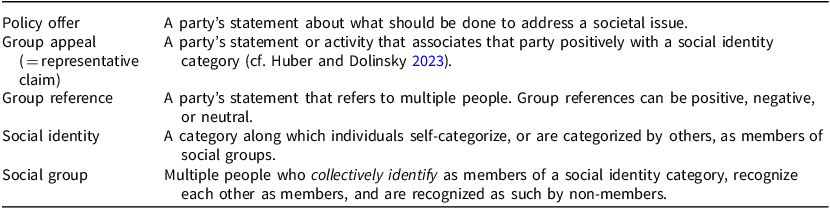
Regarding a new micro-foundation, scholars can turn to the economic models that successfully integrate the core insights of social identity theory (Tajfel and Turner Reference Tajfel, Turner and Austin1979) and self-categorization theory (Turner, Hogg, Oakes et al. Reference Turner, Hogg, Oakes, Reicher and Wetherell1987) (see previous section). On this basis, we suggest that party politics scholars treat voters as having both preferences over policy and desires for self-esteem and self-consistency that are mediated by social identity. Adding the second component would significantly modify existing models, because it implies that voters will forego the ‘closest’ (spatial theory) or ‘most salient’ (saliency theory) policy offer at least some of the time. Furthermore, they also will be influenced by how parties speak to their identification with a particular identity category.
In turn, parties can be expected to attract voters, not just with policy promises, but also with group references and appeals. Speaking positively about groups that voters identify with (while distinguishing them from negatively portrayed out-groups) raises voters’ self-esteem because it makes social comparisons more favorable to the in-group (Fiske Reference Fiske2011). In addition, parties can promise to raise their targeted group’s status through policies once in government, simultaneously addressing policy preferences and expectations to increase self-esteem in the future (Howe, Szöcsik, and Zuber Reference Howe, Szöcsik and Zuber2022).
Policy offers and group appeals do not attract voters through different motivational channels (respectively, their material interests and their need for self-esteem). Parties can influence voters’ policy preferences through group appeals and their self-identification through policy offers. The politics of interest and the politics of identity are thus intimately related, and it would be a mistake to simply add group appeal alongside policy offers without modeling these interrelations. For example, making positive statements about groups they claim to represent and negative ones about potential out-groups can heighten the salience of social conflict, which can slant voters’ preferences towards the typical policy preferences of the in-group and away from those of the out-group (Bonomi, Gennaioli, and Tabellini Reference Bonomi, Gennaioli and Tabellini2021). From this, it follows that parties should emphasize that type of conflict where their potentially supporting groups promise a winning alliance (Chandra and Boulet Reference Chandra, Boulet and Chandra2012; Huber Reference Huber2022). In addition, proposing concrete policy reforms that raise a group’s social status can also make it more attractive for voters to identify with that group (Howe, Szöcsik and Zuber Reference Howe, Szöcsik and Zuber2022), so long as their attributes are not too dissimilar from those marking group membership (Grossman and Helpman Reference Grossman and Helpman2021; Shayo Reference Shayo2009).
Parties can therefore initiate positive feedback cycles. By getting into government, they can raise the status of their core constituency groups, making it more attractive for voters to identify with those groups. The possibility of such feedback cycles suggests that getting a full grip on the temporal dynamics of political competition and representation will be challenging. If parties co-construct their constituencies, the distribution of patterns of self-identification and preferences on the ground changes as the very result of political competition – party strategies and voter preferences as well as their identities stand in an endogenous relationship with one another. Working out the rationale for strategic choices on the supply side will therefore require a back-and-forth between theory-building and more exploratory empirical analyses of how parties combine policy offers and group appeals. It also speaks in favor of integrating constructivist insights into models of issue competition that already endogenize voters’ preferences (e.g., Huber and Haselmayer Reference Huber and Haselmayer2025), instead of spatial models that take them as a given. A dynamic perspective will also require a closer connection between party politics and social movement/interest group studies (e.g., Wonka Reference Wonka2024), since the first organizations to define new constituencies are often not parties, but interest groups.
Finally, the contextual limits on and opportunities for parties’ strategic choices should not be forgotten. From the cleavage literature, we learn that large-scale societal transformations change the distribution of identification patterns on the ground, providing room for the reconfiguration of partisan conflict. From the ethnic politics and nationalism literature, we learn that a return to more visible identity markers can be expected in times of societal change. Political institutions, especially electoral systems, also can make some identity categories easier to mobilize than others (e.g., Chandra Reference Chandra2005). As Halevy’s (Reference Halevy2024) work on enfranchisement in Central Europe shows, the extent to which electoral systems include or exclude different identity groups is itself a result of dominant parties’ strategies. Importantly, the distribution of identity-related attributes itself acts as a constraint. Even though parties can change the meaning of social identity categories through their representative claims, the distribution of attributes among potential voters limits which claims will likely resonate with voters, at least in the short-to-medium run, and especially in the case of visible attributes (Chandra Reference Chandra2012: 16).Footnote 15
The empirical improvement involves measurement. To keep track of party strategies beyond policy, we need to measure their group references, some of which might be interpreted as genuine group appeals. So far, the predominant strategy has been to code electoral manifestos (e.g., Dolinsky Reference Dolinsky2021, Reference Dolinsky2023; Horn, Kevins, Jensen et al. Reference Horn, Kevins, Jensen and van Kersbergen2021; Howe, Szöcsik and Zuber Reference Howe, Szöcsik and Zuber2022; Huber Reference Huber2022; Thau Reference Thau2018, Reference Thau2019, Reference Thau2024). This could be done for more cases and longer time periods, e.g., by systematically recoding the manifestos collected by MARPOR (Volkens, Krause, Lehmann et al. Reference Volkens, Krause, Lehmann, Matthieß, Merz, Regel and Weßels2018). Manifestos also appear as the best source, not just for coding group appeals and policy offers alongside each other, but also for determining the ways in which parties connect the two (e.g., Deiss-Helbig, Guinaudeau, Matthieß et al. Reference Deiss-Helbig, Guinaudeau, Matthieß and Rentrop2024).
The human annotation of manifestos, however, is resource-intensive, one of the reasons why researchers have only covered a limited number of cases so far. It is therefore very promising that scholars are beginning to leverage large language models to automatically identify group mentions in political texts. Once calibrated against the gold standard of human coding, the trained classifiers can generate data on parties’ group references over long periods of time and from larger numbers of documents, including social media posts, as well as across the electoral and the parliamentary domains (Gremler and Haiges Reference Gremler and Haiges2025; Licht and Sczepanski Reference Licht and Sczepanksi2025). Another promising step forward is to include visual material in analyses of how campaigns link policy offers to social identity categories (e.g., Fox Reference Fox2023; Vecchiato and Munger Reference Vecchiato and Munger2025).
Furthermore, scholars doing expert surveys could ask about the core groups parties claim to represent (e.g., Szöcsik and Zuber Reference Szöcsik and Zuber2015) and about the core antagonists they seek to disparage. Finally, mass surveys could ask voters not just about parties’ stances on policy issues and their own identification with social identity categories but also about their perceptions of which party represents which social group (e.g., Bornschier, Haffert, Häusermann et al. Reference Bornschier, Haffert, Häusermann, Steenbergen and Zollinger2024). In doing so, researchers should consider existing supply-side analyses of group appeals so that the identity categories parties evoke in their manifestos are included in surveys and vice versa.
Conclusion
This article argued that ‘policy-only’ models of party competition should be superseded by a new ‘policy-cum-identity’ paradigm informed by social constructivism, one in which interests and identities both play an important role in democratic competition for representative office. We based this assessment on novel contributions from the field of party politics proper and from several neighboring fields: demand-side studies of voting, scholarship on the political mobilization of ethnic and national identity, and political economic models of identity politics. This calls for analyzing parties’ electoral platforms to measure not only their policy positions but also their group appeals. We found several pioneering studies whose authors have done precisely that, contributing an initial set of important insights. Group appeals are (1) a standard and effective element of party communication; (2) not just about ethnicity, nation, race, and gender, the categories commonly associated with so-called ‘identity politics’, but also class and a wide range of other identities; (3) mostly complementary, rather than a substitute for, parties’ policy offers; (4) influenced by the popularity of identity groups among voters and voters’ status concerns, as well as by parties’ ownership of issues connected to certain groups; and (5) more attractive for challenger than for dominant parties.
So far, however, these studies remain exceptions in the broader party politics literature, which still focuses predominantly on what voters want, not who they desire to be. Furthermore, even though they contribute important insights, the limited number of cases analyzed, the lack of conceptual agreement, the disconnection among the diverse explanations suggested, and the absence of theorizing on macro-level causes mean that much important work remains to be done before we reach an account of party competition that is up to speed with empirical realities.
We have therefore recommended coherent conceptual distinctions, inspired by the ethnic politics literature, and a micro-foundation for a new ‘policy-cum-identity’ paradigm to guide future studies of parties and elections. While we could only sketch its outlines here, we are optimistic that it will be expanded and refined in upcoming years. This is because taking identities more seriously ties in with a broader shift in political science away from purely economic models and towards more realistic accounts grounded in social psychology. Such accounts recognize that choice involves both preferences and dispositions (i.e., values and identities) (Chong Reference Chong2000; Zuber Reference Zuber2022), and that it sometimes corresponds with and at other times goes ‘beyond rationality’ (Mintz, Valentino, and Wayne Reference Mintz, Valentino and Wayne2021).
This paradigm shift, however, also reveals normative challenges. If voters’ interests and identities are at least partly endogenous to party strategies, how do we tell democratic representation from electoral manipulation? While an answer to this question is beyond the scope of this article, we want to at least point readers to relevant developments in the political theory of representation. That field has recently taken its own ‘constructivist turn’ (Disch Reference Disch2015). In a decisive shift away from Pitkin’s (Reference Pitkin1967) more static conception of representation, theorists now define representation as a dynamic interaction of claim-making and claim-acceptance, through which voters’ identities, interests, and preferences are shaped (Disch Reference Disch2011, Reference Disch2015, Reference Disch2021; Saward Reference Saward2006, Reference Saward2010; Wolkenstein Reference Wolkenstein2021). On this account, representation is successful if the represented accept the representative claims made by (or on behalf of) the representative, not because the latter acts in accordance with the fixed interests of some predefined constituency (cf. Dolinsky Reference Dolinsky2023). The institutional and other conditions under which such acceptance becomes meaningful are questions that normative and empirical scholars of representative democracy should address together.
Data availability statement
Non applicable.
Acknowledgements
We thank Catherine Frost, Karen Bird, Adrienne Davidson, and other participants at the Research in Progress Seminar of the Department of Political Science at McMaster University, Canada (22 September 2022), for a very constructive discussion of early ideas for this article. More developed drafts received excellent comments by Nicole Bolleyer, Valentin Daur, Simon Franzmann, Mirko Wegemann, and Delia Zollinger, and very helpful feedback from participants of the ECPR Joint Sessions of Workshops in Toulouse (25–28 April 2023); a workshop on Current Perspectives on Party Competition at the MZES Mannheim (8–9 February 2024); the Democracy Seminars at the University of Mainz (8 February 2024); the Comparative Politics group at the LMU Munich (5 June 2024); and the German Political Science Association’s triannual conference at the University of Göttingen (24–27 September 2024). We would also like to thank the audience at the 2023 Michigan Political Science Association Annual Conference (20 October 2023) and discussants Jose Antonio Cheibub and Matthew James Geras at the 81st Annual Meeting of the Midwest Political Science Association (7 April 2024) for their helpful comments on a related paper, and Anna Schleiter Nielsen for her support in checking all references. Finally, comments by four reviewers commissioned by the EJPR have allowed us to improve this article during the submission stage and are very gratefully acknowledged.
Funding statement
Parts of Christina Zuber’s research for this article were supported by a Faculty Research Exchange Grant of the Ontario Baden-Württemberg Program, funded by the Ministerium für Wissenschaft, Forschung und Kunst Baden-Württemberg.
Competing interests
The authors declare to have no conflict of interest related to this article.
Ethical approval
Not applicable.
Informed consent
Not applicable.

 Open access

