

1. Introduction
Latin America is the most violent region in the world and suffers from high levels of crime, in large part driven by powerful criminal organizations. In response, governments across the region are increasingly turning to militarized enforcement policies (Flores-Macías and Zarkin, Reference Flores-Macías and Zarkin2021). Yet, these policies have generally backfired and exacerbated violence, displaced crime, and triggered criminal wars (e.g., Calderón et al., Reference Calderón, Robles, Díaz-Cayeros and Magaloni2015; Dell, Reference Dell2015; Osorio, Reference Osorio2015; Durán-Martínez, Reference Durán-Martínez2017; Lessing, Reference Lessing2017; Alcocer, Reference Alcocer2024a; Blair and Weintraub, Reference Blair and Weintraub2023). Identifying government responses that improve citizen security is therefore imperative.
A leading argument is that increasing intergovernmental coordination helps the state combat violence, crime, and criminal organizations. These studies generally argue that intergovernmental coordination on security issues improves with vertical political alignment, which results in better security outcomes in politically aligned municipalities (Rios, Reference Rios2015; Trejo and Ley, Reference Trejo and Ley2016; Durán-Martínez, Reference Durán-Martínez2017; González and Cáceres, Reference González and Cáceres2019; Alberti et al., Reference Alberti, Díaz-Rioseco and Visconti2022). Alternatively, other scholars have found that this vertical alignment and coordination on security policy can increase violence (Dell, Reference Dell2015).
Yet, existing studies have limited their focus to party politics and overlooked other factors that improve intergovernmental coordination on security issues. Moreover, due to data constraints, they have yet to empirically test whether and how it impacts organized crime. This article contributes to the literature by analyzing whether improving intergovernmental coordination between enforcement agencies helps the state combat criminality and organized crime. This article follows the theoretical insights of Durán-Martínez (Reference Durán-Martínez2017), who argues that a state's “[e]nforcement efficacy depends on the ability to coordinate state actions against crime, and thus should increase as power within the security apparatus becomes more cohesive” (12). However, while Durán-Martínez (Reference Durán-Martínez2017) focuses on a multi-pronged concept of state coordination that includes enforcement and political factors, this study focuses specifically on the role of coordination between enforcement agencies.
Empirically, this study looks at Mexico, a country with powerful criminal organizations and where levels of criminality are particularly high. I leverage original data on the staggered implementation of a police reform that increased coordination between local and state police agencies to counteract organized crime and reduce high-impact crimes in the state of Guanajuato, detailed panel data on cartel activity in the state between 2000 and 2021, and monthly crime and violence data. Using the generalized synthetic control (GSC) method (Xu, Reference Xu2017), I find that increasing intergovernmental police coordination weakens cartel presence, reduces the number of cartels, and curtails cartel wars. I also find that it reduces violent theft rates, but simultaneously increases both overall homicide rates and cartel-related homicide rates.
This paper makes three main contributions. Substantively, it extends the argument that intergovernmental coordination can help address criminality to include police coordination. Methodologically, this is the first study investigating the effect of intergovernmental coordination using quantitative data on organized crime and the GSC method. Finally, the results provide nuance to the conventional wisdom that government enforcement efforts against criminal organizations are ineffective or counterproductive.
2. Context
Mexico is a federal system with three levels of government (federal, state, and municipal), each with its own police forces. Through the early 2000s, violence by criminal organizations, known as “cartels” in Mexico, began to rise. In response, the newly elected president declared war against cartels in December 2006 and deployed thousands of federal troops throughout the country, which significantly increased crime, violence, and cartel wars (e.g., Calderón et al., Reference Calderón, Robles, Díaz-Cayeros and Magaloni2015; Dell, Reference Dell2015; Osorio, Reference Osorio2015; Lessing, Reference Lessing2017; Alcocer, Reference Alcocer2024a).
This raised serious concerns about the effectiveness of local police, heterogeneity of local policing practices, and poor intergovernmental coordination between police departments (Guerrero-Gutiérrez, Reference Guerrero-Gutiérrez2011; Domínguez Ramos, Reference Domínguez Ramos2018). To address these shortcomings, two police reforms, called Unique Command (Mando Unico) and Mixed Police Command (Mando Policial Mixto), were proposed in congress between 2010 and 2014 that sought to increase coordination between local and state police to counteract organized crime and reduce high-impact crimes (Instituto Belisario Domínguez, 2015).Footnote 1 Despite receiving significant public attention, both proposals were unsuccessful in advancing beyond their congressional committees.
Nevertheless, they served as templates for various states and municipalities that independently decided to implement them. By the 2018, 71.5 percent of Mexico's 2457 municipalities had implemented some version of the police reform (López, Reference López2018). However, the lack of a federal mandate means that its implementation has been decentralized and uneven geographically, temporally, and in kind, and consequently, no dataset exists identifying where, when, or how the police reform has been implemented.
3. Case and data
This paper focuses on Guanajuato, a state in central Mexico with historically low levels of criminality and no significant cartel presence. In 2008, cartels began entering the state, causing crime and violence to increase substantially. Starting in 2014, some municipalities began adopting police reforms to increase intergovernmental police coordination hoping to counteract cartels.Footnote 2 Since then, 21 of its 46 municipalities adopted some form of the reform.Footnote 3 Six municipalities implemented Unique State Command (Mando Unico Estatal or MUE), where local police were disbanded and the state police took over local policing and are therefore excluded from the analysis.
The reform analyzed here is named Unique Police Command (Mando Unico Policial or MUP), which was explicitly intended to improve coordination between state and local police forces. The reform entails local governments continuing to hold administrative and financial power over local police but handing operational command to state police through the appointment of a member of the state police as police chief. As the governor stated in 2014, “[the new police chief's] principal function will be to coordinate the operations of the local corporation [with the state police]” (EsloCotidiano, 2014). Moreover, MUP formally establishes guidelines, protocols, and provisions to integrate and coordinate work and operations by, among others, sharing information, processes, responses, resources, and equipment. For example, state and municipal police departments merge radio frequencies, consolidate emergency communications centers, and receive training on coordination. As a local mayor stated when implementing MUP: “[t]here was a meeting between local police, transit police, state police, the Red Cross, and firefighters precisely to talk about the topic of coordination… this has allowed us to ensure that MUP has optimal communication and coordination to attend reports together with the emergency agencies” (Redacción, 2022).Footnote 4
I introduce the data used in the analysis below. Descriptive statistics for all variables are shown in Appendix Table A2.
3.1. Treatment: police reform increasing intergovernmental coordination
Data on which municipalities have implemented the reform and when does not exist. Due to this data constraint, this article focuses on the central state of Guanajuato. Drawing on information from municipal and state government official documents, statements by government officials reported in media outlets, journalistic reports, and news articles, I create a hand-coded dataset identifying which municipalities adopted MUP and when it was implemented. For each municipality, I identify (1) whether it adopted MUP or MUE at any point, (2) if it did, the month and year of implementation, (3) if it rescinded MUP or MUE, the month and year it did so, (4) if it re-implemented MUP or MUE, the month and year it did so, and (5) if it changed from MUP to MUE or the inverse, the month and year it did so. The resulting data are a municipality-month panel dataset identifying the months, if any, that each municipality had MUP or MUE. In this study I focus on MUP and exclude the municipalities that implemented MUE since it does not entail intergovernmental coordination. For the analysis on the effect of MUP on cartel activity, which is measured at the municipality-year level, this dataset is also aggregated to the municipality-year level.Footnote 5
3.2. Dependent variable: criminal governance
To analyze whether MUP impacted cartels, I use data on the population of cartels in Guanajuato from Alcocer (Reference Alcocer2024b). This dataset collects detailed information on the population of cartels operating in Guanajuato between January 2000 and December 2021, and was created using extensive qualitative research and fieldwork.Footnote 6
For this study, I rely on three measures from this dataset. First, to measure the strength of cartel presence, I use the measure of how well established each cartel is in a given municipality per year (no presence < cell presence < weak presence < strong presence) and identify the strongest presence in each municipality-year. Second, cartel number is a simple count of the number of cartels operating in a municipality per year. Third, I measure cartel wars by using the group-dyad and geographic presence data to identify municipality-years where cartels are actively fighting over a municipality.Footnote 7
3.3. Dependent variable: crime and violence
To analyze the effect of MUP on crime, I use official data on two of the most prevalent types of crimes in Mexico: theft and homicides. First, I use data on the monthly incidences of crime per municipality from the National Public Security System and on population from the 2010 census to create two variables: (1) monthly rates of violent theft per 100,000 inhabitants, and (2) monthly rates of nonviolent theft per 100,000 inhabitants. Data for these crimes are available from January 2011 to December 2021.
Second, I use monthly mortality data from Mexico's Statistical Agency to measure homicide prevalence in two ways. First, I use all homicides to calculate the monthly homicide rate for each municipality from January 2000 to December 2020. Second, Calderón et al. (Reference Calderón, Robles, Díaz-Cayeros and Magaloni2015) show that homicides of young men (males between the ages of 15 and 39) correlate highly, temporally, and geographically, with homicides perpetrated by cartels. I therefore use the homicide rate of young men for each municipality from January 2000 to December 2020 to measure cartel-related homicides.
3.4. Controls
To control for intergovernmental coordination due to party politics, I use local- and state-level election data from Magar (Reference Magar2018) and create three dummy variables: whether the mayor shares political affiliation with (1) only the governor, (2) only the president, and (3) both the governor and the president.
Implementing MUP may affect the capacity of police, so I control for the number of individuals at the municipal level assigned to public security. The data come from federal censuses of local governments conducted in 2011, 2013, 2015, 2017, 2019, and 2021 and imputed values for the missing years. Election cycles have been shown to be critical for cartel activity (e.g., Albarracín, Reference Albarracín2018; Trejo and Ley, Reference Trejo and Ley2020), so I control for election years. Finally, cartels in Guanajuato primarily fight over the illicit oil theft market (Alcocer, Reference Alcocer2024a), so I control for municipalities with oil pipelines.
For the models estimating the effect of the police reform on crime and violence, I also use the data on cartels from Alcocer (Reference Alcocer2024b) as control variables since cartel dynamics tend to drive criminality. I use four control variables: (1) the number of cartel cells operating in a municipality, (2) the number of cartels with weak presence in the municipality, (3) the number of cartels with strong presence in the municipality, and (4) a dummy variable denoting whether two or more cartels were actively fighting over the municipality.
4. Research design
Estimating the effect of the police reform on public security outcomes is not straightforward given that criminality likely plays a role in whether and when municipalities chose to adopt the reform, so the difference-in-differences’ (DID) parallel trends assumption is unlikely to hold.Footnote 8
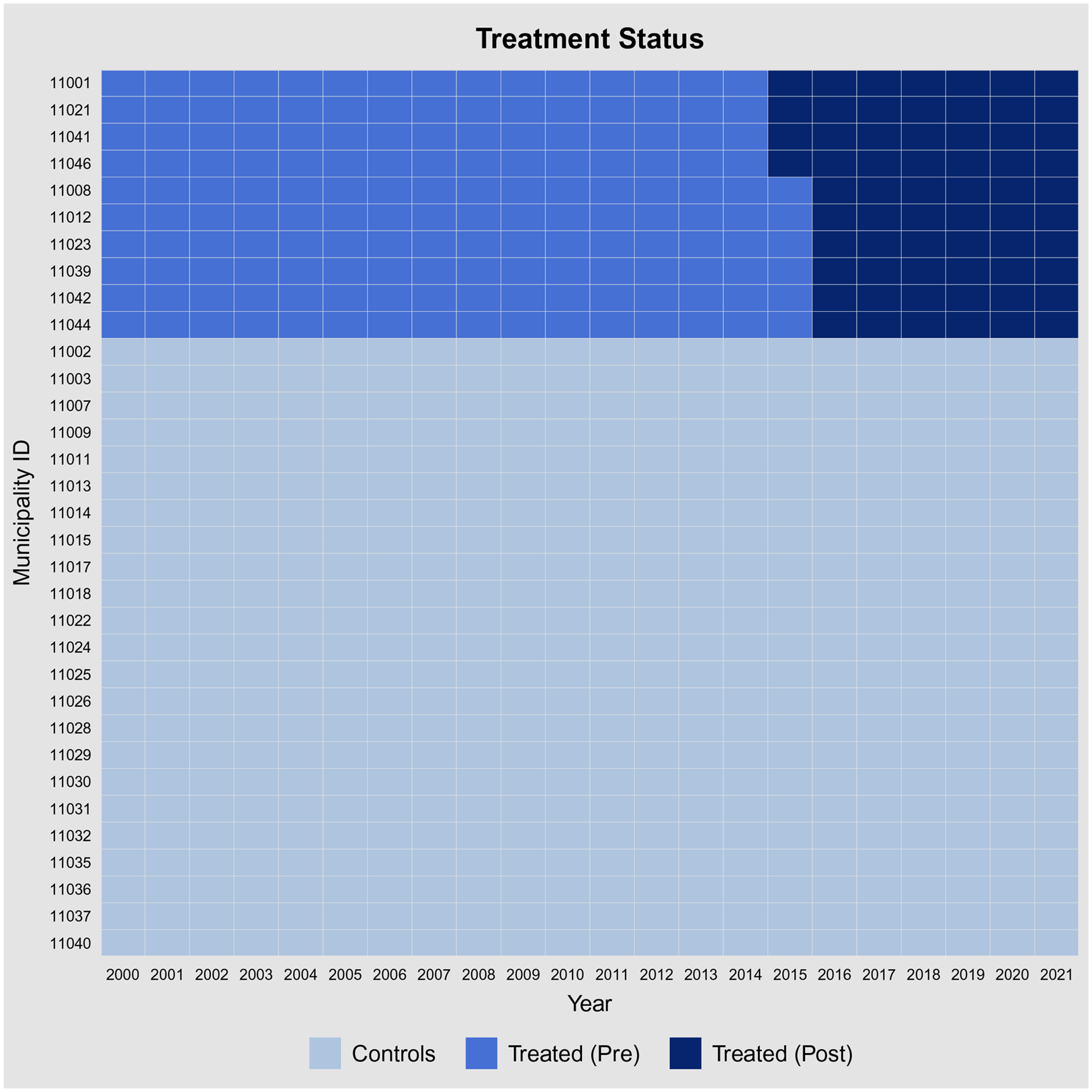
To address this concern, this study uses the GSC method (Xu, Reference Xu2017), which builds on the synthetic control method (Abadie et al., Reference Abadie, Diamond and Hainmueller2010, Reference Abadie, Diamond and Hainmueller2015) and the interactive two-way fixed effects model (Bai, Reference Bai2009). GSC allows the estimation of the average treatment effect on the treated (ATT) of a staggered treatment on an outcome. The GSC method creates counterfactuals for treated units by using pre-treatment observations to weight control units so they look similar to the treated units and pre-treatment outcome trends approximate each other. Appendixes 3 and 4 discuss in detail how the treated and control groups were selected and show the timing that each treated unit received treatment. Figure 1 shows the treatment status of the units in the sample across time for the annual data. GSC has clear advantages over other approaches in this case. First, it allows for nonrandom interventions with staggered adoption, relaxes the parallel trends assumption required by DID, generalizes the synthetic controls method to allow multiple treated units, works well when there is a small number of treated units, and allows for treatment effect heterogeneity across units.
Treatment assignment by municipality for municipality-year analysis.
I estimate two separate models since the data on cartel presence is at the municipality-year level, while the data on crime are at the municipality-month level. All models are estimated using the following specification:

where Y it denotes the outcome of interest in municipality i at time t, D it is the treatment indicator that takes on the value of 1 for municipalities that adopted the police reform once they implemented the reform and 0 otherwise, δ it estimates the heterogeneous treatment effect on municipality i at time t, $X^{'}_{{ it}}$ is a vector of observed covariates, $\lambda ^{'}_i$
 is a vector of unknown factor loadings, f t denotes a vector of unobserved common factors, and $\epsilon _{{ it}}$
 are the error terms for municipality i at time t. The interactive two-way fixed effects also control for any additional common shocks and unobserved time-invariant and time-varying covariates. The number of factors is selected using a cross-validation procedure that minimizes the mean square prediction error. Standard errors are estimated using bootstrapping with 1000 runs. All models are estimated using the expectation maximization algorithm.
For the analysis estimating the effect on cartels, t denotes years, Y it denotes different measures of cartel presence, and $X^{'}_{{ it}}$ includes controls for sociodemographic characteristics, illicit markets, local police capacity, and political factors.
For the models estimating the effect on crime and violence, Y it denotes different measures theft and homicides, t denotes months for Y it and D it, and $X^{'}_{{ it}}$ includes municipality-specific controls for cartel presence, sociodemographic characteristics, illicit markets, local police capacity, and political factors.
5. Results
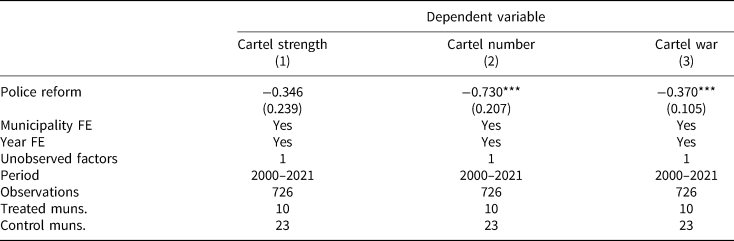
Tables 1 and 2 show the average ATT over all time periods for increased intergovernmental coordination on different measures of cartel presence and crime and violence, respectively. Figures 2 and 3 plot both the average outcomes of the treatment and synthetic control units before and after the implementation of MUP to show parallel trends (first column), and the ATT per period with 95 percent confidence intervals to visualize the effect over time (second column).Footnote 9
ATT of increased intergovernmental coordination on cartels averaged across treatment period
Note: Bootstrapped standard errors from 1000 samples.
*p<0.1; **p<0.05; ***p<0.01.
ATT of increased intergovernmental coordination on crime rates averaged across treatment period
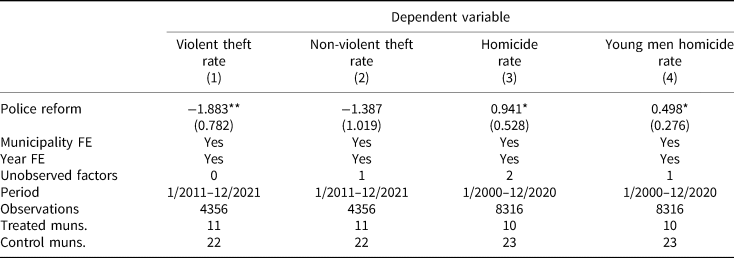
Crimes measured per 100,000 inhabitants.
Note: Bootstrapped standard errors from 1000 samples.
*p<0.1; **p<0.05; ***p<0.01.
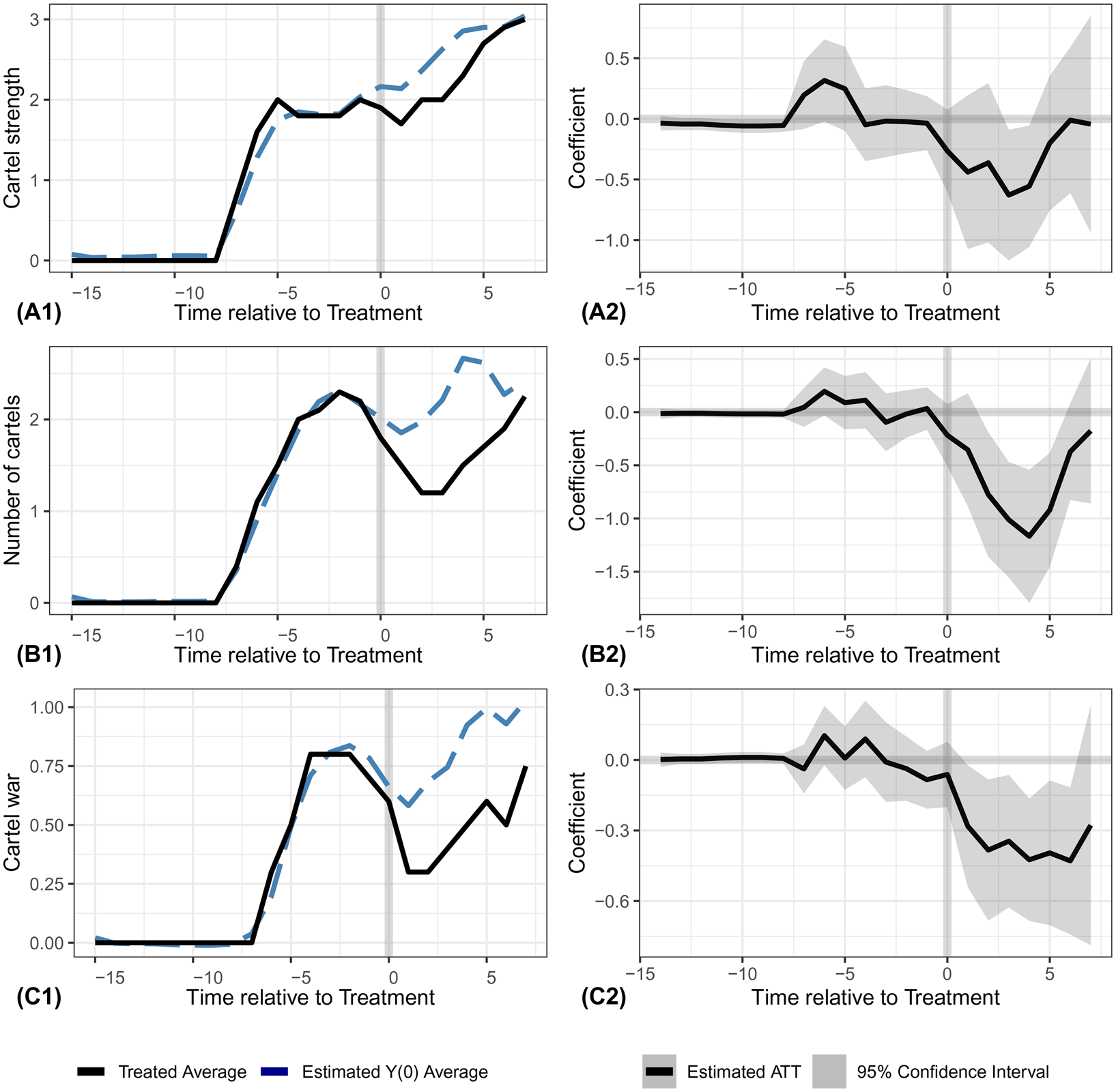
Average outcome trends for treated and synthetic control groups (left column) and ATT of police reform increasing intergovernmental coordination on cartels with 95 percent confidence intervals (right column). (A1, A2) Cartel strength, (B1, B2) number of cartels, and (C1, C2) cartel war.
Average outcome trends for treated and synthetic control groups (left column) and ATT of police reform increasing intergovernmental coordination on crime and violence with 95 percent confidence intervals (right column). (A1, A2) Violent theft rate, (B1, B2) nonviolent theft rate, (C1, C2) homicide rate, and (D1, D2) cartel-related homicide rate.
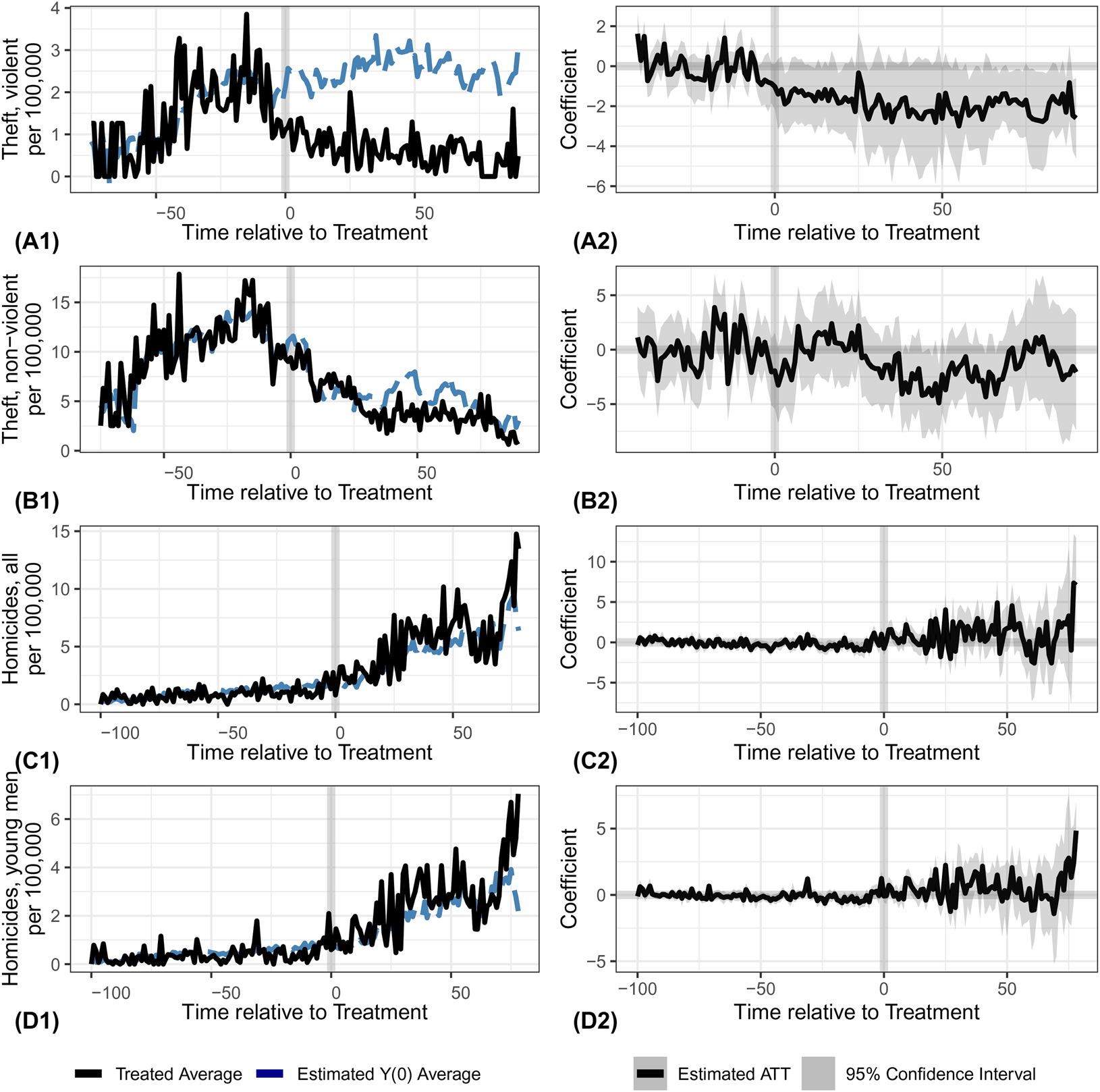
Table 1 shows that the effect of MUP on the strength of cartel presence is negative but not statistically significant. However, MUP does decrease the number of cartels operating in municipalities by almost three quarters of a cartel, which is a 0.65 standard deviation (SD) decrease. Moreover, MUP also decreased the prevalence of cartels wars by 37 percent. Looking at the effects over time in Figure 2, I find that MUP decreases the strength of cartel presence, though these results are only statistically significant the third and fourth years after its implementation, the number of cartels by the second year and cartel wars within a year. Yet, while the effect on cartel wars appears to hold after five years, the effects on cartel strength and number of cartels is lost after five and six years, respectively.
Table 2 shows that MUP decreased violent theft rate by −1.88 per 100,000, which corresponds to a reduction of 0.66 SDs. Second, estimates suggest that MUP increases both overall homicide rates and cartel-related homicide rates by 0.94 and 0.5 per 100,000 (an increase of 0.22 SDs), respectively, and these results are statistically significant at the 0.1 level. Looking at the temporal effects in Figure 3, I find that MUP has an almost immediate negative—by the third month—and lasting effect on violent theft. However, MUP only reduces nonviolent theft after three years and reverts back to no effect after four years. The effects on homicides and cartel-related homicides are also quick, with a positive statistically significant effect after two months. Yet, this effect mostly disappears after about 3.5 years.
6. Discussion
The motivation behind increasing intergovernmental police coordination in Mexico was to combat organized crime and reduce high-impact crimes. I find that MUP decreased cartel presence and violent crime but increased homicides, thought the effects fade after three to four years. Some experts claim that adopting MUP drove municipalities to lower investments in municipal police, reducing their capacity. Simultaneously, cartels likely gradually learned to circumvent MUP. This period also coincides with the 2018 election where a new governor and mayors took office, which may have impacted MUP. Moreover, MUP entailed increasing coordinated police operations against high-impact crimes that targeted hotspots and cartel members. This seems to have successfully reduced cartels’ ability to operate and perpetrate violent crimes. Yet, like other enforcement efforts, MUP triggered a violent response. This may be due to increased violence against the state, intensified (though fewer) cartel wars, and magnified pressures to control local drug dealing. These mixed results may explain why some advocates defend the reform while opponents deem it a failure.
The findings contribute to ongoing debates. First, they run counter to most studies arguing that better intergovernmental coordination reduces violence and are instead consistent with findings that government enforcement policies targeting criminal organizations generally increase violence. Second, the results add nuance by showing that intergovernmental coordination on security issues can help the state combat violent crime and criminal governance. More broadly, the results suggest that intergovernmental coordination may be one important aspect of improving governance and citizen security in violent contexts, though it is clearly not a panacea.
Supplementary material
The supplementary material for this article can be found at https://doi.org/10.1017/psrm.2024.31. To obtain replication material for this article, https://dataverse.harvard.edu/dataset.xhtml?persistentId=doi:10.7910/DVN/PBTTDM&version=DRAFT.
Data
Replication material for this article can be found at https://doi.org/10.7910/DVN/PBTTDM.
Acknowledgments
I thank Kaitlyn Chriswell, Jessica Zarkin, Elena Barham, Oscar Pocasangre, Megan Erickson, Hannah Barron, Omar García-Ponce, participants of the 2023 Public Choice Society conference panel on Crime, Conflict, and Policing, and two anonymous reviewers. I am grateful to Lucienne Arrigoni for her research assistance.
Competing interests
None.


 Open access

