


1. Introduction
The recognition that the primary long-run goal of monetary policy should be price stability has led to inflation targeting in advanced economies. Moreover, a large number of emerging and developing economies have switched from exchange rate targeting to inflation targeting, and many other countries are moving toward this monetary policy strategy. Most inflation targeting central banks adopted a 2% inflation target, but during the coronavirus pandemic, the Federal Reserve in the USA switched to a new monetary policy strategy that involves targeting an average inflation rate of 2%. After the adoption of inflation targets, and until the coronavirus pandemic, inflation rates declined in most countries around the world.
Background. However, as can be seen in Fig. 1(a) and (b), in the aftermath of the coronavirus pandemic in early 2021, inflation rates started to rise dramatically in advanced and emerging economies, respectively. In most economies, they are now far above their pre-Covid-19 levels and central banks are flagrantly missing their inflation targets. Central banks in advanced economies including the Federal Reserve, the European Central Bank, the Bank of England, and the Bank of Canada did not anticipate the inflation. They thought that there would be no inflation. When inflation appeared, they thought that it would only be temporary. Now that inflation is persistent, and they think that it is because of supply-chain problems, higher oil prices, and tight labor markets.
Inflation rates (year over year) for the G7 and EM7 countries.

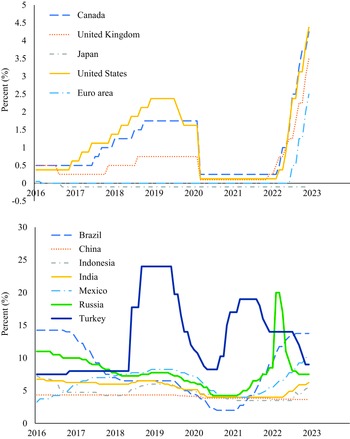
Central banks, being behind the curve in the aftermath of the coronavirus pandemic, are now trying to fight inflation, anchor inflation expectations, and restore credibility. This involves quantitative tightening as well as unprecedented increases in their policy rates, as can be seen in Fig. 2(a) and (b) for advanced and emerging economies, respectively. In the USA, for example, the Fed increased the policy rate six straight times from 0.25%–0.5% in March 2022 to 4.25%–4.5% in December 2022. In Canada, the Bank of Canada also increased its policy rate six times, from 0.25% in March 2022 to 4.25% in December 2022. The aggressive monetary tightening leads to higher interest rates and is designed to introduce slack in economies that have changed significantly after the global financial crisis and (to a larger extent after) the coronavirus pandemic.
Policy rates for the G7 and EM7 countries.

One feature that jumps out from Figs. 1(a) and (b) and 2(a) and (b) is that central banks in advanced economies were behind the curve in the aftermath of the coronavirus pandemic and kept their policy rates at the lower bound during a period when inflation started to rise dramatically. However, central banks in some emerging economies began raising policy rates ahead of advanced economies. For example, Brazil’s central bank raised the policy rate by 75 basis points in March 2021, over a year before central banks in advanced economies started raising rates. This raises interesting questions about the conduct of monetary policy in advanced and emerging economies, given that the mainstream approach to monetary policy in inflation targeting (advanced and emerging) economies is based on the new Keynesian model and is expressed in terms of interest rate rules of the type proposed by Taylor (Reference Taylor1993).
Recently, De Leo et al. (Reference De Leo, Gopinath and Kalemli-Özcan2022) in revisiting the question of the cyclical behavior of monetary policy in emerging economies, argue that the conventional wisdom [originating in Kaminsky et al. (Reference Kaminsky, Reinhart and Vegh2005) and Vegh and Vuletin (Reference Vegh and Vuletin2013)] that holds that monetary policy in emerging economies is procyclical, unlike in advanced economies in which it is countercyclical, is based on the use of market interest rates (such as money market rates or Treasury rates) to proxy for the stance of monetary policy. They argue that market interest rates can give misleading results because they conflate monetary policy stance and (time-varying) risk premia priced in by the markets. Using panel data for a large sample of countries, they show that the conduct of monetary policy in emerging markets is not fundamentally different from that in advanced economies, once risk premia and actual policy rates are separately measured.
This raises the question of how could central banks in emerging market countries shift from procyclical to countercyclical monetary policy. It has been argued that strong economic fundamentals, financial sector reforms, and mostly the adoption of explicit and transparent monetary policy frameworks such as inflation targeting facilitated the conduct of countercyclical monetary policy. Under a monetary policy of inflation targeting, price stability is the primary long-run objective of monetary policy. Inflation targeting involves several elements, including the public announcement of numerical values of the inflation targets, an institutional commitment to price stability as the primary, long-run goal of monetary policy, increased transparency in policymaking (through regular communication with the public and the markets), and increased accountability of the central bank to the public and the government for attaining its inflation objectives.
Contribution. We investigate monetary policy behavior in advanced and emerging economies: the G7 countries—Canada, France, Germany, Italy, Japan, the UK and the USA—and the EM7 countries—Brazil, China, India, Indonesia, Mexico, Russia and Turkey. We use quarterly time series data for each country and focus specifically on the following questions: Do central banks adjust their policy rates according to interest rate rules, such as the ones put forward by Taylor (Reference Taylor1993, Reference Taylor1999), responding to changes in both the inflation rate and macroeconomic conditions such as the output gap? Is the policy rate a good measure of the stance of monetary policy or is the stance of monetary policy best represented by money supply movements? In doing so, we also investigate the cyclical behavior of monetary policy variables (interest rates and the money supply) and whether the conduct of monetary policy in emerging economies is different from that in advanced economies.
Regarding the cyclical behavior of monetary policy variables, we present a comprehensive investigation in the context of the Kydland and Prescott (Reference Kydland and Prescott1990) methodology. In particular, we examine the cyclical behavior of the monetary policy variables (interest rates and the money supply), using the Hamilton (Reference Hamilton2018) regression filter to extract cyclical components. We show that in general policy rates in both advanced and emerging economies are countercyclical, but the money supply appears to be acyclical. We also investigate the robustness of our results to the use of market rates—money market rates and Treasury rates—and show that the cyclical behavior of market rates is generally similar to that of policy rates.
Having established the nominal stylized facts, we next investigate the information content of policy rates and the money supply in predicting real economic activity across advanced and emerging economies. This is done in the context of two classes of empirical models—Granger causality tests and a forecasting regression. We test for Granger causality running from policy rates and the money supply to real output and investigate whether the predictive power of money tends to be absorbed by the interest rate, as noted by Sims (Reference Sims1980) and Litterman and Weiss (Reference Litterman and Weiss1985). In addition, we use a forecasting regression to ascertain whether policy rates and the money supply can help predict future levels of economic activity in advanced and emerging economies. We also investigate the robustness of our results to data transformations (i.e., on whether the data are in log levels or growth rates). We find that in the G7 countries interest rates are more informative for predicting real output relative to the money supply, but in the EM7 countries the money supply is relatively more informative than interest rates.
Finally, we estimate central bank reaction functions to assess whether monetary policy acts countercyclically or procyclically and whether it is different across advanced and emerging economies. Since inflation targeting central banks conduct monetary policy using interest rate rules, our reaction functions describe the endogenous response of the central bank’s policy rate to the inflation rate and the output gap. We also allow for policy smoothing, thus addressing the issue of significant inertia in the policymaking process around the world. Consistent with the conventional wisdom, we find that monetary policy has generally been countercyclical in advanced economies, but that monetary policy behavior in emerging economies does not point to countercyclical policy.
Layout. The rest of the paper is organized as follows. Section 2 discusses the data. Section 3 describes the Kydland and Prescott (Reference Kydland and Prescott1990) methodology and the Hamilton (Reference Hamilton2018) filter that we use in our investigation of the cyclicality of monetary policy variables. The results of the cyclical correlation analysis are also presented in this section. Sections 4 and 6 provide an investigation of the information content of policy rates and money supply measures in the context of Granger causality tests and a forecasting regression, respectively. In Section 7, we estimate central bank reaction functions to investigate whether central banks conduct monetary policy in accordance with Taylor-type interest rate rules and whether the conduct of monetary policy in advanced economies is fundamentally different from that in emerging economies. The final section briefly concludes regarding the implications of our research for the conduct of monetary policy in advanced and emerging economies.
2. The data
We use quarterly time series data for each of the G7 and EM7 countries. Appendix Table A1 shows the sample period for each country. Generally, the sample period is dictated by the availability of the data. As shown in Appendix Table A1, for all of the G7 countries the sample period is from 1990:q1 to 2022:q3 and for the EM7 countries the sample period is generally from 1995:q1 to 2022:q3. In general, the sample period begins a bit earlier than when inflation targeting was adopted and includes the global financial crisis as well as the coronavirus pandemic. In this regard, Canada adopted inflation targeting in 1991, the UK in 1992, the eurozone in 1999, the USA in 2012, and Japan in 2013. Regarding the EM7 countries, Brazil adopted inflation targeting in 1999, Mexico in 2001, Indonesia in 2005, Turkey in 2006, and India and Russia in 2015; China is mostly managing the quantity of money.
The data are from different sources as shown in Appendix Table A2. Our measure of output is real GDP from the IMF International Financial Statistics, the OECD Monthly Monetary and Financial Statistics, and the GlobalEconomy.com (https://www.theglobaleconomy.com). Our measure of the money supply is the M3 monetary aggregate obtained from the IMF International Financial Statistics, theGlobalEconomy.com, and in some cases directly from the relevant central bank websites. We obtain the Consumer Price Index (CPI) series from the Bank for International Settlements (BIS).
We use the monetary policy rates series recently constructed by the BIS. It is to be noted that the information on policy rates is provided by the national central banks to the BIS, which in turn reports the specific interest rate that each national central banks considers as the monetary policy rate. We also use two market rates—the money market rate and the Treasury bill rate—thus speaking to the debate on whether market rates are a good proxy for the stance of monetary policy. In this regard, recently De Leo et al. (Reference De Leo, Gopinath and Kalemli-Özcan2022) argue that “the common practice of using market rates, such as government bond rates, to proxy for the stance of monetary policy leads one to draw inaccurate conclusions about emerging economies’ monetary policy cyclicality due to inherent risk premia in those market rates.” The sources of the money market rates and the Treasury bill rates are the IMF International Financial Statistics, the St. Louis Fed FRED database, or national sources retrieved from Bloomberg.
3. Nominal stylized facts
To investigate the empirical regularities of monetary policy variables in advanced and emerging economies, we use the methodology suggested by Kydland and Prescott (Reference Kydland and Prescott1990) and Hamilton’s (Reference Hamilton2018) regression filter to extract the cyclical components. In particular, for a nonstationary time series, $z_{t}$
, with quarterly data, Hamilton (Reference Hamilton2018) suggests an ordinary least squares (OLS) regression of
$z_{t}$
, with quarterly data, Hamilton (Reference Hamilton2018) suggests an ordinary least squares (OLS) regression of $z_{t}$
on a constant and four lags of itself shifted 8 quarters back, as follows:
$z_{t}$
on a constant and four lags of itself shifted 8 quarters back, as follows:
 \begin{equation*} z_{t}=\beta _{0}+\beta _{1}z_{t-8}+\beta _{2}z_{t-9}+\beta _{3}z_{t-10}+\beta _{4}z_{t-11}+v_{t}\text {.}\end{equation*}
The regression residuals, $\hat{v}_{t}$
,
$\hat{v}_{t}$
,
 \begin{equation*} \hat {v}_{t}=z_{t}-\hat {\beta }_{0}-\hat {\beta }_{1}z_{t-8}-\hat {\beta }_{2}z_{t-9}-\hat {\beta }_{3}z_{t-10}-\hat {\beta }_{4}z_{t-11}\end{equation*}
provide the cyclical component of the series. We can then investigate whether the cyclical component of the variable that captures the stance of monetary policy (the policy rate, $R_{t}$
, or the money supply,
$R_{t}$
, or the money supply, $M_{t}$
) is correlated with the cyclical component of real output,
$M_{t}$
) is correlated with the cyclical component of real output, $\tilde{y}_{t}$
.
$\tilde{y}_{t}$
.
We measure the degree of cyclical comovement by the monetary policy variable, $x_{t}$
, with real output,
$x_{t}$
, with real output, $y_{t}$
, by the magnitude of the correlation coefficient:
$y_{t}$
, by the magnitude of the correlation coefficient:
 \begin{equation*} \rho (x_{t},y_{t+j}),\quad \text { for }j=-8,-4,-3,-2,-1,0,1,2,3,4,8\text {.}\end{equation*}
where $x_{t}$
can be either the policy rate,
$x_{t}$
can be either the policy rate, $R_{t}$
, or the money supply,
$R_{t}$
, or the money supply, $M_{t}$
. The correlation coefficient,
$M_{t}$
. The correlation coefficient, $\rho (x_{t},y_{t})$
gives information on the degree of contemporaneous comovement. If
$\rho (x_{t},y_{t})$
gives information on the degree of contemporaneous comovement. If $\rho (x_{t},y_{t})\gt 0$
, we say that
$\rho (x_{t},y_{t})\gt 0$
, we say that $x_{t}$
is procyclical, if
$x_{t}$
is procyclical, if $\rho (x_{t},y_{t})\lt 0$
, we say that
$\rho (x_{t},y_{t})\lt 0$
, we say that $x_{t}$
is countercyclical, and if
$x_{t}$
is countercyclical, and if $\rho (x_{t},y_{t})=0$
, we say that
$\rho (x_{t},y_{t})=0$
, we say that $x_{t}$
is acyclical. The cross-correlation coefficient,
$x_{t}$
is acyclical. The cross-correlation coefficient, $\rho (x_{t},y_{t+j})$
for
$\rho (x_{t},y_{t+j})$
for $j\neq 0$
, gives information on the phase shift of
$j\neq 0$
, gives information on the phase shift of $x_{t}$
. If the absolute value of
$x_{t}$
. If the absolute value of $\rho (x_{t},y_{t+j})$
is maximum for a positive, zero, or negative
$\rho (x_{t},y_{t+j})$
is maximum for a positive, zero, or negative $j$
, we say that
$j$
, we say that $x_{t}$
is leading the cycle by
$x_{t}$
is leading the cycle by $j$
periods, is synchronous, or is lagging the cycle by
$j$
periods, is synchronous, or is lagging the cycle by $j$
periods, respectively.
$j$
periods, respectively.
In Table 1, we report the contemporaneous and cross-correlation coefficients between the cyclical component of each of the policy rates and the money supply and real output in advanced economies. As can be seen, policy rates in advanced economies display a significant positive correlation with real output, except for Japan for which the policy rate is acyclical, $\rho (R_{t},y_{t})=0.10$
. Assuming that changes in the monetary policy variables reflect responses to economic events (i.e., intentional policy), the procyclical behavior of policy rates supports the notion that monetary policy in advanced economies, when measured by the policy rate, is countercyclical. We also find that policy rates are leading the cycle of real output except in Japan. However, the money supply, although it is negatively related to real output except for France and Germany, it appears to be acyclical except for Japan where it is weakly countercyclical with
$\rho (R_{t},y_{t})=0.10$
. Assuming that changes in the monetary policy variables reflect responses to economic events (i.e., intentional policy), the procyclical behavior of policy rates supports the notion that monetary policy in advanced economies, when measured by the policy rate, is countercyclical. We also find that policy rates are leading the cycle of real output except in Japan. However, the money supply, although it is negatively related to real output except for France and Germany, it appears to be acyclical except for Japan where it is weakly countercyclical with $\rho (M_{t},y_{t})=-0.39$
.
$\rho (M_{t},y_{t})=-0.39$
.
Nominal stylized facts in advanced countries

In Table 2, we report the results for the EM7 countries in the same fashion as we did for the G7 countries in Table 1. Policy rates in the EM7 countries also display a significant positive correlation with real output and are also leading the cycle of real output, except for Brazil ( $\rho (R_{t},y_{t})=-0.09$
) and Turkey (
$\rho (R_{t},y_{t})=-0.09$
) and Turkey ( $\rho (R_{t},y_{t})=-0.10$
) for which the policy rate is acyclical. Also, the money supply is acyclical in the EM7 countries except for Brazil (
$\rho (R_{t},y_{t})=-0.10$
) for which the policy rate is acyclical. Also, the money supply is acyclical in the EM7 countries except for Brazil ( $\rho (M_{t},y_{t})=0.36$
), Indonesia (
$\rho (M_{t},y_{t})=0.36$
), Indonesia ( $\rho (M_{t},y_{t})=0.57$
), and to a larger extent Russia (
$\rho (M_{t},y_{t})=0.57$
), and to a larger extent Russia ( $\rho (M_{t},y_{t})=0.76$
) where it is procyclical. In general, when the stance of policy is measured by the policy rate, monetary policy in emerging economies appears to be countercyclical and not fundamentally different from the conduct of monetary policy in advanced economies. If, however, the stance of policy is measured by the money supply, then monetary policy in some emerging economies appears to be procyclical and different from the conduct of monetary policy in advanced economies.
$\rho (M_{t},y_{t})=0.76$
) where it is procyclical. In general, when the stance of policy is measured by the policy rate, monetary policy in emerging economies appears to be countercyclical and not fundamentally different from the conduct of monetary policy in advanced economies. If, however, the stance of policy is measured by the money supply, then monetary policy in some emerging economies appears to be procyclical and different from the conduct of monetary policy in advanced economies.
Nominal stylized facts in emerging countries

Recently, De Leo et al. (Reference De Leo, Gopinath and Kalemli-Özcan2022) in revisiting the question of the cyclical behavior of monetary policy in emerging economies argue that the conventional wisdom [originating in Kaminsky et al. (Reference Kaminsky, Reinhart and Vegh2005) and Vegh and Vuletin (Reference Vegh and Vuletin2013)] that holds that monetary policy in emerging economies is procyclical, unlike in advanced economies in which it is countercyclical, is based on the use of market interest rates (such as government bond rates) to proxy for monetary policy rates. They argue that market rates can give misleading results because they conflate monetary policy stance and time-varying risk premia priced in by the markets. They show that the common practice of using market rates to proxy for the stance of monetary policy leads one to draw inaccurate conclusions about the cyclicality of monetary policy in emerging economies.
To investigate the robustness of our results, we also use money market rates and Treasury rates to calculate contemporaneous and cross-correlation coefficients between the cyclical component of each of these market rates and real output in both advanced and emerging economies. The money market and Treasury rates are from the IMF International Financial Statistics or national sources retrieved from Bloomberg—see Appendix Table A1 for more details about the data. Unlike De Leo et al. (Reference De Leo, Gopinath and Kalemli-Özcan2022) who use panel data for a large sample of countries from the mid-1990s onward, with our time series data we find that the results reported in Tables 1 and 2 are robust to the use of money market and Treasury rates. The results with the money market and Treasury rates are available on the Appendix Tables B1 and B2.
4. The information content of money
The mainstream approach to monetary policy in inflation targeting advanced and emerging economies is based on the new Keynesian model and is expressed in terms of interest rate rules of the type proposed by Taylor (Reference Taylor1993, Reference Taylor1999). In this approach, the operating target of monetary policy is the interest rate on overnight loans between banks and there is no role for the aggregate quantity of money in the monetary transmission mechanism. However, in the aftermath of the global financial crisis, central banks around the world have used unconventional monetary policies, and the use of such policies has sparked considerable debate with respect to the effectiveness of the traditional interest rate targeting approach to monetary policy and the role of the money supply in monetary policy and business cycle analysis.
Having established the cyclical properties of the monetary policy variables, we next perform Granger causality tests to investigate the information content of each of the policy rate and the money supply in predicting real economic activity in each of the advanced and emerging economies. In doing so, we follow Bernanke and Blinder (Reference Bernanke and Blinder1992), Belongia and Ireland (Reference Belongia and Ireland2015), and Dery and Serletis (Reference Dery and Serletis2021) and use the following regression equation:
 \begin{equation} y_{t}=\alpha +\sum _{i=1}^{p}\beta _{i}y_{t-i}+\sum _{j=1}^{q}\theta _{j}x_{t-j}+\sum _{k=1}^{r}\lambda _{k}P_{t-k}+e_{t} \end{equation}
where $y_{t}$
is real output,
$y_{t}$
is real output, $x_{t}$
is a monetary policy variable (either the policy rate,
$x_{t}$
is a monetary policy variable (either the policy rate, $R_{t}$
, or the money supply,
$R_{t}$
, or the money supply, $M_{t}$
), and
$M_{t}$
), and $P_{t}$
is the CPI which acts as an adjustment variable to remove the effects of general prices from the estimates. We test for Granger causality in the context of a flexible lag structure, optimally chosen by the Akaike information criterion (AIC) after letting each of
$P_{t}$
is the CPI which acts as an adjustment variable to remove the effects of general prices from the estimates. We test for Granger causality in the context of a flexible lag structure, optimally chosen by the Akaike information criterion (AIC) after letting each of $p$
,
$p$
, $q$
, and
$q$
, and $r$
in equation (1) take values from 1 to 12. We report the Granger causality test results in Table 3 (using log levels), in Table 4 (using quarterly growth rates), and in Table 5 (using annual growth rates). Each entry in the tables represents the marginal significance level of the test statistic testing the null hypothesis that all lags of the monetary policy variable (the
$r$
in equation (1) take values from 1 to 12. We report the Granger causality test results in Table 3 (using log levels), in Table 4 (using quarterly growth rates), and in Table 5 (using annual growth rates). Each entry in the tables represents the marginal significance level of the test statistic testing the null hypothesis that all lags of the monetary policy variable (the $x_{t}$
variable in the above equation) can be excluded from the regression, that is
$x_{t}$
variable in the above equation) can be excluded from the regression, that is $\theta _{j}=0$
,
$\theta _{j}=0$
, $\ \forall \ j$
. Therefore, smaller
$\ \forall \ j$
. Therefore, smaller $p$
-values indicate a stronger role for that monetary policy variable.
$p$
-values indicate a stronger role for that monetary policy variable.
Granger causality test results with data in log levels

Note: Numbers are marginal significance levels.
Granger causality test results with data in quarterly growth rates

Note: Numbers are marginal significance levels.
Granger causality test results with data in annualized growth rates

Note: Numbers are marginal significance levels.
As can be seen in panel A of Table 3, the policy rate is informative for predicting the log level of real GDP in the G7 countries except for the UK and the USA. Similarly, the log level of the money supply has information content for predicting real economic activity in the G7 countries except in the cases of Germany, Italy, and the UK. In the advanced economies, the policy rate tends to be more informative in predicting the level of real GDP than the money supply. In the group of the emerging economies considered, both the policy rate and money supply have considerable information content for predicting real output. While the policy rate tends to be more informative for predicting real output in the G7 countries, we find that in the EM7 countries the money supply is relatively more informative than the policy rate. Except for Brazil and Turkey, the money supply Granger causes the level of output. In the case of the policy rate, we are unable to reject the null of no causality in the case of India, Mexico, and Russia. However, in these countries (India, Mexico, and Russia), there is a strong causal relationship between the money supply and output, suggesting that the money supply has information content for monetary and business cycle analysis.
The finding that the money supply holds greater informational value compared to the policy rate within emerging economies aligns with the evidence in Bui and Kiss (Reference Bui and Kiss2021). They provide evidence supporting the effectiveness of money supply in gauging the stance of monetary policy across 12 emerging economies, including Brazil, Mexico, and Turkey. Our findings have significant implications for the implementation of monetary policy in these emerging economies. They imply that the monetary policy stance cannot be fully captured solely by interest rate policies, particularly in economies reliant more on cash transactions than credit-based ones.
Institutional disparities between emerging and advanced economies, such as the role of governmental influence in central banking decisions and a higher prevalence of cash transactions over credit-based ones, as well as the underdeveloped financial sectors including mortgage markets, suggest that the interest rate tool might hold less potency. Instead, the role of the money supply becomes more crucial in assessing the stance of monetary policy in these emerging economies. Therefore, adopting the approach of solely relying on interest rates, as commonly practiced in advanced economies, might not be ideal for the stance and conduct of monetary policy in emerging economies.
We also investigate the sensitivity of our results to alternative data transformations to assess the Christiano and Ljungqvist (Reference Christiano and Ljungqvist1988) argument that the results of Granger causality tests depend on data transformations, that is on whether the data are in log levels or growth rates. In Tables 4 and 5, we show the results with data in quarterly growth rates and annualized growth rates, respectively. In these tables, while the money supply and real GDP are in growth rates, the policy rate is in percentage points change. For the G7 countries, the predictive relationship between money and economic activity remains stable in log levels and quarterly growth rates, but the information content of annualized money growth for predicting annualized output growth significantly wanes. On the other hand, the predictive ability of policy rates and the money supply is generally invariant to these alternative data transformations in the EM7 countries.
Sims (Reference Sims1980) and Litterman and Weiss (Reference Litterman and Weiss1985) argued that in vector autoregressions with money, output, prices, and the interest rate, causality from money to output was either nonexistent or very weak, because the predictive power of money tends to be absorbed by the interest rate. To investigate if the presence of the interest rate diminishes the predictive power of the money supply or changes our conclusions in any way, we reestimate equation (1) while also controlling for the interest rate as follows:
 \begin{equation} y_{t}=\alpha +\sum _{i=1}^{p}\beta _{i}y_{t-i}+\sum _{j=1}^{q}\theta _{j}M_{t-j}+\sum _{k=1}^{r}\lambda _{k}P_{t-k}+\sum _{\ell =1}^{s}\phi _{\ell }R_{t-\ell }+e_{t} \end{equation}
Again, we allow for a flexible lag structure optimally chosen using the AIC after letting each of $p$
,
$p$
, $q$
,
$q$
, $r$
, and
$r$
, and $s$
take values from 1 to 12. The results are presented in Table 6 for log levels, quarterly growth rates, as well as annualized growth rates. As can be seen in Table 6, for both the G7 and EM7 countries the predictive ability of the money supply is generally not absorbed by the presence of the policy rate. In fact, in some cases, the predictive ability of the money supply improves once we control for the policy rate. For example, in the case of Brazil, the annual money growth rate has more information content for predicting the annual output growth rate once we control for the policy rate; this is not the case in Table 5, as we fail to reject the null of no causality.
$s$
take values from 1 to 12. The results are presented in Table 6 for log levels, quarterly growth rates, as well as annualized growth rates. As can be seen in Table 6, for both the G7 and EM7 countries the predictive ability of the money supply is generally not absorbed by the presence of the policy rate. In fact, in some cases, the predictive ability of the money supply improves once we control for the policy rate. For example, in the case of Brazil, the annual money growth rate has more information content for predicting the annual output growth rate once we control for the policy rate; this is not the case in Table 5, as we fail to reject the null of no causality.
Granger causality test results controlling for the policy rate

Note: Numbers are marginal significance levels.
It is worth noting that our sample period falls in the post-1980s era, as shown in Appendix Table A1. The post-1980s period is a period during which the money supply is generally believed to have marginal to zero predictive power (see Friedman and Kuttner (Reference Friedman and Kuttner1992)). However, as shown in Tables 3–6, for both the G7 and EM7 countries, the predictive power of money did not significantly wane in the post-1980s period relative to the predictive power of the policy rate.
Finally, we investigate the robustness of the Granger causality test results to the use money market rates and Treasury bill rates. The results are presented in Appendix Tables B3–B6 and show that our conclusions regarding the information content of interest rates and money are robust to the use of money market and Treasury bill rates.
5. Forecasting regressions
Another way of assessing the predictive ability of policy rates and the money supply is in the context of a forecasting regression. We follow Caldara et al. (Reference Caldara, Fuentes-Albero, Gilchrist and Zakrajšek2016) and specify the following forecasting regression:
 \begin{equation} \tilde{y}_{t+h}=\alpha +\theta x_{t}+\sum _{i=1}^{h+1}\beta _{i}\tilde{y}_{t-i}+e_{t+h} \end{equation}
where $\tilde{y}_{t+h}$
is the output gap at
$\tilde{y}_{t+h}$
is the output gap at $h\geq 0$
horizon in quarters. The output gap is the percentage deviation of real GDP from trend, obtained using the Hamilton (Reference Hamilton2018) regression-based filter. In equation (3),
$h\geq 0$
horizon in quarters. The output gap is the percentage deviation of real GDP from trend, obtained using the Hamilton (Reference Hamilton2018) regression-based filter. In equation (3), $x_{t}$
is one of the monetary policy variables (the policy rate,
$x_{t}$
is one of the monetary policy variables (the policy rate, $R_{t}$
, or the money supply,
$R_{t}$
, or the money supply, $M_{t}$
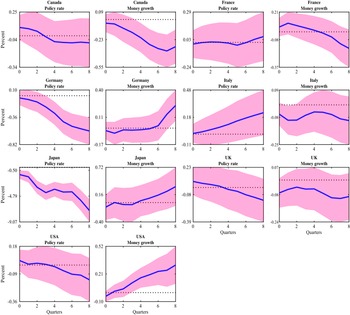
). We run this regression separately for each of the policy rate and the money supply at horizons within 2 years and present the results in Fig. 3 for the G7 countries and Fig. 4 for the EM7 countries. For clarity, the regression in equation (3) is not a rolling regression; instead, equation (3) attempts to predict the changes in
$M_{t}$
). We run this regression separately for each of the policy rate and the money supply at horizons within 2 years and present the results in Fig. 3 for the G7 countries and Fig. 4 for the EM7 countries. For clarity, the regression in equation (3) is not a rolling regression; instead, equation (3) attempts to predict the changes in $h$
quarters ahead output gap using one of the monetary policy variables at a time. For example, the value of
$h$
quarters ahead output gap using one of the monetary policy variables at a time. For example, the value of $\theta$
with
$\theta$
with $h=\left ( 0,2,4,6,8\right )$
using the policy rate is the contemporaneous, two-, four-, six- and eight-quarter ahead prediction of the output gap using the current level of the policy rate. Similar interpretation applies when we instead estimate
$h=\left ( 0,2,4,6,8\right )$
using the policy rate is the contemporaneous, two-, four-, six- and eight-quarter ahead prediction of the output gap using the current level of the policy rate. Similar interpretation applies when we instead estimate $\theta$
at
$\theta$
at $h=\left ( 0,2,4,6,8\right )$
using the money supply. In these figures, the solid line is the estimate of the
$h=\left ( 0,2,4,6,8\right )$
using the money supply. In these figures, the solid line is the estimate of the $\theta$
parameter and the shaded area is the 90% confidence interval. For each country, we show the ability of the monetary policy variable (the policy rate or the money growth) to predict the output gap.
$\theta$
parameter and the shaded area is the 90% confidence interval. For each country, we show the ability of the monetary policy variable (the policy rate or the money growth) to predict the output gap.
Dynamic properties of policy rates and the money supply in the G7 countries.

For the G7 countries (see Fig. 3), we find that an increase in the policy rate significantly predicts declines in the output gap in Germany and Japan while for the remaining countries the results are not statistically significant at the 10% significance level. The growth in money supply produces significant but delayed prediction of an increase in the output gap in Germany. Money growth also has a strong forecasting ability in the USA, where an increase in money growth predicts increases in the output gap after three-quarters. We find money growth to be negatively associated with the output gap in Canada after a year.
Dynamic properties of policy rates and the money supply in the EM7 countries.

For the EM7 countries (see Fig. 4), an increase in the policy rate predicts significant declines in the output gap in Mexico and Turkey. In Brazil and China, the increase in the policy rate generates statistically insignificant declines in the output gap. Increases in the policy rate in Indonesia and Russia have a significant positive association with the output gap. Output growth is positively associated with money growth in Brazil, India, China, Indonesia, and Russia, all of which are statistically significant except in the case of India. We find a negative association between money growth and the output gap only in Mexico and Turkey which are usually significant after a year.
This reduced-form local projection analysis shows heterogeneity across and within these two groups (G7 and EM7) of countries in terms of the expected association between changes in the monetary policy variable and changes in the output gap. In general, the expected negative association between changes in the policy rate and changes in the output gap only holds significantly for a few countries in both groups. Money growth appears to have a stronger predictive power particularly in the EM7 countries.
This is consistent with the finding in Section 4 and also with prior literature, including Bui and Kiss (Reference Bui and Kiss2021), Vegh and Vuletin (Reference Vegh and Vuletin2013), and Kaminsky et al. (Reference Kaminsky, Reinhart and Vegh2005) that the monetary policy stance and conduct are fundamentally different in emerging economies. As already mentioned, we believe much of the difference in the predictive powers of money and policy rates across the various countries, especially in emerging versus advanced economies, is due to institutional disparities such as the role of government influence in central banking decisions and a higher prevalence of cash transactions over credit-based ones, as well as underdeveloped financial sectors including mortgage markets. Overall, these results suggest that central bankers in emerging economies should be considering the structure and sources of frictions within their respective economies and the role of monetary aggregates in monetary and business cycle analysis.
We also investigate the robustness of these results to the use of money market rates and Treasury bill rates. In Appendix Figs. B1 and B3, we forecast changes in the output gap in the G7 countries with changes in the money market rate and the Treasury bill rate, respectively. These figures are almost identical to Fig. 3. We also produce similar graphs for the EM7 countries using money market rates (in Appendix Fig. B2) and Treasury bill rates (in Appendix Fig. B4). Except in the cases of China and Russia, Appendix Figs. B2 and B4 are identical to Fig. 4. For China, an increase in the Treasury bill rate significantly predicts a decline in the output gap, but increases in the central bank policy rate and money market rate have no such significant ability to predict output contraction. For Russia, increases in the money market rate and Treasury bill rate significantly predict declines in output growth after a year, whereas according to Fig. 4, an increase in the Russian central bank policy rate appears to predict an increase in output growth. In general, and for both the G7 and EM7 countries, the forecasting results are invariant to alternative interest rate measures.
6. Central bank reaction functions
In general, central banks in both advanced and emerging economies conduct monetary policy using interest rate rules such as the ones put forward by Taylor (Reference Taylor1993, Reference Taylor1999). These monetary policy rules describe the endogenous response of the central bank’s policy rate to economic fluctuations (the inflation and output gaps). We follow Smets and Wouters (Reference Smets and Wouters2007) and Carvalho et al. (Reference Carvalho, Nechio and Tristão2021) and assess whether monetary policy acts countercyclically or procyclically and if it different across advanced and emerging economies. In doing so, we use the following policy rule that allows for both policy inertia and persistent shocks (by including a first-order autoregressive term):
 \begin{equation} R_{t}=\rho R_{t-1}+(1-\rho )\left [ \phi _{\pi }\pi _{t}+\phi _{y}\tilde{y}_{t}\right ] +\phi _{\Delta }\left [ \tilde{y}_{t}-\tilde{y}_{t-1}\right ] +\varepsilon _{t} \end{equation}
where $R_{t}$
denotes the policy rate,
$R_{t}$
denotes the policy rate, $\pi _{t}$
is the inflation rate (the rate of change in the CPI), and
$\pi _{t}$
is the inflation rate (the rate of change in the CPI), and $\tilde{y}_{t}$
is the output gap. If the autoregressive coefficient,
$\tilde{y}_{t}$
is the output gap. If the autoregressive coefficient, $\rho$
, is nonzero, the policy rate adjustment to output and inflation occurs gradually over time—see Smets and Wouters (Reference Smets and Wouters2007) and Carvalho et al. (Reference Carvalho, Nechio and Tristão2021) for more details regarding equation (4). We assume purely random (zero mean) monetary policy shocks,
$\rho$
, is nonzero, the policy rate adjustment to output and inflation occurs gradually over time—see Smets and Wouters (Reference Smets and Wouters2007) and Carvalho et al. (Reference Carvalho, Nechio and Tristão2021) for more details regarding equation (4). We assume purely random (zero mean) monetary policy shocks, $\varepsilon _{t}$
.
$\varepsilon _{t}$
.
Equation (4) can be written as:
 \begin{equation} R_{t}=\theta _{1}R_{t-1}+\theta _{2}\pi _{t}+\theta _{3}\tilde{y}_{t}+\theta _{4}\tilde{y}_{t-1}+\varepsilon _{t} \end{equation}
where $\theta _{1}=\rho$
,
$\theta _{1}=\rho$
, $\theta _{2}=(1-\rho )\phi _{\pi }$
,
$\theta _{2}=(1-\rho )\phi _{\pi }$
, $\theta _{3}=(1-\rho )\phi _{y}+\phi _{\Delta }$
, and
$\theta _{3}=(1-\rho )\phi _{y}+\phi _{\Delta }$
, and $\theta _{4}=-\phi _{\Delta }$
. As in Carvalho et al. (Reference Carvalho, Nechio and Tristão2021) and De Leo et al. (Reference De Leo, Gopinath and Kalemli-Özcan2022), we use OLS to estimate the parameters of (5) and report the estimates (with standard errors in parentheses) in Table 7 (in panel A for the G7 countries and panel B for the EM7 countries). We can recover the estimates of the structural parameters,
$\theta _{4}=-\phi _{\Delta }$
. As in Carvalho et al. (Reference Carvalho, Nechio and Tristão2021) and De Leo et al. (Reference De Leo, Gopinath and Kalemli-Özcan2022), we use OLS to estimate the parameters of (5) and report the estimates (with standard errors in parentheses) in Table 7 (in panel A for the G7 countries and panel B for the EM7 countries). We can recover the estimates of the structural parameters, $\hat{\rho }$
,
$\hat{\rho }$
, $\hat{\phi }_{\pi }$
,
$\hat{\phi }_{\pi }$
, $\hat{\phi }_{y}$
, and
$\hat{\phi }_{y}$
, and $\hat{\phi }_{\Delta }$
from estimates of the reduced-form parameters,
$\hat{\phi }_{\Delta }$
from estimates of the reduced-form parameters, $\hat{\theta }_{1}$
,
$\hat{\theta }_{1}$
, $\hat{\theta }_{2}$
,
$\hat{\theta }_{2}$
, $\hat{\theta }_{3}$
, and
$\hat{\theta }_{3}$
, and $\hat{\theta }_{4}$
. As can be seen in Table 7, the
$\hat{\theta }_{4}$
. As can be seen in Table 7, the $R^{2}$
s are very high, indicating that the Taylor rule describes well the conduct of monetary policy in both the advanced and emerging countries. There are, however, qualitative as well as quantitative differences across countries.
$R^{2}$
s are very high, indicating that the Taylor rule describes well the conduct of monetary policy in both the advanced and emerging countries. There are, however, qualitative as well as quantitative differences across countries.
Estimated central bank reaction functions

Note: Numbers in parentheses are standard errors.
The estimated degree of interest rate smoothing, $\hat{\rho }$
, is very high and statistically significant at the 1% level, except for Indonesia (
$\hat{\rho }$
, is very high and statistically significant at the 1% level, except for Indonesia ( $\hat{\rho }=0.391$
with a standard error of
$\hat{\rho }=0.391$
with a standard error of $0.069$
) and Turkey (
$0.069$
) and Turkey ( $\hat{\rho }=0.091$
with a standard error of
$\hat{\rho }=0.091$
with a standard error of $0.104$
). It points to a significant degree of monetary policy inertia which is also generally more pronounced in the advanced economies than in the emerging economies. As Coibion and Gorodnichenlo (Reference Coibion and Gorodnichenko2012, p. 134) put it, “this type of inertia in monetary policy implies that central bankers will move interest rates toward their desired levels in a sequence of steps rather than in an immediate fashion as predicted by the baseline Taylor rule.” It also implies that interest rate changes two to three quarters in the future are fairly predictable given current information and, according to our estimates, they are more predictable in advanced economies than in emerging economies.
$0.104$
). It points to a significant degree of monetary policy inertia which is also generally more pronounced in the advanced economies than in the emerging economies. As Coibion and Gorodnichenlo (Reference Coibion and Gorodnichenko2012, p. 134) put it, “this type of inertia in monetary policy implies that central bankers will move interest rates toward their desired levels in a sequence of steps rather than in an immediate fashion as predicted by the baseline Taylor rule.” It also implies that interest rate changes two to three quarters in the future are fairly predictable given current information and, according to our estimates, they are more predictable in advanced economies than in emerging economies.
Implied (long-run) response to the inflation rate.

Implied (long-run) response to the output gap.

There are positive estimated responses of the policy rates to the inflation rates, except for Italy ( $\hat{\theta }_{2}=-0.044$
with a standard error of
$\hat{\theta }_{2}=-0.044$
with a standard error of $0.033$
). These responses are statistically significant at the 1% level for Germany, Japan, Brazil, China, Indonesia, Mexico, and Turkey, and at the 5% level for Canada, the UK, and the USA. However, the implied (long-run) response to inflation,
$0.033$
). These responses are statistically significant at the 1% level for Germany, Japan, Brazil, China, Indonesia, Mexico, and Turkey, and at the 5% level for Canada, the UK, and the USA. However, the implied (long-run) response to inflation, $\hat{\phi }_{\pi }=\hat{\theta }_{2}/(1-\hat{\rho })$
, is greater than 1 only for Brazil (
$\hat{\phi }_{\pi }=\hat{\theta }_{2}/(1-\hat{\rho })$
, is greater than 1 only for Brazil ( $\hat{\phi }_{\pi }=2.01$
), China (
$\hat{\phi }_{\pi }=2.01$
), China ( $\hat{\phi }_{\pi }=1.69$
), Indonesia (
$\hat{\phi }_{\pi }=1.69$
), Indonesia ( $\hat{\phi }_{\pi }=1.18$
), Mexico (
$\hat{\phi }_{\pi }=1.18$
), Mexico ( $\hat{\phi }_{\pi }=1.43$
), and Turkey (
$\hat{\phi }_{\pi }=1.43$
), and Turkey ( $\hat{\phi }_{\pi }=1.27$
), suggesting that the Taylor principle is satisfied only by these countries. In fact, the Taylor principle is not satisfied by any of the advanced economies, except perhaps for the UK, as the implied responses to inflation,
$\hat{\phi }_{\pi }=1.27$
), suggesting that the Taylor principle is satisfied only by these countries. In fact, the Taylor principle is not satisfied by any of the advanced economies, except perhaps for the UK, as the implied responses to inflation, $\hat{\phi }_{\pi }$
, are less than 1;
$\hat{\phi }_{\pi }$
, are less than 1; $\hat{\phi }_{\pi }$
is
$\hat{\phi }_{\pi }$
is $0.87$
in Canada,
$0.87$
in Canada, $0.79$
in France,
$0.79$
in France, $0.85$
in Germany,
$0.85$
in Germany, $0.09$
in Japan,
$0.09$
in Japan, $1.00$
in the UK, and
$1.00$
in the UK, and $0.86$
in the USA.
$0.86$
in the USA.
Finally, regarding the estimated response of the policy rate to the output gap, $\hat{\theta }_{3}$
, it is positive and statistically significant at the 1% level for Canada, Germany, Italy, the UK, and the USA. It is also positive and significant at the 5% level for China and Russia. This suggests that the central banks in these countries raise their policy rate in response to improving economic conditions, measured by the output gap,
$\hat{\theta }_{3}$
, it is positive and statistically significant at the 1% level for Canada, Germany, Italy, the UK, and the USA. It is also positive and significant at the 5% level for China and Russia. This suggests that the central banks in these countries raise their policy rate in response to improving economic conditions, measured by the output gap, $\tilde{y}_{t}$
. In terms, however, of the implied response to the output gap,
$\tilde{y}_{t}$
. In terms, however, of the implied response to the output gap, $\hat{\phi }_{y}=\left ( \hat{\theta }_{3}+\hat{\theta }_{4}\right )/(1-\hat{\rho })$
, we find that
$\hat{\phi }_{y}=\left ( \hat{\theta }_{3}+\hat{\theta }_{4}\right )/(1-\hat{\rho })$
, we find that $\hat{\phi }_{y}$
is
$\hat{\phi }_{y}$
is $1.14$
in Canada,
$1.14$
in Canada, $1.56$
in the USA,
$1.56$
in the USA, $0.38$
in Germany,
$0.38$
in Germany, $0.74$
in Italy, and
$0.74$
in Italy, and $0.78$
in the UK. We thus conclude that monetary policy behavior, as captured by estimated monetary policy reaction functions, is countercyclical in the advanced economies (except for France and Japan where it appears to be acyclical). However, we do not find evidence of countercyclical monetary policy in emerging economies, except perhaps for China (
$0.78$
in the UK. We thus conclude that monetary policy behavior, as captured by estimated monetary policy reaction functions, is countercyclical in the advanced economies (except for France and Japan where it appears to be acyclical). However, we do not find evidence of countercyclical monetary policy in emerging economies, except perhaps for China ( $\hat{\phi }_{y}=0.53$
), consistent with the conventional wisdom that monetary policy in emerging economies is fundamentally different from monetary policy in advanced economies.
$\hat{\phi }_{y}=0.53$
), consistent with the conventional wisdom that monetary policy in emerging economies is fundamentally different from monetary policy in advanced economies.
In advanced economies, monetary policy has generally been countercyclical, in the sense that the central bank lowers interest rates and injects liquidity in the economy during a recession (when the output gap is negative) but increases interest rates and removes liquidity during an expansion (when the output gap is positive). In emerging market economies, however, other macroeconomic fundamentals, including financial sector development, speculative attacks on their currencies, and the credibility of monetary policy, have typically prevented the conduct of countercyclical monetary policy, exacerbating the negative effects of financial crises.
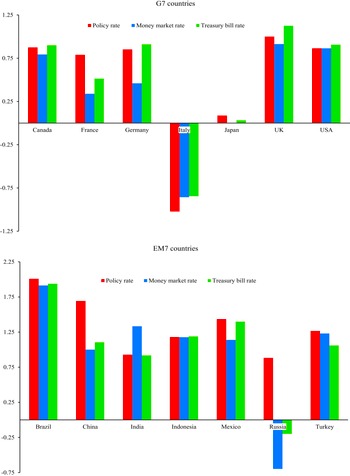
In Figs. 5 and 6, we present the central bank implied responses to inflation and the output gap in the G7 and EM7 countries, respectively, with alternative proxies for the stance of monetary policy. Fig. 5 shows that for the G7 countries, irrespective of the indicator of the stance of monetary policy, the Taylor principle is not satisfied except for the UK with either the policy rate ( $\hat{\phi}_{\pi }=1.00$
) or the Treasury bill rate (
$\hat{\phi}_{\pi }=1.00$
) or the Treasury bill rate ( $\hat{\phi}_{\pi }=1.13$
). On the other hand, the response of central banks to inflation in the EM7 countries is consistent with the Taylor principle regardless of the monetary policy variable used, except in the case of Russia.
$\hat{\phi}_{\pi }=1.13$
). On the other hand, the response of central banks to inflation in the EM7 countries is consistent with the Taylor principle regardless of the monetary policy variable used, except in the case of Russia.
The central bank responses to the output gap are countercyclical in the advanced economies, except for Japan; the response of the Japanese central bank to the output gap is always close to 0, irrespective of whether we use the policy rate ( $\hat{\phi _{y}}=0.00$
), the money market rate (
$\hat{\phi _{y}}=0.00$
), the money market rate ( $\hat{\phi _{y}}=0.01$
), or the Treasury bill rate (
$\hat{\phi _{y}}=0.01$
), or the Treasury bill rate ( $\hat{\phi _{y}}=0.02$
). In the case of France, for example, using the money market rate or the Treasury bill rate as the principal monetary policy variable generates an implied response to the output gap of
$\hat{\phi _{y}}=0.02$
). In the case of France, for example, using the money market rate or the Treasury bill rate as the principal monetary policy variable generates an implied response to the output gap of $\hat{\phi _{y}}=0.54$
and
$\hat{\phi _{y}}=0.54$
and $\hat{\phi _{y}}=0.64$
, respectively. We do find evidence of countercyclical monetary policy in emerging economies, except perhaps for China, Indonesia, and Russia.
$\hat{\phi _{y}}=0.64$
, respectively. We do find evidence of countercyclical monetary policy in emerging economies, except perhaps for China, Indonesia, and Russia.
7. Conclusion
We are motivated by central bank responses to the rise in inflation in advanced and emerging economies in the aftermath of the Covid-19 recession and investigate monetary policy behavior in advanced and emerging economies. We examine the relative information content of interest rates and the money supply in explaining key macroeconomic variations in advanced and emerging economies. We address the issue of whether the conduct of monetary policy in emerging economies is fundamentally different from that in advanced economies. We also address the issue of whether the common practice of using market interest rates (such as money market rates and government bond rates), instead of policy rates, to proxy for the stance of monetary policy leads to different conclusions regarding the conduct of monetary policy.
We use time series data for the G7 and EM7 countries and provide a comprehensive comparison between interest rates and the money supply in terms of which of these better captures the stance of monetary policy in advanced and emerging economies. In particular, we compute correlations between the cyclical components of interest rates and the money supply and the cyclical component of real output, test for Granger causality running from interest rates and the money supply to real output, use a reduced-form local projection approach to assess the predictive ability of policy rates and the money supply, and estimate central bank reaction functions. We also speak to the debate on whether central banks in emerging economies are different than their counterparts in advanced economies.
We find that money market rates, government bond rates, and policy rates are procyclical in both advanced and emerging economies, but the money supply appears to be acyclical. We find that interest rates tend to be more informative for predicting real output in the G7 countries, but in the EM7 countries the money supply is relatively more informative than interest rates. Finally, we find that monetary policy has generally been countercyclical in advanced economies, but that monetary policy behavior in emerging economies does not point to countercyclical policy. Although there has been a shift in the conduct of monetary policy by emerging market economies in recent years, and monetary policymaking has evolved in these countries, we conclude that these changes have not yet facilitated the conduct of countercyclical monetary policy as an economic stabilization tool in these countries. The conduct of monetary policy in emerging economies is still fundamentally different than in advanced economies.
Acknowledgement
Apostolos Serletis thanks Ryan and Shanna Dunfield for the Dunfield Research Fellowship that provided support for this research. We would also like to thank MM Islam Chowdhury for research assistance and two anonymous referees for comments that greatly improved the paper.
Appendix
Countries and sample periods

Dataset

Note: IFS = IMF International Financial Statistics; BIS = Bank for International Settlements;
FRED = St. Louis Fed FRED database; GE = GlobalEconomy.com; BL = Bloomberg;
OECD = OECD Stats; BM = Bank of Mexico.
Nominal stylized facts in advanced countries

Nominal stylized facts in emerging countries

Granger causality test results with data in log levels

Note: Numbers are marginal significance levels.
Granger causality test results with data in quarterly growth rates

Note: Numbers are marginal significance levels.
Granger causality test results with data in annualized growth rates

Note: Numbers are marginal significance levels.
Granger causality test results controlling for the interest rate

Note: Numbers are marginal significance levels.
Estimated reaction functions with money market and Treasury bill rates

Note: Numbers in parentheses are standard errors.
Dynamic properties of money market rates and the money supply in the G7 countries.

Dynamic properties of money market rates and the money supply in the EM7 countries.

Dynamic properties of Treasury bill rates and the money supply in the G7 countries.

Dynamic properties of Treasury bill rates and the money supply in the EM7 countries.








 Open access

