


During the 2022 Winter Olympics in Beijing, Vladimir Putin paid a visit to Xi Jinping. Following their meeting, the two leaders issued a joint statement declaring a partnership with ‘no limits’ and a shared commitment to fostering ‘true multilateralism’.Footnote 1 Four days after the Olympics closing ceremony, on 24 February, Russia launched a full-scale war on Ukraine, with coordinated attacks in multiple directions. As the world grappled with the shock of a major armed conflict erupting in Europe, the initial public reaction from China focused on a different set of issues.
In the days immediately following Russia’s invasion, Chinese netizens largely refrained from discussing Russia’s military aggression. Instead, the dominant narratives centred around Chinese men expressing a desire to ‘shelter young Ukrainian women’.Footnote 2 These sexist messages became widespread, overshadowing any immediate concern about the unfolding war. The Chinese government remained silent on the invasion during these early stages.
It was not until Chinese students stranded in Ukraine, waiting to be evacuated, began pleading with their fellow citizens to stop posting such offensive messages – fearing it would jeopardise their safety – that the Chinese authorities intervened. Chinese media regulators responded by blocking the accounts of some of the individuals responsible for these posts.Footnote 3 However, their actions were not driven by concern about the derogatory content directed at Ukrainian women. Instead, the Chinese government appeared more concerned about the potential consequences for its nationals abroad and the broader implications for China’s reputation and influence over its diaspora.
This initial popular reaction to the invasion, which Chinese media regulators only mutedly disapproved of, reflects deeper sentiments within Chinese society regarding Ukraine. Ukraine was portrayed as a weak, ‘feminine’ nation in need of protection from stronger, more ‘masculine’ powers. Rather than denouncing Russia’s brutal aggression and destruction of Ukrainian cities, many Chinese men on social media expressed a willingness to ‘protect’ Ukrainian women. This reaction underscored the pervasiveness of gendered and nationalistic views that aligned with China’s broader geopolitical narratives.
As my analysis in this book shows, the objectification of Slavic women from the former Soviet Union is a topic that has been carefully curated in both Chinese state media and popular discourse. It is closely tied to broader questions of national sovereignty, economic success, national reproduction and global power. The image of the white foreign woman in need of rescue – and willing to marry a Chinese man – serves as a symbol of China’s growing global masculine power. Russia’s war in Ukraine only amplified these narratives, bolstering the image of China as a rising force capable of stepping in where weaker nations wane.
A relational approach to China’s relations with the foreign world, particularly through the lenses of gender and race, requires an exploration of the historical, geographical and normative aspects of China’s self–other dynamics. As my analysis reveals, Russia serves as a crucial nodal point, linking China to the racialised global order through its geographical proximities, historical ties, shared orientations towards global politics, and embodied desires of global rise. This relational framework offers a unique perspective on how China defines itself in contrast to foreign others, with Russia playing a central role in shaping these perceptions.
The historical legacy of the Soviet Union – once a close ally, later an adversary and ultimately a dissolved entity – continues to loom large in China’s national consciousness. The shock of the Soviet Union’s collapse deeply impacted China’s view of its own political stability and influenced its approach to Russia and the post-Soviet republics. These historical ties and present political orientations shape the way China engages with these nations today, framing their relationships within this shared legacy. This approach stresses not only the gendered and racialised analysis of representations and discourses, but also embodied experiences.
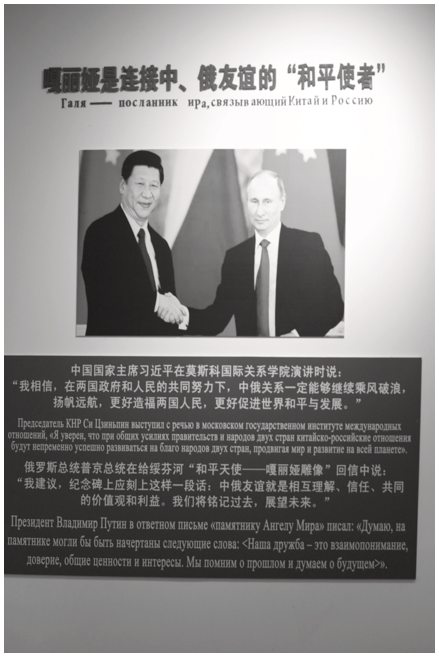
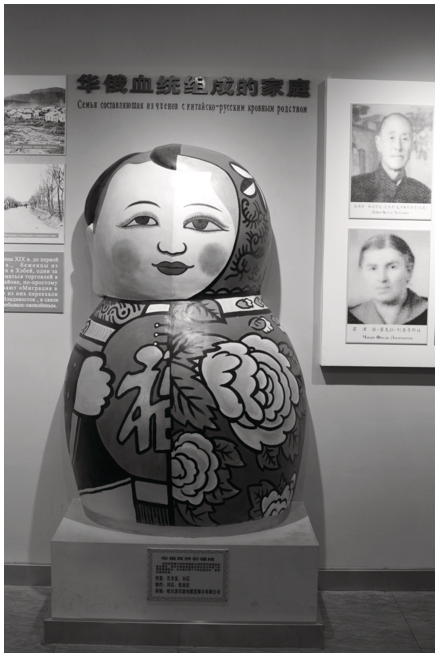
In the Suifenhe museum, dedicated to the life and heroism of Galya, a girl of mixed Chinese–Ukrainian heritage, quotes from Putin’s and Xi’s speeches appear next to an image depicting a Chinese–Russian couple, seemingly reinforcing the idea of intimate ties strengthening bilateral relations (Figs. 8.1 and 8.2). The Ukrainian origins of Galya’s mother are subsumed by the narratives of the Soviet Union and the strategic goals of Russia and China.
Suifenhe museum display: ‘A mixed-blood Chinese-Russian family’.

Suifenhe museum display: ‘Galya is a messenger of peace connecting China and Russia’.
Since the establishment of diplomatic relations in 1992, Ukraine and China have maintained well-defined bilateral ties, culminating in the signing of a Joint Declaration of Strategic Partnership in 2011. Despite decades of productive cooperation, Ukraine has not been fully perceived as a truly independent sovereign state in the minds of many ordinary Chinese. In the Chinese collective consciousness, Ukraine’s sovereignty has often been tied to its history as part of the Soviet Union (Sulian) which continues to serve as the main historical reference point. As a result, Ukraine is often seen as an appendage of Russia, rather than an independent nation. The shorthand Sulian was frequently used to refer to people from former Soviet republics, including Ukrainians and Belarusians.
However, this perception began to shift in 2014, when Ukrainian identity emerged more prominently in Chinese media discourse following the conflict in Donbas and Russia’s annexation of Crimea. Despite this shift, understanding the nature of the conflict between Russia and Ukraine has remained a topic of debate in China, resisting easy categorisation under the broader ‘post-Soviet Slavic’ label.
A dominant narrative within Chinese discourse explains the origins and nature of the conflict through familial analogies. One example is a narrative circulating through Russian and Chinese social media videos, summarising how Chinese authorities framed the war for Chinese viewers: as a family dispute.Footnote 4According to this narrative, the conflict should be viewed as a quarrel between relatives, with Russia portrayed as an ex-husband and Ukraine as an ex-wife who divorced Russia and began ‘flirting’ with a new partner, the West. Russia and Ukraine are said to have had children – Crimea, Donetsk and Luhansk. In this metaphor, the ex-wife (Ukraine) neglected the children, leading the ex-husband (Russia) to take them back. In response, Ukraine sought the help of her new partner, thus sparking the current crisis.
The analytical lens of intimate geopolitics helps to make sense of the role that the concepts of family and marriage play over international law and territorial sovereignty in understanding the conflict, with kinship relations and ethnic ties being prioritised over legal and political frameworks. By depicting the war as a domestic dispute rather than a violation of national sovereignty, the analogy supports China’s position that the conflict is an internal matter between Russia and Ukraine – one in which outside interference, particularly from the West, is unwelcome. In this context, state sovereignty is portrayed not as something governed by international laws and norms, but as rooted in familial, historical and cultural ties. As Gayle Rubin observed in her pioneering study on the political economy of sex, ‘kinship and marriage are always parts of total social systems, and are always tied into economic and political arrangements’.Footnote 5 By focusing on the specific articulations of kinship and marriage practices across borders, which intimate geopolitics brings into view, we can gain a better understanding of the underlying logics and functioning of socioeconomic and political systems, as well as the roles of gendered and racialised bodies in these systems.
One year after Russia invaded Ukraine, in February 2023 China released a twelve-point position paper stating that ‘the sovereignty, independence and territorial integrity of all countries must be effectively upheld’.Footnote 6 Yet, the paper did not mention war or invasion and did not recognise that Russia had violated Ukraine’s territorial sovereignty. In a way, this logic gave legitimacy to Russia’s actions, with Putin often portrayed as a patriarchal figure simply wanting to protect his people. Putin frequently emphasises in his speeches the concept of Russian-speaking people being part of one family. Similar tropes of historical claims and direct blood relations between people in Ukraine and Russia are used in Putin’s speeches, such as ‘We are here foreover’ and ‘We will never let you go.’ Practices like the removal of children from Ukrainian orphanages to Russia further reinforces this narrative. Occupied territories are, in other words, depicted as a conflict over the property of the former common family home of Ukrainians and Russians. This framing serves to justify Russia’s actions as protective rather than aggressive, portraying the conflict as a family matter rather than a violation of Ukraine’s sovereignty. This frame reinforces the gendered view of the world order and power dynamics in which the ex-husband (Russia) is seen as the dominant figure and the ex-wife (Ukraine) as submissive and dependent. Ukraine is depicted as lacking agency and fully reliant on external help.
Viewing China’s foreign relations through the lens of family and Chinese–foreign marriages offers a valuable perspective on the ‘China Dream’ – a vision in which hyperreality, shaped by official statements, propaganda slogans, media representations and legislation, intersects with the lived experiences and struggles of those subject to its narratives, emotional structures and policies. Marriages with foreigners play a prominent role in China’s national security discourse, where collective geopolitical ambitions and individual aspirations converge. As in analyses of previous periods of human revolutionary transformations, the way people collectively imagine the operation of their society – through popular and officially endorsed discourses and forms of representation – often depends on the norms and regulations of family relations between men, women, children and grandparents.Footnote 7
Geopolitics is inscribed on the gendered and racialised bodies of individuals. My analysis shows that the China Dream of global power is projected onto the bodies of Slavic women from the former Soviet republics, who are routinely idealised as ideal foreign wives for Chinese men. The national goal of reproduction, with its focus on specific forms of gendered and racial mixing, is deeply intertwined with the China Dream. This is evident in how various social and national issues are represented and coded in discourses and immigration regulations. For foreign wives, their outsider’s place in Chinese families and the Chinese nation is institutionalised in the visa and immigration regimes. Their children’s bodies, however, serve as contested sites of border politics where women’s maternal interests and rights are challenged by the Chinese patriarchal family values and citizenship laws.
The interplay between nationalist body politics and China’s market-driven agenda reflects how individual bodies – particularly foreign women – are mobilised in the service of national objectives. This connection between intimate relationships, state interests and broader geopolitical aims reveals the complex ways in which nationalism, gender and race are instrumentalised to achieve China’s aspirations for power and influence on the global stage. In the age of artificial intelligence, the interplay of these forces takes on new forms.
In February 2024, student vlogger Olga Loiek, studying in the USA, made a disturbing discovery: images of her were being cloned extensively on the Chinese internet to promote Russia’s nationalist propaganda and sell Russian products in China. In a YouTube video recorded shortly after uncovering the theft of her identity, she revealed that an ‘army of clones’ on Chinese social media platforms were using her face and voice to speak fluent Mandarin Chinese, advocating for limitless China–Russia relations, expressing love for China and even professing a desire to marry a Chinese man.Footnote 8 Across multiple accounts using her personal data, the underlying messages conveyed that Russia sought Chinese support, portrayed China as a powerful country, and suggested that Russian women favoured China and Chinese men. Expressing shock and bewilderment, the vlogger asked why her image was being appropriated to push Russian propaganda and commercial interests in China, especially when she had made it abundantly clear that she was a Ukrainian citizen and identified as Ukrainian, with the Ukrainian flag prominently displayed next to her social media profile icon. On 9 May 2024, as Russia celebrated Victory Day, Western media picked up Olga’s story, framing it as an example of how fake videos of Russian women expressing love for China and their desire to marry Chinese men ‘play to the feelings of superiority and use foreigners to aggrandise China’.Footnote 9
While fake, these constructs offer important insights into the hyperreality shaped by China’s national desire for global power. The trope of ‘Russian wives’ functions as a symbol of China’s political and economic success, while also serving as a marketing tool to further its economic interests. The pro-Russian Chinese clones of a Ukrainian YouTuber embody the complex intersections of geopolitics, national identity, gender, race and digital manipulation in an effort to rewrite the global order.
The irony lies in the fact that, although China’s main cyberspace regulator moved to clamp down on these fake accounts, the underlying sentiments expressed in these posts align with broader narratives promoted by the CCP. The China Dream of global power and strength, the desire of Chinese men to possesses white foreign women, and the promotion of content that advances China’s economic and geopolitical interests and market goals coalesce to produce new national narratives – especially in a time of heightened geopolitical conflicts and wars.
Olga’s appearance was weaponised to convey the China Dream of expanding global influence, using a Ukrainian woman cloned as Russian avatars professing love for China. This manipulation not only stripped Olga of her Ukrainian agency and identity but also blurred the boundaries between fake and real, Russian and Ukrainian, AI and human to serve Chinese national interests. The goal was to present China as a reliable, and much-needed partner, particularly in its relationship with Russia.
The evolving narrative emphasises that China and Russia’s intertwined histories and shared geopolitical interests are destined to reshape the existing global order. This narrative is built on myths, fakes and carefully crafted stories that fuel China’s ambition for national rejuvenation. Episodes like the ‘Russian brides village’, TV dramas and the Chinese–Russian group weddings reinforce this mythmaking, revealing how deeply China’s dream of global power is intertwined with a desire for white women’s bodies. These narratives seek to address perceived deficiencies in Chinese masculinity and nationhood – deficiencies that are, symbolically, restored through the imagined possession of foreign, especially Slavic, women.
This blend of gendered and racialised desires serves not only as propaganda but also as a reflection of broader anxieties within China’s self–other relations unfolding on the global stage. By linking national power to the idealisation of white foreign women, China’s geopolitical narrative embeds national ambitions in intimate and embodied forms. Exposing and challenging these distorted logics becomes increasingly difficult in the post-truth era, where the lines between AI and human reality are blurred. However, as demonstrated by the narrated lived experiences, adaptations and strategies of my research participants – along with the subversive potential of audiovisual and streaming technologies – closely examining these hyperrealities across multiple fields and scales can offer valuable starting points. This approach could help further the search for knowledge, understanding and critical insight in an increasingly manipulated world.

 Open access