




Introduction
The emerging field of critical forest studies calls for novel methods of knowledge creation with forestscapes that make diverse relations visible, tactile, or otherwise sensible in a wild variety of ways. Drawing on our backgrounds in Indigenous, place-based and critical posthumanist research perspectives, this paper develops an emerging series of ecological methods with the aim of working towards a decolonisation of the research image within the field of environmental education. These methods seek to make sensible the expansive and entangled nature of forest relationality across bodies, spaces and times. Through these research practices, we endeavour to bring forth forest wisdoms that contribute to more regenerative, inclusive and justice-oriented pedagogies in environmental education.
Many practices within the field of environmental education are situated within Western epistemological approaches that continue to reproduce coloniality, contributing towards the erasure of Indigenous knowledge systems and the relational webs within which we all are situated (Ross, Reference Ross2020; Stein et al., Reference Stein, Andreotti, Ahenakew, Suša, Valley, Huni Kui, Tremembé, Taylor, Siwek, Cardoso, Duque, Oliveira da Silva Huni Kui, Calhoun, van Sluys, Amsler, D’Emilia, Pigeau, Andreotti, Bowness and McIntyre2023). Much of this research does not yet fully attend to Indigenous (Cajete, Reference Cajete1994), place-based (Wooltorton et al., Reference Wooltorton, Collard, Horwitz, Poelina and Palmer2020) and critical posthuman (Barad, Reference Barad2007) contributions that highlight the dynamic, reciprocal and intra-dependent connections of bodies and environments in which “other” is not separate from “self.” Images of outdoor, nature-based and ecological education can often serve to recentre the human figure through the gaze and logic of whiteness, reifying coloniality and western dualisms, and invisibilising Indigenous sovereignties of culture, kinship, and belonging within landscapes (Newbery, Reference Newbery2012). As Newbery (Reference Newbery2012) explains, “because wilderness and nature are called into being by the meanings given them, are constituted by their own representations, they are human creations and thus subject to the whims and politics of human activity” (p. 35). However, we also note that terms such as “wilderness” and “nature” are themselves products of colonial histories which seek to separate and classify so as to sever, conquer, claim and extract.
Indigenous perspectives on forests as deep-time landscapes offer very different images of time and place which do not separate natural and cultural histories (McGrath, Troy & Rademaker Reference McGrath, Troy and Rademaker2023; Wooltorton et al., Reference Wooltorton, Collard and Horwitz2015). This refusal of separation means that forests are considered active, sentient and living societies that you belong to and have cultural and spiritual obligations to. This is very different from the modernist treatment of the forest as something passive, something that you can possess and use for your own ends regardless of your cultural commitments and responsibilities. These incommensurable images of land, culture, self and relationality continue to play out despite the ongoing survivance and resurgence of First Peoples as cultural custodians of the Earth’s forests. Important work is needed to construct alternative images of forest relations which decentre the representational logics of whiteness, and in doing so, propose a radically more capacious and pluralistic image of environmental education (Nxumalo & Cedillo, Reference Nxumalo and Cedillo2017; Nxumalo, Reference Nxumalo2019).
We take up this work in this paper through stories of ecologising research images in ways which work towards decolonising possibilities with both humility and persistence. We acknowledge that such possibilities for decolonising are not knowable in advance of the process of working towards them. Ecologisation, in this sense, gives name to a process which opens the image of research up to its own relational outside, an outside which includes coloniality and decoloniality as contrasting rather than mutually exclusive possibilities. Noting Tuck and Yang’s (Reference Tuck and Yang2012) assertion that decolonisation is not possible or even intelligible without producing concrete actions towards land back for First Peoples, we also consider broader readings of decolonising as a gradual (and/or sometimes sudden and sharp!) undoing of conscious and unconscious tendencies to separate life into the essentialised categories of white modernity (Rolnik, Reference Rolnik2023; Wa Thiong’o, Reference Wa Thiong’o1998). In this sense, decolonising practices involve disrupting inherited perceptual, conceptual and subjective assumptions that humans alone are ascribed with intelligence, sentience and agency (Bai, Reference Bai2015; Paradies, Reference Paradies2020). As Pirbhai-Illich and colleagues (Reference Pirbhai-Illich, Martin and Pete2023) explain:
Decoloniality is .. a process of de-linking …from the logics of separation and superiority, the logics of elimination and extraction, and the ways in which they are used to classify phenomena on the basis of “objective” characteristics, putting them into binarised categories of us–them, knower–known, subject–object, civilised–uncivilised, rational–irrational, and so on, creating hierarchies of worth/value. (p. 38)
Hence, while we do not define or predetermine decolonisation here as an end game, we affirm that processes of decolonising provide a lure towards re-imaging and re-imagining environmental education through the multispecies matrix of critical forest studies. We endeavour to work in anti-colonial ways to co-create research images that can highlight the interconnectedness across forest relations, as well as make the deep time landscapes of forests more visible. As Indigenous scholars Marie Battiste (Reference Battiste2013), Margaret Kovach (Reference Kovach2010) and Dwayne Donald (Reference Donald2021) assert, the work of decolonising is everyone’s responsibility and benefits us all. This becomes particularly evident in what follows, as we entertain the use of military technologies, such as drones and thermal imaging, as technologies that can potentially be recuperated and ecologised under this different image of research, effectively turning these technologies against the structures of coloniality they were produced to uphold. By considering images generated by emerging technologies alongside Indigenous paintings and storytelling shared by co-author Carmen McKay, we hope to contribute research images that enhance multispecies knowing, sensing, imagining and becoming with forests.
Our author circle is situated across two continents with diverse geographical and ecological landscapes, but similar histories of colonisation – Australia and Canada. We come to this work with diverse disciplinary and ancestral backgrounds. Carman is a contemporary Coast Salish artist, cultural educator, a certified life skills facilitator and a graduate student at Simon Fraser University in the greater Vancouver area. His father’s ancestors, the Stó:lō (River) People and his mother’s ancestors, the xʷməθkʷəy̓əm (Musqueam) People, have benefited from the liveable region for at least 9,000 years. Cher is a settler scholar with Finnish, Scandinavian and British ancestry. She works collaboratively with Carman and other colleagues to create anti-colonial pedagogical spaces in forest schools, within Coast Salish territories on the west coast of the country colonially known as Canada. She is an assistant professor in a Faculty of Education. David is a migrant scholar living and working on the unceded lands of the Woi Wurrung and Bunnwurrung language groups of the Eastern Kulin Nation in Naarm (Melbourne), so-called Australia. He teaches and researches in the areas of climate justice, regenerative education, and decolonial studies with ongoing projects focused on cultural and ecological regeneration in urbanised contexts. Jelena is an artist-researcher from the Balkans, currently a PhD candidate at RMIT University in Naarm (Melbourne), on the unceded lands of the Wurundjeri People of the Kulin Nation.
Within our collaboration, we endeavour to work in ways that engage and energise complementary perspectives and with shared intentionality, while centring Indigenous knowledge systems. Although posthuman and Indigenous perspectives are grounded in unique cosmologies and ethical commitments specific to land-based relationships (Hird et al., Reference Hird, Predko, Renders, John Müller, Grech, Rossini, Herbrechter, deBruin-Molé and Callus2022; Watts, Reference Watts2013), there are also many commonalities and resonances to be shared across these situated perspectives (Rosiek et al., Reference Rosiek, Snyder and Pratt2020). We focus our scholarship within these synergistic spaces as we share stories that work towards an ecologisation of the research image.
Ecologising the research image
Although we focus primarily on visual images within this paper, for us the research image is broadly defined to include diverse sensibilities beyond the visual, including oral, auditory, haptic, temporal, spatial, speculative, and conceptual ways of sensing (and making sense of) the co-production of knowledges (Marks, Reference Marks2002; Campt, Reference Campt2017; Rousell et al., Reference Rousell, Boadu, Hussey-Smith, Kelly, Mayes, Moss and McCandless2025). Photos, videos, audio recordings, mappings, paintings, performances, archives, tables, and graphs are all possible contributors to an image of research that variously serves to pluralise or stabilise knowledge formation. We understand the process of image creation as a powerful epistemological and ontological praxis which engages all the senses and powers of thought. As Lisa Boivin, a Deninu Kue artist and author, describes, “ … images have staying power. They occupy a different space of mind. Images are dynamic; they hang around in my intellectual space” (pp. 92–3). Etymologically, the English term “image” stems from the Latin “imaginum,” which connotes both representational assumptions (e.g. copy, imitation, likeness, statue), as well as more emergent and affective hauntings (including phantom, ghost, and apparition) (Etymonline, 2024). We view the practice of creating research images as a form of dynamic worldmaking that can educate and inspire ethical action (Beyes & Steyaert, Reference Beyes and Steyaert2011; Price, Reference Price2024).
We are guided in this thinking by Stó:lō scholar Dylan Robinson’s (Reference Robinson2020) work Hungry Listening, which discusses the affective, aesthetic, and metaphysical dimensions of decolonising perceptual engagements with both sound and image. Robinson coined the term hungry listening to refer to a continuum of colonial engagement with music characterised by extractive modes of perception, contributing to epistemological violence through an inherited disposition toward perceiving the environment as a set of sensations and information to be consumed. Robinson attributes this inheritance of hungry ways of perceiving the world to early colonists who were literally starving on the lands they stole from First Peoples and claimed to own. He argues that settler colonial ways of perceiving the environment are trained to separate out sensory information from its diachronic histories of emplacement, ignoring the cultural, spiritual, and aesthetic relationships which give rise to perception and the transmission of affect and sentience through image and sound. Robinson describes how “…hungry listening prioritises the capture and certainty of information over the affective feel, timbre, touch, and texture” (p. 38). His project is invested in an ecologisation of perception predicated on Indigenous perspectives which recognise sounds and images as vectors of affective transmission from one place and time to another, disrupting the Euro-Western ideal of frictionless transfer and universal access to sensory knowledges.
Informed by the work of Robinson (Reference Robinson2020), we endeavour to remain curious about what our senses, feelings, and intuitions are conveying to us within forests, how the fullness of forest relations can be registered through a variety of sensorial media, and what those transmissions of affect enable us to know, do, and become in specific places and times. Understandings of forest relations through settler ways of perceiving has clear limitations, calling into question what can be sensed, felt, and known about forestscapes through the colonial lens. Grentz (Reference Grenz2024) for example, explains that newcomers to Indigenous territories assumed (and in many cases continue to assume) that forests were naturally pristine, an untouched “Eden.” What they did not recognise is the long-standing relationships Indigenous peoples have with kin relations, including the purposeful shaping of landscapes for mutual benefit and sustainable and balanced ecologies. The settler image of precolonial forests and representations of so-called wild spaces can have profound implications for understandings of forest relations (Newbery, Reference Newbery2012), as well as practices of conservation, management, and restoration. Grenz (Reference Grenz2024) inspires us to re-encounter forest relations with Indigenous perspectives that disrupt ideals of wildness and purity, and to explore as researchers how we might cultivate more capacious modes of perceiving what otherwise goes unseen in the forest.
Posthuman scholarship also helps us attune to the entangled and animate nature(s) of forest relations. The feminist posthuman framework outlined by Åsberg and Braidotti (Reference Åsberg, Braidotti, Åsberg and Braidotti2018) offers theoretical and methodological tactics which “break or otherwise overcome the fixed, dyadic, and hierarchical categories of nature and culture, or the human and the nonhuman, thereby enabling alternative analyses that explore the entanglements and mutual co-constitutions that result” (p. 5). Additionally, Braidotti (Reference Braidotti2022) notes that “the posthuman feminist framework encourages a different notion of political subjectivity as a heterogeneous assemblage of embodied and embedded humans” (p. 8). Braidotti’s idea of “becoming otherwise human” challenges the power traditionally held by humanist definitions of humanity, particularly over those who have been politically and socially excluded from these definitions. While the uptake of critical posthumanist theories has been high influential across the humanities, art, and social sciences over the past three decades, the transformative implications of posthuman modes of perception have been less widely examined.
We believe that critical forest studies have a significant role to play in opening new and different modes of perception at the nexus of Indigenous philosophies and the critical posthumanities. Forests exemplify the complex and interconnected assemblages that Deleuze and Guattari (Reference Deleuze and Guattari1994) invoke in their geophilosophical work, where multiple nonhuman and human forces dynamically mix and find mutual expression through ever-changing relations. Their work emphasises the importance of difference and becoming as both functions and trajectories of Earthly desire, rejecting fixed identities and species distinctions in favour of dynamic flows and relations across geomorphic, biomorphic, and techno-semiotic strata. An assemblage approach invites way of learning to perceive the expressive capacities of forests – not as abstract systems but as living, perceptual assemblages that co-constitute reality through a symphonic orchestration of affects and sensations.
Such an approach brings critical awareness to the extraordinary diversity of sensory perspectives that co-constitute forest environments, including technological modes of sensing which are now becoming integral components of forest ecologies. Digital sensing technologies have become increasingly agentic within forest assemblages in recent years, introducing new modalities of machine sensing and automated decision making which alter the onto-political and perceptual dynamics of forests as sensory ecologies (Gabrys, Reference Gabrys2022). This intercession of machine technologies into forestscapes is generating new kinds of “smart forest” relationalities and imaginaries with wide-ranging implications and interpretations. In assembling an emerging framework for critical forest studies, Rousell and Tran (Reference Rousell and Tran2024) question how smart forest imaginaries reinforce a grid of perceptual intelligibility which privileges human mastery and control while obscuring how the relationships that hold forest communities together are both cosmological and deeply corporeal.
Within this grid of intelligibility, any one tree can be replaced by any other as determined by its capacity to serve particular human interests: to clean the air, create shade, protect us from climate change, help us build communities, and now, even become a sounding board for human desires, fears, proclivities and uncertainties… The question of what a tree feels, thinks, desires, produces, and (maybe even) dreams for itself, and within its own communities, is almost entirely occluded by such practices. Part of the problem is that smart forest projects assume that technology serves universal human interests with respect to forests and trees, an assumption which in turn reinforces a hegemonic conception of the human predicated on abstract models of use-value, rather than on living practices and relations with place. (p. 269)
Rousell and Tran (Reference Rousell and Tran2024) turn to Indigenous scholarship and place-based mentorship from local Cultural Custodians to re-engage with emerging technologies not as mechanisms of control, but as new collaborators to be welcomed and inducted into existing histories of relationship with place (Klumbyte et al., Reference Klumbytė, Britton, Laiti, Prado de O. Martins, Snelting and Ward2022; Lewis et al., Reference Lewis, Philip, Arista, Pechawis, Kite and Ahearn2018). Lewis et al. (Reference Lewis, Philip, Arista, Pechawis, Kite and Ahearn2018) article Making Kin with the Machines addresses this very point from multiple First Nations perspectives, suggesting that automated technologies could be initiated and welcomed into “an extended ‘circle of relationships’ that includes the nonhuman kin… that increasingly populate our computational biosphere” (n.p.).
In what follows, we extend this thinking and place-based work by exploring the use of drones, thermal cameras, and audio spectrograms alongside Indigenous painting and storytelling practices as different yet related ways of visualising pedagogical relationships with/in forest environments. We consider: How might emerging technologies be reclaimed and folded into intergenerational kinship relationships with/in forests? What might these technologies enable us to sense, feel, and learn about both the material and metaphysical dimensions of forests? And how might these insights inform our understandings of environmental education as it intersects with critical forest studies? We invite you to journey with us as we experiment with ecologising the research image, and in turn, the image of research as a place-based, more-than-human process.
Co-creation of research images
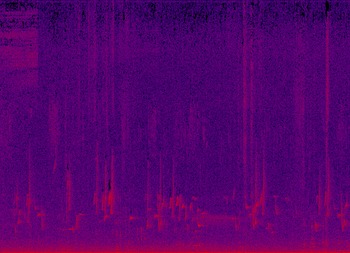
Within this project we used four different digital processes to document everyday encounters within forests. First, we used drone footage, aerial videography, which enabled us to zoom out to see forest relations from a bird’s eye view, as well as to express larger geographical spaces than would be possible from the ground. Although drone technologies were initially developed for warfare, they have become increasingly ubiquitous within nonmilitary and used for a variety of community purposes, including the collection of data to support Indigenous communities in environmental monitoring and management (MacDonald et al., Reference Macdonald, Robinson, Perry, Lee, Barrowei, Coleman, Markham, Barrowei, Markham, Ford, Douglas, Hunter, Gayoso, Ahwon, Cooper, May, Setterfield and Douglas2021; Vargas-Ramírez & Paneque-Gálvez, Reference Vargas-Ramírez and Paneque-Gálvez2019). Second, we used thermal cameras, which create heat maps of the temperature emitted by objects. Typically, the yellow and orange colours represent greater warmth than the purple colours. Third, we documented forest soundscapes through audio recordings. We used our phones to record sounds of human steps, distant birds, the calls of diverse beings, and the forest breeze. At times we left the audio recorder in a tree, in a coat pocket, or alone on the grass. The recorded sound is an expression of technology also as a medium for documenting the flows of movement we create – so when we are listening, we can hear the flows of the forest-human soundscapes becoming an expression of an experience in the moment. Finally, we converted our audio recordings into spectrograms, using Audio Spectrum Creator. A spectrogram is a visual representation of sound over time (the horizontal or x axis), indicating frequency (pitch), which is represented along the vertical line of the graph (the y axis), and intensity (loudness), which is represented through the concentration of the colour.
Research images were co-created at two locations. One site was a forest-based education programme for elementary students located in the q̓íc̓əy̓ (Katzie), q̓ʷa:n̓ƛ̓ən̓ (Kwantlen), and Semiahmoo territories in the Vancouver area (Canada). These Coast Salish territories, like most of the land in what is now known as the province of British Columbia, are unceded and were never surrendered. The weekly programme was held in a secondary forest near the children’s school. It is primarily composed of χiθəɬp (alder) and q̓əmənəɬp (maple) trees who shed their leaves annually, as well as χpáy̓əɬp (cedar trees), who are evergreen and culturally significant to Indigenous Peoples in this areaFootnote 1 . The forest is increasingly overrun by invasive blackberry bushes, which are not Indigenous to this place. Cher and Carman work as educators and researchers within this site. Ethical approval was received from both the school district, as well as the university, to conduct this research. Parental consent was provided through signing informed consent forms and children’s asset was oral and iterative.
The second site was an On Country day co-hosted by the Critical Forest Studies Collaboratory and the Centre for Regenerating Futures at Deakin University. On this day, Jelena, David and Cher (along with other colleagues) explored aspects of relationality within Corhannwarrabul (Sherbrooke Forest). This forest is part of the Dandenong Ranges National Park. It is recognised as the lands of the Woiwurrung Peoples of the Kulin Nation, and closely borders neighbouring Wurrendjeri, Bunurong, and Tangurung territories. Corhannwarrabul is home to the buln buln (superb lyrebird), which is recognised for their extraordinary vocal abilities, capable of mimicking a wide range of natural and artificial sounds, including other bird calls and (increasingly) human-made noises. As Ekkel (Reference Ekkel2024) notes, “The encroachment of white settlers on the traditional lands of the … Kulin nation, and especially the introduction of logging in Sherbrooke Forest in the 1860s, wrought massive change and destruction for the lyrebirds’ ecosystem” (p. 173). The buln buln act as key ecosystem engineers in Australian forests, displacing large quantities of soil and leaf litter while foraging, which enhances soil nutrient cycling, creates microhabitats for invertebrates, and influences patterns of plant germination and fire behaviour, thereby contributing significantly to forest ecosystem health and resilience (Maisey et al., Reference Maisey, Haslem and Bennett2025). The tallest flowering plant in the world, gorrwun (mountain ash), is also very prevalent in Corhannwarrabul. During the on Country day, we explored our forest relations and documented ourselves in relation within this space. We worked through both data sets identifying renderings that made the material and the metaphysical dimensions of forest-human relations visible. We asked ourselves and each other: what does this image make sensible that might normally go unnoticed? In the following sections, we share five interrelated stories in which research images open up alternative modes of perception within the sensory ecologies of forest environments.
Imaging forest relations across time: The story of the sacred stones
In drone footage of children in the forest (see Figure 1) on q̓íc̓əy̓, q̓ʷa:n̓ƛ̓ən̓, and Semiahmoo territories in British Columbia, the two human figures included in the image appear tiny and insignificant in relation to the vastness of the land. This also makes the physical and cultural geography of the land and waterways more apparent by situating specific forest relations within the broader territories, as well as more expansive timescapes of the bioregional environment. Multiple histories and temporalities of place are affectively present in the image. The drone footage encourages us to think with the ancient histories and the genealogical connections between people, kin, and land (Mahuika, Reference Mahuika2019; Wilson-Hokowhitu, Reference Wilson-Hokowhitu2012). These relations and stories continue to unfold and guide our ways of being in this place. As McGrath and colleagues (2023) explain, “deep-time landscapes have agency; they transcend the human. And history is embedded within and inscribed on them” (p. 9).
Forest school located in Coast Salish territories (Vancouver area).

Carman teaches us about the ancient boulders, known as sacred stones or transformer rocks that characterise Coast Salish lands. They serve as key markers within landscapes, carry important teachings, and each stone has a distinct origin story. P’Quals (meaning “the white rock”), a 486-ton granite boulder near the forest school, is one such marker. This is not our story to tell so we encourage you to listen to the oral history of P’Quals as told by Harry Chappell (Reference Chappell2023), Chief of the Semiahmoo First Nation where the Stone is located. Carman shares the story of a similar sacred stone in his neighbouring territories (Stó:lō) known as Hatzic Rock. According to the oral history of this sacred stone, in ancient times three Stó:lō leaders were gifted the written language and instructed by Xa:ls (the transformer) to share it with others. But they didn’t do so. Consequently, Xa:ls returned and transformed them into large stones and left them as a reminder for the Stó:lō Peoples for generations to come. Right before the transformation, one of the leaders shared a song, attempting to make up for his actions. This song can still be heard at this place to this very day. This story is educative and teaches us about the importance of sharing knowledgeFootnote 2 . Many generations of people understood the significance of Hatzic Rock and visited this place over thousands of years. Consequently, the energy and affective quality of this sacred place is often palpable and deeply felt.
Considered in relation to Indigenous (Christian, Reference Christian, Q’um Q’um Xiiem, Lee-Morgan and De Santolo2022), decolonial (Rousell et al., Reference Rousell, Boadu, Hussey-Smith, Kelly, Mayes, Moss and McCandless2025) and critical posthumanist (Varga, Reference Varga2024) approaches to visual analysis, the drone footage invites a more expansive imaging of forest relations across time and space. The concept of “everywhen” (McGrath et al., Reference McGrath, Troy and Rademaker2023) and a sense of the “long now” (Wooltorton et al., Reference Wooltorton, Collard and Horwitz2015) are useful when considering Indigenous ontologies and deep time connections within forestscapes, with significant implications for how images are created and interpreted. These concepts refer to the cyclical unfolding of time and how the past, present, and future are simultaneously occurring in a continuing present. This offers a counter-historical image of time which is very different from a Euro-western image of history which considers the past as that which has already occurred and is now non-existent (Rousell et al., Reference Rousell, Boadu, Hussey-Smith, Kelly, Mayes, Moss and McCandless2025). The drone footage helps to focus our attention on the forest foundations, including the unsurrendered Indigenous lands and waterways since time immemorial and the ancient wisdoms inscribed within the landscapes. Indeed, Styres et al., (Reference Styres, Haig-Brown and Blimkie2013) encourage us to attend to the precolonial storied landscapes beneath our feet.
We want to argue for the importance of grounding contemporary stories and pedagogies in the Land of urban contexts, long used and occupied by Aboriginal peoples where increasingly divergent groups of people have come to co-exist. When we speak of layers of stories and relationships, we often imagine an X-ray allowing us to peer down through layers of earth to see the footprints of all those who preceded us on this land. Our footprints join those of the first Indigenous person who walked here and all those who followed. Our stories are layered on theirs just as footprints are layered on one another. (p. 45)
When engaging in archeological excavation work, Carman learned that removing a twelve inch layer of earth can expose about 1,000 years. But how do we peel back the layers in our research images?
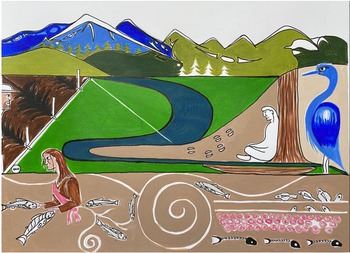
Through Carman’s practice as an artist, he portrays the unfolding of events across timescapes. This is evident in Carman’s ink drawing (see Figure 2) of the Katzie Slough, a culturally significant waterway that was diked to create farmland for settlers (see Hill et al., Reference Hill, Bailey and McKay2024). Carman includes ancient histories, such as the marriage of a Katzie Ancestor and a Sockeye Salmon (the Salmon woman in the lower left corner), with current practices, including the modern day Fisherman on the left whose fishing line severs the flow of the Slough (representing the dike), along with the eternal salmon cycles (lower right), reflecting the timeless presence of salmon in this place even though they are currently expatriated within these waters. We know that one day the salmon will once again swim in these waters and feel the external presence of their DNA within this landscape. When foreground, middle ground and background are collapsed, temporalities of the “long now” (Wooltorton et al., Reference Wooltorton, Collard and Horwitz2015) can become sensible within research images. Considering machine technologies such as drone imaging alongside Indigenous practices of artmaking and storytelling such as Carman’s offers new exciting possibilities for critical forest studies and its extension into environmental education research.
The Katzie Slough yesterday, today and tomorrow ink drawing, Carman McKay, 2023.

Imaging spiritual energies within forests: The story of the tall person
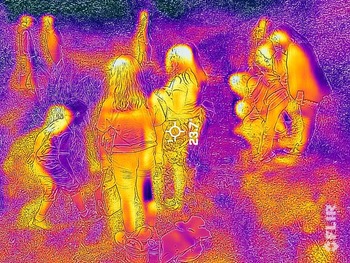
Creating research images using machine technologies can make the energies that circulate through a forest visible, and in turn, orientate us to ancestral spirits and planetary life forces that create awareness of diverse forest relations across timescapes. In Figure 3, children are gathering around a pond in the forest looking for tadpoles, but the camera reveals more than what was perceived through our eyes. The flow of different colours across beings and spaces, as well as the flattening of the fore, middle, and background in the image, create opportunities to see ancient active forces in the continuing present. For us, the images created by the thermal camera captures spirits or energies that appear as colourful auras, specks of light, and sparkles. Although it is also possible to see these energies at times without the aid of a camera, they often go unnoticed.
Looking for tadpoles in Coast Salish territories (Vancouver area).

In Figure 3, we see energy that appears to be connected but distinct from the physical bodies (note the child on the lower left), as well as hints of what resembles magical beings. In the upper right corner, Carman identified what is known in Stó:lō territories as a Tall Person. Tall People originate from other parts of our universe, and enchant humans in rare spiritual moments for those with an open mind and heart. The thermal images remind us to attend to the animistic dimensions within forestscapes (see also Antang et al., Reference Antang, Rousell, van Eeden and Grover2026 this special issue; Rousell et al., Reference Rousell, Ryan, Bauer-Nilsen, Lai, Burnard, MacKinlay, Rousell and Dragovic2022), including ancestors, spirits, and supernatural beings that may be evident through shifts in energy, glows, and breaks within visual patterns. In such situations, Carman encourages us to consider: Is it a Fire Spirit? Is a Water Spirit? Is it an Earth Spirit? An Air Spirit? Does it feel male, such as a Grandfather Spirit, or female, such as a Grandmother Spirit? Do you see them both at one time? What is your instinct telling you?
Supernatural creatures, such as Tall People, roamed the earth before the time of the ice age (also see Williams-Davison & Davidson, Reference Williams-Davison and Davidson2019) and continue to present themselves. Supernatural connections can be experienced through spirit work, ceremony, and visions quests and are moving forward through time. Belief in spirits (such as Tall People, fairies, and unicorns) are ubiquitous across cultures (see Çapan, Reference Çapan2024). In Finland for example (Cher’s ancestral homeland), the forests are populated with nature spirits, fairies, gnomes, and trolls. Knowledge of these mythical times is less interrupted within Indigenous communities in Western Canada compared to other places, as colonisation occurred more recently in this area (Chappell, Reference Chappell2023), (less than two hundred years ago).
We propose that attending to spiritual energies in forests can create connections that entangle the past with the present. Rousell et al., (Reference Rousell, Ryan, Bauer-Nilsen, Lai, Burnard, MacKinlay, Rousell and Dragovic2022) refer to such approaches as “animist pedagogies,” which take nonhuman sentience and metaphysical relationships into account within place-based educational contexts. Being open to these metaphysical forces is central to the ecologisation of the research image we undertake in this paper, disrupting the idea that ecology is somehow only discernible or intelligible through Western images of science. As Four Arrows (2022) explains, “Landscape is sacred because it lives and because it holds the spiritual energy of ancestors, being in tune with all this spiritual energy and entering into a dialog with it through praying, singing, vision questing, ceremony and daily life is vital” (p. 31). Such visitations can be instructive, sharing knowledge and values that guide ways of being. These teachings of magical beings and origin stories are rarely facilitated in meaningful ways within Western schooling. As Carman shares, such education involves a considerable amount of time, and requires us to be still, to be observant, and to recognise the places that continue to house ancient peoples, ancient forests, and ancient relations. Indeed, there are ancient beings all around us – the trees that are present today are the greatest grandchildren of the ancestral trees of the past.
Imaging multispecies worldings within forests: The story of the Buln buln (Lyrebird)
When walking through Corhannwarrabul (Sherbrooke forest) on unceded Wurundjeri Country, we engaged in listening practices focusing not only on the sound but also on the languaging of that expression – how language has been formed through movement, sound, and the felt and sensed relations of the forest as a living system. David named our walk a “listening body” in the forest, sensing, enabling, and emitting sound waves as collective experiences (Rousell et al., Reference Rousell, Gallagher and Wright2022; Reference Rousell2023). Sonic frequencies travel through bodies, objects, lands, and waters. While undertaking audio recording, we tried to escape the idea that recording should capture something we could call “the sound.” With our thinking, being, and holding the connections and attachments while walking with them, we propose sound as a living sensation which carries meaning. Robinson’s (Reference Robinson2020) critique of hungry listening is valuable here, as it urges us to open ourselves to the fullness of sound beyond commodification or aesthetic appreciation. Building on this critique, Laura Brearley (Reference Brearley, Voyageur, Brearley and Calliou2014) describes Deep Listening, present in many different Aboriginal languages, as a practice that “opens up a space to think about inner experience. It means listening not only with our ears. It’s deep listening with our eyes, deep listening with all the senses” (Treahna Hamm, email comm. with Kevin Argus) (p. 97). This form of listening invites an embodied and reciprocal engagement with the forest’s soundscape, emphasising ethical attentiveness and multisensory connection that resonates with Indigenous understandings of forests as living, communicative knowledge societies (Watts, Reference Watts2013).
Listening closely to our documentation, we hear the humming – an expression of many different species forming an incoherent soundscape – as a trans-corporeal expression of the ecosystem (the link to our recording can be found here). We converted this audio into a spectrogram to create a research image that includes these complex forest relations in a way that highlights rhythms and repetition, as well as difference (see Figure 4 for an excerpt). The visual is determined by the pitch and the intensity of sounds, offering a research image that is multisensory and distributed across frequencies of light, sound, movement, and touch.
Forest ecology, Kulin Nation (Melbourne area).

During our walk in Corhannwarrabul, we encountered a buln buln (lyrebird) nearby, and while everyone else focused on taking a photo, Jelena dropped the recorder on the ground. The buln buln reproduces the calls of other birds, as well as human sounds, such as tree felling, human voices, and camera shutters. Ferdinand (Reference Ferdinand2025) for example, documented the vocalisations of a buln buln in Corhannwarrabul that sounds like a chainsaw. They can even simultaneously vocalise multiple distinct sounds at once (Ekkel, Reference Ekkel2024), reproducing complex forest soundscapes. Buln buln perform the voices of others for a variety of reasons, including attracting a mate, warding off predators, as well as pure joy (see Ekkel). As David noted, we can also understand these birds as ecological artists – with an expression of desire and music in a sense that travels through all life, beyond survival and functional purpose, and also holds aesthetic value. The buln buln has also been referred to as a “multispecies historian, whose imitations provide mediated insights into the changing ecosystems of which they are part” (Ekkel, Reference Ekkel2024, p. 172). Indeed, the buln buln are producers of their own dynamic and entangled images of forest soundscapes.
The soundscapes, documented by us, as well as the buln buln, highlight the interconnectedness of more-than-human forestscapes, a sensibility that is central to our methods of ecologising the research image. These entanglements are a form of sympoiesis, a worlding with others, in which perceptions are co-constituted within a dynamic state of interdependence (Haraway, Reference Haraway2016).
Imaging oneness within forests: The story about what is on the inside
The thermal camera sometimes superimposes bodies on top of one another, flattening depth and disrupting the usual boundaries between beings. Here in Figure 5, the intricacies of the leaves of the plant become part of the hand. Indeed, within forests the boundaries between humans and more-than-humans are porous. When humans walk in the forest, we inhale phytoncides, organic compounds produced by trees and plants, such as pine and eucalyptus, that are released into the air, soil and water. These biologically active compounds protect plants from insects, bacteria and fungi. They also affect humans, decreasing the production of stress hormones and enhancing the immune system (Li, Reference Li2010). As illustrated in Figure 5, when we walk into forests, plants become a part of us. We propose that the thermal imaging makes our interconnectedness visible, highlights ecological thinking, and encourages us to see how we merge with forest beings.
Human hand touches a plant, Corhannwarrabul (Melbourne area).

This practice of making the porous boundaries between humans and plants visible is consistent with Carman’s practice as a contemporary Coast Salish artist. He encourages children to look carefully at forest beings and draw what is on the inside of what they are seeing – the spirit or the energy of the being (see Figure 6). He asked them to consider what is foreground, what is middle ground and what is background and how many layers could there be?
Bear and human. Human and bear. Sketch by Carman McKay.

This concept of oneness across beings is reflected in Carman’s ancestral language, halq̓eméylem, through the phrase: léts’e mót létse th’á:le, which means one heart, one mind. As critical forest studies researchers, we can create research images that demonstrate léts’e mót létse th’á:le through novel technologies, but as environmental educators, how do we develop a practice of becoming one with our environment, and support our students in doing the same? Carman encourages us to consider: Have you been out on the land? Have you been out on the river? Have you walked the mountain? And how often are you doing this? How is that repetitive connectedness possible? Can we do this tomorrow? Is this possible again the day after? Next week and next month? For us as environmental educators, these research images help us to set these intentions for ourselves and our students.
Building on the thermal camera’s propensity to superimposes bodies on top of one another, and informed by Indigenous artmaking practices, we endeavour to ecologise our research images in ways that highlight oneness and interconnectnessed across diverse beings, inspiring a more ethical praxis.
Imaging the four elements within forests: The story of balance and harmony
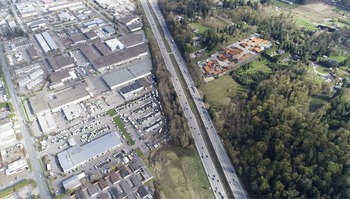
Through the aerial footage and thermal images, we become more aware of the four interdependent life forces (fire, water, earth and air), the ecology of creation, and of the massive industrial disruption to forests that may be less evident on the ground. Our drone footage (see Figure 7) makes the life and death of the forest visible. As Carman explained, with urbanisation, colonialism, development, and business, comes the death of so much on these lands. With the clear cutting of the forest, temperatures rise (fire), rainfall is less likely to be absorbed (water), the soil is eroded (earth), stored greenhouse gasses are released, and the winds will travel easily (air).
Drone footage 5 km north of the forest school, Coast Salish territories (Vancouver area).

Within the thermal image (Figure 8), the impact of the sun is heightened, contributing to our awareness of this central life force in the forest. In this image, Carman sees the element of fire, including both life-giving and destructive forces. We are reminded that during the spring the sun is in a balancing moment. Warming temperatures and increasing daylight hours, as well as other factors, signal migratory birds to return from warmer climates. The frogs, insects and others are coming to life. Increasingly with global warming by mid-summer, the forest is completely dry, and an abundance of water is needed to replenish life. The forest is thirsty, and this imbalance contributes to forms of death, including the devastating fires increasingly experienced in both Canada and Australia.
Patches of sun on the forest trail in the early summer, Kulin Nation (Melbourne area).

Together, the drone footage and thermal images, along with Carman’s sketch of the Stó:lō creation story (Figure 9), highlight the importance of attending to Medicine Wheel teachings about the four life forces (fire, earth, water, air). The Medicine Wheel is an ancient symbol and sacred circle divided into four quadrants (Mashford-Pringle & Shawanda, Reference Mashford-Pringle and Shawanda2023). Medicine Wheel teachings grew out of Indigenous communities in what is currently known as central and Eastern Canada. However, due to colonial displacement, urban Indigenous communities have created adaptable and integrative cultural experiences and understandings, surpassing specific landform cultures. The Medicine Wheel is an endearing teacher for many (but not all) Indigenous peoples in Canada. The quadrants teach circular ways of knowing across interrelated aspects, such as the four elements, the four seasons, the four stages of life, the four aspects of the wholistic self (body, mind, spirit, emotion), and the like. Medicine Wheel teachings may differ from community to community, but core concepts are often similar. One of the many common teachings is one of cyclical patterns and balance, as well as of interconnectedness. Such wholistic Indigenous theory includes “an intermixing and consideration of time and space: the past, present, future; directions, doorways of life; the ecology of creation such as earth, sun, water, air, and all their occupants; and values that retain the balance and harmony of all of the above” (Absolon, Reference Absolon2010, p. 75). Considerations of the (im)balance of life sustaining elements in forests of fire, water, earth, and air within our documentation is central to our intentions to ecologise the research image as critical forest studies scholars and environmental educators.
Stó:lō origin stories: the mosquito, robin, bear, the mountains all are part of the oral tradition of creation. Sketch by Caman Mc Kay.

Concluding thoughts
This scholarship, we propose, contributes to new research methods for making the dynamic, entangled, and enduring relationality within forests sensible through the use of machine visioning technologies, combined with Indigenous artmaking and storytelling practices. Within our thermal imaging, spectrograms, as well as much of the aerial footage, the foreground and background are flattened, insides and outsides are enfolded, and the human figure is ecologised within forests across timescapes. Markers of enduring ancient forest relations, including sacred stones, storied landscapes, and supernatural beings, become sensible in new and different ways through drone footage and thermal imaging. The entanglement and oneness of human and more-than human relations are expressed through the superimposition of diverse beings in images produced by the thermal camera and through patterns of vocalisations across kin within the spectrograms. Both drone and thermal images can help us to see the (im)balance of within ecologies of creation (sun, water, wind, and earth) that often goes unnoticed in forests. We suggest that these images shift the focus of environmental education from individual experiences to bodily collectives; from the here and now to ancient histories that continue to unfold within the present; from the corporeal to the incorporeal; and from backgrounded landscapes to essential earthly elements. We share these methods to illustrate the rich and dynamic interconnectedness that critical forest studies can offer, as well as to provide opportunities for others to build on and extend this work in their place-based and cultural contexts.
Understanding that ethics, epistemology, and ontology are entangled (Barad, Reference Barad2007; Watts, Reference Watts2013), as environmental educators we utilise our research images to co-create more complex, inclusive, and wholistic stories about forest relations within the work that we do with students on unsurrendered lands in Canada (see Hill et al., Reference Hill, Bailey and McKay2024) and Australia (see Rousell, Reference Rousell2023). These images help us to develop our “X-ray vision” to uncover sedimented layers of forest relations, including pre-contact histories, and colonial interruptions, as well as speculative futures. Together we come to understand how these layers bleed through one another (Barad, Reference Barad2014), continuously impacting ways of being on these lands (see Hill et al., Reference Hill, Bailey and McKay2024). They also support our capacities to recognise oneness across diverse bodies, such as the waters that flow through our bodies and within polluted rivers (see Hill et al., under review). In undertaking an ecologisation of the research image as a learning pathway within our work as environmental educators, we endeavour to support students in situating themselves within the forest family of life. This troubling of colonial modes of perception that disconnect from more-than-human kin relations and normalise the degradation of sacred landscapes is, in itself, an anti-colonial act. Creating research images that express relations of oneness and difference across peoples and places (past, present, and future) can bring awareness to inherent responsibilities to communicate with the land and act in accordance with creation, bridging critical forest studies into environmental education in ways that are guided by, and in allyship with, Indigenous sovereignties of place.
Acknowledgements
We express our heartfelt gratitude to the members of the Critical Forest Studies Collaboratory and Australian Journal of Environmental Education colleagues who informed, guided, and supported the development of this manuscript. We are deeply grateful for the guidance provided by Leanne Joe, Nikki Browne, and Kylie Colemane that depended our understandings of Indigenous languages and territories.
Ethical statement
This research project received ethical approval from Simon Fraser University, Application #30000531, as well as a School District (which will remain anonymous), Application #RES2023-2024-036.
Financial support
This paper draws on research supported by the Social Sciences and Humanities Research Council of Canada.
Competing interests
The author(s) would like to disclose that Associate Professor David Rousell is an Associate Editor of The Australian Journal of Environmental Education (AJEE). In accordance with AJEE protocols, Dr Rousell was not involved in the editorial process or decision making regarding this manuscript.
Author Biographies
Cher Hill is an Assistant Professor and settler scholar in the Faculty of Education at Simon Fraser University, Canada. She is deeply invested in researching educative experiences that contribute to more connected, thriving, and just communities. Cher is a passionate supporter of relational, land-centred, and community-based educational initiatives. Her current research involves working collaboratively with Elders, land guardians, environmentalists, teachers, and students to educate citizens about the impact of colonisation on the Fraser watershed, to restore local creeks, and to care for Salmon like family.
Carman McKay is a Coast Salish artist, cultural educator, life skills facilitator, and graduate student at Simon Fraser University. His father’s ancestors, the Stó:lō (River) People and his mother’s ancestors, the xʷməθkʷəy̓əm (Musqueam) People, have benefitted from this liveable region for at least 9,000 years. Carman has been fortunate to have been educated by many determined and active educators and role models from all over Turtle Island (North America). His approach to facilitation is informed by teachers who have found no fault for what he did not understand and supported him to be present to see, feel, hear, and connect with the learning meant to be received and experienced.
Jelena Aleksic is a PhD candidate at RMIT University in Melbourne, and an artist/researcher in the fields of art education and environmental humanities. Her PhD research explores relational creative practices between humans and nonhuman bodies of water in the age of the Anthropocene in Port Phillip Bay in Naarm (Melbourne). Her previous work with young people, students, art activists and refugees involved using visual practices, oral histories and storytelling around the topics of belonging and civic space for youth.
David Rousell is Associate Professor of Regenerative Education at RMIT, where he teaches and researches in the areas of climate justice, regenerative art and design, and education futures. He is a core member of the Centre for Urban Research and the Digital Ethnography Research Centre at RMIT, and founding convenor of the Critical Forest Studies Collaboratory.





 Open access

