




Introduction
Restoring natural ecosystems in high-use areas may help alleviate the growing mental health crisis. An increasing body of research suggests nature-related activities can support and restore mental health (Stigsdotter et al. Reference Stigsdotter, Ekholm, Schipperijn, Toftager, Kamper-Jørgensen and Randrup2010, Tillman et al. Reference Tillmann, Tobin, Avison and Gilliland2018, Bratman et al. Reference Bratman, Anderson, Berman, Cochran, De Vries, Flanders and Daily2019). These benefits may be particularly important given that the global prevalence rate of mental illness is increasing (Richter et al. Reference Richter, Wall, Bruen and Whittington2019), and this increase is fastest among younger people (Plana-Ripoll et al. Reference Plana-Ripoll, Momen, McGrath, Wimberley, Brikell, Schendel and Dalsgaard2022). Declines in mental health have been particularly acute on college campuses. By 2020, c. 60% of college students reported mental health challenges (Lipson et al. Reference Lipson, Zhou, Abelson, Heinze, Jirsa and Morigney2022). Students from historically marginalized groups experienced the greatest risks (Sheldon et al. Reference Sheldon, Simmonds-Buckley, Bone, Mascarenhas, Chan, Wincott and Barkham2021). This crisis worsened throughout the COVID-19 pandemic (Lipson et al. Reference Lipson, Zhou, Abelson, Heinze, Jirsa and Morigney2022, Liu et al. Reference Liu, Frazier, Porta and Lust2022), although nature-based interventions proved effective in preventing mental health declines during the pandemic (Beall et al. Reference Beall, Jackson, Casola, Peterson, Larson, Stevenson and Seekamp2022, Larson et al. Reference Larson, Mullenbach, Browning, Rigolon, Thomsen, Metcalf and Labib2022). Nature-based interventions have been linked to stress reduction (Stigsdotter et al. Reference Stigsdotter, Ekholm, Schipperijn, Toftager, Kamper-Jørgensen and Randrup2010, Hartig et al. Reference Hartig, Mitchell, De Vries and Frumkin2014), reducing depression (Shanahan et al. Reference Shanahan, Bush, Gaston, Lin, Dean, Barber and Fuller2016), increasing perceived restorativeness (Hipp et al. Reference Hipp, Gulwadi, Alves and Sequeira2016), improving mood (Holt et al. Reference Holt, Lombard, Best and Smiley-Smith2019, Ibes & Forestell Reference Ibes and Forestell2022) and improving attention (Hartig et al. Reference Hartig, Evans, Jamner, Davis and Gärling2003, Lu & Fu Reference Lu and Fu2019), thereby offering a unique health promotion pathway for college students facing psychological challenges.
Birdwatching represents a form of nature-based health intervention that has been gaining more attention recently for several reasons. First, birdwatching is both rapidly growing and is among the most common forms of nature-based recreation activities. In 2000, membership in the Royal Society for the Protection of Birds (RSPB) exceeded membership in all UK political parties (Cordell & Herbert Reference Cordell and Herbert2002), and c. 100 million Americans birdwatched in 2022 (US Department of the Interior 2023). Relatively new mobile applications to support identification (e.g., the popular Merlin bird identification application) have made birdwatching more appealing to younger people (Luna et al. Reference Luna, Gold, Albert, Ceccaroni, Claramunt, Danylo, Sturm, Joly, Vrichidis, Karatzas, Karppinen and Bonnet2018). The long legacy of birdwatching as a data source for ornithology has been leveraged in rapidly expanding, conservation-focused citizen science initiatives (Noss Reference Noss2020). Birdwatchers are also working to support a more diverse and inclusive birdwatching community (Pharr & Lanham Reference Pharr and Lanham2023). Mental health stressors such as the COVID-19 pandemic may have also encouraged more birdwatching (Basile et al. Reference Basile, Russo, Russo, Senese and Bernardo2021). Second, birdwatching is accessible: it requires limited equipment and no specific physical or athletic skills, and birds are ubiquitous even in urban environments (McCleery et al. Reference McCleery, Moorman and Peterson2014). Third, birdwatching may create positive feedback for human well-being by engendering support for wildlife conservation (Cooper et al. Reference Cooper, Larson, Dayer, Stedman and Decker2015, Dayer et al. Reference Dayer, Rosenblatt, Bonter, Faulkner, Hall, Hochachka and Hawley2019, Brock et al. Reference Brock, Doremus and Li2021), which in turn supports more biodiversity and improved human health (Robinson et al. Reference Robinson, Breed, Camargo, Redvers and Breed2024).
There is growing evidence that birdwatching supports mental health (Andrews et al. Reference Andrews, Ammirati and Andrews2025). Increased bird diversity was associated with increased life satisfaction in Europe (Methorst et al. Reference Methorst, Rehdanz, Mueller, Hansjürgens, Bonn and Böhning-Gaese2021). Similarly, birdwatching was linked to higher self-reported mental health among birdwatchers in Europe (Hammoud et al. Reference Hammoud, Tognin, Burgess, Bergou, Smythe and Gibbons2022) and among residents of Beijing (China) who reported birdwatching as a regular activity (Xie et al. Reference Xie, Pan, Zheng, Xiao and Li2023). Cox et al. (Reference Cox, Shanahan, Hudson, Plummer, Siriwardena, Fuller and Gaston2017) detected negative relationships between afternoon bird abundance and human anxiety, stress and depression in the UK. In Germany, Randler et al. (Reference Randler, Vanhöfen, Härtel, Neunhoeffer and Engeser2023) found that restoration levels were positively related to bird diversity on guided bird walks. Outdoor experiments have demonstrated that birdwatching generates larger increases in subjective well-being than do general nature walks or participation in control groups (Peterson et al. Reference Peterson, Larson, Hipp, Beall, Lerose, Desrochers and Martin2024, Ebrahimi et al. Reference Ebrahimi, Kazemi and Agha Ebrahimi2025).
Similarly, exposure to birdsong is linked to health benefits. Multiple laboratory studies linked birdsong, sometimes mixed with other pleasant noises such as running water or classical music, with lower self-reported stress, anxiety and paranoia, and even with reduced measures of biophysical stress including skin conductance (Alvarsson et al. Reference Alvarsson, Wiens and Nilsson2010, Stobbe et al. Reference Stobbe, Sundermann, Ascone and Kühn2022). Even in studies in which birdsong effects are not statistically significant, birdsong treatments are generally associated with lower levels of stress than alternative treatments such as traffic noise (Hedblom et al. Reference Hedblom, Gunnarsson, Schaefer, Knez, Thorsson and Lundström2019). One hybrid study that played birdsong on actual hiking trails demonstrated that higher song diversity predicted greater perceived restorativeness of a hike (Ferraro et al. Reference Ferraro, Miller, Ferguson, Taff, Barber, Newman and Francis2020). Vanhöfen et al. (Reference Vanhöfen, Stuck, Haag, Härtel and Randler2025) did not detect effects of birdsong or birdsong diversity but did demonstrate that nature walks themselves promoted positive emotions and lower physiological stress measures. Bird sounds also promote perceptions of restorativeness (Ratcliffe et al. Reference Ratcliffe, Gatersleben and Sowden2016, Reference Ratcliffe, Gatersleben and Sowden2018, Randler et al. Reference Randler, Vanhöfen, Härtel, Neunhoeffer and Engeser2023). In these studies, and hereafter, perceived restorativeness refers to the extent to which people view an experience as aiding recovery from stress, renewing cognitive function and recovering emotionally.
In their review of birdwatching’s benefits for human health, Andrews et al. (Reference Andrews, Ammirati and Andrews2025) concluded that more research is needed to document how the physical landscape where birdwatching occurs influences well-being, particularly because birdwatching’s value as a health intervention depends largely on claims that it can be done anywhere by anyone, despite the concept and health impacts of ‘where’ not being understood. Andrews et al. (Reference Andrews, Ammirati and Andrews2025) also highlighted the need to explore the different aspects of birdwatching that might generate such benefits, noting that contemplatively watching or listening to birds, competitive birdwatching, citizen science with birds and even physically handling birds may all elicit different effects.
In this study, we begin to address both ‘where’ and ‘how’ exposure to birds and birdsong affects mental health on a college campus by evaluating how birdsong and traffic noise impact psychological well-being and perceived restorativeness differentially in a restored forest landscape (i.e., green space) and adjacent built environment (i.e., grey space). We hypothesized that: (1) the restored forest combined with the birdsong soundscape would elicit the highest psychological well-being and perceived restorativeness; (2) the two treatments mixing location and soundscape conditions (i.e., restored forest/traffic soundscape and grey space/birdsong soundscape) would elicit intermediate levels of psychological well-being and perceived restorativeness; and (3) the grey space combined with the traffic soundscape would elicit the lowest psychological well-being and perceived restorativeness. These hypotheses are rooted in Stress Reduction Theory (SRT; Ulrich Reference Ulrich1981) and Attention Restoration Theory (ART; Kaplan & Kaplan Reference Kaplan and Kaplan1989, Ohly et al. Reference Ohly, White, Wheeler, Bethel, Ukoumunne, Nikolaou and Garside2016). SRT suggests that natural environments and specific aspects of them aid in reducing or recovering from stress in part by evoking positive emotional responses. Thus, measures of psychological well-being addressing positive and negative emotional responses to stimuli (e.g., the Scale of Positive and Negative Experience (SPANE; Li et al. Reference Li, Bai and Wang2013, Jovanović et al. Reference Jovanović, Lazić, Gavrilov-Jerković and Molenaar2020)) are well-suited to assessing the potential benefits of forests and birdsong soundscapes. ART (Kaplan & Kaplan Reference Kaplan and Kaplan1989) suggests that exposure to nature restores cognitive functioning capacity by engaging one’s involuntary attention, and that natural environments have higher restorative qualities than built environments. These restorative qualities can be reliably measured using self-report scales including the Perceived Restorativeness Scale (PRS; Hartig et al. Reference Hartig, Korpela, Evans and Gärling1997, Nghiem et al. Reference Nghiem, Wong, Jeevanandam, Chang, Tan and Goh2021). Addressing these hypotheses will provide preliminary answers regarding the degree to which restored forests in urban areas and associated birdsong soundscapes have additive positive impacts on well-being.
Methods
We used a 2 (location) × 2 (soundscapes) within-subjects design to evaluate how birdsong and restored forest impact stress levels, positive and negative experiences and the perceived restorativeness of the experiences. The restored forest was within the Rocky Branch Stream Restoration and Greenway Project’s footprint (Doll Reference Doll2010), which was conducted in 2002–2006 and included re-engineering the floodplain (e.g., restoring surface flow, installing stream meanders), removing exotic plants and native tree-planting. When the current study was conducted, the restored forest had >70% forest canopy cover and <30% built structures (e.g., buildings, paths, parking lots) within a 50-m buffer around where participants sat during treatments; it also featured no front-facing sightlines to built structures (Fig. 1). The forested landscape’s coordinates were 35.780246, −78.668538. The grey space location had >70% built structures and <30% forest canopy cover within a 50-m buffer of the seating location; it featured front-facing sightlines that included built structures (Fig. 1). The grey space location (coordinates 35.783181, −78.670695) was outside of the Talley Student Union building on North Carolina (NC) State University’s campus. Given that these geographical areas were relatively small, we used a dot-grid method to estimate tree canopy cover and built structure cover within the buffers (Cotillon & Mathis Reference Cotillon and Mathis2016). The 10-min birdsong soundscape used in the study was extracted from a recording from a freshwater marsh in the St Marks National Wildlife Refuge (Florida, USA) on the afternoon on 17 May 2023 (Singer Reference Singer2023). The birdsong was dominated by blue-grey gnatcatcher, Carolina wren and white-eyed vireo but also included pileated and red-bellied woodpeckers, other gnatcatchers, kingfishers, mourning doves and catbirds. The 10-min traffic noise soundscape used in the study was extracted from a recording at a busy intersection in Créteil (Val-de-Marne, France, within the Greater Paris metropolitan region) on 12 November 2020 (Moulaythami 2020). The two soundscape treatments were created by appending 10 min of birdsong or traffic after a 5-min acclimatization period of silence (recordings are available in Appendix S1).
Ground and aerial views of the restored forest (bottom right) and grey space (top right) locations where treatments occurred immediately prior to measuring stress, Scales of Positive and Negative Experience and the Perceived Restorativeness Scale.

Figure 1. Long description
The image consists of one aerial view and two ground photos. Panel A: An aerial view shows a student union building, a sports field, and a restored forest area labeled as Rocky Branch Greenway. Sitting locations are marked with circles. Panel B: A ground photo shows a person sitting in a red chair near a modern building with glass walls, likely the student union building. Panel C: Another ground photo shows a person sitting in a red chair in a forested area with trees and sunlight filtering through the leaves.
Participants were drawn from volunteer students in classes offered by the NC State University College of Natural Resources (n = 106). Participants received an email the week before the experiment started that thanked them for agreeing to participate and provided participation instructions. The individualized instructions included a randomly assigned, but blocked, order of location and soundscape treatments. Specifically, each participant was randomly assigned a starting location (restored forest or grey space; Fig. 1) and then randomly assigned a soundtrack order, with either birdsong or traffic being played first at the first location. Similarly, soundtrack order was randomly assigned for the second location. The research team helped ensure that each participant was able to install the VLC Media Player application on their personal cell phones, save the birdsong and traffic noise soundscape.mp3 files to the VLC media folder and play soundtracks at ‘conversational volume’ at approximately the mid-point on the VLC volume control for most devices and 50–70 dB and not to change the settings between treatments. Participants could choose any day between 7 February and 22 April 2025 to participate in the study if there was no precipitation during the data collection time period and the temperature was 20–25°C, a range at which temperature itself has minimal impact on stress (Seppänen & Fisk Reference Seppänen and Fisk2006). Participants carried their cell phones, a camp chair with arm rests (Fig. 1) and over-the-ear style noise-cancelling headphones to the first landscape that they were randomly assigned to. They placed the chair on top of a small flag either (1) facing a road intersection for the grey space location or (2) facing away from the footpath towards the trees in the restored forest location. Participants then sat in the chair and listened to their first assigned soundtrack (Fig. 1).
After each soundtrack concluded, participants immediately clicked a link for the survey. After completing the survey, they initiated the second assigned soundtrack and repeated the survey after that soundtrack concluded. Each participant then walked to their second assigned location and repeated the process in the assigned order. Completing all four treatments took c. 2 h. The survey measured psychological well-being by a single-item measure of stress (Young et al. Reference Young, Nguyen, Roth, Broadberry and Mackay2015, Turon et al. Reference Turon, Carey, Boyes, Hobden, Dilworth and Sanson-Fisher2019) and the 12-item SPANE (Li et al. Reference Li, Bai and Wang2013, Jovanović et al. Reference Jovanović, Lazić, Gavrilov-Jerković and Molenaar2020). The single-item measure of stress asked participants, ‘On a scale of 0 to 10, with 0 being no stress and 10 being the worst stress possible, what number best describes your level of stress right now?’ The selected response was coded 1–11, with 6 as the mid-point. The SPANE questions instructed participants as follows: ‘Please think about what you have been doing and experiencing during the past 10 minutes. Then report how much you experienced each of the following feelings, using the scale below.’ Scale responses for each item ranged from 1 (Very Rarely or Never) to 5 (Very Often or Always). Participants were then presented with 12 feelings, six constituting the negative SPANE and six constituting the positive SPANE (Table 1). Following conventional scoring protocols (Li et al. Reference Li, Bai and Wang2013, Jovanović et al. Reference Jovanović, Lazić, Gavrilov-Jerković and Molenaar2020), we summed scores for the six negative items into the negative SPANE scale and summed scores for the six positive items into the positive SPANE scale. Thus, scores ranged from 6 (lowest possible) to 30 (highest negative or positive score). The PRS (Negrín et al. Reference Negrín, Hernández-Fernaud, Hess and Hernández2017) instructed participants, ‘Please read each statement carefully, and then ask yourself, “How much does this statement apply to how I experience the place?” Please indicate the extent to which the given statement describes your experience in this setting (0 = Not at all; 10 = Completely).’ The scale items were scored 1–11, yielding a scale ranging from 5 (not at all restorative for all items) to 55 (completely restorative for all items). The five statements within the PRS are included in Table 1. Finally, participants were asked to share their birth year and gender identity.
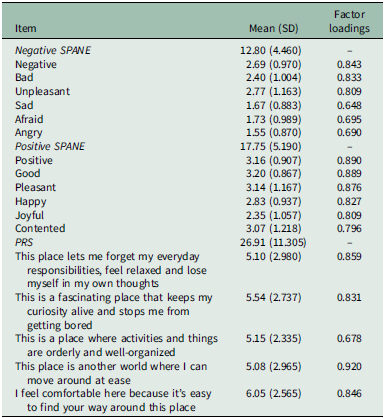
Descriptive statistics and exploratory factor analysis for the Scales of Positive and Negative Experience (SPANE) and Perceived Restorativeness Scale (PRS) items for all four treatments among the 106 participants.

Table 1. Long description
The table presents descriptive statistics and factor loadings for the Scales of Positive and Negative Experience (SPANE) and Perceived Restorativeness Scale (PRS) items. It has 18 rows and 3 columns. The columns are labeled Item, Mean (SD), and Factor loadings. The table is divided into three main sections: Negative SPANE, Positive SPANE, and PRS. Each section lists specific items with their corresponding mean, standard deviation, and factor loadings. The Negative SPANE section includes items such as Negative, Bad, Unpleasant, Sad, Afraid, and Angry. The Positive SPANE section includes items such as Positive, Good, Pleasant, Happy, Joyful, and Contented. The PRS section includes statements about the place’s ability to let one forget everyday responsibilities, keep curiosity alive, be orderly and well-organized, move around at ease, and feel comfortable. Each item is associated with a mean value, standard deviation, and factor loading.
SD = standard deviation.
We employed exploratory factor analysis (maximum likelihood with orthogonal varimax rotation) to determine whether the three multi-item scales loaded onto one factor (Table 1). We estimated internal consistency of the scales using Cronbach’s alpha. We compared treatment groups using 2 × 2 analyses of variance (ANOVAs) and Tukey–Kramer post-hoc tests (Kramer Reference Kramer1957). We estimated effect sizes for the ANOVAs using eta-squared (η2), which estimates the proportion of total variance in the dependent variable associated with the treatments (Richardson Reference Richardson2011). We used Cohen’s d as a measure of effect size for pairwise comparisons of treatments. The specific measures of effect size will facilitate comparisons with future studies, but, given the novelty of this research, we also adopted benchmarks of small (η2 = 0.01), medium (η2 = 0.06) and large (η2 = 0.14) effect sizes for model effects and small (d = 0.2), medium (d = 0.5) and large (d = 0.8) effect sizes for pairwise comparisons (Cohen Reference Cohen1988). These benchmarks are useful for novel research because direct comparisons to related studies are not possible (Lakens Reference Lakens2013).
Results
Most of the 106 participants self-identified as female (55.9% female, 38.3% male, 4.8% other, 1.0% declined to answer). Mean age was 22.5 years old (standard deviation (SD) = 2.69). Exploratory factor analysis suggests the negative SPANE represented one factor explaining 57% of the variance in negative experience (eigenvalue = 3.44) and displaying high internal reliability and acceptable factor loadings for each item (Cronbach’s alpha = 0.85; Table 1). Similarly, the positive SPANE represented one factor explaining 72% of the variance in positive experience (eigenvalue = 4.32) and displaying high internal reliability and acceptable factor loadings for each item (Cronbach’s alpha = 0.92; Table 1). The PRS measure of the perceived restorativeness of the place had one factor explaining 69% of the variance (eigenvalue = 3.45) and displaying high internal reliability and acceptable factor loadings for each item (Cronbach’s alpha = 0.89; Table 1). The stress index score averaged 4.83 (SD = 2.219; 95% confidence interval (CI) = 4.62−5.04) across all four treatments, slightly below the mid-point (6) on the scale. Similarly, the average negative SPANE score of 12.80 (SD = 4.460; 95% CI = 12.37−13.23) overlapped with ‘rarely’ experiencing the negative feelings. The average positive SPANE score of 17.75 (SD = 5.190; 95% CI = 17.25−18.25) overlapped with ‘sometimes’ experiencing positive feelings. Finally, the average PRS was 26.91 (SD = 11.305; 95% CI = 25.83−28.00), just below the mid-point (30) on the scale ranging from not at all to completely restorative.
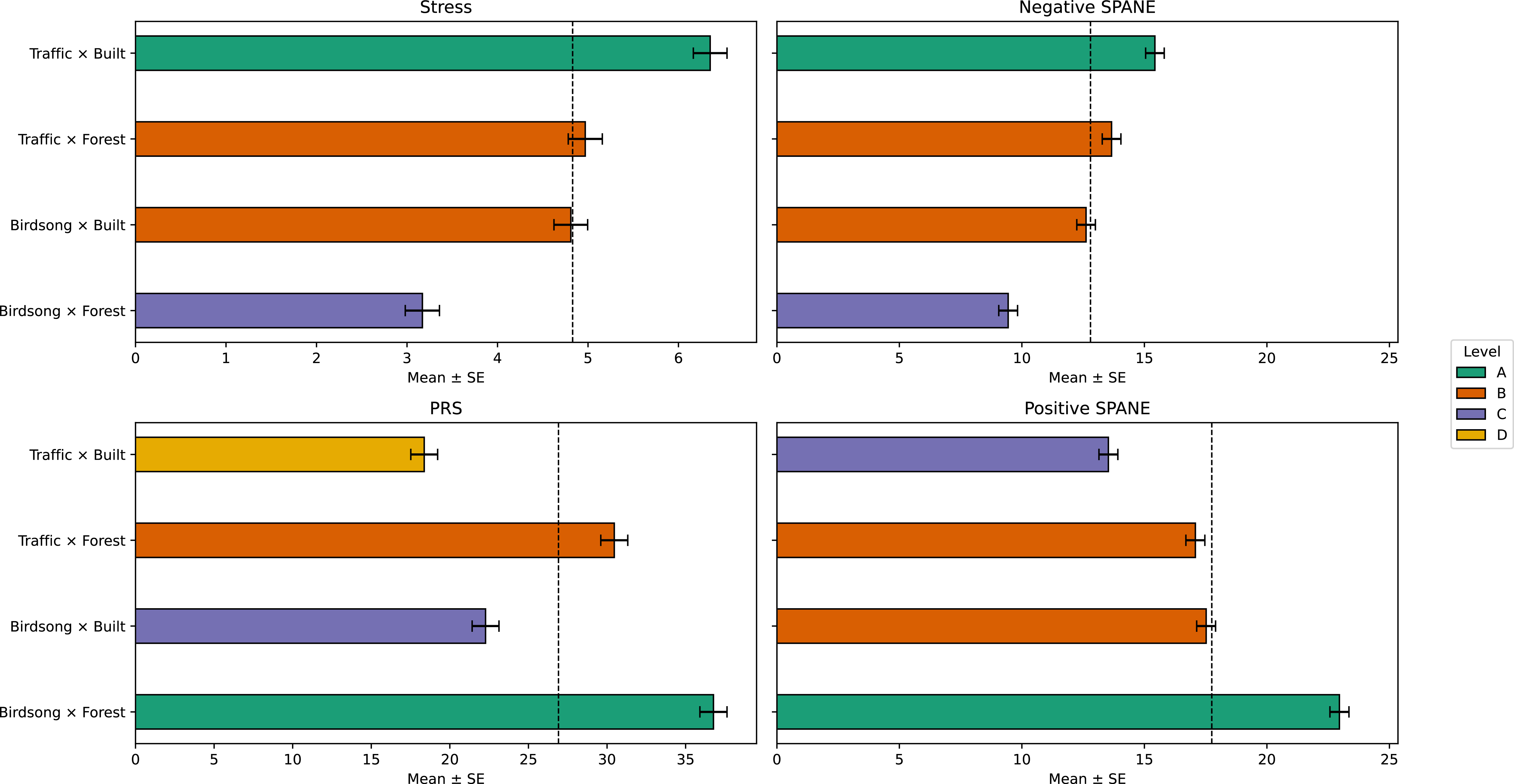
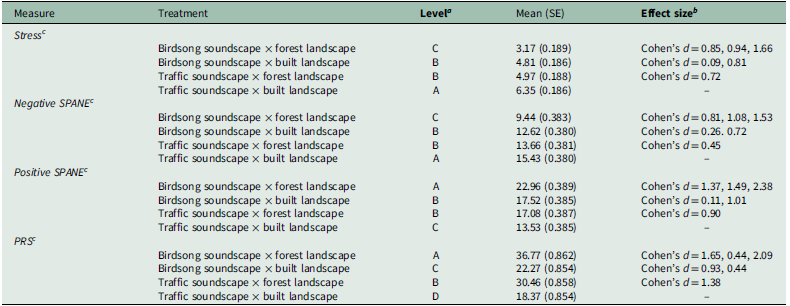
The comparison of location and soundscape treatments provided consistent and strong support for our hypotheses (Fig. 2 & Table 2). The two-way ANOVA with interaction for stress was highly significant (F3,415 = 48.25, p < 0.001). The main effect for soundscape had a large independent effect on stress (F1,417 = 80.07, p < 0.001; η2 = 0.14). Similarly, the main effect for location had a large independent effect on stress (F1,417 = 64.72, p < 0.001; η2 = 0.12). We did not detect an interaction effect (F1,417 = 0.477, p = 0.490; η2 < 0.001). Stress was lowest after the birdsong soundscape × restored forest treatment; this treatment also exhibited large effect sizes for all pairwise comparisons (Hypothesis 1; Table 2). Participants reported intermediate and indistinguishable stress levels after mixed treatments (i.e., birdsong soundscape × grey space, traffic soundscape × restored forest; Hypothesis 2; Table 2). Stress levels were the highest after the traffic soundscape × restored forest treatment, with large effect sizes for all pairwise comparisons involving this treatment (Hypothesis 3).
Comparison of stress, Scales of Positive and Negative Experience (SPANE) and Perceived Restorativeness Scale (PRS) scores between participants assigned to four treatment groups. The figure includes error bars for standard error of the mean, significantly different levels in treatments indicated by different colours and overall means for each metric indicated by dashed vertical lines.

Treatment comparisons for stress, the Scales of Positive and Negative Experience (SPANE) and Perceived Restorativeness Scale (PRS; n = 106).
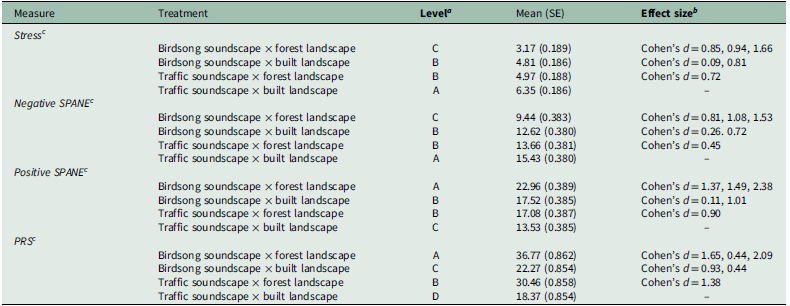
Table 2. Long description
The table presents data on the effects of different soundscape and location treatments on various measures, including stress, negative experiences, positive experiences, and perceived restorativeness. It has 16 rows and 5 columns. The columns are labeled Measure, Treatment, Level, Mean (SE), and Effect size. The table includes data for different treatments such as birdsong soundscape and traffic soundscape, and their interactions with forest and built landscapes. Each treatment is associated with a level, mean value with standard error, and effect size. The measures include stress, negative experiences, positive experiences, and perceived restorativeness, with corresponding Cohen’s effect sizes for each treatment combination.
a Levels not connected by the same letter are significantly different at p < 0.05.
b Pairwise Cohen’s d statistics ordered by comparing the treatment row to sequential treatments below it.
c All analyses of variance significant at p < 0.001.
SE = standard error.
We observed very similar patterns for negative SPANE scores. The two-way ANOVA with interaction for negative SPANE was highly significant (F3,421 = 44.76, p < 0.001). The main effect for soundscape had a large independent effect on negative SPANE (F1,423 = 88.10, p < 0.001; η2 = 0.16). The main effect for location had a medium independent effect on negative SPANE (F1,423 = 43.22, p < 0.001; η2 = 0.08). We did not detect an interaction effect (F1,423 = 3.574, p = 0.059; η2 < 0.006). Negative feelings were lowest after the birdsong soundscape × restored forest treatment, and this treatment also exhibited large effect sizes for all pairwise comparisons to other treatment groups (Hypothesis 1; Table 2). The mixed treatments elicited intermediate and indistinguishable responses for negative SPANE scores (Hypothesis 2; Table 2). The negative SPANE scores were highest after the traffic soundscape × grey space treatment, and they exhibited large or moderate effect sizes for all pairwise comparisons to other treatment groups (Hypothesis 3; Table 2). As expected, positive SPANE scores demonstrated responses to treatments inverse to those of negative SPANE scores.
The two-way ANOVA with interaction for positive SPANE was highly significant (F3,421 = 103.31, p < 0.001). The main effect for soundscape had a large independent effect on positive SPANE (F1,423 = 168.81, p < 0.001; η2 = 0.23). The main effect for location had a large independent effect on positive SPANE (F1,423 = 136.46, p < 0.001; η2 = 0.19). We detected a small interaction effect (F1,423 = 5.965, p = 0.015; η2 = 0.008), but graphical comparisons of treatments did not reveal any patterns unique to positive SPANE (Fig. 2). Positive SPANE was the highest after the birdsong soundscape × restored forest treatment, with large effect sizes for all pairwise comparisons (Hypothesis 1; Table 2). Again, mixed treatments elicited intermediate and indistinguishable positive SPANE scores (Hypothesis 2; Table 2). The traffic soundscape × grey space treatment elicited the lowest positive SPANE scores, with a large effect size for pairwise comparisons (Hypothesis 3; Table 2).
The PRS scores aligned with the hypotheses, but the PRS responded more to location than soundscape (Table 2). The two-way ANOVA with interaction for PRS was highly significant (F3,421 = 93.19, p < 0.001). The main effect for soundscape had a medium independent effect on PRS (F1,423 = 37.11, p < 0.001; η2 = 0.05). The main effect for location had a large independent effect on PRS (F1,423 = 241.16, p < 0.001; η2 = 0.34). We did not detect an interaction effect (F1,423 = 1.970, p = 0.161; η2 = 0.003). Perceived restorativeness was highest for the birdsong soundscape × restored forest treatment followed by the traffic soundscape × restored forest, birdsong soundscape × grey space and traffic soundscape × grey space treatments, respectively (Fig. 2). These results suggest the forest landscape had a larger positive effect on perceived restorativeness than the birdsong soundscape, whereas soundscape and location effects were similar for the previous three measures. Effect sizes were large for all pairwise comparisons of treatment groups for the PRS (Table 2).
Discussion
This study provides preliminary experimental evidence for a causal and additive relationship between exposure to birdsong soundscapes, restored forest and multiple measures of psychological well-being. Previous research suggests that hearing birds can lower stress (Alvarsson et al. Reference Alvarsson, Wiens and Nilsson2010, Stobbe et al. Reference Stobbe, Sundermann, Ascone and Kühn2022), and that hearing more kinds of birds while hiking can increase the perceived restorativeness of a hike (Ferraro et al. Reference Ferraro, Miller, Ferguson, Taff, Barber, Newman and Francis2020). Actively seeking birds while walking in nature may provide additive benefits beyond hearing and seeing them without intentional seeking (Peterson et al. Reference Peterson, Larson, Hipp, Beall, Lerose, Desrochers and Martin2024, Vanhöfen et al. Reference Vanhöfen, Stuck, Haag, Härtel and Randler2025). This study adds the insight that birdsong soundscapes and the forests in which they are experienced contribute additively and, in the cases of stress, positive experience and negative experiences relatively equally to well-being. Furthermore, this study demonstrated that the non-acoustic elements of a restored riparian forest may contribute more to the perceived restorativeness of experiences than acoustic features of birdsong, despite both having positive impacts. Finally, our study provides preliminary evidence that the well-being effects associated with natural forests can be reproduced by a relatively recently restored forest. These results align well with previous research (Vanhöfen et al. Reference Vanhöfen, Stuck, Haag, Härtel and Randler2025) documenting stronger effects on positive emotions and measures of physiological stress from the natural experience of a bird walk than from the birdsong heard during the natural experience.
Exposure to restored forest and birdsong may promote well-being by reducing psychological harm and restoring capacity (Marselle et al. Reference Marselle, Hartig, Cox, De Bell, Knapp, Lindley and Bonn2021). Notably, restored forests and associated birdsong may reduce the psychological harm caused by exposure to grey spaces and associated traffic noises, doing so to a greater degree than other types of natural landscapes such as grasslands (Astell-Burt & Feng Reference Astell-Burt and Feng2019, Wen et al. Reference Wen, Yan, Pan, Gu and Liu2019). Our results also align with ART (Ohly et al. Reference Ohly, White, Wheeler, Bethel, Ukoumunne, Nikolaou and Garside2016) given that stress levels were lowest and positive emotional responses were highest after exposure to the restored forest and the birdsong soundscape. Other studies support our hypotheses as well, noting that (1) birdsong soundscapes (Ferraro et al. Reference Ferraro, Miller, Ferguson, Taff, Barber, Newman and Francis2020) and forests (Hipp et al. Reference Hipp, Gulwadi, Alves and Sequeira2016, Astell-Burt & Feng Reference Astell-Burt and Feng2019, Wen et al. Reference Wen, Yan, Pan, Gu and Liu2019) promote perceived restorativeness and (2) attention restoration and stress reduction are linked to biodiversity (Nghiem et al. Reference Nghiem, Wong, Jeevanandam, Chang, Tan and Goh2021) and exposure to non-threatening wildlife such as birds (Johansson et al. Reference Johansson, Flykt, Frank and Hartig2024). Collectively, this research suggests that connection to birds – especially in natural, forested settings – can help build capacity for resilience in the face of stressors.
This study contributes to the understanding of birdwatching as a potential pathway for mitigating mental health challenges by demonstrating that one of the most accessible elements of birdwatching (i.e., birdsong) can promote psychological well-being. Although committed birdwatchers may benefit most from exposure to birds (Randler et al. Reference Randler, Murawiec and Tryjanowski2022), birdwatching is often advocated as therapy because it can be done ‘anytime, anywhere, by anybody’ (Zieris et al. Reference Zieris, Freund and Kals2023, Peterson et al. Reference Peterson, Larson, Hipp, Beall, Lerose, Desrochers and Martin2024, Andrews et al. Reference Andrews, Ammirati and Andrews2025). This study supports this claim given that (1) the only aspect of birds needed to elicit positive effects on psychological well-being and perceived restorativeness was sound and (2) these effects were achieved by participants without any birdwatching gear, in 10 min and in a restored forest landscape within an urban area. These effects are achievable by most people because they require very little physical fitness and no specialized skills or resources and can be accessed across a broad urban–rural gradient. But the additive and independent effect of the restored forest experience, particularly for perceived restorativeness, suggests that forest cover also matters. In some contexts, the benefits of combining birdwatching with restored forests, particularly those with >70% canopy cover, may not be achievable and could introduce inequity in access to the mental health benefits associated with biodiversity and activities such as birdwatching (Schell et al. Reference Schell, Dyson, Fuentes, Des Roches, Harris, Miller and Lambert2020). These biases may be particularly acute in urban areas with few trees or in ecoregions where forests only persist with significant anthropogenic support (e.g., deserts). That said, in our study the benefits of forest landscapes were achieved using a small area of restored forest within an urban matrix, suggesting that the effects could be replicated in urban parks with strategic locations of seating and viewsheds.
Future research is needed to address the important limitations of this study. The structure of the PRS may explain why location impacted the perceived restorativeness of the treatments more than soundscape. Differentiating the perceived restorativeness of an experience linked to auditory, visual and other aspects of birdwatching would probably require a new version of the PRS, considering that extant scales all appear to focus on visual elements of place (Han Reference Han2018). The PRS items (Hartig et al. 1997, Nghiem et al. Reference Nghiem, Wong, Jeevanandam, Chang, Tan and Goh2021) repeatedly invite participants to reflect on ‘place’ and experiences ‘here’. Although ‘place’ is a complex and multidimensional latent construct, connotations of the word may encourage participants to think more about the landscape as physical space rather than as a comprehensive set of sensory inputs (Ardoin et al. Reference Ardoin, Schuh and Gould2012). It is important to note, however, that pairwise comparisons still revealed higher perceived restorativeness for the birdsong soundscape × restored forest treatment than the traffic soundscape × restored forest treatment, and with a large effect size. This suggests that respondents consciously or subconsciously included soundscape within their responses to PRS items. As research exploring the links between soundscapes and sense of place continues to grow, researchers could expand investigations centred on the negative effects of anthropogenic ‘noise’ to include an emphasis on the benefits associated with more soothing natural sounds (Carson et al. Reference Carson, Cooper, Larson and Rivers2021, Yildirim & Arefi Reference Yildirim and Arefi2022). Future research that includes precise measurement and control over sound pressure levels would address an important limitation of this study. Although sound pressure levels were identical between treatments and within the window of 50–70 dB, this does not allow direct replication and limits the ability of practitioners to design birdsong-based therapies. Future studies measuring and varying sound pressure levels would allow researchers to determine the precise sound intensity likely to induce the greatest psychological well-being impacts from exposure to birdsong.
Additional studies could help determine the effective dosage required for birdsong soundscapes and restored forests. Correlative studies have identified dosage guidelines of 2 h in nature per week (White et al. Reference White, Alcock, Grellier, Wheeler, Hartig, Warber and Fleming2019), but logistical constraints have precluded experimental research that would identify dosage gradients for most forms of nature-based interventions (Shanahan et al. Reference Shanahan, Bush, Gaston, Lin, Dean, Barber and Fuller2016). Positive health effects may be achieved at progressively lower doses – such as the 10-min experimental sessions in our study – if nature-based activities become more immersive by engaging multiple sensory inputs (Franco et al. Reference Franco, Shanahan and Fuller2017). This study certainly indicates that soundscapes and restored forests have additive impacts for a given dosage time.
Demonstrating the differential effects of birdsong in restored forest and grey spaces raises a host of questions about how the location of birdwatching moderates its positive impacts on well-being. Similarly, presenting study subjects with a single birdsong soundscape that aggregates birdsong from multiple species associated with one landscape type (e.g., a forested temperate freshwater marsh in this study) presents limitations associated with the limited diversity of birdsongs and lack of control over bird species. Future research could strengthen inferences regarding the value of birdsong by randomly assigning birdsong soundtracks from diverse landscapes. Similarly, future studies could address the need for species differentiation (Buckley Reference Buckley2023) by randomly assigning soundscapes dominated by individual bird species. This could allow for species differentiation and identify unpleasant bird calls (e.g., those of herons) that might reduce measures of well-being. Beginning to address these questions will require studies focused on multiple landscape types or landscape gradients, both in the field as well as in controlled virtual environments (Hedblom et al. Reference Hedblom, Gunnarsson, Schaefer, Knez, Thorsson and Lundström2019). Future research is also needed to assess the degree to which inferences from this study apply outside the relatively narrow demographic and cultural confines of college students at NC State University.
Ultimately, this study suggests that forest restoration can produce landscapes with key features (e.g., forest, birdsong) capable of helping address human well-being challenges, particularly around college campuses. Listening to birds and casual birdwatching in these restored landscapes may provide one accessible way to address growing well-being concerns. The high accessibility of birdwatching in restored urban landscapes may benefit people such as college students who are sometimes isolated from traditional mental health resources (Rajoo et al. Reference Rajoo, Daljit and Nor Akmar2019). Despite its high accessibility, birdwatching remains skewed towards older and white participants (Rutter et al. Reference Rutter, Dayer, Harshaw, Cole, Duberstein and Fulton2021), so efforts to engage people across diverse cultural and socio-economic groups are required to ensure that mental health benefits are equitably distributed. The development of mobile applications supporting bird species identification has made birdwatching more appealing to younger people (Luna et al. Reference Luna, Gold, Albert, Ceccaroni, Claramunt, Danylo, Sturm, Joly, Vrichidis, Karatzas, Karppinen and Bonnet2018), and momentum is building around efforts to support a more inclusive birdwatching community (Pharr & Lanham Reference Pharr and Lanham2023). Restoring forests and the bird communities that depend on these natural areas can also protect access to the landscapes and soundscapes critical to maintaining and enhancing psychological well-being.
Supplementary material
To view supplementary material for this article,please visit https://doi.org/10.1017/S0376892926100484.
Acknowledgements
We would like to thank the study participants for volunteering their time and the College of Natural Resources at North Carolina State University for supporting this research. We would also like to thank the handling editors and anonymous reviewers for constructive criticism that improved the manuscript.
Financial support
None.
Competing interests
The authors declare none.
Ethical standards
This study followed all guidelines of the WMA Declaration of Helsinki and was reviewed and approved by the North Carolina State University Institutional Review Board (IRB #: 27696).



 Open access

