


After decades of struggle, the promise of decolonization far surpassed any modest aspiration of simple sovereign self-determination. Implicit in the break from colonial rule was a new world bubbling with revolutionary possibility. With the machinery of the state finally in Indian hands, the first decade of independence would see a constitution written, a universal franchise inaugurated, and petitions from rights-hungry citizens flood a recently established Supreme Court.Footnote 1 And yet for all the optimism invested in the emancipatory potential of the early republic, the murkier questions of sovereignty still demanded answers. The oldest and most fundamental, after the subject had become citizen, could the state continue to take life through law?
While a vibrant body of scholarship has examined the history of criminal law in South Asia, accounts of capital punishment have been mainly restricted to the nineteenth century.Footnote 2 With this institution continuing unabated, the twentieth-century history of the death penalty has been generally left to human rights organizations,Footnote 3 academic lawyers working toward contemporary penal reform, and global comparative studies of capital punishment.Footnote 4 Focusing chiefly on the postcolonial period, and speaking largely in one voice, this scholarship has decried an institution that prioritizes retribution before reformation, while failing as a deterrent. Moreover, as a “judge-centric” process, a clear set of sentencing standards have not materialized, leaving judges to cherry-pick precedent according to ideological preferences.Footnote 5 Falling disproportionately on those already on society's margins, it has been further contended that the punishment violates constitutional guarantees to equality under the law.Footnote 6
While these are vital arguments in ongoing campaigns for a fairer and less violent criminal justice system, it is important to recognize that the political “work of death” has never been organized singularly (or perhaps even primarily) by the careful arithmetic of the utilitarian philosopher, nor in relation to the kinder principles of justice promised by states to citizens.Footnote 7 A proper reckoning with this violence requires situating the decision to kill within its broader historical context, one in which the practical consequences of this institution are not framed as departures from what the law sets out to achieve, but legible and rationale expressions of the sovereign political authority from which the law has been assembled and developed over time. David Garland's insights are helpful here. With a focus on the history of the United States, Garland warns us against framing capital punishment in anachronistic terms, a practice that has somehow kept itself afloat among a sea of modern legal and political reforms. As an institution far more secure within modernity than is often conceded, he argues that we first require a “positive theory of what the late-modern death penalty is and does.”Footnote 8 This is equally important in the Indian context, where this punishment has not only proven stickier than penal reformers had hoped, but has shown itself capable of growth in recent years.
In considering the legal and discursive developments that have allowed the most infamous of penal institutions to travel safely across India's twentieth century, two key changes to the character and nature of capital punishment need to be properly considered. First, that the transition from colonial rule to postcolonial democracy would bring about a dramatic reduction in the scale of executions in India. In sharp contrast to the bloody years of late colonial rule in which hundreds of subjects were annually hanged, with each decade following independence execution figures would substantially decrease. By the end of the century, years could pass without a single execution. And yet as the state's appetite for the killing seemed to be dwindling, from roughly the 1980s the range of criminal offenses punishable by death would begin to slowly grow.Footnote 9 As this article will argue, these seemingly contradictory developments were in fact intimately related and historically bounded, consequences of almost a century of debates between abolitionists and retentionists.
This article traces the roots of this story across the first formal efforts at abolition in the 1920s, the Constituent Assembly debates in the 1940s, and Supreme Court judgements between 1967 and 1983.Footnote 10 As we will see, while abolitionist efforts would successfully raise the bar determining when the state could kill, the locus from where this sovereign power resided would shift significantly in response to these challenges. No longer a distilled expression of racialized colonial state power, the death penalty's longevity would reflect this institution's ability to remain comprehensible amidst a changing political landscape organized around new vocabularies of popular sovereignty and democratic will. As the act of killing became more conclusively framed as a political question for which representative legislative assemblies were responsible, the postcolonial life of the death penalty would have much less to do with constitutional promises of equality under the law, which it would appear increasingly at odds with, and much more to do with its capacity to channel the retributive political impulses of Hindu ethnonationalism into an evolving expression of state-sanctioned violence.Footnote 11
India's Bloody Colonial Code
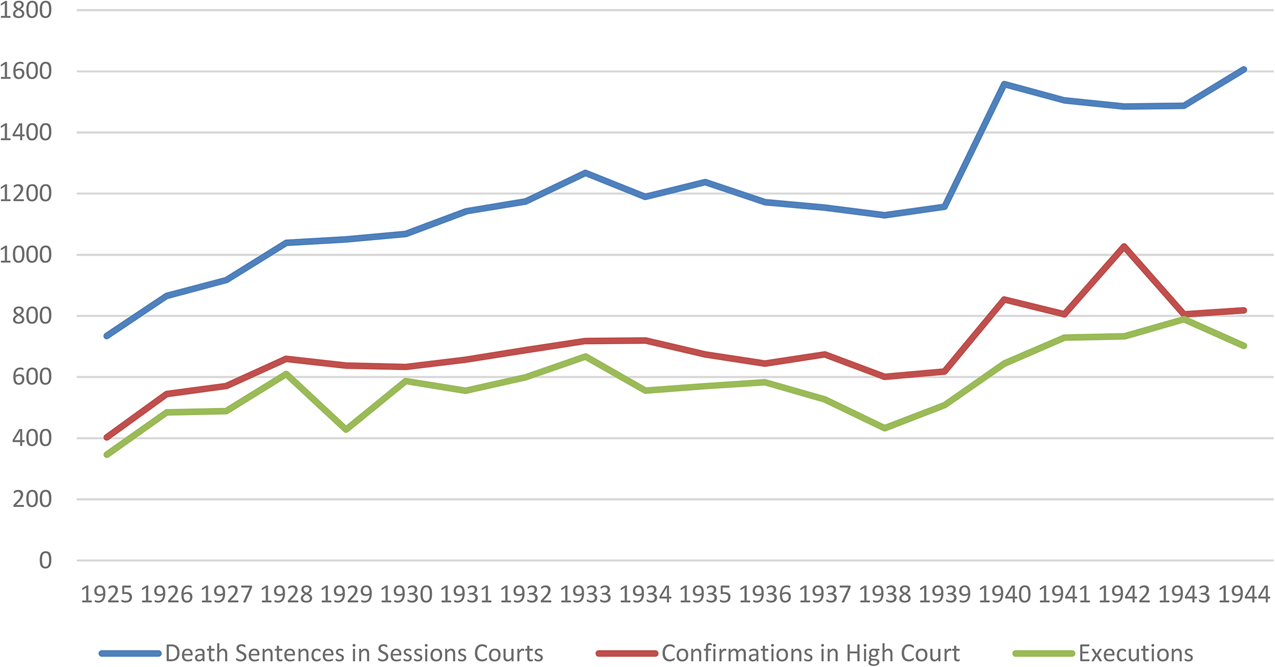
In 1946, Seth Govind Das raised a series of questions in the Legislative Assembly regarding the possibility of abolishing capital punishment in India. While statistics on executions for the late nineteenth century were relatively rare, this discussion brought forth official numbers from 1925 to 1944, recording death sentences passed in Sessions Courts, confirmations in High Courts, and, finally, hangings. The investigations made one thing clear: the hangman had been busy in late colonial India. The document counted 23,937 death sentences passed in Sessions Courts. With every sentence requiring confirmation in a High Court, this represented the best opportunity to escape the noose, with around 41% of sentences commuted or acquitted at this stage. For confirmed sentences, the final recourse lay in a petition for executive mercy. A relatively difficult and time-constrained bureaucratic process, 83% of the cases that reached this stage ended at the foot of the gallows. In total, this saw 11,539 executions, averaging 577 annually. Rising over time, while 346 hangings were performed in 1925, this would peak in 1943 with 789 individuals killed.Footnote 12 Although murders had increased during this period, they had done so at a considerably lower rate than this rise in executions.Footnote 13
Death Sentences and Executions in India, 1925–1944, NAI/Home/Public/1946/File. No. 1.22.46
“Newshour Debate: Death for Kasav,” August 30, 2012. https://www.youtube.com/watch?v=FPjrC45nRfQ

“The Newshour Debate: Justice through Death Penalty,” December 19, 2012. https://www.youtube.com/watch?v=nm1ampGOqqk

A wide range of factors undergirded the remarkable scale of this institution. As Elizabeth Kolsky has argued, the codification of criminal law had been a project defined by racial difference, starkly apparent in the negligible number of white subjects who faced the death penalty.Footnote 14 This culture of white impunity was then complemented by a much broader acceptance of the utility of corporal violence as punishment when directed toward Indian subjects.Footnote 15
When it came to murder, the most common capital offense, colonial judges had in fact enjoyed greater degrees of discretion for lenient sentencing in India than in Britain in the early years of Crown rule, being left to decide between either death or transportation for life. By 1898, this discretion had been reduced with an amendment to the Code of Criminal Procedure (CrPC) that made death the presumptive punishment, requiring special justification for a lesser sentence.Footnote 16 Given that petitions for executive mercy rarely received commutation, this placed tremendous importance on courtroom performances. Stressing the small margins that determined the fate of the accused, prominent lawyer and later advocate for abolition Kailas Nath Katju morbidly compared capital cases to a “game where the stakes are human lives.”Footnote 17
Stories of the absurd reinforced the idea that death sentences were arbitrarily pronounced in colonial courts. In one example reported in The Modern Review, seven men had been sentenced to death for participating in a murderous communal riot in 1933. The convictions rested on evidence that the ringleader, in a fit of anger, had chased a group of Muslims through the street, scaling roofs, kicking holes into walls, and finally shooting inside a house. Brought into the High Court, the condemned appeared as a frail and senile 70-year-old man, requiring two police officers to carry him to the dock. After medical examination, the civil surgeon estimated it would take him the better part of the day to walk, let alone run, the distance he was accused of hounding the victims. The appeals in this case were upheld.Footnote 18 In such an environment, issues of poverty and the absence of effective legal representation represented some of the most significant challenges for those facing capital charges. Although government efforts had begun to provide legal counsel for the poor during the early twentieth century, the premise that legal aid should be a guaranteed right organized on a national scale was not seriously considered until the 1970s.Footnote 19 Generally left to the discretion of high courts and provincial governments during the colonial period, this space was filled by small scale local organizations as best as possible.Footnote 20 With mistranslation, police corruption, and poorly trained judiciary sources of regular complaint, the importance of available and competent defense counsel is hard to underestimate.Footnote 21
Beyond the Indian Penal Code (IPC), the late colonial state was also shaped by the turbulent political context of this period. Alongside Gandhi's non-violent mass movement, the 1930s had witnessed a rise in political assassinations committed by largely middle-class revolutionaries.Footnote 22 The struggles of colonial governance in these circumstances, combined with two world wars, had seen the colonial state stockpile a wide array of legal powers. Many had extended the remit of the death sentence.Footnote 23 This included the Bengal Criminal Law Amendment Act of 1934, which had made the intent to murder a capitally punishable offense.Footnote 24 Whereas the Special Criminal Courts Ordinance of 1942 allowed death sentences to be passed without appeal.Footnote 25
With life being taken in ever greater numbers, a vocal penal reform movement emerged presenting arguments sympathetic to abolition in newspapers, lecture halls, and law journals.Footnote 26 These calls were further supported by the onset of provincial organizations engaging in questions of criminal law, culminating in the first All-India Penal Reform Conference in Bombay in 1940.Footnote 27 When it came to legislative efforts to reform the law, the question was first raised in the Imperial Legislative Council in 1918 by Kamini Kumar Chanda, who proposed undoing the 1898 amendment to reduce the number of death sentences.Footnote 28 Explicit attempts at abolition then begun in the 1920s with Gaya Prasad Singh proposing resolutions to end the death penalty in 1925, 1926, and 1927.Footnote 29 Although leading colonial officials were willing to privately concede that “Theoretically there is much to be said for the abolition of capital punishment” and that “it is not really a deterrent,” none of Singh's efforts would lead to a formal discussion.Footnote 30
With his efforts stalling, in 1929 the anticolonial revolutionary Bhagat Singh was placed on trial for his involvement in the murder of a police officer. Found guilty, he was sentenced to hang. A death sentence that captured the public imagination as never before, Singh's spectacular popularity produced huge petitions carrying 138,000 signatures for his commutation, accompanied by protests across India.Footnote 31 In the midst of this, Gaya Prasad Singh successfully introduced The Abolition of Capital Punishment Bill to the Legislative Assembly for debate. Employing a defense of abolitionism that would be recognizable to many today, he listed a series of “progressive countries” that had wholly or partially abolished the punishment, denigrated its deterrent value, heralded the importance of rehabilitation rather than retribution, and argued that its continued presence was a “relic of barbarism.”Footnote 32
Both the bill and the attempt to save Bhagat Singh and his associates failed, with the accused hanged on March 23, 1931. In the process, however, abolition had moved into the mainstream of nationalist politics, and was now included in the All-Indian National Congress Fundamental Resolutions of that year.Footnote 33 Going forward, bills for abolition were tabled in 1931, 1933, 1935, 1939, and 1946. Unsuccessful on each occasion, a series of what would become familiar reasons for retention were offered. These included the threat of terrorist violence, the re-introduction of capital punishment following abolition in other countries, and the “general standard of culture and civilization” of India.Footnote 34
While attempts in British India were unsuccessful, greater opportunities for penal reform were available in the roughly 600 Princely States governed under indirect rule at the time. Although British writings regularly depicted these quasi-sovereign territories as unable to properly keep pace with the modern world, many had become the sites of progressive criminal reform that superseded both colonial government and imperial metropole. For some, this took the shape of extremely high levels of executive mercy. In the first half of the twentieth century, Hyderabad had largely ended the practice of capital punishment, commuting 394 of 428 death sentences between 1900 and 1950.Footnote 35 Whereas Bhopal had seen just two executions from 103 death sentences between 1928 and 1944, largely attributed to the application of Sharia law, which allowed for the payment of diya as an alternative punishment to death.Footnote 36
Others went further. By 1938 it was reported that Cochin State had not organized an execution in 25 years, declaring unqualified abolition in 1944.Footnote 37 In the same year, Travancore abolished capital punishment for all crimes except offenses against the state.Footnote 38 Both the Government of India and B.R. Ambedkar understood this decision in largely cynical terms, born out of a longstanding policy of sparing Brahmins from death, which had become increasingly untenable alongside broader promises of equality under the law.Footnote 39 That such considerations had informed these decisions was certainly true, with earlier iterations of the Travancore Penal Code having explicitly exempted both Brahmins and women from capital punishment.Footnote 40 And yet in the wider world historical context of the 1930s, the radical nature of these moves should not be quickly dismissed. While signs of royal interest in less violent criminal punishment can be found by the late nineteenth century, with the Travancore prince recommending the use of chloroform to be administered before hanging to reduce pain.Footnote 41 These coastal states were joined by others, with Mysore and Cooch and Behar undertaking similar experiments.Footnote 42 An archipelago of abolitionist islands, these legal regimes were about to be submerged by the rising tide of postcolonial state sovereignty and the coming of the Indian Penal Code.
The Constitutional Right to Take Life
As independence beckoned, the path to abolition occupied a range of Indian actors. In his 1946 Gandhian Constitution for Free India, Shriman Narayan Agarwal proposed the full abolition of capital punishment, while in the same year members of the Legislative Assembly pressed the government to respect the “widely prevailing feeling in this country” and retire the noose.Footnote 43 In the broader international context, they noted that even some Nazi war criminals had recently been extended mercy.Footnote 44 By the end of the year, K.T. Shah, a key figure in the drafting of the constitution, would present a note on the fundamental rights of citizens and minorities to the Assembly, forcefully arguing for abolition.Footnote 45 Bills promising to end the death penalty within provincial governments were being tabled by early 1947, while law journals were returning to the topic, printing articles supportive of abolition.Footnote 46 With M.K. Gandhi, Jawaharlal Nehru, and B.R. Ambedkar having all declared themselves sympathetic to the cause, abolitionists could have been forgiven for harboring a degree of optimism on the eve of independence.
The events that would occur between 1946 and the Constitution of India's formal birth in 1950 would, however, see tumultuous upheaval on the subcontinent. Recently described by Gyan Prakash, this document was authored amidst a series of violent episodes that both scarred and in part defined the Indian nation-state.Footnote 47 In response to the bloody memory of partition, war in Kashmir, the violent annexation of Hyderabad, and Gandhi's assassination, the postcolonial state had acted quickly to consolidate executive authority, gripping tightly to several notorious repressive colonial era laws. When it came to the abolition of capital punishment, before the question arose formally in the Constituent Assembly, Nehru had already suggested privately that the issue was unlikely to gain traction. Asked by the Maharaja of Jaipur to support abolition, Nehru responded that while he sympathized on a philosophical level, the fact that “political murder is commonly talked about and indulged” meant that the “present moment” was inappropriate.Footnote 48
As Nehru penned his response, Nathuram Godse's shadow haunted discussions. As Sardar Vallabhbhai Patel would write to C. Rajagopalachari at the time, “I cannot think of a stronger case for the infliction of death . . . He has committed the worst crime imaginable, and as you said in an earlier letter “he stabbed the heart of India itself.”Footnote 49 For Yasmin Khan, Gandhi's death and the subsequent state organized rituals of mourning represented a critical moment that helped bind the Indian people to the Nehruvian state as the singular legitimate locus of political sovereignty.Footnote 50 If Gandhi had embodied an almost universally grievable life, his killing had in this instance also helped the state to capture a very different sentiment, the impulse toward vengeance and the location of a life deserving of death in the name of the nation.Footnote 51 Sitting in jail awaiting trial for the murder of the world's most celebrated modern thinker of non-violence, Godse had become an unmistakeable reference point in the retentionist defense.
Abolitionist efforts would continue across these early years. The issue was first broached in Parliament in early 1949, but after receiving little support the proposal was withdrawn.Footnote 52 A few months later it was discussed during the Constituent Assembly debates. Key figures like Ambedkar, now the minister for law and justice in India, drew on India's “ancient tradition” of non-violence to suggest that ‘”the proper thing for this country to do is to abolish the death sentence altogether.”Footnote 53 Others raising opposition drew on first-hand experiences of the working of the gallows. After watching thirty-seven condemned men await their fate while he had sat in a condemned cell during the 1940s, one member expressed his certainty that he had witnessed innocent men hang and guilty men walk free.Footnote 54 While such sentiment failed to coalesce into considerable momentum for total abolition, several other influential figures opposed any change at all. Having been responsible for rejecting the appeals organized on behalf of Godse for clemency, an appeal that also enjoyed the support of Gandhi's family, Patel and Rajagopalachari both stood in support of capital punishment.Footnote 55 As the constitution came to life, the state's right to take life was thus preserved, and done so in the very article that protected life.Footnote 56
And yet retention did not represent the simple transfer of a weapon of colonial violence from British hands into Indian ones. Consequential changes were evident from the moment of independence. Responding to amendments suggested by concerned members in the constituent assembly debates, the condemned were ensured a wider path to appeal High Court decisions at the Supreme Court than had previously been made possible by the Privy Council.Footnote 57 Whereas public hangings, which had continued in exceptional cases throughout the 1930s, would end with independence.Footnote 58
In the meantime, the issue of abolition continued to gain traction in popular news outlets, with both The Times of India and The Illustrated Weekly of India publishing a number of “Reader's Forums” on the question between 1954 and 1956. As the public debated the morality and efficacy of the punishment, one reader's references to Bernard Shaw's defense of the death penalty would be followed the next week with a retort presenting the French lawyer Henry Torres's critique of the punishment.Footnote 59 For those advocating penal reform, further positive developments were, however, in the offing, as politicians began blunting the criminal law's capacity for corporal violence. The widely unpopular Whipping Act of 1864, a legislation that had empowered judges to summarily flog criminals for a wide array of offenses, was abolished in 1955.Footnote 60 Scrubbing this legislation from the statute books, legislators embraced both the language of humanitarian reform and their Gandhian heritage to declare that “we do not brutalise society or turn men into brutes,” and that the punishment was “not inconsonance with our creed and principle of non-violence.”Footnote 61
With the legitimacy of violence to redress criminal wrongdoing now receiving increased scrutiny, reform-minded representatives naturally turned their gaze toward capital punishment. In this case, similar progress would prove considerably harder to come by. Questioned on the topic, the minister for home affairs forcefully argued that comparisons between the whip and the noose were inappropriate, suggesting that while “nobody likes it . . . death by itself is not humiliating; it does not degrade or deprave anyone.”Footnote 62 Two unsuccessful attempts to pass bills to abolish capital punishment in the Lok Sabha followed over the next year. On failure, a range of concerns were raised, including local government's general antipathy to the issue of abolition, confidence in the punishment's deterrent value, and India's comparatively high levels of crime. Recent experience also played a part in the death penalty defense, as politicians recalled the nightmare of partition, described by one member as when “men become beasts.”Footnote 63 Any effort to circulate the bill more widely to gather public opinion was then spurned on the basis that in such volatile times, controversial questions would cause unnecessary agitation. Summed up by one opponent in a language that would become commonplace in the coming decades, when it came to abolition of capital punishment, “the time has not yet come.”Footnote 64
While full abolition was being denied, capital punishment continued to depart from its colonial form. The Amendment Act XXVI of 1955 removed Section 367 (5) of the CrPC, the 1898 amendment that had previously made death the presumptive punishment for murder. Removing the law's structural inclination toward death, the question of punishment was now completely at the discretion of the judge.Footnote 65 With a judiciary more able to send criminal offenders to prison, a new executive brought significantly higher levels of commutation after sentencing. The success of mercy petitions had averaged 4.3% in the final 3 years of colonial rule, but the annual figure would jump to between 18 and 40% in the years between 1949 and 1961.Footnote 66 The cumulative effect of these changes would be a considerably lighter workload for India's hangman with the break from colonial rule. If the colonial state recorded 2,224 executions between 1942 and 1944, this number has been estimated at 1,422 judicial executions between 1953 and 1963, a figure that would continue to shrink. Between 1974 and 1985, this fell again to 148.Footnote 67
Popular Sovereignty and the “Rarest of the Rare”
While capital punishment in postcolonial India was retained between 1949 and 1955, the next three decades would see the foundations for its contemporary form established. A result largely of the ongoing efforts of politicians proposing private members bills and resolutions to reduce the scope of the death penalty, between 1967 and 1983 this punishment would receive the attention of the Law Commission of India and the Supreme Court, and undergo changes through amendments to the criminal code. In this process, two major developments would occur. Continuing the work of the 1955 Amendment Act, the first would see the narrowing of the grounds for capital punishment through sustained attempts to hem in judicial discretion. The second would see the radical reimagining of where judicial killing drew legitimacy from. Rather than an act undertaken by a paternalist colonial state fluent in civilizing mission rhetoric, the postcolonial state would translate this violence into something legible within new political vocabularies of constitutional democracy, equality under the law, and popular sovereignty.
This began when Shri Raghunath Singh tabled a motion for abolition in the Lok Sabha in 1962.Footnote 68 After being promised the attention of a Law Commission, the motion was withdrawn. Publishing its findings in 1967, the commission offered three volumes of carefully compiled information, a host of relevant case-law, annual criminal statistics, a history of the punishment, and comparative developments from around the world. A central plank of this investigation also came via a questionnaire. Asking relevant parties to offer their thoughts on the punishment, questions ranged from whether they supported full abolition, should women and the young be excluded, and should alternate methods of killing be considered?Footnote 69 This was then disseminated across local governments and state institutions, while a press communique was delivered to the public to invite interested individuals to offer their opinions. The responses gathered from the judiciary, the bar association, and the police saw almost universal support for retention. By contrast, a greater number of responses from the public and from zila parishads (elected district councils) erred toward restricted use or abolition.Footnote 70 Placing arguments from both sides alongside one another, the commission presented its recommendations. First, while accepting statistical evidence had not offered conclusive proof, they argued that the punishment acted as a deterrent. When it came to the wider question of abolition, the authors stated that the death penalty remained necessary. Although keen to emphasize the unsuitability of directly transplanting Western ideas into India when attempted by proponents of reform, citations of James Fitzjames Stephen endured as a conspicuous authority in the defense of retention, reappearing again later to perform similar work in Supreme Court judgements.Footnote 71
In a now well-quoted portion of the report, the authors defended their position in the following terms: “Having regard to the conditions in India, the variety of the social upbringing of its inhabitants, to the disparity in the level of morality and education in the country, the vastness of its area, to the diversity of its population and to the paramount need for maintaining law and order in the country at the present juncture, India cannot risk the experiment of abolition of capital punishment.”Footnote 72
The crux of this argument was repeated at various points, often joined by the metaphor of “ripeness” to explain that “the community has not yet reached such a stage” for abolition to become appropriate.Footnote 73 Framed through a temporal schema of civilizational progress, one that would be contemporaneously deployed by the judiciary to complete the disbandment of the criminal jury, on one level this justification for retention sounded suspiciously familiar to the colonial administrator.Footnote 74 And yet the commission's argument was no darkened corner of India's postcolonial politics yet to fully escape colonial time. As Ornit Shani has demonstrated in her study of the electoral roll, these very same problems, whether illiteracy, economic development, or geographical scale, had all been raised as potential stumbling blocks in discussions around India's readiness for fully-fledged democracy. Given short shrift, these concerns were quickly dismissed in favor of an almost unapologetically universal franchise.Footnote 75 In the case of the death penalty, while the state returned to these problems to justify its continued reliance on violence, it was in the name of the Indian people that this decision was now defended. As the commission remarked, until the “majority of citizens” supported abolition, any movement in that direction would be unwise.Footnote 76 Under these terms, capital punishment would be converted into a cathartic moment for an imagined sovereign national community to speak in a single voice, not a simple act of retribution but “the expression of public indignation at a shocking crime, which can better be described as ‘reprobation.’”Footnote 77
The conclusions sparked public debate, with lawyers and journalists publishing newspaper articles, and social scientists writing academic papers in favor and defense of abolition.Footnote 78 Indira Gandhi, then minister of Home Affairs, responded to the Law Commission with scepticism. She noted that the report failed to prove the deterrent effect of the punishment, and that its continued practice would likely lead to miscarriages of justice.Footnote 79 An example of such mistakes had in fact already been offered to the commission, in which an earlier case referenced had seen a man executed for murder, only for his victim to reappear months later.Footnote 80
The most significant consequences of this report would however be its reception in another postcolonial institution, the Supreme Court, which would quickly put these conclusions to work as capital punishment continued to face scrutiny. This attention would in part be instigated by events outside of India. The 1960s and 1970s had seen the discourse of human rights gather momentum, within which abolition had become a point of particular interest.Footnote 81 In 1966, the International Covenant on Civil and Political Rights had undertaken the first effort at the international regulation of the death penalty, while in the following decade, Amnesty International would produce the first worldwide report on the death sentence.Footnote 82 As a larger number of countries moved toward abolition, this sentiment would find expression in 1972 in the United States Supreme Court, which brought about the de facto moratorium on the death sentence in Furman v. Georgia, judging the punishment to be “cruel and unusual.”
Following on the heels of this judgement, the next year the Indian Supreme Court heard its first challenge to the death penalty on constitutional grounds in Jagmohan Singh v. The State of U.P. Singh had been convicted of murder after shooting his cousin following a long-running family dispute. Because Singh had spent hours waiting for his victim, murder weapon in hand, the High Court confirmed the death sentence, arguing the act was premediated and lacked extenuating circumstances. Now on appeal, Singh's counsel did not dispute the accused's guilt, but instead argued that the punishment violated three articles of the Constitution, referencing the Furman case in the process. In this presentation, not only did the death sentence put an end to all fundamental rights, but an absence of any guidelines for sentencing represented a “stark abdication of essential legislative function.”Footnote 83
In response, the court defended the constitutional grounds of the death penalty by referencing the decision to retain the punishment during the Constituent Assembly debates, along with the recommendations of the recent Law Commission. Revisiting earlier criticisms of the Western-centric nature of the abolitionist movement, the court dryly argued that these “kindly social reformers” did not understand India, where “social conditions are different and so also the general intellectual level.”Footnote 84 As the appeal was rejected, the judgment continued to embed this violence in the democratic language of popular sentiment, suggesting that capital punishment reflected a “token of emphatic disapproval by the society.”Footnote 85 In doing so, the court also distanced itself from the fundamental question at play, implying that the decision regarding the legitimacy of capital punishment rested in the legislature as the representative of the people.Footnote 86 Quickly following this judgment, the next year would then see amendments to the CrPC. Marking a complete reversal from the 1898 guidelines, the judge was now required to provide “special reasons” for the death penalty.Footnote 87 As described by the Supreme Court in 1974, “the unmistakeable shift in legislative emphasis is that life imprisonment for murder is the rule and capital punishment the exception.”Footnote 88
And yet the cumulative effect of these legal developments would not quell controversy over when and whom the state could kill, with appeals continuing to be lodged on this issue. By 1979, another case querying the grounds for death reached the Supreme Court, seeking clarity on the precise definition of “special reasons.” Here, and in its clearest expression yet, the court articulated who had the authority to resolve this question, stating “the case for abolition of the death sentence is political not constitutional.”Footnote 89 This would be compounded the next year with the landmark case of Bachan Singh vs State of Punjab.
Having previously served a term of imprisonment for murdering his wife, on release Singh had moved into his cousin's house, a decision that had upset his cousin's wife and son, who requested him to leave. Angered by this treatment, Singh waited for an evening when his cousin and wife were away before taking violent revenge. While the remaining household slept, Singh took an axe and killed all three of their daughters, injuring another relative nearby.Footnote 90 Sentenced to death, when this case reached the Supreme Court a five-judge bench was now pressed to consider if the broad discretion determining “special reasons” was unconstitutional, contingent on an unacceptable degree of arbitrariness when it came to the most serious of punishments. While noting that “special reasons” should be regarded in practice as “exceptional reasons,” the court clarified the position of the law, stating that all future death sentences were to be reserved for crimes deemed the “rarest of the rare.” With only the most extreme crimes now suitable for the gallows, the court then repeated the argument that the death sentence was appropriate when it expressed “society's reprobation,” and that it was on balance “in the public interest.”Footnote 91 That the criminal who first set this standard would be a wife-killer who, once released, brutally murdered the three daughters of the house, would foreshadow features of later debates that considered how the scope of the death penalty might be further broadened.
Like “special reasons” before it, the “rarest of the rare” would again find itself quickly criticized for still failing to produce uniform sentencing standards. Asked again to consider the question of arbitrariness under these newer guidelines, the judgement of Macchi Singh and Others vs State of Punjab in 1983 sought to finally settle this decade of debate. Representing another case of murderous violence instigated by a long-standing family dispute, in this instance the court expanded on earlier sentencing guidelines by offering examples of aggravating and mitigating circumstances, concluding that if the “collective conscience is so shocked.” then the death sentence remained necessary.Footnote 92 Leaving a lasting imprint on death penalty jurisprudence, the Asian Centre for Human Rights would note in 2015 that every subsequent death sentence has employed some variant of this phrase.Footnote 93
Having fully couched this violence in the idea of popular sentiment, the debate around the death penalty would soon begin to escape the drier confines of Law Commissions reports and Supreme Court judgments. In the process, the question of what to do with this punishment, and the very character of the institution itself, would start to take shape within a very different political landscape.
Killing in the Name of Some People
When capital punishment was first planted in what Ambedkar famously described as India's “undemocratic topsoil,” it was done so as a necessary balm to ease the birthing pains of a young democracy that had quickly learned the founding significance of violence for the nation-state. As the argument for retention evolved across the 1970s, the right to take life would both narrow, and yet in doing so find firmer ground. Rooted in the authority of the legislature, and watered on a diet of popular sovereignty, the scope of this violence has since grown. From seven capitally punishable offenses in the Indian Penal Code at the turn of the twentieth century, this number would reach eleven by the beginning of the next.Footnote 94 Meanwhile outside the IPC, a spiralling number of national and state laws have been passed that permit the death penalty for various crimes, many no longer relating simply to acts of murder.Footnote 95
The expanding list of capital offenses after the remaking of this violence in its new postcolonial guise was no coincidence. Beginning roughly in the 1980s, the growing tentacles of the death penalty ran concomitant to what scholars have marked as the beginnings of “conservative populism,” the hardening of communal sentiment, and the turn to neoliberal governmentality.Footnote 96 With the center of political discourse gravitating toward emotive and symbolic issues relating to India's territorial integrity or religious and caste identity, instruments able to cultivate political capital through the harvesting of enmity and resentment would prove ever more expedient.Footnote 97 As the very constitution of “the people” became a site of renewed contestation and heightened political significance, the relationship between the sovereign right to kill and populism would increasingly articulate itself in electoral promises to kill. This would culminate most prominently in the controversial case of Afzal Guru. A Kashmiri separatist convicted for the attack on the Indian Parliament in 2001, after spending 10 years on death row, his life and pending death would be widely exploited by political parties. For the Bharatiya Janata Party (BJP), then the national opposition, L.K. Advani framed this in blood-curdling communal terms, arguing at a large election rally that if “the Parliament attack case convict had the name Anand Singh or Anand Mohan, he would have been hanged by the UPA governments long back.”Footnote 98 Whereas for the Maharashtra- based Shiv Sena, political support was promised to any national party guaranteeing Guru's swift execution.Footnote 99
Alongside the figure of the terrorist, precisely as the justificatory ground for capital punishment was being whittled down to crimes that shocked the “collective conscience,” the problem of sexual violence toward women and children would enter the national conversation with hitherto unprecedented force. Following two particularly shocking gang-rape cases in the late 1970s, one of which saw the police officers accused acquitted in the Supreme Court, a civil society led movement for legal reform would instigate the first changes to the rape law since independence. Offering key justificatory fodder for the assembly of what Ratna Kapur has described as the “sexual security regime,”Footnote 100 the selective uptake of some expert recommendations and not others has resulted in the consistent prioritizing of more draconian punishment and the widening of police powers and state surveillance, while largely ignoring concerns that stricter laws would lead to lower conviction rates in practice, and jettisoning suggestions focusing on preventive measures.Footnote 101 As Pratiksha Baxi has further shown, the tone and tenor of these debates would be equally problematic, constructing the problem of rape almost solely around ideas of female shame, dishonor, and the loss of chastity.Footnote 102 Since the first amendments to this law in 1983, the consequences have largely been the consolidation of patriarchal, class, and caste-based biases around female respectability in sentencing practices.Footnote 103
Amidst this broader carceral shift, and facilitated by the concurrent rise of cable news, the question of extending death to rapists would soon also enter mainstream political debate, filling newspaper columns as it became a topic for heated debate between guests on evening news channels.Footnote 104 Much like the terrorist, the rapist embodied another figure of enmity upon which political parties could express their willingness to take swift, decisive, and violent retributive action in the name of the nation. As early as 1998, Narendra Modi, then general secretary of the BJP and charged with preparing for state elections in Madhya Pradesh, would promise to include the death penalty for crimes against women in their manifesto following a series of gang rapes targeting nuns in the region.Footnote 105 Remaining a prominent feature of the Hindu nationalist political agenda, the idea that the rapist deserved death would grow into a commonly articulated position by political leaders across parties.Footnote 106 Culminating in the 2013 amendments that made particularly “brutal” forms of rape a capital offense following the Nirbhaya gang rape case in Delhi, this decision was notably made in contradiction to the advice offered by the Verma Commission on behalf of a number of women's organizations.Footnote 107 Executed in Tihar Jail on March 2020, the four convicted men in this crime were the first executions in India since 2015. Since their sentences the recorded number of crimes against women has continued to rise, while conviction rates have not increased.Footnote 108
As Baxi has argued in specific reference to rape, rather than being organized to protect women, these measures represent the interventions of a “masculinist state” keen to distinguish more carefully “the kind of women who may be sexually accessible to all men, and others to some men.”Footnote 109 Turning to the broader function of death penalty, far from being a constitutional aberration, or a performative plaster used to covered broader government failings, the political rationality of this institution is similarly better understood once we first foreground what this institution effectively achieves. In this instance, from the late twentieth century on, the declaration of an intention to kill would become somewhat of a political adhesive, a reaffirmation of the ability to both hear the outrage of some of the electorate, and to make good on the promise to deploy the state's violence in their name. On one level a productive means to channel resentment into the rough and tumble of nationalist electoral politics, the heightened politicization of capital punishment would also drastically affect the institution itself, one whose founding purpose remained the taking of life.
While executions have not risen radically in recent decades, the structural violence this punishment is organized upon is starkly revealed by the composition of the growing number of individuals sitting on death row. As a study of 348 condemned prisoners in 2016 found, 74.1% were categorized as from economically vulnerable backgrounds, 76% were from “backward classes” and religious minorities, and a large proportion had not finished secondary education.Footnote 110 Meanwhile, although exact figures are extremely hard to obtain, the same study found that only 3.2% of prisoners on death row were women, and most reports suggest that no woman has been capitally punished in independent India.Footnote 111 If the decision made in individual courtrooms could be described by Amnesty International as a “Lethal Lottery,” the composition of the condemned presents a very legible and targeted logic to this expression of state sovereignty.Footnote 112 Whether in the actual act of execution, or in the tortuous existence of death row, this has continued to point toward lower caste men employed in the informal sector, and those from minority communities. With the discourse of the need to protect nation, woman, and child providing effective cover, the debris of a colonial past recycled for a postcolonial present has also remained highly visible. As overburdened and under-resourced courts continue to struggle with provision of proper legal aid, the condemned continue to express difficulty in properly following their cases and the courtroom process, often undertaken in English.Footnote 113
Conclusion
In May of 1990, Dhananjoy Chatterjee was arrested on charges of murder and rape. Chatterjee had been a security guard employed in a middle-class neighborhood, while the victim was an 18-year-old female resident who had just completed her board exams. With the defendant being sentenced to death, the crime had drawn tremendous media attention. Enflaming middle-class anxieties, this sentiment was succinctly articulated by the judgment's own leading rhetorical question, asking “if the security guards behave in such a manner, who will guard the guards?”Footnote 114 After the defendant had been left on death row, in the early 2000s the ruling Communist Party of India (Marxist) chief minister would come out publicly in support of execution, competing at the time with rival political parties also seeking to claim “law-and-order” platforms.Footnote 115 In contrast, the conviction would receive criticism from activists and legal scholars who believed that the court had failed to prove guilt beyond reasonable doubt, pointing to a series of inconsistencies. For some, including the accused, the problem was simpler. Unlike others convicted of similar crimes, Chatterjee could be hanged because he was poor. With his execution arranged for August 14, 2004, the night before, civil society groups attempted to stop the hanging, submitting a final hour mercy petition, organizing an all-night vigil, and sharing leaflets widely to raise awareness of the case.Footnote 116 To no avail, the following morning Chatterjee was executed.
In his examination of this event, Baidik Bhattacharya has argued that capital punishment in the postcolony is best understood as a constant effort at drawing and redrawing the “separation of the governed and the ungovernable.”Footnote 117 Offering a short overview of judicial killing across the twentieth century, I suggest that we may go even further and consider the historical life of the death sentence as part of a wider set of colonial and postcolonial shifts linked to the contested question of where sovereign authority could be derived from, and in whose name its violence could be performed. As we have argued, these more recent developments are historically contingent on older legal and political shifts that had begun in the late colonial period. Changes first made in response to failed efforts to abolish the death penalty would see the discursive and institutional authority to kill through law evolve. Having learned to speak the language of constitutional democracy and popular sovereignty, the powerful symbolism that death penalty talk offered would find itself well positioned to flourish within a national political culture increasingly organized around majoritarian expressions of belonging. As the list of who that enemy might be grew ever longer, and the threshold for societal outrage was crossed more regularly, capital punishment would become an effective political tool used to demonstrate a readiness to police the ever more exclusive boundaries governing entry into, and security within, the sovereign political nation. In the process, what was defined as rare has become ever more common, while what was justified in the name of the popular has become the instrument of the populist.
Acknowledgments
The author thanks the contributors to the special issue along with Rehan Abeyratne, Adeel Hussain, and Christopher Roberts for their helpful comments and suggestions on earlier drafts of this article. This research was kindly supported by an RGC/CERG grant (27613720).



 Open access

