


Introduction
Asymptomatic bacteriuria (AB) is defined as the presence of ≥100,000 colony-forming units per milliliter (CFU/mL) of a bacterial species in the urine, with or without pyuria, and in the absence of clinical signs of urinary tract infection (UTI), such as dysuria, pollakiuria or urinary urgency. In females, the diagnosis of AB requires two consecutive urine samples, taken approximately two weeks apart, in which the same uropathogen is isolated. In males, or in patients with an indwelling bladder catheter or those who have had the catheter removed within the previous 48 hours, a single positive urine culture is sufficient for AB diagnosis. Reference Andreu, Cacho, Coira and Lepe1–Reference Nicolle, Gupta and Bradley4
AB is present in 3 – 5% of healthy young women but is more prevalent in certain populations: approximately 11% in individuals with diabetes, 25 – 50% in adults over 70 years of age, and nearly 100% in people with an indwelling bladder catheter. Reference Nicolle, Gupta and Bradley4 Nevertheless, in most cases - including among residents of nursing homes and patients with urinary tract abnormalities—the presence of AB has not been associated with an increased risk of developing UTI. Reference Nicolle, Gupta and Bradley4–Reference Trautner and Grigoryan6
Screening and treatment of AB are recommended in specific clinical scenarios, such as in pregnant women—to reduce the risk of pyelonephritis and premature delivery—as well as prior to urological procedures associated with significant mucosal bleeding (eg, transurethral surgery of the prostate or bladder, or percutaneous stone surgery) and during the immediate posttransplant period (within 1 – 2 mo following transplantation). Reference De Cueto, Aliaga and Alós3–Reference Al Lawati, Blair and Larnard5
Evidence has shown that antimicrobial treatment of AB, outside of the specific exceptions previous mentioned, does not confer clinical benefit and, may, in fact, increase the risk of antimicrobial resistance or Clostridioides difficile infection due to its ecological impact on the microbiota. Reference Al Lawati, Blair and Larnard5,Reference Cai, Mazzoli and Mondaini7 In addition, clinical studies suggest that AB may offer a protective effect against UTIs. Reference Kranz, Bartoletti and Bruyère8 Therefore, treatment of AB should be limited for cases in which a clear benefit has been demonstrated, to avoid the unnecessary eradication of potentially protective bacterial strain.
Nevertheless, the signs and symptoms of UTI are often nonspecific in patients with spinal cord injury, in those with bladder catheterization or in the elderly. Furthermore, the prevalence of AB in higher in these groups, which can contribute to diagnostic uncertainty inappropriate antibiotic prescriptions in the presence of ambiguous or unclear symptoms. Reference Nicolle, Gupta and Bradley4
Antibiotic optimization programs have identified AB as an opportunity to reduce inappropriate antimicrobial use, especially in primary care. Reference Nicolle, Gupta and Bradley4 Despite evidence-based recommendations, approximately 45% of patients with AB receive antimicrobial treatment. Reference Flokas, Andreatos, Alevizakos, Kalbasi, Onur and Mylonakis9 Urine cultures are frequently requested as part of a differential diagnosis for nonspecific symptoms such as fever without a clear focus or general malaise. In addition, a positive urine culture can lead to an incorrect diagnosis of UTI in more than 20% of cases, even in the absence of urinary symptoms. Reference Silver, Baillie and Simor10 To address this issue, passive educational interventions, such as including interpretive comments in microbiology reports that promote prescriber autonomy, have been shown to positively influence antibiotic prescribing practices. Reference Musgrove, Kenney and Kendall11,Reference McBride, Schulz, Fox, Dipoto, Sippel and Osterby12
The aim of the study was to evaluate the impact of including a comment in microbiology reports on antibiotic prescribing in patients with positive urine cultures and suspected AB.
Materials and methods
Quasi-experimental, uncontrolled study carried out at the CHUVI between February and September 2024. Eligible participants were adults ( ≥18 yr) with a positive urine culture demonstrating growth of a single uropathogen at ≥100,000 CFU/mL and leukocyturia of <50 leukocytes/μL. Patients were required to be asymptomatic for urinary tract infection (UTI), defined as the absence of dysuria, pollakiuria, urinary urgency, flank pain, or fever. Exclusion criteria comprised typical UTI presentations, residence in long-term care facilities, presence of chronic indwelling urinary catheters, recent urological procedures involving mucosal bleeding, and pregnancy. Patients were selected through simple random sampling. The patients’ electronic medical records were reviewed. In cases where the patient did not exhibit typical UTI symptoms, the following comment was added to the microbiology report: ‘Assess according to clinical symptoms. No treatment is recommended for asymptomatic bacteriuria’. Institutionalized patients were excluded due to the unavailability of clinical data.
Demographic data (age and sex), sample origin (primary care, emergency department or hospital), reason for test request, isolated microorganism, and its antimicrobial resistance profile were collected from the patients included. The time elapsed from the issuance of the microbiology report until clinician review was recorded, along with empirical and/or targeted antimicrobial treatment and the indications for initiating such treatment. Additionally, request for repeat urine cultures were documented. All samples were processed according to the protocols established by the Spanish Society of Clinical Microbiology and Infectious Diseases. Reference Andreu, Cacho, Coira and Lepe1
Statistical analysis
Assuming that 36% of the physicians would adhere to the microbiological report’s recommendation, based on data from a previous pilot study, a sample size of 391 cases was estimated. Qualitative variables were described using absolute frequencies and percentages, while quantitative variables were presented as mean and standard deviation, if normally distributed, or as median and interquartile range otherwise. Normality was assessed using the Kolmogorov-Smirnov and Shapiro-Wilk tests. For bivariate analysis, the χ2 or Fisher’s exact test was applied to compare qualitative variables, and the Mann-Whitney U test was used to compare quantitative variables. Binary logistic regression was employed to identify factors related to adherence to the microbiological recommendation. Statistical analyses were conducted using the Statistical Package for the Social Sciences (SPSS), version 29.0. Statistical significance was defined as a P value of less than .05.
Ethical aspects
The study was approved by the Pontevedra-Vigo-Ourense Research Ethics Committee (protocol code: 2024/7491). Informed consent was not required from patients, as the intervention was directed at prescribers and did not involve direct patient participation.
Results
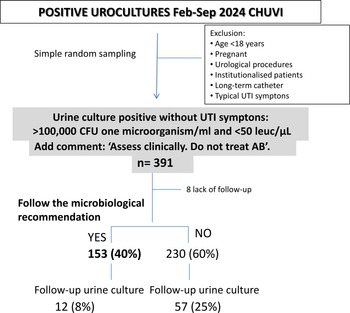
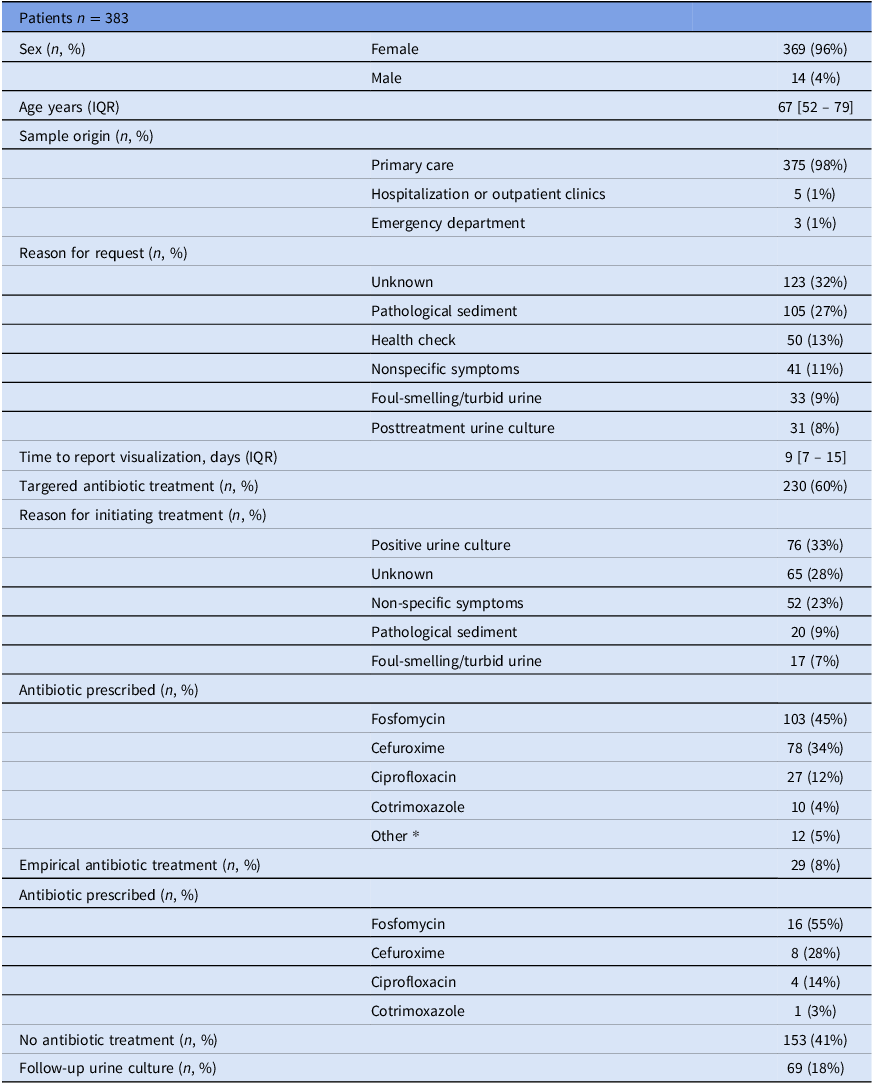
A total of 391 cases of AB were identified; eight were excluded due to the absence of follow-up consultation, resulting in a final analysis of 383 patients (Figure 1). The majority of urine cultures were from women (369; 96%), with a median age of 67 years [52 – 79] and 98% of the samples originated from primary care. In 32% of cases, the reason for the urine culture request was not documented in the medical record. Among the remaining patients, the most common indications were pathological urine sediment (27%), health check (13%) and non-urinary complaints (10%). The median time between the issuance of the microbiological report and the patient’s face-to-face or telematic consultation was 9 days (7–15).
Flow-chart of the study.

Empirical antibiotic treatment was prescribed in 29 patients (8%). Of these, 13 (45%) received a second course of antibiotics after the urine culture results were available. In total, 230 patients (60%) were started on antibiotics after following the microbiology report. The main reasons documented for initiating treatment were: positive urine culture (76; 33%), unknown reason (65; 28%) or nonspecific symptoms unrelated to the urinary tract (52; 23%) (table 1). Conversely, 153 patients did not receive antibiotic treatment, resulting in an estimated adherence to the microbiological recommendation of 40%. Additionally, a follow-up urine culture was request in 69 patients (18%); this was significantly more frequent in the nonadherence group (nonadherence group 25% vs adherence group 8%; P < .001). Among the patients who did not receive antibiotic treatment, no complications attributable to AB were identified. During the one-month follow-up period, six patients required hospitalization, none of which were related to this condition. Five patients received antibiotic therapy for unrelated indications.
Patient characteristics of as asymptomatic bacteriuria

* Other antibiotics included: amoxicillin-clavulanic (n = 6), nitrofurantoin (n = 3), cefixime (n = 2), and amikacin (n = 1)
Table 2 presents the isolated microorganisms along with their resistance patterns. Escherichia coli was the most frequently identified pathogen, accounting for 313 cases (82%), followed by Klebsiella pneumoniae with 37 cases (10%). Extended-spectrum beta-lactamase production was detected in 3.5% of E. coli and 5% of K. pneumoniae isolates, while carbapenemase production was identified in 3% of K. pneumoniae. Both fosfomycin and nitrofurantoin demonstrated overall susceptibility rates close to 90%, with the exception of fosfomycin in K. pneumoniae, for which the susceptibility rate was lower (70%).
Isolated microorganisms, antimicrobial susceptibility, and resistance mechanism asymptomatic bacteriuria cases

* Other GNB: Klebsiella oxytoca (3), Klebsiella aerogenes (3), Enterobacter cloacae (3), Citrobacter koseri (3), Serratia marcenscens (1), Proteus vulgaris (1), Morganella morganii (1);
Susceptibility percentages represent the combined percentage of isolates as susceptible to standard dose (S) and those susceptible with increased exposure (I). BLEE and CARBA resistance mechanisms are expressed as a percentage of total isolates.
Note. GNB, gram-negative bacillus; BLEE, beta-lactamase extended spectrum; CARB, carbapenemase type OXA48.
Factors associated with antibiotic use
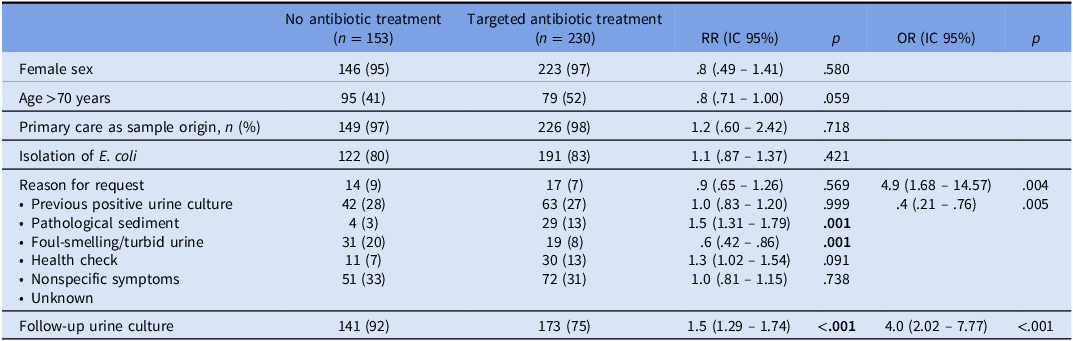
In the univariate analysis, foul-smelling or turbid urine as the reason for ordering the urine culture (Relative Risk [RR] 1.5, 95% Confidence Interval [CI] [1.31 – 1.79], P = .001), as well as the performance of a follow-up urine culture (RR 1.5, 95% CI [1.29 – 1.74], P < .001) were associated with a higher likelihood of initiating antibiotic treatment after receiving a positive result. Conversely, when the urine culture was requested as part of a health check, the likelihood of initiating treatment decreased (RR .6, 95% CI [.42 – .86], P = .001) (table 3).
Univariate and multivariate analysis of factors associated with targeted antibiotic therapy
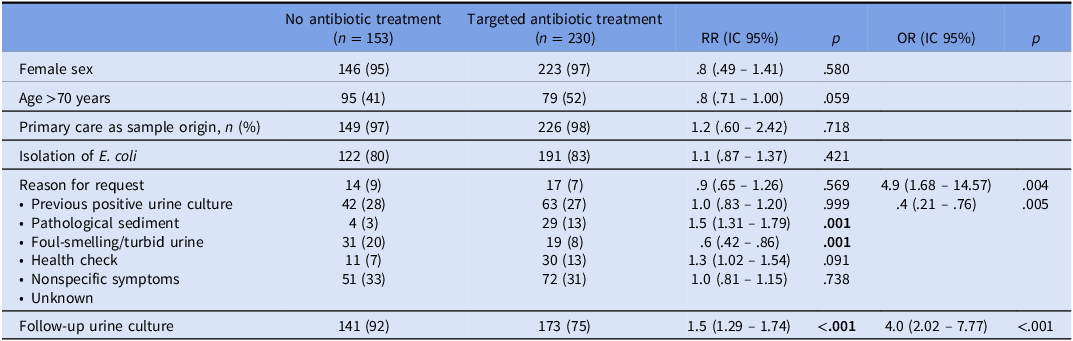
In the multivariate analysis, both the indication of foul-smelling urine (Odds Ratio [OR] 4.9, 95% CI [1.68 – 14.57], P = 004) and follow-up testing (OR 4.0, 95% CI [2.02 – 7.77], P = 005) were independently associated with an increased risk of nonadherence to the microbiological recommendation. In contrast, requesting a urine culture for a health check was associated with a higher likelihood of adherence to the recommendation (OR .4, 95%CI [.21 – .76], P = .005).
Discussion
Our results indicate that including a comment in the microbiology report may help avoid antimicrobial use in 40% of patients with AB. They also highlights the importance of diagnostic stewardship, particularly the unnecessary ordering of urine cultures in patients without UTIs, which represents a fundamental step in preventing misdiagnosis and overtreatment. Moreover, certain misconceptions remain common, such as the routine practice of performing follow-up urine culture or the incorrect association of foul-smelling or turbid urine with UTI.
The findings of this study highlight the persistence of myths surrounding the diagnosis and treatment of UTIs, such as the automatic assumption that leukocyturia or bacteriuria necessitates treatment. Reference Baghdadi, Korenstein and Pineles16 On the other hand, undue reliance on laboratory results, without adequate clinical evaluation, may lead to inappropriate therapeutic decisions. Reference Flokas, Andreatos, Alevizakos, Kalbasi, Onur and Mylonakis9,Reference Baghdadi, Korenstein and Pineles16
As observed in our study, AB remains a significant contributor to inappropriate antibiotic prescribing in primary care, consistent with findings from previous studies. Reference Flokas, Andreatos, Alevizakos, Kalbasi, Onur and Mylonakis9,Reference Silver, Baillie and Simor10 The interpretation of a positive urine culture presents a challenge for clinicians, particularly as UTI symptoms can be nonspecific, especially in certain populations. Reference Flokas, Andreatos, Alevizakos, Kalbasi, Onur and Mylonakis9,Reference Walker, McGeer, Simor, Armstrong-Evans and Loeb13 Current evidence advise against performing urine cultures in patients who do not present fever or urinary symptoms, as well as in cases where only nonspecific symptoms unrelated to the urinary tract are present. Reference Flokas, Andreatos, Alevizakos, Kalbasi, Onur and Mylonakis9,Reference Silver, Baillie and Simor10,Reference Trautner and Grigoryan6,Reference Trautner and Grigoryan14 Nevertheless, the ease of sample collection and the widespread availability of testing contribute to its indiscriminate use.
In our study, both a positive urine culture result combined with the presence of nonspecific symptoms accounted for 56% of the reasons for initiating antibiotic treatment. In addition, in 16% of patients, antibiotics were prescribed based on nonspecific findings such as sample turbidity, foul odor, or abnormalities in the urinary sediment. Nonetheless, the available evidence indicates that none of these features are specific for the diagnosis of UTI, and they should not be considered valid criteria for ordering a culture or initiating antibiotic treatment. Reference Flokas, Andreatos, Alevizakos, Kalbasi, Onur and Mylonakis9,Reference Coffey, Claeys and Morgan15
The association between the initiation of antibiotic treatment and the request for follow-up urine cultures underscores the need for educational interventions to reinforce when urine cultures are not recommended. Reference Piñeiro Pérez, Cilleruelo Ortega and Ares Álvarez2,Reference De Cueto, Aliaga and Alós3,Reference Kranz, Bartoletti and Bruyère8,Reference Shallcross, Rockenschaub, Blackburn, Nazareth, Freemantle and Hayward21 Indeed, restrictive urine culture ordering strategies have been shown not only to reduce the number of cultures performed but, more importantly, to decrease the unnecessary treatment of AB. Reference Trautner and Grigoryan6
The strategy employed in our study proved particularly useful when urine cultures were performed as part of health check-ups. This fact highlights the importance of effective communication between the microbiology laboratory and clinicians, as well as the inherent difficulties in interpreting microbiological results. It also emphasizes the value of clinical reflection in nonurgent situations, where there is greater opportunity for informed decision-making before prescribing antibiotics. The review interval for microbiology reports ranged from 3 to 15 days (median: 9), which may have influenced management of AB. Earlier reviews could have facilitated more timely treatment, whereas later reviews may have allowed for more deliberate therapeutic decisions. The observation that none of the patients who did not receive antibiotic treatment developed complications adds to the growing body of evidence supporting the safety of withholding antimicrobial therapy in AB. Furthermore, it underscores the pivotal role of interpretative comments in urine culture reports as an effective strategy to discourage unnecessary prescriptions and to strengthen antimicrobial stewardship efforts.
Various interventions have reduced the overtreatment of AB by 25 – 80%, including audits, interactive training, and structured feedback. Reference Flokas, Andreatos, Alevizakos, Kalbasi, Onur and Mylonakis9,Reference Coffey, Claeys and Morgan15,Reference Schulz, Hoffman, Pothof and Fox17 Reflective clinical decision-making, rather than automatic or impulsive antimicrobials use, has been identified as the most effective strategy to optimize antimicrobial prescribing. Reference Trautner and Grigoryan6 In this context, deferred prescribing, commonly used in young women with cystitis, could also be considered for patients with suspected AB, especially when symptoms are nonspecific or absent, thereby promoting more prudent and rational antimicrobials use. Reference Loeb, Brazil and Lohfeld18 Nevertheless, in individuals over 65 years of age, concerns about serious complications such as bacteremia, along with difficulty in interpreting symptoms, may limit the applicability of this approach. Reference Midby and Miesner19,Reference Hartman, Groen and Heltveit-Olsen20
From a microbiological perspective, we observed a high susceptibility of Escherichia coli to fosfomycin and nitrofurantoin, both recommended treatments, with lower resistant rates than those reported in previous studies conducted in our region. Reference Claeys, Trautner and Leekha22,Reference Losada, Barbeito, García-Garrote, Fernández-Pérez, Malvar and Hervada23 This finding may be influenced by the exclusion of institutionalised patients from our study, as this population typically exhibit a higher prevalence of multi-drug-resistant microorganisms. Reference Treviño, Losada and Fernández-Pérez24,Reference Briongos-Figuero, Gómez-Traveso and Bachiller-Luque25
One limitation of the study is that it was conducted within a single healthcare area, with a predominance of middle-aged women and patients from the community setting. Therefore, the results may not be generalizable to other regions, healthcare contexts, or populations. But, this cohort represents the population in which AB is most prevalent. Reference Nicolle26 Additionally, the exclusion of institutionalized patients, due to lack of clinical follow-up, and of patients with long-term indwelling catheters, in whom bacteriuria is almost universal and urinary symptoms are often nonspecific, may have introduced bias into the analysis of the results.
Our study contributes to the growing evidence that AB often results to inadequate antibiotic treatment. Reference Flokas, Andreatos, Alevizakos, Kalbasi, Onur and Mylonakis9 It provides a foundation for community antimicrobial stewardship programs to focus on, emphasizing the role of ‘urine culture management’ as a key to reduce antibiotic use in patients with AB. Reference Trautner and Grigoryan14,Reference Shallcross, Rockenschaub, Blackburn, Nazareth, Freemantle and Hayward21 A combination of educational, organizational, and communication interventions can improve adherence to clinical guidelines and reduce unnecessary antimicrobial exposure. Simple behavioral prompts, such as interpretative comments in microbiology reports, represent low-cost, scalable, and sustainable interventions. These findings are consistent with previous evidence in respiratory and urinary diagnostics, where microbiological “nudges” have been shown to promote more rational antibiotic use. Reference Musgrove, Kenney and Kendall11,Reference McBride, Schulz, Fox, Dipoto, Sippel and Osterby12,Reference Luu and Albarillo27
The misinterpretation of positive urine cultures and the presence of nonspecific symptoms are common causes of inappropriate management of patients with AB, especially in primary care. Explanatory comments in microbiology reports may optimize antimicrobial prescribing while simultaneously serving as a diagnostic stewardship intervention by discouraging unnecessary urine cultures. This strategy should be combined with other interventions to reduce unnecessary urine cultures and antibiotics use.
Acknowledgments
The authors have no acknowledgments.
Financial support
None reported.
Competing interests
All authors report no conflicts of interest relevant to this article.


 Open access

