

Introduction
The Southern Nasca Region (SNR) has been well-studied by archaeologists over the last century. Much of the focus of early investigations was on burials, pottery motifs and large ceremonial centres. In recent years, investigations have shifted towards understanding domestic life, subsistence regimes and craft production. This work has included survey of the major river valleys (e.g. Reference Isla CuadradoIsla Cuadrado & Reindel 2005; Reference SchreiberSchreiber 1999; Schreiber & Lancho Rojas 2003; Reference SilvermanSilverman 2002) and excavations of habitation and other sites therein (e.g. Reference ConleeConlee 2003; Reference VAN GijseghemVan Gijseghem 2006; Reference VaughnVaughn 2004; Reference VaughnVaughn & Linares-Grados 2006).
To date, archaeological investigations have placed little emphasis on the more remote parts of the SNR landscape, such as the quebradas (canyons) off the main valleys. Recent survey by the authors has revealed the presence of Prehispanic sites in these areas; fewer and generally smaller, they are more sparsely covered with artefacts than their counterparts in the main valleys. Follow-up excavation at one of these sites, La Ballena, has led to insights into the organisation of Prehispanic mining in the region.
La Ballena
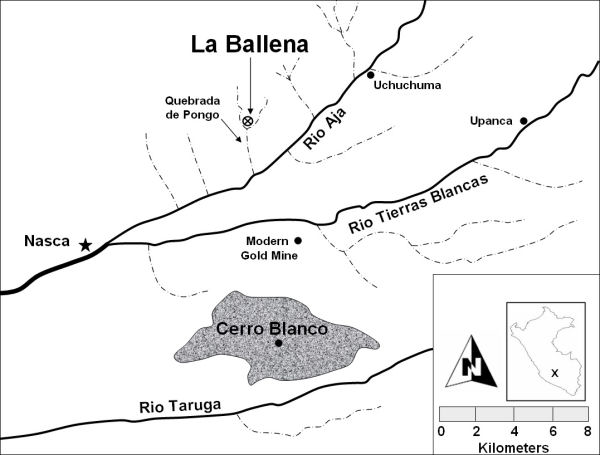
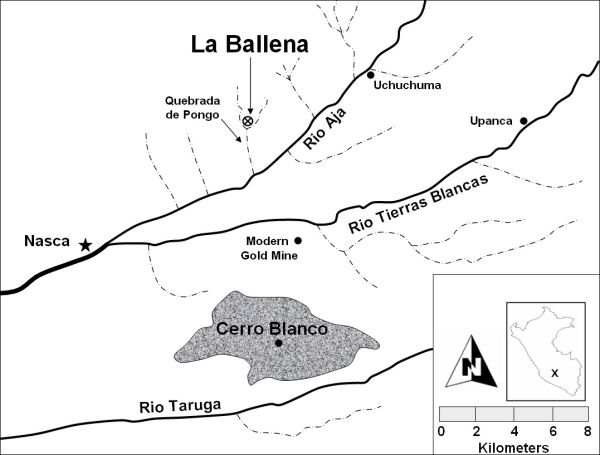
During a study of local clays in June 2002 (Vaughn & Neff 2004), the authors happened upon a small site in Quebrada de Pongo off the Rio Aja (Figure 1). The site was noted for its unusual location and composition and, in June 2006, the authors returned to this site to map and conduct small-scale excavations designed to understand its possible function.
Regional map showing location of La Ballena.
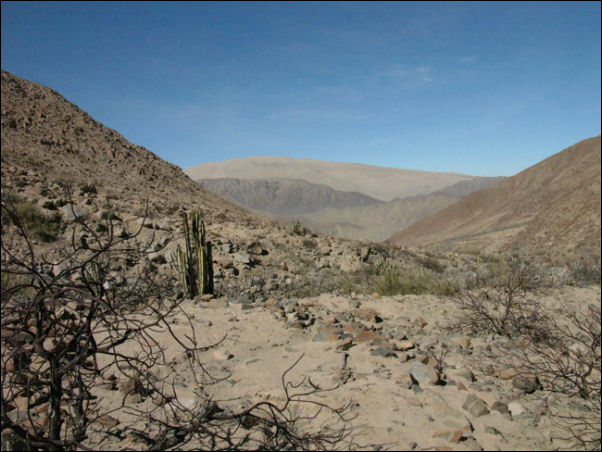
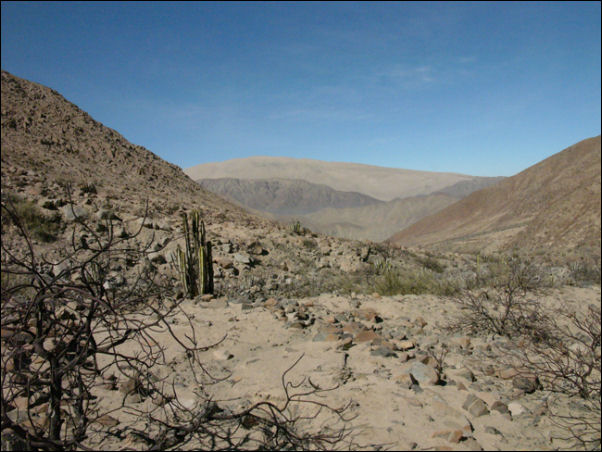
The site, named La Ballena after a local gold mine by that same name, lies up a small quebrada some 2.5km north and 260m higher in elevation than the Aja drainage. It sits at the intersection of two dry washes at approximately 1100m asl on a small terrace 2m above the quebrada bottom. Local vegetation consists of columnar cacti (Neoraimondia arequipensis) and the 'pati' tree (Carica augusti), as well as some smaller undergrowth. Looking to the south, the site also affords a clear view of Cerro Blanco, a sand-covered mountain important in local mythology (Figure 2; e.g. Reference ReinhardReinhard 1988).
Photograph from La Ballena looking south, showing rectangular patio in foreground (behind tree) and Cerro Blanco in background.
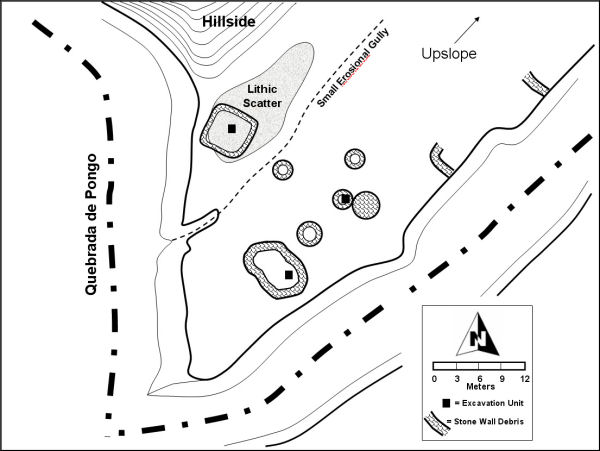
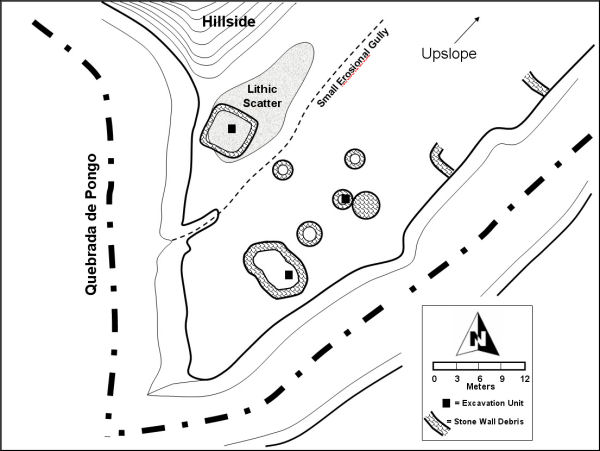
Architectural features at La Ballena include at least three circular features ranging in diameter between 2 and 4m; a larger circular arrangement of stones lacking an open interior space; and two medium-sized (c. 4—8m on a side) square to rectangular patios (Figures 3 and 4). The former appear to be the remains of small habitation or storage facilities, while the latter appear to be more open spaces where various activities were undertaken.
La Ballena site map.
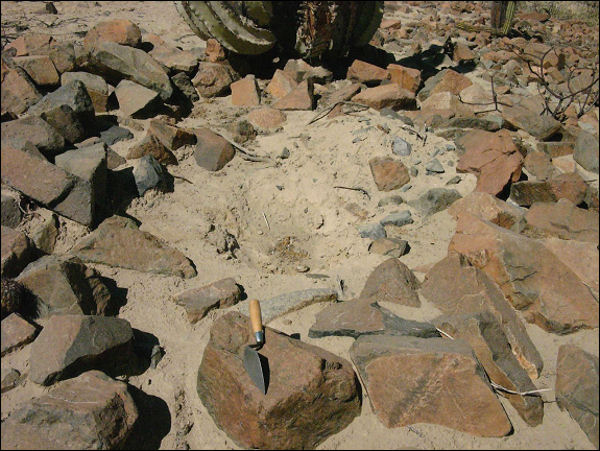
Circular feature representing temporary house or storage structure.
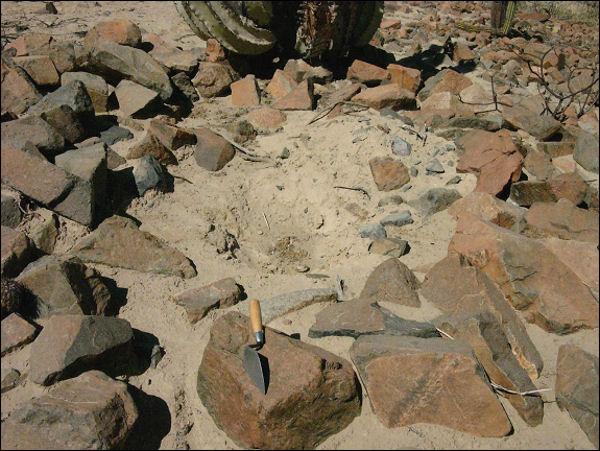
Excavations at La Ballena
Test units were excavated in three of the structures. Overall, little stratigraphy was observed in any of the units and artefact recovery was very low. A single 1x1m excavation unit over the eastern section of one of the circular features, c. 3m in maximum diameter, failed to recover any artefacts or ecofacts. Neither were a doorway, discrete habitation floor or other evidence of human occupation encountered. The size and layout suggest use as either a foundation for a small and temporary habitation or a small storage unit.
Excavations in a 1 x 1m unit in the southern rectangular patio shown in the foreground of Figure 2 produced only small numbers of unburned non-diagnostic bone and a few small pieces of débitage from local volcanic materials. No habitation floor or stratigraphy was noted. Analogous features in early Nasca sites suggest such patios were often used as activity areas to support single households, though some were used in small-scale surplus production of lithics and textiles (see Reference VaughnVaughn 2005). We assume the patio at La Ballena served a similar purpose.
A single 1 x 1m excavation unit in the northern unit produced a slightly higher density of flakes from local coarse-grained volcanics, in addition to some unburned bone. A slightly darkened area, consisting mainly of charcoal but not identifiable as a hearth, was noted in the north-eastern section of the unit, about 10cm below the present surface. We suspect that this patio was used in a fashion similar to the southern patio, to produce various crafts: given the presence of flaking debris, probably to reduce local volcanic materials into bifaces and other robust tools used in nearby activities. The charcoal staining could also represent the remains of hearth-cleanings from habitations, or perhaps thermal processing of some local resource.
Surface artefacts
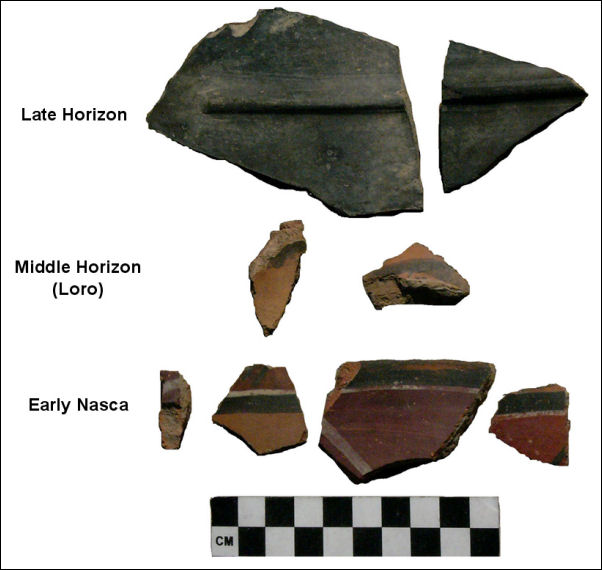
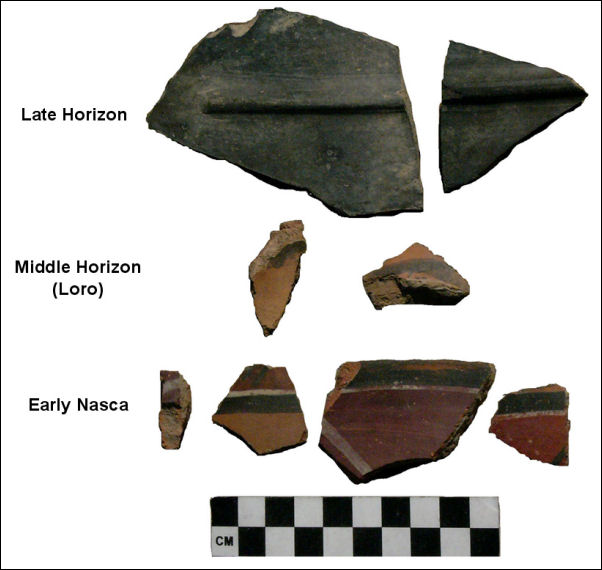
Given the lack of significant artefacts in the excavation units, the low density surface remains have to bear upon our interpretation. Potsherds comprise the most obvious and visible evidence of human occupation at La Ballena. Of these, c. 80 per cent, are thick, undecorated and non-diagnostic plainware sherds. This high frequency contrasts with figures typical at Early Nasca habitation sites in the region (Reference VaughnVaughn 2004). The remaining sherds include 8 decorated, diagnostic pieces: Early Nasca (4), Middle Horizon (2), the Late Horizon (2) (Figure 5), as well as some probable Late Intermediate sherds. This combination indicates a span of occupation potentially over 1500 years.
Temporally diagnostic ceramics from site surface.
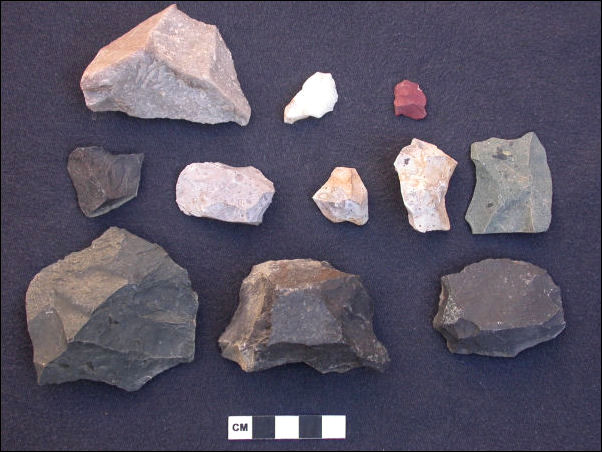
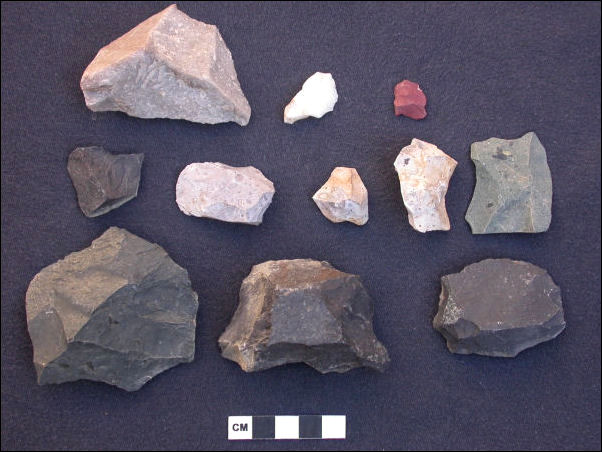
Chipped stone was also present across the site in low numbers, but was particularly common on the northern part of the site, overlapping with the second patio. The most common raw material comprises coarse- to medium-grained volcanic rocks, basalt and andesite, widely available in Quebrada de Pongo. Large percussion flakes (> 3cm in length) dominate the assemblage, indicating that most of the debris represents the byproduct of the production of large and robust tools (Figure 6). A small number of large and robust bifacial and unifacial tools were also found on the surface (Figure 6, lower row). Less common (less than 10 per cent of the total assemblage) were the smaller flakes of chert and obsidian.
Non-obsidian lithics from site surface.
Finally La Ballena produced a few fragments of large mussel shell. Although the ocean is over 65km as the condor flies, shell is not uncommon at Prehispanic sites in the SNR. The La Ballena pieces do not represent formal tools or raw material for making beads. The presence of shellfish remains could be explained in three ways. First, the shells may represent the remains of meals. However, this is a long way to bring the shellfish meat in the shell, to the point where the caloric costs of transporting the shellfish certainly outweighed the caloric returns (Reference BirdBird & Bliege-Bird 1997; Reference MetcalfeMetcalf & Barlow 1992). If these shellfish were transported for food, it must have been under unusual circumstances (e.g. high status foods or feasting refuse), yet nothing at La Ballena suggests high status or feasting. A second more likely explanation is that the shells were convenient containers for moving other goods, perhaps broken upon reaching La Ballena and discarded. A third and more intriguing possibility is that the shellfish represents raw materials for some type of processing activities. Calcium carbonate is not an uncommon component of metallurgical processes as a flux or reducing agent, including in the Andes (Reference LechtmanLechtman 1991). Although we lack direct evidence of ore processing at La Ballena, evidence for burning was present in the northern patio. Calcium carbonate can also be reduced to produce slaked lime. Slaked lime is, of course, commonly used when chewing coca leaves to assist in the extraction of alkaloid stimulants from the leaves. Given that shellfish is usually present in small but consistent amounts in habitations in the SNR, we favour this third explanation.
Discussion and interpretations
What is this site with evidence for limited habitation doing so far removed from other habitation sites in the SNR? Why was this particular location repeatedly visited for nearly 1500 years? And why are there so few artefacts at the site?
Agriculture was not possible at La Ballena. The surrounding area lacks permanent or even semi-permanent water, and the lack of precipitation in the region makes agriculture impossible without reliable water. Likewise, naturally arable land is not existent at the site or in the surrounding region, and there is no evidence that people constructed terraces for agriculture.
Given these conditions, it seems safe to say that permanent year-round occupation at La Ballena was not possible, at least not without reliable and consistent transportation of food and water from the Aja Valley. The excavations and sparse density of surface artefacts certainly support the notion that La Ballena was never continuously occupied for a significant length of time. Instead, La Ballena appears to be some sort of specialised encampment that sustained similar types of activities for at least a millennium and a half. The fact that there are not additional sites of this type in Quebrada de Pongo further suggests that one such site was enough to cover the range of activities carried out in the entire quebrada.
We have discarded, on a number of counts, two possible explanations — as a location for religious or ritual events, and as a station established to control traffic or trade into and out of an area — for the presence of a temporary but repeatedly visited specialised encampment. Instead we believe the site to be better explained as a temporary mining base camp, a place from which miners could stage day-long prospecting and/or mining activities. Several lines of evidence support this notion.
First, the Pongo region is rich in minerals, and as mentioned, the name 'La Ballena' derives from the presence of a modern gold mine in the immediate area. Itinerant miners today work the region for copper, gold, and other minerals, and during our survey of the quebrada in 2002 we encountered several small mines and trenches that had recently been excavated along veins of copper ores to the north and west of the site. We also found small modern-day miners' encampments. Material remains at these encampments were sparse, including some food refuse, blankets, plastic containers, a hearth, and occasionally a flimsy structure to protect miners from the wind. Although different in detail, the general distribution of remains is not unlike that encountered at La Ballena. A local informant involved in modern-day mining in the region thought that Prehispanic mines exist in the quebrada, but that modern mining activities had all but eradicated them. Thus, Quebrada de Pongo contains a range of minerals still available today, including several that are known to have been used by Early Nasca and later societies as both pigments and to fashion small decorative implements (Reference PhippsPhipps 1989; Reference VaughnVaughn et al. 2005).
Second, although the techniques practiced by Prehispanic miners are understudied in the region (but see Vaughn et al. 2007), the production of large and robust flaked-stone tools at a staging camp is consistent with use in mining. When hafted, such tools would have been useful in a range of mining activities, including as axes, picks and pries. Medium- to coarse-grained materials, such as the andesite and basalt available locally, would have served well in this capacity as they are not brittle. The stone artefacts found at La Ballena bear a striking resemblance to artefacts that are associated with the so-called 'Copper Man' whose mummified remains dating to AD 550 were found near the Chuquicamata atacamite mine in Chile (Reference BirdBird 1979).
Third, the presence of ceramics representing a long chronological span, but with little accumulation of habitation debris, is consistent with sustained but short-term stays, as might be expected by miners prospecting in the region. Since the scale of Prehispanic metal use was never very high, the demand for metal ores would been low. In contrast to the extensive cinnabar mining in the colonial era reported by Reference BurgerBurger and Matos (2002), the occasional extraction of copper, gold, manganese, iron, and other minerals by small groups of miners would have been sufficient to meet demands of potters and metallurgists. Yet, such mineral needs would have been maintained at low levels over time requiring repeated short-term visits to base camps such as La Ballena. The evidence at La Ballena — the small circular structures, the fragments of pottery for water and cooking, the small amount of obsidian and chert for procuring and processing food resources — is consistent with such a scenario.
Conclusions
We cannot demonstrate unquestionably that La Ballena was used as a mining base camp and believe such evidence might be difficult to come by. Unequivocal evidence to associate it with mining might come from, for example, chunks of unprocessed ore at the site. However, the majority of mineral processing and reduction would take place at the mine itself, rather than after transportation to a base camp where miners were living. Indeed, our investigations at 'Mina Primavera', a Prehispanic hematite mine some 33km to the north-east of La Ballena, suggests that most processing of hematite took place within the mine (Reference VaughnVaughn et al. 2007): there hematite was crushed in basin mortars within the cave and transported off-site using textile bags. Thus, we would not necessarily predict the presence of mine tailings or other unprocessed remains from the mines at base camps like La Ballena. While it is possible that small amounts of processed (e.g. powdered) mineral could exist at the site, for example through accidental loss, we did not discover such evidence in our investigations. It is possible that some additional thermal and/or chemical processing may also have taken place at La Ballena. More extensive excavations would be necessary to discover such evidence.
We think the most consonant explanation for La Ballena is as a mining base camp used by small groups of miners for short periods of time while working the local hills. Such small groups appear to have used the site sporadically for at least a millennium and a half, leaving only minimal refuse behind.
In the future we hope to expand our survey, to search for similar sites in nearby quebradas to determine if La Ballena is unique or part of a larger pattern, to scour the Quebrada de Pongo for Prehispanic mines that miners camping at La Ballena may have been working, and to conduct additional excavations at La Ballena to test our hypotheses.
Acknowledgements
We gratefully acknowledge the Instituto Nacional de Cultura for permission to excavate at La Ballena. In particular, we thank Rubén Garcia and Susana Arce for their support. The National Science Foundation BCS-#0211307 provided funding for the work described here. We thank José Sereveleón, Stefanie Bautista, Gonzalo Valencia, and Victor Paredes for their assistance in the field.