


Introduction
Rescue workers face intense emotional and physical stressors while responding to unpredictable disasters, which can severely impact their social, economic, and personal well-being.Reference Berger, Coutinho and Figueira 1 Exposure to traumatic events often leads to psychological issues such as anxiety, depression, and post-traumatic stress disorder. These health-detrimental factors also diminish quality of life by eroding self-esteem and a sense of purpose.Reference Mao, Fung and Hu 2
Furthermore, structural challenges like unpredictable shifts and time poverty disrupt daily routines, causing a life toll that leads to occupational imbalance. Occupational balance—the equilibrium between daily activities like self-care, work, and leisure—is vital for health and happiness.Reference Röschel, Wagner and Dür 3 While research has explored individual psychological impacts,Reference Saheem, Ayub and Mubeen 4 , Reference Trevathan-Minnis, Morris and Johnson Binder 5 the protective role of occupational balance remains understudied. Therefore, this study examines the relationship between anxiety-stress levels, quality of life, and occupational balance in rescue workers.
Methods
A cross-sectional survey was conducted with 74 rescue workers between May and September 2023, following the earthquakes in Türkiye. Participants were recruited via convenience sampling through digital platforms associated with the Disaster and Emergency Management Presidency. Inclusion criteria required active service and age between 18 and 65 years. Institutional Review Board approval and digital informed consent were obtained.
Anxiety-stress levels were measured using the Integrated Anxiety Stress Scale (IASS).Reference Ebadi 6 Quality of life was assessed via the World Health Organization Quality of Life Scale-Short Form (WHOQOL-BREF),Reference Eser, Fidaner and Fidaner 7 covering physical, psychological, social, and environmental domains. Occupational balance was evaluated using the Occupational Balance Questionnaire (OBQ-T).Reference Günal, Pekçetin and Demirtürk 8 Data analysis utilized IBM SPSS Statistics 23.0. Due to non-normal distribution, Spearman’s rank correlation and Kruskal-Wallis tests were applied to examine relationships between variables.
Results
The study included 74 rescue workers, primarily young adults (62.2% aged 20–29) and predominantly male (87.8%). The participants were mainly experienced in earthquake response, fire services, and traffic accidents, with 37.8% having one to 5 years of field experience. Detailed demographic and professional characteristics are presented in Table 1.
Demographic and professional characteristics of the rescue workers (n = 74)

Table 1. Long description
From the top, the table lists demographic and professional characteristics of 74 rescue workers. Age group: 20 to 29 years, 46 participants or 62.2 percent; 30 years or older, 28 participants or 37.8 percent. Gender assigned at birth, male: 65 participants or 87.8 percent. Education, university: 59 participants or 79.9 percent. Experience in job: 5 years or less, 52 participants or 70.2 percent; more than 5 years, 22 participants or 29.8 percent. Primary job area (multiple selections possible): earthquake or fire response, 56 responses or 14.8 percent; traffic or transportation accidents, 52 responses or 13.8 percent; other areas, 208 responses or 71.4 percent. Abbreviations: n is number of participants. n (percent) represents count and percentage of the total sample.
Abbreviations: n, number of participants.
Notes: n (%) represents the count and percentage of the total sample.
* Participants could select multiple job areas.
Anxiety-stress levels were found to be very low among 81.1% of the participants. Conversely, occupational balance and all domains of quality of life were reported at moderate to high levels. As shown in Table 2, Spearman’s rank correlation analysis revealed significant negative relationships between anxiety-stress scores and both occupational balance and all quality of life domains (P <.01). Furthermore, occupational balance demonstrated significant positive correlations with every domain of quality of life (P <.01), indicating that higher satisfaction with daily activity variety is associated with better overall well-being.
Mean scores and correlations of IASS, WHOQOL-BREF, and OBQ (n = 74)
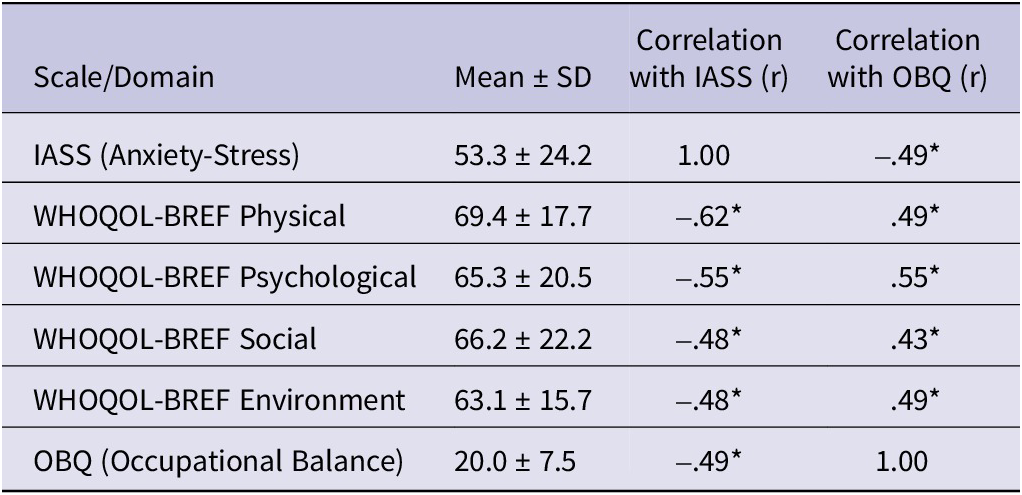
Table 2. Long description
The table contains six rows for scales: IASS (Anxiety-Stress), WHOQOL-BREF Physical, WHOQOL-BREF Psychological, WHOQOL-BREF Social, WHOQOL-BREF Environment, and OBQ (Occupational Balance). For each, the mean and standard deviation are listed, followed by Spearman correlation coefficients with IASS and OBQ. IASS has a mean of 53.3 ± 24.2, correlation with itself 1.00, and with OBQ negative point four nine (P < .01). WHOQOL-BREF Physical: mean 69.4 ± 17.7, correlation with IASS negative point six two (P < .01), with OBQ point four nine (P < .01). WHOQOL-BREF Psychological: mean 65.3 ± 20.5, correlation with IASS negative point five five (P < .01), with OBQ point five five (P < .01). WHOQOL-BREF Social: mean 66.2 ± 22.2, correlation with IASS negative point four eight (P < .01), with OBQ point four three (P < .01). WHOQOL-BREF Environment: mean 63.1 ± 15.7, correlation with IASS negative point four eight (P < .01), with OBQ point four nine (P < .01). OBQ: mean 20.0 ± 7.5, correlation with IASS negative point four nine (P < .01), with itself 1.00. All correlations marked with an asterisk are significant at P < .01. Abbreviations: IASS is Integrated Anxiety Stress Scale, OBQ is Occupational Balance Questionnaire, S D is standard deviation, WHOQOL-BREF is World Health Organization Quality of Life Scale-Short Form. All data analyzed with non-parametric tests due to non-normal distribution.
Abbreviations: IASS, Integrated Anxiety Stress Scale; OBQ, Occupational Balance Questionnaire; SD, standard deviation; WHOQOL-BREF, World Health Organization Quality of Life Scale-Short Form.
Notes: r represents the Spearman rank correlation coefficient. Data were analyzed using non-parametric tests due to non-normal distribution (P <.05).
* P <.01 for all correlations.
Discussion
The high prevalence of low anxiety levels (81.1%) among rescue workers suggests a strong healthy worker effect. Individuals remaining in these high-stress roles may have developed specialized coping mechanisms or may underreport symptoms due to a professional culture of resilience.Reference Loo, DiMaggio and Gershon 9 However, research suggests that even in cases of low reported anxiety, empathic strain—the ongoing emotional tension from witnessing suffering—remains a persistent underlying factor that can lead to burnoutReference Trevathan-Minnis, Morris and Johnson Binder 5.
This study identified lower quality of life in physical, psychological, and social domains compared to previous literature involving rescue professionals and nurses. This decline is often linked to the rigorous and traumatic nature of the environment.Reference Liu 10 Interestingly, participants reported better environmental quality of life, which may be influenced by specific institutional infrastructure or support systems provided by the Disaster and Emergency Management Presidency.
Rescue work involves not only emotional labor but also structural challenges like unpredictable shifts and time poverty. As highlighted by Trevathan-Minnis et al.,Reference Trevathan-Minnis, Morris and Johnson Binder 5 the demanding nature of these roles often leads to a life toll where workers are too physically and mentally exhausted to engage in restorative home-based occupations, directly impacting their sense of balance. The moderate occupational balance scores (20.0 ± 7.5) found in this study reflect this disruption of daily rhythms.
Consistent with previous research, a strong correlation exists between occupational balance and quality of life. Achieving a balanced work-life dynamic positively impacts social interactions and psychological well-being,Reference Trevathan-Minnis, Morris and Johnson Binder 5 , Reference Liu 10 The study had several limitations. The reliance on questionnaires alone may not capture the full depth of the issues faced by the participants. In-depth qualitative interviews are needed to gain a more comprehensive understanding. Because the data in our study were cross-sectional, longitudinal research designs are needed to investigate the possible causal relationships between specific problems in quality of life domains and occupational balance, or the predictors of anxiety-stress levels in participants. Future studies should focus on specific quality of life domains and occupational balance interventions to understand its dynamic in depth. Moreover, the potential influence of job experience on anxiety-stress levels or occupational balance was not examined in this study; future research should consider how varying years of experience in rescue work may impact these factors. Despite these limitations, this study is significant as it is among the first to explore occupational balance among rescue workers.
Acknowledgments
The authors have no acknowledgments to report.
Author contribution
F.R.A. conceived and designed the study and drafted the manuscript. E.S.B. performed data collection and statistical analysis, and G.B. provided supervision, methodology guidance, and critical revision of the manuscript for important intellectual content. All authors have approved the final version for submission.
Funding statement
This research received no specific funding.
Competing interests
The authors declare no conflicts of interest.


 Open access

