

The site and its context
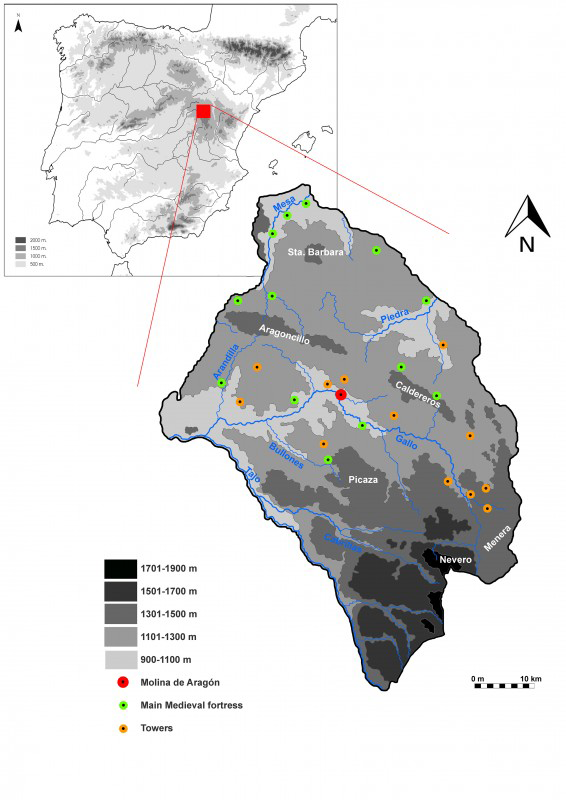
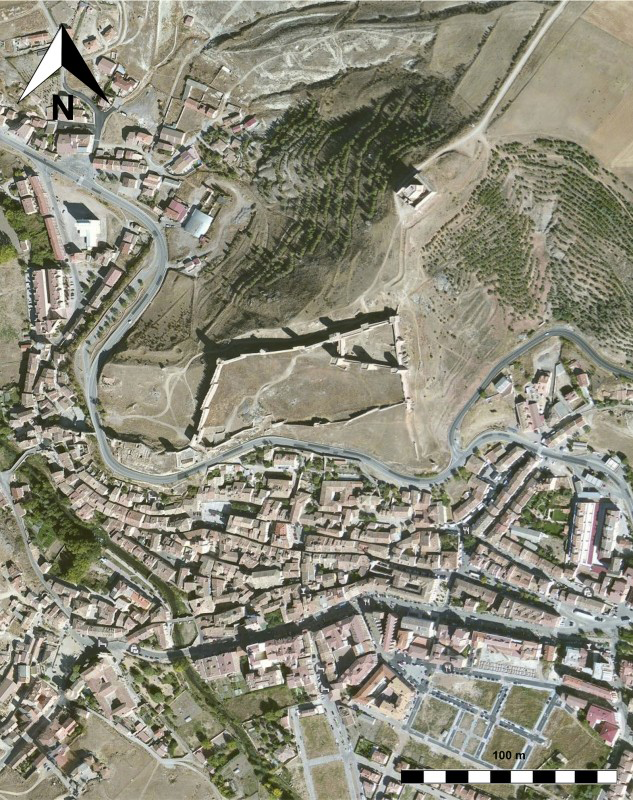
The county of Molina is a historical territory located in the east of the province of Guadalajara (Figure 1). This central part of the Iberian Peninsula represents an exceptional area for investigating the dynamics of frontiers, colonisation and social reorganisation during the formative period of the Middle Ages, when the political control of territory fluctuated between Islamic and Christian authorities. The centre of power in the region consisted of a fortified complex, located on a hill overlooking the valley of the River Gallo in the Upper Tagus, one of the principal mountain ranges in Spain and recently designated as a UNESCO Global Geopark because of its unique geological formations (Figure 2). The region has over 500 known archaeological sites dating from the Palaeolithic through to the Middle Ages (Figure 3).
Location and limits of the territory of Molina.

Aerial picture of Molina de Aragón.

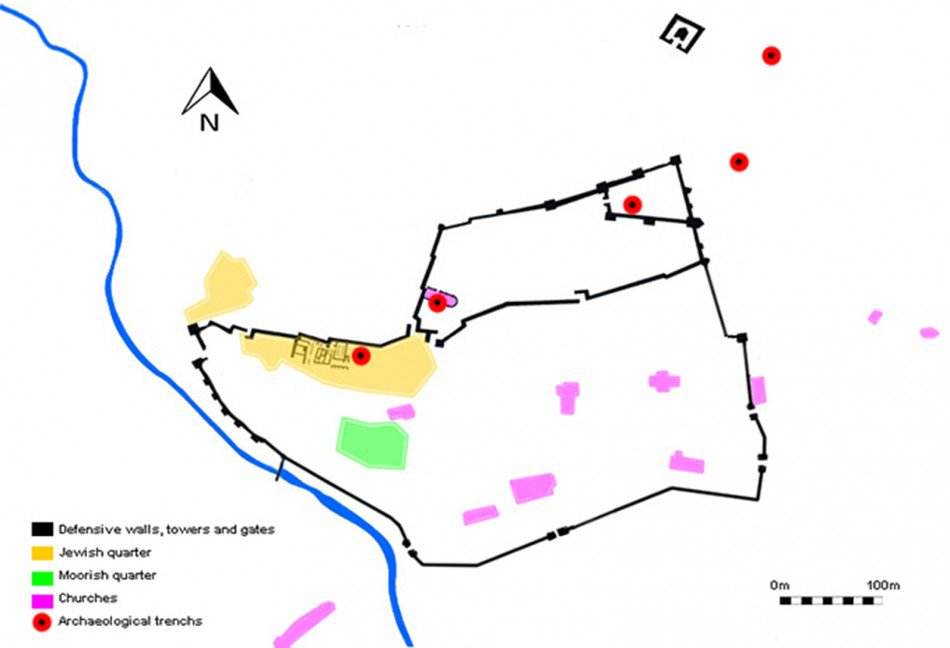
Reconstruction of Molina in the Late Middle Ages.

The fortified complex consists of a citadel connected to an enclosed ward, which was protected by external lines of walls punctuated with 14 towers and 4 gates, with an additional external tower situated on top of the hill overlooking the complex. The role of the site changed over time, from a rural fortification during the Islamic period, ruled largely by Berbers (eighth–tenth centuries AD), to a centre of power and administration during the late medieval period (thirteenth–fifteenth centuries AD). Between these two phases, it was a focal point for the defence of Al-Andalus against the expansion of Christian kingdoms from the north (tenth–eleventh centuries AD), and subsequently, it was the capital of an independent Islamic state, the Taifa of Molina, following the collapse of the Umayyad Caliphate. In AD 1129, Molina was conquered by King Alfonso I of Aragon. After fierce territorial disputes, it was finally bequeathed to the Lara family who, as magnates of the county, significantly developed the town that came to play an important economic, social and political role on the frontier between the crowns of Castile and Aragon during almost two centuries of relative independence (twelfth–thirteenth centuries AD). In the later fourteenth century AD, the town belonged to the Kingdom of Aragon for a short period (c. 1366–1375 AD), then it was subsequently incorporated into Castile and finally into Spain. After functioning as a military barracks throughout the nineteenth century, the fortress of Molina has been abandoned since the beginning of the twentieth century.
Project aims
In May 2015, a prospective survey and a series of small-scale excavations were conducted within and around the castle of Molina de Aragón, as pilot research for a larger research programme focusing on the dynamics of medieval frontier landscapes in the western Mediterranean. The aim was to investigate the development of the fortified complex of Molina de Aragón and its hinterland during the Islamic and Christian periods, focusing on changes in environmental exploitation and uses of the landscape associated with the reshaping of the frontier. The multi-scalar and multi-proxy methodology used for ‘The Ecology of Crusading Project’ (TEC), which investigated frontier societies in the medieval eastern Baltic (Pluskowski et al. 2011), was adopted and modified for the western Mediterranean.
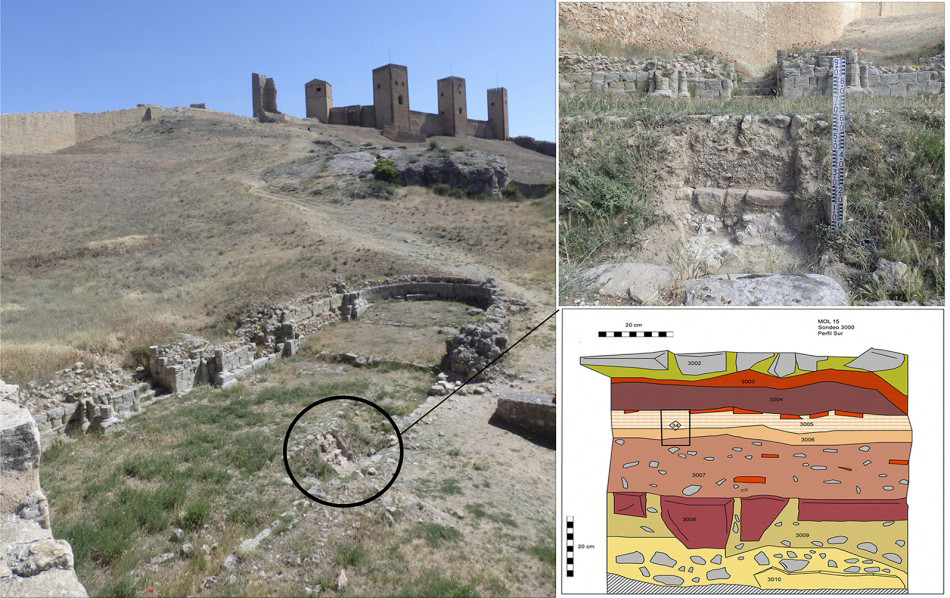
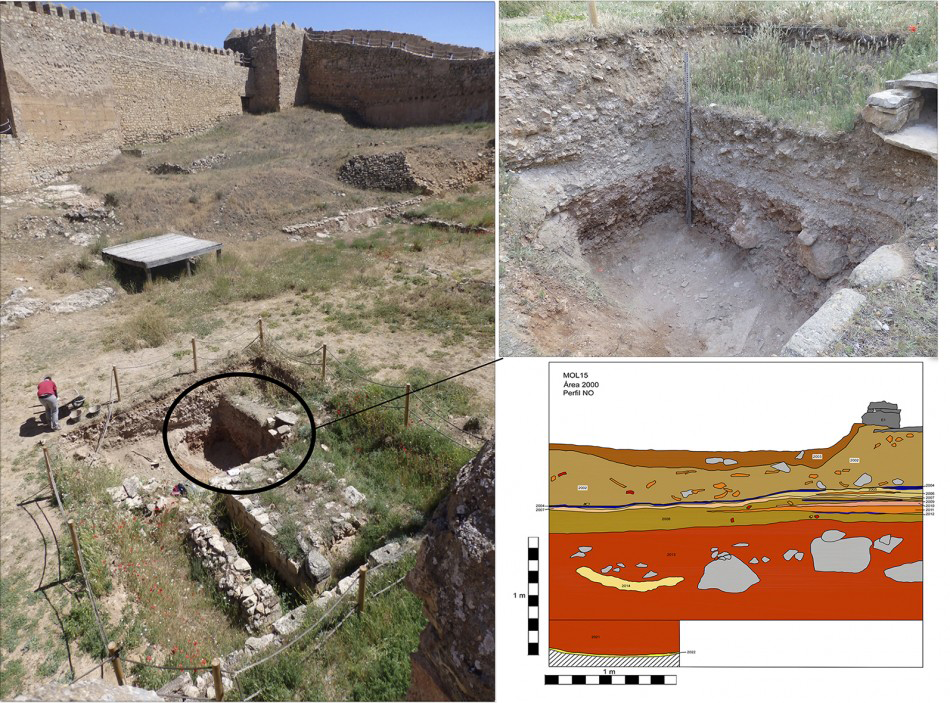
Remains of the Romanesque church inside the fortification and profile analysed micromorphology sampling.

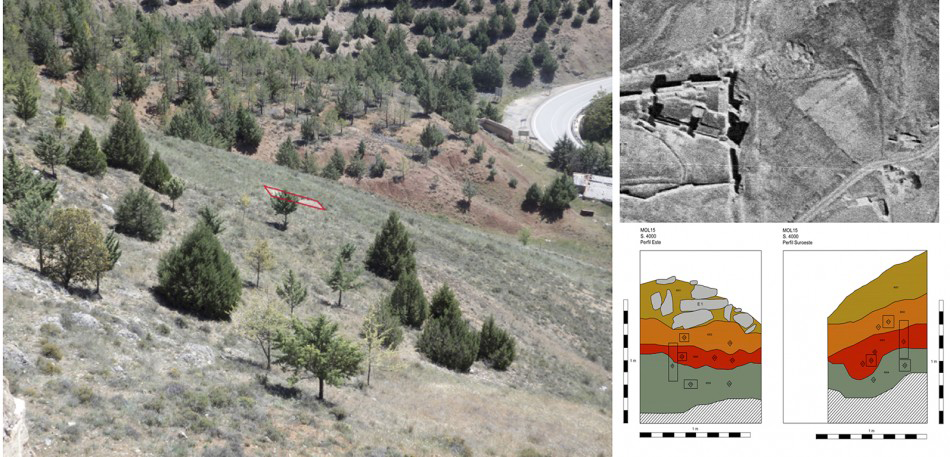
A general prospection of the site’s hinterland was carried out with the aim of selecting sites that were suitable for palaeoenvironmental analyses, focusing on lakes, where the preservation of deposits from the Islamic and Christian periods has been suggested by previous studies (Valero et al. 2008). Targeted excavations were also carried out in five areas within and around the fortified complex, with the aim of recovering and evaluating a suite of environmental data and associated material culture. Three test pits were opened in different areas of the complex—in the citadel, the church inside the outer ward, and the adjacent Jewish quarter—within trenches from previous excavations with clearly identified multi-period features (Arenas-Esteban et al. 2007; Reference Arenas-Esteban, García-Soto, García-Valero and Martínez-NaranjoArenas-Esteban 2008; see Figure 4). Samples were taken for soil micromorphology, phytolith and geochemical analyses, with the aim of investigating the changing use of the site and evaluating the quality of data (Figure 5). Two small trenches were also cut through the terraces located on the north-eastern slopes adjacent to the complex, one of them in an area that, from old aerial photographs, appears to have been cultivated in the past (Figure 6). Samples were taken for palaeoenvironmental assessment and to understand their formation in relation to the site. Alongside ongoing laboratory analyses, the next phase of work will include geophysical survey of the fortified outer ward and the continuation of palaeoenvironmental analyses of associated terraces and irrigation systems.
Study area inside the citadel, taking advantage of previous excavations.

New trench opened in the area of farming terraces and identified in the aerial photograph of 1956 (on the top left); picture provided by the Instituto Geográfico Nacional (http://fototeca.cnig.es/).

In summary, Molina provides the ideal setting through which to investigate the character of dynamic and variable frontiers over a period of eight centuries. This represents the first stage of a project that will focus on the medieval frontier itself, using a multi-scalar approach and an integrated methodology to scrutinise this specific site and its territory, exploring land use, natural resources and economic and ideological roles within societies of clearly documented religious and ethnic tensions.
Acknowledgements
The project was funded by the School of Archaeology, Geography and Environmental Science at the University of Reading. We would like to thank the Council of Molina for its generosity and support, and especially Juan Manuel Monasterio, director of the Archaeological Museum and Geopark of Molina-Alto Tajo. We would also like to thank the members of the field team: Aroa García-Suárez, Marcos Ruiz, Juhan Kari, Joaquin Checa-Herraiz and Álvaro Piña-Pérez.