

1. Introduction
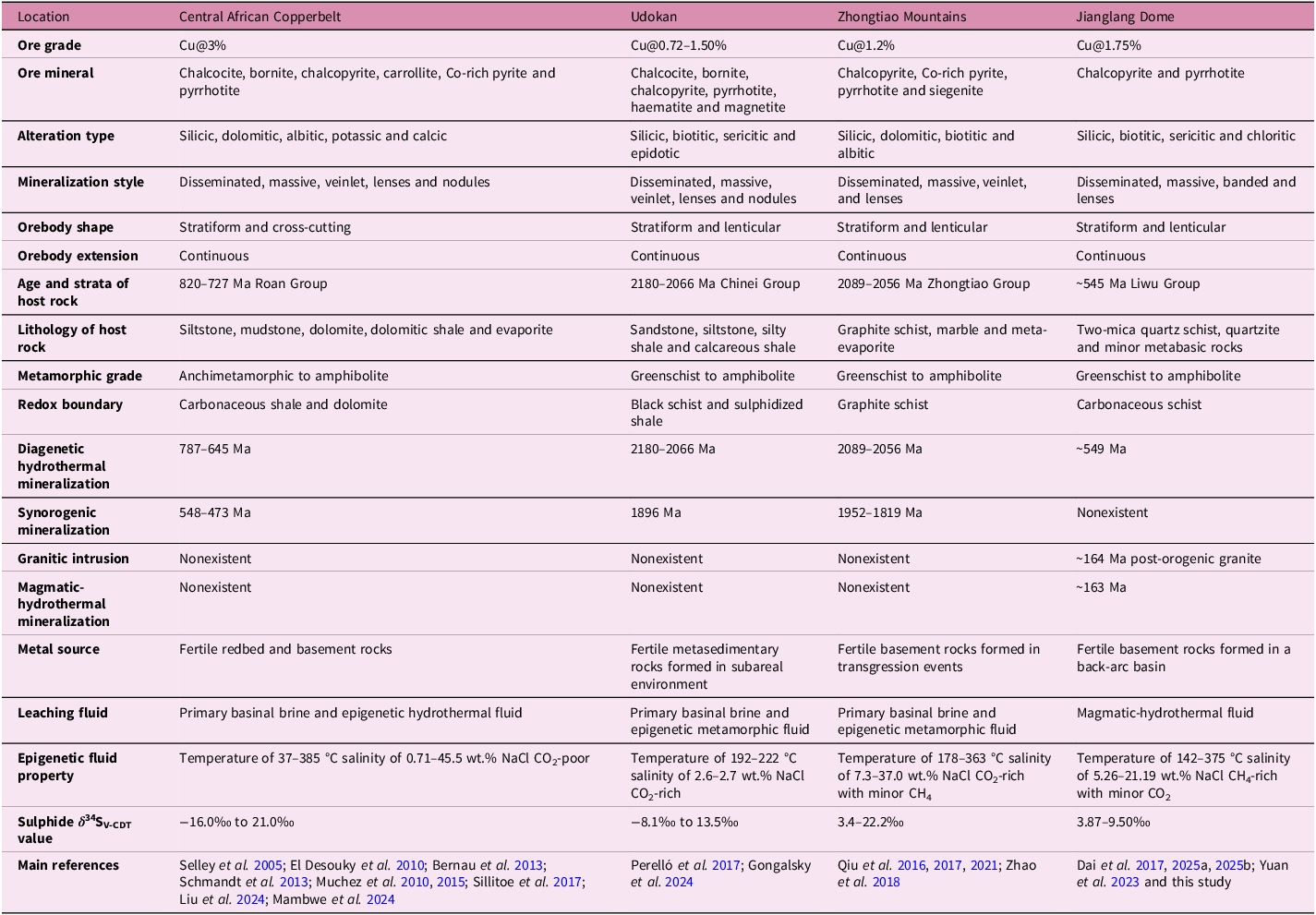
Sediment-hosted stratiform Cu (SSC) deposits, with a typical high Cu grade of 1.52%, provide more than 10% of the world’s copper resources (Mudd and Jowitt, Reference Mudd and Jowitt2018) and are an important source of cobalt (63%, Horn et al. Reference Horn, Gunn, Petavratzi, Shaw, Eilu, Törmänen, Bjerkgård, Sandstad, Jonsson, Kountourelis and Wall2021) and other metals. These deposits form when cupriferous hydrothermal fluids are transported across reduction fronts (e.g. carbonaceous shales or dolomites) and triggered copper sulphide precipitation (Hitzman et al. Reference Hitzman, Selley and Bull2010; Borg et al. Reference Borg, Piestrzynski, Bachmann, Püttmann, Walther and Fiedler2012; Brown, Reference Brown2014). The SSC deposits are associated with oxidized, saline and acid hydrothermal fluids, such as low-to moderate-temperature basinal brines and high-temperature saline fluids (Dewaele et al. Reference Dewaele, Muchez, Vets, Fernandez-Alonzo and Tack2006; El Desouky et al. Reference El Desouky, Muchez and Cailteux2009; Davey et al. Reference Davey, Roberts and Wilkinson2021; Qiu et al. Reference Qiu, Fan, Goldfarb, Tomkins, Yang, Li, Xie and Liu2021; Mambwe et al. Reference Mambwe, Delvaux, Dewaele, Kipata and Muchez2024). In some cases, the SSC deposits are hosted by metasedimentary sequences of anchimetamorphic to amphibolite-facies, and granitic intrusions are commonly absent (Hitzman et al. Reference Hitzman, Selley and Bull2010; Brown, Reference Brown2014; Hayes et al. Reference Hayes, Cox, Piatak and Seal2015). This is exemplified by typical SSC deposits in the Central African Copperbelt, the Udokan district of Russia and the Zhongtiao Mountains of the North China Craton (Table 1). Previous studies have shown that magmatic exsolution of chlorine gives rise to saline fluids, which are effective for metal remobilization and transportation (Audétat and Edmonds, Reference Audétat and Edmonds2020; Virtanen et al. Reference Virtanen, Heinonen, Molnár, Schmidt, Marxer, Skyttä, Kueter and Moslova2021). However, significant examples of SSC deposits related to magmatic-hydrothermal systems have been little documented.
Detailed comparison of classic SSC deposits and stratiform Cu deposits in the Jianglang Dome (modified after Dai et al. Reference Dai, Zhu, Liang, Li and Zhou2025b)
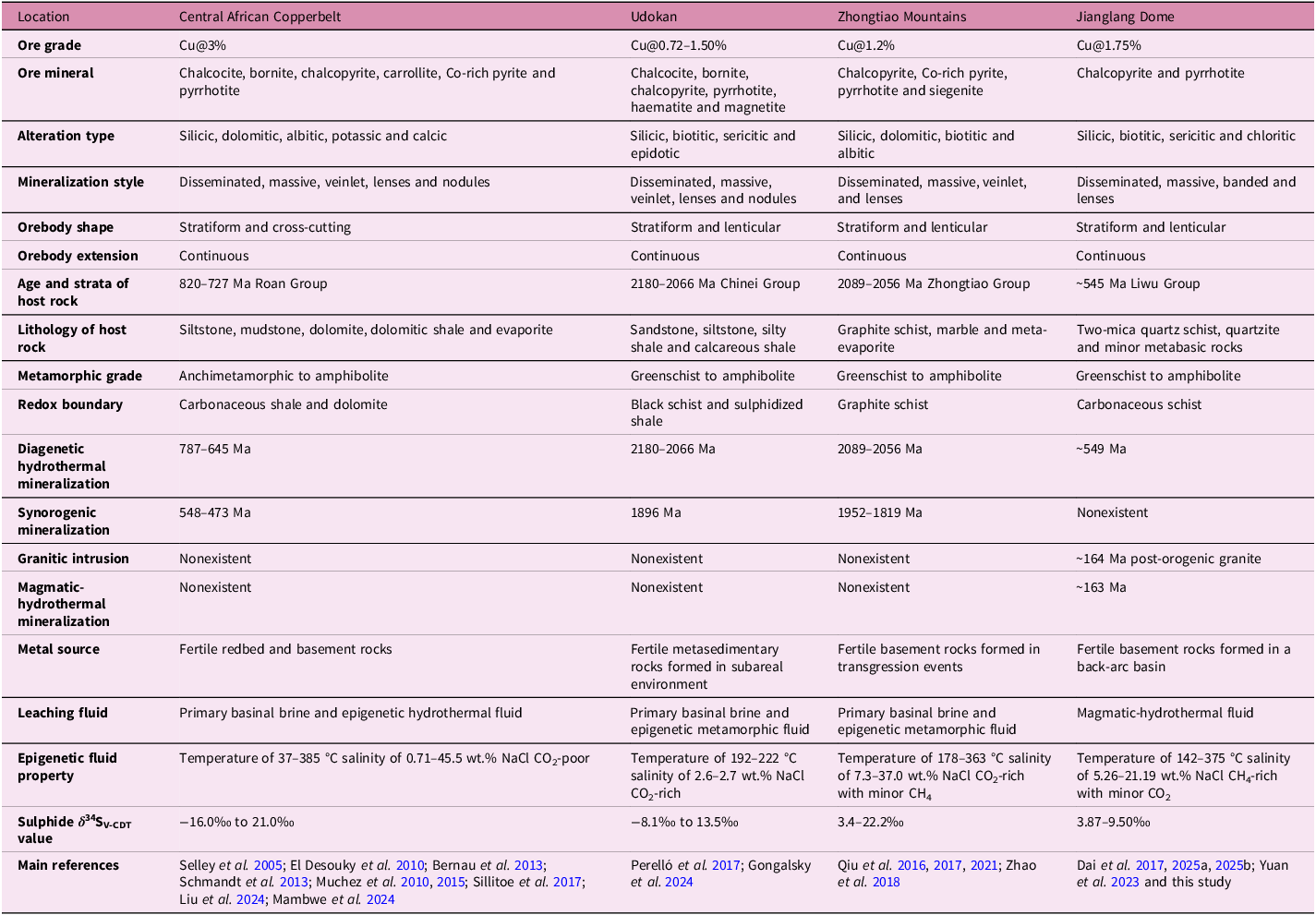
In the southeastern Songpan-Ganze Orogen, a suite of high-grade (average 1.75%) stratiform Cu deposits occurs in the Jianglang Dome, which is intruded by granitic plutons (Figure 1). These deposits are hosted by a metamorphosed siliciclastic sequence of the Late Neoproterozoic Liwu Group (544.5–538.8 Ma, Dai et al. Reference Dai, Zhu, Liang and Zhou2025a). They share similarities to classic SSC deposits, which were commonly ascribed to diagenetic hydrothermal and synorogenic mineralization (Table 1), and partially suffered complex tectonic superimposition and replacement (e.g. Brown, Reference Brown2014; Muchez et al. Reference Muchez, André-Mayer, El Desouky and Reisberg2015; Höhn et al. Reference Höhn, Frimmel, Debaille, Pašava, Kuulmann and Debouge2017; Qiu et al. Reference Qiu, Fan, Goldfarb, Tomkins, Yang, Li, Xie and Liu2021). More recently, according to chalcopyrite Re-Os and hydrothermal zircon U-Pb dating results, Dai et al. (Reference Dai, Zhu, Liang, Li and Zhou2025b) proposed two-staged formation for stratiform Cu deposits in the Jianglang Dome, including: (1) ca. 550 Ma syngenetic enrichment; and (2) ca. 160 Ma epigenetic magmatic-hydrothermal reactivation related to ca. 164 Ma granite. This thereby indicates a superimposed genetic model and a new type of granitic intrusion-related, metasedimentary rock-hosted stratiform Cu deposit (Dai et al. Reference Dai, Zhu, Liang, Li and Zhou2025b). Nevertheless, the source characteristics of fluids and metals remain poorly understood.
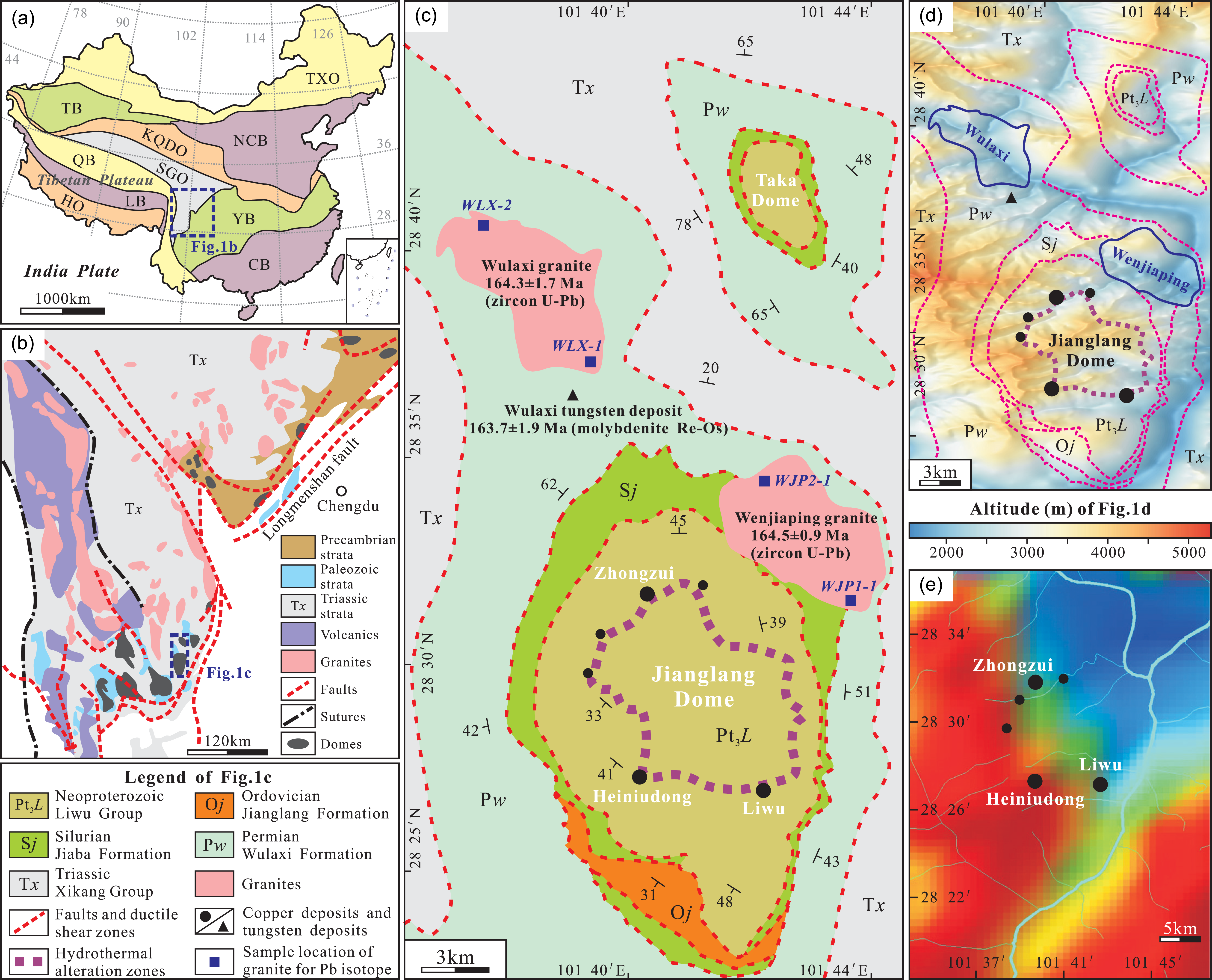
(a) Simplified tectonic division map of China, TXO = Tianshan-Xingmeng Orogen, TB = Tarim Block, NCB = North China Block, KQDO = Kunlun-Qinling-Dabie Orogen, SGO = Songpan-Ganze Orogen, YB = Yangtze Block, CB = Cathaysia Block. (b) Regional geological map of the eastern Tibetan Plateau. (c–d) Geological and topographical map of the Jianglang Dome. (e) The residual gravity anomaly map of the Jianglang Dome and its vicinity, note that warm colours indicate high gravity, while cool colours indicate low gravity.
In this study, we revisited typical stratiform Cu deposits in the Jianglang Dome, and we used chalcopyrite Re-Os dating and sulphide He-Ar-S-Pb isotope systematics to determine their mineralization age and origin. In conjunction with previous studies, our combined data illuminate a dominantly crustal origin for fluids and metals, as well as source homogeneity in the investigated stratiform Cu deposits.
2. Geological setting
2.a. Regional geology
The Songpan-Ganze Orogen covers a triangular-shaped area of about 2.2 × 10⁵ km2 in the eastern Tibetan Plateau (Figure 1a). It is the result of interactions between the Yangtze, North China and Qiangtang Blocks during the Indosinian Orogeny (Early Triassic to Early Jurassic), which were induced by the closing of the Palaeo-Tethys Ocean (Roger et al. Reference Roger, Jolivet and Malavieille2010; Xu et al. Reference Xu, Fu, Wang, Li, Zheng, Zhao and Lian2020). The Neoproterozoic crystalline basement, probably with an oceanic crust nature, only crops out in the southern part of the Songpan-Ganze Orogen and is locally migmatized and ductilely deformed (Roger et al. Reference Roger, Jolivet and Malavieille2010). The Songpan-Ganze Orogen is exclusively overlain by 5–15 km thick Triassic flysch deposits that received materials from adjacent blocks (Weislogel et al. Reference Weislogel, Graham, Chang, Wooden and Gehrels2010). These flysch deposits are composed of alternating shale and sandstone, with minor carbonate and greywacke. They suffered greenschist-to amphibolite-facies Barrovian metamorphism during the Late Indosinian crustal thickening and shortening (ca. 205–190 Ma, Huang et al. Reference Huang, Buick and Hou2003a, Reference Huang, Maas, Buick and Williams2003b) and were intruded by widespread granitic plutons (Figure 1b). Based on tectonic, geochemical and geochronological studies, these granitoids were divided in two groups: (1) syn-to late-orogenic at ca. 220–200 Ma; and (2) post-orogenic at ca. 200–150 Ma (Roger et al. Reference Roger, Malavieille, Leloup, Calassou and Xu2004, Reference Roger, Jolivet and Malavieille2010). The syn-orogenic granitoids were formed in a syn-collisional to post-collisional setting during the Palaeo-Tethys Ocean closure and subsequent collision (Gao et al. Reference Gao, Xu, Li, Ding, Das, Lian, Zheng, Yan, Pan, Jiang and Lu2023). In contrast, the late-and post-orogenic granitoids were likely associated with thickened lower crust, lithospheric delamination and asthenospheric upwelling, accompanied by extensional tectonics (Zhang et al. Reference Zhang, Parrish, Zhang, Xu, Yuan, Gao and Crowley2007).
More than ten isolated domes were distributed along the eastern Songpan-Ganze Orogen (Figure 1b), with medium-to high-grade metamorphic complexes in their cores. These domes were attributed to magma-induced uplift caused by lithospheric thermal anomalies (Yan et al. Reference Yan, Song, Fu and Tian1997). The Jianglang Dome consists of three tectonostratigraphic units (Figure 2a), including: (1) a core constituted by the Late Neoproterozoic Liwu Group; (2) an overlying middle slab of the Palaeozoic metamorphosed volcano-sedimentary sequences, including the Jianglang, Jiaba and Wulaxi Formations; and (3) a sedimentary cover of the Triassic Xikang Group (Yan et al. Reference Yan, Song, Fu and Tian1997, Reference Yan, Zhou, Song and Fu2003). These units are separated by ring-like and low-angle detachment faults or ductile shear zones (Figure 1c and d).
(a) Generalized stratigraphic column of the Jianglang Dome, modified after Yan et al. (Reference Yan, Zhou, Song and Fu2003) with the thicknesses of the geological sections we measured. (b) Column diagram of drill hole CK3104 in the Liwu deposit.
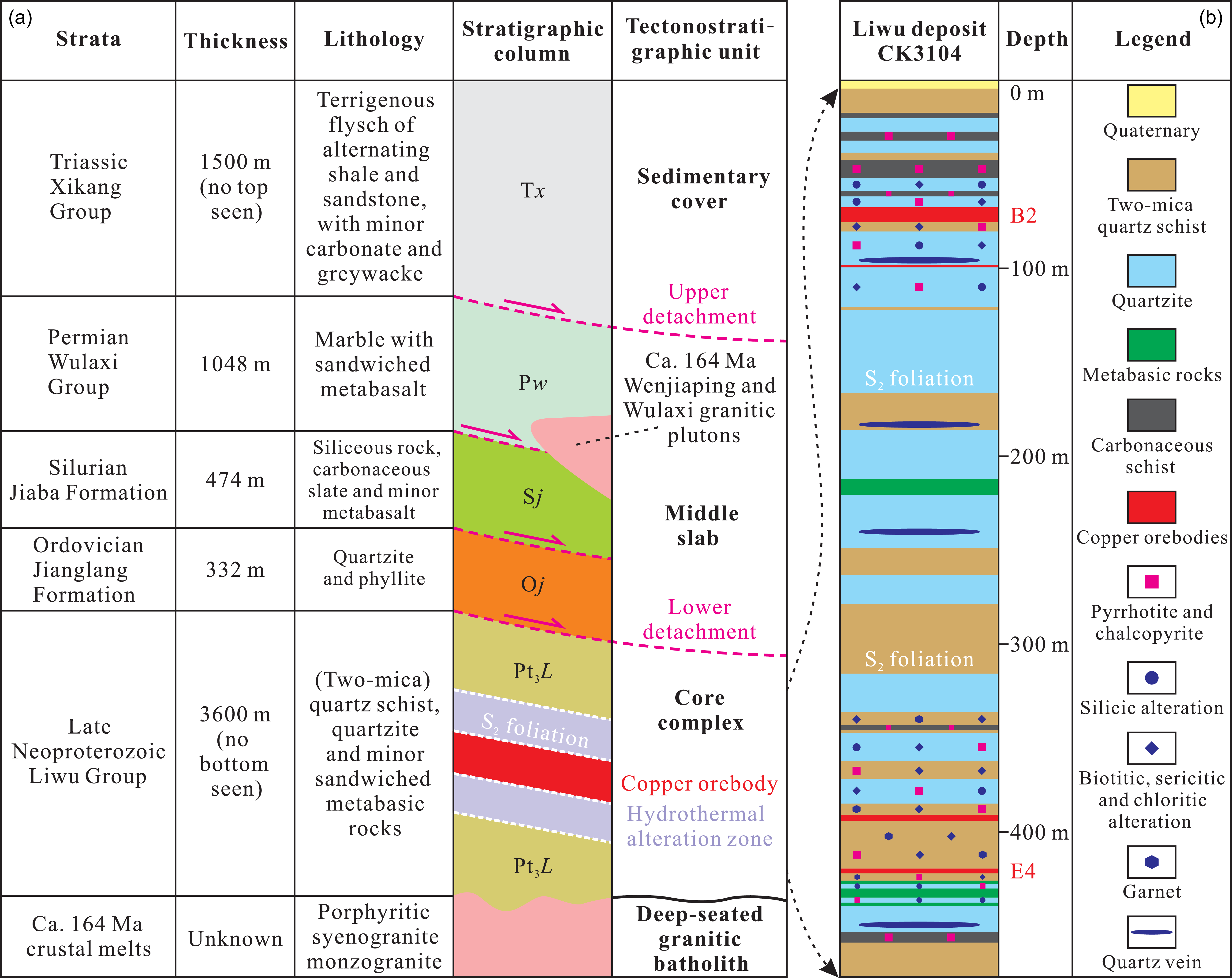
The Neoproterozoic Liwu Group consists of a metamorphosed volcano-sedimentary sequence with a total thickness of >3600 m and is mainly composed by two-mica quartz schist, quartzite and minor (total <5 vol%) sandwiched metabasic rocks (Figure 2b). Dai et al. (Reference Dai, Zhu, Liang and Zhou2025a) recently dated detrital zircons and zircon xenocrysts within these rocks and assigned a Late Neoproterozoic age of ca. 544.5–538.8 Ma. The Liwu Group rocks show geochemical and Sr-Nd-Pb isotopic signatures resembling those of modern back-arc basin sediments and basalts and were most likely formed in an incipient back-arc basin along the Northern Gondwana (Dai et al. Reference Dai, Zhu, Liang and Zhou2025a). Moreover, Yan et al. (Reference Yan, Song, Fu and Tian1997) proposed that the Liwu Group suffered greenschist to amphibolite-facies metamorphism since their formation, mainly caused by ca. 525 Ma, ca. 192–184 Ma and ca. 132–121 Ma metamorphic events.
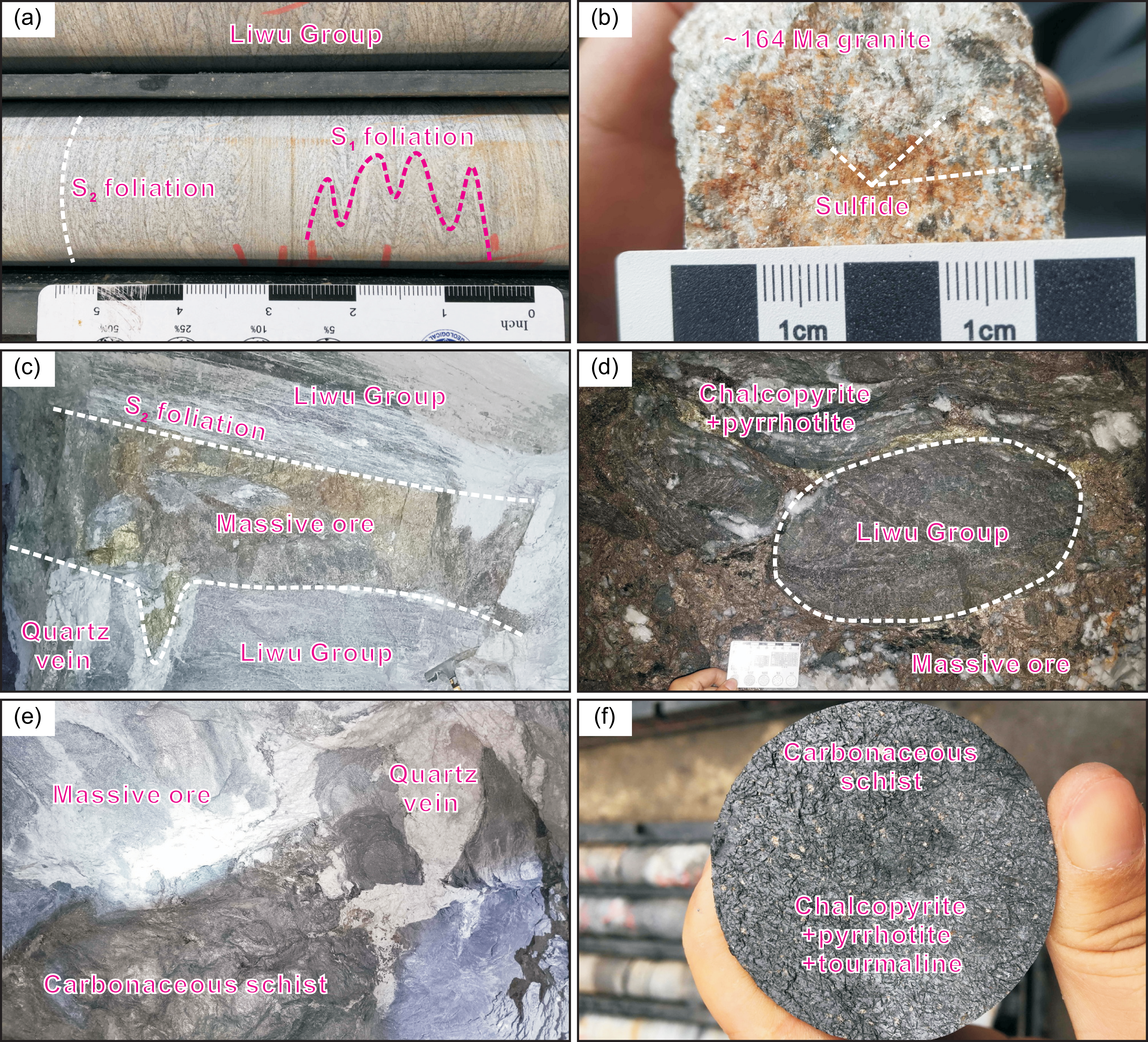
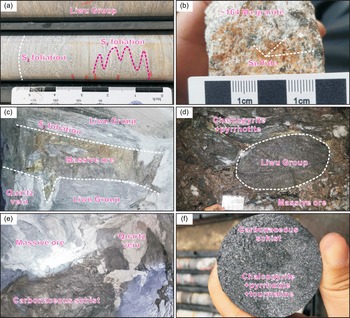
Due to multiple deformation and metamorphism, the Late Neoproterozoic Liwu Group rarely preserved its primary S0 signs (Zhang et al. Reference Zhang, Feng, Tang, Zhou, Li, Zhu, Wu and Xia2013). The S1 foliation was possibly parallel to the S0 layer and was commonly related to the formation of asymmetric folds. The S1 foliation was likely associated with the Triassic compressional orogenic event in the Songpan-Ganze Orogen (Yan et al. Reference Yan, Song, Fu and Tian1997). The mineral assemblage consists mainly of muscovite and quartz, with minor biotite, albite, K-feldspar and garnet. This indicates upper greenschist-facies metamorphism and yields temperatures of 300–360 °C and a pressure of 2.0 × 10⁸ Pa based on fluid inclusion data in syntectonic quartz veins and muscovite geothermometer (Yan et al. Reference Yan, Song, Fu and Tian1997, Reference Yan, Zhou, Song and Fu2003). The major S2 foliation is widely developed in the Liwu Group and transposes S1 in the field (Figure 3a). They are low-angle (20–30°) and occur as recumbent folds in some locations and were probably related to the Jurassic post-orogenic extension in the Songpan-Ganze Orogen (Roger et al. Reference Roger, Jolivet and Malavieille2010). Their mineral assemblage is mainly composed of biotite, muscovite, quartz and garnet. This belongs to the amphibolite-facies metamorphism, with temperatures of 460–500 °C and a pressure of 3.5 × 10⁸ Pa according to garnet-biotite and muscovite geothermometers (Yan et al. Reference Yan, Song, Fu and Tian1997, Reference Yan, Zhou, Song and Fu2003).
Field photographs of the studied stratiform Cu deposits. (a) The S1 and S2 foliation in the metasedimentary rocks of the Liwu Group. (b) Disseminated sulphides within a ca. 164 Ma granite. (c) Stratiform copper mineralization within the Liwu Group. (d) Round horsestone of the Liwu Group within massive sulphides. (e–f) Carbonaceous schist footwall rocks of Cu orebodies.
The middle slab of the Jianglang Dome is composed of (1) the Ordovician Jianglang Formation mainly composed of quartzite, (2) the Silurian Jiaba Formation composed of siliceous rock, carbonaceous slate and minor metabasalt interlayers and (3) the Permian Wulaxi Formation which consists of marble and sandwiched metabasaltic rocks (Figure 2a). These strata were metamorphosed to greenschist-and amphibolite-facies during ca. 192–184 Ma and ca. 132–121 Ma metamorphism (Yan et al. Reference Yan, Song, Fu and Tian1997). Specifically, the Wulaxi Formation has an estimated thickness of 1048 m and was assigned a maximum depositional age of 258.9 Ma based on zircon U-Pb age and regional stratigraphic correlation (Zhu et al. Reference Zhu, Dai, Wang, Xiu and Chen2020). The Triassic Xikang Group, a major component of the Songpan-Ganze Orogen, is composed of terrigenous flysch and experienced subsequent greenschist-facies metamorphism (Yan et al. Reference Yan, Zhou, Song and Fu2003).
The Wenjiaping and Wulaxi granitic plutons are outcropping in the Jianglang Dome and its vicinity (Figure 1c and d). They intrude the Liwu Group, the Jiaba Formation and the Wulaxi Formation and occupy outcrop areas of ∼34 km2 (Wenjiaping) and ∼32 km2 (Wulaxi), respectively. In some locations, disseminated sulphides (pyrite and chalcopyrite) occur within these granites (Figure 3b). Previous studies of LA-ICP-MS zircon U-Pb dating indicate emplacement ages of 164.5 ± 0.9 Ma (Wenjiaping) and 164.3 ± 1.7 Ma (Wulaxi, Dai et al. Reference Dai, Zhu, Li, Zhang, Tang and Shen2017). Geochemical and zircon Hf isotope data suggest a post-orogenic extensional setting and a main derivation from ancient continental crust (Dai et al. Reference Dai, Zhu, Li, Zhang, Tang and Shen2017). The Wulaxi skarn-type tungsten deposit within the Permian strata is close to two granitic plutons (Figure 1c and d). It has a mineralization age of 163.7 ± 1.9 Ma according to molybdenite Re-Os dating, and a magmatic-hydrothermal origin is thus proposed for this deposit (Li et al. Reference Li, Zhou, Zhang, Dai, Ma, Ma and Shen2016). According to the geophysical studies using 1: 100, 000 gravity measurement, the core of the Jianglang Dome generally shows low residual gravity anomalies (Figure 1e), implying that there might be a deep-seated granitic batholith (e.g. Mangkhemthong et al. Reference Mangkhemthong, Morley, Kanthiya and Chaisri2020).
2.b. Deposit geology
A series of stratiform (with minor lenticular) Cu deposits occurs within the Liwu Group in the core of the Jianglang Dome, typified by Liwu, Heiniudong and Zhongzui (Figure 1c and d). They are one of the most important copper producers in southwest China, and they have an average Cu grade of ∼1.75% (up to ∼20% in some places). These deposits share common characteristics in the alteration and mineralization type and are collectively referred to as ‘Liwu-type’ high-grade Cu deposits (Dai et al. Reference Dai, Zhang, Zhu, Shen, Li and Ma2016).
The alteration halos in these stratiform Cu deposits are roughly S2 foliation-parallel, with thicknesses of 100–250 m from top to bottom. They are dominated by silicic, biotitic, sericitic and chloritic alteration of primary silicate minerals (Figure 2b), with an assemblage of quartz, biotite, sericite, chlorite and minor (total <10 vol%) garnet, tourmaline and staurolite. Their alteration halos generally occur along the S2 foliation planes (Figure 2). When compared to metamorphic minerals (e.g. biotite and chlorite) in their wall rocks, these alteration minerals are present in extremely large size and high volume (Dai et al. Reference Dai, Zhang, Zhu, Shen, Li and Ma2016). The hydrothermal events can be divided into three stages according to paragenetic sequence of minerals: (1) a first stage responsible for chalcopyrite and pyrrhotite mineralization, comprising silicic (quartz), biotitic (biotite + quartz), sericitic (sericite + quartz) and chloritic (chlorite + quartz + sericite) alteration; (2) a second stage characterized by megacrystic garnet, tourmaline and staurolite; and (3) a late stage represented by non-mineralized quartz and calcite veins cross-cutting foliation.
The Cu orebodies are stratiform and lenticular within the Liwu Group (Figure 3c), locally enveloping their country rocks (Figure 3d). Mineralized and well-bedded black carbonaceous schists (2–10 m thick) are commonly distributed near the base and top of the orebodies (Figure 2b). They are mainly composed of graphite (∼65 vol%), tourmaline (∼15 vol%), biotite (∼15 vol%), quartz (∼5 vol%) and sulphide (<3 vol%). These black carbonaceous schists are smooth and easily stain hands (Figure 3e and f). Three distinct styles of sulphide mineralization with varying Cu grades have been identified in these stratiform Cu deposits: (1) massive chalcopyrite + pyrrhotite + sphalerite + pyrite + quartz, with higher Cu grades of >5% (Figure 4a and b); (2) banded chalcopyrite + pyrrhotite + quartz + biotite + sericite ± chlorite, with medium Cu grades of 1–5% (Figure 4c and d); and (3) disseminated chalcopyrite + pyrrhotite + biotite + sericite + chlorite ± quartz, with lower Cu grades of <1% (Figure 4e). From the orebody centre to its edge, three sulphide mineralization styles vary gradually (Figure 4f). This most likely indicates a paragenetic sequence of disseminated → banded → massive mineralization.
Field and optical microscope photographs of sulphide ores in the studied stratiform Cu deposits. (a–b) Hand specimen and microphotograph of massive sulphides. (c–d) Hand specimen and microphotograph of banded sulphides. (e) Drill core showing disseminated sulphides. (f) Gradational relationship among different ores and hosting rocks.
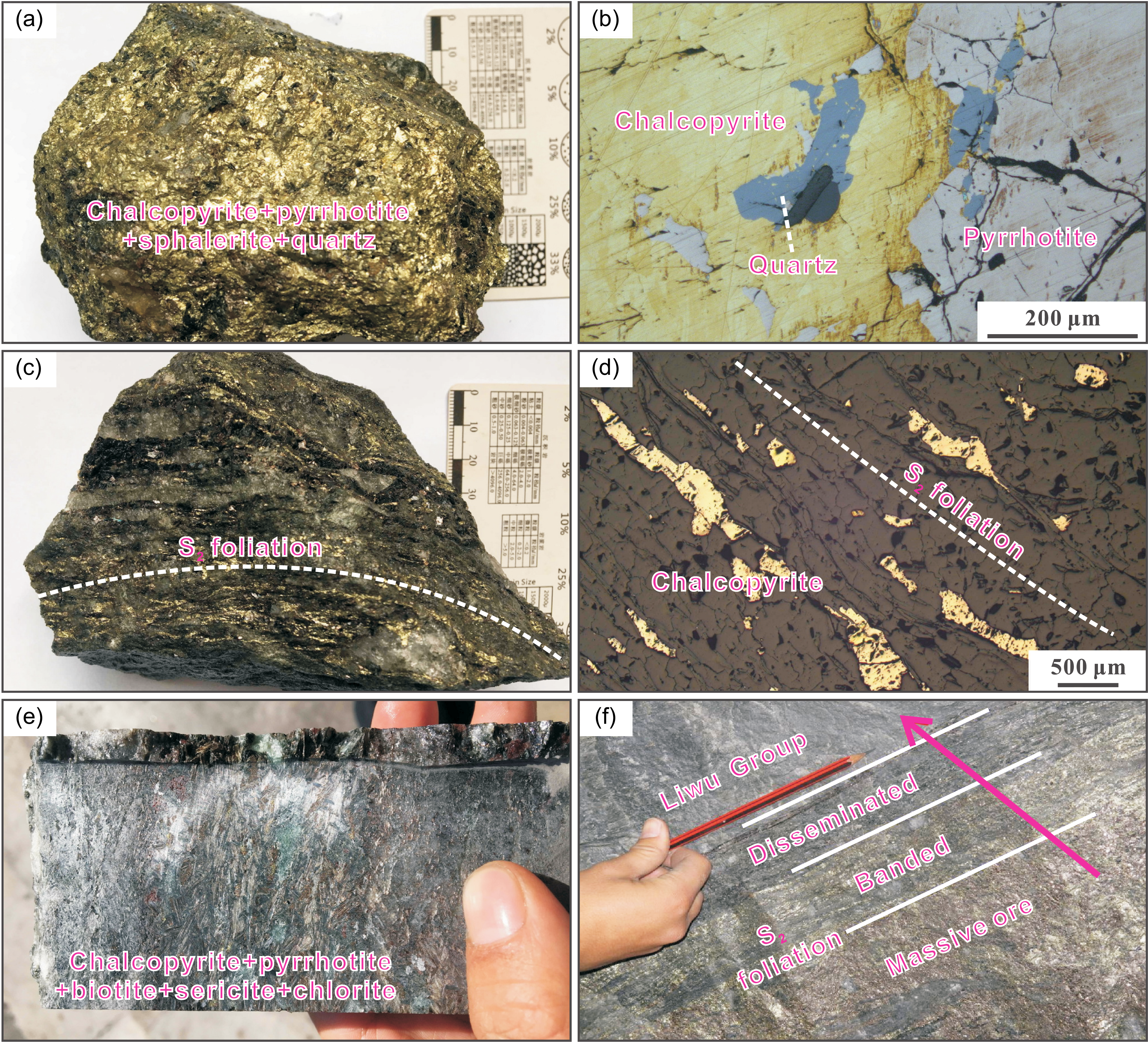
The sulphides are predominantly chalcopyrite and pyrrhotite, with minor sphalerite and pyrite. In the massive, banded and disseminated mineralization styles, the chalcopyrite grains are subhedral to anhedral, and dominantly coexisting with pyrrhotite (Figure 4b). They are commonly coarse (0.5–3 mm) in the massive ores with high chalcopyrite contents of up to 60 vol% (∼20% Cu), and small (0.1–1 mm) in banded and disseminated ores (Figure 4d). Pyrrhotite is euhedral to subhedral in the massive ores, and subhedral to anhedral in the banded and disseminated ores. It is weakly magnetic and has varying pyrrhotite contents (5–60 vol% pyrrhotite) and grain sizes (0.1–2 mm). In banded and disseminated ores, the sulphides obviously occur along the S2 foliation (Figure 4c and d). This indicates that Cu mineralization occurred earlier than or synchronously with deformation.
The Liwu, Heiniudong and Zhongzui stratiform Cu deposits are respectively located in the southeast, southwest and northwest of the Jianglang Dome (Figure 1c and d). Their Cu orebodies all occur in hydrothermal alteration halos (Figure 5). In the Liwu deposit, the Neoproterozoic Liwu Group rocks strike 20–60° and dip 19–28° SE (Figure 5a). Hydrothermal alteration zones, with a thickness of more than 200 m in some locations, can be divided into two layers (Figure 5b). The upper alteration zone contains the A2 and B2 main orebodies, extending more than 1.50 km. The lower alteration zone encloses the E4 orebody that extends ∼0.5 km. In the Heiniudong deposit, the Liwu Group strikes 115–140° and dips 20–35° SW (Figure 5c). From top to bottom, four orebodies were identified based on mineral exploration (Figure 5d): (1) II4 orebody with an extension of ∼250 m; (2) Ⅰ3 main orebody extending more than 900 m; (3) Ⅰ1 orebody with an extension of ∼700 m; and (4) Ⅲ1 orebody with an average thickness of ∼20 m, extending more than 350 m. The Liwu Group rocks in the Zhongzui deposit area strike 35–70° and dip 25–36° NW (Figure 5e). Two hydrothermal alteration envelopes were discovered based on geologic mapping and drill cores. They contain stratiform orebodies, including the upper Z1-1 orebody with an extension of >3.50 km and the lower Z2-1 orebody extending ∼1.0 km (Figure 5f).
Geological sketch maps and cross-sections of the Liwu (a–b), Heiniudong (c–d) and Zhongzui (e–f) stratiform Cu deposits, showing some of our sample locations.
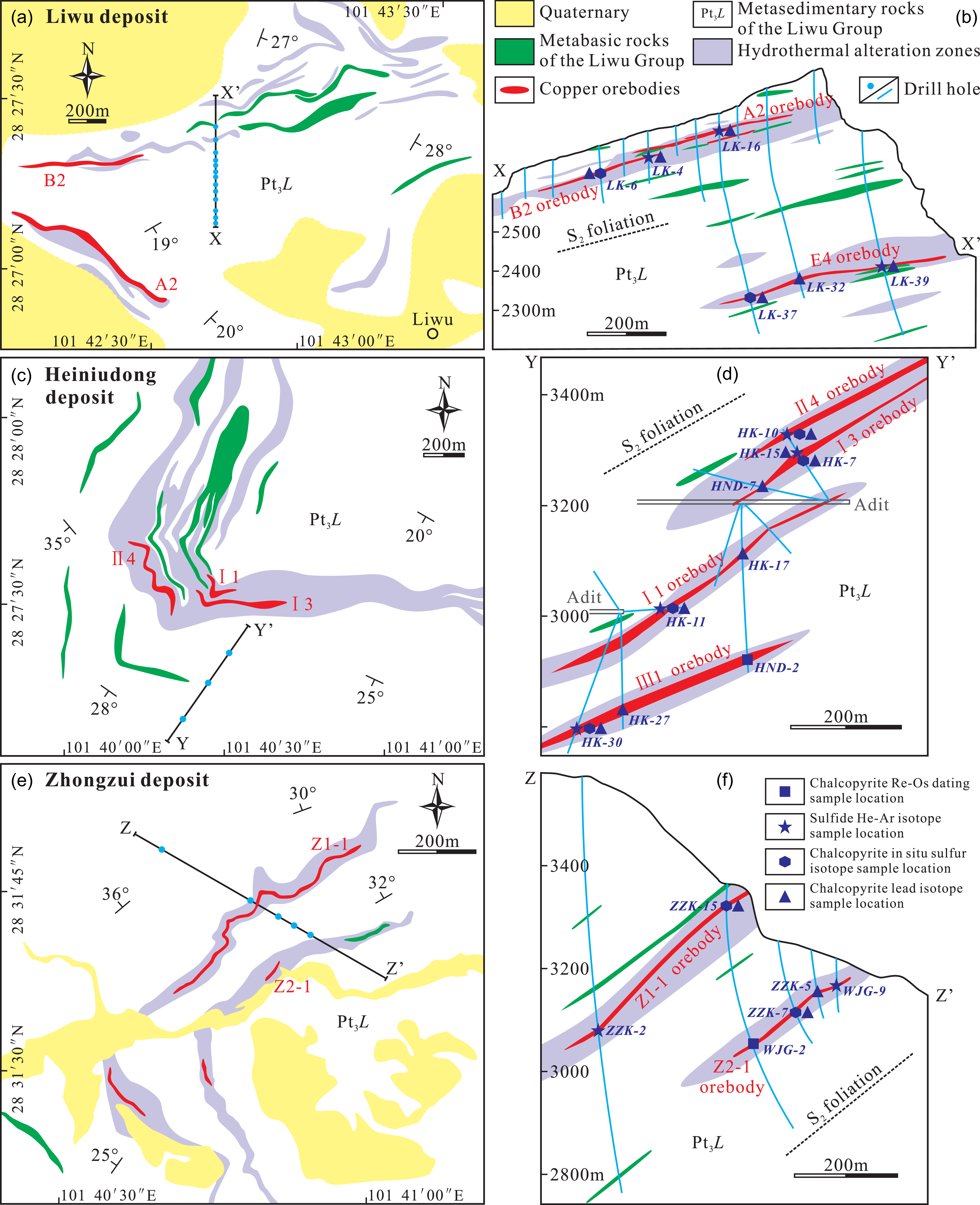
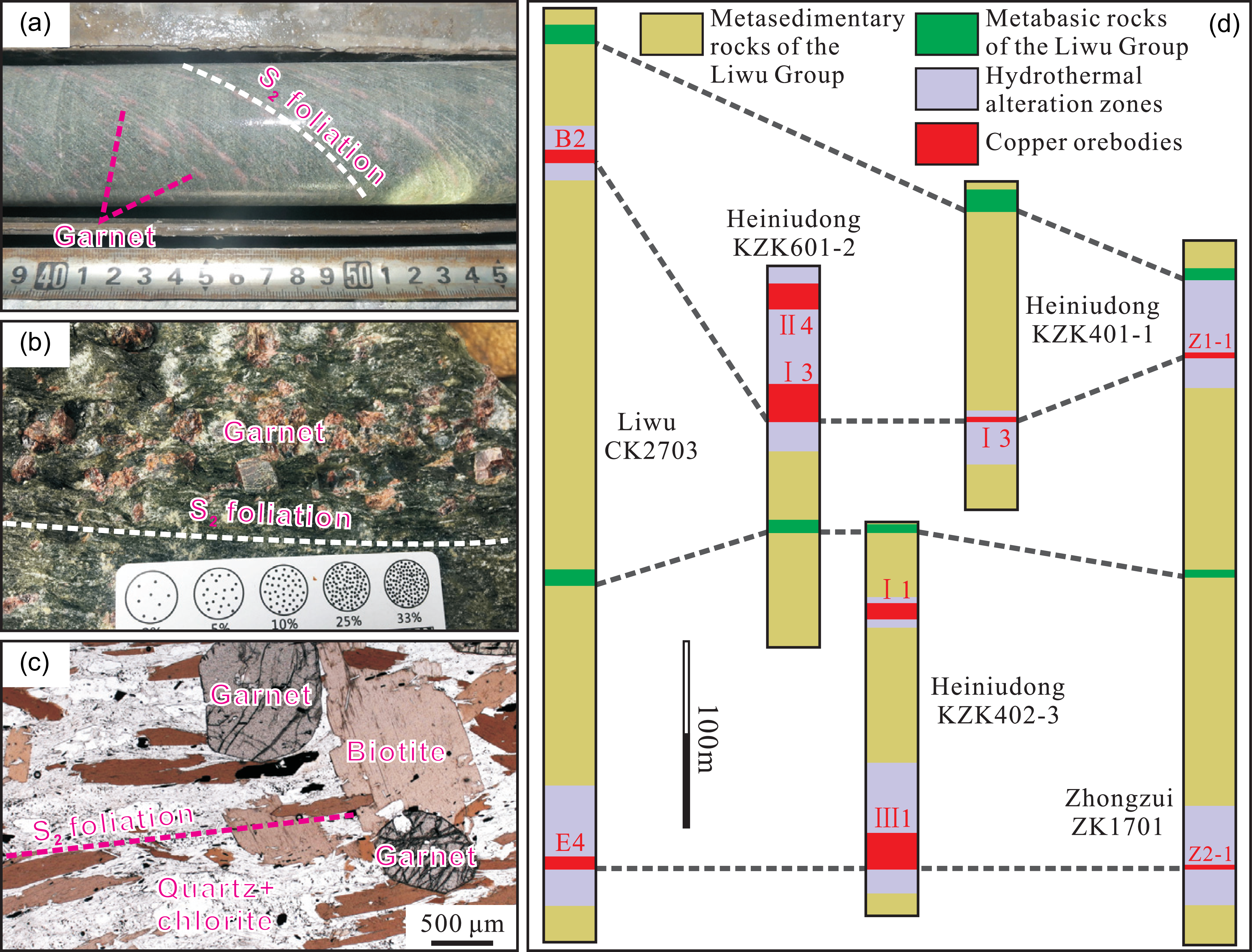
According to field observations, fine-grained (<5 mm) garnets are widely distributed in the shallower hydrothermal alteration halos, which host the A2 and B2 orebodies of Liwu, the II4, Ⅰ3 and Ⅰ1 orebodies of Heiniudong and the Z1-1 orebody of Zhongzui (Figure 5). These fine-grained garnets are commonly elongated and deformed and are S2 foliation-parallel (Figure 6a). In contrast, coarse-grained (up to 25 mm) garnets occur in the deep hydrothermal alteration zones, which contain the E4 orebody of Liwu, the Ⅲ1 orebody of Heiniudong and the Z2-1 orebody of Zhongzui (Figure 5). These undeformed and coarse-grained garnets are present as phenocrysts (Figure 6b and c) and are absent in the shallower parts. In addition, the available exploration information indicates a similar altitude difference of ∼200 m between the deep and shallow orebodies (Figure 6d). Further, several metabasic rocks can also be connected at the same altitudes. In conjunction, the deep and the shallow orebodies each belong to the same layer in the Jianglang Dome (Figure 6d), indicating that they can be fitted together and occur in a narrow stratigraphic range (Dai et al. Reference Dai, Zhu, Liang, Li and Zhou2025b). Recent geological mapping shows that the hydrothermal alteration zones with thicknesses of 100–250 m are stably and annularly distributed on the surface (Figure 1c and d), implying significant exploration potential in this region.
(a) Fine-grained deformed garnets in the shallow hydrothermal alteration parts. (b–c) Coarse-grained undeformed garnets in the deep hydrothermal alteration parts. (d) Correlation of Cu orebodies and metabasic rocks in drill cores from stratiform Cu deposits.
2.c. Sample description
We collected massive and banded ore samples with weights of 1–3 kg from the Liwu, Heiniudong and Zhongzui stratiform Cu deposits, as well as ca. 164 Ma Wenjiaping and Wulaxi granite samples in the Jianglang Dome. Their sample locations are listed in Supplementary Tables S1–S4 and are partially marked in Figure 1c and Figure 5. Disseminated ores were not sampled, because they only have a small amount of sulphide minerals. All ore samples were crushed and then sieved with the #80 mesh (180 μm) for mineral separation. Chalcopyrite and pyrrhotite grains were separated using conventional LST heavy liquids and magnetic techniques, and then they were hand-picked under a binocular microscope at the Regional Geological Survey Institute of Hebei Province (Geotourism Research Center of Hebei Province), Langfang, China. Granite samples (n = 4) were crushed into 200 mesh (75 μm) for whole-rock Pb isotopic measurements.
The massive ore samples (e.g. Re-Os sample WJG-2 and He-Ar sample LK-16) are mainly composed of chalcopyrite (15–45 vol%), pyrrhotite (10–60 vol%), quartz (5–30 vol%), sphalerite (0–10 vol%) and pyrite (0–5 vol%). The banded varieties (e.g. Re-Os sample HND-2 and He-Ar sample LK-39) mainly comprise chalcopyrite (3–15 vol%), pyrrhotite (2–20 vol%) and extensive gangue minerals (65–95 vol%, such as quartz, biotite, sericite and chlorite). In this study, three chalcopyrite separates within massive and banded ores were sampled for Re-Os dating. Nineteen chalcopyrite and one pyrrhotite samples from different Cu orebodies were used for He-Ar isotopes of fluid inclusions, and eighteen polished sections of ores were chosen for chalcopyrite in situ S isotopes. Moreover, chalcopyrite grains from forty massive and banded ore samples were selected for Pb isotopes. Detailed sampling locations and analytical results are available in Supplementary Tables S1–S4.
Granite samples were collected from the Wenjiaping and Wulaxi plutons (Figure 1c). They show a typical porphyritic texture with ∼20 vol% K-feldspar phenocryst (1.0–2.5 mm), as well as ∼40 vol% quartz, ∼25 vol% K-feldspar, ∼10 vol% biotite and ∼5 vol% sericite groundmass. In this study, Pb isotope measurements were conducted on four granite samples for comparison (Supplementary Tables S4).
3. Analytical methods
Chalcopyrite Re-Os dating was performed at the National Research Center of Geoanalysis, Chinese Academy of Geological Sciences. All samples were dissolved using the Carius tube method described by Shirey and Walker (Reference Shirey and Walker1995). Re was recovered by ion exchange, and Os was recovered by distilling the sample solution and then purified by micro-distillation. Their concentrations and isotope ratios were determined using negative thermal ionization mass spectrometry. The blank sample BK yielded extremely low Re (0.0018 ± 0.0001 ppb), Os (0.00026 ± 0.00001 ppb) and 187Os (0.000012 ± 0.000002 ppb) concentrations. The chalcopyrite standard GBW04477/JCBY was used to control reproducibility and instrument stability (Du et al. Reference Du, Qu, Wang and Li2012), and detailed analytical procedures followed those in Du et al. (Reference Du, Wu, Sun, Wang, Qu, Markey, Stein, Morgan and Malinovskiy2004). Re-Os isochron ages were calculated with 2σ uncertainty using the online IsoplotR programme (Vermeesch, Reference Vermeesch2018).
Sulphide He-Ar isotopic analysis was conducted with a one-step crushing technique at the Institute of Geology and Geophysics, Chinese Academy of Sciences. The crusher was constructed from 316L stainless steel, and noble gas isotope analyses were performed on a Noblesse mass spectrometer in static mode. The detailed crushing and analytical procedures were described by He et al. (Reference He, Zhu and Saxton2011). Helium blanks were negligible (3He blank < 3×10⁻¹⁷ cm3 STP); Ar blanks were small, about 0.1% relative to the signals. The air standard, with 3He/4He ratio of 1.384 × 10⁻⁶ (Ra) and 40Ar/36Ar ratio of 298.5, was measured every two weeks. The uncertainty of the average 3He/4He ratio of calibration measurements is better than 5%. Thus, 5% error was assigned to the calculated 3He/4He ratio, and this error was included in the unknown sample correction. The results were normalized to the value of the air standard and corrected for system blanks.
In situ sulphur isotope analyses of chalcopyrite were carried out on a Neptune Plus MC-ICP-MS (Thermo Fisher Scientific, Bremen, Germany) equipped with a Geolas HD excimer ArF laser ablation system (Coherent, Göttingen, Germany) at the Wuhan Sample Solution Analytical Technology Co., Ltd, Hubei, China. Helium was used as the carrier gas for the ablation cell and was mixed with argon after the ablation cell. The single spot ablation mode was used, and then the large spot size (44 μm) and slow pulse frequency (2 Hz) were used to avoid the downhole fractionation effect (Fu et al. Reference Fu, Hu, Zhang, Yang, Liu, Li, Zong, Gao and Hu2016). To avoid the matrix effect, a chalcopyrite standard GBW07268 (a pressed pellet, δ34SV-CDT = −0.30 ± 0.27, Fu et al. Reference Fu, Hu, Zhang, Yang, Liu, Li, Zong, Gao and Hu2016) was chosen as a reference material, which yielded consistent δ34SV-CDT values of −0.302 ± 0.028 (n = 15, mean square of weighted deviates [MSWD] = 1.2).
Lead isotope analysis is carried out at the Nanjing FocuMS Technology Co. Ltd, using Agilent Technologies 7700x quadrupole ICP-MS (Hachioji, Tokyo, Japan) to determine the exact contents of Pb available. Diluted solution (40 ppb Pb doping with 10 ppb Tl) was introduced into Nu Instruments Nu Plasma II MC-ICP-MS (Wrexham, Wales, UK) by Teledyne Cetac Technologies Aridus II desolvating nebulizer system (Omaha, Nebraska, USA). Raw data of Pb isotope ratios were corrected for mass fractionation by normalizing to 205Tl/203Tl = 2.3885 with the exponential law. Isotopic standard NIST981 was periodically analysed to correct instrumental drift, and geochemical reference materials BCR-2, BHVO-2, AVG-2, RGM-2 (Weis et al. Reference Weis, Kieffer, Maerschalk, Barling, De Jong, Williams, Hanano, Pretorius, Mattielli, Scoates, Goolaerts, Friedman and Mahoney2006) were treated as quality control.
4. Results
4.a. Chalcopyrite Re-Os dating
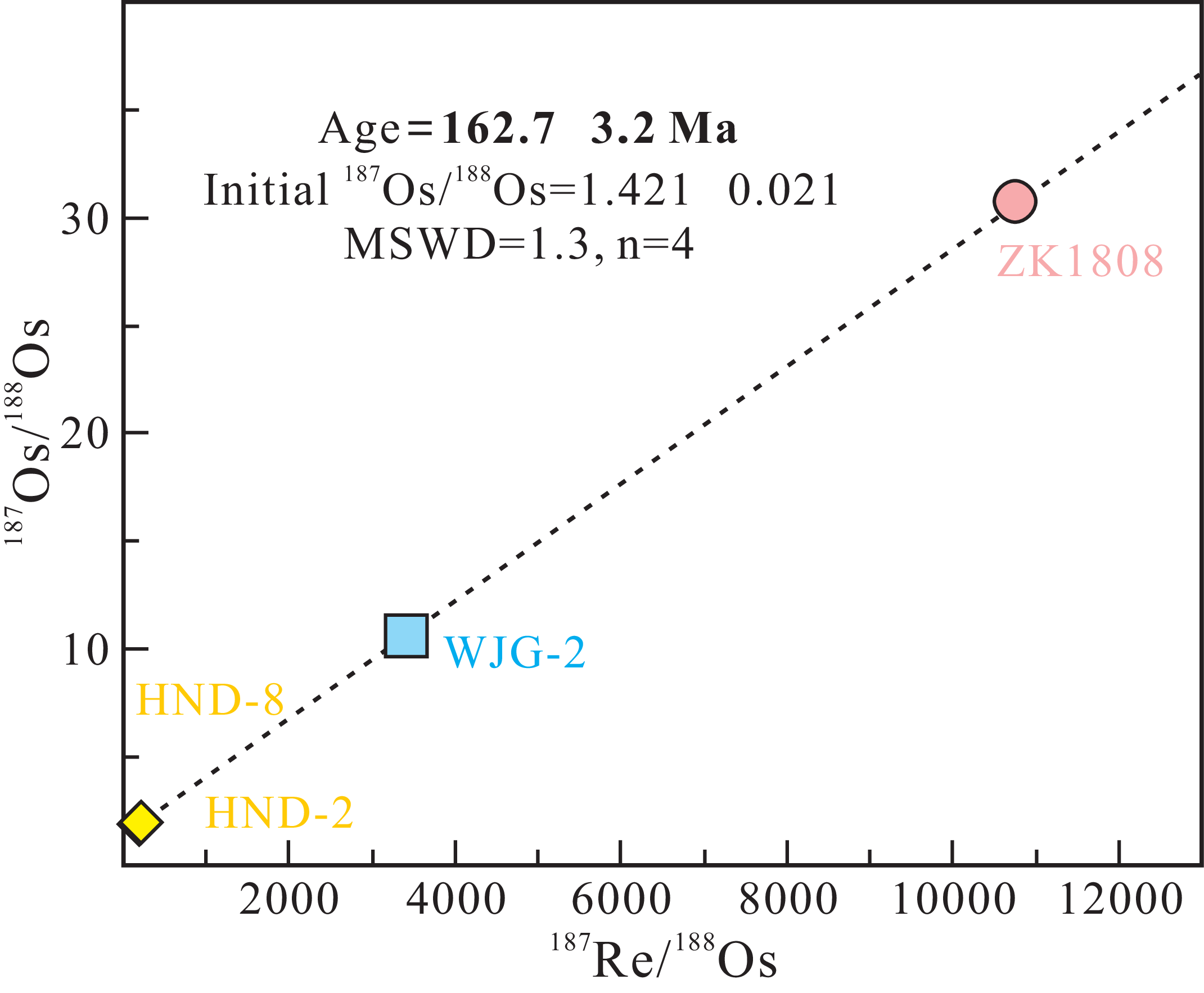
Three chalcopyrite separates in this paper, as well as sample ZK1808 in Zhou et al. (Reference Zhou, Li, Zhang, Li, Yuan, Feng, Li, Liao and Wang2017), were selected from the Heiniudong and Zhongzui deposits (Figure 5d and f). Four chalcopyrite samples show variable Re (0.3411–1.6931 ppb) and Os (0.00070–0.03731 ppb) concentrations. They yield 187Re/188Os ratios of 194–10700 and 187Os/188Os ratios of 1.958–30.70 (Supplementary Table S1). Together, data points yield an isochron date of 162.7 ± 3.2 Ma and an initial 187Os/188Os ratio of 1.421 ± 0.021 (2σ, n = 4, MSWD = 1.3, Figure 7).
Chalcopyrite Re-Os isochron age for the stratiform Cu deposits. MSWD = mean square of weighted deviates, a measure of scatter. Data of sample ZK1808 from Zhou et al. (Reference Zhou, Li, Zhang, Li, Yuan, Feng, Li, Liao and Wang2017).

4.b. Sulphide He-Ar isotopes
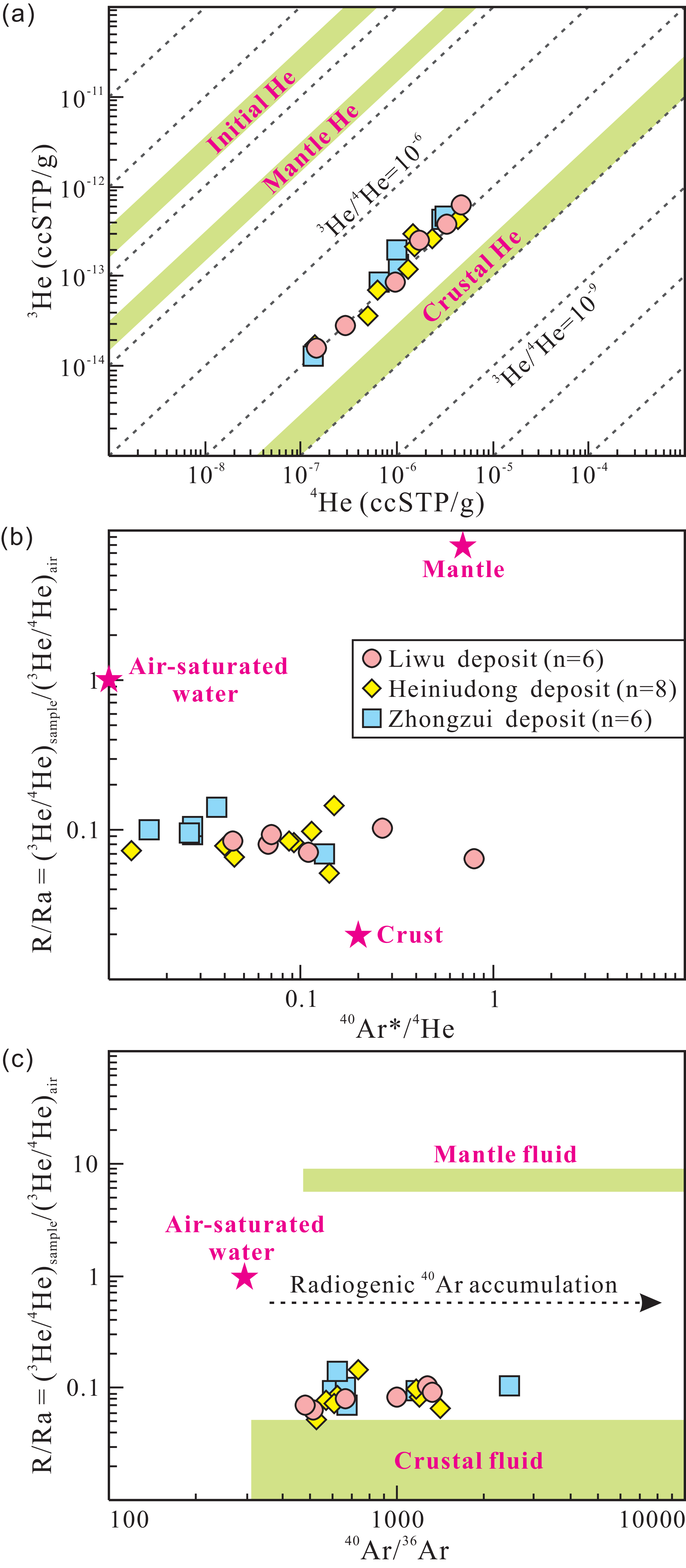
The He-Ar isotope results of fluid inclusions within chalcopyrite (n = 19) and pyrrhotite (n = 1) are listed in Supplementary Table S2. These samples have 4He contents of 1.34–47.18 × 10⁻⁷ ccSTP/g, 40Ar contents of 0.17–18.71 × 10⁻⁷ ccSTP/g and 40Ar* contents of 0.10–7.80 × 10⁻⁷ ccSTP/g, respectively. They show variable R/Ra ratios of 0.052–0.144 [R/Ra = (3He/4He)sample/(3He/4He)air, where (3He/4He)air is actual measurement data in this study], 40Ar/36Ar ratios of 479–2463 and 40Ar*/4He ratios of 0.013–0.804.
The calculated F4He values [F4He = (4He/36Ar)sample/(4He/36Ar)air, where (4He/36Ar)air = 0.1655, Kendrick et al. Reference Kendrick, Burgess, Pattrick and Turner2001] for our sulphide samples give ranges of 1600–474417. They have Hemantle values of 0.69–2.20 wt.% {Hemantle (%) = [(3He/4He)sample – (3He/4He)crust]/[(3He/4He)mantle – (3He/4He)crust] × 100, where (3He/4He)crust = 0.01 Ra and (3He/4He)mantle = 6.1 Ra, Stuart et al. Reference Stuart, Burnard, Taylor and Turner1995; Gautheron and Moreira, Reference Gautheron and Moreira2002}. On the 4He versus 3He, 40Ar*/4He versus R/Ra, and 40Ar/36He versus R/Ra diagrams, all the sulphide samples plot near the field of crustal He and fluid, with insignificant mantle signatures (Figure 8a, b and c). This indicates that the ore-forming fluids were dominantly derived from a crustal source.
He-Ar isotope composition of chalcopyrite from stratiform Cu deposits. (a) 4He versus 3He diagram, the 3He/4He ratios and fields of initial He, mantle He, and crustal He are from Mamyrin and Tolstikhin (Reference Mamyrin and Tolstikhin1984). (b) 40Ar*/4He versus R/Ra diagram, the data of crust (R/Ra = 0.02, 40Ar*/4He = 0.2) and mantle (R/Ra = 8, 40Ar*/4He = 0.69 ± 0.06) are from Ballentine et al. (Reference Ballentine, Burgess and Marty2002), and the data of air-saturated water after Stuart et al. (Reference Stuart, Burnard, Taylor and Turner1995). (c) 40Ar/36He versus R/Ra diagram, the fields of mantle and crustal fluids from Hu et al. (Reference Hu, Burnard, Bi, Zhou, Peng, Su and Zhao2009).
4.c. Chalcopyrite in situ S isotopes
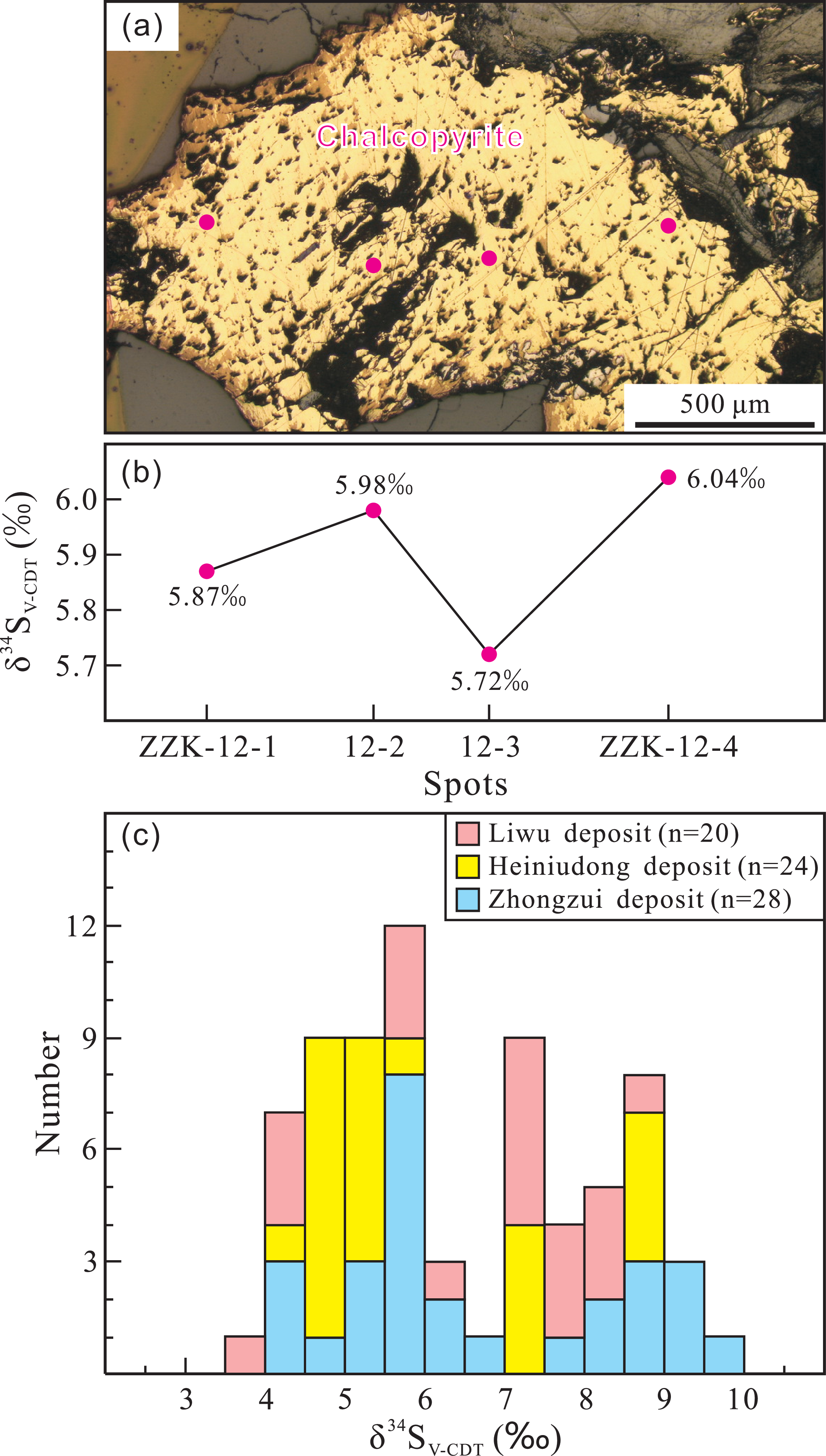
Chalcopyrite in situ S isotope data (n = 72) are provided in Supplementary Table S3. Several measurements conducted on individual chalcopyrite grains indicate that their internal sulphur isotopic compositions are homogeneous (Figure 9a and b). In general, our analysed spots display a δ34SV-CDT (Vienna-Canyon Diablo Troilite) range from 3.87‰ to 9.50‰ (Figure 9c). These data are compatible with δ34SV-CDT values of chalcopyrite and pyrrhotite separates in the Jianglang Dome (5.6–8.7‰, Yan et al. Reference Yan, Song, Fu and Tian1997). These positive δ34SV-CDT determinations are comparable to those of magnetite-series granitoids (δ34SV-CDT = 1–9‰), which were thought to originate from dominantly igneous protoliths (Sasaki and Ishihara, Reference Sasaki and Ishihara1979; Seal, Reference Seal2006). This matches the I-type affinity of the Wenjiaping and Wulaxi granite in the Jianglang Dome (Dai et al. Reference Dai, Zhu, Li, Zhang, Tang and Shen2017).
(a–b) Representative section of in situ sulphur isotope in individual chalcopyrite grains. (c) Sulphur isotope histogram of chalcopyrite from stratiform Cu deposits in the Jianglang Dome.
4.d. Chalcopyrite and granite Pb isotopes
Lead isotope compositions of chalcopyrite separates (n = 40) have 206Pb/204Pb ratios of 18.0252–19.6826, 207Pb/204Pb ratios of 15.6857–15.7943 and 208Pb/204Pb ratios of 38.2784–40.5011, respectively (Supplementary Table S4). Samples HK-8, HK-20, HK-27, ZZK-5 and ZZK-7 have relatively high lead isotope values, e.g. 206Pb/204Pb ratios of 18.6683–19.6826, 207Pb/204Pb ratios of 15.7579–15.7943 and 208Pb/204Pb ratios of 39.2542–40.5011. The others show homogeneous isotope composition and do not vary significantly with mineralization types. They exhibit 206Pb/204Pb ratios of 18.0252–18.5496, 207Pb/204Pb ratios of 15.6857–15.7817 and 208Pb/204Pb ratios of 38.2784–39.0836 (n = 35). These data broadly match those of ca. 164 Ma Wenjiaping (n = 2) and Wulaxi (n = 2) granites, with 206Pb/204Pb ratios of 18.6507–18.9474, 207Pb/204Pb ratios of 15.6794–15.7415 and 208Pb/204Pb ratios of 38.9631–39.2406. According to the 206Pb/204Pb versus 207Pb/204Pb (Zartman and Doe, Reference Zartman and Doe1981) and Δβ versus Δγ diagrams {Δβ = [(207Pb/204Pb)common/(207Pb/204Pb)mantle – 1] × 1000, Δγ = [(208Pb/204Pb)common/(208Pb/204Pb)mantle – 1] × 1000, where (207Pb/204Pb)mantle = 15.43, (208Pb/204Pb)mantle = 37.63, Zhu, Reference Zhu1998}, upper crust-derived lead components are preferred for the investigated chalcopyrite grains and associated granitic rocks (Figure 10a and b).
(a) Plot of 206Pb/204Pb versus 207Pb/204Pb for chalcopyrite separates and ca. 164 Ma granites (based on Zartman and Doe, Reference Zartman and Doe1981), the data of the Liwu Group rocks after Dai et al. (Reference Dai, Zhu, Liang and Zhou2025a). (b) Δβ versus Δγ diagram of lead isotopes (based on Zhu, Reference Zhu1998), Δβ = [(207Pb/204Pb)common/(207Pb/204Pb)mantle – 1] × 1000, Δγ = [(208Pb/204Pb)common/(208Pb/204Pb)mantle – 1] × 1000, where (207Pb/204Pb)mantle = 15.43, (208Pb/204Pb)mantle = 37.63.

5. Discussion
5.a. Epigenetic magmatic-hydrothermal mineralization
Chalcopyrite Re-Os chronometers are widely used to date mineralization events of sulphide deposits, and their high closure temperatures (> 500 °C, Zhu and Sun, Reference Zhu and Sun2013) could prevent isotopic disturbance in the absence of sulphide recrystallization (e.g. Muchez et al. Reference Muchez, André-Mayer, El Desouky and Reisberg2015). For example, Zhu and Sun (Reference Zhu and Sun2013) studied the Lala deposit in the Kangdian copper belt, southwestern China, and suggested that chalcopyrite Re-Os systematics were almost unaffected by metamorphic temperatures up to 500 °C. Previous studies indicated multiple deformation and metamorphism for the Late Neoproterozoic Liwu Group: (1) upper greenschist-facies likely attributed to the Triassic orogenic event, with temperatures of 300–360 °C based on fluid inclusion data and muscovite geothermometer; and (2) amphibolite-facies probably related to the Jurassic post-orogenic extension, with temperatures of 460–500 °C based on garnet-biotite and muscovite geothermometers (Yan et al. Reference Yan, Song, Fu and Tian1997, Reference Yan, Zhou, Song and Fu2003). These metamorphic temperatures are obviously lower than the closure temperatures of chalcopyrite Re-Os chronometers (> 500 °C, Zhu and Sun, Reference Zhu and Sun2013).
In this study, chalcopyrite Re-Os geochronology was used to constrain the Cu mineralization age in the Liwu Group. Four samples yield an isochron age of 162.7 ± 3.2 Ma (2σ, n = 4, MSWD = 1.3, Figure 7), and place a best estimate for epigenetic mineralization age. This is equivalent to the previous chalcopyrite Re-Os age of stratiform Cu deposits in the Jianglang Dome (161.8 ± 2.5 Ma, Dai et al. Reference Dai, Zhu, Liang, Li and Zhou2025b), molybdenite Re-Os age of the Wulaxi skarn-type tungsten deposit (163.7 ± 1.9 Ma, Li et al. Reference Li, Zhou, Zhang, Dai, Ma, Ma and Shen2016), as well as zircon U-Pb ages of the Wenjiaping and Wulaxi granitic plutons (164.5–164.3 Ma, Dai et al. Reference Dai, Zhu, Li, Zhang, Tang and Shen2017). Besides, Zhou et al. (Reference Zhou, Li, Zhang, Li, Yuan, Feng, Li, Liao and Wang2017) obtained a chalcopyrite Re-Os isochron age of 151.1 ± 4.8 Ma (2σ, n = 5, MSWD = 5.8) for the Liwu and Zhongzui deposits, and suggested a post-magmatic hydrothermal origin. However, our new isochron age is more robust with much lower MSWD (mean square of weighted deviates) values, most likely indicating a magmatic-hydrothermal affinity.
The initial 187Os/188Os ratio (1.421 ± 0.021, Figure 7) is comparable to that of the upper continental crust (1.4–1.9, Peucker-Ehrenbrink and Jahn, Reference Peucker-Ehrenbrink and Jahn2001), and thus suggests a crustal origin. Recent studies showed that fresh metabasic and metasedimentary rocks of the Liwu Group are metalliferous with an average Cu content of 93.3 ppm (Dai et al. Reference Dai, Zhu, Liang and Zhou2025a), much higher than the continental upper crust (Cu = 25 ppm, Taylor and McLennan, Reference Taylor and McLennan1985). Besides, chalcopyrite Re-Os dating yielded an isochron age of 549 ± 11 Ma (2σ, n = 5, MSWD = 15) for massive ores of the Liwu, Heiniudong and Zhongzui deposits, indicating syngenetic mineralization (Dai et al. Reference Dai, Zhu, Liang and Zhou2025a). All these data confirm two-staged formation of ca. 549 Ma syngenetic enrichment overprinted by ca. 163 Ma epigenetic magmatic-hydrothermal mineralization, for the stratiform Cu deposits hosted by the Late Neoproterozoic (ca. 544.5–538.8 Ma) Liwu Group.
Throughout the whole Songpan-Ganze Orogen, medium-pressure Barrovian-type metamorphism was initiated at ca. 210–205 Ma due to crustal thickening and shortening, and peak metamorphism with temperatures of 410–530 °C was recorded at ca. 204–190 Ma according to monazite U-Pb and garnet Sm-Nd ages (Huang et al. Reference Huang, Buick and Hou2003a, Reference Huang, Maas, Buick and Williams2003b). More recently, Dai et al. (Reference Dai, Zhu, Liang, Li and Zhou2025b) dated metamorphic monazites within two-mica quartz schist from the Zhongzui deposit of the Jianglang Dome, and obtained a weighted mean 206Pb/238U age of 193.0 ± 1.1 Ma (n = 25, MSWD = 2.0). This is attributed to ca. 204–190 Ma peak metamorphism in the Songpan-Ganze Orogen, which predates ca. 163 Ma epigenetic mineralization within the Liwu Group by a large time span. Besides, synorogenic metamorphic fluids typically produce widespread deposits (e.g. Perelló et al. Reference Perelló, Clifford, Creaser and Valencia2015; Qiu et al. Reference Qiu, Fan, Goldfarb, Tomkins, Yang, Li, Xie and Liu2021), yet large-scale Cu deposits remain hitherto unique in the Songpan-Ganze Orogen. Thus, this evidence indicates that epigenetic Cu mineralization in the Jianglang Dome was unlikely to be associated with synorogenic metamorphic fluids, which were commonly formed during prograde metamorphism. Further, the Triassic compressional orogenic event in the Songpan-Ganze Orogen likely formed the S1 foliation in the Liwu Group rocks (Yan et al. Reference Yan, Song, Fu and Tian1997, Reference Yan, Zhou, Song and Fu2003), which was locally overprinted and transposed by the S2 foliation (Figure 3a) due to the Jurassic post-orogenic extension in the Songpan-Ganze Orogen (Roger et al. Reference Roger, Jolivet and Malavieille2010).
5.b. Coupled source signatures of fluids and metals
As noted above, previous studies have conducted sulphur isotope on sulphides (Yan et al. Reference Yan, Song, Fu and Tian1997) and boron isotope on ore-associated tourmalines (Zhou et al. Reference Zhou, Li, Zhang, Li, Yuan, Feng, Li, Liao and Wang2017) and indicated a magmatic-hydrothermal affinity for stratiform Cu deposits in the Jianglang Dome. However, quantitative contributions of crustal (e.g. felsic basement rocks and ca. 164 Ma granites) or mantle-derived (e.g. mafic basement rocks) components of the ore-forming fluids remain unknown.
Sulphide minerals could effectively retain He, and their He-Ar isotopes are sensitive to tracing the ore-forming fluid sources (Hu et al. Reference Hu, Burnard, Bi, Zhou, Peng, Su and Zhao2009; Goodwin et al. Reference Goodwin, Burgess, Craw, Teagle and Ballentine2017). Previous studies have shown significant variation in R/Ra ratios for fluids derived from different geological reservoirs [R/Ra = (3He/4He)sample/(3He/4He)air, where (3He/4He)air = 1.39 × 10⁻⁶ (Stuart et al. Reference Stuart, Burnard, Taylor and Turner1995) and are actual measurement data in Supplementary Table S2], e.g. air-saturated water of 1, continental crust of 0.01–0.05 and subcontinental lithospheric mantle of 6.1 (Stuart et al. Reference Stuart, Burnard, Taylor and Turner1995; Gautheron and Moreira, Reference Gautheron and Moreira2002). In this paper, fluid inclusions within chalcopyrite and pyrrhotite show low R/Ra ratios of 0.052–0.144, indicating a dominantly crustal origin with negligible mantle-derived inputs. This is further illuminated by diverse discriminant diagrams (Figure 8a, b and c) and calculated Hemantle values of 0.69–2.20 wt.% (Supplementary Table S2). Interestingly, the Hemantle values match the proportion of sandwiched metabasic rocks in the Liwu Group (total <5 vol%), which are most likely responsible for minor mantle contribution during the epigenetic mineralization event. Besides, the measured 40Ar/36Ar ratios range from 479 to 2463, much higher than modern atmospheric values (40Ar/36Ar = 295.5, Steiger and Jäger, Reference Steiger and Jäger1977). This is attributed to significantly high concentration of 40Ar* (radiogenic 40Ar) of crustal sources, which could be estimated using the measured maximum 40Ar/36Ar values of sulphide samples as follows (Kendrick et al. Reference Kendrick, Burgess, Pattrick and Turner2001): 40Ar* (%) = {([40Ar/36Ar)max − 295.5] × 100}/(40Ar/36Ar)max. The calculated maximum 40Ar* concentration for the studied stratiform Cu deposits is 88%, indicating more than 88% of 40Ar/36Ar values were derived from crustal sources (e.g. Cao et al. Reference Cao, Qin, Li, Evans, He and Jin2015). Besides, their 40Ar*/4He ratios vary between 0.013 and 0.263 (except 0.804 of sample LK-39, Supplementary Table S2), resembling the crustal ratio of 0.2 and much lower than the mantle value of 0.69 ± 0.06 (Ballentine et al. Reference Ballentine, Burgess and Marty2002). This seems more likely to be associated with the involvement of air-saturated water, which could reduce 40Ar*/4He ratios and elevate R/Ra values of the crustal ore-forming fluids (Figure 8b and c). Further, atmospheric He contribution can be detected by the F4He value, which is defined as 4He/36Ar of a sample relative to the atmospheric 4He/36Ar value (0.1655, Kendrick et al. Reference Kendrick, Burgess, Pattrick and Turner2001). However, the calculated F4He values for our sulphide samples are all more than 1600, which indicates a minor contribution of atmospheric He (F4He = 1) that could be sucked into air-saturated water (Cao et al. Reference Cao, Qin, Li, Evans, He and Jin2015). Synthetically, He-Ar isotope data of fluid inclusions within chalcopyrite and pyrrhotite separates suggest that the ore-forming fluids were dominated by crustal origin, with minor air-saturated water and negligible (0.69–2.20 wt.%) mantle components.
The sulphur isotope ratio of sulphides was widely used to trace the sources of sulphur and ore-forming fluids (e.g. Seal, Reference Seal2006; Guo et al. Reference Guo, Han, Chen, Dang, Wang, Yang, Hu and Yuan2024). However, traditional sulphur isotope measurement obtains an average value of a whole-rock sample and masks possible isotopic heterogeneity between individual minerals. In this contribution, several in situ S isotope sections on individual chalcopyrite grains reveal uniform sulphur isotopic compositions (Figure 9a and b). All the analysed chalcopyrite grains yield δ34SV-CDT values between 3.87–9.50‰ (Figure 9c, Supplementary Table S3) and are consistent with previous results of chalcopyrite and pyrrhotite separates (δ34SV-CDT = 5.6–8.7‰, Yan et al. Reference Yan, Song, Fu and Tian1997). These data can be attributed to their genetic affinity with magnetite-series granitoids, which have positive δ34SV-CDT values of 1–9‰ and were derived from dominantly igneous protoliths (Sasaki and Ishihara, Reference Sasaki and Ishihara1979; Seal, Reference Seal2006). Based on petrological and geochemical studies, Dai et al. (Reference Dai, Zhu, Li, Zhang, Tang and Shen2017) proposed an I-type affinity for the Wenjiaping and Wulaxi granites in the Jianglang Dome, caused by partial melting of igneous source rocks. This likely induced all positive δ34SV-CDT values of chalcopyrite (3.87–9.50‰) from the stratiform Cu deposits in this region.
Lead isotopes are useful in evaluating the metal sources and the nature of lead reservoirs (Zartman and Doe, Reference Zartman and Doe1981; Zhu, Reference Zhu1998). The measured chalcopyrite separates within sulphide ores are characterized by variable Pb isotope compositions, with 206Pb/204Pb ratios of 18.0252–19.6826, 207Pb/204Pb ratios of 15.6857–15.7943 and 208Pb/204Pb ratios of 38.2784–40.5011 (n = 40, Supplementary Table S4). These data broadly match values of regional granites, with 206Pb/204Pb ratios of 18.6507–18.9474, 207Pb/204Pb ratios of 15.6794–15.7415 and 208Pb/204Pb ratios of 38.9631–39.2406 (n = 4). On the 206Pb/204Pb versus 207Pb/204Pb diagram, all the chalcopyrite and granite samples are close to the defined upper crust growth curve and the Pb isotope field of the Liwu Group rocks (Figure 10a). On the Δβ versus Δγ diagram, their data points are plotted in the upper crust-derived and magmatism domains (Figure 10b). All these Pb isotope features indicate that most of the lead came from the upper crust, showing a genetic affinity with ca. 164 Ma granites and the Late Neoproterozoic Liwu Group rocks.
Combined with geochronological, geochemical and isotopic data in this study and Dai et al. (Reference Dai, Zhu, Li, Zhang, Tang and Shen2017, Reference Dai, Zhu, Liang, Li and Zhou2025b), we propose that both ca. 164 Ma crust-derived granitic magmatism and the fertile Liwu Group rocks contributed significantly to the ore metal budget in the Jianglang Dome. During magma ascent processes, the crustal melts might be contaminated by the metalliferous Liwu Group, inducing similar Pb isotope signatures (Figure 10a) and sulphide-bearing granite in some locations (Figure 3b).
5.c. Mineralization potential and genetic model
All the robust geochronological and isotopic evidence presented above confirms an epigenetic magmatic-hydrothermal mineralization at ca. 163 Ma for the investigated stratiform Cu deposits in the Jianglang Dome. This is further supported by: (1) low residual gravity anomalies in the core of the Jianglang Dome (Figure 1e), implying a large deep-seated granitic batholith (e.g. Mangkhemthong et al. Reference Mangkhemthong, Morley, Kanthiya and Chaisri2020); (2) magmatic-hydrothermal affinities evidenced by chalcopyrite in situ sulphur isotope data (δ34SV-CDT = 3.87–9.50‰, Figure 9c), chalcopyrite and granite Pb isotope compositions (Figure 10), as well as boron isotope data of ore-associated tourmalines (δ11B = −15.47 ± 0.83‰ to −5.91 ± 0.67‰, Zhou et al. Reference Zhou, Li, Zhang, Li, Yuan, Feng, Li, Liao and Wang2017); and (3) ore-forming fluids related to magmatism, with temperatures of 142–375 °C and salinities of 5.26–21.19 wt.% NaCl equiv., according to recent fluid inclusion data (Yuan et al. Reference Yuan, Zhou, Song, Zhang, Zhang, Li, Yin, Wang and Tang2023). In contrast, the Triassic orogenic event (Roger et al. Reference Roger, Jolivet and Malavieille2010; Xu et al. Reference Xu, Fu, Wang, Li, Zheng, Zhao and Lian2020) and peak metamorphism at ca. 204–190 Ma (Huang et al. Reference Huang, Buick and Hou2003a, Reference Huang, Maas, Buick and Williams2003b) in the Songpan-Ganze Orogen, were not responsible for the ca. 163 Ma epigenetic magmatic-hydrothermal mineralization event in the Jianglang Dome. However, the Triassic synorogenic fluids might yield fine-grained garnets in the Liwu Group, which were elongated and deformed along the S2 foliation (Figure 6a) due to the Jurassic post-orogenic extension in the Songpan-Ganze Orogen (Roger et al. Reference Roger, Jolivet and Malavieille2010).
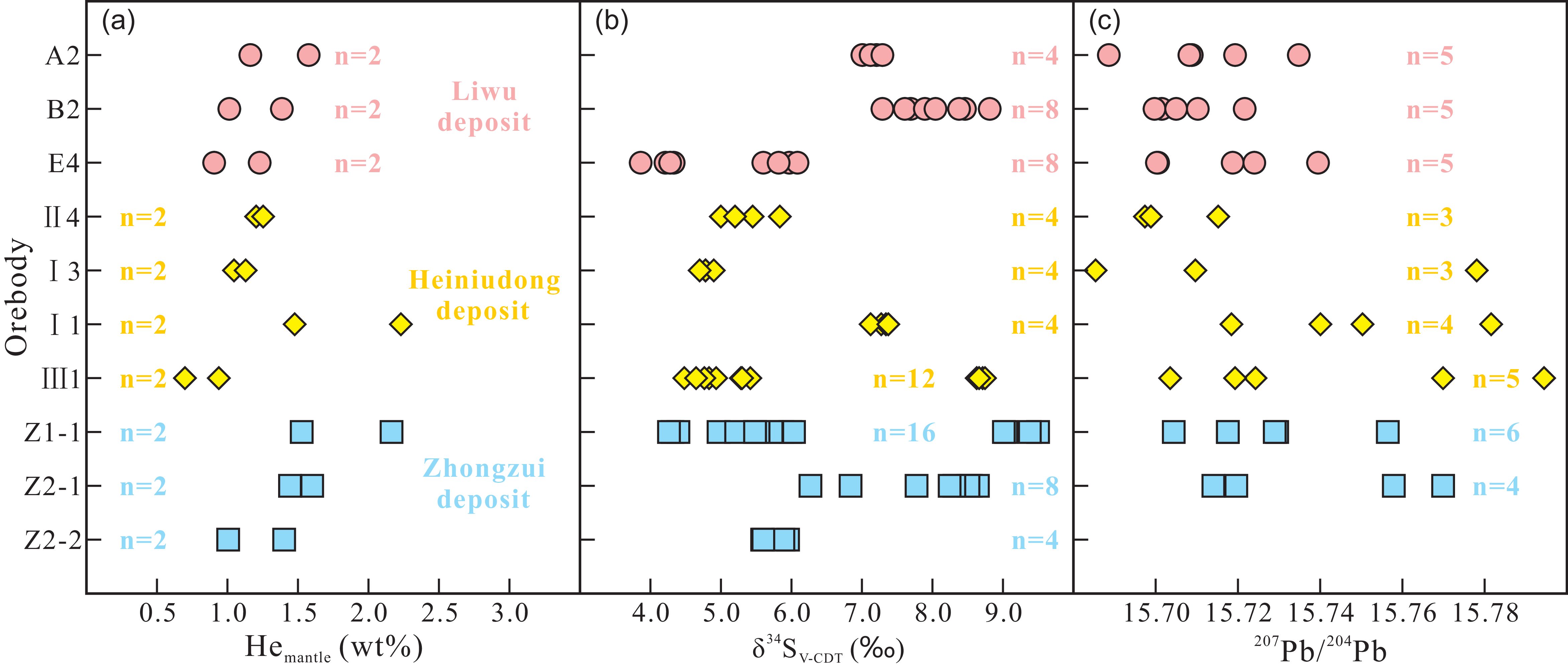
In the vertical direction, multiple en-echelon-shaped Cu orebodies are distributed in the Liwu, Heiniudong and Zhongzui stratiform deposits (Figures 5 and 6). Perfectly, these Cu orebodies show similar He-Ar-S-Pb isotope compositions (Figure 11), indicating their source homogeneity and a unified mineralization system. This is contrasting to classic SSC deposits, which commonly show heterogeneous S-Pb-Sr-Nd isotopic features (e.g. El Desouky et al. Reference El Desouky, Muchez, Boyce, Schneider, Cailteux, Dewaele and von Quadt2010; Panneerselvam et al. Reference Panneerselvam, Macfarlane and Salters2012; Van Wilderode et al. Reference Van Wilderode, Debruyne, Torremans, Elburg, Vanhaecke and Muchez2015). Indeed, almost all sulphide mineralization within the Liwu Group occurs along the S2 foliation (Figure 4c, d and f). However, the orebodies are delineated by a cut-off Cu grade of 0.4% in the Jianglang Dome, leading to minor lenticular geometries and apparent oblique cross-cutting in some locations (Figure 5). According to field geological mapping, hydrothermal alteration halos are stably and annularly distributed in the Jianglang Dome, and all the discovered stratiform Cu deposits occur near their surface extension (Figure 1c and d). This is suggestive of significant mineral exploration potential in blank areas of this dome. Emphatically, homologous domes in the eastern Songpan-Ganze Orogen, where fertile basement rocks (such as the Late Neoproterozoic Liwu Group) and magmatic-hydrothermal systems are present, likely have Cu mineralization potential, e.g. the adjacent Taka Dome to the north of the Jianglang Dome (Figure. 1c and d).
Comparison of Hemantle (a), δ34SV-CDT (b) and 207Pb/204Pb (c) values for different orebodies of stratiform Cu deposits in the Jianglang Dome.

Taken together, all the data, our preferred genetic scenario for the investigated stratiform Cu-sulphide deposits is established as follows. In the Neoproterozoic of ca. 545 Ma, a volcano-sedimentary sequence (the Liwu Group protoliths) with primary metal enrichment was deposited in a back-arc basin, and thus provided a primitive metal reservoir (Dai et al. Reference Dai, Zhu, Liang and Zhou2025a). During the post-orogenic extensional setting at ca. 200–150 Ma in the Songpan-Ganze Orogen (Roger et al. Reference Roger, Malavieille, Leloup, Calassou and Xu2004, Reference Roger, Jolivet and Malavieille2010), the decompression melting of ancient continental crust formed crustal melts and a large deep-seated granitic batholith with low residual gravity anomalies (Fig. 1e). At ca. 164 Ma, the magma intruded across the fertile Liwu Group, absorbed metallic elements and formed sulphide-bearing granite in some locations (Figure 3b). Due to the low proportion of sandwiched metabasic rocks in the Liwu Group (total <5 vol%), the crust-derived magmatic-hydrothermal fluids contained only 0.69–2.20 wt.% mantle components. These cupriferous crustal fluids mixed with minor air-saturated water, leached fertile host rocks and extracted metals (Virtanen et al. Reference Virtanen, Heinonen, Molnár, Schmidt, Marxer, Skyttä, Kueter and Moslova2021). They then transported across the black carbonaceous schists (Figure. 3e and f), which acted as a reduction front for cupriferous hydrothermal fluids (Hitzman et al. Reference Hitzman, Selley and Bull2010; Borg et al. Reference Borg, Piestrzynski, Bachmann, Püttmann, Walther and Fiedler2012; Brown, Reference Brown2014), and finally triggered stable copper sulphide precipitation (Figure 12).
Conceptual model (not to scale) showing an epigenetic and crustal origin of stratiform Cu deposits in the Jianglang Dome.

6. Conclusions
In this study, an integration of sulphide Re-Os and He-Ar-S-Pb isotope data offers important insights into mineralization age and origin of stratiform Cu deposits in the Jianglang Dome. The conclusions can be summarized as:
-
(1) Chalcopyrite Re-Os isotopic dating defines an isochron age of 162.7 Ma. This is coeval with ca. 164 Ma granites in this region and shows no overlaps with ca. 204–190 Ma peak metamorphism in the Songpan-Ganze Orogen. Combined with geophysical, S-Pb-B isotope and fluid inclusion studies, our age data confirm an epigenetic magmatic-hydrothermal mineralization, involving no synorogenic metamorphic fluids.
-
(2) Sulphide He-Ar isotope systematics support a dominantly crustal origin with minor air-saturated water for the ore-forming fluids. The calculated Hemantle values of 0.69–2.20 wt.% match the low proportion of sandwiched metabasic rocks in the fertile Liwu Group (total <5 vol%). Chalcopyrite in situ S isotope data, together with chalcopyrite Pb isotope results, suggest a genetic link with the ca. 164 Ma granites.
-
(3) According to He-Ar-S-Pb isotope compositions, all the copper orebodies within the Liwu Group show source homogeneity and a unified mineralization system. This indicates mineral exploration potentials in blank areas of the Jianglang Dome, as well as analogous domes with fertile basement rocks and magmatic-hydrothermal systems in the eastern Songpan-Ganze Orogen.
Supplementary material
The supplementary material for this article can be found at https://doi.org/10.1017/S0016756826100648
Acknowledgements
We thank Fei Su, Qiuyun Yuan, Hongfang Chen and Chao Li for analytical assistances. Special thanks are due to Gaolin Tang and Xianze Zhang for their help during the fieldwork. This research was financially supported by the National Natural Science Foundation of China (42572078, 41902068) and China Geological Survey Project (DD20230338, DD20242494). We are grateful to two anonymous reviewers for their constructive comments and important corrections, as well as efficient editorial handling by Dr. Tim Johnson.
Competing interests
The authors declared that they have no conflicts of interest in this work. We declare that we do not have any commercial or associative interest that represents a conflict of interest in connection with the work submitted.








 Open access

