





Introduction
Polychlorinated biphenyls (PCBs) are environmental contaminants found ubiquitously across the world. Reference Donaldson, Van Oostdam and Tikhonov1 PCBs are found at higher levels in Arctic Canadian regions due in part to long-range atmospheric transport. Reference Barrie, Gregor and Hargrave2 Due to biomagnification and bioaccumulation, humans are exposed to PCBs via the food chain, particularly via consumption of fish and higher order animals. Reference Dewailly, Ayotte, Bruneau, Laliberté, Muir and Norstrom3 PCBs are classed as persistent organic pollutants (POPs), with long half-lives, and it is thought that all organisms and humans contain detectible levels of PCBs in blood. 4 In humans, the half-life of PCBs is reported to range between 7 and 30 years in serum. Reference Wolff, Fischbein and Selikoff5 Developmental exposure to PCBs has been especially concerning in eastern Arctic regions such as Nunavik, Montagnais of Quebec, and Baffin Island, Reference Muckle, Dewailly and Ayotte6 that are home to many Indigenous Inuit populations. Even with declining levels of environmental PCB contamination in the Arctic, Reference Dallaire, Dewailly, Muckle and Ayotte7 developmental PCB exposure has been associated with shorter duration of gestation and reduced fetal growth in these regions. Reference Dallaire, Dewailly and Ayotte8 Reports have suggested that Inuit newborns have PCB levels at thresholds which are likely to result in cognitive problems. Reference Muckle, Dewailly and Ayotte6
PCBs can pass to the developing fetus through the placental barrier. Reference Funatsu, Yamashita and Ito9 Indeed, PCBs have been reported in umbilical cord blood Reference Butler Walker, Seddon and McMullen10 and in breast milk. Reference Muckle, Ayotte, Dewailly, Jacobson and Jacobson11 In humans, lactational transfer of PCBs is higher comparative to placental transfer. Reference Kodama and Ota12 Through the course of breast-feeding, lactational exposure to PCB residue peaks in matured milk rather than colostrum Reference Polishuk, Ron, Wassermann, Cucos, Wassermann and Lemesch13,Reference Wassermann, Wassermann, Cucos and Miller14 . Longitudinal epidemiological evidence suggests that PCB exposure can have adverse effects on multiple systems including the central nervous system (CNS) Reference Klocke and Lein15 and endocrine system. Reference McKinney and Waller16
Developmental PCB exposure appears to have selective effects on specific domains of neuropsychological functioning in children. Infants in Arctic Canada exposed to high PCB levels in both prenatal and postnatal periods showed deficits on measures of visual recognition memory Reference Boucher, Muckle and Jacobson17 and subtle deficits in attention. Reference Verner, Plusquellec and Desjardins18 Disturbances in information processing in children of preschool and kindergarten-age have also been reported. Reference Boucher, Bastien and Saint-Amour19 In relation to emotional and mental health, prenatal PCB levels were reported to correlate with ratings of unhappiness, anxiety, and less positive affect in children 5-years of age. Reference Plusquellec, Muckle and Dewailly20 Findings in 11-year-old children were also notable. Here, higher PCB levels were associated with poorer performance on measures of fine motor speed and manual dexterity with arm and hand movements. Reference Boucher, Muckle, Ayotte, Dewailly, Jacobson and Jacobson21 Furthermore, prenatal PCB levels were reported to worsen performance on measures of attention and impulsivity in children assessed at 11 years of age Reference Ethier, Muckle, Jacobson, Ayotte, Jacobson and Saint-Amour22,Reference Boucher, Burden and Muckle23 . Slower reaction time and reduced error monitoring (which affect one’s ability to move through tasks efficiently) was also associated with PCB exposure in children that were assessed at 11 years of age. Reference Boucher, Burden and Muckle23 Lastly, altered performance on measures of visual processing was associated with PCB levels in preschool aged children Reference Saint-Amour, Roy and Bastien24 but this effect was not found in 11-year-old children. Reference Ethier, Muckle and Bastien25 Prenatal and postnatal exposure to PCB-153 has been associated with smaller left entorhinal cortex volume at ages 16–22, alongside deficits in spatial navigation memory performance. Reference Bastien, Muckle and Ayotte26 Assessing emotion dysregulation and related neural correlates, early-life exposure to PCB-153 in cord blood was associated with differential activation of the right orbitofrontal cortex during the conditioning phase of a fear conditioning task in 18-year-old Inuit participants from the Nunavik cohort. Reference Lamoureux-Tremblay, Chauret and Muckle27 The aforementioned findings derived from participants in a birth cohort study are in early adulthood (age range 20–30). Thus, results associated with older aged cohorts are unavailable from this study group which necessitates animal studies to estimate effects of developmental PCB exposure in mid-advanced aging.
Accordingly, in utero and lactational exposure to OH-PCB 106 has been reported to produce differential effects on spontaneous locomotor activity and motor coordination in young adult male mice. Reference Haijima, Lesmana, Shimokawa, Amano, Takatsuru and Koibuchi28 Exposure to a PCB mixture was observed to act as an endocrine disruptor, altering social preferences compared to controls in offspring aged to postnatal day 330. Reference Karkaba, Soualeh, Soulimani and Bouayed29 In offspring aged to postnatal 425, lactational exposure to non-dioxin-like PCBs was associated with deficits in long-term memory, increased late neuronal vulnerability to amyloid stress, with no observed effect on short-term memory. Reference Elnar, Allouche, Desor, Yen, Soulimani and Oster30 Sprague Dawley rat offspring prenatally exposed to Aroclor 1221 showed sex-dependent alterations in social behavior and social novelty behavior were reported, with adult females exhibiting significantly higher corticosterone concentrations compared to males. Reference Reilly, Weeks, Topper, Thompson, Crews and Gore31 Chemical mixtures with other contaminants including PCBs were associated with transcriptional changes in female offspring aged to postnatal day 350 (though no measures in this study were influenced by perinatal Aroclor 1254 exposure alone). Reference Gill, Bowers, Nakai, Yagminas, Mueller and Pulido32 No structural or histopathological alterations were observed in that study. Reference Gill, Bowers, Nakai, Yagminas, Mueller and Pulido32 Decreased brain weight has been observed comparative to controls at postnatal day 35, in Sprague Dawley rats following developmental and lactational exposure to Aroclor 1254, but this effect was not observed at postnatal day 77. Reference Chu, Bowers and Caldwell33 In the same study, systemic effects in rats following developmental and lactational exposure to Aroclor 1254 was shown to increase liver weight and decrease weight of ovary, uterus, thymus, and kidney at postnatal day 35 also accompanied by histopathological changes. Reference Chu, Bowers and Caldwell33 Only left kidney weight continued to be significantly suppressed at postnatal day 77. Reference Chu, Bowers and Caldwell33 Serum (thyroxine, triiodothyronine, thyroid stimulating hormone) and various liver biochemical indices was altered at earlier timepoints in that study, however normalized comparative to controls by postnatal day 350. Reference Chu, Bowers and Caldwell33 Similar biochemical effects have been reported elsewhere associated with developmental PCB exposure more proximal to timing of exposure Reference Pelletier, Masson and Wade34,Reference Bowers, Nakai and Chu35 . Together, these findings suggest that developmental PCB exposure may have selectively lasting and domain-specific effects.
Prenatal and early postnatal PCB exposure may perturb CNS development via multiple molecular mechanisms that are not fully understood. The main mechanism of developmental toxicity from PCBs is thought to result via disruption of maternal hypothalamic-pituitary-thyroid (HPT) axis homeostasis, that also affects fetal thyroid hormone production. Reference Bowers, Nakai and Chu35 Amongst various effects attributed to PCBs 4,Reference Klocke and Lein15 , studies have shown that PCBs can disrupt neurotransmission mediated by dopamine Reference Lesmana, Shimokawa, Takatsuru, Iwasaki and Koibuchi36 and GABA, Reference Bandara, Eubig, Sadowski and Schantz37 increase oxidative stress, Reference Yang and Lein38 and disrupt components of the neurovascular unit such as tight junctions Reference Eum, András, Couraud, Hennig and Toborek39,Reference Eum, Jaraki, András and Toborek40 . These findings informed rationale and method for the present study and selection of markers of interest. Accordingly, the battery of markers of interest of brain structure and function selected in the present study fall into a broad range of targets linked with exposure effects associated with PCBs in the literature in the following categories: neurotransmission and neuronal (dopamine and norepinephrine (tyrosine hydroxylase), GABA (glutamic acid decarboxylase-67 [GAD67]), cresyl violet, and Hoechst), oxidative stress/apoptotic/necrotic injury (lipofuscin, microglial cd11b, cleaved caspase-3), and neurovascular unit (rat endothelial cell antigen [RECA-1]). Markers of interest are further described in Table 1.
List of markers, outcome interpretations, and neural regions-of-interest. Immunohistochemical marker (column A), category (column B), outcome interpretation (column C), and citations associated with marker/region-of-interest/PCB exposure (column D). Regions-of-interest were identified based on literature, ranging from epidemiological findings, findings linked with PCB exposure in human and animal studies, and findings with the region-of-interest. Where studies cited do not correspond with the marker of interest/region-of-interest, authors sought to identify novel regions of exposure and effect

PCBs interact with a multitude of different receptors that lend understanding to differing modes of action between dioxin-like and non-dioxin-like chemical structures. Dioxin-like PCBs are ligands of the aryl hydrocarbon receptor (AhR) with polymorphisms that influence the extent of toxicity. Reference Klinefelter, Hooven and Bates41 Cyp1a2 (-/-) knock-out models have demonstrated that teratogenic dioxin-induced effects are mediated by CYP1A2 induction. Reference Dragin, Dalton, Miller, Shertzer and Nebert42 Dioxin-like PCBs may also act via AhR-independent pathways. Non-dioxin-like PCBs have been suggested to disrupt neurodevelopment via ryanodine receptors and subsequent alterations to intracellular calcium (Ca2+dependent) homeostasis. Reference Elnar, Diesel and Desor43 Toxic mechanisms may also include disruptions in transcription of multiple genes however, the full extent of effects from this is not known. Reference Padhi, Pelletier and Williams44 The degree of chlorination of individual PCB congeners is thought to influence the extent of PCB accumulation throughout the body, including the CNS. Reference Stewart, Pagano, Sargent, Darvill, Lonky and Reihman45
Non-dioxin-like congeners have also been linked with developmental neurotoxicity. Reference Klocke and Lein15 When non-dioxin-like PCBs are metabolized, glucuronidation is thought to be one mechanism by which PCBs (like other xenobiotic substances) are made more water soluble for urinary elimination. All PCBs are lipid soluble and accumulate in tissue, including the CNS. Though studies are limited, in utero and lactational exposure studies have shown that PCBs may accumulate in a generalized manner in the CNS, Reference Ness, Schantz and Hansen46 however more research is needed to clarify if certain neuronal regions preferentially accumulate PCBs or are affected by PCB exposure. Furthermore, evidence suggests developmental exposure to PCBs promotes divergent responses upon multiple neurobehavioral endpoints which may be attributed to dose of exposure, and that may not follow a dose–response relationship. Reference Bowers, Nakai, Yagminas, Chu and Moir47 Therefore, in the present study, it was of interest to examine multiple neural regions across the CNS that were selected due to known function and potential relevance to the broad clinical and subclinical impairments associated with developmental PCB and PCB exposure reported in the epidemiological literature Reference Boucher, Muckle, Ayotte, Dewailly, Jacobson and Jacobson21,Reference Boucher, Burden and Muckle23,Reference Sioen, Den Hond and Nelen48 and animal studies (see Table 1, column D).
The overarching Developmental Origins of Health and Disease (DOHaD) concept hypothesizes that early-life exposure to perturbations, such as exposure to PCBs in the maternal environment, may influence risk of health and disease outcomes of offspring later in life. Reference Mandy and Nyirenda49 There remain many unanswered questions about toxic effects of PCB exposure during embryonic and fetal development, especially at relatively low doses, and outcomes in adult offspring. Therefore, the objective was to examine a broad subset of markers in the CNS that may provide a clearer picture of long-term alterations in brain structure and function that may occur from developmental exposure to PCBs. Doses selected in this study were derived from prior work described previously based on maternal blood profiles of pregnant females in the Canadian Arctic Reference Butler Walker, Seddon and McMullen10,Reference Chu, Bowers and Caldwell33,Reference Muckle, Dewailly and Ayotte50 and previous studies Reference Chu, Bowers and Caldwell33,Reference Pelletier, Masson and Wade34,Reference Padhi, Pelletier and Williams44,Reference Bowers, Nakai, Yagminas, Chu and Moir47 . Therefore, in the current study, it was hypothesized that developmental exposure to PCBs, at dosages relevant to human populations where PCBs are a significant environmental contaminant, produces long-lasting changes in markers of structure and function in the CNS in comparison to controls.
Method
Ethics project statement
Procedures involving live animals were carried out at Health Canada (Environmental Health Sciences and Research Bureau, Ottawa, Ontario, Canada) under the supervision of Principal Investigator Dr Wayne Bowers. Health Canada’s Institutional Animal Care Committee granted ethics clearance, consistent with ethical requirements of the Canadian Council on Animal Care. Health Canada and the Northern Contaminants Program (that provided funding for this research to Dr Bowers) granted permission to N.R. to complete this study at Queen’s University. Procedures after brain extractions (immunohistochemical and immunofluorescence procedures, microscopy, and image analysis) were conducted by N.R.
Toxicant preparation
PCB congeners were of analytical grade (≥ 99%), listed in Table 2. PCB 28 and 183 were purchased from AccuStandard (New Haven, Connecticut). All other PCBs were purchased from Cerilliant (Round Rock, Texas). The upper dose of the PCB mixture contained 1.0992 mg PCB, per 1 ml corn oil solution (Mazola brand, Bestfoods, Canada). The lower dose PCB solution consisted of the high dose PCB solution, diluted to appropriate concentration with corn oil. Preparation of PCB stock solution is described previously Reference Chu, Bowers and Caldwell33,Reference Pelletier, Masson and Wade34 . The concentrations of PCBs in the dosing solution was verified by an independent laboratory prior to administration to dams (Wellington laboratories, Guelph, Ontario).
PCB congeners included in mixture. a toxic equivalency factor (TEF) 0.00003 Reference Van den Berg, Birnbaum and Denison143

Experimental animals
The experimental animals that were the focus of the present study were Sprague Dawley adult rat offspring aged to postnatal day 450. Animals were housed in plastic polycarbonate cages measuring 35 cm (L) × 30 (W) × 16.6 (H) with shaved wood bedding. Each cage was equipped with a water bottle fitted with a stainless-steel sipper tube and ball-bearing tip.
Maternal toxicant administration and study design
Unmated female rats were trained to accept sweet cookies which were readily consumed, prior to mating. Each female rat received cookies with clean corn oil for 5 days prior to breeding to ensure they were acclimatized prior to the toxicant-exposure period. Corn oil was chosen as a vehicle as per previous studies Reference Chu, Bowers and Caldwell33,Reference Pelletier, Masson and Wade34,Reference Padhi, Pelletier and Williams44,Reference Bowers, Nakai, Yagminas, Chu and Moir47 .
Dams were exposed to vehicle (corn oil) or PCB mixture from GD 1 until PND 21 for a total 42 day (21 days in utero + 21 days lactation). Pregnant rats were fed small cookies (Teddy Grahams, Kraft Canada, Canada) containing a measured volume of the PCB solution in corn oil based on body weight (bw) each day (0.011 mg/kg/day “low” or 1.10 mg/kg/day “high”). There was no further exposure to PCB mixture or vehicle after postnatal day 21. Offspring were then aged to postnatal day 450. To simplify the reference to doses, herein “low” refers to the 0.011 mg/kg/day maternal dose of the PCB mixture and “high” the 1.10 mg/kg/day maternal dose.
In summary, the study design (3 × 2) compared three groups of adult rat offspring (control, Low PCB, High PCB) that were exposed to PCBs indirectly (in utero and lactational exposure) and included males and females.
Maternal bw was monitored daily, and the daily dose of PCB was adjusted according to bw. All animals had access to regular chow (Purina Mills Lab Diet 5001) and water ad libitum. Cages were monitored daily to verify consumption of cookies by dams, which were readily consumed within 5 minutes.
Pups were weighed daily beginning at PND 5 until PND 30. After this period, the animals were weighed 3 times per week.
Breeding and randomization of offspring
Breeding conditions and randomization have been described previously. Reference Rustom and Reynolds51 Briefly, in total, 30 dams (n = 10/group) were exposed to either “low” or “high” PCB doses, or vehicle (Fig 1). From these groups of dams, one or two littermates per litter were randomized into the present study, allowing for each animal to be treated as an individual case. Reference Rustom and Reynolds51 The offspring not included were used in separate studies for different objectives, as animals were part of a broader toxicological study.
Randomization of animals in experiment control and PCB. In the present study 30 pregnant rats were exposed to corn oil (vehicle) or low PCB (0.011 mg/kg/body weight) or high PCB (1.10 mg/kg/body weight) from gestational day 1 to postnatal day 21. In this study, the pregnant rats produced litters that were culled to 8/group, yielding a total 240 offspring. From the offspring produced, a subset of animals were randomized into the present study, 1 – 2 littermates maximum per group, which allowed each animal to be treated as an individual case. Offspring were not exposed to PCBs after postnatal day 21 and were euthanized at postnatal day 450.

The rationale relating to sample size was two-fold. The number of offspring included were based on (1) logistical feasibility associated with the method (immunohistochemistry, number of neural regions assessed and number of outcome measures (markers) of choice); and (2) based on a previous study Reference Bowers, Nakai, Yagminas, Chu and Moir47 that examined neurobehavioral endpoints linked with developmental PCB exposure but used a smaller sample size and different postnatal assessment time point. The present study aimed to increase the sample sizes per group, including males and females, to examine possible effects of developmental PCB exposure on markers of brain structure and function as endpoints in adult rat offspring. Therefore, there was no specific single outcome measure that was used to determine sample size.
Euthanasia and brain sectioning
Adult rat offspring were euthanized via transcardial perfusion at postnatal day 450. At the time of euthanasia, adult female offspring were of an age consistent with reproductive senescence, with a high likelihood of being in persistent or prolonged diestrus Reference Ishii, Yamauchi, Matsumoto, Watanabe, Taya and Chatani52,Reference Shirai, Houle and Mirsky53 . An a priori decision was made where animals were excluded only if they died prior to the planned euthanasia date at PND 450 and there was no additional inclusion or exclusion criteria. Brains were extracted, fixed, frozen, and sectioned at 40 µm.
Immunohistochemistry & immunofluorescence
Staining procedures were described previously. Reference Rustom and Reynolds51 Multiple staining protocols were implemented using the conventional horseradish peroxidase (HRP)-linked streptavidin method in conjunction with 3,3’-diaminobenzidine (DAB) as the chromogen. Table 3 provides a comprehensive overview of the specific markers, antibody names (proportions and concentrations), and brain regions examined. Control procedures (both positive and negative) were conducted for all immunohistochemistry and immunofluorescence steps, adhering to established best practices (Hewitt et al., 2014). Chromogenic DAB-based protocols were favored over fluorescence-based methods due to the necessity for repeated examination of the same tissue sections, thereby minimizing the risk of signal degradation from photobleaching.
Immunohistochemical and immunofluorescence markers of interest and corresponding neuronal regions of interest Reference Rustom and Reynolds51

Note: IHC – Immunohistochemistry DAB method; IF – immunofluorescence. a Note: Antigen retrieval conducted prior to application of primary antibody. b 48 hour incubation. c 12 hour incubation. streptavidin-conjugated horse radish peroxidase (Jackson Immunoresearch, 116-030-084) was used to visualize RECA-1/TH/Cd11b [1:500], [1:2]; and CC3 [1:1000], [1:1]). Concentrations appearing after an antibody concentration represent the antibody aliquot concentration, where [1:1] = no dilution, or 100% stock concentration and [1:2] = 1 part stock + 1 part diluent, so 50% of the stock concentration.
Antibody diluents were prepared as follows: the primary antibody solution contained 10 mM PBS (100 ml), Triton-X-100 (300 µl), and sodium azide (0.02 g); the secondary solution omitted sodium azide but retained the same PBS and Triton-X-100 concentrations. Streptavidin-HRP was diluted using the secondary solution. Prior to any washes, slide-mounted sections were air-dried for 15 minutes at room temperature (RT) to enhance tissue adhesion. Incubation times labeled as “overnight” corresponded to approximately 12 hours; during this step, slides were left at RT for 15 minutes before being refrigerated. Antibody application volumes were standardized at 200 µl per section per incubation. Secondary and tertiary incubations were each carried out for two hours at RT.
For the DAB reaction, TRIS-HCl buffer was freshly prepared (50 ml total: 0.379 g TRIS (Sigma–Aldrich), 50 ml distilled water, and one aliquot of DAB), with 4.8 µl of hydrogen peroxide added immediately prior to immersing tissue sections. Humidity-controlled chambers were employed to prevent drying during chromogenic staining, while opaque chambers were used during immunofluorescent labeling to minimize light exposure. Washing steps consisted of three rinses in 10 mM PBS, each lasting five minutes. The dehydration process included sequential immersion in 70, 95%, and 100% ethanol, followed by a final clearing step in Clearene (Leica, 3 minutes). All stained sections were coverslipped with DPX mounting medium.
A standard cresyl violet staining protocol was used for 40 µm thick fixed-frozen tissue sections. Slides were immersed in 1% cresyl violet (2 g dye in 200 ml distilled water) for three minutes, followed by three washes in 10 mM PBS. Sections were then washed twice in distilled water (2 minutes each), differentiated in a solution of glacial acetic acid (4 ml in 500 ml distilled water) for three minutes, rewashed, dehydrated, cleared, and coverslipped.
Hoechst staining was performed beginning with PBS washes. Antigen retrieval involved applying tri-sodium citrate buffer (200 µl per slide) followed by microwaving for 50 s. After cooling to RT, Hoechst stain was applied either by pipetting or immersion, depending on batch size, and incubated on a low-speed shaker. Sections were then washed (3 times for 2 minutes in PBS), cleared in Clearene for 3 minutes, and coverslipped.
For visualizing lipofuscin autofluorescence, sections underwent standard PBS washes, ethanol dehydration, Clearene clearing, and coverslipping.
RECA-1 immunohistochemistry included an additional antigen retrieval step where slides were incubated in preheated 10 mM PBS. This buffer was microwaved in a separate container until it reached near boiling (∼1.5 minutes on medium–high) before being used in Coplan jars. After this step, hydrophobic barriers were drawn around tissue sections using a marker, post-heating, to prevent disintegration.
A full list of the immunohistochemical or immunofluorescent markers, brain regions analyzed, immunohistochemical markers and antibodies can be found in Table 3.
Microscopy, anatomical localization, and image analysis procedures
Imaging was conducted using a Zeiss AxioImager.M2 microscope equipped with a motorized stage, along with Orca R2 fluorescent imaging (X-Cite Series 120Q light source) and Q-Imaging color cameras. During immunofluorescence procedures, exposure times were generally maintained under 100 milliseconds to minimize autofluorescence. For each stain, multiple fields per neuronal region-of-interest were examined. To ensure consistent identification of regions of interest across all samples, anatomical localization was guided by the Paxinos and Watson Rat Brain Atlas (4th edition). Reference Paxinos and Watson54 Key landmarks used to verify consistent rostrocaudal positioning included the presence and morphology of key structures for each region-of-interest (e.g., for striatum, the lateral ventricles, the anterior commissure, and the shape and relative position of the caudate-putamen). Sectioning was performed at comparable anterior–posterior levels, and images were consistently taken from matched bregma coordinates to minimize variability across subjects for each stain. Image analysis and processing were carried out using ImageJ (Java 1.6.0_20, 64-bit), a widely accepted and validated open-source software platform developed by the National Institutes of Health Reference Abràmoff, Magalhães and Ram55,Reference Schneider, Rasband and Eliceiri56 . Table 4 details the ImageJ function protocol per immunohistochemical or immunofluorescent stain where results were recorded in Microsoft Excel thereafter and before statistical analysis.
Image J analysis procedures

Investigators were not blinded. Stages of the study were conducted by different, trained individuals consistent with their role and expertise that served as a method to segregate roles and reduce bias. Health Canada staff prepared the PCB mixture and validation was via an external laboratory. Separate groups of individuals were responsible for animal care and euthanasia. One individual carried out immunohistochemistry, image analysis, and conducted the statistical analysis. At the time of image analysis, quantitative data was generated which mitigated against bias and need for multiple assessors for inter-rater reliability.
Statistical analysis
Prior to statistical testing, each dependent variable was tested using the Kolmogorov–Smirnov test against a normal distribution. Levene’s test for equality of variances was used to determine if data met the assumption of homogeneity of variance. Data were transformed (e.g., log10) if assumptions for normality or homoscedasticity were violated, and if unable to correct, the Bonferroni correction was used. Data were considered to be statistically significantly different if p < 0.05. Treatment (vehicle control, low and high PCB exposure level) and sex were considered between-subject factors. Two-way analysis of variance (ANOVA) was used to detect main effects and potential interactions. Post-hoc comparisons for main effects utilized Šídák’s multiple comparisons test.
For each outcome measure, group mean ± standard error of the mean (SEM) are presented, where analysis focused on comparing control and PCB-exposed offspring. All data were analyzed using SPSS Statistics (IBM, version 28).
Results
General toxicological endpoints
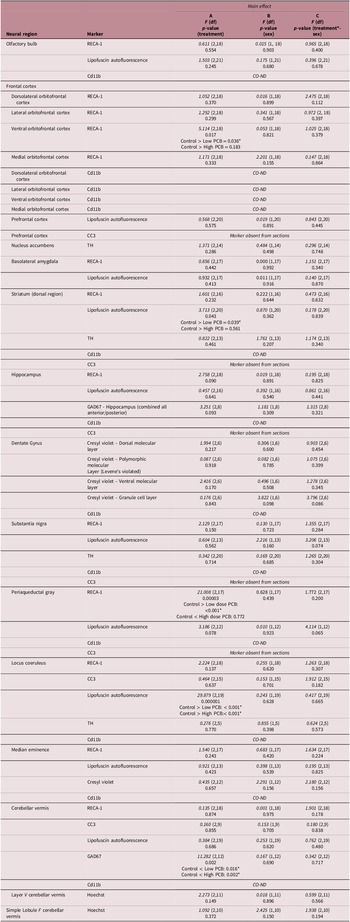
There were no premature deaths in pups prior to the intended euthanization date. No other toxicological endpoints such as brain weights were assessed since the primary intention of this study was to examine immunohistochemically-related neuropathology. Statistically significant findings are present in the text and figures, and all analyses are shown in Table 5. Offspring samples were excluded from immunohistochemical analysis and then were not included in data analysis, if there was tissue sample damage observed prior to immunohistochemical processing or damage during processing.
Results summary

A significant effect of treatment was observed, and no effect of sex or interaction effects throughout the present study. * p < 0.05 following Šídák’s post-hoc comparisons. Column A (effect of treatment); Column B (effect of sex); Column C (interaction effects). Coarse observation, no difference (CO-ND); F-value (F); Degrees of freedom (df).
GAD67
Two-way ANOVA revealed a significant main effect of treatment (F (2, 12) = 11.282, p = 0.002) upon GAD67 immunoreactivity in the cerebellar vermis of adult rat offspring. There was no main effect of sex (F (1,12) = 0.167, p = 0.690), nor a main interaction effect (F (2,12) = 0.342, p = 0.717) detected upon GAD67 immunoreactivity in the cerebellar vermis. Šídák’s post-hoc analysis revealed that exposure to PCBs significantly increased GAD67 immunoreactivity in low PCB (p = 0.016), and high PCB (p = 0.002) exposure groups comparative to controls (Fig 2).
GAD67 immunoreactivity following developmental exposure to PCBs in the cerebellar vermis. Pregnant dams were treated orally with a low (0.011 mg/kg/day body weight) or high (1.10 mg/kg/day body weight) dose of PCBs during pregnancy (21 days) and lactation (21 days). (a) Two-way analysis of variance revealed a significant main effect of treatment (F (2, 12) = 11.282, p = 0.002) upon GAD67 immunoreactivity in adult rat offspring. There was no main effect of sex (F (1,12) = 0.167, p = 0.690), nor a main interaction effect (F (2,12) = 0.342, p = 0.717) detected upon GAD67 immunoreactivity in the cerebellum. Šídák’s post-hoc analysis revealed that exposure to PCBs significantly increased GAD67 immunoreactivity in low PCB (p = 0.016), and high PCB (p = 0.002) exposure groups comparative to controls. Data are mean ± SEM of positive staining detected at value maxima (VM) threshold 100 in the cerebellar vermis of control (n = 6, 3 male, 3 female) and PCB-exposed (low PCB: n = 6, 2 male, 4 female; high PCB: n = 6, 3 male, 3 female) adult rat offspring (postnatal day 450) (*p = < 0.05). VM refers to the maximum number of bright local intensity peaks detected in an image, typically during semi-quantitative analysis such as cell counting or feature detection in image J. Findings are reflective of increased inhibitory GABAergic activity in the cerebellar vermis following developmental PCB exposure. (b) Photomicrographs (ba: control; bb: low PCB; bc: High PCB) of GAD67 immunoreactivity in the cerebellar vermis (bregma ∼ −10.30 mm – −10.52 mm). GAD67 is expressed in purkinje cells in the cerebellum (dark brown stain/HRP-conjugated streptavidin) and resembles traces along the limits of white matter layers (seen between traced black lines). Images captured at 2X magnification. Scale bar represents 100 μm. Coronal section of cerebellum (region-of-interest identified in black square) is presented below scale bar.

Lipofuscin autofluorescence
In the locus coeruleus (LC), two-way ANOVA revealed a significant main effect of treatment (F(2, 19) = 29.879, p < 0.001), but no effect of sex (F(1, 19) = 0.243, p = 0.628) and no interaction effect (F(2, 19) = 0.417, p = 0.665) in adult rat offspring. Šídák’s post-hoc analysis revealed that lipofuscin autofluorescence in the LC was significantly decreased in PCB-exposed offspring, in comparison with controls (low dose, p < 0.001, high dose p < 0.001) (Fig 3). In addition, two-way ANOVA revealed a significant main effect of treatment (F(2, 20) = 3.713, p = 0.043), but no effect of sex (F(1, 20) = 0.870, p = 0.362) and no interaction effect (F(2, 20) = 0.178, p = 0.839) in the dorsal striatum of adult rat offspring. Šídák’s post-hoc analysis revealed that lipofuscin autofluorescence in the dorsal striatum was significantly decreased in low dose PCB-exposed adult rat offspring (p = 0.039), in comparison with controls (high dose PCB, p = 0.561) (Fig 4).
Lipofuscin autofluorescence following developmental exposure to PCBs in the locus coeruleus. Pregnant dams were treated orally with a low (0.011 mg/kg/day body weight) or high (1.10 mg/kg/day body weight) dose of PCBs during pregnancy (21 days) and lactation (21 days). (a) Two-way analysis of variance revealed a significant main effect of treatment F (2, 19) = 29.879, p < 0.001), however no effect of sex (F (1, 19) = 0.243, p = 0.628) and no interaction effect (F (2, 19) = 0.417, p = 0.665) in adult rat offspring. Šídák’s post-hoc analysis revealed that lipofuscin autofluorescence in the LC was significantly decreased in PCB-exposed offspring, in comparison with controls (low dose, p < 0.001, high dose p < 0.001). Data are presented as mean ± SEM of positive pixels (red autofluorescence) in the LC of control (n = 9, 4 male, 5 female) and PCB-exposed (low PCB 0.011 mg/kg/day), n = 8, 4 male, 4 female, high PCB(1.10 mg/kg/day), n = 8, 4 male, 4 female) adult rat offspring (postnatal day 450) (* p = < 0.05). Findings reflect that developmental exposure to PCBs did not increase oxidative stress. (b) Photomicrographs (ba: control; bb: low PCB; bc: high PCB) of lipofuscin in the LC (bregma −9.68 mm – −10.04 mm). Lipofuscin is an endogenous marker of oxidative stress and is expressed in neurons and glia. Red autofluorescence was captured under a tetramethylrhodamine-isothiocyanate (TRITC) filter (emission peak 570 nm). Images were captured 20X magnification. Images represented were processed under the split channel function on imageJ for the red channel only, were all adjusted for brightness equivalently across three images, and red color applied for illustrative purposes. Scale bar represents 25 μm. Coronal section of the LC (region-of-interest identified in black) is presented under scale bar of micrograph.

Lipofuscin autofluorescence following developmental exposure to PCBs in the dorsal striatum. Pregnant dams were treated orally with a low (0.011 mg/kg/day body weight) or high (1.10 mg/kg/day body weight) dose of PCBs during pregnancy (21 days) and lactation (21 days). (a) Two-way analysis of variance revealed a significant main effect of treatment F (2, 20) = 3.713, p = 0.043), however no effect of sex (F (1, 20) = 0.870, p = 0.362) and no interaction effect (F (2, 20) = 0.178, p = 0.839) in adult rat offspring. Šídák’s post-hoc analysis revealed that lipofuscin autofluorescence in the dorsal striatum was significantly decreased in low dose PCB-exposed adult rat offspring (p = 0.039), in comparison with controls (high dose PCB, p = 0.561). Data are presented as mean ± SEM of positive pixels (red autofluorescence) in the dorsal striatum of control (n = 9, 5 male, 4 female) and PCB-exposed (low PCB 0.011 mg/kg/day: n = 8, 4 male, 4 female, high PCB 1.10 mg/kg/day: n = 9, 4 male, 5 female) adult rat offspring (postnatal day 450) (* p = < 0.05). Findings suggest that maternal exposure to 0.011 mg/kg/body is not reflective of increased oxidative stress in the dorsal striatum (b) Photomicrographs (ba: control; bb: low PCB; bc: high PCB) of lipofuscin in the striatum (bregma 1.54 mm – 0.20 mm). Lipofuscin is an endogenous marker of oxidative stress expressed in neurons and glia. Red autofluorescence was captured under a tetramethylrhodamine-isothiocyanate (TRITC) filter (emission peak 570 nm). Images were captured at 10X magnification. For illustrative purposes, images represented were processed under the split channel function on imageJ for the red channel only, were all auto-adjusted, subsequently adjusted for brightness uniformly across three images, and red color applied. Scale bar represents 75 μm. Coronal section of the dorsal striatum (region-of-interest identified in black) is presented under the scale bar of the photomicrograph.

RECA-1
Two-way ANOVA revealed a significant main effect of treatment (F(2,17) = 21.008, p < 0.001) in the periaqueductal gray of adult rat offspring. There was no effect of sex (F (1,17) = 0.628, p = 0.439) nor a significant main interaction effect detected (F (2,17) = 1.772, p = 0.200). Šídák’s post-hoc analysis revealed that PCB exposure at the low dose (p < 0.001) decreased the perimeter of endothelial cells and capillaries (RECA-1) in the PAG in adult rat offspring, in comparison to controls (high dose PCB, p = 0.875) (Fig 5). Similar results were observed in the ventral orbitofrontal cortex. In the ventral orbitofrontal cortex, data was transformed (log10) prior to statistical analysis to correct for a violation in normality. Two-way ANOVA revealed a significant main effect of treatment (F(2,18) = 5.114, p = 0.017) in adult rat offspring. There was no effect of sex (F(1,18) = 0.053, p = 0.821) nor a significant main interaction effect detected (F(2,18) = 1.025, p = 0.379). Šídák’s post-hoc analysis revealed that PCB exposure at the low dose (p = 0.016) decreased the perimeter of endothelial cells and capillaries in the ventral orbitofrontal cortex in adult rat offspring, in comparison to controls (high dose PCB, p = 0.183) (Fig 6).
Endothelial cell and capillary perimeter (RECA-1) following developmental exposure to PCBs in the periaqueductal gray (PAG). Pregnant dams were treated orally with a low (0.011 mg/kg/day body weight) or high (1.10 mg/kg/day body weight) dose of PCBs during pregnancy (21 days) and lactation (21 days). (a) Two-way analysis of variance revealed a significant main effect of treatment (F (2,17) = 21.008, p < 0.001) in adult rat offspring. There was no effect of sex (F (1,17) = 0.628, p = 0.439) nor a significant main interaction effect detected (F (2,17) = 1.772, p = 0.200). Šídák’s post-hoc analysis revealed that PCB exposure at the low dose (*p < 0.001) decreased the perimeter of endothelial cells and capillaries in the PAG in adult rat offspring, in comparison to controls (high dose PCB, p = 0.875). Data are presented as mean ± SEM of RECA-1 immunoreactivity (pixels) in the PAG of control (n = 8, 4 male, 4 female) and PCB-exposed (low PCB (0.011 mg/kg/day): n = 7, 3 male, 4 female; high PCB (1.10 mg/kg/day), n = 8, 4 male, 4 female) adult rat offspring (postnatal day 450) (*p = < 0.05). (b) Photomicrographs (ba: control; bb: low PCB; bc: high PCB) of RECA-1 in the PAG (bregma ∼ -6.30 – −7.04 mm). Endothelial cells are abundant, dark in appearance and elongated in control tissue (HRP-conjugated streptavidin). In offspring exposed to PCBs in development, RECA-1 immunoreactivity is decreased with fewer elongated cells and reduced endothelial cell thickness and capillary definition, particularly following the low dose exposure. Images were captured at 10X magnification. Scale bar represents 75 μm. Coronal section containing PAG (region-of-interest identified in black) is presented under the scale bar of the photomicrograph.

Endothelial cell and capillary perimeter (RECA-1) following developmental exposure to PCBs in the ventral orbitofrontal cortex. Pregnant dams were treated orally with a low (0.011 mg/kg/day body weight) or high (1.10 mg/kg/day body weight) dose of PCBs during pregnancy (21 days) and lactation (21 days). (a) Two-way analysis of variance revealed a significant main effect of treatment (F (2,18) = 5.114, p = 0.017) in adult rat offspring. There was no effect of sex (F (1,18) = 0.053, p = 0.821) nor a significant main interaction effect detected (F (2,18) = 1.025, p = 0.379). Šídák’s post-hoc analysis revealed that PCB exposure at the low dose (*p = 0.016) decreased the perimeter of endothelial cells and capillaries in the ventral orbitofrontal cortex in adult rat offspring, in comparison to controls (high dose PCB, p = 0.183). Data were transformed (log10) and are presented as mean ± SEM of RECA-1 immunoreactivity (pixels) in the ventral orbitofrontal cortex of control (n = 8, 4 male, 4 female) and PCB-exposed (low PCB (0.011 mg/kg/day): n = 8, 4 male, 4 female; high PCB (1.10 mg/kg/day), n = 8, 4 male, 4 female) adult rat offspring (postnatal day 450) (*p = < 0.05). (b) Photomicrographs (ba: control; bb: low PCB; bc: high PCB) of RECA-1 immunoreactivity (bregma ∼ 4.00 mm – 3.70 mm). Images were captured at 10X magnification. Images displayed were adjusted for brightness uniformly across all images to aid visualization of endothelial cells and capillaries. Scale bar represents 75 μm. Coronal section presented under the scale bar depicts the capture field of photomicrographs are within the ventral orbitofrontal cortex (identified in black).

Discussion
The main purpose of this study was to examine whether prenatal and early postnatal exposure to PCBs could elicit long-lasting changes to a battery of markers of brain structure and function. In this study, the doses of PCBs administered to rodents were based on environmentally relevant levels that are seen in human populations in the Canadian Arctic. Selective changes in markers of brain structure and function were found, which supports the study hypothesis. Interestingly, developmental exposure to the low (0.011 mg/kg/day) dose of PCBs led to statistically significant changes in select markers of interest, in specific neural regions rostral to the LC in adult rat offspring, that were not evident following developmental exposure to the high (1.10 mg/kg/day) dose of PCBs.
Effects observed reflective of a nonmonotonic dose–response relationship
In the present study, three findings were reflective of nonmonotonic dose–response curves, where the lower level of maternal PCB exposure led to statistically significant outcomes in the CNS of adult rat offspring, and the higher level of maternal exposure did not differ statistically to controls. In literature, the concept of nonmonotonic dose–response relationships is a mathematical method of describing “a nonlinear relationship between dose and effect where the slope of the curve changes sign somewhere within the range of doses examined”, also referred to as a biphasic dose–response curve. Reference Vandenberg, Colborn and Hayes57 Nonmonotonic curves are especially associated with exposure to low levels of endocrine disrupting compounds (EDCs) such as PCBs. Reference Vandenberg, Colborn and Hayes57 The present findings are consistent with others who reported on various neurobehavioral outcomes. Reference Bowers, Nakai, Yagminas, Chu and Moir47 In that study, authors reported selectively altered neurobehavioral responses in offspring exposed to maternal doses of PCBs at the 0.011 and 1.10 mg/kg/day levels, which may be described as following a nonmonotonic response curve. In that study, the doses, control condition, exposure paradigm, and species strain (Sprague Dawley) are the same as the present study. On the measure of motor activity assessed at postnatal day 16, offspring exposed to the PCB mixture at the lower dose (0.011 mg/kg/day) during development and lactation exhibited less motor activity in comparison to offspring exposed to the higher dose. Reference Bowers, Nakai, Yagminas, Chu and Moir47 The results of the present study relating align with others as related to nonmonotonic dose-responses: that outcomes observed at low levels of exposure of a given EDC cannot be reliably predicted based on outcomes observed from higher levels of exposure of the same EDC. Reference Vandenberg, Colborn and Hayes57
In the present study, in both the PAG and ventral orbitofrontal cortex, maternal exposure to the 0.011 mg/kg/day resulted in a decreased perimeter of endothelial cells and capillaries (RECA-1). This finding is consistent with others who have shown that constituents of endothelial cells, such as tight junctions, and tight junction proteins are disrupted by PCB exposure in vitro Reference Eum, András, Couraud, Hennig and Toborek39,Reference Eum, Jaraki, András and Toborek40 . Others have noted that PCB-induced endothelial cell disruption renders the blood-brain barrier (BBB) even more punctate in vivo. Reference Seelbach, Chen and Powell58 Selvakumar et al. Reference Selvakumar, Prabha, Saranya, Bavithra, Krishnamoorthy and Arunakaran59 demonstrated that the BBB is not only more permeable following PCB exposure, but that tight junction protein mRNA decreases as a result of PCB exposure in multiple neuronal regions namely, cerebrum, cerebellum and hippocampus. The mechanism by which PCBs disturb endothelial cell structure and function remain to be elucidated, however, it has been demonstrated in vitro that the AhR is present and functionally active in endothelial cells, rendering them a target of dioxin-like PCBs. Reference Filbrandt, Wu, Zlokovic, Opanashuk and Gasiewicz60 Also, in vitro, noncytotoxic dosing of PCB dehydroxylated metabolite (quinone derivative 2,3,5-trichloro-6-phenyl- [1,4]benzoquinone) PCB29-pQ stimulated endothelial hyperpermeability by mediating vascular endothelial-cadherin disassembly, junction breakdown, and focal adhesion formation. Reference Zhang, Feng and Bai61 Altogether, the present study contributes further evidence that developmental PCB exposure may perturb endothelial cells and capillaries, albeit long after the exposure period.
Both the PAG and ventral orbitofrontal cortex play important functional roles and may be linked with adverse outcomes reported amongst First Nation and Northern Canadian youth and adults. For example, it is well-acknowledged that First Nation youth and adults have reported adverse outcomes in relation to addiction-related relapse and related help-seeking behavior in relation to addiction. 62 The PAG is theoretically implicated in substance misuse and substance abuse relapse. Reference Vázquez-León, Miranda-Páez, Chávez-Reyes, Allende, Barragán-Iglesias and Marichal-Cancino63 The PAG is also a neural region implicated in the descending pain inhibitory system Reference De Andrade, Martinez and Pagano64 and implicated in orofacial pain. Reference Rotpenpian and Yakkaphan65 First Nations living on-reserve and in Northern communities report a greater prevalence of dental pain in comparison to the general population. Reference Vázquez-León, Miranda-Páez, Chávez-Reyes, Allende, Barragán-Iglesias and Marichal-Cancino63
Moreover, the ventral orbitofrontal cortex is implicated in impulse control and visuospatial attention Reference Murphy, Dalley and Robbins66,Reference Chudasama, Passetti, Rhodes, Lopian, Desai and Robbins67 . Epidemiological evidence suggests that impulse control and visuospatial task performance were shown to be disturbed in individuals developmentally exposed to PCBs in Northern Canada. Reference Boucher, Burden and Muckle23
Additionally, in the present study, lipofuscin autofluorescence was significantly decreased in the dorsal striatum of adult rat offspring exposed to the maternal PCB dose of 0.011 mg/kg/day, in comparison to controls (see section “Comparable responses to both PCB levels following developmental PCB exposure” below for greater elaboration on this finding as related to lipofuscin).
Effects observed reflective of a dose–response relationship
A dose–response relationship was observed in the cerebellar vermis associated with marker GAD67, in particular where the magnitude of the response differed between low and high dose exposure groups. Developmental PCB exposure at both the low (p = 0.016) and high dose (p = 0.002) led to significantly increased GAD67 immunoreactivity in the cerebellar vermis of adult rat offspring, in comparison to controls (Fig 2). GAD67 immunoreactivity following exposure to the higher dose (M = 410.500, SEM = 45.635, p < 0.01) differed in comparison to the lower dose (M = 342.375, SEM = 48.403, p < 0.05). It is thought that an increase in GAD67 would functionally result in increased inhibitory neurotransmission in the cerebellar vermis. There are a number of reasons why GAD67 in the cerebellum may be affected by developmental PCB exposure, particularly associated with timing of PCB exposure and GAD67 expression characteristics in the cerebellum. GABA and GAD67 appear in the early days of embryonic development, Reference Redburn, Schousboe, Redburn and Schousboe68 which coincides with timing of PCB exposure that occurred throughout gestation (and lactation) in the present study. Secondly, GAD67 is expressed widely in Purkinje cells in the cerebellum and these Purkinje cells develop prenatally before birth. Reference Zawia69 Indeed, Padhi et al. Reference Padhi, Pelletier and Williams44 reported decreased mRNA expression gene PCP2 (purkinje cell protein 2) in the cerebellum of Sprague Dawley rat offspring exposed to PCBs in utero and in lactation. PCP2 is expressed in embryonic cerebellum and in adult Purkinje cells. Reference Dastjerdi, Consalez and Hawkes70 Thus, it is plausible that a disturbance in mRNA expression of PCP2 may directly or indirectly perturb GAD67 immunoreactivity. Further research is needed to elucidate the mechanism by which PCP2 may influence GAD activity. Thirdly, a primary mode of action of PCB perturbation involves thyroid hormone disturbance, and Purkinje cells are thought to be targets of TRα1 thyroid hormone receptors. Reference Fauquier, Chatonnet and Picou71 Thus, PCB perturbations of Purkinje cells could also lead to subsequent disturbance of GAD67 function in the cerebellum, increasing GAD67 and thus increased inhibitory neurotransmission. AhR mRNA has been detected in the rodent cerebellum at embryonic day 18.5. Reference Kimura and Tohyama72 Since dioxin-like PCBs act mechanistically on AhR, this may be another avenue by which developmental PCB exposure could indirectly interfere with GAD67 in the cerebellum, at this critical developmental stage.
Furthermore, non-dioxin-like PCBs in this study, known to act via ryanodine receptors disrupting calcium signaling, have also been shown to perturb cerebellar Purkinje cells. Reference Yang, Kim and Phimister73 Ryanodine receptor genes 1,2, and 3 (RYR1, RYR2, and RYR3 respectively) are expressed in the CNS, but RYR1 is specifically expressed in cerebellar Purkinje cells. Reference Ogawa74 Further research is needed to determine whether the observed alteration in GAD67 immunoreactivity following developmental exposure to PCBs is mediated via a ryanodine receptor mechanism.
Alterations to GAD67 immunoreactivity in the cerebellum may also potentially be due to epigenetic changes that can persist following maternal exposure to PCBs in offspring, though there is no direct evidence linked with PCB exposure and epigenetic changes in GAD67.
Lastly, increased GAD67 immunoreactivity may be a consequence of developmental toxicant exposure if PCB exposure is conceptualized as a chemical stressor posing risk of neuronal injury. GAD67 has been reported to increase following injury. Reference Pinal and Tobin75 Although the changes in GAD67 immunoreactivity were not expected to be accompanied by CC3 immunoreactivity in the cerebellar vermis following PCB exposure, it cannot be ruled out that apoptosis, necrotic injury, or oxidative stress-related neuronal insult may have occurred more proximal to PCB exposure, leading to long-lasting changes in GAD67 expression.
Overall, the findings reported are consistent with previous literature that demonstrate that the cerebellum is vulnerable to developmental PCB exposure at environmentally relevant doses.
Comparable responses to both PCB levels following developmental PCB exposure
In the present study, developmental PCB exposure led to statistically significant decreases in lipofuscin autofluorescence in the LC. Here, both the maternal 0.011 and 1.10 mg/kg/day PCB exposure level led to comparable decreases in lipofuscin autofluorescence. This finding may be reflective of a ceiling effect, with this specific marker of interest, in this particular neuronal region.
To the best of our knowledge, this paper is the first to report these findings in the LC. In the current study, lipofuscin red autofluorescence was examined in the 400–700 nm range (peak excitation ∼ 578 nm) consistent with others Reference Zheng, Clabough, Sarkar, Futter, Rubinsztein and Zeitlin76–Reference Moreno-García, Kun, Calero, Medina and Calero78 . Increases in oxidative stress would be hypothesized to be more proximal to developmental toxicant exposures, however it was unclear what, if any, long-term effects would be observed in lipofuscin comparative to controls. In literature, reductions in lipofuscin have been reported following pharmacological treatment with nootropics Reference Paula-Barbosa, Brandão, Pinho, Andrade, Madeira and Cadete-Leite79 or supplements such as acetyl-L-carnitine, Reference Aliev, Liu and Shenk80 where reductions are thought of as a beneficial outcome on cellular health and metabolism. Accordingly, the present findings pertaining to lipofuscin reduction in the LC do not provide evidence for dysfunction. The results of the present study therefore do not suggest that developmental exposure to PCBs adversely affected lipofuscin content as an endogenous marker of oxidative stress in the LC.
This finding does not rule out the possibility that other adverse effects occurred in the LC following developmental toxicant exposure, associated with markers that were not assessed in the present study. LC may be another region particularly vulnerable to PCB exposure since AhR have been shown to co-localize with noradrenergic neurons. Reference Kimura, Kohda, Maekawa, Fujii-Kuriyama and Tohyama81 Recently, Kimura et al. Reference Kimura, Kohda, Maekawa, Fujii-Kuriyama and Tohyama81 provided confirmatory immunohistochemical localization of AhRs in the LC comparing AhR knock-out and AhR knock-in mice and, in their experiment using TCDD. Their results suggested that LC neurons are likely targets of dioxin-like exogenous agents as the principal site of noradrenergic neurons in the CNS, even in early development. Reference Kimura, Kohda, Maekawa, Fujii-Kuriyama and Tohyama81
In relation to PCB exposure effects on neuropsychological aspects and the LC, this neural region has been implicated in cognitive flexibility (specifically prediction errors/error monitoring). Reference Sales, Friston, Jones, Pickering and Moran82 However, there is presently no known evidence linking developmental toxicant exposure, performance in cognitive domains, and lipofuscin content in the LC.
Limitations
With regard to limitations of this study, it is important for the results of the present study to be interpreted with caution. Where the results reported can only be attributed to the PCB mixture, the results do not necessarily accurately reflect outcomes that may result from exposure to a single PCB congener within the mixture.
The number of neuronal regions assessed coupled with interest in conducting an immunohistochemical analysis meant that sample sizes varied and were, on occasion, not as large as originally targeted. Often immunohistochemical analyses are paired with other methods, and it may be very common to see low sample sizes in such studies. Therefore, the present study aimed to include as many animals per group as possible within available resources and considering comprehensive image analysis. Taking this into account, it is important to acknowledge that that the absence of significant sex effects in this current sample do not preclude the presence of one in a larger sample size, as samples sizes to test for sex differences were underpowered.
An additional limitation is due to interest in performing immunohistochemical analysis. A decision was made to not perform stereology as it would not have been feasible to complete analysis for all stains and the number of regions of interest. Moreover, image stacks were not used, as this function at the time of study conceptualization was not readily available. Future studies can possibly confirm our findings using such methods. Additionally, one individual conducted image capture, and analysis. Though use of ImageJ and procedures may mitigate against bias due to computerized software generating data, a risk of bias must be acknowledged.
In relation to analysis, ImageJ was used to semi-quantitatively assess markers of interest. In such analysis, a noise-to-signal ratio is experimentally determined for each stain assessed in protocol development stages. Inter-study variability using ImageJ as opposed to standard protocols is expected. At time of image capture using Stereo Investigator, a stringent process was in place ensuring that all images per stain were optimized and consistent across image capture (e.g., brightness, exposure). ImageJ analysis then applies masks to images optimized to detect wanted signal and then generates numeric values that correspond to the signal. Thus, in certain cases, numbers seen reflect quantification of signal that corresponds to immunoreactivity, but not the cell itself. Secondly, where ImageJ detected pixels, this was indicated accordingly. Pixels however are a standard measure to present data in relation to lipofuscin and morphology (e.g., of endothelial cells and capillaries) Reference Brianezi, Minicucci, Marques and Miot83–Reference Rodriguez Torres, Lee, Mihlstin and Tomsak86 .
Furthermore, this study focused on assessing neuropathology as opposed to other toxicological endpoints that are crude, such as brain weight, discussed elsewhere more proximal to time of exposure. Reference Chu, Bowers and Caldwell33
Lastly, there is some question as to how much PCB is biologically available to the fetus and neonate following maternal oral exposure to low quantities of PCB. In the present study, this was not directly measured, and it is assumed that PCB was biologically active in developing rats since this has been widely reported in other studies. Reference Verner, Plusquellec and Desjardins18 The doses selected were scaled to be proportional to produce levels of PCBs that have been reported in populations which informed the rationale of the present study Reference Butler Walker, Seddon and McMullen10,Reference Chu, Bowers and Caldwell33,Reference Muckle, Dewailly and Ayotte50 . Though it is acknowledged in literature that PCBs pass through the placental barrier, Reference Funatsu, Yamashita and Ito9 are reported in umbilical cord blood, Reference Butler Walker, Seddon and McMullen10 in breast milk Reference Muckle, Ayotte, Dewailly, Jacobson and Jacobson11 and that in humans, lactational transfer, especially in matured milk Reference Kodama and Ota12–Reference Wassermann, Wassermann, Cucos and Miller14 , it is unclear in the present study the exact point at which PCBs were biologically active and the length of time of biological activity persisted, since it was not measured. In this study, authors posit that PCBs were biologically active more proximal to the time of exposure, since there was no further exposure to PCBs after the lactational period that would have continued until postnatal day 450. This further suggests that group differences reported between controls and PCB-exposed groups are likely attributed to dose, duration, and timing of exposure, and would have differed if exposure continued throughout the postnatal period and adult development period.
Future directions and conclusions
In utero and lactational exposure to PCBs was shown to influence long-term changes in markers of CNS structure and function. In this study, the doses of PCBs administered to rodents were based on environmentally relevant levels in maternal blood of individuals in the Canadian Arctic. This study confirms that selective regions in frontal, subcortical, and hindbrain regions were affected by PCB exposure, and these findings largely support epidemiological observations noted in literature. Secondly, amongst the statistically significant findings, neural regions rostral to the LC assessed in the present study demonstrated a nonmonotonic dose–response to developmental PCB exposure.
With respect to future directions, the neural regions in this study are implicated in cognition and general neuropsychological outcomes, and are regionally interconnected Reference Sales, Friston, Jones, Pickering and Moran82,Reference Provost, Hanganu and Monchi87,Reference Hanganu, Provost and Monchi88 . Using a similar experimental paradigm, it would be valuable to assess adult rat offspring using a mixed cross-sectional longitudinal design, to assess markers similar to the present study paired with neurobehavioral testing similar to previous studies. Reference Bowers, Nakai, Yagminas, Chu and Moir47 Here, it would be hypothesized that low and high dose exposure levels used in this study, would produce divergent neurobehavioral outcomes as was observed more proximal to the time of exposure Reference Bowers, Nakai, Yagminas, Chu and Moir47,Reference Vandenberg, Colborn and Hayes57 .
Acknowledgments
Authors gratefully acknowledge Dr Wayne Bowers (Retired Health Canada Scientist) who along with his many collaborators and colleagues informed the conception of this work, to investigate health effects that may result from chemical exposures in Northern regions of Canada. Health Canada and the Northern Contaminants Program granted permission to N.R. to complete this study at Queen’s University. Staff member of Dr Bowers, Ben Wild, supported brain sectioning.
Financial support
Dr Wayne Bowers was awarded funding that supported this project by the Northern Contaminants Program (H-05).
Competing interests
The authors do not have any conflicts of interest to declare.
Ethics statement
The authors assert that all procedures contributing to this work comply with the ethical standards of the relevant national guides on the care and use of laboratory animals (Canadian Council on Animal Care) and has been approved by the institutional committee (Health Canada).
CRediT author statement
G. Nazneen Rustom: hypothesis formulation, methodology after brain extractions, formal analysis, writing-original draft. James N. Reynolds: hypothesis formulation, project supervision, writing - review and editing.




 Open access

