


1. Introduction
The undergraduate engineering curriculum in the United States has increasingly incorporated introductory design courses to introduce students to design processes, problem-solving approaches, and terminology, with an expectation for continued application throughout their education (Reference OakesBesterfield-Sacre et al., 1998; Reference Dym, Little and OrwinDym, 2013; Reference Besterfield-Sacre, Amaya, Shuman, Atman and PorterOakes & Dustker, 2022). Frequently, students next revisit design in capstone courses where they apply systems engineering and engineering science to real-world problems. Several programs include additional intervening design courses, but few integrate design instruction with engineering science coursework. This separation may create a disconnect between theoretical knowledge and its application in design in students’ minds, potentially hindering retention and confidence in using engineering concepts, as confidence is built through practice (Reference Brennan, Hugo and GuBrennan et al., 2013). Such gaps disproportionately affect students by race and gender (Reference Moakler and KimCech et al., 2011; Chachra & Kilgore, Reference Chachra and Kilgore2009; Colbeck et al., Reference Colbeck, Cabrera and Terenzini2001; Reference Cech, Rubineau, Silbey and SeronLitzler et al., 2014; Moakler Jr & Kim, Reference Litzler, Samuelson and Lorah2014). Various pedagogical strategies have been employed to enhance student confidence (Reference Hutchison-GreenEllis et al., 2003; Reference Ellis, Scordilis and CookeHutchison-Green, 2008) and retention(Reference Geisinger and RamanGeisinger & Raman, 2013), particularly in engineering design (Reference McKenna and HirschMcKenna & Hirsch, 2005) and other disciplines such as mathematics (Reference Parsons, Croft and HarrisonParsons et al., 2009).
Traditionally, engineering science courses have focused on developing domain knowledge with minimal opportunities for students to apply these concepts in design contexts, particularly to problems framed using design terminology. The assumption that students can later easily and confidently apply engineering science knowledge to the design process may be overly optimistic. Limited opportunities for design application may hinder students’ confidence development in the application of domain knowledge. The course modification described here seeks to build confidence by incorporating design exercises directly into the engineering science learning process so that students apply their theoretical understanding to problems framed within their design courses as in Figure 1. By integrating design challenges after domain knowledge instruction and measuring the change in confidence, we examine whether these brief interventions improve student confidence sufficiently to justify their inclusion in engineering science curricula.
Schematic of initial and revised course sequence with assessments shown

Prior work by the author examined the evolution of student confidence in addressing engineering design exercises within a materials engineering course (Reference KraussKrauss, 2023). These exercises apply the terminology and style of Dym (Reference Dym, Little and OrwinDym, 2013) to frame design problems using functions, objectives, and constraints. The design space is restricted to approved materials with specified properties, requiring students to select the best material for a given design goal. Topics include elastic and plastic deformation, tensile failure, creep and relaxation, impact, and fatigue. Each exercise challenges students to navigate conflicting objectives with unclear stakeholder priorities, justifying their decisions. Scaffolded exercises progress from well-defined problems with clear solutions to complex, constraint-reduced challenges, simulating real-world design trade-offs. Later stages expose students to the designer’s responsibility of interpreting conflicting priorities, requiring them to define equations that articulate their reasoning. This increasing reliance on judgment-based decision-making aligns with Kolb’s (Reference Kolb and PlovnickKolb & Plovnick, 1974) learning stages, transitioning from abstract conceptualization to active experimentation. Student confidence plays a crucial role in self-efficacy, even when they may not immediately recognize the value of case-based learning in their development (Reference Yadav, Alexander and MehtaYadav et al., 2019).
This work examines course modifications and their impact on student confidence. The prior version relied primarily on lectures with brief observational lab activities, assuming students would seamlessly transfer theoretical knowledge to design solutions. To better support confidence in applying technical knowledge to design decision-making, the revised course structure shifts significant content delivery to asynchronous pre-lecture activities, allowing class time for interactive, design-focused problem-solving. This study evaluates how active learning enhances student confidence in applying engineering science to design problems, with initial and revised course structures, shown in Figure 1. The approach aligns with many problem-based learning approaches such as the CDIO framework, integrating technical knowledge with hands-on learning to develop professional skills (Crawley et al., 2007). As seen in other CDIO-inspired courses, active collaboration and application improve engagement and skill mastery (Säisä et al., 2017), while iterative design activities increase confidence in solving complex, multidisciplinary challenges (Hernández & Ramírez). The novelty of the work is in the focus on confidence development in application of domain knowledge to design.
One example of the design exercises involves selecting the best material for a tie rod, balancing weight minimization and environmental impact (using embodied energy as a proxy). Through analysis, students discover that the lightest material does not always have the lowest embodied energy, prompting discussions on trade-offs and the designer’s responsibility to consider broader implications for users, society, and the environment rather than defaulting to a single “best” choice. Without explicit prioritization guidance, students must quantify trade-offs mathematically. For example, if the lightest tie rod is 1 kg lighter but the lowest-impact material reduces embodied energy by 1 kJ, selecting the former implies valuing 1 g of mass reduction over 1 J of energy reduction. Students must justify their selection based on these trade-offs, either quantitatively or qualitatively. A less quantified approach might argue that the second lightest material is “light enough,” prioritizing environmental impact instead.
This exercise is one of several that progressively introduce more complex challenges, integrating intersecting design considerations beyond core materials engineering knowledge. By engaging in these increasingly open-ended exercises, students build confidence in navigating ambiguous and conflicting objectives, mirroring the complexities of professional engineering decision-making. The discussions extend to the broader consequences of design choices, such as the energy required to move the additional weight over the tie rod’s service life. Through this structured progression, students develop technical expertise and confidence to make informed, responsible design decisions.
2. Study
This study examines how four design exercises incorporated into a materials engineering course impact student design confidence (Reference Alias, Nur, Hafiz and HafirAlias & Hafir, 2009). This study expands on the earlier work on this topic covering three times as many students over four additional terms than was possible in the initial study, greatly increasing the statistical power, compared to the previous study (Reference KraussKrauss, 2023). This study follows the methodology employed in the initial work on this topic. The course studied was taught over six semesters (fall, 2021 spring 2021, fall 2022, spring 2022, fall 2023, and fall 2024) covering four academic years from 2021 to 2024 at a small liberal arts college focused on science, engineering, and mathematics undergraduate education. The design exercises (DEs) cover the topics of DE1: yield, ultimate tensile strength, strain; DE2: creep and relaxation; DE3: impact; and DE4: fatigue and were completed in numerical order. Students were permitted to consult with others in the course on the best approach to address the ill-defined DE problems. The four exercises are each conducted in two parts, over approximately half of two seventy-five-minute lectures. That is, about thirty-seven and a half minutes of lecture time is nominally assigned for each half of a design exercise. The time of effort required was controlled by having students complete the assignment entirely or almost entirely during lecture. As such, the time required to complete this intervention may be balanced against any benefits derived and compared to other potential interventions.
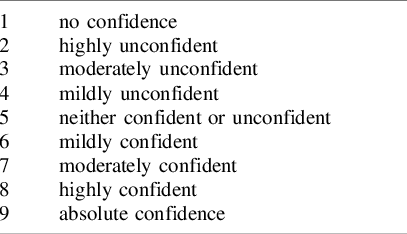
Students completed an online pre-assessment and post-assessment survey for each of the design exercises describing the degree of confidence they had in their ability to design across several measures related to the design exercise topic. All students completed all readings, lectures, and homework on the topic of each design exercise prior to attempting the exercise in class. The pre-assessments were submitted prior to attending the lecture with the first part of each design exercise but after all other instruction on the theme of the design exercise. The post-assessments were submitted following completion of the design exercise. As a result, differences in the pre-exercise and post-exercise self-reported student confidence are attributable to participation in the exercise and not to additional instruction on the topic of the design exercise or to scores received for their work. The specific survey statements changed with each DE topic other than statement 3, addressing confidence in generation of a design performance metric, which was consistent across all design exercises. The intention of including a single general measurement of confidence for data collection across all design exercises was to determine the degree to which this largely generalizable statement about confidence changed with exposure to a new design exercise topic. The data from each design exercise are presented independently and include data from different terms of instruction combined. For all questions, a single 9-point Likert scale was used to establish the student’s confidence in response to questions related to the design exercise activity, Table 1. A 9-point scale was chosen to permit finer responses in confidence levels without requiring selection of extremes. Each question is tested statistically using a paired Student’s T- test with a null hypothesis that the design exercise intervention does not improve the student’s degree of confidence with respect to each statement pre and post exercise.
Nine-point Likert scale of student responses to their degree of confidence in response to the statements offered in pre activity and post activity design exercise surveys

3. Results and statistical treatment
3.1. Design exercise 1, tie-rod in tension
The first design exercise considered a tie-rod under tension. Students were asked to select from a list of 8 materials (properties provided: Youngs Modulus, Yield Strength, Ultimate Tensile Strength, Density, Cost (per kg.), and Embodied Energy). The functions, objectives, and constraints were varied over four cases focusing on total mass, cost, embodied energy and mass, and cost with a free variable in the range of acceptable rod radii. The changes in the objectives and constraints were deceptively simple but resulted in significant challenges for student designers. Throughout this document, the results of the survey are presented for the pre activity (Pre) and post activity (Post). A total of 88 students responded to both the pre and post assessment survey. Average values of data are reported in Figure 2. Confidence intervals of 95% are shown. Students are asked to respond to the five following survey statements.
Student responses indicating confidence across the five statements surveyed for Design Exercise 1. Confidence bands indicate 95% confidence intervals

Survey Statement 1: I am confident in my ability to translate design objectives, functions, and constraints into the parameters required for material selection decisions.
Survey Statement 2: I am confident in my ability to select the best material for a tie rod design to minimize cost, weight, embodied energy, or other factors of interest.
Survey Statement 3: I am confident in my ability to generate a design performance metric separated by Function, Geometry, and Material.
Survey Statement 4: I am confident in my ability to select the best material for a tie rod design so that it will not yield or such that it will not break.
Survey Statement 5: I am confident in my ability to select the best geometry and material combination for a tie rod design so that it will not yield or such that it will not break and be lowest cost, mass, or other factors of interest.
3.2. Design exercise 2, compressed disc at elevated temperature
Design exercise 2 considered a disc subject to a constant displacement compression under an elevated temperature (relaxation) and a tie-rod under a constant loading under elevated temperature. Students were to find the lightest or lowest cost material from 8 provided for each condition. Variations in test temperature or duration were included as part of the problem conditions. The number of student subjects who completed both pre and post assessments for DE2 is 102. Results are shown in Figure 3.
Student responses indicating confidence across the five statements surveyed for Design Exercise 2. Confidence bands indicate 95% confidence intervals

Survey Statement 1: I am confident in my ability to translate design objectives, functions, and constraints into the parameters required for creep.
Survey Statement 2: I am confident in my ability to translate design objectives, functions, and constraints into the parameters required for relaxation.
Survey Statement 3: I am confident in my ability to generate a design performance metric separated by Function, Geometry, and Material.
Survey Statement 4: I am confident in my ability to select the best material for a spring design so that it will not creep unacceptably.
Survey Statement 5: I am confident in my ability to select the best material for a spring design so that it will not undergo unacceptable relaxation.
3.3. Desig nexercise 3, impact car bumper with temperature considerations
In design exercise 3, students considered a simplified model of a car bumper subjected to impact loading at different temperature conditions. They had to select the best material for a provided list of 8 choices that best met requirements for being low cost, lightweight, and environmentally low cost. In addition, geometry variations were permitted in some cases. The number of student subjects who completed both pre and post assessments for DE3 is 96. Results are shown in Figure 4.
Student responses indicating confidence across the five statements surveyed for Design Exercise 3. Confidence bands indicate 95% confidence intervals

Survey Statement 1: I am confident in my ability to translate design objectives, functions, and constraints into the parameters required for a design that must absorb an impact load.
Survey Statement 2: I am confident in my ability to translate design objectives, functions, and constraints into the parameters required for a design subject to impact load at cold temperatures.
Survey Statement 3: I am confident in my ability to generate a design performance metric separated by Function, Geometry, and Material.
Survey Statement 4: I am confident in my ability to select the best material for a spring design so that it will absorb the required energy with consideration of potential ductile to brittle transition.
Survey Statement 5: I am confident in my ability to select the best material and geometry combination for a bumper design so that it will meet the objective of being environmentally sustainable.
3.4. Design exercise 4, fatigue failure
Design exercise 4 focused on the topic of fatigue. Eight materials with their properties and fatigue testing data were available to the students. This considered a design problem of a cyclically loaded tie rod in tension. Goals included making a lightweight tie rod that had a proscribed lifetime, a low-cost tie rod with a higher lifetime, a low cost and low embodied energy tie rod with a proscribed lifetime, and a tie rod of longest possible lifetime and low embodied energy. The number of students who completed both pre and post assessments for DE4 is 97. Results are shown in Figure 5.
Student responses indicating confidence across the five statements surveyed for Design Exercise 4. Confidence bands indicate 95% confidence intervals

Survey Statement 1: I am confident in my ability to translate design objectives, functions, and constraints into the parameters required for a design that must work under cyclic loading.
Survey Statement 2: I am confident in my ability to alter geometry as a design parameter to accommodate cyclic loading.
Survey Statement 3: I am confident in my ability to generate a design performance metric separated by Function, Geometry, and Material.
Survey Statement 4: I am confident in my ability to select the best material for a tie rod design subjected to cyclic loading of a defined minimum number of cycles.
Survey Statement 5: I am confident in my ability to select the best material and geometry combination for a tie rod design subjected to cyclic loading to optimize for different objectives.
3.5. Statement 3 across design exercises
One statement was repeated for each design exercise. This statement, statement 3, was relevant to all the design exercises in that it generally described confidence in translating a set of statements to a performance metric. The number of participants for each term is the same as previously described in the individual design exercises. Results are shown in Figure 6. Survey Statement 3: I am confident in my ability to generate a design performance metric separated by Function, Geometry, and Material.
Student responses indicating confidence for statement 3 surveyed across the four Design Exercises. Confidence bands indicate 95% confidence intervals

3.6. Statistical treatment and results
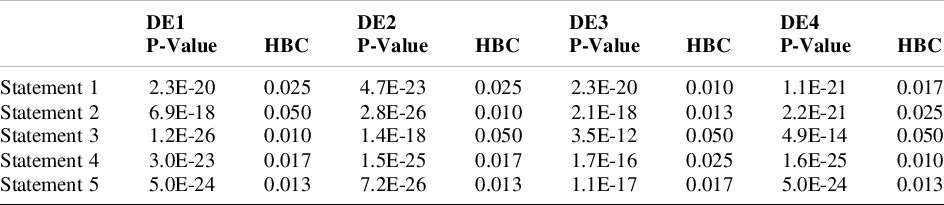
The statistical significance of differences in the student responses to the statements for the four design exercises were evaluated using two-tailed, paired Student T-tests. To correct for Type II errors, the Holm-Bonferroni Correction is applied to maintain an alpha of 0.05 or 95% confidence. The corrected alpha value for each statement of each design exercise is listed in Table 2 as HBC. Results shown in Table 2 indicate that the differences between initially self- reported student confidence and post design activity self-reported student confidence for each test.
Statistical significance of the pre-activity and post-activity responses for statements 1 through 5 across the Design Exercises determined with two-tailed, paired Student-T tests. Values in bold are statistically significant at greater than the 95% confidence level

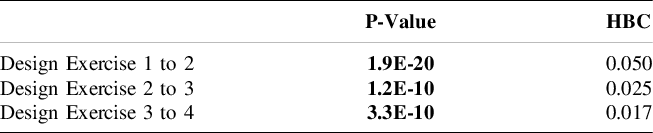
The significance of statistical differences in the student initial responses (pre-activity) to the initial response to statement three across for the four design exercises were evaluated using two-tailed Student T-tests (non-paired). To correct for Type II errors, the Holm-Bonferroni correction is applied to maintain an alpha of 0.05 or 95% confidence. The corrected alpha value for each statement of each design exercise is listed in Table 3 as HBC. Results in Table 3 indicate that there is a statistically significant difference between the initial confidence for the previous exercise compared to the initial confidence in the second design exercise for every case considered.
Statistical significance between the pre-activity responses for statement 3 across the Design Exercises determined with two-tailed (non-paired) Student-T tests. The alpha value is corrected for Type II errors using the Holm-Bonferroni method to maintain a 95% confidence level. The values in bold are statistically significant at greater than the 95% confidence level

4. Discussion
Following completion of all reading, associated homework problems, hands-on laboratory exercises, and quizzes but prior to completing the related design exercise the average range of student confidence responses was in the range between the “mildly unconfident” and “neither confident nor unconfident” ratings. Educators would reasonably aspire for greater student confidence in applying engineering science knowledge to design application following completion of the listed coursework. The average increase from pre-assessed confidence to post assessed confidence increased by a statistically significant degree in each statement examined for the design exercises, typically from about 4.5 (between mildly unconfident and neither confident nor unconfident) to about 6.9 (approximately moderately confident) following completion of the seventy-five-minute exercise. The final confidence score of applying the topical content to design would reflect knowledge of competing issues in a design exercise that students would not have considered in the pre assessment.
Statement three on the application of a performance metric remained unchanged over the four design exercises. It might be expected that confidence in this specific topic would increase in stepwise manner throughout subsequent design exercises through repeated practice. This was only the case for increased confidence observed between the first exercise and the second and subsequent design exercises where confidence increased from a score of 4.02, “mildly unconfident to 5.15 (DE2), 5.24 (DE3), and 4.96 (DE4), where a score of 5 is neither confident nor unconfident. This is despite the rise in the post design exercise score of Statement 3 of 7.43 (DE1), 6.88 (DE2), and in 6.72 (DE3). It may be that a degree of confidence is retained related to statement 3, which is generally applicable to all design activities, but a lack of confidence with respect to the specific application of the new topical knowledge persists. This may suggest that even confidence in general tasks is related to application to domain knowledge specific topics. It is unclear if confidence in other topics declines in a similar manner over time.
Together, the statistically significantly increasing confidence following the topical design exercises and a moderate persistent increase in statement three confidence suggests that while the design exercises are effective in increasing confidence and that the degree of confidence increase is at least partially specific to the topic covered in the specific design activity. Stated differently, the transferability of design activity confidence is somewhat restricted to the specific engineering science content applied in those exercises. This would indicate that design exercises should be developed that cover the content or topics of interest specifically to increase student confidence as the transfer of confidence on the same design activity but applied to a different topic from that previously explored by students appears limited.
In this study, a seventy-five-minute lecture was dedicated in total to each design exercise. It is not clear that student confidence plateaued on a specific topic basis following this educational intervention. It may be that shorter design exercises could positively influence student confidence to the same extent or to some extent or that the design exercises might be better applied as extended homework problems rather than as in-class exercises. Qualitative observation by the author suggests that, following a period of struggle, students approached each other or the instructor for clarification or assistance in framing the design problems. It appeared that these exchanges guided the approach students adopted to generating solutions but not the priorities they set for solving the incompletely defined aspects of the exercise. For example, if asked to identify a design that is lightweight and low-environmental impact, a student might seek peer assistance in understanding how to calculate the mass or environmental impact of a design or how to identify the factors that might be adjusted within the constraints. Nevertheless, the student was unlikely to automatically accept their peer’s relative order of importance of these objectives and therefore was reasonably likely to choose a different specific design solution from their peer.
5. Utility for educators
Many educators assume that the integration of engineering science knowledge into a design process is a natural and obvious extension of student activity in a design process. This study suggests that many students lack confidence in the application of known engineering science knowledge in design activities. In the case of this study, despite the information content being recently taught and its direct application to the design activity explored, there was generally lower confidence expressed by students in terms of its application to a design activity. Engineering programs may want to consider the challenge faced by students with respect to developing confidence in the application of engineering science or, more generally, topical knowledge, to the engineering design process without practicing using related engineering design activities.
A student’s ability to understand and apply course content may be evaluated and improved using different methods by course instructors. For engineering design applications, it may be particularly beneficial for instructors to select exercises that focus on applying topical knowledge to design activities in order to build student confidence. Among the many activities available to improve student design confidence, allocating approximately four seventy-five-minute lectures (five hours total) to design exercises during a twenty-seven-lecture term may seem demanding. However, this time investment can be offset by incorporating out-of-class video lectures or reducing other assignments, such as homework. Alternatively, these five hours of design exercises could be conducted outside of class, with some consultation on problem-solving approaches integrated into lectures.
Notably, the statistical support for these recommendations has increased significantly since the previous version of this study, strongly suggesting their adoption by instructors. While it remains uncertain whether applying knowledge to design exercises also enhances foundational understanding of core material, the evidence consistently shows that student engagement in design exercises significantly boosts confidence in ways that traditional coursework alone does not. Regardless of the specific approach or time allocation, prioritizing design application as part of the curriculum clearly benefits student development with respect to confidence. It is suggested by the results of the drop in persistence of confidence with respect to statement 3 across multiple design topics that confidence improvement is strongly related to the specific topics incorporated into the coursework.
6. Conclusion and future work
A benefit of design exercises for increasing student confidence applying topical material from an introduction to materials engineering course is observed. This benefit suggests that increased attention focused on application of engineering science course knowledge might benefit student design confidence more broadly if applied in engineering courses. Important open questions remain.
Investigation of the impact of exercise duration is of interest to the author and may be of use to the engineering design education community. It would be beneficial to have a clearer understanding of the trade-off between design confidence, confidence persistence, and student time investment on design exercises. It may be that briefer, focused exercises might be sufficient to result in similar increases in student confidence. Alternatively, it may be that longer exercises might be necessary for greater persistence or degree of student design confidence.
Quantifying the difference across sex, race, or ethnicity in student confidence applying course content in design would be helpful for instructors. The response to the design exercises in this study were not found to differ by sex, race, or ethnicity significantly primarily due to low power with respect to the number of participants when evaluated across these categories. Despite an approximately even split between male and female students, the number of respondents coupled with small class sizes made this analysis challenging. Additional investigations will hopefully increase study power to address this open question.
The influence of setting of the design exercises in not well understood. This study conducted the design exercises in a controlled classroom during lecture. While this permitted an immediate response to student issues or confusion, it also prevented a more generalized understanding of the influence of setting or assignment type (homework vs. in-class, for example). It would be good to know the degree to which success depends on an in-class setting for the design exercises to increase student confidence. Finally, objective performance in application of knowledge may not necessarily be linked to student confidence. It would be helpful to understand the degree to which both design applying the course content improves and the degree to which student mastery of the course content improves through its application in design exercises.




 Open access

