





Impact statement
Traces of percussive stoneworking follow the origin, evolution, and dispersals of hominins in the Genus Homo for more than 2.5 million years. Archaeologists commonly ask questions about how stoneworking and stone tools contributed to ours and earlier hominins’ evolutionary success. This paper tacks differently. It asks what change and variability in the Eastern African Plio-Pleistocene archaeological record dating between 0.8 and 3.5 million years ago tell us about hominin extinctions. Changes in stoneworking accompany evolutionary changes in the Genus Homo, but not changes in now-extinct hominin genera, Australopithecus and Paranthropus.
Introduction
Humans have contemplated our extinction for a very long time (Lynskey, Reference Lynskey2025). One thinks this concern ironic, for our global geographic distribution and large population (extraordinary for creatures our size) make us immune to all but a handful of biosphere-level extinction threats (Shea, Reference Shea2023). Thinking about Pleistocene hominin extinctions takes us to a “lost world,” in which long-term hominin survival was far from a certain thing.
With respect to extinctions, a curious pattern stalks the hominin fossil record. First appearance dates (FADs) of our species (Homo sapiens) correlate with last appearance dates (LADs) of other hominins. There are a few exceptions to this pattern, such as in the East Mediterranean Levant (Shea, Reference Shea2025), but generalizing broadly, humans’ arrival anywhere is bad news for large mammals, including other hominins, everywhere (Martin, Reference Martin1989). As Marean (Reference Marean2015) puts it, we are “the most invasive species of all.” But does this pattern arise from something uniquely human, or was it established early on in the evolution of the Genus Homo? To answer this question, we must examine later Pliocene and early Pleistocene evidence from Eastern Africa (Ethiopia, Kenya, Tanzania, and adjacent countries). There, between 0.8 and 3.5 Ma, the earliest species of our Genus, Homo, differentiated themselves from other hominins and began their global dispersal (Fleagle et al., Reference Fleagle, Shea, Grine, Baden and Leakey2010). For brevity’s sake, this paper uses the term, “Plio-Pleistocene,” for this period.
This paper uses Stoneworking Modes A-I, a diagnostic framework developed for comparing stone tool evidence across different archaeological age-stages and research traditions (Shea, Reference Shea2013). One of the main obstacles for comparing Plio-Pleistocene stone tool evidence (or the evidence from any period, really) is that archaeologists organize their observations in so diverse ways that comparisons inevitably require one to resort to “lowest common denominator” descriptions of stone tools. Eastern Africa suffers acutely from such “lithics systematics anarchy” due to the variety of imported and indigenous research traditions in place among archaeologists working in that region (Shea, Reference Shea2023). More detailed comparisons require an archaeologist to re-examine artifacts their colleagues have already published, a task for which it can be difficult to obtain funding, especially for recently-published evidence. Stoneworking Modes A-I do not require this. One can usually ascertain from published literature for which among Stoneworking Modes A-I an archaeological lithic assemblage preserves evidence.
Using Stoneworking Modes A-I does not preclude using more conventional artifact-focused approaches. If all one needs to know is whether Archaeologist A and Archaeologist B are writing about the same or different things when they attribute specific sets of stone tools to one or another stone tool industry or some other higher-order assemblage-groups, then Stoneworking Modes A-I can allow one to quickly discover and investigate any differences in their attributions. Such differences can be resolved quickly either by communications with colleagues or by targeted physical examination of the artifact collections in question. If one’s research question requires one know how many choppers vs. scrapers are present or parametric measurements of specific artifacts, then Stoneworking Modes A-I poses no obstacles to doing so. (To invoke a medical analogy, diagnosing a patient as having the flu does not preclude recording their sex or their weight, but it speeds the path to treating them.) Used in this way, Stoneworking Modes A-I can be an aid to collaboration and to replicability in archaeological stone tool analysis.
Using Stoneworking Modes A-I also allows more inclusive comparisons than otherwise. It has proven useful for testing hypotheses about behavioral differences among “technological primates” (Shea, Reference Shea2017b), for synthesizing the stone tool evidence for the full sweep of Eastern African prehistory (Shea, Reference Shea2020), and for documenting changes in human (H. sapiens) problem-solving strategies over the course of our global dispersal (Shea, Reference Shea2023). Researchers have also used it to test hypotheses about “cumulative culture” and for other purposes (Paige and Perreault, Reference Paige and Perreault2022, Reference Paige and Perreault2024).
One did not develop Stoneworking Modes A-I specifically to investigate Plio-Pleistocene hominin extinctions; but if it proves useful in this task, then colleagues may find Stoneworking Modes A-I helpful in researching hominin extinctions in other regions and time periods. By “useful” one means that it achieves either the same or additional insights into those extinctions than those archaeologists have thus far achieved using other approaches to the stone tool evidence. If, on the other hand, applying Stoneworking Modes A-I to the Eastern African Plio-Pleistocene lithic evidence produces “data anarchy” offering up no insights whatsoever, then it will have failed.
Finally, and if only to manage expectations, one needs to state what this paper does not do. It does not review of the different ways in which researchers organize the Plio-Pleistocene stone tool evidence from Eastern Africa (e.g.,; Leakey, Reference Leakey1971; Isaac et al., Reference Isaac, Harris, Kroll, Isaac and Isaac1997; Mora Tocal et al., Reference Mora Tocal, Matinez Moreno and Batlle1992; de la Torre et al., Reference de la Torre, Mora, Domínguez-Rodriguo, de Luque and Alcalá2003; de la Torre, Reference de la Torre2004; de la Torre and Mora, Reference de la Torre and Mora2005; Delagnes and Roche, Reference Delagnes and Roche2005; Diez-Martin et al., Reference Diez-Martin, Sanchez Yustos, Domínguez-Rodrigo, Mabulla, Bunn, Ashley, Barba and Baquedano2010; Stout et al., Reference Stout, Semaw, Rogers and Cauche2010; Roche et al., Reference Roche, de la Torre, Arroyo, J-P and Harmand2018; Shea, Reference Shea2020; Mesfin et al., Reference Mesfin, Caruana and Kuman2026) or the Pleistocene lithic evidence from elsewhere (Bordes, Reference Bordes1961; Laplace, Reference Laplace1974; Debénath and Dibble, Reference Debénath and Dibble1994; Tostevin, Reference Tostevin2012; Boëda and Chazan, Reference Boëda and Chazan2023). Doing justice to this topic would vastly exceed space available and distract from its main concern, Plio-Pleistocene hominin extinctions.
This paper neither discusses nor critiques the higher-order groupings of stone tools (named industries, traditions, technological complexes, etc.) currently in use in Eastern African “deep-time” prehistory (see Shea, Reference Shea2020). Using Stoneworking Modes A-I does not require one to organize the stone tool evidence in terms of these entities.
Methods and materials
Hominin fossils
Paleontologists group Plio-Pleistocene hominin fossils into at least three major genera, Australopithecus, Paranthropus, and Homo. The principal quality that recommends all three genera as possible stoneworkers is their loss of their Miocene ancestors’ large self-sharpening canine teeth (Fleagle et al., Reference Fleagle, Baden, Gilbert, Fleagle, Baden and Gilbert2026). Stone tools are essentially artificial teeth (Shea, Reference Shea2017b), and so, all of these hominins had possible motives for using stone cutting tools, either naturally-fractured rocks or, if and when such stones were unavailable, the edges of freshly-broken bone (Eren et al., Reference Eren, Lycett, Bebber, Key, Buchanan, Finestone, Benson, Gürbüz, Cebeiro, Garba, Grunow, Lovejoy, MacDonald, Maletic, Miller, Ortiz, Paige, Pargeter, Proffitt, Raghanti, Riley, Rose, Singer and Walker2025). As to means and opportunity, fossils of all three genera occur in places where rocks amenable to percussive fracturing are available and where fractured fossil bones appear. All appear to have had opposable thumbs and capacities for power and precision grasping, albeit with some variation in capability (Kivell et al., Reference Kivell, Baraki, Lockwood, Williams-Hatala and Wood2023). We can rule out none of them as possible stone tool makers and users (Prat, Reference Prat2025).
All of these creatures appear to have been sexually dimorphic (Fleagle et al., Reference Fleagle, Baden, Gilbert, Fleagle, Baden and Gilbert2026), and as such the ranges concerning their inferred height and weight express lower values for presumed females and higher ones for males. Estimates quoted here combine those recently published by Monson et al. (Reference Monson, Weitz and Brasil2026) with those from the website of the United States National Museum of Natural History (Smithsonian Institution) Human Evolution Research Program (https://humanorigins.si.edu/).
Australopithecus afarensis is the best-documented among Eastern Africa’s several named Plio-Pleistocene australopithecines (Hammond and Mongle, Reference Hammond, Mongle, Beyin, Wright, Wilkins and Olszewski2023; Fleagle et al., Reference Fleagle, Baden, Gilbert, Fleagle, Baden and Gilbert2026). These hominins stood about 105–151cm tall and weighed between 29 and 42 kg. Their brain volume was around 500 cm3, not much larger than that of chimpanzees, but their molar teeth are larger than those of chimpanzees and of living humans. Their post-cranial remains and footprints attributed to them at Laetoli in Tanzania show they walked bipedally, but with some differences from living human bipedalism (Raichlen et al., Reference Raichlen, Gordon, Harcourt-Smith, Foster and Haas2010).
Paranthropus comprises mainly P. boisei and P. aethiopicus (Hammond and Mongle, Reference Hammond, Mongle, Beyin, Wright, Wilkins and Olszewski2023; Fleagle et al., Reference Fleagle, Baden, Gilbert, Fleagle, Baden and Gilbert2026). These hominins stood about 124–137cm tall and weighed between 34 and 49 kg. Their brain volume, 400–550 cm3, was the same or a little larger than that of Australopithecus, but smaller than those of Early Homo and H. ergaster/erectus. Paranthropines’ most distinctive features involve their powerful biting and chewing capacities. These include very large molars, wide zygomatic arches and a sagittal crest that anchored enlarged temporalis and masseter muscles. Postcranial remains suggest a body shape-more-or-less like Australopithecus -long arms, short legs, and a flaring ribcage.
Fossils of the Genus Homo differ from australopithecines and paranthropines in featuring larger brains, smaller molars, reduced prognathism, and reduced anatomical supports for chewing. Paleontologists recognize major differences between Early Homo and Homo ergaster/erectus. Views diverge over which Eastern African fossils are H. ergaster vs. H. erectus (Klein, Reference Klein2009; Fleagle et al., Reference Fleagle, Baden, Gilbert, Fleagle, Baden and Gilbert2026); so, here we treat them together.
Minimally, Early Homo includes Hesydrus habilis and (arguably) H. rudolfensis (Hammond and Mongle, Reference Hammond, Mongle, Beyin, Wright, Wilkins and Olszewski2023; Fleagle et al., Reference Fleagle, Baden, Gilbert, Fleagle, Baden and Gilbert2026). These creatures’ height ranged from 100 to 130 cm. Estimates of their brain size vary widely, but most fall between 500 and 800 cm3. Post-cranially, they had long arms, short legs and other features suggesting that, while they show distinctive features of terrestrial locomotion, they retained ancestral hominin skeletal adaptations to arboreality (climbing in trees) (Grine et al., Reference Grine, Yang, Hammond, Jungers, Lague, Mongle, Pearson, Leakey and Leakey2026).
Homo ergaster/erectus had larger brains than Early Homo (750–1,000 cm3) and they were taller (160–189 cm). Post-cranially, Homo ergaster/erectus had a more derived postcranial skeleton, one with hallmarks of “endurance bipedalism” similar to those seen among younger hominins (Lieberman et al., Reference Lieberman, Bramble, Raichlen, Shea, Grine, Fleagle and Leakey2008). These features include a long and narrow foot with an enlarged hallux aligned parallel to the other toes, relatively long legs and relatively short arms, and a rounded ribcage with a true waist (a large gap between lower ribs and ilium) (Walker and Leakey, Reference Walker and Leakey1993; Fleagle and Lieberman, Reference Fleagle, Lieberman, Dial, Shubin and Brainard2015; Hammond and Mongle, Reference Hammond, Mongle, Beyin, Wright, Wilkins and Olszewski2023; Fleagle et al., Reference Fleagle, Baden, Gilbert, Fleagle, Baden and Gilbert2026).
Stone tools
Why did Plio-Pleistocene hominins make stone tools? The archaeological consensus holds that they did so as aids to pre-oral food-processing, and perhaps to make cutting tools to shape other implements out of wood. Stone tool cut-marks on bone indicate that some stone tools were used as aids to butchery (Potts and Shipman, Reference Potts and Shipman1981; Bunn et al., Reference Bunn, Kroll, Ambrose, Behrensmeyer, Binford, Blumenschine, Klein, McHenry, O’Brien and Wymer1986; Blumenschine and Pobiner, Reference Blumenschine, Pobiner and Ungar2007), and lithic wear-trace analyses hint at other possible uses on wood and softer plant matter (Keeley and Toth, Reference Keeley and Toth1981; Lemorini et al., Reference Lemorini, Plummer, Braun, Crittenden, Ditchfield, Bishop, Hertel, Oliver, Marlowe, Schoeninger and Potts2014). Eastern Africa lacks preserved wooden artifacts of this age, though some are known from sites in other regions, such as Gesher Benot Ya’acov in Israel (Goren-Inbar et al., Reference Goren-Inbar, Werker and Feibel2002). Oddly, and in contrast with the stone tools recent humans use, many Plio-Pleistocene stone tools bear traces of extensive percussion that did not result in large-scale fracturing but rather “comminution” (multiple overlapping and incompletely-propagated fractures) (Mora and de la Torre, Reference Mora and de la Torre2005; Diez-Martín et al., Reference Diez-Martín, Sánchez, Domínguez-Rodrigo, Mabulla and Barba2009). The nature of these percussive tasks remains unknown. We can say little about them other than that they created noise. Indeed, we should not dismiss the possibility that noise-making for some social and/or signaling purpose may have motivated Plio-Pleistocene hominins’ percussive stoneworking.
Archaeologists’ stone artifact typologies and higher-order systematics for the Eastern African Plio-Pleistocene stone tool evidence vary historically and between different (mostly European) research traditions (Shea, Reference Shea2020). This variation makes large-scale comparisons difficult. I developed Stoneworking Modes A-I to enable comparisons of the stone tool evidence without having to disentangle that evidence from these pre-existing archaeological systematics, either in Eastern Africa or anywhere else (Shea, Reference Shea2013). Modes A-I is not an artifact typology. It is a standardized set of diagnoses of stoneworking methods. It comprises nine modes, some of which it further divides into submodes, distinct variants of the major modes recognized across research traditions. Specific sorts of artifacts indicate each of these modes and submodes, but some artifacts can indicate more than one mode/submode and vice versa. For this reason, Stoneworking Modes A-I registers presence/absence only (Shea, Reference Shea2013, Reference Shea2017a, Reference Shea2017b, Reference Shea2020, Reference Shea2023). It does not register differences in lithic raw materials (though one could do so if one wanted to), and it does not take into account archaeologists’ (and others’) speculations about stone tool functions.
This paper uses data from the Eastern African Prehistoric Stoneworking Survey (EAPSS) (Shea, Reference Shea2020), a database compiling observations about Stoneworking Modes A-I on more than 250 lithic samples dating from the Later Pliocene to the Iron Age. This database, updated regularly, is available at this website: https://sites.google.com/a/stonybrook.edu/john-j-shea/eastern-african-stone-tools-east-typology?authuser=0.
Eastern African Plio-Pleistocene assemblages do not preserve all of Stoneworking Modes A-I. The sections below describe those the EAPPS identifies as represented among in them (see also Figure 1).
Schematic diagram of the Stoneworking Modes represented among Eastern African Plio-Pleistocene assemblages.

Figure 1. Long description
The schematic is organized into three horizontal rows. The top row contains three panels: Mode A Anvil percussion shows a hand striking a core on an anvil with arrows indicating force direction; Mode B Bipolar core reduction shows a core held between two stones with arrows for bidirectional force; Mode C Short non-hierarchical core reduction shows a core rotated and struck in sequence, labeled 1 and 2, with arrows and the instruction rotate core, repeat. The middle row is divided by a horizontal line and features Mode D Flake retouch with five submodes: D1 Scraper retouch shows a core with retouched edge and arrows; D2 Macrolithic backing/truncation shows a core with a straight edge and arrows; D4 Burination shows a core split into elongated flakes with arrows; D5 Convergent retouch shows a pointed core with converging arrows; D7 Flake-core reduction shows a core and flakes with arrows indicating removal. To the right, Mode E Submode E1 Long core-tool production shows a large core with multiple flake scars and arrows, with a scale bar labeled 10 cm. The bottom row contains three panels: Mode F Bifacial Hierarchical Core Reduction with F1 Preferential B H C reduction showing a core with large flake removals and arrows, and F3 recurrent radial-centripetal B H C reduction showing a core with circular flake removals and arrows; Mode G Submode G1 Platform core reduction shows a core with flakes removed from a single platform, indicated by arrows. All panels use arrows to indicate the direction and sequence of stone removal or retouch.
One assumes most readers know basic terms for stone tools, but for any who do not, a simple description follows: Percussive stoneworking involves striking one rock (a core) with another one (a hammerstone) or some other hard object until fracture detaches a large portion of that rock (a flake). “Hierarchy” refers to core reduction in which flakes detached from one side of an edge differ from those detached from the opposite side of that edge. “Retouch” describes smaller-scale fractures initiated on core or flake edges. Archaeologists use many terms for retouched artifacts, but the most basic of these and those relevant for Plio-Pleistocene archaeology are core-tools and retouched pieces/retouched flakes. For more detailed descriptions of stoneworking, techniques, methods, and terms for its products, see Whittaker (Reference Whittaker1994) and/or Shea (Reference Shea2020).
Mode A, anvil percussion, involves throwing or striking a core against another rock or some other hard substrate, such as a bedrock exposure in such a way that the resulting damage to the core includes either a few large fractures or multiple incompletely-propagated fractures, “stacks” of short step-terminated fractures, and/or comminution (Shea, Reference Shea2020). Diagnostic artifacts include stone percussors, hammerstones, spheroids and subspheroids.
Mode B, bipolar core reduction, creates fractures by striking the uppermost surface of a core, flake, or some other rock that rests on a hard substrate. Diagnostic artifacts include bipolar cores and scaled pieces. Some artifacts damaged through so-called “passive-rest” percussion may simultaneously fit the criteria for Mode B and Submode G1 (discussed below).
Mode C, short non-hierarchical core reduction, involves sequential and relatively large (>2cm long) non-hierarchical flake removals from clasts (rounded rocks) or angular rock fragments (both of whose cardinal dimensions [length, width, and thickness] are roughly equal to one another). Diagnostic artifacts include bifacial choppers, discoids, and polyhedrons.
Mode D, flake retouch, detaches contiguous series of relatively small (10–20 mm long) flakes from the edge of a flake or flake fragment. Such retouch can be either hierarchical or non-hierarchical. Characteristic artifacts include retouched pieces.
Submode D1, scraper retouch, removes a continuous series of flakes at right angles to the edge of a flake/flake fragment, thereby creating an edge that is relatively acute in cross-section. Diagnostic artifacts include scrapers, notches, and denticulates.
Submode D2, macrolithic backing/truncation, creates relatively steep (>70°) retouch on artifacts longer than 30mm. Characteristic artifacts include backed and/or truncated pieces.
Submode D4, burination, propagates a fracture roughly perpendicular to a flake’s dorsal or ventral surface. Diagnostic artifacts include burins, burin flakes, and tranchet flakes. Burin flakes grade into elongated flakes struck from flake-cores (discussed below).
Submode D5, convergent retouch, brings together retouched edges that intersect at acute angles in both plan and profile views. Diagnostic artifacts include points, awls, and convergent scrapers.
Submode D7, flake-core reduction, detaches relatively large flakes (>20 mm long) from flake fragments. Diagnostic artifacts include cores-on flakes and so called “Kombewa flakes,” flakes that propagated under another flake’s bulbar eminence and thus appear to have two ventral surfaces.
Mode E, elongated non-hierarchical core reduction, involves non-hierarchical flake detachments from an elongated piece of stone (a core, flake, or tabular rock fragment) in such a way that flakes propagate roughly perpendicularly to the core’s long axis.
Submode E1, long core-tool (LCT) production, creates bifacial cores with width/ thickness ratios usually greater than 3 to 1. Diagnostic artifacts include handaxes, cleavers, picks, bifaces, “Acheulean elements,” and other so-called “large cutting tools.”
(Modes A-I uses the term, “long-core tools” rather than “large cutting tools” because it accurately describes the artifacts in question without exaggerating their size or making assumptions about their functions. Most of these LCTs are not much larger than a human hand (Marshall et al., Reference Marshall, Gamble and Roe2003) or a smart phone (iPhone 17™=149.6 × 71.5 × 7.95 mm), and only a small number (dozens out of the thousands held in archaeological museums) preserve evidence of having been used to cut anything (Shea, Reference Shea2017b).)
Mode F, bifacial hierarchical core (BHC) reduction, detaches relatively short flakes from one side of a worked edge and longer flakes from the other side of that same edge. Ridges separating the shorter fracture scars (“faceting”) create a convexity that concentrates percussor force onto a small area, propelling fracture propagations initiated there farther than would otherwise be the case. Levallois cores are BHCs, but Mode F also includes BHCs that some archaeologists might not classify as Levallois cores.
Preferential BHC reduction (Submode F1) detaches a single relatively large flake from one side of the core’s working edge.
In recurrent radial-centripetal BHC reduction (Submode F3), an overlapping series of flake scars converge with one another from multiple points around the core’s circumference.
Mode G, unifacial hierarchical core (UHC) reduction, entails a stable hierarchy of fracture initiation and fracture propagation surfaces in which the fracture initiation surface is roughly planar and maintained at nearly a right angle to the curved and convex fracture propagation surface. Most Plio-Pleistocene instances of Mode G are platform core reduction (Submode G1), in which stoneworkers detach relatively short flakes (length = <2×width) from tabular or roughly hemispherical cores. Diagnostic artifacts include unifacial choppers and core-scrapers.
Results and analysis
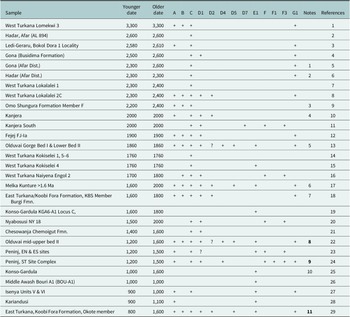
Viewed in terms of Stoneworking Modes (see Table 1), the Eastern African Plio-Pleistocene stone tool evidence features two major inflection points, one around 3.4 Ma, the other around 1.9 Ma.
Plio-Pleistocene Stone tool assemblages from the Eastern African prehistoric stoneworking survey

Table 1. Long description
The table has 18 columns. The first three columns are Sample, Younger date, and Older date, followed by columns for tool types labeled A, B, C, D1, D2, D4, D5, D7, E1, F, F1, F3, G1, then Notes and References. Each row represents a site, with Sample names such as West Turkana Lomekwi 3, Hadar Afar AL 894, Ledi-Geraru Bokol Dora 1 Locality, Gona Busidima Formation, Gona Afar Dist., Hadar Afar Dist., West Turkana Lokalalei 1, West Turkana Lokalalei 2C, Omo Shungura Formation Member F, Kanjera, Kanjera South, Fejej FJ-Ia, Olduvai Gorge Bed I and Lower Bed II, West Turkana Kokiselei 1 5–6, West Turkana Kokiselei 4, West Turkana Naiyena Engol 2, Melka Kunture greater than 1.6 Ma, East Turkana Koobi Fora Formation KBS Member Burgi Fmn., Konso-Gardula KGA6-A1 Locus C, Nyabosusi NY 18, Chesowanja Chemoigut Fmn., Olduvai mid-upper bed II, Peninj EN and ES sites, Peninj ST Site Complex, Konso-Gardula, Middle Awash Bouri A1 BOU-A1, Isenya Units V and VI, Kariandusi, East Turkana Koobi Fora Formation Okote member. Younger and Older date columns list ages in thousands of years, ranging from 3,300 to 800. Tool type columns contain plus signs for presence, question marks for uncertainty, or are blank for absence. Notes column contains numbers or bolded numbers referencing specific site details, and References column contains numbers corresponding to literature citations. Table footnotes specify which numbers in Notes refer to which sites, and which numbers in References correspond to which publications.
Notes: Specific sites included: 1. OGS-6, OGS-7, EG-10, EG-12, 2. AL-666, AL-894, 3. FtJi 1, 2, 5, Omo 57, 123, 4. KS1, KS2, 5. DK, FLK NN levels 1–4, FLK Zinj & upper levels, FLK N levels 1–6, Deinotherium level, HWK East, 6. Karre 1, Gombore I Level B, Iy, Garba IV Levels C-D, 7. Fxjj 1–3, 4–9, 13, 14, 8. HWK East: Sandy Conglomerate Levels 3–5, FLK North Sandy Conglomerate, MNK Skull Site, EFHR, MNK Main Occupation, FC West, FC, SHK, TK, BK, 9. Omo 57, 123, 10. KGA 4-A2, KGA 10-A11, KGA7-A1, A2, A3, KGA12-A1, KGA20-A1, A2, 11. FwJj1, GaJi 5, FxJj 11, 15–18, 20, 23, 37–38, 50, 63–64.
References: 1. Harmand et al. (Reference Harmand, Lewis, Feibel, Lepre, Prat, Lenoble, Boes, Quinn, Brenet, Arroyo, Taylor, Clement, Daver, Brugal, Leakey, Mortlock, Wright, Lokorodi, Kirwa, Kent and Roche2015), 2. Hovers (Reference Hovers, Schick and Toth2009), 3. Braun et al. (Reference Braun, Aldeias, Archer, Arrowsmith, Baraki, Campisano, Deino, DiMaggio, Dupont-Nivet, Engda, Feary, Garello, Kerfelew, McPherron, Patterson, Reeves, Thompson and Reed2019), 4. Semaw et al. (Reference Semaw, Rogers, Stout, Schick and Toth2009), 5. Semaw et al. (Reference Semaw, Rogers, Stout, Schick and Toth2009), 6. Kimbel et al. (Reference Kimbel, Walter, Johanson, Reed, Aronson, Assefa, Marean, Eck, Bobe, Hovers, Rak, Vondra, Yemane, York, Chen, Evensen and Smith1996), (Goldman-Neuman and Hovers, Reference Goldman-Neuman and Hovers2012), 7. Kibunjia (Reference Kibunjia1994), 8. Prat et al. (Reference Prat, Brugal, Tiercelin, Barrat, Bohn, Delagnes, Harmand, Kimeu, Kibunjia, P-J and Roche2005), 9. Merrick and Merrick (Reference Merrick, Merrick, Coppens, Howell, Isaac and Leakey1976), Howell et al. (Reference Howell, Haesaerts and de Heinzelin1987), Delagnes et al. (Reference Delagnes, Boisserie, Beyene, Chuniaud, Guillemot and Schuster2011), de la Torre (Reference de la Torre2004), 10. Plummer et al. (Reference Plummer, Bishop, Ditchfield and Hicks1999), 11. Bishop et al. (Reference Bishop, Plummer, Ferraro, Braun, Ditchfield, Hertel, Kingston, Hicks and Potts2006), 12. Asfaw et al. (Reference Asfaw, Beyene, Semaw, Suwa, White and WoldeGabriel1991), Barsky et al. (Reference Barsky, Chapon-Sao, Bahain, Beyene, Cauche, Celiberti, Desclaux, De Lumley, De Lumley, Marchal, P-E and Pleurdeau2011), 13. Leakey (Reference Leakey1971), de la Torre and Mora (Delagnes and Roche, Reference Delagnes and Roche2005), 14. Lepre et al. (Reference Lepre, Roche, Kent, Harmand, Quinn, Brugal, Texier, Lenoble and Feibel2011), 15. Lepre et al. (Reference Lepre, Roche, Kent, Harmand, Quinn, Brugal, Texier, Lenoble and Feibel2011), 16. Roche et al. (Reference Roche, de la Torre, Arroyo, J-P and Harmand2018), 17. Chavaillon and Piperno (Reference Chavaillon and Piperno2004), 18. Isaac and Isaac (Reference Isaac and Isaac1997), 19. Beyene et al. (Reference Beyene, Katoh, WoldeGabriel, Hart, Uto, Sudo, Kondo, Hyodo, Renne, Suwa and Asfaw2013), 20. Texier (Reference Texier1995), 21. (Gowlett et al., Reference Gowlett, Harris, Walton and Wood1981), 22. Leakey (Reference Leakey1971), de la Torre and Mora (Delagnes and Roche, Reference Delagnes and Roche2005), 23. Domínguez-Rodrigo et al. (Reference Domínguez-Rodrigo, Alcala and Luque2009), 24. de la Torre and Mora (Diez-Martín et al., Reference de la Torre, Mora, Domínguez-Rodrigo, Alcala and Luque2009), 25. Beyene et al. (Reference Beyene, Katoh, WoldeGabriel, Hart, Uto, Sudo, Kondo, Hyodo, Renne, Suwa and Asfaw2013), 26. Schick and Toth (Reference Schick and Toth2017), 27. Roche et al. (Reference Roche, Brugal, Lefevre, Ploux and Texier1988), 28. Shipton (Reference Shipton2011), 29. Isaac and Isaac (Reference Isaac and Isaac1997).
The period around 3.4 Ma marks the earliest evidence of occasional stoneworking. The stone tool evidence from this date onwards to 1.9 Ma features evidence of Modes A, B, C, and G1, anvil percussion, bipolar core reduction, short non-hierarchical core reduction, and platform core reduction (respectively). After 1.9 Ma evidence appears for Stoneworking Modes D, E, and F, flake retouch, LCT production, and BHC reduction.
The stoneworking methods present before 1.9 Ma are, to put it simply, simple. They work on pretty much any rock with even an approximation of conchoidal fracture. That they appear among artifacts made by novice craft/hobby knappers and even persons with little or no prior experience or knowledge about stone tools (Shea, Reference Shea2015; Snyder et al., Reference Snyder, Reeves and Tennie2022) suggests one can explain their occurrences in terms of improvisation involving local responses to immediate needs. Some teaching and learning and carrying rocks from one place to another probably went on among the Plio-Pleistocene stoneworkers who made these artifacts, much as it appears to do among living primates that use stone tools (McGrew, Reference McGrew1992; Haslam et al., Reference Haslam, Hernandez-Aguilar, Proffitt, Arroyo, Falótico, Fragaszy, Gumert, Harris, Huffman, Kalan, Malaivijitnond, Matsuzawa, McGrew, Ottoni, Pascual-Garrido, Piel, Pruetz, Schuppli, Stewart, Tan, Visalberghi and Luncz2017). (One thinks it would be odd indeed if it did not do so.)
How occasional was occasional? This earliest phase of Eastern Africa’s lithic record boasts an impressive gap nearly a million years long between the Lomekwi 3 evidence and the next dated appearances of lithic artifacts around 2.5–2.6 Ma, such as Nyayanga and Namorotukanan (both in Kenya) (Plummer et al., Reference Plummer, Oliver, Finestone, Ditchfield, Bishop, Blumenthal, Lemorini, Caricola, Bailey, Herries, Parkinson, Whitfield, Hertel, Kinyanjui, Vincent, Li, Louys, Frost, Braun, Reeves, EDG, Onyango, Lamela-Lopez, Forrest, He, Lane, Frouin, Nomade, Wilson, Bartilol, Rotich and Potts2023; Braun et al., Reference Braun, Palcu Rolier, Advokaat, Archer, Baraki, Biernat, Beaudoin, Behrensmeyer, Bobe, Elmes, Forrest, Hammond, Jovane, Kinyanjui, de Martini, Mason, McGrosky, Munga, Ndiema, Patterson, Reeves, Roman, Sier, Srivastava, Tuosto, Uno, Villaseñor, Wynn, Harris and Carvalho2025). Even after stoneworking seems to begin in earnest after 2.5 Ma, many other long gaps appear in the evidence from the same sedimentary basins. If Eastern African Plio-Pleistocene hominins were as profligate stoneworkers as their Holocene human descendants, then there would still be gaps, but many more of them and of shorter duration.
The period after 1.9 Ma appears to signal a shift to increasingly habitual stoneworking. To be clear, I am not arguing that occasional and improvisational stoneworking stopped, but rather that habitual stoneworking augmented it. Modes D, E, and F all require more time, impulse control, planning, and arguably expertise than Modes A, B, C, and G1 (Key et al., Reference Key, Stileman, Fedato and Eren2026). Diagnostic artifacts for Modes D, E, and F rarely appear among stone tools novice flintknappers produce spontaneously (i.e., without expert tutoring) for the simple reason one can easily make consequential errors in creating them (Shea, Reference Shea2015).
Carefully retouching the edge of a flake can restore a use-dulled edge to functionality, but doing so haphazardly or wrongly can diminish that edge’s cutting potential. For example, retouch initiated by striking along the edge of a flake’s smooth ventral surface “follows” that surface’s contour, creating a straight or slightly curved edge that cuts well. Striking both dorsal and ventral sides creates jagged edges that exert greater amounts of drag while cutting. (Picture the edge of a woodcarving knife vs. that of a cross-cut saw.)
Imposing an elongated shape on a core, such as an LCT, makes that core vulnerable to lateral fracturing and end-shock in ways that detaching flakes from shorter non-hierarchical cores does not (Callahan, Reference Callahan1979; Whittaker, Reference Whittaker1994; Patten, Reference Patten2009). Experiments reproducing LCTs suggest novices and relatively inexperienced stoneworkers can produce such artifacts, but they also show that experienced stoneworkers do so more swiftly and efficiently (i.e., detaching fewer flakes in the process and with fewer catastrophic errors) (Key et al., Reference Key, Stileman, Fedato and Eren2026).
Bifacial hierarchical core reduction (Mode E) requires a stoneworker to maintain a stable hierarchy between the side of an edge that serves as a source of fracture initiation points and the other side from which they detach longer, wider, and thinner flakes (Boëda, Reference Boëda, Dibble and Bar-Yosef1995).
These observations suggest that after 1.9 Ma, some hominins were devoting considerably more than the minimal amounts of thought, time, and labor to stoneworking. Percussive stoneworking also entails an imprecisely quantifiable risk of injury (Gala et al., Reference Gala, Lycett, Bebber and Eren2023). These increased costs and risks only make sense if hominins were engaging in more habitual stone tool use, using stone tools for longer periods, in more varied tasks, and with a significant “curated” component, −that is, carrying stone tools around with them and shaping stone tools for efficient carrying and safe use while cutting, and resharpening them when they became dull, damaged, or broken (Binford, Reference Binford1979; Shott, Reference Shott1996; Key et al., Reference Key, Proffitt, Stefani and Lycett2016).
Elsewhere (Shea, Reference Shea2017a, Reference Shea2017b), I have argued that hominin stoneworking follows a long-term and cumulative trend, from occasional to habitual to obligatory stone tool use. The Eastern African Plio-Pleistocene stone tool evidence supports that hypothesis’ predictions for all but the later, obligatory stone tool use phase. (That phase appears to have begun after 0.2–0.3 Ma [Shea, Reference Shea2017a, Reference Shea2017b]).
Discussion: Stoneworking and hominin extinctions
In a perfect world, one would be able to confidently assign specific stone tool samples to specific hominin creators. We do not live in a perfect world. Even in cases where hominin fossils identifiable to taxon appear together with stone tools in the same sedimentary deposit, we cannot and should not assume those hominins made those stone tools, merely that fossils and stone tools were deposited between the oldest and youngest dates for that deposit. We can, however, work with FADs and LADs for hominins and for the presence/absence of Modes A-I in the Eastern African stone tool evidence. This approach is not without risks or potential problems (Bobe and Wood, Reference Bobe and Wood2022), but it is better than nothing. Table 2 lists the FADs and LADs for Eastern African hominin genera.
First and last appearance dates for Plio-Pleistocene hominins in Eastern Africa
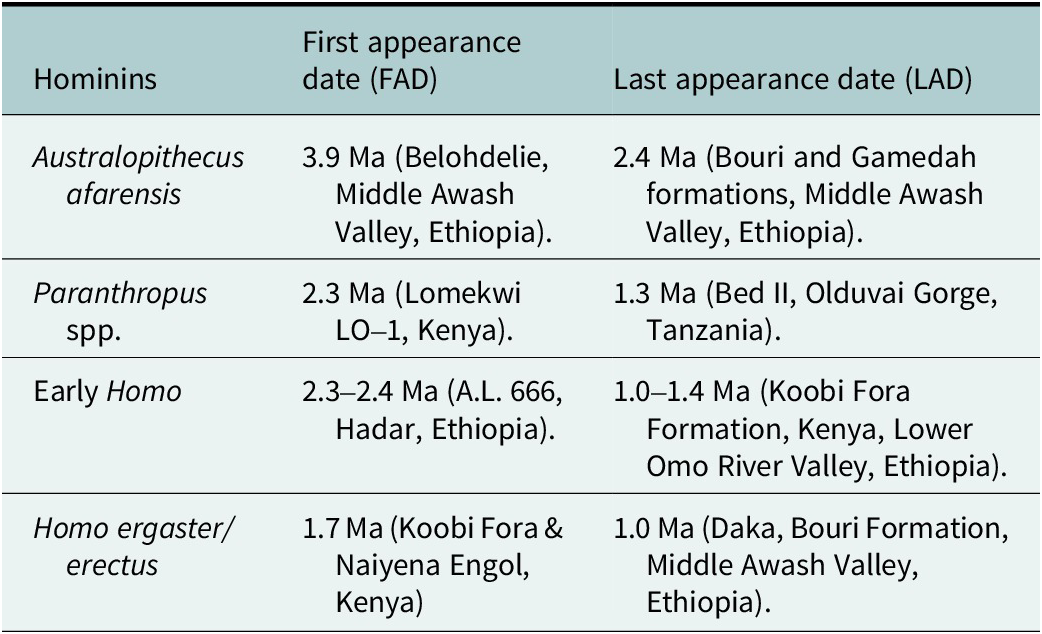
Table 2. Long description
From top to bottom, the first row lists Australopithecus afarensis with first appearance at 3.9 Ma in Belohdelie, Middle Awash Valley, Ethiopia, and last appearance at 2.4 Ma in Bouri and Gamedah formations, Middle Awash Valley, Ethiopia. The next row lists Paranthropus species with first appearance at 2.3 Ma in Lomekwi LO-1, Kenya, and last appearance at 1.3 Ma in Bed II, Olduvai Gorge, Tanzania. The third row lists early Homo with first appearance between 2.3 and 2.4 Ma at A.L. 666, Hadar, Ethiopia, and last appearance between 1.0 and 1.4 Ma in Koobi Fora Formation, Kenya, and Lower Omo River Valley, Ethiopia. The final row lists Homo ergaster or erectus with first appearance at 1.7 Ma in Koobi Fora and Naiyena Engol, Kenya, and last appearance at 1.0 Ma in Daka, Bouri Formation, Middle Awash Valley, Ethiopia.
The Eastern African stone tool evidence sheds little light on australopithecines’ extinction. They were around when some hominins started making stone tools between 2.5 and 3.5 Ma, but their LAD around 1.9 Ma leaves not a ripple in the stone tool evidence. If anything, evidence for stoneworking increases from that those dates onwards.
FADs for the Genus Homo ca. 2.3 Ma mark a major inflection point in the evidence. Around 2.5 Ma, hominins started making stone tools and littering Eastern Africa with them more regularly than previously (Key and Williams, Reference Key and Williams2026). That other parts of Africa show similar upticks in percussive stoneworking after 2.5 Ma (Plummer et al., Reference Plummer, Harmand, Finestone and Wilson2025) suggests this increase in stoneworking’s archaeological “visibility” was part of a wider evolutionary process and not a regional phenomenon unique to Eastern Africa.
FADs for Homo ergaster/erectus ca. 1.7 Ma correlate with first appearances of long core-tool (LCT) production and with the scaling-up of both hierarchical and non-hierarchical core reduction (Sharon Sharon, Reference Sharon2009; Sharon, Reference Sharon2010). The archaeological consensus holds LCTs were tools used to butcher large mammal carcasses or general purpose tools shaped for easy hand carrying (Wynn and Gowlett, Reference Wynn and Gowlett2018; Litov et al., Reference Litov, Ben-Dor and Barkai2026). Whatever their purposes, LCTs clearly worked well at them, for LCTs show up shortly after 1.6 Ma all over Africa and in southern Eurasia west of the Bay of Bengal and together with fossils of Homo ergaster/erectus and other species of the Genus Homo. LCTs are rarely the earliest lithic evidence for hominin activity in these regions (Shea, Reference Shea, Fleagle, Shea, Grine, Baden and Leakey2010). Instead, they seem to appear after delays of variable duration, perhaps a result of regional variation in hominins’ “settling in” and augmenting improvisation with more stereotyped ways of provisioning themselves with stone tools to serve predictable needs for such artifacts.
Paranthropus’ LAD after 1.3 Ma does not correlate with a major change in the Eastern African stone tool evidence. Paranthropus and H. ergaster/erectus were large, habitually ground-dwelling primates with similar nutritional requirements, and presumably similar ranked-choices among food sources. It is possible that more habitual stone tool use or novel stone tool uses as subsistence aids among Homo ergaster/erectus adversely affected Paranthropus. If so, however, then it appears to have been a long-running process, one that played out over 600,000 years between 1.2 and 1.8 Ma.
Paranthropines were by any measure evolutionarily successful, living in a wide range of African habitats for more than two million years. Why does their extinction leave so little trace in the stone tool evidence? Though early studies cast doubt on paranthropine stoneworking (Leakey, Reference Leakey1971), the last several decades have seen paleoanthropologists increasingly accept the possibility that Paranthropus made and used stone tools (Susman, Reference Susman1998; Prat, Reference Prat2025). But, what if we are wrong? While Paranthropus might have benefitted from using stone tools for pre-oral food processing as Early Homo and H. ergaster/erectus did, making, using, and maintaining percussively-fractured stone tools could have been redundant with their evolved anatomical supports for biting and chewing tough materials. Why learn stoneworking, risk injury doing so, and carry heavy stone tools around, if all they needed were the teeth already in their mouths? Paranthropus may have needed stone cutting tools no more so than wolves need knives or beavers need chainsaws.
Conclusion
This paper has explored what the Eastern African Plio-Pleistocene stone tool evidence arranged in terms of Stoneworking Modes A-I tells us about hominin extinction. It tells a complex story –not a surprising finding considering the chronological scale involved and the many uncertainties about who made which stone tools, and why they did so. The strongest case for a connection between extinctions in the hominin fossil record and changes in the stone tool evidence involve Early Homo and H. ergaster/erectus. Species of the Genus Homo appear entangled with the stone tool evidence in ways Paranthropus and Australopithecus do not.
A broad consensus among paleontologists holds that Early Homo’s extinction was a pseudo-extinction (“anagenetic speciation”) between at least one of those hominins and H. ergaster/erectus. Whether changes in stoneworking around 1.8 Ma were causes, consequences, or a bit of both in this transition invites multiple working hypotheses.
Paranthropus’ extinction occurred after the appearance of novel features of (presumably) H. ergaster/erectus’ habitual stoneworking around 1.8 Ma. Nevertheless, one must remain mindful of the 600,000-year offset between FADs of that stone tool evidence Paranthropus’ LAD of 1.2 Ma. Six hundred thousand years is a lot of time. We cannot reject the hypothesis that Paranthropus’ extinction had nothing to do with H. ergaster/erectus’ activities.
This paper has done what it can with the Plio-Pleistocene lithic evidence from Eastern Africa in its current state. Viewing that evidence thorough the lens of Stoneworking Modes A-I does not overturn, and indeed supports, the current archaeological consensus about differences among australopithecines’, paranthropines’, and early Homo’s involvements in percussive stoneworking. This finding is remarkable, at the very least, because Stoneworking Modes A-I was not purposefully designed with that goal in mind. This suggests Stoneworking Modes A-I may have value for investigating hominin extinctions in other contexts where traditional archaeological stone tools systematics makes large-scale comparisons difficult other than in terms of “lowest common denominators.” One thinks using Stoneworking Modes A-I for such purposes would be more effective and more credible if prior theory informed it, −predicting specifically how hominin extinctions should affect variability in the stone tool evidence. Archaeologists have tried to investigate these matters by reverse-engineering “prior” theory after having documented archaeological variability for going on a century or more (Shea, Reference Shea2011). A different, predictive “strategic modeling” approach (Tooby and DeVore, Reference Tooby, DeVore and Kinzey1987) to the stone tool evidence will almost certainly be more useful to larger field of human origins research (Shea, Reference Shea2017b).
Moving forward requires two courses of action. First, we must increase the number of Eastern African Plio-Pleistocene lithic assemblages with well-constrained ages. Second, we must test hypotheses derived from the Eastern African record with data from Southern Africa and other regions. Doing so will show us whether the Eastern African evidence is representative of continent-wide evolutionary processes or if it documents strictly regional phenomena. Organizing new evidence and previously-discovered evidence from Southern Africa (and elsewhere) in terms of Stoneworking Modes A-I will make such comparisons more convenient (or at least less fraught) than alternatives that require one to reconcile seemingly-irreconcilable conflicts between competing stone tool systematics (artifact typologies and measurement conventions) and then to re-analyze, artifact-by-artifact, the hundreds of thousands of Plio-Pleistocene stone tools reposing in museum archives. If using Stoneworking Modes A-I does not answer a particular research question, then the latter, artifact-based option remains available.
Open peer review
To view the open peer review materials for this article, please visit http://doi.org/10.1017/ext.2026.10014.
Data availability statement
All the data used in this paper are in Table 1. They are excerpted from a larger database, the Eastern African Stoneworking Survey (EAPSS) published in Shea (Reference Shea2020) and available in digital format at this website, https://sites.google.com/a/stonybrook.edu/john-j-shea/eastern-african-stone-tools-east-typology?authuser=0.
Acknowledgements
I thank my wife, Patricia Crawford, and two anonymous reviewers for their comments on a previous draft of this paper.
Author contribution
J.J.S. wrote the entirety of this paper himself.
Financial support
This work received no financial support.
Competing interests
The author declares no conflict of interests.


 Open access

