Towards the end of Shakespeare’s narrative poem Venus and Adonis (1593), the distraught Venus discovers Adonis’s body after he has been killed by the boar. She observes not only the ‘wide wound’ made by the boar’s tusk but also the effect of Adonis’s death on the surrounding landscape: ‘No flower was nigh, no grass, herb, leaf, or weed / But stole his blood, and seemed with him to bleed’.Footnote 1 Here the environment appears to be capable of appropriating Adonis’s blood and even partaking in his suffering; although the word seemed raises the possibility that this may be an illusion. Nevertheless, the terms in which the narrator describes this seeming correspondence between Adonis and the natural world – and Venus’s subsequent reaction – are highly suggestive:
This stanza describes Venus’s passionate response to Adonis’s death and her attempts to express her sorrows. The narrator employs an unusual verbal form of passion to mean ‘To show, express, or be affected by passion or deep feeling’ (OED, v., 3). Shakespeare uses the word elsewhere to mean a spoken articulation of grief, yet Venus expresses her sorrows silently: ‘Dumbly she passions’.Footnote 2 In this way, while Venus herself is silent, the narrator of the poem makes creative use of an existing emotion word to describe her bodily expressions of woe. But what is especially striking here is the phrase ‘solemn sympathy’. The term sympathy – which could refer to natural or cosmic correspondences in the period – implies an occult affinity between Adonis and the landscape; yet the qualifier solemn imbues it with an emotional quality.Footnote 3 The poem thus shifts its attention from the natural environment to Venus’s emotions: the apparent ‘sympathy’ of the grassland is both a figure and prompt for her extreme grief. On another level, however, this passage dramatizes a wider shift in early modern culture, whereby the concept of sympathy is increasingly associated with, and used to express, human feelings. This solemn sympathy is less a magical quality of the landscape and more a powerful metaphorical means for Shakespeare to describe Venus’s sorrow for Adonis’s death.
The predicament that Shakespeare depicts here – which involves the relationship between emotional experience, emotional expression, and the concept of sympathy – is the central subject of the present book. The chapters that follow offer a new conceptual and semantic history of sympathy in the early modern period. I argue that the emergence and development of the term sympathy is related to wider changes in the affective culture of early modern England, in which emotions were increasingly seen as things that individuals do rather than forces that act upon them. Venus and Adonis itself hints at this shift in its innovative use of passions, an earlier term for emotions, as a verb.Footnote 4 The poem’s fascination with sympathy – and its experimentation with this verbal form of passion – points not only to a complex understanding of fellow-feeling but also to an active form of emotional experience. This shift would eventually lead to the word passions, with its implications of passivity, being superseded by the term emotions.Footnote 5 As we shall see throughout this book, Renaissance representations of sympathy often have a self-consciously semantic dimension, with characters either dissatisfied with the language they use, or seeking out new words to describe their feelings. By tracing this history the book challenges well-established critical and historical narratives regarding the ‘development’ of sympathy in pre-modern Europe, as well as offering a wider reassessment of early modern emotions, thought, and ethics.
In recent years there has been a resurgence of scholarly interest in sympathy, particularly amongst literary historians and philosophers, which is arguably part of the wider ‘affective turn’ across the humanities.Footnote 6 However, scholars have generally worked under the assumption that the crucial period for the development of sympathy was the eighteenth century. In the pre-modern world of the Renaissance, the argument goes, sympathy was an essentially passive phenomenon, in which individuals were affected by physical and physiological processes. In an important article from 1998, for example, Andrew Cunningham writes that, ‘Prior to the Enlightenment … “sympathy” usually referred not to a coming together of mental states, but to a coming together of physical objects, whether this took the form of simple attraction, of the mutual assimilation of qualities, or of mutual interaction towards some common end’.Footnote 7 Similarly, Ildiko Csengei’s study of eighteenth century sensibility emphasizes the prevalence of the scientific model of sympathy in earlier periods: ‘During the seventeenth century, sympathy was defined as an attraction that made similar material particles migrate towards each other’.Footnote 8 Jeanne M. Britton goes further by describing this earlier conception of sympathy as ‘an unreflective, somatic communication’ that ‘persists well into the early nineteenth century and often … relies on untraceable, immaterial affinities between organs or across bodies’.Footnote 9 And, in her study of Emotions in History: Lost and Found (2011), Ute Frevert has presented the emotional form of sympathy as an invention of modernity:
Empathy and sympathy/compassion serve as great examples of emotions that are ‘invented’ and ‘found’ in the modern period … Since the eighteenth century, empathy and sympathy have been regarded as civil society’s primary emotional resources, connecting citizens and fine-tuning their mutual relations. They have fuelled humanitarian movements, from abolitionism to campaigns against cruelty, from giving shelter to escaping slaves to donating money for grief-stricken citizens in the present world.Footnote 10
This passage perhaps raises more questions than it answers. Are emotions ‘invented’ or ‘found’ in particular periods? Certainly new emotion words come into being, including sympathy, which first appears in English printed texts in the 1560s, and empathy, which emerges at the start of the twentieth century. But the question of whether those words create new feelings or provide new ways of describing pre-existing ones is a complex and contentious one. What is the relationship between emotional expression and emotional experience? Frevert does admit that there was a vibrant early modern history of emotions; but her comments here reinforce the conventional view that the crucial period for the development of sympathy was the eighteenth century. The present book argues that, pace Frevert, sympathy and compassion were primary emotional resources prior to the eighteenth century; that Shakespeare and his contemporaries were fascinated by ideas of pity and fellow-feeling; and that there was a culture of sympathy – and an emerging discourse of sympathy – in the early modern period.
We might begin by thinking about the history of the term sympathy, which had multiple and shifting meanings during the sixteenth and seventeenth centuries. The OED suggests that the word was primarily understood to mean ‘A (real or supposed) affinity between certain things, by virtue of which they are similarly or correspondingly affected by the same influence … (esp. in some occult way), or attract or tend towards each other’ (OED, 1a; first cited usage 1586). This earlier conception of sympathy – a physical or occult attraction between people, objects in the cosmos, parts of the body, the body and the soul, or even musical vibrations – appears in the work of several Latin authors from antiquity who were influential in the Renaissance, including Galen, Plutarch, and Pliny.Footnote 11 For example, in book 20 of his Natural History, Pliny the Elder writes that:
The Greeks have applied the terms ‘sympathy’ and ‘antipathy’ [sympathiam et antipathiam] to this basic principle of all things: water putting out fire; the sun absorbing water while the moon gives it birth; each of these heavenly bodies suffering eclipse through the injustice of the other … the magnetic stone draws iron to itself while another kind of stone repels it … Other marvels, equally or even more wonderful, we shall speak of in their proper place.Footnote 12
Here Pliny draws our attention to the fact that sympathy is a word and concept borrowed from the Greeks: the Latin sympathia comes from the ancient Greek συμπάθεια, or sumpatheia (‘having a fellow feeling’). He goes on to describe an elaborate system of hidden sympathies and antipathies, which offers a wonderfully comprehensive way of explaining various natural phenomena, including why objects attract or repel each other; why the sun absorbs water; why magnets work; and (perhaps most tenuously) why the blood of a goat can break diamonds. It is a curious mixture of natural philosophy, magic, and folklore.
These Latin authors were an influence on European Renaissance writers on occult philosophy, including Heinrich Cornelius Agrippa and Giambattista Della Porta.Footnote 13 Agrippa’s De occulta philosophia (first published 1531–3) and Della Porta’s later study of Magia naturalis (first published 1558), which were both written in Latin and display their indebtedness to Pliny, invoke the ancient system of sympathies and antipathies. For example, Della Porta offers this admirable example from Pliny: ‘A Dog is most friendly to a man; and if you lay him to any diseased part of your body, he takes away the disease to himself; as Pliny reporteth’.Footnote 14 He also makes a suggestive analogy between the parts of the world and the parts of the body:
The Platonicks termed Magick to be the attraction or fetching out of one thing from another, by a certain affinity of Nature. For the parts of this huge world, like the limbs and members of one living creature, do all depend upon one Author, and are knit together by the bond of one Nature: therefore as in us, the brain, the lights [lungs], the heart, the liver, and other parts of us do receive and draw mutual benefit from each other, so that when one part suffers, the rest also suffer with it …
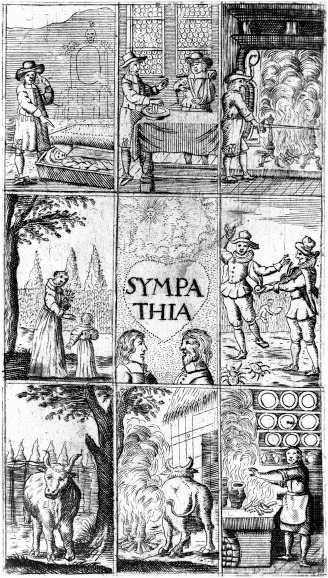
For Della Porta, the world is like the human body, and vice versa, with their individual components responding sympathetically to each other.Footnote 15 The implication is that the transference of suffering between individuals is also a natural process of attraction and affinity (rather than a cognitive or imaginative response). Magia naturalis was widely read across Europe, and translated into various languages including Italian, Dutch, German, and French.Footnote 16 It is one of the few sources cited by Michel Foucault in his influential characterization of sympathy as the most significant and powerful form of resemblance in the early modern period.Footnote 17 The fact that Agrippa and Della Porta’s works were also translated into English in the mid-seventeenth century (see Figure 1) suggests that such concepts remained influential, even if some readers were beginning to doubt the evidential basis of such claims.Footnote 18

Figure 1 Natural magick by John Baptista Porta, a Neapolitane: in twenty books … Wherein are set forth all the riches and delights of the natural sciences (London, 1658), title page.
The classical concept of sympathy also finds its way into various English texts in the sixteenth century. The Latin term sympathia appears in Thomas Elyot’s Latin Dictionary (1538), which defines it as ‘a mutuall combination of thynges naturall in the operation of theyr powers and qualities, as water in coldenesse dothe participate with erthe, in moysture with the ayre, the ayre with the fyre in heate, with water in moysture’.Footnote 19 Sympathia also appears in Thomas Gale’s translation of Galen’s works from 1586, which includes a discussion of the ways in which parts of the body affect each other: ‘at this time the causes of these intemperatives are to be considered, whether these be common to all the whole bodie, or else proper of some partes, which should infest the ulcerate member by societie, the Greekes call it Simpathia’.Footnote 20 In the same year early modern readers could have encountered the concept of sympathy in Timothy Bright’s A treatise of melancholie, which uses the Anglicised form simpathy to describe how the brain communicates with the heart, and how both parts then affect the rest of the body: ‘these being troubled carie with them all the rest of the partes into a simpathy, they of all the rest being in respect of affection of most importance. The humours then to worke these effectes, which approch nigh to naturall perturbations grounded upon just occasion, of necessity, alter either brayne or hart’. The heart is then ‘moved to a disorderly passion’.Footnote 21 By the 1580s, then, sympathy was used by medical writers to describe a form of compassionate contagion between bodily parts and understood in humoral terms.
The idea of sympathy as correspondence and transmission persists into the seventeenth century. In Philemon Holland’s 1603 translation of Plutarch’s Morals, for example, sympathy is included in the list of ‘certeine obscure words’ that are helpfully glossed at the back of the volume: ‘Sympathie, that is to say, A fellow feeling, as is betweene the head and stomacke in our bodies: also the agreement and naturall amitie in divers senslesse things, as between iron and the load-stone’.Footnote 22 And in The Passions of the Minde in Generall (1604) Thomas Wright likens the process of moving others to notions of physical transference and induction: ‘If my hand be hot for the fire, the fire must bee more hot it selfe: if my chamber be lightsome for the beames of the sunne, the sunne it selfe must be more lightsome: If I must bee moved by thy perswasions, first thou must shew me by passion, they perswaded thy selfe’.Footnote 23 Wright conceives of emotional transference in the same way that he regards the transference of heat and light between physical bodies or spaces. Half a century later, in A Late Discourse … Touching the Cure of Wounds by Sympathy (1658), Kenelm Digby describes his famous ‘powder of sympathy’ – which could cure wounds without touching them – and suggests that laughing and sadness are also transmitted by an automatic process:
Now lets consider how the strong imagination of one man doth marvailously act upon another man who hath it more feeble and passive … If one come perchance to converse with persons that are subject to excesse of laughter, one can hardly forbear laughing, although one doth not know the cause why they laugh. If one should enter into a house, where all the World is sad, he becomes melancholy, for as one said, Si vis me flere dolendum est primum ipsi tibi …Footnote 24
Here Digby refers to Horace’s often-cited Latin tag ‘si vis me flere’ – the rhetorical ideal that in order to move others you have to be moved yourself.Footnote 25 Digby invokes this familiar rhetorical trope but suggests that such emotional transference has a physiological basis, continuing with the reflection that ‘Women and Children being very moist and passive, are most susceptible of this unpleasing contagion of the imagination’ (p. 93). Using language that recalls Renaissance antitheatricalists, Digby proposes that the transmission of sorrow is a form of contagion that affects weak and passive individuals.Footnote 26 Such examples offer a compelling picture of sympathy in the sixteenth and seventeenth centuries: the term, it would seem, simply described the process by which two things influenced each other, or were attracted to one another (see Figure 2).
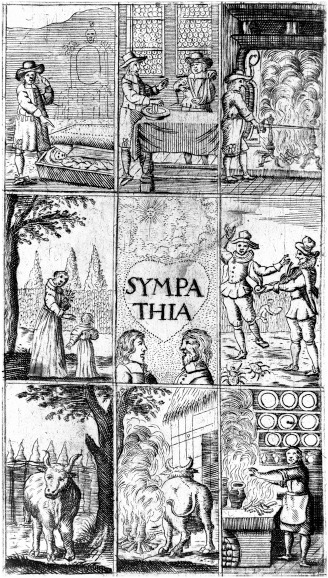
Figure 2 Frontispiece to Kenelm Digby, Eröffnung unterschiedlicher Heimlichkeiten der Natur, worbey viel … Reden von nützlichen Dingen … und vornemlich von einem wunderbaren Geheimnüss in Heilungen der Wunden … durch die Sympathiam, trans. M. H. Hupka (Frankfurt, 1677).
This picture of early modern sympathy – as a form of likeness and correspondence, and part of a wider analogical worldview – is corroborated by the history of the word that we find in the OED. The more general sense of ‘Agreement, accord, harmony, consonance, concord; agreement in qualities, likeness, conformity, correspondence’ (OED, 2) has the earliest citation (Geoffrey Fenton’s 1567 translation of Bandello: ‘If he had bene aunswerd with a sympathia or equalitie of frendshipp’). The idea of sympathy as ‘The quality or state of being thus affected by the suffering or sorrow of another; a feeling of compassion or commiseration’ (OED, 3c) does not, we are told, appear until 1600; while the more complex idea of sympathy as ‘the fact or capacity of entering into or sharing the feelings of another or others; fellow-feeling’ (OED, 3b) only appears in 1662. The OED’s account of the development of sympathy might thus confirm the standard view that the ‘modern’ understanding of the term – as a complex, imaginative engagement with the other – only emerges fully in the long eighteenth century with the philosophical writings of David Hume and Adam Smith.Footnote 27
Critics are beginning to recognize that this standard history of sympathy needs revision: Seth Lobis’s The Virtue of Sympathy (2015) has argued for the earlier emergence of a culture of sympathy, but his study focuses on later seventeenth-century writers, including Margaret Cavendish, Katherine Philips, and John Milton, and thus neglects the key developments that took place in the late sixteenth and early seventeenth centuries.Footnote 28 Other critics working in later periods have acknowledged that there was not a clear and decisive shift from one model to the other; as Lily Gurton-Wachter suggests in a recent discussion of sympathy in the eighteenth and early nineteenth centuries, ‘fellow feeling didn’t simply replace the natural or physiological sympathies’, but rather ‘the two overlapped and intertwined’, and ‘the latter never fully disappeared’.Footnote 29 I agree with Gurton-Wachter that the transition from one model to the other was not linear or uninterrupted, but would argue that scepticism regarding the natural or physiological model can be traced back to the sixteenth century. Indeed when we turn to literary, dramatic, and religious texts from this period we can see the gradual emergence of the more ‘modern’ usages of the term considerably earlier than the OED suggests. This more complex usage of sympathy grows out of, and extends, an early modern fascination with ideas of pity and compassion; and even before the term is used in this sense, literary and dramatic representations of fellow-feeling point to a complex imaginative and cognitive engagement with the other.
My investigation into this conceptual and semantic history poses some complex methodological questions: how can one be sure that a word that is shifting in meaning is being used in a particular way in any given text? Does the appearance of a new emotion word create new possibilities of feeling? How far can one identify the nascent presence of a concept, even when the word is absent? This book does not seek to provide definitive answers to these questions, but it does examine a wide range of usages of the words sympathy and sympathize, as well as the period’s fascination with fellow-feeling and compassion, and attempts to map the gradual coalescing of the two. This history could of course be traced back further – for example to the medieval concept of ‘pitee’ (deriving from the Latin pietas), and to classical poetics.Footnote 30 Yet there is a marked intensification in articulations of compassion and pity in the late sixteenth century, when earlier terms such as rue and ruth start to become obsolete and sympathy offers a new way of conceptualizing and articulating a correspondence of woe. It is thus an important example of the phenomenon described by Eric Auerbach: ‘on the basis of its semantic development a word may grow into an historical situation and give rise to structures that will be effective for many centuries’.Footnote 31 As we shall see, certain developments in the sixteenth and seventeenth centuries meant that a word from natural philosophy evolved into a more specifically affective term used to describe emotional correspondence between individuals. In this way, my particular focus on the history of the term sympathy is not merely etymological or philological but rather part of a broader argument about changes in social and religious life in the period – which I will return to later in this Introduction – and the shifting understanding of human emotions and relationships.
In our own period, sympathy has arguably been replaced by empathy as the primary term for describing compassion and fellow-feeling.Footnote 32 And yet, as Lauren Wispé has written, ‘The concepts of sympathy and empathy are frequently confused, and both have been variously and vaguely defined’.Footnote 33 More recently, Remy Debes has suggested that the two terms are ‘eclectic concepts, which only the most dogmatical ignorant pretend to separate objectively and without stipulation’.Footnote 34 As we noted earlier, empathy is the more recent term, and first appears in English in 1909 (Edward Titchener’s translation of Theodore Lipps’s term Einfühlung). It is thus another loan word, from another language. The term suggests ‘The quality or power of projecting one’s personality into or mentally identifying oneself with an object of contemplation, and so fully understanding or appreciating it’ (OED, 2a). In modern and contemporary usage, empathy is generally regarded as an imaginative process, in which one imagines oneself in the situation of the suffering other, while sympathy involves feeling pity and compassion for the other from one’s own perspective. But this book will argue that both of these ideas were formerly contained within the word sympathy; in other words, it is only in the last century that the term empathy has come to denote a distinct type of engagement with others. As we shall see, early modern representations of fellow-feeling involve complex forms of imaginative projection and identification that could certainly be described as empathetic. The semantic history of sympathy thus demonstrates the extent to which these different aspects of pity, compassion and emotional transference are closely related and often overlap.
The present book, then, does not seek to offer a complete or comprehensive history of sympathy; rather it illuminates a crucial period in its development in Anglophone culture. What is especially striking in tracing this history is that some of the earliest examples of the word sympathy appear in literary texts and are associated with emotional correspondence. These specifically emotional usages – often describing a ‘sympathy of affections’ between friends or lovers – first appear in translations of European vernacular texts.Footnote 35 For example, in Thomas Hudson’s 1584 translation of Du Bartas’s The Historie of Judith we find a moving description of Judith and her husband: ‘this chaste young-man & his most chastest wife, / as if their bodies twaine had but one life’. This text invokes the humanist idea of one soul in two bodies, in this case two individuals who are identical in thought and expression: ‘what th’ one did will, the other wild no lesse, / As by one mouth, their wils they do expresse’. This leads the narrator to reflect upon their emotional correspondence:
The narrator includes the word simpathie to describe this emotional correspondence; as with other early usages, the word is italicized and capitalized, indicating that it is imported directly from the French original.Footnote 37 In this way, while Hudson finds English equivalents for many of the words in this passage, he retains the French term simpathie to describe the close affinity between Judith and her husband. At the back of Hudson’s text we find ‘a table of signification of some words as they are used before’, in which sympathie is glossed as ‘Concordance of nature and things’’ (sig. H4v). As we have already seen, this was the standard definition of the word in the late sixteenth century. However, within the poem itself the term is clearly being used to describe an exchange of sorrows. The importance of this passage is further evidenced by the fact that Robert Allott reproduces it as the final extract in a section marked ‘Sorrow’ in his poetic anthology Englands Parnassus (1600).Footnote 38 The anthologizing of these four lines demonstrates that sympathy was being presented to English readers as a quotable and useful word for expressing grief and compassion. As we will see in Chapter 3, such anthologies and miscellanies played an important role in disseminating certain innovative emotion words, and provided new models of fellow-feeling and gender relations that became available in the wider culture.
While Hudson’s translation imports the French word sympathie (and glosses it in its earlier sense of correspondence) we find a rather different case when we turn to John Harington’s influential 1591 English version of Ariosto’s Orlando Furioso. At the start of book 30, the narrator apologizes for his rude comments about women at the end of the previous book and asks for their clemency. His explanation is that he has been carried away by a kind of literary madness, and, more specifically, that he was moved with ‘sympathy’ for Orlando:
In the 1591 edition there is a marginal gloss to the left of this stanza, which tells us that ‘Sympathy is in effect, as much as compassion or feeling of anothers misery’.Footnote 39 Harrington’s poem thus offers clear evidence that the affective understanding of sympathy was available and conceivable as far back as the early 1590s. What makes this example even more suggestive is that, in Ariosto’s original, the narrator compares his passion to Orlando’s love-induced madness, but there is no reference to anything that we might call sympathy. The Italian simpatia does not appear; and the narrator simply says (to quote a modern prose translation) ‘I am no less divorced from myself than was Orlando’.Footnote 40 This is Harington introducing the word and the concept of sympathy into his translation of an Italian text. This moment thus represents a creative imitation or outdoing of Ariosto, in which Harington is also introducing this definition of the term to his English readers.
In addition to such literary examples, there are various noteworthy instances of religious writers using the term sympathy to refer to fellow-feeling in the late sixteenth century. While writers of imaginative literature appear initially to have borrowed the term from continental texts, religious writers seem to have derived it from classical and natural philosophical works. Early examples use the term in its wider sense of agreement to describe the affinity between the soul and the body, as we see in Richard Cavendish’s The image of nature and grace (1571): ‘And even naturall Philosophy teacheth this, that betweene the soule and the body, there is a certaine sympathy or knitting of affection: for who seeth not that in melancholy bodyes the mynde is heavy and solitary, in sanguine bodies mery and lyght’.Footnote 41 This interest is extended in various sermons from the 1580s onwards, which use the idea of sympathy between parts of the body – which we have already seen invoked in works of magic and medicine – as a way of describing the unity between members of the church. For example, William Burton’s An exposition of the Lords Prayer (1594) includes an extended meditation on the first word of the Lord’s prayer – ‘our’ – in the form of a catechism. The word not only unites the speakers in prayer but also in sympathy and fellow-feeling:
it putteth us in minde of that sympathie and fellow-feeling of our brethrens miseries, which may move us to helpe them even when we can, & have fit occasion: for we are all as members of one and the same bodie by faith: therefore if one bee hurt, all must helpe; if one bee grieved, all must bee grieved; and if one rejoyce, all must rejoice.Footnote 42
As Burton suggests, if one person is grieved, all must be grieved, as all ‘members’ are part of the same body by faith; he combines ‘sympathie’ with ‘fellow-feeling’ to suggest this shared suffering. The marginal note points to various biblical verses on this theme, including Romans 12:15 (‘Rejoyce with them that rejoyce, & wepe with them that wepe’), which was frequently quoted in the period, and which Burton duly paraphrases. His description of sympathy may suggest a straightforward or automatic form of emotional correspondence; and yet, as we shall see in Chapter 2, sermons increasingly associate sympathy with an imaginative response to the suffering of others. This kind of response often involved reflecting upon and imaginatively participating in Christ’s passion, which was arguably the preeminent ethical example of intersubjective sympathy.Footnote 43 As Thomas Bilson writes, in The survey of Christs sufferings for mans redemption (1604), ‘this is that which you call sympathie, when both doe suffer paine together, the one from and with the other’.Footnote 44
By the turn of the seventeenth century, then, sympathy could be used in the narrower sense of shared suffering and fellow-feeling, as well as the more general senses of agreement and physiological correspondence. One particularly influential writer from this period, Michel de Montaigne, refers to both of these understandings of sympathy in his Essays. English readers would have encountered the term sympathy in John Florio’s 1603 translation, although – as we saw in the case of John Harington – Florio sometimes allows himself a degree of creativity and liberty in his usage of the word. In Florio’s translation of ‘An Apologie of Raymond Sebond ’ Montaigne explicitly mentions the earlier model of sympathy as correspondence and agreement: ‘There are certaine inclinations of affection, which without counsell of reason arise somtimes in us, proceeding of a casuall temerity, which some call Sympathie: beasts as wel as men are capable of it’.Footnote 45 This is a fairly accurate translation of the French, which includes the term sympathie: ‘que d’autres nomment sympathie’.Footnote 46 Clearly Montaigne is aware of the earlier concept, characterizing it as an unreasoned inclination of affection found in both humans and animals. However, in another essay, ‘Of crueltie’, Montaigne writes candidly about his own more complex feelings of pity and compassion:
I have a verie feeling and tender compassion of other mens afflictions, and should more easily weep for companie sake, if possiblie for any occasion whatsoever, I could shed teares. There is nothing sooner mooveth teares in me, then to see others weepe, not onely fainedly, but howsoever, whether truely or forcedly … As for me, I could never so much as endure, without remorse and griefe, to see a poore, sillie, and innocent beast pursued and killed … And least any bodie should jeast at this simpathie, which I have with them, Divinitie it selfe willeth us to shew them some favour.Footnote 47
Here Montaigne admits his readiness to weep, even if the weeping he responds to is produced ‘fainedly’. He thus attests to his imaginative capacity for entering into the feelings of others – whether humans or animals – and Florio once again borrows simpathie from the original French text. The word is used to describe sympathy with another creature (‘a poore, sillie, and innocent beast’) that is quite unlike the self, and thus recalls Montaigne’s memorable reflections upon his cat that appear in ‘An Apologie of Raymond Sebond ’.Footnote 48 It seems clear that Montaigne used the French word in both senses: the physiological and the emotional. His essays thus provide further evidence that these two conceptions of sympathy coexisted in the Renaissance. The fact that the word could be used in both senses also suggests the close affinity – or perhaps sympathy – between these two definitions of the term.
There is another passage in Florio’s translation that is even more suggestive: Montaigne’s account of the execution of a thief in Rome, which also appears in ‘Of crueltie’. This passage is highly concerned with pity and a community of feeling:
It was my fortune to be at Rome, upon a day that one Catena, a notorious high-way theefe, was executed: at his strangling no man of the companie seemed to be mooved to any ruth; but when he came to be quartered, the Executioner gave no blow that was not accompanied with a pitteous voyce, and hartie exclamation, as if every man had had a feeling sympathie, or lent his senses to the poore mangled wretch.
Here, then, we have a moving account of this ‘companie’ sharing in this piteous spectacle. When Catena is hanged, no one is moved to ‘ruth’ – an earlier term for compassion and pity that was becoming increasingly archaic in the Renaissance. Yet they do have a ‘feeling sympathie’ that is expressed audibly, and which emerges as the man’s torture continues. The passage thus describes the shared feeling of sympathy between this community of spectators, and how they projected those feelings onto the object of contemplation. We might also suggest that there is a kind of textual community being constructed here, as Montaigne, Florio, and their readers are drawn into this imagined community as well. And yet, in the French original, Montaigne does not use the word sympathie:
On l’estrangla sans aucune émotion de l’assistance; mais, quand on vint à le mettre à quartiers, le bourreau ne donnoit coup, que le peuple ne suivit d’une vois pleintive et d’une exclamation, comme si chacun eut presté son sentiment à cette charongne [as if every one had lent his feelings to this carcass].
In the French text Montaigne uses the word sentiment, as well as émotion, which had yet to be absorbed into English, but not sympathy. Clearly, then, this is a moment when Florio wanted to amplify and extend Montaigne’s vivid description of the crowd ‘len[ding]’ their feelings to the man. This sense of an outward movement from the self seems to have caught Florio’s imagination and prompted him to add the word sympathie – used in the sense of feeling – into his translation. This example would suggest that the transmission of sympathy was more intricate and two-way than it might at first appear: the word both emerges from, and finds its way back into, translations of European texts.
Given these complex usages of the term sympathy it is perhaps surprising that early modern historians and critics have been so adamant that it was understood strictly in material and physical terms. This is related to a larger tendency in the study of early modern emotions to argue for the prevalence and importance of Galenic humoral theory. In 1999, Michael Schoenfeldt argued that the Renaissance was a period ‘when the “scientific” language of analysis had not yet been separated from the sensory language of experience’, and that ‘the Galenic regime of the humoral self … demanded the invasion of social and psychological realms by biological and environmental processes’.Footnote 49 Similarly, Gail Kern Paster’s Humoring the Body (2004) emphasized the ways in which early modern emotions were ‘the stuff of the body’ and inseparable from physiological experiences.Footnote 50 She argued that early modern texts point to a ‘psychophysiological reciprocity between the experiencing subject and his or her relation to the world’, and that the humoral body is ‘characterized not only by its physical openness but also by its emotional instability and volatility, by an internal microclimate knowable, like climates in the outer world, more for changeability than for stasis’ (p. 19). More recently, Mary Floyd-Wilson has suggested that some emotions could not be explained in such humoral terms; yet her approach is nevertheless similar to that of Paster, emphasizing the influence of occult sympathies and antipathies on women’s bodies and emotions. Floyd-Wilson argues that sixteenth-century understandings of sympathy ‘had surprisingly little to do with moral philosophy’, and that, prior to the eighteenth century, ‘sympathy was not just a somatic feeling but a somatic feeling that breached the boundaries of individual bodies’.Footnote 51 In this way, while Floyd-Wilson’s study attempts to move beyond humoral theory her conception of sympathy and early modern emotion remains largely deterministic, passive, and bodily. According to her, the sympathy that existed between individuals was no different from the magical forces that bind the universe together.
The present book builds upon this scholarly interest in the passions and the transmission of affect, while at the same time questioning the emphasis upon humoral theory and the body. It thus joins with other recent studies that have argued for a more pluralistic and active conception of early modern emotional experience. Richard Strier – one of the most strident critics of the humoral approach – has argued that the ‘new humoralists’ are akin to new historicists in their questioning of individual agency, and that humoral theory is one of several tools used by scholars to characterize the period ‘in dark and dour terms’. He writes that the focus of the new humoralists ‘might be said to be on selves in the period as physiocultural rather than sociocultural formations’.Footnote 52 Meanwhile Cora Fox and Lynn Enterline have argued for greater attention to the influence of classical narratives and intertexts in studying the emotional culture of the period, with Enterline focusing on the ways in which Shakespeare’s reflections on the passions ‘involve meta-theatrical or meta-rhetorical reflections on classical figures, texts, and traditions’.Footnote 53 Other scholars working in the field have highlighted the importance of religious and philosophical frameworks. For example, Brian Cummings and Freya Sierhuis have called for a ‘realignment’ of the field, ‘both with the ancient concerns of rhetoric and with contemporary reflections on intersubjectivity and self-reflection’.Footnote 54 More recently still, Steven Mullaney has voiced his scepticism about the ability of Galenic physiology to provide access to the feelings of the past, and about whether ‘an etiological theory of the passions could become the basis for a phenomenology of emotions’. Arguing for a ‘reformation of emotions’ in the period, he suggests that this shift took place ‘in the social and hence the lived world of feeling, as opposed to the theoretical or polemical discourses of medical treatises’.Footnote 55
In contesting the conventional history of sympathy mapped out above, Sympathy in Early Modern Literature and Culture seeks to extend this critique of the medical-humoral model of early modern emotions. I argue that representations of pity and compassion from this period are far more concerned with imagination, projection, and self-recognition than has been previously recognized. This more complex form of sympathy, which we will see represented and explored in a wide range of literary and cultural texts, cannot simply be understood as a version of natural sympathy or a subset of Foucauldian similitude.Footnote 56 This approach is perhaps where the present study most clearly departs from the new humoralists; it proposes that early modern emotions were often the effect of human intersubjectivity and not solely or even primarily grounded in the body. Of course, one has to be careful to avoid projecting one’s own conceptual and emotional frameworks onto the past; but we also have to recognize that such methodological concerns about anachronism are complicated when we are dealing with a word whose meaning is in flux. As we shall see in the chapters that follow, various early modern texts implicitly question the quasi-scientific model of sympathy as a way of explaining human emotions. Moreover, the conceptual history with which I am concerned invites reflection upon the ways in which emotions (and emotion words) were both shaped by and came to shape the workings of early modern culture. It also prompts us to think about present-day theoretical debates regarding whether emotions are socially constructed or biologically hardwired.Footnote 57
One attractive model that may provide a way out of this theoretical impasse appears in William Reddy’s The Navigation of Feeling (2001). As Reddy pertinently asks, ‘Must emotions be either cultural or biological?’Footnote 58 He takes a more nuanced view, proposing that emotions are ‘largely (but not entirely) products of learning’, and questions the idea that human experience is entirely malleable – or that suffering in distant times and places is ‘just another byproduct of a cultural context’ (p. xii). Reddy writes that ‘history becomes a record of human efforts to conceptualize our emotional makeup, and to realize social and political orders attuned to its nature’ (p. xii). He is especially interested in the language of feeling, asserting that ‘Emotion and emotional expression interact in a dynamic way’, and that ‘this one aspect of emotional expression is universal’ (p. xii). Reddy’s position relates to what some twenty-first century critics have called ‘soft essentialism’ in their attempts to counterbalance the social constructivist critique of the self that was particularly influential in the 1980s and 90s.Footnote 59 This is not to argue for a kind of unchanging human nature, but rather to recognize that there are some aspects of human life – for example, the fact that human beings reflect upon the relationship between their own feelings and the emotional codes of their culture – that are transhistorical.
Drawing upon J. L. Austin’s How to Do Things with Words (1962), Reddy proposes the term emotives for describing emotion words that are not simply performative or constative. This model arguably reflects Reddy’s desire to reconcile the two theoretical poles of social constructivism and universalism, inasmuch as constative or descriptive statements (which describe a pre-existing world) are comparable to universalism, while performative utterances (which actually do things in the world) are comparable to social constructivism.Footnote 60 Reddy suggests that emotives not only have a real external referent, but also change what they refer to: ‘Emotives are themselves instruments for directly changing, building, hiding, intensifying emotions, instruments that may be more or less successful … emotives are a two-edged sword in that they may have repercussions on the very goals they are intended to serve’ (p. 105). This seems to me to be a fruitful concept for thinking about my central topic, as it addresses how the history of a word intersects with the history of a concept or feeling. It also highlights the ways in which new emotion words can be generated by and tested in cultural texts, and how verbal creativity can deepen and extend the affective vocabulary of an emotional community. As an important emotional ‘keyword’, sympathy provided early moderns with a new way of articulating (and intensifying) a highly complex emotional experience.Footnote 61
Such debates regarding the relationship between emotional expression and emotional experience speak to wider scholarly discussions about the relationship between culture and identity. In early modern studies a number of critics have argued that selves and emotions are partly but not wholly shaped by culture. For example, Nancy Selleck’s The Interpersonal Idiom in Shakespeare, Donne, and Early Modern Culture (2008) suggests that the new historicists’ emphasis upon identity as a cultural artefact and social construct is too simplistic. In particular, she queries Stephen Greenblatt’s suggestion that self-fashioning always takes place in relation to an ‘other’ that is alien, strange, or hostile. She suggests that ‘Moving beyond a Self/Other dichotomy means conceptualizing others with the same ontological status as the self – others with whom the self can be interchanged, who can penetrate and alter the self, whose perspectives can shape and constitute the self ’. Selleck argues that Renaissance articulations of selfhood point to the ways in which the self was ‘interpersonally embedded’.Footnote 62 Building upon the writings of Mikhail Bakhtin, Selleck proposes a model of dialogic consciousness, which allows us to recognize ‘the impact of the other not as that which deconstructs an already existing self, but as what the self is made on’.Footnote 63 In this way, the idea of early modern subjects being either authors of themselves or entirely determined by their context begins to look like a false dichotomy: rather we should see Renaissance selfhood – like our own perhaps – as being inherently relational, in which the self is defined and understood in relation to other selves and other stories.
This is why the case study of sympathy – which is precisely concerned with the role of mimesis and intersubjectivity in the experience of emotions – is so suggestive. The development of the word sympathy helps us to map the complex ways in which the feelings of pity and compassion intersect and interact with early modern culture. For, while some critics have argued that early moderns were fundamentally embedded in and affected by the natural world, it seems to me that this is a period when human selves were starting to regard themselves as separate from that environment, and as individuated beings able to imagine and participate in the feelings of another.Footnote 64 Indeed the shift from a physiological to a social understanding of sympathy illuminates the complex relationship between the self and the wider community. One is necessarily cautious about crediting the Renaissance with the invention of sympathy (or the birth of the ‘modern’ subject); and yet Nick Davis, in his study of Early Modern Writing and the Privatization of Experience (2013), has suggested that there was an identifiable change in the culture, ‘by which special importance is transferred to the community-detached self as a locus of valued experience’. At the same time, however, he emphasizes the ways in which the early modern self was nevertheless connected to other selves:
the intersubjective relation, however one wishes to inflect an account of it, defines an inherent and structural non-detachment from others of the individual ego; it implies that analysis of individual agency necessarily includes analysis of what the individual experiences as the agency of others.
Davis suggests that this history of privatization is ‘a history of devices, practical and conceptual, making for a sense of individually lived separation from the lives of others’, which includes ‘the replacement of an architecture favouring communal life by one allowing for periods of personal isolation’.Footnote 65 A similar argument was made half a century ago by Lionel Trilling in his Sincerity and Authenticity (1972), which was also interested in such cultural developments and the processes that led to people perceiving themselves as ‘individuals’.Footnote 66 As John Lee has written in a recent discussion of Trilling, ‘this increasing awareness of one’s own particularity made for a greater awareness of the singularity of others, and so of a public society made up of other, similarly distinct persons, as opposed to a social order defined by custom and underpinned by divine authority’.Footnote 67
My research into the history of sympathy speaks to this longstanding interest in the development of the early modern self, not least because it is centrally concerned with the relationships between selves. The material developments identified by Trilling and Davies, together with other social changes – particularly the Reformation’s emphasis upon the individual’s relationship with God – and the expanding emotional vocabulary of the period, led to an increased theorization of pity and compassion, in which individuals came to be regarded as a connected network of distinct selves rather than a homogenous social group. In particular, the emergence of sympathy as a new emotion word appears to have prompted a reconsideration of the nature and boundaries of personhood in the period. It also reminds us that certain linguistic innovations – such as the advent of sympathize as a verb in the mid-1590s – can be an agent of social change. For, if engaging with others is an active and agential process, sympathy might paradoxically be regarded as a new form of separation and resistance, as individuals distinguish themselves from groups and collectives of one kind or another. This resistance emerges most clearly in the religious and political texts we will encounter in Chapters 2 and 5; but throughout the book we will see how a more rational and dissonant view of human relationships leads to – but also necessitates – an ability to imagine oneself in the position of another.
In addition to such material, social, and linguistic developments, the literary and rhetorical culture of the period seems to have been particularly significant in shaping these imaginative aspects of sympathy. After all, literary and dramatic texts involve storytelling, imitation, and role-playing, which are vital imaginative tools for negotiating the space between the self and the other – especially if the other is not identical to the self.Footnote 68 Such tools were also central to humanist education and classical rhetoric. Horace’s tag ‘si vis me flere’, taken from a key passage in The Art of Poetry, was frequently and enthusiastically quoted in the sixteenth and seventeenth centuries (for example by Kenelm Digby, as we saw earlier). This is the passage as it appears in Ben Jonson’s translation:
The idea of moving another person to pity, and that in order to move others you have to be moved yourself, was a key concept in classical and Renaissance rhetoric. There is an implicit understanding in this passage that emotions could be passed spontaneously from one person to another, which might seem to confirm the sense that sympathy – or at least the idea of emotional transference and correspondence – was understood as a kind of automatic contagion. And yet, if we turn to Quintilian’s Institutio oratoria, we find that this interest in emotion is part of a wider fascination with representational mimesis. In book 6, Quintilian describes the figure of enargeia, or vividness, as ‘a quality which makes us seem not so much to be talking about something as exhibiting it. Emotions will ensue just as if we were present at the event itself ’.Footnote 70 For Quintilian, vivid narrative descriptions should not only persuade the reader that they are in the presence of the thing being described, but also stir the emotions. Elsewhere in the same book Quintilian recommends evoking ‘an impression of reality’, and seems to admit that there is something quite wily, or even cunning, about the emotional manipulation that he advocates:
The heart of the matter as regards arousing emotions, so far as I can see, lies in being moved by them oneself. The mere imitation of grief or anger or indignation may in fact sometimes be ridiculous, if we fail to adapt our feelings to the emotion as well as our words and our face. Why else should mourners, at least when their grief is fresh, seem sometimes to show great eloquence in their cries? … Consequently, where we wish to give an impression of reality, let us assimilate ourselves to the emotions of those who really suffer; let our speech spring from the very attitude that we want to produce in the judge.
Like Horace, Quintilian describes a form of emotional chain reaction, in which the orator feels the emotions of their client, which are then transferred onto the judge, audience, or reader. At the same time, however, this is a performance or a role that the orator has to play. The orator’s emotional response to his client’s case acts as a template for the response of the judge; but the orator’s performed response has the potential to be more moving than the original emotions of the client.
Furthermore, Quintilian’s understanding of emotional transference or correspondence also involves a form of imaginative substitution: ‘when pity is needed, let us believe that the ills of which we are to complain have happened to us, and persuade our hearts of this … We shall thus say what we would have said in similar circumstances of our own’ (6.2.34). Here Quintilian suggests that one has to summon up extreme emotions in order to create a compelling illusion of reality – yet one has to persuade one’s own heart to have those emotions, in order to provoke them in another. This is produced through an imaginative process, whereby the orator imagines what he would have said, and by extension how he would have felt, if he been in the same predicament. Cicero makes a similar point in his De Oratore: ‘compassion is awakened if the hearer can be brought to apply to his own adversities, whether endured or only apprehended, the lamentations uttered over someone else, or if, in his contemplation of another’s case, he many a time goes back to his own experience’.Footnote 71 For these classical writers, then, compassion is not simply automatic or contagious, but involves the orator or hearer remembering his own experiences, or imagining what he would say in the situation of the suffering other. Both Cicero and Quintilian thus imply that being an effective orator involves what we would now describe as empathy. Quintilian is quite explicit about the way in which role-play involves imaginative transposition and taking on the emotions of the part that we perform: ‘Even in school, it is proper that the student should be moved by his subject and imagine it to be real – all the more indeed because we speak in school more often as litigants than as advocates. We play the part of an orphan, a shipwrecked man, or someone in jeopardy: what is the point of taking these roles if we do not also assume the emotions?’Footnote 72
Such examples complicate the idea that the history of sympathy is one of linear progression, in which human beings invented a sophisticated model of projection and imaginative emotional engagement in the eighteenth century (or indeed the Renaissance). At the same time, however, Quintilian’s comments about students being moved by their subject remind us of a specifically early modern practice that was part of the grammar school curriculum and bound up with humanist ideas of imitation.Footnote 73 The pedagogical practice of ethopoeia involved (predominantly male) students being instructed to imagine themselves in the role of tragic women from classical texts. Richard Rainholde’s A booke Called the Foundacion of Rhetorike (1563) describes ethopoeia as ‘a certain Oracion made by voice, and lamentable imitacion, upon the state of anyone’. The first sort of ethopoeia is described as
a imitacion passive, which expresseth the affection, to whom it partaineth: whiche altogether expresseth the mocion of the mynde, as what patheticall and dolefull oracion, Hecuba the quene made, the citee of Troie destroyed, her housbande, her children slaine.Footnote 74
The most well-known literary response to this rhetorical exercise is to be found in act two of Hamlet, in which the First Player recites a moving account of Hecuba’s grief, which prompts Hamlet to reflect upon his own emotional state in relation to the Player’s performance. We might also think of Lucrece’s reflections upon the figure of Hecuba in the long ekphrasis towards the end of The Rape of Lucrece.Footnote 75 On a more fundamental level, however, such rhetorical training is a key context for understanding early modern emotions; perhaps more so than Galenic humoral theory. As we shall see in Chapter 4, the story of the fall of Troy – familiar to grammar school boys from their reading of Virgil’s Aeneid – was a paradigmatic narrative for early moderns and their thinking about tragedy, and what Colin Burrow has termed ‘situated affect’.Footnote 76 The emphasis in the Aeneid upon tragic storytelling, and its effect upon Dido, reminds us of the extent to which sympathy and compassion are often intertextual and relational. As Peter Goldie has emphasized, ‘grief is an emotion best understood and explained through a narrative’.Footnote 77
The idea that a moving representation can be just as effective as, or even more affecting than, the ‘real thing’ is explored in Philip Sidney’s Astrophil and Stella (printed 1591). In Sonnet 45, Astrophil notes that Stella has been moved by a fictional narrative:
Katherine Duncan-Jones has suggested that this sonnet recalls the Aristotelian paradox that objects represented in art may have an emotive effect that they lack in life. The sequence as a whole, she writes, may constitute ‘the tale of me’.Footnote 79 Astrophil asks Stella to imagine that he is a fictional character: then she would be moved by his plight. But of course Astrophil is himself an imaginary persona who may or may not represent a version of his author. This is a moment when, as Alastair Fowler puts it, ‘Fiction … imitates empathy itself, interweaving subject and object so intricately that one may be at a loss to know where participation is to end’.Footnote 80 The kind of misdirection and manipulation that we find in Sidney’s poem is thus a cunning rhetorical and mimetic strategy. It emphasizes the ways in which Renaissance explorations of pity can play with the distinction between representation and reality, and how drawing attention to a text’s fictionality can paradoxically increase its affectivity.
Sidney’s playful experimentation here with tales and tragedies may have been one inspiration for a highly self-reflexive passage in Shakespeare’s Richard II (c.1595), which includes the new word sympathize.Footnote 81 In 5.1, Richard commands the Queen to spend the rest of her days in a nunnery, and enjoins her to tell his story in the context of other old, tragic tales. He goes on to offer a piece of narrative that is simultaneously about the power of narrative:
The play’s editors do not quite agree on the meaning of sympathize here, in particular whether it carries the earlier sense of correspondence or the more ‘modern’ sense of emotional affinity. Charles Forker glosses the word as ‘respond to, or match’, while Andrew Gurr suggests that it means ‘share the feelings of ’.Footnote 82 Yet the response that Richard describes here is a specifically emotional one. His speech can thus be read as an early example of the emotional form of sympathize, ‘To feel sympathy; to have a fellow-feeling; to share the feelings of another or others’ (OED, 4a; first cited usage 1607). This claim is complicated, of course, by the fact that the objects experiencing compassion are not human: Richard describes the piteous response of the ‘senseless’ embers of the fire, and thus recalls the ‘senslesse things’ described in Holland’s translation of Plutarch’s Morals quoted above. However, the fact that Richard’s speech is concerned with an imaginary act of storytelling suggests that the function of the sympathetic brands is a poetic one: they offer Richard a powerful metaphorical means of expressing his faith in the ability of language to move others. While the notion of sympathetic magic is certainly evoked, this extraordinary speech emphasizes the figurative, aesthetic, and rhetorical possibilities of the concept. The senseless brands are said to be moved, not by an occult or physical process, but by the sad stories recounted by Richard’s figured narrator.
As we shall see in Chapter 3, Shakespeare played an important role in the creation of such emotion words, including the verbal form sympathize. At the same time, however, this book is especially interested in the ways in which notable articulations or representations of sympathy were reworked and echoed by other writers, and how such layers of emotional intertextuality both represent and enact a transmission of feeling. For example, Christopher Middleton’s The legend of Humphrey Duke of Glocester (1600) includes a moving description of the parting of Humphrey (who was the brother of Henry V), and his wife Ellinor, who is to be exiled; the depicted situation thus mirrors the parting of Richard and Queen Isabel in Shakespeare’s Richard II. As they part, Humphrey says that he will spurn men’s company and tell his sorrows ‘to beastes and birds, / Trees, stones and rivers … till to my wofull words / They frame lamenting notes’.Footnote 83 He goes on to describe a form of emotional affinity between his grief and the natural environment:
This passage might seem to support the idea that early modern emotions existed in relation to the environment, which is itself alive and capable of feelings. Even hard stones, which were proverbially unsympathetic, will ‘simpathize’ with the protagonists’ sorrow, and hope that it might be relieved.Footnote 84 And yet, Humphrey is not describing what is taking place within the fictional world of the poem, but rather offering a poetic description of his solitude and grief. He invokes the idea of natural sympathy as a way of describing an idealised audience for his woeful words, which will be magically moved to feel his sorrows. Like the speech from Richard II quoted above, which may well have influenced Middleton, this is a highly reflexive passage about the power of language that describes a figured emotional response. By the early seventeenth century, then, the cosmological understanding of the term was still invoked, but was available as a rich metaphorical concept that could be used to articulate an exchange of feelings. Rather than being an automatic or natural process, sympathy was increasingly regarded as an imaginative and cognitive activity that individuals could engage in, or – like the ‘wicked men’ described by Middleton – withhold.
This book is organized both chronologically and generically. My central case studies are drawn from a sixty-year period, roughly from the late 1570s, when appearances of the word sympathy in printed texts start to proliferate, to 1640. The book’s primary mode of investigation is close textual analysis, although its methodology is necessarily more interdisciplinary than my previous monograph and involves a broader range of genres and approaches – including the history of science and intellectual history as well as literary history. The first four chapters chart the development of sympathy in the late Elizabethan period, and each focuses on a different genre: prose romances, sermons, complaint poems, and dramatic works. The next two chapters – which explore the Jacobean and Caroline periods – range across these genres and introduce two more: political tracts and scientific treatises respectively. My aim throughout the book is to explore the interactions between these different texts, their sources and analogues, and how they shaped the emotional culture of the period. I argue that the words sympathy and sympathize emerge through a complex process of translation, imitation, and transmission, which in turn makes the words increasingly available in the wider culture.
The first chapter explores some of the earliest appearances of the term sympathy in Elizabethan prose fiction, where it is used to refer to a naturally occurring affinity or resemblance between people. I consider how such concepts are explored and interrogated in John Lyly’s Euphues: The Anatomy of Wit, Sidney’s Old Arcadia, and Thomas Lodge’s Rosalynde. Lyly’s Euphues represents an important transitional moment in the history of sympathy, as it employs both the earlier Latin form sympathia and the newer English word sympathy to describe the ‘sympathy of manners’ between two male friends: Euphues and Philautus. Within this discourse we can see the term sympathy increasingly used to describe a correspondence of woe, or what the narrator of Anthony Munday’s translation of Palmerin suggestively refers to as a ‘sympathy of afflictions’.
The second chapter examines the important cultural role played by early modern sermons in refining and developing the meaning of the term. In the 1580s preachers begin to use sympathy to describe a mutual suffering between people. The Protestant preacher William James, for example, combines the natural philosophical concept of sympathy with biblical ideas as a way of describing both the ‘bodie’ of the church and the emotional correspondence between its members. Drawing upon comparable works by Edwin Sandys, John Udall, and Henry Holland, I argue that sermons from this period play a key part in creating an imaginative understanding of sympathy, which parallels contemporary developments in poetic and dramatic culture. The chapter proposes that articulations of sympathy in sermons are significant in performative and rhetorical terms, inasmuch as they employ the idea of physiological agreement as a way of trying to unite a diverse audience into a single compassionate body – albeit one constituted of individual selves.
This process of associating sympathy with ideas of compassion and commiseration can also be discerned in poetic works. Chapter 3 considers the first appearances in print of the word sympathize, and argues that female complaints of the 1590s were particularly concerned to explore ideas of emotional imitation and transmission. The fact that these poems rework and echo each other makes their focus on imitation all the more suggestive and complex. The chapter examines Samuel Daniel’s influential The Complaint of Rosamond, which offers an ambivalent retelling of Rosamond’s story and includes various figured allegories of interpretation and reader response. While Daniel’s poem does not use the word sympathy, it does appear in several complaint poems that followed, such as Thomas Lodge’s The Complaint of Elstred and Shakespeare’s The Rape of Lucrece. The chapter focuses on Lucrece’s encounters with Tarquin, her maid, and the painted figure of Hecuba. The encounter between Lucrece and her maid in particular seems to have caught the imagination of various subsequent poets who reworked it; while poetic miscellanies from the turn of the seventeenth century reproduced several key passages from these complaint poems, perpetuating this intriguing process of emotional and textual imitation.
Chapter 4 explores the drama of the 1580s and 90s, and how playwrights of the period were fascinated by ideas of pity and fellow-feeling, and how to articulate such emotions. I discuss how playwrights’ grammar school training and reading of classical texts led to a fascination with intense emotional states, and the capacity of drama to move audiences to compassion. Marlowe’s Dido, Queen of Carthage and Kyd’s The Spanish Tragedy are important case studies here, inasmuch as they dramatize the complexities of emotional correspondence as well as highlighting the limitations of earlier emotion words such as rue and ruth. The influence of these plays is felt in Shakespeare’s Titus Andronicus, which not only invokes (and interrogates) earlier models of physical and physiological sympathy but also depicts a ‘sympathy of woe’ between Titus, Marcus, and Lavinia. The chapter also considers the appearance of the verbal form sympathize in several plays from the late 1590s, including Samuel Brandon’s 1598 closet drama The Vertuous Octavia. Such plays raise central questions about emotional agency: Octavia invokes the possibility that she might ‘simpathize’ with her husband, while simultaneously suggesting that she is capable of resisting such emotional forces.
The book then turns to the Jacobean period, where we find that the term sympathy is co-opted into political discourse – including King James’s own writings – and that literary and dramatic texts are increasingly interested in the political aspects of pity and compassion. Chapter 5 suggests that, while some texts from this period present an optimistic vision of a nation united in political and emotional sympathy, others offer a more pessimistic and fragmented picture of Jacobean society. These debates about the political aspects of sympathy, and whether the monarch should feel sympathy for his subjects, inform Jacobean dramatic works, including William Alexander’s The Tragedy of Croesus and Shakespeare’s King Lear. I argue that King Lear does not simply advocate sympathy and fellow-feeling but rather exposes their limitations, and the ways in which concepts of compassion were complicated by an individual’s class and status. The chapter also examines the representation of sympathy in royal elegies – which commemorated the deaths of Prince Henry and Queen Anne – alongside religious and political writings from the 1610s. I suggest that the increased bleakness of the 1623 text of Lear may reflect wider social anxieties about what Thomas Medeley calls ‘this iron and flinty age’.
Finally, Chapter 6 explores the Caroline period, and argues that the affective meanings of sympathy and sympathize persisted despite a renewed interest in the natural philosophical conception of sympathy. I argue that the fascination with ‘sympathy at a distance’ in the 1620s and 30s has been taken as normative by critics and cultural historians, resulting in a skewed understanding of sympathy in the preceding decades. The chapter discusses several scientific and theological treatises that debated the magical properties of the weapon-salve (a precursor to Digby’s powder of sympathy), including works by Francis Bacon, William Foster, and Robert Fludd. It argues that several plays that followed offered a highly sceptical response to these debates – in particular Henry Glapthorne’s medical satire The Hollander, which presents the weapon-salve as a sham cure. The chapter also considers how the concept of natural sympathy feeds into and complicates religious writings during this period; it focuses on Charles Fitzgeffry’s extraordinary set of sermons Compassion towards captives, which describes sympathy for those in bondage in terms that anticipate modern conceptions of empathy.
In the Coda I reflect further upon the importance of religious and literary writings in this history of sympathy, as well as the complex intersection between natural philosophical and emotional models. I also suggest that critics have presented ‘contextual’ writings – such as Edward Reynolds’s A treatise of the passions – in ways that may have downplayed their complexity. I take Reynolds’s treatise as my final case study and argue that his conception of the passions was primarily spiritual, intellectual, and rhetorical, rather than humoral or environmental. In this way, the book demonstrates the multiple ways in which sympathy functioned across several distinct literary and cultural realms; but it also reveals some surprising and intriguing connections, interactions, and sympathies between my chosen texts. Taken as a whole, my case studies provide a new account of affective relationships in the early modern period, and show how the materialist understanding of sympathy was channelled into a new version that prioritised affective relations between people. While the book argues that the development of sympathy in the Renaissance was not straightforward or linear, it nonetheless reveals that early modern individuals were not simply passive bodies affected by unseen forces, but rather thinking and feeling human beings, capable of putting themselves imaginatively into the positions of others.