




Introduction
In modern Korean art historiography, the distinction between modernism and realism – often framed as “art for art’s sake” as opposed to “art as communication” – has long structured critical discourse. Already in the 1920s, colonial salon-sponsored academic naturalism, derived from Japanese imperial art institutions, coexisted uneasily with modernist experimentation.Footnote 1 A third position soon emerged, rejecting both academic naturalism and modernist detachment in favor of an art grounded in everyday life and socioeconomic realities. Artist and critic Kim Pokjin (김복진, 1901–1940) exemplified this stance through his participation in PASKYULA and the Korean Proletarian Artists’ Federation. Warning against a conception of art as either bourgeois diversion or elite retreat, he called for practices rooted in labor and lived experience (Kim P. Reference Kim1923, 64–67; Oh Y. Reference Oh2023, 99–100). Drawing on Japanese avant-garde currents such as MAVO, Kim incorporated art into daily visual culture – book design, stage sets, and signage (Ki Reference Ki2000; Seo Reference Seo2007).
This modernism–realism dialectic, however, lost traction after the Korean War (1950–1953). In the context of national division and anti-communist authoritarianism, direct sociopolitical representation became fraught. In its place, Korean Informel – with gestural abstraction, thick impasto, and turbulent palettes – emerged as a new visual language for conveying existential and collective trauma. Expressive of psychic dislocation yet aligned with international postwar abstraction, Informel symbolized a rupture and cosmopolitan renewal. Groups such as the Contemporary Artists Association (Hyŏndae Misulga Hyŏphoe 현대미술가협회) promoted Informel as a decisive generational shift, rejecting both the naturalism of colonial academicism and the geometric abstraction of colonial modernism, and proclaiming Korea’s entry into global modernist discourse (Yun Reference Yun2018; Kim Reference Kim2020) (Figure 1).
Pak Seo-bo, Painting (Hoehwa 회화) No. 1-57, 1957, Oil on canvas, 95 × 82 cm. Courtesy of Kiji Foundation.

Postwar modernism in Korea was thus marked by competing genealogies of abstraction—on one side, the rationalist, geometric forms associated with colonial modernism, and on the other, the gestural immediacy and material turbulence of Informel. These contrasts reflected not only stylistic preferences but also competing visions of how art should respond to Korea’s tumultuous twentieth century. Yet across these differences, artists converged around a shared pursuit of formal autonomy, esthetic innovation, and international contemporaneity, defining postwar abstraction as a decisive departure from its colonial predecessors.
By the mid-1970s, with the institutional consolidation of Tansaekhwa (monochrome painting 단색화), modernism dominated both domestic circuits and international reception. What began as esthetic and material experimentation was soon reframed through the rhetoric of “Koreanness,” cultural authenticity, and spirituality, becoming the centerpiece of official discourse on Korean art. This narrative privileged institutional trajectories over the heterogeneity of artistic responses to the postwar condition (Woo Reference Woo2021; Cho Reference Cho2022). Younger artists criticized this turn to Korean essence and spiritualism, as well as the retreat from sociopolitical engagement and the prioritization of theory over practice (Taedam 1982). Turning instead toward lived realities, they developed strategies that challenged both art-world conventions and wider structures of oppression. Often articulated through metaphor, allegory, or phenomenological modes still marked by modernism, their work was later faulted by socially engaged critics and minjung (people 민중) artists for lacking political directness. At the same time, occupying an intermediary position between modernism and realism, these practices have remained overlooked in art historiography, which tends to spotlight institutional modernism and its conflict with minjung art, thereby reinforcing a reductive binary between modernism and realism. It is within this historiographic blind spot that this study situates artists such as Shin Hak-chul, whose work would come to engage with modernism in ways that unsettled its assumptions about form, reality, and artistic communication.
In the late 1970s, social-realist tendencies emerged as a small group of younger artists sought to represent Korea’s sociopolitical realities, distinguishing their practice from both Tansaekhwa and peers still bound by modernist concerns. This turn must be read against South Korea’s escalating political crisis: under Park Chung-hee’s authoritarian rule (박정희, 1961–1979), rapid industrialization advanced at the expense of equity and political freedoms, while dissent was suppressed. Park’s assassination in 1979 briefly heralded the “Seoul Spring,” but Chun Doo-hwan (전두환, 1980–1987)’s 1980 coup and the subsequent Gwangju Uprising – in which state forces killed hundreds, with estimates ranging into the thousands – produced a decisive rupture.
Out of this reckoning arose minjung art, heterogeneous in form yet united in its resistance to institutional modernism and in its alignment with the democratization movement. While minjung artists also worked in painting and sculpture, it was through reproducible and collectively produced media - woodcut prints, banners, and murals - that the movement’s imagery most visibly circulated across schools, factories, and civic spaces, becoming inseparable from the visual culture of protest and solidarity. More than an oppositional stance, however, it constituted a historiographical intervention: artists and critics revisited the trajectory of Korean modernism, arguing that since the early reception of Western art in Korea, modernist practice had remained alienated from lived realities and failed to communicate with wider publics. By reframing this history, they positioned their practices as correctives to exclusions that had long marginalized socially grounded art. At the same time, internal debates among minjung artists and critics – over medium, tradition, and the balance between esthetic innovation and political utility – revealed both the vitality and contradictions of the movement.
This modernism–realism divide has imposed significant limitations not only on the interpretation of artworks but also on the structure of Korean art historiography. While reducing modernism to formalist experimentation and aspirations for international contemporaneity, it casts realism as a vehicle for social representation and political commitment. Such distinctions obscure the complexity of both positions and overlook artists who have moved across or beyond them. As artist and art critic Park Chan-Kyong (박찬경) has argued, this binary logic has led to incomplete assessments of key figures – none more so than Shin Hak-chul, whose use of photorealism, photomontage, and popular visual culture marked a hybrid practice that resists such classification.Footnote 2
Although frequently cited as a paradigmatic minjung artist, Shin’s work cannot be confined to categories such as minjung art or realism. His trajectory – from modernist experiments in the 1960s to the historically charged Modern Korean History (Han’guk Kŭndae-sa 한국근대사) series (1980–1985) – reveals a sustained negotiation between formal innovation and sociohistorical critique. From the mid-1960s onward, he engaged with international currents including Art Informel, Op Art, and Pop Art, as well as installation practices informed by Lee Ufan (이우환) and Merleau-Ponty. He also critically confronted Tansaekhwa, probing the sociopolitical dimensions of materiality and abstraction. In parallel, his photographic experiments introduced elements of photomontage and hyperrealism to his painting. Rather than adopting these styles in sequence, Shin synthesized them into a hybrid practice that culminated in Modern Korean History.
Often interpreted as a political turn or realist culmination, the series should instead be understood as an intensification of his longstanding interrogation of form and the material conditions of historical experience. Synthesizing decades of experimentation with historical consciousness, these works complicate the modernism–realism binary and demand a substantial degree of historiographical elasticity. Yet prevailing discourse has left Shin’s realism undertheorized, confined to schematic categories that obscure the hybridity of his practice (Kim Reference Kim1982; Hwang Reference Hwang1990; Sung Reference Sung2003; Shim Reference Shim2014; Han Reference Han2011).
This article proposes an alternative historiographical lens – one that foregrounds how artists such as Shin Hak-chul navigated and, at times, transcended dichotomous categories in their search for new vocabularies of reality.Footnote 3 By analyzing Shin’s formal strategies alongside his social engagement, the study challenges linear narratives of Korean modernism and realism and questions the presumed monopoly of minjung art over “reality.” In doing so, the study reimagines the relationship between artistic form, sociohistorical experience, and communicative intent.
To pursue this intervention, this article follows Shin’s trajectory in broadly chronological order: first, his engagements with Informel, Op Art, and Pop Art in the 1960s; second, his experiments of the 1970s, shaped by phenomenological and material concerns, particularly in relation to Lee Ufan; third, his incorporation of objects and photomontage as a critique of Korea’s sociohistorical reality; and finally, his Modern Korean History series of the 1980s, read not as departure but as culmination. Taken together, these discussions reposition Shin’s oeuvre as a critical site at which to rethink the relationship between form, content, and historical memory in both Korean and global art histories.
Materializing reality: objecthood, representation, and the politics of form in Shin Hak-chul’s early work
During the Korean War (1950–1953), artists struggled to find a visual language for trauma and dislocation. Some turned to realism, exemplified by groups such as Blue Pulse (Ch’ŏngmaek 청맥), as a means of bearing witness (Kim Reference Kim2011, 226–28). Others captured the textures of refugee life or evoked nostalgic memories of the prewar era in semi-figurative or abstract modes (Yun Reference Yun1995, 15) (Figure 2).Footnote 4
Chang Ucchin, Fish Market (Chagalch’i sijang 자갈치 시장), 1956, Oil on paper, 13 × 18 cm. Courtesy of Chang Ucchin Museum.

By the war’s end, abstraction had become the dominant avant-garde force. Unlike the geometric abstraction of the prewar period, which was associated with industrial design and rational order, Informel foregrounded existential rupture and the raw aftermath of conflict, articulated through thick impasto, dark palettes, and chaotic forms. This abstraction was championed by groups such as the Contemporary Artists Association (The Korea Times 1958). Yet, by the early 1960s, Informel’s radical edge had been absorbed into Park Chung-hee’s authoritarian cultural policies. Promoted as the modern face of national development and showcased at international exhibitions, it drifted into stylistic repetition and a vehicle for recognition abroad (Kim H. 2016, 136–40). Within this climate, younger artists – including Shin – began to question Informel’s relevance, and search for new strategies attuned to Korea’s rapidly changing sociopolitical realities.
This search unfolded amid Seoul’s accelerated modernization. Following the First Five-Year Economic Development Plan (1962–1967), sweeping projects under Mayor Kim Hyŏnok (김현옥 1966–1970) – the Riverside Northern Expressway, elevated highways, tunnels, and Sewoon Arcade – radically reshaped the city, earning Kim the nickname “Bulldozer Mayor” (Cho Reference Cho1975). These transformations were not only spatial but also social, marked by rising consumer culture, new urban subjectivities, and the technocratic logic of state planning. As daily life became increasingly regulated and oriented toward productivity, young artists felt compelled to break from inherited formal languages and devise strategies that were responsive to industrialization, mobility, surveillance, and urban fragmentation.
These social transformations coincided with the arrival of international neo-avant-garde movements that offered new models for artistic practice. By the mid-1960s, Korean artists and critics were engaging with Pop Art, Op Art, Nouveau Réalisme, and Object Art, which challenged modernist ideals of formal autonomy by collapsing distinctions between painting and sculpture, art and mass culture, and the esthetic and the everyday. A key figure among those introducing these trends was art critic Yi Il (1932–1997),Footnote 5 based in France, who witnessed the rise of Neo-Dada, including the 1963 École de Paris exhibition and Robert Rauschenberg’s Grand Prize for Painting at the 1964 Venice Biennale. In his influential 1965 essay, “Modern Art Is Not the Art of Resistance But the Art of Participation” [오늘의 미술은 항거의 미술이 아니라 참가의 미술], Yi, drawing on Pierre Restany (1930–2003), the principal critic of the Nouveau Réalisme group, argued that art should move beyond resistance and autonomy toward participation in society (Yi Reference Yi1965; Shin Reference Shin2014, 192-198). His critique of Informel extended beyond esthetics, encompassing a rethinking of artistic agency; his participatory ethos profoundly shaped Shin and his generation, who sought vocabularies responsive to both global currents and Korea’s sociopolitical realities.
Building on this ethos, younger artists experimented with materials and forms that directly addressed everyday socioeconomic conditions. Lee Tae Hyun (이태현)’s Life (Myŏng 命)-2 (1967; Figure 3), featuring industrial rubber gloves systematically repeated across a red panel, underscores the mechanization of mass production while evoking the fragmentation of the human body under a developmentalist logic (Kim M.-K. Reference Kim2003, 33). Shim Sun Hee (심선희)’s Mini 1 (1967; Figure 4) depicts a mini-skirted female figure segmented into wooden blocks, a metaphor for emerging forms of youth self-expression and contemporary fashion – possibly epitomized by cultural icons such as singer Yoon Bok-hee – while also exposing women’s bodies to heightened regulation and surveillance (Shim 2025).Footnote 6 The work foreshadows Park Chung-hee’s early 1970s skirt-length inspections, when the miniskirt became a contested symbol of liberation, generational conflict, and state control (Kim M.-K. Reference Kim2003, 68–69).
Lee Tae Hyun, Life (Myŏng 命)-2, 1967, plywood and industrial gloves, 170×120 cm.
(Source: Kim, Mikyung 김미경 (2003). 한국의 실험미술 Han’guk ŭi Silhŏm Misul [Korea’s experimental art]. Seoul: Sigongsa). Courtesy of the artist.

Shim Sun Hee, Mini-1, 1967, Mixed media, 200 × 150 × 100 cm (re-created in 2001).
(Source: Korea’s experimental art. 2003. Seoul: Sigongsa). Courtesy of the artist.

It was on this shifting artistic landscape that Shin Hak-chul, born in the rural farming village of Kimch’ŏn in Kyŏngsang Province, entered Hongik University in 1964. At the time, Informel remained the dominant esthetic paradigm within the university’s art program, and Shin initially engaged with its gestural abstraction, drawing on the formal vocabulary of figures such as Park Seo-bo (박서보, 1931-2023), a leading Informel painter and faculty member. Yet, like many of his generation, he soon grew disillusioned with Informel’s introspective and individualist orientation. In response, Shin and his peers began to look outward, turning to international Neo-Avant-Garde tendencies – Pop Art, Nouveau Réalisme, and Object Art – that challenged modernist purity by collapsing distinctions between high art and mass culture. Shin’s early works from this period reflect a growing desire to reimagine both the role of the artist and the relationship between art and everyday life.
One of Shin’s earliest works to embody this esthetic shift is Abstraction–3 (Chusang-3, 1969; Figure 5), an assemblage marking a decisive move away from Informel toward object-based experimentation. The piece evolved through Abstraction–1 (a gestural Informel painting) and Abstraction–2 (comprising geometric elements with collaged newspapers). In Abstraction–3, a two-panel construction, the left panel juxtaposes two kinds of object-like elements. The first consists of painted line motifs in varying patterns and scales, arranged across divided sections of the canvas in a collage-like format. The dynamic movement of these lines, together with the dissonance produced among them, causes the canvas to appear less a site of pictorial illusion than a sensuous object in itself, evoking the optical effects of Op Art. Alongside this painterly collage, however, another register of objecthood emerges: crumpled or geometrically folded newspapers and similar everyday materials are affixed to the surface, so that the canvas presents not only painted forms that evoke objecthood but also actual objects that operate as images. In contrast, the right panel exposes the reverse side of the canvas, into which the artist embedded newspapers, advertisements, and a plastic bottle, and even thrust his own arm through a cut-out opening. As this work demonstrates, on both sides, the canvas ceases to function as a neutral support and instead becomes a sculptural object; reality is not merely represented but materially embedded, collapsing the boundaries between image and object, art and life (Yoo Reference Yoo2019, 109).
Shin Hak-chul, Abstraction (Chusang 추상)-3, 1967, Oil painting, canvases, newspaper, objects. The original work has been lost.
(Source: 제1회 민족미술상 수상작가 신학철 Che-1-hoe minjok misulsang susang chakka Shin Hak-chul [The First Winner of the National Art Award: Shin Hak-chul]. 1991. Seoul: Hakgojae). Courtesy of the artist.

This dynamic resonates with the writings of Yi Il, the abovementioned modernist critic, who co-founded the AG Group (아방가르드 협회; 1969–1975). In his 1969 essay, “Theory of the Avant-Garde” [아방가르드론], Yi cited Robert Rauschenberg’s Combine Paintings as exemplifying “an objectification of Abstract Expressionist subjectivity” through the “unification of image and object,” works that assert themselves as tangible entities rather than symbolic representations (Yi Reference Yi1969, 8; Yoo Reference Yoo2019, 110). This notion of “the objectification of the image and the imaging of the object” provides a valuable framework for interpreting Shin’s early investigations into the material conditions of art-making (Yoo Reference Yoo2019, 110).
Even as he developed object-based installations, Shin continued to paint – not as a return to conventional representation but rather as part of a broader inquiry into how various media mediate reality. Working across both painting and installations allowed him to probe their distinct affordances: painting as an affective, imagistic construction, and object art as a tactile, spatial encounter (Yoo Reference Yoo2019, p. 111). This dual engagement reflects a broader attempt to reconceive the role of the artist vis-à-vis the shifting socio-material realities of late-1960s Korea.
In this context, Shin’s engagement with reality expanded from material immediacy to sociohistorical narration, as his turn to figurative painting foregrounded not only the objecthood of the artwork but also its capacity to stage historical memory and collective experience. In pursuing this inquiry, Shin drew on a pop-inflected, dystopian visual language to construct urban environments in which the human figure appears fragmented, exposed, or mechanized. In one painting, a naked woman lies across a grid while a sculptural face hovers above her, projected like an image on a screen – an unsettling tableau closer to science-fiction cinema than to traditional oil painting (Figure 6).
Shin Hak-chul, The City I Live In-1 (Naega sanŭn tosi 내가 사는 도시), 1967, Oil on canvas, 94x68cm.
(Source: The First Winner of the National Art Award: Shin Hak-chul. 1991. Seoul: Hakgojae). Courtesy of the artist.

By juxtaposing corporeal vulnerability with machinic mediation, the work dramatizes the alienation of the human body within the technological and urban infrastructures of late-1960s Korea. The painting thus exemplifies how Shin used figuration not to return to traditional mimesis but to expose the psychic and social dislocations of modern life. Here, figuration becomes a means of exposing the body’s alienation within modern life, a concern that soon expanded to the broader social fractures of urbanization.
While much of Shin’s early work explored the alienating textures of urban life, his critical perspective was equally shaped by a rural upbringing that sharpened his awareness of the uneven fallout from Seoul’s rapid development. He read the city not as an emblem of capitalist uplift but as a terrain of displacement and loss, where the lives of rural migrants and laborers were largely effaced within triumphant narratives of modernization. In contrast to contemporaries who estheticized the metropolis through the abstraction or polished surfaces, Shin pursued its internal contradictions. His turn to figuration and realism was an effort to restore visibility to those excluded from the visual economy of progress.
Form is no less central to this critique than theme. In a series of family portraits derived from black-and-white photographs (Figure 7), Shin addresses the alienation and uprooted lives of urban migrant workers – people displaced by the very forces his earlier works interrogated. Rather than merely recording hardship, he asserts the figures’ objecthood and weight, isolating them against emptied, barren backgrounds. The emphatic figure–ground split forecloses narrative action and casts them as material witnesses to structural trauma. Their bodies verge on reification, bearing both the psychic burden and spatial dislocation produced by economic displacement. Through this dialectic of concreteness and estrangement, Shin’s figurative realism recovers what modernization attempts to erase: the lived experiences of those excluded from its visual field. His paintings thus propose a novel relationship between art and the real – not as representation, but as revelation.
Shin Hak-chul, Family (Kajok 가족), 1968, Oil on canvas, 50.0×65.2 cm.
(Source: The First Winner of the National Art Award: Shin Hak-chul. 1991. Seoul: Hakgojae). Courtesy of the artist.

Toward reality: from phenomenological encounter to social engagement
Building on this concern with the real, Shin Hak-chul’s trajectory was defined not simply by sustained engagement with Korea’s sociopolitical realities but by a fundamental interrogation of how Korean modernism could confront reality. Unlike contemporaries who enthusiastically embraced imported neo-avant-gardes (Neo-Dada, Pop), he doubted their fit with Korea’s historical and material conditions. This skepticism was shared by a number of artists and critics who questioned whether styles rooted in Western consumer capitalism could reflect local life, given the stage of industrial and media development that Korea had reached in the late 1960s. As art critic Lee Kyung-sung (이경성, 1934–2007) put it: “In our society, where scientific civilization lags behind and modernization progresses slowly, adopting Op Art is not yet timely” (Lee K.1968).
Amid this climate, Shin turned decisively to figuration and realism, a commitment evident in the paintings discussed earlier. The move set him apart from dominant esthetics while keeping him responsive to the sociopolitical landscape. Although not formally aligned with dissident intellectual circles or activist collectives, his stance resonated with emerging calls for socially engaged realism that first surfaced in literature and theater in the late 1960s before fully entering visual-art discourse.
A key early node in that discourse was the 1969 “First Manifesto of the Reality Group” (Hyŏnsil Tongin 현실동인) [현실동인 제1선언], which has been widely read as a precursor to the emergence of minjung art. Written by dissident poet and thinker Kim Chi-ha (김지하, 1941–2022) and edited by dissident art critic Kim Yunsu (김윤수, 1936–2018), the manifesto indicted the Korean art world’s “barren landscape,” naming esthetic sterility, social disengagement, uncritical mimicry of foreign styles, structural incoherence, and misplaced faith in artistic purity. Kim Chi-ha singled out Pop and Neo-Dada as a kind of superficial “naturalism” – not in the sense of academic naturalism, but as a mere mirroring of capitalist consumer culture’s surface, devoid of critical engagement with Korea’s deeper social contradictions. In opposition to such superficial avant-garde practices, the manifesto called for a realism that would be not merely representational but also critical and transformative – capable of confronting and reshaping the structures of reality.
Kim Chi-ha’s vision of realism resonated with broader dissident concerns about the role of art under authoritarian rule. Compared with literature and theater – which by the late 1960s were engaging with contemporary social conditions – visual art was slower to develop a politically charged discourse. Kim Yunsu traced this delay to colonial-era salon structures that upheld the idea of artistic autonomy and detachment from social life (Kim Y.-S. Reference Kim1975, 14). A decade later, dissident critic Sung Wankyung (성완경, 1944–2022) expanded the critique, arguing that many Korean artists continued to treat art as a self-contained esthetic pursuit, disconnected from historical and human concerns (Sung W. 1980, 28–30). Despite their differing emphases, both Kim and Sung diagnosed the same obstacle: entrenched notions of artistic autonomy – shaped by colonial legacies and institutional conservatism – that impeded socially engaged visual practice.
Artists’ relation to reality, however, was also conditioned by pedagogical legacies that continued to define the terms of artistic production and education. Trained in modernist traditions that privileged esthetic autonomy, many addressed social concerns through abstract or philosophical means rather than direct visual intervention. While some critics challenged this detachment, others sought to reimagine art’s relation to the world through metaphor, allegory, or phenomenological approaches. Among them, Lee Ufan emerged as pivotal: his writings and practice set the terms for a broader shift in Korean art from representation to materiality and embodied perception – an influence so pervasive it was soon described as the “Lee Ufan phenomenon” (Kwon and Kim Reference Kwon and Kim2023, 462). For Lee, esthetic experience resides not in symbolic content but in the relational dynamics of object, space, and viewer – a conception that gained particular resonance amid the regional and intellectual realignments that followed the mid-1960s.
The 1965 normalization of South Korea–Japan relations, despite widespread public opposition, opened new channels of cultural exchange and positioned Japan as a conduit for Korean artists seeking to navigate what were, in effect, transnational networks. It was within this shifting landscape that Lee Ufan – a Zainichi Korean artist-theorist based in Japan – introduced new models of artistic practice that deeply influenced Korean experimental circles. His 1971 essay, “An Introduction to the Phenomenology of ‘Encounter’” [‘만남’의 현상학적 서설], published in the AG Group journal (to which Shin also contributed), critiques modern epistemology for reducing the world to human subjectivity and rejects both Cartesian dualism and Western formalist abstraction (Lee U. 1971). In place of these perspectives, Lee proposes encounter as the ground of esthetic experience: meaning arises through open-ended interaction between matter, space, and perception. The artist is not a sovereign creator but a facilitator of presence, intervening minimally so that material and environment resonate on their own terms (Park S.-h. Reference Park2024, 69–71).
Lee’s philosophy gained currency in the 1970s among Korean artists seeking alternatives to the continued emulation of Western modernism. Its critique of anthropocentrism and the dualisms underpinning Western thought spoke to artists grappling with Korea’s peripheral position in the global art system; it also drew upon East Asian esthetic traditions – Daoist nonintervention and cosmologies of human–nature harmony. Equally, Lee’s framework challenged hierarchical cultural structures, envisioning an increasingly horizontal, relational worldview (Kee Reference Kee2013). Under Park Chung-hee’s authoritarian regime, such esthetic subtlety enabled forms of critical engagement that could bypass overt repression.
Beyond theory, Lee’s ideas translated directly into practice, shaping material and spatial strategies. The AG Group’s 1971 exhibition “Reality and Realization” (Hyŏnshil kwa Silhyŏn 현실과 실현), held at the Contemporary Art Museum in Tŏksu-gung (Tŏksu palace 덕수궁), exemplified this turn. Shim Moon-seup (심문섭) produced a vertical wooden pillar with depressions cut into its surface, treating both the voids and the scattered shavings as integral to the work. Lee Kang-so (이강소) installed white-painted reeds set into plaster bases directly on the gallery floor. Within the white cube, their bleached forms appear fragile and artificial, staging a tense coexistence between organic matter and constructed space (Kim Reference Kim2003, 158–59; Figure 8).
Lee Kang-so, Blank Space (Yŏbaek 여백), 1971, Reed, paint, plaster, Dimensions variable, Courtesy of the artist and Gallery Hyundai.

While many artists in the AG Group foregrounded phenomenological encounters with matter and space, Shin pursued his own trajectory, oriented toward social commentary. Unlike his peers in the 1971 exhibition who emphasized material process and perceptual interaction, he incorporated signifiers from everyday life – schematic male/female pictograms reminiscent of restroom signage, or a business suit presented as a discrete object. These appropriations reframed ordinary symbols of social order within an artistic context, offering a playful yet critical reflection on gender, class, and identity. Although the precise targets of his commentary remain open to interpretation, the use of such motifs clearly marks a departure from the group’s phenomenological orientation and anticipates later turns to socially engaged realism.
At the 1972 AG exhibition, Shin’s shift became explicit. He installed two coffin-shaped boxes, each pierced with four holes, alongside eight live chickens with their eight feeding bowls, which roamed around the installation space (Figure 9). The color-painted boxes, animated by their living occupants, directly invoked the “chicken coop” – the colloquial term for the densely packed, uniform apartment blocks that had come to dominate Korea’s rapidly urbanizing landscape. Transposed into the gallery, this makeshift coop did more than unsettle esthetic conventions: it indicted the dehumanizing logic of developmental housing policy by forcing viewers into an estranged bodily encounter with the lived realities of 1970s Seoul. The atmosphere of domestic compression and existential displacement anticipates the fiction of Park Wan-suh, who likewise exposed the psychic toll of postwar modernization through the architecture of the apartment complex (Park W. 1974).
Shin Hak-chul, Three-dimensional work (Ipch’e chakp’um 입체 작품), 1972, two coffin-shaped boxes, eight chickens, eight feeding bowls (exhibited at the second AG Exhibition).
(Source: The First Winner of the National Art Award: Shin Hak-chul. 1991. Seoul: Hakgojae). Courtesy of the artist.

In this respect, Shin diverged sharply from other AG members. Having initially adopted the group’s experimental idioms, he moved beyond phenomenological materialism to foreground structural critique – treating art not as encounter but as exposure. By the early 1970s, Korean experimental art itself had entered a transitional phase. Internationally, expectations that non-Western art should display “cultural authenticity” constrained recognition of Korean conceptual practices; domestically, a younger generation of artists such as Sung Neung Kyung (성능경) questioned the relevance of avant-garde forms – especially object and installation – which they viewed increasingly as disconnected from lived experience and even alienating (interview with Sung by the author, September 21, 2020). This reorientation was underscored by Lee Ufan’s own shift from installation to painting, prompting many peers to reassess the political and formal possibilities of the medium.
By the mid-1970s, painting had reasserted itself as the central medium of contemporary Korean art. Tansaekhwa initially grew out of an exploration of the material and esthetic properties of paint and canvas – often pursued in dialog with Lee Ufan’s object-installation experiments and theoretical writings – but it increasingly became a site for negotiating Korean identity and East Asian spirituality (Kee Reference Kee2013). A decisive turning point came with the 1975 Tokyo Gallery exhibition “Five Korean Artists, Five Kinds of White” (韓国・五人の作家 五つのヒンセク“白”). In his catalog essay, Japanese critic Nakahara Yūsuke read the shared white monochrome as a collective expression of Korean sensibility (Nakahara Y. 1975). Korean critic Yi Il likewise emphasized white’s metaphysical resonance, claiming that “white is not merely a color but a state of mind” (Yi I. 1975). Tansaekhwa thus emerged less as a purely formalist tendency than as a spiritualized modernism – positioned within global discourse as distinctly Korean.
As Tansaekhwa was becoming absorbed into critical and institutional frameworks, its experimental vitality hardened into a new orthodoxy (Taedam 1982, 47–50). For a younger generation of artists, this esthetic uniformity began to echo the Park regime’s rigidity, revealing a troubling parallel between artistic consolidation and authoritarian power. By the late 1970s, this younger cohort – including Shin – had come to challenge Tansaekhwa’s dominance, critiquing its reliance on abstract notions of Koreanness and spirituality and the way meaning was perceived as predetermined – even before any stroke touched the surface (Chang Reference Chang2025, 148). Artist Moon Beom (문범) warned that Tansaekhwa had grown too comfortable in this frame, even seeming to “beg for Asian interpretation” (Mun Reference Mun1979, 80–82; Chang Reference Chang2025, 148). Looking back, Moon recalled feeling constrained by what he perceived as the “heaviness” and the excessive emphasis on locality within the Tansaekhwa generation, as well as by the tendency to rationalize modern art through the idiom of the Taoist-inflected idea of ‘non-doing nature’ (Muwi chayŏn 무위자연)(Oh S. 2000, 233; Chang Reference Chang2025, 148).
For a younger generation of Korean artists, the late 1970s marked a decisive break from metaphysical abstraction toward direct engagements with lived experience. The period saw an expanding diversity of experimental approaches – photorealism, performance, video, environmental art – with two particularly distinct tendencies: the observational precision of photorealism and the embodied, phenomenological modes of performance and perceptual practice. Despite their apparent differences, both tendencies drew on Lee Ufan’s phenomenological approach – his open-ended conception of the relation between objects and their environment. Together, they chart divergent routes for confronting contemporary reality and set the stage for Shin’s own reconfiguration of realism.
Among these diverse approaches, photorealism gained particular visibility in the late 1970s, supported by new art institutions such as the Dong-A Fine Arts Festival (Tong’a Misulche 동아미술제) and the JoongAng Fine Arts Prize (Chungang Misul Taejŏn 중앙미술대전), both sponsored by major newspaper conglomerates. Artists associated with this tendency depicted everyday objects and urban environments with photographic precision, treating visual observation as a primary mode of engagement with contemporary life. Lee Sukju (이석주) and Ji Seokchol (지석철), for example, focused on close-up surfaces – brick walls, leather sofas – emphasizing material texture and visual fidelity over narrative content. While not always framed as social critique, many practitioners regarded the objective photorealism style as a way to register the sensory and material conditions of everyday experience. This tendency marked a broader shift away from abstraction and toward the textures of observable reality – although its implications would later be contested within Korea’s evolving realist and figurative practices.
This turn toward observation, however, was not the only way artists grappled with the problem of reality. Even as photorealism foregrounded the surface of the visible world, another group of artists – including the members of the Seoul’80 Group (서울’80) – pursued a radically different path. Rejecting both the neutrality of visual observation and the authority of traditional media, they emphasized bodily experience and environmental engagement grounded in phenomenological philosophy. Drawing on Maurice Merleau-Ponty’s later writings, particularly his notion of la chair (the flesh), these artists reconceived perception as a relation of reciprocity: body and world were no longer separate entities but folded into one another through a shared sensory medium. Perception, in this view, was not a detached act of seeing but an interwoven process in which meaning emerged from movement, sensation, and embodied interaction (Chang Reference Chang2025, 159-160).
For these artists, nature was not an idealized backdrop or symbolic foundation of national or regional identity, but a mutable field co-constituted through bodily presence and perceptual engagement (Shin Reference Shin2023; Chang Reference Chang2025). To explore this reconfiguration, Suh Yongsun (서용선), Moon Beom, and Kim Tschoon-su (김춘수) turned to serial photography and performance to document ephemeral encounters, privileging process and duration over static form. For example, Suh’s Transmission (Chŏn 傳, 1980) registers the blurred motion of a pine tree swaying in light and wind (Figure 10), while Kim’s Circle 8012 (원 8012, 1980) inscribes the artist’s movement around a tree, translating bodily gesture into spatial mark (Chang Reference Chang2025, 156).
Suh Yongsun, Transmission (Chŏn 傳), 1980, B/W, 40×40 cm. Courtesy of the artist.

Yet this reconfiguration of perception did not resolve the structural conflict between esthetic experimentation and political commitment. Despite their critique of modernist detachment, many phenomenological and performance-based artists remained tethered to the very formal and perceptual frameworks they sought to subvert – frameworks still closely aligned with Tansaekhwa (Chang Reference Chang1982). As a result, minjung artists and critics came to regard their practice not as politically engaged but as a continuation of esthetic autonomy under another guise.
Attentive to modernist inquiries yet charting a more radical course, Shin redefined art’s relation to lived experience through direct engagement with the sociopolitical conditions of contemporary Korea. Repurposing photorealism and photographic imagery, he shifted attention from the body as a site of perceptual encounter to the body as a historical witness, inscribed by the structural violence of modernization, labor exploitation, and urban alienation. Rather than relying on formal abstraction, phenomenological encounter, or symbolic metaphor, he grounded his practice in a materialist and historical framework shaped by everyday struggle and social contradiction. His realism was never immediate or naïvely mimetic; it remained rigorously formal, negotiating frictions between image, medium, and address. The aim was not simply to depict reality, but to forge a visual language capable of bearing the psychological intensity and structural weight of modern Korean life.
Material turns, figural returns: Shin Hak-chul and the embodied politics of form
At the 1974 AG Seoul Biennale, Shin Hak-chul’s Wrapping Objects with Thread series marked a pivotal turn. Quotidian items – tree branches, chicken feet, scissors, books – were affixed to neutral-toned canvases, sometimes protruding beyond the stretcher to breach pictorial bounds. Binding the objects with thread tonally matched to the ground evokes Tansaekhwa yet redirects its procedures toward a sculptural, materially charged form of expression. For Shin, wrapping was not merely formal but performative and meditative, enabling what he called “pure contact” with material reality through the immediacy of touch (Shin Reference Shin1979, 97).
This sensibility finds a poignant focus in Utmost Devotion (Chisŏng 지성, 1974; Figure 11), where wrapping takes on ritualistic and reparative dimensions. Set against the backdrop of rapid industrialization under Park Chung-hee – defined by mechanization, export-driven growth, and standardized production at the expense of workers’ rights and lived expression – the work counters the alienation of mass labor through an intimate, hand-driven process. Slow, tactile, and insistently manual, wrapping operates as quiet resistance: reclaiming the intimacy of touch and reasserting the artist’s body as central to meaning-making (Shin Reference Shin1979, 97). Yet the neutral palette and the abstracting effect of wrapping also bracket social specificity, rendering the objects formally ambiguous.
Shin Hak-chul, Utmost Devotion (Chisŏng 지성), 1974, objet on canvas, 33.3 × 45.5 cm.
(Source: 신학철: 우리가 만든 거대한 상 Shin Hak-chul: Uriga mandŭn kŏdaehan sang [Shin Hak-chul: The monument we created]. 2003. Seoul: Korea Culture and Arts Foundation; Maronie Art Museum). Courtesy of the artist.

The friction between material immediacy and sociopolitical urgency became increasingly clear to Shin. Growing skeptical of his early phenomenological orientation, he turned from material abstraction to representational imagery, reaffirming a commitment to sociopolitical content (Shin Reference Shin1979, 97; Yoo Reference Yoo2019, 114–15). This shift was not merely formal but intertwined with broader artistic and socioeconomic conditions, setting the stage for his historically charged works of the 1980s. His figural turn unfolded alongside the emergence of New Figuration (Sin Hyŏngsang 신형상) in late-1970s Korea, a critical designation coined by Kim Yunsu for a younger generation of artists whose diverse figurative practices engaged with social realities and marked a decisive departure from entrenched academic naturalism (Kim and Ch’oe Reference Kim and Ch’oe1981, 29–38; Seo Reference Seo2025).
These artists reintroduced the human figure – or the indexed presence of the body through lived environments and everyday objects – to critique both modernist formalism and abstraction’s esthetic detachment. For example, Son Sanggi (송상기)’s Me on the Day (Kŭnal ŭi nanŭn 그날의 나는, 1975) renders a cold, alienating cityscape where fragmented figures, vehicles, and signposts surface through hazy, scratched horizontal bands – evoking urban chaos and psychic dislocation. Lee Sang-guk (이상국)’s Village (Maŭl 마을, 1976; Figure 12) depicts a densely packed expanse of brick-hued houses that fills the picture plane, rendered in thick, muddy textures that evoke the precarious lives of Korea’s working-class communities.
Yi Sang-guk, Village (Maŭl 마을), 1981, Acrylic on hemp, 55 × 76 cm. Courtesy of the bereaved family of the artist and SeMA (Gana Art Collection).

Building on this turn, Shin shifted his focus toward external social realities, with the human figure becoming central as a vehicle of social critique and historical consciousness. He interrogated the material and ideological structures of modern capitalism, from mass consumer culture to the expanding commodity economy. His Resurrection (Puhwal 부활, 1979; Figure 13)-1 crystallizes this shift: a doll’s torso, an electric bulb, a spoon, chopsticks, and a metal clip – each tightly bound in beige thread – assemble into a fragmented body. The thread obscures the familiar identity of these everyday objects, effacing their commodity status while reconstituting them as parts of a corporeal assemblage. In this way, Shin exposes the porous boundary between lived embodiment and the logics of consumer culture.
Shin Hak-chul, Resurrection (Puhwal 부활)-1, 1979, Objets on canvas, 53x72.7cm, courtesy of the artist and SeMA (Gana Art Collection).

Although this renewed focus on figuration and lived realities intersected with contemporaneous New Figuration, Shin’s path remained grounded in material experimentation – still tethered to medium specificity. His object-canvas works – whether white-painted or wrapped in neutral thread in an austere esthetic inflected by Tansaekhwa – foregrounded material presence and immanence but at the cost of formal diversity and affective range. Seeking to move beyond those limits, he turned to photography – often drawn from contemporary magazines – as a medium that could bridge formal experimentation and social observation. With its referentiality and structural malleability, photography offered a new visual grammar, capturing the texture of urban consumer culture while enabling more complex formal construction (Yoo Reference Yoo2019, 117–118). The turn also echoed his experience as a rural migrant navigating the impersonal landscape of modern Seoul.
Shin experienced profound disorientation after relocating to Seoul – a city whose rapid urbanization and burgeoning consumerism he perceived as both oppressive and disorienting. This alienation became central to his artistic vision, leading him to describe his work as “an inevitable curse against the city” (Shin and Park Reference Shin and Park2003, 104). His discomfort crystallized while reading late-1970s women’s magazines, filled with commodified fantasies and consumerist ideals of femininity. For Shin, these glossy images epitomized the surface logic of mass culture, obscuring the psychological and material dislocations produced by Korea’s capitalist transformation (Shin and Park Reference Shin and Park2003, 105). It was in this context that Shin turned to photography, not merely as a representational tool but as a critical medium with which to expose the dissonance of modern urban life.
Shin’s photomontages from 1979–1980 embody this tension, treating the body and face as primary sites of commodification and urban alienation (Figure 14). Anonymous crowds stretch across the picture plane, their faces replaced by consumer goods – men’s shoes, Coca-Cola bottles, soy sauce containers. These uncanny substitutions erase individuality while fusing human form with the circuits of consumption and desire. Set against dark, void-like backdrops, the spectral figures collapse boundaries between flesh and commodity, identity and advertisement.
Shin Hak-chul, Tacit indication (Muksi 묵시)-802, 1980, Collage, 80.3×60.6 cm, Courtesy of the artist and MMCA.

At the same time, Shin’s photomontages began to situate modernization and urbanization within the longer arc of modern Korean history. In Landscape (P’unggyŏng 풍경, Figure 15)-1, a landfill of discarded goods floods the foreground while ghostly historical figures haunt the middle ground. Amid the refuse, a single knife-wielding arm rises – conflating the phallic and the violent, desire and aggression – against a vast, ominous sky. This unsettling motif reflects Shin’s early exploration of the erotic and corporeal dimensions of modern Korean history. The composition stages a confrontation between past and present, consumption and its disavowed waste, modernity and its violent underside. It also signals Shin’s deepening preoccupation with historical memory and foreshadows his turn to modern Korean history as a central subject.
Shin Hak-chul, Landscape (P’unggyŏng 풍경)-1, 1980, Collage, 104x53cm, Courtesy of the artist and SeMA (Gana Art Collection).

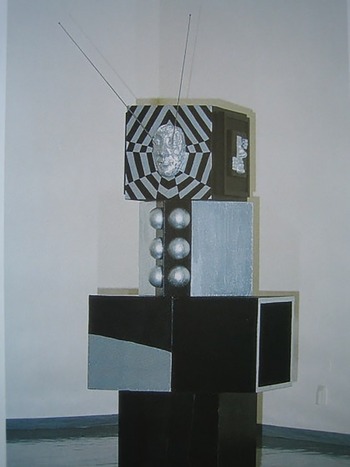
While photomontage afforded greater conceptual flexibility than his earlier objects, it also imposed formal limits: glossy magazine images lent immediacy but lacked the sculptural weight he sought. Shin later recalled that he often thought of his paintings “as sculpture,” even imagining that others might remake them three-dimensionally – a telling reflection of his desire for works to possess the tangibility of mass and volume rather than surface alone.Footnote 7 This recognition prompted a parallel exploration of sculpture (Yi H. 2019). In the Metamorphosis (Pyŏnshin 변신) series, Shin staged this tension across both media (Figure 16-1, 2). The montage versions assemble magazine fragments within a pictorial field, overlaid with painted interventions and subtle surface alterations, while the wooden version assumes a mask-like form whose contoured surface evokes a crushed aluminum can. Whereas the photomontage retains recognizability through photographic referents, the sculpture dissolves representational detail into abstract, organic form, foregrounding material presence and tactility (Yoo Reference Yoo2019, 117–118).
-1, 2. Shin Hak-chul, Metamorphosis (Pyŏnshin 변신)–6, 1979, photomontage, 27.3 × 40.9 cm (Left); Metamorphosis, 1980, wood sculpture, 40 cm (height) (right).
(Source: The First Winner of the National Art Award: Shin Hak-chul. 1991. Seoul: Hakgojae). Courtesy of the artist.

Together, these works mark a hinge in Shin’s practice: a shift from the photographic referentiality of montage to the embodied immediacy of sculpture, with each medium advancing distinct formal and conceptual problems. Yet sculpture introduced its own constraints – its abstraction risked blurring narrative coherence and draining contextual specificity. In response, Shin began to focus more intently on painting during the 1980s, seeking to synthesize the narrative address of montage with the material density of sculpture. Although objects and photomontage had dominated his earlier work, painting had persisted in parallel, valued for its flexibility and capacity to absorb other modes of representation.
This synthesis found its fullest articulation in the Modern Korean History series (1980–85), where Shin reimagined the relationship between modernism and realism through the problem of communicability. Here, modern Korean history appeared not as a distant chronicle but as an embodied, tactile experience – mediated by the painted surface and grounded in the corporeal logic of the human figure. The series comprised eleven oil paintings, several of which were introduced at his 1982 solo exhibition at the Seoul Museum of Art. Across this corpus, Shin fused photographic citation with assertive painterly reworking: disparate historical figures, machines, and everyday objects are organically interconnected, evoking the convolutions of intestines, brain folds, and muscle tissue, producing a grotesque vitality that oscillates between the sublime and the monstrous.
The following section situates the Modern Korean History series within late-1970s and early-1980s debates in Korea, when realism – particularly photorealism – became a flashpoint for rethinking how art should engage with social reality, historical representation, and the politics of form. Against this backdrop, Shin’s hybrid approach reshaped modes of historical address in contemporary art.
Toward a monumental corporealityFootnote 8 : reconfiguring the Real in Shin Hak-chul’s history paintings
Photorealism in 1970s Korea often functioned – or at least was claimed by its practitioners to do so – as a generational form of resistance against both institutional figuration and the ascendant Tansaekhwa. Its reception, however, was far from uniform. Art critic Park Yong-sook (박영숙, 1941–2025), initially encouraging its early experiments, soon dismissed it as “neither truly photographic nor truly real” but rather “an awkward imitation of [American] photorealism,” faulting what she regarded as uncritical imports and surface effects (Kim Reference Kim1978). Another art critic Ch’oe Min (최민, 1944–2018) – a member of Reality and Utterance (Hyŏnsil kwa Parŏn 현실과 발언), a key realist collective of the 1980s – criticized photorealism’s esthetic neutrality and lack of social address (Ch’oe Reference Ch’oe1982).Footnote 9 Its hyperreal focus on stones, grass, sofa fabrics, or sand, he argued, failed to articulate a critique of contemporary society and merely reproduced the formal detachment it claimed to oppose (Ch’oe 1977, 52–58; Kim and Ch’oe Reference Kim and Ch’oe1981). Even as some photorealists defended factuality (Sasil 사실) as a way to grasp everyday life with immediacy (Taedam 1982, 47–56), the ideological ambivalence of photorealism – and its limits as critical social practice – was increasingly apparent by the early 1980s.
Against this backdrop, Shin’s Modern Korean History series marked a decisive departure: technically grounded in photorealist procedures yet conceptually and politically disruptive. Whether in the American variant (e.g., Richard Estes) with urban commodities and streetscapes, or in the Korean variant with natural and everyday motifs, photorealism fixated on surface texture; by contrast, Shin grounded his practice in history’s underlying force and affective charge. Drawing on newspapers, documentary photographs, and photo anthologies such as One Hundred Years of Modern Korean History in Photographs (Sajinŭro Ponŭn Han’guk 100-nyŏnsa 사진으로 보는 한국 100년사, 1978), he produced compositions that were not merely referential but confrontational, charged with affective density (Shin C. Reference Shin2014; Tong-a Ilbosa 1978).
This approach came into public view with Shin’s 1982 solo exhibition at the Seoul Museum of Art, a seismic moment in the Korean art world. As artist Park Bul-dong (박불똥) later recalled, the show was “an explosive event,” stunning audiences unaccustomed to surreal, provocative, overtly political imagery within a field then dominated by formal abstraction (Park Reference Park1988, 24). The exhibition’s force lay in the series itself – an ambitious body of work that reconfigured both the form and the politics of photorealism in Korea and advanced what I term “monumental corporeality” – a mode defined not only by scale but also by the body’s capacity to register historical trauma and to reconfigure memory, as the following sections will elaborate.
The Modern Korean History series comprises eleven black-and-white oil paintings ranging in size from 80 × 45 cm to 130 × 390 cm. Each deploys dense photomontage, reconfigured into a surreal photorealism in which smooth, polished surfaces give rise to visceral, often monstrous figures. Rather than unfolding in a linear sequence, the series developed organically, alternating between compressed historical narration and fractured allegory. Modern Korean History nos. 3, 4, 6 (Figure 17) already trace a recognizable arc – from the Tonghak Peasant Uprising through national division to the 1980s democratization movement – anticipating the consolidating narrative framework of Modern Korean History-Synthesis (Han’guk Kŭndaesa Chonghap 한국근대사-종합 1983; Figure 18), the largest and most complex canvas (130 × 390 cm). By contrast, several later canvases are pared down and function less as narrative progressions than as visual palimpsests: fragmented, episodic, and violently incongruent.
Shin Hak-chul, Modern Korean History (Han’guk Kŭndae-sa 한국근대사)–6, 1981, Oil on canvas, 57.5x149.5cm. Courtesy of the artist and SeMA (Gana Art Collection).

Shin Hak-chul, Modern Korean History-Synthesis (Han’guk Kŭndaesa Chonghap 한국근대사-종합), 1983, Oil on canvas, 130 × 390 cm. Courtesy of the artist and MMCA.

In Modern Korean History 8, for instance, the pictorial field is dominated by a large head rendered with a metallic, cold surface, its features seemingly fused together like organic machinery. The head opens in a feral roar, exposing sharp, animalistic teeth. This grotesque visage is combined with a winged, muscular torso – suggestive of a fallen angel – while below, a Yamaha motorcycle is wedged between a woman’s legs. These stark motifs, presented in a black-and-white register that recalls old photographs, produce a composition that is at once pared down and violently unstable, charged by disjunction rather than narrative continuity.
Taken together, these formal variations point to a deeper consistency in Shin’s project: its refusal of closure. Despite variations in scale and complexity, the corpus is unified by its resistance to dialectical resolution.Footnote 10 Even Synthesis only appears to gesture toward reconciliation – in its title, in its layered motifs, and in the embrace of a man and woman atop its visceral organic structure, an image that seems to promise liberation and unification – yet this reconciliation is ultimately deferred. The series rejects Hegelian teleology: modernity is not staged as a dialectical struggle between the people’s democratic longing and its antithesis (imperialism, dictatorship, capitalism), culminating in resolution. On the contrary, democracy and capitalism often develop in collusion, compounding contradictions that Shin’s paintings render rather than resolve.
Formally, too, the painting resists closure: its mingled corpses and living bodies, compressed grounds, and chaotic proliferations expose modern Korean history as a body that cannot be contained within any single organizing schema. What Shin stages, then, is not synthesis but a psychic terrain in which the unconscious residues and forces of competing modernities collide – through rupture, compression, and symbolic excess.
This refusal of dialectical closure is equally evident at the esthetic level. Shin unsettles photorealism’s claims to objectivity while breaking with the conventions of National History Painting (Minjok kirokhwa 민족기록화), whose symbolic clarity and heroic monumentality cast the past as a coherent narrative of progress. In their place, his history painting advances a new paradigm: painterly montage that fragments the historical continuum and exposes its affective residues, internal contradictions, and latent fractures. In this sense, the Modern Korean History series is monumental not in terms of sheer scale or commemorative grandeur but in its capacity to reactivate memory and unsettle linear history (Yoo Reference Yoo2019, 122). Here, Shin’s practice resonates with Gilles Deleuze’s notion of fabulation – a mode of collective image-making that refuses closure, inventing “a people” rather than private fictions (Deleuze Reference Deleuze1989, 222).
From this perspective, monuments need not be fixed signs of remembrance. They can function instead as what Deleuze and Guattari call “blocs of sensation” – condensed affects and forces that endure through sensation rather than representation (Deleuze and Guattari Reference Deleuze and Guattari1994 [1991], 67–69). Read in this way, Shin’s canvases do not simply depict the past but set it in motion. His organic, composite figures – where flesh, machine, and archival debris collide within compressed grounds – generate affective shocks that surface what official historiography cannot absorb: unresolved traumas of division, authoritarian violence, and imperial entanglements (Yoo Reference Yoo2019, 122). His montages thus operate as painterly monuments: unstable yet enduring blocs of sensation that register contradiction as embodied experience rather than as reconciled narrative.
The body is the primary site where this reactivation takes place. Shin’s figures are not symbolic stand-ins or heroic subjects but conduits through which historical forces and material energies flow. Flesh merges with consumer objects (Coca-Cola bottles, television sets), with instruments of power and destruction (knives, tanks), and with grotesque organic matter (pig heads, broken eggs, corpses). These hybrid forms register history not as allegory but as lived force, pressing unstable bodies into configurations that are fractured, porous, and continually transforming. They hold antagonistic forces together – popular desire for democracy and liberation alongside dictatorship, industrial injury, and U.S. power – without reconciling them (Fuchs Reference Fuchs, Sabine, Fuchs, Summa and Müller2012, 9).
This exploration of the body as a site of historical inscription resonates with Friedrich Nietzsche’s conception of memory as an organic process of assimilation. For Nietzsche, memory is not a fixed archive but “the plastic power of a man, the power of growing out of oneself, of transforming and incorporating things past and foreign” (Nietzsche Reference Nietzsche and Breazeale1983, 62). In this sense, memory functions like digestion: a capacity to metabolize external forces into lived and embodied experience. Shin’s figures enact this principle. They metabolize trauma, transforming it into painterly form. History is not recalled so much as reenacted and displaced in fractured, unstable bodies (Nietzsche Reference Nietzsche, Colli and Montinari1988, 175; Park K. 2016, 99; Yoo Reference Yoo2019, 125–26). The body itself becomes memory – processual, unstable, and open to continual recombination with other beings, objects, and residues of history. As an art theorist Shim Kwanghyun (심광현) has argued, Shin’s series amounts to a kind of “painterly psychoanalysis,” excavating the unconscious dimensions of modern Korean history through formal experiment and recombination (Shim Reference Shim2014, 50–56). This perspective highlights how Shin’s history paintings probe beneath ideological categories to register the affective and instinctual dimensions of collective life.
Shin’s own reflections reinforce this orientation. He described his project as a “history of the body,” suggesting that the unconscious and instinctive forces of modern Korean history cannot be grasped through binary oppositions – ruler and ruled, perpetrator and victim – but emerge instead within a complex energetic field where antagonistic subjects are bound together. Even pivotal events, such as the assassination of Park Chung-hee, are not treated as mere outcomes of political calculation. Rather, Shin interpreted them as eruptions of a more elemental “animality” of the people, driven to a breaking point where endurance was no longer possible: “When pressed into a corner, animality bursts forth – something unknown, intolerable, irrepressible, breaking out in a roar. I want my painting to be like that” (Shin and Park Reference Shin and Park2003, 108).
In this respect, Shin’s conception of history as bodily memory differentiates him from many of his minjung contemporaries. While sharing overlapping sources and political commitments, Shin’s history paintings diverge from minjung art’s frequent emphasis on collective agency framed through fixed binaries. Instead, he probed history’s unconscious operations – how it moves beneath ideology through affect, instinct, and the body (Park Reference Park2004, 100–101).
This orientation comes into sharp relief in Modern Korean History – Synthesis. Nearly four meters tall (130 × 390 cm), the towering canvas carries a pulsating organic structure from bottom to top – a form at once bodily and architectural, monumental in scale and symbolic density. Rendered in monochrome oil, it appears at first to unfurl a familiar continuum – from the Tonghak Peasant Movement and anti-colonial resistance to national division, the Korean War, dictatorship, and industrialization – culminating in the aspiration to reunification. Yet the ascent resists teleology. The surface teems with grotesque imagery – bodies of shifting scale and motion, mechanical and organic fragments, chaotic juxtapositions. The viewer confronts a hybrid organism in which living and dead, memory and trauma are entangled. Refusing coherent order, the work exposes the body of modern Korean history as incongruent and irreducible – a visceral field in perpetual reconfiguration.
Shin visualizes libidinal forces as at once repressive and erotic: systems of power corrupted by their own violence, bodies propelled by unchecked desire. In one canvas, a naked woman grips a Yamaha motorcycle thrust between her thighs, its placement underscoring the image’s erotic violence; the machine itself mutates, its handlebars morphing into breasts while its frame sprouts bestial fangs. Nearby, a muscular male torso merges with a metallic tank, evoking the military–industrial complex. As art critic Sung Wankyung observes, Shin’s monumental bodies operate through brute muscularity and primal instinct, embodying both aggression and raw sexual energy (Sung Reference Sung2003, 13–14). These grotesque hybrids lay bare the psychic contradictions of modern Korean history – collapsing victim and perpetrator, repression and pleasure, state power and collective resistance. In their scale and object-like presence, they solicit not detached looking but embodied confrontation, rendering history as a volatile, affective field charged with unresolved forces.
By illuminating these contradictions, Shin’s monumental corporeality reframes familiar accounts of realism and unsettles conventional modes of historical commemoration in Korean art. His history paintings do not merely document the past; they embody it – rendering the body as both a site of lived experience and a vessel for unconscious forces, a medium through which trauma, memory, and resistance are made materially present.
This orientation also complicates the frequent attribution of Modern Korean History to the so-called “realist phase” within Shin’s artistic trajectory of the late 1970s and 1980s. Such a designation oversimplifies the radical complexity of his project. Shin does not return to realism in any straightforward sense; he reworks its foundations, converting the affective and unconscious dimensions of the Real into a visual language charged with psychic intensity. This transformation grew out of decades of formal and material experimentation, through which he interrogated the very conditions under which reality might be seen, felt, and addressed. Rather than bridging modernism and realism, Shin reconfigured their opposition, treating them as overlapping modes of esthetic and political inquiry on the evolving landscape of contemporary Korean art.
Conclusion
For decades, the accounts of contemporary Korean art have been organized through rigid oppositions – modernism versus realism, postwar abstraction versus the politically mobilized minjung art of the 1980s. Such binaries have yielded caricatures: modernism cast as purely formalist and outward-looking, realism dismissed as technically crude or merely instrumental. These narratives not only flatten the formal heterogeneity and conceptual ambition of minjung art but also marginalize the diverse modernist practices that sought new forms of communication, social engagement, and political resonance.
Tracing Shin’s trajectories across and through these categories reveals a more intricate landscape. Working within and against each label, he pursued multiple conceptions of reality through sustained experiments with objecthood, the body, surface, and spatial dissonance. Since the 1960s, his practice has spoken in international artistic languages while remaining anchored in Korea’s specific sociohistorical conditions. From object-based assemblage and photomontage to figural painting, his practice consistently sought to give shape to lived experience and suppressed memory. His Modern Korean History series synthesized these inquiries into what I term “monumental corporeality”: a visual language where photographic reference, sculptural density, and painterly immediacy converge to materialize collective memory – memory not constituted by grand narrative but by the invisible forces and energies through which such narratives take shape and endure (Yoo Reference Yoo2019, 130). In this sense, his paintings sought to capture what Shin once described as the people’s elemental “animality,” an eruption of instinct and energy breaking through repression and becoming legible on the picture plane as history itself embodied.
By reconfiguring how form, history, and embodiment meet on the picture plane, Shin demonstrates the permeability of the modernism/realism divide, recasting realism as reflexive, mediated, and historically situated. Situating his work within the broader trajectories of postwar Korean art and global modernism advances a more reflexive and transnational art historiography – one that treats modernism and realism not as opposed paradigms but as negotiated fields shaped by institutional structures, ideological pressures, and esthetic experimentation. His practice makes clear that the divide was never absolute but always porous and contested.
Ultimately, Shin’s work compels a rethinking of the boundary between minjung and modernist art. His engagement with the real – at once material condition and historical affect – expands the very terms of realism in both Korean and global contexts. Rather than advancing a national case, his practice models how postwar artists across diverse sites confronted inherited categories, embraced contradiction, and forged new forms of artistic and historical thought. In doing so, Shin’s art invites a more dynamic and transnational understanding of realism and modernism within twentieth-century cultural politics.
Supplementary material
The supplementary material for this article can be found at https://doi.org/10.1017/S147959142510048X.




 Open access

