

The literature commonly conceptualizes clientelism as a conditional exchange of favors or benefits for political support (Stokes et al. Reference Stokes, Dunning, Nazareno and Brusco2013), describing it as a relationship in which politicians (patrons) maintain control, holding voters (clients) accountable for their electoral decisions or support. This interpretation posits clientelism as a perversion (Stokes Reference Stokes2005) of democratic vertical accountability, wherein voters have the power to hold politicians accountable through voting. Consequently, this characteristic of clientelistic relations is thought to adversely affect a crucial aspect of democratic quality—horizontal accountability, which involves the oversight and sanctioning activities executed by independent state agents over the executive. By undermining voting as a mechanism of citizen control, clientelism potentially diminishes electoral repercussions for politicians who neglect their oversight and sanctioning responsibilities.
This article extends the discussion by delineating a variant of high client agency clientelism and analyzing its repercussions on local horizontal accountability. It specifically examines municipal councilors within a Strong Mayor model—where councilors and mayors are independently elected—and scrutinizes their dual role as patrons and accountability agents. The study investigates how councilors’ patron status influences their willingness to hold local executives accountable, employing qualitative analysis of twenty-four councilors across three Santiago de Chile municipalities. Chile’s context of a stable state (Fund for Peace 2019) and consolidated democracy (Marshall and Gurr Reference Marshall and Gurr2014), characterized by strong horizontal accountability, relatively low corruption (Rosales Reference Rosales2007; Transparency International 2012), and a robust local electoral democracy (Bland Reference Bland2011), provides a fitting backdrop for this study. Despite favorable conditions, Chilean municipal councils, like those elsewhere in Latin America, often exhibit limited oversight over local executives (OECD 2017; Kersting et al. Reference Kersting, Caulfield, Nickson, Olowu and Wollmann2009).
In the client-driven variant of clientelism introduced by the article, clients, rather than patrons, initiate and enforce clientelistic exchanges. This form exists alongside traditional patron-driven clientelism, in which patrons control the exchange. In scenarios where councilors must deliver benefits to local communities without adequate resources, communities might use electoral incentives to force councilors to procure and distribute benefits. Nonetheless, councilors who build strong relationships with communities, monitor voter behavior, and access discretionary resources can invert this dynamic, compelling voter support.
The cases examined reveal significant differences in councilors’ willingness to oversee local executives. Client-driven clientelism can discourage councilors from monitoring the local executive, as dependence on municipal resources to meet clientelistic demands allows local executives to undermine councilors’ attempts at accountability by limiting resource access. In contrast, councilors in patron-driven clientelistic relationships, not dependent on municipal resources, are better positioned to resist mayoral influence and more likely to fulfill their accountability roles.
Clientelism and accountability
Traditionally, clientelism has been viewed as a patron-driven relationship in which politicians (patrons) control and hold voters (clients) accountable for their electoral decisions or political support. This control hinges on the patrons’ ability to do two key actions to ensure the credibility of voters’ promises of support. The first is monitoring, which involves gathering information to verify whether clients support the patron. The second is enforcing compliance, achieved by excluding nonsupportive clients from the distribution of goods or benefits.Footnote 1 Therefore, if clients support the patron, they are rewarded with certain benefits or goods. Conversely, failure to support results in exclusion from these provisions, serving as punishment. Thus, authors typically characterize relations of clientelism as hierarchical, vertical, asymmetric, or exploitive, where voters are often in a disadvantaged position (or persuaded) to trade their political subordination for material rewards (Hicken Reference Hicken2011; Stokes Reference Stokes2005; Hilgers Reference Hilgers2011; Fox Reference Fox1994).Footnote 2
Contrary to this traditional view, recent scholarship underscores the relevance of clients’ interests and active role in initiating these clientelistic bonds. Highlighting the presence of a demand for clientelism, scholars have noted clients’ pronounced preference for clientelistic over programmatic interactions with politicians, driven by the efficiency and negotiability of the benefits received (Gay Reference Gay1990, Reference Gay1999; Auerbach Reference Auerbach2019). Consistently, others have argued that civil society leaders, in particular, might utilize clientelism as a strategy to sustain their organizations by procuring and distributing valuable services to their members (Palmer-Rubin Reference Palmer-Rubin2022). Moreover, ethnographic evidence has revealed voters’ strategic support for likely winners (even if they are expected to be unreliable patrons) to embody a sense of entitlement, legitimize their future demands, and hopefully persuade these politicians to engage in clientelism (Borges Martins Da Silva Reference Borges Martins Da Silva2023). Showing how clients can impact politicians’ attitudes, researchers have argued that a prevalent demand for clientelism, coupled with voters’ tendency to assess politicians on nonprogrammatic grounds, compels even programmatic politicians to engage in nonprogrammatic practices, including clientelism (Johannessen Reference Johannessen2020; Szwarcberg Reference Szwarcberg2013).
Furthermore, clients are also posited as key actors in shaping and sustaining clientelistic networks. Particularly in contexts of high competition between brokers or patrons, clients can sort out patrons and brokers who are unlikely to deliver and credibly signal their commitment to providing their political support. Through such actions, they can overcome the typical credibility challenges inherent in clientelism, bypassing the need for monitoring, enforcement, or norms of reciprocity (Nichter Reference Nichter2018; Auerbach and Thachil Reference Auerbach and Thachil2018; Auerbach Reference Auerbach2019).
Horizontal accountability is commonly considered a crucial factor in determining the quality of democracy, given its vital role in preventing arbitrary power use by rulers, reducing corruption, impunity among state actors, and the improper use of resources (Schedler, Diamond, and Plattner Reference Schedler, Diamond and Plattner1999; Mainwaring Reference Mainwaring2003; Diamond and Morlino Reference Diamond and Morlino2004; Manzetti Reference Manzetti2014). The pervasive influence of clientelism on the voter-politician relationship suggests it could also significantly impact horizontal accountability. A focus on municipal-level horizontal accountability, where clientelism is notably prevalent, is essential for a nuanced understanding of political dynamics in Latin America.
Although decentralization efforts were envisioned to strengthen regional democracies (Montero and Samuels Reference Montero and Samuels2004; Devas and Delay Reference Devas and Delay2006), reports often highlight the coexistence of democratic elections with local rulers’ abusive practices.Footnote 3 Yet the scholarship has predominantly concentrated on subnational undemocratic regimes at the state or province level (Pino Reference Pino2017), overlooking the municipal level. Moreover, research on local democracy predominantly examines the interactions between citizens and local governments, emphasizing electoral and participatory aspects while overlooking the democratic significance of horizontal relationships among locally elected authorities.Footnote 4 This gap underscores the need for a deeper examination of how clientelism at the municipal level influences the mechanisms of horizontal accountability and, by extension, the overall quality of democracy in the region.
Municipal councils are pivotal in supervising local executives and addressing the shortcomings of other oversight bodies (Devas and Delay Reference Devas and Delay2006; Denters Reference Denters2006; Kersting et al. Reference Kersting, Caulfield, Nickson, Olowu and Wollmann2009; Chasukwa and Chinsinga Reference Chasukwa and Chinsinga2013) and citizen-based accountability mechanisms (Blair Reference Blair2000; Grindle Reference Grindle2007; Moreno-Jaimes Reference Moreno-Jaimes2007). Their role is particularly vital under the strong mayor model, widely adopted in Latin America, which bolsters separation and autonomy between mayors and councils (Lankina Reference Lankina2008; Kersting et al. Reference Kersting, Caulfield, Nickson, Olowu and Wollmann2009; Devas and Delay Reference Devas and Delay2006). Nevertheless, two primary factors can hinder the effectiveness of councils in their accountability functions. First, despite formal independence from other local authorities, councilors’ reelection prospects are vital for their continuity, which could conflict with their accountability obligations as they seek voter approval (Moreno, Crisp, and Shugart Reference Moreno, Crisp and Shugart2003). Second, the efficacy of councilors is often constrained by their access to knowledge, time, resources, and status. These elements are particularly crucial for fulfilling their accountability roles, given that mayors typically enjoy higher status and better access to staff and municipal resources (Kersting et al. Reference Kersting, Caulfield, Nickson, Olowu and Wollmann2009; Yilmaz, Beris, and Serrano-Berthet Reference Yilmaz, Beris and Serrano-Berthet2010; Lankina Reference Lankina2008; Denters Reference Denters2006).
While some scholars suggest that vertical and horizontal accountability might not inherently align (Luna Reference Luna2016; Hagopian Reference Hagopian2016; Boas, Hidalgo, and Melo Reference Boas, Hidalgo and André Melo2019; Singer Reference Singer2018; O’Donnell Reference O’Donnell1994), horizontal accountability is traditionally viewed as a secondary principal-agent relationship, dependent on the primary vertical accountability between voters and their elected officials. In this model, elected representatives’ responsibilities for overseeing other state agents are considered part of their mandate from voters, who evaluate their performance in these roles when deciding on electoral rewards or sanctions. Thus, horizontal accountability functions as a mediated form of accountability, where voters indirectly enforce executive accountability through their elected representatives’ oversight and sanctioning activities (Laver and Shepsle Reference Laver and Shepsle1999; Fox Reference Fox2007). However, this mechanism is vulnerable to breakdowns when citizens do not hold their representatives to account (Moreno, Crisp, and Shugart Reference Moreno, Crisp and Shugart2003), a scenario often seen in patron-driven clientelism where representatives evade their horizontal accountability obligations without electoral consequences (Moreno, Crisp, and Shugart Reference Moreno, Crisp and Shugart2003).Footnote 5
Client agency challenges this dynamic, suggesting that it can reverse the distortions in vertical accountability and enable voters to actively hold politicians accountable, even in clientelistic relationships. When clients initiate and promote clientelism, they transform the relationship from one of subjugation to an active exchange, seeing it as a chance to secure otherwise inaccessible benefits (Gay Reference Gay1999; Nichter Reference Nichter2018; Auerbach Reference Auerbach2019). Nonetheless, this form of accountability significantly deviates from the democratic ideal, where resource allocation is based on impartial rules and transparent decision-making processes (Kitschelt and Wilkinson Reference Kitschelt and Wilkinson2007) and maintains a system where targeted benefits are tied to political support. The impact of clients’ agency on horizontal accountability, however, remains unexplored.
This article advances the concept of client agency within clientelism, proposing that clientelism can manifest in scenarios where clients, rather than patrons, assert control over these exchanges. Aligning with recent scholarship that explores the varied forms of clientelism (Aspinall et al. Reference Aspinall, Weiss, Hicken and Hutchcroft2022; Palmer-Rubin Reference Palmer-Rubin2022), this study emphasizes the significance of the origins of clientelistic resources and the type of patrons’ ties with local communities as crucial determinants of these forms.
Furthermore, the article supports the notion that client agency can revert the accountability dynamics between clients and politicians, further impacting politicians’ motivations toward horizontal accountability. It examines contexts in which politicians, lacking robust ties to communities and discretionary resources, face pressures from local communities to initiate clientelistic exchanges. Communities drive these relationships by demanding benefits from politicians and holding them accountable for their delivery, with electoral outcomes serving as potential rewards or sanctions. This dynamic pressures politicians to seek resources for distribution, often looking toward state resources controlled by the executive as their main avenue for clientelism. When patrons are also accountability agents and whoever grants them access to those resources is accountable to them (as in relations between municipal councilors and mayors), the resource provider can discourage these agents from performing their accountability duties.
Chile as a research siteFootnote 6
Like most countries in Latin America, Chile’s local governments have followed, since 2004, a strong mayor model in which the local executive and the local legislature are elected separately through popular vote. Both mayors and councilors are elected every four years and can be reelected indefinitely.Footnote 7 Mayors are elected under a plurality system, and councilors under a single-district open-list proportional representation system. As Hinojosa and Franceschet (Reference Hinojosa and Franceschet2012) argued, the 2004 change in local elections’ rules increased competition in the councilors’ elections and reduced the discipline that parties required from councilors to get one of their candidates elected mayor. Compared to other countries in the region, municipal councils in Chile are rather small—six to ten councilors (Kersting et al. Reference Kersting, Caulfield, Nickson, Olowu and Wollmann2009).
The literature assigns municipal councilors a significant role in clientelistic relationships. As local authorities, councilors are usually in close contact with voters from specific local communities, which gives them ample opportunities to hand benefits and goods to these voters and monitor their political behavior (Stokes et al. Reference Stokes, Dunning, Nazareno and Brusco2013). This literature commonly addresses councilors’ role as brokers between these communities of voters and other politicians at a higher level. However, because they also are authorities elected through popular vote, this article focuses on their role as patrons insofar as they use clientelism to obtain voters’ support for themselves.
Municipal councils in Chile are mandated to oversee local executives and are endowed with formal powers for that duty. Municipal councils can, for example, summon any head of municipal departments for interrogation, and the mayor is required to respond promptly to any information request made by the councilors. Councilors also can request external audits to assess specific processes. The law provides councilors with one direct mechanism to sanction the municipal administration, which is the removal of the municipal administrator (the closest collaborator of the mayor within the municipal administration) with the agreement of two-thirds of the councilors. In addition to this mechanism, councilors can only indirectly sanction mayors or their administrations by submitting complaints to state agents with more direct sanctioning power, such as the criminal justice system, the Comptroller General’s Office (CGR), and the Electoral Courts (Rosales Reference Rosales2007).Footnote 8
Mayors remain preponderant figures in Chile’s local politics, as they usually do in Latin America. Municipal councils participate in municipal decision-making; however, the mayor alone sets the agenda for issues to be voted upon, and the council cannot make changes to the budget proposed by the mayor. Moreover, the status and resources of municipal councils—characterized by low pay, part-time hours, and a lack of formal resources and staff to perform their duties—are in sharp contrast with those of mayors, who have a full-time schedule and salary (Kersting et al. Reference Kersting, Caulfield, Nickson, Olowu and Wollmann2009; Rosales Reference Rosales2007). Mayors also have de facto discretion over the appointment and career development of municipal bureaucrats, which gives them wide control over the bureaucracy and allows them to use public employment to generate and maintain networks for voter mobilization (Corvalan, Cox, and Osorio Reference Corvalan, Cox and Osorio2018; Toro Reference Toro2016). However, research has found a gender gap in this regard, as women mayors tend to reduce the number of public employees (Alberti, Diaz-Rioseco, and Visconti Reference Alberti, Diaz-Rioseco and Visconti2022).
Parliamentarians in Chile may maintain some influence over local politicians. However, Chilean national parties have limited control over local governments, especially because they cannot oppose the nomination of incumbent candidates, and party elites usually leave local politicians unchecked (Rosales Reference Rosales2007; Luna and Altman Reference Luna and Altman2011).Footnote 9 However, local governments have a strong financial and functional dependence on the national state, which is common throughout the region (Nickson Reference Nickson2011; Fernández Richard Reference Fernández Richard2013) and has allowed national governments to benefit mayors from the governments’ party coalition by allocating more funds to their municipalities (Lara and Toro Reference Lara and Toro2019).
Cases
This article analyzes three cases (municipalities) housing twenty-four municipal councilors from the City of Santiago de Chile, focusing on their role in connecting with local communities and overseeing their mayors. Santiago is divided into thirty-four administrative units (comunas), each managed by a municipality (Ducci Reference Ducci2002). The municipalities selected for this research were Estación Central, Quinta Normal, and Pudahuel and were analyzed for the term between December 6, 2012, and December 6, 2016.
The municipalities selected for this study are situated in the northwestern part of Santiago, a region characterized by middle- and low-income demographics. This area aligns with scholarly expectations that clientelistic relationships are more likely to emerge, particularly when they serve as problem-solving networks that fill the gaps left by the state’s absence (Kitschelt and Wilkinson Reference Kitschelt and Wilkinson2007; Stokes et al. Reference Stokes, Dunning, Nazareno and Brusco2013; Hagene and González-Fuente Reference Hagene and González-Fuente2016; Brusco, Nazareno, and Stokes Reference Brusco, Nazareno and Carol Stokes2004). Supporting this characterization, data from the CASEN 2015 survey reveals that the populations of these municipalities exhibit medium to low socioeconomic levels. This assessment is based on indicators such as the poverty rate, average years of schooling, and average per capita income, further detailed in Appendix A.
As indicated in Table 1, among the municipalities studied, Estación Central and Quinta Normal exhibit higher levels of party competition, as evidenced by the narrow margins of victory in past council and mayoral elections. The mayors of these municipalities hail from diverse political backgrounds and parties, reflecting a broad ideological spectrum. Specifically, the mayor of Estación Central is affiliated with the right-leaning Unión Demócrata Independiente (UDI), while Pudahuel’s leadership comes from the Socialist Party (PS), and Quinta Normal is governed by a representative of the center-left Christian Democrat Party (DC). Notably, only the mayor of Estación Central faced a municipal council where the majority of members belonged to opposition parties, highlighting a dynamic of political contestation within these local governments (see Appendix A).
Political characterization of cases
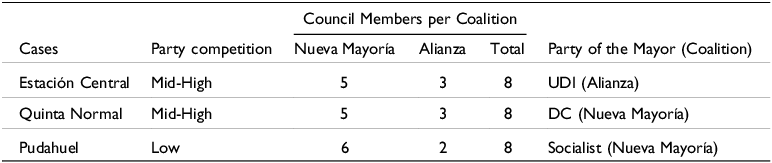
Note. Alianza was a center-right coalition, comprising Unión Demócrata Independiente (UDI) and Renovación Nacional (RN) parties. Nueva Mayoría was a center-left coalition, made of the Christian Democratic (DC), the Socialist (PS), the Radical (PR), the Partido por la Democracia (PPD), and the Communist (PC) parties.
Data and variables
This study analyzes the nuanced interplay between two key relational dynamics in municipal governance: the interactions between municipal councilors and local communities, and the interactions between councilors and local executives. It examines the extent and nature of councilors’ engagement with local communities, exploring both historical and ongoing clientelistic connections. Additionally, the study investigates the councilors’ role in horizontal accountability and the various elements influencing their relationship with local executives.
The research methodology is centered around fifty-one semistructured interviews conducted in 2015 and 2016 with pivotal figures in the municipalities. Interviewees comprised a diverse group, including municipal councilors, bureaucrats, leaders of local organizations, and congresspersons representing the studied comunas. Efforts were made to contact all councilors and congresspersons, with interviews conducted with those available and willing to participate. The selection process for municipal bureaucrats and local organization leaders employed a snowball sampling technique, initiated through councilors’ referrals and continuing until informational saturation was achieved. Further details on the interviewees and the fieldwork are provided in Appendixes B and C.
Despite not specifying any particular type of organization when asking councilors to recommend local leaders, all suggestions pointed to leaders of neighborhood associations (Juntas de Vecinos).Footnote 10 These entities are key pillars of civil society in Chile, endowed with legal responsibilities to foster community development, advocate for members’ interests and rights, and collaborate with both national and municipal authorities as outlined in Ley N° 19.418, 1997. Their prevalence is notable across Chile’s comunas, representing about one-third of the nation’s civil society organizations (Delamaza and Corvera Reference Delamaza and Teresa Corvera2018). They play a significant role in civic participation, ranking just behind religious organizations, and often serve as umbrellas for various other groups, including senior citizen associations, motherhood associations, and sports clubs.Footnote 11
The municipal bureaucrats interviewed occupied various roles, all of which necessitated substantial engagement with local communities. Their positions ranged from neighborhood agents to directors of departments crucial for community liaison, such as community development, community organizations, or departments offering specific services like tourism, poverty relief, or employment information. To ensure confidentiality, the article discloses only the positions of those directly working with councilors in the empirical evidence sections, safeguarding the anonymity of all participants.
This article analyzes horizontal accountability by focusing on municipal councilors’ willingness to hold mayors accountable rather than their capacity to do so or actual instances of accountability. This willingness is seen as an inherent and latent characteristic, pivotal for activating horizontal accountability under certain conditions, such as instances of mayoral misconduct. This approach emphasizes the potential for accountability, underscoring the importance of the perpetual possibility of being held to account as a key deterrent against the misuse of power by state agents (Mulgan Reference Mulgan2000; O’Donnell Reference O’Donnell2003). It posits that the actual capability for accountability holds little weight without the foundational willingness to pursue it, thus framing this disposition as a critical factor for effective governance.
To assess councilors’ disposition toward accountability, the study analyzed data from three primary sources: 51 semistructured interviews with key stakeholders, 120 reports from printed and electronic news media, and 9 formal complaints filed by councilors with the Comptroller General’s Office against local executives, detailed further in Appendix B. Councilors were categorized based on their loyalty, skepticism, or ambivalence toward their mayors, reflecting their inclination to engage in accountability measures. This classification derived from their mentions in news media and complaints to the Comptroller General’s Office, aligning with the predominant perceptions expressed in the interviews. Loyal councilors were those who neither reported the local executive to the Comptroller General’s Office nor critiqued the mayor in news media. Skeptical councilors were identified by their reports to the Comptroller General’s Office or their predominance in news media as critics of the mayor. Ambivalent councilors were those who had not reported the local executive to the Comptroller General’s Office and were either balanced in their support and criticism of the mayor in news media or were scarcely mentioned.
Client-driven clientelism
In the cases studied, municipal councilors performed their duties under a widely shared expectation that they would actively provide direct solutions to neighbors’ problems. As expressed in the interviews, in these comunas, “what people demand from their local authority is to resolve those types of problems: that they got bitten by a dog, or [need help to pay] the water or the electricity bills” (Loyal PDC Councilor 1, Quinta Normal), and it was “well established that councilors must have resources to give” (President of Neighborhood Association 3, Estación Central. Close to Skeptical PS Councilor 1). Consistently, councilors usually perceived that “the only thing that people want from [them] is to solve [these] problems” and that local communities “approach [their councilors] only for that” (Skeptical PS Councilor, Quinta Normal). Highlighting how these expectations were above these communities’ partisan or ideological preferences, a councilor from an opposition party mentioned that local communities “don’t care if you are from [one party or the other], they are happy if an authority comes to support their dreams and smaller wishes” (Loyal PPD Councilor, Estación Central).
Addressing these demands was not included in councilors’ formal duties and usually clashed with their attention to their legally described responsibilities. Making explicit the difference between formal duties and what people expected from them, one councilor explained that they could dismiss people’s requests, arguing, “I’m not here to do this.” However, such a response “would be an academic understanding of our job and not a social understanding of what people expect from us” (Loyal PDC Councilor 1, Quinta Normal). In this dilemma, councilors admitted that addressing local demands took priority over their formal responsibilities. As a councilor from the opposition illustrated, his legally described duties were “approximately ten percent of the things I do as a councilor, which more commonly involve helping neighbors to obtain some benefits, and addressing specific demands they may have” (Skeptical PS Councilor 1, Estación Central).
However, councilors’ participation in local problem-solving was not only a widespread expectation that councilors met. It was unofficially enforced by local communities that used their political support and opposition to reward or punish councilors for their performance in meeting these expectations. For instance, communities were mentioned to use their voting power as leverage, threatening to withhold or promising to give their vote, withdrawing or offering campaign support, damaging or enhancing the politician’s local reputation, or hindering or aiding their access to local voters. Therefore, local communities (clients) wielded their political support or opposition as tools to penalize politicians (patrons) who failed to meet their expectations. Councilors who did not respond to these demands faced defamation, active opposition, and obstacles in reaching other voters, making them less likely to attract voters who might appreciate their programmatic appeal.
Consequently, councilors usually assumed that this involvement in local problem-solving constituted an informal requirement of their position, especially because they commonly perceived these punishments as real threats to their chances for reelection. This type of enforcement—and its perceived electoral consequences—created an informal institutionFootnote 12 that maintained the transactional character of clientelistic relationships, where favors and political support are conditionally exchanged.
As the interviews revealed, local organizations’ leaders played a significant role in granting the rewards and punishments that enforced these interactions, especially given their capacity to transform their organizations’ members into reliable voters for local politicians. Local leaders could play that significant role due to their position as gatekeepers of their organizations (enabling or impeding councilors to meet with their organizations’ members) and their influence over their organizations’ members (mobilizing them and suggesting to them whom to vote for).
As gatekeepers, local leaders were reported to be the ones who “open the doors of their organizations for [councilors] to meet more people,” and they do so “if [councilors] fulfill some requirements they think are important,” like helping them with their demands (Skeptical PS Councilor 1, Estación Central). Similarly, these gatekeeper leaders were also able to block the entrance of unsupportive councilors. Illustrating this gatekeeping role and their connection to the delivery of benefits, a municipal bureaucrat mentioned that, among local organizations, it was common to require councilors to “knock on the door with their elbow”—that is, carrying a gift in their hands. These organizations’ leaders “stop [politicians] at the entrance, to see if they are allowed to come in, and if they don’t bring something, they simply say no” (Bureaucrat 1, Estación Central). Organizations’ leaders also used invitations to include or exclude councilors from their activities. So, “for example, if a neighborhood association celebrates its anniversary, it will only invite the ones that have supported them” (Loyal PPD Councilor, Estación Central). As a local leader admitted, “When we see that a councilor doesn’t cooperate with us, we don’t invite them. So, we do select them…. We don’t even knock on their doors because I don’t know what they are here for” (President of Neighborhood Association 4, Quinta Normal. Close to skeptical and loyal councilors from different parties).
Consistently, councilors highlighted the delivery of favors to local communities as their “entrance ticket [to local organizations],” which was relevant for them because, then, the members of these organizations “will consider listening to what you say and what you propose” (Loyal PDC Councilor 1, Quinta Normal). Moreover, councilors considered that opportunities to meet with organizations were critical for their future electoral success because they could use them to secure these members’ votes. As one councilor explained: “If I visit local organizations, I most probably will ask them to vote for me, and most of them will probably vote for me. So, it will pay off” (PPD Councilor, Quinta Normal). Highlighting how these organizations provided opportunities to connect with more people and obtain more votes, another councilor explained that “the more people you meet, the more possible it is that more people will adhere to you. The more hands you shake, the more votes you get” (Skeptical PS Councilor 1, Estación Central).
In this context, local leaders’ influence on their organizations’ members was perceived as especially relevant. As the interviews reported, by allowing councilors in, local leaders “endow [them] with their capital, their reputation” (Skeptical PS Councilor 1, Estación Central) so that the communities then trust these councilors. Moreover, councilors perceived local leaders as highly influential on neighbors’ direct electoral decisions, especially given their better knowledge and higher interaction with local politicians. As councilors expressed, “those leaders are closer to the authorities—they know what [these authorities] are talking about and know who they are.” But neighbors usually “don’t even know who the current authorities are. So [the neighbors] ask [the leaders] whom they should vote for, and they tell them” (Loyal UDI Councilor 2, Estación Central).
Local leaders also punished councilors who failed to help them with both direct manifestations of disapproval and attempts to harm their reputation. As the councilors declared, the ones who refused or failed to give received insults and recriminations from local leaders and were slandered in front of local communities or other authorities. As one councilor reported, “If you don’t give, people will slander you. [They will say]’ that cheap councilor doesn’t even give prizes for a bingo session,’ … and mention that in their neighborhood associations, to their families, and to [the other councilors]” (Skeptical PS Councilor, Quinta Normal). Just as local leaders’ approval of councilors positively affected these councilors’ reputation and electoral chances, their disapproval was perceived as having the opposite effect.
Consequently, councilors usually saw few chances to escape from these exchanges, fearing being voted out if they refused to participate in local problem-solving. As one of them expressed, councilors “cannot afford to stay out of the resolution of their quotidian problems [because], if you say ‘No, I don’t have the money,’ that electorate died for you…. They are the people who, in the next election, will say whether you had a good or a bad performance—but according to their standards, not the description of your duties in the manuals” (Loyal PDC Councilor 1, Quinta Normal). Highlighting how even local leaders’ slander was enough to encourage councilors to get involved in local problem-solving, one of them mentioned that he contributed to bingo sessions “so that people don’t say bad things about me. So that they don’t say ‘hey, don’t ask him for anything because he doesn’t help’” (Ambivalent UDI Councilor, Estación Central).
Patron-driven clientelism
On the side of client-driven clientelistic relationships, some councilors developed more traditional clientelistic relationships, purposely using the distribution of goods and benefits to reward political support (and punish the lack thereof). These exchanges were usually based on councilors’ ability to develop personal relationships of mutual help and loyalty with local communities, obtain resources to distribute before they are requested, and monitor communities’ support.
By developing close personal relationships with local communities, councilors could obtain local communities’ support before handing out favors, which allows them to use the distribution of resources to reward supporters and punish nonsupporters. Councilors usually had developed relationships from their history of leadership in local organizations and connections with local leaders. For example, one councilor explained that he received the support and was “very well received by Catholic communities (but not by the Evangelical ones)… because I was a leader of a Catholic group before and, therefore, I have a very good connection with [Catholic] priests. Then, they take me to their events and, for example, dress me as Santa for Christmas celebrations,” where he handed out gifts (Skeptical PS Councilor 1, Estación Central).
These relationships with local communities (especially with local organizations) usually were formalized as godparent-hood (apadrinamiento) relations—a practice in which local organizations nominate local authorities as their protector (godparent), thus making explicit a relationship of mutual help and loyalty. As one councilor described, “With these organizations, I have a preferential treatment, which is translated, for example, in … orienting them in the management of their resources … [,] keeping them informed, [and] helping them with … applications [for funds]. This support is mutual [and includes] electoral support. Our most loyal team in the field is 90 percent made up of local leaders [who] manifest [their support] explicitly” (Skeptical PS Councilor 1, Pudahuel).
Electoral campaigns offered a privileged opportunity for councilors to assess which communities supported them. As the interviews reported, the loyal communities “worked [for councilors’ campaigns] for free and offered various ways [to collaborate], for example, by offering their roofs to hang billboards” (Collaborator of Ambivalent UDI Councilor, Estación Central). Councilors rewarded these communities afterward and, contrasting with client-driven clientelism, on their own initiative rather than responding to these communities’ requests. As the collaborator of one councilor explained, they rewarded loyal communities, for example, by “helping them to apply for public funds to finance their activities…. There, we are the ones who call the organizations that are loyal to us” (Collaborator of Ambivalent UDI Councilor, Estación Central). Accounting for how campaign support helped identify and punish disloyal communities, one local leader described how a councilor refused to contribute to a bingo session because the beneficiaries did not support her in the past. “She said ‘the thing is they didn’t support my campaign.’ … She expected them to have voted for her, recommended people to vote for her, or have participated actively in her campaign” (President of Neighborhood Association 2, Estación Central. Close to Ambivalent UDI Councilor).
The resources that councilors distributed in this way were usually independent of the municipality. Although sometimes they involved a significant outlay of resources, they more commonly involved more modest contributions. For example, collaboration to further communities’ self-help initiatives (e.g., prizes for bingo sessions, participation in neighbors’ initiatives); immediate solutions to urgent needs (e.g., paying bills, getting groceries); information (e.g., about subsidies, handing administrative orientation); company and emotional support; networking opportunities (e.g., contact with higher authorities or professional services); and small token gifts (e.g., cakes for organization meetings). Councilors commonly received these resources before local communities requested them. Therefore, councilors were better able to distribute these resources discretionally and used them to reward or punish local communities for their loyalty or opposition. One councilor explained this situation by resorting to a hypothetical example. She said that, if someone hands her “a truck full of sawdust,” she would not hand any of it to “Neighborhood Association A, [whose leader doesn’t commit to supporting anybody], but I would be happy to hand some of it to Association B. Because [they have supported me] and I know that … I must give them something back whenever I have the chance” (Loyal UDI Councilor 2, Estación Central).
However, these relationships of reciprocal loyalty faced two limitations. First, councilors could be godparents of only a small number of local organizations. Therefore, while some councilors selected various organizations as their godchildren, others described how focusing their work on specific sectors of the comuna was another viable strategy. Consistently, local leaders claimed to have this type of relationship with only one or two councilors, while they rarely saw the others. The second limitation involved local organizations’ willingness to establish these relationships, with some refusing to pledge their loyalty to any local authority. As one municipal bureaucrat explained, with some organizations, “You never know—they greet every gift they receive and say they will support everyone.” Other organizations “are more honest—they do say ‘no, we are not going to [support you].’ And if they have to work [for a candidate’s campaign], they go out and do canvassing” (Bureaucrat 3, Pudahuel).
Effects on horizontal accountability
In the cases analyzed, client-driven clientelism discouraged councilors’ monitoring of the performance of the local executive. The widespread expectation and enforcement of councilors’ participation in local problem-solving pushed councilors to get extra resources to meet these expectations—resources that they frequently found in their municipalities, especially by interceding between local communities and the municipal bureaucrats. However, local executives used councilors’ access to these resources as rewards for their loyalty and punishments for their disloyalty to the mayor, thus discouraging them from performing their accountability duties.
Councilors’ ability to intercede consisted of access to three types of resources. The first of these resources was access to municipal bureaucrats to channel the communities’ requests they received. Thus, by granting them “a direct relationship with [the bureaucrats] who manage the processes that neighbors need,” they could, for example, “skip all the protocols, speak directly with the head of the department, [and] in fifteen minutes, solve a problem that [a neighbor had] for months” (Collaborator of Loyal PDC Councilor 1, Quinta Normal). Second, local executives provided councilors with opportunities to interact with local communities. These instances included, for example, events with local communities, where councilors were invited and allowed to “interact with the neighbors” (Loyal UDI Councilor 2, Estación Central), “hand out [gifts], spend time with people, [and hear those] who come with a request” (Skeptical PS Councilor, Quinta Normal), and “do their partisan politics … and political proselytism” (Bureaucrat 2, Quinta Normal). Finally, mayors hired more or less personal collaborators to help councilors with their duties, including receiving and processing local demands.
However, these opportunities for intercession were granted discretionally to councilors, rewarding loyalty and punishing disloyalty to the mayor. As councilors described, their capacity to channel local demands to municipal bureaucrats depended “on the willingness of the heads of municipal departments to receive [their] requests,” and they were willing only when councilors had “a good relationship with the mayor…. If you are not on good terms with the mayor, you can forget that [your] requests will have any type of support” (Skeptical PS Councilor 1, Estación Central). Similarly, bureaucrats admitted to exclude from activities with local communities those councilors who “think that we do everything wrong, [so that], if they need to approve the budget for something, they vote against it because of ‘a’, ‘b’ or ‘c’ reasons” (Bureaucrat 2, Quinta Normal). Accounting for how loyalty affects the size of councilors’ staff, local actors explained that councilors loyal to the mayor had more collaborators hired for them (Collaborator of Ambivalent UDI Councilor, Estación Central) and that those collaborators were either fired or threatened with firing when councilors failed to support the mayor (Skeptical PS Councilor 1, Estación Central).
Then, councilors responding to client-driven clientelism by resorting to municipal resources had strong incentives to give up their horizontal accountability duties. As a loyal councilor from an opposition party illustrated, he was “loyal to the mayor” and a “bad supervisor” of the local executive because councilors “don’t have much power—we can listen to neighbors’ demands but, in the end, we need to turn to [the mayor] to get their problems solved” (Loyal UDI Councilor 1, Quinta Normal).
Contrasting with the client-driven variant, councilors who developed patron-driven clientelistic relationships could leverage local communities’ support independently of municipal resources. That arrangement had significant implications for horizontal accountability. It gave councilors the autonomy from the mayors that councilors in client-driven clientelism lacked and allowed them to hold the local executive accountable without risking their electoral chances. Although observed in the three municipalities analyzed, Pudahuel’s case provides a paradigmatic example. It shows how councilors who developed patron-driven clientelistic relationships were prone to hold the mayor accountable.
As the interviews revealed, Pudahuel’s councilors usually arose from a local leadership position, and many of them cultivated local organizations’ loyalty through godparent relationships. As previously mentioned, these relationships emphasized mutual help, in which councilors offered goods and benefits and local organizations provided their political loyalty. Illustrating this loyalty, one local leader mentioned that her community’s members had harshly rejected boxes of groceries offered by municipal bureaucrats in exchange for support for the mayor, telling them to “shove them.” To explain this behavior, she referred to their loyalty to one councilor, who was long involved in that community and usually delivered favors to them: “We have attained many things with [our councilor]. He was our neighbor, he lived and grew up here, and we know him and his family. We all rely on them because we know them and they support us” (President of Neighborhood Association 4, Pudahuel. Close to Skeptical UDI Councilor).
To maintain relationships with local communities, councilors usually relied on their own time and independently obtained resources, thus maintaining their independence from the mayor and the municipal bureaucracy. Consistently, the interviews reported that councilors rarely interceded between local communities and the municipal bureaucracy. Bureaucrats, for example, mentioned that the demands that they received from councilors were “not too many” (Bureaucrat 2, Pudahuel) and that they “actually receive more neighbors’ demands from the mayor himself” (Bureaucrat 1, Pudahuel). Similarly, local leaders perceived councilors as incapable of getting anything from bureaucrats: “If [bureaucrats] don’t want to hear councilors, they simply don’t do it” (President of Neighborhood Association 4, Pudahuel. Close to Skeptical UDI Councilor). Consistently, they declared preferring either contacting a friend within the municipality, asking the mayor directly, or confronting the bureaucracy themselves.
Based on this autonomy from the local executive, these councilors were better able to oppose the mayor and hold him accountable. Although the mayor’s party coalition had a majority in the council (six councilors), four of these councilors, along with one from an opposition party, presented a fierce skeptical stance towards the mayor. They, for example, used local newspapers to publicly announce their shared commitment to “investigate and decide” about the municipality’s use of resources (Diario Tropezón Reference Tropezón2012) and later to publicly denounce cases of the municipality’s misuse of resources (Diario Tropezón Reference Tropezón2014). They also collectively presented two complaints to the Comptroller General’s Office against the mayor for violating budget regulations, which resulted in changes in the budget decision-making process. Consistently, the interviewees declared that this coalition impeded “anything from being approved until everything is completely clear” (Bureaucrat 1, Pudahuel).
Discussion
The findings discussed in this article illuminate a distinctive variant of clientelism, characterized by client enforcement and control, which diverges from traditional conceptualizations centered on patron dominance. This client-driven clientelism extends clients’ agency beyond simply persuading or selecting among potential patrons, as outlined in previous literature (Borges Martins Da Silva Reference Borges Martins Da Silva2023; Auerbach and Thachil Reference Auerbach and Thachil2018; Nichter Reference Nichter2018). Instead, clients actively enforce these exchanges, compelling politicians to participate and upholding the quid-pro-quo character that distinguishes clientelism. As described in the results, they can do so, for example, by threatening to withhold or promising to give their vote, withdrawing or offering campaign support, damaging or enhancing the politician’s local reputation, or hindering or aiding their access to local voters. Consistent with previous research (Johannessen Reference Johannessen2020; Szwarcberg Reference Szwarcberg2013), the councilors studied showed to be receptive to these punishments and rewards and adapted their behavior accordingly. Thus, these clients demonstrated an advanced level of agency that can catalyze clientelism even in its absence.
This form of clientelism presents a stark contrast to patron-driven models, which describe clients as more passive and dependent. However, the research indicates that both forms can coexist within the same municipality, with councilors engaging in varied clientelistic relationships with different community groups. Consistent with previous research (Aspinall et al. Reference Aspinall, Weiss, Hicken and Hutchcroft2022; Palmer-Rubin Reference Palmer-Rubin2022), the findings suggest that the origin and history of the linkages and the source of clientelistic resources play a critical role in shaping these relationships.
The analysis also underscores the complex relationship between clientelism and both vertical and horizontal accountability. Client-driven clientelism, particularly when state resources are seen as the primary means of satisfying voter demands, can have a more corrosive effect on horizontal accountability compared to its patron-driven counterpart. The patron-driven form certainly reduces incentives for politicians to hold executives accountable as well; however, these politicians may still be motivated by other factors, such as party politics (Morgenstern and Manzetti Reference Morgenstern and Manzetti2003; Packel Reference Packel2008; Blair Reference Blair2000), politicians’ ambitions to become the next executive head, and their commitment to accountability duties (as indicated by interviews and newspaper articles analyzed in this research).
Conversely, client-driven clientelism creates a disincentive for politicians to fulfill their oversight roles, opting instead to secure resources for voter satisfaction. This dynamic is evident in some of Chile’s urban municipalities, where councilors, under pressure from community demands, prioritize accessing municipal resources (controlled by the mayor) over wielding mayoral oversight.
Consistent with the literature highlighting the low relevance of party politics in Chile’s local governments (Ordóñez Reference Ordóñez2023; Luna and Altman Reference Luna and Altman2011; Rosales Reference Rosales2007), the findings suggest that councilors’ party affiliations have a lesser impact on their oversight behavior than the direct incentives and pressures from client-driven clientelism. This is particularly visible in the behavior of councilors who, regardless of party lines, align with or oppose the mayor based on the pragmatic benefits of such alignments. However, further research is necessary to fully understand the parties’ effect on these matters.
Conclusion
The literature commonly understands clientelism as a relationship in which politicians (patrons) are in control, holding voters (clients) accountable for their electoral decisions or political support—a patron-driven form of clientelism. In the context of local politics under Strong Mayor systems, this article accounts for a variant of clientelism that can coexist with this patron-driven type and deviates from other forms of high client agency clientelism. In this variant, clients initiate and enforce clientelistic exchanges—and is, therefore, a client-driven form of clientelism. As the cases analyzed show, when councilors are widely expected to provide benefits to local communities but lack the means to satisfy all these demands, these communities can use rewards and punishments that affect these councilors’ electoral chances to enforce this provision. However, councilors who can develop close personal relationships with local communities, monitor voters, and obtain resources that they can distribute discretionally and before they are requested can also invert this relationship and become themselves the ones who enforce these exchanges. Thus, maintaining a patron-driven pattern.
Differentiating between the two types of clientelism is of particular relevance. As the article shows, they can have different consequences for local democracy. Examining their effect on a critical determinant of the quality of democracy—horizontal accountability—the results show that client-driven clientelism can have more decisive impacts on local politicians’ inclinations to hold the executive accountable. While remaining accountable to voters, these politicians are pushed to find resources to address voters’ demands—resources that they frequently obtain in exchange for their loyalty to the mayor. Patron-driven clientelism, on the other hand, inverted the accountability relationship between voters and politicians, making the former accountable to the latter. However, insofar as they were developed without resorting to municipal resources, local politicians were able to escape from the influence of the mayor and hold the local executive accountable without risking their electoral chances.
Finally, these results argue against perspectives suggesting that strong vertical accountability over horizontal accountability agents always promotes these agents’ oversight and sanctioning activities. As the effects of client-driven clientelism suggest, vertical accountability can be detrimental to horizontal accountability if voters hold politicians accountable for their performance in delivering particularistic goods and benefits. Also, as the presence of more traditional patrons showing a high inclination towards holding the executive accountable suggests, horizontal accountability can thrive when vertical accountability falters.
Thus, the results complement the literature on delegative democracy by showing how (at least at the local level) vertical accountability can not only strengthen executives vis-à-vis the agencies entrusted to restrain them but also weaken horizontal accountability agents. As the results suggest, this is especially the case when voters expect these agents to deliver particularistic goods and benefits that can only be obtained by resorting to the executive and can punish representatives who fail to deliver.
Supplementary material
To view supplementary material for this article, please visit https://doi.org/10.1017/lar.2024.63
Funding
This article was funded by Agencia Nacional de Investigación y Desarrollo (ANID) through the program FONDECYT Postdoctorado N° 3220799.


 Open access

