




Introduction
Despite the large number of children growing up bilingually around the world, little is known about how pre-schoolers learn a second language (L2), especially for those who are learning a L2 with very different linguistic structures to their first language (L1). These children are often expected to become bilingual with ease, learning the L2 much like their monolingual peers. But it is unclear whether they demonstrate same types of L1 interference that are seen in older L2 learners, or instead echo monolingual development. A better understanding of this issue is important for our theoretical understanding of how children acquire language at the bilingual interface, with implications for both educators and clinicians.
One group of children who learn two languages that have very distinct linguistic systems is Mandarin-speaking children acquiring L2 English. Unlike English, where inflectional morphology is used to mark number, subject-verb agreement and tense, Mandarin does not use grammatical inflections. For example, number in English is marked by a morpheme, e.g., the -s in duck s . In Mandarin, however, number is marked by using numerals and classifiers, e.g., two classifier duck (两只鸭子). Furthermore, English inflections often involve consonant clusters at the ends of words (e.g., duc ks /dɐks/), whereas Mandarin only has two-word final (coda) consonants (both nasals), with most words containing only an open syllable (e.g., ma, pa). This raises the question of whether the simpler Mandarin L1 phonotactic structure leads to interference in pre-schoolers’ acquisition of the phonotactically more complex English (L2), and the implications for the acquisition of English grammatical inflections.
Due to these phonotactic differences, Mandarin-speaking adults often omit English coda consonants, clusters, and inflections, even after years of English exposure (Broselow & Zheng, Reference Broselow and Zheng2004; Hansen, Reference Hansen2001; Lardiere, Reference Lardiere1998a, Reference Lardiere1998b; Xu & Demuth, Reference Xu and Demuth2012; Xu Rattanasone & Demuth, Reference Xu Rattanasone and Demuth2014). For example, using an elicited imitation task, Mandarin-speaking adults who were asked to repeat simple three-word sentences produced simple codas /k/ and /s/ (e.g., duc k and bu s ) in 80% of the target words, but coda clusters/inflections (as in duc ks ) in only 50% of words, with either cluster reduction to /s/ or complete omission (Xu & Demuth, Reference Xu and Demuth2012).
The same has been found for school-aged L2 learning children, showing variable use of grammatical inflections after 5 years of English immersion at school (Jia, Reference Jia2003; Jia & Fuse, Reference Jia and Fuse2007; Paradis, Tulpar & Arppe, Reference Paradis, Tulpar and Arppe2016). However, few studies have attempted to tease apart the role of learning a new L2 phonology (i.e., syllable structure/coda clusters) from learning a new L2 morphology (i.e., grammatical inflections). One study that did examine coda acquisition by Mandarin-speaking pre-schoolers found that, while codas were often omitted, this was especially the case for morphologically complex coda clusters, e.g., duc ks , (Xu Rattanasone & Demuth, Reference Demuth2014). But it is currently unclear which poses the greatest challenge, the different phonology or morphology. Also missing is a comparison with L1 English-speaking peers.
Teasing apart the contributions of phonology vs. morphology in pre-schoolers’ learning an L2 grammar is not easy; even monolingual English-speaking children do not produce coda clusters consistently (Smit, Hand, Freilinger, Bernthal & Bird, Reference Smit, Hand, Freilinger, Bernthal and Bird1990). For example, 2-year-olds are more likely to produce inflectional morphology utterance finally compared to utterance medially, and to more accurately produce inflectional morphemes that involve singleton codas (e.g., bee s) rather than articulatorily more challenging clusters (e.g., duc ks ) or the low frequency syllabic plural (e.g., hors es ) (Mealings, Cox & Demuth, Reference Mealings, Cox and Demuth2013; Song, Sundara & Demuth, Reference Song, Sundara and Demuth2009). Utterance final words are easier for young children because these undergo phrase-final lengthening (Oller, Reference Oller1973), allowing more time to plan and produce these morphemes. In contrast, for morphemes occurring utterance medially, 2-year-olds have less time to coordinate and produce while still planning for the following word (Theodore, Demuth & Shattuck-Hufnagel, Reference Theodore, Demuth and Shattuck-Hufnagel2011). Therefore, both phonotactics and prosodic context (position within a phrase) play important roles in young monolingual English-speaking children’s early productions, consistent with the predictions of the Prosodic Licensing Hypothesis (Demuth, Reference Demuth2014).
Very young L2 learning children are still acquiring their L1 while learning a second language. Past studies have shown both accelerated acquisition patterns in learning complex phonological structures (e.g., coda clusters) in simultaneous bilinguals (Lléo et al., Reference Lleó, Kuchenbrandt, Kehoe, Trujillo and Müller2003), and cross-linguistic interference in early sequential bilinguals (Gildersleeve-Neumann et al. Reference Gildersleeve-Neumann, Peña, Davis and Kester2009). Therefore, even in very young children, learning a L2 may be different from learning two L1s. In the case of Mandarin-speaking children who are only learning complex coda clusters only in the L2, a study with 3-year-olds has found that they were able to produce /s/ and /ts/ codas 12 months of learning English (Xu Rattanasone & Demuth, 2013). At the same age, Mandarin monolingual children are producing both coda nasals and a range of onsets including stops and fricatives (Hua & Dodd, 2000). These findings suggest that preschoolers are able to acquire new complex L2 phonological structures and can transfer knowledge from the L1 rapidly. The Mandarin-speaking preschoolers also show patterns of L2 English acquisition that are similar to their monolinguals, producing coda clusters less consistently in the sentence medial position than sentence finally (Xu Rattansone & Demuth, 2013). Therefore, just as phonotactics and prosodic context (position within a phrase) both play important roles in young monolingual English-speaking children’s early productions, we might therefore expect the same for early L2 learners though slightly lower in performance.
One of the earliest acquired grammatical inflections for English-speaking children is the plural morpheme (Brown, Reference Brown1973). It is also early acquired for infant adoptees immersed in English (Pierce, Genesee & Paradis, Reference Pierce, Genesee and Paradis2013). The plural has several allomorphs, with the more frequent segmental allomorphs /s/ and /z/ (e.g., duck s , dog s ) acquired before the much lower frequency syllabic allomorph /əz/ (e.g., hors es ), in both production (Berko, Reference Berko1958; Brown, Reference Brown1973) and comprehension (Davies, Xu Rattanasone & Demuth, Reference Davies, Xu Rattanasone and Demuth2017, Reference Davies, Xu Rattanasone and Demuth2020). Even 2-year-olds are already making an articulatory distinction between singulars and plurals ending in the same coda cluster, i.e., higher tongue position for /s/ in singular bo x /bɔ ks/ compared to the plural rocks /rɔ ks /, suggesting sensitivity to morphological structure even for the same /ks/ cluster (Song, Demuth, Shattuck-Hufnagel & Ménard, Reference Song, Demuth, Shattuck-Hufnagel and Ménard2013). The /ks/ cluster is therefore useful for teasing apart phonological vs. morphological effects for words, where a coda cluster can be either singular (monomorphemic) or plural (bimorphemic). It can also be compared to words ending in simple codas having different morphological structure (e.g., no se vs. bee s ), serving as a control for examining the different roles of phonology (singleton vs. coda clusters) vs. morphology (singulars vs. plurals) when acquiring L2 grammatical inflections.
While there is a clear need to better understand whether Mandarin-speaking pre-schoolers show L1 interference vs. similar patterns in acquiring L2 English inflectional morphology, probing pre-schoolers’ developing L2 linguistic knowledge is not easy. Pre-schoolers do not yet have the cognitive and speech motor skills for the many standardised tests designed for school-aged children, nor have most tests been developed or normed for bilinguals.
One method commonly used to tap the grammatical knowledge of pre-schoolers is the elicited imitation task, where children listen and repeat a short sentence. Such tasks are very useful for testing phonological and morpho-syntactic knowledge in monolingual 2-3-year-olds (Mealings et al., Reference Mealings, Cox and Demuth2013; Mealings & Demuth, Reference Mealings and Demuth2014; Song et al., Reference Song, Sundara and Demuth2009, 2013; Theodore et al., Reference Theodore, Demuth and Shattuck-Hufnagel2011; Theodore, Demuth & Shattuck-Hufnagel, Reference Theodore, Demuth and Shattuck-Hufnagel2012a; Valian, Reference Valian1991). This has also been used to assess the grammatical knowledge of monolingual 4-5-year-olds, as in the Grammar and Phonology Screening (GAPS) (Gardner, Froud, McClelland & van der Lely, Reference Gardner, Froud, McClelland and van der Lely2006), testing for issues such as developmental language disorder (DLD).
Other tasks used to test the productive knowledge of grammar in monolingual children include elicited production tasks. This requires children to produce the correct grammatical form that matches the semantic context, e.g., one dog, two ___. This is a task that 3-year-olds can perform (Zimmerman, Steiner & Pond, Reference Zimmerman, Steiner and Pond2011). Older 4-year-olds can also perform this task with novel words, e.g., when given one wug, they are asked to produce two ___, as shown by Berko (Reference Berko1958) in her famous wug experiment.
Still other studies have used comprehension tasks to test young children’s grammatical knowledge, often using novel words. One version of the task requires children to match the grammatical form given with the correct context, e.g., pre-schoolers may be asked to point to “the teps” while being shown two pictures, one depicting a single novel animal and another depicting a group of novel animals. This is a less demanding task than the elicited production task, and can be used with younger, less verbal children, from the age of 3 (Davies, Xu Rattanasone, Schembri & Demuth, Reference Davies, Xu Rattanasone, Schembri and Demuth2019).
While these tasks can be used with monolingual pre-schoolers to probe their knowledge of inflectional morphology, it is unclear whether they are appropriate for use with emerging bilingual children who are still acquiring their L2. We addressed this question by using converging evidence from all three methods to probe L1 Mandarin-speaking pre-schoolers’ developing knowledge of English L2 plural morphology, and compared this to that of their monolingual peers.
Study 1, using an elicited imitation task, examined L1 Mandarin-speaking pre-schoolers’ ability to produce English L2 phonological and morphological structures involving plural inflections. Studies 2 and 3 used an elicited production task and a 2-alternative forced-choice comprehension task, respectively, to probe Mandarin-speaking pre-schoolers’ emerging knowledge of L2 English plural morphology. In each study, Mandarin-speaking pre-schoolers’ performance was compared with that of their English monolingual peers, with age of English acquisition on individual performance also assessed. It was anticipated that the findings would be of both theoretical and methodological interest for scholars, teachers, clinicians, and parents alike, providing much-needed insight into the process of language development for emerging bilingual pre-schoolers.
Study 1 – Elicited Imitation
The overall goal of Study 1 was to tease apart the different contributions of phonology vs. morphology during Mandarin-speaking pre-schoolers’ emerging learning of L2 English. To do this an elicited imitation task was used with a carefully controlled set of singular/plural words containing similar phonotactics. Past studies with monolingual English-speaking 2-year-olds and L2 English learning Mandarin-speaking 3-year-olds have shown an emerging ability to produce English /s/ both as a singleton and as part of coda consonants (Kirk & Demuth, Reference Kirk and Demuth2005; Xu Rattanasone & Demuth, Reference Demuth2014). However, it was unclear whether Mandarin-speaking pre-schoolers would show a difference between monomorphemic (singular) vs. bimorphemic (plural) words.
If learning new L2 phonology is challenging, then the simple coda /z/ (e.g., no se ) should be easier to produce than the coda cluster /ks/ (e.g., fo x ), whereas if learning L2 inflectional morphology is the primary challenge, then both singleton and cluster codas in singular words should be easier to produce than in plurals (no se , fo x vs. bee s , duc ks ). Furthermore, if the more frequent plural forms are acquired earlier than lower frequency plurals, then singleton plurals should be easier to produce than syllabic plurals (bee s vs. hors es ). Finally, if producing codas is more challenging in more complex prosodic contexts, emerging bilingual pre-schoolers should produce fewer codas utterance medially than utterance finally.
Acoustic analysis of children’s productions was used to provide greater coding accuracy than perceptual transcriptions alone, since contrasts made by young children may not be detected by the adult listener (Li, Edwards & Beckman, Reference Li, Edwards and Beckman2009; Scobbie, Gibbon & William, Reference Scobbie, Gibbon and William2000; Theodore, Demuth & Shattuck-Hufnagel, Reference Theodore, Demuth and Shattuck-Hufnagel2012b).
Method
Participants
Twenty Mandarin-speaking pre-schoolers with a mean age of 3;5 years (range 3;0 – 3;11; 10 boys, 10 girls) were recruited. All spoke Mandarin at home and had been attending an English-speaking childcare centre for at least one year (range: 12-24 months). The average age when they began attending an English-speaking childcare centre was 1;11 (range: 0;9-2;11). The children attended childcare at least 2 days per week (range: 2-5 days). This ensured that all had some knowledge of English before participating in the experiment. All parents grew up in mainland China and had education ranging from high school to postgraduate degrees.
Twenty Australian English-speaking monolingual controls with a mean age of 3;1 years (range 3;0 – 3;6 years; 11 boys, 9 girls) were recruited from the same childcare centres as the Mandarin-speaking pre-schoolers. All parents reported English as their native language and also had education ranging from high school to postgraduate degrees.
This study was carried out in accordance with the ‘Macquarie University Human Research Ethics Committee’ approvals, with written informed consent from all parents. All children were recruited from childcare centres in Sydney, Australia. None reported any history of diagnosed hearing or language difficulties.
Stimuli
Given the limited vocabulary of 3-year-olds, we examined a subset of high-frequency English singular and plural words ending in the singleton fricative /z/ (e.g., no se vs. bee s ), the /ks/ cluster (e.g., bo x vs. roc ks ) and the syllabic plural /əz/ (e.g., hors es ). A total of 25 nouns, 5 each of singular vs. plural words ending in /z/ and /ks/, and 5 syllabic plural /əz/ words, were selected (see Table 1.). All were picturable monosyllabic singular nouns inflected with the segmental or syllabic plural morpheme and found in the input to 3-year-olds growing up in an English-speaking environment (Bååth, Reference Bååth2010; MacWhinney, Reference MacWhinney2000). The plural target words are nouns inflected with either the segmental (more frequent) or syllabic (less frequent) allomorphs. The test words were placed in both utterance medial and utterance final contexts, e.g., ‘Their bees buzz’ and ‘They’re her bees’. All utterance medial target words were followed by a high-frequency verb beginning with /b/, thus avoiding possible coarticulation or resyllabification effects.
All stimuli were recorded in a child-friendly speech register by a female monolingual speaker of Australian English. This register is generally slower in speaking rate and more carefully articulated than speech directed to adults, providing optimal acoustic cues and time for young children to process the target words and sentences. Each stimulus sentence was extracted from the recordings using Praat software (Boersma & Weenink, Reference Boersma and Weenink2012) and combined with the associated picture for presentation on Microsoft Powerpoint. Two randomised lists of target nouns were created and presented in counterbalanced order across participants to control for order effects.
Procedure
All participants and parents were invited into a sound-attenuated room where the child was invited to play a language game. The child sat at a child-sized table where pictures with the pre-recorded stimulus sentences were played on a computer monitor. The test began with two practice trials, where the child was asked to repeat the sentence they heard; if they were not able to respond after the initial prompt, the sentence was repeated up to three times before moving to the next trial. This was generally an easy task and was completed in 20 minutes. Participants received a T-shirt and some stickers for their participation.
All children were also administered the Pre-school Language Scales, Fifth Edition (PLS-5, Zimmerman et al., Reference Zimmerman, Steiner and Pond2011) screener to ensure that monolingual children with developmental language disorder (DLD) were excluded from the study. This screener also contained a plural subtest. Children’s speech productions were recorded on a computer with a Behringer C-2 directional microphone using Protools software. Sampling rate was set to 44.1 kHz at 16‑bit quantization. Uncompressed WAV files were then exported for later acoustic analysis using Praat. Acoustic analysis was conducted to determine how accurate participants were at producing the target codas/inflections.
Acoustic coding
All children attempted at least 60% of the trials, with a total of 1084 tokens (585 from L1 Mandarin-speaking & 499 from L1 English-speaking children). Two trained coders coded all the data, cross-coding 10% of the tokens, with reliability between the two coders on the presence or absence of an acoustic event being 89%.
The presence vs. absence of acoustic cues was coded for each coda type, i.e., /z/, /ks/ and /əz/. Each acoustic cue was identified by visual inspection of the waveform, spectrogram and listening to the utterance. The fricative /z/ was identified by the presence of a voiced period (voice bar) and frication noise following vowel offset (see Figure 1). The stop+fricative /ks/ cluster was identified by the presence of closure (an abrupt diminishing of amplitude at the end of vowel and F3 cessation), closure duration (the interval between termination of vowel-formant transition and onset of coda bursts), the presence of coda burst(s), and frication noise (see Figure 2). The syllabic plural /əz/ was identified by the presence of a periodic waveform between two periods of frication noise (see Figure 3).
Stimuli of Monosyllabic Singular and Plural Words with Singleton, Cluster, and Syllabic Plural Codas

* Australian English is a non-rhotic dialect, /r/ is not produced but instead results in the lengthening of the preceding vowel.
Voice bar and frication noise used to identify the presence of coda /z/, e.g., in the word bees

Closure, burst and frication noise used to identify the presence of coda cluster /ks/, e.g., in the word box

Vowel 2 and frication noise 2 used to identify the presence of /əz/, e.g., in the word buses

Results
Two sets of analyses were conducted to explore the effect of L2 phonotactic structure on the acquisition of plural inflections. The first set of analyses examined the hypothesis that simple coda /z/ would be easier to produce than a coda cluster /ks/ (no se vs. fo x ), and both types of codas would be produced more accurately in singular compared to plural words (no se , fo x vs. bee s , duc ks ). The second set of analyses examined the plural allomorphs, predicting that the plural would be better produced in simple segmental codas /z/ compared to the more complex /ks/ coda clusters or the low frequency /əz/ syllabic plural.
L2 phonotactic effects on Learning L2 inflectional morphology
Overall, the Mandarin-speaking children performed better than expected, with a mean accuracy of 78%. The first analysis used a linear mixed-effects model (LMEM) conducted in JAMOVI version 1.0.7.0 statistics software (The JAMOVI project, 2019) and the GAMLj library (Gallucci, Reference Gallucci2019), with Satterthwaite adjustments to denominator degrees of freedom in R (R Core Team, 2018). Group (L1 Mandarin vs. L1 English), Coda Type (singleton vs. cluster), Number (singular vs. plural) and utterance Position (medial vs. final) were entered as fixed factors, with Participants and Item as random variables with random intercepts (see Table 2 for results and R-code; more maximal models could not converge). Several significant effects were found, though the 4-way interaction was not significant. The three significant 3-way interactions were Group, Coda, and Number (see Figure 4), Group, Coda and Position (see Figure 5), and Coda, Number and Position (see Figure 6). Post‑hoc analyses using Bonferroni adjustments for multiple comparisons were conducted to explore each 3-way interaction.
Fixed Effects Parameter Estimates for Coda Type, Number by Group

R-code: Produced ~ Coda*Number*Group +(1|Child)+(1|Item). *p < .05, **p < .01, ***p < .001
Percent correctly produced with singleton codas vs. coda clusters in the Singular (left) vs. Plural (right) for L1 English-speaking monolinguals (solid lines) and L1 Mandarin-speaking emerging bilinguals (broken lines), with standard error.

Percent correctly produced with singleton codas vs. coda clusters in utterance medial (left) vs. utterance final (right) positions for English monolinguals (solid lines) and L1 Mandarin-speaking (broken lines) children with standard error.

Percent correctly produced with singleton codas vs. coda clusters in utterance medial (left) vs. utterance final (right) positions for plural (solid lines) and singular words (broken lines) with standard error across both groups.

The first set of post-hoc analyses (Group x Coda x Number) showed no differences for monolingual children, but Mandarin-speaking children produced significantly more singular words (M = 83.5%) than plurals ending in clusters (M = 67.4%) (e.g., more fo x than duc ks , (t(45.4) = 4.258, p = .003)). For plurals, they also produced more singleton codas (M = 84.0%) than coda clusters (M = 67.4%) (e.g., more bee s than duc ks , (t(45.4) = 4.392, p = .002)) (see Figure 4). Therefore, for these Mandarin-speaking children, coda clusters are hardest to produce in plural words, showing a clear interaction between phonology and morphology. However, the lack of 4-way interactions with group suggests that this is not unique to bilinguals, monolingual children show the same pattern, and therefore these results do not provide any evidence for L1 interference.
The second set of post-hoc analyses (Group x Coda x Position) showed that, although the English-speaking children produced significantly fewer coda consonants in utterance medial position (M = 71.85%) compared to utterance finally, as expected (M = 83.6%; t(227) = 3.483, p = .017; see Figure 5), the Mandarin-speaking children had particular difficulty with clusters utterance medially, producing significantly fewer coda clusters in utterance medial position (M = 64.3%) compared to all other conditions: singleton medial (M = 78.9%; t(1328.2) = 5.890, p < .001), singleton final (M = 83.0%; t(159) = 3.879, p = .004), and cluster final (M = 86.0%; t(160) = 4.814, p < .001). These results thus show that the Mandarin-speaking children had challenges producing codas in the most prosodically challenging contexts (coda clusters utterance medially), for both singulars and plurals.
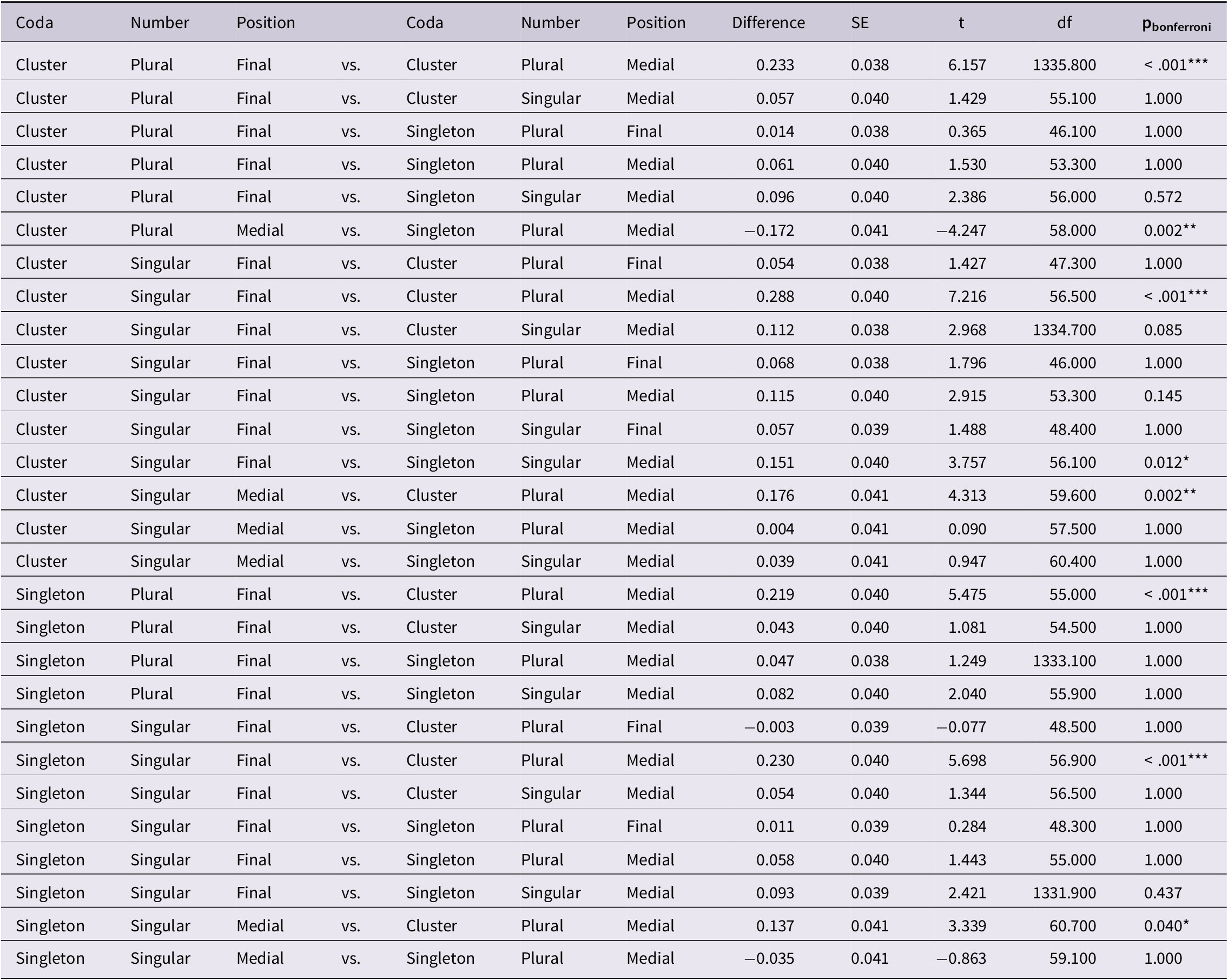
The final set of post-hoc analyses (Coda x Number x Position) showed eight significant pairwise comparisons, with the most challenging condition for all children being utterance medial coda clusters in the plural (M = 58.9%; see Figure 6; for pairwise results see Appendix A). Together these results suggest that all pre-schoolers were affected by prosodic constraints, where more complex coda clusters in the more challenging utterance medial position were harder to produce. These phonological constraints then also interacted with morphology, making plural words ending in coda clusters the most difficult to produce. Again, suggesting the lack of L1 interference.
Taken together, these three sets of post-hoc analyses suggest that, while all children struggled with producing plural words with complex coda clusters (coda complexity effect) in the challenging utterance medial position (utterance position effect), Mandarin-speaking children are affected to a greater extent compared to their monolingual peers most likely due to reduced input in English.
Production of plural allomorphs
A second LMEM was conducted to better understand the L2 children’s ability to produce the different plural allomorphs. Children’s productions of the more frequent segmental plurals (either as a singleton or as part of a cluster) were compared to the lower-frequency syllabic plural (see Table 3 for results and R-code; more maximal models could not converge). Helmert coding was used for the three-level factor Coda (singleton, cluster, syllabic) with Coda1 contrast between singleton and both cluster and syllabic plurals (-2, 1, 1) and Coda2 contrast between cluster vs. syllabic plurals (0, -1, 1). Several significant effects were found, including four 2-way interactions between Group and the Coda contrasts, as well as utterance Position and the Coda contrasts, but no significant 3-way interactions were detected.
Fixed Effects Parameter Estimates for Allomorph by Group

Produced ~ Allomorph * Group + (1|Child) + (1|Item). *p < .05, **p < .01, and ***p < .001.
Post-hoc analyses using Bonferroni adjustments for multiple comparisons were then conducted to test for significant 2-way interactions (see Figure 7). These showed that the English-speaking monolinguals produced syllabic plurals (M = 93.4%) more often than segmental plurals (Singletons: M = 73.7%; t(68) = 3.347, p = .020; Clusters (M = 76.1%; t(67) = 3.627, p = .008). Mandarin-speaking pre-schoolers, on the other hand, produced significantly more plurals ending in singleton codas (M = 84.0%) compared to both those ending in clusters (M = 67.4%; t(38) = 4.486, p < .001) and syllabic plurals (M = 69.0%; t(75) = 5.120, p < .001).
Percent correctly produced for codas ending in a singleton, cluster and syllabic plural morpheme for English monolinguals and L1 Mandarin-speaking children with standard error.

Finally, the effect of length of acquisition for the Mandarin-speaking children was examined, with months at childcare as an approximation for the length of exposure to English. No significant effect was detected in any model (see Appendix B); however, this sample of children is quite homogenous in age and therefore had a limited range in terms of length of exposure to English. Future studies will need to include children from a larger age range to better be able to quantify the role of early language experience.
Discussion
Mandarin-speaking children’s performance on this imitation task was surprisingly good given that they have only been attending an English-speaking childcare for 12-24 months. The general pattern of performance for the two groups was also remarkably similar. Utterance medial position was challenging for both groups of children, especially for the more complex coda clusters, though the effects were larger for the Mandarin-speaking pre-schoolers. Compared to their monolingual peers, Mandarin-speaking children were more affected by prosodic complexity, producing fewer singulars and plurals with coda clusters in the more challenging utterance medial position. These patterns are consistent with those of younger English-speaking monolinguals (2-year-olds) and the predictions of the Prosodic Licencing Hypothesis based on monolingual children (Demuth, Reference Demuth2014; Mealings et al., Reference Mealings, Cox and Demuth2013; Song et al., Reference Song, Sundara and Demuth2009). Previous study of simultaneous bilingual infants and toddlers has found a similar increase in syllabic complexity over time (CV > CVC > CVCC) (Lleó & Prinz, Reference Lleó and Prinz1996; Lleó et al., Reference Lleó, Kuchenbrandt, Kehoe, Trujillo and Müller2003), suggesting that our sample of early L2 learning children is much more like monolingual and simultaneous bilinguals than school aged L2 learning children in acquiring a new phonology.
Given the above findings, one might anticipate that these Mandarin-speaking pre-schoolers are well on their way to acquiring English plural morphology. However, recall that we had also collected data from the PLS-5 screener. While these Mandarin-speaking pre-schoolers performed well on expressive and receptive vocabulary, and on the negation subtest, only 6% passed the PLS-5 plural subtest (compared to 100% of the monolinguals). This required children to produce the plural forms of baby, cat and horse, elicited by pictures of two babies, cats, and horses. The Mandarin-speaking children’s poor performance on this subtest strongly suggests that they have not yet acquired plural grammar (see Table 4).
Percent of L1 English and L1 Mandarin 3-year-olds passing the PLS5 Screener Plural Subtest

* Able to produce 4/5 word sentences in English as reported by the experimenter based on elicited conversations conducted at the end of each session (mothers were not able to provide an informative answer as most did not speak to their children in English)
One reason for this difference in performance might be that the elicited imitation task only assessed children’s phonological skills, not their knowledge of plural grammar. It is possible that these L2 learning pre-schoolers had lexicalised the plural form of nouns, with little understanding of the internal morphological structure or grammatical function of inflections (e.g., cats vs. cat+s). Study 2 was therefore designed to address the question of whether the Mandarin-speaking pre-schoolers have acquired productive knowledge of how to form the plural, i.e., understand that the plural morpheme has a grammatical function.
Study 2 – Elicited Production
Study 1 showed that Mandarin-speaking pre-schoolers can produce plural words. However, it was unclear whether they had acquired the grammatical knowledge to generate plurals. This can be tested using an elicited production task, where children are given the singular and asked to produce the plural, as in the PLS-5 screener (Zimmerman et al., Reference Zimmerman, Steiner and Pond2011).
Being able to use grammar productively shows that children understand the morphological structure of words and the grammatical function of inflections. Monolingual children show an understanding of the internal structure of familiar plural words by 3 years (Zimmerman et al., Reference Zimmerman, Steiner and Pond2011), novel words by 4 years (e.g., wugs = wug + /z/) (Berko, Reference Berko1958; Davies et al., Reference Davies, Xu Rattanasone and Demuth2017, Reference Davies, Xu Rattanasone, Schembri and Demuth2019; Kouider, Halberda, Wood & Carey, Reference Kouider, Halberda, Wood and Carey2006).
Study 2 was therefore designed to use an elicited production task with real words and 4-year-olds, focussing on the more challenging coda clusters and syllabic plurals. If the elicited imitation task in Study 1 actually tapped productive knowledge of plural grammar, then the Mandarin-speaking pre-schoolers should also perform well on this elicited production task. However, if the PLS-5 screener results are robust, we might expect these emerging bilinguals to perform poorly on this elicited production task.
Method
Participants
This study was carried out in accordance with the ‘Macquarie University Human Research Ethics Committee’ approvals, with written informed consent from all parents. All children were recruited from childcare centres in Sydney, Australia. None reported a history of diagnosed hearing or language difficulties.
Twenty Mandarin-speaking pre-schoolers with a mean age of 4;8 years (range 4;0–5;4 months; 13 boys, 7 girls), who spoke only Mandarin at home, were recruited from the Sydney area. Most were born in Australia except for 6 who were born in China. The average age when they began attending an English-speaking childcare was 1;8 (range: 0;11-3;10), and all had attended childcare for at least one year (range: 12-48 months) and at least 2 days per week (range: 2-5 days). This ensured that they had some knowledge of English before participating in the experiment. Their parents all grew up in mainland China, and had an undergraduate degree or higher.
Twenty Australian English-speaking pre-schoolers with a mean age of 4;6 years (range 4;0–4;11 months; 10 boys, 10 girls) were also recruited as controls. Eighteen spoke only English at home, and 2 were exposed to 3-4 hours per week of Greek from their grandparents. The children’s parents had all grown up in an English-speaking country and had education ranging from high school to postgraduate degrees.
Stimuli and procedure
A total of 10 words often used with young children (as reported on http://childfreq.sumsar.net/) were used for stimuli, 5 for each of the cluster plurals (duc ks , ca kes , roc ks , forks & bi kes ) and the syllabic plurals (hors es , hous es , nos es , ros es & vas es ). To elicit the target words, pictures were shown on a laptop and the experimenter engaged the child in a turn-taking task. In a typical trial, the tester pointed to a picture of a single item, e.g., a dog, and said ‘Here is a dog’, then revealed a new picture with several dogs and ask ‘What do you see now? These are …’, thus prompting the children for an answer. Two practice trials were provided at the beginning of the experiment, one for the cluster and one for the syllabic plural allomorph. Children were given up to 3 attempts to provide the correct answer if needed.
A trained research assistant who was a native speaker of Australian English administered the test in a quiet room in the childcare centres and perceptually coded children’s responses as either correct (i.e., produced) or omitted. Given the results of the PLS-5 screener reported in Study 1, we expected the monolingual 4-year-olds in the present study to be at ceiling. We also expected the Mandarin L1 emerging bilinguals to have some knowledge of the plural, but to perform less well, particularly on the low frequency syllabic plural.
Results
Two separate one-sample t-tests against chance (50%) were conducted for each Allomorph by Group (see Figure 8). After Bonferroni adjustment to alpha for 4 comparisons (alpha = .012) per group, the monolinguals were found to be at ceiling for cluster plurals (M = 100%, std = 0) and significantly above chance for the syllabic plural (M = 97%, t = 28.687, df = 19, p < .001). In contrast, the Mandarin-speaking children were at chance for the cluster plurals (M = 39%, t = -1.222, df = 19, p = .237) and significantly below chance for the syllabic plurals (M = 7%, t = ‑9.731, df = 19, p < .001). These results suggest that only the monolingual pre-schoolers showed productive knowledge of the plural, and that the Mandarin-speaking children were treating the syllabic plural as a singular.
Box plots for correctly produced segmental and syllabic morphemes for L1 English and L1 Mandarin-speaking children. ***p < .001.

The effect of length of acquisition for the Mandarin-speaking children was then examined, with months at childcare as a measure of length of exposure to English. Again, no significant effect was detected (see Appendix C).
Discussion
In contrast with the results from the elicited imitation task in Study 1, the results from the elicited production task in Study 2 suggest that Mandarin-speaking emerging bilingual pre-schoolers have not yet learned how to inflect English nouns for the plural. Taken together, the results from Studies 1 and 2 suggest that these emerging bilinguals can imitate plural words, demonstrating that producing coda clusters is neither a perceptual nor an articulatory problem, but that they are not yet able to productively use plural morphology in an elicited production task.
Perhaps the elicited production task was too challenging for children with an emerging understanding of plural grammar. It requires children to combine the lexical form with the appropriate morphology, e.g., duck+s. If this generation task is too challenging, perhaps they might be able to recognise the correct forms in a comprehension task. Study 3 therefore tested children’s ability to comprehend the plural.
Study 3 – Comprehension
During early language development children can often demonstrate comprehension before being able to produce or generate the same forms. This well-known receptive-expressive gap in vocabulary has been documented for both the L1 and L2 acquisition (Gibson, Oller, Jarmulowicz & Ethington, Reference Gibson, Oller, Jarmulowicz and Ethington2012). However, this gap can be as large as one standard deviation for the L2 population (Keller, Troesch & Grob, Reference Keller, Troesch and Grob2015). It is therefore possible that while Mandarin-speaking pre-schoolers might not yet demonstrate the ability to productively generate plural forms when speaking English, they might already have good comprehension of plural morphology.
Study 3 thus investigated Mandarin-speaking pre-schoolers’ comprehension of plural grammar using a 2-alternative forced-choice (2AFC) task presented on an iPad (cf. Davies et al., Reference Davies, Xu Rattanasone, Schembri and Demuth2019). Unlike Study 2, it used novel words and pictures, where a picture of a single novel item X was presented next to a picture of 5 novel items Y, e.g., children heard either ‘touch the deg’ or ‘touch the teps’. This type of design must be used in comprehension tasks because otherwise, when prompted to respond to a singular item (e.g., duck vs. ducks), children might look at/touch one of the items in a group (e.g., of ducks) instead of the singular picture. Also, if two known words are used, children could use their lexical knowledge to perform the task without paying any attention to the plural inflection, e.g., duck vs. cats. A novel word task is also a more direct test for children’s productive knowledge of the plural, as children must generalise their knowledge about plural grammar from known words to novel words.
Using an intermodal preferential looking (IPL) paradigm, it was found that 24-month-old English-speaking monolinguals can associate novel items like daps (segmental plural) with a group of novel animals, but only by 36 months can they do the same with novel items like dasses (syllabic plurals) (Davies et al., Reference Davies, Xu Rattanasone and Demuth2017, Reference Davies, Xu Rattanasone and Demuth2020). Similarly, using a 2AFC task delivered on an iPad, monolingual 3-year-olds are above chance at choosing the correct number condition for novel words carrying segmental and syllabic plurals (Davies et al., Reference Davies, Xu Rattanasone, Schembri and Demuth2019). Taken together, these studies show that English-speaking monolinguals have an emerging knowledge of plural morphology by 2 years and have productive knowledge of all plural allomorphs by 3 years. Using the same comprehension/iPad task as in Davies et al., (Reference Davies, Xu Rattanasone, Schembri and Demuth2019), Study 3 thus tested Mandarin-speaking pre-schoolers’ comprehension of L2 English plurals.
Method
Participants
This study was carried out in accordance with the ‘Macquarie University Human Research Ethics Committee’ approvals, with written informed consent from all parents. All children were recruited from childcare centres in Sydney, Australia. None reported a history of diagnosed hearing (including ear infections) or language difficulties.
Twenty Mandarin-speaking pre-schoolers with a mean age of 4;1 years (range: 3;2 – 4;9; 11 boys, 9 girls) who spoke only Mandarin at home were recruited. The average age when they began attending an English-speaking childcare was 2;4 (range: 0;10-3;6). These children had been attending childcare for at least one year (range: 15-52 months) for at least 2 days per week (range: 2-5 days). All parents were native speakers of Mandarin and grew up in China, except for one mother who was born in China but immigrated to Australia as a child. The parents all had an undergraduate degree or higher. Data from two additional children were excluded from the analyses for scoring less than 70% on the practice and filler trials using real words. This ensured that all the children included in the analysis understood the task.
Forty-eight monolingual Australian English-speaking pre-schoolers with a mean age of 4;0 years (3;1 – 4;11; 23 boys, 25 girls) who spoke only English at home were recruited. Their parents all had grown up in an English-speaking country and had an undergraduate degree or higher.
Design
A mixed design was used with group as the between-subjects factor (L1 English vs. L1 Mandarin). The two within-subjects factors were the number condition of the words (Singular vs. Plural) and the plural allomorph type (Segmental /s, z/ vs. Syllabic /əz/). The experiment was implemented using a 2AFC paradigm delivered on an iPad with chance at 50%.
The procedure consisted of two blocks (segmental and syllabic allomorph) presented in counterbalanced order across all children to avoid any effects of presentation order on performance. Pseudo-randomizations for the order of trials were also created within each block. While each block contained the same set of nonce objects/animals across the four randomizations, each object/animal was depicted only once as a plural target, once as a plural distractor, once as a singular target and once as a singular distractor. Pictures were yoked so that across the four versions no two objects/animals were displayed together in more than one trial, and no auditory stimulus item was presented with any object/animal more than once across the four versions, regardless of being a target or distractor.
Stimuli
Auditory stimuli
The auditory stimuli were recorded in a sound-attenuated room, spoken by a female native Australian-English speaker using a child-friendly speech register. The audio was recorded using Cool Edit Pro 2.0 sampled at 48kHz. Stimuli were recorded as complete utterances with carrier phrases. Stimuli for all trials were recorded with the carrier phrase “touch [the X]” (see Table 5 for the list of stimuli).
Singular and Plural Novel Stimulus Items.

For the test trials, a total of 72 novel words were recorded, 36 of which were singular and 36 inflected for plural. Each child only saw one form of the word (either singular or plural, but not both). Novel words had onset stops that are early acquired by English-speaking children: /n/, /d/, /t/, /b/, /p/, /g/ and /k/ (Smit et al., Reference Smit, Hand, Freilinger, Bernthal and Bird1990). Vowels were all short Australian-English vowels: /æ/, /ɛ/, /ɪ/, /ɐ/ and /ɔ/ (Harrington, Cox & Evans, 1997). In addition to these novel words, 12 real words were also recorded: bat(s), crab(s), mop(s) and pig(s) for the segmental plural block, and horse(s), rose(s) and bus(es) for the syllabic plural block. The training block contained five trials with singular target words: dog, bird, cat, nug, and mib. To ensure minimal acoustic differences across the auditory stimuli, splicing was conducted using Praat (Boersma & Weenink, Reference Boersma and Weenink2012). For each test block, the target words were spliced onto one carrier phrase.
Visual stimuli
The visual stimuli were 48 objects and cartoon animals. All novel animals were depicted with happy faces and closed eyes, and did not resemble anything real or fictional. For filler the trials, 22 real objects/animals were created: box, shirt, duck, frog, clock, hat, cow, fox, bat, bug, pig, snake, mop, cake, crab, rat, bus, house, rose, tree, horse, and bear. These known trials were included to maintain children’s interest and were not analyzed. Visual stimuli were constructed with a single novel animal/object (singular) on one side and a different group of five novel animals/objects on the other side (plural). The training trials consisted only of single animals, two of which were novel. See Figure 9 for examples of each trial type.
Examples of visual stimuli used during (A) training trial, (B) familiar animal test trial, (C) novel object test trial, (D) novel animal test trial.

Equipment
The children wore Sennheiser HD 280 pro headphones. The experimental software was built using the Serenity Engine (Budziszewski, Reference Budziszewski2003) and presented on an Apple iPad Air 2 (240 x 169.5 mm, with a resolution of 2048 x 1536 at 264 dpi).
The Serenity Engine is a multiplatform engine written in C using the OpenGL library. This software makes use of Serenity’s iOS port, and uses the iOS native sound playing capabilities. However, its image displaying capabilities are platform-independent. As the current software used a number of large image files, Serenity preloaded the images into memory before each experiment began, ensuring smooth performance throughout. After each trial, results were saved to a text file and then uploaded to an SQL database for later download.
Procedure
The children were tested in a quiet area of their childcare centre, at a child-sized table and chairs. All children wore headphones: this helped them to focus on the task and minimized environmental noise. The iPad was placed directly in front of the child. To ensure that the relevant plural morpheme could be heard, children were first played an /s/ and a /z/ segment extracted from the stimuli. If children indicated they could hear both segments by repeating each sound, the experiment proceeded; if not, the volume was adjusted until correct responses were provided.
The initial five trials contained the Practice Block, which tested children’s understanding of the forced-choice paradigm. The practice trials presented children with two pictures side-by-side, both depicting a single animal: dog vs. cat and cow vs. bird. After the pictures had been displayed for 2 seconds, an auditory prompt told the children to “touch the dog” and “touch the bird”. The next practice trial presented a cat next to novel animal X, and the child heard “touch the cat”. The fourth and fifth practice trials presented children with a dog vs. novel animal X, and a bird vs. novel animal Y, and had the auditory stimuli “touch the nug” and “touch the mib”. Upon touching a picture, an audible chirrup would play, and the chosen picture would flash for 1.5 seconds. This happened regardless of whether the child chose the target or the distractor. During the practice trials, the experimenter gave the child positive verbal reinforcement.
After completing the practice trials, understanding of English plural morphology was tested in 31 test trials divided into two blocks. Each test block contained trials with novel pictures and auditory stimuli, as well as filler trials with known words. The segmental plural test block consisted of 16 trials (12 novel & 4 filler), and the syllabic plural test block consisted of 15 trials (12 novel & 3 filler).
For each test trial, two pictures of novel objects were displayed side-by-side, one of a single object X (singular), and the other of a different set of five objects Y (plural). After 2 seconds, an auditory prompt played requesting participants to “Touch the (one of the two pictures)”. The auditory stimulus contained a singular novel word in CVC phonological form (e.g., “dup”), or an inflected plural novel word in CVCs/CVCz/CVCəz form (e.g., “teps/degs/kosses”).
Results
First, to test whether children could comprehend the number condition of novel words, performance was compared to chance (i.e., 50%). With alpha set at 0.05, four one sample t-tests were conducted for each group (Figure 10). English monolinguals performed significantly above chance on all four conditions: segmental singular (t(47) = 3.794, p < .001), segmental plural (t(47) = 6.002, p < .001), syllabic singular (t(47) = 3.463, p = .001), and syllabic plural (t(47) = 5.342, p < .001). However, the Mandarin group were no different from chance on all conditions: segmental singular (t(19) = -.213, p = .834), segmental plural (t(19) = 1.064, p = .301), syllabic singular (t(19) = 1.641, p = .117), and syllabic plural (t(19) = .767, p = .453).
Box plots for percent correct for novel targets consistent with segmental and syllabic plural word forms and their singular forms for English monolinguals and L1 Mandarin-speaking pre-schoolers. ***p < .001.

To test group differences and any interactions with the allomorph type and number conditions, a linear mixed-effects model was constructed with both age (in months) and months at childcare as covariates, and child as a random variable, with random slopes fitted for each group (more maximal models could not converge; see Table 6). With Satterswaite adjustment for denominator dfs, only a significant main effect of L1 group was found (t(60) = -2.478, p = .016), suggesting that L1 English monolinguals performed significantly better than L1 Mandarin-speaking preschoolers. Importantly, the English-speaking monolinguals did not treat singulars ending in a fricative (e.g., coss, dass) as plurals; this would violate English word minimality constraints (CV syllables with short vowels cannot constitute well-formed words in English), showing a nuanced understanding of English phonological and lexical structure (see Davies et al., 2017, 2019, 2020, for discussion).
Fixed Effects Parameter Estimates for Group by Number and Allomorph

R-code: Score ~ 1 + Group + Number + Allomorph + Group:Number + Group:Allomorph +Number:Allomorph + Group:Number:Allomorph+(1 | Child).
*Indicates significance at p<.05 and ^approaching significance
Finally, length (months) at childcare was used to assess exposure to English on performance. Again no significant effect was detected (see Appendix D). These results provide further support for Study 2, showing that Mandarin-speaking pre-schoolers are not yet able to comprehend the number condition of novel words, performing significantly below their English monolingual peers.
General discussion
In this series of studies, we probed L1 Mandarin-speaking emerging bilingual pre-schoolers’ knowledge of L2 English inflectional morphology. Study 1, using an elicited imitation task, found that Mandarin-speaking pre-schoolers with only one to two years of exposure to English can produce plural words quite well when asked to repeat, though plural words with coda clusters (e.g., duc ks ) and syllabic plurals (e.g., hors es ) were not produced as consistently as phonologically simple plural codas like bee s . Their unexpected good overall production in shows that, even with less L2 English input and having an L1 with a different phonological structure, these young children can acquire English phonotactic structures relatively quickly, showing developmental patterns that are similar to that of younger monolingual children (Demuth, Reference Demuth2014).
However, it was unclear whether these emerging bilingual 3-year-olds had productive knowledge of plural morphology: perhaps they kept these three-word sentences in short-term working memory and then simply repeated what they heard, producing plural words without understanding the internal morphological structure or grammatical function of the plural inflections. Further support for this possibility came from their poor performance on the plural formation task in the PLS-5 screener (one cat, two cats ).
To probe this possibility, Study 2 used an elicited production task with real words (like the PLS-5 screener), and tested slightly older 4-year-olds. As with the PLS-5, the results showed that these emerging bilinguals were not able to supply the plural forms of familiar words. In contrast, their monolingual peers performed at ceiling. But perhaps generating the plural was too hard for these children, taxing working memory and lexical access. A comprehension task was therefore designed, where children needed only to recognise the novel word forms that were consistent with plural word structures.
Study 3 therefore used a forced-choice comprehension task on the iPad, where the child heard a novel word, and had to press either the singular picture or a plural picture with a different set of novel items. This tested emerging bilingual pre-schoolers’ knowledge of plural morphology on words they had never heard before. Although the monolingual children were again at ceiling, the emerging bilinguals were at chance, suggesting little productive knowledge of English plural formation. Taken together, the results from Studies 2 and 3 provide a consistent picture, suggesting that these L1 Mandarin-speaking pre-schoolers have not yet acquired productive use of L2 English plural grammar. They also suggest that the elicited imitation task used in Study 1 did not tap knowledge of inflectional morphology for these Mandarin-speaking pre-schoolers, even though it has shown this for monolinguals (Mealings & Demuth, Reference Demuth2014; Mealings et al., Reference Mealings, Cox and Demuth2013).
These findings have both theoretical and applied implications. They suggest that Mandarin-speaking pre-schoolers do not yet understand the morphological structure and grammatical function of English inflected words, despite being able to imitate these forms in production. Early L2 learning children may thus need longer exposure to English before the learning of inflectional morphology is achieved. Although the syllabic plural presented challenges for these children in the present study, there are reports that school-aged Mandarin-speaking children learning L2 English acquired the syllabic form of the past tense (e.g., batted) earlier than segmental allomorphs (e.g., kicked), matching Mandarin disyllabic word structure (Nicoladis, Yang & Jiang, Reference Nicoladis, Yang and Jiang2020). These results differ from ours. First, since our pre-schoolers are still learning their L1 Mandarin phonology, they may not be able to capitalise on L1 transfer as much as their older school-aged counter parts. Second, Davies et al. (Reference Davies, Xu Rattanasone and Demuth2017) have established that the syllabic plural allomorph is far less frequent than the segmental allomorphs, accounting for only 6.9% of plural types in pre-schoolers’ input. This raises many questions about when and how pre-schoolers learn L2 English inflectional morphology more generally, and the segmental and frequency contributions of different allomorphs (e.g., tense forms such as walk-s, wash-ed), calling for a longitudinal study to track this development over time.
Our results also highlight the importance of using the appropriate methodology to tap into young L2 learners’ morphological representations. Although the elicited imitation task is sensitive to eliciting the acquisition of phonotactics (e.g., coda complexity) and prosodic (utterance position) effects, and morphology in younger monolingual 2-year-olds, it is not useful for assessing older L2 pre-schoolers’ morphological representations. Future studies could try longer sentences but that might be too challenging for early L2 learners. On the other hand, both elicited production and novel word comprehension tasks appear to be effective at testing L2 pre-schoolers’ morphological representations. The novel word comprehension task may also be suitable to use with younger L2 learners who are not yet able to produce speech reliably.
These findings may also generalise to pre-schoolers speaking other L1s that do not have codas, clusters, or grammatical inflections. This suggests the need for further study of emerging bilingual pre-schoolers from other L1s that are typologically distinct from English. This is especially important given that previous studies on typologically more similar L1s have suggested that there may be a critical period for acquiring L2 inflectional grammar at around the age of 4 (Meisel, Reference Meisel2004, Reference Meisel2009). The Mandarin-speaking children discussed in the three studies here were acquiring L2 English much earlier, at 2 and 3 years, yet might still show challenges in acquiring new morphological structures. However, these results are likely due to reduced English input compared to their monolingual peers, and may reflect slower rather than different acquisition patterns for these very early L2 learning pre-schoolers. Future studies, especially with longitudinal designs, that document patterns of early bilingual language development across different groups of L1 and L2 learning children are needed to better understand how early L2 acquisition might differ from L1 acquisition.
In addition to L1 typology, other factors may have contributed to the current findings. In Australia, Mandarin is the most common home language spoken besides English, and there are high concentrations of Mandarin-speaking communities in Sydney. Mandarin-speaking pre-schoolers often have peers and teachers in childcare centres who also speak L1 Mandarin. This provides an environment where they may have less early L2 immersion than children in other countries or children speaking other L1s. Thus, lack of sufficient exposure to the L2, combined with L1 typology, may contribute to the present results. Note also that most of the parents of these children were generally well-educated, with sufficient English language skills to attend university. However, even if the parents occasionally speak English at home, the input may have missing grammatical morphemes (Lardiere, Reference Lardiere1998a,b). Future longitudinal studies will therefore need to consider the role of both amount and type of L1 and L2 input at home and in childcare, the potential effect on these children’s L2 acquisition, and if and when these children catch up to their monolingual peers.
Conclusions and implications
This series of studies provides an important first look into the L2 English abilities of Mandarin-speaking emerging bilinguals during the crucial pre-school years of early language development, with implications for school readiness. The results suggest that while pre-schoolers can acquire new L2 phonology quickly, they are much slower in acquiring productive use of a new L2 morphology. However, the learning constraints appear to be similar to those for monolinguals and simultaneous bilinguals rather than older school aged L2 learning children. The findings also highlight the need to use appropriate methods for tapping the grammatical knowledge of L2 learning pre-schoolers and role of reduced input on early L2 acquisition. More research is needed to understand typical L2 development for children who speak a typologically distinct L1 from English under different language environments and to track longer term acquisition patterns. Until these questions are addressed, it will prove challenging to identify emerging bilinguals at risk of developmental language disorders.
Acknowledgments
* This research was supported, in part, by Macquarie University and the following grants: NIH R01HD057606, ARC DP110102479, and ARC CE110101021. We thank Felicity Cox and members of the Child Language Lab for assistance with stimulus design and acoustic analysis
Post-hoc pairwise comparisons for Coda, Number, and Position
Fixed Effects Parameter Estimates for Coda Type and Number with Length of Exposure to English (LoE) as a covariate for Mandarin-speaking children

Fixed Effects Parameter Estimates for Allomorph with Length of Exposure to English (LoE) as a covariate for Mandarin-speaking children

Fixed Effects Parameter Estimates for Allomorph with Length of Exposure to English (LoE) as a covariate for Mandarin-speaking children

Fixed Effects Parameter Estimates for Number and Coda type with Length of Exposure to English (LoE) as a covariate for Mandarin-speaking children


 Open access

