





Introduction
Volunteering in general is considered a valuable societal act, advocated as a method of community engagement with potential public health benefits (Jenkinson et al. Reference Jenkinson, Dickens, Jones, Thompson-Coon, Taylor, Rogers, Bambra, Lang and Richards2013). The current extensive literature regarding volunteering has primarily examined the benefits of volunteering with regard to individuals (Koelsch Reference Koelsch2017; Lawton et al. Reference Lawton, Gramatki, Watt and Fujiwara2021; Linning and Jackson Reference Linning and Jackson2018), with previous work highlighting benefits such as a sense of fulfillment and shared identity leading to increased social connection (Gray and Stevenson Reference Gray and Stevenson2020) and a reported improvement in mental health (Jenkinson et al. Reference Jenkinson, Dickens, Jones, Thompson-Coon, Taylor, Rogers, Bambra, Lang and Richards2013). However, the challenges and resultant negative experiences of volunteering seem less well reported (Nichol et al. Reference Nichol, Wilson, Rodrigues and Haighton2023; Wu et al. Reference Wu, Sheehan and Pinto Da Costa2023). Volunteers supporting people seeking asylum (PSA) represent a specific subsection of the volunteering community, who are exposed to a unique set of challenges, (Jones and Williamson Reference Jones and Williamson2014) such as exposure to the traumatic narratives of PSA and the conduction of work within an environment of obstructive immigration policy (Posselt et al. Reference Posselt, Deans, Baker and Procter2019). Although volunteering in this context has previously been explored, past studies have largely focused upon volunteers acting within a professional capacity, rather than lay volunteers acting through informal channels (Roberts et al. Reference Roberts, Teague, Lee and Rushworth2021). It is the experience of this cross section of volunteers, lay persons supporting PSA on an informal basis, that we are interested in exploring, within the unique context of the Bibby Stockholm barge.
Volunteering, health, and wellbeing
Literature regarding why people volunteer indicates a collection of contextualized intrinsic and extrinsic motivations (Rose Reference Rose2016; Stukas et al. Reference Stukas, Hoye, Nicholson, Brown and Aisbett2016). One commonly described motivation relates to firmly held altruistic or humanitarian values (Borho et al. Reference Borho, Georgiadou, Grimm, Morawa, Silbermann, Nißlbeck and Erim2019; Partavian and Kyriakopoulos Reference Partavian and Kyriakopoulos2023; Yarris et al. Reference Yarris, Garcia-Millan and Schmidt-Murillo2020), sometimes instilled through personal and family histories (Yarris et al. Reference Yarris, Garcia-Millan and Schmidt-Murillo2020). Another frequent theme is active citizenship, a societal responsibility to foster social inclusion (Koelsch Reference Koelsch2017; Steen Bygballe Jensen and Kirchner Reference Steen Bygballe Jensen and Kirchner2020) and to react to the political atmosphere (Jones and Williamson Reference Jones and Williamson2014; Laine and Salmi-Niklander Reference Laine and Salmi-Niklander2017; Steen Bygballe Jensen and Kirchner Reference Steen Bygballe Jensen and Kirchner2020), where acts of compassion are thought to embody social change (Monforte and Maestri Reference Monforte and Maestri2023).
Aside from benefits to communities, there are direct and indirect benefits to volunteers (Koelsch Reference Koelsch2017; Lawton et al. Reference Lawton, Gramatki, Watt and Fujiwara2021; Linning and Jackson Reference Linning and Jackson2018). Significant evidence suggests that voluntary work provides social, mental, and physical health benefits to volunteers (Nichol et al. Reference Nichol, Wilson, Rodrigues and Haighton2023) and has been linked to improvements in wellbeing in elderly populations (De Wit et al. Reference De Wit, Qu and Bekkers2022; Weziak-Bialowolska et al. Reference Weziak-Bialowolska, Skiba and Bialowolski2024), important within the United Kingdom, given its ageing demographic (Tabassum et al. Reference Tabassum, Mohan and Smith2016). However, evidence regarding the benefits of volunteering is not straightforward (Lawton et al. Reference Lawton, Gramatki, Watt and Fujiwara2021; Nichol et al. Reference Nichol, Wilson, Rodrigues and Haighton2023; Van Willigen Reference Van Willigen2000).
A reason for the debate regarding the health benefits is the lack of clarity surrounding causal mechanisms by which volunteering improves health (Jenkinson et al. Reference Jenkinson, Dickens, Jones, Thompson-Coon, Taylor, Rogers, Bambra, Lang and Richards2013). Anderson et al.’s (Reference Anderson, Damianakis, Kröger, Wagner, Dawson, Binns, Bernstein, Caspi and Cook2014) systematic review attempted to address this in relation to older volunteers, through their development of a theoretical framework. Fig. 1 presents a modified version of their framework (Ibid, p.1507), which we have augmented with additional findings from further systematic reviews by Casiday (Reference Casiday2008), Guiney and Machado (Reference Guiney and Machado2018), Hyde et al. (Reference Hyde, Dunn, Scuffham and Chambers2014), Jenkinson et al. (Reference Jenkinson, Dickens, Jones, Thompson-Coon, Taylor, Rogers, Bambra, Lang and Richards2013), and Milbourn et al. (Reference Milbourn, Saraswati and Buchanan2018) providing a theoretical framework for development within the context of this study.
Conceptual framework based upon Anderson et al.’s theoretical model of how volunteering leads to functional improvements and decreases dementia risk among older adults (2014, p. 1507) augmented with findings from others as discussed.

Fig. 1. Long description
Starting at the left, ‘Volunteering’ is the anchor. Three arrows extend rightward to ‘Cognitive activity’, ‘Physical activity’, and ‘Social activity’. Each activity connects to a central box labeled ‘Mechanisms’, which lists: Social interaction, Altruism, Role enhancement, Self-efficacy, Physical health, Developing healthy behaviours, Developing coping strategies, Cognitive activity, and Learning. From the mechanisms box, arrows extend rightward to three personal outcomes: ‘Psychosocial Functioning’ at the top, ‘Physical functioning’ in the middle, and ‘Cognitive functioning’ at the bottom. Arrows connect these outcomes vertically, indicating interrelated improvements.
Despite benefits, volunteering can negatively impact volunteers, although this appears less well researched. Volunteering can be challenging, placing demands upon finances, time, and emotional capacity, which can lead to resentment or burnout (Nichol et al. Reference Nichol, Wilson, Rodrigues and Haighton2023; Wu et al. Reference Wu, Sheehan and Pinto Da Costa2023). Evidence suggests the ability to cope with such psychological challenges may depend upon whether a volunteer is operating through a formal or informal network; however, there is no current consensus as to which is considered most protective (Appau and Awaworyi Churchill Reference Appau and Awaworyi Churchill2019; Borho et al. Reference Borho, Georgiadou, Grimm, Morawa, Silbermann, Nißlbeck and Erim2019; Nappo and Fiorillo Reference Nappo and Fiorillo2020).
A report issued by the United Kingdom (NCVO 2023a) found that volunteering is decreasing. A commonly reported reason for withdrawing from voluntary work stemmed from a sense that volunteering is increasingly feeling like an unpaid job, leading to a decrease in volunteer satisfaction and an increase in perceived time commitment. A decline in volunteering is of concern given that it contributes £17.8 billion to the UK economy (NCVO 2023b), filling gaps in statutory provision (Laine and Salmi-Niklander Reference Laine and Salmi-Niklander2017; Nichol et al. Reference Nichol, Wilson, Rodrigues and Haighton2023).
Volunteers supporting asylum seekers
The term “asylum seeker” denotes a sociolegal positionality referring to a person seeking international protection, due to fear of persecution or threat to life or freedom within their country of origin, who is awaiting a final decision regarding their claim for refugee status (UN 1951). PSA are generally considered a vulnerable population with complex health needs (Jones and Williamson Reference Jones and Williamson2014; Partavian and Kyriakopoulos Reference Partavian and Kyriakopoulos2023). These needs are often exacerbated by difficulties accessing healthcare (Ahmadinia et al. Reference Ahmadinia, Eriksson-Backa and Nikou2022; Jones and Williamson Reference Jones and Williamson2014), discrimination, isolation, uncertainty, xenophobia, and a lack of autonomy, acting together to affect the social determinants of health (Jones and Williamson Reference Jones and Williamson2014; Marmot and Wilkinson Reference Marmot and Wilkinson1999; Partavian and Kyriakopoulos Reference Partavian and Kyriakopoulos2023; Phillimore and Cheung Reference Phillimore and Cheung2021).
Volunteers supporting PSA are required to cope with a particular set of challenges due to the complex health and personal circumstances of PSA (Jones and Williamson Reference Jones and Williamson2014). Working alongside PSA puts volunteers at risk of vicarious trauma through exposure to traumatic narratives, and secondary trauma due to witnessing the destitution and extensive health needs of PSA, both of which may negatively impact volunteer mental health (Borho et al. Reference Borho, Georgiadou, Grimm, Morawa, Silbermann, Nißlbeck and Erim2019; Henderson et al. Reference Henderson, Jewell, Huang and Simpson2025; Koelsch Reference Koelsch2017; Posselt et al. Reference Posselt, Deans, Baker and Procter2019). This is discussed within the literature in relation to “compassion fatigue,” which Figley (Reference Figley1995) describes as a three-faceted phenomenon of burnout, secondary traumatic stress, and reduced compassion satisfaction (Pardess et al. Reference Pardess, Mikulincer, Dekel and Shaver2014). A systematic review by Roberts et al. (Reference Roberts, Teague, Lee and Rushworth2021) highlighted higher levels of compassion fatigue in those supporting PSA than in “other helping professionals.” They did, however, report considerable heterogeneity between studies, especially regarding measures used to assess outcome. Because of this specific set of challenges, much of the literature concludes that volunteers should be appropriately trained and psychologically supported to prevent negative mental health outcomes (Borho et al. Reference Borho, Georgiadou, Grimm, Morawa, Silbermann, Nißlbeck and Erim2019; Jones and Williamson Reference Jones and Williamson2014; Roberts et al. Reference Roberts, Teague, Lee and Rushworth2021). While much research has been conducted regarding the way exposure to primary and secondary trauma affects clinicians, who volunteer formally on a professional basis (Posselt et al. Reference Posselt, Deans, Baker and Procter2019), and are trained to employ coping mechanisms, such as boundary setting (Koelsch Reference Koelsch2017), emotional distancing, and task-orientated coping (Maestri and Monforte Reference Maestri and Monforte2020), little has been done to describe the impact of vicarious and secondary trauma upon laypersons volunteering informally in this context.
A further challenge highlighted in literature is that of working alongside obstructive immigration policy (Jones and Williamson Reference Jones and Williamson2014; Partavian and Kyriakopoulos Reference Partavian and Kyriakopoulos2023), found to be the greatest stressor among volunteer clinicians in Australia (Posselt et al. Reference Posselt, Deans, Baker and Procter2019). Therefore, volunteering to support PSA can be considered a form of activism in protest of the way PSA are treated by governments (Monforte and Maestri Reference Monforte and Maestri2023; Rose Reference Rose2016; Stock Reference Stock2017). Through everyday activities, volunteers attempt to amend the situation within their local contexts (Steen Bygballe Jensen and Kirchner Reference Steen Bygballe Jensen and Kirchner2020). This puts volunteers at risk of encountering intimidation and isolation from their communities (Rose Reference Rose2016).
There have been two previous studies examining the experience of volunteers supporting PSA within the UK context. Jones and Williamson’s Reference Jones and Williamson2014 qualitative study in Glasgow interviewed eight participants, two of which were asylum seekers themselves, and one a paid volunteer, volunteering across a variety of formal and religious organizations across Glasgow. Data were analyzed using a framework analysis. Their research highlighted that volunteers’ roles included the support of destitute asylum seekers and acting as advocates to facilitate access to services, largely motivated by a humanitarian interest in the situation of asylum seekers within the United Kingdom. They further reported upon both the positive and negative aspects the volunteer experience, although did not discuss this in terms of overall volunteer health and wellbeing. They did, however, include a brief analysis of support for volunteers, where several volunteers described the available support to be lacking. In contrast, Maestri and Monforte’s (Reference Maestri and Monforte2020) qualitative study conducted 72 in-depth interviews with volunteers across the United Kingdom involved in charities and networks supporting refugees at both local and national levels. In contrast to Jones and Williamson, Maestri and Monforte sought to examine the volunteer experience through the lens of the “deservingness” of refugees, and how volunteers navigated moral dilemmas and emotional unease within this paradigm. Although both these studies explored the volunteer experience, we believe there remains a literature gap regarding the experience, health and wellbeing of lay volunteers, volunteering to support PSA on an informal basis.
National and local context
The UK’s overburdened asylum system has been characterized as inefficient (Partavian and Kyriakopoulos Reference Partavian and Kyriakopoulos2023), with greater concern for state security than the welfare of PSA, a group perceived as a threat to society (Cooper et al. Reference Cooper, Blumell and Bunce2021). This rhetoric has been employed to generate a “hostile environment” where immigration policies isolate PSA from society and the welfare state (Partavian and Kyriakopoulos Reference Partavian and Kyriakopoulos2023), leaving a gap in welfare provision increasingly filled by voluntary organizations (Steen Bygballe Jensen and Kirchner Reference Steen Bygballe Jensen and Kirchner2020; Wren Reference Wren2007; Yarris et al. Reference Yarris, Garcia-Millan and Schmidt-Murillo2020).
This study focuses upon the town of Weymouth and the Isle of Portland in Dorset, a rural county of Southwest England. Previously an area of heavy industry, the economy is now dominated by low paying seasonal tourism causing pockets of significant deprivation (Our Dorset 2022). Between July 2023 and January 2025, Portland Port hosted the Bibby Stockholm barge, a floating mass accommodation unit housing up to 400 men seeking asylum (BBC 2025). The Bibby Stockholm had previously been used by the governments of Germany and the Netherlands to house homeless individuals and PAS, although conditions on board at the time were criticized as being inhumane (Turner et al. Reference Turner, Davies, Isakjee, Mayblin and Yemane2023). The barge represented the flagship of the, then Conservative, government’s initiative to cut the cost of housing asylum seekers in hotels, estimated to stand at around £8 million per day (BBC, 2023).
The presence of the Bibby Stockholm was met with local and national protests regarding the suitability of both the Barge for housing PSA, and its location in Dorset (Morris Reference Morris2023). Local protests saw the clashing of two opposing groups “No to the Barge,” and “Stand Up to Racism” (SUTR) (Ibid). Neither group approved of the Bibby Stockholm although their primary grievances differed as “No to the Barge” focused upon the impact the Bibby Stockholm would have upon the safety and social service provision of the small local community (Morris Reference Morris2023), while “SUTR” were primarily concerned with the negative impact the barge accommodation would have upon its occupants due to the exacerbation of past trauma, a concern shared by national commentators (Looi Reference Looi2023). Concerns regarding the suitability of accommodation units like the Bibby Stockholm have been raised with respect to other mass accommodation sites, such as Royal Air Force Wethersfield, which was declared the site of a mental health crisis (MSF 2024). Tragically, fears regarding the negative effect of housing asylum seekers upon the barge were fulfilled as in December 2023 Leonard Farruku, an Albanian asylum seeker, was found dead in his room on the Bibby Stockholm after taking his own life (Mahase Reference Mahase2024).
Research question and objectives
While there is significant literature regarding health benefits of voluntary work, this has focused upon elderly populations outside the context of supporting PSA. Similarly, while literature describes challenges specific to volunteering with PSA, studies have mostly been conducted with healthcare professionals abroad rather than laypersons volunteering on an informal basis within the United Kingdom. This study, focusing on laypersons informally supporting PSA in the United Kingdom, expands upon previous studies by Jones and Williamson (Reference Jones and Williamson2014) and Maestri and Monforte (Reference Maestri and Monforte2020) to fill a prominent research gap. Additionally, volunteering has the potential to both positively and negatively affect wellbeing. As volunteers supplement the welfare state, volunteer health and the sustainability of the voluntary sector is in the interest of wider society. Thus, the research question; “What is the lived experience of volunteers that support PSA within the context of the Bibby Stockholm?,” is of both academic and societal importance.
Methodology
The following methodology and subsequent results are reported with reference to the Consolidated Criteria for Reporting Qualitative Research checklist (COREQ) after Tong et al. (Reference Tong, Sainsbury and Craig2007). This study was conducted within an interpretivist paradigm, underpinned by ideas of social construction (Berger and Luckmann Reference Berger and Luckmann1967; Holloway and Galvin Reference Holloway and Galvin2023). Given the nature of the research question and paradigm, a qualitative strategy was employed. Data were collected via face-to-face one-to-one interviews and analyzed using thematic analysis (TA). As an under researched area, we chose to utilize a strategy that was open in terms of exploring possibility, while giving an authentic voice to this overlooked group (Guba and Lincoln Reference Guba and Lincoln1989; Holloway and Galvin Reference Holloway and Galvin2023).
The target population was the inhabitants of Weymouth and Portland who participated in voluntary work with PSA. There were minimal exclusion criteria; participants had to be over the age of 18, support PSA on a voluntary basis and conduct this work within Weymouth and Portland. Purposive sampling was used given the small, difficult to access target group possessing the desired characteristic of lay persons volunteering to support PSA in Weymouth and Portland. Participants were recruited through contacting a publicly known, local informal voluntary support group working with PSA across Weymouth and Portland. The support group is not identified to protect the identities of participants. The support group facilitated recruitment through the internal dissemination of the participant information sheet and contact details of the researchers. Interested participants contacted the researchers directly and were given the opportunity to discuss questions surrounding study participation, following which written consent was obtained prior to interview. Sampling within this context evolves (Holloway and Brown Reference Holloway and Brown2012), thus, snowball sampling was additionally utilized, as participants referred other potential participants to the interviewer, following the completion of their interview (Holloway and Galvin Reference Holloway and Galvin2023). No recruited participants withdrew from the study.
Data were collected via face-to-face, one-to-one semi-structured interviews lasting 60–140 minutes conducted in July and August 2024. These interviews were conducted in mutually agreed public locations across the Isle of Portland, thus allowing participants to choose a location they found familiar, where they could comfortably discuss their experience. Interviews were conducted by PB, a medical doctor by training currently specializing in general internal medicine. She is neurodiverse, with a strong sense of social justice and a specific interest in global health for which she holds a Bachelor of Science, and a Master of Science. Participants were not known to PB prior to participation.
Interviews began with a single open question; “Please can you talk to me about your experience as a volunteer supporting PSA?.” This question was selected as it is deliberately broad, allowing participants space to answer as they interpreted, with minimal researcher influence. This was followed by participant-guided discussion. After this unstructured period, the interviewer referred to an interview guide (Supplementary Appendix A), developed from reflection on the literature, to explore relevant areas not initially discussed. Interviews were recorded using a Dictaphone, and the audio files transcribed using Microsoft Word. The accuracy of these transcriptions was manually checked. Stored data were pseudoanonymized, and access to the master key was restricted to PB only.
Nine interviews were conducted, the number determined by ongoing critical reflection of the meaning richness achieved, conceptualized after Dey’s theoretical sufficiency (Dey Reference Dey1999), and Malterud, Siersma, and Guassora’s information power (Malterud et al. Reference Malterud, Siersma and Guassora2016). These concepts were used as an alternative to data saturation (Glaser and Strauss Reference Glaser and Strauss1967; Hennink and Bailey Reference Hennink and Bailey2011), a contested method that implies that data collection is a finite process (Braun and Clarke Reference Braun and Clarke2021).
Data were analyzed using TA, after Braun and Clarke (Reference Braun and Clarke2006, Reference Braun and Clarke2012, Reference Braun and Clarke2013 and Reference Braun and Clarke2021). TA is a six-phase method for systematically identifying, organizing, and offering insight into patterns of meaning within a dataset, through collation into themes, allowing researchers to make sense of shared experiences and meanings (Braun and Clarke Reference Braun and Clarke2012). This method of analysis was selected due to its accessibility and flexibility, facilitating an analysis that coheres with the methodology.
Following transcription and data familiarization, one researcher (PB) manually analyzed and coded the data using Microsoft Word. Codes sharing a unifying feature were collated into themes using physical grouping and mind mapping techniques (Supplementary Appendix B), the latter utilizing Mindview software. Themes were further developed through the creation of an illustrative figure (Figs. 3–5), which lent itself to a clear, focused definition that demonstrated the scope and purpose of each theme. This analysis was a dynamic process where transcripts, codes, and themes were revisited throughout the entire process as understanding of the data developed.
Although this study is concerned with the way in which participants interpret their experiences, we acknowledge our role in telling their story, the epistemological standpoint. Thus, during data collection and analysis we reflected upon our background, experiences and how our assumptions affect these processes (Polit and Beck Reference Polit and Beck2014). This formed the basis of our reflexivity, the way that we attended “systematically to the context of knowledge construction … at every step of the research process” (Malterud Reference Malterud2001, p. 484). Ethical approval was granted by the University College London Research Ethics Committee on June 14, 2024 (Reference number: 26791/001).
Results and discussion
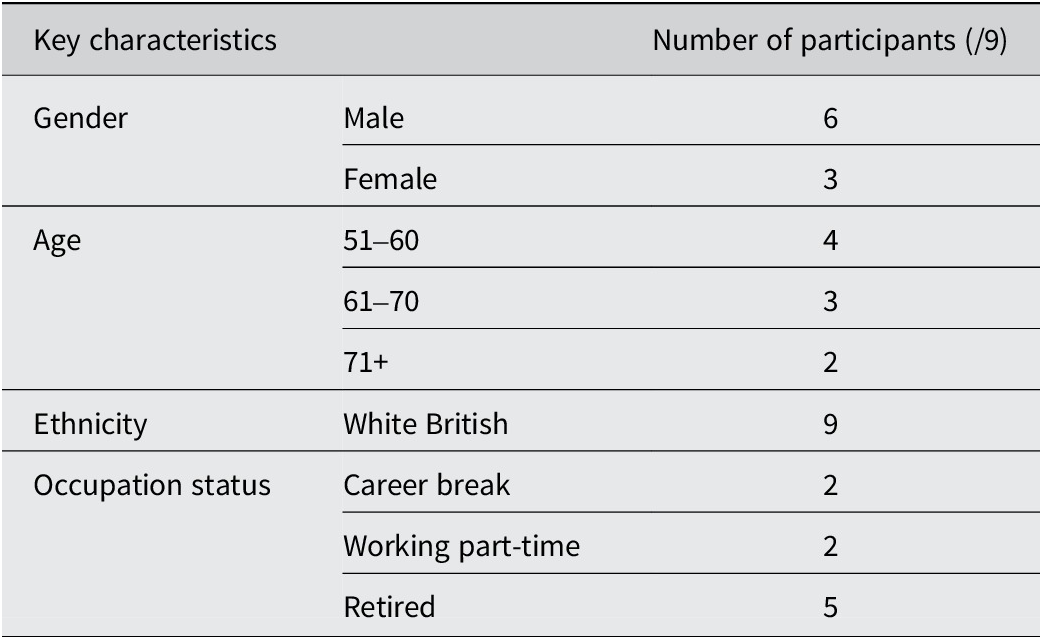
This section presents our findings in a combined manner to aid coherence and flow (Holloway and Brown Reference Holloway and Brown2012; Holloway and Galvin Reference Holloway and Galvin2023). Anonymized, verbatim quotations are included to support themes and key findings. Nine participants aged 50–80 were recruited, six male and three female. Most were either retired or working part time, while two were taking career breaks which coincided with their period of volunteering. All were of Caucasian ethnic origin and had lived on Portland for varying lengths of time (Table 1). While participants could be considered the “usual suspects” (Braun and Clarke Reference Braun and Clarke2013), their demographics are representative both of those who volunteer (NCVO 2023a) and those who reside in Weymouth and Portland (Dorset Council 2024).
Key characteristics of included participants

Table 1. Long description
The table has three columns: key characteristics, category, and number of participants out of nine. For gender, male is six and female is three. For age, four are 51 to 60, three are 61 to 70, and two are 71 plus. For ethnicity, all nine are White British. For occupation status, two are on a career break, two are working part-time, and five are retired. Each characteristic is listed in the first column, with its categories and corresponding participant counts in the next columns.
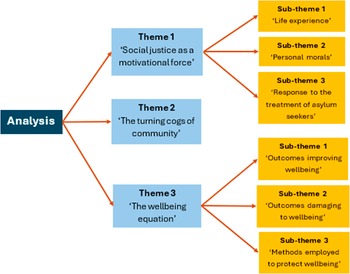
Our interpretation of the data generated three overarching themes, with three subthemes within themes 1 and 2, respectively (Fig. 2).
Themes and subthemes developed from analysis.

Fig. 2. Long description
At the left, a dark blue box labeled Analysis branches rightward into three light blue boxes stacked vertically. From top to bottom, these are Theme 1 ‘Social justice as a motivational force’, Theme 2 ‘The turning cogs of community’, and Theme 3 ‘The wellbeing equation’. Themes 1 and 2 connect rightward to three yellow sub-theme boxes. For Theme 1, the sub-themes are Sub-theme 1 ‘Life experience’, Sub-theme 2 ‘Personal morals’, and Sub-theme 3 ‘Response to the treatment of asylum seekers’. For Theme 3, the sub-themes are Sub-theme 1 ‘Outcomes improving wellbeing’, Sub-theme 2 ‘Outcomes damaging to wellbeing’, and Sub-theme 3 ‘Methods employed to protect wellbeing’. All arrows move horizontally from left to right, visually grouping sub-themes under their respective themes.
Theme 1: Social justice as a motivational force
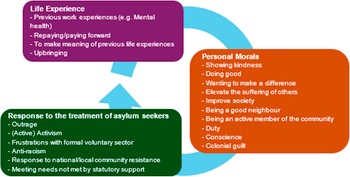
Theme 1 relates to the way in which participants seemed to situate descriptions of their motivations to volunteer within the principle of social justice. Across participants’ motivational experiences, we noted three distinct subthemes during our analysis where codes related to either life experience, personal morals, or response to the perceived treatment of PSA. Fig. 3 illustrates the grouping of relevant analytic codes to form our overarching theme and three subthemes. It demonstrates the cyclical way we consider life experiences, personal morals, and situational responses, to interact.
Social justice as a motivational force.

Fig. 3. Long description
Starting at the top left, a purple rectangle labeled Life Experience lists previous life experiences such as mental health, repaying or paying forward, making meaning of previous life experiences, and upbringing. An arrow points right to a brown rectangle labeled Personal Morals, which includes showing kindness, doing good, wanting to make a difference, elevating the suffering of others, improving society, being a good neighbour, being an active member of the community, duty, conscience, and colonial guilt. Another arrow points downward to a green rectangle at the bottom labeled Response to the treatment of asylum seekers, listing outrage, active activism, frustrations with the formal voluntary sector, anti-racism, response to national or local community resistance, and meeting needs not met by statutory support. The final arrow curves upward to complete the cycle, connecting back to Life Experience.
Subtheme 1: Life experience
Motivations were often described as being informed by life experience as found by Yarris et al. (Reference Yarris, Garcia-Millan and Schmidt-Murillo2020). For some, this life experience drew upon childhood experiences of parental activism, for others this included a reflection upon the kindness that has been shown to them by others in their own times of need:
Human kindness and respecting people’s dignity is activism. Isn’t it in its own way? And just trying to spread that, and I’ve been on the receiving end as well.—Olivia
For two volunteers, such motivation drew upon previous experiences travelling and wanting to repay the welcome and kindness they had been shown during previous travels, something not apparent in the literature:
I was probably the only westerner on these islands in the middle of nowhere and I was absolutely safe and welcomed. Yeah, so in part, that was my experience, and I am dogged about passing that on.—Olivia
But at the end of the day, people treated me with when I went to another country respect, they gave me respect. They welcomed me. And I didn’t expect any of that…and embraced me and I embraced them—George
Subtheme 2: Personal morals
Several participants described a moral underpinning to action, often mentioned in terms of “making a difference” or “helping” PSA, and in so doing, improve their experience and alleviate pain:
It’s just my global social sense of duty if you see what I mean. You know, if you can make a difference at trivial expenditure of effort, why wouldn’t you?—Michael
How could I help and what I could do? But I just felt I needed to do something.—George
This underpins the theme, “social justice as a motivational force,” which highlights the way participants located motivations driving their voluntary work within an altruistic framing, something found within the literature (Koelsch Reference Koelsch2017; Partavian and Kyriakopoulos Reference Partavian and Kyriakopoulos2023; Wu, Sheehan, and Pinto Da Costa, Wu et al. Reference Wu, Sheehan and Pinto Da Costa2023). Although motivations differed slightly between individuals, all appeared to be linked by social justice; the duty to ensure equal rights for all despite perceptions of the inferiority of specific groups by those with greater power. This has additionally been found with professionals who volunteer (Buettner-Schmid and Lobo Reference Buettner-Schmid and Lobo2012; Levy and Sidek Reference Levy and Sidek2006).
One participant described how their volunteering fulfilled a moral obligation to redress the legacy of colonialism through acknowledging colonial responsibility for conflicts that have caused widespread population displacement, something not explicitly described in the literature:
After all, we divided communities, got a lot to answer for. And I think if in some small way I can redress that, then I’m happy to do so. It is a very small way.—Fred
Subtheme 3: Response to the treatment of asylum seekers
Interviews largely began with participants describing how they were moved to act to support PSA housed on the Bibby Stockholm, partially due to fears regarding how the barge accommodation would negatively impact its occupants, as shared by national commentators (Looi Reference Looi2023):
I felt that the Bibby was really a bad idea. I thought putting them in a secure environment was wrong…all these people are fleeing trauma, not good for their mental health at all.—Fred
Most participation grew in response to extrinsic factors, particularly the local political atmosphere, something found across the literature (Jones and Williamson Reference Jones and Williamson2014; Laine and Salmi-Niklander Reference Laine and Salmi-Niklander2017; Rose Reference Rose2016; Stukas et al. Reference Stukas, Hoye, Nicholson, Brown and Aisbett2016). To participants, the Bibby Stockholm is a local manifestation of national asylum policies that treat PSA in an inappropriate manner frequently described by participants as “inhumane”:
Definitely emotionally it’s been a shock to see how, almost in an inhumane way, these people are disregarded as humans. It’s like they’re just digits, you know, pieces on a chessboard or something that get moved around, and you see that in a lot of ways.—Clara
We consider this was further compounded by perceptions of poor statutory support for PSA, particularly in terms of mental health and logistics, with ineffective “formal” well-funded voluntary support, causing some volunteers to seek “informal” opportunities instead as found by Rose (Reference Rose2016) in Germany. As in other situations, volunteers filled gaps in service provision (Laine and Salmi-Niklander Reference Laine and Salmi-Niklander2017; Nichol et al. Reference Nichol, Wilson, Rodrigues and Haighton2023):
I feel really angry about Dorset Council. I feel really, really angry because I think their response has been horrendous. We could have done this so differently, you know, because they didn’t put a response in at all, and it’s sort of half-hearted at best now—Sophie
Throughout discussion, we were struck by the compassion of volunteers and the visceral outrage they felt in response to the sociopolitical climate PSA are forced to navigate. We could see the way in which volunteers were attempting to make amends locally, which Steen Bygballe Jensen and Kirchner (Reference Steen Bygballe Jensen and Kirchner2020) also describe in Berlin and Copenhagen, using compassionate acts as vehicles for social change as found by Maestri and Monforte (Reference Maestri and Monforte2020) in the United Kingdom and France:
I think a few of us were in tears, you know? It’s just not the world I want to live in. I don’t want to live in where people are just treated like fodder—Olivia
Theme 2: The turning cogs of community
Volunteers reflected on the processes of community (MacQueen et al. Reference MacQueen, McLellan, Metzger, Kegeles, Strauss, Scotti, Blanchard and Trotter2001), with a particular focus upon welcoming, confronting resistance, and loss. Using codes from the analysis, Fig. 4 represents these processes as a series of interconnected cogs, whereby processes such as the internal or external testing of community bonds, the breaking up of community through loss, or the welcoming and joining of new members, who in turn develop a sense of communal belonging, drive the ever-evolving “machine” we envisage community to be.
Volunteering is thought to strengthen community and enhance wellbeing through increased social capital (Nichol et al. Reference Nichol, Wilson, Rodrigues and Haighton2023; Onyx and Warburton Reference Onyx and Warburton2003; Vannier et al. Reference Vannier, Mulligan, Wilkinson, Elder, Malik, Morrish, Campbell, Kingham and Epton2021). Many participants felt that they were welcoming PSA, through the creation of group activities such as a conversation club, and being welcomed, for example, into the cricket club through the participation of PSA.
…the more you do this stuff the more you actually find yourself inserted into the community.—James
Turning cogs of community.

I’ve met in quick time, some of the most fantastic people I’ve ever met in my life. It’s brought, a lot of really good people together.—Olivia
All volunteers described forming new friendships, with PSA and members of the local community. This increase in social connectedness has been described by Vannier et al. (Reference Vannier, Mulligan, Wilkinson, Elder, Malik, Morrish, Campbell, Kingham and Epton2021) as a method of increasing individual and community social capital and therefore wellbeing. Many did not consider their actions “volunteering” or “work,” but acts of community care; helping neighbors in need and reflects the difficulties in defining volunteering described in the literature (Rose Reference Rose2016):
…because when the barge first came, I thought, ‘oh, I’d like to be a decent neighbour’….—James
Sometimes negativity within the local community toward PSA was directed toward volunteers, making them feel “othered.” For many, this formed part of the local political atmosphere that pushed individuals to volunteer as found in Glasgow by Jones and Williamson (Reference Jones and Williamson2014) and Finland by Laine and Salmi-Niklander (Reference Laine and Salmi-Niklander2017):
I woke up one morning and there was a really horrible post on my phone, which was like a parody of the Jaws poster. And it’s ‘we need a bigger shark’ … I was feeling a bit queasy about that. And quite alone.—Olivia
Much negativity occurred on social media, but also physically in the form of local protests and verbal abuse, affecting participants differently depending on their social media presence, community profile, and how publicly they advertised their support of PSA. While the majority of volunteers did not experience significant resistance, or seemed unaffected by what they did encounter, we were shocked to hear how aggressively some were targeted:
I’m also aware of other volunteers that have had harassment, very affected by comments they’ve been given and worried for their families.—George
One participant described a threat too graphic to be repeated here, that had made them, at times, fearful for the safety of themselves and their family.
Participants noticed a gradual shift in community attitudes from fear and distrust toward acceptance and welcoming, once the PSA had established themselves as assets to the community through their own voluntary work, for example, with the homeless or the local museum. Nonetheless, pockets of quite extreme resistance remained, as highlighted by recent far-right protests in Weymouth (Gudge and Cridland Reference Gudge and Cridland2024).
Something that has not appeared in the research literature relates to how PSA and volunteer communities are constantly growing and shrinking, and how the loss of members raises different emotions. Volunteers described how PSA would be removed from the barge, and therefore the community, with little to no notice:
…you do feel attached and a warmth and a love for these men. And they’re our friends, you know? And so, when they just get shipped and dispersed overnight, it’s painful.—Olivia
For a few volunteers the loss was described in a positive manner and did not result in a reported negative emotional response as a removed PSA had likely received a positive decision. However, for those who had developed friendships or had been intensively supporting an individual, we could see how emotionally painful the loss was:
Sometimes I am wracked a little bit with guilt. There have been some people that probably need more help than I’ve been able to give really and that that’s quite difficult—Sophie
Halfway through the interviews the new Labor government announced it would not be renewing the Bibby Stockholm contract (Home Office 2024). This altered the context of the final interviews, removing the uncertainty regarding the temporality of the PSA and gave volunteers a chance to reflect on how they felt about the removal of the Bibby Stockholm. While all volunteers opposed the barge as inappropriate accommodation, many commented on how their lives had been enriched in often unexpected ways:
When the barge is gone and, that’s, I can only be delighted when that happens, and it will leave a void.—William
For others, it means the end to an unyielding burden:
So, part of me will be, there will be a great sense of relief when the barge goes because we can rest. And at the moment, it’s hard to do that because the need is still there, and it keeps coming.—Clara
Theme 3: The wellbeing equation
Participants described their experience of volunteering as overwhelmingly positive, indicating overall improvements in wellbeing as found by researchers in other contexts (Lawton et al. Reference Lawton, Gramatki, Watt and Fujiwara2021; Nichol et al. Reference Nichol, Wilson, Rodrigues and Haighton2023; Piliavin and Siegl Reference Piliavin and Siegl2007). However, volunteers did discuss negative experiences and how they overcame these barriers to wellbeing (Linning and Jackson Reference Linning and Jackson2018) something not widely discussed in the broader literature. Fig. 5 brings together our final theme as three subthemes, whereby overall wellbeing is the sum of Outcomes improving wellbeing, plus the net effect of Outcomes damaging to wellbeing and Strategies employed to protect wellbeing.
The wellbeing equation.

Fig. 5. Long description
On the far left, an orange rounded rectangle lists factors improving wellbeing: fulfilling motivations, doing good, broadening horizons, enjoyment, social engagement, physical activity, sense of purpose and belonging, shared experience, human connection, self-healing, realisation of trust, membership of community, tangible impact, laughter, identification of safe spaces, perspective and gratitude, sense of achievement. Centered, a green rounded rectangle lists damaging wellbeing factors: commitment, emotional burden, exposure to trauma, expectation or exploitation, testing of trust or boundaries, loss, fatigue, negative community interactions, fear for personal and family safety, becoming overwhelmed or burnt out. To the right, a blue rounded rectangle lists protecting wellbeing factors: boundaries, distancing, withdrawing, rationalising, group support, compartmentalising, volunteer role, offloading, reflection or not reflecting, letting go. There is a plus sign following factors improving wellbeing. There is a minus sign between damaging wellbeing and protecting wellbeing, all of which is contained within brackets. All arrows point to a large purple circle labeled Wellbeing at the far right.
Subtheme 1: Outcomes improving wellbeing
Participants highlighted wellbeing benefits of volunteering described in other contexts (Lawton et al. Reference Lawton, Gramatki, Watt and Fujiwara2021; Nichol et al. Reference Nichol, Wilson, Rodrigues and Haighton2023; Piliavin and Siegl Reference Piliavin and Siegl2007). All volunteers mentioned the enjoyment they derived from voluntary work, through mechanisms such as socializing, forming human connections, shared experiences, and fulfilling motivations of social justice:
…the pleasure that comes from thinking, you’re doing something that helps people.—Michael
One volunteer explicitly recognized the reciprocal nature of voluntary work, in terms of the bidirectional benefits of giving and receiving:
… you know this with all voluntary work or even just helping people it’s not just a one-way thing, you know, when you help you receive that fulfilment and that joy and sense of making a valuable contribution, so it’s very two-way.—Clara
Every volunteer discussed the joy of learning from PSA, through kindness or the sharing of knowledge. All described learning about cultures broadening their horizons, something that does not appear to have been previously discussed in the literature:
I mean I am having the most extraordinary education into the state of the world. If you ask me what’s, it’s not why I do it, but if you ask it what’s in it for me. There’s this free education in this tiny little piddling island which had been very, very white. Nearest University miles away. Not known for higher education. Yet, I’m getting the most extraordinary education.—James
We hypothesize volunteers’ sense of amazement in acquiring such knowledge is due to the combination of the perceived authenticity of the information, in coming directly from individuals with first-hand experiences in these cultures, as well as the surrealness of meeting cultural experts “down the road”:
…it’s just been a privileged time. I’m just so grateful for this time, to get to know men from different cultures, to experience Ethiopian food down the road…—James
It is well documented that following retirement, individuals can feel lost in terms of identity and purpose, which can negatively impact wellbeing (Linning and Jackson Reference Linning and Jackson2018). While no retired volunteers explicitly described this process, many did reflect positively on the sense of purpose their voluntary work gave them particularly in terms of social justice:
… a huge sense of purpose when I wasn’t looking for one, but I guess for some people maybe it’s been even more valuable. Maybe they were looking for something…—William
…it’s enriching on loads of levels where you’re thinking about your own place in the world and what you and being part of a solution or a greater good….—Olivia
Some volunteers mentioned how their experience offered an opportunity for self-reflection and exploration of their own identities and origins, possibly due to being confronted with men who had been, in some ways, stripped of their identities. Others described how the experience of volunteering had been a journey of self-healing, a chance to identify safe spaces within the community and build confidence, perspective and strategies of emotional protection:
I think I’m quite privileged to have worked with the guys, it’s helped me become the person I am.—George
Subtheme 2: Outcomes damaging to wellbeing
Volunteers described significant negative experiences, something rarely focused upon in previous research with non-professionals. Most of these challenges were driven by the complex situational and mental health needs of PSA as found by Jones and Williamson (Reference Jones and Williamson2014) in Glasgow. Those more involved in the coordination of activities and the arrangement of legal and mental health support for PSA, described greater time, emotional commitments, and strain than those who participated solely in group activities such as the conversation club and games nights, something found across other contexts (Linning and Jackson Reference Linning and Jackson2018; Nichol et al. Reference Nichol, Wilson, Rodrigues and Haighton2023; Wu, Sheehan, and Pinto Da Costa, Wu et al. Reference Wu, Sheehan and Pinto Da Costa2023) representing a form of compassion fatigue as previously discussed (Figley Reference Figley1995; Pardess et al. Reference Pardess, Mikulincer, Dekel and Shaver2014).
Several volunteers described emotional pain linked to their involvement with traumatic narratives, additionally found by Posselt et al. (Reference Posselt, Deans, Baker and Procter2019) with medical professionals in Australia, the ongoing poor mental health of PSA, and the difficulties imposed by the environment. All volunteers engaged with the traumatic narratives of PSA to some extent. Although none sought such conversations, volunteers recognized the importance of listening given the lack of statutory mental health support. Some volunteers were able to emotionally protect themselves from this emotional burden, for others it could be overwhelming:
(He) told me some of his story and it was absolutely harrowing, and it began nine years ago. But I also don’t want people to tell the stories because they feel obligated. Do you see what I mean? That they need to, but I will listen. I mean, I was quite glad that he had to go because I thought ‘I don’t know whether I can listen to any more of this today’.—Olivia
I am aware with myself, and I think it’s…I’m sure it’s happening with the others, that we’re kind of building up this, layers of our own trauma or our own emotions that go with it, and I think that exhausts us as much as anything.—Clara
One volunteer, with previous experience in mental health, described how they were essentially running an informal crisis support service for men on the barge unable to access adequate provision. We are sure they would not have anticipated this role/unpaid job at the start of their volunteering journey, although similar situations are discussed in the literature (NCVO 2023a; Wren Reference Wren2007):
That person was probably suicidal at the time; in fact, I knew he was suicidal at the time. And I was there for him.—George
Three volunteers described how, in some ways, they felt responsible for PSA, which can be a motivation, but also a stressor if they “failed” the PSA even when things were beyond their control, something alluded to by Linning and Jackson (Reference Linning and Jackson2018) among volunteers in general:
…people almost expecting us to be able to deliver. And we had to say, ‘we’re all volunteers, we haven’t got any money. We rely on people giving us things and we’ll do our best’.—William
Subtheme 3: Strategies employed to protect wellbeing
Participants mentioned strategies to protect wellbeing:
…because if you don’t look after yourself then you get ill, and then you can’t actually do what needs to be done, and you kind of have a right to your own health as well.—Clara
These were often learnt through personal experience, particularly in health and social care, reflecting research with volunteer clinicians (Borho et al. Reference Borho, Georgiadou, Grimm, Morawa, Silbermann, Nißlbeck and Erim2019) and more general volunteers (Nappo and Fiorillo Reference Nappo and Fiorillo2020). Despite the heterogeneous backgrounds of participants, all employed boundary setting, in terms of time, activity type, or role, for emotional protection as found for example, in volunteers supporting PSA in Australia (Koelsch Reference Koelsch2017):
I just think it’s about doing what you can and there’s always more to do. So, you set your own boundaries in terms of time and things, but also saying there are things that you can’t, you can’t go there.—William
The mental health of PSA was particularly problematic and resulted in emotional distancing as had been found by Maestri and Monforte (Reference Maestri and Monforte2020):
I think if you’re going to start talking about what’s happened in their situation, you’re going to raise some possibly difficult emotions for them. I think if you’re going to do that you need back up really. You don’t want them left with that. So that would be a concern I think of mine to open doors.—Fred
For some participants, involvement was emotionally overwhelming and led to them stepping back:
…at some point I pulled away from the actual group, and I think at some point I was quite concerned about our welfare. I thought it was too much because potentially it could have been hundreds of traumatised men. And I felt out of depth with the potential.—Olivia
Generally, volunteers felt practically and emotionally supported by each other, possibly because of shared identity as has been found in other contexts (Teixeira-Santos et al. Reference Teixeira-Santos, Bobrowicz-Campos and Abreu2024).
A degree of mutual support. And amongst the volunteers, sometimes, we have a bit of sort of informal stuff, but I haven’t felt the need for anything else—William
Some participants questioned whether informal support was enough:
But there’s no real, [professional support] maybe we should have offered it, supervision, reflective type practise, which I think would be very useful—George
Development of a conceptual framework
In the introduction, we presented a conceptual framework (Fig. 1) representing the broader literature of volunteering, but given limited research, was not applicable to lay volunteers supporting PSA. In this light and based tentatively on this qualitative study, we have revised the framework (Fig. 6) focusing on how volunteering in this context acts through a variety of mechanisms to produce both positive and negative personal outcomes, which, mediated by protective mechanisms, act upon psychosocial functioning as illustrated by our wellbeing equation (Fig. 5).
Revised conceptual framework. Where green arrows signify positive or protective volunteer outcomes, and red arrows signify negative volunteer outcomes.

Fig. 6. Long description
Anchored at the left, a grey box labeled Social Activity lists Volunteering to support Asylum Seekers. A blue rightward arrow leads to a central box labeled Mechanisms, which lists Shared experience, Community, Performative social justice, Altruism, Social interaction, Caring, Contributing/giving back, Fulfilling motivations, and Learning. From this central box, a green upward arrow points to Positive Outcomes, which include Achievement, Purpose, Enjoyment, Doing good, Broadening horizons, Connection, Belonging, Self-healing, Perspective, and Gratitude. A red downward arrow points to Negative Outcomes, listing Emotional Burden, Breaking of community, Testing trust/Boundaries, Commitment, Loss, Exposure to traumatic narratives, Fatigue, and Negative community interactions. Both Positive Outcomes and Negative Outcomes have arrows leading to a rightmost box labeled Psychosocial Functioning. Positive Outcomes connect via a green arrow, Negative Outcomes via a red arrow. Between these, a central box labeled Protective Mechanisms lists Boundaries, Distancing, Offloading, Withdrawing, Support, Compartmentalising, Rationalising, Reflecting/not, and Volunteer role, with a green arrow from Protective Mechanisms to Psychosocial Functioning. The diagram visually distinguishes positive/protective (green arrows) and negative (red arrows) pathways.
The act of volunteering was viewed more as a social rather than a cognitive or physical activity. We found it difficult to fully separate mechanisms from personal outcomes, as several mechanisms, for example, “shared experience,” could be considered both, a difficulty found in the literature (Jenkinson et al. Reference Jenkinson, Dickens, Jones, Thompson-Coon, Taylor, Rogers, Bambra, Lang and Richards2013). Thus, we adopted the bidirectional process of mechanisms and outcomes after Anderson et al. (Reference Anderson, Damianakis, Kröger, Wagner, Dawson, Binns, Bernstein, Caspi and Cook2014). Additionally, it is important to acknowledge the temporality of personal outcomes, which are always in flux. Considerations of the dynamics of the effects of volunteering on volunteer health and wellbeing are central to improving volunteering outcomes and thus retention.
Strengths and limitations
This study addresses gaps in the literature as previously highlighted and makes an important contribution to the very limited research conducted around the Bibby Stockholm in general. It has been conducted among a group of difficult to reach individuals, whose voices are seldom heard. Participants reported enjoying the interview process as it gave them a chance to reflect upon their volunteer experiences and feel heard, thus the process helped to support them in their voluntary work.
There are limitations to this study. First, we acknowledge that experiences of participants represent those from a singular, small group of volunteers in a specific geographical location and may differ to those of different groups, something that has been found in other studies (Appau and Awaworyi Churchill Reference Appau and Awaworyi Churchill2019; Borho et al. Reference Borho, Georgiadou, Grimm, Morawa, Silbermann, Nißlbeck and Erim2019; Nappo and Fiorillo Reference Nappo and Fiorillo2020). Having said this, our approach allowed us to reach a group of seldom-heard voices volunteering within a unique and highly charged political context.
Second, the results of this study are subject to recall bias as participants were asked to recount their experience from memory and may have focused on more recent experiences. Participants may have also not discussed events which might compromise the safety of others or public perception of PSA. There may additionally be an element of selection bias, if decisions regarding non-participation were linked to specific characteristics, such as feeling dis-enamored with volunteering.
Finally, we must briefly reflect upon our personal bias. In this, we agree with Galdas (Reference Galdas2017, p. 2), that, “those carrying out qualitative research are an integral part of the process and final product, and separation from this is neither possible nor desirable”. Qualitative research is subjective in its very nature and always open to questions of bias, however, in conducting this research we have endeavored to address such criticism by being open, transparent, and reflexive.
Implications for policy and future research
While it is unsuitable to generalize the findings of this study, some may be transferable to other contexts. First, this study highlights the role of informal voluntary work in filling gaps in UK statutory service provision. While some gaps can be filled by community-based volunteers, this could place an inappropriate burden upon volunteers that may damage wellbeing. Future asylum policy should focus on more formal provision for PSA and support for volunteers, drawing upon volunteers’ grassroots insights.
While a “hostile environment” has been created to dissuade PSA from entering the United Kingdom, it has failed, created additional costs, damaged PSA and volunteer wellbeing, and contributed to civil conflict. Instead, policy should draw upon the experience of “community,” so that the integration of PSA within society can be better supported, and so that volunteers may be better supported within their communities. A national resettlement program, drawing upon aspects of the Homes for Ukraine Sponsorship Scheme (The Migration Observatory 2024), a program with strong public support whereby Ukrainian asylum seekers could be sponsored by UK hosts and granted a temporary visa allowing them to work, study and access statory support (Casu et al. Reference Casu, Berg and Zschomler2026), could somewhat achieve this.
Finally, the results of this study provide further evidence of the impact of volunteering on health and wellbeing and address the knowledge gap regarding this relationship within the context of lay persons informally supporting PSA. Further research within different contexts would add to this limited body of knowledge. Research regarding lay volunteers working with vulnerable groups in other contexts, for example, victims of sexual assault, would provide insights into the transferability of these findings, develop the conceptual framework further, and help to improve the volunteer experience and thus retention.
Conclusion
Volunteers supporting PSA provide services that would otherwise go unprovided, benefiting PSA, wider society, and the government. Their ongoing wellbeing, and therefore the sustainability of their contribution, is valuable. As such, they should be supported. Although our study highlights an overall reported positive experience of lay volunteers supporting PSA within the context of the Bibby Stockholm barge, several important challenges, which placed undue strain upon volunteers, were identified. Through continued work with volunteers supporting PSA, academics may co-produce an understanding of unmet volunteer needs within this context.
Supplementary material
The supplementary material for this article can be found at http://doi.org/10.1017/S0957876526000574.
Acknowledgments
Many thanks to those who participated in this research. Without your time, kindness, and allowing a little window into your experience, this project would not have been feasible. Additional thanks to Dr Sean Beer for his unwavering help and guidance.
Funding statement
No funding was received for conducting this study.
Competing interests
The authors have no competing interests to declare that are relevant to the content of this article.
Ethical standards
Ethical approval was granted by the Research Ethics Committee at University College London on June 14, 2024 (Reference No. 26791/001).



 Open access

