


1. Introduction
Behavioural design is a growing field focused on designing for behaviour change. In designing for behaviour change, behavioural designers apply methods and methodologies across a broad range of fields including, but not limited to, engineering design, systems design, design thinking, behavioural science and psychology (Reference Cash, Gamundi, Echstrøm and DaalhuizenCash et al., 2022; Reference Niedderer, Clune and LuddenNiedderer et al., 2017). Here, behavioural design differs from other design fields by its dual focus on two distinct design objectives: i) the primary objective of positive individual and societal behaviour change, and ii) the interventions that facilitates behaviour change (Reference Khadilkar and CashKhadilkar and Cash, 2020). As such, to design effective interventions, behavioural designers need to generate ideas across a solution space that do not only focus on technical elements but also incorporate behavioural aspects. While there is a long tradition for creativity research scoped around engineering design focusing on technical elements (e.g. Reference Shah, Smith and Vargas-HernandezShah et al., 2003), researchers are starting to call for research scoped around behavioural design creativity (e.g., Reference Duarte and DaalhuizenDuarte and Daalhuizen, 2023). However, little is still known about the creative output of ideation in behavioural design. In contributing to answer these calls, this research aims at exploring the overall research question: “How are behavioural design ideas distributed across the behavioural design solution space?” In answering this question, this study takes an exploratory approach to examining the creative characteristics of solution ideas generated in a behavioural design study. We qualitatively examine 330 solution ideas using the Behavioural Design Space (BDS) framework as creative assessment framework as the BDS offers “a set of common, crosscutting parameters linking understanding of behaviour change techniques as well as the design of artefact-based interventions, relevant for behavioural design across application areas” (Reference Nielsen, Daalhuizen and CashNielsen et al., 2021, p. 6). As such, the BDS framework provides a good foundation for examining the generated ideas, as it captures both behavioural and technical elements. The examination highlights insights to uneven distribution of solution ideas across the six BDS parameters: cognition, ability, motivation, timing, social context and physical context. These findings indicate lost creativity opportunities and hints towards fixation issues, both pointing to the need for further research into how designers can be better supported to explore creative opportunities across the solution space during ideation when designing for behaviour change.
2. Theoretical background
2.1. Creativity and creative assessment
Creativity, here referred to as the ability of coming up with novel yet feasible solution ideas (Reference Mumford, Connelly and GaddisMumford et al., 2003), is an important skill in any type of problem solving. For decades, designers have divided creative problem solving into two distinct processes: diversion and conversion (Reference GuilfordGuilford, 1956). In coming up with creative ideas, designers apply divergent ideation methods to ‘open up’ the solution space (Reference Jauk, Benedek and NeubauerJauk et al., 2012). Here, one of the most well-known ideation methods is Reference OsbornOsborn’s (1953; Reference Osborn1963) brainstorming where designers generate a pool of solution ideas. However, through the past many decades, multiple studies have shown that fixation, defined as “a blind adherence to a set of ideas or concepts limiting the output of conceptual design” (Reference Jansson and SmithJansson & Smith, 1991, p. 3), during idea generation hinders creativity (Reference Kohn and SmithKohn and Smith, 2011; Reference Crilly and CardosoCrilly and Cardoso, 2017). Hence, to foster creativity and avoid fixation, it is important to understand how and to what degree designers consider and explore elements across the problem-solution space.
While multiple assessment metrics and frameworks exist, most of them are rooted in distinct research fields. For example, Reference Shah, Smith and Vargas-HernandezShah et al.’s (2003) novelty, variety, quality, and quantity measures rooted in engineering design is among the most popular creative metrics for assessing technical features. Rooted in social design, Reference Tromp, Hekkert and VerbeekTromp et al.’s (2011) decisive, coercive, seductive, and persuasive influence types categorise how people experience the behavioural redirection facilitated by interventions. Rooted in behaviour science, Reference Michie, Richardson, Johnston, Abraham, Francis, Hardeman and WoodMichie et al.’s (2013) Behaviour Change Techniques (BCTs) are widely used to identify interventions’ ‘active components’. Michie et al. BCT taxonomy consists of 93 BCTs (Reference Michie, Richardson, Johnston, Abraham, Francis, Hardeman and WoodMichie et al., 2013), where BCTs are defined as “the smallest identifiable components that in themselves have the potential to change behavior” (Reference Michie, West, Sheals and GodinhoMichie et al., 2018, p. 212). Two examples of BCTs include ‘feedback on behaviour’ and ‘prompts/cues’ showcasing how BCTs focus on conceptual categories rather than specific object related design features. For example, while the distinct ideas ‘putting CO2 labels on meat packaging’ and ‘locate meat near other protein-based foods in supermarkets’ both can be categorised as prompts/cues, conceptually and technically they are different from each other. While all these assessment methods have obvious strengths within their fields, they are limited in their respective primary focus on either technical or behavioural features. However, when dealing with the interdisciplinary problem-solution space in behavioural design, the cross-cutting Behavioural Design Space (BDS) framework (Reference Nielsen, Daalhuizen and CashNielsen et al., 2021) provides a good foundation for examining the creative output of behavioural design ideation as it is developed to capture the combination of both behavioural and technical elements essential to behavioural interventions. Specifically, the BDS framework (Figure 1) consist of six essential parameters for scoping the solution space in behavioural design, including: cognition, ability, motivation, timing, social context and physical context.
The Behavioural Design Space framework (Reference Nielsen, Daalhuizen and CashNielsen et al., 2021)

Figure 1 Long description
A diagram of the Behavioural Design Space framework. The diagram is structured as a circular model with multiple layers. The outermost layer is divided into four quadrants labeled Cognition, Ability, Motivation, and Timing. The next inner layer is divided into six segments labeled Physical context, Social context, Where interventions act, When interventions are active, Practical mechanisms utilized, and How interventions are processed. The innermost layer contains labels such as systems, products, parts, system 1, system 2, mental, physical, intrinsic, extrinsic, individual, interpersonal, community, before, interaction, and after. The diagram illustrates the relationships and interactions between these parameters, highlighting the distribution of solution ideas across the behavioural design solution space.
3. Method
Given the lack of prior creativity studies in behavioural design, we take an exploratory approach building on examples from related relevant research. To answer the research question “How are behavioural design ideas distributed across the solution space?”, we analyse a subset of a rich dataset collected in 2023 with findings first published in 2025 (Reference Nielsen, Cash, Daalhuizen and TrompNielsen et al., 2025). In that study, amongst other tasks, 63 engineering design students (33 female) each generated a pool of brainstormed solution ideas targeted at solving the global issues connected to unhealthy and unsustainable meat consumption. The global meat consumption problem brief was constructed to reflect a real-life global challenge combining both technical and behavioural issues across the problem-solution space. Thus, as the participants generated ideas related to changing meat consumption, the subset provides an ideal dataset for assessing idea diversity across the behavioural design solution space. In average, the participants reported an average age of 24, 3-4 years of engineering design education, and 2-4 months of relevant work experience.
3.1. Data collection
The participants were instructed to think of themselves as designers hired to solve the global challenges connected to unhealthy and unsustainable meat consumption. The study was conducted in a lecture room, where the participants solved multiple design tasks individually. In the first task, which is subject for analysis in this study, the participants were given 12 minutes to brainstorm as many ideas as possible. They were instructed to use pen and paper and note each idea in a separate space on the provided paper sheets.
3.2. Data preparation, coding and analysis
3.2.1. Data preparation
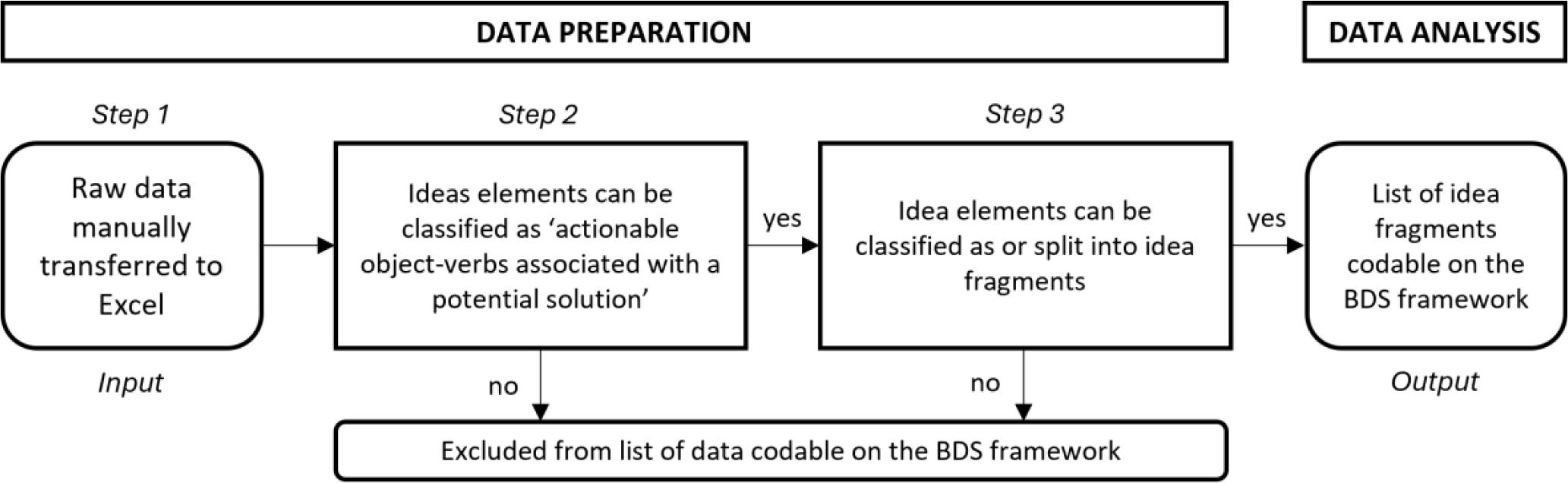
Inspired by the steps taken in Reference Nielsen, Daalhuizen and CashNielsen et al.’s (2021) ‘defining the Behavioural Design Space’ study, the data was prepared for coding in three steps. First, we manually transferred the written raw data in the spaces on the provided paper sheets into Excel with the content of each box transferred to a corresponding Excel cell. Second, in each Excel cell we identified idea elements following Reference Cash and ŠtorgaCash and Štorga’s (2015) characterisation ‘actionable object-verbs associated with a potential solution’. In this process, 107 elements did not explicitly refer to ideas (= ‘non-idea’ elements) and was excluded for further examination. For example, we excluded “eating meat is unsustainable for the planet” and “people don’t want to give up meat in their diet” as they focus on problem elements and do not provide details for a solution. While these ‘non idea’ elements represent app. 25 % of the raw data, the remaining 315 idea elements still provided a large enough pool of generated solution ideas suitable for in-depth examination. Third, for simplicity in the coding process, we identified that all idea elements were on the smallest ‘fragment’ possible (Reference SosaSosa, 2019). While most idea elements were already on the level of ‘idea fragments’, 6 idea elements were split into 2 or 3 idea fragments. For example, “decreasing meat production by increasing accessibility of plant-based options, educating the population, and tax meat products” was split into three separate idea fragments. This process resulted in a list of 330 idea fragments (= solution ideas) codable on the Behavioural Design Space (BDS) framework (Reference Nielsen, Daalhuizen and CashNielsen et al., 2021). An overview of the data is provided in Table 1, and an overview of the data preparation process is provided in Figure 2.
Overview of data

Overview of the data preparation

3.2.2. Data coding and analysis
After data preparation using the BDS framework (Reference Nielsen, Daalhuizen and CashNielsen et al., 2021) as a creative assessment framework, the first and second author coded each of the idea fragments adopting a coding to consensus approach. This approach was chosen as the coders are the developers of the BDS framework and has first-hand experience using the BDS as a coding scheme (Reference Nielsen, Daalhuizen and CashNielsen et al., 2021).
During coding all idea fragments were treated as isolated ideas with respect to the target behaviour of ‘consuming meat’. When ideas did not provide enough explicit detail to categorise how a BDS parameter was utilised, we coded that specific BDS parameter as “not addressed”. Following this procedure, all idea fragments were manually coded on the BDS framework in Excel. For example, the idea fragment “educate kids about the negative impact on the environment and people’s health caused by eating too much meat” was coded as:
[system 2 cognition; mental ability; extrinsic motivation; before ‘consuming meat’; community; system]
Each step in the data preparation, coding and analysis was discussed and agreed upon between the first and second author through verbal discussion.
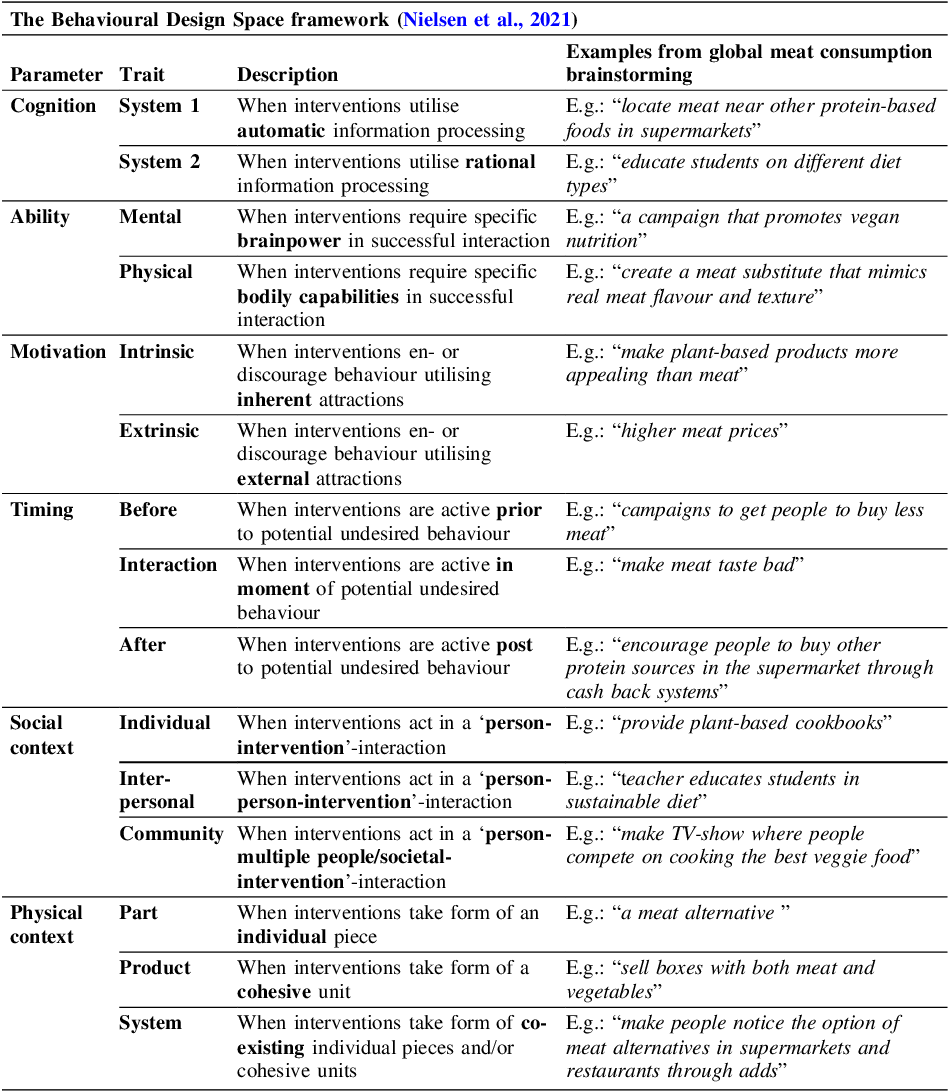
Table 2 shows an overview of the BDS parameters, their distinct traits and descriptions, as well as examples solution ideas from the pool of coded idea fragments.
The Behavioural Design Space (BDS) used as creative assessment framework

4. Findings
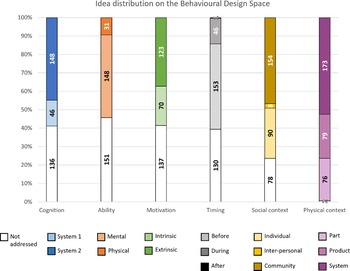
Figure 3 show the distribution across the six BDS parameters. Here, each column provides a visual representation of the distribution within each parameter: cognition, ability, motivation, timing, social context, and physical context. These include: “not addressed” (white) as well as the 2-3 specific traits within each parameter (light/darker/dark colours) with a notation of total numbers of solution ideas (= idea fragments).
Distribution of coded idea fragments across the Behavioural Design Space framework’s six parameters: cognition, ability, motivation, timing, social and physical context

In assessing the idea characteristics, in the following Sections 4.1-4.6, we provide an overview of how the generated solution ideas are distributed across the BDS, one parameter at a time.
4.1. Cognition
The cognition parameter in Figure 3 shows the distribution of solution ideas utilising automatic information processing (system 1 cognition) versus rational information processing (system 2 cognition). Here, app. 60% of 330 solution ideas in total provided enough detail to be coded on the cognition parameter. Of these 194 solution ideas, about 1/4 utilises automatic information processing (system 1 cognition), and about 3/4 utilises rational processing (system 2 cognition).
4.2. Ability
The ability parameter in Figure 3 shows the distribution of solution ideas requiring specific brainpower (mental ability) versus specific bodily capabilities (physical ability). Here, app. 55% of 330 solution ideas in total provided enough detail to be coded on the ability parameter. Of these 179 solution ideas, 148 requires specific brainpower (mental ability) and only 31 requires specific bodily capabilities (physical ability).
4.3. Motivation
The motivation parameter in Figure 3 shows the distribution of solution ideas en- or discouraging behaviour utilising inherent attractions (intrinsic motivation) versus external attractions (extrinsic motivation). Here, app. 60% of the solution ideas in total provided enough detail to be coded on the motivation parameter. Of these 193 solution ideas, about 1/4 en- or discourage behaviour utilising inherent attractions (intrinsic motivation), and about 3/4 en- or discourage behaviour utilising external attractions (extrinsic motivation).
4.4. Timing
The timing parameter in Figure 3 shows the distribution of when the solution ideas are active with respect to the potential undesired behaviour which in this study is ‘consuming meat’. Thus, the distribution in this case showcases the distribution of solution ideas active prior to consuming meat (before) versus active in moment of consuming meat (during) versus active post to consuming meat (after). Here, app. 60% of the 330 solution ideas in total provided enough detail to be coded on the timing parameter. Of these 200 solution ideas, about 3/4 is active prior to consuming meat (before), about 1/4 are active in moment of consuming meat (during), and only 1 is active post to consuming meat (after).
4.5. Social context
The timing parameter in Figure 3 shows the distribution of solution ideas acting in person-intervention interaction (individual) versus acting in a person-person-intervention interaction (interpersonal) versus acting in a person-multiple people/societal-intervention interaction (community). Here, app. 78% of the 330 solution ideas in total provided enough detail to be coded on the social context parameter. Of these 252 solution ideas, about 1/3 acts in a person-intervention interaction (individual), only 8 acts in a person-person-intervention interaction (interpersonal), and about 2/3 acts in a person-multiple people/social intervention interaction.
4.6. Physical context
The timing parameter in Figure 3 shows the distribution of solution ideas taking form of an individual piece (part) versus a cohesive unit (product) versus a co-existing pieces and/or units (system). Here, all except 2 solution ideas provided enough detail to be coded on the physical context parameter. Of these 328 solution ideas, about 1/4 takes form of an individual piece (part), 1/4 as a cohesive unit (product) and about 2/4 takes form of co-existing pieces and/or units (system).
5. Discussion
5.1. Unpacking the uneven distribution within BDS parameters
The findings reveal an uneven distribution of solution ideas across all six BDS parameters. In the cognition parameter, the distribution weighs towards system 2 solution ideas. Here, about 3/4 of the ideas utilising rational information processing, whereas about 1/4 system ideas utilising automatic information processing. For example, both “Food habits education in schools” and “Make meat more expensive for consumers” both rely on people’s conscious and reflective interaction for these solution ideas to be effective in changing meat consumption behaviour. On the contrary, solution ideas such as “Have meat located near other protein-based foods in the supermarket” and “Make meat less appealing to eat” utilises automatic information processing by aiming at changing people’s behaviour through a location and taste nudge, respectively. These findings highlight that most of the solution ideas are focused on cognition heavy (Reference KahnemanKahneman, 2011) ideas, with lost creative potential of low cognitive load solution ideas.
In the ability parameter, the distribution heavily weighs towards mental ability solution ideas with 148 ideas requiring specific brainpower versus only 31 ideas requiring specific bodily capabilities for successful interaction. Here, many of the solution ideas are themed around various ways of in- or decreasing prices, providing education, and increasing awareness which all require brainpower capabilities such as calculation and learning skills. In this dataset, most of the solution ideas requiring specific bodily capabilities has to do with the physical activity of eating, e.g. “add additives so it’s easy to get filled stomachs”. These findings highlight a lost creative potential in ideas that utilise physical abilities as part of the solution.
In the motivation and physical context parameter, there is a slightly less uneven distribution. Here, the distribution in the motivation parameter is app. 1/3 intrinsic motivation and 2/3 extrinsic solution ideas. While most of the ideas rely on dis- or encouraging external attractions (Reference Ryan, Deci, Sansone and HarackiewiczRyan and Deci, 2000) such as “lowering prices on plant-based meat alternatives” and “educate the younger population”, still many of the ideas rely on dis- or encouraging internal attractions. Here, one example is “make meat alternatives taste better than meat” which eliminates the behavioural barrier of getting people to give up on something they from an eating experience desire more. In physical parameter, the distribution is app. 1/4 solution ideas parts, 1/4 products, and app. 1/2 systems. While half of the ideas are presented as co-existing parts and products, 47 of these are only coded on the physical context as they represent a technically focused systemic solution (Reference Andreasen, Hansen and CashAndreasen et al., 2015) that would only implicitly change meat consumption behaviour, such as “grow meat in labs” and “only allow production of alternative meat”. As such, the distribution on solution ideas focused on direct behavioural impact is more balanced. Overall, the findings on the motivation and physical context highlights lower risk of lost potential in the idea pool compared to the remaining four behavioural parameters.
In comparison, the distribution on the timing and social context parameters is by far the most uneven. Here, of the three possible traits within both parameters has one trait that is dominantly utilised, and one that is almost completely unutilised. In the timing parameter, app. 3/4 of the solution ideas are active ‘during meat consumption’, and only one solution idea, “encourage people to buy other protein sources in the supermarket through cash back systems”, is active ‘after meat consumption’ (Reference MiltenbergerMiltenberger, 2011). Since many interventions incorporate elements that are active after the potential undesired behaviour, e.g. ‘scheduled consequences’, ‘rewards’, and ‘feedback’ Behaviour Change Techniques (BCTs) (Reference Michie, Richardson, Johnston, Abraham, Francis, Hardeman and WoodMichie et al., 2013), it is surprising to find only one solution idea with the ‘after (lack of) meat consumption’ timing trait. In the social context parameter, app. 2/3 of the ideas are acting as societal solutions, hence coded ‘community’, and only 8 ideas are acting as inter-personal solutions, e.g. “tasting sessions”. As inter-personal relationships have an important impact on people’s behaviour (Reference BanduraBandura, 1991; Reference BronfenbrennerBronfenbrenner, 1986), and that inter-personal elements are commonly used to increase change of intervention adherence, e.g., getting a training partner or work mentor, it is unexpected to see only 8 solution ideas coded as ‘inter-personal’. As such, the high degree of uneven distribution together with parameter traits almost unutilised across both the timing and social context parameters point to critical risk of lost creative potential.
5.2. Future research scoped around creativity in behavioural design
The uneven distribution across BDS parameters provide insights to relevant future work scoped around behavioural design creativity. Overall, the uneven distribution across BDS parameters is in line with findings from Reference Nielsen, Daalhuizen and CashNielsen et al.’s (2021, Figure 4) study, where assessment of 519 ideas captured through video recordings of expert behavioural designer’s 1-1.5 hours group ideation session across five different client cases, also revealed uneven distributions. Thus, the uneven distribution found in this study is not that surprising, yet, from a creativity perspective the findings are undesirable as they reveal a risk of lost creative opportunities because of fixation towards specific parameter traits. For example, on the social context parameter with 154 ‘community’ and 90 ‘individual’ ideas vs. only 8 ‘inter-personal’ ideas.
While there is no evident answer to what an ideal distribution look like, both the highly uneven distributions and lack utilised BDS parameters indicates fixation (Reference Jansson and SmithJansson and Smith, 1991) and thus risks of lost creative opportunities. This points to the need for developing and testing creative methods that help behavioural designers explore the opportunities across the entire BDS framework. This is especially important since interventions comprise multiple co-existing, contextual intervention elements. As such, behavioural designers work with complex solution spaces comprising multiple technical, behavioural and contextual elements (Reference Baxter, Mandeno, Aunger and BrialBaxtor et al., 2025; Reference Bay Brix Nielsen, Cash and DaalhuizenBay Brix Nielsen et al., 2024) with creative opportunities connected to both each individual intervention element and the intervention as a whole. In helping designers explore creative opportunities across the BDS framework, future research could map and examine the evolution of behavioural design solutions with the aim of exploring where in these activities it is most fruitful to consider different behavioural, technical, and contextual aspects. For example, behavioural designers might benefit from focusing on the different elements in one way during ideation activities, and in other ways in conceptualisation activities, whilst together ensuring that all aspects of the BDS framework is considered across the full process of designing for behaviour change. In addition, to help designers capture and self-assess their creative output during behavioural design idea generation, future research is needed to maturing creative assessment framework capturing the complexity of behavioural design solution space. Here, relevant avenues could explore how to combine elements from established creative metrics and assessment frameworks from relevant fields, such as Reference Shah, Smith and Vargas-HernandezShah’s et al.’s (2003) creative effectiveness metrics, Reference Tromp, Hekkert and VerbeekTromp et al.’s (2011) influence types, and Reference Michie, Richardson, Johnston, Abraham, Francis, Hardeman and WoodMichie et al.’s (2013) BCT’s.
6. Limitations
This study has two main limitations. First, the findings are limited to generated solution ideas targeting unhealthy and unsustainable meat consumption. For that reason, the study can be categorised as ‘a single case’ study. However, with 63 participants ideating a total of 330 solution ideas, the dataset has a decent size for in-dept qualitative analysis. Second, the participants consist of engineering design students which could be categorised as novel designers. However, the participants had to be at least halfway through their bachelor’s degree, and in average they reported having 3-4 years of engineering design education and 2-4 months of relevant work experience. Given their educational backgrounds and experience, the students were well-suited for generating solution ideas to a quality that was well-suited for examining the creative outcome. While this study only includes one theme for ideation, unhealthy and unsustainable meat consumption, and uses students, overall, the findings align with the ones from Reference Nielsen, Daalhuizen and CashNielsen et al.’s (2021) that examines the distribution of solution ideas generated by experts. As such, both on their own and together they provide relevant insights to creativity in behavioural design.
7. Conclusion
This study set out examine creativity in behavioural design by exploring how behavioural design ideas are distributed across the solution space. To this end, we examined a total of 330 solution ideas generated through brainstorming, using the Behavioural Design Space (BDS) as creative assessment framework. The findings revealed an uneven distribution of solution ideas across all six BDS parameters: cognition, ability, motivation, timing, social context, and physical context. In addition, particular traits within the timing and social context parameters were almost completely unutilised. Together, the findings are indicative towards fixation and reveal various degrees of risk of lost creative opportunities, which points to the need for future research focused on better understanding and supporting creativity in behavioural design.



 Open access

