


Elections are the cornerstone for democratic governance, and the stability of democracy ultimately rests on all parties’ willingness to adhere to the rules and principles of free and fair elections (Collier and Adcock Reference Collier and Adcock1999; Dahl Reference Dahl1971; Przeworski Reference Przeworski1991). Yet electoral integrity has recently come under pressure, even in established democracies. In the United States, the outgoing president, Donald J. Trump, sought to overturn the 2020 presidential result, culminating in the January 6 insurrection at the US Capitol and ensuing partisan conflicts over elections. At the same time, surveys show that Americans consistently view free and fair elections as essential for democracy (Carey et al. Reference Carey, Helmke, Nyhan, Sanders and Stokes2019; Chu et al. Reference Chu, Williamson and Yeung2024; Davis et al. Reference Davis, Gåddie and Goidel2022). A crucial question, then, is whether voters would withhold support from a politician or party if they learned that they had undermined electoral integrity.
The prevailing evidence paints a sobering picture: voters rarely ‘punish’ democratic violations, such as gerrymandering, restricting voting access, or ignoring judicial decisions, if doing so requires crossing party lines (Carey et al. Reference Carey, Clayton, Helmke, Nyhan, Sanders and Stokes2022; Frederiksen Reference Frederiksen2024; Gidengil et al. Reference Gidengil, Stolle and Bergeron-Boutin2022; Graham and Svolik Reference Graham and Svolik2020; Tomz and Weeks Reference Tomz and Weeks2025). Because such findings suggest that parties and candidates can undermine basic democratic rules with relative impunity, they have led to discouraging conclusions about the implications of partisanship for democratic stability (for example, Finkel et al. Reference Finkel, Bail, Cikara, Ditto, Iyengar, Klar, Mason, McGrath, Nyhan, Rand, Skitka, Tucker, Van Bavel, Wang and Druckman2020; Kingzette et al. Reference Kingzette, Druckman, Klar, Krupnikov, Levendusky and Ryan2021; Nyhan and Titiunik Reference Nyhan and Titiunik2024; Webster Reference Webster2020).
Yet, despite the significant advances in understanding how partisanship shapes tolerance of undemocratic behavior, concerns about weak mass support for democracy may be overstated. Specifically, existing research has primarily used vote choice measures from candidate-choice experiments to show that voters typically prioritize partisan or policy interests above democratic principles when choosing candidates (Carey et al. Reference Carey, Clayton, Helmke, Nyhan, Sanders and Stokes2022; Gidengil et al. Reference Gidengil, Stolle and Bergeron-Boutin2022; Graham and Svolik Reference Graham and Svolik2020). While this is undoubtedly an important indicator of the electorate’s ability to defend democracy against would-be authoritarians, a sole focus on ‘rejecting undemocratic political actors at the ballot box’ (Frederiksen Reference Frederiksen2024, 766) may overlook subtler signs of disapproval. Specifically, such defection combines evaluations of the co-partisan candidate with willingness to support an out-partisan alternative. Because multiple considerations, such as ideology, policy preferences, and partisanship, shape vote choice, opposing a co-partisan candidate ‘does not necessarily require supporting an out-partisan, a potentially insurmountable hurdle’ (Mummolo et al. Reference Mummolo, Peterson and Westwood2021, 950).Footnote 1
In this article, I therefore take a different approach, proposing to complement the analysis of partisan tolerance for anti-democratic behaviors with a higher-resolution measure of support: partisan affective attachments. Such attachments measure an individual’s sense of psychological orientation towards a party, which has long been recognized as the essence of party identification (Campbell et al. Reference Campbell, Converse, Miller and Stokes1960; Dias and Lelkes Reference Dias and Lelkes2022; Huddy et al. Reference Huddy, Mason and Aarøe2015; Iyengar et al. Reference Iyengar, Sood and Lelkes2012). Attachments and vote choice can be conceived as two ‘support’ measures with varying levels of plasticity; if electoral subversion alienates the party base, we should observe effects on attachments before vote choice (Coppock et al. Reference Coppock, Hill and Vavreck2020). Owing to their centrality for party identification and behavior, measures of partisan attachments have been widely used to study voter reactions to different norm violations (Druckman et al. Reference Druckman, Gubitz, Levendusky and Lloyd2019; Mutz Reference Mutz2007; Skytte Reference Skytte2021, Reference Skytte2022; Shafranek Reference Shafranek2020; Wolsky Reference Wolsky2022). Although we are ultimately interested in understanding the electoral costs of undermining democracy, the objective in this study is to examine whether electoral violations cause partisans to update affective attachments, vote choice, both, or neither.
To theorize the effects of electoral subversion on partisan attachments, I draw on insights from social psychological theories of procedural justice and intergroup emotions. Specifically, I argue that voters perceive electoral transgressions as major norm violations and that partisans will disassociate themselves from their party in response to learning about electoral subversion. Furthermore, I argue that learning about in-party violations leads to increasing partisan ambivalence, as voters come to question both their in-party attachments and their out-party animosity. I report findings from three original, preregistered survey experiments conducted in the United States (N = 8,800), testing the impact of electoral violations on partisan attachments, conceptualized as both positive and negative partisanship.
The three experiments examine the effects of electoral violations of varying severity, all based on real-world examples, and progress as stepping-stones. The first experiment presents unequivocal information about rule-breaking (ballot fraud and misinformation) to estimate the effects on partisan attachments and vote choice without uncertainty or source confounds. Given the blunt nature of Study 1, these effects represent the upper bound of partisans’ reactions. The second experiment introduces ambiguity about the illicitness of the subversion by focusing on gerrymandering, a subtler, legally obfuscated way of undermining electoral integrity (Birch Reference Birch2011; Keena et al. Reference Keena, Latner, McGann and Smith2021; Kenny et al. Reference Kenny, McCartan, Simko, Kuriwaki and Imai2023), to gauge whether sensitivity varies to different types of malpractice. Recognizing that, in the real world, voters rarely observe democratic rule-breaking directly and must rely on media sources, whose credibility may vary in voters’ minds, the third experiment varies the source (Fox News or MSNBC) of otherwise an identical gerrymandering story to evaluate whether partisans’ sensitivity to electoral subversion is conditional on who provides the information.
The findings offer a nuanced message about partisans’ tolerance for electoral integrity violations. On the one hand, all three studies replicate the main message in extant work: most partisans are unwilling to ‘punish’ electoral subversion by voting for the opposing party, even when there was no doubt about their co-partisans’ wrongdoings. The findings thus corroborate previously found limits on electoral punishment for anti-democratic behavior. At the same time, all three studies find that subverting electoral integrity strongly alienates the party base. Exposure to electoral malpractice by co-partisans reduces feelings of in-party attachments, and unequivocal violations can even reduce feelings of out-party animus. Blatant violations by the in-party thus increase a sense of partisan ambivalence (see Lavine et al. Reference Lavine, Johnston and Steenbergen2012); reducing in-party attachments and increasing affect towards the opponents. These effects are most pronounced for the more severe violations of electoral integrity in Study 1. However, the results of the third experiment show that information sources can play a pivotal role in shaping accountability for wrongdoings. The results show that while partisans update partisan attachments in response to gerrymandering information from a co-partisan source, they tend to discount otherwise identical information from an uncongenial source. However, the difference in media effects is small and these findings remain suggestive.
Overall, the findings offered in these three experiments contribute to ongoing discussions about partisanship and tolerance of democratic subversion. Consistent with prior work, they suggest relative electoral impunity for violating democracy’s core institutions (Carey et al. Reference Carey, Clayton, Helmke, Nyhan, Sanders and Stokes2022; Frederiksen Reference Frederiksen2024; Graham and Svolik Reference Graham and Svolik2020). Yet they also show subtler costs: breaking basic democratic rules and norms erodes partisan attachments, a serious penalty given the centrality of affective attachments for political behavior (Campbell et al. Reference Campbell, Converse, Miller and Stokes1960; Dias and Lelkes Reference Dias and Lelkes2022; Iyengar et al. Reference Iyengar, Sood and Lelkes2012; Huddy et al. Reference Huddy, Mason and Aarøe2015). Parties and candidates may not face an immediate electoral punishment for undermining electoral integrity, but they risk alienating their core supporters, gradually chipping away at their base. The results therefore challenge the view that partisans want to win at all costs (Finkel et al. Reference Finkel, Bail, Cikara, Ditto, Iyengar, Klar, Mason, McGrath, Nyhan, Rand, Skitka, Tucker, Van Bavel, Wang and Druckman2020; Webster Reference Webster2020). The message from this study is, on balance, broadly encouraging: partisans distance themselves from their party in the face of electoral violations. Partisans are not so blinded by party loyalty that they look the other way or even endorse illicit tactics that help their side win. This is an important contextualization to existing narratives about the perils of partisanship for democratic health. Yet the positive implications should not be overstated. Even though reactions to electoral subversion register as partisan alienation, willingness to vote against the in-party remains low. What is more, the findings suggest that people primarily update their partisan sentiments when provided with trustworthy information about electoral transgressions, indicating that media polarization may dampen responsiveness to democratic rule-breaking.
‘Partyism’ and Commitment to Democracy
What does extant work teach us about partisans’ willingness to forego basic democratic rules if it benefits their party? Party identity represents an increasingly salient demarcation in American politics today (Huddy et al. Reference Huddy, Mason and Aarøe2015; Mason Reference Mason2018), leading some scholars to conclude that ‘it is difficult to overstate the importance of party loyalty’ (Barber and Pope Reference Barber and Pope2019, 39). Perhaps the most concerning feature of widespread ‘partyism’ is the potential to undermine Americans’ commitment to the rules and principles of democracy, driving them to see political losses as ‘existential threats that must be averted – whatever the cost’ (Finkel et al. Reference Finkel, Bail, Cikara, Ditto, Iyengar, Klar, Mason, McGrath, Nyhan, Rand, Skitka, Tucker, Van Bavel, Wang and Druckman2020, 533) and to ‘prioritize “victory” over the other side above winning “fairly”’ (Webster Reference Webster2020, 109). Partisanship has even been linked to the dehumanization of opposing-party members and support for political violence (Cassese Reference Cassese2021; Kalmoe and Mason Reference Kalmoe and Mason2022; Martherus et al. Reference Martherus, Martinez, Piff and Theodoridis2021, but see Westwood et al. Reference Westwood, Grimmer, Tyler and Nall2022).
This view seems to fit with prior work on democratic violations, which has found that voters often support, or at least disapprove less of, anti-democratic behavior if it benefits their side (Claassen and Ensley Reference Claassen and Ensley2016; Gidengil et al. Reference Gidengil, Stolle and Bergeron-Boutin2022). In a seminal study, Graham and Svolik (Reference Graham and Svolik2020, 392) find that only a few Americans ‘punish’ undemocratic behavior (such as banning rallies or restricting voting access) if doing so implies voting for the opposition, leading to the well-known conclusion that voters are ‘partisans first and democrats only second’. To be sure, there are negative consequences of anti-democratic actions on support, but these are ‘much smaller than the effects of partisanship or policy’ (Nyhan and Titiunik Reference Nyhan and Titiunik2024, 269, see also Frederiksen Reference Frederiksen2024). There is also evidence that partisans support giving elected leaders discretion over democratic principles but only when their party is in power (Simonovits et al. Reference Simonovits, McCoy and Littvay2022).
Another explanation is that partisan identification leads to such pervasive biases that voters perceive undemocratic behavior through a partisan double standard. Tomz and Weeks (Reference Tomz and Weeks2020), for example, show that partisans disapprove more strongly of foreign electoral interference helping political opponents. More broadly, people may rationalize their understanding of democracy when confronted with undemocratic behavior to realign the in-party’s behavior with democratic principles (Krishnarajan Reference Krishnarajan2023). Partisans may even have motivations to reward in-party transgressions (Solaz et al. Reference Solaz, De Vries and De Geus2019) or to derogate the opposing party in response to them (Rothschild et al. Reference Rothschild, Keefer and Hauri2021).
Different cognitive mechanisms notwithstanding (see Druckman Reference Druckman2024 for an overview), the overarching consensus in existing research is that parties and party leaders can break democratic rules with relative impunity (Finkel et al. Reference Finkel, Bail, Cikara, Ditto, Iyengar, Klar, Mason, McGrath, Nyhan, Rand, Skitka, Tucker, Van Bavel, Wang and Druckman2020; Nyhan and Titiunik Reference Nyhan and Titiunik2024; Graham and Svolik Reference Graham and Svolik2020). Partisans may somehow legitimize, tolerate, or even endorse democratic transgressions that benefit their party. When given a choice between a co-partisan candidate who has violated democratic norms and an opposing-party candidate who has not, most partisans tend to stick with their party.
Despite robust evidence that partisanship often trumps democratic principles, concerns about Americans’ willingness to tolerate undemocratic behavior may be overstated. Most existing research measures ‘punishment’ through vote choice (for example, Carey et al. Reference Carey, Clayton, Helmke, Nyhan, Sanders and Stokes2022; Frederiksen Reference Frederiksen2024; Gidengil et al. Reference Gidengil, Stolle and Bergeron-Boutin2022; Graham and Svolik Reference Graham and Svolik2020). The idea is that voters only deter candidates and parties from violating democracy’s rules if they are willing to trade off their policy preferences, ideological leanings, or partisanship for democratic compliance. While this is undoubtedly an important metric of an electorate’s ability and willingness to defend democracy against undemocratic candidates, it also sets a high bar for observing costs. Because many different considerations shape an individual’s electoral decision, anti-democratic behavior may not always outweigh these other motives in any one given choice-scenario (Aarslew Reference Aarslew2023). In this view, voter defection represents an arguably coarse measure of partisans’ tolerance of democratic norm violations. Voters may strongly disapprove of democratic transgressions yet nevertheless vote for the norm-violating co-partisan candidate.
In this study, I propose complementing the analysis of partisans’ tolerance for undemocratic behavior by using a higher-resolution measure of support: partisan affective attachments. Party affect is best described as a ‘summary evaluation’, which ‘collapses judgments about an object into a single dimension of favorability’ (Broockman et al. Reference Broockman, Kalla and Westwood2023, 809). Partisan affective attachments thus capture the individual’s sense of affective orientation towards a party, which has long been seen as the defining feature of party identification (Campbell et al. Reference Campbell, Converse, Miller and Stokes1960; Dias and Lelkes Reference Dias and Lelkes2022; Huddy et al. Reference Huddy, Mason and Aarøe2015; Iyengar et al. Reference Iyengar, Sood and Lelkes2012). Attachments and electoral support are thus two points on a support scale, moving from more to less granularity. To be clear, I am not proposing that vote choice is unimportant or that attachments represent a more accurate metric of the costs of rule-breaking. The purpose is instead to highlight that there could be real political costs associated with undermining democratic rules even though defection rates remain low. Specifically, any erosion of partisan attachments indicates that parties and candidates who violate democratic principles risk alienating their core supporters, effectively chipping away at their base.
I focus on electoral integrity violations for three reasons. First, elections are the cornerstone of democracy (Collier and Adcock Reference Collier and Adcock1999; Dahl Reference Dahl1971; Przeworski Reference Przeworski1991). Although many advocate that democracy involves more than holding free and fair elections (for example, Dahl Reference Dahl1971), democracy without elections cannot work. Second, voters consistently rate free and fair elections as essential for democracy (Carey et al. Reference Carey, Helmke, Nyhan, Sanders and Stokes2019; Chu et al. Reference Chu, Williamson and Yeung2024; Davis et al. Reference Davis, Gåddie and Goidel2022). This is important, as some of the instances of anti-democratic behavior used in previous research, such as restricting senators’ campaign activities near hospitals (Krishnarajan Reference Krishnarajan2023), may be too subtle to trigger substantive voter reactions, though they are undemocratic in principle (see Adserà et al. Reference Adserà, Arenas and Boix2023; Haggard and Kaufman Reference Haggard and Kaufman2021). But if citizens do not support democracy’s basic framework, the diffuse support that undergirds democratic legitimacy evaporates (Reference Anderson, Blais, Bowler, Donovan and ListhaugAnderson et al., 2005; Reference EastonEaston, 1975). Finally, as elections create winners and losers, they highlight partisan interests. Election losses can trigger partisan anger and sadness, and present a status-loss threat, which has been argued to increase tolerance of undemocratic actions (Finkel et al. Reference Finkel, Bail, Cikara, Ditto, Iyengar, Klar, Mason, McGrath, Nyhan, Rand, Skitka, Tucker, Van Bavel, Wang and Druckman2020; Kalmoe and Mason Reference Kalmoe and Mason2022; Webster Reference Webster2020). Electoral subversion thus pits strong partisan interests and democracy’s foundation directly against each other.
The Impact of Electoral Malpractice on Partisan Attachments
How should we expect violations of electoral integrity to shape party attachments? I argue that there are good reasons to expect that electoral transgressions change how partisans feel about their party, alienating even ardent partisans. Political psychological work on procedural fairness shows that fairness perceptions shape evaluations of authorities and institutions and are associated with considerations of institutional legitimacy (Becher and Brouard Reference Becher and Brouard2020; Hibbing and Alford Reference Hibbing and Alford2004; Smith et al. Reference Smith, Larimer, Littvay and Hibbing2007; Tyler Reference Tyler2006; Wilking Reference Wilking2011). For example, there is evidence that fairness principles constrain partisan self-interest in evaluations of election reform proposals such as same-day registrations (Mccarthy Reference Mccarthy2019; Plescia et al. Reference Plescia, Blais and Högström2020; Virgin Reference Virgin2021). And comparative research has shown that voters tend to equate democracy with free and fair elections (Adserà et al. Reference Adserà, Arenas and Boix2023; Carey et al. Reference Carey, Helmke, Nyhan, Sanders and Stokes2019; Chu et al. Reference Chu, Williamson and Yeung2024; Davis et al. Reference Davis, Gåddie and Goidel2022). Building on this body of work, I argue that electoral fairness constitutes an important democratic norm, and that election subversion, therefore, represents a direct norm violation.
What happens when the individual’s party subverts elections? Drawing on social psychological work on social identity and intergroup emotions, I argue that electoral violations by the in-party push individuals to disassociate themselves from the party. What is more, I argue that violations of electoral integrity have the effect of causing voters to report greater warmth towards the opposing party. The paper’s main argument is thus that electoral subversion by the in-party leads to a heightened sense of partisan ambivalence.
From a social identity perspective, partisans want to positively differentiate the in-party from the out-party (Greene Reference Greene2004). Evidence that the in-party has violated basic rules or norms undermines these goals, causing negative emotional reactions (Druckman et al. Reference Druckman, Gubitz, Levendusky and Lloyd2019; Van Kleef et al. Reference Van Kleef, Wanders, Stamkou and Homan2015). These emotions have direct behavioral and attitudinal consequences by making people more uncertain about their preconvictions and more open to new information (Gervais Reference Gervais2019; Valentino et al. Reference Valentino, Hutchings, Banks and Davis2008,Reference Valentino, Brader, Groenendyk, Gregorowicz and Hutchings2011). As Gervais (Reference Gervais2021, 2) notes, ‘(w)hen in-elites initiate hostile, norm-violating aggression, it undermines the perception of in-group moral superiority; it is viewed as degrading behavior, which can trigger disgust and lead co-partisans to distance themselves from the elite’. Moreover, the so-called ‘black sheep effect’ suggests that group members tend to derogate in-group deviance more than otherwise identical out-group deviance to maintain or restore a positive in-group differentiation (Eidelman et al. Reference Eidelman, Silvia and Biernat2006; Fousiani et al. Reference Fousiani, Yzerbyt, Kteily and Demoulin2019; Marques et al. Reference Marques, Yzerbyt and Leyens1988; Marques and Paez Reference Marques and Paez1994).
Recent empirical work corroborates such a line of reasoning, documenting the negative effects of major norm violations on in-group attachments. Eady et al. (Reference Eady, Hjorth and Dinesen2023), for example, demonstrate that the January 6 2021 insurrection caused a strong and lasting reduction of self-expressed partisanship among Republicans on Twitter (now X). Similarly, research on political incivility has shown that excessive insults reduce partisan attachments among supporters of the perpetrating party (Costa Reference Costa2021; Druckman et al. Reference Druckman, Gubitz, Levendusky and Lloyd2019; Frimer and Skitka Reference Frimer and Skitka2018; Skytte Reference Skytte2022). And while partisans may desire preferential treatment of the in-party, they oppose intentionally harming the opposition (Lelkes and Westwood Reference Lelkes and Westwood2017). Hence, there is some evidence that parties risk alienating their base when they go too far, breaking established norms.
What is more, work in intergroup emotions theory shows that hostility towards the out-group perceived as unjustified can cause reparative action and feelings of empathy towards the out-group (Ferguson and Branscombe Reference Ferguson, Branscombe, von Scheve and Salmela2014; Hakim et al. Reference Hakim, Branscombe and Schoemann2021; Maitner et al. Reference Maitner, Mackie and Smith2006). In a political domain, Druckman et al. (Reference Druckman, Gubitz, Levendusky and Lloyd2019) find that incivility in co-partisan media causes voters to express lower affect for the in-party and higher affect for the out-party (see also Frimer and Skitka Reference Frimer and Skitka2018). Based on this, we should expect that in-party election cheating makes voters less reliant on partisan preconvictions and less sure about the positive group differentiation. I argue that electoral violations cause co-partisans to disassociate themselves while also causing them to report less hostile attitudes towards the opposing party.Footnote 2
What happens when the opposing party violates electoral integrity? Partisans already hold the opposing party in low esteem (Abramowitz and Webster Reference Abramowitz and Webster2018); out-party cheating only serves to justify their views. For example, Gervais (Reference Gervais2019) finds that exposure to incivility by political opponents triggers feelings of anger, leading people to cling to their preexisting convictions (see also Webster Reference Webster2020). I therefore also expect that out-party transgressions exert a positive comparison effect, leading partisans to double down on support for their party. Election cheating by the out-party may cause people not only to be less favorable towards the opposing party but to simultaneously feel more attached to their party.
Hypothesis 1: Election cheating by the in-party increases partisan ambivalence by (a) decreasing in-party affinity and (b) decreasing out-party resentment.
Hypothesis 2: Election cheating by the out-party reduces partisan ambivalence by (a) increasing in-party affinity and (b) increasing out-party resentment.
The Moderating Effects of Partisan Media
The discussion above builds on the premise that citizens receive credible information about electoral violations. However, voters often rely on reports about democratic transgressions from third-party sources, and the perceived credibility of the different sources may vary between voters. Research on persuasion has demonstrated that people are more swayed by information from sources deemed trustworthy (Druckman Reference Druckman2022a; Lupia Reference Lupia2013). Believing that a given source shares one’s interests increases persuasiveness as the source is perceived to have little incentive to deceive.
Media source cues likely play a prominent role in shaping responses to information about democratic violations, as Americans are increasingly polarized over media trust (Peterson and Kagalwala Reference Peterson and Kagalwala2021; Clemm Von Hohenberg and Guess Reference Clemm Von Hohenberg and Guess2023). Partisan-based media mistrust shapes how voters process politically relevant information, as they use source cues to make inferences about media content ideology and bias (Feldman Reference Feldman2011; Turner Reference Turner2007). Thus, voters may be more inclined to dismiss information from media sources affiliated with political opponents because they mistrust the the content veracity. For example, Botero et al. (Reference Botero, Cornejo, Gamboa, Pavao and Nickerson2015) find that information about corruption from a trusted source produces greater reductions in political support. Conversely, when a source provides information against their known biases, it conveys a strong signal about the veracity of the information content (Calvert Reference Calvert1985; Berinsky Reference Berinsky2023, Reference Berinsky2017). Hence, I expect that information about in-party election cheating provided by a congenial (pro-attitudinal) source will be more persuasive than similar information provided by an uncongenial source.
Hypothesis 3: The effects of election cheating information on partisan ambivalence are stronger when provided by a congenial media source.
Research Design and Data
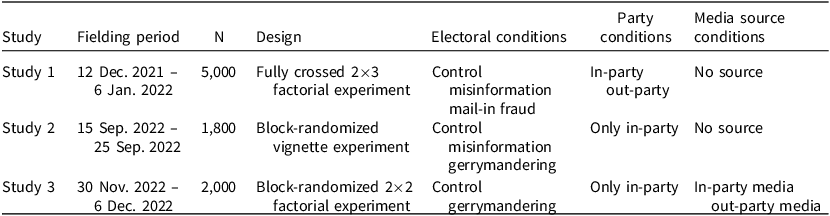
I conducted three survey experiments in the United States to examine partisans’ reactions to electoral subversion. All studies recruited descriptively representative samples of the US adult population using quotas based on age, sex, and region from Lucid’s online panels. Data for Study 1 (N = 5,000) were collected between 26 December 2021 and 6 January 2022, data for Study 2 (N = 1,800) were collected in September 2022, and data for Study 3 (N = 2,000) were collected between 30 November and 6 December 2022. All experiments use real-world examples of election cheating to inform the treatment material. The experiments were preregistered with OSF.Footnote 3 Table 1 presents an overview.
Overview of experimental studies

Note: all studies were collected through Lucid using quotas based on age, sex, and region.
I focus on the United States, as it has become central to discussions of democratic backsliding in recent years (Gidengil et al. Reference Gidengil, Stolle and Bergeron-Boutin2022; Graham and Svolik Reference Graham and Svolik2020; Krishnarajan Reference Krishnarajan2023; Simonovits et al. Reference Simonovits, McCoy and Littvay2022; Tomz and Weeks Reference Tomz and Weeks2020). On the one hand, this does pose limitations for generalizability. For example, the findings may not extend to multiparty systems, where voters can more easily shift their votes to proximate alternatives to penalize undemocratic behavior, and partisan identification may function differently (Wagner Reference Wagner2020).
At the same time, the United States also represents a ‘hard test’ for detecting changes in partisan attachments. As noted above, partisanship is particularly salient in American politics (Barber and Pope Reference Barber and Pope2019; Huddy et al. Reference Huddy, Mason and Aarøe2015; Mason Reference Mason2016). Given the high levels of polarization and partisan hostility in the United States (Abramowitz and Webster Reference Abramowitz and Webster2018; Webster Reference Webster2020), we might expect voters to be especially unwilling to update partisan sentiments, even in the face of democratic rule-violations. More importantly, the two-party system also allows me to clearly pit partisan self-interest against democratic principles, as any losses for one party necessarily advantage the other.
Treatment Material
The three studies were designed to build on each other as stepping-stones, with each experiment adding nuance to the previous ones. Specifically, because experiments aim to isolate the effects of one causal variable, ‘which means removing the “noise” of real life . . . it becomes inevitable that they look different from the multidimensional nature of “real life”’ (Druckman Reference Druckman2022b, 53). Accordingly, the experiments progressively reintroduce such ‘noise’ by moving from unambiguous violations in a clean setting to subtler offenses and, finally, to information delivered by different media sources.
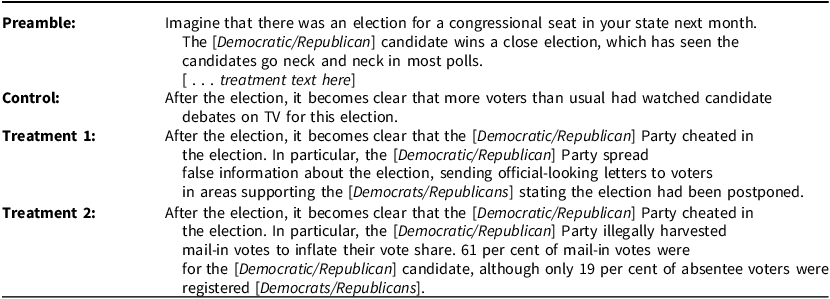
First, Study 1 sets aside uncertainty about illegitimacy, aiming to examine how unequivocal electoral transgressions change how partisans feel about their party. Study 1, therefore, presents participants with unambiguous information about electoral subversion. Although this is necessarily an artificial set-up, it provides a crisp and unconfounded benchmark of partisans’ reactions. Specifically, Study 1 randomly assigned participants to read about either the Republican or the Democratic Party in a hypothetical election in their state, in which the party either won fairly (control condition) or engaged in misinformation or mail-in fraud (treatment conditions). Table 2 presents the exact wording.
Experimental wording (Study 1)

Note: N = 5,062. Control group = 1,684 N (33.2 per cent), treatment group 1 = 1,690 N (33.4 per cent), treatment group 2 = 1,693 N (33.4 per cent).
Two considerations were central to the design of Study 1. First, the treatments build on real-world violations of electoral integrity in recent US elections. Second, the experimental prompt needed to be sufficiently unambiguous to create a situation where partisans faced tension between election fairness norms and partisan instincts. It is worth pointing out that while there is no evidence of systematic election fraud in US elections, there have been minor, non-systematic attempts at cheating. Misinformation (such as robocalling, push polling, or sending fake letters) has featured non-trivially in American elections in recent years (Common Cause Foundation 2008; Washington Post 2020). Similarly, the absentee ballot fraud treatment draws on the 2019 election for the Ninth Congressional District in North Carolina, in which Republican candidate Mark Harris admitted to harvesting mail-in votes (New York Times 2019; Politico 2021).
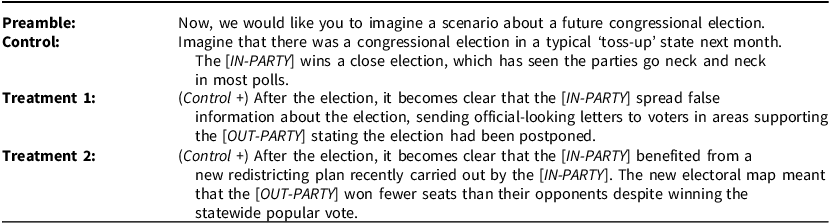
The second experiment extends Study 1’s focus to more ambiguous electoral integrity violations. A concern with powerful survey experimental prompts is that the observed effects are not generalizable (Barabas and Jerit Reference Barabas and Jerit2010). As unequivocal electoral malpractice is rare, one may worry that the findings may not say much about the effects of cheating on mass behavior more broadly. Partisans may, in other words, respond quite differently to transgressions that are legally more obfuscated. Study 2 therefore adds a layer of ‘real-world noise’ by introducing ambiguity to the treatments. Specifically, it replaces the mail-in fraud condition with a gerrymandering condition (see the wording in Table 3).
Experimental wording (Study 2)

Note: N = 1,779. Control group = 594 N (33.4 per cent), treatment group 1 = 592 N (33.3 per cent), treatment group 2 = 593 N (33.3 per cent).
Gerrymandering is ideal for this purpose as it represents a subtle but common violation of electoral integrity in the United States (Keena et al. Reference Keena, Latner, McGann and Smith2021; Kenny et al. Reference Kenny, McCartan, Simko, Kuriwaki and Imai2023). State Assemblies redrew election districts ahead of the 2022 midterm elections, and redrawing districts is not in itself illegitimate. However, for parties and lawmakers, gerrymandering represents an opportunity to significantly change the lean and composition of Congress. Because gerrymandering gives one party an edge in a given election but is not necessarily illegal, it is an ‘example of forbearance since it involves the spirit rather than the letter of the law’ (Druckman et al. Reference Druckman, Klar and Krupnikov2024, 144). This, in turn, makes gerrymandering well suited to examine how subtle malpractice shapes political support. From a voter perspective, it may often be unclear how gerrymandering influences the outcome of an election or undermines electoral integrity. Nevertheless, scholars typically consider partisan gerrymandering a type of institutional electoral subversion (Birch Reference Birch2011).
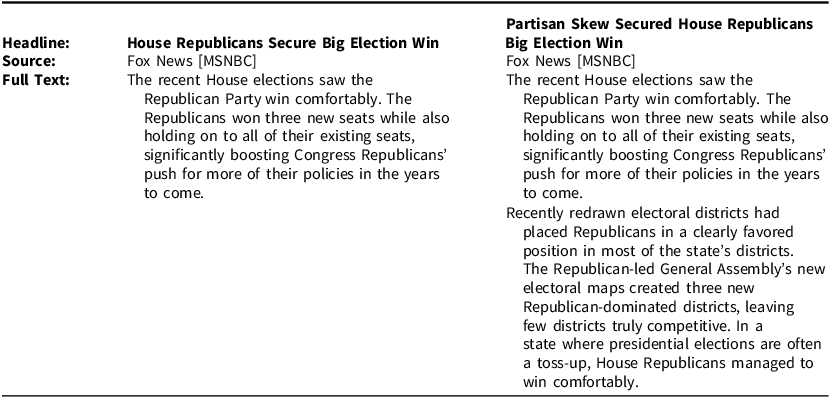
The first two experiments provide unmediated information about election cheating, as is common in the literature. However, as voters rarely observe democratic rule-breaking directly, providing such information may not be an accurate approximation of how voters learn about violations. To test Hypothesis 3, the final experiment introduces variation in which media source provides information about in-party gerrymandering. The vignettes are presented to respondents as excerpts from mock news articles (from either MSNBC or Fox News). MSNBC is the congenial source for Democratic partisans and the uncongenial source for Republicans, and vice versa.Footnote 4 As in Study 2, the experiment prompts respondents to imagine that there had just been a congressional election in a typical ‘toss-up’ state, after which they read an article about the election. Table 4 shows the four possible conditions for a Republican respondent.
Experimental wording (Study 3)

Note: N = 2,181. In-party control = 550 N (25.2 per cent), out-party control = 549 N (25.2 per cent), in-party treatment = 541 N (24.8 per cent), out-party treatment = 541 N (24.8 per cent).
A common thread in the three experiments is the prompt to ‘imagine a scenario’ about a congressional election. To alleviate ethical concerns about deception, I opted to use hypothetical scenarios. Importantly, recent evidence shows that situational hypotheticality does not affect responses (Brutger et al. Reference Brutger, Kertzer, Renshon, Tingley and Weiss2023), and that it therefore does not lead to inflated treatment effect estimates. What is more, all treatments were based on real-world examples of electoral violations, thus avoiding constraining the findings’ inferential potential (Barnfield Reference Barnfield2022).
Measures
Party identification
Prior to randomization, participants’ partisanship was measured using the three common ANES-type questions (see Appendix A1). For the main analyses below, these measures are collapsed to a binary indicator of partisanship. In Study 1, 2,374 respondents identified with the Democratic Party, and 1,884 respondents identified as Republicans. Respondents’ partisanship was then matched to the experimental conditions to create a binary indicator of co-partisanship, which takes the value 1 if the respondent identifies with the party in their vignette (N = 2,121) and 0 if the respondent identifies with the opposing party (N = 2,137).Footnote 5 In Study 2, 1,047 respondents identified as Democrats and 732 respondents identified as Republicans. In Study 3, 1,312 respondents identified as Democrats and 869 respondents identified as Republicans. Studies 2 and 3 are block-randomized designs, requiring that participants are assigned to in-party conditions only (that is, Republican respondents only read about Republicans winning or engaging in electoral transgression). As preregistered, pure independents are dropped from the survey prior to randomization in Studies 2 and 3.
Partisan attachment
The main outcome of interest is partisan attachments, measured through party affect (cf. Campbell et al. Reference Campbell, Converse, Miller and Stokes1960; Dias and Lelkes Reference Dias and Lelkes2022; Iyengar et al. Reference Iyengar, Sood and Lelkes2012). Most voters display a mix of in-party attachment (positive partisanship) and out-party animus (negative partisanship), which can strongly influence political behavior, either on their own or in combination (Abramowitz and Webster Reference Abramowitz and Webster2018). To fully capture the effects of electoral transgressions on partisan attachments, I measure party affect towards both parties. Respondents were asked, ‘How supportive would you feel about the parties based on the text you just read?’ Here, respondents rated both the Democratic and the Republican parties on a 0–10 scale.Footnote 6 The ratings are re-scaled from zero to one and are matched to respondents’ partisanship to create measures of in-party affect (Study 1: M = 0.77, SD = 0.23; Study 2: M = 0.79, SD = 0.22; Study 3: M = 0.82, SD = 0.21) and out-party affect (Study 1: M = 0.27, SD = 0.26; Study 2: M = 0.25, SD = 0.25; Study 3: M = 0.23, SD = 0.26).Footnote 7 Although multiple measures of partisan attachments exist in the literature, I opted to use thermometer ratings, because they have been validated in empirical work (Gidron et al. Reference Gidron, Sheffer and Mor2022; Tyler and Iyengar Reference Tyler and Iyengar2024) and used extensively in similar work on norm violations and scandals (for example, Druckman et al. Reference Druckman, Gubitz, Levendusky and Lloyd2019; Mutz Reference Mutz2007; Shafranek Reference Shafranek2020; Skytte Reference Skytte2021,Reference Skytte2022; Wolsky Reference Wolsky2022).
Electoral punishment
I measure electoral punishment as an individual’s willingness to sanction norm violations by voting for the opposing party (cf. Frederiksen Reference Frederiksen2024; Gidengil et al. Reference Gidengil, Stolle and Bergeron-Boutin2022; Graham and Svolik Reference Graham and Svolik2020; Tomz and Weeks Reference Tomz and Weeks2025). Specifically, respondents were asked: ‘If a new election for a congressional seat were held after two years with the same candidates running, who would you vote for?’ I constructed a measure of electoral punishment with a binary measure of intentions to vote for an out-partisan candidate (Study 1: M = 0.016; Study 2: M = 0.01; Study 3: M = 0.02).
Manipulation check and additional outcomes
To gauge whether the treatments were successful in manipulating electoral fairness, the survey included a measure of perceived electoral legitimacy and a treatment recall item.Footnote 8 If participants do not adjust perceived electoral legitimacy, there is no reason to expect that the treatment produced downstream consequences for partisan attachments or vote choice (Aarslew Reference Aarslew2023). After reading the experimental vignettes, participants rated perceived election fairness on a five-point scale (cf. Anderson et al. Reference Anderson, Blais, Bowler, Donovan and Listhaug2005). The legitimacy ratings were re-scaled from zero to one (Study 1: M = 0.78, SD = 0.27; Study 2: M = 0.80, SD = 0.25; Study 3: M = 0.85, SD = 0.24). Study 1 also measured voters’ feelings towards the in- and out-party on perceived policy threat and willingness to cheat in elections. Because the findings are similar to those of partisan affect, these findings are shown in the Appendix.
Findings
Before presenting the findings, I checked that randomization produced balanced groups. Next, I examined whether respondents could correctly recall the topic of the experimental vignettes (Study 1: recall = 95 per cent; Study 2: recall = 95.5 per cent; Study 3: recall = 69.1 per cent).Footnote 9 I return to the noticeably lower recall in Study 3 below. Comparing perceived electoral legitimacy across conditions indicates that the treatments in all three experiments were successful: respondents in the treatment groups considered the elections significantly less fair (Appendix D). Details on these tests and survey procedures, screening questions, and attention checks, as well as a discussion of ethics, are in the supplementary material. In the interest of simplicity, the main findings are presented in Figures 1–3. The supplementary material contains all accompanying tables. As preregistered, all estimates are unstandardized OLS regression coefficients with robust standard errors.
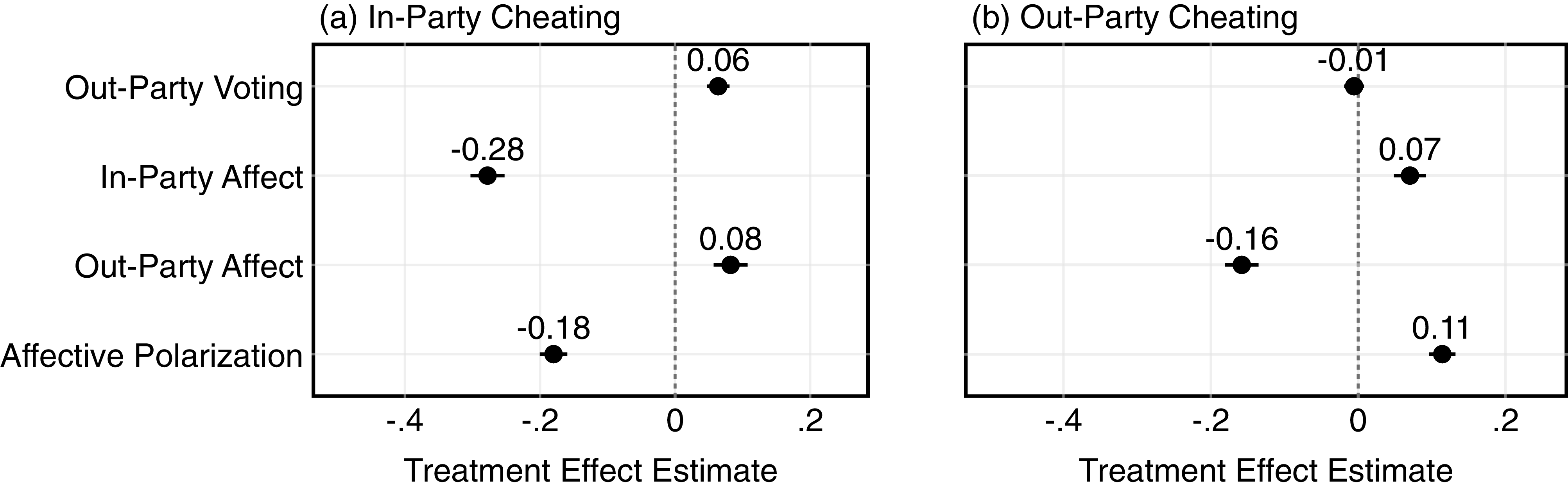
Effect of unequivocal electoral integrity violations on vote choice and attachments (S1).
Note: difference between a fair election win and election cheating, estimated for both the in-party (a) and out-party (b). Dots represent point estimates and bars are 95 per cent confidence intervals using robust standard errors. N = 4,117. Associated regression tables in Appendix E.

For all three experiments, I begin by examining whether partisans are willing to defend democracy in the face of electoral rule-violations if doing so implies voting for an opposing-party candidate, which has been the predominant focus in prior studies (for example, Carey et al. Reference Carey, Clayton, Helmke, Nyhan, Sanders and Stokes2022; Frederiksen Reference Frederiksen2024; Gidengil et al. Reference Gidengil, Stolle and Bergeron-Boutin2022; Graham and Svolik Reference Graham and Svolik2020). Specifically, I compare the estimated likelihood of voting for the opposing-party candidate when the in-party has violated electoral integrity and when it has not.
Study 1: Backlash Against Blatant Cheating
In Study 1, the analytical focus is on comparisons between a fair election win and an electorally subverted win holding the party constant. For presentational purposes, I consider respondents to be in one of four conditions: (1) in-party control (for example, Democrats exposed to a fair Democratic win), (2) in-party election cheating (for example, Democrats exposed to cheating by the Democratic Party), (3) out-party control (for example, Republicans exposed to a fair Democratic win), or (4) out-party election cheating (for example, Republicans exposed to cheating by the Democratic Party).Footnote 10
First, are partisans willing to defend democracy in the face of blatant electoral rule-violations if the price of doing so is voting for an opposing-party candidate? As shown in Figure 1, unambiguous electoral violations by the in-party increase the out-party’s vote share, but only by 6.4 percentage points (p < 0.001). This level of electoral punishment is similar to that found in previous work. In Graham and Svolik (Reference Graham and Svolik2020), about 13.1 per cent of voters, in some choice-scenarios, cross party lines to sanction a co-partisan who adopts anti-democratic policies. Likewise, Frederiksen (Reference Frederiksen2024) demonstrates that an undemocratic co-partisan defeats a democratic out-partisan by about 32 percentage points. When measuring the political costs of unambiguously undemocratic tactics by means of electoral punishment, previous findings replicate: candidates and parties can undermine basic electoral rules with relative impunity. Unsurprisingly, the impact of out-party subversion on out-party voting is negligible (M C = 2.5 per cent v. M T = 1.9 per cent, p = 0.43).
Turning to attachments, we observe much greater movement. Figure 1(a) demonstrates that unequivocal electoral violations by the in-party pull two levers. On the one hand, partisans disassociate themselves from their party; relative to the baseline, in-party attachments fall by 28 percentage points (p< 0.001). At the same time, these violations have the effect of increasing out-party affect by 8 percentage points (p< 0.001). In other words, substantial malpractice by one’s in-party intensifies a sense of partisan ambivalence, making the party’s base feel less strongly attached to their party and less strongly opposed to the opposition. The net result is an 18 percentage point reduction in affective polarization (p< 0.001).Footnote 11
Electoral violations by the out-party produce the opposite effects; when the out-party engages in illegitimate election tactics, it exacerbates out-party resentment by 16 percentage points (p< 0.001) and causes partisans to double down on attachments to their party (7 percentage points, p< 0.001). The consequence is an 11 percentage point increase in affective polarization (p< 0.001).
Study 2: Even Subtle Election Cheating Alienates Partisans
Study 2 requires the transgression to be on the part of the respondent’s in-party and randomization into experimental conditions, therefore, occurred after blocking on participants’ self-reported partisanship. As treatment assignment was randomized conditional on an individual’s partisanship, the following regressions control for party identification.
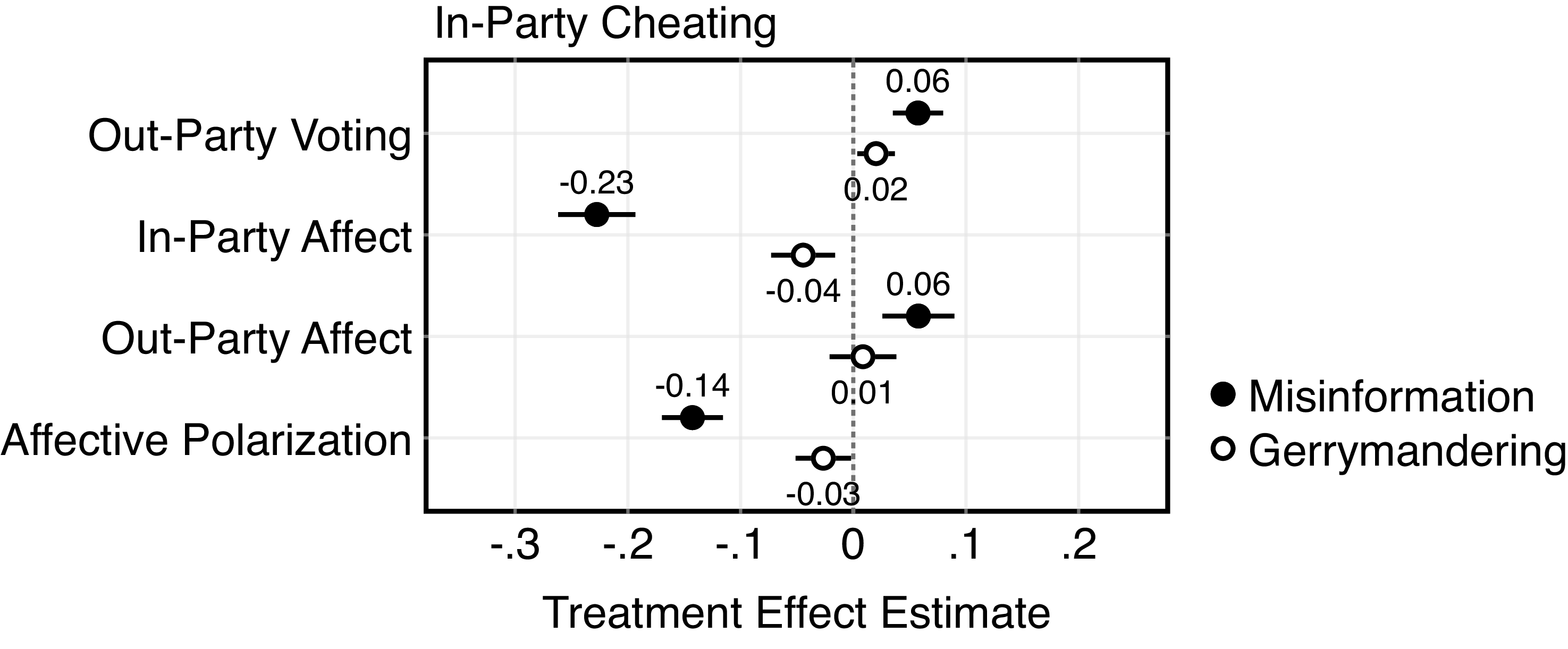
Figure 2 presents the effects of misinformation and gerrymandering. First, the findings on misinformation closely resemble the findings in Study 1. Compared to a fair election win, misinformation causes partisans to feel markedly less attached to their party and less fervently opposed to the opposing party, but only slightly increases intentions to vote for an out-party candidate.
Effects of subtle and unequivocal violations (S2).
Note: difference between a fair election win and election cheating, estimated for the in-party. Dots (black = misinformation, white = gerrymandering) represent point estimates and bars are 95 per cent confidence intervals using robust standard errors. N = 1,777. Associated regression tables in Appendix E.

Second, gerrymandering produces strikingly similar effects, albeit noticeably smaller in magnitude. When the in-party redraws electoral districts to their own advantage, only 2 percentage points are willing to cross party lines (p = 0.017). Compared to the 6 percentage point (p< 0.001) ‘punishment’ for misinformation, it is clear that sensitivity to electoral malpractice differs depending on type: voters perceive misinformation to be a greater infringement on electoral integrity than gerrymandering.Footnote 12
Regarding partisan attachments, co-partisan gerrymandering caused respondents to express lower affect towards their party (4.4 percentage points, p = 0.002). Recall that the treatment material did not explicitly state that the redistricting was illegitimate. In that light, a decrease of almost 5 percentage points is substantial. On the other hand, gerrymandering does not consistently improve out-party attitudes (1 percentage point, p = 0.57).
Overall, the findings from Study 2 thus demonstrate that although voters differentiate between degrees of malpractice, they disapprove of both subtle and severe transgressions. Yet only severe electoral norm violations spark reparative action on out-party attitudes.
Study 3: The Moderating Effects of Partisan Media
Study 3 moves away from the unmediated scenarios in Studies 1 and 2 by introducing media sources with known partisan leanings (Fox News and MSNBC). I consider respondents to be in one of four conditions: (1) in-party control (for example, Republicans reading about a fair Republican win from Fox News), (2) out-party control (for example, Republicans reading about a fair Republican win from MSNBC), (3) in-party treatment (for example, Republicans reading about a gerrymandered Republican win from Fox News), or (4) out-party treatment (for example, Republicans reading about a gerrymandered Republican win from MSNBC).
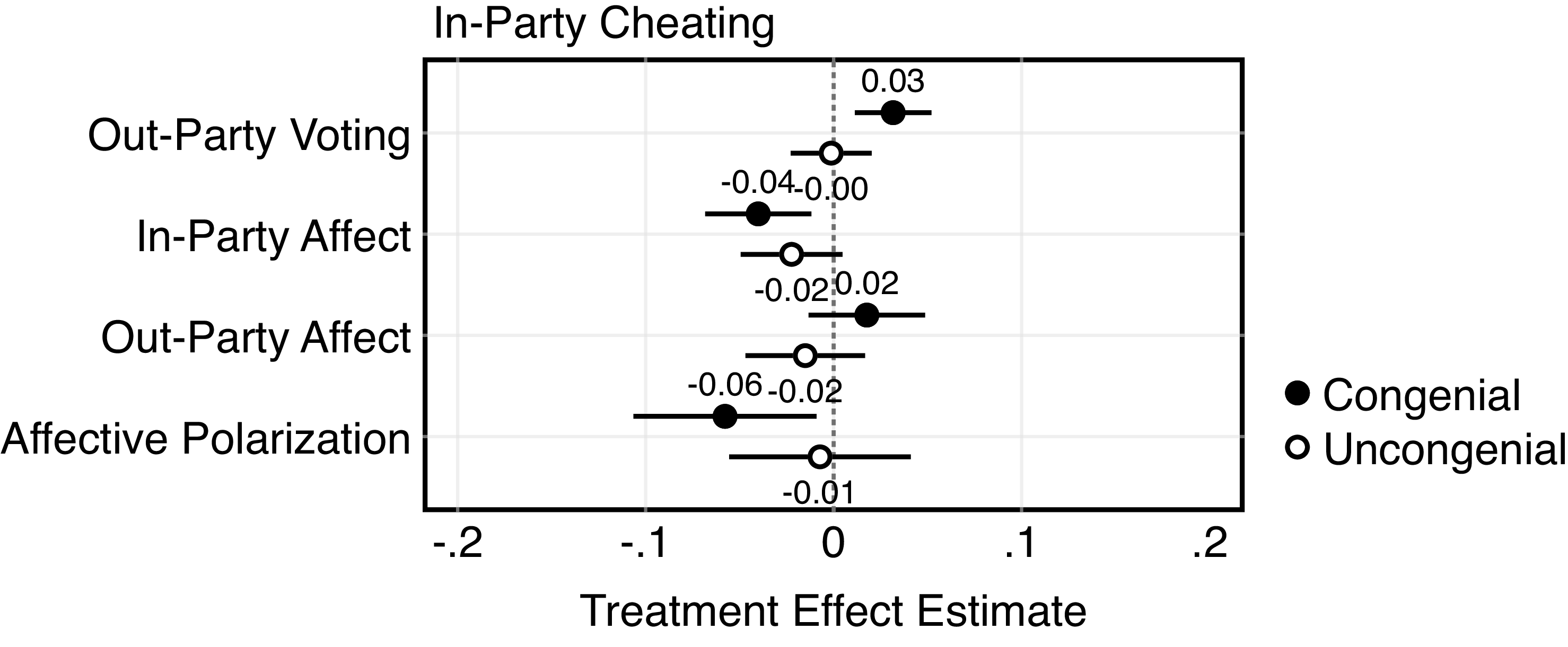
As the experiment in Study 3 adds another layer of experimental variation, I first examine whether that treatment layer was successful by use of a treatment recall question, asking respondents to name the media source in their vignette. A total of 647 participants (30.9 per cent) could not recall the information source. Regressing recall on a treatment indicator, media source, treatment × media source, and partisanship shows that recall rates were significantly lower in both treatment conditions, which could suggest that the additional text in these conditions distracted respondents’ attention from the media source (see also Brutger et al. Reference Brutger, Kertzer, Renshon, Tingley and Weiss2023). As a consequence, the effect estimates obtained in Study 3 are best thought of as intention-to-treat (ITT) estimates, which does not assume full compliance (Gerber and Green Reference Gerber and Green2012). I estimate the differences between these conditions by OLS regression functions, controlling for partisanship. Figure 3 shows the effect of gerrymandering information from in-party (congenial) (difference between conditions 1 and 3) and out-party (uncongenial) sources (difference between conditions 2 and 4).
Effects of source congeniality (S3).
Note: difference between a fair election win and gerrymandering, estimated for congenial (black) and uncongenial (white) sources. Dots are point estimates and bars are 95 per cent confidence intervals using robust standard errors. N = 1,779. Associated regression tables in Appendix E.

Figure 3 shows that treatment effects tended to be larger when the gerrymandering news excerpt provided a congenial source cue. Gerrymandering information increases out-party voting by 3 percentage points (p = 0.002), but only when provided by an in-party source. Otherwise identical information provided by an out-party source did not affect out-party voting (p = 0.90). Likewise, the effect on in-party affect is -4 percentage points if the news come from an in-party source (p = 0.005), twice as large as when the same information comes from an out-party source (p = 0.1). As in Study 2, I observe no effect of gerrymandering on attitudes towards the opposing party.
The results from Study 3 thus suggest that gerrymandering is mainly costly when the information is provided by a co-partisan media source. However, it is worth noting that most of the estimated differences in source effects fail to reach statistical significance (see Appendix L). Indeed, only the two-way interaction estimate on out-party voting is statistically significant (p = 0.029). Overall, Study 3 thus provides only suggestive evidence that partisans are more inclined to discount information about their party’s wrongdoings if such information is provided by out-party sources.
Robustness Checks and Auxiliary Analyses
The supplementary material presents a series of robustness checks and additional analyses. The Appendix shows similar findings on two alternative measures of partisans’ feelings towards the in- and out-party: evaluations of the parties’ policies as a threat to the country’s well-being and the parties’ perceived willingness to cheat to win elections (Appendix B). The results from all studies are similar when analyzing only strong and moderate partisans and when including pure independents. Using a mock-vignette approach (Kane et al. Reference Kane, Velez and Barabas2022), the Appendix shows that the findings are unchanged by conditioning on pre-treatment attention. Moreover, using a measure of self-monitoring, a trait that captures an individual’s tendency to misrepresent their views to appease others (Berinsky Reference Berinsky2004; Webster et al. Reference Webster, Connors and Sinclair2022), Study 2 shows that it is unlikely that socially desirable misreporting drives the findings. The Appendix also demonstrates that the findings from Study 2 are similar when using a measure of social identification with the parties (cf. Huddy et al. Reference Huddy, Mason and Aarøe2015). Moreover, the supplementary material presents the estimated treatment effects conditional on beliefs about the legitimacy of the 2020 election, demonstrating that so-called ‘election deniers’ are equally sensitive to blatant transgressions but less sensitive to gerrymandering. The Appendix also decomposes the effects on voting when allowing respondents to vote for an independent candidate (Appendix M). The analysis shows that, across all three experiments, most partisans who withdrew support from their co-partisan opted for the face-saving option of an independent candidate rather than cross the party lines. Appendix N shows that the findings from the three studies are similar for Republicans and Democrats. Finally, the supplementary material presents findings for all preregistered hypotheses and tests, and shows the estimated average treatment effects on all measured outcomes.
Discussion and Conclusions
If voters learned that their party had undermined electoral fairness to get an edge in an election, would they withhold support or look away? Prior work paints a sobering picture, demonstrating that partisan interests often constrain voters from ‘punishing’ democratic rule-violations at the ballot box (Carey et al. Reference Carey, Clayton, Helmke, Nyhan, Sanders and Stokes2022; Frederiksen Reference Frederiksen2024; Gidengil et al. Reference Gidengil, Stolle and Bergeron-Boutin2022; Graham and Svolik Reference Graham and Svolik2020). Yet because electoral defection sets a high bar for detecting political costs of subverting democracy, these studies potentially overlook subtler signs of voter alienation. In this article, I therefore fielded three experiments to examine the effects of electoral violations on electoral support and a more pliable support measure: partisan attachments.
The findings presented in this article offer mixed messages about partisans’ support for democratic rule-breaking. On the one hand, in all three experiments, only a few partisans were willing to defend democracy if the price of doing so was voting for the opposing party. Consistent with findings in extant work, the electoral costs of undermining democracy’s core institution are, therefore, relatively modest. At the same time, the analysis uncovered more nuanced responses when looking at the more pliable measure of partisan affective attachments. In the first study, in which respondents read about unequivocal electoral violations, such brazen attempts to subvert elections strongly alienated the party’s base: partisans felt less strongly attached to their in-party and less strongly opposed to their out-party. The second study, which compared the effects of unequivocal and more ambiguous electoral integrity violations, found that although partisans disapproved more strongly of brazen violations, even gerrymandering caused partisans to distance themselves from their party. The final experiment, however, provided suggestive evidence that information about electoral violations mainly caused alienation when provided by a co-partisan source. In contrast, partisans tended to discount otherwise identical information from an uncongenial source. As the difference in effects between media sources was not consistently statistically significant, however, these findings remain suggestive and should be interpreted with caution.
At this point, it is worth discussing some limitations of this study. A limitation concerns the ‘costs’ of ‘punishing’ in-party transgressions in a survey. Simply put, respondents may engage in ‘cheap talk’, falsely stating that they disapprove of democratic violations without genuinely disapproving of such tactics. On the other hand, however, there are at least three reasons why this is likely not the case. First, I find no evidence that individuals more inclined to adjust behavior to fit social expectations were more likely to ‘punish’ electoral subversion (Appendix J). Second, expressing disapproval of one’s in-party is not cost-free, insofar as partisans derive an ‘expressive utility’ from supporting their in-party in surveys (Huddy et al. Reference Huddy, Mason and Aarøe2015; Malka and Adelman Reference Malka and Adelman2023; Schaffner and Luks Reference Schaffner and Luks2018). Finally, the findings uncovered here corroborate recent non-survey-based evidence that democratic norm violations (the January 6 Capitol Hill riots) caused a lasting detachment among Republican voters on social media (Eady et al. Reference Eady, Hjorth and Dinesen2023). Despite the relatively easy route to ‘cheap talk’ in survey experiments, the findings align with recent work using strictly behavioral measures of partisan identification.
A related limitation concerns the measure of partisan affective attachments. One may argue that affect ratings are overly pliable and, therefore, do not say much about voters’ partisan loyalties. Similarly, because participants’ affective attachments were measured immediately after exposure to treatment, the experiments cannot establish whether partisan alienation persists beyond the survey. Indeed, as most studies find relatively short-lasting effects of survey experimental treatments (Druckman and Nelson Reference Druckman and Nelson2003; Sniderman Reference Sniderman2018), one should be careful not to conclude that norm violations cause lasting partisan alienation without further evidence (but see Eady et al. Reference Eady, Hjorth and Dinesen2023). In addition, because the scenarios are hypothetical (cf. APSA 2022 guidelines), the affective reactions may be somewhat stronger than we would observe in the real world. However, prior work finds that situational hypotheticality does not affect treatment effect estimates (Brutger et al. Reference Brutger, Kertzer, Renshon, Tingley and Weiss2023) and hypothetical scenarios are common in experimental work on non-behavioral outcomes (for example, Tomz and Weeks Reference Tomz and Weeks2020; Shafranek Reference Shafranek2020; Webster et al. Reference Webster, Glynn and Motta2024). Nevertheless, the evidence of partisan alienation presented here is best described as immediate affective reactions. At the same time, however, it is worth noting that the measure of partisan attachment aligns with existing conceptualizations of partisanship as a psychological, affective orientation towards a party (Campbell et al. Reference Campbell, Converse, Miller and Stokes1960; Dias and Lelkes Reference Dias and Lelkes2022; Iyengar et al. Reference Iyengar, Sood and Lelkes2012), and that partisan thermometer ratings have been subject to empirical validation (Gidron et al. Reference Gidron, Sheffer and Mor2022; Tyler and Iyengar Reference Tyler and Iyengar2024). This is also why affective thermometers are widely used in empirical work to study voters’ reactions to various norm violations (for example, Druckman et al. Reference Druckman, Gubitz, Levendusky and Lloyd2019; Mutz Reference Mutz2007; Shafranek Reference Shafranek2020; Skytte Reference Skytte2021,Reference Skytte2022; Wolsky Reference Wolsky2022).
Taking a step back, the results may seem discordant with recent events in the United States. Many Republicans, for example, continue to express support for Trump’s efforts to overturn the results of the 2020 presidential election. Similarly, a YouGov poll found that 66 per cent of Republican voters approve of the party’s plans to redraw election boundaries to get an edge in the 2026 elections, while only 11 per cent disapprove (YouGov 2025). And in California’s statewide special election on Proposition 50, which authorized temporary changes to congressional district maps in response to partisan redistricting in Texas, voters approved the measure. However, these examples are not directly comparable to the informational environment in the three experiments presented here. Rather, these examples illustrate that, in the real world, multiple factors influence partisans’ support for candidates and parties who undermine democracy. Extant work has found that factors such as elite communication or countervailing messages can mitigate or amplify the effects of norm violations on support (Clayton et al. Reference Clayton, Davis, Nyhan, Porter, Ryan and Wood2021; Druckman Reference Druckman2023).
At a more general level, this limitation speaks to the knots and bolts of survey experiments. Because experiments aim to ‘isolate the impact of a causal variable, which means removing the “noise” of real life’, they inevitably ‘look different from the multidimensional nature of “real life”’ (Druckman Reference Druckman2022b, 53). That is, the experimenter’s objective is to cut through the ‘noise’ of the real world to examine how an isolated change in the independent variable affects an outcome of interest. While the findings in the three experiments show substantive partisan alienation in response to electoral violations, the consequences may look different in the real world as a wide range of forces interact to shape voter reactions. Indeed, as the third experiment suggests, partisan media may play a critical role as a linkage institution between elites and voters. A fruitful avenue for future research is to uncover the factors that constrain or enable democratic accountability.
These limitations notwithstanding, the experiments in this article make important contributions to existing literature. Most importantly, the findings add to the recent stream of empirical work on voters’ willingness to sanction anti-democratic candidates at the ballot box. The dominating view offers a sobering message: parties and elites can undermine democracy’s basic institutional framework with relative impunity from their base supporters (Carey et al. Reference Carey, Clayton, Helmke, Nyhan, Sanders and Stokes2022; Finkel et al. Reference Finkel, Bail, Cikara, Ditto, Iyengar, Klar, Mason, McGrath, Nyhan, Rand, Skitka, Tucker, Van Bavel, Wang and Druckman2020; Frederiksen Reference Frederiksen2024; Gidengil et al. Reference Gidengil, Stolle and Bergeron-Boutin2022; Graham and Svolik Reference Graham and Svolik2020; Krishnarajan Reference Krishnarajan2023; Simonovits et al. Reference Simonovits, McCoy and Littvay2022). Yet, as opposing a co-partisan does not require supporting an out-partisan (Aarslew Reference Aarslew2023; Mummolo et al. Reference Mummolo, Peterson and Westwood2021), existing narratives may have overstated the disconcerting picture of partisans’ support for democratic subversion. By measuring ‘punishment’ in terms of partisan attachments, as a supplement to the commonly used vote-choice measure, this article demonstrates that candidates and parties cannot violate basic democratic rules with exemption. While partisans may not vote against their party to ‘punish’ isolated transgressions in any one given election, such events may gradually chip away the party’s core support base. In turn, such partisan alienation can have marked implications for political behavior downstream (Campbell et al. Reference Campbell, Converse, Miller and Stokes1960; Huddy et al. Reference Huddy, Mason and Aarøe2015).
Likewise, the findings help adjudicate between different explanations for partisans’ unwillingness to switch allegiances in response to democratic rule-breaking. While some scholars argue that partisan biases prevent voters from seeing in-party transgressions as democratic violations (Claassen and Ensley Reference Claassen and Ensley2016; Krishnarajan Reference Krishnarajan2023; Tomz and Weeks Reference Tomz and Weeks2020), drive partisans to reward in-party trangressions (Solaz et al. Reference Solaz, De Vries and De Geus2019), or that partisans desire winning above winning fairly (Finkel et al. Reference Finkel, Bail, Cikara, Ditto, Iyengar, Klar, Mason, McGrath, Nyhan, Rand, Skitka, Tucker, Van Bavel, Wang and Druckman2020; Webster Reference Webster2020), others argue that democratic concerns are simply outweighed by other considerations (Frederiksen Reference Frederiksen2024; Graham and Svolik Reference Graham and Svolik2020). However, these different explanations are difficult to disentangle when looking at vote choice, as they all predict low defection rates. Using more fine-grained measures of support, however, allows us to move past such observational equivalence. The findings here are inconsistent with explanations that partisans simply look away or desire winning at all costs. When taken together, the findings thus help contextualize ongoing discussions about the implications of partisanship for democratic erosion.
The findings also speak to the literature on the implications of affective polarization for support for democracy. While the causal effect of affective polarization on tolerance for democratic norm violations remains debated (Broockman et al. Reference Broockman, Kalla and Westwood2023; Kingzette et al. Reference Kingzette, Druckman, Klar, Krupnikov, Levendusky and Ryan2021; Voelkel et al. Reference Voelkel, Chu, Stagnaro, Mernyk, Redekopp, Pink, Druckman, Rand and Willer2022; Webster Reference Webster2020), this study found that voters adjust views for both their in- and out-party when faced with transgressions of democracy’s rules. This suggests that negative and positive partisanship may be more malleable than previously assumed and poses questions about the import of out-party animus for political behavior (Abramowitz and Webster Reference Abramowitz and Webster2018; Lee et al. Reference Lee, Lelkes, Hawkins and Theodoridis2022). Indeed, the findings point to the bounds of partisanship as an unmoved mover, insofar as party identification is affective rather than ideological (Campbell et al. Reference Campbell, Converse, Miller and Stokes1960; Dias and Lelkes Reference Dias and Lelkes2022; Iyengar et al. Reference Iyengar, Sood and Lelkes2012).
Overall, this study provides some reassurance to counterbalance existing narratives suggesting that Democrats and Republicans would readily undermine democracy to beat their opponents. There are limits to what partisans will tolerate, even if it benefits their party. Even ardent partisans distance themselves from their party when it subverts democracy’s bedrock institution. However, it is also important not to overstate the implications of these findings or minimize the gravity of the apparent willingness of some partisans to do away with democracy. There are undoubtedly still reasons for concern about the state of democracy in the United States (Carey et al. Reference Carey, Helmke, Nyhan, Sanders and Stokes2019; Levitsky and Ziblatt Reference Levitsky and Ziblatt2018). Yet it is equally important not to exaggerate the impunity with which parties and candidates can undermine democratic rules and norms. The findings in this study help us contextualize the findings and discussions about the implications of partisanship for support for anti-democratic behavior in extant work. It joins a handful of studies questioning the limits of partisan loyalty (Eady et al. Reference Eady, Hjorth and Dinesen2023; Lelkes and Westwood Reference Lelkes and Westwood2017; Westwood et al. Reference Westwood, Grimmer, Tyler and Nall2022), suggesting that partisans are not so blinded by loyalty that they desire to win at all costs.
Supplementary material
The supplementary material for this article can be found at https://doi.org/10.1017/S0007123426101343.
Data availability statement
Replication data for this article can be found in Harvard Dataverse at url: https://doi.org/10.7910/DVN/YWMRHS.
Acknowledgements
The author thanks Jakob Tolstrup, Svend-Erik Skaaning, Pedro Magalhães, Kristian V. S. Frederiksen, Nicholas Dias, Matt Levendusky, Nicholas Haas, Suthan Krishnarajan, Daniel Bischof, Martin Bisgaard, Bryan Gervais, Rasmus Skytte, and Lasse Leipziger, as well as members of SPARC at ICS (Lisbon), panel participants at APSA 2022 and EPSA 2023, and anonymous reviewers, for valuable comments and discussions on earlier versions of this manuscript.
Financial support
Support for this research was provided by the Department of Political Science, Aarhus University.
Competing interests
The author declares no competing interests.
Ethical Standard
This research was conducted in line with the ethical standards contained in the 1964 Declaration of Helsinki and its later amendments, and was approved by the Institutional Review Board at Aarhus University (BSS-2022-067 & BSS-2022-068).


 Open access

