




Introduction
Food security is a recurrent challenge in the semi-arid Kerio Valley of north-west Kenya. However, along the Elgeyo escarpment on the western side of the valley, Marakwet farmers have developed sophisticated farming technologies with an ancestry of over 200 years. Most notable is an extensive network of irrigation channels with main branches totalling over 300 kilometres in length (Davies et al. Reference Davies, Kiprutto and Moore2014; Soper Reference Soper, Kipkorir, Soper and Ssennyonga1983). Complex patterns of fallowing, soil maintenance, tenure, labour allocation, crop diversity, regional exchanges and community decision making are also employed (Davies et al. Reference Davies, Lunn-Rockliffe, Kiprutto, Kipkore, Moore, Davies, Mintchev and Woodcraft2023). While these practices are continually shifting, at their core is an enduring continuity that we have elsewhere described as ‘cultural resilience’ (Davies and Moore Reference Davies and Moore2016) and a form of ‘emergent prosperity’ (Davies et al. Reference Davies, Lunn-Rockliffe, Kiprutto, Kipkore, Moore, Davies, Mintchev and Woodcraft2023). Despite this endurance, external engagement with Marakwet farmers is characterized by nearly a century of proclamations of agricultural inefficiency and impending collapse (e.g. Kipkorir and Kareithi Reference Kipkorir and Kareithi2013). In our study area of Tot-Sibou village in the north of the region, numerous development initiatives have come and gone over the years, including experimental test plots, schemes for cash cropping and attempts to re-engineer local irrigation. Few have endured more than a decade (Davies and Moore Reference Davies and Moore2016; Östberg and Caretta Reference Östberg and Caretta2017).
The latest development project to appear in Tot-Sibou began in 2012 and became operational in early 2014 (Caretta and Cheptum Reference Caretta and Cheptum2021; Davies et al. Reference Davies, Lunn-Rockliffe, Kiprutto, Kipkore, Moore, Davies, Mintchev and Woodcraft2023). Initially planned as a food security scheme for vulnerable pastoral Pokot communities living around Kolowa across the Kerio Valley, the Tot-Kolowa irrigation project underwent numerous modifications during its implementation that resulted in a range of unintended consequences. This article explores the project’s development, early operation and subsequent failure, focusing on a series of events that precipitated the outbreak of small-scale conflicts over land and resources (see also Caretta and Cheptum Reference Caretta and Cheptum2021). We use this analysis to consider more broadly how such schemes become entangled with pre-existing forms of farming and ecological management and the implications this may have for wider community resilience.
Rural development, irrigation and resilience
Programmes of rural development and natural resource management in Kenya and elsewhere in Africa have been littered with concerns over the effectiveness of smallholder agricultural production since the early colonial period (Moore Reference Moore2018), but this is balanced by a history of questionable agricultural interventions that often failed to fulfil their expected potential. Irrigation in particular has taken on a key role within these narratives (Adams and Anderson Reference Adams and Anderson1988), wherein complex food security issues are reduced to simple engineering solutions (Diemer and Vincent Reference Diemer and Vincent1992). Applied in a top-down fashion by well-meaning technical experts and policymakers, such solutions have been utilized with surprising regularity over the last century, yet the lessons of difficulties encountered by past interventions seem not to have been learned (Adams and Grove Reference Adams and Grove1984; Hogg Reference Hogg, Anderson and Grove1987; Reference Hogg1983; Moris and Thom Reference Moris and Thom1990; Östberg and Caretta Reference Östberg and Caretta2017). New phases of state-led ‘mega’ irrigation projects, such as Kenya’s ‘million acre’ Galana-Kulalu food security project, spearheaded by the National Irrigation Authority,Footnote 1 provide added impetus to learn from these experiences (Müller-Mahn et al. Reference Müller-Mahn, Mkutu and Kioko2021).
As in many other externally designed projects, it seems likely that the planners of the Tot-Kolowa scheme had little understanding of existing agricultural practice, local economies, politics or social life. Instead, the scheme was treated as a technical challenge, where the re-design of food production was clearly prioritized over interventions aimed at supporting, reinforcing and maximizing existing resilient systems. Given that the design, implementation and legacy of such projects emerge through complex relational dialogues between donors, consultants and local communities in non-linear and unpredictable ways (Berre et al. Reference Berre, Geissler and Lagae2022; Gez Reference Gez2021; Li Reference Li2007; Mosse Reference Mosse2005), it is hardly surprising that the planners of the Tot-Kolowa intervention were unable to anticipate how the scheme would actually play out.
This process has been documented by Caretta and Cheptum (Reference Caretta and Cheptum2021), where they demonstrate how, despite community willingness towards the Tot-Kolowa project, local knowledge and practice were undermined by the praxis and rhetoric of development actors who lacked sensitivity to local forms of land management. We expand on this account by scrutinizing the articulation of the project within pre-existing socio-ecological contexts to further consider how participant farmers navigated the scheme’s participatory obligations and responsibilities. These responses unfolded in creative and dynamic ways that frequently deviated from (and in some instances undermined) the project’s original aims. On the one hand, then, this article is a narrative of pragmatic making do and the willingness of local engagement built on hopes and aspirations for positive change. On the other hand, it is a narrative of innovative opportunism and active entrepreneurial spirit. Rather than embracing wholesale transformation, farmers incorporated newly presented possibilities into existing complex patterns of household production, using the project to extend business and social networks in an attempt to fulfil multiple aspirations. In this sense, the scheme was not viewed locally as a radical panacea – a solution to the challenges of food insecurity that development planners sought to redress – but rather as an opportunity that could be usefully incorporated within already complex livelihood strategies.
We see these processes of selective incorporation and rejection as facets of an emergent cultural resilience. Drawing on ecology and complexity theory, cultural resilience here is conceptualized as a series of contextual attributes (practices, knowledge, values) that intersect across networks and institutions through time in ways that provide the means for dynamic response and adaptation to non-linear and unpredictable change (for further detail, see Davies and Moore Reference Davies and Moore2016: 68). Thus, while we recognize that the term ‘resilience’ itself has the potential to be somewhat problematic, particularly in its application within policy literature to justify certain systems of governance (e.g. Joseph Reference Joseph2013), we find validity in its ability to capture how the complexities of socio-ecological change are enacted and navigated. This form of emergent cultural resilience can be seen with reference to a long history of engagements with novelty, a history in which the Tot-Kolowa scheme is just the most recent in a long line of possible sources of change that local farmers have previously come up against (Adams Reference Adams, Leach and Mearns1996; Dietz et al. Reference Dietz, van Haastrecht and Moore1987; Kipkorir Reference Kipkorir, Kipkorir, Soper and Ssennyonga1983). These range from precolonial encounters and trading activities to early colonial introductions of New World crops and to the opportunities afforded by modern hybrid cultivars. Engagement with new ideas, technologies and materials is nothing new in Marakwet, and the selective incorporation, exploitation, adoption and rejection of different aspects of the Tot-Kolowa project exemplify how Marakwet farmers have previously engaged with agricultural interventions (Davies and Moore Reference Davies and Moore2016). This selectivity represents a key aspect of cultural resilience, whereby effective practices are augmented by new ideas, technologies and materials without embracing the wholesale adoption of practices that remain uncertain or locally unproven. Engagement with ‘development’ in the form of the Tot-Kolowa scheme is thus characteristic of the Marakwet approach to novelty more generally – that is, cautious yet creative experimentation with the continuous management of associated risk.
Interventions such as the Tot-Kolowa project are really only novelties in kind rather than in essence. Encounters with new things, ideas and practices have always been the norm, while ideas and contestations about ‘development’ are historically a longstanding part of local experience (Derbyshire et al. Reference Derbyshire, Moore, Cheptoo and Davies2020; Moore Reference Moore1986; Reference Moore and Hodder1987; Reference Moore2011; Reference Moore2018). In this sense, a longer-term understanding of Marakwet agricultural history contextualizes the challenges and ultimate failure of this recent development project not as a singular rejection of external intervention, but rather as part of a long history of engagement with diverse actors. Within this history, the offerings (and often the aims and ambitions) impressed upon Marakwet farmers by outsiders are creatively reformulated, operationalized and embodied in diverse ways, resulting in unintended, yet often resilient, emergent properties among the agricultural systems they intended to remodel (Davies and Moore Reference Davies and Moore2016).
However, as we show below, the Tot-Kolowa scheme was unique in the way that it exacerbated longstanding tensions over land and natural resources to such an extent that they could no longer be maintained by normal social or discursive processes of resource allocation, arbitration and peace making, in part playing into deep histories of community conflict and resulting in the ultimate collapse of the scheme (see also Caretta and Cheptum Reference Caretta and Cheptum2021). To some degree, while previous interventions have rarely fulfilled the aims of their designers, they have at least brought in materials and ideas for Marakwet farmers to usefully incorporate within their own practice (Kipkorir et al. Reference Kipkorir, Kipkorir, Soper and Ssennyonga1983). Far less frequently have such interventions disastrously fed into underlying social tensions so that they served to potentially undermine community resilience and social cohesion at a more general level.
Overall, then, this article aims to contribute to a longstanding and diverse body of work that critiques simplistic agricultural development initiatives (Adams and Grove Reference Adams and Grove1984; Hogg Reference Hogg, Anderson and Grove1987; Reference Hogg1983; Moris and Thom Reference Moris and Thom1990; Östberg and Caretta Reference Östberg and Caretta2017). We extend such works not only by exploring the limitations of the intervention in question, but also by considering how certain aspects of the project were usefully incorporated into household economies in ways that diverged from the initial intentions of the planners, and how the scheme later became disastrously implicated within wider social conflicts.
Development of the Tot-Kolowa irrigation project
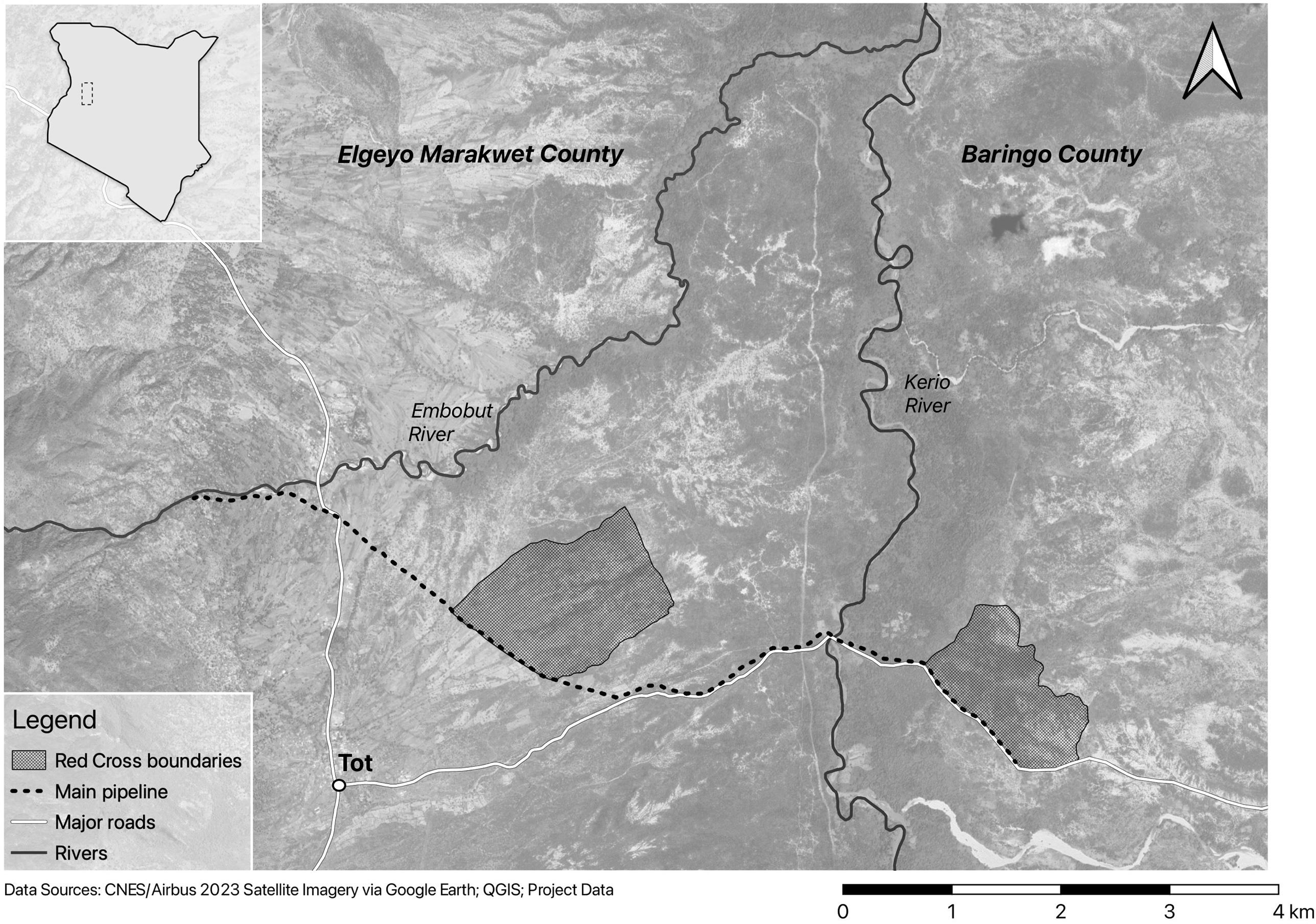
Severe droughts in northern Kenya from late 2010 to 2012 refocused public attention on issues of food insecurity. In the Kerio Valley, responses materialized in the form of several dam and irrigation projects funded in conjunction with international partners and lenders.Footnote 2 As an early initiative, much attention focused on the Tot-Kolowa irrigation project, which was started and implemented by the Kenyan Red Cross and funded by the Canadian Red Cross and the drought fundraising campaign Kenya4Kenyans (Caretta and Cheptum Reference Caretta and Cheptum2021; see Figures 1 and 2).
Map of Tot-Kolowa irrigation project.
Sign indicating funding and management of the Tot-Kolowa project.

Media announcements varied widely as to the amount of funding secured (123 million–150 million Kenyan shillings), the number of people to be assisted (ranging from 1,000 to 3,000 families/homes), and the area to be irrigated (from 500 to 1,000 acres).Footnote 3 Unfortunately, we have not gained access to the initial financial or technical plans for the project, but it seems that expectations varied from the outset. Initial scheme designs appear to have involved piping water eastwards from the higher altitudes of the Embobut River to a location in the Kerio Valley where vulnerable ‘pastoralist’ Pokot families would be encouraged to take up cultivation as a means of ensuring food security (Figures 3a and 3b). These plans seem to have been modest, with the aim to irrigate between 500 and 1,000 acres to be farmed by approximately 500–1,000 Pokot households. In this sense, the scheme replicated a plethora of similar small-scale irrigation projects implemented from the colonial period onwards, especially mirroring those aimed at pastoral livelihood ‘development’ within the immediate region (Hogg Reference Hogg, Anderson and Grove1987; Reference Hogg1983). As noted above, such schemes have a long history (often of failure) and a broad literature of attendant critique. But this history seems to have gone unnoticed or unacknowledged in the planning of the Tot-Kolowa scheme (Caretta and Cheptum Reference Caretta and Cheptum2021; Östberg and Caretta Reference Östberg and Caretta2017).
The main steel pipe exiting the off take.

Concrete off take dam on the Embobut River. Note the extensive silting at the intake already in April 2013.

From the start, the project encountered a fundamental challenge. Since the source of the irrigation water lay in Marakwet, not Pokot, and the Marakwet have a deep history of water resource management, the scheme would require Marakwet cooperation if it were to succeed. The proposed pipeline would also need to cross Marakwet farmland to reach the Pokot on the east side of the Kerio Valley. Historic tensions between the Marakwet and the Pokot added further complications – the late 1990s in particular had seen a resurgence of inter-ethnic violence, culminating in major attacks by the Pokot in 2001 and resulting in numerous deaths (Elfversson Reference Elfversson2016; Kiprono Reference Kiprono2018). While peace-building initiatives throughout the 2000s had largely de-escalated tensions, potential conflicts over land, resources and animals remained present, such that any endeavour founded on inter-community collaboration was relatively risky. The Tot-Kolowa project organizers recognized something of this issue, and by November 2012 agreements between the Pokot and Marakwet had been signed and the project had partially rebranded itself as a ‘peace-building’ initiative (Ndanyi Reference Ndanyi2012b; Kibor Reference Kibor2015). Under this revised plan, the Marakwet were now to get their own area of irrigated land equivalent to that of the Pokot. The water pipeline would now begin with an initial intake at the Embobut River north of Tot-Sibou, and then run eastwards across Marakwet land, where secondary and tertiary pipes would water a 500 acre area of land belonging to the Marakwet Kapishoi and Shaban clans (see Figure 1). The main pipeline would then continue eastwards, cross the Kerio River in a pipe attached to the road bridge, and feed into a near identical network of secondary and tertiary pipes watering an additional 500 acres (Figure 4).
The Tot-Kolowa main pipeline crosses the Kerio River, attached to the main road bridge.

In terms of engineering, the project would develop a concrete weir and intake at the Embobut River, from which the main steel pipeline would decrease from 14 inches in diameter to 8 inches on the Pokot side and, except for a short section at the initial intake, would be buried approximately 1–1.5 metres deep. Secondary plastic pipes leading into the fields would be 4 inches in diameter and also buried, while tertiary pipes leading to 40 x 50 metre individual plots (500 on each side of the river, totalling 1,000) would be approximately 2 inches in diameter and buried at the same depth. A vertical standpipe with a tap would break the ground surface between every two plots, and every two farmers were to be given a 30 metre section of flexible hosepipe and a pressure-driven sprinkler to distribute water.
Making use of the increased elevation at its source, the system was to be pressure driven with air valves and cut-offs at appropriate points so that flow rates could be regulated throughout the network. The concrete intake would consist of a large weir and sluice gates to further control flow into the pipe (particularly necessary when the river was in spate) while also allowing accumulated sediment to be washed out. In the first season, farmers were supplied with a range of free fertilizers and pesticidesFootnote 4 and a supply of metal hand tools including hoes, mattocks and machetes. Farmers were to be encouraged to monocrop maize in the first cropping season (April to May 2014), and 2 kilograms of DH04 hybrid maize seed per person were distributed. They were also urged to establish their own cooperative (involving both the Pokot and Marakwet) for system management and produce marketing. No formal plans were made for ongoing maintenance beyond the first year, and this was left in the hands of the planned cooperative. On the Pokot side, public toilets and a hygiene education programme were also instigated.
Division and allocation of plots on the Marakwet side of the scheme followed two principles. First, the area was divided into two halves split between two clans, Kapishoi and Shaban, who had donated land to the scheme. These are the two largest clans within Tot-Sibou, and the other clans did not possess suitable land to donate – a socially divisive issue with consequences that are expounded below (see also Caretta and Cheptum Reference Caretta and Cheptum2021). Within these clan divisions, plots were then allocated by drawing lots. In theory, plots were supposed to be allocated to those with most claim to the land given over to the scheme, as well as to needy members of the community. In practice, members from family lineages within each clan were selected to draw lots to determine which plot they received. The number of plots was split evenly between the two clans; however, as the Shaban clan was smaller in number, many members were allocated larger or double plots, while some plots were allocated, shared or loaned to outside family members and others. In contrast, the larger population size of the Kapishoi clan meant that some households did not receive land at all. Construction of the project took place throughout 2013, with the first crops being planted in May 2014.
Our research
Since 2010, we have been conducting extensive research into the agricultural landscapes of Marakwet and had developed a team of six community-based citizen science researchers (all themselves farmers). The team members were all trained in GPS mapping, digital photography and semi-structured interview techniques. In 2011, we established a research programme to analyse land use and tenure patterns in Tot-Sibou, selecting some eighty households for repeat interview and mapping of their landholdings. Among demographic data, information was collected on fallowing patterns, crops grown and subsequent yields. In 2014, we followed forty-one of these farmers as they shifted part of their agricultural activities onto the Tot-Kolowa project. Here, we documented their ongoing decision-making processes, challenges encountered and resultant innovations, all the while remaining attentive to how these unfolded in relation to wider agricultural practices across the landscape.
All of our research team held their own plots within the scheme, and one of us (Bailengo) was a secretary of the Marakwet committee elected to oversee the project. We were also able to formally interview this committee as a group in late 2014. Therefore, while we failed to obtain formal plans and feasibility studies from the Red Cross, we managed to document extensive personal testimonies concerning how the scheme was presented to the community on the Marakwet side and how it came into operation. Our data on the project’s management on the Pokot side is more limited, although in late 2014 we were able to interview members of the Pokot organizing committee and the local administrative chief. The local research team also made several visits to the Pokot side to observe developments and to speak informally to friends and relatives involved in its set-up.
Establishment and initial challenges, 2012–14
Construction of the intake and pipelines began in June 2012. As work progressed, farmers were ‘educated’ in irrigation by, among other activities, an instructive excursion to a working irrigation project in Meru, central Kenya – a trip that seems to have missed the fact that the Marakwet themselves are well known for their long history of irrigation-fed agriculture. Aside from this oversight, the Tot-Kolowa scheme drew on a range of pre-existing social processes and land use practices to streamline its implementation. It is thus important to pause here to briefly describe these existing agronomic practices in order to contextualize how the scheme both built on and broke away from older forms of farming.
While previously presented as having a single form of irrigated agriculture (Adams and Watson Reference Adams and Watson2003; Adams et al. Reference Adams, Watson and Mutiso1997; Östberg Reference Östberg, Widgren and Sutton2004; Soper Reference Soper, Kipkorir, Soper and Ssennyonga1983; Ssennyonga Reference Ssennyonga, Kipkorir, Soper and Ssennyonga1983; Watson et al. Reference Watson, Adams and Mutiso1998), the farmers of Tot-Sibou in fact engage in several types of arable cultivation. Semi-permanent fields with relatively fixed boundaries are arrayed along the foot of the Elgeyo escarpment and watered via an extensive indigenous irrigation system that has been in existence for over 200 years (Davies et al. Reference Davies, Kiprutto and Moore2014; Östberg and Caretta Reference Östberg and Caretta2017). These plots are nominally accessed and allocated through patrilineal descent and are largely the preserve of individual households. Individually fenced fields receive irrigation from water channels on the basis of household allocations as negotiated at kapkimwar, a meeting of men held to decide water rights, distribution and management (Adams et al. Reference Adams, Watson and Mutiso1997; Caretta and Börjeson Reference Caretta and Börjeson2015; Östberg Reference Östberg, Håkansson and Widgren2014; Ssennyonga Reference Ssennyonga, Kipkorir, Soper and Ssennyonga1983). Smaller but similar household plots are also cultivated adjacent to household compounds on the steeper slopes of the escarpment, as well as around major river courses, making use of high water tables, motorized pumps and occasional flood recession.
The second major form of Marakwet cultivation is undertaken communally with bush clearance and cultivation organized at the clan level (i.e. a maximal descent group). These plots are situated in the wide expanse of flatter land spreading eastwards to the Kerio River (Figure 5). Once cleared, communal labour is used to fence the whole cultivation area and to extend irrigation channels several kilometres from the main furrow branches, enabling considerable efficiencies in labour and water conservation (Figure 6). Typically, these communal plots cycle across the landscape, moving annually as fertility declines. In comparison to the short-fallow and high-input systems of household-scale fields, these communal plots are evidence of a long-fallow system with areas periodically left fallow for five to twenty years or more. Sections of the landscape that have often been perceived as barren bush by outsiders are thus actually areas of long fallow regrowth where communal labour was previously used to sustainably cultivate and maintain poorer soils (French Reference French2014). Recent research into soil chemistry confirms how communal, shifting irrigation and cultivation work to enhance otherwise poor soils over the long term (Caretta et al. Reference Caretta, Westerberg, Mburu, Fischer and Börjeson2018).
Indigenous irrigation and clan divisions in Tot-Sibou. Thin lines indicate major irrigation channels and the secondary and tertiary network of smaller channels in Kapishoi clan land in 2011. (For clarity, other irrigation branches are not shown.) The two circles in the centre represent areas of communal shifting cultivation that move (along with associated irrigation) every few years. This area was ‘over-printed’ by the Tot-Kolowa scheme from 2012 to 2016.

Work team repairing a pipe junction in 2014.

In 2013, Kapishoi and Shaban farmers shifted their focus from this form of communal long-fallow cultivation to the Tot-Kolowa project, while simultaneously maintaining their individual ‘household’ cultivation plots. Given that the piped irrigation network was not yet ready in 2013, some farmers channelled their own irrigation water into the cleared area, using the existing system of furrows, and undertook their own cultivation there as they might in any other year. However, one notable divergence from preceding years was the fact that the Marakwet farmers cleared a much larger area than usual, since the scheme was ultimately to supply irrigation to a total of 500 acres. This area was cleared by hand, with scrubland being chopped with machetes and larger trees felled with axes and fire. Machinery was provided by the Red Cross to help clear tree debris and to level gullies.
This communal work drew on longstanding practices and represented a major investment of time and energy undertaken in good faith by local participants. However, by early 2014, it had become clear that some of this effort had been wasted. For unknown reasons, the budget for the scheme was revised and the cultivation area on each side of the Kerio River was halved to 250 acres. The farmers seem to have taken this blow with good humour, but eyebrows were raised when it became clear that the Pokot farmers to the east of the river were unwilling to clear the bush for their own plots. This refusal is understandable, given that the specifics of the scheme had yet to be solidified, coupled with the fact that the Pokot largely came from a cattle-herding background and were less used to the communal agricultural labour and skills required for the project. The Red Cross was consequently forced to bring in tractors and hire Marakwet labourers to clear the Pokot land, while the Marakwet themselves clearly wondered why they had not received such help.
A number of interesting consequences resulted from this series of events. First, the Marakwet were now reluctant to invest more of their own labour in the scheme, and instead petitioned the Red Cross for increased technical support, including tractors. These petitions were partially successful, with support for tractor ploughing offered in 2014 and a number of commercial tractors hired for private use in 2015. The traditional precedence of communal labour was also undermined when it came to the fencing of the cleared area. Normally the community would construct a single fence around the perimeter of the cleared area to keep out grazing goats and cattle. However, this was never undertaken on the scheme as there was uncertainty as to whether the Red Cross might undertake this task themselves. A more ad hoc and individualistic approach to fencing ensued, resulting in many plots remaining completely unprotected. This situation later forced many farmers to spend considerable time watching their crops and guarding them from wandering livestock, and undermined the normal communal practices through which harvests would be protected.
Preliminary botanic surveys of fallow regrowth under traditional land management schemes, complemented by interviews with local farmers, seem to suggest that nitrogen-fixing plants, including species of acacia (Vachellia sp.), form an important vector for soil nutrient regeneration. Farmers have indicated that under previous land clearance regimes the roots of many fallow regrowth species were left intact, and that larger acacia trees were left untouched. Traditional clearance practices thus promoted nitrogen fixing during cultivation itself, and facilitated the rapid recolonization of nitrogen-fixing and other plant species once fields were left fallow. Under situations of tractor clearance and ploughing, these roots and trees were largely removed, while the deeper tillage had the potential to disrupt soil structures and create different regrowth patterns. It is not clear if such impacts were modelled by the project’s designers, but it is certainly evident that they diverged from the traditional practices of the Marakwet themselves and potentially undermined natural processes of soil regeneration.
Unexpected challenges and innovations, 2014–15
The irrigation scheme officially became operational in May 2014 and participant farmers began preparing their first crop. Teething issues were of course inevitable, but it is interesting how solutions to these problems were left largely in the hands of the local organizing committees. It is unclear if this lack of provision was intentional on the part of the Red Cross, or whether the technical challenges that arose were wholly unexpected. In either case, the user communities had to devise a range of innovative solutions on their own behalf.
An immediate issue that arose was a lack of water pressure for round-the-clock irrigation on either side of the scheme, let alone across the project’s entirety. A series of negotiations rapidly ensued between the Marakwet and Pokot, resulting in an equal allocation of water between the two communities. The organizing committees agreed that the Marakwet would have access to water on Mondays and Tuesdays, while Wednesdays and Thursdays were allocated to the Pokot. Fridays and Sundays were for anybody’s use on either side of the scheme, and Saturdays were reserved for washing and clearing out the intake. Second, where sequences of valves allowed for blocks of fields to be isolated in succession, a localized timetable of daily water allocation was devised on both the Marakwet and Pokot sides to irrigate each block in turn. The result of this negotiation was that each farmer had access to approximately half a day of water every week.
Given that these negotiations and allocations drew directly on pre-existing community experiences of traditional irrigation management, the negotiations were undertaken swiftly, and the agreed allocation principles well understood. However, mirroring the rigidity of the fixed pipe system itself, this formalized timetable lost the inherent flexibility and nuance of older irrigation systems where farmers were more readily able to petition for allocations out of turn when the necessity arose (Adams et al. Reference Adams, Watson and Mutiso1997). In this instance, the ad hoc construction of minor offtakes to meet urgent needs was no longer viable, as this would require entire irrigation blocks to be opened up and closed off at once, thus throwing the complex system of allocations off course. In short, the piped irrigation scheme was far less flexible than older furrow irrigation.
Issues with water pressure were compounded by additional challenges associated with damaged and leaking pipes (Caretta and Cheptum Reference Caretta and Cheptum2021). Breakages were particularly common where the gauge decreased from the main pipe into the secondary and tertiary pipe network, and where the water passed from metal to plastic pipes. We did not conduct a formal survey of all breakages, but local testimony indicates that they were numerous throughout the first year of cultivation and continued into the second. While the Red Cross did leave some spare and replacement piping with the local organizing committee and trained a team of farmers in basic pipe maintenance, no wider technical provision or financial support seems to have been provided. Ad hoc repairs, often requiring considerable labour and resources, were thus usually undertaken at the farmers’ expense, and had the additional impact of throwing the allocation schedule off balance (Figure 6).
It rapidly became clear to the Marakwet organizing committee that a more formal system of maintenance was required. Thus, a series of communal meetings (not including the Red Cross) were convened throughout mid-2014 with the purpose of establishing an official pipe repair team who would be reimbursed for their work through a system of subscriptions amounting to 200 Kenyan shillings per plot per year. The repair team would also be responsible for the prevention of silting at the main Embobut intake, where a series of sluices that had been established to flush the intake and prevent siltation were proving inadequate and the intake had to be dug out periodically as a result. Interestingly, while far from technologically perfect, the older community irrigation channels recognized this silting issue within their design and incorporated simple structures to divert water during spate so that the main channels were not damaged. Traditional intakes also used fairly insubstantial construction materials that made them easy to repair, or even rebuild entirely, while intake areas were quite narrow to ensure that siltation was kept to a minimum. The Tot-Kolowa project could easily have learned from this technology to optimize the engineering of the scheme, but it failed to do so.
In addition to breakages in the main irrigation pipes, farmers also struggled with breakages to the vertical standpipes and taps placed between every two plots for water distribution. These vertical pipes were made from plastic and were not mounted on any form of support structure, thus risking being broken if knocked, particularly by grazing animals (mostly cows). While repairs were not impossible, many farmers lacked the time, expertise and resources to repair such damage, an issue that was especially acute on the Pokot side of the scheme where post-harvest grazing had been more prominent and had broken many standpipes. Similar complaints were levelled at the hosepipes and sprinklers, which were allocated jointly to every two farmers. Hoses were flimsy, of inadequate length and did not attach properly to the taps. Sprinkler heads frequently jammed or lacked sufficient water pressure to work effectively. Many farmers instead invested in personal hosepipes and more effective sprinkler heads, which, while costly, were readily available from local suppliers and already well understood.
Another series of interesting innovations revolved around the use of the chemical fertilizers and hybrid maize seeds supplied at no cost by the Red Cross in the first season of cultivation. In short, farmers were encouraged to monocrop maize and instructed (but not, it seems, formally guided) to establish a cooperative to market and sell the resulting harvest. However, with the commercial value of maize already low, most farmers recognized that further flooding local markets with an overabundance of supply would result in small profits. As such, while maize was grown in the first season for both family consumption and commercial sale, no larger-scale cooperative marketing was ever established. Many farmers instead realized that far more potential lay in the selective cultivation of diverse horticultural products, playing their efforts against variable market demands and attendant price fluctuations. In this sense, it was the post-maize short-term period of cropping in the latter part of 2014 that was widely considered to be the greatest benefit of the scheme. This cropping encompassed several varieties of beans, green grams (commonly known as mung beans), ground nuts and watermelons, the latter of which proved to be particularly profitable at market. This locally led cropping innovation shows that the farmers themselves were astute economic actors who sensibly acted independently of the guidance they had received.
Several farmers also realized that, given that most of the land on the scheme was newly cultivated and thus naturally fertile, chemical fertilizers were not necessarily needed. As such, some retained their fertilizers for future years, while a good number sold them on to realize an immediate income. By late 2014, some farmers had emerged as especially enterprising individuals, gaining a local reputation for their innovative exploitation of the scheme, notably through their large investments in cultivating valuable horticultural products. For other farmers, however, the situation was rather different. Indeed, interviews in 2014 revealed how some project participants had significant qualms about the quality of the land they had been allocated. As the pipe and field system had been laid out in a regular, rectilinear grid system, the process of plot allocation made no provision for the presence of small erosion gullies, areas of sheet erosion and top-stripped soils, and pre-existing areas of what some farmers described as ‘salty’ soil. Complaints emphasized that such land parcels were wholly or partially uncultivatable, or that they required considerably more tillage and chemical fertilizer to make them viable. Under previous patterns of communal cultivation and flexible irrigation infrastructure, such patches would easily be avoided by moving, extending or contracting land to meet the demands of socio-ecological variability. In contrast, the lack of flexibility of the fixed piping and the resulting challenges it generated were apparent to our research team from the very first season of cultivation. As we move on to explore, these issues raised major questions surrounding the long-term ecological and agronomic viability of the system. However, as will also become apparent, other events quickly overtook concerns about the scheme’s operational longevity, effectively rendering the project a failure even before these factors could be tested fully.
Wider unintended impacts, sustainability and longevity, 2014–15
A big challenge arising from the Tot-Kolowa project in 2014 was the unexpected influx of wildlife rarely seen in the region. A range of birds, most notably large crested cranes, were attracted to the site by the sudden availability of well-watered crops and the relative lack of bird-scaring procedures, which, in previous years, would have been organized collectively. These birds caused a host of problems, but it was the inflow of warthogs that proved most damaging, particularly to the watermelons, which had been cultivated in large numbers for the first time in the region, resulting in a loss of harvest – a situation not helped by the lack of robust communal fencing. It surprised both our research team and local farmers just how quickly the scheme had transformed local ecologies of bird and animal life – generating local admiration at natural flourishing, but also concern over the potential damage to agrarian livelihoods.
These perceptions of rapid ecological change, combined with local recognition that the quality of fertile land within the scheme was itself variable, raised wider concerns about the project’s longevity and its impact on ecological sustainability. Discussions among our team as well as the organizing committee in November 2014 were centred on the worry that traditional long-fallow field systems were not replicable due to the scheme’s spatial fixity, and that project land would instead need to be maintained by the application of chemical fertilizers. Echoing the soil chemistry analysis of Caretta et al. (Reference Caretta, Westerberg, Mburu, Fischer and Börjeson2018), community members articulated concern that this permanence would upset existing patterns of soil maintenance, and that piped water itself lacked the important nutrients carried by open furrows, a point confirmed by Wiborgh’s (Reference Wiborgh2015) analysis of furrow water chemistry. Also discussed was the nature and value of fallow regrowth and the damage that may have been done to nitrogen-fixing root systems by the removal of previously preserved acacia trees.
Additionally, it was recognized locally that the success of the Tot-Kolowa scheme would hinge on the capacity of individual households to marshal and manage labour. As noted above, Kapishoi and Shaban farmers in Tot-Sibou already enjoyed access to good-quality, irrigated farmland, maintaining small gardens near their homes and larger plots at the foot of the escarpment. Indeed, our 2012 survey of some eighty households within Tot-Sibou mapped their existing arable plots and found that each household held on average 2.89 plots of land, confirming general observations that a variety of different foodstuffs are cultivated across a range of ecologies (Bernstein Reference Bernstein2017). A major challenge faced by households was thus not accessing land itself, but rather mobilizing labour for its successful management. In normal years, households could flexibly invest either more or less energy in the communal plots further away from their homes, with primary cultivation efforts being focused on field systems at the foot of the escarpment. Conversely, the instigation of the Tot-Kolowa scheme tightened families’ focus on fields further from the escarpment at the expense of their more proximate holdings. A number of farmers talked of the temporary neglect of family farms at the foot of the escarpment, while others noted a decline in the maintenance of attendant irrigation networks. Some families managed their labour requirements by renting or loaning out land to others, including family members from the Marakwet highlands, and even enterprising businesspeople from much further afield. A 2015 survey of the 250 farmers on the Marakwet side of the scheme identified forty-five farmers operating such arrangements. Of these, twenty-one had allowed family members or neighbours to cultivate their plots as part of ongoing obligations. Some seventeen had rented out their plots to outsiders who had paid to cultivate the land and reap the harvest. Finally, seven farmers had utilized the longstanding Marakwet principle of samat – the offer to allow another to cultivate your land provided the subsequent harvest is shared, normally on a fifty-fifty basis.
These processes of loaning, commercial renting and samat drew on older forms of tenure and show that, for many, the Tot-Kolowa scheme was seen as a business opportunity rather than a food security necessity per se. Informants stated that this pattern revealed an inherent unfairness in the scheme, in that those who benefited most already had the ability, networks and/or capital required to cultivate multiple plots, whereas the neediest in the community (including many from the smaller clans of Tot-Sibou) were unable to claim land in the project at all. As we examine below, this point of contention became particularly significant over time. Such processes also show how longstanding practices of flexible landscape and labour management were co-opted to manage the challenges of the scheme in ways that were not envisaged by its original designers. In practice, many farmers from outside the community were among the most commercially innovative users of the scheme, pioneering the cultivation of cash crops, especially watermelons and cabbages, that were sold to traders coming from large urban markets in Eldoret and even Nairobi (Figure 7).
Melon harvest in November 2015.

It is in this vein that, throughout 2014 and 2015, the project was often spoken of as a great new economic opportunity. However, informants also noted that this level of cultivation might not be sustainable. In particular, many reported that perceived economic opportunism, coupled with the lack of traditional community controls regarding land use, had led to year-round intensive cultivation. While this was initially productive, the lack of any annual fallow periods, conjoined with concerns over the removal of non-cropping nitrogen-fixing plants and the sheer inability of the system to move across the landscape, was clearly beginning to worry a number of local farmers.
The constant issues relating to managing water pressure and repairing broken pipes compounded concerns about project sustainability, as did the challenge of establishing a cooperative and encouraging scheme members to pay to join it. Initial steps were taken towards this latter project, with a Marakwet committee having been established and paperwork prepared to register the cooperative prior to local events overtaking the situation (see below). On the Pokot side, cultivation was largely absent by 2015 due to repeated breakages to pipes and the lack of an organized repair team. There were also rumours of financial impropriety relating to the proposed collective. Thus, for the Pokot – the original project beneficiaries – the scheme had effectively failed after only a single season of cultivation (Figures 8a and 8b).
Water pooling on the Pokot side due to a missing tap and improper control of cut-off valves.

Ad hoc repairs to a standpipe damaged by cattle grazing on the Pokot side in November 2014.

Unintended consequences: land conflicts and project collapse, 2015–22
Although the Tot-Kolowa scheme was initially formulated as a food security project, few checks were in place to ensure that the neediest community members actually benefited. Instead, as detailed by Caretta and Cheptum (Reference Caretta and Cheptum2021), the project exacerbated longstanding pre-existing structural tensions within the community of Tot-Sibou. As mentioned above, Tot-Sibou is organized around four exogamous Marakwet clans – Kapishoi, Shaban, Kapsiren and Kapchepsom. The Kapishoi and Shaban clans hold the largest territories, including the land most suitable for the Tot-Kolowa scheme. As such, only Kapishoi and Shaban were able to contribute land, and it was consequently they who principally benefited from it.
Members of the Kapsiren clan were particularly upset with this arrangement due to a series of land disputes dating back many decades. Indeed, Kapsiren have long argued that their own clan territory extends east from Tot centre towards the Kerio River, while other clans state that Kapsiren have historically had no such land rights in this location. This dispute has been at the centre of several instances of localized violence and, with the proposed Tot-Kolowa scheme benefiting just two of the four clans, Kapsiren grievances around land allocation only became stronger. As the production of cash crops and profits from the scheme accrued for the project beneficiaries in 2015, protests from Kapsiren clan members became more intense and threats of aggression between Kapsiren and Kapishoi became particularly acute. By late 2015, a series of violent incidents resulting in several deaths and reciprocal house burnings brought issues to a head and many families chose to temporarily leave the village. By early 2016, cultivation had been severely disrupted and self-imposed curfews curtailed social and economic life (see also Caretta and Cheptum Reference Caretta and Cheptum2021).
Tensions intensified further in mid-2016, when members of the Pokot community east of the Kerio River became involved. As with the longstanding land tensions between Marakwet clans, periodic conflicts between Pokot and Marakwet communities have a deep history. These stem from a host of intersecting factors, including resource availability, boundary disputes, cattle rustling, retaliatory raids and perceived government bias, neglect and corruption towards both communities. The result has been cyclical patterns of violence, often culminating in the destruction of property, widespread displacement and significant loss of life (Elfversson Reference Elfversson2016; Kiprono Reference Kiprono2018). The eruption of violence in 2016 marked the latest phase in this long history, with tensions initially flaring as Pokot individuals became drawn into Marakwet intra-clan violence via extended kin relations. Ensuing acts of aggression were further seized upon by an emerging age set of young Pokot men looking to establish themselves within a socio-economic context of high unemployment and political disenfranchisement in the face of forthcoming national elections. Violence escalated and land seizures, cattle raiding and retaliatory fighting led to a surge in homicide rates (Kibor Reference Kibor2019). Such events saw the implementation of localized curfews, an increased presence of General Service Unit police personnel and the movement of people away from the region as they chose to live with relatives elsewhere.
The Tot-Kolowa project cannot be blamed for the violence that occurred. As noted, deeper and more longstanding intra- and inter-community tensions clearly underpinned the conflict. But the scheme was naively pulled into these deeper histories such that it further aggravated pre-existing tensions. In this sense the project failed in one of its initial aims to solidify peace between the Pokot and Marakwet, as evidenced by its amplification rather than intended mitigation and prevention of recursively coalescing forms of conflict. It seems fairly clear that the project designers failed to pay due attention to the wider social, historical and political geography of the region, and concurrently made little attempt to consider how, or indeed why, the project could or should act as either a food security or peacebuilding initiative. Indeed, as critical development theorists have observed, technical interventions such as this are often circular in their implementation – casting problems or challenges in the light of the technical solutions that planners already have in mind – and thus effectively de-politicize complex socio-political contexts (Ferguson Reference Ferguson1994).
A recent field assessment of the scheme in July 2022 confirmed the collapse of the project. Both the Marakwet and Pokot areas of the scheme had not been utilized since some limited cultivation in 2016. Water and pipe engineering works are now completely overgrown and in many cases irreparably damaged. On the Pokot side in particular, we noted considerable damage to piping, and even to the concrete pressure valve housings, which would be both financially and technically onerous to rectify (Figure 9). It is also noticeable that the acacia-dominated landscape of old is now characterized by much lower and denser scrub thicket vegetation, the long-term ecological impacts of which are yet to be understood. It is clear, however, that a considerable amount of effort would now need to be invested to re-establish the scheme.
Major damage to piping and pressure valves on the Pokot side of the Tot-Kolowa scheme.

Conclusions: failure, development and resilience
This article has discussed how the Tot-Kolowa irrigation scheme was originally conceived, designed and presented as a technical solution to food insecurity in the Kerio Valley. While initially modest, complications surrounding resource management and access to land necessitated a series of modifications to reflect the realities on the ground. This redesign increased the project’s scope to serve both the Pokot and the Marakwet, a process that saw the scheme being rebranded as a peacebuilding and food security initiative. However, multiple challenges continued to arise, including issues with labour allocation, communal fencing, wildlife damage, managing water pressure and pipe breakages, and replacing substandard building materials. Solutions to these issues largely emerged from existing knowledge and practice of the community itself rather than from external development actors, but deep concerns remained about the longer-term ecological sustainability of the scheme and its potential to undermine older forms of flexible agriculture.
Despite these challenges, the scheme still had the potential to prove a success. Interviewees saw numerous short-term positives to the initiative, including the creation of well-irrigated arable land, the initial cost-free provision of hybrid seeds and fertilizers, increased crop yields and the emergence of multiple business opportunities. Rather than embracing the project as a means for wholesale economic transformation, farmers incorporated it into existing complex patterns of household production, using it to extend business and social networks and maximize resources to fulfil multiple aspirations. While these activities were clearly at odds with the original aims of the scheme, the ways in which farmers negotiated their obligations to the project’s designers and managed to make the most of the opportunities afforded to them clearly speak to the creative manner in which rural communities are able to shape their own engagements with outside planners. It is in this way that the Tot-Kolowa scheme was never viewed as a panacea to food insecurity, but rather as an opportunity that could be usefully incorporated into already complex community lifeways.
These processes of selective incorporation and rejection can be considered a form of emergent cultural resilience (see Davies and Moore Reference Davies and Moore2016; Derbyshire et al. Reference Derbyshire, Moore, Cheptoo and Davies2020; Moore Reference Moore2011). Although we currently lack the data to argue that this form of resilience is manifest in Pokot lifeways (similar arguments have been made for the Pokot residing elsewhere (Bollig Reference Bollig2016; Davies and Moore Reference Davies and Moore2016)), our analysis shows that Marakwet engagements with development interventions should be understood as a part of this broader history of resilience. Thus, while it is tempting to see the scheme as a typical example of a failed development model, we need to be more specific about the form this failure took. Certainly, the Marakwet community did not reject the project, being largely engaged and accepting throughout its implementation despite perceived limitations to its design. Instead, the scheme’s failure lay in its inability to recognize that pre-existing agricultural infrastructure and attendant knowledge were already an innovative agricultural success story – honed, refined and actively reorganized by the community itself over at least the last 200 years (Davies and Moore Reference Davies and Moore2016; Davies et al. Reference Davies, Kiprutto and Moore2014). Marakwet farmers already regularly combined newer and older materials, ideas and practices in ways that did not necessarily mean that older knowledge and contemporary interventions were incompatible. However, the designers of the Tot-Kolowa scheme ignored these 200-plus years of collective experimentation and experience, and thus devised a scheme that lacked the scope for effective sustainable synergies with existing agricultural practice.
With hindsight, the design of the Tot-Kolowa scheme will hopefully seem an historic anomaly – the short-lived product of a dated twentieth-century rationality that attempted to treat complex socio-political and socio-natural problems with simple technical solutions. This said, with the emergence of new phases of top-down development across the country, many of which are taking the form of state-led ‘mega’ projects (Müller-Mahn et al. Reference Müller-Mahn, Mkutu and Kioko2021), it is more pertinent than ever to understand how such schemes will continue to become entangled with pre-existing socio-ecological contexts, and that success can only be realized by building on, rather than undermining, existing community knowledge and practice.
Acknowledgements
Thanks are due to members of the Marakwet Citizen Science Research Team, including Noah Kiplagat, Andrew Kibet Yano, Joseph Kimutai Cheptorus and Thomson Kiptum. Research was undertaken with permission from the National Commission for Science, Technology and Innovation (licence numbers P/13/6805/360, P/19/3137 and P/21/10301). We are grateful to the University of Eldoret, the British Institute in Eastern Africa, the Institute for Global Prosperity, University College London and the McDonald Institute for Archaeological Research, University of Cambridge, for supporting the work. Thanks are also due to the Economic and Social Research Council and Arts and Humanities Research Council for funding projects within the context of which research for this article was conducted, including ‘Unravelling Complexity: Understanding the Land–Water–Food Nexus in Elgeyo-Marakwet, North-West Kenya’ (ES/P002609/1), ‘Prosperity and Innovation in the Past and Future of Agriculture in Eastern Africa’ (AH/T00424X/1) and ‘Cultivating through Crises: Empowering African Small-Holders through Histories of Creative Emergency Response’ (AH/V009281/1).
M. I. J. Davies is Deputy Director of the McDonald Institute for Archaeological Research at the University of Cambridge. Before this he was Associate Professor and Director of Education at the Institute for Global Prosperity, University College London. He has held appointments in African Studies and Archaeology and at the British Institute in Eastern Africa, Nairobi. He has worked with the Marakwet Research Citizen Science team on a range of issues since 2009.
Henrietta L. Moore is the Founder and Director of the Institute for Global Prosperity and Chair in Culture Philosophy and Design at University College London. A leading global thinker on prosperity, her work crosses disciplines, from social science to the arts, business innovation and the natural sciences, and she applies these different perspectives to inform research and policy at all levels.
Nelson Bailengo is a member of PROCOL Africa’s Citizen Science team working in Elgeyo Marakwet county. He has expertise in a range of mixed methods, including landscape mapping, ethnobotanical surveys and the collection of oral histories.
Mallory Bernstein holds extensive experience in data science, management and statistics in clinical research, including varied laboratory techniques, biostatistics and data interpretation. She completed a master’s degree in African Studies with Health (University College London, 2017) and is currently working in SARS-CoV-2, HIV and TB research at the Africa Health Research Institute.
Helena Cheptoo is Assistant Director of PROCOL Africa’s Marakwet Research Station. She has significant knowledge in regional history and changing cultural practice. She has particular experience in ethnographic interview techniques and in translation and transcription.
Timothy Kipkeu Kiprutto is Director of PROCOL Africa’s Marakwet Research Station and Chief Citizen Scientist. Timothy is a trained forester with over a decade of experience working on anthropological research in Marakwet.
Samuel Lunn-Rockliffe is an Early Career Research Fellow at the McDonald Institute for Archaeological Research, University of Cambridge. He has worked closely with PROCOL Africa’s Citizen Science team since 2014, focusing on histories of agricultural innovation, landscape change and the politics of conservation.
David Kay is a geoarchaeologist working as a specialist for Oxford Archaeology. His research interests extend across landscape archaeology, anthropology, material culture studies, environmental science and archaeological theory. He obtained his PhD from the University of Cambridge in 2021, for which he investigated the historic landscape and settlement history of the Marakwet communities of north-west Kenya.
Wilson Kipkore is a Senior Lecturer and manager in natural resource management at the University of Eldoret, Kenya. He has a range of experience working with leading East African environmental NGOs and as the Chief Executive of the Permanent Presidential Commission on Soil Conservation and Afforestation for the Kenyan government.


 Open access

