


Introduction
Pallas’s Fish Eagle Haliaeetus leucoryphus (hereafter PFE) is considered the northern hemisphere’s most poorly-studied eagle (Katzner and Tingay Reference Katzner, Tingay, Tingay and Katzner2010). As a species with an apparently complex and poorly understood migratory system (Bildstein Reference Bildstein2006, Naoroji Reference Naoroji2006), it has a widespread distribution that includes large areas of central, southern and eastern Asia, but populations are thought to be declining across substantial parts of its range (BirdLife International 2001, 2012a, Sourav et al. Reference Sourav, Ahmed and Thompson2011, Gombobaatar et al. Reference Gombobaatar, Monks, Seidler, Sumiya, Tseveenmyadag, Bayarkhuu, Baillie, Boldbaatar and Uuganbayar2011). Classified as ‘Vulnerable’ on the IUCN Red List (BirdLife International 2012b), these declines are attributed to the widespread loss, degradation and disturbance of wetland habitat, loss of potential nesting habitat, pollution from agricultural and industrial chemicals and human persecution (BirdLife International 2001, 2012a).
According to BirdLife International (2001, 2007), the three main breeding populations of PFE were believed to be in China, Mongolia and the Indian subcontinent, although there were few quantitative data to support that assessment. With reported “significant” PFE population declines during the 20th century in China, Pakistan, India, Nepal and Bangladesh, it had been suggested that Mongolia held the main PFE breeding population (BirdLife International 2007). Since then, more evidence has suggested the Mongolian PFE population may be smaller than previously estimated (Gilbert and Gombobaatar Reference Gilbert and Gombobaatar2009). Our study aimed to expand this work by collating existing data on historical and contemporary records of PFE in Mongolia, and to conduct field surveys at as many of these sites as possible, to assess the species’ current distribution, identify key site characteristics and determine current status in the country. Our study provides the most up-to-date information currently available, based on an extensive review of published historical literature and the results of field surveys undertaken between 2005 and 2011.
Study area
Lying between latitudes 42°N and 51°N, Mongolia is a vast land-locked country extending east-west across 2,500 km of Central Asia between Russia and China, with an approximate area of 1.5 million km2. Although a country of climatic and geographic extremes (Wingard and Zahler Reference Wingard and Zahler2006), much of the land area consists of open steppe, transitioning to taiga forest in the north and the Gobi Desert in the south and west. Wetlands and lakes of variable size fleck the landscape, with approximately 3,000 rivers stretching over 67,000 km in the north (Wingard and Zahler Reference Wingard and Zahler2006). Mongolia is populated by just under 3 million people, over half of whom depend directly or indirectly on the traditional nomadic system of livestock production, raising goats, sheep, cattle, yaks and horses (Zahler et al. Reference Zahler, Joly, Krueger, Osofsky, Enkhtuvshin, Steele, Oviedo and McCauley2007).
Methods
Historical literature review
Forty-three Mongolian, Russian, German and English language sources (covering the period 1901–2009) were reviewed from the collections held at the National University of Mongolia and the Mongolian National Library, Ulaanbaatar. Sources were reviewed to identify information relating to historical PFE distribution and status. Localities were mapped using 1:500,000 topographical maps and a national road atlas (1:2,000,000). Imprecise localities such as long river corridors were classified as ‘general areas’, whereas place names or defined geographical features such as lakes were classified as ‘specific locations’. Where sources referred to museum specimens, we endeavoured to verify the records by consulting with the museum collection curators.
Field surveys
These were conducted each year (2005–2011) between April and October, encompassing the period during which PFEs have been recorded in the historical literature. The surveys were a combination of both opportunistic and targeted site visits. The opportunistic surveys ran concurrently with an avian influenza surveillance programme focusing on wetlands throughout Mongolia, covering 12 of the 21 national aimags or provinces (Gilbert et al. Reference Gilbert, Jambal, Karesh, Fine and Shiilegdamba2012). During these surveys, sites were selected either on the basis of locations cited within the historical literature review (the PFE-targeted survey), or by the presence of congregatory waterbirds (particularly Anseriformes and Charadriiformes) (opportunistic surveys), and included rivers and lakes of variable size. Surveys were conducted using a combination of transport including motor vehicle, on foot and an inflatable zodiac boat with 25 hp outboard motor, traveling parallel to the shore as close as water depth, vegetation or terrain allowed. A hand-held GPS (Garmin) was used to record the distance travelled at each site. Regular stops were made to scan for perched or flying eagles using binoculars (8x 32) and spotting scopes (80 mm, 20-60 x zoom). The coordinates of all sighted PFEs were recorded and age was estimated, based on plumage characteristics (Naoroji Reference Naoroji2006). Age was classified as adult (full adult plumage attained in 4th or 5th year), sub-adult (had at least initiated one moult cycle, but not yet attained full adult plumage) and juvenile (< 1 year). We also recorded the presence of White-tailed Eagles Haliaeetus albicilla, the only Haliaeetus congener in Mongolia that shares a cosmopolitan diet with the PFE (Naoroji Reference Naoroji2006) and is a potential competitor for breeding sites. We also recorded the presence/absence of Great Cormorants Phalacrocorax carbo, an obligate piscivore and thus a crude indicator of fish stocks at each site.
Wetland characteristics
We categorised wetlands as either lakes or rivers. Lake surface area was measured using a GIS database (ArcGIS). Lake elevation was measured using a handheld GPS (Garmin).
Results
Historical literature review
PFEs were mentioned in 30 of the 43 reviewed literature sources, relating to 82 discrete observations from a total of 39 sites (Figure 1). We elected to exclude a museum specimen held at the Museum of Zoology, Polish Academy of Sciences (catalogue number MIZ 41050, collected by B. Dybowski, and W. Godlewski on 9 August 1873), as we were unable to confirm that the collection locale (listed as “Dauria”) lay within the territory of modern-day Mongolia. Twenty sites were classified as specific locations, 14 as general areas and five were untraceable (of which Kharaa Gol [river] could be traced to Khentii aimag [province], but the actual location of the river could not be determined). Although presence of PFE was used among the justifications for listing the Darkhad Valley as an Important Bird Area (BirdLife International 2004), we were unable to locate any specific records of the species in this location, nor were local people familiar with the species and so we did not consider this locality among our list of historical sites. Of the 40 observations where the number of eagles was specified, only three reported more than two birds present: five birds of unspecified age at Uureg Nuur on 24 May 1977 (Baranov Reference Baranov1991); seven birds of unspecified age at Buuntsagaan Nuur in June 2003 (Bold Reference Bold, Bold, Boldbaatar and Munkhbayer2005); six adults and 15 immatures at Airag Nuur in June 1995 (A. Brӓunlich in Birdlife International 2001). Within the 30 references where PFEs were mentioned, only five referred to breeding PFEs at seven sites (Table S1 in the online supplementary materials). One of the five references (Fisher Reference Fisher1970 in Stubbe et al. Reference Stubbe, Kaczensky, Wesche, Samjaa, Stubbe and Reading2010) makes a generic reference to PFE as “breeding visitors” in two specific locations (Buuntsagaan Nuur and Orog Nuur), but it is unclear whether definitive evidence of nesting activity was observed, or birds were merely present during the perceived breeding period. Three references (Buturlin Reference Buturlin, Elpatevskii and Elpatevskii1913 in Sumiya and Skryabin Reference Sumiya and Skryabin1989, Tugarinov Reference Tugarinov1928 in Stubbe et al. Reference Stubbe, Kaczensky, Wesche, Samjaa, Stubbe and Reading2010, Kozlova Reference Kozlova1930) mention an unquantified number of nests in three general areas (Tuul Gol at Urguu [Ulaanbaatar], Tamir Gol and Kherlen Gol) and one specific location (Khuvsgul Nuur). Only one reference (Sh. Boldbaatar in Stubbe et al. Reference Stubbe, Kaczensky, Wesche, Samjaa, Stubbe and Reading2010) quantified breeding attempts at a specific location with a single nest containing a single egg on 24 June 1999 (at Tsagaan Gol, Khar-Us Nuur). We attempted to determine where the egg is currently held, but we understand it was not collected (Boldbaatar pers. comm.). Although BirdLife International (2001) cite Sushkin (Reference Sushkin1938) as a source for information on PFE nesting on the ground in Mongolia, we were unable to find reference to this in the primary text.
A map illustrating 34 locations where Pallas’s Fish Eagle has been reported in Mongolia based on literature sources. Observations are illustrated within time periods consistent with the scheme used in BirdLife International (2001), and classified as ‘specific locations’ (white squares = undated, white circles = pre-1950, grey circles = 1950–1979, black circles = 1980 to present), or ‘general areas’ (dashed line = undated, white line = pre-1950, grey line = 1950–1979, black line = 1980 to present). The key to location numbers is presented in Table S1. Four locations could not be traced and therefore are not illustrated.
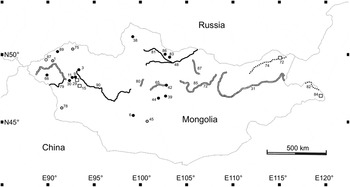
The process of collating historical records was complicated by the distribution of information in source material in several different languages. For instance, we found that observations of PFE reported along the Kherlen Gol and Churchin Gol by Popov (Reference Popov1991) in Stubbe et al. (Reference Stubbe, Kaczensky, Wesche, Samjaa, Stubbe and Reading2010), actually referred to White-tailed Eagles, and were likely to have been due to a mistranslation from the original Russian text.
Field surveys
A total of 77 sites were visited including 21 of the 34 traceable, historical PFE sites (Table S2 and Figure 2), and all seven of the locations with historical reports of breeding activity. The number of individual site visits totalled 234 and ranged from one to 24 visits per site (mean number of visits = 3.0, SD 3.6). Fifty-seven of the 77 sites received full survey coverage at least once, and 20 sites received partial survey coverage due to accessibility or other logistical difficulties. PFEs were observed at eight sites (Table 1), all of which were known historical sites. The number of individual PFEs observed at any site ranged from one to six. The number of PFEs in each age class was 21 adults, five sub-adults, and 10 juveniles. Great Cormorants were observed at 36 sites, and White-tailed Eagles at 21 sites. There was a significant association between sites where PFEs were observed and where Great Cormorants were present (chi-value = 7.586, df = 1, P = 0.006). Whereas, White-tailed Eagles were only observed at four of the PFE sites, an association that was not significant (chi-value = 1.387, df = 1, P = 0.239).
A map illustrating locations in Mongolia where surveys took place for Pallas’s Fish Eagle between 2005 and 2011. Survey sites include lakes or rivers of limited length (white circle = no eagles observed, black circle = eagles observed), and longer rivers (white lines = no eagles observed). The key to location numbers is presented in Table S2.

Observations of Pallas’s Fish Eagles made during surveys between 2005 and 2011.

Wetland characteristics
Of the 77 survey sites, 65 were characterised as lakes, 11 as rivers and one was a wetland complex including both rivers and lakes (Table S2). All observations of PFEs were made on lakes with the exception of a single individual recorded along Chono Kharaikh Gol [river], at elevations between 1,030 m and 1,988 m. The surface area of lakes visited ranged from 0.03 to 3,350 km2, with PFEs only observed on relatively large water bodies ranging from 25 to 1,077 km2 (Table S2).
Discussion
Our study casts doubt on the assumption that Mongolia was, or is, a breeding stronghold for PFE. The extreme climatic conditions in Mongolia will likely restrict the PFE’s potential breeding period to the months of April–October, so that hatching is synchronised with the thaw in mid-May (as with White-tailed Eagle, the PFE’s congener; pers. obs.). Within 29 published historical accounts referring to these months, only five specifically mentioned PFE breeding activity (presence of nests or an egg). Of the 27 traceable, historical locations where no evidence of breeding was recorded, it is conceivable that authors either failed to observe or neglected to record breeding activity. However, our own contemporary surveys at 15 of these locations made during the same months did not produce any evidence of PFE breeding. It is possible that breeding PFEs could have switched to new breeding locations in response to changing environmental conditions at some historical breeding sites; however, we failed to find any evidence of breeding at 55 widely dispersed wetlands that were not documented within the historical literature review, and represented potential alternative breeding sites.
Although many observations of PFE involved juvenile birds, this does not necessarily imply that these individuals hatched within Mongolia. On several occasions juvenile eagles were observed in fresh plumage (with little or no evidence of wear) as early as June (pers. obs. and M. Valkenburg and W. Faveyts in litt. 2010). Considering that Mongolian water bodies remain frozen until late April or early May, it is likely that these birds hatched in locations south of Mongolia, and may be individuals from the breeding population in the Indian subcontinent. For example, the PFE’s breeding season in northern India has been defined as September to March, sometimes into April, with adults and juveniles leaving by the end of April/early May when they “disappear northwards over the Himalaya into Tibet and the high plateau lakes of Western Xizang Zizhiqu in Central Asia” (Naoroji Reference Naoroji2006). Similarly, Sourav et al. (Reference Sourav, Ahmed and Thompson2011) documented PFEs arriving to breed in Bangladesh in late August and leaving (for an unknown destination) by the end of April/early May.
With the exception of a museum specimen collected at Khuvsgul Nuur on 24 December 1912 (by F. Schillinger, in Piechocki Reference Piechocki1983), all historical observations of PFEs in Mongolia were made between April and September. However, a re-examination of the Khuvsgul Nuur specimen (#NMW 42.010) has determined that this bird is in fact a White-tailed Eagle (A. Gamauf, Naturhistorisches Museum Wien, in litt. 2013), and a second putative PFE obtained by the same collector in October 1913 (#NMW 42.011) was also re-identified as this species. Recent observations of PFE in Kazakhstan include records from February and March (Kovalenko Reference Kovalenko2009), suggesting that at least a portion of that population may be present throughout the year (although probably not numerically significant considering the scarcity of the species there). This does not appear to be the case in Mongolia, where PFEs migrate during the severe winter months. With only four dated records of PFEs in China between November and March (BirdLife International 2001), it seems likely that the Mongolian population winters in latitudes south of the Himalayas, but further work is required to establish the nature of this connectivity.
The misidentification of the specimens collected by F. Schillinger highlights a potential source of error when reviewing records of PFE in the literature that are unsupported by specimens or irrefutable evidence such as photographs. Juvenile and subadult birds could conceivably be confused with several sympatric species within the genus Aquila, or with the congener White-tailed Eagle. Adult birds are more distinctive, but confusion with White-tailed Eagle or juvenile Golden Eagles Aquila chrysaetos remains possible. As an example, Popov (Reference Popov2002) examined records of breeding PFE along the eastern shores of Lake Baikal and concluded that these records were more likely to have been observations of nesting White-tailed Eagles, which were otherwise overlooked by the surveyors. A similar conclusion was reached by Zhatkanbaev (Reference Zhatkanbaev2011) in relation to breeding records of PFEs in the Ile River Delta, Kazakhstan. However, even when museum specimens are available they need to be treated with caution. For example, Rasmussen and Prŷs-Jones (Reference Rasmussen and Prŷs-Jones2003) documented a variety of uncertainty issues when relying upon these sources, such as data-poor labels, careless labelling, label substitution, problems with transliteration, translation, interpretation and reading of labels, unreliability of local collectors, misidentification, intentional fraud etc. For this reason we would encourage further research on putative PFE museum specimens from across the species’ range that should include physically examining the specimens as opposed to relying on museum catalogue data. This may result in putative PFE specimens being re-identified as White-tailed Eagle, as well as putative White-tailed Eagles being re-identified as PFE.
Our failure to detect PFEs at 13 of 21 historical sites may be indicative of a decline in site occupancy of PFEs in our study area. However, it should be noted that our surveys were not comprehensive, as we were unable to visit a further 18 historical locations. It is also conceivable that we may have missed PFEs at large sites that were only partially surveyed. For example, Popov and Tupitsyn (Reference Popov and Tupitsyn2008) recorded the continuing presence of PFEs in the northern part of Khuvsgul Nuur that we did not visit. To address this limitation, we contacted ornithological tour groups to request details of their observations and we also reviewed contemporary bird sightings available on the internet (Table S3). However, although we received responses from four tour group leaders and found seven internet sources reporting PFEs sightings, we were only able to find evidence of PFE at one further location (a single bird reported at Tolbo Nuur [site number 65, Figure 2] in May 2010, a site at which we had failed to detect PFEs). Although this is far from conclusive, we contend that our results are suggestive of a decline in site occupancy and recommend that future Mongolian surveys focus on the historical sites that we did not visit (Table S1). We further recommend that measures are taken to centralise PFE observations made by ornithological tour groups and other visiting birdwatchers in order to capture and collate potentially valuable data.
The lack of evidence of a large breeding population in Mongolia is of concern. Although we may have missed evidence of breeding at the historical sites that we were unable to visit, even if those 18 sites are currently occupied by breeding PFEs this would still not amount to a breeding stronghold. This has ramifications for the species’ conservation status.
The conservation status of PFE was first classified as ‘Vulnerable’ in 1994, and it remains in this category to date (BirdLife International 2012b). However, in recent years declines have been reported in parts of the species’ range including Russia (Vazhov et al. Reference Vazhov, Karyakin, Nikolenko, Barashkova, Smelansky and Tomilenko2011), Kazakhstan (Berezovikov and Samusev Reference Berezovikov and Samusev2003), Bangladesh (Sourav et al. Reference Sourav, Ahmed and Thompson2011) and India and China (BirdLife International 2012a). These declines, coupled with the results of our study, suggest that this classification may no longer be an accurate reflection of the species’ conservation status.
According to the current IUCN Red List, the C2a(ii) criterion used to assess the species’ status can be split into three main parts: (C) Population size estimated to number fewer than 10,000 mature individuals, (2) A continuing decline, observed, projected or inferred, in the number of mature individuals, and (a[ii]) All mature individuals in one subpopulation (IUCN 2001). We agree that the population size is unlikely to exceed 10,000 mature individuals, but importantly we would suggest that this threshold (which triggers the status of ‘Vulnerable’) is probably a considerable overestimate and should now be reviewed, especially given the lack of both historical and contemporary evidence of a large breeding population in Mongolia. The next numerical threshold used by IUCN to trigger a status of ‘Endangered’ is a population size estimated to number fewer than 2,500 mature individuals; we suggest this figure is probably a more realistic estimate of the PFE’s current population size. We also agree with part (2), that there is likely a continuing decline, observed, projected or inferred, in the number of mature individuals. This is plausible given the multiple sources citing declines in large parts of the species’ range. The available evidence used to support part (a[ii]), that all mature individuals are considered to be in a single subpopulation, is less clear. With the possible exception of a relict population in Kazakhstan, it appears that all remaining northern populations migrate to southern latitudes during the northern winter. This has important implications for the interpretation of population data, as there is a risk of double counting for migratory birds that are observed at both limits of their annual movement cycle. With a population decline evident in several areas, the key element of criterion C that IUCN uses to differentiate between ‘Vulnerable’ and ‘Endangered’ status is the estimated population size of mature adults. We propose that an assessment of global population size is now a priority, and should take place in the southern portion of the species’ range, between the months of November and March. Connectivity between populations also requires closer scrutiny, including research into the migratory movements of birds in the southern and northern parts of the range.
Assuming that there is a migratory connectivity between the Mongolian and southern PFE populations, then it follows that threats specifically affecting the species in Mongolia could have wider implications across the species’ range. Potential threats previously documented for PFE in Mongolia include hydroelectric development, over-fishing and climate change (Gilbert and Gombobatar Reference Gilbert and Gombobaatar2009). The recent construction of hydroelectric dams on the Chono Kharaikh Gol and Zavkhan Gol has disrupted water flow at several historical and contemporary PFE sites (including sites 9, 11 and 30 along the watershed of the dam at Chono Kharaikh Gol, and sites 3, 76, and 90, downstream from the Zavkhan Gol dam, Figures 1 and 2). There is also the potential threat of mercury poisoning from hydroelectric developments, particularly for piscivorous top predators (e.g. Elliott et al. Reference Elliott, Machmer, Wilson and Henny2000, Weech et al. Reference Weech, Scheuhammer and Elliott2006). The reliance of PFE on areas with significant fish stocks (estimated based on the presence of Great Cormorants) may indicate sensitivity to unsustainable harvesting of this resource. Illegal fisheries were in evidence throughout the survey period at Ugii Nuur (site number 42, Figures 1 and 2), a location that should be considered one of the most important PFE sites in Mongolia, and ice fishing was widely reported by nomadic herders in the western lakes (e.g. site number 29, Figure 2). Mongolia has also been experiencing a protracted decline in available surface water, leading to a reduction in water levels at many lakes, and drying of several river drainages of importance to PFE (for example site numbers 6, 45, 72 and 74, Figures 1 and 2) (Sternberg Reference Sternberg2008, Sukh Reference Sukh2012). Long-term climate models predict that this trend is likely to continue, and could lead to further loss of PFE habitat in the coming years (Simonov and Dahmer Reference Simonov and Dahmer2008).
Conclusions
We conclude that Mongolia is not a breeding stronghold for PFE and probably never was, as we could find no material evidence suggestive of breeding activity in either the historical record or during our own extensive field surveys. The population that is there is small and there is evidence of a decline in site occupancy. There is an urgent requirement to undertake satellite telemetry studies to determine the migratory linkages between Mongolia and areas in the species’ southern range. To properly evaluate the conservation status of the species there is an urgent need to collate contemporary data on the population of PFE (particularly mature individuals) in the southern portion of the range including the Indian subcontinent, and potentially to include surveys in under-studied areas such as Myanmar. The completion of these studies would be essential to facilitate a reassessment of the species’ conservation status, which may be more endangered than currently recognised.
Supplementary Material
The supplementary materials for this article can be found at journals.cambridge.org/bci
Acknowledgements
We sincerely appreciate the support of The Peregrine Fund for providing funding for the 2009 PFE-targeted field surveys. We extend our gratitude to David McAdams for contributing sightings and assisting in field surveys, also to Machiel Valkenburg and Wouter Faveyts (Central Asia Birding), Mark Beaman (Birdquest), James Lidster (Sunbird), Kiera Griffin (Naturetrek), Rebecca Waters and Dick Forsman for comments on Pallas’s Fish Eagle sightings. We are also grateful to Markus Jais and Mayke Leggewie for help with German translation, and Jevgeni Shergalin, Igor Fefelov and Victor Popov for assistance with Russian literature sources. Finally, we would like to thank Anita Gamauf for researching putative PFE specimens archived at the Naturhistorisches Museum Wien, Vienna, and to Thomas Trombone at the American Museum of Natural History, and Mark Adams at the Natural History Museum, UK for their help in sourcing museum specimens.



