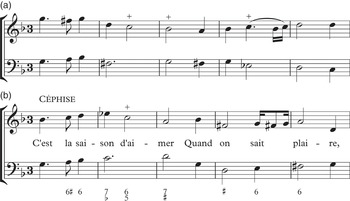


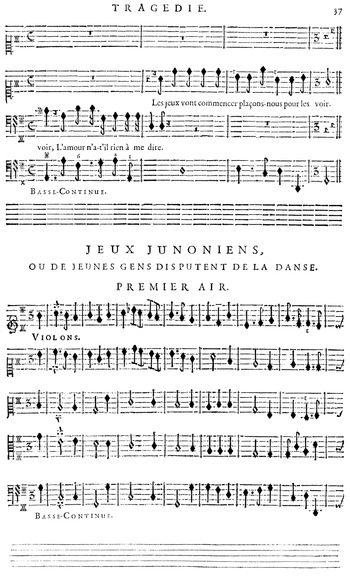
Just as the larger dramaturgy of divertissements is very carefully controlled, so too is their construction. Lully’s notational practices emphasize connectedness, as when the last measure of a recitative changes to the meter of the entrance music for the divertissement, which starts on beat 3 (Figure 2-1). This is not an operatic style that lends itself to interruption by applause; the sense of continuity is far too great. Yet even the most basic questions – such as who danced where – rarely have easy answers, and it is only after comparing every one of Lully’s divertissements to its fellows that I have come to identify his conventions. Because some of these have been misunderstood by both scholars and performers, I have felt compelled to lay out the evidence for my conclusions in some detail. This chapter explores the conventions Quinault and Lully developed that allowed for the integration of dance and song within dramatic structures that favor coherence and continuity.
Primary Sources
There is no single source to consult for establishing the mechanics of a divertissement. The two most basic are the librettos and scores associated with performances at the Opéra during Lully’s lifetime: a libretto was printed for each premiere, and, for every opera starting with Bellérophon (1679), a full score was printed by Christophe Ballard, under the supervision of Lully himself.Footnote 1 Isis was published in partbooks in the year of its premiere (1677), and for two earlier operas, Atys and Thésée, Ballard published full scores within two years of Lully’s death.Footnote 2 This means that, for ten out of Lully’s thirteen tragédies en musique, there are important contemporary sources for both the text and music. The eighteenth-century full scores for Cadmus et Hermione, Isis (both from 1719) and Psyché (1720) are less reliable than the earlier Ballard prints, as are the reduced scores published starting with Alceste in 1708 by Henri Baussen or the Ballard family.Footnote 3 But even the best of Ballard’s scores and librettos have ambiguities and errors; several problematic instances are discussed below.
To date, three operas have appeared in the new critical edition of Lully’s Œuvres complètes: Armide, Thésée, and Isis.Footnote 4 The two earliest tragédies, Cadmus et Hermione and Alceste, were published in the old edition of Lully’s works, as was the late opera Amadis. These three volumes are not without problems, but are nonetheless works of serious scholarship.Footnote 5 The piano-vocal scores published between 1876 and 1892 as part of the series Chefs d’œuvre classiques de l’opéra français cannot be considered reliable. Some extant copies of the Ballard prints were marked up for performance, although most of the annotations appear to date from the middle of the eighteenth century.Footnote 6 Numerous manuscripts of Lully’s operas survive; some are copies of the printed scores, others are commercial copies made by workshops such as the one established in Paris by Foucault; still others have unique pedigrees.Footnote 7 In addition, there are some performing parts for a few of Lully’s works preserved in Paris at the Bibliothèque de l’Opéra, almost all of them from the eighteenth century.Footnote 8 It is far beyond the scope of this book to take into account this mass of disparate and dispersed source material, even though some of it might contain useful information. I have thus relied on the original layer of Ballard’s full scores, librettos published during Lully’s lifetime, the librettos collected in the Recueil général des opéra,Footnote 9 and the available critical editions.
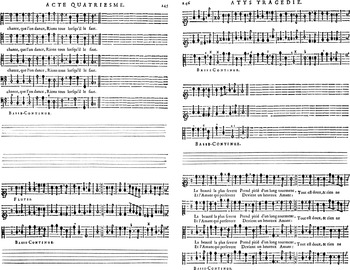
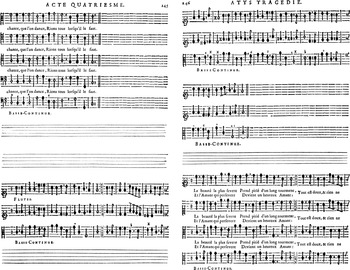
One subgroup of librettos are particularly useful: those that contain the names of the performers and thus combine the functions of libretto and program. These may reveal how the singing and dancing roles were distributed, how many performers of each there were, and whether there were any solo dancers. Such librettos generally list the performers in the prologue separately, the cast of the tragédie on pages just before the start of Act i, and the performers in the divertissements at the start of the relevant scene; see Figure 2-2, for Act iii of Atys. During Lully’s lifetime such librettos were printed only for court performances, but Lully did not mount all of his operas at court and not all such productions generated their own librettos.Footnote 10 There are no personnel records from the Académie Royale de Musique during Lully’s tenure and the extent to which the court and Palais-Royal productions had performers and staging practices in common can be only partially reconstructed. That said, the court librettos do represent performances done under Lully’s direction, and presumably represent practices he endorsed or initiated. When it comes to the dancers in particular divertissements, the numbers of performers are similar in the court librettos to those for revivals in Paris starting in 1699. This stability suggests that the differences between Paris and Saint-Germain performances during the 1670s as to how the dancers were deployed may not have been great.

In general, scores tend to have only rudimentary headings (Premier Air, Chœur de Nymphes), whereas librettos include more information about the characters appearing in a given scene. However, librettos focus on the sung texts and only rarely mention the dance pieces. It would be easy to infer from the Parisian libretto of Atys that Act v has no dancing at all, whereas the score includes three instrumental dances. But scores have their own limitations: they offer little guidance as to which characters do the dancing, and the sequence of events may sometimes be unclear.Footnote 11 Cases of ambiguity are signaled in the discussions that follow.
Because the librettos and scores do not provide sufficient information for reconstructing a divertissement, additional guidance must come from Lully’s contemporaries. The choreographies in Beauchamps-Feuillet notation that can be linked to the Paris Opéra would seem a likely place to start, but none originated during Lully’s lifetime, nor do they ever preserve more than one or two isolated dance pieces from an opera. There is, however, one fully choreographed stage work dating from 1688, the year after Lully’s death, the comic mascarade Le Mariage de la grosse Cathos; it conveys enormous amounts of information about how a work of musical theater was put together, notwithstanding its differences in genre and scale from Lully’s tragédies en musique. The mascarade, which was performed privately at Versailles in a large room, involves nine singers, eight dancers, and an on-stage, eight-member oboe band. Its composer, André Danican Phildor l’aîné, and choreographer, Jean Favier l’aîné, had both performed for years under Lully’s direction; Favier had almost certainly been a regular member of the Paris Opéra’s dance troupe since its inception. The dance notation (which uses Favier’s own system), preserves not only the ten choreographies that appear in the course of the approximately 45-minute work, but also shows some of the floor patterns traced by the singers and the on-stage instrumentalists.Footnote 12 This little work does not answer all the questions raised by a Lullian tragédie en musique, but the staging conventions it evinces prove valuable as a lens for examining Lully’s own practices. Another useful source is Marc-Antoine Charpentier’s autograph score for Circé, a machine play written by Thomas Corneille and Donneau de Visée in 1675.Footnote 13 Charpentier’s autograph includes annotations showing where the dancers do and do not dance; its practices in this regard are entirely consistent with those seen thirteen years later in Le Mariage de la grosse Cathos.
Some additional information about dance practices comes from seventeenth-century writings. However, during this period eyewitness accounts of performances are both rare and vague. And whereas dance theorists and aestheticians do offer important perspectives that are discussed in later chapters, they rarely deal with practicalities. Moreover, many writers from this period copy from each other without acknowledgement, a phenomenon that makes evaluating their remarks more difficult. The encyclopédistes delve into greater detail about useful musical and choreographic matters, but they were writing in the middle of the eighteenth century after more than one major aesthetic shift had occurred. The foundation for this chapter thus remains a close reading of the librettos and scores.
Interpreting the Didascalies
Generally speaking, the librettos supply more information about staging than do the scores. This comes in the form of didascalies; I have chosen to adopt the French word rather than the English “stage directions” because of its broader meanings. In Quinault’s librettos, the didascalies are of three types:
(1) identification of where the action takes place;
(2) the names of the characters who appear in a scene;
(Atys ii/2: “cybele, celenus, melisse, Troupe de pretresses de cybele”)
(3) an indication of what the characters are doing.
(Atys i/8: “Cybèle, carried by her flying chariot, enters her temple, all the Phrygians hasten to go there, and they repeat the last four lines that the goddess has pronounced.”)
Categories 2 and 3 are particularly useful, even if not as extensive as one would like. Convention dictated a change of scene number whenever characters entered or left the stage. Quinault’s didascalies note the presence of characters who remain silent as well as of the singers. In the second example above, three individuals and a group of priestesses are shown to be on stage, but as the scene develops only two of them – Cybèle and Célénus – sing. Melisse is given lines in the next scene, but the priestesses never open their mouths; in fact, they remain mute for the entire opera, even though they have quite a bit of stage time. Given that dancers are also silent characters, a system of enumeration that includes everyone who makes a physical appearance is extremely helpful.Footnote 14
On the surface the third category looks intended to tell the actors what to do. In practice, however, Quinault’s didascalies function quite differently. In this example the first two of the three clauses could be read as instructions for the performers, but the third is superfluous: the four lines of Cybèle’s text that the chorus repeats are written out twice in the libretto, once for her and again for them (see Figure 2-3). Perhaps the second two-thirds of the didascalie were intended to insist on the Phrygians’ urgency, to give a sense of the emotional climate, rather than to offer instructions for movement. In fact, category 3 didascalies often seem aimed at the armchair reader, as a means of enabling someone who is not in the theater to form a mental picture of the stage or to get a sense of a scene’s overall affect. At the conclusion of Proserpine, “The heavens open and Jupiter appears, accompanied by celestial divinities. Pluton and Proserpine come out of the Underworld, seated on a throne, and Cérès takes a place near her daughter.” This is not a set of staging instructions for a singer or for a director (a position that did not yet exist). Moreover, Lully’s operas were proprietary; there was no reason to write didascalies with future performers in mind.Footnote 15 It is worth remembering that librettos were often read for pleasure at home.

Another didascalie that seems aimed at the armchair reader comes from Roland iii/5: “Angélique leaves to find Roland, in order to keep him away from the port from where she plans to embark with Médor.” If this were a true stage direction, it could end after the first two words, but instead Quinault reveals Angélique’s intentions, which have no impact at all on the stage, since Angélique’s planned encounter with Roland does not figure inside the opera. Even when didascalies do appear to describe a set of events, the temporal frame may be difficult to pin down. In the following instance are the actions simultaneous or consecutive? “The nymphs and woodland gods hide, Alphée and Aréthuse descend to the Underworld, Cérès’s flying chariot stops, and the goddess gets out” (Proserpine iii/3). Didascalies often seem to offer a snapshot of an entire scene, one in which time is collapsed and dancing is implied only in the vaguest terms, such as the following from Atys ii/4: “The Zephyrs appear in an elevated, brilliant glory. The different peoples who have come to the fête for Cybèle go into the temple and try together to honor Atys, and they acknowledge him as the high priest for Cybèle.” This kind of didascalie seems akin to the engravings from the period that collapse several events into a single, impossible moment.Footnote 16
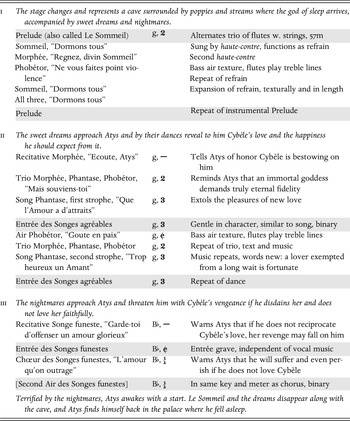
Sometimes Quinault’s didascalies do appear to describe the action, as in the dream sequence in Atys iii/4: “The nightmares approach Atys and threaten him with Cybèle’s vengeance if he scorns her love and does not love her faithfully.” This, however, paraphrases the sung texts rather than offering instructions for on-stage movement. Moreover, it applies to all the Songes funestes, without discriminating between dancers and singers. Such a didascalie makes a significant aesthetic statement about how group characters are conceived, but it does not help much with questions of staging.
Every now and then a didascalie offers a bit of information about the dancing, as in Thésée i/10: “A combat in the manner of the Ancients is formed,” or Roland i/6: “The chorus of Insulaires sings […] and the other Insulaires dance in the manner of their country.” These two have the virtue of giving a hint, however vague, about the movement style. More often, however, the didascalies allude to the emotion the scene is supposed to convey, without mentioning through what kinds of movements the emotion is to be expressed: “The fairies and the shades of the heroes show, through their dances, the joy they feel at Roland’s return to health” (Roland v/3); or “The followers of Hatred show that she is making ready with pleasure to triumph over Love” (Armide iii/4). A few appear to offer help as to where in a scene the dancing occurs (“The Arts, disguised as gallant shepherds […] are the first to start dancing” (Psyché v/4)), but matching such remarks with the score often proves a challenge.Footnote 17 Yet even with their limitations, didascalies offer a crucial tool for envisaging the dances within an opera.
The Mechanics of Lully’s Divertissements
The Characters
The “verisimilitude of the merveilleux” identified by Kintzler allowed for human and divine characters to mingle freely throughout the opera, and the structure of the divertissement promoted a free exchange between individuals – including the main characters – and groups. But as a practical matter, the functions of singing and dancing were supplied by different people, whether they represented gods or humans, individuals or collective characters. A division of labor is explicit throughout the librettos, where in divertissement after divertissement the lists of roles distinguish between those who sing and those who dance. Occasionally a semantic distinction is even made between a chœur (singers) and a troupe (dancers), even when the characters are members of the same group: “Chœur de Phrygiens chantants, Chœur de Phrygiennes chantantes, Troupe de Phyrigens dansants, Troupe de Phrygiennes dansantes” (Atys i/7). The librettos that provide the performers’ names are even more explicit: the 1677 libretto of Alceste identifies sixteen of the attacking soldiers in Act ii as singers and four of them as dancers, while among the defending combatants there are only six singers, but still four dancers.
Even if functionally distinct, such characters were conceptually unified, subsumed into a single group. A typical didascalie identifies the performers in Alceste v/6 as “a troupe of shepherds and shepherdesses, some of whom sing, the others of whom dance.” Furthermore, the collective characters are all engaged in the same enterprise: “The people of the kingdom of Damascus show, through their dances and their songs, their joy about the advantage that the princess’s beauty has won over Godefroy’s knights” (Armide i/3); or “the shepherds and silvans, dancing and singing, come to offer presents of fruit and flowers to the nymph Syrinx, and they attempt to persuade her not to go hunting, and to submit herself to Cupid’s laws” (Isis, iii/6). In this division of labor, one group supplies the text, the other the movement; the dancers serve, in a sense, as surrogates for the singers. Another way of conceptualizing this type of casting is to see every role as being assigned two sets of bodies, although the number of singers and dancers need not be equal for the principle to apply. The modes of discourse may be different, but the expressive goals are the same.
This amalgamation of singers and dancers into a single entity is also implicit in the writings of aestheticians, who locate its roots in the chorus of ancient Greek tragedy, which they understood to have been danced as well as sung:
It is permissible to mix ballets into musical representations, because the two are made for each other and this blend is both pleasing and natural – not at all freakish. Tragedies may also have ballet interludes, because such ballets are to the tragedy what the choruses of the Ancients were, where one sang and danced.Footnote 18
Barring a few infidelities made to verisimilitude, opera is almost a tragedy such as the Greeks had. For if we have introduced into our operas some things that they would have repudiated and that they certainly would not have wanted, in recompense we have retained their choruses, which our [spoken] French tragedies have rejected. By that means, I argue, opera makes up for some of its defects and has acquired a great advantage over tragedy.Footnote 19
One important distinction emerges not along functional lines, but on the basis of gender. Quinault and the librettists who followed him were scrupulous in distinguishing between male and female roles: in most cases a scene will have both Bergers and Bergères, Phrygiens and Phrygiennes. The one exception is with troupes of “peuples,” where it is understood that the populace includes both men and women. Quinault’s syntactical distinction was not pedantic; Lully often composed passages or even entire numbers for the male or female subgroups, be they singers or dancers. Some divertissements may involve characters of a single gender only, as when Proserpine sings with her nymphs in Act ii of the eponymous opera; demons, in Lully’s operatic world, are always male. The French language easily allows for this distinction, but sometimes a libretto may attribute different names to groups who nonetheless function together. There is, for instance, no such being as a male Amazon, so in Bellérophon i/5 the corresponding male roles are for Solymes, a warlike people from Lycia in Asia Minor whom the mythological Bellerophon is reputed to have conquered. (The distinction is one of role, not of the gender of the performer; the singing Amazons in Bellérophon were performed by six men and six women, and all of the dancers, both Amazons and Solymes, were men.Footnote 20) Shepherds might be paired with either shepherdesses or nymphs; in both cases all are treated as members of a single group. There are, however, some cases where there are genuinely distinct groups on stage at the same time, often set up in opposition to each other. Two groups react in song and dance to the tragic death of Atys; a group of female Corybantes (followers of the goddess Cybèle) expresses rage, while a mixed chorus of wood and water divinities expresses sorrow (Atys v/7). Such divisions of the chorus and dancers into distinguishable groups, often the followers of separate gods, are likelier to occur at one end or the other of the opera – either in concluding celebratory divertissements or in prologues.
Very occasionally a chorus and a group of dancers may have different roles. In Act i of Persée, Queen Cassiope attempts to appease the wrath of the goddess Junon by offering games in her honor. The chorus is identified as spectators, whereas the dancers are “young persons chosen for the games.” In Act ii of Atys, the dancing Zephyrs have no choral counterpart, although there are also Zephyrs on stage playing instruments. More often, particularly in celebratory divertissements, the dancers may be a special subset of the population represented by the choral singers. In the last act of Phaéton the chorus is made up of diverse people – Egyptians, Indians, and Ethiopians – whereas the dancers are Egyptian shepherds and shepherdesses.
Rarer still than divertissements where the chorus and dancers have different roles are those that have dancers, but no chorus at all. In Phaéton i/7, “Triton comes out of the sea accompanied by a troupe of followers, of whom one group plays instruments and the other group dances.” Here the chorus has been replaced by on-stage instrumentalists; the only singers in this scene, during which Proteus transforms himself into several different shapes, are the two soloists: Proteus himself and Triton. In Cadmus et Hermione ii/6, Amour, the only singer in the divertissement, animates a group of golden statues, who jump off their pedestals and dance. Yet even here dancing is in close contact with singing. The vocal forces may sometimes be reduced, but in no Lully opera does dancing ever occur without some kind of vocal framework.
The instrumentalists on stage in Act ii of Atys are not unique: eleven court librettos for seven different operas provide the names of the instrumentalists who appeared on stage, and the example of Phaéton shows that such practices were not confined to court performances.Footnote 21 In other operas their presence is implicit; the didascalie in Amadis i/4 does not mention the trumpets that the score calls for, but as the scene staged a combat, military instruments would be natural. By bringing instrumentalists on stage Quinault and Lully could signal to the audience that a shift had occurred from the world of “speech” to a realm in which music is the medium of discourse; the opening of the dream sequence in Atys iii/4 is marked by the arrival of dreams playing viols, flutes, and theorbos (see Figure 2-2). On-stage musicians, like the singers and dancers, were assigned roles and costumed appropriately; there is a costume design by Berain for a priestess playing the “flute” in Thésée.Footnote 22 If the functioning of the on-stage oboe band in Le Mariage de la grosse Cathos bears a relationship to Lully’s practices (and its composer, Philidor, was an on-stage oboist in many of Lully’s operas), then Lully’s musicians may well have participated in the overall choreography, and not just remained fixed in place.Footnote 23
Other moving bodies beside dancers and musicians – supernumeraries or acrobats – were sometimes called upon to provide special effects. In Alceste, at the end of Act i, personifications of the winds are conjured up by Thétis and Aeolus: first the Aquilons cause a storm, then the Zéphyrs calm it;Footnote 24 the cast list for Act iii calls for “followers of Pluton, singing, dancing, and flying.” At the end of Act iv in Atys, flying Zephyrs whisk Sangaride and Atys away from her father’s horrified courtiers.Footnote 25 Also in Atys v/3, Alecton, a silent character, “comes out of the Underworld, holding a torch in her hand, which she shakes over Atys’s head,” driving him temporarily mad. Such characters are rarely identified by name in the librettos. One exception was the famous acrobat Allard, who played the role of a flying phantom in Thésée at Saint-Germain-en-Laye in 1675 and 1677. Spectacular special effects such as these appear to have been carried out by non-dancing personnel with the help of stage machinery.Footnote 26
One carryover from the conceptualizing of singers and dancers as all members of the chorus is the terminology, still in use at the Paris Opéra today, of “coryphée.” In the ancient Greek theater, the coryphæus meant the individual in a chorus delegated to speak individually, and at the Opéra, since 1779 if not earlier, coryphée has designated a rank for dancers who sometimes step out of the corps de ballet to do a solo or perform in a small ensemble. Similarly, in a Lullian divertissement an individual may step out of the chorus or the dance troupe, but still share the collective identity. In the scene of mourning in Alceste one of the singing Femmes affligées leads the group in its rituals, but leadership may also be entrusted to a dancer: in the first act of Proserpine, one of the dancing Sicilians has a solo role as the Conducteur de la fête. This particular role is mentioned in the main body of the libretto, but more often solo roles for dancers are only discernible from the lists of performers included in court librettos. The 1676 court libretto for Atys, for example, identifies Beauchamps as a soloist among the eight other dancing Songes funestes (see Figure 2-2). Whether in such an instance the soloist functioned as a leader of the group is unclear, but should be considered a possibility.
Solo turns inside divertissements are not confined to anonymous characters; singers of secondary roles may participate. This is the case with Céphise and Straton, confidants of Alceste and Licomède, who each sing a dance-song in Act v of Alceste; in Act i of Armide it is Hidraot, Armide’s uncle, who leads the celebrations in her honor. However, some of the characters who have names are episodic, appearing only in one act, even though their role may be crucial. Pluton and Proserpine in Act iv of Alceste are two such, as are Le Sommeil, Morphée, Phobétor, and Phantase – the fantastic beings who populate Atys’s dreams. In this scene the dancing analogues of these four singers are the Songes agréables.
The roles protagonists play in divertissements may be either active or passive. (Excluded from consideration are the fêtes where a protagonist does nothing but watch.) The dream sequence in Atys iii/4 is of the passive variety: Atys falls asleep on stage and the audience sees and hears what passes through his mind. In Persée ii/8–10 the hero is armed in a solemn ceremony by a series of divinities, so that he will be prepared to battle Medusa. On the active side of the ledger are divertissements ranging from fêtes to battles. Atys and Sangaride lead the ceremonies that honor the arrival of the goddess Cybèle (Atys i/7). It is within a sumptuous celebration that Médor and Angélique give full expression to their love (Roland ii/5). Proserpine frolics with her nymphs; the hidden Pluton is so taken with her charms that he interrupts the festivities to kidnap her (Proserpine ii/8–9). In the following act (iii/8) her mother, Cérès, and her equally enraged followers set fire to the earth.
The converse of placing protagonists within divertissements is giving voice to group characters in other parts of an act. Alceste opens with a sequence of brief choral interjections that wish happiness to the newlyweds. The chorus is listed in the didascalie, so is presumably on stage, but in other instances the chorus is either invisible (Amadis v/4) or sings from off stage (Bellérophon iv/2–3) and no dancers function in conjunction with their voices. Such spots are dramatically effective, but they do not figure in this study.
Staging the Dancers and the Chorus
A system that assigns function based on a specific skill set solves a practical problem of finding high-quality performers in both domains. Lully’s dancers were highly trained professionals. If they had an additional skill, it was usually playing the violin; many, among them such luminaries as Pierre Beauchamps and Jean Favier, came from families of violinists. Only occasionally was a performer good enough at singing and dancing to be hired to do both. Marie-Louise Desmâtins made her debut in Persée (1682) as both a singer and dancer, and her name appears in librettos in both capacities until 1703; thereafter, until her death in 1708, she sang only.Footnote 27
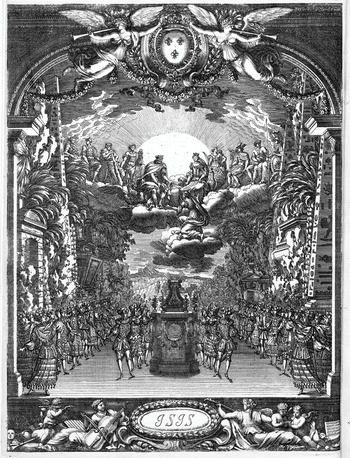
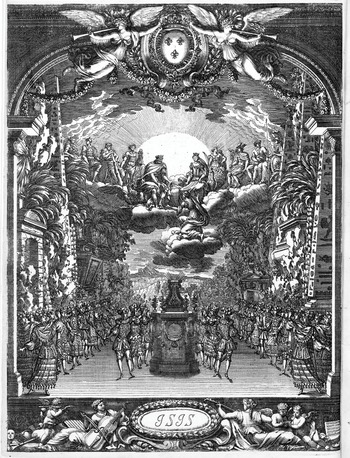
This division of labor impacts not only Lully’s musical constructions, but also the staging. If dancers are to provide actions on behalf of the chorus, they need space. Evidence from the eighteenth century suggests an arrangement of the stage with the chorus in two rows on its perimeter; as early as 1700 librettos listed the choristers according to which of two rows they stood in, and later in the century the choristers were identified as standing either on the queen’s side (stage right) or the king’s (stage left).Footnote 28 This arrangement was mocked by Fuzelier in a parody of Lully’s Persée done at the Théâtre Italien in 1722: “[the nymphs] take their places with the cyclopes along the two sides of the stage, like the chorus at the Opéra.”Footnote 29 In three Lully revivals between 1699 and 1705, chosen by way of example, the chorus constituted a substantial group: 35, 28, and 31 singers respectively.Footnote 30 According to mid-century writers such as Cahusac who complained about it, the chorus, once it had entered and taken up its positions, did not move, no matter what the text.Footnote 31 The chorus may not have been quite so immobile in Lully’s day as it was 75 years later: some of Quinault’s didascalies suggest movement, most notably one in Cadmus et Hermione iii/6, in which singing sacrificateurs prostrate themselves while other sacrificateurs dance; after the dance those who had been prostrated stand up and sing. But even in this scene the choristers might not have to do more than bow down and stand up in place; they still would need to be out of the way of the dancers, who perform between their moments of song. Figure 2-4 shows one such division of the stage: the concluding divertissement in Isis, with the chorus of Egyptians in two rows on the sides, the dancers surrounding the altar, and Jupiter and Junon, joined by other gods, welcoming Isis to the heavens.
The one contemporary document to show placement for the singers – the choreographic notation for Le Mariage de la grosse Cathos – does not have as rigid a use of space as the eighteenth-century evidence suggests, but it does show a concern with keeping the performers on the periphery until they become the focus of attention. Each of the different groups – singers, dancers, and instrumentalists – has a home position around the perimeter of the stage, from which individuals venture into the center when needed, only to retreat after their moment in the limelight.Footnote 32 In this modest work it is the oboists who occupy the sides of the stage, but in their use of space they seem somewhat analogous to the chorus in an opera.
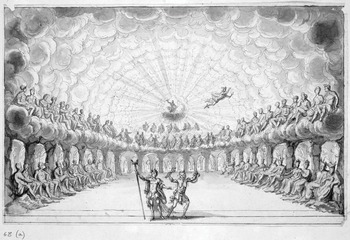
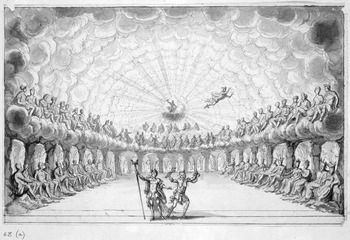
A relatively static approach to staging the chorus seems consistent with what can be gleaned from Lully’s librettos. In some scenes the chorus was even seated, as in the last act of Alceste: “the stage changes and represents a triumphal arch between two amphitheaters, where are seen a multitude of different peoples from Greece, assembled to welcome Alcide who has returned triumphant from the Underworld.” This strategic positioning leaves the center of the stage open. The libretto for Bellérophon, which has a similarly grandiose finale, describes the space as “the courtyard of a palace which appears elevated in the Glory. It is approached by two large steps […] which are enclosed by two large architectural structures of extraordinary height. The two steps and the surrounding galleries are filled with the people of Lycia.” The chorus of twelve Hours that sang in the Sun’s palace in Act iv of Phaéton was seated behind a cloud-enclosed balustrade in the 1721 revival, if not before.Footnote 33 The stage might have looked something like the one seen in Figure 2-5; in grandiose scenes such as these, the visual impression might have been increased by figures painted on the scenery, as Tessin reported in 1687.Footnote 34
It has been claimed that in French baroque opera the chorus generally remained on stage during the course of an entire act, but this assertion cannot be supported.Footnote 35 Lully’s librettists were scrupulous about listing the characters in every scene, to the point of mentioning characters who are present but do not sing. In the librettos the chorus and the dancers are generally shown to arrive together at the start of a divertissement, and Lully often composed music for their entrance. Moreover, their arrival is often preceded by some kind of invitation or anticipation. Roland hears shepherds arriving before he sees them (“J’entends un bruit de musique champêtre” (Roland iv/2)) and Atys, at the opening of the opera, repeatedly invites the Phyrigians to come honor Cybèle, before they finally arrive in Scene 7; he even offers a progress report in Scene 5. Prompt notes for mid-eighteenth-century performances of French operas call for entrances and exits of the chorus in expected places.Footnote 36 A case could be made that when the chorus appears without the dancers early in the act and then sings again a few scenes later, as in the last act of Alceste, it might have remained visible the entire time.Footnote 37 But acts constructed in this manner are considerably less frequent than ones where the libretto identifies the divertissement, which is usually well into the act, as the place where the chorus appears for the first time. It makes much more sense to conclude that the chorus, involving both dancers and singers, enters and leaves where the libretto says it does.
Once the two groups were on stage, how did they interact? At first glance the answer might seem straightforward: vocal pieces would be sung and instrumental pieces danced. But this begs the question of what vocal pieces that use dance rhythms might imply about movement on stage. Straton’s air in the last act of Alceste (“A quoi bon”) shares key, meter, gavotte rhythms, and overall affect with the dance that precedes it; the musical connections are so strong that the audience perceives this pair of pieces as a single unit. Would both have been danced? The available evidence suggests that the conventions were different for choruses than they were for solo songs or small ensembles. Whereas choruses could sometimes, within specific parameters, be danced, songs by soloists, no matter how danceable in affect, were not – at least not in Lully’s day. The next sections explore the separate conventions in turn.
Dance Inside of Choruses
Lully’s choruses come in many musical guises. But when it comes to how the singers and dancers behave relative to each other, the choruses reduce to four types: ones that have intermittent dancing; ones danced throughout; ones that involve some kind of movement other than dancing; and ones that have no dancing at all. It is not always a simple matter to identify the category to which a chorus may belong. However, models from Lully’s contemporaries provide enough data to offer a point of entry into the practices of the day.
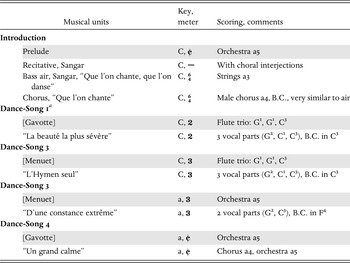
Many of Lully’s choruses are celebratory and these often call attention to their own musicality: “Chantons tous, en ce jour, la gloire de l’amour,” sings the chorus at the conclusion of Amadis. The texts not infrequently also invite dancing: “Que l’on chante, que l’on danse,” sing Sangar and the chorus in Atys iv/5. Just this kind of text is found in Thomas Corneille’s machine play Circé, which was first performed by Molière’s troupe in 1675:
Chœur des Divinités des Forets:
Les plaisirs sont de tous les âges / Les plaisirs sont de toutes les saisons. / Pour les rendre permis on sait que les plus sages / Ont souvent trouvé des raisons. / Rions, chantons, / Folâtrons, sautons. / Les plaisirs sont de tous les âges / Les plaisirs sont de toutes les saisons.
(Chorus of woodland gods: The pleasures are always in season. Wise men have often found reasons for justifying them. Let’s laugh and sing and have fun and jump around. The pleasures are always in season.)
Charpentier’s music survives in his own hand; his annotations show not only that dancers were involved, but where.Footnote 38 This particular piece has three different textures: vocal trio, chorus, and four-part instrumental ensemble. The dancers’ participation is a function of the texture, as Table 2-1 shows. (Here and in subsequent tables, the instrumental sections are shaded.)
| Bars | No. of bars | Texture | Charpentier’s annotations |
|---|---|---|---|
| 1–7 | 7 | Two vocal trios alternate | |
| 8–20 | 13 | Chorus | |
| 21–28 | 8 | Instrumental | |
| 29–40 | 12 | Chorus and vocal trio alternate | |
| 41–48 | 8 | Instrumental | “danseurs” |
| 49–59 | 11 | Vocal trio | |
| 60–62 | 3 | Instrumental | “danseurs” |
| 63–77 | 15 | Chorus and vocal trio alternate | |
| 78–79 | 2 | Instrumental | “danseurs” |
| 80–81 | 2 | Chorus | “sans danseurs” (without dancers) |
| 82–89 | 8 | Instrumental | “danseurs” |
| 90–101 | 12 | Chorus | “ici les danseurs figurent sur la fin de ce chœur” (the dancers move at the end of this chorus) |
The dancers apparently remain still during the first instrumental phrase (unless Charpentier neglected to write an instruction), but thereafter they appear in every instrumental interlude, no matter how short. They do not, however, move when the chorus is singing, until the last twelve bars of the piece. The rapidity with which the dancers alternate between movement and stasis in response to the musical texture can be startling. Whereas most of the dance phrases are eight bars long, one lasts only three, and starting at m. 78 the dancers spring into action for a mere two bars before stopping out for another two.
The same pattern of alternation can be observed in Le Mariage de la grosse Cathos. In one of its choruses, whose four-line text celebrates the pleasures of life, Favier’s notation shows not only that this chorus was danced, but with what steps and to which phrases of the music. This simple piece consists of seven phrases, of which the four sung ones frame the three purely instrumental ones. The dancing occurs only during the instrumental sections, until the last choral refrain (see Table 2-2).Footnote 39
| Bars | No. of bars | Texture | Choreography |
|---|---|---|---|
| 1–8 | 8 | Chorus | No dancing |
| 9–16 | 8 | Instrumental | Danced by the four women |
| 17–24 | 8 | Chorus | No dancing |
| 25–32 | 8 | Instrumental | Danced a8 |
| 33–40 | 8 | Chorus | No dancing |
| 41–48 | 8 | Instrumental | Danced by a solo man |
| 49–56 | 8 | Chorus | Danced a8 |
Neither Philidor nor Charpentier wanted dancers to move while singing was going on – except during the concluding phrase. The general rule appears to be that only one thing should happen at a time, so that the two systems of discourse – textual and choreographic – do not compete for the audience’s attention. The music is the glue that holds the two systems together, and once the text has become familiar after multiple repetitions and the piece builds toward a conclusion, both singing and dancing are allowed to happen simultaneously. Thus the chorus ends with satisfaction for the eyes as well as the ears.
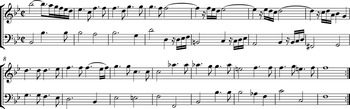
This pattern – identical in these two choruses, which between them frame Lully’s operatic career – has far-reaching implications. Many of Lully’s choruses are constructed along similar lines, with changes of texture from the vocal to the instrumental, sometimes even with further textural changes within the two basic divisions. Example 2-1 shows the end of a chorus from Armide iv/2, whose text invites participation by the dancers and whose musical construction allows for it. More importantly, the principle of alternation – of a single focus for the audience’s attention – turns out to have wide application, as the section below on dance-songs shows.

A second type of chorus is danced throughout – or almost so. The model, from Le Mariage de la grosse Cathos, again circumscribes where the dancing appears. This chorus repeats an astonishing announcement that has already been sung as a solo and a duet: “Allons, accourons tous / La grosse Cathos se marie.” (Come on, let’s all hasten, Fat Kate is getting married!”) Philidor’s chorus is sung throughout, with the brief text repeated three times. On the words “Allons, accourons tous” the dancers rush forward from either side of the stage, then freeze for two bars while they listen to the news. This pattern happens twice; on the third and last iteration of the text, the dancers move throughout the phrase and end by taking up positions that free the center of the stage for the approaching solo singers.Footnote 40 Would the dancers have moved throughout the entire chorus if its text had been different? With a sample of one only, we cannot know. But the impulse to end this chorus with movement as well as song seems to be one shared with the earlier choreographed chorus, as it serves to round out the number visually as well as aurally. This model suggests that choruses in Lully operas with action words might also be susceptible to choreographic treatment, whether or not they contain purely instrumental passages.
The third type of chorus involves a violent and frightening event, such as the earthquake that destroys part of Cérès’s palace at the end of Act i of Proserpine, while the members of the chorus comment on what they are watching. The chorus may either be sung throughout or else may have instrumental interludes that provide a convenient place for the action to take place. In Alceste ii/3–4, a battle wages between the soldiers attacking the city of Scyros and those defending it. A march brings the attackers on stage and the battle takes place during this double chorus; there is no other music available. Its action may be traced in the texts: after the dancing attackers bring in battering rams, their comrades sing “Let each of us eagerly fight; let us break down the towers and ramparts.” The response of the defenders suggests that their group of dancers shot arrows down upon the attackers: “May the enemy shudder under the hail of our arrows and spears.” The chorus is punctuated by instrumental phrases that feature trumpets and drums, and the meter changes as the battle progresses. Whether the dancers gestured while dancing or simply mimed is impossible to know, but in all performances for which librettos with the performers’ names exist, dancers, not supernumeraries, supplied the movement.Footnote 41
The battle in Persée iv/5–7, on the other hand, relies upon special effects, as the hero, using Mercure’s winged sandals to fly through the air, defeats the sea monster and rescues Andromède. The commentary sung by the two rival groups of spectators – Andromède’s fearful countrymen on the one hand, the water deities rooting for the monster on the other – is continuous, so the action has to take place while the chorus is singing. In Bellérophon iv/7, the hero battles with the Chimera that is ravaging Ethiopia. In what must have been a spectacular piece of stagecraft, Bellérophon, mounted on Pegasus, swoops down three times from the heavens, succeeds in killing the Chimera on the third pass, flies around the stage three more times, then rises through the clouds. An off-stage chorus describes the action as it happens, urges the hero on, and applauds his ultimate victory; their words are punctuated by vigorous instrumental passages. Such choruses provide plenty of visual stimulation, but require no dancers.
The fourth – and perhaps most common – treatment for choruses is no dancing at all. Here again Le Mariage de la grosse Cathos provides a useful model: of its five choruses only two are choreographed; the three that lack dancing also lack instrumental interludes. Moreover, none of them has the kind of text that invites physical movement. In many instances, it would appear, choruses are to be heard, not watched. Any dancers on stage (which in most instances there would be) simply stand in place. The proportion observable in Philidor’s masacarade – slightly more than half of the choruses are not danced – seems in line with Lully’s practices. In view of later practices, when composers made a point of identifying a chorus that was intended to be danced by labeling it a “chœur dansé,”Footnote 42 it would appear that the default was for choruses not to be danced, unless the structural or textual criteria were met. Nonetheless, every chorus should be considered as a possible candidate for choreographic treatment, the evaluation being made on the basis of its structure, text, location within the divertissement, dramatic context, and musical surroundings.
The Choreographic Treatment of Dance-Songs
One of Lully’s most reproducible conventions inside divertissements, especially those framed as fêtes, is the dance-song – a vocal piece with the structure of a dance (binary or rondeau), clear phrasing, and set to texts with short poetic lines that are more metrically regular than those in recitative, even if not every line has the same number of syllables (see the example from Phaéton on p. 71). Dance-songs may be set as solos, duets, trios, or choruses.Footnote 43 Solo singers are generally anonymous members of the choral collective (e.g., a shepherd), but sometimes are named secondary characters. The text may be strophic – in which case there are never more than two strophes – or it may have a single strophe only. Dance-songs are the property of divertissements; they are not found in other parts of the opera. This is another point of difference between Lully’s practices and Venetian opera, where strophic structures were one of the main ways for defining arias.Footnote 44 For the French, strophic structures called attention to themselves as music and had to be used diegetically. These pieces are certainly danceable – but were they in fact danced?
A dance-song never stands alone. Lully always pairs it with an instrumental dance piece that precedes or follows it (sometimes both) and that may carry a genre designation such as menuet or gavotte, but more often does not. In many instances the dance piece and the song are identical, except for the change in performing medium (see Figure 2-6). Alternatively, the song and the dance may be similar rather than identical, being related by key, meter, rhythmic patterns, phrase structures, and overall affect, as is the case with the two back-to-back dance-songs in the last act of Alceste. In each pair the text has only a single verse, and the dance comes first (see Example 2-2). There may even be no double bar between the two pieces, such that the notation alone encourages a continuous performance.
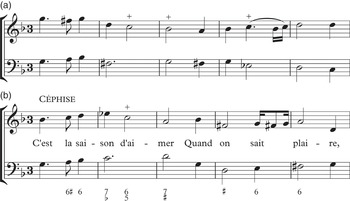
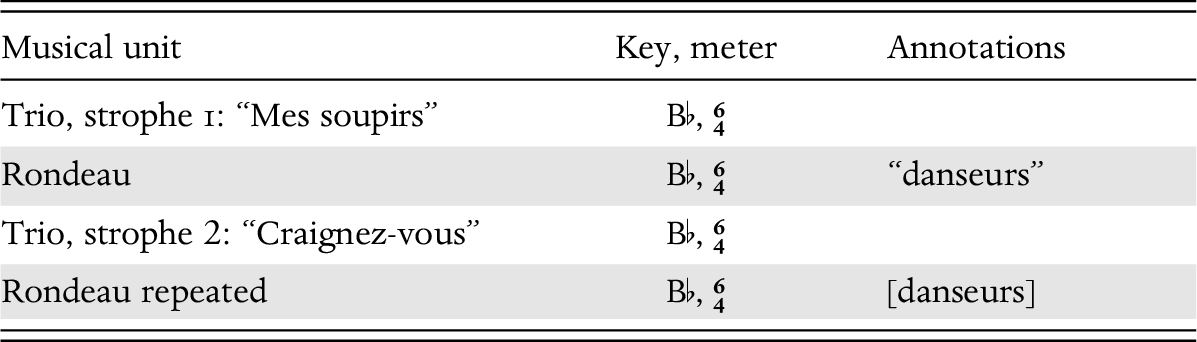
On musical grounds, there is no reason why dancing begun in the instrumental section could not continue on into the vocal one. Furthermore, some of the didascalies that Quinault wrote into his librettos might seem to suggest simultaneity of song and dance, including the ones for this very spot in Alceste: “Straton sings in the middle of the dancing herdsmen” and “Céphise sings in the middle of the shepherds and shepherdesses who dance” (“Straton chante au milieu des Pâtres dansants”; “Céphise chante au milieu des Bergers et des Bergères qui dansent”). Nonetheless, there are compelling reasons for concluding that the meaning of such didascalies is not transparent.Footnote 45 Rather, the general rule appears to be, yet again, that the dancing and singing occur in alternation. Moreover, Lully turns out to have had a blueprint for strophic dance-songs (see Table 2-5). The next several paragraphs lay out the evidence for these conclusions. The discussion of necessity becomes intertwined with notational conventions that Ballard used, as some of the ambiguity derives from space-saving shortcuts.
| Musical unit | Key, meter | Annotations |
|---|---|---|
| Trio, strophe 1: “Mes soupirs” | B♭,  | |
| Rondeau | B♭, | “danseurs” |
| Trio, strophe 2: “Craignez-vous” | B♭, | |
| Rondeau repeated | B♭, | [danseurs] |
The aesthetic rationale implicit in the construction of choruses – one that shifts the focus back and forth between singing and dancing – would seem to apply even more strongly to solo songs, where the words are repeated much less than in choruses and therefore require more attention from the audience. In fact, not one of the solo songs or duets in Le Mariage de la grosse Cathos is choreographed, no matter how danceable the music. Charpentier’s Circé corroborates this pattern, in a strophic complex very similar in construction to many units found in Lully operas.Footnote 46
Charpentier made a point of the continuity from vocal trio to dance by omitting a double bar between them and by writing, “Go on without interruption to the following rondeau.” As he had in the chorus already cited (see p. 41), Charpentier annotated his score to show that he wanted the dancers to figure only during instrumental passages. Further annotations reveal that the dancers – or rather, acrobats (sauteurs) – run to get themselves into fixed positions, then move to another pose. The second strophe of the trio is said to follow the rondeau without interruption, after which “the rondeau is played again while the acrobats form three other figures, after which the play concludes with a chorus mixed with dances and dangerous leaps.”
The practice of alternation can be documented within Lully’s own operas, thanks primarily to explicit didascalies in the two librettos written by Thomas Corneille and Bernard le Bovier de Fontenelle – Psyché and Bellérophon. Whereas Quinault was economical in his use of didascalies, Corneille and Fontenelle’s more generous approach helps clarify the order of events. In the prologue of Bellérophon three groups of characters are on stage: Apollon and the Muses; Pan with shepherds and shepherdesses; and Bacchus with Aegipans and Mænades. After a large chorus involving the followers of all three gods, the score presents three short binary pieces in a row, starting with a vocal minuet (Figure 2-7). This single page presents the entire piece: a didascalie above the music indicates that the instrumental and vocal music alternate, whereas a longer didascalie in the libretto insists that the shepherd sings after the first dance and that dance and song are interleaved. (“Les Bergers et les Bergères commencent ici une entrée, après laquelle un Berger chante les deux couplets suivants, qui sont entremêlés de danses.”) Table 2-4 outlines the order of events when the libretto and score are read together.Footnote 47

| Musical Unit | Texture | Comments |
|---|---|---|
| Menuet | strings a5 | danced by shepherds and shepherdesses |
| Sung menuet, strophe 1, “Pourquoi” | solo voice, B.C. | no dancing |
| Menuet, repeated | strings a5 | danced |
| Sung menuet, strophe 2, “Que sert” | solo voice, B.C. | no dancing |
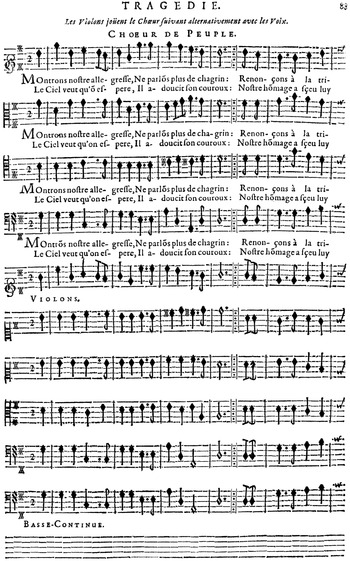
The identical structure appears in Bellérophon iii/5.Footnote 48 This complex divertissement, rich with didascalies, depicts a ceremonial sacrifice at the oracle of Apollon. It includes no fewer than three choral dance-songs, all exhibiting the same structure. In the second one the people dance around the fire and sing “Montrons notre allegresse.” Like many dance-songs it is binary and has short, clear phrases (Figure 2-8). Its strophic structure is discernible not only in the parallel construction of the two strophes, but is mentioned explicitly in the libretto, which makes a point of insisting that the didascalies belong in specific places relative to the sung texts. Two key words, “ici” and “ensuite,” anchor the sequence: “here the people dance around the fire, and then sing the first verse.” The libretto then writes out the first verse in full, followed by the instruction, “the people continue their dance, and [then] sing the second verse.” (“Then” is implicit in the “alternativement” written into the score.) Notwithstanding the alternation in performance, these didascalies further demonstrate the conceptual unity of the singing and dancing characters, who are treated as a single group (“le peuple”), even though their modes of communicating with the audience are not the same. The instructions are also valuable because Ballard did not print the dance separately from the chorus; the two are conflated into the choral version. It is obvious that the way to derive the instrumental version is simply to omit the voices; the orchestra part stands perfectly well on its own.
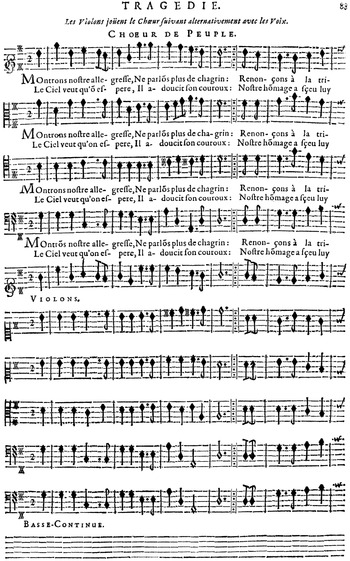
After a brief intervention by the Sacrificateur, there is another strophic chorus from which the alternating instrumental version must be derived. This one has a very different affect; the text begs Apollon for deliverance from the sorrows caused by the ravages of the monster. The music is in G minor, in (a presumably slow) triple meter, with an orchestral accompaniment that intersperses strings and trio passages for flutes. Yet notwithstanding the musical differences, the overall structure is the same. Thanks to the didascalies, we can be sure that its four-part structure consisted of dance – chorus strophe 1 – dance repeated – chorus strophe 2. The march that opens the divertissement also turns out to function in an identical way. It is a binary piece in gavotte rhythm and is followed by a chorus with the same rhythmic profile and the same structure. There is no verbal instruction in the score to repeat the march, but the libretto is clear : “here a second entrée is done, after which the people sing the second verse.” Not only is the march the only available instrumental piece, its close musical relationship to the chorus makes it the only piece that could possibly fulfill the function.
The principle of alternation seems to apply to the rest of this divertissement as well: every time action is required, such as when the bull is sacrificed or the Pythie emerges from her cave, instrumental music is supplied. The same principle applies to i/5 of this opera: “The Amazons and Solymes begin their dances here and then sing the following words, of which each verse is sung after a dance.” (Emphasis added.) This particular divertissement offers a slightly expanded variant on the pattern: a dance that is independent of the vocal music (“Premier Air”) opens the sequence, but thereafter comes a four-part choral dance-song, initiated by the dance piece (the “Second Air”).
The sources for Bellérophon thus reveal two important principles: (1) the norm is for singing and dancing to alternate; and (2) dance-songs with a strophic construction adhere more often than not to the blueprint shown in Table 2-5. This structure applies whether the song is choral, solo, or for a small ensemble. Ballard’s notational practices often obscure the order of eventsFootnote 49 – perhaps because it was too obvious to need spelling out – but thanks to the more generous didascalies in the libretto for Bellérophon, the structure of the convention emerges.
| Instrumental piece | [danced] |
| Song, strophe 1 | |
| Instrumental piece, repeated | [danced] |
| Song, strophe 2 |
After studying the informative didascalies in Bellérophon, one returns to Quinault’s librettos with a different eye. Occasionally Quinault does make the same kind of distinction, as when in Thésée iv/7 the inhabitants of the enchanted island dance “to the tune of the shepherdess’s song,” which is played by rustic instruments. But the question remains whether or not didascalies such as the ones in the last act of Alceste, where Céphise sings “in the middle of” (au milieu de) shepherds and shepherdesses who dance, or the one from Isis iii/3, in which “one part of the nymphs dances during the time that the others sing” (“Une partie des Nymphes dansent dans le temps que les autres chantent”) can be read as calling for the simultaneity of song and dance. If one chooses to read such didascalies literally, one would be obliged to conclude that Lully staged dance-songs differently when Corneille was the librettist than when Quinault did the writing – that the dancing and singing are interleaved in Bellérophon and Psyché, whereas in Quinault’s operas, they are simultaneous. That explanation does not pass the test of Occam’s razor. Quinault’s didascalies cannot be read as if they had been written in the nineteenth or twentieth century. Rather, they rely on verbal formulas that give a global overview of several minutes of a scene, in which time is collapsed.
A passage from Menestrier supports a sequential interpretation of dancing “in the middle of” singing:
Just as musical performances are sometimes interrupted by ballet entrées, it is also possible to interrupt ballet entrées with songs. In the ballet entitled Le Triomphe de l’Amour, which was danced for the king and queen last winter, [the goddess] Diana sang in the middle of dances by her nymphs, and an Indian man and two Indian women sang in the middle of another entrée. A nymph among the followers of Youth sang in the middle of another entrée.Footnote 50
Menestrier’s examples are of one art “interrupting” the other; his “in the middle of” means “in between parts of.”Footnote 51 Quinault’s formulaic language makes much more sense interpreted in this vein, as a shorthand, rather than as a descriptor.Footnote 52 The practice of alternating song and dance is observable on other stages as well: at the Théâtre Italien, the fair theaters, and in ballets done at Jesuit colleges.Footnote 53 The practice seems to have been widely observed, not confined to the stage of the Académie Royale de Musique.
Yet even once we recognize alternation as a governing principle, the order of events may appear ambiguous. Although many Ballard scores do supply instructions (e.g., Roland i/6, 68: “On reprend l’air et la chanson encore une fois”), many strophic songs have none. In unmarked cases should we assume that, following the dance, the two strophes are sung one directly after the other? I think not. Among Lully’s dance-songs, the strophic construction outlined in Table 2-5 is by far the dominant model. The dance and the song may either be identical or closely connected; the strophes may have a refrain or lack one;Footnote 54 the form of each strophe may be either binary or rondeau; the song may be sung by an individual, an ensemble, or a chorus. But however those parameters may vary, the four-section unfolding of the piece, starting with the dance, is the most common construction.Footnote 55
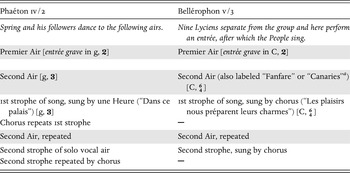
A tiny number of four-section structures reverse the order and put the vocal part first; in Thésée iii/7 a chorus of shades (“On nous tourmente / Sans cesse aux Enfers”) is followed by a dance (“Second Air”), the second verse of the chorus, and a repeat of the dance – all of them fully written out in the Ballard score. The basic dance-song structure may be expanded by including both a soloist and a chorus (see Table 2-6 for an example from Phaéton). Another type of expansion, although rare, consists of adding a third iteration of the dance after the second verse of the song.Footnote 56
| Phaéton iv/2 | Bellérophon v/3 |
|---|---|
| Spring and his followers dance to the following airs. | Nine Lyciens separate from the group and here perform an entrée, after which the People sing. |
Premier Air [entrée grave in g,  ] ] | Premier Air [entrée grave in C, ] |
Second Air [g,  ] ] | Second Air (also labeled “Fanfare” or “Canaries”a) [C, ] |
| 1st strophe of song, sung by une Heure (“Dans ce palais”) [g, ] | 1st strophe of song, sung by chorus (“Les plaisirs nous préparent leurs charmes”) [C, ] |
| Chorus repeats 1st strophe | ─ |
| Second Air, repeated | Second Air, repeated |
| Second strophe of solo vocal air | Second strophe, sung by chorus |
| Second strophe repeated by chorus | ─ |
a Although not so labeled in the Ballard score, this piece and the chorus that follow are called “canaries” in several musical sources (see LWV 57/69-70) and in a notated choreography (see Ch. 4, p. 112).
Not all of Lully’s dance-songs are strophic. When the song has only one verse, it is often embedded in the center of an ABA structure, with a dance to which it is closely related on both sides. Another formal option presents the dance and the related song only once each, in which case it is more common for the dance to go first, as with the back-to-back dance-songs in Act v of Alceste, sung by Straton and Céphise. When the order is reversed and the vocal piece is heard first, the context generally carries extreme emotion, as in Armide iii/4, when the followers of Hatred insist in rapid and forceful homorhythms that nothing causes so much suffering as Love (“Tu fais trop souffrir sous ta loi. / Non, tout l’Enfer n’a rien de si cruel que toi”). The dance that follows (“Second Air,” marked “Vite”) interposes jagged hemiolas into the rapid meter. According to the didascalie, “the followers of Hatred show that she is preparing with pleasure to conquer Love.” The cumulative threat of chorus and dance so horrifies Armide that she abruptly changes her mind and renounces Hatred’s help. In a similarly charged scene, Atys iii/5, the chorus of nightmares is followed by a vigorous dance in the same meter ( ); Atys wakes up terrified.
A strophic dance-song, juxtaposed with a related dance piece, offers a clear structure for the alternation of song and dance. However, there may be some instances in which such units would seem to invite participation by dancers at the end of the second strophe. It is hard to imagine that the celebrations that conclude an opera such as Bellérophon, which ends with a strophic choral dance-song, would leave the dancers standing still during the final measures, no matter how the chorus is constructed (see the outline in Table 2-6). In this instance the sung canarie has a refrain, so a likely spot for the dancers to join the singers would be the B section of the second strophe, when the refrain is sung for the second time. This would respect the principle of not having dance compete with new text, yet would still allow the opera to end in spectacular fashion, with all the characters on stage taking part.
Structures in which an instrumental piece is related to a song or chorus in one of the ways discussed above account for approximately two-thirds of the instrumental dance pieces in Lully’s operas. This close correspondence between the vocal, text-bearing realm and the world of physical movement is one of the hallmarks of French opera, but the aesthetic principle of a single focus that governs how the two realms interact may seem counterintuitive to today’s opera spectators, who are used to seeing many activities happening on stage at once. Rosow has extended the principle of a single focus to argue that whereas Lully and Quinault generally separated dancing and singing in real time, within the realm of the opera, which operates according to different rules than does the outside world, the two happen, in a sense, simultaneously:
A corollary of this principle of single focus is its implication of continuous behavior that the audience neither sees nor hears. While we watch the dancing Ethiopians, the singing Ethiopians continue to celebrate, but we do not hear them; while we hear the singers, the dancing Ethiopians continue to celebrate, but we do not see them […] Lully and Quinault want us to understand these activities to occur simultaneously as we focus on them successively. The conventional code for presenting such a structure involved symmetrical patterning: an apparently static tableau.Footnote 57
Independent Instrumental Dances
Whereas most of Lully’s instrumental dance pieces are intimately connected to a vocal piece, approximately one third of them have no musical relationship to the rest of the divertissement other than key, and, perhaps, meter. One independent type is the marche, which often provides the entrance music in ceremonial contexts. Marches that involve military processions, as in the battle scenes in Act ii of Alceste and Act i of Thésée, are in rondeau form with trumpets and drums playing during the refrains. The triumph in honor of Bellérophon in i/5 receives the military musical treatment, even though those processing are not soldiers but the hero’s prisoners from a campaign conducted before the opera starts. Armide’s triumph in Act i, however, has no trumpets and drums, perhaps because those entering, the people of Damascus, are civilians, even if they are celebrating her military successes – or is it because she is a woman and only men merit trumpets? The fact that marches are not usually anchored to vocal pieces seems unsurprising,Footnote 58 and they are generally followed by something sung, often an announcement in recitative, setting the scene for what is to come.
Other ceremonial processions may be set to marches, such as the entrance of people offering gifts to the goddess Isis in Phaéton iii/4. The libretto specifies that “the young male and female Egyptians who carry the offerings approach the temple of Isis while dancing.”Footnote 59 A possible model for performing such a piece is offered by the single extant march choreography, the opening number in Le Mariage de la grosse Cathos. There the through-composed music is played twice, first as a processional for the entire cast, the second time as a dance for eight. During the procession everyone takes one step per measure, whereas the choreography assigns the dancers a varied step vocabulary.Footnote 60 Given the large number of people entering the stage in Phaéton iii/4 and the relatively short music available (a binary piece of 18 notated bars – or 36, if both repeats are made), the option of playing the entire piece twice so that the entrance can be made with due pomp is attractive. An extension of the amount of music also offers the possibility of highlighting the gift-giving by making the dancing subsequent to, rather than simultaneous with the procession.
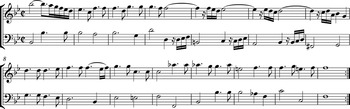
One other category of instrumental dance does not have a vocal analogue – the entrée grave. This is a slow dance in duple meter characterized by dotted quarter-note/eighth-note patterns, rather like the opening portion of an overture. The adjective “grave” is found in the headings for choreographies (see Chapter 3, pp. 94–95); in scores such a piece is generally identified simply as an entrée or an air. Nor do scores often say to which group of dancers a piece may be assigned, but in choreographic sources entrées graves are always danced by men, and in the divertissements that include one there are always male characters – or nasty creatures that are coded male – available to dance it. One such instance is the first dance for the nightmares in Atys (Example 2-3).
In divertissements where they are used, entrées graves tend to be the first purely instrumental dance, perhaps following a chorus. They are often followed by another instrumental dance in a contrasting character, but one that is part of a dance-song complex. This is the case in Phaéton iv/2, which takes place in the palace of the Sun, where the next dance is in a light triple meter and tied both to a solo vocal air and to a chorus on the same text. Similarly, in the celebrations that end Bellérophon the entrée grave is followed by two canaries, the first instrumental, the second sung by the chorus. In both of these cases, the second unit adheres to Lully’s normal blueprint for dance-songs, with the one difference that the unit in Phaéton uses an expanded version, involving both a soloist and the chorus (see Table 2-6).Footnote 61
The dream sequence in Atys iii/4 is organized differently. After the Songes heureux have been dispatched by a bass Songe funeste, who warns Atys in recitative that if he refuses Cybèle’s love, she will take revenge, the dancing nightmares embody the warning in the entrée grave shown above in Example 2-3. Next a pair of related pieces – chorus and dance – reinforce the threat. (See Section iii in Table 2-11, p. 64.) Here, as in the other two operas, the entrée grave makes a strong statement on its own through music and movement. Yet Lully does not often present dance pieces in isolation, and in all three of these cases, the very next dance returns to the orbit of vocal music and a sung text. This phenomenon is not limited to cases that involve entrées graves. In Phaéton v/4 a bourrée is the musically independent piece, but it is immediately followed by a strophic dance-song.
It occasionally happens that Lully places two – or once even three – independent dances in a row,Footnote 62 but he nonetheless integrates them into a dramatic whole. In Act iv of Armide the Chevalier danois and Ubalde have come looking for Renaud, intending to rescue him from the sorceress’s clutches. Armide tries to distract them by conjuring up false images of their own sweethearts; the first such temptation, aimed at the Chevalier danois, constitutes the divertissement proper (iv/2). First, his beloved Lucinde, seconded by a chorus of rustic folk, tries to charm him (“Voici la charmante retraite”). Next come a gavotte and a canarie that have no musical connection either with each other or with the choruses on either side. The second chorus, however, follows the same pattern as the first (Lucinde’s words and music are repeated by her followers) and it quickly transforms into a repeat of “Voici la charmante retraite.” Thus even though the two dances are musically independent, they are enfolded within a structure that circles back on itself.
Chaconnes and Passacailles
Chaconnes and passacailles, the largest of all the dance types, have affinities with both the independent dances and the dance-songs, in that of the six such dances in Lully’s tragédies, two of them are purely instrumental (the chaconne in Phaéton ii/5 and the passacaille in Persée v/8), whereas the other four incorporate vocal sections (the chaconnes in Cadmus et Hermione i/4, Roland iii/6, and Amadis v/5, and the passacaille in Armide v/2). Of these the only one to end the opera is the enormous chaconne in Amadis; the oft-repeated claim that Lully’s tragédies end with chaconnes is not accurate.Footnote 63
The passacaille from Armide illustrates how Lully interweaves vocal and instrumental sections into a gigantic construction (see Table 2-7). If all the repeats the Ballard score calls for are taken, the piece lasts approximately fifteen minutes and has 522 measures. The chaconnes from Amadis and Roland are longer still, each having over 800 bars. (It is not unusual for these long pieces to have internal repeats, although many are through-composed. When repeats are indicated by sign or by verbal instructions, how much music to repeat is sometimes ambiguous.)
| No. of bars | Scoring |
|---|---|
| 149 | Instrumental passacaille |
| 16 | Premier Récit, by an Amant fortuné, “Les plaisirs ont choisi” |
| 16 | Premier Couplet du chœur, “Les plaisirs ont choisi” |
| 8 + 8 | Instrumental trio, then a5 texture |
| 24 | Amant fortuné, “C’est l’amour” |
| 24 | Chorus, “C’est l’amour” |
| 8 + 8 | Instrumental trio, then a5 texture |
| 24 | Amant fortuné, “Jeunes cœurs” |
| 24 | Chorus, “Jeunes cœurs” |
| 16 | Premier Récit, repeated |
| 16 | Pr. Couplet du chœur, repeated |
| 149 | Repeat of instrumental passacaille* |
| 16 | Premier Récit, repeated* |
| 16 | Premier Couplet du chœur, repeated * |
In her critical edition of Armide, Rosow chose to adhere to the sequence of the piece copied into the two instrumental parts remaining from the premiere, which do not repeat the last three sections (marked in the table with asterisks). Even in this shorter form, the passacaille has 341 measures.Footnote 64 In both versions the passacaille is marked by an alternation between instrumental and vocal sections, a construction that lends itself to alternating dancing and singing; presumably the last sixteen measures, sung by the chorus to a now thoroughly familiar text, would also have been danced.
Whereas the chaconne and passacaille are both structured as unfolding variations above either a ground bass or a repeating harmonic pattern, they differ from each other both in their music and in the dramatic uses to which they were put. The passacailles in French opera tend to be in a minor mode and to start on the downbeat; whereas chaconnes are usually in a major mode and tend to begin on the second beat of the bar. Passacailles have a slower tempo than chaconnesFootnote 65 and narrower uses; they are often found in association with women, not infrequently when seduction is involved. Chaconnes have broader dramatic uses (and sometimes an exotic flavor); a substantial subgroup of them is comic.Footnote 66 Because their great length and exceptional construction color any divertissement in which they appear, chaconnes and passacailles are discussed in several parts of this book.
Divertissement Architecture
Lully’s divertissements vary enormously in length and structural complexity, but the most common elements are the close connections between vocal and dance music and the use of repetition as a structural device. The principle of expansion via repetition, built into dance-songs, appears at larger organizational levels as well and even extends beyond the divertissement into other parts of the act.Footnote 67 The divertissements are also unified by key: most remain in the same key throughout, unless they occupy more than a single scene; excursions away are limited to the parallel major or minor, or, if the mode is minor, to the relative major. The examples that follow lay out a few of Lully’s varied structures.Footnote 68
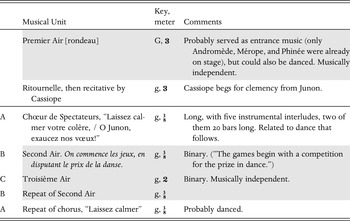
The organizing principle in Persée i/5 is a palindrome. When the opera opens Junon is angry with Cassiope, queen of Ethiopia, because she dared compare herself to the goddess. Junon has sent a monster, Méduse, to ravage the land. In an attempt to appease Junon, Cassiope leads a set of religious games, whose centerpiece is a dance contest (Table 2-8).Footnote 69 The jeux junoniens fail to calm Junon’s wrath and the news that Méduse is approaching sends everyone fleeing.
Games in honor of Junon, where young people compete in dancing.
| Musical Unit | Key, meter | Comments | |
|---|---|---|---|
| Premier Air [rondeau] | G, | Probably served as entrance music (only Andromède, Mérope, and Phinée were already on stage), but could also be danced. Musically independent. | |
| Ritournelle, then recitative by Cassiope | g, | Cassiope begs for clemency from Junon. | |
| A | Chœur de Spectateurs, “Laissez calmer votre colère, / O Junon, exaucez nos vœux!” | g,  | Long, with five instrumental interludes, two of them 20 bars long. Related to dance that follows. |
| B | Second Air. On commence les jeux, en disputant le prix de la danse. | g, | Binary. (“The games begin with a competition for the prize in dance.”) |
| C | Troisième Air | g, | Binary. Musically independent. |
| B | Repeat of Second Air | g, | |
| A | Repeat of chorus, “Laissez calmer” | g, | Probably danced. |
The “Premier Air” fulfills the function of the marches found in so many ceremonial scenes, and, like them, is musically independent. It may well have been danced, especially given that some of the people entering the stage have been designated to participate in the dance contest. Cassiope probably enters last, as she has her own ritournelle before she addresses Junon; she explains that she has assembled young couples about to be married to demonstrate their skill in dance, and that she herself acknowledges her guilt and wishes to make amends. The chorus that follows, entreating Junon to heed the country’s pleas, represents the first of the five pieces in the palindrome. It is followed by three instrumental pieces: a dance in that is related to the chorus; a musically independent piece that may be a bourrée; and a repeat of the dance in . This central sequence, where the dance contest must have taken place, is rounded off by a repeat of the chorus. The connection made via the music between the dancers and the chorus of spectators, who beg Junon for mercy, reminds us that the dance contest is a serious matter. If the chorus did not involve dancing in its first iteration, it must surely have done so the second time, as both its position at the end of the divertissement and its construction invite dance: of its 113 measures, 58 are choral and 55 instrumental, in a lopsided alternating pattern that becomes more instrumental as the piece progresses (Table 2-9).
White = choral; shaded = instrumental
| 28 | 5 | 6 | 7 | 6 | 20 | 6 | 3 | 6 | 20 | 6 |
The chorus’s ritualistic text repetition begins to sound almost desperate when, after the opening prayer, which uses all four lines of text, the group thereafter repeats only the words, “If we could please you, how happy we would be!” (“Si nous pouvions vous plaire, / Que nous serions heureux”). It is worth noting that the chorus, for all that its members are identified as spectators, shows more initiative than do most of Quinault’s choruses: the text they sing is their own, not a repetition of Cassiope’s words. Their independence from her, both textual and formal (Cassiope’s recitative stands outside the palindrome), serves to emphasize the enormity of their queen’s transgression, which has put her at odds with her subjects and threatened the survival of Ethiopia.
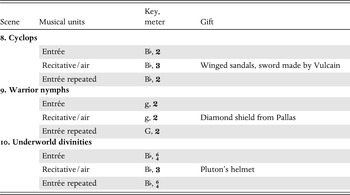
The divertissement in the following act operates on a different principle, one that uses parallel structures to cumulative effect. After the failure of the games honoring Junon, Persée has volunteered to try to kill Méduse. Mercure ascends from the Underworld to tell him that Jupiter, Persée’s father, along with all the other gods except Junon, is on his side. (As a god, Mercure would normally descend from the heavens, but his quest for material aid has taken him to the Underworld.) In a series of three parallel scenes different demigods arm Persée: the cyclopes bring winged sandals and a sword made by Vulcain, warrior nymphs provide a diamond shield given by Pallas (Athena), and Underworld divinities give him Pluton’s helmet (Table 2-10). Each scene involves dancers (plural, although their number is not indicated in the libretto) plus a single singer from the same group of demigods, and each has the same tripartite structure. The three scenes have a symmetrical key scheme: the outer ones are in major, the central one in the relative minor.
| Scene | Musical units | Key, meter | Gift |
|---|---|---|---|
| 8. Cyclops | |||
| Entrée | B♭, | ||
| Recitative/air | B♭, | Winged sandals, sword made by Vulcain | |
| Entrée repeated | B♭, | ||
| 9. Warrior nymphs | |||
| Entrée | g, | ||
| Recitative/air | g, | Diamond shield from Pallas | |
| Entrée repeated | G, | ||
| 10. Underworld divinities | |||
| Entrée | B♭, | ||
| Recitative/air | B♭, | Pluton’s helmet | |
| Entrée repeated | B♭, | ||
After Persée is solemnly and progressively armed from his heels to his head, Mercure sings an air that is taken up by the chorus: “May the Underworld, the earth, and the heavens, may the entire universe favor your generous undertaking.” This chorus, which crowns the divertissement, offers its own three-part structure: two extended choral passages surrounding an instrumental section of approximately equal length. The sequence offers the necessary opportunity for “the entire universe” to be represented visually as well as textually: the libretto indicates that each group of demigods has remained on stage when the new one arrives. Thus all three groups of dancers are available to end the act in a grand choreographic image of unity, as Mercure and Persée fly off together.Footnote 70
The dream sequence in Atys has a complex three-part structure (Table 2-11).Footnote 71 The first section evokes the world of sleep in a long instrumental prelude that is extended vocally by the personified figure of Sommeil and his companions, who extol the peace that sleep provides above a continuation of the bass line from the prelude. In the second section, the sweet dreams (dancers), aided by Sommeil’s three companions, reveal Cybèle’s love to Atys. In the third, nightmares (both singers and dancers) threaten Atys with the consequences if he does not return Cybèle’s affections. The two happier sections involve structural repetitions: the first has a large ABA form, with the A section instrumental and the B vocal;Footnote 72 the second expands the vocal portion of Lully’s standard strophic dance-song unit. In the third section, the nightmares’ avoidance of formal constructions magnifies the disruption their arrival causes.
| i | The stage changes and represents a cave surrounded by poppies and streams where the god of sleep arrives, accompanied by sweet dreams and nightmares. | ||
| Prelude (also called Le Sommeil) | g, | Alternates trio of flutes w. strings, 57 m | |
| Sommeil, “Dormons tous” | Sung by haute-contre, functions as refrain | ||
| Morphée, “Regnez, divin Sommeil” | Second haute-contre | ||
| Phobétor, “Ne vous faites point violence” | Bass air texture, flutes play treble lines | ||
| Repeat of refrain | |||
| Sommeil, “Dormons tous” | Expansion of refrain, texturally and in length | ||
| All three, “Dormons tous” | |||
| Prelude | Repeat of instrumental Prelude | ||
| ii | The sweet dreams approach Atys and by their dances reveal to him Cybèle’s love and the happiness he should expect from it. | ||
| Recitative Morphée, “Ecoute, Atys” | g, ─ | Tells Atys of honor Cybèle is bestowing on him | |
| Trio Morphée, Phantase, Phobétor, “Mais souviens-toi” | g, | Reminds Atys that an immortal goddess demands truly eternal fidelity | |
| Song Phantase, first strophe, “Que l’Amour a d’attraits” | g, | Extols the pleasures of new love | |
| Entrée des Songes agréables | g, | Gentle in character, similar to song, binary | |
| Air Phobétor, “Goute en paix” | g,  | Bass air texture, flutes play treble lines | |
| Trio Morphée, Phantase, Phobétor | g, | Repeat of trio, text and music | |
| Song Phantase, second strophe, “Trop heureux un Amant” | g, | Music repeats, words new: a lover exempted from a long wait is fortunate | |
| Entrée des Songes agréables | g, | Repeat of dance | |
| iii | The nightmares approach Atys and threaten him with Cybèle’s vengeance if he disdains her and does not love her faithfully. | ||
| Recitative Songe funeste, “Garde-toi d’offenser un amour glorieux” | B♭, ─ | Warns Atys that if he does not reciprocate Cybèle’s love, her revenge may fall on him | |
| Entrée des Songes funestes | B♭, | Entrée grave, independent of vocal music | |
| Chœur des Songes funestes, “L’amour qu’on outrage” | B♭, | Warns Atys that he will suffer and even perish if he does not love Cybèle | |
| [Second Air des Songes funestes] | B♭, | In same key and meter as chorus, binary | |
| Terrified by the nightmares, Atys awakes with a start. Le Sommeil and the dreams disappear along with the cave, and Atys finds himself back in the palace where he fell asleep. | |||
The Atys dream sequence is long and sumptuous, but a few divertissements are very lean, with only one instrumental piece. This is the case in iv/2 of Cadmus et Hermione, Lully’s first tragédie, which draws upon one of the ancient Greek origin myths: Cadmus kills a dragon, and then distributes its teeth over a ploughed field as if they were seeds. Here is Quinault’s version of what happens (in this case all of the characters except Cadmus are dancers; the 1678 court libretto calls for eight): “Cadmus sows the dragon’s teeth and the land produces armed soldiers, who at first turn their weapons against Cadmus. He, however, throws into their midst a kind of grenade that Amour has given him. It breaks into many pieces, which force the soldiers to fight and slaughter each other. The five who remain alive at the end of the battle deposit their weapons at Cadmus’s feet.” The fanfare-dominated music for the battle, a binary “Air pour les Combattants,” is not associated with any vocal music; in fact, it is introduced only by an exchange in recitative between Cadmus and Amour, who brings him the grenade, and an eight-bar duet for the two of them. These three little pieces constitute the entire divertissement. The dance’s status as action cannot account for its brevity, as can be seen by a comparison with the divertissement in Act ii of Alceste, in which Alcide and Admète’s troops attack the walls of Scyros, only to meet sufficient resistance that the battle rages for quite some time. But these are both special cases where the usual conventions governing divertissement structures do not apply.
In Act iv of Bellérophon, the hero’s battle with the Chimera, which is set against a single chorus punctuated by instrumental phrases, fulfills the function of a divertissement. At the opposite extreme stands Act iii of Persée, where it makes little sense to try to define the divertissement as something separate from the rest of the act. As it opens, the Gorgon Méduse is with her two hideous sisters, mourning her lost beauty. They hear sweet music as Mercure appears. He enchants them to sleep, then summons Persée, who decapitates Méduse. Her two sisters try to attack, but, thanks to Pluton’s helmet, Persée is invisible. Méduse’s blood produces monsters, who fly, crawl, or run in search of the invisible Persée; this, the “Entrée des Fantômes,” is the only “official” dance piece in the entire act (Example 2-4a). The sisters urge the monsters to take revenge, and the rushing sixteenth notes of the dance reappear in their duet, suggesting that the monsters continue their threatening gestures in alternation with the Gorgons’ exhortations (Example 2-4b); the duet ends with monster music. At Mercure’s bidding, Persée flies off with Méduse’s head, as chasms open and the two remaining Gorgons fall into the Underworld.

Isis has two divertissements that not only drive the story, but exhibit architectural fluidity. In iii/4 the audience learns that the nymphs and shepherds are actors in a play that retells the story of Pan and Syrinx, produced by Mercure with the goal of making Argus fall asleep. Mercure is acting on behalf of Jupiter, who is trying to rescue his latest love-interest, Io, from the prison in which his jealous wife has enclosed her, with Argus as guard. This effort fails, and for all of Act iv a Fury drags poor Io around the globe from one torment to another.
Even in more conventional constructions the boundary between the divertissement and the rest of the act may blur. In Armide ii/3, after his famous monologue, “Plus j’observe ces lieux, et plus je les admire,” Renaud is lulled to sleep to the same rocking motions of muted strings that had punctuated his words. While he sleeps, demons disguised as nymphs and shepherds tempt him to yield to love, in vocal and instrumental music that is similar to the lullaby. The chorus, dancers and singers alike, must sneak onto the stage, as there is no obvious point for their entry. Trying to define one particular spot as the start of this divertissement seems artificial – although on its other side it does come to an abrupt and dramatic end when Armide arrives, dagger at the ready. The fuzziness around the edges of many divertissements – or within them – is a significant feature of Lully’s style, as is the fuzzy line between recitative and air. In both cases, attempts to delineate separable units may serve useful analytical purposes but run the risk of over-codyfing Lully’s actual practices. Moreover, even when the musical boundaries seem clear, the visual ones may be less so. It often happens that the chorus remains on stage after a divertissement ends and a new scene begins; this is the case in Act i of Armide when the celebrations in her honor are interrupted by the arrival of a messenger bearing bad news. A dramatic rupture has occurred, but from the audience’s perspective, the stage looks just as crowded as before. The movements of masses of people on and off stage may belong to a different category of architecture than do musical structures, but they nonetheless have an enormous impact on how the operas are experienced in the theater.
The Dramaturgical Implications of Mechanics
Before going on, it seems useful to summarize the main points already made about the mechanics of Lully’s divertissements. After his death these practices underwent modifications, although the basic templates remained in place, especially in tragédies, through the time of Rameau – and even beyond.
Dance in Lully’s operas functions within a primarily vocal context. Instrumental dance pieces are either musically related to adjacent vocal pieces, or, if they are musically independent, are in close proximity to vocal pieces to which they have dramatic connections.
Two categories of instrumental pieces account for many of the dances that are musically independent of the vocal music: marches and entrées graves. The former are not restricted to military contexts, but serve when ceremonial entrance music is in order. The latter, which also tend to come toward the beginning of divertissements, are in a slow duple meter with dotted figures and seem to be intended for male characters.
Approximately two-thirds of Lully’s instrumental dance music is closely related – or sometimes even identical – to a vocal piece with which it alternates. Many of these dance-songs are strophic, with two strophes (only); in most such cases the dance piece initiates the unit, yielding dance – first strophe of song or chorus – repeat of dance – second strophe. (In Ballard’s scores such structures are rarely written out in full; more frequently verbal instructions reveal the order of events, although these may sometimes be incomplete or even missing. It is essential to read the librettos in conjunction with the scores for help in establishing the proper sequence.)
A corollary is that whereas some instrumental dances lack a vocal correlate, virtually all solo songs or duets in Lully’s divertissements are part of a larger structure. Either they are linked to a chorus, usually on the same text and with closely related music, or they are paired with an instrumental dance.Footnote 73 (This observation applies only to songs in closed forms, not to passages of recitative. Choruses may also be paired with dances, but do not have to be.)
The dancers are, in a sense, “body doubles” for the members of the chorus or for the minor characters who sing in the divertissements; the dancers supply the movement, the singers the voices. When the roles of the dancers and singers within the chorus are not fully congruent, it is usually because the dancers represent a subgroup. (In Bellérophon v/3 the singing chorus represents peoples from different nations, the dancers a group of nine lords.) The numbers of singing bodies and dancing bodies do not need to be equal; the singing chorus is always more numerous than the dancers, and even when the dance is juxtaposed with solo singing or a small ensemble, the numbers of singers and dancers are not necessarily identical.
This functional division finds its analogue in structures that favor alternation between dancing and singing over simultaneity. The basic principle seems to be that there should be a single focus for the audience’s attention, either on song or on dance, but that the two should not compete with each other.
The principle of alternation can be seen in other parts of the operas as well: in the instrumental music provided to cover entrances and exits or changes of scenery, so these movements do not have to happen while someone is singing, or in vocal pieces (mostly choruses) describing action that takes place in instrumental phrases strategically structured into them. Any instrumental piece, or instrumental passage within a sung piece, should be considered as a potential site for movement of some kind.
Dancing does not take place during solo singing, but may within some (not all) choruses. Conventions govern where the dancing occurs:
◦ Choruses that have a “let’s sing and dance” kind of text invite the dancers to participate. Other choruses may be preceded by a didascalie suggesting dancing, or operate within a dramatic context where dancing seems appropriate.
◦ Lully’s choruses often interleave instrumental phrases with the vocal ones. In those choruses where dancing seems dramatically plausible, the instrumental phrases, no matter how short, offer sites for dancing; during the vocal phrases, the dancers remain still. Toward the end of the chorus, once multiple repetitions of the text have made it familiar, the dancers may move during the vocal phrases. Involving everyone on stage seems particularly appropriate for choruses that end divertissements.
◦ Choruses that are structured as dance-song complexes with the instrumental dance coming first may have been danced at the end of the second strophe – particularly if the chorus has a refrain and if it concludes the divertissement. There is no clear evidence as to this practice, but it seems to follow from the general pattern of inviting participation by the entire on-stage group at the end of a divertissement.
◦ Choruses that have texts invoking action on the part of the group may have been danced (or mimed) throughout, even if there are no instrumental phrases within the chorus. If, however, the chorus is adjoined by an instrumental piece available to absorb the actions, the dancing might have occurred there rather than during the chorus.
Lully and Quinault’s divertissements come in many different overall shapes, but most of them rely on some kind of structural repetition – of a chorus (all or in part), of an instrumental dance, or of a dance-song. When something danced is repeated, the choreography was probably varied (see discussion in Chapter 14, pp. 440ff).
The structure of divertissements as a whole shows that dance functions within a continuous texture that connects pieces to each other. Dance is presented not as an interruption or as a parenthesis within the action, but as part of a natural continuum that incorporates multiple modes of expression.
These findings impact both performance and interpretation. Once we understand the structural conventions of Lully’s divertissements, we acquire tools for resolving thorny practical questions such as who dances where and how such scenes might be staged. Furthermore, this type of understanding becomes crucial for those preparing critical editions, in view of the notational ambiguities found in the Ballard scores. Once we realize how much can be learned by examining how the parts work with the whole, we position ourselves to address questions of meaning. The remaining sections explore case studies where this wider angle of vision allows for interpretive possibilities that are unavailable if the dance music is taken in isolation.
Reading the Texts
Operatic historiography has tended to dismiss divertissement texts as trivial or even immoral.Footnote 74 However, once we pay attention to the words sung by supposedly minor characters, we discover that they offer hermeneutic tools and that Quinault carefully crafted them for their particular location.
In Act iv of Phaéton the deeply ambitious title character, who is angling to become the next king of Egypt, comes to the palace of his father, the Sun. He has been insulted by his rival, Epaphus, son of Jupiter, and wants to restore his honor by dispelling all doubts about his lineage. The Sun, surrounded by the Hours of the day and the four Seasons, welcomes him in style. After the festivities, Phaéton asks his father for a sign that will prove his parentage to the world. The Sun rashly assents before asking what sign Phaéton has in mind. When he learns that Phaéton wishes to drive the Sun’s chariot across the sky, he instantly foresees the consequences, but cannot go back on his word. The inevitable catastrophe occurs in the last act. However, during the happy period before Phaéton requests the favor, the festivities in the Sun’s palace extend over two scenes, one in the presence of the Sun, the other after Phaéton joins him. In Scene 1 a chorus of Hours and the personified Autumn praise the benefits the Sun brings. Although it is constructed as a gigantic rondeau, with the chorus singing a refrain to danceable music in triple meter, this scene appears to be devoted to singing the Sun’s praises; it is only after Phaéton arrives that dancers embellish the festivities. Quinault aligned the two personified seasons who participate in this divertissement with the two main characters: the older figure, Autumn, sings for the Sun and the youthful Spring dances for Phaéton.
The welcome extended to Phaéton is initially expressed through movement: Scene 2 opens with a musically independent entrée grave (the Premier Air), but the Second Air initiates a four-part, strophic dance-song complex whose text is addressed to Phaéton (outlined in Table 2-6). Each verse is sung first by one of the Hours (soprano) and then by the chorus. The exceptionally square, triple-meter music is called a menuet in some secondary Lully sources.Footnote 75 Beyond Spring, who probably danced a solo during the entrée grave,Footnote 76 the number and gender of the dancers are unknown for the 1683 premiere; in 1702 Spring’s followers included four men and four women.
Scène Seconde:Footnote 77 Le Printemps et sa suite dansent, et les autres Saisons chantent avec les Heures, pour témoigner qu’ils se réjouissent de l’arrivée du fils du Soleil, dans le palais de son père.
| Premier Air | |
| Second Air | |
| Une des Heures et les Choeurs, qui lui répondent | |
| [First strophe:] | Dans ce palais |
| Bravez l’envie, | |
| Dans ce palais, | |
| Vivez en paix. | |
| Soyez content, tout vous y convie; | |
| Goûtez toujours les biens les plus parfaits, | |
| L’honneur qui suit une illustre vie, | |
| Est un bonheur qui ne finit jamais. | |
| Repeat of Second Air | |
| Une des Heures et les Choeurs | |
| [Second strophe:] | Ne tardez pas, |
| La Gloire est belle, | |
| Ne tardez pas, | |
| Suivez ses pas. | |
| Vous la cherchez, sa voix vous appelle, | |
| Vous êtes fait pour aimer ses appas, | |
| L’amour constant que l’on a pour elle, | |
| Porte un grand nom au-delà du trépas. | |
| Les Choeurs | |
| Dans cette demeure charmante, | |
| Venez jouir d’une gloire éclatante; | |
| Jeunes héros, tout répond à vos vœux, | |
| Venez jouir d’un sort heureux. | |
| (Spring and his followers dance; the other Seasons sing with the Hours, to show their joy about the arrival of the son of the Sun at his father’s palace. | |
One of the Hours and the chorus, which repeats her words: In this palace defy envy and live in peace. Be happy; everything invites you. Always enjoy the best. The honor that attaches to an illustrious life brings unending happiness. [Second verse:] Do not wait; Glory is beautiful, follow her steps. You search for her, her voice is calling you; you love her attractions. A constant love for Glory carries a great name beyond death. [Chorus:] In this charming domain come enjoy a brilliant glory. Young hero, everything responds to your wishes; come enjoy your happy fate.) | |
Both the first strophe of the dance-song and the chorus that concludes the divertissement allude to the happiness, glory, and honor Phaéton can find in his father’s palace. The second strophe, while not breaking the joyous mood, is more pointed: whereas the first quatrain exhorts Phaéton to seek glory (encouragement he does not need), the second puts a finger on his psychological state and, in a double-edged aphorism, prefigures the outcome of the opera, in which a love of glory carries an illustrious person beyond death. Whether this degree of subtlety could have been conveyed in the dancing cannot be known, but it is nonetheless built into the unit as a whole.
The divertissement texts in Act iv of Atys also reward attentive reading. The scene is the palace of Sangar, father of the opera’s heroine, Sangaride. He and his followers – river gods of various types – have come together to celebrate the imminent wedding of Sangaride to Célénus, king of Phrygia. In the preceding scene, Sangaride and Atys have vowed eternal faith to each other, even if their love must remain secret. Atys leaves, aiming to use the power the goddess Cybèle has granted him to help resolve their dilemma, but Sangaride remains behind, obliged to participate with Célénus in the unwelcome festivities her father is hosting. On one level this divertissement, which consists of an invitation to sing and dance, followed by no fewer than four dance-songs in a row (see Table 2-12), offers a much needed respite from the untenable situation in which Sangaride and Atys find themselves. The jolly dance music Lully provided, which alternates menuets and gavottes, seems joyous and unproblematic.Footnote 78
| Musical units | Key, meter | Scoring, comments | |
|---|---|---|---|
| Introduction | |||
| Prelude | C, | Orchestra a5 | |
| Recitative, Sangar | C, ─ | With choral interjections | |
| Bass air, Sangar, “Que l’on chante, que l’on danse” | C, | Strings a3 | |
| Chorus, “Que l’on chante” | C, | Male chorus a4, B.C., very similar to air | |
| Dance-Song 1a | |||
| [Gavotte] | C, | Flute trio: G1, G1, C3 | |
| “La beauté la plus sévère” | C, | 3 vocal parts (G2, C1, C3), B.C. in C3 | |
| Dance-Song 3 | |||
| [Menuet] | C, | Flute trio: G1, G1, C3 | |
| “L’Hymen seul” | C, | 3 vocal parts (G2, C1, C3), B.C. in C3 | |
| Dance-Song 3 | |||
| [Menuet] | a, | Orchestra a5 | |
| “D’une constance extrême” | a, | 2 vocal parts (G2, C3), B.C. in F4 | |
| Dance-Song 4 | |||
| [Gavotte] | a, | Orchestra a5 | |
| “Un grand calme” | a, | Chorus a4, orchestra a5 | |
a Reproduced in Fig. 2-6, p. 48.
Quinault, however, appears to have had a more subtle conception, one that sets up a dialogue between two competing views of love and marriage, one naïve, the other cynical. The arguments are laid out over six strophes, set as three songs, that conclude in a single-strophe chorus ending the divertissement with the statement, shocking under the festive circumstances, that “A great calm is too boring, we prefer storms.” (“Un grand calme est trop facheux, / Nous aimons mieux la tourmente.”) Storms and upheaval are certainly what the rest of the opera provides, starting with the next scene in which Atys returns, refusing to perform the marriage ceremony on the untrue grounds that Cybèle won’t allow it, and departs with Sangaride. The chorus reacts with anger to end the act: “Quelle injustice!”
An interpretation of the divertissement as promoting the kind of conversation that might have graced the salon of a PrécieuseFootnote 79 hinges on close attention to the libretto. The Ballard full score, published thirteen years after the opera went on the stage, includes the order of events outlined in Table 2-12.Footnote 80 Whereas the score makes it appear that all four of these dance-songs have only one strophe, the libretto gives two strophes to each of the first three. However, Quinault interleaved the texts of the first two songs, rather than presenting them sequentially, as is apparent in the libretto from their structural characteristics alone (see Table 2-13). That the interleaving was purposeful is confirmed in a parody of Atys, whose texts follow the same pattern.Footnote 81
| Text | Form | Music | |
|---|---|---|---|
| Song 1, strophe 1 | “La beauté la plus sevère” | 10-line strophe, | [Gavotte] |
| 6-line refrain | |||
| Song 2, strophe 1 | “L’Hymen seul ne saurait plaire” | 8-line strophe, | [Menuet] |
| 4-line refrain | |||
| Song 1, strophe 2 | “Il n’est point de résistance” | 10-line strophe, | [Gavotte] |
| 6-line refrain | |||
| Song 2, strophe 2 | “L’Amour trouble tout le monde” | 8-line strophe, | [Menuet] |
| 4-line refrain |
This order of events – assuming it is preserved in performanceFootnote 82 – turns the sequence into a back-and-forth dispute about love. The first song argues that a persevering lover will succeed in the end, just as water, falling drop by drop, can pierce the hardest stone. The second song claims that marriage alone cannot please, that love is what matters. But love cannot be controlled: Hymen (the god of marriage) comes when he is called, but Love comes when he pleases. The second strophe of the first song responds that fidelity triumphs in the long run, to which the second strophe of the second song replies that Love is a perpetual trouble-maker. The third song disputes the cynical view, saying in its first strophe that the singer plans to love the same person forever and in the second warning that a fickle heart that strays from the safe harbor is sure to encounter a storm. The concluding chorus continues the weather imagery of the third song, but rejects calm waters as boring, in favor of meteorological excitement. For the Parfaict brothers, this divertissement, with its equivocal tone, “verges on base ridiculousness.”Footnote 83
The perspectives in these texts are so distinctive that the performance must have assigned the different points of view to different groups. The 1676 court libretto, which lists the 41 performers (Table 2-14), reinforces this impression. The rivers are male roles, the fountains female; the little streams were performed by children. The qualification “grands” applied to some of the river gods means they are adults – to distinguish them from the little streams and also from the old rivers and fountains who dance. Given that river gods appear in various places on the list in the libretto, the separation must be functional, between larger groups and those who appear in small ensembles.
| 12 big river gods, singing [men, those who form the male chorus] |
| 5 river gods playing the flute |
| 4 fountain divinities, singing [women] |
| 2 river gods [men, presumably singers in the small ensembles] |
| 2 river gods, dancing together [men] |
| 2 little gods of streams, singing and dancing [boys] |
| 4 little gods of streams, dancing [boys] |
| 6 big river gods, dancing [men] |
| 2 old rivers gods, dancing [men] |
| 2 old fountain nymphs, dancing [men in women’s roles] |
This setting apart of the groups in the list suggests that these distinctions were discernible on stage. But how they map onto the various musical numbers inside the divertissement is less than clear, not least because the headings are vague in the libretto and in the score almost non-existent. The only unambiguous piece is the chorus “Que l’on chante,” labeled “Choeur des Fleuves” and scored for male chorus; this must have been sung by the twelve adult river gods. The final chorus calls for all four voice types and probably involved the entire group of singers and dancers. For the remaining pieces, various hypotheses can be imagined, but there is no clear solution. And where, in all of this disputation, should the two old couples dance? As in Thésée, a dance for old folks seems intended to ridicule, or at the very least to raise a smile. The oldsters have no vocal counterparts, and the didascalies do not mention them; they would, nonetheless, seem likely to share the jaundiced view of songs two and four – or perhaps their dancing could be used to undercut the greeting-card sentiments of song three. Wherever they may have danced, their presence in this divertissement is not a fluke: danced roles for old rivers and old fountains remained in revivals of Atys until 1725.Footnote 84
A director today would have to decide who does what where, but an ideal performance would make visible and audible the questions about marriage the texts present. After all, the bridal couple, Sangaride and Célénus, are on stage to witness these debates; these words – less than reassuring – matter to them.
Text and Action
In most of Lully’s dance-songs, as in the sequence just discussed, the dancers and instrumentalists first present the idea, then the singers put into words what the audience has just seen and heard. In such structures the audience receives the visual sign before it gets the textual one. This progression is not so different from what happens elsewhere in Lully’s operas, where a prelude or ritournelle may serve not only as entrance music for a main character, but also as a means of introducing a mood that is given voice when the character begins to sing. In his divertissements it is dance that usually initiates the expressive unit.
In pieces where the librettist, composer, and choreographer have done their jobs effectively, there exists a built-in reciprocity between the text, the music, and the movements of the dancers. However, the relative representational weight on the different components may shift depending on the order of events. In those sequences where a dance follows a related vocal piece, the sung text sets up the movements of the dancers, and their interpretation is more transparent. When, however, the chorus that precedes a dance is one of high passion and alludes to actions, then the question re-emerges of whether the members of the chorus are expected to act. In such cases differences in the way the libretto presents the text have the potential to impact our interpretations of how scenes were staged. In iii/4 of Armide Hatred and her followers, whom Armide has summoned in an effort to destroy the love she feels for Renaud, sing energetically of their desire to destroy the power of Love: “Let’s break his bowstring, tear up his blindfold, burn his arrows, and extinguish his torch.” Their text invites action, but who performs it – the choristers while they sing, or the dancers, to the fiendish instrumental air that follows?Footnote 85 In the libretto the didascalie that describes the action follows the text of the chorus: “The followers of Hatred hasten to break and burn the weapons used by Love.” Should the location of the didascalie lead us to conclude that these words apply only to the dance piece and thus represent another instance where the singing and the dancing were sequential?
A similar question emerges in Alceste iii/5, during the mourning for Alceste’s sacrifice of her own life to save her husband’s. After an extended and complex choral scene that honors Alceste’s memory and deplores her death, there is a vigorous chorus (“Let us smash the sad remnants of these superfluous ornaments”) followed by a musically similar dance piece, with which it overlaps (Example 4-6) – but this time the didascalie is located in the libretto before the text of the chorus:Footnote 86
A spasm of pain overcomes the two troupes of mourners. Some of them rend their clothes, others tear their hair, and all of them break the ornaments they have been carrying at the feet of the image of Alceste.
The “two troupes of mourners” allude to men and women, so the didascalie does not answer the questions of whether the dancers, choristers, or both are the ones carrying out the actions or of where within the two pieces of music (one choral, one instrumental) the violent actions would have been represented. Could this chorus have been danced throughout? Or would the movements of the dancers have been deferred until the instrumental piece, the only dance in the entire divertissement? It may be coincidence, but this brief chorus (20 bars) has an identical structure to the action chorus in Le Mariage de la grosse Cathos: the text is sung three times in a row to slightly different music, without any instrumental interludes. More significantly, the sorrowing woman who leads the ritual has already introduced the text slightly earlier in the scene, singing it three times herself, so that it is already familiar to the audience.Footnote 87 Under these circumstances, it seems conceivable that the chorus itself could have provided a site for action, and that the movement could have continued on into the dance piece that follows.
If this possibility can be admitted, it is worth looking at Armide again and asking whether the chorus about breaking Love’s weapons, which directly follows Hatred’s utterance of the same words, could also have accompanied movement. The difference between the two scenes is the location of the didascalie in the libretto: in Armide the didascalie follows, rather than precedes the text of the chorus, whereas in Alceste it comes before the chorus sings. Should a distinction in staging be based on this typographical difference? In my view, both options for performance – action deferred until the instrumental dance or action during both the chorus and the dance – can be supported by the evidence we have, which is only partial. The one point that does seem clear is that no matter where the action occurred, the dancers would have been the ones performing it. Whether the chorus also gestured, we cannot know, but surely the burden of the physical expression was on the dancers.Footnote 88
Other scenes pose the question of whether a specific action that appears to be assigned to a singer might also, in practice, have been performed by dancers. In Roland i/6 Angélique is presented with a valuable gift on behalf of her suitor Roland, who is away battling his enemies. In Act iv the bracelet becomes a symbol of Angélique’s betrayal, when Roland learns that she has given it away. The gift is thus central to the plot and the gift-giving must be done in a suitably ceremonial manner. The transaction happens during the Act i divertissement, when one of Roland’s companions, the prince Ziliante, and his followers pay Angélique homage. The only pertinent didascalie reports that “The chorus sings the last few lines while Ziliante presents the bracelet to Angélique.” Notwithstanding what sounds like a clear stage direction, it seems likelier that Ziliante’s followers – the dancers among them – were the ones who made the actual presentation. First, the social hierarchies visible both within the opera itself and within the society that gave it birth support such an inference. Ziliante is a prince; he is not the type who does work himself, rather he orders other people to carry it out. (See Kintzler’s observation [Chapter 1] that the laws of verisimilitude demand that lofty characters behave in a manner worthy of their rank.) The last few lines of the chorus represent a classic spot where the dancers are already likely to be in motion; it is not difficult to imagine the ceremonial presentation of the bracelet as part of the choreography. This type of surrogacy seems completely in line with Lully’s aesthetic and was to remain in place in subsequent decades.Footnote 89
The phenomenon of singers as explainers, dancers as their active agents may even occur outside of divertissements. At the end of Phaéton, during which the arrogant young man loses control of the Sun god’s chariot as it careens across the sky, the Egyptian shepherds who had prematurely celebrated Phaéton’s success remain on stage during the last four scenes and are therefore available to carry out the frantic movements of the populace as it tries to escape the fires scorching the earth. The alternations between choral supplications and frenzied instrumental passages that Lully constructed into the choruses in Scenes 5 and 7 call for a vigorous physical response.
Celebrations
Of all the divertissement types in Lully’s operas, the celebrations that conclude most of them are the least examined, probably because they can be dismissed as nothing more than joyous tags onto a work whose plot has already been resolved.Footnote 90 Whereas these scenes may seem hard places to argue that a divertissement really matters to an opera, it turns out that happy celebrations are not all alike. The endings of Alceste, Bellérophon, and Persée have in common that the protagonist’s heroic deeds have restored order to society, a royal marriage is being celebrated, and at least one god participates in the festivities. On one level all three reinforce the monarchical status quo, by showing the populace joyously endorsing the deeds of their rulers, in an ending punctuated by a rousing chorus. Yet the individual features of each divertissement impact the audience’s perception of what is being celebrated and offer a retrospective commentary on the entire opera.
Of the three, the ending of Alceste is the most complex. As we have already seen (Chapter 1), the celebration has a dual basis: Alcide’s triumph over his baser desires and the reunion of Alceste and Admète. The singing and the dancing choruses involve both male and female roles, and the presence of Apollon and the Muses signifies that knowledge and the arts have added their blessings to those of the populace. Alcide, a loner at the start of the opera, now shares in the general adulation. But the divertissement also embraces the two comic characters, Céphise and Straton, who each sing a dance-song while surrounded by their rustic followers. These two groups of dancers then participate in the double chorus that ends the opera, thus signaling that the harmony now reigning includes not only the noble characters, whose merits are celebrated in the sung texts, but the lowly ones, whose movements animate the opera’s final moments. No one person dominates this scene; the entire social order from the gods to the herdsmen is celebrated.
In Bellérophon the hero has overcome the magical forces arrayed against him, killed the Chimera, and earned the hand of the king’s daughter. Yet again joyous crowds gather (peoples of different nations) and the goddess Pallas Athena, who had lent Bellérophon a hand earlier in the opera, escorts him to the festivities in her flying chariot. Since a wedding is being celebrated, a mixed group of dancers would seem to be appropriate, in keeping with the mixed chorus. But, instead, there are nine Lords, one of whom dances alone, plus the eight who compose his retinue. Four on-stage trumpeters accompany them.Footnote 91 This choice casts an entirely different character over the proceedings, especially when the first dance is a virtuoso, noble-style entrée grave. (See Table 2-6, p. 57.) This dance puts not social harmony but manly vigor and prowess on display – all the more since the dancing roles call for a leader and a group of followers. The object of the celebrations, the dancers seem to be saying, is Bellérophon the hero, not Bellérophon the bridegroom. This heroic impression is reinforced by the words of the choruses that surround this dance, which mention love only obliquely and attribute the cause for joy to the unnamed hero’s acts. The trumpets and drums that play during the first chorus as well as in the canarie (also labeled “fanfare”), the dance that alternates with the concluding chorus, further add to the luster. In this militarized environment love seems beside the point.
Of all Lully’s heroes, Persée is by far the most visibly heroic. Inside the opera alone, before the eyes of the audience, he kills Méduse, rescues Andromède by killing a sea serpent, and fights off an armed attack by the troops of his rival, Phinée. If ever a hero deserved magnificent celebrations, featuring a god or two, Persée would be the one. Yet the celebrations that conclude Persée have a very different cast from those in Bellérophon. There are actually three places in this act where dancers appear: first, during the wedding ceremony in Scene 3, where the singing priest of the god Hyménée is supported by dancing followers; second, during the battle that interrupts the wedding; and third, as part of the concluding celebrations. A god does put in an appearance at the appropriate moment, but it is not Persée’s father, Jupiter, or any of the gods who had armed Persée in Act ii. Rather, it is Vénus, the goddess of love, accompanied by Amour, Hyménée, the Graces, the Jeux, and cherubs. Their descent from the heavens is announced by Persée himself, just after he has petrified his enemies:
(Méduse’s head has punished them. Let us cease fearing cruel fortune; heaven promises us happy days. Vénus is coming to our aid, bringing Love and Marriage with her. Vénus’s palace descends.)
Persée’s air (“Cessons de redouter”) is preceded by an unlabeled instrumental piece that is identical to his extended binary air in structure, melody, and bass line.Footnote 92 The function of the prelude may well have been to accompany the descent of Vénus’s palace, notwithstanding the location of the didascalie in the libretto. Although it is not built over a ground bass, the triple meter of this unit leads seamlessly into the passacaille that follows; there is even a modulatory descent (from C major to a minor) written into the last measure of the song to smooth the connection. The passacaille, which is 99 measures long and purely instrumental, is to be understood as operating within the realm of Vénus, who is clearly the one controlling the divertissement. Her recitative, telling Cassiope, Céphée, Andromède, and Persée that they are about to be elevated into the heavens as constellations, follows this dance. Given her dominion over the passacaille, it is no wonder that a choreography from the stage of the Opéra, which probably dates from the 1703 revival, is one of the most tender and romantic dances for a couple Pécour ever composed.Footnote 93 As Vénus, her followers, and the two apotheosized couples rise to the heavens, the Ethiopians pay homage both to the marriage and to the heroic Persée:
(Victorious hero, Andromède is yours. Your valor and Marriage give her to you. Glory and Love crown you. Was there ever a sweeter triumph?)
Given the broadened emphasis it is not surprising to see that a dance piece, simply called “Air” in the score but with the rhythmic characteristics of an entrée grave, appears within two iterations of the chorus. This provides an opportunity for virtuoso male dancing to be put on display, so that Persée’s heroic side can be highlighted.Footnote 94 Yet the triple-meter chorus, connected to the passacaille and to Vénus both musically and textually (Vénus, Amour, and Hyménée all have solos within it) returns to end the opera on the words “Andromède is yours.” The heroic moment is subsumed within a paean to love.
This chapter has argued that the mechanics of operatic divertissements reward study because they help us understand operatic staging and offer hermeneutic tools to historians and performers alike. It is a challenge to tease out seventeenth-century performing practices from the incomplete and dispersed evidence available, but if we learn from the process that even celebratory fêtes can project strikingly different affects, we begin to understand how great are the potential rewards. The principle of alternation, in which dance and solo singing are reserved for separate moments, is so far removed from our own conceptions of theatrical performances, that the evidence for it has generally passed unnoticed or even been misread. The conclusions presented in this chapter rest upon examination of all Lully’s divertissements; it is only through a broad view that patterns have emerged.