




All improvement in the political sphere must proceed from the ennobling of character. But … how can character be ennobled? … [We need] for this end an instrument … [devoid] of political corruption. This instrument is the art of the beautiful; these sources are open to us in its immortal models.Footnote 1
Bad art … is the true radix malorum.Footnote 2
Good travels at a snail's pace. Those who want to do good … are not in a hurry.Footnote 3
Introduction
In 2015, Sagarika Ghose, a prominent journalist writing for a prominent Indian newspaper, decried the decline and death of India. Actually, it is more accurate to say she lamented the decline and death of Bengal. However, for Ghose, as with many of the Bengali bhadralok class of which she is a member, it is not unfair to say that as Bengal goes, so too does India. What is more, the bhadralok and Bengal are taken to be almost synonymous, such that the status of the bhadralok is an index of Bengal, and Bengal of India.Footnote 4
In this article, I argue that Satyajit Ray's film Jalsaghar provides a unique perspective on an over-looked aspect of bhadralok culture and, in particular, what could be called bhadra nationalism. Bhadra nationalism may be translated as ‘gentlemanly nationalism’ or ‘refined nationalism’ or ‘educated nationalism’.Footnote 5 I seek to demonstrate that the film points to a mission of sorts—one animated at least in part by notions of earthly paradise, notions the bhadralok interpolate into their nationalism. The aim here is to describe and analyse this mission as it emerges in Jalsaghar, not to show how the bhadralok actually do, in practice, take up the challenge and weave it into their nationalism and broader self-fashioning.Footnote 6
I begin with some background about the bhadralok and Satyajit Ray's Jalsaghar, respectively. This is followed by a synopsis of the film and then an analysis of it.
The bhadralok
In Bengali Hindu circles, bhadra means ‘gentlemanly, refined, educated, respectable, genteel’ and lok means ‘people’.Footnote 7Bhadralok was and is the encompassing term for both men and women—in much the same way that ‘Man’ has been used to include both.Footnote 8 In the context of this article, one might take bhadralok to be a muted form of ‘noble people’.
My interest in the bhadralok is that they are crucial for understanding the trajectory of modern nationalism in India; Partha Chatterjee calls the bhadralok the ‘nationalist elite’.Footnote 9 I suggest that they saw—and in some ways still see—themselves as the flagship and what I would call the futurity of Indian nationality. In this sense, they perceived themselves as the patrons of progress who would guide India into the currents of universal history in the form of a modern and ostensibly liberal nation-state. In his important nationalist tome, The Discovery of India, Jawaharlal Nehru stated that a dynamic, forward-looking middle class was a prerequisite for progress and, in particular, for progress in a newly independent post-colonial country such as India.Footnote 10 Nehru's hope was that such a forward-looking class would not support either exclusivist aristocracies or self-aggrandizing industrialists but, rather, would possess sufficient education and vision to lead the country to a political revolution. The revolution would be based on rational thought, including scientific and technological thought, and lead to a dynamic, progressive India which was, in his view, the ultimate (some might say utopian) aim of national self-determination. The bhadralok felt that they were precisely what was required.Footnote 11
The bhadralok emerged initially as middle-level landlords and professionals, a notch below the large-scale and longer-standing aristocratic landowners, the zamindari class, within the British colonial hierarchy.Footnote 12 They were constituted by the three upper castes of Bengali Hindu society: Brahman, Kayastha, and Vaidya. They established themselves in the professions such as law and education, opportunities provided by the British colonial regime (‘the Raj’), and were, accordingly, disproportionately employed in the administrative and judicial operations of the colonial state. Above all, they defined themselves as well educated and refined—refined in relation to profession, but also in terms of the arts, character, cultivation, language, clothing, food, profession, etc. To undertake manual labour would be to sully their bhadrata (bhadra-ness); they did not want to get their hands muddy.
The bhadralok expected that they would play a leading role in Bengal and Bengal would play a leading role in an independent Indian nation.Footnote 13 One still occasionally hears members of the bhadralok claiming that ‘what Bengal thinks today, India thinks tomorrow’—an adage first articulated in the early twentieth century by a (non-Bengali) leader of the Indian nationalist movement. For many bhadralok, Indian nationalism was indistinguishable from Bengali nationalism, with the advancements of the latter paving the way for the former.
It is within this arc of aspiration, presumption, and expectation that Sagarika Ghose's concern and criticism may be understood. She laments that we are witnessing ‘the death of the bhadralok in Bengal’. She describes the bhadralok as ‘Bengal's greatest resource’, pointing to their connoisseurship of classical music (which will be important in the discussion below) among other traits. She names a number of exemplary and iconic members of the bhadralok, including Ram Mohan Roy, Swami Vivekananda, Rabindranath Tagore, and Jalsaghar director Satyajit Ray, whom she singles out as ‘possibly Bengal's last Renaissance man’.Footnote 14
However, in Ghose's view, the bhadralok, including Ray, failed to raise ‘the masses’ to ‘higher levels of education and refinement’, stating that refinement in India has never been a ‘mass movement … culture is not [has not been] used to awaken the masses to a higher level of enlightenment’. She continues, ‘Bengal's famous gentility and sophistication remain restricted to the thin social strata’, which demonstrates that the bhadralok have failed to uplift and enrich ‘the greater public’. Rather than leading India to honourable refinement, she suggests, Bengal, on the whole, has instead sunk to the ‘anti-modern’ and vulgar level of the ‘Hindi-heartland’, namely Hindi-speaking states: the bhadralok took great pride in the Bengali language—to the extent that one could describe Bengali nationalism as linguistic nationalism.
Jalsaghar and bhadralok
In this article, I focus on one particular ideal of nationhood suggested in Satyajit Ray's Jalsaghar. This ideal is related to but distinct from that of progress and, especially, the utilitarian rendition of progress wherein technological innovation is the signal means to an end: the generation of the greatest good for the greatest number. This ‘good’ is usually understood also in material—namely economic—terms and related to the idea of popular sovereignty: rule of, by, and for ‘the people’ where the people are understood as a nation, the arena of the greater good. In the context of subcontinental nationalism, this utilitarianism was most famously and formidably advanced by Nehru, though he did not explicitly label his nationalism as utilitarian. Indeed, it was his vision of how India should proceed into the future that was adopted with independence and pursued for decades—decades divided into five-year plans.Footnote 15
By contrast, the ideal I attend to was and is focused on aesthetic edification, with aesthetic construed broadly to encompass spiritual or perhaps religious experience. This ideal, the film shows, is one the zamindars claimed as their purview. My suggestion is that Jalsaghar asks, or tasks, the bhadralok to claim this purview too. Jalsaghar intimates to us, and its intended audience, that the long-standing ideal and practices related to earthly paradise are key to ennobling nationalism.Footnote 16
In making this argument, I have chosen to translate Jalsaghar as ‘The Soirée Room’ rather than ‘The Music Room’ or ‘Music Salon’; in French, Jalsaghar is called ‘Le Salon de Musique’. Jalsa can be translated as ‘music’ and ghar as ‘room’ or ‘salon’ (or also ‘family’, as noted below). I prefer the admittedly less elegant soirée room because jalsa does not solely mean music or dance, but is associated more generally with aesthetic and spiritual edification. In this respect, it stands for cultivation and refinement, and the opportunity for blissful, ecstatic experience.
The term ‘soirée’ also evokes a sense of temporality. It indicates the time of day, namely, per the French soir, evening.Footnote 17 That jalsas were held and hosted in the evenings is important in many ways, including the ways in which different times of day are laden with significance in Bengali culture. Dusk, the transition time to evening, was a time when temple bells would ring, and the auspicious sound of the conch shell (shankha) trumpeted and lamps of worship lighted (tulsi seva). Not unrelated, using ‘soirée’ serves as a temporal marker, indicating that there is a beginning and an end, as in a performance, and thereby reminds that the soirée is more an event than a room or a space.Footnote 18
Finally, in using the term ‘soirée’, I also wish to underscore the idea of a gathering for convivial delight. A soirée is an event not for an individual but for a collective—a collective defined by the shared ideal of aesthetic edification and even ecstatic experience. That is, this collective is not a meeting, in the sense that the word ‘meeting’ is associated with collective deliberation and adjudication. Similarly, I avoid using ‘salon’ to distinguish the use of time and space in Jalsaghar from the use of ‘salon’ in the canonical works of Jürgen Habermas and Eric Hobsbawm.Footnote 19 For these scholars, the salon is a key space where deliberation occurs, and where the public sphere and even popular sovereignty emerge in modern European history. Although the soirée has its part to play in how popular sovereignty is imagined in the subcontinent, it is a very different role from that of the ‘meeting’ or ‘salon’ in studies of European modernity.Footnote 20
In this article, I use Ray's film for three reasons. First and foremost, I take the film as pointing to one way that the ideal of noble refinement entered the bhadralok nationalist imaginary, even if the shape that bhadra nationalism ultimately assumed is not presented herein. Second, I treat the film as a sort of socio-historical document: it is a reminder of actual socio-historical dynamics and facts, such as that there was a zamindari class, that hosting soirées (as I call them) and patronizing the arts was important to the self-definition of this class, and this was at times at odds with a more utilitarian impulse toward technological agendas which were linked with anti-elitism for some Indian nationalists.Footnote 21 Third, I believe that anthropologists and others in the human sciences continue to underestimate the role that film plays in the production of, in particular, elite plans and practices. Jalsaghar points, albeit implicitly, to bhadralok concerns and aspirations and, in doing so, it contributes to constituting them.
Soirée room: a selective synopsis
The synopsis is selective in that it points to those aspects of the film that are most relevant to the argument about earthly paradise proffered below.
The film was made in 1958, 11 years after India became independent from British colonial rule—an independence that concomitantly partitioned Bengal, locating West Bengal in the republic of India and East Bengal in the republic of Pakistan as East Pakistan (which then became the independent republic of Bangladesh in 1971, well after the film was made).
Jalsaghar is set in the 1920s, on the estate and palace of the zamindar Lord Biswambhar Roy in Bengal. Zamindars were ‘feudal’ landowners who were granted their holdings and, often, noble rank, such as ‘Lord’ or ‘Raja’, during Mughal or British times.Footnote 22 Their wealth came from taking a share of what the ‘peasants’ or tenants (prajas, ryots) on the land produced and/or by serving as revenue collectors for Mughal and later British rulers. Some suggest that the zamindari system had an abiding and even appealing ethos of noblesse oblige. Lord Roy certainly sees himself in such a light. But I agree with those who find the arrangement not only exclusionary, but also exploitive and oppressive—a form, arguably, of bonded labour. Indeed, the system had generated resistance of various sorts—the political career of A. K. Fazlul Huq (1873–1962) and the 1946–47 Tebagha Andolan come immediately to mind—and was already in decline when it was finally outlawed in Bengal in 1950, eight years before Ray's film was made.
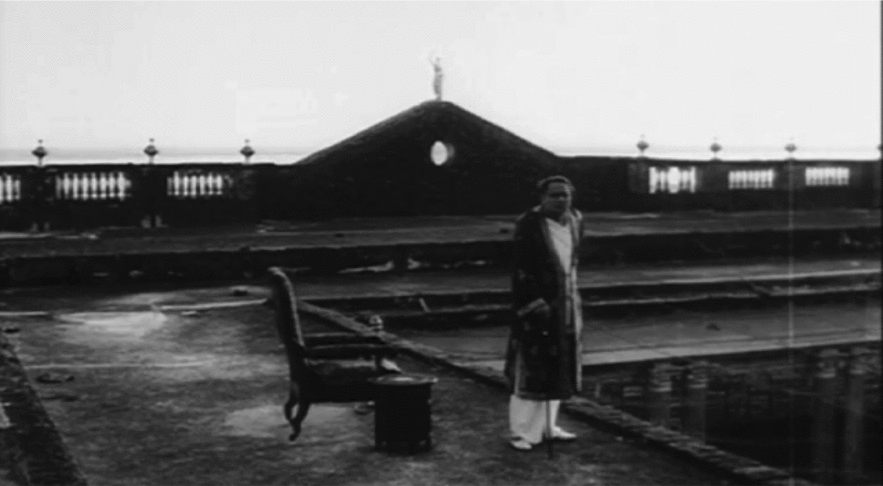
The film is structured as a prologue with two acts.Footnote 23 In the prologue, we see a bereft and life-less Lord Roy on the open rooftop terrace of his palace. He sits in an elegant but worn upholstered armchair, holding his gilded cane next to his face in a melancholy manner.Footnote 24 All is so still that we think it a photograph that has frozen a moment in time. Roy is roused from his lassitude when he hears music—the playing of the shenai, an oboe-like instrument associated with auspicious occasions (see Figure 1).Footnote 25 He asks his servant, Ananta, what the occasion is. Ananta informs that Roy's neighbour and nemesis, Mahim Ganguly, is holding the upanayan ceremony for his son—an important initiation or coming-of-age ceremony that upper-caste adolescent males did and do as a rite of passage towards adulthood.Footnote 26 Roy's ear is so attuned that he identifies which specific musician is playing the shenai. Ganguly, we will learn, is an entrepreneurial parvenu—at least from the perspective of Lord Roy and also, arguably, from the perspective of director Ray.
Jalsaghar: Lord Roy on his terrace. Source: Courtesy of Aurora Films.
The Lord asks if he himself was invited to the ceremony and whether he was invited by letter or in person; those who are to be the most honoured guests should be invited in person.Footnote 27 He was invited, but by letter. Still, the sounds of the shenai and the idea of upanayan make Roy smile, and this takes Roy and the viewer back four years; for the viewer, it is a flashback but, for Roy, it is his memory.
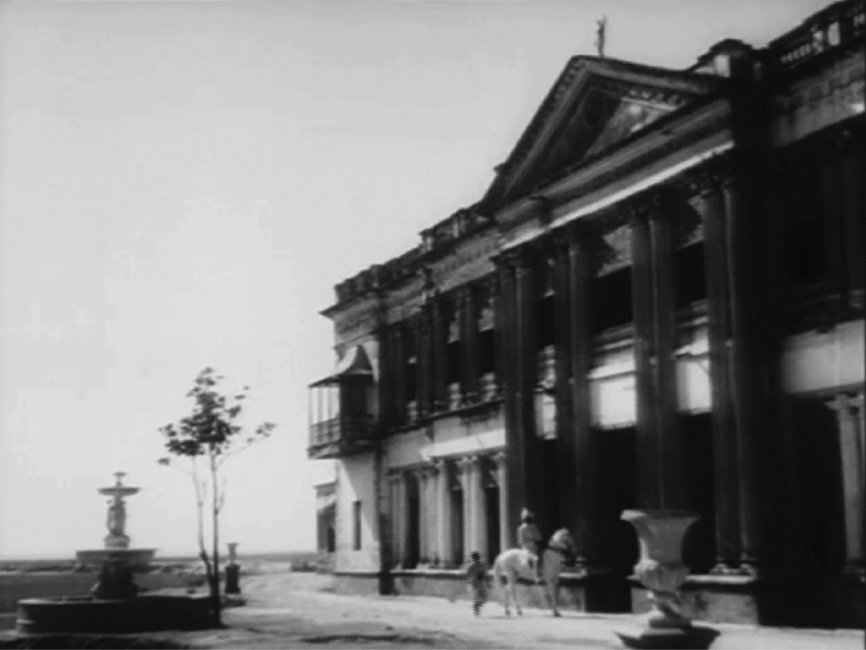
Act I, the flashback, is lengthy, at about 50 minutes. It is the upanayan day of Lord Roy's only son, Khoka. Roy arrives at his palace on his white steed, in a jaunty but leisurely gallop, dressed magnificently (see Figure 2). Two shenai players and a tabla player are filling the estate with music. He is happy. But all is not as splendiferous as it seems: on entering the palace, the estate's manager, Prasanna, informs Roy that the bank has sent a letter declining his application for more credit. We are implicitly reminded of Ganguly's invitation by letter, rather than in person, and soon learn that Ganguly, like the bank, is rich. Still, although Lord Roy's estate is in financial trouble, the film makes clear early in the flashback that this does not much trouble him; he seems to find the mundane to be beneath him. Prasanna and Roy's wife, Mahamaya, will later say that he should have given more attention to the practical and financial aspects of running a zami (an estate). But the Lord's passions—Mahamaya suggests they are more addictions—are not for the practical, but for the noble, as Roy views them.
Jalsaghar: Lord Roy arrives at his splendid palace, with fountain in front. Source: Courtesy of Aurora Films.
The Lord is informed that Ganguly is already at the palace, awaiting his return. Roy refers to Ganguly as a ‘userer's son’ (soodkhorer beta) with disdain. But Ganguly has a business proposition and, given the estate's financial problems, the manager cajoles the Lord into seeing him. Roy receives Ganguly in the soirée room, where he treats Ganguly as an inferior, not worthy of the usual hospitality: no refreshment or even a seat is offered. Nevertheless, he agrees to Ganguly's request to rent a portion of the Lord's estate for a business enterprise.Footnote 28 Roy reminds Ganguly that the Roy family has always been noble in its financial dealings, and intimates to Ganguly that he must treat any workers for his business accordingly. After Ganguly is dismissed, Roy instructs Prasanna that no money acquired from the family of the usurer—tainted money—can be used towards the costs of his son's all-important initiation. That night, the Lord has something of squabble with his wife about the value of money, and the cost of costs, in which she suggests he close the soirée room because it is financially unfeasible and, as noted, an addiction. He does not agree.
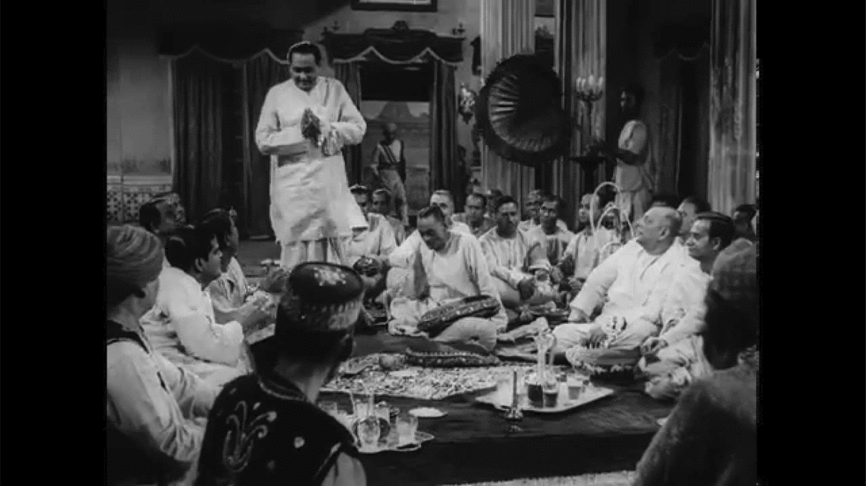
During a soirée at Roy's house, the Lord and his other refined guests are enthralled, awed, mesmerized, and transported into an earthly paradise. The paradise is a sensual one, of perfume, sweets, flowers, drink, hookahs, paintings, and, above all, music and dance—the dancing including both erotic and religious elements. The guests languorously lose themselves in these exceptional, uplifting, and collective pleasures, while servants fan them: the evening is already appealing, as it is cooler than the heat of the day, but the servants’ fanning makes the experience more regal as well as more comfortable (see Figure 3).
Jalsaghar: the host of noble lineage—a soirée at the House of Roy. Source: Courtesy of Aurora Films.
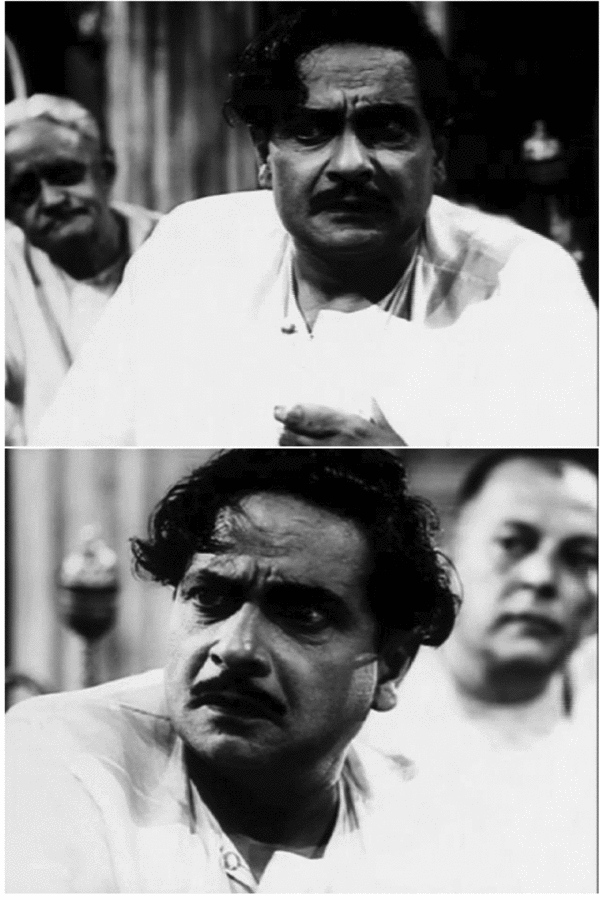
The businessman Ganguly has been invited (by letter) and sits among them in the ‘audience’.Footnote 29 In contrast to the Lord and the other guests, he seems somehow out of place—or, perhaps, from some other time. While others are transported by the delights of the event, Ganguly seems distracted and his consumption of tobacco—cigarettes and snuff, not the stately hookah—and alcohol seems to arise from a compulsive restlessness, one that may make him entrepreneurial and enterprising, but perhaps not suited for the more noble and finer things in life. At a key moment, he looks more perturbed and irked than enthralled by the music, dance, and indeed the entire sensorium (see Figure 4).
Jalsaghar: Ganguly is perturbed at a soirée. Source: Courtesy of Aurora Films.
The association between the time-space of the jalsaghar and paradise, as an ideal to be appreciated, valued, lived, and even dreamt, is evinced in a sequence in which Roy and his wife have a disagreement over money, as mentioned above: he has pawned her jewels to pay for a soirée. Mahamaya describes a disturbing nightmare that she had about the estate and recalls that the estate once had a proper garden, but the river has long since washed it away. Lord Roy counters, saying that, when he dreams, it is of a jalsaghar: ‘… a grand soirée is occurring: Rambha sings, Urvashi dances, and Menaka … Menaka.’ In uttering this last name, Roy falls asleep and drifts, we may presume, into this dream of delight. Rambha, Urvashi, and Menaka are the names of well-known celestial nymphs (apsaras) in Hindu mythology, including the Hindu classic, the Mahabharata. These apsaras are comparable to Greek muses. They dance exquisitely to the music played at the courts of Indra, the king of all deities, in godly palaces. Urvashi is beautiful and elusive, the source of much delight, and is considered a ‘dawn goddess’ (see note 18). Rambha, an unrivalled musician and dancer, and Menaka are sent by Indra to tempt the penances of the most revered sages with their offerings of worldly pleasures. The viewer of the film is clearly expected to know these references to the classics, and the pleasures to which they are tied.
Sometime after the film's first soirée scene (there are three), the son Khoka and wife leave to visit her family.Footnote 30 To get there and back, they will have to take a boat to cross the river that bounds the estate.Footnote 31 But Roy decides to host another soirée—in large measure to prevent Ganguly from hosting one. He asks his son and wife to hurry back so that they can be present at the ancestral home, though the soirée itself is primarily for adult males. But, as the guests arrive and the soirée begins and continues, the two have still not returned. A storm is raging. Roy takes leave of the soirée and goes outside, seeking news. Prasanna, quaking, standing in the storm, says that both son and wife have perished in the river. Khoka's corpse is brought to Roy. He steps into the storm to take his son's body and clutches it to his own. Crying ‘Khoka! Khoka!’ in tearful agony, the Lord falls into the mud.
Here the flashback ends, but the film continues to what I am calling Act II. After the loss of his son and wife, Roy withdraws from life and secludes himself upstairs, never leaving the palace. He has the soirée room closed and renounces all pleasures associated with it, except the hookah. Only Ananta and Prasanna remain of his staff, whereas once there were hundreds. Many of his possessions, including silverware and furniture, have had to be sold. The palace is so dilapidated that it can hardly be called a proper house for humans, let alone a palace. Now, bats and birds and dogs and spiders also live there.Footnote 32 There are cobwebs. The estate's Kali temple remains, as well as some funds dedicated to maintaining it. And his horse and elephant remain, too: the Lord had refused to sell them, despite offers. We are, in fact, back to the very beginning of the film, but, with the flashback finished, the film will now move forward.
As Act II proceeds, Ganguly comes to see Lord Roy, arriving with celerity in a motorcar, horn honking stridently. While waiting to see Roy, he disparages the palace: its disrepair, the lack of servants. He notes that, even in this condition, the palace retains some economic utility, namely if sold to generate money. When he finally sees the Lord, it is on a veranda, not inside the soirée room, which remains closed. This time, Ganguly takes a seat and is given something to drink, which he tries to avoid imbibing—a further sign of disrespect. Ganguly no longer calls Roy ‘Lord’, but has taken the liberty of calling him ‘grandfather’, thus inserting himself into the noble lineage and, at once, undermining Roy's select status. Ganguly implies that Roy's gold-handled cane, which the Lord once carried about like a royal staff, is no longer an accoutrement of prestige, but a crutch for those who have become feeble with age, whose time has passed.
Ganguly has come to invite Roy to the opening of his new jalsaghar. He boasts about whom he has hired to perform: a dancer and musicians of rare excellence. Roy declines to attend, even though Ganguly has come in person to invite him. It seems that, for Roy, Ganguly may host performances, but could never host true soirées, because Ganguly is uncultivated and thus an illegitimate curator of what a soirée should offer, such as moments of collective ecstasy and transcendence. For Lord Roy, to delight in the finer things, indeed, to have the cultivation to not only appreciate, but also produce such things, is the preserve of the nobility.Footnote 33
Roy immediately resolves to host a soirée himself, the night following Ganguly's, with the same performers that Ganguly had boasted about. He will best the upstart. But how will he pay? Roy declares he will use the ‘trust’ fund set aside for the worship and maintenance of the goddess Kali housed in the estate's temple. Manager Prasanna, who has always been obedient and servile, is appalled and protests. This is beyond the pale. But Lord Roy insists and the soirée room is reopened. Roy will seek again to summon an earthly paradise, even if it entails crossing Kali, the protective but severe mother goddess.Footnote 34
Ganguly arrives at Roy's soirée. His manner now is all the more brash, even petulant. The evening before, he had hosted a performance, though we did not hear or see it. He behaves almost as if he himself is hosting this soirée, too. At the end of the dancer's enthralling performance, Ganguly tries to make the first gift to the performers, but Roy uses his cane to halt Ganguly's hand. ‘It is the prerogative of the house-holding host’ (grihaswami), Roy says sternly, ‘to give the first benefaction’ (inam), which he then does. Ganguly is humiliated (see Figure 5).
Jalsaghar: Lord Roy to Ganguly: the host house has the privilege of making the first offering. Source: Courtesy of Aurora Films.
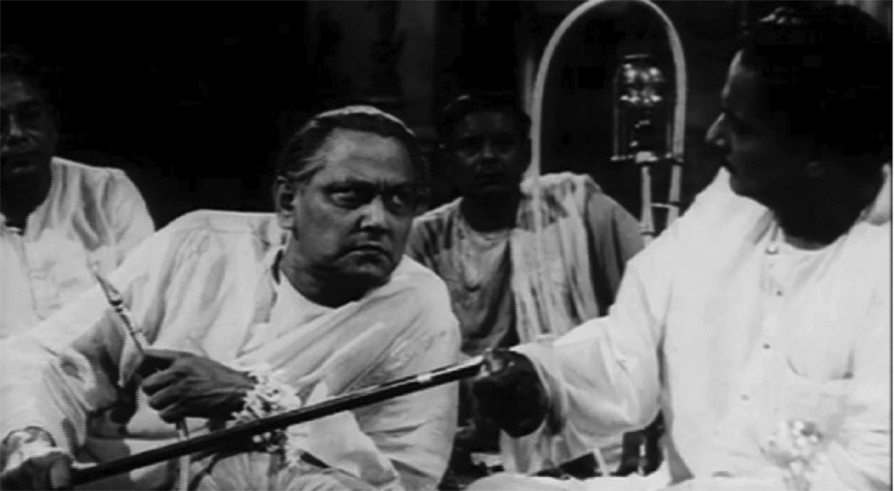
In the final sequence, Roy is elated, now less for the experience of the soirée in itself, but insofar as it served as a means to an end: to demean Ganguly. The Lord is intoxicated, but by victory, not beauty. Moreover, to arrive at this end, he used the money appropriated, inappropriately, from the temple fund, from the truly sacrosanct.
Roy's and Ray's earthly paradise
As in Ray's other films, Jalsaghar complicates the interrelations between the aesthetic and spiritual traditions of Bengal's older nobility, on the one hand, and an anti-elitist and putatively populist utilitarian modernity, on the other.Footnote 35 Putting these more abstractly, I see, in Jalsaghar, a juxtaposition between values that are ends in themselves versus values that are means to an end. The moments of transcendent experience that Ray conveys through his depiction of the soirées appear as ends in themselves, not as, primarily, tools to other goals beyond the uplifting and edifying experience itself; Lord Roy betrays this noble ideal when he uses the soirée, the possibility of earthly paradise, to humble Ganguly.
Paradise and/as enacting the classical
The decline and demise of Lord Roy are already announced in the film's first sequence. As noted above, he is shown motionless and, as the camera zooms out (as the ‘photograph’ becomes film), we see that he is on the large open roof terrace of his palace. The terrace, and Roy, are enclosed by a Greek-revival-style balustrade interrupted by the palace's tympanus with its acroterion on top. These are a homage to the ethos and spirit of a classical age, not uncommon during that period of British imperialism in India. Ostensibly, therefore, Roy is seated in a (Western) neo-classical temple—or the vestiges of one, as the entire terrace is desolate and decrepit (see Figure 1).
These hints of grandeur are also conveyed at the beginning of the flashback where we see the estate as whole, bounded by the river Padma in the distance. The palace's imposing façade comes into full view. Next to it stand a tree and a fountain that, in accordance with the British colonial Greek revival mentioned above, is embellished with Caryatids, reminiscent of those of the Erechtheion on the Athenian Acropolis (see Figure 2).Footnote 36
Ronald Inden speaks of Italy's Renaissance era Villa d'Este's complex of palace, gardens, fountains, music, poetry, dinners, and spectacles staged so that ecstasy could be experienced: ‘The villa with its gardens was an earthly paradise where men engaged in diverting practices that induced moments of transcendence during life’.Footnote 37 The earthly paradise of villa and garden is the time-space where the classics, in which the members of the ruling society had been educated, came back to life. Seeing themselves as adults edified by having studied the Classical (Greek and Roman) age was integral to the ‘fashioning of themselves as men and women resident in a courtly paradise and to the fashioning of that paradise itself’.Footnote 38 It is in this sense that the idea of earthly paradise goes beyond the individual performances in the soirée room. Instead, the complex assemblage of acts and effects serve to demarcate the unique enclosure that is this paradise—a time-space wherein one can, potentially, have ecstatic or transcendent experiences, for its aim is to induce them.Footnote 39
Inden's analysis is important for two reasons. First, his reference to the re-enacting of the classics is echoed in Jalsaghar, albeit in variously mediated and altered forms. This is evident in the appropriation of Greek styles by first the British and then, in turn, the zamindars. Furthermore, the film celebrates classical Indian music and dance; the issue of classics will be revisited below. The soirée scenes are so extended and impressive that I would argue that the film is committed to sharing these as extraordinary experiences in themselves more than to advance the plot, namely Lord Roy's decline, Ganguly's rise, and so on. Without such attention to, indeed immersion into, the soirées, the story would be much less compelling. Through the soirées, the film brings the earthly paradise into the viewer's present, so the viewer will savour and value it appropriately. The jalsaghar, the inner sanctum of the protagonist Lord Roy's palace, is a time-space enclosure which encompasses those inside it who, in turn, are expected to be edified enough to experience the moments of ecstatic delight that these events offer, and which then edifies all the more. In this sense, the soirée room is a chronotope of pleasure that is comparable to how Socrates characterized the gardens (pairidaeza) of Persian kings, ‘filled with all the fine and good things that the earth wishes to bring forth’.Footnote 40
Second, Inden underscores that, with regard to how these paradisiacal performances index the status of the garden's owners, tidy dichotomies between the religious and the secular and between tradition and modernity are dubious at best. ‘Classical imagery is being used to symbolise secular entities, the power, wealth, and fame of the garden's owner’, but any ‘dichotomy of “religious” and “secular” which echoes those of “traditional” or “medieval” and “modern,” is, however, too neat if not downright false’.Footnote 41 For the purposes of my argument, Inden's point is important insofar as the overlaps among paradise, lineage, and nation also bring together the putatively religious with the secular, the immortal classics with the ephemeral modern, and, in bhadra nationalism, the hope of suturing nobility with utility.Footnote 42
It is through the words of Roy's servant, Ananta, that one gets a sense of the components that make a building into a palace where paradise can be made present. Early in the flashback, we see Roy listening to a live sitar recital, sitting leisurely on a veranda and smoking his hookah. Unfortunately, an obstinate clanging then intrudes upon this subtle ambience. Ananta explains that the noise is that of the new electric generator purchased by Ganguly. Ananta speaks admiringly of the light the generator can produce even in the dead of night and, that night, Roy goes to his rooftop terrace to see the light emanating from his rival's house.Footnote 43 Later in the flashback, Roy asks Ananta to describe Ganguly's estate. By this point, Ananta is well aware that Lord Roy and his arriviste neighbour are in competition and, accordingly, what he is really being asked. He replies: ‘It is not as prestigious as your palace: no music room, no fountain, no garden, no temple, nothing.’Footnote 44
For the Lord, the palace is a place for the generation of delight, not revenue: a place for a nobility that transcends the boorish banality of money or utility—a place only those who have the right lineage and the right aesthetic education can uphold and extend.Footnote 45
Paradise and/as lineage
The soirée also overlaps with the idea of noble lineage, and vice versa. At one level, this seems obvious; after all, in the scene where Lord Roy revels in his humiliation of Ganguly at the final soirée, he explicitly says that he was able to do so because of his noble lineage (‘noble’ spoken in English). But my claim is stronger: the moments of earthly paradise that the soirées offer are a way of manifesting or channelling or making present the glory of the lineage—a lineage that itself is thereby also a spectacle of sound and light. The ecstasy of the soirée is also that of an aesthetic and spiritual joining with, or sharing in, the lineage itself, of being encompassed in its glory.Footnote 46 To enter the soirée is not to enter a room, but rather to participate in an event—if one has the qualities and refinement to do so—that allows one to experience the nobility and beauty of the lineage, at least for a time.
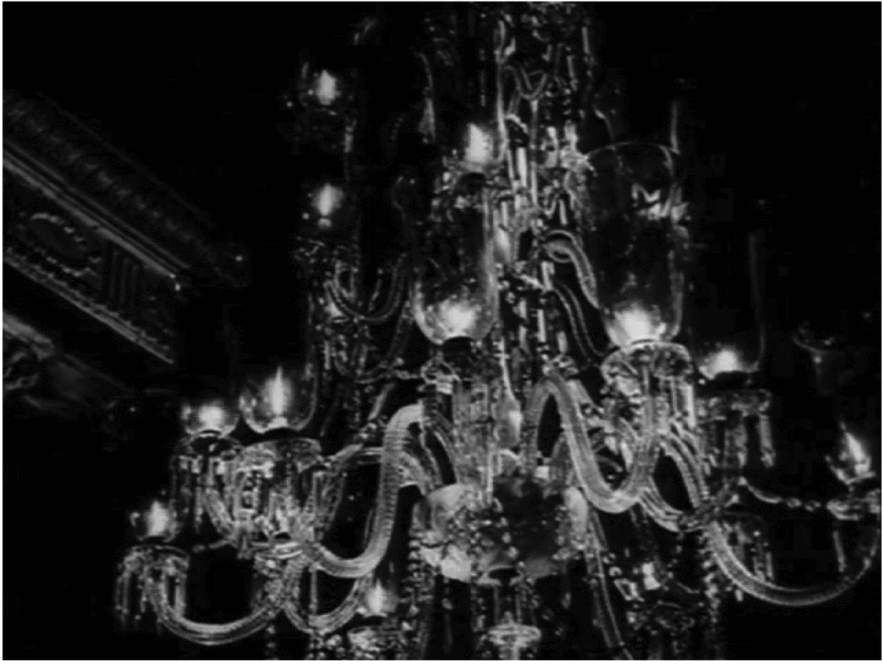
Most interpreters of Jalsaghar have focused on the symbolism of the mirrors in the movie, and not without reason. Yet, in my view, the central symbol of the film is the main chandelier in the soirée room that, I argue, stands for Roy's lineage. Importantly, it is the chandelier that begins and ends the movie, swaying uncertainly in the dark, while the credits roll. The chandelier also sways portentously during the storm—a storm that arises during a soirée, and in which Roy's son perishes and also his wife; with her dies the possibility of having another son for the patriline.
Phillip Kemp and others have taken the chandelier as a sign that the Lord's way of life—and that of the zamindars more broadly, presumably—is ‘grandiose but obsolescent’.Footnote 47 The chandelier, in this interpretation, would be contrasted with Ganguly's electric generator, with the candles in the crystal sconces set against the bulbs of the modern machine; this would, indeed, be Ganguly's perspective. But transcendence is not subject to the historical time of technological progress. I have argued throughout that, for Roy, the palace with its soirées is a place for rarefied delight, not accumulating profits. Likewise, in my view, the chandelier is a manifestation of a living lineage that is, in fact, musical and luminous; if the chandelier were to be valued by its utility alone, with utility itself defined in a particular way, only then could the chandelier be evaluated as ‘obsolescent’, out-of-date.
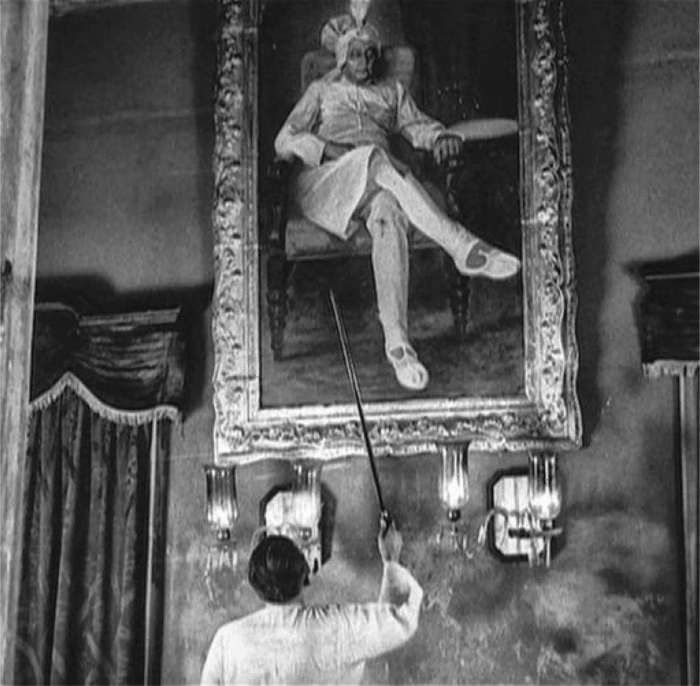
It is true that, when he tries to explain his superiority to his servant Ananta, Roy speaks of his lineage in terms of bloodlines, saying ‘blood’ in both English and Bengali (rakta).Footnote 48 But, immediately thereafter, Roy toasts his noble ancestors: his grandfather, followed by his great-grandfather, and finally his great-great-grandfather, raising his glass to each of their portraits in that order, going further and further back in time and history. Significantly, the portraits are all in the soirée room and all shine, are visible, because of the chandelier. In the film, the chandelier is shown to be jingling sweetly more than once. In one scene, it is the very jingling of the chandelier that prompts a pan of these portraits of the ancestors accompanied by a medley of soirée music. After toasting his ancestors, Roy turns to his own portrait and toasts his ‘own noble self’. He is then troubled to see a spider on his portrait and the soundtrack becomes alarming—thunderclaps in a storm, like that of when he clutched Khoka's corpse. He shoos the spider away with his cane (in a gesture that redoubles how he had used the cane to demean Ganguly at the soirée, another intruder into the soirée-as-lineage) (see Figure 6). Immediately thereafter, he trains his attention to the glorious chandelier that illuminates the soirée room; he is directed to it, initially, by a reflection of the chandelier in the glass he had raised to applaud and admire his ancestors’ nobility, as well as his own. It is the chandelier that captures him now, in its splendour, as he looks up at it and its light and sparkle shower him, a luminous ablution, with sublime sitar strains as accompaniment.
Jalsaghar: Roy shoos spider—another encroachment on the lineage—off his portrait's knee. Source: Courtesy of Aurora Films.
The Bengali word for chandelier (jharabati) can mean, with a bit of license, something like ‘a cascade of luminosity’. In Bengali, the word ghar means room, as in jalsa-ghar, but it can also mean ‘house and family’.Footnote 49 Thus, the chandelier hanging in the music room, or ghar, embodies three-dimensionally this brilliant family ‘tree’, the light of which now shines on, and through, Roy, the adult descendant, the latest curator of both lineage and delight, until his son is ready to take charge (see Figure 7).Footnote 50
Jalsaghar: the chandelier—luminous and musical lineage. Source: Courtesy of Aurora Films.
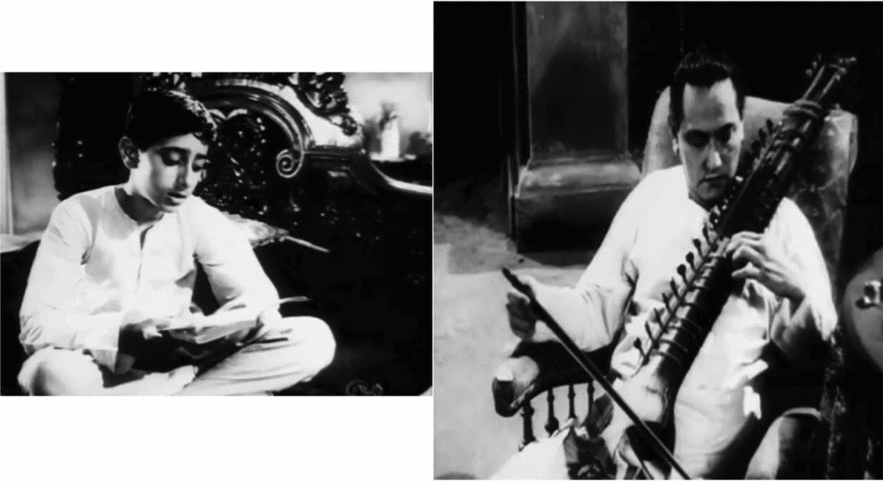
In the flashback, we saw the Lord preparing his son Khoka, the next in line, for a life of nobility. We saw Khoka learning about painting (he is especially attentive when his father's portrait is painted) and being tutored in music by Roy himself (see Figure 8). Khoka learned to ride the elephant and his father's horse; in the original short story, we are told that the Roy household once had many stables of horses. At one point, Mahamaya complained that Khoka has inherited his father's obsessions with the arts and with riding, to the point of neglecting his studies. Roy explained that the son must indeed inherit—learn—these things, in order to embody the lineage and properly rule over the palace and estate when his time comes. There can be no compromising when it comes to nurturing Khoka's noble character (including horse-riding) or aesthetic and spiritual edification.
Jalsaghar: father tutoring son in music. Source: Courtesy of Aurora Films.
By the final scene, however, his son has died and, in the soirée room, the chandelier's candles start going out, one by one. Then all the other candles around the room go out as well. Seeing this, Lord Roy is gripped with dread. The camera shows us the chandelier and Roy approaching it, staring up in horror. Significantly, Roy then steps out of the shot for a moment, but the camera stays focused on the chandelier. Roy returns just as the last candle in the chandelier dies. His spectacular lineage is being extinguished. He falls to the ground, as he did with Khoka's corpse. He cries out for Ananta, who rushes to his side and assures that dawn has arrived.
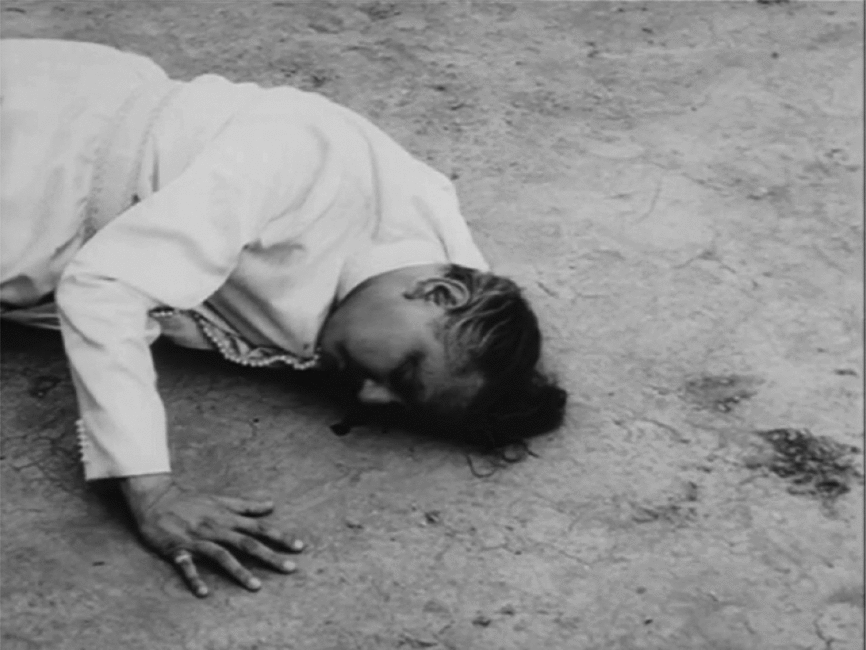
Roy hears his horse neighing, reminding us again of the auspicious shenai’s call and, after a good look at his gold-handled cane, he insists he will immediately go riding. Ananta tries to stop him, but he rides off, straight at a boat on the bank of the river, prompting the viewer to recall that his son and wife were killed while travelling, in a boat, to be back at the palace in time for the soirée, as the Lord had insisted. The zamindar charges ahead, faster and faster. But, unlike the ecstasy-inducing acceleration of a soirée's music and dance, there is no pleasure in this gathering speed—only uncertainty and fear. His horse throws him and he dies (see Figure 9). It is the dawn of a new era, but the Gangulys of the world, and their lineages, cannot enrich India in the fullest sense. India must look to the future, but without losing its euphonious, lustrous, and illustrious ideals (see Figure 10). Who then will suture together these diverse agendas?
Jalsaghar: Lord Roy, dead after being thrown from a horse. Source: Courtesy of Aurora Films.
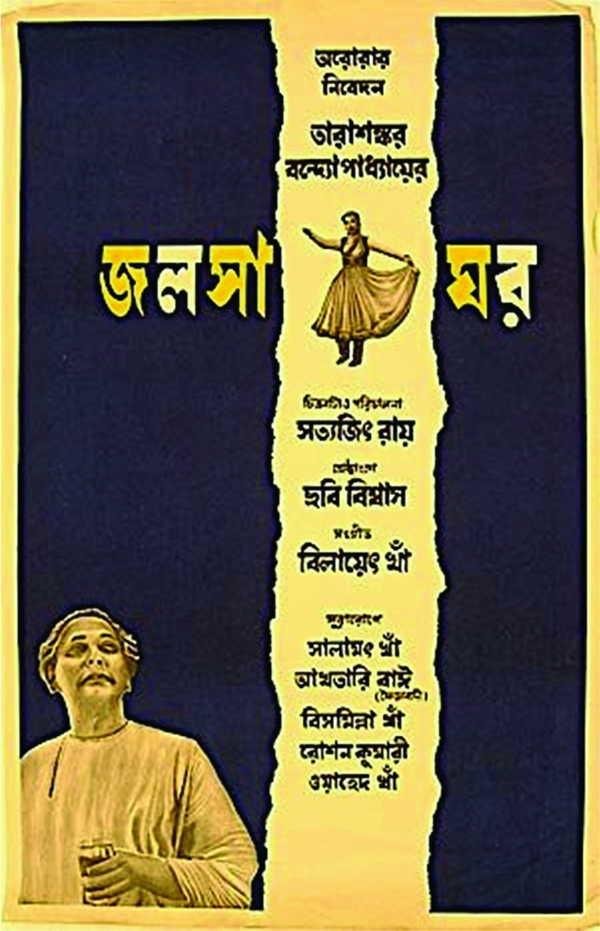
Jalsaghar film poster. The film's title is presented as a chandelier, with the jalsa image in the middle. Lord Roy looks up while the light of the lineage flows down. Source: Courtesy of Aurora Films.
The absent presence of the bhadralok
By insisting on the aesthetic patrimony of cultural refinement, the film calls for new curators of earthly paradise and a new role for both curators and paradise in the new nation. My argument is that the film awards the bhadralok the role of producing, preserving, and transmitting this aesthetic patrimony and, consequently, tasks them with suturing this ideal to that of national progress: pursuing at once values that are timeless ends in themselves and those that accumulate value as they progress through time.
Can this argument be advanced when the bhadralok do not appear in the film? When the word bhadralok is never even uttered? I connect the bhadralok to the jalsaghar in two ways. The first is to note that the film is made by and for the bhadralok; the second is by way of invoking the theoretical idea of the ‘constitutive outside’. It is ‘by’ the bhadralok in that the film is based on a short story penned in 1938.Footnote 51 The 1930s were years in which bhadra nationalism was at the fore in Bengal. Further, the author, Tarasankar Bandyopadhyay, was a prolific and popular bhadra author. He was a close associate of bhadralok icon Rabindranath Tagore—the first Asian Nobel Prize winner (as bhadralok are quick to point out), which he won for literature. Tagore's songs, called Rabindrasangeet, were and are treated with great reverence among the bhadralok. That Tagore is linked to—some would say appropriated by—Bengali nationalism is evinced in the fact that his songs are today used as the national anthems for both India and Bangladesh, respectively, with one of the songs composed in the wake of the 1905 partitioning of Bengal by the British Raj and the other composed when Bengal was reunited in 1911. The 1905 partition stoked bhadralok nationalism, and its 1911 reversal was significantly due to the agitation of the bhadralok.Footnote 52 Satyajit Ray, as Sagarika Ghose notes, was a quintessential member of the bhadralok class. Ray, like Bandyopadhyay, also knew Tagore. Tagore was a friend of the Ray family—a family made up largely of intellectuals and writers. Ray later enrolled in a school Tagore had founded, and studied art there.Footnote 53
Jalsaghar is also ‘for’ the bhadralok. Satyajit Ray intended and hoped that it would compensate, at least in part, for his earlier film, Aparajito (Unvanquished, 1956), which was a critical success but a commercial failure. Ray had been looking for a story that was already popular among the reading public in Bengal, as was Jalsaghar—written, as noted above, by an author who was himself also already popular in these circles. The desire for commercial success is also a reason Ray wanted to create a film that was conducive to the incorporation of song and dance—two elements that would help make cinema more popular for his target audience: a specifically Bengali cinema-going audience, for he felt that the film would not be one that would resonate beyond Bengal. The film was expected to draw members of the middle to upper classes, especially through its use of classical Indian music. As Sharmistha Gooptu writes:
The culture of classical music was a growing trend among the more literate sections of the middle classes in post-independence India, and the classical style music and dance sequences in the film, performed by leading practitioners of the day, could have been expected to draw this segment—Ray's own social class.Footnote 54
Thus, the combination of Bandyopadhyay's popularity and the growing interest in classical music and dance provided Ray with a means by which to both exploit and affect the imaginary of his contemporaries.
A second way to establish the centrality of the bhadralok in Jalsaghar given their absence from the film is in theoretical terms. I would argue that the bhadralok serve as a constitutive outside to the conflict between the film's rival figures, Lord Roy and the industrialist Ganguly, the aristocrat and the businessman—or, more broadly, between projects that pursue ends in themselves versus those that pursue means to ends.Footnote 55 As this constitutive outside, the bhadralok can be seen to transcend the film's depicted divide between a decaying yet noble aristocracy and a burgeoning utilitarian industrial class, and, in this way, to point to a specifically bhadralok sense of nationalism, or bhadra nationalism. The semiotics of the film wittingly or otherwise target the Bengali audience, which in this case was predominantly made up of self-described intelligentsia or literati, whose self-identity also entailed a sense of being refined. Through the dynamics of the constitutive outside, the film bestows upon the bhadralok the role of constructing a project of education that is also an initiation, upholding the values of refinement, delight, and art that can give the nation the noble character it needs as it progresses in other, more material terms.Footnote 56
There is another absence, related to the bhadralok, that must be accounted for: why is there no showcasing of Bengali music, dance, etc.? One reason is that Jalsaghar is not specifying how, namely through what activities, it—the preservation of noble character through aesthetics and refinement—must be done as much as demonstrating the step prior: that it must be done, if only to not let such an important task fall into the hands of the likes of Ganguly. Here, the notion of ‘constitutive outside’ is again of help.
But there is more to be said. First is that, as noted in the first paragraph of the article, it is not surprising for the Bengali bhadralok to represent India and Bengal as co-extensive. Insofar as the film is by, for, and about the bhadralok, the music showcased is not not-Bengali. Another way to put this is that anything Indian is Bengali. Sudipta Kaviraj speaks of the ‘confidence of the educated Bengali's chauvinism’ in relation to the bhadralok’s appropriation of history in the nineteenth century: ‘[A] process in which the Bengali aggressively appropriates the other. Bengalis do not as yet see themselves as part of a larger whole; they simply append India to themselves.’ Kaviraj calls this ‘the founding moment of conceiving a “national” community, the historic beginning of an imaginative integration’—one, I might add, very much on the terms preferred by the bhadralok.Footnote 57
The second answer regarding the absence of Bengali content in the jalsas is the emphasis placed on the timeless classics. The bhadralok engagement with the classics was noted above and, indeed, specifically in relation to the intended audience for Jalsaghar. What is more, in India, broadly speaking, there have been two sorts of music that can be called classical: Hindustani and Carnatic, glossed as northern and southern. The performances in Jalsaghar are Hindustani classical—as one would expect in a Bengal that had been under Mughal rule—and the capital of such classic culture at the time was the city of Lucknow. I have described Lord Roy as a connoisseur, but that can be extended to ‘cosmopolitan’. As noted before, the Roy dynasty became a proper dynasty during the Mughal period; we can come to this conclusion on various grounds, but not least because of the lineage—the portraits of his noble ancestors that he toasts, going back to his great-great-grandfather. It should be no surprise that, embedded in this history, the House of Roy's cosmopolitanism would be of Persian influence.Footnote 58 Accordingly, I would say that the issue is not whether the jalsas are or are not Bengali, but that they are classical and, indeed, cosmopolitan. However, this does pose the challenge to the bhadralok that this article has been pointing to: how, then, to appropriate nobility—here, arguably, a classical and Persian-attuned nobility—into the project of Bengali nationalism. The film raises the conundrum and calls the bhadralok to respond (thereby justifying their part in doing so); but the film does not answer how the bhadralok are to carry forward this standard, through what specific practices.Footnote 59
In this article, I have proposed that the bhadralok were challenged to preserve an ethos of nobility that overlaps with the pleasures of earthly paradise. Importantly, it is a paradise in a sensual sense—a garden of wonder, awe, and the uplifting, exceptional, and collective delight of perfumes, sweets, food, flowers, drink, architecture, paintings, gardens, fountains, eroticism, and, above all, song and dance. This is not the other-worldly heaven of unending serenity, bleached white; nor is it a pew-like order as commanded by imposing, authoritative organ music. And it most definitely is not the monastic ideal of paradise sought through penitential prayer, in which the abnegation of pleasure in this life prefigures the same in the afterlife. Rather, here, the ‘task’ is to delight and even transcend. It is an end in itself.Footnote 60
At the same time, this ideal of earthly paradise overlaps with, though is to be kept distinct from, the utilitarian (and perhaps utopian) thinking that also informed bhadralok nationalism. The latter, as reflected in the commitments of Nehru, uphold technological innovation and, more broadly, utilitarian rationality as a means to an end—a way of producing the greatest good for the greatest number of ‘the Indian people’.Footnote 61Jalsaghar says implicitly that, with the feudal lords rightly gone, and the crass businessmen eager but incapable, the role and responsibility of reproducing refinement have been conferred onto the bhadralok. Perhaps we can call it the bhadralok’s burden.
As noted at the outset, Sagarika Ghose finds that the bhadralok have failed to discharge their duty, have failed to lift the other citizens of India to their level of education and refinement. Many bhadralok would argue that it is independent India that has instead failed them, and has prevented them from fulfilling the mission of suturing nobility and utility together into an ideal nation. In any case, the bhadralok are absent in both Jalsaghar and the new India. The film, albeit implicitly, insists on their importance, whereas India, apparently, does not.
Supplementary material
To view supplementary material (including two film clips) for this article, please visit https://doi.org/10.1017/S0026749X16000482.


 Open access

