

Introduction
As an island nation, Japan has traditionally placed significant importance on the maritime industry and fisheries. Guided by a fundamental policy direction aimed at the stable and sustainable use of the ocean and the establishment and maintenance of maritime order, Japan has actively contributed to the formation of international maritime regimes and frameworks while simultaneously advancing relevant legal systems and policies at the domestic level. In addition, Japan adopted a monist approach to the domestic application of international treaties, such as the United Nations Convention on the Law of the Sea (hereinafter referred to as UNCLOS), earlier than other countries in the Northeast Asian region. On the basis of this legal orientation, Japan established a comprehensive legal framework and, in 2007, enacted the Basic Act on Ocean Policy to promote active, integrated, and strategic use, management, and development of its maritime spaces. In accordance with this Act, the Japanese government has since been publishing the Basic Plan on Ocean Policy on a regular basis. To date, four iterations of the Basic Plan on Ocean Policy have been published, reflecting the evolution of Japan’s macro-level and effective response system for ocean governance. The Plan serves as a vital strategic compass guiding Japan’s maritime activities across a wide range of areas, including the sustainable use and conservation of marine resources, protection of the marine environment, maritime transportation, and safety (Kim & Kim, Reference Kim and Kim2024).
Moreover, Japan’s interest in the polar regions emerged earlier than that of its neighbouring countries, such as South Korea and China, largely due to its geographic vulnerability and sensitivity to climate change as an island nation. Initially focused on scientific research and exploration in both the Arctic and Antarctic, Japan’s polar policy has gradually expanded in scope to encompass a broader range of areas, including economic interests, science and technology, environmental protection, and national security (Um, Reference Um2021).
For example, from 1993 to 1999, Japan participated in the International Northern Sea Route Programme (INSROP) with Russia and Norway to assess the technical feasibility of the commercial use of the Northeast Passage. Building on INSROP, Japan launched the Japan Northern Sea Route Programme (JANSROP) to independently evaluate Arctic shipping, including feasibility studies, Arctic-capable bulk carrier design, and trial operations of Russian cargo vessels. From 2002 to 2006, JANSROP-II expanded this work by compiling regional resource data in the Russian Far East, developing the world’s first Arctic shipping GIS (JANSROP-GIS), and proposing a marine environmental protection regime for the Sea of Okhotsk (Yoo, Reference Yoo2023).
In particular, as a non-Arctic state, Japan has positioned itself not as a stakeholder but as a contributor to Arctic affairs. By expressing its national intent to actively engage in addressing various challenges surrounding the Arctic, Japan seeks to enhance its presence and demonstrate leadership in Arctic governance within the international community (Park & Lee, Reference Park and Lee2022).
However, existing research on Japan’s maritime policy has generally treated maritime and Arctic policies as separate areas of study or has focused on analysing the relationship between maritime law and maritime policy. Notably, with the release of Japan’s 4th Basic Plan on Ocean Policy in 2023, there has been little comparative analysis incorporating all 4 Plans, and few studies have examined the comprehensive and strategic evolution of Japan’s maritime policy alongside the emergence and development of its Arctic policy. This study distinguishes itself by addressing this interrelationship and providing a more integrated perspective. Accordingly, this paper analyses the content of Japan’s 1st through 4th Basic Plans on Ocean Policy, along with its Arctic policy, by first examining each plan and policy individually, and then conducting a comparative analysis to identify key characteristics, transitions, and their broader implications.
Comparison of the Basic Plan on Ocean Policy
The 1st Basic Plan on Ocean Policy (2008)
In 2007, the Headquarters for Ocean Policy was established within the Japanese Cabinet to promote a comprehensive and strategic maritime policy. It is a cabinet-level, cross-ministerial coordination body. Rather than being housed in a single ministry, the Headquarters operates at the highest level of government, reflecting Japan’s recognition of the ocean as a strategic domain that cuts across security, environmental protection, scientific research, economic development, and territorial governance. The Prime Minister of Japan serves as the Director-General of the Headquarters, ensuring strong political leadership and authority. The Chief Cabinet Secretary and the Minister in Charge of Ocean Policy act as Vice Directors-General, while all other Ministers of State participate as members. This composition enables comprehensive, whole-of-government coordination and minimises fragmentation among ministries with overlapping maritime responsibilities (Cabinet Office, 2023).
In addition, the Ocean Policy Secretariat is the permanent administrative body supporting the Headquarters for Ocean Policy. It is responsible for policy planning, data analysis, and the practical coordination of inter-ministerial consultations. The Secretariat primarily handles administrative and operational tasks and provides substantive support for both the formulation and implementation of the Basic Plan for Ocean Policy. The Secretariat is led by a senior official of the Cabinet Office at the director-general level and is staffed mainly by seconded officials from across multiple ministries rather than personnel belonging to a single ministry. This cross-ministerial staffing structure enables the Secretariat to integrate diverse expertise and facilitate effective whole-of-government coordination in ocean policy. (Cabinet Office, 2023).
That same year, the 1st Basic Plan on Ocean Policy was released in 2007, based on six fundamental principles and comprising twelve key policy measures. Among these twelve measures, those concerning maritime development primarily focus on the development and utilisation of marine resources. In the area of scientific knowledge, emphasis is placed on technological research and development. With regard to integrated ocean management, the policy mainly addresses maritime zones adjacent to Japanese territory and remote islands, rather than targeting distant offshore areas (Cabinet Office, 2008). A notable feature of this 1st Plan is the inclusion of public awareness and human resource development related to ocean affairs. This reflects Japan’s recognition, as an island nation, of the importance of public education and the cultivation of talent in various fields such as maritime policy and technology. During this period, Japan had not yet shown significant interest in the Arctic region, which was still perceived as relatively distant and less directly relevant to its national maritime agenda. This is summarized in Figure 1.
Principles and policy measures in the 1st Basic Plan on Ocean Policy Cabinet Office, Government of Japan, 2008.

Although the 1st Basic Plan on Ocean Policy did not explicitly include detailed references to the Arctic, indicating limited direct governmental interest at the time, Arctic-related research was actively pursued at the private and academic levels. Based on these efforts, there was a notable trend of proposing advanced policies and measures to the government from non-state actors. For example, the Sasakawa Peace Foundation, a private organisation affiliated with the Nippon Foundation and possessing an extensive international marine research network, had actively engaged in research and policy advisory activities aimed at shaping Japan’s early marine and Arctic policies even before the Japanese government developed a full-fledged interest in Arctic affairs (Yoo, Reference Yoo2023).
In particular, in 2010, Ocean Policy Research Institute, which is a policy-oriented think-tank under the Sasakawa Peace Foundation, established the Japan Arctic Ocean Conference (日本北極海会議) with the explicit objective of providing policy recommendations to the Japanese government. The participants included government officials involved in marine affairs, as well as academics, practitioners, and researchers, forming a cross-sectoral expert network. As a privately led platform, the Arctic Ocean Conference played an important role in laying the initial intellectual and institutional foundations for the formation of Japan’s Arctic policy (Yoo, Reference Yoo2023).
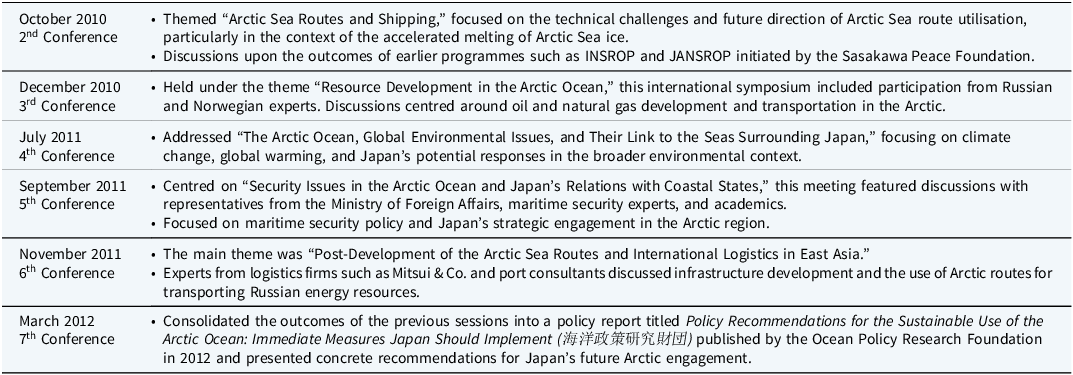
The series of Arctic Ocean Conferences held between 2010 and 2012 played a significant role in shaping discourse before the formulation of the 2nd Basic Plan. These conferences facilitated discussions on global governance related to the Arctic, starting from the framework of international law and ocean governance, and extending to the exploration of diverse and comprehensive Arctic regimes that could be applied to the Arctic Ocean (Yoo, Reference Yoo2023). Through these conferences, various policy recommendations were made to the Japanese government, including the establishment of a dedicated body for Arctic policy, active participation in Arctic Ocean governance and marine environmental protection, involvement in the management and development of Arctic resources, the strengthening of Arctic research activities, prompt responses to changes in logistics resulting from the opening of Arctic sea routes, the formulation of new security strategies to address such developments, contribution to the establishment of a stable order in the Arctic Ocean, and enhanced cooperation with Russia (Jin, Reference Jin2016). History and Main Contents of the Arctic Ocean Conference are shown in Table 1.

In 2012, the Ocean Policy Research Foundation laid the groundwork for Japan’s Arctic policy by releasing a comprehensive proposal titled Policy Measures for the Sustainable Use of the Arctic, which included nine key policy recommendations (Seo, Reference Seo2020). That same year, in November, the Japan Institute of International Affairs published a strategic report entitled Arctic Governance and Japan’s Diplomatic Strategy. The report assessed the current status of Arctic affairs across various sectors, including resource and energy development, Arctic Sea routes, security, environmental protection, and governance. It presented six major policy recommendations to the Japanese government:
-
1. Establish win-win relationships with Arctic states in the field of resource development;
-
2. Ensure the proper implementation of the UNCLOS;
-
3. Strengthen cooperation with the United States on Arctic-related issues;
-
4. Leverage Japan’s expertise and environmental technologies to play a leading role in Arctic environmental protection;
-
5. Participate more actively in Arctic diplomacy; and
-
6. Strengthen the national Arctic policy system by establishing an Arctic Headquarters within the Cabinet Office (Jin, Reference Jin2016).
The 2nd Basic Plan on Ocean Policy (2013)
In March 2013, the Japanese government released its 2nd Basic Plan on Ocean Policy, marking the first time that the Arctic was explicitly included in a national-level ocean policy document. Although the scope was limited, the inclusion of the Arctic signified a shift toward governmental recognition of the region’s strategic importance. The 2nd Basic Plan was formulated in response to a range of natural and geopolitical developments following the Great East Japan Earthquake, including renewed attention to disaster preparedness, the reassessment of energy policies, rising expectations for marine and renewable resources, shifting international dynamics over maritime interests, global environmental changes, and the increasing feasibility of utilising Arctic Sea routes. Unlike the 1st Basic Plan, the 2nd plan incorporated substantial content related to the Arctic Ocean, laying the foundation for a more strategic governmental approach to Arctic affairs. The plan emphasised the importance of Arctic observation and research, international cooperation at a global level, and the exploration of the potential of Arctic Sea routes – thus establishing the groundwork for Japan’s evolving Arctic policy (Park & Lee, Reference Park and Lee2022).
In particular, the plan identified four key strategic objectives aimed at addressing the various emerging issues surrounding the Arctic Ocean. Building upon existing thematic continuity, these objectives emphasised a global perspective on the Arctic and reflected Japan’s growing interest in both environmental and geopolitical dimensions of the region. The designated priorities included:
-
1. Observation and Research on the Arctic, to better understand and predict Arctic Sea ice reduction and environmental changes resulting from climate change;
-
2. Conservation of the Arctic Environment, focusing on the preservation of fragile ecosystems;
-
3. International Coordination and Cooperation, emphasising global collaboration on Arctic-related matters; and
-
4. Study on the Feasibility and Safe Navigation of the Arctic Sea Route, which aimed to explore the potential of utilising Arctic maritime routes and to develop comprehensive and strategic responses to the environmental changes affecting the Arctic Ocean (Kim & Baek, Reference Kim and Baek2017).
The 2nd Basic Plan on Ocean Policy is structured into three main chapters, in addition to an introductory overview. Chapter 1 outlines the fundamental policies and frameworks related to maritime affairs, offering an analysis of both domestic and international oceanic conditions and presenting the overarching direction and specific areas of Japan’s maritime policy. Chapter 2 delves into detailed policy measures that the government must systematically and comprehensively implement. These include a wide range of thematic areas such as marine resources, the marine environment, the Exclusive Economic Zone (hereinafter referred as to EEZ), maritime transportation and logistics, maritime security, oceanographic surveys, marine science and technology research, development of the marine industry, coastal and remote island management, international cooperation in maritime affairs, and marine education and public awareness. Chapter 3 discusses the administrative and operational requirements necessary to implement the above policies and outlines areas requiring revisions or enhancements to improve policy effectiveness. The table below summarises all references to the “Arctic” as they appear in the original text of the 2nd Basic Plan. A review of this content reveals that, at the time, the Japanese government was particularly focused on the Arctic Sea Route, viewing it as a key area of strategic interest in the context of climate change and the resulting transformation of Arctic maritime conditions.
In March 2013, the Japanese Ministry of Foreign Affairs formally appointed an ambassador in charge of Arctic Affairs, responsible for representing Japan’s position within the Arctic Council. Subsequently, in May of the same year, Japan was granted permanent observer status in the Arctic Council. These developments marked a significant step in Japan’s proactive engagement in Arctic governance. To further strengthen its comprehensive approach to Arctic Ocean issues, the Japanese government established the Liaison Conference for Arctic Affairs among Relevant Ministries and Agencies in July 2013. It functions as an intra-governmental coordination conference mechanism (the inter-ministerial body) centred around the Headquarters for Ocean Policy including representatives from ten key ministries and agencies: the Cabinet Secretariat, (Cabinet Office, 2023) Ministry of Internal Affairs and Communications, Ministry of Education, Culture, Sports, Science and Technology (hereinafter referred to as MEXT), Ministry of Agriculture, Forestry and Fisheries, Ministry of Economy, Trade and Industry, Ministry of Land, Infrastructure, Transport and Tourism, Ministry of the Environment, and Ministry of Defense (Yoo, Reference Yoo2023). Over the course of ten meetings, the Liaison Conference for Arctic Affairs facilitated inter-ministerial information sharing and conducted a comprehensive review of Japan’s potential contributions to the Arctic region. The discussions focused on identifying key policy priorities, expanding Japan’s role through Arctic observation and research, strengthening global cooperation, and assessing the feasibility of Arctic Sea routes. These efforts culminated in the formulation of Japan’s Arctic Policy in 2015, which systematically outlined the country’s strategic approach to Arctic Ocean issues (Park & Lee, Reference Park and Lee2022).
Japan’s Arctic Policy, published in 2015, is grounded in the principle of Proactive Contribution to Peace and aims to position Japan as a key contributor to the international community through coordinated efforts across various sectors, including diplomacy, security, environmental protection, transportation, resource development, information and communication technology, and science and technology. The policy promotes collaboration among academia, industry, and government with the goal of enhancing Japan’s role on the global stage (Um, Reference Um2021).
Japan, as a non-Arctic state, invokes this principle to legitimise its strategic engagement and to reinforce its identity as a responsible actor committed to the peaceful and sustainable development of the Arctic (Seo, Reference Seo2020). Thus, Japan’s Arctic policy serves as a prominent example of the country’s evolving maritime strategy – shifting from a traditional focus on the Malacca Strait route, which connects the Middle East, Southeast Asia, and the waters surrounding Japan, toward the Arctic Ocean as an emerging strategic maritime domain. This transition reflects Japan’s active pursuit of new sea lanes and its intention to expand its maritime engagement into the Arctic region, highlighting a significant transformation in its broader ocean policy (Yoo, Reference Yoo2023).
Japan’s Arctic Policy articulates its strategic vision across seven key thematic areas, emphasising the nation’s role as a proactive contributor to the international community. These focus areas include:
-
1. (Environment-Ecosystem) Contributing to the resolution of environmental issues by fully considering the fragility of the Arctic ecosystem,
-
2. (Science and Technology) Utilising Japan’s advanced science and technology in addressing Arctic challenges,
-
3. (Climate-Environment) Recognising the dual economic and social implications of climate and environmental changes in the Arctic,
-
4. (Resource development and Sea routes) Pursuing economic opportunities through Arctic resource development and the use of Arctic Sea routes,
-
5. (International cooperation) Promoting the rule of law and peaceful international cooperation in the region,
-
6. (Indigenous communities) Respecting the rights and sustainability of traditional economic and social systems of Arctic indigenous peoples, and
-
7. (Security) Contributing to the security and stability of the Arctic (The Headquarters for Ocean Policy, 2015).
These efforts are structured around three core policy pillars: Research and Development, International Cooperation, and Sustainable Use. Under this framework, Japan aims to implement various specific initiatives with the overarching objective of becoming “a nation that contributes to the international community (Tonami, Reference Tonami2018).” Through its Arctic policy, the Japanese government outlines a comprehensive approach encompassing research, infrastructure development, and international cooperation. According to the Research and Development part, the policy emphasises Japan’s contribution to addressing global climate change and environmental transformations in the Arctic region, while also supporting evidence-based national policy formulation and decision-making (Seo, Reference Seo2020).
In the area of International Cooperation, the policy highlights Japan’s intention to contribute to the formation of international norms – such as the Polar Code – through the dissemination of scientific findings. It also advocates for active participation in the Arctic Council and the enhancement of bilateral and multilateral cooperation with both Arctic and non-Arctic states. Lastly, the Sustainable Use pillar includes measures such as the development of Arctic route prediction systems to prepare Japanese industries for the full-scale use of Arctic Sea routes, as well as the collaborative development of mineral and marine biological resources. Taken together, these components demonstrate that Japan’s Arctic policy presents an integrated and forward-looking framework that spans from scientific research to infrastructure readiness and global partnership (Seo, Reference Seo2020).
A closer examination of the seven thematic areas within Japan’s Arctic policy reveals a comprehensive and strategically layered approach to Arctic engagement. In the field of climate, environment, and ecosystems, Japan aims to contribute to global solutions by leveraging its experience in leading international negotiations – such as the Kyoto Protocol and the Aichi Biodiversity Targets – and applying its scientific research outcomes (Seo, Reference Seo2018). With respect to science and technology, the policy emphasises strengthening Arctic research to support evidence-based policy-making and address global challenges. This includes the successful implementation of the Arctic Challenge for Sustainability (hereinafter referred to as ArCS) I program, enhancement of Arctic observation through the use of satellites, research stations, and research vessels, and the development of advanced observational equipment tailored for extreme environments. Further initiatives include building a national Arctic research network, promoting the sharing and management of Arctic data, supporting researcher training, establishing cooperative research bases with Arctic states such as the United States and Russia, and initiating the design of a next-generation icebreaking research vessel (Seo, Reference Seo2020).
In the area of resource development, Japan’s strategy includes cooperation with Arctic coastal states for the exploration and development of mineral and marine biological resources, alongside efforts to secure the necessary technologies for sustainable resource extraction. Regarding the Arctic Sea Route, the policy addresses the natural, technological, institutional, and economic challenges associated with its use. Japan aims to develop navigational safety systems – such as sea ice distribution and weather forecasting platforms – to create the infrastructure needed for its industries to safely and effectively utilise Arctic shipping lanes in the future. In terms of international cooperation, Japan commits to joint responses to global Arctic issues and active participation in the formation of international norms and governance mechanisms. In the field of security, Japan adopts a cautious and diplomatic stance. Recognising the increasing military presence of Arctic states in the region, the policy emphasises the need to monitor these developments and to promote international dialogue and cooperation to prevent escalating tensions. Rather than direct military involvement, Japan seeks to ensure peace and safeguard its national security by engaging in diplomatic discussions and preemptively understanding shifts in Arctic security dynamics (Seo, Reference Seo2018).
A particularly noteworthy aspect of Japan’s Arctic Policy is the explicit inclusion of Indigenous Peoples as a distinct thematic focus. The policy emphasises the importance of protecting indigenous traditions and promoting sustainable development that is beneficial to Arctic communities. Japan’s recognition of indigenous issues reflects a broader understanding of the human dimension of Arctic development. The policy underscores that as Arctic development accelerates – through increased resource exploitation, overfishing, and rising traffic along Arctic Sea routes – there is a growing risk of environmental degradation, including marine pollution and oil spills. These risks pose serious threats to the livelihoods, ecosystems, and cultural integrity of Arctic Indigenous Peoples. In this context, Japan positions indigenous rights not only as a cultural or ethical concern but also as a matter of human security, stressing that this issue must be addressed not only by Arctic states but also by all countries that may benefit from or engage with Arctic maritime activities (Seo, Reference Seo2018).
Furthermore, Japan’s Arctic research and development agenda includes social science-oriented policy initiatives, such as analysing the socio-economic impacts of environmental changes in the Arctic region, facilitating the communication of research findings to policymakers and stakeholders, and fostering the education and training of young scientists. These initiatives reflect Japan’s recognition of the broader societal dimensions of Arctic change. Based on these policy directions, MEXT has taken the lead in organising and managing national flagship programmes, thereby operationalising the Research and Development pillar of Japan’s Arctic Policy. These programmes have both diversified the scope of Japan’s Arctic research and facilitated the annual dissemination of outcomes to the international community. Within this framework, Japan’s Arctic humanities and social science research has gradually expanded its reach while simultaneously building an interdisciplinary research structure through collaboration with the natural sciences. This approach underscores Japan’s commitment to integrated, cross-sectoral research in addressing the complex challenges of the Arctic region (Seo, Reference Seo2020).
The 3rd Basic Plan on Ocean Policy (2018)
From 2015 onward, the Arctic Ocean Conference was reorganised as the Study Group on the Future of the Arctic (北極の未来に関する研究会). In cooperation with the Nippon Foundation and the National Graduate Institute for Policy Studies, it prepared and published a policy proposal in November 2017 titled Issues and Policy Measures on the Arctic that Japan Should Address with Priority (わが国が重点的に取り組むべき北極に関する課題と施策), which contributed to the formulation of the 3rd Basic Plan on Ocean Policy, adopted by Cabinet decision in 2018 (Yoo, Reference Yoo2023).
This proposal was directly submitted to the Minister of State for Ocean Policy in January 2018. Subsequently, in May 2018, Japan’s Headquarters for Ocean Policy incorporated an active Arctic policy into the 3rd Basic Plan on Ocean Policy, positioning it as one of the key pillars of the nation’s maritime strategy (Yoo, Reference Yoo2023). While Japan’s heightened interest in the Arctic has been partly driven by its status as a permanent observer to the Arctic Council and its evolving national strategy, it is particularly notable that the Arctic was formally emphasised as a critical component of maritime policy beginning with the 3rd Basic Plan in 2018 (Yoo, Reference Yoo2023). This marks the Japanese government’s explicit commitment to integrating Arctic affairs into its ocean policy framework and pursuing them in a proactive manner.
In the 3rd Basic Plan on Ocean Policy, Japan’s Arctic policy was elevated from a component within the general “plan” to an independent category under the “key measures,” thereby gaining prominence as one of the principal strategies within the broader ocean policy framework. This reclassification underscores the increased policy significance accorded to Arctic affairs (Park & Lee, Reference Park and Lee2022). In an effort to further reinforce the authority of maritime policy administration, the Secretariat of the Headquarters for Ocean Policy was transferred in 2017 – one year prior – from the Cabinet Secretariat to the Cabinet Office and was simultaneously renamed the “Secretariat for the Promotion of Comprehensive Ocean Policy (総合海洋政策推進事務局)” (Cai, Reference Cai2020).
Japan’s Cabinet Secretariat functions as the political and administrative coordination body of the Cabinet, playing a central role in ensuring the effective implementation of the Prime Minister’s policies. It primarily handles issues that require immediate responses and involve a high degree of political sensitivity, and it exercises real-time leadership in policy decision-making and crisis management. In this sense, the Cabinet Secretariat may be understood as analogous to a prime ministerial secretariat directly supporting the Prime Minister. In contrast, the Cabinet Office is an institution focused on the planning and coordination of policies that are more medium- to long-term and institutional in nature. Although it is also directly under the Prime Minister, the Cabinet Office places emphasis on systematically advancing cross-ministerial national strategic agendas (Cabinet Office, Government of Japan, 2019).
Through this institutional division of roles, Japan conceptualises ocean policy – and by extension Arctic policy – not as a policy domain that can be effectively managed by a single ministry, but as a comprehensive policy area requiring an integrated, whole-of-government approach. This structure reflects Japan’s intention to design and institutionalise ocean and Arctic policy as core national priorities within a long-term strategic framework. Nevertheless, the content of the Arctic policy in the 3rd Basic Plan largely mirrors that of the 2015 Arctic policy, revealing a significant limitation. Specifically, the three primary pillars – research and development, international cooperation, and sustainable utilisation – remain essentially unchanged from the earlier framework, suggesting continuity rather than innovation in Japan’s Arctic policy approach (Seo, Reference Seo2020).
In order to conduct an interim review of Japan’s Arctic policy and to identify priorities and formulate strategic measures within the framework of the three major policy pillars for the next decade, the Headquarters for Ocean Policy launched a private-sector research initiative in 2018, known as the Japan Arctic Policy Project Team (日本北極政, hereinafter referred to as PT). In July of the same year, the Arctic Policy PT was established alongside the Maritime Domain Awareness PT – which includes border surveillance – and the Marine Plastics PT. These teams commenced their respective research activities, and the Arctic Policy PT submitted its final report to the Headquarters in June 2019. The report assessed Japan’s Arctic policy in light of developments in major countries, including the United States, China, Russia, and Canada, and proposed one priority initiative under each of the three pillars of Japan’s Arctic policy, taking into consideration Japan’s national interests (Seo, Reference Seo2020). Specifically, the report identified the following priorities:
-
1. Research and development: The formulation of a successor programme to MEXT’s flagship initiative, ArCS I;
-
2. Sustainable use: Measures to promote the activation of Arctic Sea routes; and
-
3. International cooperation: The successful hosting of the 3rd Arctic Science Ministerial.
Based on these recommendations, MEXT launched the follow-up programme, ArCS II, in June 2020, building on the successful completion of ArCS I in 2019 (Seo, Reference Seo2020). The ArCS II program, like its predecessor ArCS I, aims to contribute to the realisation of sustainability by observing environmental changes in the Arctic and enhancing climate prediction capabilities. It focuses on evaluating the impacts of Arctic environmental changes on human societies and on disseminating scientific knowledge to domestic stakeholders, with the goal of informing legal and policy responses in the Arctic region. Under this overarching objective, the programme outlines four strategic goals:
-
1. Understanding the current state of Arctic environmental changes through advanced observation systems,
-
2. Enhancing weather and climate prediction capabilities,
-
3. Assessing the impacts of environmental changes in the Arctic on human societies, and
-
4. Promoting the social implementation of research outcomes and contributing to legal and policy responses for the sustainable use of the Arctic.
To achieve these goals, the programme has established 11 thematic research clusters. Notably, in the field of social sciences, emphasis is placed on research concerning international law, institutional frameworks, and Arctic geopolitics. This marks a significant development, as the programme not only seeks to support policy implementation through the application of natural science findings, but also aims to generate original contributions from the social sciences that can directly inform Japan’s policy responses and engagement in the evolving international Arctic landscape (Seo, Reference Seo2020).
A notable feature of the ArCS II program is the inclusion of a wide range of detailed sub-projects within its thematic research clusters, particularly those focused on the full-scale utilisation of Arctic Sea routes. These sub-projects encompass economic feasibility assessments, the development of accident prevention and response technologies to ensure navigational safety, route forecasting support, and oil spill response measures in the event of maritime accidents. As previously discussed, should the Arctic shift from a region of peace and cooperation to one of heightened tension due to intensified geopolitical competition among global powers such as the United States, Russia, and China, and the strengthening of military-security frameworks, non-Arctic states may face significant threats in terms of secure navigation and resource development cooperation. In anticipation of such developments, a new thematic research cluster dedicated to international politics has been established within ArCS II, comprising six specialised sub-projects. This initiative is particularly significant as it underscores the essential role of Arctic-focused social science research at the national level. By engaging experts in Arctic security, international law, and geopolitical forecasting, Japan aims to ensure that future Arctic economic activities and scientific endeavours are not hindered by emerging geopolitical tensions. Based on this approach, the humanities and social sciences are positioned as equal counterparts to the natural sciences within the ArCS II framework – highlighting an interdisciplinary structure that is both balanced and policy-relevant (Seo, Reference Seo2020).
In the context of international cooperation, the Third Arctic Science Ministerial (hereinafter referred to as ASM 3) was held in Tokyo from May 8 to 9, 2021, co-hosted by Japan and Iceland. The meeting brought together representatives from 35 countries, regions, and Indigenous communities. The Arctic Science Ministerial is a high-level platform aimed at promoting research, observation, and response strategies to address major societal challenges in the Arctic. It seeks to strengthen scientific collaboration among relevant nations and Indigenous organisations. The central theme of ASM 3 was Knowledge for a Sustainable Arctic, which was further organised into four sub-themes: Observation, Understanding, Responding, and Strengthening (Hataya, Reference Hataya2023).
In connection with the 3rd Basic Plan on Ocean Policy, the Japanese government adopted the Free and Open Indo-Pacific (hereinafter referred to as FOIP) vision as a key pillar of its foreign policy strategy beginning in 2016, subsequently formalising it as a regional strategy.
(Cai, Reference Cai2020). Japan’s FOIP initiative initially emerged in response to China’s increasingly assertive actions in the Indo-Pacific region, including physical pressure on Japan in the East China Sea and around the Senkaku Islands, the establishment of an Air Defense Identification Zone (ADIZ) over the East China Sea, the use of military power to coerce other claimant states in the South China Sea, and the construction of military bases in the South China Sea and Indian Ocean. These developments, often framed within the broader context of Anti-Access/Area Denial (A2AD) strategies, were perceived by Japan as serious threats to both current and future international order. Japan’s FOIP policy thus reflects a sense of urgency toward preserving a rules-based maritime order and counterbalancing China’s growing influence in the region (Cai, Reference Cai2020).
The contents of the 3rd Basic Plan on Ocean Policy were subsequently reflected in Japan’s defense policy. Following the release of the plan, the Ministry of Defense dispatched a Maritime Self-Defense Force (MSDF) submarine to the South China Sea for the first time to conduct military exercises. In September 2018, the helicopter carrier Kaga was deployed to the South China Sea and the Indian Ocean to demonstrate Japan’s strategic presence in the region. Later that year, in December 2018, key elements of the 3rd Basic Plan were incorporated into Japan’s National Defense Program Guidelines, which stated that Japan would “strategically promote multi-faceted and multi-layered security cooperation” (Cai, Reference Cai2020). Among Japan’s core responses to China’s regional assertiveness is a strong emphasis on international norms and rules. The principle of the Rule of Law encompasses respect for the territorial sovereignty and maritime rights of relevant states, adherence to international maritime law and treaties, and the resolution of disputes through dialogue rather than the use of force. The concept of Freedom of Navigation underlines the importance of maritime security and the protection of vital sea lanes, particularly in the South China Sea and the Indian Ocean. Meanwhile, the concept of Free Trade signals Japan’s opposition to China’s Belt and Road Initiative (BRI) to the extent that it is perceived as an attempt to establish hegemonic or exclusive spheres of influence (Cai, Reference Cai2020).
The 4th Basic Plan on Ocean Policy (2023)
Japan’s 4th Basic Plan on Ocean Policy, released in April 2023, is structured into three main parts. Part I outlines the fundamental direction of ocean policy, while Part 2 details the specific measures that the government must undertake in a comprehensive and systematic manner. Part 3 describes the necessary arrangements for the implementation of these measures. In Chapter 1 of Part 1, the Plan highlights the need to promote Arctic policy as one of the fundamental directions in response to the evolving international maritime landscape. Part 2 presents specific Arctic-related policy measures, which are categorised into three areas: research and development, international cooperation, and sustainable utilisation. The Plan further asserts that Japan is the closest Asian country to the Arctic Ocean, thereby positioning itself to benefit from economic and commercial opportunities such as the development of the Arctic Sea routes and natural resources. This geographical advantage is used to justify Japan’s proactive engagement in Arctic affairs under the framework of its ocean policy (Heng & Freymann, Reference Heng and Freymann2023).
In particular, Japan’s core Arctic policy pillars – research and development, international cooperation, and sustainable utilisation – have remained consistent throughout the Second, Third, and now the 4th Basic Plan on Ocean Policy. However, the Arctic policy presented in this 4th Plan carries additional significance in that it reflects Japan’s clearer articulation of its Arctic identity, aligning its national interests with its international presence and influence. Japan emphasises the strengthening of its Arctic capabilities, the promotion of international scientific collaboration, and the development of next-generation human resources to address Arctic-related challenges. Through these efforts, Japan seeks to revitalise its Arctic engagement. In particular, by reinforcing the theme of sustainable utilisation, Japan signals its intention to transition from a passive observer to an active participant in Arctic development, underscoring its pragmatic interests in the region. A key component of this is the collection and sharing of information on the Arctic region and the Arctic Sea Route, coupled with the promotion of collaboration among government, academia, and industry. The plan also prioritises climate change mitigation and environmental protection in the Arctic, in alignment with Japan’s Long-term Strategy under the Paris Agreement and its Plan for Global Warming Countermeasures (Khang, Reference Khang2024).
Japan’s efforts to strengthen its Arctic research capabilities are reflected in the concrete technological initiatives outlined in the 4th Basic Plan on Ocean Policy, including the construction of a next-generation icebreaking research vessel and other advancements to enhance Arctic observation infrastructure. By accelerating collaborative projects such as ArCS II, the plan not only ensures that Japan actively contributes to shaping the Arctic agenda but also aims to cultivate human resources capable of leading international discussions and resolving emerging issues in the region. In line with these goals, Japan is currently constructing its first dedicated Arctic research vessel, Mirai II, which is scheduled to begin operation in 2026. This vessel will significantly enhance Japan’s capacity for year-round Arctic research and data collection. At a time marked by intensifying climate crises and heightened geopolitical competition, Japan has demonstrated a strong commitment to participating in Arctic research, governance, and the evolving commercial landscape of the region. Accordingly, Japan emphasises the importance of contributing to international scientific cooperation, including through forums such as the Arctic Council and bilateral or multilateral partnerships with other Arctic states. Such efforts are not only central to the formation of rules and norms related to the Arctic but are also directly tied to Japan’s interests in expanding its economic engagement in Arctic resource development and utilisation of Arctic shipping routes (Khang, Reference Khang2024).
In particular, as the war in Ukraine has made the resumption of bilateral cooperation with Russia increasingly uncertain, Japan has shifted its focus more strongly toward scientific research in the polar regions and sought to strengthen Arctic cooperation with Northern European and Arctic states (Hataya, Reference Hataya2023). In line with this strategic shift, Japanese Foreign Minister Yoko Kamikawa announced a new diplomatic initiative during her visit to Finland in January 2024, aimed at enhancing cooperation between Japan and the Nordic countries. This initiative includes not only Finland but also Sweden, Norway, Denmark, and Iceland and encompasses cooperation in the fields of maritime security and regional stability. One of its central objectives is to serve as a strategic response to the growing presence of Russia and China in the Arctic Ocean (Jiji Press, 2024).
Comparative analysis
Comparative overview of the Basic Plans on Ocean Policy
The Basic Plan on Ocean Policy, released in four phases, demonstrates a consistently balanced framework across the plans, suggesting its sustained policy direction. Notably, the 2nd and 3rd Plans incorporate specific educational components, indicating a shift from mere interest in policy planning to heightened emphasis on its practical importance – reflecting a gradual intensification of policy weight (Park & Lee, Reference Park and Lee2022). Furthermore, while the enactment of the Basic Act on Ocean Policy and the formulation of the 1st and 2nd Basic Plans (up to the early 2010s) were shaped primarily by Sino-Japanese tensions over resource development, the 3rd Plan was framed within the context of Japan’s FOIP vision, marking a strategic pivot toward bolstering security vis-à-vis China. The frequent use of the term “threat” in the 3rd Plan suggests that the Japanese government has shifted the policy emphasis from marine resource development to maritime security (Cai, Reference Cai2020).
From a content-oriented perspective, a comparison between the 3rd Basic Plan on Ocean Policy and its 1st and 2nd iterations reveals the addition of two notably new strategic elements. First, the 3rd Plan introduces a focus on enhancing Maritime Domain Awareness (hereinafter referred to as MDA). MDA refers to a surveillance and information system that utilises reconnaissance and communication satellites to track the movements of foreign vessels and suspicious ships. The Japanese government has explicitly emphasised the goal of strengthening MDA capabilities. The Plan further stipulates the expansion of capacity-building support – including the provision of equipment and technology cooperation – to littoral states, with the objective of ensuring the security of maritime transportation routes. Second, the 3rd Basic Plan explicitly addresses the evolving security environment surrounding maritime affairs. It highlights increasing threats to Japan’s maritime interests, citing concrete examples such as incursions into territorial waters by foreign vessels and illegal fishing activities by foreign fishing boats. These developments are portrayed as indicators of a worsening regional security landscape in the seas surrounding Japan. Such increased emphasis on maritime security, especially its prominent positioning at the forefront of the 3rd Plan, underscores Japan’s heightened sense of urgency and perceived threats to national maritime security. It signals a significant policy shift toward securitisation of maritime space (Cai, Reference Cai2020).
While the 4th Basic Plan on Ocean Policy does not significantly differ in substance from the 3rd Plan, certain elements are presented in a revised order. Notably, the enhancement of MDA capabilities is addressed in direct conjunction with maritime security, reflecting a growing emphasis on the collection, analysis, and utilisation of maritime data in response to recent global conflicts and heightened security instability. Additionally, the prioritisation of content related to island conservation and the development of the EEZ suggests Japan’s continued and serious concern over recurring incidents – such as incursions into its territorial waters and illegal fishing by foreign vessels in surrounding maritime areas. These issues point to an acute awareness of infringements on Japan’s maritime rights and sovereignty. Compared to broader topics such as environmental conservation or the promotion of the maritime industry, the 4th Plan places greater urgency on security-related matters. This shift underscores the Japanese government’s increasing perception of maritime security threats as immediate and pressing challenges that require strategic attention.
An examination of Japan’s Basic Plans on Ocean Policy across different periods reveals a gradual shift in emphasis. This is summarized in Figure 2. While the importance of conserving marine resources and the marine environment, as well as the economic benefits associated with the EEZ and the utilisation of maritime industries, remains acknowledged, these aspects have been relatively de-emphasised in favour of political and strategic concerns. Increasing attention is now being paid to maritime security and the enhancement of maritime domain awareness. Furthermore, specific policy elements that were clearly delineated in the 1st and 2nd Basic Plans – such as the securing of maritime transport and comprehensive coastal zone management – have since the 3rd Basic Plan has been integrated under broader goals like strengthening maritime situational awareness. Similarly, marine research and the development of marine science and technology have been grouped together under unified objectives. This evolution can be interpreted as a strategic response to the rapidly changing maritime environment. It reflects Japan’s intent to foster integrated maritime governance and to create more effective and efficient research activities by linking the results of maritime surveys directly to research and development efforts.

Japan’s Basic Plans on Ocean Policy and the Arctic: Two-track approach
Japan’s Arctic policy is fundamentally rooted in its Basic Plans on Ocean Policy, and it is framed within the broader vision of contributing proactively to international peace (Proactive Contribution to Peace). The policy encompasses a wide range of sectors, including diplomacy, national security, environmental protection, transportation, resource development, information and communications, and science and technology. Japan aims to establish its position as a leading nation contributing to the international community through Arctic engagement. To this end, the policy emphasises the strategic use of Japan’s scientific and technological strengths from a global perspective, while taking into full account the fragility and low resilience of the Arctic environment and ecosystem. It seeks to promote peaceful and orderly international cooperation in accordance with international law, respect the rights of Indigenous peoples to preserve their traditional, economic, and social foundations, and closely monitor Arctic security dynamics. At the same time, the policy expresses Japan’s intention to explore the potential economic opportunities arising from the Arctic, such as the development of Arctic Sea routes and resource extraction, in response to climate and environmental change (Jin, Reference Jin2016).
Prior to the 2000s, Japan’s policy toward the Arctic region primarily focused on environmental conservation, particularly with regard to the preservation of the global environment in response to climate change in the Arctic. However, since 2007, the policy direction has shifted toward the economic dimension, emphasising the utilisation of Arctic Sea routes and natural resources (Park & Lee, Reference Park and Lee2022). Notably, according to the 3rd Basic Plan on Ocean Policy, Japan is expected to intensify its efforts to secure national interests through engagement in the Arctic Ocean, signalling a more proactive strategic posture (Cai, Reference Cai2020).
On this basis, Japan’s Arctic policy is being implemented through a dual-track approach, which is explained in Table 2. The first track involves the pursuit of political and economic benefits through the development of Arctic Sea routes. This track is led by the central government, which sets the overall direction and coordinates with relevant ministries and agencies to ensure inter-agency cooperation. The second track concerns science, technology, and research, which is spearheaded by the MEXT. Under this framework, affiliated research institutions and private sector research organisations operate within the broader policy guidelines set by the government, conducting research and programme development in alignment with their institutional mandates. This bifurcated policy structure reflects Japan’s strategic intent to balance national interest-driven engagement with knowledge-based contributions to Arctic governance (Park & Lee, Reference Park and Lee2022).

Political and economic interests of the Arctic Shipping Route
In the field of political and economic interests through the Arctic Shipping Route led by the government, the Ministry of Land, Infrastructure, Transport, and Tourism has established the “Arctic Ocean Route Industry-Academia-Government Collaborative Council.” This council works with domestic shipping companies and energy-related firms in Japan to gather information on the technical and economic aspects of utilising the Arctic Route, and closely examines the feasibility of policy implementation. The government ensures the sharing of information among the private sector, research institutions, and administrative bodies, while formulating various policies to enable the stakeholders to make more proactive and efficient business decisions (Park & Lee, Reference Park and Lee2022). To promote the commercial utilisation of the Arctic, including the Arctic Shipping Route and natural resource development, the government continues to support business model formation and innovation through industry-academia-government collaboration. Additionally, efforts to enhance awareness and promote Arctic-related economic activities are being strengthened. This approach is aimed at driving innovation and creating business opportunities to foster a sustainable Blue Economy in the Arctic (Study Group for the Future of the Arctic, 2017).
Advancements in science, technology, and research
In the field of science, technology, and research, significant developments are being made to enhance the understanding and utilisation of the Arctic region. These advancements include improvements in the technologies required for navigating and exploiting Arctic shipping routes, as well as innovations aimed at ensuring the sustainable extraction and management of natural resources in the region (Park & Lee, Reference Park and Lee2022). Government agencies, in collaboration with academic and private sector partners, have been focusing on advancing scientific research related to the Arctic’s unique environment and its potential for economic activities. This includes the development of specialised icebreaking vessels, satellite technologies for better monitoring of the Arctic region, and environmental impact studies to ensure that economic activities in the region are carried out in an ecologically responsible manner. Furthermore, interdisciplinary research combining geophysics, marine biology, and climate science is being prioritised to deepen knowledge about the Arctic’s changing conditions and their implications for global climate and biodiversity (Study Group for the Future of the Arctic, 2017). These scientific efforts play a crucial role in formulating effective policies and strategies for the sustainable development of the Arctic’s resources, ensuring that technological advancements support long-term environmental and economic sustainability.
A closer analysis of the R&D programmes within Japan’s Arctic policy reveals several important characteristics. Initially, Japan’s early Arctic-related R&D projects largely focused on natural sciences, with relatively low emphasis on the humanities and social sciences. These fields were often not included in the project scope and were pursued at the project level. However, following the establishment of Japan’s Arctic Policy in 2015, Arctic-related research and development projects transitioned into large-scale programmes, and the significance of the humanities and social sciences gradually increased. This shift highlights a growing recognition of the importance of interdisciplinary research, particularly concerning climate change, human society, and the environmental impacts of societal changes. Notably, Japan’s Arctic research exhibits a strong tendency toward interdisciplinary integration, notably in fields such as climate change and human society, as well as environmental and societal impacts (Seo, Reference Seo2020). To further promote Arctic research, Japan encourages interdisciplinary approaches, such as the ArCS project, which builds research networks and stations. These efforts are designed to strengthen cooperation across natural sciences, social sciences, and the humanities, facilitating a multi-faceted and integrated approach to Arctic research (Study Group for the Future of the Arctic, 2017).
Rule of law for security and international cooperation
Since as early as 2011, the Japan Maritime Self-Defense Force (hereinafter referred to as JMSDF) has been discussing the security framework adjustments required due to the opening of the Arctic Sea Route. In a research presentation held at the JMSDF Staff College, it was noted that while the immediate construction of military capabilities specifically focused on the Arctic Sea Route is a sensitive and challenging matter, there were suggestions for long-term measures. These included the construction of icebreaking escort ships, the establishment of C4ISR systems, and the development of rear support bases to assist operations in the Arctic (Park, Reference Park2013). As a prerequisite for ensuring the safety and security of the Arctic, Japan places particular emphasis on maintaining the rule of law in the region. Building on this understanding, Japan actively engages with platforms such as the Arctic Council and consistently highlights the importance of respecting international law, particularly the UNCLOS, while emphasising the principle of freedom of navigation. The rule of law is seen as crucial for the security and stability of the Arctic, and Japan stresses its commitment to maintaining maritime order and contributing to the development of international agreements regarding the Arctic. Furthermore, to contribute to the protection of the rule of law, Japan maintains and strengthens close cooperation with Arctic states and other relevant countries. Through Arctic-related international platforms, governance, and forums, Japan seeks to build diplomatic trust with these nations, aiming to actively participate in the creation of international regulations for the Arctic, such as those discussed within the Arctic Council (Study Group for the Future of the Arctic, 2017).
One of the key features of Japan’s Arctic policy, as outlined in 2015, is its focus on ensuring the rule of law and particularly respecting international legal frameworks applicable to the Arctic Ocean. Japan swiftly expressed its support for the Ilulissat Declaration, in which the five Arctic coastal states reaffirmed their commitment to existing legal frameworks, particularly international law, that govern the Arctic Ocean. The declaration emphasised the importance of maintaining the established legal framework for the Arctic, specifically maritime law, and stated that there was no need to develop a new, comprehensive international legal regime to control the Arctic Ocean. Additionally, Japan’s Arctic policy explicitly references Article 234 of the UNCLOS, which addresses ice-covered areas in the Arctic region. The policy emphasises the importance of maintaining an appropriate balance between navigation and the protection and conservation of the marine environment, as outlined in international law. Japan underscores the necessity of cooperation with coastal states to ensure that these objectives are achieved. By highlighting this provision, Japan stresses the need for collaborative efforts in managing Arctic shipping routes and safeguarding the fragile Arctic marine ecosystem (Nishimoto, Reference Nishimoto2023). The 4th Plan continues to maintain this fundamental approach. In this policy, Japan’s leading strength in Arctic affairs is explicitly identified as science and technology. These fields are seen as crucial tools for participating in the establishment of international regulations and promoting international cooperation. The policy reaffirms the need for compliance with relevant international laws, such as the UNCLOS, in Arctic maritime areas. It emphasises the importance of establishing the “rule of law” to ensure the sustainable and responsible use of Arctic marine resources (Cabinet Office, 2023).
Conclusion
As a maritime nation, Japan is inherently sensitive to issues related to the ocean. Among emerging areas of interest, the polar regions – particularly the Arctic – have drawn increasing attention. In the process of engaging with Arctic affairs, Japan inevitably considers its national interests, as the region presents opportunities for both competition and cooperation in areas such as Arctic Sea routes, future resource exploitation, and energy development. This study analyses the changing tendencies and characteristics of Japan’s maritime policy, focusing on its strategic goals and policy approaches toward Arctic governance. The findings suggest that Japan’s Arctic activities and policies are heavily influenced by governmental policy intentions. Moreover, these policies reflect not only economic and environmental objectives but also substantial political and security-driven motivations and interests.
For Japan, the Arctic is no longer perceived as a distant concern belonging to other countries, but rather as a critical region essential for safeguarding its sovereignty and advancing national interests. Strengthening Arctic governance within its maritime policy has become geopolitically significant, as it is viewed as a means to ensure peace and stability along Japan’s maritime and island borders. Accordingly, Japan seeks to actively engage in Arctic activities and the formation of international legal norms, promoting its Arctic Policy as a key pillar of its maritime strategy, supported by cutting-edge science and technology. Moreover, amid growing concerns over global warming and climate change, the Arctic Ocean region increasingly demands multilateral cooperation within a framework of global governance. Japan’s Arctic policy, which is fundamentally based on international cooperation, is thus gaining heightened attention. Given the potential for conflict among major powers, including Arctic states, the region represents a strategic space where tensions may escalate. Consequently, Japan is placing greater emphasis on bilateral agreements and international cooperation to address major global issues and agendas concerning the Arctic region, including the Arctic Ocean (Yoo, Reference Yoo2023). In this context, Japan seeks to actively engage not only in environmental and resource-related issues in the Arctic, but also in matters concerning Arctic security. Such efforts are aimed at enhancing the country’s influence in Arctic-related decision-making processes and expanding its strategic presence in the region.
Nevertheless, this study faces limitations in systematically analysing the development process and specific policy instruments of Japan’s maritime and Arctic policies. Therefore, future research should undertake a more detailed examination of Japan’s Arctic activities based on chronological and thematic characteristics. It should also explore the legal and policy frameworks that could enable Japan to emerge as a key stakeholder in Arctic affairs. Given Japan’s growing role as a neutral stakeholder in Arctic politics and its efforts to position itself as an opinion leader in the international community, it is essential that Japan continues to develop flexible and detailed policy measures to effectively respond to emerging Arctic issues in the long term. This should be recognised as a critical task for enhancing Japan’s overall legal and policy frameworks related to Arctic engagement as a future maritime power. Rather than focusing on fragmented solutions to individual problems, a more integrated, long-term perspective is needed – one that identifies interconnections with other policy domains and continuously explores multidimensional strategies for addressing complex Arctic challenges.



 Open access

