


Social cognition is of interest in schizophrenia research, partly owing to its association with poor social functioning. Facial affect recognition is one component of social cognition and it has been well established that individuals with schizophrenia generally show deficits in both identification and discrimination of facial affect at all stages of the illness. These are stable deficits that appear to be unrelated to symptoms. Reference Addington, Saeedi and Addington1,Reference Addington and Addington2 Since social deficits often precede the onset of full-blown psychosis, Reference Pinkham, Penn, Perkins, Graham and Siegel3 the purpose of this paper was to determine whether facial affect deficits are present in people at clinical high risk for psychosis (i.e. putatively prodromal).
Method
The sample consisted of 86 individuals at clinical high risk for psychosis, 50 individuals with a first episode of psychosis, 53 with a chronic course of schizophrenia and 55 non-psychiatric controls. All clinical high-risk individuals are participants in the PREDICT study at the University of Toronto (n=34), the University of North Carolina (n=32) or Yale University (n=20), a three-site study determining predictors of conversion to psychosis. All clinical high-risk individuals met the Criteria of Prodromal States using the Structured Interview for Prodromal Symptoms. Reference Miller, McGlashan, Rosen, Cadenhead, Cannon, Ventura, McFarlane, Perkins, Pearlson and Woods4 All participants met attenuated positive symptom state criteria, which included the emergence or worsening of a non-psychotic disturbance of thought content, thought process or perceptual abnormality over the past year.
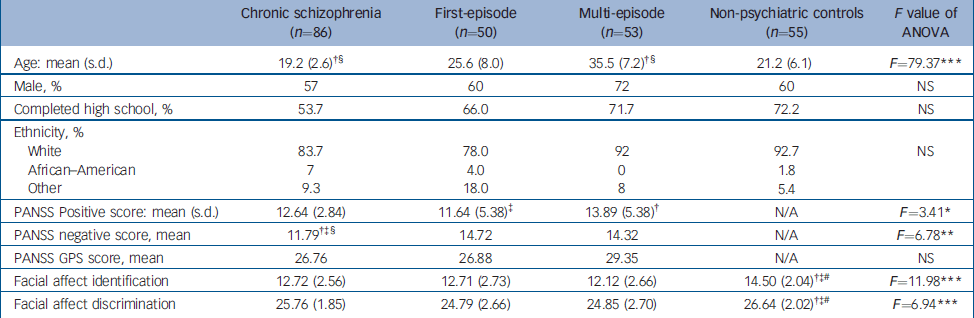
The first-episode, multi-episode and control participants were specifically recruited for studies examining facial affect recognition in psychosis at the University of Calgary and have been well described elsewhere. Reference Addington, Saeedi and Addington1 Using the Structured Interview for DSM–IV (SCID), all of the first-episode and multi-episode individuals met DSM–IV criteria for a schizophrenia-spectrum disorder except nine first-episode participants who met criteria for other psychotic disorders. Based on SCID criteria there were no current or past psychiatric disorders in the control participants. Demographic data are presented in Table 1. The only site differences were in the number of students from North Carolina.
Demographic data and differences between groups on facial affect recognition tasks
| Chronic schizophrenia (n=86) | First-episode (n=50) | Multi-episode (n=53) | Non-psychiatric controls (n=55) | F value of ANOVA | |
|---|---|---|---|---|---|
| Age: mean (s.d.) | 19.2 (2.6)†§ | 25.6 (8.0) | 35.5 (7.2)†§ | 21.2 (6.1) | F=79.37*** |
| Male, % | 57 | 60 | 72 | 60 | NS |
| Completed high school, % | 53.7 | 66.0 | 71.7 | 72.2 | NS |
| Ethnicity, % | |||||
| White | 83.7 | 78.0 | 92 | 92.7 | NS |
| African—American | 7 | 4.0 | 0 | 1.8 | |
| Other | 9.3 | 18.0 | 8 | 5.4 | |
| PANSS Positive score: mean (s.d.) | 12.64 (2.84) | 11.64 (5.38)‡ | 13.89 (5.38)† | N/A | F=3.41* |
| PANSS negative score, mean | 11.79†‡§ | 14.72 | 14.32 | N/A | F=6.78** |
| PANSS GPS score, mean | 26.76 | 26.88 | 29.35 | N/A | NS |
| Facial affect identification | 12.72 (2.56) | 12.71 (2.73) | 12.12 (2.66) | 14.50 (2.04)†‡# | F=11.98*** |
| Facial affect discrimination | 25.76 (1.85) | 24.79 (2.66) | 24.85 (2.70) | 26.64 (2.02)†‡# | F=6.94*** |
The facial affect recognition tests were the Facial Emotion Identification Test (FEIT) and the Facial Emotion Discrimination Test (FEDT). Reference Kerr and Neale5 Both use black and white photographs of facial emotions that are presented on DVD. The FEIT consists of 19 faces each depicting one of six different emotions (happiness, sadness, anger, surprise, disgust, shame), shown one at a time for 15 s, with 10 s of blank screen between each stimulus presentation. After each stimulus, the participant makes a forced choice by selecting which of the six emotions is depicted. The score is the sum of the number of correct emotion identifications (0–19). The FEDT consists of 30 pairs of photographs, each pair showing two different people displaying one or two of the six emotions depicted in the FEIT. The pairs are presented simultaneously for 15 s, with 15 s of blank screen between each presentation. The task is to judge whether the two people in each pair have the same or different emotions. The score is the number of correct discriminations (0–30). All individuals except those in the control group were assessed with the Positive and Negative Syndrome Scale for Schizophrenia (PANSS). Reference Kay, Fiszbein and Opler6
Formal consent was obtained from all participants. Testing took place during two sessions, usually on the same day but always within a 7-day period. For PREDICT, all three sites participated in a rater training programme developed at Yale that teaches clinical researchers to identify the prodromal syndrome with good reliability. Reference Miller, McGlashan, Rosen, Cadenhead, Cannon, Ventura, McFarlane, Perkins, Pearlson and Woods4 The kappa statistic was used to compare trainee agreement with the gold standard diagnosis of the presence or absence of a prodromal syndrome. Kappa was greater than 0.80 at all sites and the overall kappa was 0.90. J.A. chaired weekly conference calls to review criteria for every clinical high-risk individual admitted to the study. Facial affect recognition assessments were conducted by trained research assistants under the supervision of D.P. Detailed descriptions of quality training and good to excellent reliability for the data from all other participants has been described elsewhere. Reference Addington, Saeedi and Addington1
Results
All results are presented in Table 1. One-way ANOVAs were used to compare groups with Tukey post hoc tests to determine specific group differences. The groups differed significantly in age, with the multi-episode group being significantly older and the clinical high-risk group significantly younger. The first-episode, multi-episode and clinical high-risk groups did not differ on the General Psychopathology Scale of the PANSS. The multi-episode group rated significantly higher on positive symptoms than the first-episode group, with the clinical high-risk group in between without significantly differing from either. The clinical high-risk group had significantly lower ratings on negative symptoms than the first-episode and multi-episode groups.
A one-way between-groups MANOVA was performed to determine group differences on facial affect recognition, controlling for age. There was a statistically significant difference between groups on the combined dependent variables (F[4, 240]=6.27; P=0.0001; Wilks' λ=0.86; partial η2=0.07). Both the identification task (F[2, 242]=10.15; P=0.0001; partial η2=0.11) and the discrimination task (F[2, 242]=5.52; P=0.001; partial η2=0.07) were statistically significant. The one-way ANOVA (Table 1) demonstrates that on the identification task, the control group performed significantly better than the clinical high-risk and patient groups. On the discrimination task, patient groups performed significantly more poorly than the control group, and the performance of the clinical high-risk group fell between that of the patient and control groups without significantly differing from either.
Discussion
This is one of the first studies to examine facial affect recognition in a group of individuals at high risk of developing psychosis. A previous study did not detect any differences between control individuals and a very small (n=19) clinical high-risk sample. Reference Pinkham, Penn, Perkins, Graham and Siegel3 The young people in our at-risk sample were seeking help and had significant disability. Their ability to identify emotions did not differ from the patient groups and was significantly worse than the control group. Their ability to differentiate emotions did not differ significantly from either group, most likely because the discrimination task is less difficult than the identification task. Reference Addington, Saeedi and Addington1 It has been suggested Reference Kee, Horan, Mintz and Green7 that such deficits may be vulnerability factors in that subtle deficits in affect perception were detected in unaffected biological siblings of patients with schizophrenia. Our study suggests that these deficits are present, before the full expression of a psychotic illness, in high-risk individuals of whom only about 25% will go on to develop a full-blown psychotic illness. Reference Yung, Yuen, Berger, Francey, Hung, Nelson, Phillips and McGorry8
Our study has limitations. It is cross-sectional and does not address predictors of conversion. The control individuals are at a different site but do demonstrate results consistent with the rest of the literature. There was no control task to determine whether the impairment was specific to emotions or is generalised, although results of using a differential design in the literature are mixed. Reference Addington, Saeedi and Addington1 The strengths of our study are the reasonably large numbers in each group, the well-defined clinical high-risk group and the use of three control groups.
There may be implications for affect recognition deficits in the conversion to psychosis that can be examined only in longitudinal studies. In addition, if we want to better understand the social decline observed prior to the onset of psychosis, future studies should examine the relationship between social functioning, affect recognition and cognition. Reference Addington, Saeedi and Addington1
Acknowledgements
This study was supported by NIMH grants: U01MH066134 to J.A., U01MH066069 to D.P. and U01MH066160 to S.W. J.A. also received a grant from the Canadian Institutes of Health Research.




eLetters
No eLetters have been published for this article.