


Globalization is detrimental to the ability of governing parties to fulfill their campaign promises. We argue that the constraints of globalization – international legal commitments, the empowerment of market actors, and economic uncertainty – impede promise keeping. This chapter presents a qualitative case study to probe the mechanisms associated with these constraints. We examine why the United Kingdom’s Conservative Party was unable to fulfill one of its central campaign promises of 2010, to reduce net migration to below 100,000 during the 2010–2015 governing period when the party held executive office.
The net-migration promise made by the Conservative Party in 2010 was one of the most prominent promises made by party leader David Cameron during the election campaign. He promised to reduce net migration to below 100,000 by the end of the government’s term in office. This promise became the cornerstone of the party’s broader commitment to control immigration, an issue that was increasingly politicized among the British electorate. Concerns over the perceived strain that rising immigration levels were placing on public services, as well as job competition, made this pledge highly significant to voters, particularly after the 2008 financial crisis. The promise was largely driven by rising public pressure to curb migration, influenced by the growth of right-wing, anti-immigration sentiment, especially from the UK Independence Party (UKIP). UKIP framed migration as a key issue, and Cameron’s Conservatives sought to neutralize this political threat by promising strict migration controls. The promised policy targeted both non-European Union (EU) migration and, indirectly, EU migration, despite the United Kingdom’s commitments under the European Union’s policy of free movement of people, which made it difficult to reduce migration from other EU countries. The government soon encountered multiple obstacles to fulfilling this promise. By 2015, despite tightening immigration policies for non-EU nationals, net migration had risen to over 330,000, far exceeding the promised cap of 100,000. The failure to keep this promise became a focal point of criticism of the Conservative government, and the issue of migration remained central to political debate in the United Kingdom, contributing to the momentum for the 2016 Brexit referendum, where controlling immigration was one of the most prominent arguments in favor of leaving the EU.
We use these events as a typical case study with which to explore the mechanisms linking globalization to broken campaign promises. As Gerring (Reference Gerring, Box-Steffensmeier, Brady and Collier2008) explains, typical cases are not selected to adjudicate between rival explanations but rather to investigate the plausibility of a theorized relationship by examining the underlying theoretical mechanisms that link cause and outcome in a context where both the cause and outcome are clearly present. In our framework, we hypothesize that intense economic globalization constrains national governments’ ability to fulfill campaign promises. The promise to reduce net migration to below 100,000 offers a paradigmatic example of this dynamic. The United Kingdom was one of the most globalized countries in the world at the time, with exceptionally deep integration into international trade, financial markets, and the institutional framework of the EU. It was also a clear case of a broken promise: the promise was repeated across multiple election cycles, consistently salient to voters, and ultimately abandoned in the face of rising migration and political pressure.
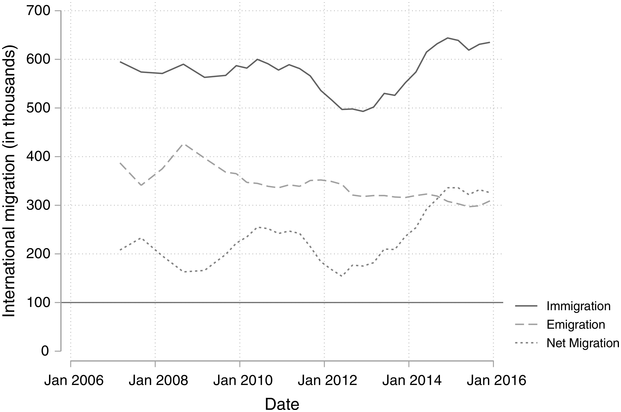
What makes this typical case especially useful is the combination of factors at play. First, immigration policy was a highly salient issue, not only central to the Conservative Party’s agenda, but also a point of intense public interest. Research shows that governments are generally more likely to fulfill promises on salient issues (Böhmelt and Ezrow Reference Böhmelt and Ezrow2021), yet the Conservative Party failed in delivering on this promise. Figure 5.1 shows that although net migration fell somewhat after the 2010 election, the government failed to bring it even close to the promised level, and the numbers rose again after 2012. This failure is noteworthy given that public pressure to keep the promise was intense. Because the United Kingdom was highly exposed to globalization and broke its promise, we would expect to observe the mechanisms underlying our argument.
International migration to the United Kingdom.
While this design strengthens our analytic leverage, it also entails important limitations. As a single-country case study, it does not allow for causal generalization or claims about external validity. Its value lies instead in its illustrative power: It offers a concrete setting in which to observe how economic globalization can constrain promise keeping, particularly on electorally salient issues such as immigration. By tracing the political processes through which a government that was highly exposed to globalization failed to fulfill a major campaign promise, the case provides a window into the causal mechanisms that undermine promissory representation in open economies. This approach is a valuable part of our multimethod research design. As Seawright (Reference Seawright2016) emphasizes, the combination of large-n statistical analysis and within-case process tracing allows researchers to test general patterns while also unpacking the dynamics that produce them. The case complements our cross-national findings by showing how global economic entanglements interact with domestic political pressures in ways that limit governments’ ability to deliver on their electoral commitments.
We rely on a range of secondary sources (including academic studies and newspaper articles), primary archival materials (such as election manifestos, consultation reports, and government communications), and interviews with political, administrative, and economic elites who were involved in the debates. In selecting the interviewees, we strove to maintain a balance across political ideologies, views on immigration, and background in terms of public and private sectors. The interviewees include:
Interview 1 (March 29, 2021; online interview): Rt. Hon. Sir Vince Cable, Former Secretary of the Department of Business, Innovation, and Skills. Member of the Liberal Democratic Party.
Interview 2 (June 29, 2021; online interview): Dr. Nick Hillman, Former Special Advisor to Baron David Willets at the Ministry of Universities and Sciences and Director of the Higher Education Policy Institute.
Interview 3 (June 23, 2021; phone interview): Professor Sir David Metcalf, Former Chair of the Migration Advisory Committee and Emeritus Professor of the London School of Economics.
Interview 4 (June 28, 2021; online interview): Ian Robinson, Former Assistant Director responsible for Economic Migration Policy at the UK Home Office, Partner at Fragomen LLP.
Interview 5 (July 7, 2021; online interview): Jill Rutter, Institute for Government, British Government civil servant until 2011.
Interview 6 (July 14, 2021; online interview): Jonathan Portes: Former Chief Economist in the UK Cabinet Office and Director of the National Institute of Economic and Social Research.
Interview 7 (August 2, 2021; online interview): Rt. Hon. Damian Green: Former Immigration Minister, member of the Conservative Party.
All interviews were loosely structured interviews based on common guiding questions. The interviews were conducted remotely via video conference or telephone call and lasted between thirty and sixty minutes.Footnote 1
The broad range of primary and secondary material we reviewed for the case study supports our main arguments. Despite public pressure, the government’s efforts to keep the promise were constrained by international legal commitments and market-driven labor demands, illustrating the mechanisms by which globalization affects promise fulfillment. The inability of the governing Conservative Party to reduce net migration, despite significant political capital invested in the issue, therefore aligns with our theoretical framework. This makes the case not only representative but also demonstrative of how globalization presents challenges for governments, confirming the broader patterns explored in this study.
The main factors in relation to the net-migration promise align with the mechanisms outlined in the theory. The promise itself was formulated in response to shifting voter expectations driven by perceived economic and cultural risks of increased immigration, as well as to party competition and ideological positioning. We will analyze the effect of globalization on promise making more extensively in Part III of the book, but we foreshadow those analyses by noting that this case illustrates how globalization changes voters’ expectations regarding government policies. In this case, UKIP was able to politicize immigration as an economic and cultural cost borne by British citizens, which increased pressure on the Conservative Party to promise to curb migration. This pressure was heightened by the threat of Conservative voters and politicians abandoning the Conservative Party in favor of UKIP.
The breaking of the pledge was driven by a combination of factors relating to global market movements, international commitments that conflicted with the promise, and effective lobbying by national and international market actors. Economic uncertainty, EU membership, and lobbying efforts by various market actors, both within and outside the United Kingdom, hampered the ability of the government to reduce migration to a point that would have fulfilled its campaign promise.
The Genesis of the Migration Promise
The Conservative Party pledged to cut net migration in response to public concerns regarding increasing levels of migration in a challenging economic context. Before the 2010 election, the Conservative Party led by David Cameron was the main opposition party challenging the incumbent Labour Party led by Prime Minister Gordon Brown. At the time of the 2010 election, the country was reeling from the global financial crisis, and unemployment had risen to over two million for the first time since the 1990s. These economic conditions fueled anti-immigration sentiments among large parts of the population who believed that many of the economic problems were caused by immigration. These views were perpetuated by an increase in net migration. One study found that while fewer people were leaving the country (60 percent decline) in the 12 months to June 2010, more overseas students were entering the country (35 percent increase), leading to a sharp rise in net immigration (Owen and Travis Reference Owen and Travis2010).
By 2010, immigration had become one of the most pressing political issues in the United Kingdom, with a clear majority of British citizens expressing concern over the increasing number of immigrants. A 2011 Ipsos MORI survey found that 64 percent of respondents believed that Britain had too many immigrants, reflecting a growing sense of anxiety among the public (Blinder and Richards Reference Blinder and Richards2020). Groups like Migration Watch UK, a prominent anti-immigration lobby, channeled these concerns, arguing that unchecked immigration was placing a significant strain on public services, housing, and the overall quality of life in the United Kingdom. They criticized the government for losing control over national borders, which had allowed immigration levels to rise unsustainably.
The intense public opposition to immigration affected all major political parties in the run-up to the 2010 election. UKIP capitalized on this sentiment, positioning itself as the party that would tackle immigration head-on. UKIP pledged to impose an immediate five-year freeze on immigration, framing this as a solution to what they termed “uncontrolled mass immigration” (Carey and Geddes Reference Carey and Geddes2010: 860). This promise resonated with a significant portion of the electorate, allowing UKIP to gain considerable public support. UKIP won second place in the 2009 European Parliament elections, and its transformation into a multi-issue party strengthened its appeal at the national level (Ford and Goodwin Reference Ford and Goodwin2014). UKIP’s message resonated with many voters who generally voted for the Conservatives, and it gained most votes in Conservative-held constituencies. Immigration quickly became a central issue during the 2010 election campaign, with the topic featuring prominently in all three of the leaders’ debates.
Faced with the UKIP challenge and mounting public pressure, both major parties were forced to propose policies aimed at tightening immigration controls. This political dynamic set the stage for the Conservative Party’s promise to reduce net migration. With UKIP gaining ground on the Conservative Party, and public opinion in favor of reducing migration, David Cameron committed the party to reducing immigration. On January 10, 2010, just months ahead of the general election, he made the now infamous promise in a BBC interview, stating that if he won the election, he would limit net immigration to “tens of thousands” each year (BBC News 2010).
The promise had been prepared carefully. It was developed by the Shadow Minister of Immigration Damian Green based on a pamphlet he had written on economic migration with David Davies, another prominent Conservative politician. It was agreed upon by a small group of party elites, including the shadow Home Office team and the leadership of the Conservative Party. The 2010 Conservative Party election manifesto made the 100,000 net migration target official party policy (Conservative Party 2010). According to our interviewees, the promise was not merely aspirational; or as Cameron put it himself: “no ifs, no buts” (Travis Reference Travis2015). Our interviewees who participated in the formulation of the promise shared the view that there was a sincere belief within the party leadership that the target was achievable when it was formulated.
According to many observers and our interviewees, the rationale behind Cameron’s move was to respond to public concerns about immigration and to neutralize migration as an issue during the campaign (Bale, Hampshire, and Partos Reference Bale, Hampshire and Partos2011). And indeed, during the campaign, the Conservative Party won significant political ground on the basis of their promise on immigration, the only issue on which the party scored significantly better than the Labour Party (Elliott Reference Elliott2010). According to a YouGov survey, at 25.2 percent the Conservatives were far ahead of both Labour (6.3 percent) and the Liberal Democrats (1.8 percent) on respondents’ judgment of the best party to handle immigration. Immediately after announcing the promise in early 2010, Cameron’s personal favorability ratings increased substantially (Dahlgreen Reference Dahlgreen2015).
The Road to Failure
The Conservative Party won the 2010 election and subsequently led a coalition government with the Liberal Democrats. Under the leadership of Home Secretary Theresa May, the UK Home Office introduced one of the harshest immigration policies in British history. The government implemented a cap on skilled labor migration from outside the European Union, which was promised in the Conservative’s 2010 manifesto. It also introduced a new minimum income threshold for people with spouses from overseas, which was arguably consistent with its 2010 manifesto statement to “limit … access only to those who will bring the most value to the British economy,” a statement that conveys intent but does not specify the action that would be taken. The government also cracked down on “bogus” colleges and “foreign criminals” (Trilling Reference Trilling2020). In addition, the Hostile Environment Policy, as it was called, included administrative and legislative steps to make it as difficult as possible for noncitizens to stay in the United Kingdom (Hill Reference Hill2017; Trilling Reference Trilling2020).
Yet, net migration remained stubbornly above 100,000 and even increased to 336,000 just before the 2015 election (up from 246,000 in 2010) according to the UK Office of National Statistics. Despite this failure to meet their target, the Conservative Party reiterated the same promise during the 2015 election campaign. When Theresa May assumed leadership, the pledge was repeated once more in the 2017 election. It was only in 2019 that the party abandoned the net migration target, replacing it with a new promise to implement an Australian-style points-based immigration system.
Our analysis indicates three main reasons why the Conservatives were unable to fulfill the promise. One obvious, though perhaps surprisingly not the most important obstacle to fulfilling the promise was the United Kingdom’s membership in the EU. The United Kingdom was committed to freedom of labor movement across Europe as part of the European Single Market. To accede to the EU in 2007, Bulgaria and Romania had agreed to limited movement of labor during a transition period (Schneider Reference Schneider2009). When this transition period came to an end in 2013, there were substantial increases in migration from both countries to the United Kingdom. The European Single Market constrained the government’s ability to fulfill its promise. As Theresa May said after it became clear that the government had failed to keep its promise: it was “unlikely” the target of getting net migration below 100,000 would be met, because EU migration had “blown us off course” (BBC News 2014).
However, the effect of legal commitments associated with EU membership should not be overstated. Migrants from EU member countries accounted for less than one-third of long-term migrants to the United Kingdom. In 2010, of the 281,000 immigrants, 196,000 (70 percent) were from outside the EU. Even if the government had eliminated all immigration from the EU, it would not have achieved its target of 100,000 (Office of National Statistics). Rather than focusing on EU citizens, the government attempted to cut immigration from non-EU countries, including the immigration of skilled individuals who were highly sought after by UK businesses and other organizations in the private and public sectors. There was also an attempt to cut numbers of overseas students, who brought both economic benefits partly through college tuition fees and their contributions to the United Kingdom’s scientific community.
The government’s inability to affect or even anticipate emigration was another important constraint on its capacity to fulfill the promise, one that was subject to considerable uncertainty. A decline in British emigration after 2010 contributed significantly to the failure to fulfill the promise. The fall in emigration was partly the result of the increased costs of living abroad due to a weak pound, with the government having little control over currency movements due to the United Kingdom’s integration into global financial markets (Owen and Travis Reference Owen and Travis2010). In a consultation report from 2010, the Migration Advisory Committee (MAC), an independent government advisory committee, warned the government that uncertainties about emigration numbers as well as EU rules might limit the feasibility of achieving the net migration target (Migration Advisory Committee 2010). In addition, many Britons returned to the United Kingdom during this period from crisis-hit Spain and Dubai, which further contributed to increased net migration (Travis Reference Travis2010a).
It also did not help that the promise was opposed by a broad range of national and international actors from the private and public sectors. Following a call for responses on these issues, the Migration Advisory Committee received over 400 responses from domestic and international actors including the Scottish Government, the Government of Ireland, the Embassy of Japan, various trade federations, banking associations, law firms, law associations, the health and social services sectors (including hospitals, medical services, and nursing homes), private companies, the British Chamber of Commerce, the oil industry, universities, research institutes, the Royal Bank of Canada, the Greater London Authority, the Department of Health, the Department of Education, the Department of Work and Pensions, and the Migration Policy Institute. The opposition expressed to the cap was as forceful as it was unanimous. Of the responses quoted in the report, only one response from a member of the public argued in favor of the cap on migration (Migration Advisory Committee 2010).
Private and public sector employers warned that the introduction of a cap would lead to major skill shortages. The lobbying efforts came from a variety of stakeholders, including politicians from all parties, business groups, law firms, car manufacturers, pharmaceutical companies, and the National Health Service (NHS). The NHS relied on recruiting skilled and relatively low-paid care workers from abroad. Gerwyn Davies from the Chartered Institute of Personnel Development expressed his concerns with a stark warning to the government:
The reality for employers is that training workers to plug the UK skills gap is a lengthy task. … The abrupt introduction of a radical cap would therefore leave many employers with a bigger skills problem and tempt employers with global operations to offshore jobs, where they can find the skills.
Sectors with international operations raised concerns about the significant adverse economic effects of restricting immigration. In a joint response to the Migration Advisory Committee consultation, the Association of Foreign Banks (AFB) and British Bankers’ Association (BBA) threatened that:
If the ability of migrants to enter the UK under Tier 2 is significantly reduced, AFB and BBA members will create jobs overseas that otherwise would have been created in the UK. As a result, the teams supporting those roles will also be located overseas.
Similar forecasts about business offshoring came from other sectors, including the oil and gas sector as well as international law firms (Migration Advisory Committee 2010). Sarah Mulley, Associate Director at the Institute of Public Policy Research, summarized the implications of the Migration Advisory Committee’s report succinctly:
The … analysis shows clearly how difficult it will be for the government to fulfill its promise to cut immigration substantially. The government now faces an unpalatable choice between introducing a policy which it knows will be damaging to the economy and public services, or failing to fulfill a key promise to the electorate.
Further pressure came from overseas. A major concern was that restrictive immigration measures would make it difficult to secure trade cooperation, and several interviewees noted the effect of the policies on relations with India. The policies threatened to derail negotiations between Britain and India to promote trade between the two countries in 2010. The UK government wanted the Indian government to allow British banks, legal and insurance firms, and small manufacturers to operate in India. In return, India asked for mutual recognition of qualifications so that its lawyers and bankers could operate in the United Kingdom. The Indian government was concerned that the cap on immigration would make this difficult and was dismayed by what they called racially prejudiced policies toward Indians. The United Kingdom had much to lose as total bilateral trade between the United Kingdom and India was worth £11.5 billion, and UK exports to India totaled £4.7 billion in 2009 (Waugh Reference Waugh2010). Our interviews confirmed that the pressure worked; after a high-level meeting between the UK and Indian governments, the United Kingdom shelved planned restrictions on intracompany transfers, which were opposed by Indian firms.
Similarly, the Embassy of Japan indicated that restrictive immigration policies:
would effectively force Japanese companies operating in the UK to reduce their future investment and to withdraw from this country. This will result in a huge number of job cuts for British workers employed in these companies.
The pressure exerted by these actors was intense and expressed through a range of channels. It was expressed publicly (through the media, including the notoriously vociferous British tabloid newspapers) as well as behind closed doors (through lobbying the Department of Business, Innovation and Skills, the Home Office, or the prime minister through the Business Advisory Group). Although the pressure did not convince the governing Conservative Party to abandon the promise altogether, it did not pursue many of the measures it had originally intended to, and many compromises were made. For example, the Home Office agreed not to restrict intracompany transfers, which made up a significant share of immigration. It also made significant concessions on foreign students and family reunification policies, for instance, in relation to minimum income requirements for immigrants to bring additional family members. As one of the interviewees notes “if there hadn’t been resistance, from lobby groups, from me and my colleagues, they [anti-immigration measures] would have gotten much worse.”
Alternative Explanations
The main alternatives to our view that globalization constraints led to this broken promise are less convincing. One alternative and somewhat cynical interpretation of the events described is that the Conservative Party’s net-migration promise was mainly symbolic, that the party did not have any serious intention of fulfilling the promise, and that it did so knowing that there are no significant consequences of breaking campaign promises. The evidence from this case and from comparative research does not support this view. Although the formulation of the promise was a response to political circumstances, it was made after extensive deliberation among party elites. According to those close to the Home Office and David Cameron, there was a sense that the promise was achievable. One interviewee noted that the target seemed not too far off given that net migration had been below 100,000 just a few years earlier. Moreover, the evidence indicates that the government made significant attempts to fulfill the promise. It imposed a cap on non-EU migration, introduced new income requirements for family reunification, implemented tougher standards for education providers that brought in overseas students, and generally created a hostile environment for migrants, all of which were criticized heavily as draconian. The fact that these policies did not achieve the promised level of net migration does not imply that the promise was made without any intention of keeping it.
Furthermore, the consequences from breaking this promise have been significant. According to one interviewee close to the party elites, the net-migration promise became an “albatross around the government’s neck.” The breaking of the promise fueled the rise of UKIP, whose leader criticized Cameron for failing to limit migration to the United Kingdom. With the looming electoral threat of UKIP, internal divisions widened within the Conservative Party and many Conservatives left the party to join UKIP. These divisions were among the factors contributing to yet another fateful promise by the Conservative Party. In its 2015 manifesto, the Conservative Party promised to hold a referendum on the United Kingdom’s membership of the European Union (Dorey and Garnett Reference Dorey and Garnett2016). In the end, the nonfulfillment of the migration promise cost Prime Minister David Cameron his political career at least indirectly, as he stepped down as prime minister after the leave campaign won the Brexit referendum in 2016.
Another alternative interpretation of the case study might be that the promise was broken mainly because of coalition politics, rather than international constraints. Indeed, the Conservative Party’s junior coalition partner, the Liberal Democrats, was much more supportive of immigration and opposed including the promise in the coalition agreement (BBC News 2014). However, the influence of the Liberal Democrats does not appear to have been decisive. Immigration was one of the policy areas in which the Liberal Democrats were unable to exert any significant influence over the Conservative-led government (Partos and Bale Reference Partos and Bale2015). Not one of the policies outlined in the Conservative Party’s manifesto in that area was dropped from the government’s agenda; all that was added was the inclusion of a Liberal Democrat promise to end the detention of children in asylum cases, a promise that even many “mainstream” Conservatives supported or could tolerate. All accounts of the coalition formation process suggest that immigration was a nonnegotiable “redline” for the Conservatives and that the Liberal Democrats were made aware of this from the outset (Bale, Hampshire, and Partos Reference Bale, Hampshire and Partos2011). In his interview with us, Sir Vince Cable himself described the Liberal Democrat’s influence as negligible:
We were preventing them from reaching their target. But of course, the real reason wasn’t our obstruction. I mean, that would have helped, but it was because of when there were gaps in the labor market, there were no restrictions on people coming in from the EU, and there was nothing the government could do to affect them. But having set a target, it made it abundantly clear to the British public what the problem was: the European Union.
One of our interviewees pointed out that the forceful opposition by Sir Vince Cable may even have been counterproductive in that it reduced the willingness of the Home Office to negotiate with the Department of Business.
A final and decisive argument against the coalition politics interpretation of the case study is that the Conservative Party was unable to fulfill the migration promise even after the coalition ended in 2015, after which it continued governing as a single-party government. This indicates that the presence of the Liberal Democrats in government does not explain the failure to fulfill the promise in the 2010–2015 period. This aligns with broader findings in the literature. Although Thomson et al. (Reference Thomson, Marsh, Farrell and McElroy2017) find that coalition governments are on average less likely to fulfill campaign promises, senior coalition partners that control the prime ministership, as well as coalition partners that hold the ministerial portfolios relevant to their promises, are in relatively strong positions when it comes to promise keeping. These governing parties generally fulfill promises at similar rates to parties in single-party governments.
Discussion
Globalization has significantly constrained the ability of governing parties to fulfill their campaign promises, and this chapter examines the mechanisms through which these constraints operate in a typical case study focused on the UK Conservative Party’s pledge to cut net migration. The case study highlights how the three major globalization constraints – international legal commitments, the empowerment of market actors, and economic uncertainty – led to the breaking of this prominent campaign promise. At the same time, the fourth constraint of globalization, citizens’ rising expectations that their governments protect them from globalization risks, set the scene for the making of the promise in the first place. By examining a typical case study, this chapter explores the mechanisms in greater depth than we are able to in the previous chapter’s quantitative analysis.
The headline finding from this chapter is that globalization created significant barriers that made fulfilling a high-profile promise nearly impossible. Despite the strong public support for the Conservative Party’s net-migration promise, the party was unable to fulfill it, as we would expect given that the United Kingdom was one of the most globally integrated economies in the world. International legal commitments, particularly those tied to EU membership and the free movement of labor within the EU, limited the government’s ability to implement strict immigration policies. As a member of the EU, the United Kingdom was bound by agreements that allowed for the free movement of EU citizens, which severely restricted the UK government’s control over immigration numbers.
Market actors also exerted considerable influence, lobbying for more open immigration policies to secure a steady supply of labor for industries that relied on foreign workers from both inside and outside the EU. This dynamic was especially evident in sectors like healthcare, agriculture, and technology, where the demand for migrant labor was high. Multinational corporations and economic elites resisted any restrictive policies that would negatively affect their operations. The lobbying from these actors compounded the government’s inability to meet its migration promise, as reducing immigration risked causing an economic downturn and potential labor shortages, undermining the United Kingdom’s position in a globalized economy.
Finally, economic uncertainty played a critical role. Fluctuations in the global economy, coupled with the financial instability following the 2008 economic crisis, made it difficult for the government to predict future economic conditions, particularly around migration patterns. For example, the number of British emigrants leaving the United Kingdom fell after 2010 due to the weakened pound and deteriorating economic conditions abroad, which increased net migration beyond the government’s control. These unexpected economic shifts complicated the governing party’s ability to meet the net migration target it had promised.
From the perspective of promissory representation, the failure to fulfill campaign promises is problematic for political parties, because they expect that voters will punish them at the next election. In the next chapter, we provide observational and experimental evidence that such retrospective punishment does indeed take place. We will also explore whether voters consider the constraints of globalization when they punish parties for breaking promises. The evidence clearly shows that voters do not let politicians “off the hook” because they are constrained by globalization. On the contrary, it appears that promise keeping and breaking has become an even more important benchmark for voters against which to assess politicians’ performance. As we will show in Part IV of the book, this presents a serious dilemma for political parties and affects their strategies when formulating their electoral appeals and campaign promises.

 Open access