




1. Introduction and main results
The study of extremal problems about induced subgraphs is a popular theme in combinatorics. Of particular interest is finding the lengths of a longest induced path and of a longest induced cycle (also called a hole) in a given graph $G$
. Two key examples, that have been studied in the past, are when
$G$
. Two key examples, that have been studied in the past, are when $G$
is the
$G$
is the $d$
-dimensional hypercube, wherein finding the length of a longest induced path is known as the ‘Snake-in-the-Box’ problem [Reference Abbott and Katchalski1, Reference Hartarsky19, Reference Zémor29], and when
$d$
-dimensional hypercube, wherein finding the length of a longest induced path is known as the ‘Snake-in-the-Box’ problem [Reference Abbott and Katchalski1, Reference Hartarsky19, Reference Zémor29], and when $G$
is the binomial random graph
$G$
is the binomial random graph $G(n,p)$
. Let us note here that the length of a longest induced path is at most twice the size of a largest independent set in
$G(n,p)$
. Let us note here that the length of a longest induced path is at most twice the size of a largest independent set in $G$
.
$G$
.
The study of induced cycles in $G(n,p)$
dates back to the late ’80s. Frieze and Jackson [Reference Frieze and Jackson18] showed that for each sufficiently large constant
$G(n,p)$
dates back to the late ’80s. Frieze and Jackson [Reference Frieze and Jackson18] showed that for each sufficiently large constant $d$
, whp
Footnote
1
the random graph
$d$
, whp
Footnote
1
the random graph $G(n,d/n)$
contains an induced cycle of length at least
$G(n,d/n)$
contains an induced cycle of length at least $c(d)\,n$
for some constant
$c(d)\,n$
for some constant $c(d)\gt 0$
. Łuczak [Reference Łuczak26] and, independently, Suen [Reference Suen28] later improved this, proving that whenever
$c(d)\gt 0$
. Łuczak [Reference Łuczak26] and, independently, Suen [Reference Suen28] later improved this, proving that whenever $d\gt 1$
, whp
$d\gt 1$
, whp $G(n,d/n)$
contains an induced cycle of length at least
$G(n,d/n)$
contains an induced cycle of length at least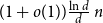 $(1+o(1))\frac {\ln d}{d}\,n$
. A simple first-moment argument implies that whp the length of a longest induced cycle for large
$(1+o(1))\frac {\ln d}{d}\,n$
. A simple first-moment argument implies that whp the length of a longest induced cycle for large $d$
in
$d$
in $G(n,d)$
is at most
$G(n,d)$
is at most $(1+o_d(1))\frac {2\ln d}{d}\,n$
. This upper bound was shown to be asymptotically tight by Draganić, Glock, and Krivelevich [Reference Draganić, Glock and Krivelevich11]. Dutta and Subramanian [Reference Dutta and Subramanian12] further established a two-point concentration result on the length of a longest induced path in
$(1+o_d(1))\frac {2\ln d}{d}\,n$
. This upper bound was shown to be asymptotically tight by Draganić, Glock, and Krivelevich [Reference Draganić, Glock and Krivelevich11]. Dutta and Subramanian [Reference Dutta and Subramanian12] further established a two-point concentration result on the length of a longest induced path in $G(n,p)$
for
$G(n,p)$
for $p\ge \log ^2n/\sqrt {n}$
.
$p\ge \log ^2n/\sqrt {n}$
.
It appears natural to extend the study of extremal problems for induced paths and cycles for random to pseudo-random graphs. The latter can be informally described as graphs whose edge distribution resembles that of a truly random graph $G(n,p)$
of a similar density. Formally, given a
$G(n,p)$
of a similar density. Formally, given a $d$
-regular graph
$d$
-regular graph $G$
on
$G$
on $n$
vertices, denote the eigenvalues of its adjacency matrix by
$n$
vertices, denote the eigenvalues of its adjacency matrix by $d=\lambda _1\ge \lambda _2\ge \cdots \ge \lambda _n$
. Letting
$d=\lambda _1\ge \lambda _2\ge \cdots \ge \lambda _n$
. Letting $\lambda \,:\!=\, \max \{|\lambda _2|,|\lambda _n|\}$
, we then say that
$\lambda \,:\!=\, \max \{|\lambda _2|,|\lambda _n|\}$
, we then say that $G$
is an
$G$
is an $(n,d,\lambda )$
-graph. The expander mixing lemma, due to Alon and Chung [Reference Alon and Chung4], relates the spectral ratio
$(n,d,\lambda )$
-graph. The expander mixing lemma, due to Alon and Chung [Reference Alon and Chung4], relates the spectral ratio $\frac {\lambda }{d}$
to the edge-distribution of these graphs (see Lemma2.2). We refer the reader to [Reference Hoory, Linial and Wigderson20, Reference Krivelevich22, Reference Krivelevich and Sudakov23] for comprehensive surveys on the subject of pseudo-random graphs and expanders.
$\frac {\lambda }{d}$
to the edge-distribution of these graphs (see Lemma2.2). We refer the reader to [Reference Hoory, Linial and Wigderson20, Reference Krivelevich22, Reference Krivelevich and Sudakov23] for comprehensive surveys on the subject of pseudo-random graphs and expanders.
As noted before, it is thus quite natural to ask whether one can find long induced cycles, similar to the case of the binomial random graph $G(n,d/n)$
, in
$G(n,d/n)$
, in $(n,d,\lambda )$
-graphs (naturally under some assumption on the aforementioned spectral ratio). A first result in this direction was recently obtained by Draganić and Keevash [Reference Draganić and Keevash10], who showed the following: any
$(n,d,\lambda )$
-graphs (naturally under some assumption on the aforementioned spectral ratio). A first result in this direction was recently obtained by Draganić and Keevash [Reference Draganić and Keevash10], who showed the following: any $(n,d,\lambda )$
-graph
$(n,d,\lambda )$
-graph $G$
with
$G$
with $\lambda \lt d^{3/4}/100$
and
$\lambda \lt d^{3/4}/100$
and $d\lt n/10$
contains an induced path of length
$d\lt n/10$
contains an induced path of length $\frac {n}{64d}$
; their paper did not address the problem of long induced cycles.
$\frac {n}{64d}$
; their paper did not address the problem of long induced cycles.
Our first main result improves upon the result of Draganić and Keevash [Reference Draganić and Keevash10] by significantly relaxing the assumption on the spectral ratio, as well as showing the existence of a long induced cycle, instead of a path.
Theorem 1.
There exist constants $\delta _1,\delta _2,\delta _3\gt 0$
such that the following holds. For any integers
$\delta _1,\delta _2,\delta _3\gt 0$
such that the following holds. For any integers $n, d$
and for any
$n, d$
and for any $(n,d,\lambda )$
-graph
$(n,d,\lambda )$
-graph $G$
such that
$G$
such that $d\le \delta _3 n$
and
$d\le \delta _3 n$
and $\lambda /d\le \delta _1$
,
$\lambda /d\le \delta _1$
, $G$
contains an induced cycle of length at least
$G$
contains an induced cycle of length at least $\delta _2n/d$
.
$\delta _2n/d$
.
A few comments are in place. We note that for $\delta _1$
sufficiently small, one can take
$\delta _1$
sufficiently small, one can take $\delta _2=1/150$
; in fact, as we will soon see, we can find a longer induced path, of length at least
$\delta _2=1/150$
; in fact, as we will soon see, we can find a longer induced path, of length at least $\frac {n}{48d}$
, thus improving also the constant factor in the result of [Reference Draganić and Keevash10]. Further, since a random
$\frac {n}{48d}$
, thus improving also the constant factor in the result of [Reference Draganić and Keevash10]. Further, since a random $d$
-regular graph on
$d$
-regular graph on $n$
vertices
$n$
vertices $G_{n,d}$
is typically an
$G_{n,d}$
is typically an $(n,d,\lambda )$
-graph with
$(n,d,\lambda )$
-graph with $\lambda \le 2\sqrt {d}$
(see, e.g., [Reference Friedman16]), we obtain that for large enough
$\lambda \le 2\sqrt {d}$
(see, e.g., [Reference Friedman16]), we obtain that for large enough $d$
, whp
$d$
, whp $G_{n,d}$
contains an induced cycle of length
$G_{n,d}$
contains an induced cycle of length $\Omega (n/d)$
. This improves the bound of Frieze and Jackson [Reference Frieze and Jackson18] from 1985, who showed that whp
$\Omega (n/d)$
. This improves the bound of Frieze and Jackson [Reference Frieze and Jackson18] from 1985, who showed that whp $G_{n,d}$
contains an induced cycle of length
$G_{n,d}$
contains an induced cycle of length $\Omega (n/d^2)$
(see also [Reference Enriquez, Faraud, Ménard and Noiry13]), and makes progress towards resolving [Reference Frieze17, Problem 74], which asks to determine the typical length of a longest induced cycle in
$\Omega (n/d^2)$
(see also [Reference Enriquez, Faraud, Ménard and Noiry13]), and makes progress towards resolving [Reference Frieze17, Problem 74], which asks to determine the typical length of a longest induced cycle in $G_{n,d}$
. Finally, let us note that our proof yields a randomised algorithm, which finds in a linear in
$G_{n,d}$
. Finally, let us note that our proof yields a randomised algorithm, which finds in a linear in $n$
time an induced cycle of length at least
$n$
time an induced cycle of length at least $\delta _2n/d$
whp.
$\delta _2n/d$
whp.
It turns out, perhaps somewhat surprisingly, that insights and results from the setting of site percolation prove very efficient, leading to a rather simple (in hindsight) proof of Theorem1. Intuitively, finding an induced cycle is ‘easier’ when the graph is sparse, and in this case, choosing a random set of vertices typically yields a sparser graph, wherein every induced structure is also an induced structure in the host graph. Formally, given a host graph $G=(V,E)$
, form a random subset
$G=(V,E)$
, form a random subset $V_p$
by retaining every
$V_p$
by retaining every $v\in V$
independently with probability
$v\in V$
independently with probability $p$
. The
$p$
. The $p$
-site-percolatedFootnote
2
subgraph
$p$
-site-percolatedFootnote
2
subgraph $G_p$
is then
$G_p$
is then $G_p\,:\!=\, G[V_p]$
. We will derive Theorem1 from our next result.
$G_p\,:\!=\, G[V_p]$
. We will derive Theorem1 from our next result.
Theorem 2.
Let $\epsilon \gt 0$
be a sufficiently small constant. Let
$\epsilon \gt 0$
be a sufficiently small constant. Let $n,d\,:\!=\, d(n)\in \mathbb{N}$
be such that
$n,d\,:\!=\, d(n)\in \mathbb{N}$
be such that $d=o(n)$
. Let
$d=o(n)$
. Let $p=\frac {1+\epsilon }{d}$
. Then, there exists a constant
$p=\frac {1+\epsilon }{d}$
. Then, there exists a constant $\delta \,:\!=\, \delta (\epsilon )\gt 0$
such that the following holds. Let
$\delta \,:\!=\, \delta (\epsilon )\gt 0$
such that the following holds. Let $G$
be an
$G$
be an $(n,d,\lambda )$
-graph with
$(n,d,\lambda )$
-graph with $\frac {\lambda }{d}\le \delta$
. Then,
whp
$\frac {\lambda }{d}\le \delta$
. Then,
whp $G_p$
contains an induced path of length at least
$G_p$
contains an induced path of length at least $\frac {\epsilon ^2n}{3d}$
.
$\frac {\epsilon ^2n}{3d}$
.
Note that Theorem2 naturally implies that deterministically the whole graph $G$
contains a long induced path. In fact, with a little more effort, one can typically find an induced cycle of length
$G$
contains a long induced path. In fact, with a little more effort, one can typically find an induced cycle of length $\Omega (n/d)$
in
$\Omega (n/d)$
in $G_p$
, see details in Remark3.1. Further, as we mentioned after Theorem1, it is not hard to verify that one can take any
$G_p$
, see details in Remark3.1. Further, as we mentioned after Theorem1, it is not hard to verify that one can take any $\epsilon \le 1/4$
, and thus obtain an induced path of length
$\epsilon \le 1/4$
, and thus obtain an induced path of length $\frac {n}{48d}$
.
$\frac {n}{48d}$
.
Since the edge-distribution of an $(n,d,\lambda )$
-graph
$(n,d,\lambda )$
-graph $G$
(when
$G$
(when $\lambda /d\le \delta$
for some sufficiently small constant
$\lambda /d\le \delta$
for some sufficiently small constant $\delta$
) resembles that of the binomial random graph
$\delta$
) resembles that of the binomial random graph $G(n,d/n)$
, one might expect to find an induced path (or even cycle) of length
$G(n,d/n)$
, one might expect to find an induced path (or even cycle) of length $\Theta (\frac {\ln d}{d})n$
in
$\Theta (\frac {\ln d}{d})n$
in $G$
. Perhaps somewhat surprisingly, as our next result shows, this is not the case.
$G$
. Perhaps somewhat surprisingly, as our next result shows, this is not the case.
Theorem 3.
For every constant $\delta \gt 0$
, there exists a constant
$\delta \gt 0$
, there exists a constant $C\,:\!=\, C(\delta )\gt 0$
such that the following holds. For every sufficiently large
$C\,:\!=\, C(\delta )\gt 0$
such that the following holds. For every sufficiently large $d\in \mathbb{N}$
, there exist infinitely many
$d\in \mathbb{N}$
, there exist infinitely many $n$
for which there exists an
$n$
for which there exists an $(n,d,\lambda )$
-graph
$(n,d,\lambda )$
-graph $G$
with
$G$
with $\frac {\lambda }{d}\leq \delta$
, whose longest induced path is of length at most
$\frac {\lambda }{d}\leq \delta$
, whose longest induced path is of length at most $\frac {Cn}{d}$
.
$\frac {Cn}{d}$
.
In particular, Theorem3 shows that Theorem1 is tight up to a multiplicative constant. Let us note that this also marks a key difference between a longest path in an $(n,d,\lambda )$
-graph, which is of length linear in
$(n,d,\lambda )$
-graph, which is of length linear in $n$
[Reference Krivelevich and Sudakov24], and a longest induced path, which we now see might be of length at most linear in
$n$
[Reference Krivelevich and Sudakov24], and a longest induced path, which we now see might be of length at most linear in $n/d$
.
$n/d$
.
Given an $(n,d,\lambda )$
-graph
$(n,d,\lambda )$
-graph $G$
with
$G$
with $\lambda /d$
being a (small) constant, by Theorems1 and 3 we know that a largest hole of
$\lambda /d$
being a (small) constant, by Theorems1 and 3 we know that a largest hole of $G$
is of size
$G$
is of size $\Omega (n/d)$
, and this estimate is tight. It would be interesting to relate the spectral ratio
$\Omega (n/d)$
, and this estimate is tight. It would be interesting to relate the spectral ratio $\lambda /d$
(where we allow the ratio to depend on
$\lambda /d$
(where we allow the ratio to depend on $d$
) to the size of a largest hole of an
$d$
) to the size of a largest hole of an $(n,d,\lambda )$
-graph
$(n,d,\lambda )$
-graph $G$
. In particular, one may wonder whether a largest hole is of size
$G$
. In particular, one may wonder whether a largest hole is of size $\Omega (n\log (d/\lambda )/d)$
– indeed, when
$\Omega (n\log (d/\lambda )/d)$
– indeed, when $\lambda \ll d$
, the independence number of an
$\lambda \ll d$
, the independence number of an $(n,d,\lambda )$
-graph
$(n,d,\lambda )$
-graph $G$
satisfies
$G$
satisfies $\alpha (G)=\Omega (n\log (d/\lambda )/d)$
(see, for example, [Reference Krivelevich and Sudakov23, Proposition 4.6]).
$\alpha (G)=\Omega (n\log (d/\lambda )/d)$
(see, for example, [Reference Krivelevich and Sudakov23, Proposition 4.6]).
Application Theorem2 and its proof bear interesting consequences in terms of counting non-isomorphic induced subgraphs. Let $\mu (G)$
be the number of non-isomorphic induced subgraphs in
$\mu (G)$
be the number of non-isomorphic induced subgraphs in $G$
. Erdős and Rényi conjectured that for every constant
$G$
. Erdős and Rényi conjectured that for every constant $c_1\gt 0$
, there exists a constant
$c_1\gt 0$
, there exists a constant $c_2\gt 0$
such that if
$c_2\gt 0$
such that if $G$
has no subset
$G$
has no subset $S$
of
$S$
of $c_1\log n$
vertices on which
$c_1\log n$
vertices on which $G[S]$
is either the complete graph or the empty graph (that is,
$G[S]$
is either the complete graph or the empty graph (that is, $G$
is
$G$
is $c_1$
-Ramsey), then
$c_1$
-Ramsey), then $\mu (G)\ge \exp \{c_2n\}$
. Several results in this direction were obtained [Reference Alon and Bollobás3, Reference Alon and Hajnal5]; in particular, in 1976, Müller [Reference Müller27] showed that whp
$\mu (G)\ge \exp \{c_2n\}$
. Several results in this direction were obtained [Reference Alon and Bollobás3, Reference Alon and Hajnal5]; in particular, in 1976, Müller [Reference Müller27] showed that whp $\mu (G(n,1/2))=2^{(1-o(1))n}$
. The conjecture was finally confirmed by Shelah in 1998 [Reference Suen28].
$\mu (G(n,1/2))=2^{(1-o(1))n}$
. The conjecture was finally confirmed by Shelah in 1998 [Reference Suen28].
In a recent work [Reference Krivelevich and Zhukovskii25], the second and fourth authors determined the asymptotics of $\mu (G(n,p))$
for (almost) the entire range of
$\mu (G(n,p))$
for (almost) the entire range of $G(n,p)$
. They further showed that whp the number of non-isomorphic induced subgraphs in a random
$G(n,p)$
. They further showed that whp the number of non-isomorphic induced subgraphs in a random $d$
-regular graph
$d$
-regular graph $G_{n,d}$
is exponential in
$G_{n,d}$
is exponential in $n$
as well, and the base of the exponent grows to
$n$
as well, and the base of the exponent grows to $2$
with growing
$2$
with growing $d$
. Utilising Theorem2, we are able to show that for pseudo-random graphs,
$d$
. Utilising Theorem2, we are able to show that for pseudo-random graphs, $\mu (G)$
is exponential in
$\mu (G)$
is exponential in $(n\log d)/d$
.
$(n\log d)/d$
.
Theorem 4.
There exist constants $\delta _1,\delta _2,\delta _3\gt 0$
such that the following holds. For any integers
$\delta _1,\delta _2,\delta _3\gt 0$
such that the following holds. For any integers $n, d$
and for any
$n, d$
and for any $(n,d,\lambda )$
-graph
$(n,d,\lambda )$
-graph $G$
such that
$G$
such that $d\le \delta _3 n$
and
$d\le \delta _3 n$
and $\lambda /d\le \delta _1$
,
$\lambda /d\le \delta _1$
,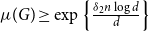 $\mu (G)\ge \exp \left \{\frac {\delta _2n\log d}{d}\right \}$
.
$\mu (G)\ge \exp \left \{\frac {\delta _2n\log d}{d}\right \}$
.
We further show that the above is tight up to the constant in the exponent.
Theorem 5.
For every constant $\delta \gt 0$
, there exists a constant
$\delta \gt 0$
, there exists a constant $C\gt 0$
such that the following holds. For every sufficiently large
$C\gt 0$
such that the following holds. For every sufficiently large $d\in \mathbb{N}$
, there exist infinitely many
$d\in \mathbb{N}$
, there exist infinitely many $n$
for which there exists an
$n$
for which there exists an $(n,d,\lambda )$
-graph
$(n,d,\lambda )$
-graph $G$
with
$G$
with $\lambda /d\le \delta$
satisfying that
$\lambda /d\le \delta$
satisfying that $\mu (G)\le \exp \left \{\frac {Cn\log d}{d}\right \}$
.
$\mu (G)\le \exp \left \{\frac {Cn\log d}{d}\right \}$
.
Structure of the paper. In Section 2 we present notation used throughout the paper, describe an adaptation of the Depth-First-Search algorithm which we will employ, and collect several lemmas to be utilised in the proof. Then, in Section 3 we prove Theorem2 and derive Theorem1 from it. In Section 4 we prove Theorem4. Finally, in Section 5 we give constructions proving Theorems3 and 5.
2. Preliminaries
Given a graph $G=(V,E)$
and sets
$G=(V,E)$
and sets $A,B\subseteq V(G)$
, we denote by
$A,B\subseteq V(G)$
, we denote by $e(A,B)$
the number of edges with one endpoint in
$e(A,B)$
the number of edges with one endpoint in $A$
and the other endpoint in
$A$
and the other endpoint in $B$
. We further abbreviate
$B$
. We further abbreviate $e(A)\,:\!=\, e(A,A)/2=e(G[A])$
. We denote by
$e(A)\,:\!=\, e(A,A)/2=e(G[A])$
. We denote by $N(A)$
the external neighbourhood of
$N(A)$
the external neighbourhood of $A$
, that is,
$A$
, that is,
 \begin{equation*}N(A)=\{v\in V\setminus A\colon \exists u\in A, uv\in E\}.\end{equation*}
Given $v\in V$
and
$v\in V$
and $A\subseteq V$
, we denote by
$A\subseteq V$
, we denote by $d(v,A)$
the number of neighbours of
$d(v,A)$
the number of neighbours of $v$
in
$v$
in $A$
. When
$A$
. When $A=V$
, we write
$A=V$
, we write $d(v)\,:\!=\, d(v,V)$
for the degree of
$d(v)\,:\!=\, d(v,V)$
for the degree of $v$
in
$v$
in $G$
. Recall that given
$G$
. Recall that given $G=(V,E)$
, we form
$G=(V,E)$
, we form $V_p$
by retaining every
$V_p$
by retaining every $v\in V$
independently and with probability
$v\in V$
independently and with probability $p$
; we then abbreviate
$p$
; we then abbreviate $G_p=G[V_p]$
. Throughout the paper, we systematically ignore rounding signs as long as it does not affect the validity of our arguments.
$G_p=G[V_p]$
. Throughout the paper, we systematically ignore rounding signs as long as it does not affect the validity of our arguments.
2.1 Auxiliary lemmas
We will make use of the following fairly standard Chernoff-type probability bound (see, for example, Appendix A in [Reference Alon and Spencer6]).
Lemma 2.1.
Let $X\sim Bin(n,p)$
. Then, for any
$X\sim Bin(n,p)$
. Then, for any $0\le t \le np$
,
$0\le t \le np$
,
 \begin{equation*} \mathbb{P}\left (\left |X- \mathbb{E}[X]\right |\ge t\right )\le 2\exp \left \{-\frac {t^2}{3np}\right \}\!. \end{equation*}
Throughout the rest of the section, we set $\epsilon \gt 0$
to be a sufficiently small constant. We assume that
$\epsilon \gt 0$
to be a sufficiently small constant. We assume that $G$
is an
$G$
is an $(n,d,\lambda )$
-graph (in fact, we consider a sequence of pairs
$(n,d,\lambda )$
-graph (in fact, we consider a sequence of pairs $(d_k,n_k)\in \mathbb{N}^2$
and a sequence of
$(d_k,n_k)\in \mathbb{N}^2$
and a sequence of $(n_k,d_k,\lambda _k)$
-graphs
$(n_k,d_k,\lambda _k)$
-graphs $(G_k)_{k\in \mathbb{N}}$
satisfying
$(G_k)_{k\in \mathbb{N}}$
satisfying $d_k=o(n_k)$
). We write
$d_k=o(n_k)$
). We write $\delta =\frac {\lambda }{d}$
for the spectral ratio. We further set
$\delta =\frac {\lambda }{d}$
for the spectral ratio. We further set $p=\frac {1+\epsilon }{d}$
, and let
$p=\frac {1+\epsilon }{d}$
, and let $V_p$
and
$V_p$
and $G_p$
be as defined above.
$G_p$
be as defined above.
Let us first collect several lemmas that will be useful for us throughout the paper. The first is the aforementioned expander mixing lemma, due to Alon and Chung [Reference Alon and Chung4].
Lemma 2.2.
For any pair of subsets $A,B\subseteq V(G)$
,
$A,B\subseteq V(G)$
,
 \begin{equation*}\left |e(A,B)-\frac {d}{n}|A||B|\right |\leq \lambda \sqrt {|A||B|}.\end{equation*}
2.2 A modified depth first search algorithm
Let us present a variant of the Depth First Search (DFS) algorithm, which we will utilise to show a typical existence of a long induced path when proving Theorem2. The variant combines ideas of the algorithm presented in [Reference Draganić, Glock and Krivelevich11] together with the one presented in [Reference Krivelevich21].
The algorithm is fed a graph $G=(V,E)$
with an ordering
$G=(V,E)$
with an ordering $\sigma$
on its vertices, and a sequence
$\sigma$
on its vertices, and a sequence $(X_v)_{v\in V}$
of i.i.d. Bernoulli
$(X_v)_{v\in V}$
of i.i.d. Bernoulli $(p)$
random variables (with
$(p)$
random variables (with $0\le p\le 1$
). We maintain five sets of vertices:
$0\le p\le 1$
). We maintain five sets of vertices: $T$
, the set of vertices yet to be processed;
$T$
, the set of vertices yet to be processed; $U\subseteq V_p$
, the set of active vertices, kept in a stack (the last vertex to enter
$U\subseteq V_p$
, the set of active vertices, kept in a stack (the last vertex to enter $U$
is the first to leave);
$U$
is the first to leave); $S_1$
and
$S_1$
and $S_2$
, the sets of processed vertices (which fell into
$S_2$
, the sets of processed vertices (which fell into $V_p$
); and
$V_p$
); and $W$
, the set of processed vertices which fell outside of
$W$
, the set of processed vertices which fell outside of $V_p$
. We initialise
$V_p$
. We initialise $U,S_1,S_2,W=\varnothing$
and
$U,S_1,S_2,W=\varnothing$
and $T=V$
. The algorithm terminates once
$T=V$
. The algorithm terminates once $U\cup T=\varnothing$
. As we will see, throughout the execution,
$U\cup T=\varnothing$
. As we will see, throughout the execution, $U$
will span an induced path in
$U$
will span an induced path in $G_p$
.
$G_p$
.
Each step of the algorithm corresponds to exposing a random variable $X_v$
, and proceeds as follows.
$X_v$
, and proceeds as follows.
-
1. If $U$
is empty, we consider the first vertex
$v$
in
$T$
according to
$\sigma$
.
$U$
is empty, we consider the first vertex
$v$
in
$T$
according to
$\sigma$
.-
(a) If
$X_v=1$
, we move
$v$
from
$T$
to
$U$
. -
(b) Otherwise (that is, if
$X_v=0$
), we move
$v$
from
$T$
to
$W$
.
-
-
2. If
$U\neq \varnothing$
, let
$u$
be the vertex on the top of the stack
$U$
.-
(a) If
$u$
has no neighbours in
$T$
, move
$u$
from
$U$
into
$S_1$
, and return to 1 and proceed. -
(b) Otherwise, let
$v$
be the first vertex in
$T$
according to
$\sigma$
such that
$uv\in E$
.
-
i. If
$X_v=0$
, we move
$v$
from
$T$
to
$W$
. -
ii. If
$X_v=1$
and
$v$
has a neighbour in
$U\setminus \{u\}$
, we move
$v$
from
$T$
to
$S_2$
. -
iii. Otherwise (that is, if
$X_v=1$
and
$v$
has no neighbours in
$U\setminus \{u\}$
), we move
$v$
from
$T$
to
$U$
.
-


We will make use of the following simple observations about the above algorithm. First, at every step of the algorithm, $G_p[U]$
spans an induced path. Indeed, if a vertex
$G_p[U]$
spans an induced path. Indeed, if a vertex $v$
gets added to
$v$
gets added to $U$
at Case 2b, then
$U$
at Case 2b, then $v$
augments the existing path spanned by
$v$
augments the existing path spanned by $U$
by attaching itself to its last vertex
$U$
by attaching itself to its last vertex $u$
. Also, by Case 2(b)iii the only neighbour of
$u$
. Also, by Case 2(b)iii the only neighbour of $v$
along the path is
$v$
along the path is $u$
, thus the new path is induced as well. Further, at every step, there are no edges between
$u$
, thus the new path is induced as well. Further, at every step, there are no edges between $S_1$
and
$S_1$
and $T$
, and thus
$T$
, and thus $N_G(S_1)\subseteq S_2\cup U\cup W$
. Moreover, for every integer
$N_G(S_1)\subseteq S_2\cup U\cup W$
. Moreover, for every integer $0\le k\le n$
, after
$0\le k\le n$
, after $k$
steps
$k$
steps $|S_1\cup S_2\cup U\cup W|=k$
.
$|S_1\cup S_2\cup U\cup W|=k$
.
Finally, observe that at any step, the connected component $C$
of
$C$
of $G_p$
currently explored (that is, the one containing vertices in
$G_p$
currently explored (that is, the one containing vertices in $U$
) stays connected when restricted to
$U$
) stays connected when restricted to $S_1\cup U$
, and every vertex of
$S_1\cup U$
, and every vertex of $C$
in
$C$
in $S_2$
sends at least two edges to
$S_2$
sends at least two edges to $S_1\cup U$
. Therefore,
$S_1\cup U$
. Therefore, $|S_2|\le |E(G_p)|-|V(G_p)|$
.
$|S_2|\le |E(G_p)|-|V(G_p)|$
.
2.3 Upper bound on the excess of
$G_p$

In order to find a quantitative bound for the size of $|S_2|$
from the DFS algorithm in the previous subsection, we use several results on site percolation on pseudo-random graphs to derive an upper bound for
$|S_2|$
from the DFS algorithm in the previous subsection, we use several results on site percolation on pseudo-random graphs to derive an upper bound for $|E(G_p)|$
and lower bound for
$|E(G_p)|$
and lower bound for $|V(G_p)|$
. The first result relates the spectral ratio of
$|V(G_p)|$
. The first result relates the spectral ratio of $G$
to the vertex-expansion (in
$G$
to the vertex-expansion (in $G$
) of sets which lie in
$G$
) of sets which lie in $G_p$
.
$G_p$
.
Lemma 2.3 (Lemma 2.4 in [Reference Diskin and Krivelevich9], see also [Reference Krivelevich21]). Let $\alpha \,:\!=\,\alpha (\epsilon )\in (0,\epsilon ^{8})$
be a constant. Suppose that
$\alpha \,:\!=\,\alpha (\epsilon )\in (0,\epsilon ^{8})$
be a constant. Suppose that $\delta \le \alpha ^{2/\alpha }$
. Then,
whp
$\delta \le \alpha ^{2/\alpha }$
. Then,
whp $V_p$
does not contain a set
$V_p$
does not contain a set $S$
with
$S$
with $|S| = m$
,
$|S| = m$
, $\frac {\alpha n}{d}\leq m\leq \frac {n}{3d}$
, such that
$\frac {\alpha n}{d}\leq m\leq \frac {n}{3d}$
, such that $|N_G(S)| \lt (1-\alpha )\left (dm-\frac {d^2m^2}{2n}\right )$
.
$|N_G(S)| \lt (1-\alpha )\left (dm-\frac {d^2m^2}{2n}\right )$
.
Let us now recall the notion of excess. For a connected graph $H$
, we define the excess of
$H$
, we define the excess of $H$
as
$H$
as $\mathrm{exc}(H)\,:\!=\, |E(H)|-|V(H)| + 1$
. If
$\mathrm{exc}(H)\,:\!=\, |E(H)|-|V(H)| + 1$
. If $H$
has more than one connected component, then we set
$H$
has more than one connected component, then we set $\mathrm{exc}(H)$
to be the sum of the excesses of each of its components. Recall that
$\mathrm{exc}(H)$
to be the sum of the excesses of each of its components. Recall that $S_2$
from the DFS algorithm in the previous subsection satisfies
$S_2$
from the DFS algorithm in the previous subsection satisfies $|S_2|\le |E(G_p)|-|V(G_p)|\le \mathrm{exc}(G_p)$
. Thus, to control
$|S_2|\le |E(G_p)|-|V(G_p)|\le \mathrm{exc}(G_p)$
. Thus, to control $|S_2|$
, it will be of use for us to estimate the typical excess of
$|S_2|$
, it will be of use for us to estimate the typical excess of $G_p$
. We require some additional results on site percolation on pseudo-random graphs.
$G_p$
. We require some additional results on site percolation on pseudo-random graphs.
Given $G_p$
, we denote by
$G_p$
, we denote by $L_1$
the largest component of
$L_1$
the largest component of $G_p$
. Let us further define
$G_p$
. Let us further define $x$
to be the unique solution in
$x$
to be the unique solution in $(0,1)$
of
$(0,1)$
of
 \begin{equation} x=(1+\epsilon )(1-\exp \left \{-x\right \}). \end{equation}
We note that $x=2\epsilon -\frac {2\epsilon ^2}{3}+O(\epsilon ^3)$
(see [Reference Diskin and Krivelevich9, Equation (4)]). The following theorem estimates the typical order of
$x=2\epsilon -\frac {2\epsilon ^2}{3}+O(\epsilon ^3)$
(see [Reference Diskin and Krivelevich9, Equation (4)]). The following theorem estimates the typical order of $L_1$
.
$L_1$
.
Theorem 2.4 (Theorem 2 of [Reference Diskin and Krivelevich9]). Let $\alpha \,:\!=\,\alpha (\epsilon )\in (0,\epsilon ^{8})$
be a constant. Suppose that
$\alpha \,:\!=\,\alpha (\epsilon )\in (0,\epsilon ^{8})$
be a constant. Suppose that $\delta \le \alpha ^{2/\alpha }$
. Then,
whp
,
$\delta \le \alpha ^{2/\alpha }$
. Then,
whp
,
 \begin{equation*}\left ||V(L_1)|-\frac {xn}{d}\right |\leq \frac {7\alpha n}{d},\end{equation*}
where $x$
is as in (1).
$x$
is as in (1).
The next result estimates the typical number of edges in $L_1$
.
$L_1$
.
Theorem 2.5 (Theorem 4 of [Reference Diskin and Krivelevich9]). Let $\alpha \,:\!=\,\alpha (\epsilon )\in (0,\epsilon ^{8})$
be a constant. Suppose that
$\alpha \,:\!=\,\alpha (\epsilon )\in (0,\epsilon ^{8})$
be a constant. Suppose that $\delta \le \alpha ^{2/\alpha }$
. Then,
whp
,
$\delta \le \alpha ^{2/\alpha }$
. Then,
whp
,
 \begin{equation*}\left |e(L_1)-\frac {((1+\epsilon )^2-(1+\epsilon -x)^2)n}{2d}\right |\leq \frac {8\alpha ^{1/4} n}{d},\end{equation*}
where $x$
is as in (1).
$x$
is as in (1).
Finally, the following result estimates the typical number of edges in $G_p$
which are neither in
$G_p$
which are neither in $L_1$
nor in isolated trees.
$L_1$
nor in isolated trees.
Theorem 2.6 (Lemma 6.4 of [Reference Diskin and Krivelevich9]). Let $\alpha \,:\!=\,\alpha (\epsilon )\in (0,\epsilon ^{8})$
be a constant. Suppose that
$\alpha \,:\!=\,\alpha (\epsilon )\in (0,\epsilon ^{8})$
be a constant. Suppose that $\delta \le \alpha ^{2/\alpha }$
. Then,
whp
, the number of edges in
$\delta \le \alpha ^{2/\alpha }$
. Then,
whp
, the number of edges in $G_p$
which are in components that are neither the giant component nor isolated trees is at most
$G_p$
which are in components that are neither the giant component nor isolated trees is at most $\frac {7\alpha ^{1/4} n}{d}$
.
$\frac {7\alpha ^{1/4} n}{d}$
.
With these three results at hand, we can now estimate the typical excess of $G_p$
.
$G_p$
.
Lemma 2.7.
Suppose that $\delta \le \epsilon ^{24/\epsilon ^{12}}$
. Then,
whp
,
$\delta \le \epsilon ^{24/\epsilon ^{12}}$
. Then,
whp
, $\mathrm{exc}(G_p)= O(\epsilon ^3)n/d$
.
$\mathrm{exc}(G_p)= O(\epsilon ^3)n/d$
.
Proof. Note that under the above assumption, we can take $\alpha$
from Theorems2.4, 2.5, and 2.6 to be
$\alpha$
from Theorems2.4, 2.5, and 2.6 to be $\alpha =\epsilon ^{12}$
. Then, by Theorems2.4 and 2.5,
$\alpha =\epsilon ^{12}$
. Then, by Theorems2.4 and 2.5,
 \begin{align*} \mathrm{exc}(G_p[L_1])&\le \frac {((1+\epsilon )^2-(1+\epsilon -x)^2)n}{2d}+\frac {8\epsilon ^{12/4} n}{d}-\frac {xn}{d}+\frac {7\epsilon ^{12} n}{d}+1\\[3pt] &\le \frac {\left (\epsilon x-x^2/2\right )n}{d}+\frac {O(\epsilon ^3)n}{d}=\frac {O(\epsilon ^3)n}{d}, \end{align*}
where the last equality follows from $\epsilon x-x^2/2=O(\epsilon ^3)$
. Since isolated trees have no excess, by the above together with Theorem2.6, we conclude that whp
$\epsilon x-x^2/2=O(\epsilon ^3)$
. Since isolated trees have no excess, by the above together with Theorem2.6, we conclude that whp
 \begin{align*} \mathrm{exc}(G_p)\le \mathrm{exc}(G_p[L_1])+\frac {7\epsilon ^{12/4}n}{d}=\frac {O(\epsilon ^3)n}{d}, \end{align*}
as required.
3. Existence of induced paths and cycles
We begin by finding an induced path in the percolated graph $G_p$
. To do so, we apply the modified DFS algorithm presented in Section 2 and obtain a lower bound on the size of the set of active vertices, which spans an induced path. The proof relies on Lemmas2.7 and 2.3.
$G_p$
. To do so, we apply the modified DFS algorithm presented in Section 2 and obtain a lower bound on the size of the set of active vertices, which spans an induced path. The proof relies on Lemmas2.7 and 2.3.
Proof of Theorem 2. Let $\delta = \epsilon ^{24/\epsilon ^{12}}$
. Run the DFS algorithm described in Section 2 on
$\delta = \epsilon ^{24/\epsilon ^{12}}$
. Run the DFS algorithm described in Section 2 on $G$
. We claim that after
$G$
. We claim that after $\epsilon n$
steps in the algorithm, whp,
$\epsilon n$
steps in the algorithm, whp, $|U|\geq \frac {\epsilon ^2n}{3d}$
, and thus, as
$|U|\geq \frac {\epsilon ^2n}{3d}$
, and thus, as $U$
forms an induced path in
$U$
forms an induced path in $G_p$
, the statement follows.
$G_p$
, the statement follows.
Indeed, after $\epsilon n$
steps,
$\epsilon n$
steps, $|U\cup S_1\cup S_2|\sim Bin(\epsilon n,p)$
. Thus, by Lemma2.1, with probability at least
$|U\cup S_1\cup S_2|\sim Bin(\epsilon n,p)$
. Thus, by Lemma2.1, with probability at least $1-2\exp \left \{-\frac {(n/d)^{4/3}}{4\epsilon n /d}\right \}$
we have that
$1-2\exp \left \{-\frac {(n/d)^{4/3}}{4\epsilon n /d}\right \}$
we have that $\bigg ||U_1\cup S_1\cup S_2|-\frac {(1+\epsilon )\epsilon n}{d}\bigg |\le (n/d)^{2/3}$
. Further, by Lemma2.7 together with our assumption on
$\bigg ||U_1\cup S_1\cup S_2|-\frac {(1+\epsilon )\epsilon n}{d}\bigg |\le (n/d)^{2/3}$
. Further, by Lemma2.7 together with our assumption on $\delta$
, we have that whp
$\delta$
, we have that whp $|S_2|=O(\epsilon ^3)n/d$
. Assume towards contradiction that
$|S_2|=O(\epsilon ^3)n/d$
. Assume towards contradiction that $|U|\lt \frac {\epsilon ^2n}{3d}$
. Then, whp,
$|U|\lt \frac {\epsilon ^2n}{3d}$
. Then, whp,
 \begin{align*} |S_1|\ge \frac {(1+\epsilon )\epsilon n}{d}-n^{2/3}-O(\epsilon ^3)\frac {n}{d}-\frac {\epsilon ^2 n}{3d}\ge \frac {(\epsilon +3\epsilon ^2/5)n}{d}. \end{align*}
On the other hand, whp,
 \begin{equation*}|S_1|\le |U\cup S_1\cup S_2|\le 4\epsilon n/(3d)\lt n/(3d),\end{equation*}
and thus by Lemma2.3 applied with $\alpha =\epsilon ^{12}$
(which is possible by our assumption on
$\alpha =\epsilon ^{12}$
(which is possible by our assumption on $\delta$
), we have that whp
$\delta$
), we have that whp
 \begin{align*} |N_G(S_1)|\ge (1-\epsilon ^{12})\left (\epsilon +3\epsilon ^2/5-\frac {1}{2}(\epsilon +3\epsilon ^2/5)^2\right )n\gt \epsilon n, \end{align*}
a contradiction, since $N_G(S_1)\subseteq S_2\cup U\cup W$
and
$N_G(S_1)\subseteq S_2\cup U\cup W$
and $|S_2\cup U\cup W|\le |S_1\cup S_2\cup U\cup W|\le \epsilon n$
.
$|S_2\cup U\cup W|\le |S_1\cup S_2\cup U\cup W|\le \epsilon n$
.
With this result at hand, we are ready to prove Theorem1. We take the induced path obtained in Theorem2 and, using Lemma2.2, “close” (a substantial part of) it into a cycle. By carrying this out carefully, we ensure that the resulting cycle is induced and is long enough.
Proof of Theorem 1. Let $\epsilon ,\delta (\epsilon )\gt 0$
be as in the statement of Theorem2. We may assume that
$\epsilon ,\delta (\epsilon )\gt 0$
be as in the statement of Theorem2. We may assume that $\delta _1\le \delta (\epsilon )$
. Let
$\delta _1\le \delta (\epsilon )$
. Let $p=\frac {1+\epsilon }{d}$
. Then, by Theorem2, whp
$p=\frac {1+\epsilon }{d}$
. Then, by Theorem2, whp $G_p$
contains an induced path of length at least
$G_p$
contains an induced path of length at least $\frac {\epsilon ^2n}{3d}$
. Thus, deterministically,
$\frac {\epsilon ^2n}{3d}$
. Thus, deterministically, $G$
contains an induced path
$G$
contains an induced path $P$
on
$P$
on $k=\frac {\epsilon ^2n}{3d}$
vertices (note that for the latter to hold, we merely needed the first statement to hold with positive probability).
$k=\frac {\epsilon ^2n}{3d}$
vertices (note that for the latter to hold, we merely needed the first statement to hold with positive probability).
Let $P=\{v_1,\ldots ,v_{k}\}$
. Let
$P=\{v_1,\ldots ,v_{k}\}$
. Let $P_1=\{v_1,\ldots , v_{k/3}\}$
be the first
$P_1=\{v_1,\ldots , v_{k/3}\}$
be the first $\frac {\epsilon ^2n}{9d}$
vertices of
$\frac {\epsilon ^2n}{9d}$
vertices of $P$
, and let
$P$
, and let $P_2=\{v_{2k/3+1},\ldots ,v_{k}\}$
be the last
$P_2=\{v_{2k/3+1},\ldots ,v_{k}\}$
be the last $\frac {\epsilon ^2n}{9d}$
vertices of
$\frac {\epsilon ^2n}{9d}$
vertices of $P$
. Let
$P$
. Let $P^{\prime}=\{v_{k/2-k/20+1},\ldots ,v_{k/2+k/20}\}$
be the set of
$P^{\prime}=\{v_{k/2-k/20+1},\ldots ,v_{k/2+k/20}\}$
be the set of $\frac {\epsilon ^2n}{30d}$
vertices at the middle of
$\frac {\epsilon ^2n}{30d}$
vertices at the middle of $P$
. By Lemma2.3,
$P$
. By Lemma2.3, $|N_G(P_1)|, |N_G(P_2)|\geq \frac {\epsilon ^2n}{10}$
. Since
$|N_G(P_1)|, |N_G(P_2)|\geq \frac {\epsilon ^2n}{10}$
. Since $G$
is
$G$
is $d$
-regular,
$d$
-regular, $|N_G(P^{\prime})|\leq d|P^{\prime}|=\frac {\epsilon ^2n}{30}$
. Set
$|N_G(P^{\prime})|\leq d|P^{\prime}|=\frac {\epsilon ^2n}{30}$
. Set $N_1=N_G(P_1)\setminus \left (P\cup N_G(P^{\prime})\right )$
and similarly
$N_1=N_G(P_1)\setminus \left (P\cup N_G(P^{\prime})\right )$
and similarly $N_2=N_G(P_2)\setminus \left (P\cup N_G(P^{\prime})\right )$
. Note that
$N_2=N_G(P_2)\setminus \left (P\cup N_G(P^{\prime})\right )$
. Note that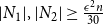 $|N_1|,|N_2|\geq \frac {\epsilon ^2n}{30}$
. In particular, by Lemma2.2,
$|N_1|,|N_2|\geq \frac {\epsilon ^2n}{30}$
. In particular, by Lemma2.2, $e(N_1,N_2)\ge \epsilon ^5 dn\gt 0$
.
$e(N_1,N_2)\ge \epsilon ^5 dn\gt 0$
.
Let $u_1\in N_1$
,
$u_1\in N_1$
, $u_2\in N_2$
be such that
$u_2\in N_2$
be such that $u_1u_2\in E(G)$
. Consider
$u_1u_2\in E(G)$
. Consider $L=\{v_1,\ldots ,v_{k/2-k/20}\}$
and
$L=\{v_1,\ldots ,v_{k/2-k/20}\}$
and $R=\{v_{k/2+k/20+1},\ldots ,v_k\}$
. If
$R=\{v_{k/2+k/20+1},\ldots ,v_k\}$
. If $u_1$
has a neighbour in both
$u_1$
has a neighbour in both $L$
and
$L$
and $R$
, we let
$R$
, we let $w_1$
be the neighbour of
$w_1$
be the neighbour of $u_1$
from
$u_1$
from $L$
closest to
$L$
closest to $P^{\prime}$
, that is, to
$P^{\prime}$
, that is, to $v_{k/2-k/20}$
. Similarly, let
$v_{k/2-k/20}$
. Similarly, let $w_2$
be the neighbour of
$w_2$
be the neighbour of $u_1$
from
$u_1$
from $R$
closest to
$R$
closest to $P^{\prime}$
. Recall that
$P^{\prime}$
. Recall that $u_1$
has no neighbours in
$u_1$
has no neighbours in $P^{\prime}$
, hence
$P^{\prime}$
, hence $u_1$
, together with the subpath of
$u_1$
, together with the subpath of $P$
starting at
$P$
starting at $w_1$
and ending at
$w_1$
and ending at $w_2$
forms an induced cycle in
$w_2$
forms an induced cycle in $G$
whose length is at least
$G$
whose length is at least $|P^{\prime}|=\frac {\epsilon ^2n}{30d}$
. This completes the proof, with
$|P^{\prime}|=\frac {\epsilon ^2n}{30d}$
. This completes the proof, with $\delta _2=\epsilon ^2/30$
. A similar argument applies when
$\delta _2=\epsilon ^2/30$
. A similar argument applies when $u_2$
has a neighbour in both
$u_2$
has a neighbour in both $L$
and
$L$
and $R$
.
$R$
.
Now, since $u_1\in N_1\subseteq L$
and
$u_1\in N_1\subseteq L$
and $u_2\in N_2\subseteq R$
, it remains to consider the case where
$u_2\in N_2\subseteq R$
, it remains to consider the case where $u_1$
has a neighbour in
$u_1$
has a neighbour in $L$
but not in
$L$
but not in $R$
and
$R$
and $u_2$
has a neighbour in
$u_2$
has a neighbour in $R$
but not in
$R$
but not in $L$
. Let
$L$
. Let $w_1$
as the neighbour of
$w_1$
as the neighbour of $u_1$
from
$u_1$
from $L$
closest to
$L$
closest to $P^{\prime}$
, and similarly, define
$P^{\prime}$
, and similarly, define $w_2$
as the neighbour of
$w_2$
as the neighbour of $u_2$
from
$u_2$
from $R$
closest to
$R$
closest to $P^{\prime}$
.
$P^{\prime}$
. $u_1u_2$
together with the subpath of
$u_1u_2$
together with the subpath of $P$
starting at
$P$
starting at $w_1$
and ending at
$w_1$
and ending at $w_2$
forms an induced cycle in
$w_2$
forms an induced cycle in $G$
whose length is at least
$G$
whose length is at least $|P^{\prime}|=\frac {\epsilon ^2n}{30d}$
which again completes the proof, with
$|P^{\prime}|=\frac {\epsilon ^2n}{30d}$
which again completes the proof, with $\delta _2=\epsilon ^2/30$
.
$\delta _2=\epsilon ^2/30$
.
Remark 3.1. We note that, with a bit more effort, one can show the typical existence of an induced cycle of length $\Omega (\epsilon ^2n/d)$
in
$\Omega (\epsilon ^2n/d)$
in $G_p$
. Let us give a sketch of the proof. We may employ a sprinkling argument, setting
$G_p$
. Let us give a sketch of the proof. We may employ a sprinkling argument, setting $p_2=\frac {\epsilon ^3}{d}$
, and
$p_2=\frac {\epsilon ^3}{d}$
, and $p_1$
to be such that
$p_1$
to be such that $(1-p_1)(1-p_2)=1-p$
. We then have that
$(1-p_1)(1-p_2)=1-p$
. We then have that $G_p$
has the same distribution as
$G_p$
has the same distribution as $G[V_{p_1}\cup V_{p_2}]$
, and
$G[V_{p_1}\cup V_{p_2}]$
, and $p_1\ge \frac {1+\epsilon -\epsilon ^3}{d}$
. By Theorem 2, whp there is an induced path
$p_1\ge \frac {1+\epsilon -\epsilon ^3}{d}$
. By Theorem 2, whp there is an induced path $G[V_{p_1}]$
of length at least
$G[V_{p_1}]$
of length at least $\Omega (\epsilon ^2n/d)$
. Similar to the above proof, one can consider
$\Omega (\epsilon ^2n/d)$
. Similar to the above proof, one can consider $N_1,N_2$
the neighbourhoods in
$N_1,N_2$
the neighbourhoods in $G$
of some sufficiently long prefix and suffix of the path, which have whp at least
$G$
of some sufficiently long prefix and suffix of the path, which have whp at least $\epsilon ^5dn$
edges between them. We can then consider sequentially every vertex in
$\epsilon ^5dn$
edges between them. We can then consider sequentially every vertex in $N_1$
, and whether it falls into
$N_1$
, and whether it falls into $V_{p_2}$
, noting that a typical vertex in
$V_{p_2}$
, noting that a typical vertex in $N_1$
will have
$N_1$
will have $\Omega (d)$
neighbours in
$\Omega (d)$
neighbours in $N_2$
. Upon reaching a sufficiently large subset
$N_2$
. Upon reaching a sufficiently large subset $W\subseteq N_1$
in
$W\subseteq N_1$
in $V_{p_2}$
whose neighbourhood (in
$V_{p_2}$
whose neighbourhood (in $G$
) in
$G$
) in $N_2$
is of order
$N_2$
is of order $d|W|$
, we may percolate
$d|W|$
, we may percolate $N_2$
with probability
$N_2$
with probability $p_2$
, and whp obtain an edge in
$p_2$
, and whp obtain an edge in $G[V_{p_2}]$
between
$G[V_{p_2}]$
between $N_1$
and
$N_1$
and $N_2$
, and then complete the proof as before.
$N_2$
, and then complete the proof as before.
4. Non-isomorphic induced subgraphs
The proof of Theorem4 will utilise Theorem2, together with Lemma2.3 to construct a long induced path $P$
and a set
$P$
and a set $W^{\prime}$
of size
$W^{\prime}$
of size $\Theta (d|P|)=\Theta (n)$
, such that each vertex in
$\Theta (d|P|)=\Theta (n)$
, such that each vertex in $W^{\prime}$
has a unique neighbour in
$W^{\prime}$
has a unique neighbour in $P$
, and
$P$
, and $N_P(W^{\prime})$
avoids the endpoints of
$N_P(W^{\prime})$
avoids the endpoints of $P$
. Their neighbours, and has pairwise distances at least 4 along
$P$
. Their neighbours, and has pairwise distances at least 4 along $P$
. We then show that the induced subgraph on
$P$
. We then show that the induced subgraph on $V(P)\cup W^{\prime}$
contains the required number of non-isomorphic induced subgraphs.
$V(P)\cup W^{\prime}$
contains the required number of non-isomorphic induced subgraphs.
Proof of Theorem 4. Let $\epsilon ,\delta (\epsilon )\gt 0$
be as in the statement of Theorem2. We may assume that
$\epsilon ,\delta (\epsilon )\gt 0$
be as in the statement of Theorem2. We may assume that $\delta _1\le \delta (\epsilon )$
, and in particular,
$\delta _1\le \delta (\epsilon )$
, and in particular, $\delta _1\le \epsilon ^{8/\epsilon ^4}$
. Let
$\delta _1\le \epsilon ^{8/\epsilon ^4}$
. Let $p=\frac {1+\epsilon }{d}$
. Then, by Theorem2, whp
$p=\frac {1+\epsilon }{d}$
. Then, by Theorem2, whp $G_p$
contains an induced path
$G_p$
contains an induced path $P$
of length exactly
$P$
of length exactly $\frac {\epsilon ^2n}{3d}$
. Furthermore, by Lemma2.3 and by our assumption on
$\frac {\epsilon ^2n}{3d}$
. Furthermore, by Lemma2.3 and by our assumption on $\delta _1$
, whp
$\delta _1$
, whp $|N_G(P)|\ge (1-\epsilon ^4)\left (\frac {\epsilon ^2n}{3}-\frac {\epsilon ^4n}{18}\right )\ge \frac {\epsilon ^2n}{3}-\epsilon ^4n$
. Thus, there exists (deterministically) an induced path
$|N_G(P)|\ge (1-\epsilon ^4)\left (\frac {\epsilon ^2n}{3}-\frac {\epsilon ^4n}{18}\right )\ge \frac {\epsilon ^2n}{3}-\epsilon ^4n$
. Thus, there exists (deterministically) an induced path $P=\{v_1,v_2,\ldots ,v_k\}$
in
$P=\{v_1,v_2,\ldots ,v_k\}$
in $G$
on
$G$
on $k=\frac {\epsilon ^2n}{3d}$
vertices, such that
$k=\frac {\epsilon ^2n}{3d}$
vertices, such that $|N_G(P)|\ge \frac {\epsilon ^2n}{3}-\epsilon ^4n$
.
$|N_G(P)|\ge \frac {\epsilon ^2n}{3}-\epsilon ^4n$
.
Now, since $G$
is
$G$
is $d$
-regular, we have that
$d$
-regular, we have that $\sum _{v\in N_G(P)}d(v,P)\le \sum _{v\in P}d(v)=\epsilon ^2n/3$
. Suppose towards contradiction that there are more than
$\sum _{v\in N_G(P)}d(v,P)\le \sum _{v\in P}d(v)=\epsilon ^2n/3$
. Suppose towards contradiction that there are more than $2\epsilon ^4n$
vertices in
$2\epsilon ^4n$
vertices in $N_G(P)$
each having at least two neighbours in
$N_G(P)$
each having at least two neighbours in $P$
. Then,
$P$
. Then,
 \begin{align*} \sum _{v\in N_G(P)}d(v,P)\ge |N_G(P)|+2\epsilon ^4n\gt \epsilon ^2n/3, \end{align*}
which is a contradiction. Hence, there exists a set $U\subseteq N_G(P)$
of size at least
$U\subseteq N_G(P)$
of size at least $\frac {\epsilon ^2n}{3}-3\epsilon ^4n$
, such that every
$\frac {\epsilon ^2n}{3}-3\epsilon ^4n$
, such that every $u\in U$
has exactly one neighbour in
$u\in U$
has exactly one neighbour in $P$
. In particular, this implies that there are at least
$P$
. In particular, this implies that there are at least $\frac {\epsilon ^2n}{10d}$
vertices in
$\frac {\epsilon ^2n}{10d}$
vertices in $P$
which have at least
$P$
which have at least $\frac {d}{10}$
neighbours in
$\frac {d}{10}$
neighbours in $U$
. Let us denote the set of these vertices in
$U$
. Let us denote the set of these vertices in $P$
by
$P$
by $W$
. Let us then choose a subset
$W$
. Let us then choose a subset $W^{\prime}\subseteq W$
, such that
$W^{\prime}\subseteq W$
, such that $v_1,v_2,v_{k-1},v_k\notin W^{\prime}$
, and the distance in
$v_1,v_2,v_{k-1},v_k\notin W^{\prime}$
, and the distance in $P$
between any
$P$
between any $u,u^{\prime}\in W^{\prime}$
is at least
$u,u^{\prime}\in W^{\prime}$
is at least $4$
. Note that we can choose such
$4$
. Note that we can choose such $W^{\prime}$
with
$W^{\prime}$
with $|W^{\prime}|\ge |W|/5\ge \frac {\epsilon ^2n}{50d}$
. Crucially, observe that every
$|W^{\prime}|\ge |W|/5\ge \frac {\epsilon ^2n}{50d}$
. Crucially, observe that every $u\in N_G(W^{\prime})\cap U\,:\!=\, N_{W^{\prime}}$
has a unique neighbour
$u\in N_G(W^{\prime})\cap U\,:\!=\, N_{W^{\prime}}$
has a unique neighbour $v\in W^{\prime}$
on
$v\in W^{\prime}$
on $P$
.
$P$
.
Now, let $H\,:\!=\, G[V(P)\cup N_{W^{\prime}}]$
. Let
$H\,:\!=\, G[V(P)\cup N_{W^{\prime}}]$
. Let $A\neq A^{\prime}$
be subsets of
$A\neq A^{\prime}$
be subsets of $N_{W^{\prime}}$
, such that
$N_{W^{\prime}}$
, such that $G[V(P)\cup A]\cong G[V(P)\cup A^{\prime}]$
. Let
$G[V(P)\cup A]\cong G[V(P)\cup A^{\prime}]$
. Let $\psi :V(P)\cup A\to V(P)\cup A^{\prime}$
be an isomorphism between these two graphs. We claim that
$\psi :V(P)\cup A\to V(P)\cup A^{\prime}$
be an isomorphism between these two graphs. We claim that $\psi \mid _{V(P)}$
is either the trivial automorphism of
$\psi \mid _{V(P)}$
is either the trivial automorphism of $P$
, or the non-trivial involution automorphism of
$P$
, or the non-trivial involution automorphism of $P$
. First, note that the only two vertices in
$P$
. First, note that the only two vertices in $H$
which are of degree one and have a neighbour of degree two are
$H$
which are of degree one and have a neighbour of degree two are $v_1$
and
$v_1$
and $v_k$
. Indeed,
$v_k$
. Indeed, $v_2,v_{k-1}\notin W^{\prime}$
and thus have degree two, and any other vertex of degree one is in
$v_2,v_{k-1}\notin W^{\prime}$
and thus have degree two, and any other vertex of degree one is in $N_{W^{\prime}}$
, and thus has a neighbour on
$N_{W^{\prime}}$
, and thus has a neighbour on $V(P)$
of degree at least three. It thus suffices to show that
$V(P)$
of degree at least three. It thus suffices to show that $\psi$
sends vertices of degree two in
$\psi$
sends vertices of degree two in $V(P)$
to (possibly other) vertices of degree two in the same set
$V(P)$
to (possibly other) vertices of degree two in the same set $V(P)$
.
$V(P)$
.
Suppose towards contradiction that there exists $u\in V(P)$
such that
$u\in V(P)$
such that $d_H(u)=2=d_{G[V(P)\cup A]}(u)$
and
$d_H(u)=2=d_{G[V(P)\cup A]}(u)$
and $\psi (u)\in A^{\prime}$
. Since every vertex in
$\psi (u)\in A^{\prime}$
. Since every vertex in $A^{\prime}\subseteq N_{W^{\prime}}$
has a unique neighbour in
$A^{\prime}\subseteq N_{W^{\prime}}$
has a unique neighbour in $P$
and since
$P$
and since $\psi (u)$
has degree two in
$\psi (u)$
has degree two in $G[V(P)\cup A^{\prime}]$
, we have that
$G[V(P)\cup A^{\prime}]$
, we have that $\psi (u)$
has a neighbour in
$\psi (u)$
has a neighbour in $A^{\prime}$
, which we denote by
$A^{\prime}$
, which we denote by $v$
. Let
$v$
. Let $x_1$
be the unique neighbour of
$x_1$
be the unique neighbour of $\psi (u)$
in
$\psi (u)$
in $P$
, and let
$P$
, and let $x_2$
be the unique neighbour of
$x_2$
be the unique neighbour of $v$
in
$v$
in $P$
, noting that both
$P$
, noting that both $x_1$
and
$x_1$
and $x_2$
have degree at least three in
$x_2$
have degree at least three in $G[V(P)\cup A^{\prime}]$
. We then have that
$G[V(P)\cup A^{\prime}]$
. We then have that $\psi (u)$
belongs to the path
$\psi (u)$
belongs to the path $x_1\psi (u)vx_2$
in
$x_1\psi (u)vx_2$
in $G[V(P)\cup A^{\prime}]\subseteq H$
. However, by construction of
$G[V(P)\cup A^{\prime}]\subseteq H$
. However, by construction of $H$
, since
$H$
, since $d_H(u)=2$
, the two closest vertices to
$d_H(u)=2$
, the two closest vertices to $u$
which have degree at least
$u$
which have degree at least $3$
in
$3$
in $G[V(P)\cup A]$
(and therefore, in
$G[V(P)\cup A]$
(and therefore, in $H$
) lie on
$H$
) lie on $P$
, and thus are at distance at least four from each other – contradiction.
$P$
, and thus are at distance at least four from each other – contradiction.
Therefore, any automorphism $\psi$
has that
$\psi$
has that $\psi \mid _{V(P)}$
is one of the two involution automorphisms. Hence, for a fixed automorphism of
$\psi \mid _{V(P)}$
is one of the two involution automorphisms. Hence, for a fixed automorphism of $P$
, any two subsets
$P$
, any two subsets $A,A^{\prime}\in N_{W^{\prime}}$
having
$A,A^{\prime}\in N_{W^{\prime}}$
having $|A^{\prime}\cap N(v)\cap N_{W^{\prime}}|\neq |A^{\prime}\cap N(v)\cap N_{W^{\prime}}|$
for some
$|A^{\prime}\cap N(v)\cap N_{W^{\prime}}|\neq |A^{\prime}\cap N(v)\cap N_{W^{\prime}}|$
for some $v\in W^{\prime}$
cannot span (together with
$v\in W^{\prime}$
cannot span (together with $P$
) isomorphic subgraphs. We thus conclude that, for every tuple
$P$
) isomorphic subgraphs. We thus conclude that, for every tuple $(0\leq s_v\leq d/10)_{v\in W^{\prime}}$
, there exists at most one other tuple
$(0\leq s_v\leq d/10)_{v\in W^{\prime}}$
, there exists at most one other tuple $(0\leq s^{\prime}_v\leq d/10)_{v\in W^{\prime}}$
satisfying the following: there exist two subsets
$(0\leq s^{\prime}_v\leq d/10)_{v\in W^{\prime}}$
satisfying the following: there exist two subsets $A,A^{\prime}\subset N_{W^{\prime}}$
such that
$A,A^{\prime}\subset N_{W^{\prime}}$
such that $|A\cap N(v)\cap N_{W^{\prime}}|=s_v$
and
$|A\cap N(v)\cap N_{W^{\prime}}|=s_v$
and $|A^{\prime}\cap N(v)\cap N_{W^{\prime}}|=s^{\prime}_v$
for every
$|A^{\prime}\cap N(v)\cap N_{W^{\prime}}|=s^{\prime}_v$
for every $v\in W^{\prime}$
and
$v\in W^{\prime}$
and $G[V(P)\cup A],G[V(P)\cup A^{\prime}]$
are isomorphic. Therefore,
$G[V(P)\cup A],G[V(P)\cup A^{\prime}]$
are isomorphic. Therefore,
 \begin{equation*} \mu (G)\geq \frac {1}{2}(d/10)^{|W^{\prime}|}\geq \frac {1}{2}\left (\frac {d}{10}\right )^{\frac {\epsilon ^2n}{50d}}\ge \exp \left \{\frac {\delta _2n\log d}{d}\right \}, \end{equation*}
for small enough $\delta _2$
, as required.
$\delta _2$
, as required.
5. Constructions
Both the proof of Theorem3 and of Theorem5 will follow from quite similar constructions. Let us first collect some notation and results about the spectra of graphs. We refer the reader to [Reference Barik, Kalita, Pati and Sahoo7, Reference Cvetković, Doob and Sachs8] for a comprehensive study of the spectra of graphs and graph operations.
Lemma 5.1 (see, e.g., [Reference Barik, Kalita, Pati and Sahoo7]). The eigenvalues of the complete graph on $n$
vertices are
$n$
vertices are $n-1$
of multiplicity
$n-1$
of multiplicity $1$
, and
$1$
, and $-1$
of multiplicity
$-1$
of multiplicity $n-1$
. The eigenvalue of the empty graph on
$n-1$
. The eigenvalue of the empty graph on $n$
vertices is zero with multiplicity
$n$
vertices is zero with multiplicity $n$
.
$n$
.
We will make use of the following graph operation. Let $r\gt 0$
be an integer. Let
$r\gt 0$
be an integer. Let $G$
and
$G$
and $H$
be two graphs, such that
$H$
be two graphs, such that $H$
is
$H$
is $r$
-regular. The lexicographic product (denoted by
$r$
-regular. The lexicographic product (denoted by $\mathrm{lex}(G,H)$
) of
$\mathrm{lex}(G,H)$
) of $G$
and
$G$
and $H$
has vertex set
$H$
has vertex set $V(G)\times V(H)$
and for every
$V(G)\times V(H)$
and for every $u,v\in V(G)$
and
$u,v\in V(G)$
and $x,y\in V(H)$
,
$x,y\in V(H)$
, $(u,x)$
is adjacent to
$(u,x)$
is adjacent to $(v,y)$
if and only if either
$(v,y)$
if and only if either $uv\in E(G)$
or
$uv\in E(G)$
or $u=v\wedge xy\in E(H)$
.
$u=v\wedge xy\in E(H)$
.
One can think of such an operation as taking a graph $G$
and replacing each vertex of
$G$
and replacing each vertex of $G$
by a copy of
$G$
by a copy of $H$
; in particular, when
$H$
; in particular, when $H$
is the empty graph, this is simply the blow-up operation. The lexicographic product satisfies the following property (see, e.g., [Reference Barik, Kalita, Pati and Sahoo7]).
$H$
is the empty graph, this is simply the blow-up operation. The lexicographic product satisfies the following property (see, e.g., [Reference Barik, Kalita, Pati and Sahoo7]).
Lemma 5.2.
Suppose $\lambda _1,\ldots , \lambda _n$
are the eigenvalues of a graph
$\lambda _1,\ldots , \lambda _n$
are the eigenvalues of a graph $G$
on
$G$
on $n$
vertices and
$n$
vertices and $\mu _1=r,\ldots ,\mu _m$
are the eigenvalues of an
$\mu _1=r,\ldots ,\mu _m$
are the eigenvalues of an $r$
-regular graph
$r$
-regular graph $H$
on
$H$
on $m$
vertices. Then, the eigenvalues of the adjacency matrix of the lexicographic product
$m$
vertices. Then, the eigenvalues of the adjacency matrix of the lexicographic product $\mathrm{lex}(G,H)$
are
$\mathrm{lex}(G,H)$
are $\lambda _im+r$
of multiplicity
$\lambda _im+r$
of multiplicity $1$
for
$1$
for $1\leq i\leq n$
and
$1\leq i\leq n$
and $\mu _j$
of multiplicity
$\mu _j$
of multiplicity $n$
for
$n$
for $2\leq j\leq m$
.
$2\leq j\leq m$
.
Let us begin with the proof of Theorem5, whose construction is slightly simpler.
Proof of Theorem 5. Let $\delta \gt 0$
be a constant. Let
$\delta \gt 0$
be a constant. Let $d\in \mathbb{N}$
be sufficiently large, and let
$d\in \mathbb{N}$
be sufficiently large, and let $n\in \mathbb{N}$
be such that
$n\in \mathbb{N}$
be such that $d,n$
satisfy the parity assumptions which are implicit below (in particular,
$d,n$
satisfy the parity assumptions which are implicit below (in particular, $n$
is divisible by
$n$
is divisible by $d$
). Let
$d$
). Let $d_0\,:\!=\, d_0(\delta )$
be the smallest integer satisfying
$d_0\,:\!=\, d_0(\delta )$
be the smallest integer satisfying $d_0\ge 3$
and
$d_0\ge 3$
and $\sqrt {d_0}\ge \frac {3}{\delta }$
.
$\sqrt {d_0}\ge \frac {3}{\delta }$
.
Assume first, for the sake of clarity of presentation, that $d$
is divisible by
$d$
is divisible by $d_0$
. Let
$d_0$
. Let $n_0\,:\!=\, n\cdot d_0/d$
, and let
$n_0\,:\!=\, n\cdot d_0/d$
, and let $H_1$
be an
$H_1$
be an $(n_0, d_0, \lambda _0)$
-graph with
$(n_0, d_0, \lambda _0)$
-graph with $\lambda _0\le 3\sqrt {d_0}$
— indeed, such a graph exists, since a random
$\lambda _0\le 3\sqrt {d_0}$
— indeed, such a graph exists, since a random $d_0$
-regular graph on
$d_0$
-regular graph on $n_0$
vertices typically satisfies this (see, e.g., [Reference Krivelevich and Sudakov23]). We note that we assume here that
$n_0$
vertices typically satisfies this (see, e.g., [Reference Krivelevich and Sudakov23]). We note that we assume here that $n_0$
is sufficiently large with respect to
$n_0$
is sufficiently large with respect to $d_0$
, and in turn,
$d_0$
, and in turn, $n$
is sufficiently large with respect to
$n$
is sufficiently large with respect to $d$
. Let
$d$
. Let $H_2$
be the empty graph on
$H_2$
be the empty graph on $d/d_0$
vertices. Set
$d/d_0$
vertices. Set $G=\mathrm{lex}(H_1,H_2)$
. By Lemmas5.1 and 5.2 we have that
$G=\mathrm{lex}(H_1,H_2)$
. By Lemmas5.1 and 5.2 we have that $G$
is an
$G$
is an $(n,d,\lambda )$
-graph with
$(n,d,\lambda )$
-graph with $\lambda =\lambda _0\cdot \frac {d}{d_0}$
. Hence, by our choice of
$\lambda =\lambda _0\cdot \frac {d}{d_0}$
. Hence, by our choice of $d_0$
,
$d_0$
,
 \begin{align*} \frac {\lambda }{d}=\frac {\lambda _0}{d_0}\le \frac {3}{\sqrt {d_0}}\le \delta , \end{align*}
and thus satisfies the requirement of Theorem5.
Let $V(H_1)=\{v_1,\ldots , v_{n_0}\}$
. Let
$V(H_1)=\{v_1,\ldots , v_{n_0}\}$
. Let $V_1,\ldots , V_{n_0}$
be subsets of
$V_1,\ldots , V_{n_0}$
be subsets of $V(G)$
, where
$V(G)$
, where $V_i$
is the blow-up of
$V_i$
is the blow-up of $v_i$
. Note that, by construction, given two graphs
$v_i$
. Note that, by construction, given two graphs $G_1,G_2\subseteq G$
, if for every
$G_1,G_2\subseteq G$
, if for every $i\in [n_0]$
,
$i\in [n_0]$
, $|V(G_1)\cap V_i|=|V(G_2)\cap V_i|$
, then
$|V(G_1)\cap V_i|=|V(G_2)\cap V_i|$
, then $G_1\cong G_2$
. We thus conclude that the number of non-isomorphic induced subgraphs of
$G_1\cong G_2$
. We thus conclude that the number of non-isomorphic induced subgraphs of $G$
is bounded from above by the number of different tuples
$G$
is bounded from above by the number of different tuples $(0\leq s_i\leq d/d_0)_{i=1}^{n_0}$
. Hence,
$(0\leq s_i\leq d/d_0)_{i=1}^{n_0}$
. Hence,
 \begin{align*} \mu (G)\le \left (\frac {d}{d_0}+1\right )^{n_0}=\exp \left \{\frac {nd_0}{d}\log \!(d/d_0+1)\right \}\le \exp \left \{\frac {Cn\log d}{d}\right \}, \end{align*}
as required.
In the general case, when $d$
is not divisible by
$d$
is not divisible by $d_0$
, let us write
$d_0$
, let us write $d=qd_0+r$
where
$d=qd_0+r$
where $q\in \mathbb{N}$
and
$q\in \mathbb{N}$
and $1 \le r \le d_0-1$
. Suppose first that
$1 \le r \le d_0-1$
. Suppose first that $qr$
is even. We then set
$qr$
is even. We then set $H_2$
to be a graph on
$H_2$
to be a graph on $q$
vertices, formed by taking a disjoint union of
$q$
vertices, formed by taking a disjoint union of $\lfloor \frac {q}{r+1}\rfloor -1$
cliques of size
$\lfloor \frac {q}{r+1}\rfloor -1$
cliques of size $r+1$
, and on the remaining
$r+1$
, and on the remaining $q-(r+1)\left (\lfloor \frac {q}{r+1}\rfloor -1\right )$
vertices we draw an arbitrary
$q-(r+1)\left (\lfloor \frac {q}{r+1}\rfloor -1\right )$
vertices we draw an arbitrary $r$
-regular graph (indeed, such a graph exists since
$r$
-regular graph (indeed, such a graph exists since $qr$
and
$qr$
and $r(r+1)$
are both even). If
$r(r+1)$
are both even). If $qr$
is odd, then both
$qr$
is odd, then both $q$
and
$q$
and $r$
are odd, and thus
$r$
are odd, and thus $q-1$
is even. Let us write
$q-1$
is even. Let us write $d=(q-1)d_0+(d_0+r)$
. We then set
$d=(q-1)d_0+(d_0+r)$
. We then set $H_2$
to be a graph on
$H_2$
to be a graph on $q-1$
vertices, formed by taking a disjoint union
$q-1$
vertices, formed by taking a disjoint union $\lfloor \frac {q-1}{d_0+r+1}\rfloor -1$
cliques of size
$\lfloor \frac {q-1}{d_0+r+1}\rfloor -1$
cliques of size $d_0+r+1$
, and on the remaining
$d_0+r+1$
, and on the remaining $(q-1)-(d_0+r+1)\left (\lfloor \frac {q-1}{d_0+r+1}\rfloor -1\right )$
vertices we draw an arbitrary
$(q-1)-(d_0+r+1)\left (\lfloor \frac {q-1}{d_0+r+1}\rfloor -1\right )$
vertices we draw an arbitrary $(d_0+r)$
-regular graph (indeed, such a graph exists since
$(d_0+r)$
-regular graph (indeed, such a graph exists since $q-1$
and
$q-1$
and $(d_0+r)(d_0+r+1)$
are both even). The rest of the proof, for both cases (both choices of
$(d_0+r)(d_0+r+1)$
are both even). The rest of the proof, for both cases (both choices of $H_2$
), is quite similar to the case where
$H_2$
), is quite similar to the case where $d$
is divisible by
$d$
is divisible by $d_0$
.
$d_0$
.
The construction for the proof of Theorem3 is very similar, where instead of replacing every vertex with an independent set, we will replace every vertex with a copy of the complete graph.
Proof of Theorem 3. Let $\delta \gt 0$
be a constant. Let
$\delta \gt 0$
be a constant. Let $d\in \mathbb{N}$
be sufficiently large, and let
$d\in \mathbb{N}$
be sufficiently large, and let $n\in \mathbb{N}$
be such that
$n\in \mathbb{N}$
be such that $d,n$
satisfy the parity assumptions which are implicit below (in particular,
$d,n$
satisfy the parity assumptions which are implicit below (in particular, $n$
is divisible by
$n$
is divisible by $d$
). Let
$d$
). Let $d_0$
be the smallest integer satisfying
$d_0$
be the smallest integer satisfying $d_0\ge 3$
and
$d_0\ge 3$
and $\sqrt {d_0}\ge \frac {4}{\delta }$
.
$\sqrt {d_0}\ge \frac {4}{\delta }$
.
Assume first, for the sake of clarity of presentation, that $d+1$
is divisible by
$d+1$
is divisible by $d_0+1$
. Let
$d_0+1$
. Let $k\,:\!=\, \frac {d+1}{d_0+1}$
, and let
$k\,:\!=\, \frac {d+1}{d_0+1}$
, and let $n_0=n/k$
. Let
$n_0=n/k$
. Let $H$
be an
$H$
be an $(n_0,d_0,\lambda _0)$
-graph satisfying that
$(n_0,d_0,\lambda _0)$
-graph satisfying that $\lambda _0\le 3\sqrt {d_0}$
(indeed, a random
$\lambda _0\le 3\sqrt {d_0}$
(indeed, a random $d_0$
-regular graph on
$d_0$
-regular graph on $n_0$
vertices typically satisfies this). In particular, here too we assume that
$n_0$
vertices typically satisfies this). In particular, here too we assume that $n_0$
is sufficiently large with respect to
$n_0$
is sufficiently large with respect to $d_0$
, and in turn,
$d_0$
, and in turn, $n$
is sufficiently large with respect to
$n$
is sufficiently large with respect to $d$
. Set
$d$
. Set $G=\mathrm{lex}(H,K_k)$
. Noting that
$G=\mathrm{lex}(H,K_k)$
. Noting that $kd_0+k-1=d$
, we then have that
$kd_0+k-1=d$
, we then have that $G$
is a
$G$
is a $d$
-regular graph on
$d$
-regular graph on $kn_0=n$
vertices. Furthermore, by Lemmas5.1 and 5.2 we have that the second largest eigenvalue of
$kn_0=n$
vertices. Furthermore, by Lemmas5.1 and 5.2 we have that the second largest eigenvalue of $G$
,
$G$
, $\lambda$
, satisfies that
$\lambda$
, satisfies that
 \begin{align*} \frac {\lambda }{d}=\frac {k\lambda _0+k-1}{kd_0+k-1}\le \frac {4}{\sqrt {d_0}} \le \delta , \end{align*}
and thus $G$
satisfies the assumptions of Theorem3.
$G$
satisfies the assumptions of Theorem3.
By the construction of $G$
, we have that a largest independent set of
$G$
, we have that a largest independent set of $G$
is of size at most
$G$
is of size at most $n_0=(d_0+1)n/d$
. Therefore, a longest induced path in
$n_0=(d_0+1)n/d$
. Therefore, a longest induced path in $G$
is of length at most
$G$
is of length at most $2(d_0+1)n/d$
. Setting
$2(d_0+1)n/d$
. Setting $C\,:\!=\, C(\delta )=2(d_0+1)$
completes the proof.
$C\,:\!=\, C(\delta )=2(d_0+1)$
completes the proof.
In the general case, where $d+1$
is not divisible by
$d+1$
is not divisible by $d_0+1$
, let
$d_0+1$
, let $r$
be the residue of
$r$
be the residue of $d+1$
modulo
$d+1$
modulo $d_0+1$
. Let
$d_0+1$
. Let $k\,:\!=\, \frac {d+1-r}{d_0+1}$
, and let
$k\,:\!=\, \frac {d+1-r}{d_0+1}$
, and let $H_2$
be a copy of
$H_2$
be a copy of $K_k$
with an
$K_k$
with an $r$
-regular graph removed. We then take
$r$
-regular graph removed. We then take $G=\mathrm{lex}(H,H_2)$
. The rest of the proof is quite similar to the case where
$G=\mathrm{lex}(H,H_2)$
. The rest of the proof is quite similar to the case where $d+1$
is divisible by
$d+1$
is divisible by $d_0+1$
.
$d_0+1$
.
6. Concluding remarks
In this paper we studied two quantities: the size of a largest hole, and the number of non-isomorphic induced subgraphs of $(n,d,\lambda )$
-graphs under the standard mild assumption that the spectral ratio
$(n,d,\lambda )$
-graphs under the standard mild assumption that the spectral ratio $\lambda /d$
is bounded by a small constant. Concretely, we have shown a tight bound on the size of a largest hole in
$\lambda /d$
is bounded by a small constant. Concretely, we have shown a tight bound on the size of a largest hole in $(n,d,\lambda )$
-graphs, which is of order
$(n,d,\lambda )$
-graphs, which is of order $n/d$
. We have also shown that the number of non-isomorphic induced subgraphs of
$n/d$
. We have also shown that the number of non-isomorphic induced subgraphs of $(n,d,\lambda )$
-graphs is of order at least
$(n,d,\lambda )$
-graphs is of order at least $\exp \left \{\Theta \left (n\log d/d\right )\right \}$
and that this bound is tight up to a multiplicative factor in the exponent.
$\exp \left \{\Theta \left (n\log d/d\right )\right \}$
and that this bound is tight up to a multiplicative factor in the exponent.
It is plausible to expect similar results to hold for other definitions of pseudo-random graphs (see [Reference Krivelevich and Sudakov23, Section 2] for a comprehensive survey on the subject). It is also natural to ask how to generalise our result on induced paths to arbitrary induced bounded degree trees. This question has been studied in random graphs, see for example [Reference Akhmejanova, Kozhevnikov and Zhukovskii2, Reference Erdős and Palka14, Reference de la Vega15].
Moreover, as discussed earlier in this paper, it would be interesting to relate the spectral ratio $\lambda /d$
(where we allow the ratio to depend on
$\lambda /d$
(where we allow the ratio to depend on $d$
) to the size of a largest hole of an
$d$
) to the size of a largest hole of an $(n,d,\lambda )$
-graph
$(n,d,\lambda )$
-graph $G$
. Supported by the fact that when
$G$
. Supported by the fact that when $\lambda \ll d$
, the independence number of an
$\lambda \ll d$
, the independence number of an $(n,d,\lambda )$
-graph
$(n,d,\lambda )$
-graph $G$
satisfies
$G$
satisfies $\alpha (G)=\Omega (n\log (d/\lambda )/d)$
(see [Reference Krivelevich and Sudakov23, Proposition 4.6] for example), we tend to believe the following:
$\alpha (G)=\Omega (n\log (d/\lambda )/d)$
(see [Reference Krivelevich and Sudakov23, Proposition 4.6] for example), we tend to believe the following:
Conjecture 6.1.
There exists a constant $\delta \gt 0$
such that the following holds. For any integers
$\delta \gt 0$
such that the following holds. For any integers $n, d$
and for any
$n, d$
and for any $(n,d,\lambda )$
-graph
$(n,d,\lambda )$
-graph $G$
such that
$G$
such that $\lambda /d\le \delta$
,
$\lambda /d\le \delta$
, $G$
contains an induced cycle of length
$G$
contains an induced cycle of length $\Omega (n\log (d/\lambda )/d)$
.
$\Omega (n\log (d/\lambda )/d)$
.
Acknowledgements
Part of this work was done while the fourth author was visiting Tel Aviv University, and he would like to thank the university for its hospitality. The second author was supported in part by NSF-BSF grant 2023688.


 Open access

