


An immediate consequence of trading is new information – prices that people experience, observe or learn about through gossip. Price information allows individuals to make comparisons between what is and what might be.
–Vernon Smith & Bart Wilson, Humanomics (2019, p. 15).
I Introduction
As a professor, scholar and government regulator, Jerry Ellig deeply understood the costs and benefits of cost–benefit analysis. He was a relentless champion for advancing the methods used by agencies, largely devoting his career to the effort of enhanced accountability. Perhaps more than any other economist of his generation, he carried the burden – not jazzy, often thankless – of checking the models, assumptions and numerical tabulations of his colleagues. He followed up on the methods used and the work product deployed to craft regulatory outcomes. He studied those procedures, understood them, questioned them and was persuasive in implementing improved structures within regulatory commissions. He was the ever-cheerful leader of an important movement to evaluate the evaluators.
This article attempts an Elligian analysis, deconstructing and appraising the recent approach to estimating costs and benefits in the 5.9 GHz Band proceeding conducted by the U.S. Federal Communications Commission. The empirical research we examine focuses on two industry-supported papers (Rand, Reference Carew, Martin, Blumenthal, Armour and Lastunen2018; WiFiForward, 2020) and the subsequent analysis by the regulator itself (FCC, 2020b). Overall, the approach to identifying net benefits of rival spectrum allocations encounters both theoretical issues (valuing substitutions at the margin), institutional complexities (identifying transaction costs associated with particular access rights) and challenges over the appropriate choice of price proxies. Understanding how such efforts are undertaken in real-world analyses should yield insights into administrative processes – how they perform and how they may be improved.
Previous research has deconstructed the policy analysis undertaken by the FCC in its 2020 reallocation of the 5.9 GHz ITS Band (Hazlett, Reference Hazlett2022). Ironically, while the FCC concluded in 2020 that its 1999 mandate that 5.9 GHz airwaves be used for a specific purpose was a socially costly policy error, it yet employed the same methodology to impose a new mandate, authorizing Wi-Fi (over 45 MHz) and vehicle telematics (30 MHz), but blocking other competing spectrum-based applications. The agency’s analysis of costs and benefits was helpful in describing the template used for agency decision-making. This transparency helps illuminate key shortcomings in the analysis.
Jerry Ellig was an eloquent proponent of cost–benefit research within both the regulatory process and after-action appraisals. This requires regulators to consider a “wide variety of alternative solutions,” and account for the “good things that regulated entities, consumers and other stakeholders must sacrifice to achieve the desired outcome under each” (Ellig, Reference Ellig2018, pp. 7–8). But where key parameters are poorly identified, Ellig noted, “agencies are more likely to base regulatory decisions on hopes, intentions and wishful thinking than on reality” (Ibid, p. 8).Footnote 2 This article seeks an Ellegian understanding of the 5.9 GHz reallocation by the Federal Communications Commission.
II The 5.9 GHz proceeding
In 1999, the FCC set aside a 75 MHz band for use in wireless vehicle telematics and Intelligent Transportation Services (ITS). Yet, by 2012, with virtually no use of the band in evidence, the agency began considering whether the “Car Band” would be more valuable to society if authorized for other applications.Footnote 3 In particular, the FCC was interested in a reallocation of the band, in part or in full, for the benefit of wireless local area networks (WLANs) associated with Wi-Fi deployments.
Over the following years, a brisk intra-industry squabble played out at the FCC. Car makers such as General Motors, Toyota and BMW, in alliance with the Department of Transportation, continued to support the 1999 allocation dedicating the bandwidth to ITS and Dedicated Short-range Communications (DSRC), a family of technologies made to operate aboard moving vehicles. Internet-related companies, including Comcast, Google and Microsoft, however, actively sought to switch the 1999 allocation to favor rules allowing Wi-Fi services to expand (particularly from the neighboring 5.8 GHz band).
The primary motivation for changing the 1999 allocation rules was clear: almost no progress had been made in using the 5.9 GHz band for the uses the FCC had sought to support. While vehicle informatics and telematics had made great strides in promoting fuel efficiency, navigational tools and collision mitigation, these improvements had almost entirely ignored the 5.9 GHz band, instead using 4G, 5G, LIDAR, RADAR or other technologies. As FCC Chair Ajit Pai wrote in his Statement on the Nov. 2020 rule-making:
More than 20 years ago, the Commission allocated 75 megahertz of spectrum from 5.850–5.925 GHz for [ITS and DSRC]. Unfortunately, over two decades later … 99.9943% of [vehicles] still do not have DSRC on-board units (FCC, 2020b, p. 13576).
Still, conflict raged about what to do. The most influential of the private studies was performed under the auspices of the Rand Corporation, a well-known think tank.Footnote 4 In its 2019 Proposed Rulemaking, which laid the predicate for its November 2020 Order, the Commission cited the Rand study 13 times, and invited others to focus on the analysis therein: “With respect to the RAND 5.9 GHz Study, in particular, we seek comment on [how various calculations were] an appropriate way to measure the benefits of introducing unlicensed operations in the 5.9 GHz band.”Footnote 5 In its 2020 Order, the Commission cited the study over 10 times and discussed its findings in the context of its own estimation of costs and benefits. While the Commission found the Rand study to be flawed,Footnote 6 it is notable that the FCC adopted a methodology that mirrored the approach of the Rand paper.
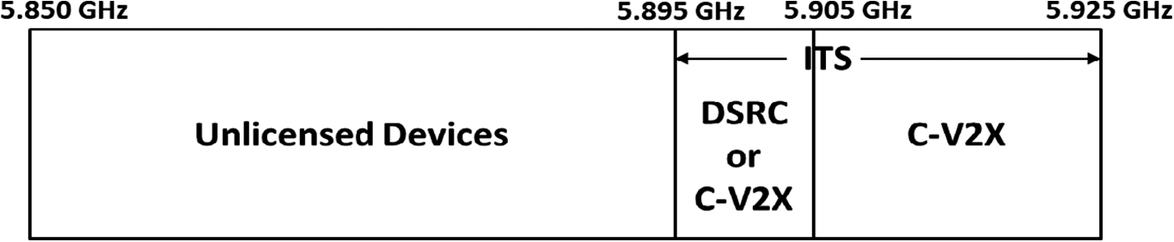
While the Rand paper advocated a reallocation of all 75 MHz in the ITS Band to unlicensed use, the FCC in 2020 opted to cut the baby in half: 45 MHz was transitioned to unlicensed, while 30 MHz remained dedicated for vehicular communications. In particular, 10 MHz was set aside for DSRC or C-V2X services (cellular-vehicle to everything, including moving cars and stationary transmitters); another 20 MHz was set aside entirely for C-V2X. As shown in Figure 1. The 75 MHz allocation, previously entirely ITS, was truncated, split between ITS and unlicensed device access to support, in particular, Wi-Fi.
FCC’s Nov. 2020 “Proposed Band plan” for 5.9 GHz (FCC, 2020, Par. 10).
III Cost–benefit analysis in radio spectrum
Since the Radio Act of 1927, the radio spectrum has been allocated according to “public interest” by regulators (Hazlett, Reference Hazlett2020). In lieu of market transactions revealing marginal values and opportunity costs, FCC regulators traditionally choose how spectrum inputs are made available for one application among many.
Leo Herzel (Reference Herzel1951, Reference Herzel1952, Reference Herzel1998) argued that allowing private ownership of airwaves would enable better information and superior spectrum allocation choices. This idea was taken up by R.H. Coase (Reference Coase1959) in a famous paper advocating the use of frequency rights as an alternative to “public interest” allocations. In some wireless markets, this reform was adopted over the ensuing half-century; de facto property rights for radio spectrum have brought significantly greater transparency to valuations (Hazlett, Reference Hazlett2017).
But the majority of useful radio spectrum is still governed by regulatory rulemakings where the authority imposes rules favoring select applications, technologies or business models. As in the FCC’s reallocation of the ITS “Car Band.” In the matter, the Commission attempted to estimate the value of the 5.9 GHz bandwidth set aside to support vehicle-based communications against, alternatively, the benefits to be gained by diverting the bandwidth to supporting Wi-Fi services.
The government’s calculations rely on input from outside parties, private and public. Yet, the data generated in the process generally do not reveal preferences established via prices in arms-length exchanges, but policy arguments advanced for a desired legal outcome. The reliability of rulemakings based on such analysis has been questioned by FCC economists:
[S]uch a process has some important limitations, not the least of which is that it is often … based on the reported needs of interested parties. One method of reducing the incentive the parties have to exaggerate the value they place on a given set of license rules involves creating a market for such rules in which participants bid to have their license rule needs met. By reducing the incentive that interested parties have to misrepresent their economic interests, this approach may substantially improve the efficiency of the licensing process. (Bykowsky et al., Reference Bykowsky, Olson and Sharkey2008, p. 26)Footnote 7
The FCC’s recent 5.9 GHz frequency reallocation used economic arguments provided in three cost–benefit analyses, one conducted by the Commission and two by private parties seeking to influence the FCC’s decision. These approaches are analyzed in this article. In particular, the expected infirmities are evident in the two studies submitted by the parties, while debilitating errors are incorporated in the FCC’s study.Footnote 8 Setting aside principal-agent problems, regulators select spectrum allocation rules designed to maximize the social benefits flowing from resource inputs. The logic tracks a mimicking of competitive markets.Footnote 9 Yet it is an error to define the value of the resource by the value of the outputs that use it. In Hazlett & Honig, we dub this the TV Spectrum Allocation Fallacy, in that television station owners have maintained that the bandwidth they are allocated creates high economic value given the large expenditures observed for TV sets and TV programming.
But the delivery of video programming, which may be achieved via over-the-air transmissions as prescribed in FCC broadcast licenses, may travel via substitute conduits: cable TV, satellite TV, broadband networks and non-TV terrestrial wireless (via smartphones), for instance. The valuation issue must be addressed quite differently than by the imputation of valued outputs to a particular input. In particular, the value of the marginal product is identified. The analysis then compares the incremental net benefits created by doing one set of activities (or rules), to gains available from the next best option (or combination of inputs). This will necessarily incorporate consideration of the opportunity costs of the spectrum resource consumed by the activities being evaluated.
IV Cost–benefit estimates for 5.9 GHZ: Rand (Reference Carew, Martin, Blumenthal, Armour and Lastunen2018)
(a) Summary of valuation estimates.
The 2018 Rand study sought to quantify gains to producers and consumers from using more spectrum to support WiFi services. Before discussing issues involved with the methodology used, we consider the magnitude of the estimates, comparing them to market data now observable, as a reality check. A summary of the results is given in Table 1.
Rand estimates of “Economic Value” of 5.9 GHz reallocation ($ Bil.)a
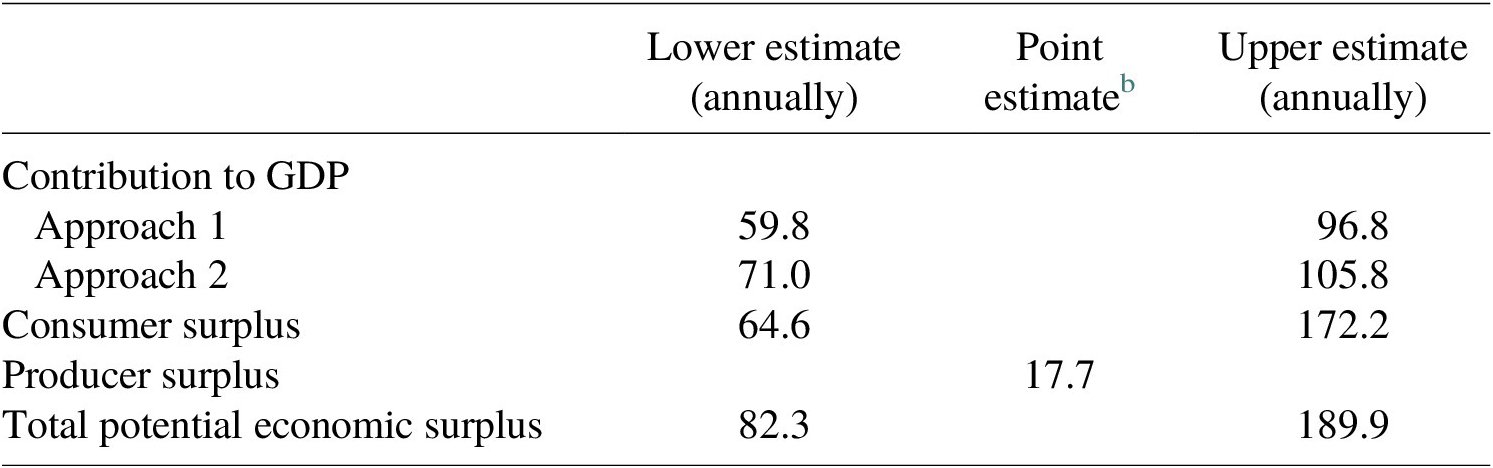
a Source: Rand (Reference Carew, Martin, Blumenthal, Armour and Lastunen2018), Table 10.1, p. 42. Values annualized for 2017.Footnote 10 The study assumes reallocation of the entire 75 MHz ITS Band to WiFi.
b Where one estimate is given rather than Lower and Upper estimates
The three estimations for annual benefit flows are offered as rival approximations.Footnote 11 The Rand study defines a mid-point for “contribution to GDP” of $83.35 billion (the mid-point of Approach 1 and Approach 2, using mid-points of the Low and High estimates for each), while “total potential economic surplus” is estimated at $136.1 billion (the mid-point of the two forecasts supplied). The mid-point of these two methods then results in a calculation of incremental benefits equal to just shy of $110 billion annually.Footnote 12 These purported gains constitute a perpetuity. Discounted at a 5% real social discount rate,Footnote 13 the net present value equals $2.2 trillion as the social value of a reallocation of 75 MHz to unlicensed spectrum, accompanied by rules designed to encourage Wi-Fi usage, in the 5.9 GHz band.Footnote 14 The magnitude is implausible, even if all economic value (not just an increment associated with reallocation) is attributed to the FCC policy switch. Market values for flexible-use, exclusive bandwidth rights (bid for by mobile network carriers) are visible via FCC license auctions and secondary market transactions. Using these price data, I estimated the market price of licenses allocated 75 MHz in the 5.9 GHz band to be equal to about $4 billion (Hazlett, Reference Hazlett2022). See Table 2.
Wireless license values v. Rand unlicensed estimates
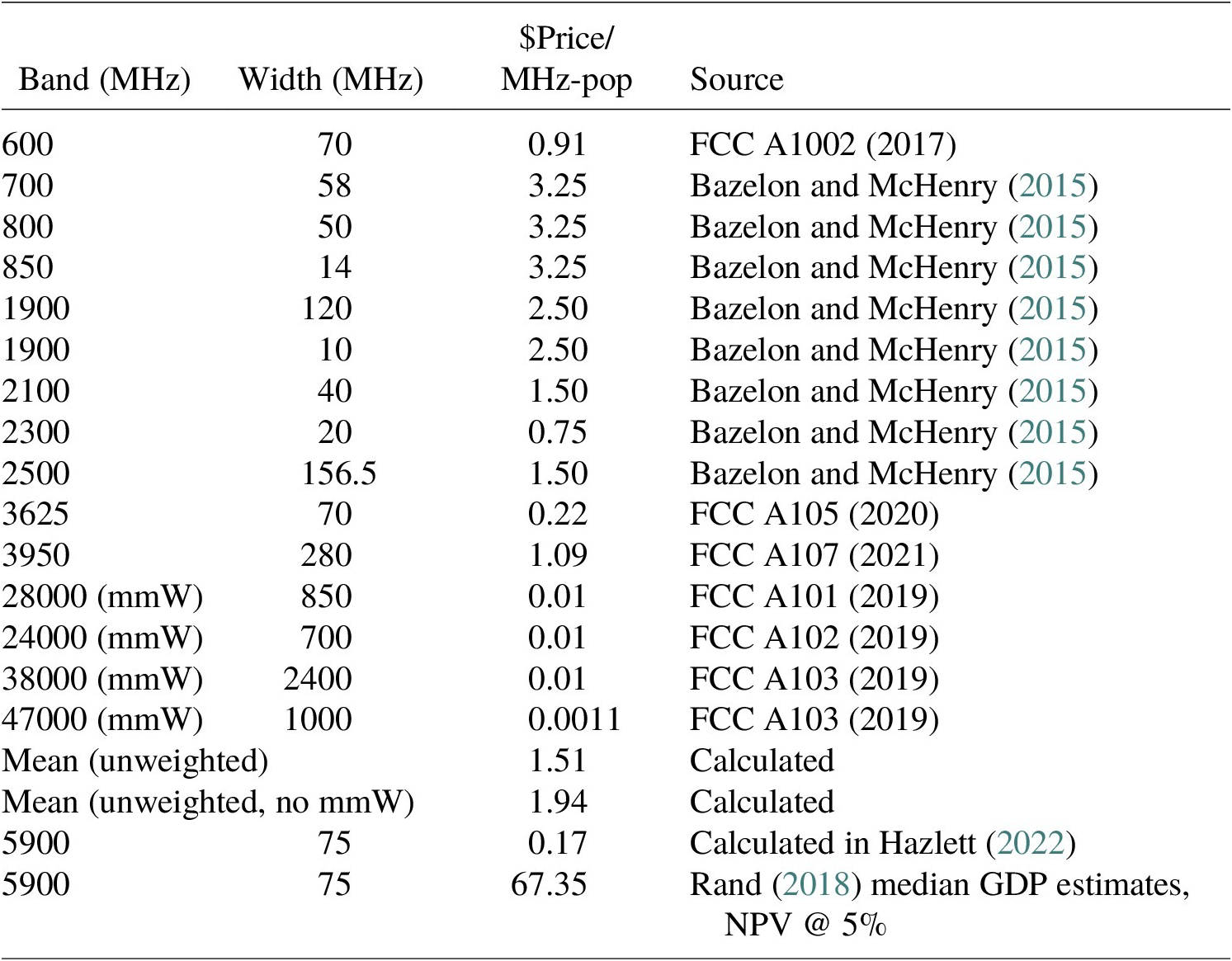
This estimation, properly adjusting for frequency location, represents about just 0.18% of the Rand estimate.Footnote 15 The market price of licenses, while revealing a market evaluation of expected producers’ surplus (PS), does not directly capture the consumer surplus (CS) that accrues to demanders (rather than suppliers). It is a standard metric used by the FCC that the ratio of CS/PS is about 10.Footnote 16 Adding consumer surplus to the producers’ surplus valuation implied by the market value of exclusive, flexible-use licenses allocated 75 MHz of 5.9 GHz spectrum, then implies that the valuation difference between market bids and the Rand mid-point estimate is 50-to-one (higher for Rand).Footnote 17 Hence, the projected valuation is nowhere near the observed market values for analogous assets.
The Rand Study does not consider any such reality check and does not explain the vast differential with the market prices observed.Footnote 18 This omission is notable on its own, but also because the Rand study itself attempts to incorporate license prices into its estimates. In presenting its projected values for Consumer Surplus and Producer Surplus, the Rand study uses the winning auction bids from 2017, as registered in FCC Auction 1002, as 5.9 GHz spectrum valuation proxies. Market prices do reveal valuations, if not all costs or values, and using such evidence may be a promising empirical strategy. Yet, the study misinterprets how the data apply in this comparative context, where Rand aims to establish how social value from a spectrum regime switch will alter market deployments. Rand seeks to measure producers’ surplus from the contemplated 75 MHz reallocation thusly:
[O]ne way to think about the potential gains to producers [firms supplying wireless devices and/or services] is in making it equivalent to their willingness to pay for a MHz of spectrum. As a combination of licensed and unlicensed spectrum, the FCC’s Incentive Auction of 2016 [sic] gets at this value. A total of 84 MHz was auctioned off, of which 14 MHz were ultimately allocated for unlicensed, which received $19.6 billion. That makes a simple estimate of marginal value to producers approximately $235.7 million, and 75 MHz worth roughly $17.7 billion (Rand, Reference Carew, Martin, Blumenthal, Armour and Lastunen2018, p. 35; footnote omitted).Footnote 19
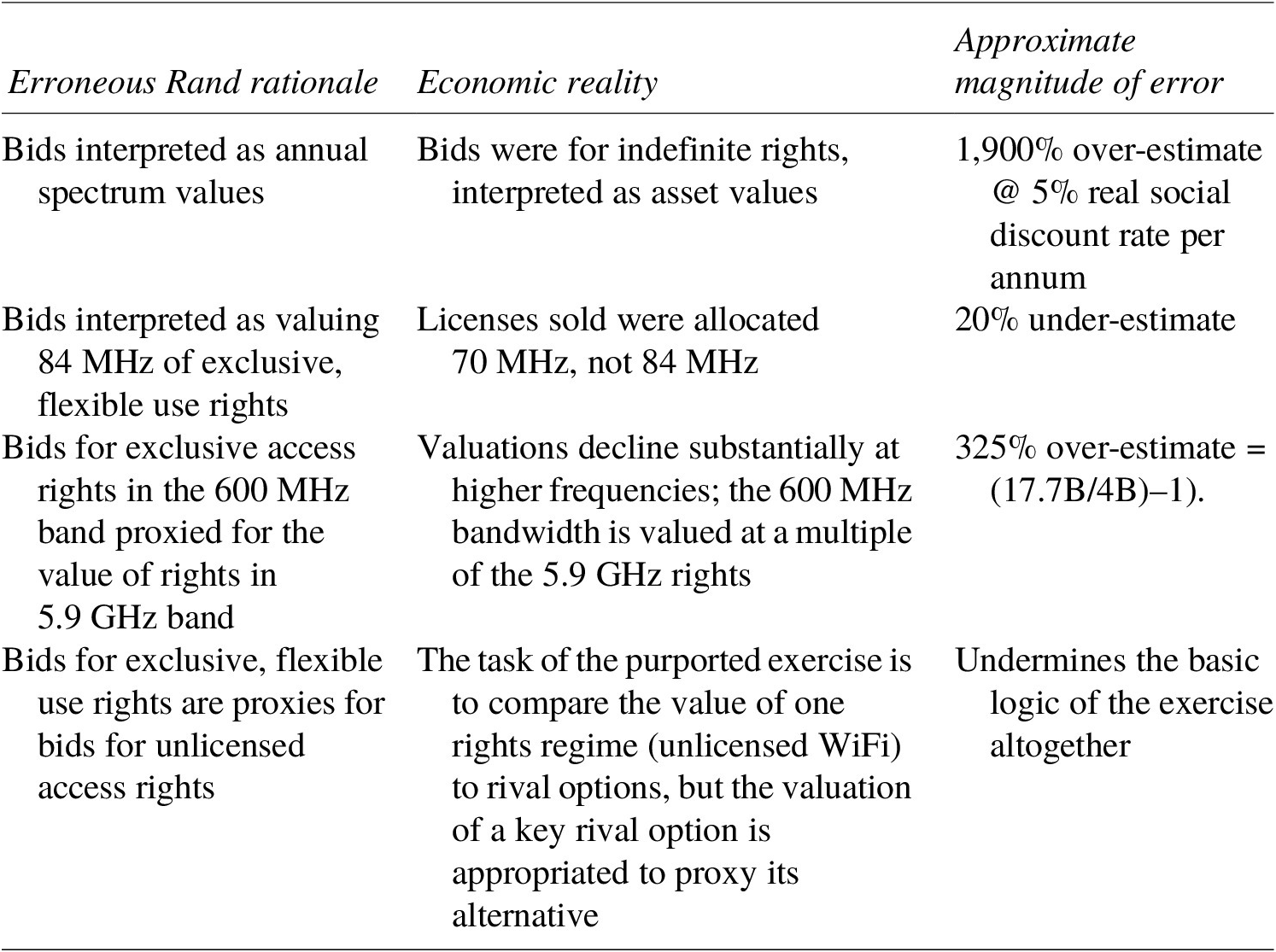
At least four glaring errors are exhibited. First is that the auction bids for licenses are interpreted as annual value flows; they are lump sum present values. The $17.7 billion in asserted benefits flowing to bidders in the FCC’s 2017 “incentive auction” (formally, FCC Auction 1002), are then added to the annual benefits of the reallocation (see Table 1). In fact, this increases the scale of such social benefits by nearly 20-fold, assuming (reasonably) a real social discount rate of 5% per annum. This stems from the fact that winning bidders of FCC licenses pay once to then receive rights indefinitely; license terms were established as 12 years for initial rights, with renewals at 10-year intervals thereafter.Footnote 20 Such renewals are pro forma, as there are no subsequent auctions, and rights are simply reassigned to existing licensees provided that such licensee conforms with FCC rules. (Given the economic incentives, they always do.)
A second serious error stems from the Rand study positing that 84 MHz of “licensed and unlicensed spectrum” was allocated by the Incentive Auction in 2017. With total revenues received by the Government of $19.8 billion, the Rand conclusion is that payment for access to 75 MHz, instead of 84 MHz, represents $17.7 billion in expected profit (producer surplus) by simple linear extrapolation. But the implicit Rand assumption, that the $19.8 paid for mobile licenses in Auction 1002 was a payment for spectrum access to another 84 MHz, is wrong. The bids were for access to 70 MHz nationwide (10 MHz allocated to each of the seven licenses in every local market). The 14 MHz cleared by the FCC in the same proceeding and opened (in part) to unlicensed use was not offered to bidders on special terms. Any unlicensed device usage permitted on those airwaves is open as per FCC rules that do not give any priority to auction winners. This error undercounts the producer surplus value the Rand study seeks to quantify by 20%.
But the third error is far more dramatic and easily overwhelms this bias in the opposite direction. As shown above, the price of access rights tends to decrease, per MHz, as frequencies increase. Hence, the bids for exclusive rights to 600 MHz spectrum will be predictably far greater, per MHz, than bids for access to 5.9 GHz spaces. Indeed, in the frequency value adjustment made in Hazlett (Reference Hazlett2022), the 75 MHz allocated to flexible-use licenses would predictably bring about $4 billion in winning bids. This implies that the error made in the Rand paper, which ignored the difference in frequency, overstated the value by approximately 325%.
But the fourth and most fundamental confusion is that the rights offered in FCC Auction 1002 were for exclusive control, of keen interest to mobile carriers, while the Rand study purports to be estimating the valuation for non-exclusive rights, aimed to support devices (such as Wi-Fi routers) most readily employed on unlicensed bands. The Rand study appropriates the valuations revealed in this competition for de facto ownership and applies them as proxies for the value of distinct non-exclusive access rights – rights created in an unlicensed allocation as an alternative to defining and selling flexible-use licenses. The point of the Rand paper is to argue for a distinct value proposition by rejecting an auction in favor of FCC-imposed sharing rules. But it loses this essential logic in then asserting that bids for exclusive spectrum rights define the social value generated by an alternative regime.
A summary of these four errors is given in Table 3.
Errors in Rand’s $17.7B producer surplus estimate for 75 MHz reallocation to WiFi in 5.9 GHz band (Note: Rand’s numerical estimate based on winning bids for mobile licenses in auction 1002)
In any event, the value estimations are entirely uncompelling. Before further describing the methods used to derive them, another simple “eye test” might be applied. Here we use the values deduced from “Contribution to GDP” estimates, which are represented as proxies for producers’ surplus. The 5.9 GHz band lies at the top end of what are commonly described as mid-band frequencies. It is reasonable to conclude that the marginal value of this bandwidth is no higher than the other bands available for use.Footnote 21 Such allocations span 1944 MHz (Stewart et al., Reference Stewart, Nickerson and Welham2022). Applying the Rand estimates to these airwaves implies that the value of unlicensed spectrum in the United States, in present value terms, is approximately $43 trillion.Footnote 22 In contrast, the aggregate value of all residential real estate in the United States, is estimated to be $43 trillion.Footnote 23 This implies, among other things, that the unlicensed spectrum inputs into WLANs available in a home are equal in value to the house itself.
(b) GDP contribution: approach 1
The relationship between broadband speed is deduced by a regression attempting to predict how higher speeds produce higher GDP. A model is calibrated by regressing quarterly U.S. state-level income, 1Q2010 to 1Q2017, against Internet speeds, population, unemployment rate and fixed effects (state and time). The estimated coefficient on Internet speed is interpreted to mean that each 100% increase in average download speed is associated with a 1.37% increase in total economy-wide GDP. This elasticity exceeds that estimated elsewhere by a considerable magnitude (Rohman and Bohlin, Reference Rohman and Bohlin2012 produce an elasticity equal to 0.3%; see, also, Ford, Reference Ford2018), and accounts for an implausibly large portion of income gains when applied over large margins of (real or estimated) Internet speed changes (see discussion in Section IV).
The study then assumes that an additional 75 MHz of radio spectrum regulated under unlicensed rules favoring Wi-Fi service will increase U.S. broadband speeds at the capacity of the new bandwidth. The calculation relies on the prediction that Wi-Fi speeds (for 5 GHz traffic) will jump from 360 to 1560 Mpbs (Rand, Table 5.2, p. 22), increasing weighted average Wi-Fi speeds by (in what it identifies as its “most accurate estimate” [p. 21]) from 211 to 867 Mpbs (p. 22). The assumed 311% data rate increase reflects that the 5.9 GHz reallocation could make an additional 160 MHz channel available for Wi-Fi traffic; adding to two existing 160 MHz channels in the 5 GHz Wi-Fi bands. Both the default (211 Mbps) and forecast (867 Mbps) speeds are deduced from theoretical propositions about bit stream capacities rather than observed usage. The projected increase in speed is then predicted to add $96.8 billion annually to GDP. (A smaller estimate of $59.8 billion, from alternative assumptions, is argued to be less accurate.)
The framework used by Rand produces improbable estimates as it abstracts from real-world trade-offs. First, the elasticity estimated uses actual speeds as the observed correlate of higher GDP, but the application of the metric is then to a hypothetical potential broadband speed. The mismatch is problematic on its own, but pointedly so in the case at hand. The potential increase in speed that drives Approach 1 is non-binding: Wi-Fi relays of Internet content by residential users do not travel faster than the Internet connection itself. In 2021, average U.S. residential download speeds were 99 mpbs.Footnote 24 Given this, lifting the Wi-Fi retransmission ceiling to 1560 Mbps predictably has little, if any, impact now or for some years. Moreover, for Wi-Fi devices to access the 5.9 GHz band requires users to purchase new Wi-Fi 6E routers and clients (such as smartphones or tablets). These complements are expensive. Wired recommends routers costing between $300 and $430 (Hill, Reference Hill2022), but advises home Wi-Fi users to deter investments in upgrades by some years. When adoptions do arrive, speed increases via enhanced Wi-Fi will likely be considerably below those predicted by Rand (Reference Carew, Martin, Blumenthal, Armour and Lastunen2018): “the real-world sustained rates are always much lower than the theoretical ones” (Ngo, Reference Ngo2020). Using 160 MHz channels (via Wi-Fi 6E equipment) will only bump actual download speeds by about 50% over the previous (Wi-Fi 5) performance. This speed boost will come with a shorter range for the same power (Ibid).
Second, it is incorrect to attribute all potential gains from Internet access using the 5.9 GHz band for Wi-Fi when there are alternative ways of achieving data rate increases without consuming the additional bandwidth. Better, more expensive routers or densification of ancillary access points improve Wi-Fi speeds over given spectrum allocations. Deployment of additional wired connections such as Ethernet does so, as well. If the gains delivered by an additional 75 MHz of airwave inputs could be distinctly delivered via outlays of $X per user, the expected gains from the spectrum allocation (in this one employment) cannot exceed $X per user.
Third, the opportunity costs of the allocated spectrum must be recognized in the comparison. The Rand claim is that allocating 75 MHz for newly dedicated Wi-Fi access will deliver speed gains and, therefore, GDP gains. But it ignores that the allocation of the spectrum for the specific purpose of Wi-Fi will exclude alternative uses; indeed, the policy argument made by Rand is requesting the FCC to do exactly that by imposing power limits, technical restrictions and avoiding the creation of property rights (transferred in licenses assigned by auction) that would give competing parties the option to bid on rights controlling frequency usage. The GDP addition that Rand claims to estimate is wrongly construed to be the gross amount it offers as its assessment: the value of the services sacrificed by excluding alternative products – including, for example 5G services supplied over the 75 MHz – must necessarily be subtracted to fulfill the net value being claimed by Rand.
These critical calculations or adjustments are omitted by Rand. The opportunity cost omission is easy to spot: the Table of Contents lists a section on “Allocation Options and Tradeoffs for the 5.9 GHz Band,” which features only subsections for: “Status Quo (no DSRC Reallocation),” “Partial Unlicensed Reallocation,” “Shared Unlicensed Reallocation” and “Full Unlicensed Reallocation.” The range of opportunities is defined as an arbitrarily path-dependent list of options: either freeze the 5.9 GHz band in its 1999 set-aside, reallocate it to Wi-Fi or split the baby. Given that the 1999 allocation reserved the band for a technology the FCC finds not usefully deployed despite zero-priced spectrum access, the cost of switching to Wi-Fi is held artificially low. Further, alternative wireless applications were assumed away without considering their potential value even as making more bandwidth available for mobile cellular (4G and 5G) was being trumpeted as a national strategic goal in Pres. Barack Obama’s 2016 “Forward Leaning Broadband Policy.”Footnote 25
(c) GDP contribution: approach 2
Rand attempts to value the boost in sales of wireless traffic and wireless devices when Wi-Fi speeds are boosted. GDP gains are taken to be equal to the delta on revenues (unit prices × increased sales), with production costs implicitly assumed to be zero. (This erroneously double counts inputs in final sales; GDP sums “value added” contributions.) The calculated sums are represented to yield “monetary equivalence” of output gains from reallocating 75 MHz of 5.9 GHz frequencies using “two main sources of direct value: the revenue to ISPs for average data consumption per device and sales of the devices themselves” (Rand, Reference Carew, Martin, Blumenthal, Armour and Lastunen2018, p. 28).
The number of new sales for the devices starts with a list of radios: 4G smartphones, tablets, smart home devices, laptops, gaming consoles, virtual reality systems and 5G smartphones. The article then assumes that the incremental 75 MHz of bandwidth set aside for Wi-Fi access will create capacity for potential new traffic; it then uses two different methods for filling up the new frequency spaces with additional devices. (The two calculations are made with respect to “load share” assumptions and “device share” assumptions.) The gain to GDP is approximated by summing annual new “data revenue” (consumed by the newly sold wireless devices, which presumably raise demand – and then revenues – paid for ISP service) and “device revenue” (from sales of additional smartphones, laptops, etc.).Footnote 26 Data revenue (annual increases) and Device Revenue are estimated as: $ \mathrm{Data}\ \mathrm{revenue}=\sum \Big(\mathrm{Added}\ \mathrm{devices}\times \mathrm{Average}\hskip0.4em \frac{\mathrm{GB}}{\mathrm{mo}}\times 0.148\times 0.43 $
,
$ \mathrm{Data}\ \mathrm{revenue}=\sum \Big(\mathrm{Added}\ \mathrm{devices}\times \mathrm{Average}\hskip0.4em \frac{\mathrm{GB}}{\mathrm{mo}}\times 0.148\times 0.43 $
,
 $$ \hskip-20em \mathrm{Device}\ \mathrm{revenue}=\sum \mathrm{Added}\ \mathrm{devices}\times \mathrm{Average}\ \mathrm{price}. $$
Total Revenue is then defined as the sum of the two values. The quantity of the added devices is predicted given technical assumptions, not discerned from market reactions (consumer demand changes) associated with spectrum allocations. The monetization of the asserted gains in devices and device use is valued, in the first equation, by the observed revenue for ISP broadband connections, divided by total GBs used per month (0.148) and then adjusted by the proportion of Wi-Fi usage per GB consumed (.43).
The point estimate for total annual economic gain is, using the “load share” apportionment of bandwidth, $105.8 billion (with just $4.2 bil. associated with extra data flows and $101.6 bil. with device sales). When the alternative assumption is used to predict the mix of new radio purchases, “device share,” the estimate falls to $71.0 billion ($2.3 bil. from data, $68.7 from devices) (Rand, Reference Carew, Martin, Blumenthal, Armour and Lastunen2018, Tables 6.3, 6.4). See Table 1.
The estimates are unpersuasive. First, attributing economic gain to the revenues purportedly generated by additional unit sales omits the cost of goods sold. When tabulating GDP, only value-added merits inclusion, so this vastly overstates output gains. Indeed, where incremental costs exceed incremental revenues, GDP should decrease rather than expand. (This is entirely possible in the extant case, given that neither suppliers nor consumers pay for spectrum inputs in the unlicensed regulatory model.) Second, the postulated speed increases from home Wi-Fi service assumed to range (post-FCC reallocation) from 960 to 2560 Mbps, will have no substantive effect over many years, as ISP connections run at far lower speeds. Third, the postulated speed increases for Wi-Fi cannot come instantly, as assumed, given that there is a long-lived adoption pattern with a ramp-up entailing significant costs for upgraded routers and clients. These lags and costs predictably reduce forecast gains.
Second, increasing unlicensed Wi-Fi bandwidth by about 4% (using 2018 FCC low-band and mid-band allocations; about 2% using 2020 allocations) is not likely to markedly increase broadband retransmission capacities or spur large new device sales, unless one assumes unrealistic elasticities.
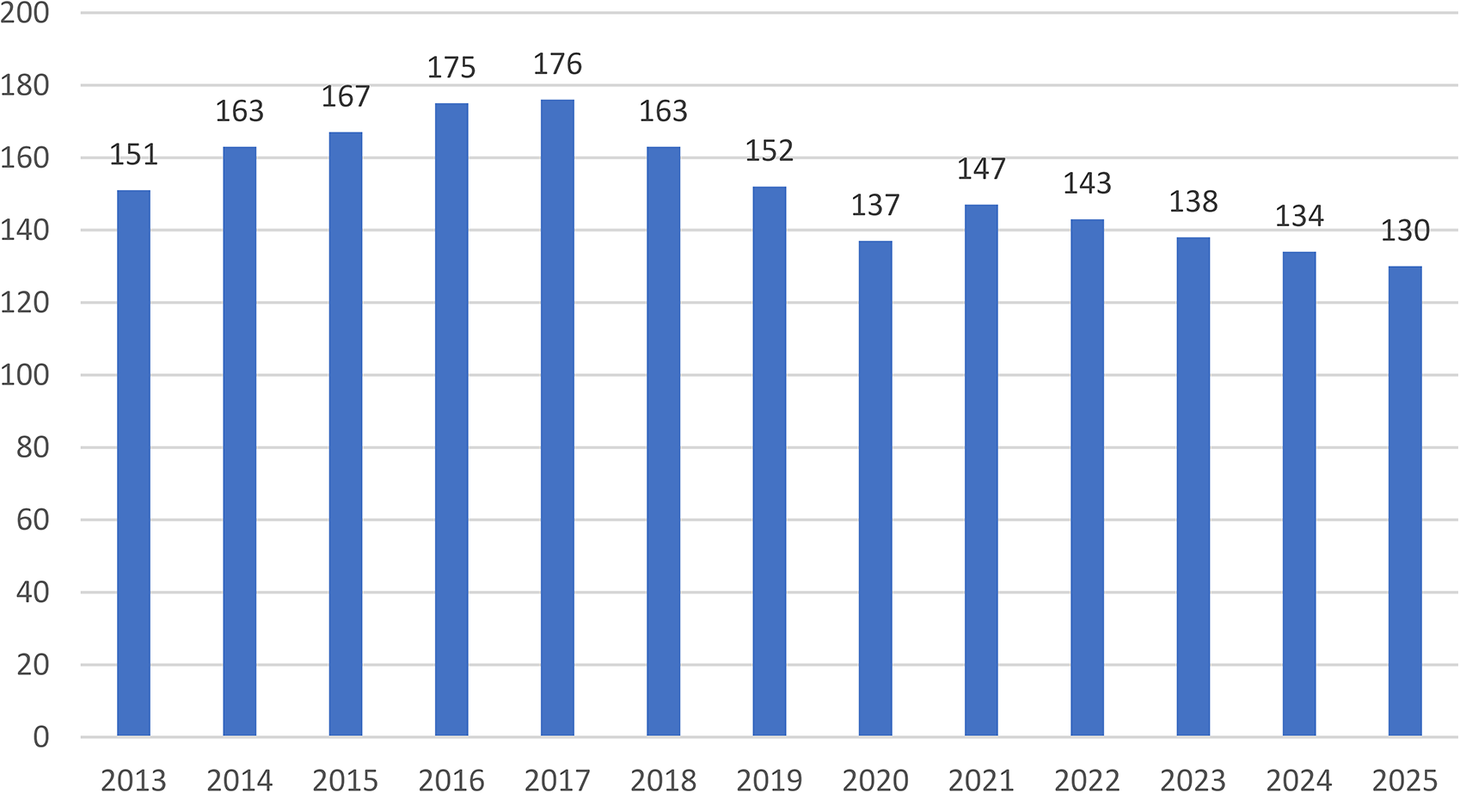
Third, the probability of the calculated demand responses assumed in the Rand model can be judged by considering the primary driver of Rand’s tabulated gains (via “load share”): an increase in U.S. laptop sales of over 118 million units annually. At $750 per unit, the assumed delta in adoption under the higher “load share” formulation accounts for 87.5% of “total annual revenue” (Table 6.3). Yet, in 2021, there were just 29 million laptops sold in the United States.Footnote 27 The forecast increase in laptop sales by over 300% is not credible.Footnote 28 Likewise the other valuation method (“device share”), offers a forecast of $71 billion in annual benefits, of which 88% stems from (a) a smartphone sales increase of 51 million units and (b) a laptop sales increase of 52 million units. The laptop increment (nearly doubling sales) is not plausibly associated with the small bandwidth increment, nor is the immediate rise in smartphones assumed to result: smartphone sales in 2020 (when the FCC 5.9 GHz reallocated was enacted) were about 137 million units. While it would not be impossible for a marked change in demand for such devices to drive an increase in annual sales by 38% (i.e. an additional 52 million units), it would be unlikely that such increases would either spring from a small increment of available Wi-Fi bandwidth or that such gains, if indeed achieved, would be unnoticed in aggregate trend. But, as seen in Figure 2, unit sales for smartphones appear to have been flat (slightly declining from the pre-Covid level displayed in 2019) over the 2019–2022 period and are forecast to remain so – despite the FCC reallocation – through 2025.
U.S. smartphone sales (millions of units)Footnote 29.
Fourth, prices paid by consumers to connect to broadband ISPs do not proxy Wi-Fi value. The ISP delivers a wide area network (WAN) service that embeds transport rights (and interconnection accessing networks and websites around the world) and is then complemented by local area relays supplied by a wireless router at the customer’s premises. The latter might be supplied via the purchase of a $50 device.Footnote 30 Many if not most households do not directly purchase these routers, as they are routinely bundled with ISP subscriptions and installed at the customer’s premises by a cable company or telecommunications carrier. The service provided is not a substitute for the WAN connection being purchased, but a complement – just as are in-home (or office) Ethernet wiring, desktop computers and other devices (flat panel TV screens, smartphones, etc.) that process IP traffic. The ISP charges (in the Rand estimates) $48.37 for the wide-area services. These may look like they are similar services for “bit transport,” but then both LAX-Heathrow first class seats and bike rentals at the Santa Monica pier price “vehicle transport.” It is irrelevant that 43% of Internet bit traffic may ride over WLANs by Wi-Fi, before or after traveling to or from distant destinations via the WAN. The ISP charges the same connection fee to households that do not use Wi-Fi but instead plug devices into routers (or use Ethernet to locally distribute signals). The services are distinct products.Footnote 31
(d) Rand’s total welfare calculations
Finally, Total Welfare generated caused by a 75 MHz reallocation is estimated. Rand argues that $18 billion in annual producers’ surplus would be created, analogizing spectrum value to the winning bids made in the FCC’s Auction 1002, and another $66 billion to $172 billion in annual consumer surplus. Summing up, the study concludes that the 75 MHz reallocation would produce $82 billion to $190 billion in annual social increases for the U.S. economy. The calculations for consumer surplus are summarized in Table 4.
Estimated annual consumer surplus gains from 75 MHz reallocation in 5.9 GHz Footnote 32

The exercise begins by assuming that the FCC spectrum reallocation will create additional channels for Wi-Fi transmissions and that these channels will result in faster speeds. The biggest throughput gains are those allowing for the largest channels (160 MHz), with bits theoretically traveling up to 2560 Mbps. These speed increases are calculated to create extra value for subscribers who continue to pay about $50 a month for broadband service supplied by an ISP. The faster speeds are valued at $1.76 per (additional) Mbps, a point estimate produced in a 2016 study. Additional consumer surplus is calculated, in Option 1, as: 960*$1.76*0.43 = $723 per household per year. Because there are 88.87 million broadband-connected homes (71% of 125,170,072 households), the estimated increase in Consumer Surplus associated with the additional bandwidth equals $64.6 billion. On the other hand, given that it can be just as easily assumed that the reallocation will result in the use of a wider channel for Wi-Fi transport, the 160 MHz channel hypothesized in Option 3 produces a larger number: $1,937 in annual consumer surplus gains per household and $172.2 billion in aggregate annual increase.
The first notable deficiency in the tabulation is that it fails to identify a marginal gain – in broadband speed, capacity, service quality or price – that would causally relate to a change in consumer surplus. Instead, the absolute value of the theoretical speed of the new channels created (960, 1280 or 2560 Mbps) is simply multiplied by the assumed willingness to pay per gigabyte. That estimated value gain is then applied across all ISP-connected households to produce aggregate gains in surplus, yet omits that residential Wi-Fi users were already plugged in, receiving some level of service, without the 5.9 GHz reallocation. In fact, as seen above, the assumption that any of the additional speeds supplied by the 960–2560 Mbps in-home connections will create marginal value in current or near-future years is dubious, given that ISP connections are not constrained by the current levels of retransmission (or available via standard upgrade cycles over time).
Secondly, the willingness to pay is vastly overestimated. The value used is from Nevo et. al (2016), which used 2012 data to evaluate increases in broadband ISP service over relatively small deviations from median values, is inapt. Analyzing more recent data, Liu et al. (Reference Liu, Prince and Wallsten2018) found demand highly non-linear, with “relatively little added value beyond 100 Mbps.” While households were seen to have a willingness to pay equal to $2.34 per Mbps when speeds rose from 4 to 10 Mbps, the shadow price fell to just $0.02 per Mbps when increasing from 100 to 1000 Mbps.Footnote 33 Given that the Rand study evaluates changes assumed to be in this higher range (from 960 to 2560), the value multiplier employed is seen to be about two orders of magnitude too high.
Third, the willingness-to-pay estimates are, as above, taken from broadband ISP service, not Wi-Fi. Hence, the price proxy is misapplied. This can be seen in the conclusion that a small increase in bandwidth allocated to Wi-Fi (75 MHz in the 5.9 GHz band) would result in gains of nearly $2,000 (in the application of another 160 MHz band). Were such gains available to improved speeds, the deployment of additional routers and relays (perhaps using meshes) would be an alternative pathway for achieving such large per-household gains. The estimates for the marginal impact of the spectrum reallocation, incorrectly, ignore such options.
Fourth, and most stunning, is the misinterpretation of demands revealed for flexible-use, exclusive rights to 600 MHz spectrum as produced in FCC Auction 1002, in a lump sum present value, as analogous to annual benefits to producers from unlicensed spectrum. This was discussed above.
Fifth, there is essentially no cost in the Rand cost–benefit study. It introduces its exercise in the following way:
[U]nderstanding the economic potential of unlicensed spectrum [is] critical in designing spectrum allocation policies that maximize benefits to consumers and the economy [citation deleted]. If there is inadequate unlicensed spectrum available to carry WiFi traffic, these advances could be constrained. Imagine the unrealized economic potential and gains to consumers if the future availability of unlicensed spectrum were unable to keep up with demand. Concerns have been raised, for example about sufficient spectrum throughput to access the millions of apps that do everything from online banking to health monitoring…. (Rand, Reference Carew, Martin, Blumenthal, Armour and Lastunen2018, p. 1)
This one-sided presentation of a multisided problem precisely illustrates the approach that R.H. Coase (Reference Coase1959) critiqued decades ago. It focuses policy on protecting one particular set of activities, without considering that that protection itself interferes with competing activities. The socially interested regulatory approach, conversely, seeks to balance the rival opportunities – or, more exactly, to pursue rules permitting consumers and producers, scientists and entrepreneurs, to coordinate so as to achieve the optimal resource usage:
It is sometimes implied that the aim of regulation in the radio industry should be to minimize interference. But this would be wrong. The aim should be to maximize output. All property rights interfere with the ability of people to use resources. What has to be insured is that the gain from interference more than offsets the harm it produces. (Coase, Reference Coase1959, p. 27)
Imagine if a 20-year allocation for a wireless application the FCC thought would be important turned out to be a vacant lot. Imagine, further, that the spectrum real estate that went unused for decades was highly valuable in the creation and operation of 5G wireless networks, satellites or healthcare services not yet invented. That would be a social tragedy. Yet, in the Rand perspective, it would not be noticed – unless fitting within the confines of a particular allocation as envisaged by regulators. As with the 1999 champions of the ITS band.
V Reallocating 45 MHZ from its band to WiFi: WiFiForward (2020)
In addition to the Rand study, an April 2020 paper published by WiFiForward (“WFF, 2020”), a coalition of companies advocating FCC reallocation of 5.9 GHz bandwidthFootnote 34 for the use of local area networks,Footnote 35 was referenced by the Commission in its 2020 Order in two places. One criticized the analysis for being based (as was the Rand study, in part) on contributions to GDP that were linked to an estimated broadband speed-GDP relationship. The issue was simultaneity; the correlation between the two measures would be logically caused as much (or more) by GDP driving broadband adoption (and speed) as by the reverse.Footnote 36 The other noted that the Rand and WiFiForward studies reached similar conclusions about the 5.9 GHz reallocation, using similar methodologies, although the WiFiForward paper produced lower estimated gains from a reallocation of 5.9 GHz bandwidth. The rival estimates reflect differences in assumptions, including that (a) 45 MHz (not 75 MHz) would be reallocated; (b) changes over just 4 years 2022–2025 would be calculated; (c) the empirically derived relationship between broadband speed and GDP would be calibrated on international data in a model that produced a lower magnitude.
Nonetheless, the WFF estimates are created using a similar methodology to Rand (Reference Carew, Martin, Blumenthal, Armour and Lastunen2018). The WFF paper attempts to observe bandwidth values primarily by hypothesizing what the 45 MHz reallocation will do to increase download speeds and what the improvement in average network performance will do to impact US GDP. Some calculated consumer surplus gains are tacked on, and producer surplus gains from new devices assumed to enter the market because of the higher network capacities are tallied,Footnote 37 but 78% of the “total economic value” emanates from the “increase in GDP from faster broadband.” See Table 5.

Predicted GDP growth attributed to broadband speed increase as per estimated Rand and WFF models

Notes and Sources: GDP per capita for 1999 increased by 63% adjusted to 2021 dollars, as per the CPI calculator.
The Rand model utilized an empirically calculated elasticity of GDP with respect to broadband speed equal to 1.37%; WFF (2020) derives a smaller elasticity equal to 0.073 per cent.Footnote 38 The lower magnitude for the WFF study is attributed to the inclusion of additional explanatory variables (economy-wide investment ratio and level of broadband subscribership) as well as the use of a distinct panel featuring 49 countries rather than (U.S.) state-level data (WFF, 2020, p. 26).
Nonetheless, WFF’s asserted empirical relationship between broadband download speeds and GDP is also implausible. This is seen in applying the estimated elasticities (broadband speed growth causing GDP growth) to historical data. In 1999, the FCC issued its first broadband report (FCC, 1999) and defined broadband speed as equal or above 200 kilobits per second. Only a small fraction of U.S. households then subscribed (the Commission cited at least 375,000 paying customers),Footnote 39 as residential broadband had been recently introduced and was just taking off in its mass market adoption. Over the following two decades, of course, Internet data rates increased markedly. By 2021, the mean U.S. download speed for residential broadband service was 99.3 Mbps (Wheelwright, Reference Wheelwright2021).
Indeed, the predicted gain in U.S. GDP per capita, using Rand’s calculated coefficient, equals 47% of the total actual (inflation-adjusted) gain, while WiFi Forward’s calculation attributes 26% of the 1999–2021 income increase to rising broadband speeds. These forecasts are well beyond the range of plausibility, dwarfing the economic importance of the entire Digital Economy. The Bureau of Economic Analysis attributes 10.2% of 2020 national income to the entire Digital Economy.Footnote 40 Telecommunications and Internet Services industries were, jointly, just 27% of this Digital Economy.
(b) Narrow assumptions that exclude economic tradeoffs
The 160 MHz channel that is claimed to be uniquely helpful in accommodating high-speed throughput for Wi-Fi users is not only available in the 5 GHz band already (with government sharing rules, including DFS, thought to diminish its utility), but is made available in the 6 GHz allocation for unlicensed devices set-aside by the FCC in April 2020. This allotment covers 1.2 GHz or 60 channels of 20 MHz; with channel bonding, there are at least seven 160 MHz channels available to users adopting Wi-Fi 6E routers and clients (Hill, Reference Hill2022).
This alternative path to higher Wi-Fi throughput was approved by the FCC in April 2020, months ahead of the agency’s decision to reallocate 45 MHz of 5.9 GHz in the ITS band. The 6 GHz unlicensed allocation logically alters the value of the marginal product of the 45 MHz at 5.9 GHz given the spacious new bandwidth presented (by FCC action). Yet, the study’s approach ignored such trade-offs, calculating possible gains from speed increases using 5.9 GHz for Wi-Fi as if that were the only pathway to such improvements.
Indeed, the premise of both the Rand (Reference Carew, Martin, Blumenthal, Armour and Lastunen2018) and WFF (2020) studies is that a spectrum reallocation in the 5.9 GHz band will increase Internet access speed, but both ignore the fact that the increases were already available through hardware upgrades. That is, Wi-Fi 6 routers achieve maximum theoretical speeds of up to 9.6 Gbps.Footnote 41 Such equipment could be deployed more densely in homes and offices to increase Wi-Fi speeds using only the unlicensed bands previously allocated. Yet, the WFF (2020, p. 24) approach begins with the premise that the “assignment of 45 MHz in the 5.9 GHz band will increase the average router capacity,” failing to cost out the relevant alternatives. Or the consumed spectrum inputs.
If the WFF, 2020 valuation model were applied to actual 2020 data it would find virtually no social gain. That is because no substantial adoption of Wi-Fi 6E standards in the United States has occurred. Supply chain issues may be a factor in this lack of deployment,Footnote 42 although U.S. 5G networks are aggressively (and expensively) building out mid-band spectrum access rights, overcoming such impediments.Footnote 43 What is more relevant is the lack of consumer demand. Advantages afforded by incremental bandwidth for Wi-Fi must be accompanied by the purchase of complements, notably the hardware and software conforming to new Wi-Fi 6E specifications. Such equipment is expensive, with standard home units (offered by Motorola, Google and Netgear) selling for $300 to $430 (Hill, Reference Hill2022). WFF, 2020 ignores these co-investments which, in any event, must be subtracted from estimated gains to calculate net marginal benefits.
Hence, while 2022 was predicted by WFF, 2020 to see $7.2 billion in increased value for the U.S. economy (see Table 4) as per the 2020 FCC reallocation, the result has proven illusory. The cost–benefit analysis performed by Wi-Fi users does not pencil out. As a Wired Magazine story published in October 2022 (Hill, Reference Hill2022) explained: “There are many ways to make your internet faster, but the specifics depend on what you’re willing to spend ….” The reality is that U.S. households are not much constrained by existing Wi-Fi speeds; the marginal value placed on faster in-premises transmissions is slight; costs of upgrades are relatively expensive (even with spectral inputs made zero-priced by the FCC).
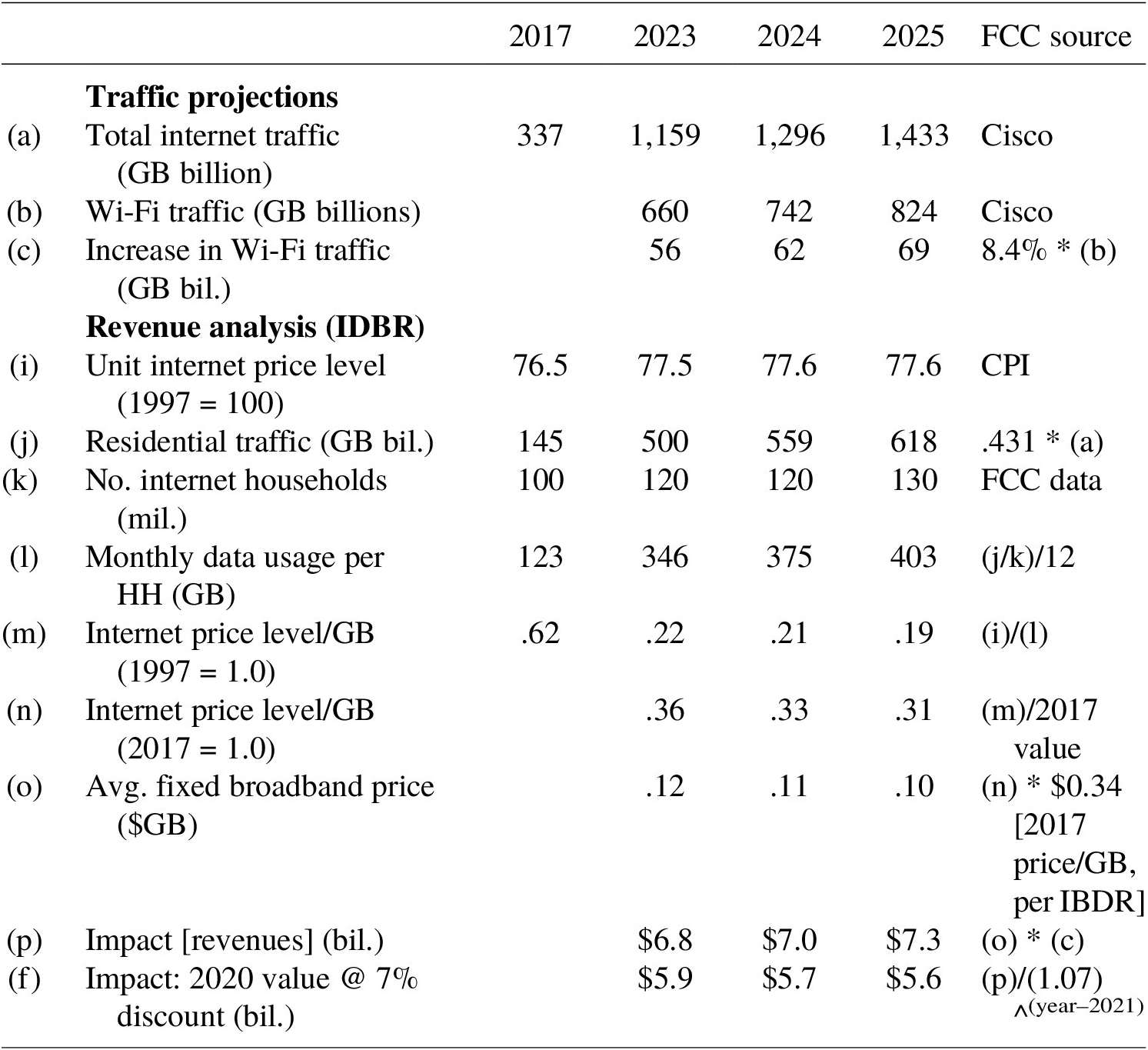
FCC calculations valuing increases in Wi-Fi service (per extra 45 MHz of unlicensed spectrum in 5.9 GHz band)Footnote 44
VI Reallocating 75 MHZ from its band to WiFi: FCC (2020)
Proponents of the Commission proposal generally refer to [Rand, Reference Carew, Martin, Blumenthal, Armour and Lastunen2018 that estimates] that repurposing the 5.9 GHz for unlicensed use could generate between $82.2 billion and $189.9 billion in economic welfare per year, or the substantially lower benefits estimate of approximately $28 billion between 2022 and 2025 put forth by [WFF, 2020] … While few commenters disputed the benefits put forth by RAND and WiFiForward, below, we present our own estimate … (FCC, 2020b, Par. 126).
The FCC study of costs and benefits did find much lower benefits associated with a 45 MHz reallocation of ITS spectrum, about $6 billion annually (2020 present value for each of 3 years, 2023–2025). The numerical estimates declined, but the basic methodology was borrowed. The FCC examined existing Wi-Fi data flows before the contemplated 5.9 GHz reallocation (of 45 MHz), and assumed that the new authorized bandwidth would instantly increase traffic by 8.4% (FCC 2020b, par. 134). This increment was not deduced via observed economic behavior but from a calculation that additional bandwidth would create several new channels for Wi-Fi users, and the traffic carried – assumed to instantly be “fully utilized” – would generate bit flows commensurate with a weighted average of the new channels (8.4%).
The FCC then calculates a shadow price based on monthly prices paid for broadband ISP subscriptions; applies this to the mean consumption of data (in GBs) per month; and adjusts this price-per-GB for future declines (as traffic flows are seen to be increasing far more rapidly than nominal ISP subscription fees). The rate is then applied to the forecast increase in Wi-Fi data traffic, under the assumption that what can be observed in broadband markets – dollars paid for Internet access – is analogous to what residential users would pay for additional Wi-Fi traffic. As explained above, the proxy is incorrect. The ISP connection is a complement to Wi-Fi service, not a substitute and broadband ISP price (or average revenue per GB) does not reveal demand for the other product.
That the estimated increments of Wi-Fi traffic, priced by referenced to ISP fees, are claimed to generate about $6 billion in annual revenues proved sufficient for the FCC to decide in favor of a “split the baby” decision to reallocate 45 MHz of the ITS band, leaving 30 MHz for vehicle telematics such as DSRC chips. The decision owes to the FCC’s finding that the cost of this reallocation was de minimus: “we do not believe that this proceeding will lead to cognizable costs because of automobile collisions that may be linked to our actions” (FCC, 2020b, par. 140). The Commission was correctly dubious of estimates advanced by auto companies and transportation regulators who leveraged the harms done by traffic accidents into justifications for freezing the ITS spectrum allocation. That did not reflect a proper margin, the agency explained, so “we reject cost quantifications based on enumerations of the economic harms resulting from police-reported vehicle crashes in the United States that are not specifically tied to changes in ITS spectrum” (FCC, 2020b, par. 138; footnotes omitted). Further, it found estimates based on unrealistic assumptions uncompelling and pointed to evidence in the record “that 30 megahertz of spectrum is sufficient to support many ITS applications and existing studies do not show that more spectrum would give rise to additional benefits” (FCC, 2020b, par. 141; footnote omitted).
This demonstrates an appreciation of marginal values, a logic that the Commission extended in admonishing pro-ITS studies for assuming that there were no alternatives to existing technological pathways for vehicle informatics. Specifically, the National Highway Transportation Safety Administration “forecasts benefits based on the state of technology in the 2010–2013 base period, which likely substantially overestimates the benefits of DSRC in later years, when reliance on complementary or substitute safety systems (e.g. based on cameras, lasers and radars) would likely be far more widespread than in 2010–2013” (FCC, 2020b, par. 139). This is a far better point than the FCC imagined.
In fact, the problem was not that the NHTSA chose the wrong base period, or that technology was advancing, but that the estimation was based on selecting one possible production technology, allowing for no optimization (reconfiguring as new options appeared) among inputs and then assuming gains were possible only via altering one particular (politically controlled) input. The seminal error in such analysis was to then attribute any increase in output entirely to that one variable. But that is just the methodology employed by Rand (Reference Carew, Martin, Blumenthal, Armour and Lastunen2018), WFF (2020) and the FCC’s own cost–benefit analysis in calculating gains to the FCC’s reallocation of the 5.9 GHz airwaves in terms of changes to ulicensed allocations intended to support Wi-Fi. It assumes one pathway, freezing all but the FCC-determined spectrum contribution, and replaces supporting market choices with assumptions (left unchecked by actual market performance) producing new output levels. This fails to factor in consumer demand, which may not value the marginal gains in this particular spectrum more than the alternative.
The burden of decision-making is that society has countless options to choose from. The purpose of rules is to enable the most productive selections:
There are various combinations of resources – transmission power, antenna height and directivity, frequency of transmission, method of propagation, etc. – that can be utilized to achieve a given level of (received) power at a point distant from the point of transmission. The range of alternative combinations is determined by technology – the state of the arts – and is an engineering problem. The “proper” combination actually to use to achieve a given goal is, however, an economic problem and is not (properly) soluble solely in terms of engineering data (Coase et al., Reference Coase, Meckling and Minasian1995, 23; emphasis original).
VII Conclusion
[T]wo of the most powerful instruments of economic analysis [were] developed by [Alfred] Marshall, the idea of the margin and that of substitution, giving the idea of substitution at the margin.
Ronald Coase, The Nature of the Firm (Coase, Reference Coase1937), 387.
Because spectrum is a non-priced resource in which ownership rights are not freely transferable, the Federal Communications Commission rarely considers the value or the opportunity cost of spectrum allocated to a particular use or class of users.
Douglas W. Webbink, How Not to Measure the Value of a Scarce Resource: The Land-Mobile Controversy (Webbink, Reference Webbink1969), 202.
In the FCC’s, 2020 reallocation decision, moving 45 MHz of radio spectrum from rules designed to favor vehicle telematics into rules supporting Wi-Fi services, the agency sought to provide the sort of cost–benefit analysis that had previously been missing. They were led in this effort by studies conducted by various parties, public and private, competing to influence the spectrum allocation policy choice. That economic trade-offs are explicitly part of the policy analysis is a cause for some satisfaction, progress that is furthered by a decades-long movement to liberalize spectrum use in the United States (Hazlett, Reference Hazlett2017).
Nonetheless, current policy exhibits, as best, an incomplete success. This is seen in the uncompelling estimates put forward by Rand (Reference Carew, Martin, Blumenthal, Armour and Lastunen2018) and WiFi Forward (2020), and then the FCC’s own study of the matter in its Nov. 2020 Order. While rejecting the empirical estimates produced by the private studies in attempting to calibrate the relationship between average broadband speed and GDP, estimates that were implausibly vast, the Commission continued to model a spectrum reallocation by using arbitrary technical channelization adjustments and ambitious supporting assumptions, while ignoring opportunity costs.
The Commission has made a commitment to improve such estimates, and structural reforms have been enacted to assist that effort. Indeed, Jerry Ellig was personally involved in the reforms that brought agency economists together in the new Office of Economics and Analytics, created in early 2018 (Ellig, Reference Ellig2018). The aim of that structural switch, as per the FCC, was to see “that economic analysis is deeply and consistently incorporated in the agency’s regular operations” (quoted Ibid.). A post-action review of the role that such analysis played in crafting, influencing and then implementing its 5.9 GHz allocations – from 1999 to the present – would seem a fitting project for the OEA.
Key weaknesses in the three reports studied in this article include:
-
• Confusing application (or device) revenues for the marginal value of an input. Assuming that a particular increase in one resource input (radio spectrum) is associated with an increase in output (in wireless services) is insufficient grounds for concluding that the latter delta quantifies the former. The output gains must reflect consumer demands at the margin, be net of costs and must consider alternative methods for producing similar increases. Tabulating market prices for a mix of outputs seemingly associated with a particular input such as radio spectrum can lead to absurd results. In 1968, The Social and Economic Benefits of Television Broadcasting consulting report submitted to the FCC projected that broadcast TV generated $101.6 billion in annual gains for the American economy. This compared with U.S. GNP then equal to $866 billion, making it “probable that the $101.6 billion figure is a substantial overestimate” (Webbink, Reference Webbink1969, p. 207). The Rand and WFF studies achieve similar levels of implausibility.
-
• Price proxies to monetize forecast output gains must reflect the value of the actual service being evaluated. The demand for Internet access is not equivalent to the demand for Wi-Fi transmission. The services are complements rather than substitutes and supplied using distinct production functions, which alters willingness-to-pay.
-
• Omitting opportunity costs eliminates “cost–benefit analysis.” All three studies share this fatal flaw. In considering only the opportunity to continue what the Commission identified as a moribund spectrum allocation (dating to 1999), the weighing of tradeoffs was not achieved but avoided.
-
• Administrative procedures are not recognized or appropriately considered in these cost–benefit exercises. Rule makings that impose centralized control tend to come with rigidities; these potentially block experimentation, innovation and change. This is the FCC’s own finding – that its 1999 decision to reserve 75 MHz specifically for Intelligent Transportation Services and Dedicated Short-range Communications blocked the productive use of spectrum resources. The implication is that rights were too restrictive (and fragmented) to appropriately adjust. Considering these costs, and how alternative rights might improve incentives for discovery and change, should be vital components of cost–benefit analysis.
-
• The administrative structure used to allocate radio spectrum is prone to non-transparency. When bandwidth is allocated between rival applications by directive, spectrum input prices are not observed and demands are not revealed. Value estimates may exhibit huge variances from actual values. Exploring reforms that enable price revelation remains an idea worth pursuing.
Jerry Ellig’s was a charming scholar and deserves to be long remembered as the Happy Warrior of regulatory economics. He was not the economist who looked in the wrong place for the coin he had dropped in the darkness; rather, he was the economist who moved the streetlight to where it would most usefully shine. It was his profound mission: to improve decision-making by illuminating the costs and benefits of alternative policy pathways. In his long work on a Regulatory Scorecard, Jerry emphasized Openness, Analysis and Use (Ellig and Peirce, Reference Ellig and Peirce2014, p. 379). Making our rules fit Jerry’s grade sheet would improve both the grades and the rules.


 Open access

