

1. Introduction
Jadeitite sensu stricto is a relatively rare rock type that mainly consists of near-endmember jadeite-rich clinopyroxene (>90 vol% pyroxene with on average at least 80 mol% jadeite; Harlow et al. Reference Harlow, Tsujimori and Sorensen2015). Such rocks occur as isolated bodies within serpentinite or in serpentinitic mélanges together with high-pressure/low-temperature (HP/LT) metamorphic rocks (e.g. Harlow & Sorensen, Reference Harlow and Sorensen2005; Yui et al. Reference Yui, Maki, Usuki, Lan, Martens, Wu, Wu and Liou2010; Tsujimori & Harlow, Reference Tsujimori and Harlow2012; Harlow et al. Reference Harlow, Tsujimori and Sorensen2015, and references therein). Most jadeitites are interpreted to have formed at P < 2.0 GPa and T < 500 °C (e.g. Harlow et al. Reference Harlow, Tsujimori and Sorensen2015), but temperatures >550 °C were also reported for some occurrences (e.g. García-Casco et al. Reference García-Casco, Rodríguez Vega, Cárdenas Párraga, Iturralde-Vinent, Lázaro, Blanco Quintero, Rojas-Agramonte, Kröner, Núñez Cambra, Millán, Torres-Roldán and Carrasquilla2009; Schertl et al. Reference Schertl, Maresch, Stanek, Hertwig, Krebs, Baese and Sergeev2012; Angiboust et al. Reference Angiboust, Glodny, Cambeses, Raimondo, Monié, Popov and Garcia-Casco2020, Reference Angiboust, Muñoz-Montecinos, Cambeses, Raimondo, Deldicque and Garcia-Casco2021). Petrogenesis of jadeitites is often controversial and associated either with strong metasomatism and replacement of felsic protoliths (R-type) or with precipitation (P-type) from aqueous fluids in veins, or a combination of both processes (e.g. Harlow & Sorensen, Reference Harlow and Sorensen2005; Tsujimori & Harlow, Reference Tsujimori and Harlow2012; Harlow et al. Reference Harlow, Tsujimori and Sorensen2015, and references therein). In either case, jadeitite formation requires circulation of Na-Al-Si-rich fluids. The fluids for the formation of P-type jadeitites originate from the dehydration of a descending slab in a subduction zone or from crystallization of trondhjemitic melts (e.g. Harlow et al. Reference Harlow, Tsujimori and Sorensen2015; Cárdenas-Párraga et al. Reference Cárdenas-Párraga, García-Casco, Harlow, Blanco-Quintero, Rojas-Agramonte and Kröner2012, Reference Cárdenas-Párraga, Garcia-Casco, Blanco-Quintero, Rojas-Agramonte, Cambra and Harlow2021). In the case of R-type jadeitites, the most plausible precursors are felsic igneous rocks (e.g. Coleman, Reference Coleman1961; Mori et al. Reference Mori, Orihashi, Miyamoto, Shimada, Shigeno and Nishiyama2011; Compagnoni et al. Reference Compagnoni, Rolfo and Castelli2012; Hertwig et al. Reference Hertwig, McClelland, Kitajima, Schertl, Maresch, Stanek, Valley and Sergeev2016, Reference Hertwig, Maresch and Schertl2021; Angiboust et al. Reference Angiboust, Glodny, Cambeses, Raimondo, Monié, Popov and Garcia-Casco2020, Reference Angiboust, Muñoz-Montecinos, Cambeses, Raimondo, Deldicque and Garcia-Casco2021). Understanding the mode of formation is of importance for the evaluation of U–Pb zircon data since the assessment of their geological relevance depends crucially on the petrogenesis of the host rocks (e.g. Fu et al. Reference Fu, Valley, Kita, Spicuzza, Paton, Tsujimori, Bröcker and Harlow2010, Reference Fu, Paul, Cliff, Bröcker and Bulle2012). Furthermore, as jadeitite formation is not restricted to the eclogite and blueschist facies, these rocks may have a different metamorphic age than spatially associated HP/LT rocks (Tsujimori & Harlow, Reference Tsujimori and Harlow2012; Harlow et al. Reference Harlow, Tsujimori and Sorensen2015), adding further complexities to the interpretation of their geological history.
The focus of this paper is on jadeitites from the Cycladic Blueschist Unit (CBU) of Syros and Tinos and describes their field relations, mineralogy, geochemistry and U–Pb zircon geochronology. Although the importance of Cretaceous ages for the heterogeneous block populations of both islands is well documented (e.g. Keay, Reference Keay1998; Bröcker & Enders, Reference Bröcker and Enders1999; Tomaschek et al. Reference Tomaschek, Kennedy, Villa, Lagos and Ballhaus2003; Bröcker & Keasling, Reference Bröcker and Keasling2006; Bulle et al. Reference Bulle, Bröcker, Gärtner and Keasling2010), uncertainties remain as to when the jadeitites were formed in relation to high-pressure metamorphism and by which process. A particular concern of this study is to improve the geochronological database, which is currently limited to U–Pb zircon ages for only one sample from each of the two islands (Bröcker & Enders, Reference Bröcker and Enders1999; Bröcker & Keasling, Reference Bröcker and Keasling2006), which may not cover the entire time span of jadeitite formation. Furthermore, the question arises whether there are significant differences in the origin of the jadeitite and metamafic block-bearing sequences on Syros and Tinos.
2. Regional geology
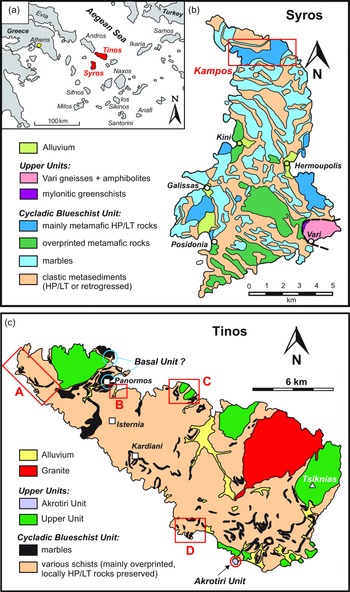
The Attico-Cycladic Crystalline Belt (ACCB) represents a major tectonostratigraphic unit of the Hellenides and is mainly exposed in the central Aegean region (Fig. 1a). The ACCB comprises two major tectonic units with different P–T–D–t histories, both consisting of numerous fault-bounded subunits (e.g. Dürr et al. Reference Dürr, Altherr, Keller, Okrusch, Seidel, Closs, Roeder and Schmidt1978; Dürr, Reference Dürr and Jacobshagen1986; Forster & Lister, Reference Forster and Lister2005; Ring et al. Reference Ring, Glodny, Will and Thomson2010). The Upper Cycladic Unit includes a heterogeneous sequence of unmetamorphosed Permian to Miocene sediments, Jurassic and undated ophiolitic and metamorphic sole remnants, greenschist-facies rocks with Cretaceous to Palaeogene metamorphic ages as well as Late Cretaceous amphibolite-facies rocks and granitoids (e.g. Altherr et al. Reference Altherr, Kreuzer, Lenz, Wendt, Harre and Dürr1994; Patzak et al. Reference Patzak, Okrusch and Kreuzer1994; Sanchez-Gomez et al. Reference Sanchez-Gomez, Avigad and Heimann2002; Kuhlemann et al. Reference Kuhlemann, Frisch, Dunkl, Kázmér and Schmiedl2004; Be´eri-Shlevin et al. Reference Be’eri-Shlevin, Avigad and Matthews2009; Martha et al. Reference Martha, Dörr, Gerdes, Petschick, Schastok, Xypolias and Zulauf2016; Lamont et al. Reference Lamont, Roberts, Searle, Gopon, Waters and Millar2020a). Evidence for HP/LT metamorphism, which is a key feature in the metamorphic history of the structurally lower sequences, was not reported. The upper units were juxtaposed by low-angle detachments onto the nappe stack of the CBU (e.g. Avigad & Garfunkel, Reference Avigad and Garfunkel1989; Brichau et al. Reference Brichau, Ring, Carter, Monié, Bolhar, Stockli and Brunel2007; Jolivet & Brun, Reference Jolivet and Brun2010; Jolivet et al. Reference Jolivet, Lecomte, Huet, Denèle, Lacombe, Labrousse, Le Pourhiet and Mehl2010).
(a) Geographic overview of the larger study area. (b, c) Simplified geological maps of Syros (modified after Keiter et al. Reference Keiter, Piepjohn, Ballhaus, Lagos and Bode2004) and Tinos (modified after Melidonis, Reference Melidonis1980). Red rectangle in (b) outlines Kampos area. Red rectangles in (c) show areas where blocks occur more frequently in the schist sequences. A = NW Tinos; B = Panormos; C = Mavra Gremna; D = Kionia.

The CBU consists of several tectonic subunits representing a meta-ophiolitic mélange and a metamorphosed volcano-sedimentary passive margin succession (e.g. Dürr Reference Dürr and Jacobshagen1986; Okrusch & Bröcker Reference Okrusch and Bröcker1990; Forster & Lister, Reference Forster and Lister2005; Ring et al. Reference Ring, Glodny, Will and Thomson2010; Glodny & Ring, Reference Glodny and Ring2022; and references therein), which can be assigned to an upper and lower group of nappes (Grasemann et al. Reference Grasemann, Huet, Schneider, Rice, Lemonnier and Tschegg2018; Glodny & Ring, Reference Glodny and Ring2022). The lower group was affected by peak conditions of 400 ± 20 °C and 1.0 ± 0.2 GPa, whereas the upper group records temperatures and pressures of 550 ± 50 °C and 2.0 ± 0.2 GPa (Grasemann et al. Reference Grasemann, Huet, Schneider, Rice, Lemonnier and Tschegg2018). Numerous geochronological studies documented a polyphase Eocene to Miocene metamorphic history, which includes an eclogite- to epidote blueschist-facies event (c. 55–40 Ma) and later overprinting at lower pressure blueschist-, greenschist- or amphibolite-facies P–T conditions (e.g. Altherr et al. Reference Altherr, Schliestedt, Okrusch, Seidel, Kreuzer, Harre, Lenz, Wendt and Wagner1979; Okrusch & Bröcker, Reference Okrusch and Bröcker1990; Wijbrans et al. Reference Wijbrans, Schliestedt and York1990; Bröcker et al. Reference Bröcker, Kreuzer, Matthews and Okrusch1993; Tomaschek et al. Reference Tomaschek, Kennedy, Villa, Lagos and Ballhaus2003; Lagos et al. Reference Lagos, Scherer, Tomaschek, Münker, Keiter, Berndt and Ballhaus2007; Ring et al. Reference Ring, Glodny, Will and Thomson2010; Bröcker et al. Reference Bröcker, Baldwin and Arkudas2013; Laurent et al. Reference Laurent, Jolivet, Roche, Augier, Scaillet and Cardello2016, Reference Laurent, Huet, Labrousse, Jolivet, Monie and Augier2017, Reference Laurent, Scaillet, Jolivet, Augier and Roche2021; Cliff et al. Reference Cliff, Bond, Butler and Dixon2017; Peillod et al. Reference Peillod, Ring, Glodny and Skelton2017; Lamont et al. Reference Lamont, Searle, Gopon, Roberts, Wade, Palin and Waters2020b; Glodny & Ring, Reference Glodny and Ring2022).
Greenschist-facies rocks at structurally deep levels of Tinos, Evia, Samos, separated from the structurally higher sequences by thrust faults, and regional amphibolite-facies metamorphic rocks at deep levels on Naxos do not record earlier HP/LT conditions or only lower grade blueschist metamorphism than the CBU and are interpreted to be para-allochthonous units (Avigad & Garfunkel, Reference Avigad and Garfunkel1989; Ring et al. Reference Ring, Laws and Bernet1999; Shaked et al. Reference Shaked, Avigad and Garfunkel2000; Lamont et al. Reference Lamont, Searle, Waters, Roberts, Palin, Smye, Dyck, Weller and St-Onge2019). In the case of Tinos, this has not yet been clearly confirmed (Bröcker & Franz, Reference Bröcker and Franz2005).
In the southern Cyclades (e.g. Ios, Sikinos), the CBU is underlain by gneisses and schists of a pre-Alpine crystalline basement (e.g. van der Maar, Reference Van der Maar1980; van der Maar & Jansen, Reference Van der Maar and Jansen1983), which was also affected by HP/LT metamorphism (Perraki & Mposkos, Reference Perraki and Mposkos2001; Wolfe et al. Reference Wolfe, Spear, Thomas, Hasegawa, Libby and Cheney2023). Detrital zircon geochronology implies a continuous stratigraphic record and provenance evolution and thus a para-autochthonous relationship between basement and the CBU (Flansburg et al. Reference Flansburg, Stockli, Poulaki and Soukis2019; Poulaki et al. Reference Poulaki, Stockli, Flansburg and Soukis2019). Between c. 17 and 11 Ma, the Cyclades were intruded by numerous I- and S-type granitoids (e.g. Altherr et al. Reference Altherr, Kreuzer, Wendt, Lenz, Wagner, Keller, Harre and Höhndorf1982; Bolhar et al. Reference Bolhar, Ring and Allen2010).
3. Local geology
On Syros Island (Fig. 1b), two lithostratigraphic subunits occur structurally above the CBU: the Vari gneisses and a greenschist-facies mylonite sequence (e.g. Ridley, Reference Ridley, Dixon and Robertson1984; Trotet et al. Reference Trotet, Jolivet and Vidal2001a, Reference Trotet, Vidal and Jolivet2001b; Keiter et al. Reference Keiter, Ballhaus and Tomaschek2011; Soukis & Stockli, Reference Soukis and Stockli2013). These rocks were either not affected by HP/LT metamorphism or do not preserve such mineral assemblages and most likely represent down-faulted tectonic slices representing the hanging wall of the subduction zone complex (e.g. Ridley, Reference Ridley, Dixon and Robertson1984; Soukis & Stockli, Reference Soukis and Stockli2013). The Vari subunit mainly consists of quartzofeldspathic orthogneisses with early Triassic (c. 244–240 Ma) protolith ages of the granitic precursor (e.g. Keay, Reference Keay1998; Keiter et al. Reference Keiter, Ballhaus and Tomaschek2011; Soukis & Stockli, Reference Soukis and Stockli2013). Geochemical characteristics indicate an affinity to volcanic arc granites (M. Engel, unpub. Ph.D. thesis, Johannes Gutenberg-Universität, Mainz, 2006). White mica geochronology (40Ar–39Ar and Rb–Sr) and zircon overgrowths (U–Pb) provided two groups of Late Cretaceous ages (c. 100–95 Ma and c. 75 Ma), interpreted to constrain the time of upper greenschist- to epidote amphibolite-facies metamorphism (Maluski et al. Reference Maluski, Bonneau and Kienast1987; Tomaschek et al. Reference Tomaschek, Baumann, Villa, Kennedy and Ballhaus2000). The tectonic contact with the CBU, considered to be a low-angle normal fault (Ridley, Reference Ridley, Dixon and Robertson1984), is roughly delineated by a thin sequence of greenschist-facies mylonitic schists, phyllites and minor serpentinite, interpreted as a distinct subunit at the base of the orthogneisses (Bröcker & Enders, Reference Bröcker and Enders2001; Keiter et al. Reference Keiter, Ballhaus and Tomaschek2011; Soukis & Stockli, Reference Soukis and Stockli2013). This detachment was active at c. 9–12 Ma, as evidenced by zircon fission-track data (Ring et al. Reference Ring, Thomson and Bröcker2003).
The structurally lower sequences mostly represent the CBU (e.g. Dixon & Ridley, Reference Dixon, Ridley and Helgeson1987; Keiter et al. Reference Keiter, Ballhaus and Tomaschek2011) and include several lithostratigraphic or tectonic subunits, which are separated by ductile shear zones (Laurent et al. Reference Laurent, Jolivet, Roche, Augier, Scaillet and Cardello2016; Kotowski et al. Reference Kotowski, Cisneros, Behr, Stockli, Soukis, Barnes and Ortega-Arroyo2022; Uunk et al. Reference Uunk, Brouwer, de Paz-Álvarez, van Zuilen, Huybens, van ’t Veer and Wijbrans2022).
A particularly striking feature is an HP/LT mélange, which is best exposed in northern Syros (Kampos mélange; Fig. 1b; e.g. Dixon & Ridley, Reference Dixon, Ridley and Helgeson1987), but most parts of Syros consist of marble-schist sequences. The significantly greater thickness of the marbles compared to the neighbouring islands of Tinos and Andros probably results from tectonic repetition by thrusting or isoclinal folding (e.g. Dixon & Ridley, Reference Dixon, Ridley and Helgeson1987; Keiter et al. Reference Keiter, Ballhaus and Tomaschek2011).
The Syros nappe stack was affected by HP/LT metamorphic conditions up to c. 1.3–2.2 GPa and 450–550°C, but at different times, and variable degrees of lower pressure overprinting (e.g. Trotet et al. Reference Trotet, Jolivet and Vidal2001a, Reference Trotet, Vidal and Jolivet2001b; Keiter et al. Reference Keiter, Piepjohn, Ballhaus, Lagos and Bode2004; Schumacher et al. Reference Schumacher, Brady, Cheney and Tonnsen2008; Philippon et al. Reference Philippon, Brun and Gueydan2011; Laurent et al. Reference Laurent, Huet, Labrousse, Jolivet, Monie and Augier2017; Uunk et al. Reference Uunk, Brouwer, ter Voorde and Wijbrans2018, Reference Uunk, Brouwer, de Paz-Álvarez, van Zuilen, Huybens, van ’t Veer and Wijbrans2022; Skelton et al. Reference Skelton, Peillod, Glodny, Klonowska, Manbro, Lodin and Ring2019; Ring et al. Reference Ring, Pantazides, Glodny and Skelton2020; Gorce et al. Reference Gorce, Caddick, Baxter, Dragovic, Schumacher, Bodnar and Kendall2021; Kotowski et al. Reference Kotowski, Cisneros, Behr, Stockli, Soukis, Barnes and Ortega-Arroyo2022; Glodny & Ring, Reference Glodny and Ring2022).
Various geochronologic methods (40Ar–39Ar, K–Ar, Rb–Sr, U–Pb, Sm–Nd, Lu–Hf) documented the importance of Eocene HP/LT metamorphism (55–40 Ma) for both the Kampos mélange and other CBU subunits (e.g. Maluski et al. Reference Maluski, Bonneau and Kienast1987; Bröcker & Enders, Reference Bröcker and Enders2001; Tomaschek et al. Reference Tomaschek, Kennedy, Villa, Lagos and Ballhaus2003; Putlitz et al. Reference Putlitz, Cosca and Schumacher2005; Lagos et al. Reference Lagos, Scherer, Tomaschek, Münker, Keiter, Berndt and Ballhaus2007; Bröcker et al. Reference Bröcker, Baldwin and Arkudas2013; Cliff et al. Reference Cliff, Bond, Butler and Dixon2017; Skelton et al. Reference Skelton, Peillod, Glodny, Klonowska, Manbro, Lodin and Ring2019; Gorce et al. Reference Gorce, Caddick, Baxter, Dragovic, Schumacher, Bodnar and Kendall2021; Kotowski et al. Reference Kotowski, Cisneros, Behr, Stockli, Soukis, Barnes and Ortega-Arroyo2022; Uunk et al. Reference Uunk, Brouwer, de Paz-Álvarez, van Zuilen, Huybens, van ’t Veer and Wijbrans2022, Reference Uunk, Brouwer, ter Voorde and Wijbrans2018; Tual et al. Reference Tual, Smit, Cutts, Kooijman, Kielman-Schmitt, Majka and Foulds2022). The geological relevance of younger white mica dates has been attributed either to incomplete resetting or to distinct exhumation increments (e.g. Bröcker et al. Reference Bröcker, Baldwin and Arkudas2013; Rogowitz et al. Reference Rogowitz, Huet, Schneider and Grasemann2015; Cliff et al. Reference Cliff, Bond, Butler and Dixon2017; Laurent et al. Reference Laurent, Huet, Labrousse, Jolivet, Monie and Augier2017; Uunk et al. Reference Uunk, Brouwer, ter Voorde and Wijbrans2018; Glodny & Ring, Reference Glodny and Ring2022). The marble-schist sequence records only minor, localized evidence for Miocene ages (∼ 21 Ma) that are common elsewhere in the Cyclades (e.g. Bröcker et al. Reference Bröcker, Baldwin and Arkudas2013; Kotowski et al. Reference Kotowski, Cisneros, Behr, Stockli, Soukis, Barnes and Ortega-Arroyo2022). Tomaschek et al. (Reference Tomaschek, Keiter, Kennedy and Ballhaus2008) also described a tectonic slice of the Cycladic basement within the basal part of the CBU.
On Tinos Island (Fig. 1c), the metamorphic succession can be subdivided into at least three tectonic subunits, referred to in the local literature as the Akrotiri Unit, the Upper Unit, and the Lower Unit (e.g. Melidonis, Reference Melidonis1980; Okrusch & Bröcker, Reference Okrusch and Bröcker1990; Katzir et al. Reference Katzir, Matthews, Garfunkel and Schliestedt1996). The Akrotiri and Upper subunits (Fig. 1c), which form the uppermost part of the metamorphic sequence, belong to the regional Upper Cycladic Unit and record amphibolite and greenschist-facies P–T conditions (e.g. Patzak et al. Reference Patzak, Okrusch and Kreuzer1994; Katzir et al. Reference Katzir, Matthews, Garfunkel and Schliestedt1996; Bröcker & Franz, Reference Bröcker and Franz1998; Zeffren et al. Reference Zeffren, Avigad, Heimann and Gvirtzman2005; Lamont et al. Reference Lamont, Roberts, Searle, Gopon, Waters and Millar2020a). Field observations as well as lithological and metamorphic similarities indicate a correlative relationship with the two upper subunits on Syros (Bröcker & Enders, Reference Bröcker and Enders2001; Soukis & Stockli Reference Soukis and Stockli2013).
The Akrotiri Unit (300–350 m thick) comprises a relatively small occurrence near the main town of the island (Fig. 1c) and mainly consists of an interlayered amphibolite-gneiss sequence (Patzak et al. Reference Patzak, Okrusch and Kreuzer1994). P–T estimates indicate metamorphic pressures of 0.6–0.85 GPa and temperatures of c. 490–610 °C (Patzak et al. Reference Patzak, Okrusch and Kreuzer1994). K–Ar hornblende and white mica dating of amphibolites and gneisses yielded apparent ages of c. 77–66 Ma and c. 60–53 Ma, respectively (Patzak et al. Reference Patzak, Okrusch and Kreuzer1994). The contact to other subunits is not exposed, but judging from general field relationships this gneiss-amphibolite sequence forms the uppermost part of the Tinos metamorphic succession. The position of the Akrotiri rocks within the overall structural architecture of the region is not yet fully understood. The Akrotiri rocks either belong to a specific tectonic subunit on top of the CBU, e.g. the Asteroussia nappe, or are related to the local Tsiknias metamorphic sole (Patzak et al. Reference Patzak, Okrusch and Kreuzer1994; Katzir et al. Reference Katzir, Matthews, Garfunkel and Schliestedt1996; Lamont et al. Reference Lamont, Roberts, Searle, Gopon, Waters and Millar2020a).
The Upper Unit (at least 750m thick) includes serpentinites, meta-gabbros, meta-plagiogranites, amphibolites, ophicalcites and listvenites that are embedded in, or are structurally underlain, by mostly mafic phyllites (Melidonis Reference Melidonis1980; Katzir et al. Reference Katzir, Matthews, Garfunkel and Schliestedt1996; Bröcker & Franz, Reference Bröcker and Franz1998; Zeffren et al. Reference Zeffren, Avigad, Heimann and Gvirtzman2005; Hinsken et al. Reference Hinsken, Bröcker, Strauss and Bulle2017; Lamont et al. Reference Lamont, Roberts, Searle, Gopon, Waters and Millar2020a; Mavrogonatos et al. Reference Mavrogonatos, Magganas, Kati, Bröcker and Voudouris2021). The metamorphic history of the various rock types includes upper greenschist to amphibolite-facies ocean floor metamorphism, greenschist-facies overprinting during Oligocene-Miocene orogenic processes and formation of a metamorphic sole that is locally partially melted (Katzir et al. Reference Katzir, Matthews, Garfunkel and Schliestedt1996; Bröcker & Franz, Reference Bröcker and Franz1998; Zeffren et al. Reference Zeffren, Avigad, Heimann and Gvirtzman2005; Lamont et al. Reference Lamont, Roberts, Searle, Gopon, Waters and Millar2020a). Jurassic U–Pb zircon protolith ages for a plagiogranitic sill (c. 162 Ma) and a meta-gabbro (c. 144 Ma) imply a correlative relationship of the Tsiknias occurrence (Fig. 1c) to the Pelagonian ophiolites of the Greek mainland (Lamont et al. Reference Lamont, Roberts, Searle, Gopon, Waters and Millar2020a). Zircons of leucodioritic melt pockets in the sole amphibolites yielded a zircon overgrowth U–Pb age of 74.0 ± 3.5 Ma (Lamont et al. Reference Lamont, Roberts, Searle, Gopon, Waters and Millar2020a), which overlaps with the K–Ar dates of the Akrotiri amphibolites. K–Ar, 40Ar–39Ar and Rb–Sr dates of other Upper Unit rocks (mafic and pelitic phyllites, meta-gabbros) range from 95 to 13 Ma and were related to variable age resetting during juxtaposition-related ductile deformation (Bröcker & Franz, Reference Bröcker and Franz1998; Zeffren et al. Reference Zeffren, Avigad, Heimann and Gvirtzman2005). The Upper Unit was placed on top of the Lower Unit by a low-angle normal fault (e.g. Avigad & Garfunkel, Reference Avigad and Garfunkel1989; Katzir et al. Reference Katzir, Matthews, Garfunkel and Schliestedt1996; Brichau et al. Reference Brichau, Ring, Carter, Monié, Bolhar, Stockli and Brunel2007) during a regional greenschist-facies episode at c. 21 Ma, which also affected the underlying CBU (Bröcker& Franz, Reference Bröcker and Franz1998).
The Lower Unit (c. 1250–1800 m in thickness), recently interpreted as consisting of several subunits with different tectonic and thermal histories (Lamont et al. Reference Lamont, Searle, Gopon, Roberts, Wade, Palin and Waters2020b), belongs to the regional CBU and comprises mainly siliciclastic metasediments, marbles as well as mafic and felsic meta-volcanic rocks (e.g. Melidonis, Reference Melidonis1980; Bröcker et al. Reference Bröcker, Kreuzer, Matthews and Okrusch1993; Hinsken et al. Reference Hinsken, Bröcker, Berndt and Gärtner2016; Lamont et al. Reference Lamont, Searle, Gopon, Roberts, Wade, Palin and Waters2020b). Hinsken et al. (Reference Hinsken, Bröcker, Berndt and Gärtner2016) reported Late Cretaceous (c. 80–70 Ma) maximum depositional ages (MDAs) for the lithostratigraphic succession above the lowermost dolomite marble, which contains Triassic fossils (Melidonis, Reference Melidonis1980). Remnants of HP/LT rocks or mineral assemblages are common, but pervasively retrogressed greenschist-facies rocks are more widespread (e.g. Melidonis, Reference Melidonis1980; Bröcker et al. Reference Bröcker, Kreuzer, Matthews and Okrusch1993; Breeding et al. Reference Breeding, Ague, Bröcker and Bolton2003; Bulle et al. Reference Bulle, Bröcker, Gärtner and Keasling2010; Lamont et al. Reference Lamont, Searle, Gopon, Roberts, Wade, Palin and Waters2020b).
Metamorphic conditions of the HP/LT event originally were estimated at ∼1.2–2.0 GPa and 450–550°C (e.g. Bröcker et al. Reference Bröcker, Kreuzer, Matthews and Okrusch1993; Parra et al. Reference Parra, Vidal and Jolivet2002). More recent petrological modelling suggests peak P–T conditions of ∼2.0–2.6 GPa and 490–570°C (Lamont et al. Reference Lamont, Searle, Gopon, Roberts, Wade, Palin and Waters2020b). The highest P–T conditions were reported for blueschists and eclogites from the Kionia area, which represents the topmost part of the Lower Unit (Lamont et al. Reference Lamont, Searle, Gopon, Roberts, Wade, Palin and Waters2020b). For rocks from deeper structural levels, Lamont et al. (Reference Lamont, Searle, Gopon, Roberts, Wade, Palin and Waters2020b) described P-T conditions of ∼1.85 GPa and 480–510°C for the HP stage and of ∼0.7 GPa and 500–540°C for the retrograde greenschist overprint. According to Parra et al. (Reference Parra, Vidal and Jolivet2002), overprinting during exhumation includes decompression from 1.5–1.8 GPa at 500 °C to 0.9 GPa at 400 °C, a thermal overprint (400–550 °C, ∼0.9 GPa) and further decompression from 0.9 GPa at 550–570 °C to 0.2 GPa at 420 °C. White mica dating indicated Eocene white mica ages for HP/LT rocks (c. 44–40 Ma) and ages between 36 and 21 Ma for greenschist-facies rocks (e.g. Bröcker et al. Reference Bröcker, Kreuzer, Matthews and Okrusch1993, Reference Bröcker, Bieling, Hacker and Gans2004; Bröcker & Franz, Reference Bröcker and Franz1998). More recently, Glodny and Ring (Reference Glodny and Ring2022) argued that blueschist-facies conditions lasted from at least c. 36 to 33 Ma and reported a c. 22 Ma age for the greenschist-facies overprint. Bulle et al. (Reference Bulle, Bröcker, Gärtner and Keasling2010) and Hinsken et al. (Reference Hinsken, Bröcker, Berndt and Gärtner2016) described U–Pb zircon rim data of c. 57–46 Ma and related these ages to the HP/LT stage.
The lowermost part of the metamorphic sequence is exposed in NW Tinos near Panormos (Fig. 1c) and consists of greenschist-facies dolomite marbles and minor sedimentary phyllites, which have been interpreted either as a para-autochthonous Basal Unit (Avigad & Garfunkel, Reference Avigad and Garfunkel1989) or as an integral part of the Lower Unit (Melidonis, Reference Melidonis1980; Bröcker & Franz, Reference Bröcker and Franz2005). In eastern Tinos (Fig. 1c), the emplacement of Miocene I- and S-type granitoids (c. 15–14 Ma; Altherr et al. Reference Altherr, Kreuzer, Wendt, Lenz, Wagner, Keller, Harre and Höhndorf1982; Bröcker & Franz, Reference Bröcker and Franz1998; Keay, Reference Keay1998; Brichau et al. Reference Brichau, Ring, Carter, Monié, Bolhar, Stockli and Brunel2007) has caused contact metamorphism in both the Upper Unit and the Lower Unit (Avigad & Garfunkel, Reference Avigad and Garfunkel1989; Bröcker & Franz, Reference Bröcker and Franz1994, Reference Bröcker and Franz2000; Stolz et al. Reference Stolz, Engi and Rickli1997).
4. Field description
4.a. The Kampos mélange on Syros
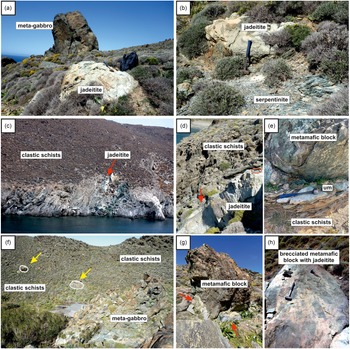
The Kampos mélange is shown on geological maps as a distinct lithological or tectonic subunit unit (e.g. Dixon & Ridley, Reference Dixon, Ridley and Helgeson1987; Keiter et al. Reference Keiter, Piepjohn, Ballhaus, Lagos and Bode2004, Reference Keiter, Ballhaus and Tomaschek2011), but at least the inferred upper tectonic contact is not well established. The mélange includes blocks and tectonic slices (<1 m to several hundred metres) of various eclogite- and blueschist-facies rocks such as meta-gabbros, eclogites, glaucophanites, ultrabasic rocks, jadeitites and interlayered bimodal metavolcanic rocks, which are partly exposed by erosion from a matrix of altered ultramafic rocks or clastic metasediments (Fig. 2; e.g. Dixon & Ridley, Reference Dixon, Ridley and Helgeson1987; Seck et al. Reference Seck, Koetz, Okrusch, Seidel and Stosch1996; Bröcker & Enders, Reference Bröcker and Enders2001; Breeding et al. Reference Breeding, Ague and Bröcker2004; Keiter et al. Reference Keiter, Piepjohn, Ballhaus, Lagos and Bode2004, Reference Keiter, Ballhaus and Tomaschek2011; Marschall et al. Reference Marschall, Ludwig, Altherr, Kalt and Tonarini2006; Ague Reference Ague2007; Miller et al. Reference Miller, Marschall and Schumacher2009; Bulle et al. Reference Bulle, Bröcker, Gärtner and Keasling2010; Gyomlai et al. Reference Gyomlai, Agard, Marschall, Jolivet and Gerdes2021). Many blocks are still in contact with sheared serpentinite or chlorite- and talc-rich schists derived from an ultramafic precursor (Fig. 2b, e). Prominent blackwall alteration zones are widespread due to metasomatic interaction with serpentinitic host rocks (e.g. Dixon & Ridley, Reference Dixon, Ridley and Helgeson1987; Bröcker & Enders, Reference Bröcker and Enders2001; Miller et al. Reference Miller, Marschall and Schumacher2009; Gyomlai et al. Reference Gyomlai, Agard, Marschall, Jolivet and Gerdes2021). P–T estimates for blackwall formation range from ∼1.2 GPa and 500–550 °C (Breeding et al. Reference Breeding, Ague and Bröcker2004) to 0.6–0.7 GPa and 400–430 °C (Marschall et al. Reference Marschall, Ludwig, Altherr, Kalt and Tonarini2006) or 1.2 GPa and 430 °C (Miller et al. Reference Miller, Marschall and Schumacher2009). Discrete serpentinite blocks are locally preserved. Whole rock major and trace element geochemistry and stable isotope data (δD and δ18O) of serpentinites suggest an origin in an extensional tectonic setting, such as a hyper-extended margin or a mid-ocean ridge and fracture zone environment (Cooperdock et al. Reference Cooperdock, Raia, Barnes, Stockli and Schwarzenbach2018).
Field images from the Kampos mélange, Syros. (a) Jadeitite and meta-gabbro blocks (GPS: N 37° 29.582; E 24° 54.301). (b) Jadeitite-serpentinite contact (GPS: N 37° 29.603; E 24° 54.663). (c, d) Jadeitite in mainly clastic metasedimentary host rocks (GPS: N 37°29.581; E 024°54.037). (e) Metamafic block with thin selvage of altered ultramafic schists (=um, with hammer on it) within clastic metasediments (GPS: N 37° 29.569; E 24° 54.093). (f) Blocks of variably sized glaucophane-rich rocks (yellow arrows) and meta-gabbro in clastic metasedimentary schists. (g) Close-up of the leftmost block in the previous image (GPS: N 37° 29.688; E 24° 53.955). Red arrows point to blackwall zones. (h) Lower half of the brecciated eclogite-jadeitite block (GPS: N 37° 29.603; E 24° 54.558). Hammer for scale, marked by red ellipse in (d), is 40 cm in length.

Siliciclastic metasediments also occur as host rocks for mafic and felsic blocks (Fig. 2c–f; Dixon & Ridley, Reference Dixon, Ridley and Helgeson1987; Keiter et al. Reference Keiter, Ballhaus and Tomaschek2011), particularly in the upper part of the mélange zone. Metamorphosed mafic blocks in a matrix of blueschists and quartz mica schists have also been reported from rock sequences below the Kampos mélange and its correlative equivalents (Laurent et al. Reference Laurent, Jolivet, Roche, Augier, Scaillet and Cardello2016; Kotowski & Behr, Reference Kotowski and Behr2019), but the focus here is on jadeitite-bearing occurrences. For detailed field descriptions of the Kampos mélange see Dixon and Ridley (Reference Dixon, Ridley and Helgeson1987) and Gyomlai et al. (Reference Gyomlai, Agard, Marschall, Jolivet and Gerdes2021).
The Kampos block population includes rock fragments with Cretaceous (c. 80–75 Ma) U–Pb zircon ages (e.g. Keay, Reference Keay1998; Tomaschek et al. Reference Tomaschek, Kennedy, Villa, Lagos and Ballhaus2003; Bröcker & Keasling, Reference Bröcker and Keasling2006; Supplementary Table S1) attributed to either igneous crystallization or to metamorphic or hydrothermal processes. Some tectonic fragments yielded a Triassic (c. 245–240 Ma) protolith age (Bröcker & Keasling, Reference Bröcker and Keasling2006). Such ages were also reported for similar rocks from structurally lower CBU sequences (Tomaschek et al. Reference Tomaschek, Kennedy, Villa, Lagos and Ballhaus2003), suggesting that tectonic slices originating from disruption of a primary lithostratigraphic unit were also incorporated in the mélange. However, most of the blocks are interpreted as remnants of oceanic lithosphere from a back-arc basin (Seck et al. Reference Seck, Koetz, Okrusch, Seidel and Stosch1996; Keay, Reference Keay1998).
The modal and geochemical variability of the metamafic rocks has been linked to the development of their protoliths in different magma chambers (Seck et al. Reference Seck, Koetz, Okrusch, Seidel and Stosch1996). Protoliths of the coarse-grained metamafic rocks were interpreted to represent gabbros affected to varying degrees by fractional crystallization, while the precursors of finer-grained metamorphosed mafic rocks were associated with ocean floor basalts (e.g. Dixon & Ridley, Reference Dixon, Ridley and Helgeson1987; Seck et al. Reference Seck, Koetz, Okrusch, Seidel and Stosch1996). Protolith ages of matrix rocks are poorly constrained. Clastic metasedimentary rocks from the Kampos area indicate a Late Cretaceous MDA (c. 95–70 Ma; Keay, Reference Keay1998; Löwen et al. Reference Löwen, Bröcker and Berndt2015).
Explanations for the origin of the block-in-matrix sequences on Syros include mechanical mixing by olistostromatic or tectonic processes (e.g. Dixon & Ridley, Reference Dixon, Ridley and Helgeson1987; Bröcker & Enders, Reference Bröcker and Enders2001; Bulle et al. Reference Bulle, Bröcker, Gärtner and Keasling2010) and concepts based on the exposure of mafic and ultramafic rocks on the seafloor in a hyper-extended intra-oceanic setting combined with rheological heterogeneities of subducted rock types (e.g. Kotowski & Behr, Reference Kotowski and Behr2019, Reference Kotowski, Cisneros, Behr, Stockli, Soukis, Barnes and Ortega-Arroyo2022; Gyomlai et al. Reference Gyomlai, Agard, Marschall, Jolivet and Gerdes2021).
4.b. The Tinos block-in-matrix sequence
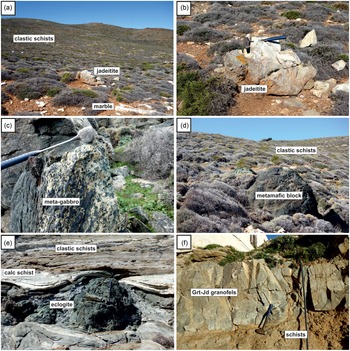
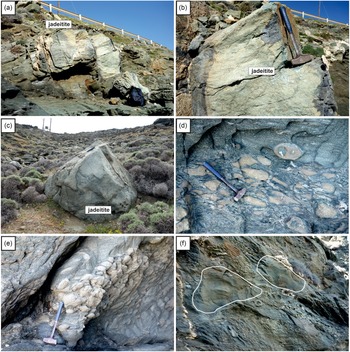
Occurrences of metamorphosed mafic blocks in a metasedimentary matrix were recognized in NW-Tinos, near Kionia, SE of Panormos and in the Mavra Gremna area (labelled A, B, C and D in Fig. 1c). However, unlike northern Syros, there is not a clearly defined and mappable mélange subunit. Instead, from the top to the base of the Lower Unit, relatively few isolated blocks of meta-gabbros, glaucophanites, eclogites, jadeitites and ultramafic rocks (mostly <1–10 m, but up to 300 m) occur at various levels within the marble-schist sequence (Bröcker & Enders, Reference Bröcker and Enders1999; Bulle et al. Reference Bulle, Bröcker, Gärtner and Keasling2010). The block-forming process is controversial. Bulle et al. (Reference Bulle, Bröcker, Gärtner and Keasling2010) assumed a meta-olistostromatic origin. In contrast, Lamont et al. (Reference Lamont, Roberts, Searle, Gopon, Waters and Millar2020a) attributed the blocks to boudinage of mafic lithologies. The block population records HP/LT metamorphic conditions and includes rock types like those in the Kampos mélange (Figs. 3, 4a–c), but their abundance is much smaller, and the matrix consists almost entirely of metasedimentary or meta-tuffaceous rocks. Especially noteworthy is the existence of jadeitites (Figs. 3a, b; 4a–c). Ultramafic rocks are rare (e.g. Lamont et al. Reference Lamont, Searle, Gopon, Roberts, Wade, Palin and Waters2020b), but some metamafic blocks are surrounded by a thin serpentinite or chlorite schist cover (Bulle et al. Reference Bulle, Bröcker, Gärtner and Keasling2010), suggesting that these blocks were originally in contact with an ultramafic matrix. Ion probe dating of eclogite, glaucophanite, blackwall and chlorite schist yielded Cretaceous U–Pb zircon ages (c. 80 Ma; Bulle et al. Reference Bulle, Bröcker, Gärtner and Keasling2010; Supplementary Table S1). Similar MDAs have been reported from the enclosing schists, implying that detritus derived from the block-forming mafic lithologies also occurs in the metasediments (Bulle et al. Reference Bulle, Bröcker, Gärtner and Keasling2010; Hinsken et al. Reference Hinsken, Bröcker, Berndt and Gärtner2016). In various parts of the Lower Unit, meta-conglomerate horizons are associated with the block-in-matrix succession (Fig. 4d–e; Bulle et al. Reference Bulle, Bröcker, Gärtner and Keasling2010).
Field images from the Mavra Gremna and Kionia areas, Tinos. (a) Isolated jadeitite block (sample 4011) in marble-schist sequence. (b) Close-up of jadeitite block 4011 (GPS: N 37° 38.809; E 025° 07.180). (c) HP/LT metamorphic meta-gabbro (GPS: N 37° 38.809; E 25° 07.224). (d) Metamafic block in clastic schists (GPS: N 37° 38.867; E 25° 07.358). (e) Boudinaged eclogite block in metasedimentary host rocks (GPS: N 37° 39.040; E 25° 07.184). (f) Kionia garnet-jadeite granofels (GPS: N 37° 33.483; E 25° 07.767). Hammer for scale is 40 cm in length.

Field images from the Panormos area, Tinos. (a) In-situ jadeitite block in green meta-tuffaceous schists in the coastal cliff north of Rochari beach (samples 5535, 5537, 5539; (GPS: N 37° 38.982; E 25° 03.475). (b) Close-up of block shown in previous image with haematite-rich alteration along the block margin. (c) Strongly retrogressed jadeitite block from the coastal cliff area north of Rochari beach (samples 9028, 9029; (GPS: N 37° 38.875; E 25° 03.740). (d, e) Monomict volcaniclastic meta-conglomerates (GPS: N 37° 38.893; E 25° 03.709 and N 37° 38.885; E 25° 03.697). (f) Olistoliths in meta-conglomeratic matrix (GPS: N 37° 38.885; E 25° 03.697). Hammer for scale in (a–e) is 40 cm in length. Field of view in (f) about 6 m wide.

5. Analytical methods
Mineral compositions were determined with a JEOL 8530F electron microprobe (EMP). Natural and synthetic mineral standards were used for calibration. Operating conditions were a 15 kV accelerating voltage, 5 nA electron beam current and a 5-μm spot size. Counting times were 5 s on the peak and 2 s on the background.
For U–Pb geochronology, zircon crystals were separated from several kilograms of fresh rock by standard routines (jaw crusher, disc mill, Wilfley table, Frantz magnetic separator, methylene iodide heavy liquid and handpicking under stereomicroscope). After preparation of epoxy resin mounts and polishing to expose grain interiors, cathodoluminescence (CL) imaging was applied to reveal the internal zircon structures and to guide spot placement. Ion microprobe (SHRIMP) dating was carried out at the Centre of Isotopic Research (VSEGEI), St. Petersburg, Russia. Analytical procedures followed standard operating routines and were similar to those reported by Bulle et al. (Reference Bulle, Bröcker, Gärtner and Keasling2010) and Bröcker et al. (Reference Bröcker, Löwen and Rodionov2014). Individual spot ages in Supplementary Table S5 are based on the 207Pb correction method, assuming 206Pb/238U–207Pb/235U age-concordance. Most analyses contain very little common Pb and thus are insensitive to the choice of initial isotopic composition. Weighted averages (without error in standard) and intercept ages are quoted as 206Pb/238U ages with 95% confidence limit and 2σ uncertainty, respectively. The uncorrected data for all samples are presented in Tera–Wasserburg diagrams. Such plots, regressions and weighted mean age calculations are based on Isoplot 4.15 (Ludwig, Reference Ludwig2012).
Bulk-rock compositions were analysed by Actlabs, Ancaster, Ontario, applying a lithium metaborate/tetraborate fusion technique followed by acid digestion and analysis by ICP and ICP/MS (4Lithoresearch analytical protocol).
6. Petrography and mineralogy
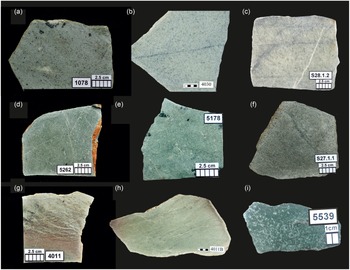
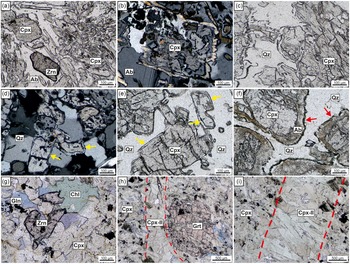
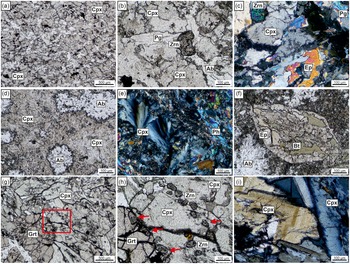
Nineteen samples were selected for more detailed petrographic, geochemical and geochronological investigation. Samples from Syros are from the Kampos area (Fig. 1b). Samples from Tinos were collected in various parts of the island (Fig. 1c). GPS coordinates of sampling locations are reported in Supplementary Table S2 (available online at https://doi.org/10.1017/S0016756823000602). Field images are shown in Figs. 2–4. Hand specimen images are presented in Fig. 5. Photomicrographs are depicted in Figs. 6 and 7. EMP analyses with the focus on clinopyroxene compositions are summarized in Supplementary Table S3.
Hand specimen pictures of jadeitites from Syros and Tinos.

Thin section images of samples from the Kampos area, Syros. (a, b) Jadeitite 1078. (c, d) Jadeitite 4030. (e) Jadeitite S28.1. (f) Jadeitite S27.1. (g) Eclogite 5175. (h, i) Eclogite 5171. Yellow arrows in (d, e) point to retrograde albite around jadeite. Red arrows in (f) indicate newly formed aegirine augite. Red dashed lines in (h, i) roughly delineate younger veins. Ab, albite; Chl, chlorite; Cpx, clinopyroxene; Gln, glaucophane; Qz, quartz; Zrn, zircon.

Thin section images of samples from various locations on Tinos jadeitites and garnet-jadeite granofels from Tinos. (a, b, c) Jadeitite 4011, Mavra Gremna area. (d) Overprinted jadeitite 5535. (e, f) Strongly overprinted jadeitite 9028, Panormos area. (g, h, i) Garnet-jadeite granofels 1049, Kionia area. Red rectangle in (g) outlines area shown as close-up in (h). Red arrows in (h) point to zircon grains in and around garnet: Ab, albite; Bt, biotite; Chl, chlorite; Cpx, clinopyroxene; Ep, epidote; Grt, garnet; Pg, paragonite; Ph, phengite; Zrn, zircon.

Many of the samples examined are not jadeitite sensu stricto but variably albitized or impure jadeitites with lower jadeite contents. Fresh or poorly overprinted jadeitites are massive, non-foliated and granoblastic rocks with mostly light-green colour (Fig. 5). With increasing degree of retrograde overprinting, the colour changes to darker shades of green. Apart from possibly zircon, no igneous relicts or pseudomorphs of such phases were found.
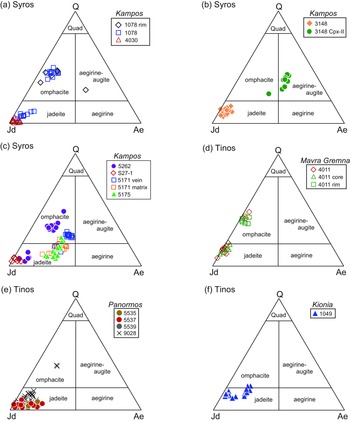
The primary mineral assemblages mainly consist of jadeite and variable modal amounts of white mica, epidote, amphibole, zircon and titanite (Figs. 6, 7). Some samples also contain quartz (e.g. sample 4030). Pristine clinopyroxene is high in jadeite component (Jd> 80 mol.%; Fig. 8; Supplementary Table S3) and occasionally shows oscillatory zoning. The most abundant retrograde phase is albite (Figs. 6a–f; 7d) with nearly end-member composition (Supplementary Table S3). Retrograde overprinting is also indicated by omphacitic rim compositions of clinopyroxene and small grains or overgrowths of aegirine augite (Figs. 6f; 8a, b). In general, jadeitites from Syros are better preserved than similar rocks from Tinos.
Compositions of clinopyroxenes in the classification diagram of Morimoto et al. (Reference Morimoto, Fabries, Ferguson, Ginzburg, Ross, Seifert, Zussman, Aoki and Gotthardi1988).

On Tinos, two petrographic and geochemical types of jadeite-rich rocks can be distinguished: The first type (sample 4011) corresponds to similar rocks from Syros and occurs as loose block in association with various schists and marble (Figs. 3a, b; 4a–c). More strongly overprinted derivatives of such rocks are exposed in the Panormos area both as in-situ block within meta-tuffaceous schists (samples 5535, 5537, 5539; Fig. 4a, b) and as loose boulders (sample 9028; Fig. 4c). Despite severe retrogression, unoriented and mostly fine-grained jadeite (up to Jd >90 mol.%) is still preserved (Fig. 8e; Supplementary Table S3). The second type (sample 1049) is restricted to a small occurrence near Kionia (Fig. 1c) and was originally described as jadeitite (Bröcker & Enders, Reference Bröcker and Enders1999) but is more aptly defined as garnet-jadeite granofels, as the mineral composition often contains significant amounts of garnet (Fig. 7g, h). Many hand samples are very similar to eclogite, but the clinopyroxenes are jadeites (Fig. 8f). Most of the original outcrop was destroyed by the construction of a house, but a small part remained and shows the garnet-jadeite granofels in metasedimentary schists (Fig. 3f).
Samples 5171, 5175 and 5176 represent the mafic parts of the compound eclogite-jadeitite block (Fig. 2h; stop 11 in the excursion guide of Dixon & Ridley, Reference Dixon, Ridley and Helgeson1987; for additional outcrop pictures see Bröcker & Keasling, Reference Bröcker and Keasling2006). The mineral assemblage of the newly dated sample 5175 (Fig. 6g) is dominated by sodium-rich clinopyroxene (>70 vol.%) and relatively little garnet (5–10 vol.%). Epidote, white mica and rutile occur as additional primary phases. Glaucophane, titanite and chlorite are related to a later overprint. Sample 5171 was collected from a different part of the net-veined block and has less garnet than the other two samples but shows cross-cutting omphacitic clinopyroxene veins (Fig. 6 h, i). The compositions of matrix and vein clinopyroxenes partially overlap, but the veins include abundant crystals with lower Jd component (Fig. 8c; Supplementary Table S3).
7. Whole rock geochemistry
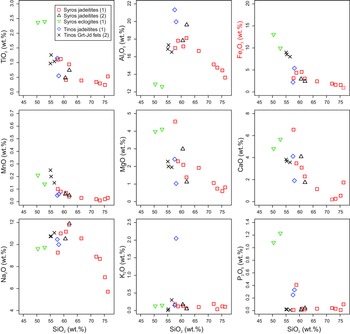
Analytical results are summarized in Supplementary Table S4. On a volatile-free basis, normalized to 100%, the jadeitites from Syros have intermediate to high SiO2 (57.8–76.3 wt.%), moderate to high Al2O3 (13.6–19.6 wt.%) and Na2O (5.7–11.9 wt.%) as well as variable MgO (0.6–4.6 wt%), total Fe2O3 (1.1–5.1 wt.%) and CaO (0.2–6.5 wt.%) concentrations. MnO, K2O and P2O5 contents are mostly very low (<0.1wt.%, <0.2% and <0.1 wt.%, respectively). TiO2 is in the range from 0.2 to 1.1 wt.%. Jadeitites from Tinos (samples 4011 and 5539) are characterized by intermediate SiO2 (57.6–58.1 wt.%) combined with high Al2O3 (20.0–21.3 wt.%) and high Na2O (10.0–10.5 wt.%). Samples 4011 and 5539 are similar in composition to the Syros jadeitites, except the high K2O concentration (2.1 wt.%) of sample 5539, while the Kionia garnet-jadeite samples (1045, 1049, 1050) have significantly higher total Fe2O3 (8.9–10.0 wt.%). MgO (2.0–2.3 wt.%) and CaO (3.6–3.8 wt.%) are in the range of the Syros samples. MnO (<0.25 wt.%), K2O (<0.3%) and P2O5 (<0.1 wt.%) are very low. Harker diagrams show decreasing values of TiO2, Al2O3, FeO, MnO, CaO and Na2O with increasing SiO2 (Fig. 9). Among the trace elements, the high Zr concentrations (up to 2000 ppm) of the Kionia samples are particularly noticeable.
Harker diagrams for jadeitites and eclogites from Syros and Tinos. Data source: (1) = this study; (2) Bröcker and Enders (Reference Bröcker and Enders2001). Diagram was made with GeoChemical Data toolkit (GCDkit, version 6.0; Janoušek et al. Reference Janoušek, Farrow and Erban2006).

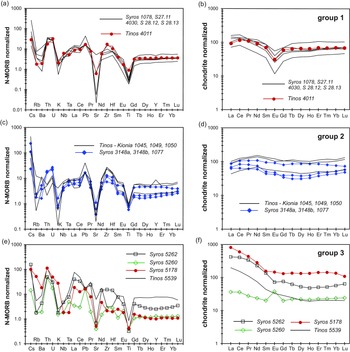
There are no significant bulk-rock compositional differences between jadeitites from Syros and Tinos (Figs. 9, 10). In MORB-normalized multi-element diagrams, the jadeitites and the garnet-jadeite rocks show similar distribution patterns with enrichment in high HFSE and negative troughs for at K, Sr and Ti and flat REE trends (Fig. 10a, c, e). However, based on normalized REE patterns, different groups can be distinguished. The first group is characterized by distribution patterns with distinct negative Eu anomalies (Eu/Eu* = 0.38–0.71; Fig. 10b). Samples of the second group show almost horizontal sinusoidal REE variations (Fig. 10d). Three jadeitites of the third group show enrichments of the LILE and a negative REE slope (Fig. 10f). The REE pattern of sample 5260 differs from all other samples by having a positive Eu anomaly (Eu/Eu* = 1.9; Fig. 10c).
Normalized trace element and REE patterns for jadeitites and eclogites from Syros and Tinos, including data reported by Bröcker and Enders (Reference Bröcker and Enders2001). N-MORB normalization values are from Sun and McDonough (Reference Sun, McDonough, Saunders and Norry1989). Chondrite normalization values are from McDonough and Sun (Reference McDonough and Sun1995).

8. U–Pb geochronology
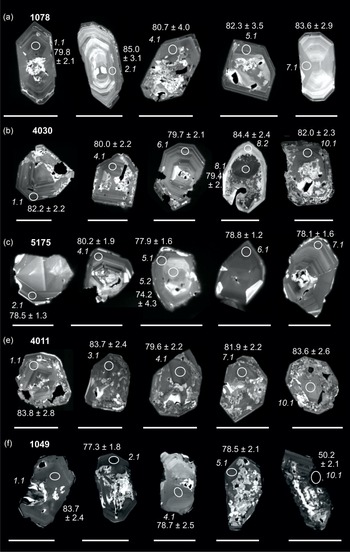
CL images of zircon are shown in Fig. 11 and U–Pb analytical data are reported in Fig. 12 and Supplementary Table S5. For all dated samples, zircon O–Hf isotope data were already reported by Fu et al. (Reference Fu, Valley, Kita, Spicuzza, Paton, Tsujimori, Bröcker and Harlow2010, Reference Fu, Paul, Cliff, Bröcker and Bulle2012).
Cathodoluminescence images of representative zircons of U–Pb-dated samples from Syros and Tinos with spot identification numbers and 206Pb/238U ages (1σ). White lines for scale are 200 µm in length.

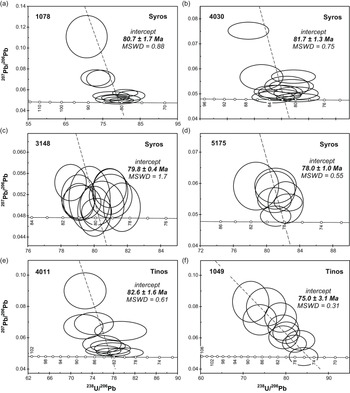
Tera–Wasserburg diagrams of U–Pb-dated samples from Syros and Tinos. Data point error ellipses indicate 1σ uncertainties. Black dashed lines in (a, b, d, e) indicate mixing trend with a common Pb composition anchored at 207Pb/206Pb values of 0.841 (t = 78–83 Ma; Stacey & Kramers, Reference Stacey and Kramers1975) and in (c) of 0.9618 (Broken Hill gold). Dashed line in (f) indicates an unanchored mixing trend.

In all samples, zircon typically has a short prismatic or blocky morphology. Pristine grains or domains show mostly rhythmic zoning or sector-zoned internal patterns, but many crystals have complex cauliflower-like internal structures, indicating partial recrystallization (Fig. 11). Inherited cores or distinct overgrowths were not observed, but some zircon grains of sample 1049 have dark, irregularly shaped, recrystallized domains.
Sample 1078 (Figs. 5a; 6a, b) was collected from a loose block in the upper part of the path to Lia beach, just after the gate. The quartz-bearing jadeitite 4030 (Figs. 5b; 6c, d) represents the block shown in Fig. 2c, d (stop 15 in the excursion guide of Dixon & Ridley, Reference Dixon, Ridley and Helgeson1987). Ion probe dating of samples 1078 and 4030 yielded almost identical anchored intercept ages of 80.7 ± 1.7 Ma and 81.7 ± 1.3 Ma, respectively (Fig. 12a, b).
Sample 3148 represents the jadeitite from the eclogite-jadeitite net-veined rock with distinct blackwall alteration zones (stop 11 of Dixon & Ridley, Reference Dixon, Ridley and Helgeson1987). This sample was dated in a previous study (Bröcker & Keasling, Reference Bröcker and Keasling2006) and is presented here with new data evaluation. The screened data give an intercept age of 79.8 ± 0.4 Ma (Fig. 12c), which only slightly differs in the uncertainty from the original age calculation. From this outcrop, the mafic host rock, represented by sample 5175 (Fig. 6g), was also dated. Eight zircon spot analyses provided an intercept age of 78.0 ± 1.0 Ma (Fig. 12d).
Sample 4011 (Figs. 5g, h; 7a–c) was collected in the Mavra Gremna area on Tinos where it occurs as loose boulder together with widely scattered metamorphosed mafic blocks within a marble-schist sequence (Fig. 3a, b). Ten U–Pb spot analyses yielded an intercept age of 82.6 ± 1.6 Ma (Fig. 12e). Sample 1049 (garnet-jadeite granofels) from Kionia was included in this study to check the geological significance of a previously reported TIMS multigrain zircon date (Bröcker & Enders, Reference Bröcker and Enders1999). U–Pb zircon data define a lower intercept age (not anchored) of 75.0 ± 3.1 Ma and a geologically meaningless upper intercept (Fig. 12f). A recrystallized domain gave the youngest spot age of 52.2 ± 2.1 Ma (spot 10.1; Fig. 11f). The weighted mean 206Pb/238U age is 78.6 ± 1.9 Ma (spot 10.1 excluded). For all other samples, the weighted average ages are nearly identical to the intercept ages (Supplementary Table S5).
9. Discussion
9.a. Zircon geochronology and bulk-rock compositions
One aim of this study was to expand the small geochronological dataset for jadeitites from the Cyclades and to resolve ambiguities of existing multigrain TIMS zircon data. In the case of Syros, it was easy to select additional samples as virtually all jadeitites of the Kampos area are zircon-rich. The situation is more difficult on Tinos, where jadeitites are much rarer and only occasionally contain zircon.
The newly dated samples from both islands yielded U–Pb intercept ages of c. 83–80 Ma and almost identical weighted average 206Pb/238U ages (Fig. 12a–c, e; Supplementary Table S5). The metamafic host rock and cross-cutting jadeitite of a brecciated eclogite-jadeitite block yielded U–Pb ages of 78.0 ± 1.0 Ma and 79.8 ± 0.4 Ma, respectively, which overlap within analytical uncertainty (Fig. 12c, d; see also Bröcker & Keasling, Reference Bröcker and Keasling2006). Taken together, these data document that there is only a single age group of jadeitites on Syros and Tinos.
Based on normalized REE patterns, different groups of jadeitites and jadeite-rich rocks can be distinguished (Fig. 10b, d, f). This variability in composition may be related to derivation from different plagiogranitic protoliths, such as described from the Oman and Troodos ophiolites (e.g. Rollinson, Reference Rollinson2009; Freund et al. Reference Freund, Haase, Keith, Beier and Garbe-Schönberg2014), to metasomatic alteration of a single protolith type by fluids of variable composition, to direct precipitation from different jadeitite-forming fluids, to differences in modal abundance of accessory phases or to changes in REE signatures during retrograde processes. At this stage, this aspect cannot be further clarified because, among others things, no geochemical data are available for potential felsic protoliths. A special case is the in-situ occurrence of garnet-jadeite granofels near Kionia (Figs. 1c, 3f). This rock has a very Zr-rich rock bulk-rock composition (c. 1700–2000 ppm) and corresponding zircon abundance (Fig. 7g, h), which is also typical for a very small occurrence of loose eclogite fragments (Zr: c. 3500–5000 ppm) located a few hundred metres away at the foot of the same hill (Bröcker & Enders, Reference Bröcker and Enders1999, Reference Bröcker and Enders2001).
The bulk-rock composition of the garnet-jadeite samples can be clearly distinguished from the Tinos jadeitites (samples 4011 and 5539), but their REE patterns are very similar to those of Syros samples 3148 and 1077 (Fig. 10). Oscillatory-zoned jadeite (Fig. 7i) and the similarity of trace element and rare earth distribution patterns to those of a sample representing fracture-filling jadeitite indicate original crystallization in an open system and a P-type formation mode. However, in contrast to the Kampos mélange, which locally hosts jadeitites in metasedimentary schists (Fig. 2c), there is no evidence here of subsequent tectonic or sedimentary incorporation of foreign material into the host rock, such as remnants of a serpentinized matrix or blackwall alteration around the granofels as a result of initial contact with ultramafic matrix. Thus, this outcrop could represent a boudin of an extrusive or intrusive meta-igneous layer or vein, as postulated by Lamont et al. (Reference Lamont, Searle, Gopon, Roberts, Wade, Palin and Waters2020b) for the formation of metamafic blocks in the Tinos schist sequences. However, it should be emphasized that there is no general evidence for a boudinage origin of the block-in-matrix occurrences on Tinos. Isolated metamafic blocks (meta-gabbro, eclogite, glaucophanite) and jadeitites occur sporadically in schists. There are no lithological horizons of such rocks that are continuously or discontinuously exposed over longer distances. In addition, blackwall alteration and altered ultramafic schists around blocks have also occasionally been described from the Tinos metamafic blocks (Bulle et al. Reference Bulle, Bröcker, Gärtner and Keasling2010), suggesting incorporation of exotic material by tectonic or sedimentary reworking. In any case, the Kionia garnet-jadeite rocks and eclogites are unusual and rare lithologies that are not known anywhere else in the CBU.
In a previous study, multigrain U–Pb zircon TIMS dates of c. 63–61 Ma were reported for sample 1049 from the Kionia in-situ outcrop (Bröcker & Enders, Reference Bröcker and Enders1999). This apparent age is not confirmed by ion probe dating of zircons from the same sample, which instead yielded a U–Pb intercept age of 75 ± 3.1 Ma and a single spot age of c. 50 Ma for a recrystallized domain (Fig. 11; Supplementary Table S5). Similar Cretaceous (78.2 ± 1.4 Ma) and Eocene (ca. 57–54 Ma) U–Pb ages were reported for a Kionia eclogite (Bulle et al. Reference Bulle, Bröcker, Gärtner and Keasling2010).
9.b. Relationship between zircon and jadeitite formation
In the central Aegean region, jadeitites occur on the islands of Syros, Tinos and Andros (Fig. 1a). In terms of bulk-rock composition, the age complexity of the zircon population and the protolith age, the jadeitite from Andros differs significantly from similar rocks on the neighbouring islands (Höhn et al. Reference Höhn, Bröcker and Berndt2022). Particularly striking is the more complex zircon population of the only dated sample, which is characterized by Jurassic overgrowths (163.1 ± 3.9 Ma and 174.3 ± 2.0 Ma) on Middle Proterozoic (c. 1126 Ma and c. 1421 Ma) and Permian (c. 273 Ma and c. 281 Ma) grains (Bulle et al. Reference Bulle, Bröcker, Gärtner and Keasling2010), indicating an R-type origin. It is very likely that the Andros occurrence belongs to another tectonic subunit within the nappe stack of the CBU (Höhn et al. Reference Höhn, Bröcker and Berndt2022).
The jadeitites from Syros and Tinos are different. These rocks yielded Late Cretaceous U–Pb zircon ages (c. 80 Ma; Fig. 12; Supplementary Table S5), as did the zircons from spatially associated metamafic mélange rocks, which are interpreted as protolith ages. Similar observations in the Rio San Juan Complex, Dominican Republic, led to the conclusion that the jadeitite protoliths were part of the oceanic crust before subduction (Hertwig et al. Reference Hertwig, Maresch and Schertl2021). However, since the samples studied here are from a mélange, it is possible that rocks of the same age, formed in different ways and in different places, were mixed later in the subduction channel or during tectonic or sedimentary reworking.
The significance of zircon in jadeitites (inherited or newly formed?) is often controversial, and the different interpretations proposed for the jadeitites of Syros and Tinos are a good example of such controversies. Early studies interpreted the U–Pb ages of jadeitites and related blackwall zones as indication for Cretaceous metamorphic or hydrothermal subduction zone processes (Bröcker & Enders,Reference Bröcker and Enders1999; Bröcker & Keasling, Reference Bröcker and Keasling2006). This explanation was challenged in later studies, which instead argued for an igneous zircon origin, based on mantle-like oxygen isotope ratios and initial epsilon hafnium values of zircons (Fu et al. Reference Fu, Valley, Kita, Spicuzza, Paton, Tsujimori, Bröcker and Harlow2010, Reference Fu, Paul, Cliff, Bröcker and Bulle2012), similar interpreted protolith ages of associated eclogites and meta-gabbros and a re-evaluation of presumed high-pressure mineral inclusions as pseudo-inclusions (Tomaschek et al. Reference Tomaschek, Kennedy, Villa, Lagos and Ballhaus2003; Fu et al. Reference Fu, Valley, Kita, Spicuzza, Paton, Tsujimori, Bröcker and Harlow2010). These arguments led to the conclusion that the jadeitites were formed by complete metasomatic replacement of a pre-existing meta-igneous rock during Eocene HP/LT metamorphism recorded in other CBU rocks (Fu et al. Reference Fu, Valley, Kita, Spicuzza, Paton, Tsujimori, Bröcker and Harlow2010, Reference Fu, Paul, Cliff, Bröcker and Bulle2012). However, the petrogenesis of the studied jadeitites does not seem to be related to the formation of blackwalls at the contacts between blocks and ultramafic matrix, as some jadeitite blocks, like other lithologies, also show such reaction rinds.
Nevertheless, uncertainties remain regarding the petrogenesis and the timing of jadeitite formation. Eocene HP/LT metamorphism is evident, but the jadeitites may also reveal earlier subduction-related processes under different P–T conditions. There is a much larger time window for jadeitite formation, bracketed by Cretaceous zircon protolith ages (c. 80 Ma) of various mélange blocks, and white mica ages for the waning stages of blueschist facies metamorphism (c. 40 Ma).
As discussed below, the conclusion that the jadeitites were formed by metasomatic replacement of a pre-existing rock rather than precipitation from aqueous fluids, with the zircons representing relicts of the igneous protolith (Fu et al. Reference Fu, Valley, Kita, Spicuzza, Paton, Tsujimori, Bröcker and Harlow2010, Reference Fu, Paul, Cliff, Bröcker and Bulle2012), is not entirely convincing. Most jadeitites are found as isolated blocks, completely detached from the original site of formation. Only in one case is the original relationship documented by a brecciated eclogite-jadeitite block broken into two larger pieces that show the net-veined block interior very well (Fig. 2h). This structure documents either the forceful injection of felsic melts into already lithified parts of a mafic protolith or the precipitation of jadeitite from vein fluids in fractures. However, this observation does not necessarily mean that the jadeitite formed during the blueschist-facies overprint of pre-existing eclogite (Tsujimori & Harlow, Reference Tsujimori and Harlow2012). The age of jadeitite formation may be older than both the eclogite- and blueschist-facies P–T stages recorded in other mélange rocks.
The lack of a resolvable age difference between host rock (78.0 ± 1.0 Ma) and cross-cutting jadeitite (79.8 ± 0.4 Ma; Fig. 12c, d) could be due to the following explanations:
-
(a) The igneous origin of both rock types and the intrusive relationship are correctly interpreted. The zircons of both rock types were formed during the same magmatic event before subduction and indicate the protolith age. Both rock types were later metasomatically altered by hydrothermal fluids, with the felsic rock showing pervasive jadeititization, while the mafic host rock was much less affected. Apart from zircon, no other relics of the original igneous rock are preserved in the jadeitites.
-
(b) The parental rocks of the jadeitites are not subducted fragments of the ocean crust but originate from slab-derived melts or from otherwise unrecognized magmatic processes in the Cretaceous subduction zone. The zircons indicate the protolith age. Alternatively, the 80 Ma zircons could represent xenocrysts in subducted or slab-derived magmatic protoliths that do not date the time of partial melting or later jadeitite formation.
-
(c) The net-veined block is evidence of hydrothermal or mechanical brecciation of an eclogitic rock and precipitation of jadeitite from Na-Si-Al-rich aqueous fluids. The host rock was also affected to some extent by fluid infiltration. If the igneous origin of the zircons is correct, the zircons in the jadeitite must be fluid-transported xenocrysts that were picked up elsewhere. The time of jadeitite formation remains undetermined. The 80 Ma zircons of the eclogite give an age of the metamafic protolith.
-
(d) The interpretation of a magmatic origin of the zircons is wrong. The existence of contemporaneous zircon in both the host rock and the jadeitite is due to the infiltration of zirconium-rich fluids.
There is currently no fully convincing answer to the question of which of these alternatives apply. The distinction between hydrothermal, igneous or metamorphic zircon is often difficult and ambiguous. Many of the criteria commonly used as distinguishing features, such as Th/U ratios, trace element and REE signatures (e.g. Flores et al. Reference Flores, Martens, Harlow, Brueckner and Pearson2013), do not provide clear indications of the mode of formation (e.g. Schaltegger, Reference Schaltegger2007; Bulle et al. Reference Bulle, Bröcker, Gärtner and Keasling2010; Zhong et al. Reference Zhong, Feng, Seltmann, Li and Qu2018). Nevertheless, in the present case, a misinterpretation of the O–Hf zircon characteristics is not very likely. The relatively small compositional range of average δ18O (4.7 % to 5.5 %) and initial ε Hf (t) values (+10 to +24) is consistent with an igneous origin and indicates zircon crystallization from melts that were produced from a depleted mantle source (Fu et al. Reference Fu, Valley, Kita, Spicuzza, Paton, Tsujimori, Bröcker and Harlow2010, Reference Fu, Paul, Cliff, Bröcker and Bulle2012). However, zircons in jadeitite may be xenocrysts that have been entrained by melt or aqueous fluids. The presence of such zircons in aqueous solutions does not seem to be a particularly realistic hypothesis, but such scenarios have been proposed both for zircon in jadeitites (Meng et al. Reference Meng, Yang, Makeyev, Ren, Kulikova and Bryanchaninova2016; see also Yui & Fukuyama, Reference Yui and Fukuyama2015) and for zircon in quartz veins cross-cutting eclogite (Sheng et al. Reference Sheng, Zheng, Chen, Li and Dai2012).
Formation of jadeitite requires hydrothermal fluids that induce metasomatism or direct open-system crystallization in fractures. Field observations indicate that at least some of the studied jadeitites belong to the P-type. Interestingly, oscillatory-zoned clinopyroxenes of some Syros omphacitites suggest a similar origin (see Shigeno et al. Reference Shigeno, Mori, Shimada and Nishiyama2012 for a similar example from western Kyushu, Japan). So far, neither the claim that all jadeitites of Syros are metasomatized rocks nor the age of jadeitite formation has been conclusively proven. Both aspects require further investigation. Such studies should also take a closer look at the geochemistry of meta-plagiogranitic dykes and melt injections in meta-gabbros as potential precursors of R-type jadeitites, as a direct lineage may be established here. In this context, it is interesting to note that Hertwig et al. (Reference Hertwig, Maresch and Schertl2021) reported that jadeite rocks from the Rio San Juan Complex, Dominican Republic, could have been derived from plagiogranites by isochemical replacement or metasomatic desilication without extensive chemical exchange.
9.c. Different origins for the jadeitite-bearing sequences on Syros and Tinos?
A characteristic feature of the Kampos mélange on Syros is the abundance of blocks within a relatively well-defined and mappable horizon, the presence of both serpentinitic and clastic metasedimentary host rocks and metasomatic reaction rinds at contacts between blocks and ultramafic matrix. On Tinos, only few blocks occur in metasedimentary and meta-tuffaceous sequences, serpentinite is rare and blackwall rinds around blocks have either never existed or are only sporadically preserved (Bulle et al. Reference Bulle, Bröcker, Gärtner and Keasling2010). In addition, both native and exotic blocks with Triassic and Late Cretaceous U–Pb zircon ages, respectively, have been described from the Kampos mélange, whereas only exotic Late Cretaceous blocks were reported from Tinos (Keay, Reference Keay1998; Bröcker & Enders, Reference Bröcker and Enders1999; Tomaschek et al. Reference Tomaschek, Kennedy, Villa, Lagos and Ballhaus2003; Bröcker & Keasling, Reference Bröcker and Keasling2006; Bulle et al. Reference Bulle, Bröcker, Gärtner and Keasling2010). However, upon closer inspection, the differences between the two areas are smaller than first appears. The two block-in-matrix occurrences share many petrographic, geochemical and geochronological similarities, including that (1) the same rock types occur as blocks (e.g. meta-gabbros, eclogites, glaucophanites, jadeitites, serpentinites), (2) some metamafic mélange rocks have high Ti or Zr concentrations (e.g. Seck et al. Reference Seck, Koetz, Okrusch, Seidel and Stosch1996; Bröcker & Enders, Reference Bröcker and Enders2001), (3) mainly Cretaceous U–Pb zircon ages (c. 80 Ma) were determined for mélange blocks, (4) blocks are repeatedly found in metasedimentary host rocks and (5) similar MDAs were reported for block-bearing clastic schists (Bulle et al. Reference Bulle, Bröcker, Gärtner and Keasling2010; Löwen et al. Reference Löwen, Bröcker and Berndt2015; Hinsken et al. Reference Hinsken, Bröcker, Berndt and Gärtner2016).
The coincidence of the U–Pb zircon ages of meta-igneous blocks and the MDAs of metasediments led to the interpretation that both blocks and sedimentary detritus of similar age originated from the same source and were mixed during gravity-driven transport (Bulle et al. Reference Bulle, Bröcker, Gärtner and Keasling2010). This explanation was questioned by Lamont et al. (Reference Lamont, Searle, Gopon, Roberts, Wade, Palin and Waters2020b) and Kotowski et al. (Reference Kotowski, Cisneros, Behr, Stockli, Soukis, Barnes and Ortega-Arroyo2022). In the case of Tinos, Lamont et al. (Reference Lamont, Searle, Gopon, Roberts, Wade, Palin and Waters2020b) argued that the sporadic blocks in a mainly metasedimentary matrix differ significantly from the Kampos mélange on Syros and suggested a primary sedimentary-volcaniclastic origin, with the eclogites representing boudinaged mafic intrusions or lava flows rather than olistoliths. Lamont et al. (Reference Lamont, Searle, Gopon, Roberts, Wade, Palin and Waters2020b) compared the field situation on Tinos with the Chroussa subunit on Syros, which also comprises block-bearing coherent sequences (Keiter et al. Reference Keiter, Ballhaus and Tomaschek2011; Laurent et al. Reference Laurent, Jolivet, Roche, Augier, Scaillet and Cardello2016) and described a lithological difference between the blocks on Tinos, interpreted as boudins of mafic layers, and the more diverse rock types of the mélange on Syros, interpreted to represent fragments of subducted oceanic crust.
Field observations are not fully consistent with this interpretation. Boudinage at all scales is a common feature on Tinos; however, the same rock types are found in the block population as in the Kampos melange, including meta-gabbros, eclogites and jadeitites (Figs. 3, 4a–c), but in much smaller numbers. Some of these blocks are surrounded by thin ultramafic or chloritic selvages and blackwall zones (Bulle et al. Reference Bulle, Bröcker, Gärtner and Keasling2010). This suggests that these rocks were originally in contact with a serpentinite matrix before being redeposited into the present host rocks. This is similar to parts of the Kampos area where blocks with a thin ultramafic cover are found within clastic schists (Fig. 2c, f; e.g. Dixon & Ridley, Reference Dixon, Ridley and Helgeson1987; Bulle et al. Reference Bulle, Bröcker, Gärtner and Keasling2010; Keiter et al. Reference Keiter, Ballhaus and Tomaschek2011). It is unlikely that such block-in-matrix structures simply record competence contrasts. A non-boudinage-related block-in-matrix fabric for at least parts of the block population is also evident, for example, by the presence of jadeitites. A coarse-grained meta-gabbro lens (up to 300 m in diameter) with preserved magmatic relics (Bulle et al. Reference Bulle, Bröcker, Gärtner and Keasling2010) also supports this interpretation, as sill-like intrusions of such melts are unknown from the Cyclades. In addition, mass flow processes are documented by frequent meta-conglomeratic layers, which locally are associated with larger olistoliths (Fig. 4d–f).
Kotowski et al. (Reference Kotowski, Cisneros, Behr, Stockli, Soukis, Barnes and Ortega-Arroyo2022) pointed out that the ‘mélange’ structure in large parts of Syros does not result from sedimentary or subduction-related tectonic processes but is inherited from the original intra-oceanic setting. These authors concluded that the field relationships can be reconciled by assuming subduction of hyper-extended lithosphere, which led to exposure of mafic and ultramafic rocks on the seafloor by oceanic core complex detachments, followed by subduction along the interface shear zone, return flow in the subduction channel and imbrication (Kotowski et al. Reference Kotowski, Cisneros, Behr, Stockli, Soukis, Barnes and Ortega-Arroyo2022).
As an argument for rejecting the interpretation of Bulle et al. (Reference Bulle, Bröcker, Gärtner and Keasling2010), Kotowski et al. (Reference Kotowski, Cisneros, Behr, Stockli, Soukis, Barnes and Ortega-Arroyo2022) stressed that the presence of apparent young-on-old stratigraphic relationships in the detrital zircon record is not consistent with mechanical mixing during subduction or submarine landslide processes. However, this assessment is not entirely conclusive for several reasons:
(1) The original sequence stratigraphy is not well understood and may involve a more complex internal framework of depositional units and processes than can be resolved by existing detrital zircon data. (2) Detrital zircons do not provide absolute ages but only an upper boundary for the timing of sedimentation. The presumed ´young-on-old’ structural relationships are therefore not really proven but only inferred. Moreover, such relationships have not been described from Syros but from the Western and Southern Cyclades (Seman et al. Reference Seman, Stockli and Soukis2017; Poulaki et al. Reference Poulaki, Stockli, Flansburg and Soukis2019). From northern Syros, Seman (Reference Seman2016) instead reported that two schist samples (Gramatta schists) collected north of the Kampos mélange yielded MDAs (75 ± 5 Ma) that correspond to both the youngest detrital age group of the underlying Kampos schists (Löwen et al. Reference Löwen, Bröcker and Berndt2015) and the interpreted protolith ages of mélange blocks (e.g. Keay, Reference Keay1998; Tomaschek et al. Reference Tomaschek, Kennedy, Villa, Lagos and Ballhaus2003; Bröcker & Keasling, Reference Bröcker and Keasling2006). Seman (Reference Seman2016) proposed a stratigraphic relationship between the two occurrences and considered the Gramatta schists as sedimentary cover of the Kampos sequence.
Taken together, this leads to the conclusion that the recorded sedimentation of northern Syros is consistent with a model suggesting that mass-transport processes played a role in the formation of the block-in-matrix structures. However, the field observations and data can also be reconciled with other interpretations that differ mainly in whether mafic and ultramafic fragments were already exposed on the seafloor before subduction (Kotowski & Behr, Reference Kotowski and Behr2019; Kotowski et al. Reference Kotowski, Cisneros, Behr, Stockli, Soukis, Barnes and Ortega-Arroyo2022) or whether fragments of such rocks were later detached from the subducting plate, and in the importance of subsequent tectonic or sedimentary reworking for the incorporation of blocks into their present host rocks (Dixon & Ridley, Reference Dixon, Ridley and Helgeson1987; Bulle et al. Reference Bulle, Bröcker, Gärtner and Keasling2010; this study). The original tectonic relationships are no longer preserved. As reported from other exhumed subduction-accretionary complexes around the world, superposition of different processes is very likely (e.g. Festa et al. Reference Festa, Pini, Ogata and Dilek2019, Reference Festa, Barbero, Remitti, Ogata and Pini2022 and references therein). A ‘one-size-fits-all’ model is almost certainly wrong.
10. Concluding remarks
Jadeitites document processes that occur at or near the slab–mantle interface, followed by return flow in the subduction channel. Numerous studies have shown that jadeitites are mostly associated with exhumed serpentinite-matrix mélanges. However, in the CBU, jadeitites are occasionally (Syros) or exclusively (Tinos) found in clastic metasediments or meta-tuffaceous sequences. While an original relationship with ultramafic rocks is clearly documented for jadeitites from Syros by blackwalls or thin layers of serpentinitic schists around the blocks, such features are largely absent on Tinos. The most likely explanation for these observations is that the original field structures were reworked by various tectonic and sedimentary processes. The differences between the Kampos mélange on Syros and the block-in-matrix sequence on Tinos mainly concern the amount of serpentinite and the abundance of mélange blocks but do not indicate a significantly different origin.
This study further corroborates the importance of c. 80 Ma zircon ages for jadeitites from both islands, but their geological significance remains unclear. Interpretations suggesting that all jadeitites were formed by pervasive metasomatic replacement of a pre-existing rock are not fully supported by field observations, which indicate jadeitite precipitation in fractures in at least some cases. Both precipitation- and replacement-type processes may be documented by jadeitites and omphacitites of the study area.
A relationship between the jadeitite formation and the Eocene blueschist facies metamorphism recorded in associated rocks seems plausible at first, but this HP/LT event might have simply overprinted pre-existing jadeitite. So far, no exact age could be assigned to the formation of this rock type. More details are needed to understand the petrogenesis of the jadeitites from the CBU.
Supplementary material
The supplementary material for this article can be found at https://doi.org/10.1017/S0016756823000602
Availability of data and material
Full dataset available as Online Resource.
Code availability
Not applicable.
Acknowledgements
The author would like to thank M. Trogisch for thin section preparation and J. Berndt and B. Schmitte for help on the electron microprobe. A. Larionov, I. Paderin, S. Presnyakov and N. Rodionov are gratefully acknowledged for kind support and help with the SHRIMP analyses. The author would also like to thank Thomas Lamont and an anonymous reviewer for very helpful and constructive comments.
Financial support
This work was supported by a grant from the Deutsche Forschungsgemeinschaft BR 1068/13-1.
Competing interests
None.


 Open access

