Hostname: page-component-68c7f8b79f-xc2tv Total loading time: 0 Render date: 2025-12-26T06:47:41.417Z Has data issue: false hasContentIssue false

Grooves in forereefs act as transport channels to deliver coral rubble during tropical cyclones

Published online by Cambridge University Press:  12 December 2025

Ana Vila-Concejo*
Affiliation:
Geocoastal Research Group, School of Geosciences, The University of Sydney Faculty of Science, Australia Marine Studies Institute, The University of Sydney Faculty of Science, Australia
Lachlan A. Perris
Affiliation:
Geocoastal Research Group, School of Geosciences, The University of Sydney Faculty of Science, Australia Marine Studies Institute, The University of Sydney Faculty of Science, Australia
Ana Paula da Silva
Affiliation:
Geocoastal Research Group, School of Geosciences, The University of Sydney Faculty of Science, Australia Marine Studies Institute, The University of Sydney Faculty of Science, Australia
Kate Whitton
Affiliation:
Geocoastal Research Group, School of Geosciences, The University of Sydney Faculty of Science, Australia Marine Studies Institute, The University of Sydney Faculty of Science, Australia
Liav Meoded-Stern
Affiliation:
Geocoastal Research Group, School of Geosciences, The University of Sydney Faculty of Science, Australia Marine Studies Institute, The University of Sydney Faculty of Science, Australia
Wan-Yi Steilberg-Liu
Affiliation:
Geocoastal Research Group, School of Geosciences, The University of Sydney Faculty of Science, Australia Marine Studies Institute, The University of Sydney Faculty of Science, Australia
Ruby Holmes
Affiliation:
One Tree Island Research Station, The University of Sydney Faculty of Science, Australia
Heinrich Breuer
Affiliation:
One Tree Island Research Station, The University of Sydney Faculty of Science, Australia
Maria Byrne
Affiliation:
Marine Studies Institute, The University of Sydney Faculty of Science, Australia Integrative Marine Biology Group, School of Life and Environmental Sciences, The University of Sydney Faculty of Science, Australia
Thomas E. Fellowes
Affiliation:
Geocoastal Research Group, School of Geosciences, The University of Sydney Faculty of Science, Australia Marine Studies Institute, The University of Sydney Faculty of Science, Australia Water Research Laboratory, School of Civil and Environmental Engineering, UNSW Sydney, Manly Vale, NSW 2093, Australia
Tristan Salles
Affiliation:
Geocoastal Research Group, School of Geosciences, The University of Sydney Faculty of Science, Australia Marine Studies Institute, The University of Sydney Faculty of Science, Australia
Bradley D. Morris
Affiliation:
Water, Wetlands and Coasts Science, Science and Insights Division, Department of Climate Change, Energy, the Environment and Water, NSW Government, Sydney, Australia
Eleanor Bruce
Affiliation:
Geocoastal Research Group, School of Geosciences, The University of Sydney Faculty of Science, Australia Marine Studies Institute, The University of Sydney Faculty of Science, Australia
*
Corresponding author: Ana Vila-Concejo; Email: ana.vilaconcejo@sydney.edu.au
Rights & Permissions [Opens in a new window]

Abstract

The long-term stability of coral reef islands and associated reef top sedimentary landforms requires the delivery of sediment from the forereef, but the rates and pathways of sediment delivery to these systems remain unclear. Spurs and grooves (SAGs) are ubiquitous geomorphic features fringing coral reefs, characterised by shore-normal coral ridges (spurs) separated by channels (grooves) with either bare substrate or a relatively low sediment infill. SAGs dissipate wave energy, facilitate offshore sediment transport and enhance nutrient exchange. Here we present the first evidence that SAG can also act as channels for onshore transport of rubble during high-energy events, contributing to maintaining reef islands and rubble-based ecosystems.

Information

Type
Rapid Communication
Creative Commons
Creative Common License - CCCreative Common License - BY
This is an Open Access article, distributed under the terms of the Creative Commons Attribution licence (http://creativecommons.org/licenses/by/4.0), which permits unrestricted re-use, distribution and reproduction, provided the original article is properly cited.
Copyright
© The Author(s), 2025. Published by Cambridge University Press

Impact statement

This study documents a rare and consequential sediment transport event following a sequence of climate-related disturbances on the Great Barrier Reef. In the early months (Austral summer) of 2024, the reef experienced the ninth global bleaching event, with catastrophic impacts at One Tree Reef, a site of long-standing significance in Geoscience. One year later, in March 2025, Tropical Cyclone Alfred remobilised the resulting rubble and transported it onto the reef flat. While grooves (the channels of spur and groove systems) have long been suspected to play a role in sediment dynamics, the prevailing view has been that it is “impossible” for rubble to move upslope through them to the reef flat. Our study shows the first evidence that large volumes of coral rubble are delivered to the reef flat through these grooves. We present qualitative and quantitative drone surveys and field measurements of topography and bathymetry to document this process. These findings carry implications for sediment budgets, interpretations of past reef-building processes and forecasts of reef and shingle island evolution under climate change. These insights are especially timely given their relevance to increasingly used restoration strategies (e.g., rubble stabilisation) and to global sustainability efforts, particularly United Nations Sustainable Development Goals related to Small Island Developing States, such as SDG13 (Climate action), SDG14 (Life below water) and SDG 11 (Sustainable cities and communities). These insights are important given the relevance to millions of people globally whose livelihoods are inextricably linked to coral reef ecosystems.

Introduction

Coral reef islands are dynamic environments that, by adjusting to the environmental conditions (Masselink et al., Reference Masselink, Beetham and Kench2020), remain among the most climate-vulnerable ecosystems on Earth. Physical modelling of gravel islands has demonstrated that islands could build up and adapt to sea level rise (Tuck et al., Reference Tuck, Kench, Ford and Masselink2019; Masselink et al., Reference Masselink, Beetham and Kench2020). However, the pathways and rates of sediment supply, without which build-up cannot happen, are event-driven and remain poorly constrained (de Bakker et al., Reference de Bakker, Perry and Webb2025). Islands composed of biogenic carbonate materials are built from sediments derived from the surrounding forereefs and reef flats. Consequently, the sediment supply is threatened by climate change disruptions such as increased marine heatwaves and intense tropical cyclones, which reduce overall reef productivity (de Bakker et al., Reference de Bakker, Perry and Webb2025). Here, we present new evidence of the pathways of sediment delivery from a bleached coral reef during a tropical storm.

Spurs and grooves (SAGs) act as living breakwaters (Munk and Sargent, Reference Munk and Sargent1948) on the forereef of coral reefs. Spurs are parallel ridges of living carbonate material (coral and algae) separated by regularly spaced channels (grooves) (Duce et al., Reference Duce, Vila-Concejo, Hamylton, Webster, Bruce and Beaman2016). SAGs are usually oriented perpendicular to the reef crest and/or the incoming waves. They form a “comb-tooth” pattern (6–8 m wide) extending from the reef crest to depths of 20 m (Gischler, Reference Gischler2010). SAGs show considerable variations in morphology predominantly driven by the prevailing hydrodynamic energy (Duce et al., Reference Duce, Dechnik, Webster, Hua, Sadler, Webb, Nothdurft, Salas-Saavedra and Vila-Concejo2020). SAG morphology has been documented across different reef morphologies, including fringing reefs, barrier reefs and atolls through coral-rich seas (Duce et al., Reference Duce, Vila-Concejo, Hamylton, Webster, Bruce and Beaman2016). While they have been studied since the mid twentieth century (Munk and Sargent, Reference Munk and Sargent1948), recent years have seen an increased focus on SAG research, including remote sensing (Duce et al., Reference Duce, Vila-Concejo, Hamylton, Webster, Bruce and Beaman2016), numerical modelling (Rogers et al., Reference Rogers, Monismith, Feddersen and Storlazzi2013; da Silva et al., Reference da Silva, Storlazzi, Rogers, Reyns and McCall2020; Watanabe et al., Reference Watanabe, Kan, Toguchi, Nakashima, Roeber and Arikawa2023; Perris et al., Reference Perris, Salles, Fellowes, Duce, Webster and Vila-Concejo2024) and field measurements (Storlazzi et al., Reference Storlazzi, Ogston, Bothner, Field and Presto2004; Monismith et al., Reference Monismith, Herdman, Ahmerkamp and Hench2013; Rogers et al., Reference Rogers, Monismith, Dunbar and Koweek2015; Duce et al., Reference Duce, Dechnik, Webster, Hua, Sadler, Webb, Nothdurft, Salas-Saavedra and Vila-Concejo2020, Reference Duce, Vila-Concejo, McCarroll, Yiu, Perris and Webster2022; Acevedo-Ramirez et al., Reference Acevedo-Ramirez, Stephenson, Wakes and Mariño-Tapia2021; Sartori et al., Reference Sartori, Boles, Monismith, Mumby, Dunbar, Khrizman, Tatebe and Capozzi2025). These studies have confirmed that SAG morphology and hydrodynamics are linked to wave climate, from incident short waves to infragravity. They are important wave dissipaters protecting the areas behind reefs (Monismith et al., Reference Monismith, Herdman, Ahmerkamp and Hench2013; Duce et al., Reference Duce, Vila-Concejo, McCarroll, Yiu, Perris and Webster2022; Watanabe et al., Reference Watanabe, Kan, Toguchi, Nakashima, Roeber and Arikawa2023; Perris et al., Reference Perris, Salles, Fellowes, Duce, Webster and Vila-Concejo2024).

SAGs exist under a broad range of wave energy settings and associated water flows (Duce et al., Reference Duce, Vila-Concejo, Hamylton, Webster, Bruce and Beaman2016, Reference Duce, Dechnik, Webster, Hua, Sadler, Webb, Nothdurft, Salas-Saavedra and Vila-Concejo2020). It is mostly through modelling that water flows in the SAG zone have been investigated, with research indicating the existence of counter-rotating Lagrangian circulation cells in the grooves (Rogers et al., Reference Rogers, Monismith, Feddersen and Storlazzi2013; da Silva et al., Reference da Silva, Storlazzi, Rogers, Reyns and McCall2020). However, it is unclear whether the flows that occur in the grooves drive sediment transport onshore (towards the reef flat) or offshore. While numerical modelling studies (Rogers et al., Reference Rogers, Monismith, Feddersen and Storlazzi2013) mostly found gentle offshore flow over the shallow part of the grooves, others (da Silva et al., Reference da Silva, Storlazzi, Rogers, Reyns and McCall2020) showed a gentle onshore current in most of their simulations. More recently, field measurements have shown offshore flow in shallow grooves under low wave energy conditions (Perris et al., Reference Perris, Lindhart, Salles, da Silva, Fellowes and Vila-Concejo2025; Sartori et al., Reference Sartori, Boles, Monismith, Mumby, Dunbar, Khrizman, Tatebe and Capozzi2025). While Rogers (Reference Rogers, Monismith, Feddersen and Storlazzi2013) posits that under strong wave forcing, the offshore transport on the grooves would be reduced or potentially reversed, such conditions have never been measured or observed. A study using tracers of the effects of Category 4 Typhoon Robyn in 1993 in Kume Island (Ryukyus, Southern Japan) showed that coral clasts could be transported from the forereef (up to 12 m depth) onto the reef flat, but those clasts were not located on the grooves (Kan, Reference Kan and Bellwood1995). Other indications of onshore transport result from personal observations by the authors of the current manuscript of onshore imbrication of coral clasts witnessed while deploying instruments in the Maldives and the Great Barrier Reef.

One Tree Reef (OTR) is a wave-exposed mesotidal platform reef located on the southern Great Barrier Reef (GBR, Figure 1). Its eastern margin comprises a rubble-dominated reef flat containing an estimated 14 million tons of rubble derived from the reef front (Thornborough and Davies, Reference Thornborough, Davies and Hopley2011). It is one of the few reefs in the GBR containing a shingle island on its exposed margin. Coral rubble is the generic term used to denote sediments resulting from the fragmentation of calcifying organisms, including coral and molluscs. It refers to sediment larger than sand (>2 mm) and typically up to boulder size in the Udden-Wentworth scale (>256 mm), with a variety of morphologies ranging from branching to tabular (Rasser and Riegl, Reference Rasser and Riegl2002). The coral rubble is dumped on the reef flat during a large, high-energy event and is then reworked (Thornborough and Davies, Reference Thornborough, Davies and Hopley2011) with some of it forming rubble spits or tracts (Shannon et al., Reference Shannon, Power, Webster and Vila-Concejo2013) that deliver rubble to the shingle island (Talavera et al., Reference Talavera, Vila-Concejo, Webster, Smith, Duce, Fellowes, Salles, Harris, Hill, Figueira and Hacker2021). The SAGs on the eastern forereef of OTR (Figure 2) have spurs with ~90% coral cover and grooves with a “U”-shaped cross-section, and at the base have a variable amount of large rubble clasts with occasional pockets of coarse sand (Duce et al., Reference Duce, Vila-Concejo, Hamylton, Webster, Bruce and Beaman2016). Rubble environments are ubiquitous in coral reefs (Blanchon et al., Reference Blanchon, Jones and Kalbfleisch1997; Thornborough and Davies, Reference Thornborough, Davies and Hopley2011), and previous ecosystem restoration studies have highlighted that rubble mobility hinders coral growth (Ceccarelli et al., Reference Ceccarelli, McLeod, Boström-Einarsson, Bryan, Chartrand, Emslie, Gibbs, Rivero, Hein, Heyward, Kenyon, Lewis, Mattocks, Newlands, Schläppy, Suggett and Bay2020). On the other hand, recent studies suggest that rubble fields are important ecosystems that serve as potential targets for coral settlement (Heyward et al., Reference Heyward, Giuliano, Page and Randall2024).

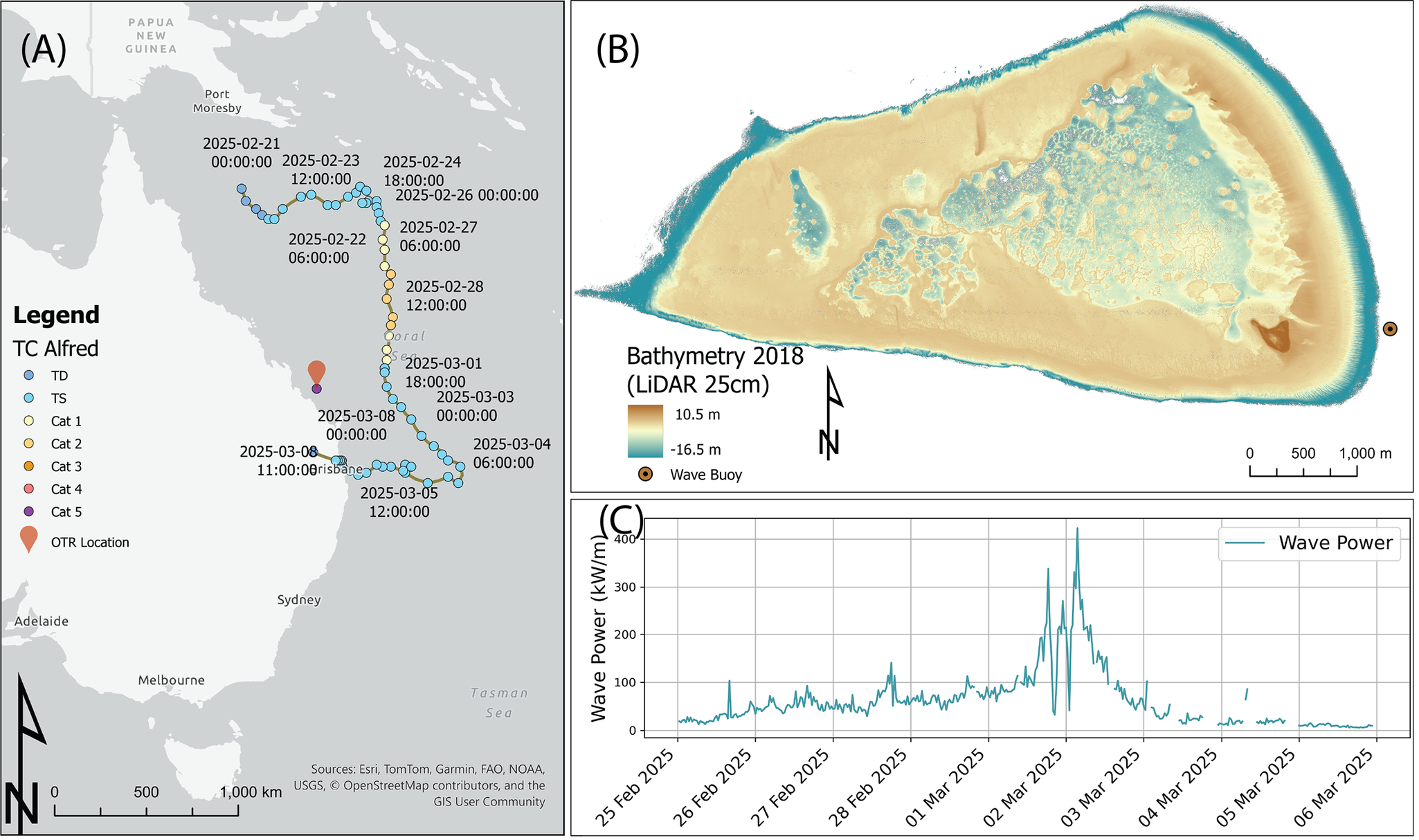
Figure 1. (A) Location of One Tree Island on the southern Great Barrier Reef off the coast of NE Australia and track and Saffir-Simpson category for Tropical Cyclone Alfred in March 2025, note in the legend, TD= Tropical Depression and TS= Tropical Storm (Source IBTrACS (Knapp et al. Reference Knapp, Kruk, Levinson, Diamond and Neumann2010)); (B) LiDAR Digital Elevation Model (Vertical datum is mean sea level, MSL) with 25 cm resolution of One Tree Reef (OTR) measured in 2018 (Harris et al. Reference Harris, Webster, Vila-Concejo, Duce, Leon and Hacker2023) showing the location of the Spotter wave buoy; (C) Wave power from the southern One Tree Island Research Station (OTIRS) wave buoy on the east flank of One Tree Reef (see B for location) during TC Alfred.

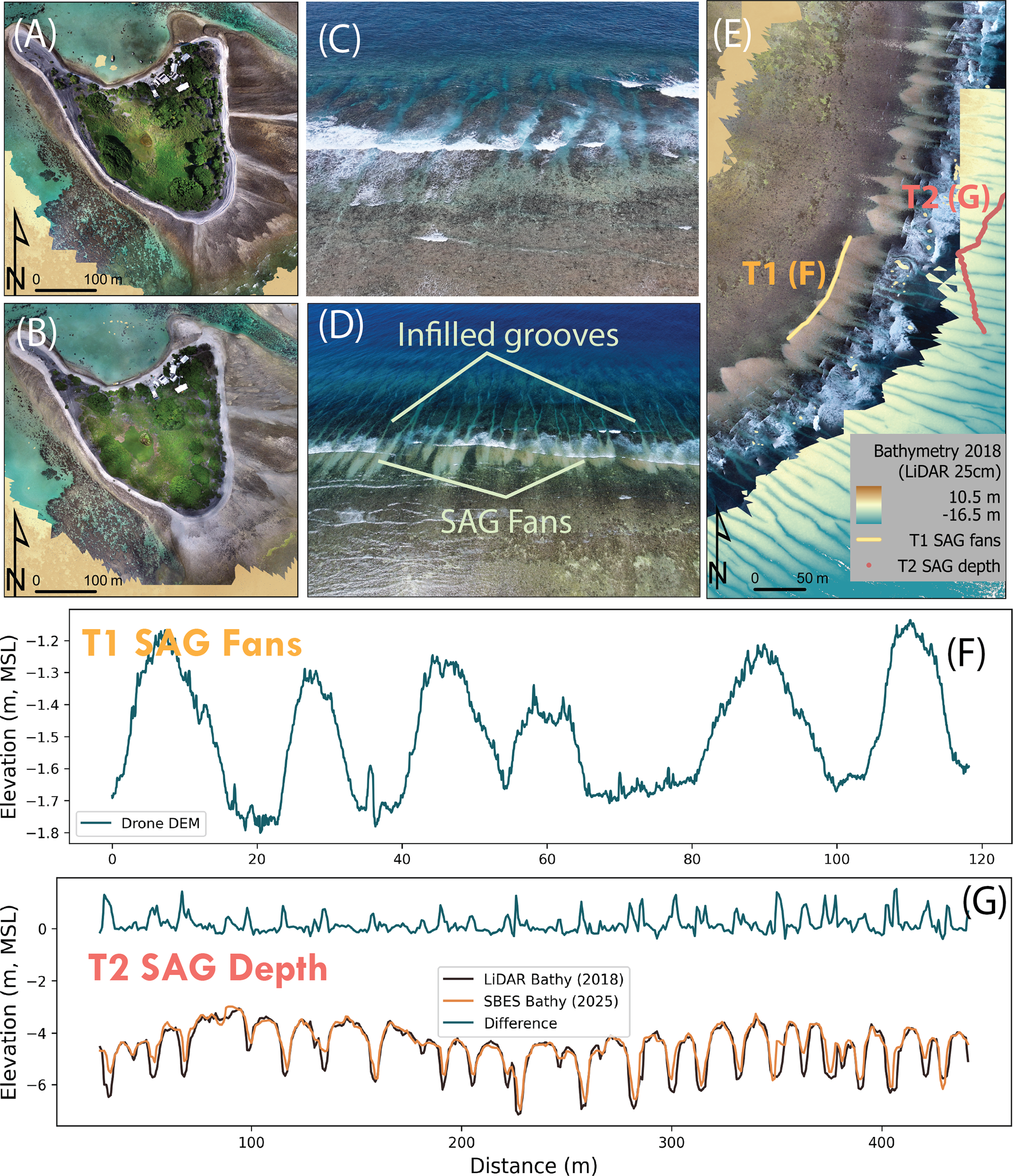
Figure 2. Orthomosaics of One Tree Island with adjacent rubble reef flat in November 2022 (A) and post TC Alfred in March 2025 (B); the grooves off the SE of One Tree Reef are clear of sediment in November 2024 (photo by Lachlan Perris, C) and infilled with coral rubble fans spilling sediment as SAG Fans onto the reef flat post TC Alfred in March 2025 (photo by One Tree Island Research Station, OTIRS, D); Orthomosaic of the SAG at One Tree Reef post TC Alfred (March 2025), showing the sediment fans delivered through the groove channels, and the locations of T1 and T2, the SAG bathymetry corresponds to data obtained with LiDAR in 2018(E); T1 shows a cross-section of the edges of the rubble fans extracted from the drone data (F); and, T2 demonstrates infilling of the grooves by comparing a LiDAR bathymetry from 2018 with a single beam bathymetry (T2) measured in 2025 post TC Alfred (G).

In February–March 2024, OTR underwent the worst bleaching in its history, causing up to 53% coral mortality (Byrne et al., Reference Byrne, Waller, Clements, Kelly, Kingsford, Liu, Reymond, Vila-Concejo, Webb, Whitton and Foo2025), more acute in areas of low hydrodynamic energy (Meoded-Stern et al., Reference Meoded-Stern, Silva, Foo, Waller, Byrne and Vila-Concejo2025). This event generated large amounts of coral rubble resulting from the dead coral collapse. One year after the bleaching, on 1 March 2025, Tropical Cyclone (TC) Alfred passed 340 km east of One Tree Island (Figure 1A). It was a slow-moving Category 1–2 cyclone (Saffir-Simpson Scale) that downgraded to Tropical Storm later that day, still sustaining strong winds. Our wave Spotter Buoy located on the SE off the reef (Figure 1B) recorded Significant Wave Heights (H s) up to 7 m with associated Peak Periods (T p) of 12 s. This led to wave power exceeding 250 kW/m sustained over nearly 12 h (Figure 1C). Fortunately, for One Tree Island Research Station, the largest waves occurred during the astronomical low tides.

As expected, TC Alfred delivered large volumes of rubble to the reef flat, modifying the overall morphology of the island (Figure 2A,B; see white rubble in 2B over the reef flat and on the northern tip). The mechanisms acting during these event-driven stochastic occurrences are not well established/studied, and scientists have debated for years whether SAGs could act as channels to deliver sediments to the reef flat under high-energy conditions. In March 2025, immediately after the passage of TC Alfred, we captured a photo showing grooves that are normally relatively empty of sediment (Figure 2C) were completely infilled with sediment and had newly formed sedimentary fans of rubble extending out from each groove on the eastern margin of OTR (Figure 2D). This is the first evidence showing the grooves acting as channels for rubble delivery onto the reef flat from decades of SAG research worldwide. Measurements from drone surveys post-Alfred show the distinct one-to-one spatial alignment between the rubble fans and the grooves, with each groove producing a single fan (Figure 2E). Bathymetric measurements show over 1 m of rubble infilling on the previously mostly bare grooves (Figure 2F).

Our observations and measurements establish, for the first time, grooves as channels transporting coral rubble onto the reef flat during high-energy conditions. This contrasts with the commonly accepted paradigm that rubble on the reef flats is transported from the spurs during high-energy conditions, and that rubble in the grooves remains trapped there or, under the right conditions, moves down the groove (Kan et al., Reference Kan, Hori, Kawana, Kaigara and Ichikawa1997; Hubbard and Dullo, Reference Hubbard, Dullo, Hubbard, Rogers, Lipps and Stanley2016; Duce et al., Reference Duce, Dechnik, Webster, Hua, Sadler, Webb, Nothdurft, Salas-Saavedra and Vila-Concejo2020; Sartori et al., Reference Sartori, Boles, Monismith, Mumby, Dunbar, Khrizman, Tatebe and Capozzi2025). The observed groove onshore transport occurred during extreme high-energy conditions, with TC Alfred being in the top 99th percentile of TC-generated waves for the study area. The threshold at which this onshore transport initiates is likely location dependent and deserves further investigation, as onshore rubble transport is crucial for the persistence of rubble islands, and TCs are expected to become more intense and less frequent in the Southern Hemisphere (Knutson et al., Reference Knutson, Camargo, Chan, Emanuel, Ho, Kossin, Mohapatra, Satoh, Sugi, Walsh and Wu2020). Finally, our observations highlight that the function of SAGs is not limited to the dissipation of wave energy but enables onshore rubble transport and contributes to coral environment dynamics essential for reef ecosystem health. While we have shown that rubble delivery plays an important role in the island stability of shingle islands, it has also been shown to influence sandy islands such as the Maldives (Gea-Neuhaus et al., Reference Gea-Neuhaus, Scott, Masselink, Lindhart, Vila-Concejo and Kench2025). Reef building is more than coral growth; it is a complex interplay of carbonate production, destruction and transport, as well as the reincorporation of sediment into the reef framework (Hubbard and Dullo, Reference Hubbard, Dullo, Hubbard, Rogers, Lipps and Stanley2016). In the face of a changing climate, there is an urgent need to understand natural coral reef systems (Streit et al., Reference Streit, Morrison and Bellwood2024). Understanding rubble dynamics must precede rubble restoration as a management tool in natural systems.

Open peer review

To view the open peer review materials for this article, please visit http://doi.org/10.1017/cft.2025.10019.

Data availability statement

The data will be made available once processed and published in its entirety. In the meantime, colleagues can address data requests to the corresponding author.

Acknowledgements

The authors would like to acknowledge the First Nation peoples on whose land the One Tree Island Research Station stands, the Bailai, Gurang, Gooreng and Taribelang Bunda (FNBGGGTB) People. The authors would also like to acknowledge the Gadigal People from the Eora Nation, where the University of Sydney stands. This research has been partially funded by the Australian Research Council (ARC) Discovery Project DP220101125 and the Marine Resource Initiative (MRI) project with Geoscience Australia and the Australian Department of Foreign Affairs and Trade. Wave data from the spotter buoy was processed by the Coastal and Marine Science team, Department of Climate Change, Energy, the Environment and Water (DCCEEW), NSW Government, Australia. This work represents a contribution to the ARISE project (UKRI grant EP/X029506/1). We thank Jody Webster and the MARS5007 2025 cohort for supporting some of the measurements. Claudia Le Quesne and Lara Talavera contributed to the data processing for the November 2022 dataset.

Author contribution

AV-C led the research, processed data and wrote the manuscript. LAP, KW, W-YS-L, RH and HB obtained and processed field data. BDM processed the Spotter Buoy wave data. APdS, LM-S, MB, TEF, TS and EB contributed to data analysis. All authors contributed to writing and editing the manuscript.

Financial support

This research has been partially funded by the Australian Research Council (ARC) Discovery Project DP220101125 and the Marine Resource Initiative (MRI) project with Geoscience Australia and the Australian Department of Foreign Affairs and Trade. LAP was supported by an RTP scholarship. KW and APdS were supported by DP220101125.

Competing interests

The authors declare none.
References

Acevedo-Ramirez, CA, Stephenson, W, Wakes, S and Mariño-Tapia, I (2021) Wave transformation on a fringing reef system with spur and groove structures. Journal of Geophysical Research: Oceans. https://doi.org/10.1029/2020jc016910.Google Scholar
Blanchon, P, Jones, B and Kalbfleisch, W (1997) Anatomy of a fringing reef around grand Cayman; storm rubble, not coral framework. Journal of Sedimentary Research 67(1), 116. https://doi.org/10.1306/D42684D7-2B26-11D7-8648000102C1865D.Google Scholar
Byrne, M, Waller, A, Clements, M, Kelly, AS, Kingsford, MJ, Liu, B, Reymond, CE, Vila-Concejo, A, Webb, M, Whitton, K and Foo, SA (2025) Catastrophic bleaching in protected reefs of the Southern Great Barrier Reef. Limnology and Oceanography Letters. https://doi.org/10.1002/lol2.10456.Google Scholar
Ceccarelli, DM, McLeod, IM, Boström-Einarsson, L, Bryan, SE, Chartrand, KM, Emslie, MJ, Gibbs, MT, Rivero, MG, Hein, MY, Heyward, A, Kenyon, TM, Lewis, BM, Mattocks, N, Newlands, M, Schläppy, M-L, Suggett, DJ and Bay, LK (2020) Substrate stabilisation and small structures in coral restoration: State of knowledge, and considerations for management and implementation. PLoS One 15(10), e0240846. https://doi.org/10.1371/journal.pone.0240846.Google Scholar
da Silva, RF, Storlazzi, CD, Rogers, JS, Reyns, J and McCall, R (2020) Modelling three-dimensional flow over spur-and-groove morphology. Coral Reefs 39(6), 18411858. https://doi.org/10.1007/s00338-020-02011-8.Google Scholar
de Bakker, DM, Perry, CT and Webb, AE (2025) Quantifying coral reef accretion in a changing world: Approaches, challenges and emerging opportunities. Cambridge Prisms: Coastal Futures 3, e15. https://doi.org/10.1017/cft.2025.10005.Google Scholar
Duce, S, Dechnik, B, Webster, JM, Hua, Q, Sadler, J, Webb, GE, Nothdurft, L, Salas-Saavedra, M and Vila-Concejo, A (2020) Mechanisms of spur and groove development and implications for reef platform evolution. Quaternary Science Reviews 231, 106155. https://doi.org/10.1016/j.quascirev.2019.106155.Google Scholar
Duce, S, Vila-Concejo, A, Hamylton, SM, Webster, JM, Bruce, E and Beaman, RJ (2016) A morphometric assessment and classification of coral reef spur and groove morphology. Geomorphology 265, 6883. https://doi.org/10.1016/j.geomorph.2016.04.018.Google Scholar
Duce, S, Vila-Concejo, A, McCarroll, RJ, Yiu, B, Perris, LA and Webster, JM (2022) Field measurements show rough fore reefs with spurs and grooves can dissipate more wave energy than the reef crest. Geomorphology 413, 108365. https://doi.org/10.1016/j.geomorph.2022.108365.Google Scholar
Gea-Neuhaus, A, Scott, T, Masselink, G, Lindhart, M, Vila-Concejo, A and Kench, P (2025) Coral rubble mobility on an intertidal reef flat Huvadhoo atoll, Maldives. In Proceedings of Coastal Dynamics. Aveiro, Portugal: Springer-Nature.Google Scholar
Gischler, E (2010) Indo-Pacific and Atlantic spurs and grooves revisited: The possible effects of different Holocene Sea-level history, exposure, and reef accretion rate in the shallow fore reef. Facies 56(2), 173177. https://doi.org/10.1007/s10347-010-0218-0.Google Scholar
Harris, DL, Webster, JM, Vila-Concejo, A, Duce, S, Leon, JX and Hacker, J (2023) Defining multi-scale surface roughness of a coral reef using a high-resolution LiDAR digital elevation model. Geomorphology 439, 108852. https://doi.org/10.1016/j.geomorph.2023.108852.Google Scholar
Heyward, A, Giuliano, C, Page, CA and Randall, CJ (2024) Rock and roll: Experiments on substrate movement and coral settlement. Coral Reefs 43(5), 14171429. https://doi.org/10.1007/s00338-024-02547-z.Google Scholar
Hubbard, DK and Dullo, W-C (2016) The changing face of reef building. In Hubbard, KD, Rogers, SC, Lipps, HJ and Stanley, JDG (eds.), Coral Reefs at the Crossroads. Dordrecht: Springer Netherlands, pp. 127153. https://doi.org/10.1007/978-94-017-7567-0_6.Google Scholar
Kan, H (1995) Typhoon effects on sediment movement on reef edges and reef slopes. In Bellwood, O (ed.), Recent Advances in Marine Science and Technology ‘94. Townsville: Pacon International and James Cook University, pp. 191201.Google Scholar
Kan, H, Hori, N, Kawana, T, Kaigara, T and Ichikawa, K (1997) The evolution of a Holocene fringing reef and island: Reefal environmental sequence and sea level change in Tonaki Island, the Central Ryukyus. Atoll Research Bulletin 443, 1. https://doi.org/10.5479/SI.00775630.443.1.Google Scholar
Knapp, KR, Kruk, MC, Levinson, DH, Diamond, HJ and Neumann, CJ (2010) The international best track archive for climate stewardship (IBTrACS): Unifying tropical cyclone best track data. Bulletin of the American Meteorological Society 91, 363376. https://doi.org/10.1175/2009bams2755.1.Google Scholar
Knutson, T, Camargo, SJ, Chan, JCL, Emanuel, K, Ho, CH, Kossin, J, Mohapatra, M, Satoh, M, Sugi, M, Walsh, K and Wu, L (2020) Tropical cyclones and climate change assessment part II: Projected response to anthropogenic warming. Bulletin of the American Meteorological Society 101(3), E303E322. https://doi.org/10.1175/BAMS-D-18-0194.1.Google Scholar
Masselink, G, Beetham, E and Kench, P (2020) Coral reef islands can accrete vertically in response to sea level rise. Science Advances 6(24), eaay3656. https://doi.org/10.1126/sciadv.aay3656.Google Scholar
Meoded-Stern, L, Silva, AP, Foo, SA, Waller, A, Byrne, M and Vila-Concejo, A (2025) Reef geomorphology, hydrodynamic energy and coral morphology influence recovery after bleaching. Marine Environmental Research 212, 107554. https://doi.org/10.1016/j.marenvres.2025.107554.Google Scholar
Monismith, SG, Herdman, LMM, Ahmerkamp, S and Hench, JL (2013) Wave transformation and wave-driven flow across a steep coral reef. Journal of Physical Oceanography 43(7), 13561379. https://doi.org/10.1175/JPO-D-12-0164.1.Google Scholar
Munk, WH and Sargent, MC (1948) Adjustment of bikini atoll to ocean waves. Eos, Transactions American Geophysical Union 29(6), 855860. https://doi.org/10.1029/TR029I006P00855.Google Scholar
Perris, LA, Lindhart, M, Salles, T, da Silva, AP, Fellowes, TE and Vila-Concejo, A (2025) Hydrodynamic controls on spur and groove morphology flow variability and reef structure. Geomorphology in review.Google Scholar
Perris, L, Salles, T, Fellowes, TE, Duce, SJ, Webster, JM and Vila-Concejo, A (2024) The influence of coral reef spur and groove morphology on wave energy dissipation in contrasting reef environments. Journal of Geophysical Research-Earth Surface 129(8), e2023JF007424. https://doi.org/10.1029/2023JF007424.Google Scholar
Rasser, M and Riegl, B (2002) Holocene coral reef rubble and its binding agents. Coral Reefs 21(1), 5772. https://doi.org/10.1007/s00338-001-0206-5.Google Scholar
Rogers, JS, Monismith, SG, Dunbar, RB and Koweek, D (2015) Field observations of wave-driven circulation over spur and groove formations on a coral reef. Journal of Geophysical Research: Oceans 120(1), 145160. https://doi.org/10.1002/2014JC010464.Google Scholar
Rogers, JS, Monismith, SG, Feddersen, F and Storlazzi, CD (2013) Hydrodynamics of spur and groove formations on a coral reef. Journal of Geophysical Research: Oceans 118(6), 30593073. https://doi.org/10.1002/jgrc.20225.Google Scholar
Sartori, G, Boles, EL, Monismith, SG, Mumby, PJ, Dunbar, RB, Khrizman, A, Tatebe, L and Capozzi, R (2025) Morphologically driven sedimentation patterns on a coral reef. Coral Reefs 44(2), 591607. https://doi.org/10.1007/s00338-025-02629-6.Google Scholar
Shannon, AM, Power, HE, Webster, JM and Vila-Concejo, A (2013) Evolution of coral rubble deposits on a reef platform as detected by remote sensing. Remote Sensing 5(1), 118. https://doi.org/10.3390/rs5010001.Google Scholar
Storlazzi, CD, Ogston, AS, Bothner, MH, Field, ME and Presto, MK (2004) Wave- and tidally-driven flow and sediment flux across a fringing coral reef: Southern Molokai, Hawaii. Continental Shelf Research 24(12), 13971419. https://doi.org/10.1016/j.csr.2004.02.010.Google Scholar
Streit, RP, Morrison, TH and Bellwood, DR (2024) Coral reefs deserve evidence-based management not heroic interference. Nature Climate Change 14(8), 773775. https://doi.org/10.1038/s41558-024-02063-6.Google Scholar
Talavera, L, Vila-Concejo, A, Webster, JM, Smith, C, Duce, S, Fellowes, TE, Salles, T, Harris, D, Hill, J, Figueira, W and Hacker, J (2021) Morphodynamic controls for growth and evolution of a rubble coral island. Remote Sensing 13(8). https://doi.org/10.3390/rs13081582.Google Scholar
Thornborough, KJ and Davies, PJ (2011) Reef flats. In Hopley, D (ed.), Encyclopedia of Modern Coral Reefs. Netherlands: Springer, pp. 869876.Google Scholar
Tuck, ME, Kench, PS, Ford, MR and Masselink, G (2019) Physical modelling of the response of reef islands to sea-level rise. Geology 47(9), 803806. https://doi.org/10.1130/G46362.1.Google Scholar
Watanabe, M, Kan, H, Toguchi, K, Nakashima, Y, Roeber, V and Arikawa, T (2023) Effect of the structural complexity of a coral reef on wave propagation: A case study from Komaka Island, Japan. Ocean Engineering 287, 115632. https://doi.org/10.1016/j.oceaneng.2023.115632.Google Scholar
Figure 0

Figure 1. (A) Location of One Tree Island on the southern Great Barrier Reef off the coast of NE Australia and track and Saffir-Simpson category for Tropical Cyclone Alfred in March 2025, note in the legend, TD= Tropical Depression and TS= Tropical Storm (Source IBTrACS (Knapp et al. 2010)); (B) LiDAR Digital Elevation Model (Vertical datum is mean sea level, MSL) with 25 cm resolution of One Tree Reef (OTR) measured in 2018 (Harris et al. 2023) showing the location of the Spotter wave buoy; (C) Wave power from the southern One Tree Island Research Station (OTIRS) wave buoy on the east flank of One Tree Reef (see B for location) during TC Alfred.

Figure 1

Figure 2. Orthomosaics of One Tree Island with adjacent rubble reef flat in November 2022 (A) and post TC Alfred in March 2025 (B); the grooves off the SE of One Tree Reef are clear of sediment in November 2024 (photo by Lachlan Perris, C) and infilled with coral rubble fans spilling sediment as SAG Fans onto the reef flat post TC Alfred in March 2025 (photo by One Tree Island Research Station, OTIRS, D); Orthomosaic of the SAG at One Tree Reef post TC Alfred (March 2025), showing the sediment fans delivered through the groove channels, and the locations of T1 and T2, the SAG bathymetry corresponds to data obtained with LiDAR in 2018(E); T1 shows a cross-section of the edges of the rubble fans extracted from the drone data (F); and, T2 demonstrates infilling of the grooves by comparing a LiDAR bathymetry from 2018 with a single beam bathymetry (T2) measured in 2025 post TC Alfred (G).

Author comment: Grooves in forereefs act as transport channels to deliver coral rubble during tropical cyclones — R0/PR1

Comments

Dear Professor Tom Spencer,

I am pleased to submit our manuscript, titled “Grooves in forereefs act as transport channels to deliver coral rubble during tropical cyclones”, for consideration as a Rapid Communication in Coastal Futures.

This study documents a rare and consequential sediment transport event following a sequence of climate-related disturbances on the Great Barrier Reef. In the early months (Austral summer) of 2024, the reef experienced the 9th global bleaching event, with catastrophic impacts at One Tree Reef, a site of longstanding significance in Geoscience. One year later, in March 2025, Tropical Cyclone Alfred remobilised the resulting rubble and transported it onto the reef flat.

While grooves (the channels of Spur and Groove systems) have long been suspected to play a role in sediment dynamics, the prevailing view has been that it is “impossible” for rubble to move upslope through them to the reef flat. Our manuscript shows the first evidence that large volumes of coral rubble are delivered to the reef flat through these grooves. We present qualitative and quantitative drone surveys and field measurements of topography and bathymetry to document this process.

These findings challenge long-standing assumptions about sediment delivery mechanisms on coral reefs. They carry immediate implications for coral island sediment budgets, interpretations of past reef-building processes, and forecasts of reef and island evolution under climate change. These insights are specially timely given their relevance to increasingly used restoration strategies (e.g., rubble stabilization) and to global sustainability efforts, particularly United Nations Sustainable Development Goals related to Small Island Developing States (SIDS) such as SDG13 (Climate action), SDG14 (Life below water), and SDG 11 (Sustainable cities and communities). These insights are especially timely given the relevance to millions of people globally whose livelihoods and sovereign marine resources are inextricably linked to coral island stability.

This Rapid Communication is well suited to Coastal Futures and will be of broad interest, to researchers studying climate impacts, island dynamics, and Earth system evolution. We did not submit to the special collection on Extreme Events at the Coast because the deadline was two months ago and in their advertisement, they did not mention Rapid Communication as one of the accepted article types. We would be happy to contribute to that collection if the editorial team think it is appropriate, and we are still on time.

Thank you for considering our submission. We believe it will make a timely and significant contribution to the journal’s readership.

Review: Grooves in forereefs act as transport channels to deliver coral rubble during tropical cyclones — R0/PR2

Conflict of interest statement

Reviewer declares none.

Comments

This is an extremely interesting and novel piece of work that should be published. It details for the first time field evidence of the role of spurs and grooves in delivering sediment to the reef flats during cyclones. This finding has implications for understanding the processes of sediment delivery to reef flats and ultimately eventually to islands. Some minor suggested amendments are provided below.

Suggest to reference Tuck et al. 2019 in reference to physical models – line 59. (Megan E. Tuck, Paul S. Kench, Murray R. Ford, Gerd Masselink; Physical modelling of the response of reef islands to sea-level rise. Geology 2019;; 47 (9): 803–806. doi: https://doi.org/10.1130/G46362.1)

Line 62 – suggest change ‘forereefs’ to ‘reefs’ or ‘forereefs and reef flats’ as it is not just the forereefs that produce sediment.

Line 63 – be specific about climate change disruptions – increased sea surface temps, and maybe increased intensity of tropical cyclones?

Line 86 – are these circulation cells located in grooves?

Line 95 – please indicate where this study was undertaken

Line 98 – do you mean Kan? Or the authors of this current manuscript – please clarify who these authors are

Line 111/112 – is the presence of large rubble clasts covering the bottom of the grooves? Does it build up in these grooves for example? Or is it a fine veneer?

Figure 1 – Very nice figure, but its not clear what TD and TS stand for (depression and storm?). Please include in the caption, and also add (OTR) to the caption after One Tree Reef (change from Island to match figure)

Line 126 – add month of bleaching

Line 161 – ‘reef building is more than coral growth’ – this needs further explanation. I think you need to explain the role that rubble plays in reef building as well

Figure 2 – Great pictures – but do you have an equivalent picture to D) that you could use for C) instead or as well? C shows the SAG clearly but does not show the landward section of reef so you cannot get an idea of how ‘new’ these rubble fans are (are they all rubble, or a mixture of sand too?) . The description of E) needs some additional information – this is a combo of LiDAR from 2018? Plus orthomosaic? Its not clear what data are from 2018 and what are from 2025?. In (G) suggest changing key to LiDAR bathy and drone bathy. It would be interesting to overlay the location of grooves upon E) to determine if the location of these fans are directly landward or slightly angled relative to the centre of the grooves (does one groove produce one fan, or multiple grooves?).

Review: Grooves in forereefs act as transport channels to deliver coral rubble during tropical cyclones — R0/PR3

Conflict of interest statement

Reviewer declares none.

Comments

This is an exceptionally valuable report on phenomena occurring at the reef edge of coral reefs during heavy swells, based on data and observations from the period around intense, infrequent tropical cyclones. Unlike sand cays, the seafloor where coral rubble accumulates and the islets composed of coral rubble are difficult to observe continuously as they change. Observations during major events like Tropical Cyclone Alfred provide a realistic and reliable opportunity to obtain evidence. The authors' initiative in successfully seizing this extremely valuable chance is commendable.

The text is concise yet contains important points and is commendable. However, Figure 2 contains many unclear points and should be improved.

Figure 2

1) Is it possible to describe where changes occurred by comparing (A) and (B)?

For example, the shape of the spite on the reef northeast of OTI has also changed (the elongated spite seaward has disappeared, and sedimentation is progressing near the island). The vegetated spite northwest has become narrower (has erosion progressed?).

2) Are (C) and (D) photographs from the same viewpoint? (C) appears to be a vertical photograph, while (D) seems to be an oblique photograph.

It is unclear what “the grooves off the SE of One Tree Reef” refers to; please indicate this with arrow(s) on the figure or add an explanatory note.

Please also add arrow(s) to photograph (D) for the description “infilled with coral rubble fans spilling sediment onto the reef flat”.

Regarding wave conditions at the reef edge during tropical cyclones, there is a paper by Watanabe et al. 2023.

https://doi.org/10.1016/j.oceaneng.2023.115632

Note that the filling of grooves with coral gravel is also evident from observations of cross-sections of cutting through coral reefs (Kan et al. 1995, 1997). These papers are for your information. They can be viewed at the following sites.

Kan, H., Hori, N., Nakashima,Y. and Ichikawa,K. (1995) The evolution of narrow reef flats at high-latitude in the Ryukyu Islands. Coral Reefs, Vol.14, p.123-130.

https://link.springer.com/article/10.1007/BF00367229

Kan,H., Hori,N., Kawana,T., Kaigara,T. and Ichikawa,K. (1997) The evolution of a Holocene fringing reef and island: reefal environmental sequence and sea level change in Tonaki Island, the central Ryukyus. Atoll Research Bulletin, No.443, p.1-20.

https://d1wqtxts1xzle7.cloudfront.net/84708123/Kan_et_al_1997_Atoll_Res_Bull_Smithsonian_-libre.pdf?1650678660=&response-content-disposition=inline%3B+filename%3DThe_evolution_of_a_Holocene_fringing_ree.pdf&Expires=1758677739&Signature=Uvej7851~vkFT59z~0CisQaRbadJd0~8n1IG7jTapPqo1udvy6G-eU0LuYXVGL0xnUMvypX6FUluUOCLAcYhLD7DFsCVw~DLdMKfG1PHKKKvUyNE-Oc7JcKifog2bpHUC04TwUWv0mBEfds3lXaBIUaWrNmjExCU0CkGof~UEjKqbZH4TVQXfQV~WHk94S0D~dfn90clRP9-M3-Gm4HAUXap8-XGRM-rnNV92VCStnEZQYfEj5fwgtik2NMtbu1cJ19iFCGjszHN-xHueRjrpGXdy5-2NndYParJJ~RsFTUyDLfUT6Kf5x9uJujJ-v8oavg7SBHp2AEr4QBBcmJ4zQ__&Key-Pair-Id=APKAJLOHF5GGSLRBV4ZA

Since I can’t seem to attach the file, I’ll provide the website instead.

Recommendation: Grooves in forereefs act as transport channels to deliver coral rubble during tropical cyclones — R0/PR4

Comments

The two reviewers provide very positive examinations of your manuscript. I agree that this work should be published with some minor / moderate revisions. These all seem relatively straightforward and think this team of authors will have no problem making the necessary revisions.

I do have some queries and confusion about the way this research is framed. It seems as though spur and groove outer reef morphologies are being described as an avenue for sediment transport for building reef islands. My understanding of reef islands comes from the GBR / Seychelles / Malaysia and for those sites, reef islands tend to build up on the leeward, rather than the windward, side of a reef platform. There are no SaGs on the leeward side of these platforms.

The study site of this paper, One Tree Island, is a shingle (rather than sand), island and a rather anomalous case for the Capricorn Bunker Group, and indeed the wider GBR as the island has formed on the windward side of the reef. To make a direct linkage between the SnG sediment stores and islands, and to claim that this work has significance for low lying island communities elsewhere seems a stretch.

The authors should either reframe, or explicitly name some reef islands (i.e. sand cays of the sort that may be populated in the Pacific, where islanders are seeing the impacts of sea-level rise) that have actually formed or been nourished through sediment transport adjacent to spur and grooves. There has been a tendency in recent years to identify sediment in any part of the reef system as an immediate saviour of reef islands. Most have no credible foundation.

Funafuti could be an example where windward islands have formed through coral rubble accumulation. The reef flats are narrow (<100m). While there is little doubt the coral rubble must have been derived from the forereef (which does have SnG), the mechanisms could be storm removal of coral and gravel along the entire forereef as opposed to SnG being the conveyor.

A broader question is why they make this link? The work is significant without leveraging off the discussion around island susceptibility to change, and is this necessary? Perhaps the article could be framed around the storage and potential flux of gravel to reef flats more generally?

Finally, in the acknowledgements section you acknowledge the first nations TOs for OTI, can you name and/ or list the groups?

Decision: Grooves in forereefs act as transport channels to deliver coral rubble during tropical cyclones — R0/PR5

Comments

No accompanying comment.

Author comment: Grooves in forereefs act as transport channels to deliver coral rubble during tropical cyclones — R1/PR6

Comments

Dear Professor Tom Spencer and A/Prof Sarah Hamylton,

Thank you very much for your considering our manuscript for publication, and apologies for our delay in resubmitting. I have just returned from three weeks in the field.

We have addressed all the comments and suggestions from the Handling Editor and the two anonymous reviewers and believe the paper has improved. We are submitting a version with tracked changes, a rebuttal table and a clean version of the paper.

Thank you for considering our submission. We believe it will make a timely and significant contribution to the journal’s readership.

Sincerely,

Professor Ana Vila-Concejo on behalf of all co-authors

Recommendation: Grooves in forereefs act as transport channels to deliver coral rubble during tropical cyclones — R1/PR7

Comments

This manuscript has been much improved by the revisions - I am happy to accept without it going out to a further review, subject to a few minor amendments, as outlined in the attached version.

Well done to this research team for this valuable paper!

Decision: Grooves in forereefs act as transport channels to deliver coral rubble during tropical cyclones — R1/PR8

Comments

No accompanying comment.

Author comment: Grooves in forereefs act as transport channels to deliver coral rubble during tropical cyclones — R2/PR9

Comments

Please find our new resubmission- we have addressed the Associate Editor’s comments and hope that the manuscript is now ready for publication. We thank the Associate Editor and the Editor in Chief and also the anonymous reviewers for helping us improve the manuscript.

Best wishes,

Ana

Recommendation: Grooves in forereefs act as transport channels to deliver coral rubble during tropical cyclones — R2/PR10

Comments

No accompanying comment.

Decision: Grooves in forereefs act as transport channels to deliver coral rubble during tropical cyclones — R2/PR11

Comments

No accompanying comment.